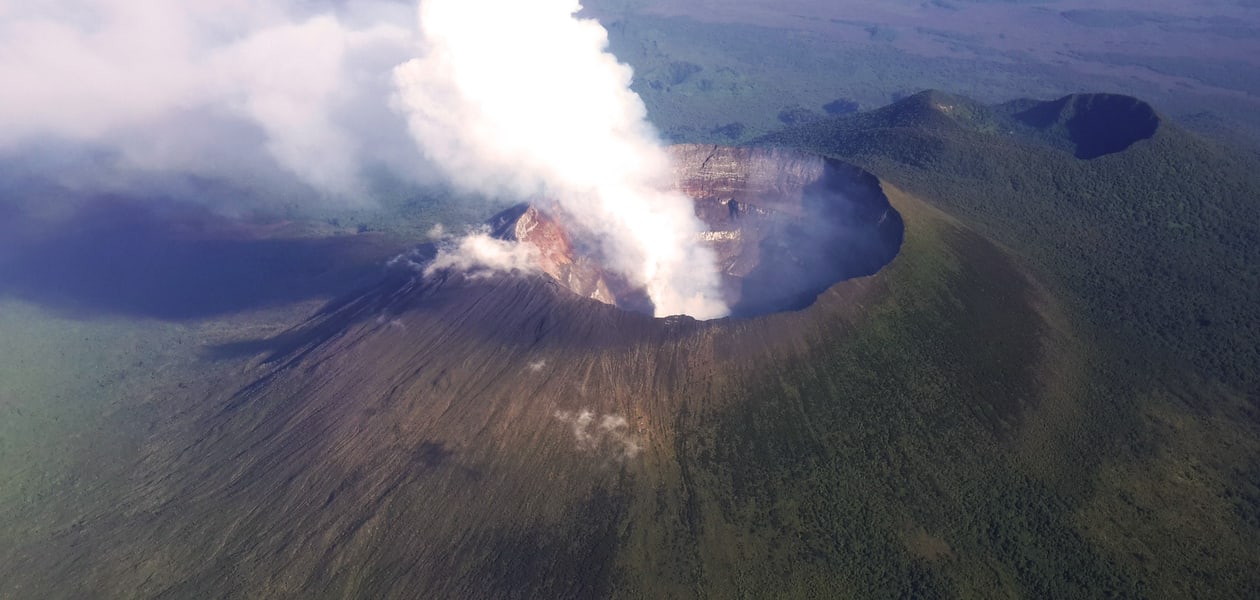
DR Congo
MONUSCO / Neil Wetmore / Wikimedia Commons · CC BY-SA 2.0 · cropped
The Democratic Republic of the Congo is the second-largest country in Africa by land area — 2,344,858 km² — and holds about 124 million people, which makes it the most populous French-speaking country in the world. Kinshasa is the capital, largest city and economic centre. The Republic of the Congo and the Angolan exclave of Cabinda lie to the west, the Central African Republic and South Sudan to the north, Uganda, Rwanda, Burundi and Tanzania to the east, and Zambia and Angola to the south. It is centred on the Congo Basin: dense rainforest crossed by an enormous river system, with mountains in the east and south-east.
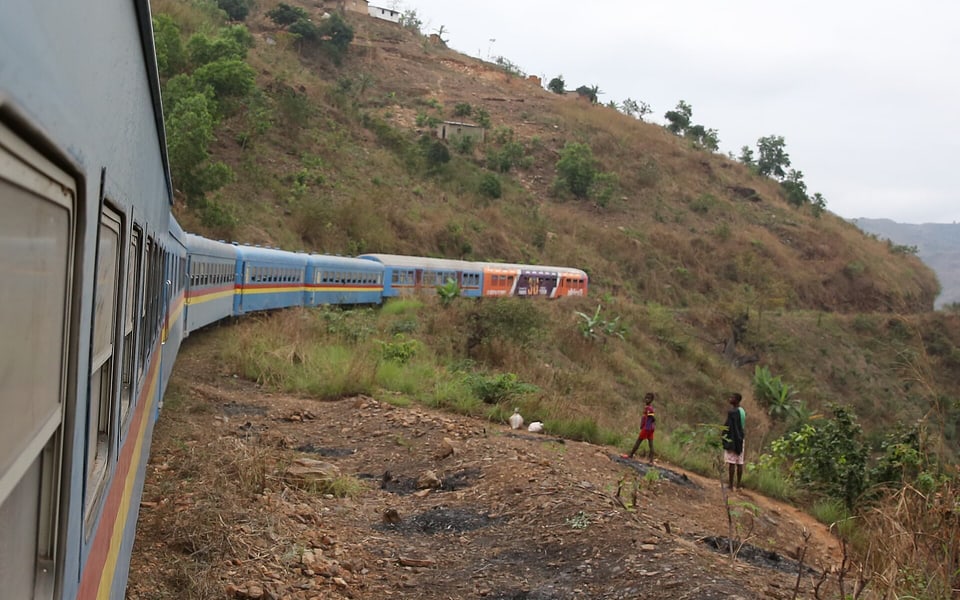
That river system explains the railways. The lines here were laid to get around the parts of the water that boats cannot use, so the network is a set of separate pieces connected by river rather than by track. The most important is the Matadi–Kinshasa Railway, 366 km of Cape gauge past the cataracts of the lower Congo, above which the river is navigable for thousands of kilometres. Three operators share the map — SNCC, SCTP and the Uele railways — and between them they use four different gauges.
Rail journeys in DR Congo
Good to know
What is a portage railway?
A railway built to carry traffic around a stretch of river that boats cannot pass. Below Kinshasa the Congo drops through the Livingstone Falls to the sea, so ocean ships cannot get up and river boats cannot get down. The Matadi–Kinshasa line exists to bridge that gap; upstream of Kinshasa, water transport reaches roughly two-thirds of the country.
Why do the railways not join up?
Because the river was the network and the railways were built to supplement it. Each system was laid between two navigable reaches — Kisangani to Ubundu, Kindu down to Kalemie on Lake Tanganyika, Matadi to Kinshasa — so a journey across the country has always meant alternating between train and boat. They are not even built to the same gauge: 1,067 mm, metre gauge and 600 mm all appear on the same map.
How many people speak French here?
Enough for the DRC to be the most populous French-speaking country in the world — more than France. French is the official language and the language of administration and the railways, while more than two hundred indigenous languages are spoken, of which Lingala is the most widespread.
Are there rail passes for the DRC?
No. There is no pass scheme, no multi-journey ticket and no unified network for one to cover. Tickets are bought for the individual train from whichever operator runs the line.