Matadi to Kinshasa
MONUSCO / Abel Kavanagh / Wikimedia Commons · CC BY-SA 2.0 · 2015 · cropped
- DistanceMatadi to Kinshasa · 366 km — the board on the Kinshasa platform says 365
- DurationEight and three-quarter to nine and a half hours, on the two runs publicly timed
- Best seasonThe dry middle of the year — every recent stoppage has followed heavy rain
Introduction
The passenger train is not running. ONATRA reopened the Matadi–Kinshasa line in October 2025 and doubled it to two rotations a week in March 2026, but the April rains broke the drainage again and the service has been suspended since. On 31 July 2026 the railway's director in Kongo Central said reopening still depends on two unfinished works, and gave no date. Only freight is moving, between Matadi, Minkelo and Lukala. Everything below describes the journey as it was last run and last priced.
Below Kinshasa the Congo stops being a river you can travel on. In its last 350 kilometres it falls 270 metres through the rapids named after Livingstone, and the second-largest flow in the world — around 42,000 cubic metres a second — goes down them in a way no boat has ever managed. Above that stretch the same river is navigable for thousands of kilometres into the middle of the continent. Below it, ocean ships come up as far as Matadi and stop. The whole Congo basin hangs on the gap between those two points, and since 1898 a railway has been the thing that closes it.
It is 366 kilometres of Cape gauge, and almost nothing about it came cheaply. The official toll for the eight years of construction between 1890 and 1898 was 1,932 dead, a figure carved into the memorial at the Kinshasa end and widely held to be an undercount; the rebuilding of 1923–31, which widened the gauge and eased the gradients, cost about seven thousand more. What the traveller gets for that is one of the more remarkable half-days on any railway: out of a port wedged into a rock gorge, up onto the Kongo plateau through palm country and brickfields, and down again to the capital on the bank of the river the line exists to avoid.
The Journey
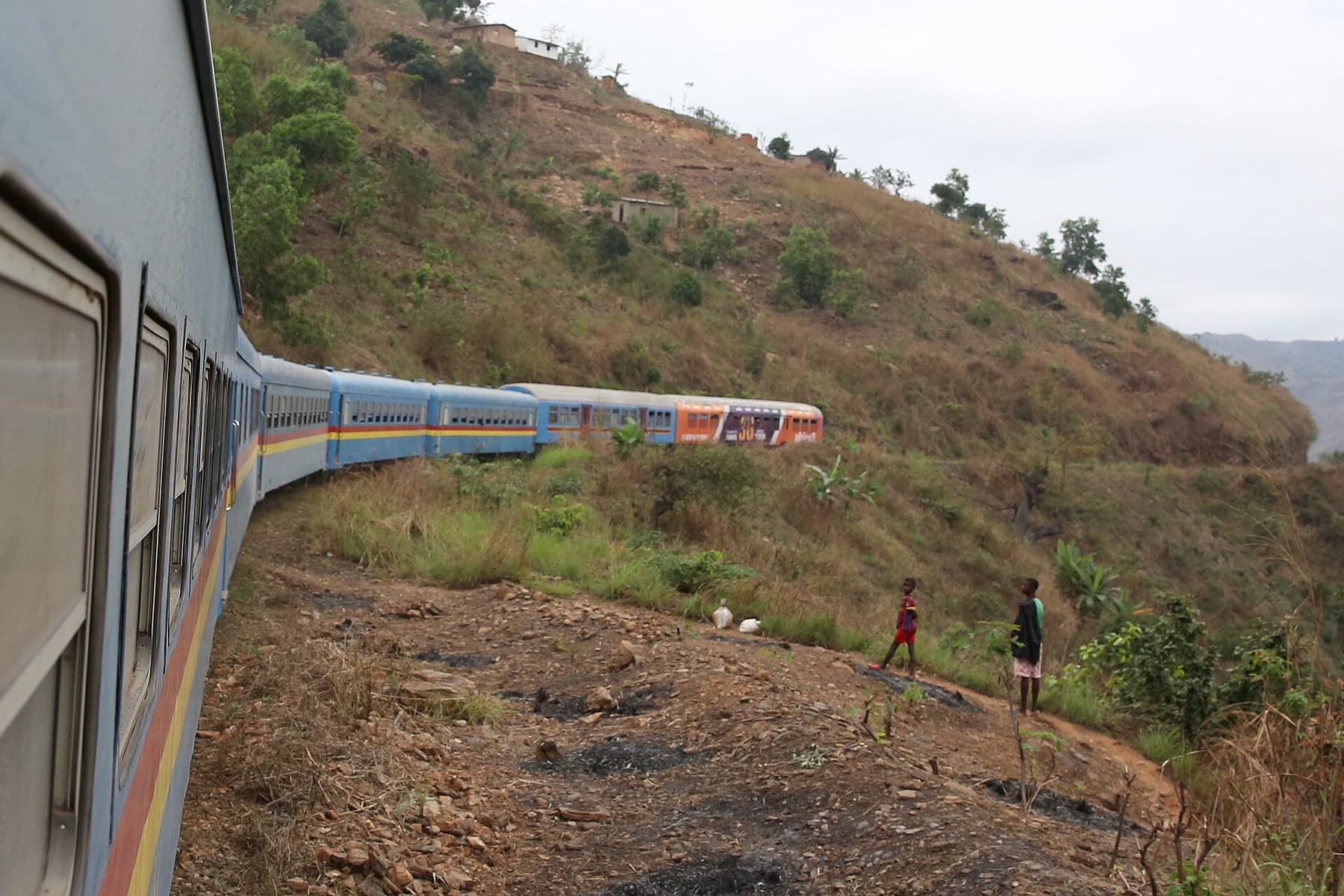
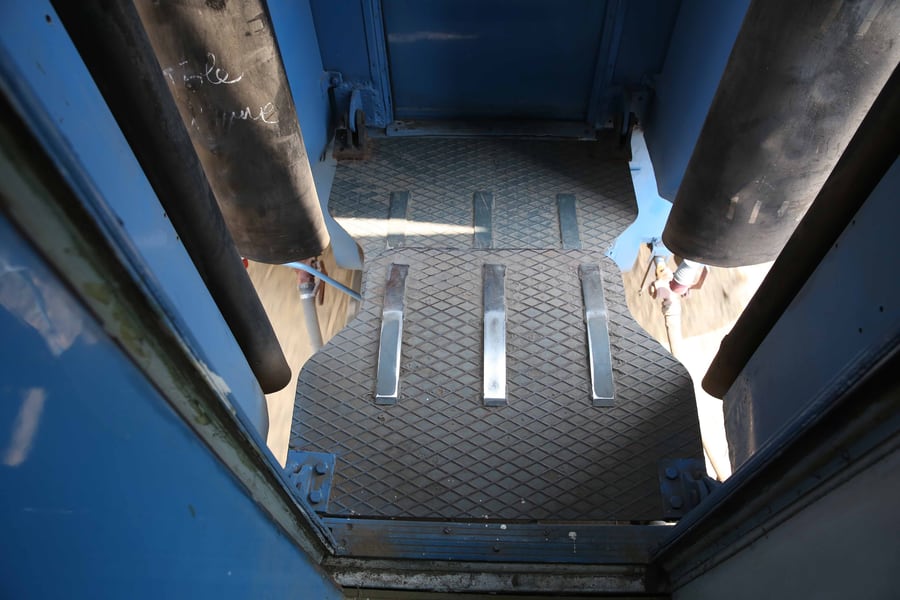
The train that ran in 2025 and 2026 was not Congolese and never had been. Seven cars of a KiHa 183 diesel multiple unit, built in Japan between 1979 and 1992 by Fuji Heavy Industries and Niigata Tekko, spent their working lives on limited expresses in Hokkaido, were withdrawn, and were exported to the Democratic Republic of the Congo in 2023. They entered service on the Matadi–Kinshasa line on 3 September 2025. They were designed for snow, and on a good day they are capable of 130 km/h — which this railway has never once asked of them.
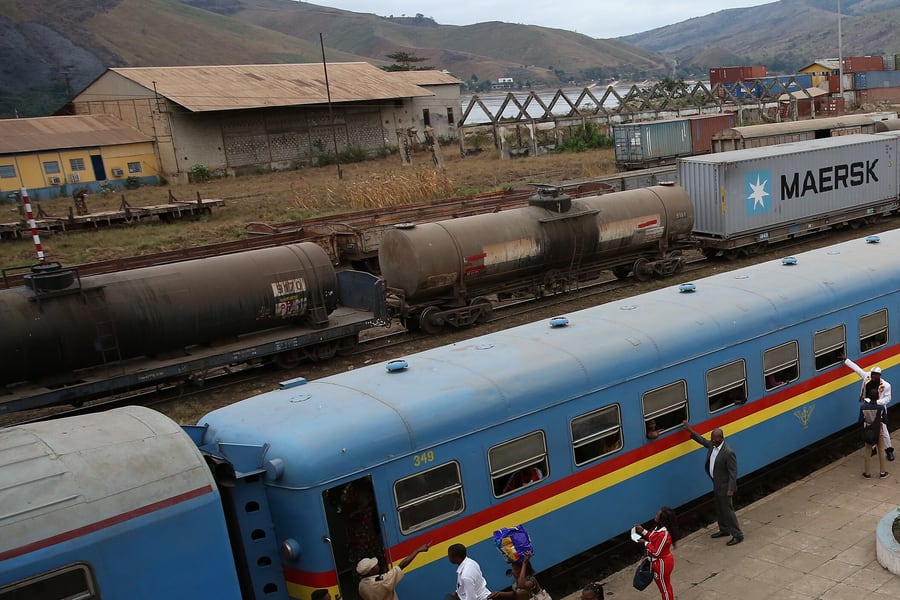
Departure from Matadi is at first light, from a station squeezed between the cliff and the quays. The port is the point of the whole exercise: everything that reaches the country by sea is unloaded here, at the last place an ocean ship can get to, and there is nowhere flat for it to go. The line leaves along the water, crosses the Mpozo and starts to climb almost at once. The original alignment took gradients of 45 per mille and curves of 50-metre radius; the rebuild of the 1920s brought those down to 17 and up to 250, at the cost of a new route through a strip of territory that Belgium and Portugal exchanged in 1928 for the purpose. Ninety-nine metal bridges and something like 1,250 steel aqueducts carry it up.
Onto the plateau
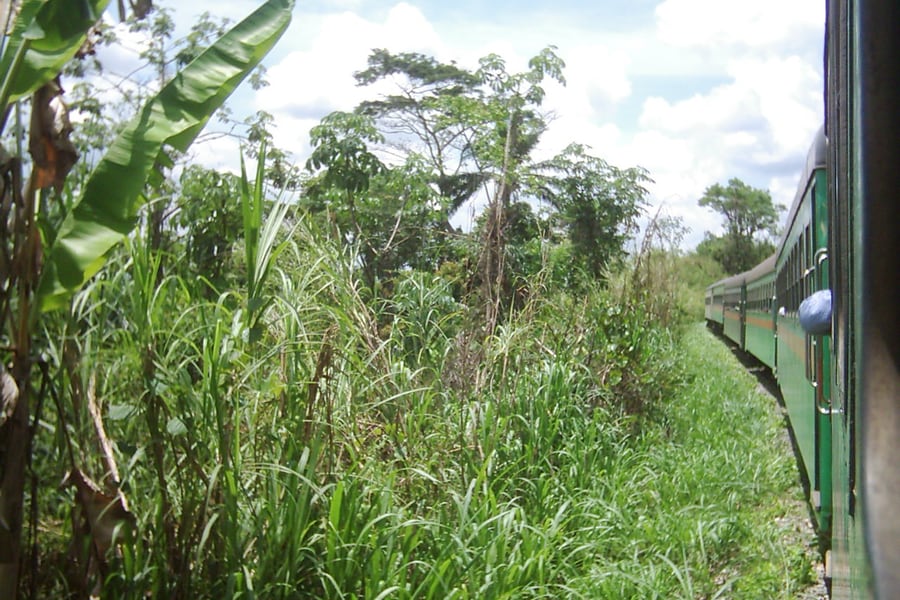
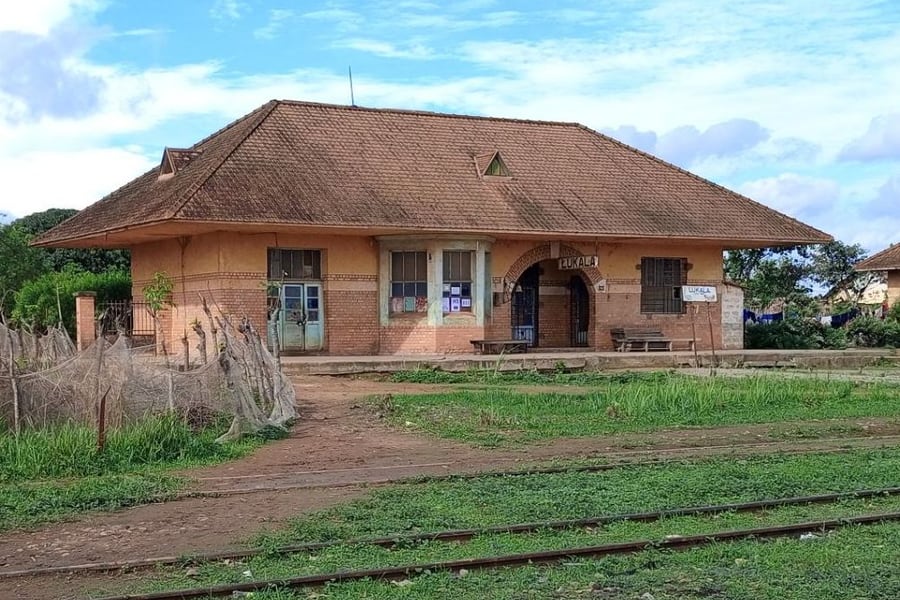
By Songololo and Kimpese the country has opened into the rolling grass and red laterite of Kongo Central, with oil palms in the valleys and stacks of hand-made brick drying at the roadside — the region's other industry, and unmistakable from the window. Lukala has the cement works that keep freight trains running even when the passenger service does not. A little off the main line here stands Mbanza-Ngungu, once Thysville, named for Colonel Albert Thys, who promoted the railway; its main industry is still railway engineering, and beneath it is a cave system whose blind, colourless barb lives nowhere else on earth.
Down to the Pool
From Kisantu, with its botanical garden of 225 hectares, the line begins the long descent to the river. Kasangulu is the last stop before the city; after Kimwenza the suburbs close in, and the train runs into Kinshasa-Centrale through a capital of markets and standing traffic. At the Kinshasa terminus the first locomotive to work the line stands on a plinth beside a white station board reading KINSHASA-EST · ALTITUDE 307 M · MATADI 365 KM. It is the plainest summary of the journey anyone has written: three hundred metres of climb and descent, and a river you cannot use for a metre of it.
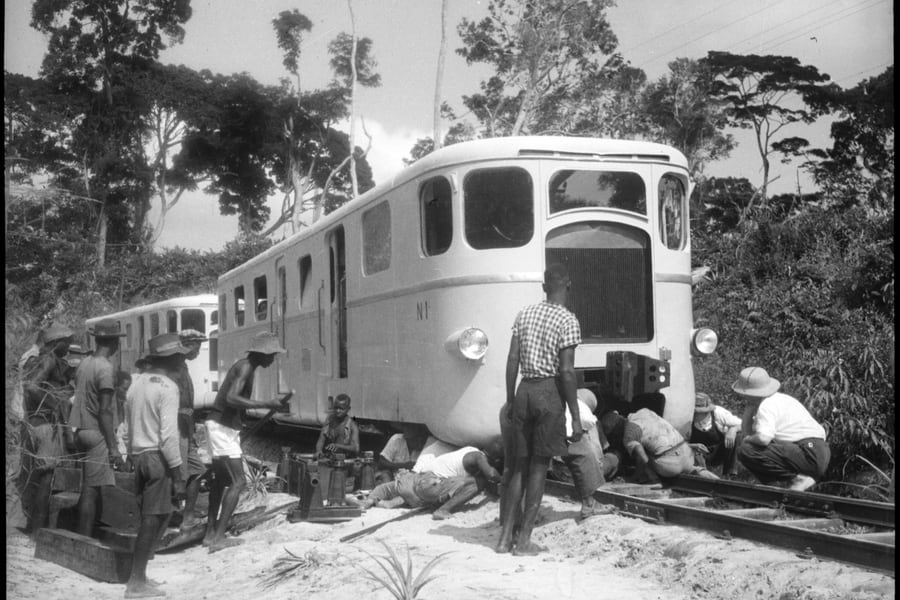
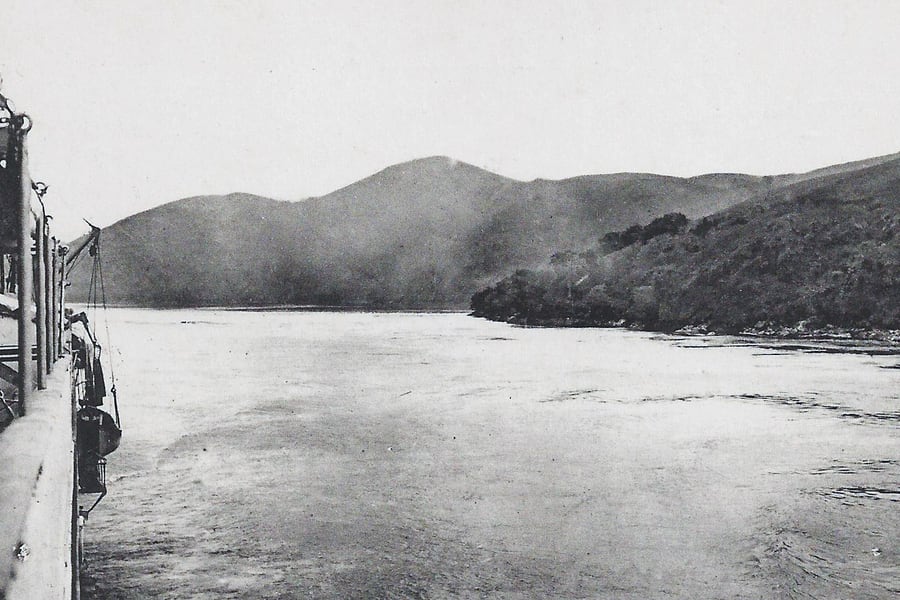
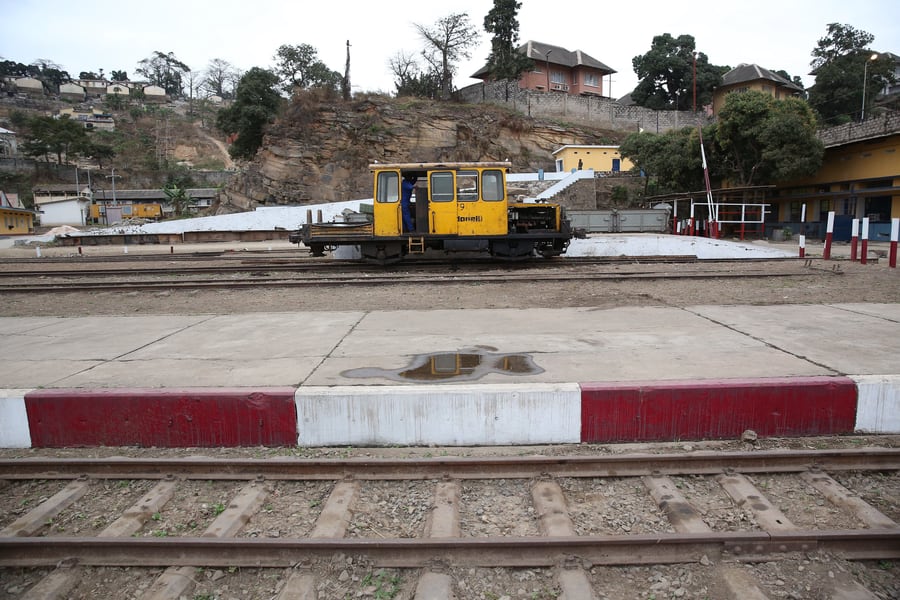
Along the route
 Adkulungu / Wikimedia Commons · CC BY-SA 4.0 · 2024 · cropped
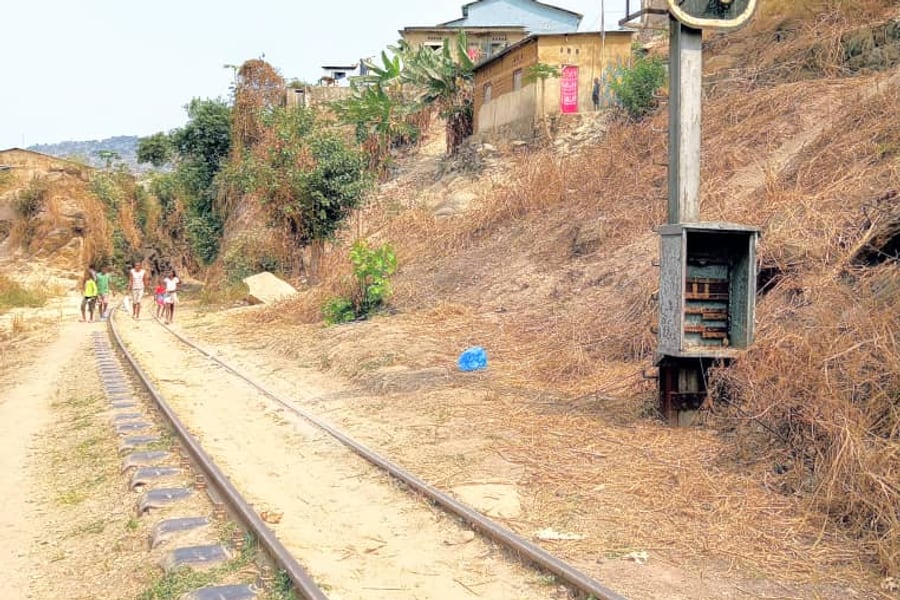
Out of Matadi, over the Mpozo
The line leaves the quays along the water and crosses the Mpozo within a few kilometres, then climbs hard. Original gradients were 45 per mille; the 1920s rebuild brought them down to 17.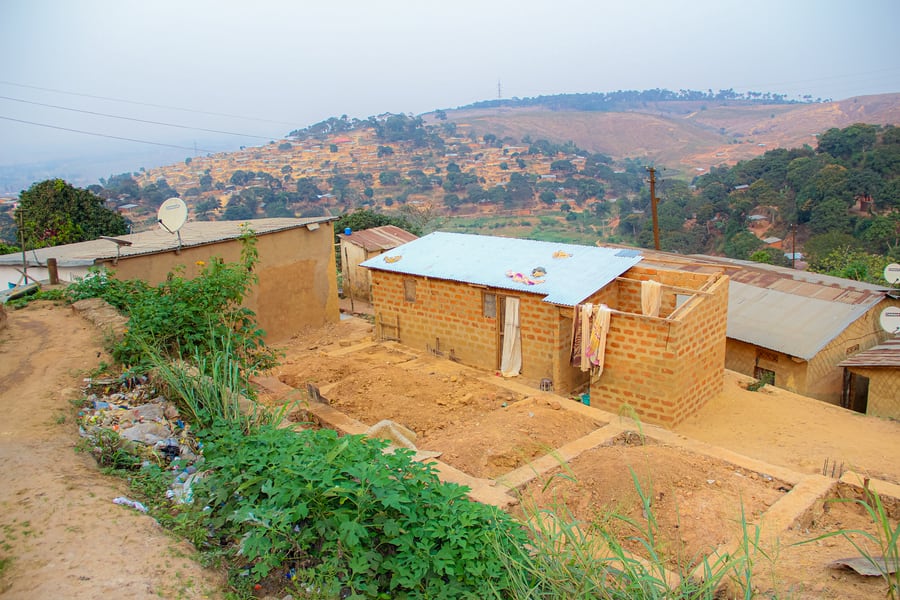 Leon Bilili / Wikimedia Commons · CC BY-SA 4.0 · 2017 · cropped
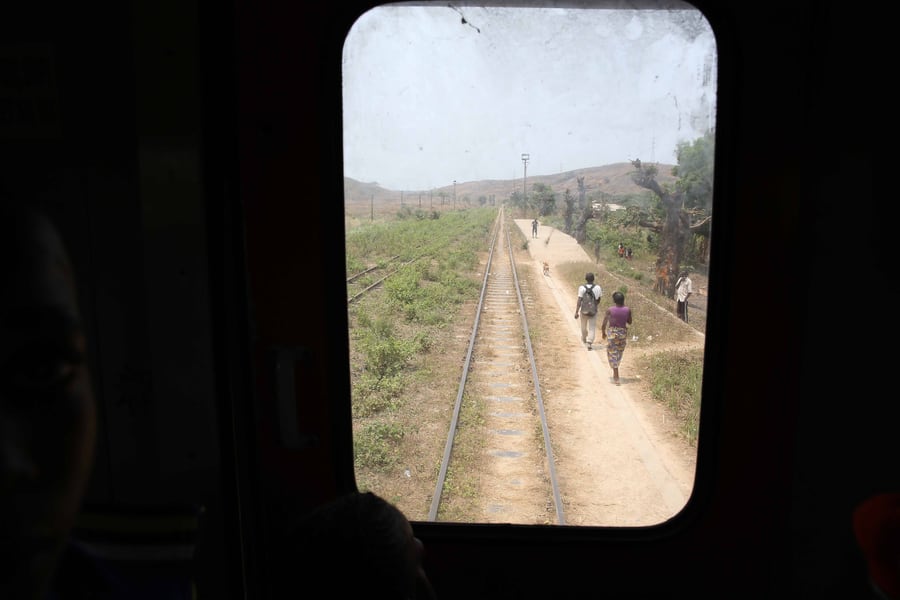
Brick and laterite
On the plateau around Kimpese the ground turns red and the stacks of hand-made brick drying beside the track become the most conspicuous thing in the landscape.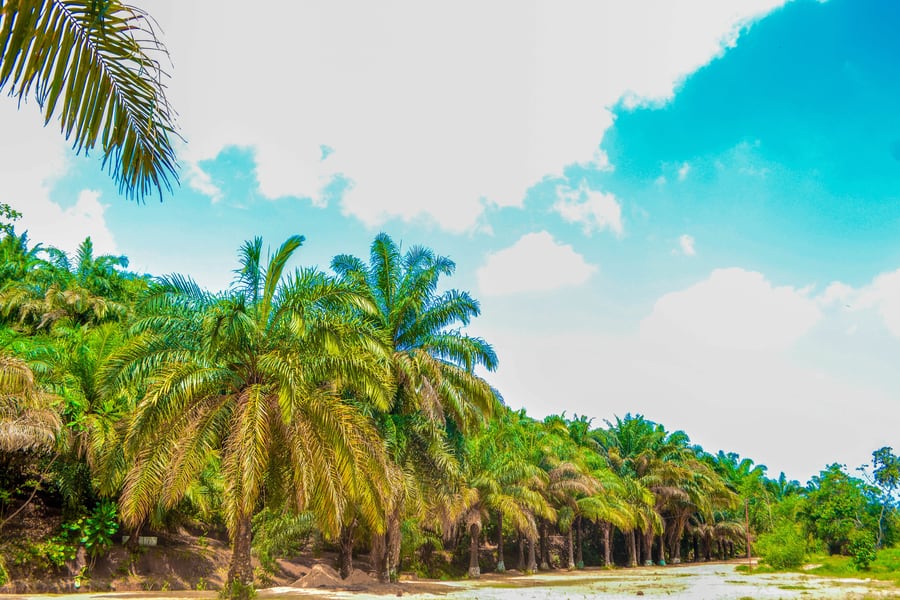 Leon Bilili / Wikimedia Commons · CC BY-SA 4.0 · 2022 · cropped
Palm country
Oil palms fill the valleys between the ridges for much of the middle of the run — the crop the colonial economy of the lower Congo was built on, and still a living one.A bit of history
Culture & experiences along the way
 MONUSCO / Abel Kavanagh / Wikimedia Commons · CC BY-SA 2.0 · 2015 · cropped
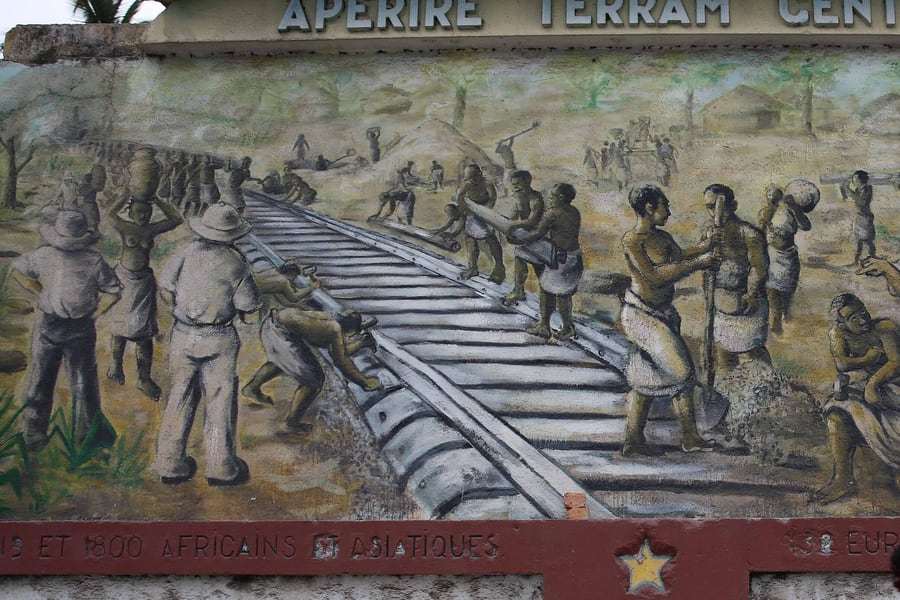
Aperire Terram Gentibus
To open the land to the nations. The motto runs above a relief on the wall at the Kinshasa station showing the track being laid by hand, and the panel beneath it counts the dead of 1898–1948: 1,800 Africans and Asians, 132 Europeans. It is the railway's own account of itself, and it is worth reading twice.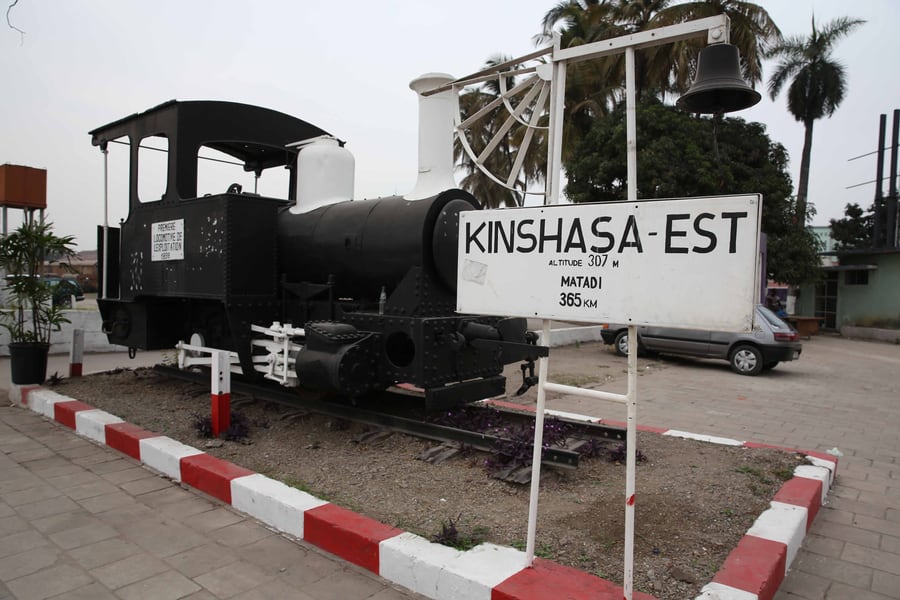 MONUSCO / Abel Kavanagh / Wikimedia Commons · CC BY-SA 2.0 · 2015 · cropped
The first locomotive, on its plinth
The engine that first worked through from Matadi stands outside the Kinshasa terminus on a short length of rail, beside a white station board reading KINSHASA-EST · ALTITUDE 307 M · MATADI 365 KM. Small, black and riveted — the whole railway began at that size.Timetables
No train is running as this page is written, and no restart date has been published. Radio Okapi reported on 31 July 2026 that Jean-Claude Ngoma Moussa, ONATRA's delegated railway director for Kongo Central, has made reopening conditional on two drainage jobs: rebuilding a collapsed collector at Limete in Kinshasa, and overhauling the Kimwenza system so that water is carried away to the Lukaya. Until both are done, only restricted freight runs, between Matadi, Minkelo and Lukala. The table below is the last pattern ONATRA published, and it is here so that a reader knows what the service looks like when it works — not as a train to turn up for.
The last published pattern
Announced by Dieudonné-François Bongwala W'Isola, director of ONATRA's railway department, and in force from 15 March 2026 until the suspension.
| Direction | Days | Departure | Typical arrival |
|---|---|---|---|
| Kinshasa-Centrale → Matadi | Saturday, and Wednesday from 15 March 2026 | 07:30 | mid-afternoon |
| Matadi → Kinshasa-Centrale | Sunday, and Thursday from 15 March 2026 | 07:30 | mid-afternoon |
Before 15 March 2026 there was one rotation a week: out of Kinshasa on Saturday, back from Matadi on Sunday, both at 07:30 sharp.
How long it takes. The two runs that were timed in public took eight and three-quarter hours and nine and a half. The test working of 18 October 2025 left Matadi at 08:30 and reached Kinshasa's central station at about 17:15; the inaugural express the following day left Kinshasa at 07:45 and was into Matadi at 17:15.
Stops. Kinshasa-Centrale, Maete, Kimwenza, Kasangulu, Kisantu, Lufu-Toto, Kivulu-Ngongo, Lukala, Kimpese, Songololo, Lufu and Matadi.
As of September 2026. There is no online timetable: ONATRA posts service notices on the board at the station and through the Congolese press. The operator is the Office national des transports (opens in a new tab), which lists the Chemin de Fer Matadi–Kinshasa and its 366 km among the ports, shipyards and river routes it runs.
Tickets
Tickets are sold at the station window and nowhere else: there is no online sale, no agency and no app. ONATRA's director general, Martin Lukusa Cibangu Panu, set the fares for the reopened express in October 2025 and asked for booking at least 48 hours before departure. Prices were announced in US dollars but are payable in Congolese francs, at the rate of the day — the first published figures, before the dollar prices, were 60,000 and 120,000 francs.
Second class was abolished when the express restarted. It had cost about six dollars, and its removal was criticised at once, because it was the class most people on this line could afford. The March 2026 relaunch put a middle class back in, at thirty-five dollars.
Book your tickets
First class
US$25, collected in Congolese francs
The cheapest fare on the express since second class was withdrawn in October 2025.
via ONATRAPremium
US$35, collected in Congolese francs
The middle class added when the service went to two rotations a week in March 2026.
via ONATRAVIP
US$50, collected in Congolese francs
The top class, sold as luxury when the line reopened, with refreshments included.
via ONATRARail Passes
There is no rail pass for the Democratic Republic of the Congo, and there is nothing for one to cover. The country's railways are three unconnected systems — ONATRA's Matadi–Kinshasa line, SNCC's network in the south and east, and the Uele railways in the north — built to different gauges and joined to one another by river rather than by track. No through ticket exists between them.
For this journey that means a single fare, bought at the window at Matadi or Kinshasa, for the train you intend to take. Interrail and Eurail do not reach Africa; no African pass includes the DRC. If a reader has seen a "Congo rail pass" advertised, it is not ONATRA's.
As of September 2026.
Places to Visit
Almost everything worth stopping for on this line is water or forest, and that is not an accident: the railway was laid where the river could not go, so it spends its whole length within reach of the thing it was built to avoid. The cataracts at either end are the reason the line exists, and both are close enough to a terminus to be seen in a morning.
One stop that has no card below is worth naming anyway. Mbanza-Ngungu, the old Thysville, stands a little off the main line on the plateau, and under the town is a cave system found in 1915 whose resident is the African blind barb — a colourless, eyeless fish that lives in these caves and no others. Only one of the caves, Finzolua, is open to visitors.
 NGAMPUTU SAGE / Wikimedia Commons · CC BY-SA 4.0 · 2025 · cropped
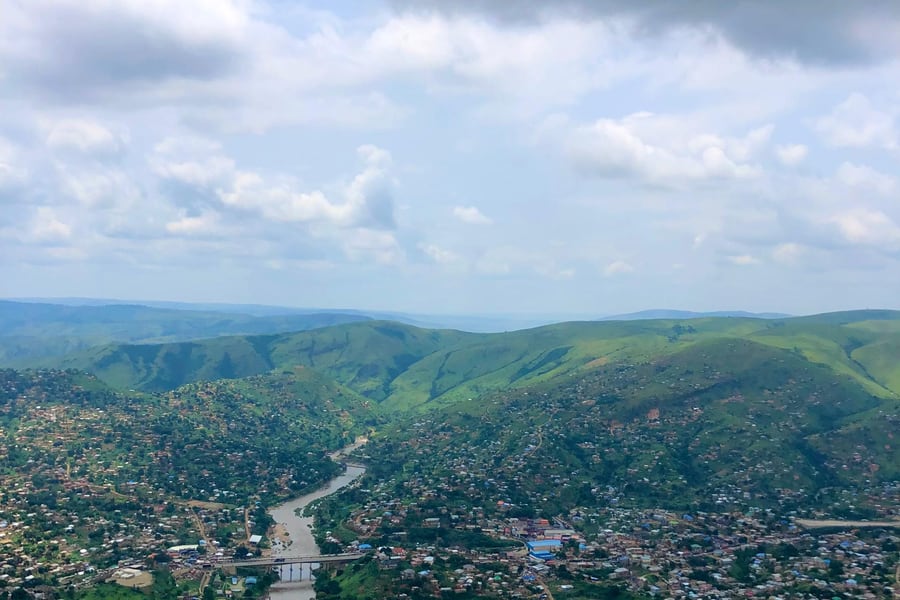
Matadi, in its gorge
The town climbs the rock on both banks of a river that has cut itself a trench here, and its name is simply the Kikongo for stone. This is as far inland as an ocean ship can come, and the port handles the sea trade of a country of 124 million people. From the heights above the town you can see the whole arrangement at once: the quays, the river bending away between hills, and the railway starting its climb out.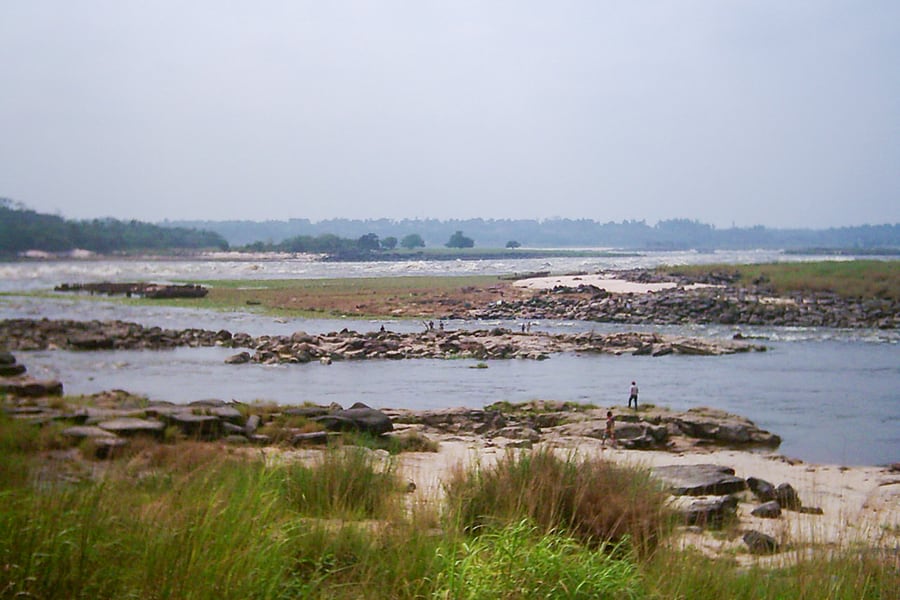 Vberger / Wikimedia Commons · public domain · cropped
The Livingstone rapids at Kinshasa
The first of the cataracts begins at the western edge of Kinshasa itself, in Ngaliema, where the Congo leaves the Pool and starts down. It is an easy half-day from the middle of the city, and standing on the rocks with that volume of water going past explains the railway better than any figure can — 270 metres of fall in 350 kilometres, and the second largest flow of any river on earth.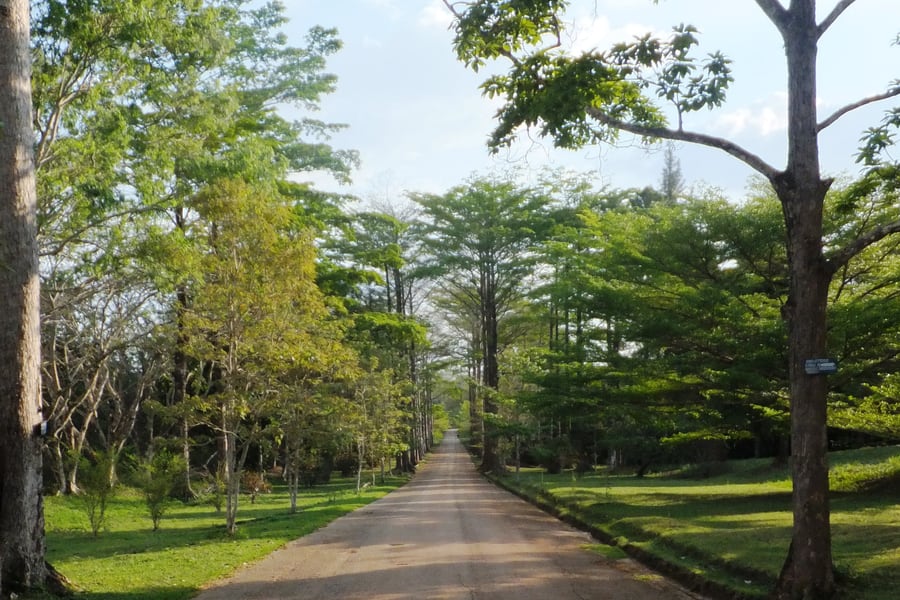 Pandries / Wikimedia Commons · CC BY-SA 3.0 · 2013 · cropped
The botanical garden at Kisantu
Brother Justin Gillet, a Jesuit, began planting here in 1898 and formally founded the garden in 1900. It now covers 225 hectares and holds some 2,200 species, watered by a network of canals off the Yindu. It was badly damaged in the fighting of 1997, rebuilt from 2004, and by 2016 was one of the country's principal tourist destinations again. The station is on the line.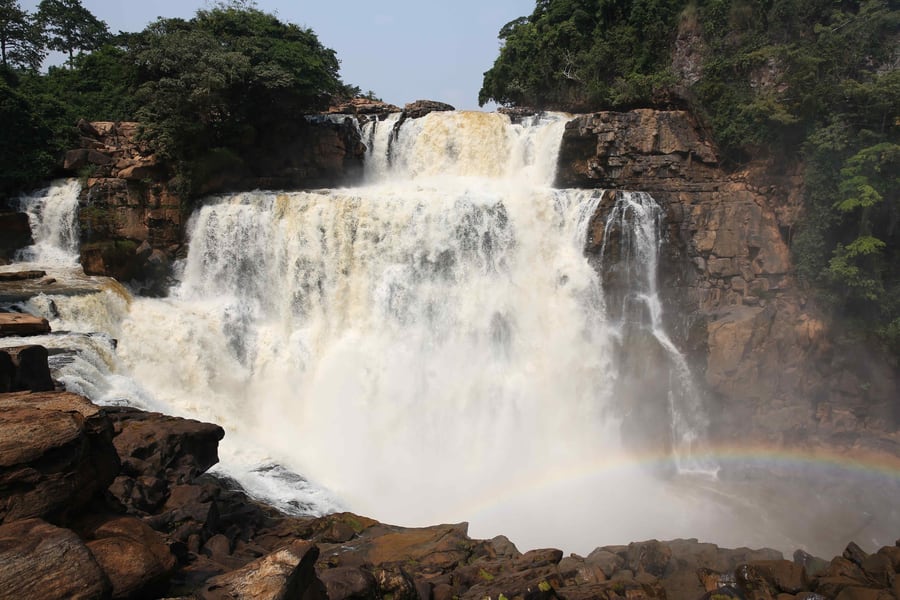 MONUSCO / Abel Kavanagh / Wikimedia Commons · CC BY-SA 2.0 · 2015 · cropped
The Zongo falls
The Inkisi drops 65 metres in one curtain at Zongo, about 130 km from Kinshasa and a reasonable detour from Kisantu. There is spray, a permanent rainbow in the right light, and a hydroelectric station taking part of the flow. Of everything on this route it is the one people travel from the capital specifically to see.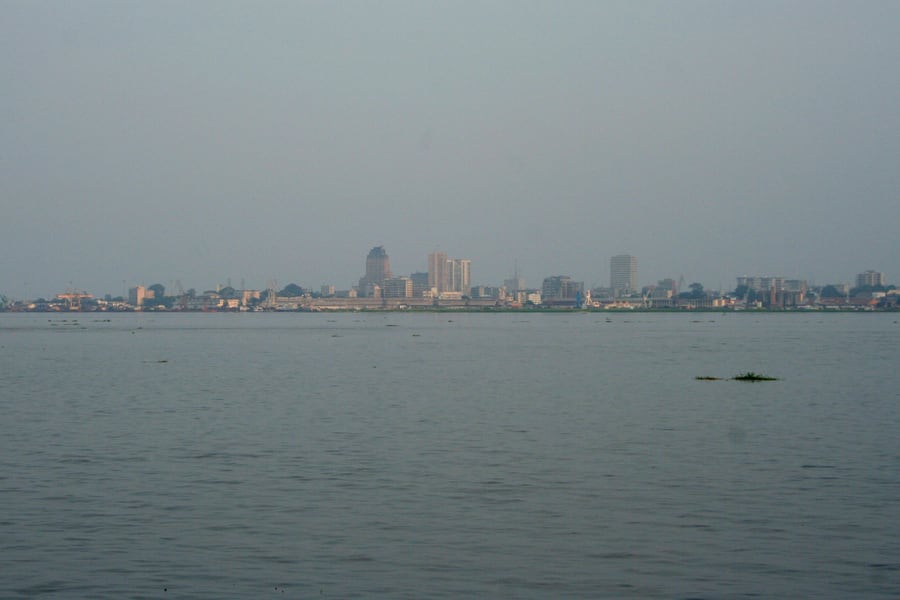 Karin Lakeman / Wikimedia Commons · CC BY-SA 3.0 · 2010 · cropped
Kinshasa and the Pool
The river arrives at the capital as a lake — the Pool Malebo, wide enough that Brazzaville on the far bank is a horizon rather than a neighbour. Above it the Congo is navigable for thousands of kilometres; below it, nothing floats. Gombe, the district on the water, holds the ministries, the embassies and the hotels, and the walk along the bank is the clearest view of why this city is where it is.Where to Sleep
Both cards below are in Kinshasa, in the Gombe district, which is where the embassies, the ministries and every hotel with a working website are. Either is a short drive from the central station.
There is no card for Matadi, and that is deliberate. The port's landmark hotel is the Métropole on Avenue Kinkanda — a Gothic Revival pile of 1930 by the Belgian architect Ernest Callebout, built like a Florentine palazzo and much reduced since — but it has no website, and neither does anything else in the town: only aggregator listings. Rather than send a reader to one of those, we say plainly that a bed at the Matadi end has to be arranged locally.
Where to stay
Pullman Kinshasa Grand Hotel
4 Avenue Batetela, in Gombe
Rooms looking over the pool, the city or the river, with four restaurants and two bars on site.
Check Availability (opens in a new tab, on pullman.accor.com)via pullman.accor.comFleuve Congo Hotel
The only hotel built on the bank of the Congo
Two hundred and thirty-seven rooms in the embassy district, most of them facing the river.
Check Availability (opens in a new tab, on blazonhotels.com)via blazonhotels.comPractical Information
Before anything else: check whether the train is running. It was not in September 2026, and it has started and stopped four times since 2020. ONATRA announces both by notice at the station and through the Congolese press; there is no timetable page to refresh.
Travel advice. The FCDO's advice, updated 26 August 2026, does not cover this route. Its "against all travel" areas are the eastern provinces — Ituri, North and South Kivu, Maniema, Tanganyika, Haut-Uélé and Haut-Lomami — the Kwamouth territory, and a 50 km strip along the Central African Republic border, all of them a thousand kilometres and more from the line. Within Kinshasa the FCDO does advise against all but essential travel to the N'djili and Kimbanseke districts and to the N1 between Menkao and Kenge. Kongo Central and central Kinshasa carry no blanket advisory.
Language and money. French is the language of the railway and of every notice. The currency is the Congolese franc; fares have been quoted in dollars but are collected in francs at the day's rate, and payment is cash at the window.
Book ahead. When the express ran, ONATRA asked for tickets to be bought at least 48 hours before departure. There is no online sale.
Season. The line's recent stoppages have all followed heavy rain — November 2025 and April 2026 both — so the dry middle of the year is both the pleasanter time to travel and the likelier one for the train to be running.
Questions or corrections
Planning this trip and stuck on something, or spotted a time, fare or detail that has changed? Send us a message about Matadi to Kinshasa. We read every one, and we update this page when something has changed.