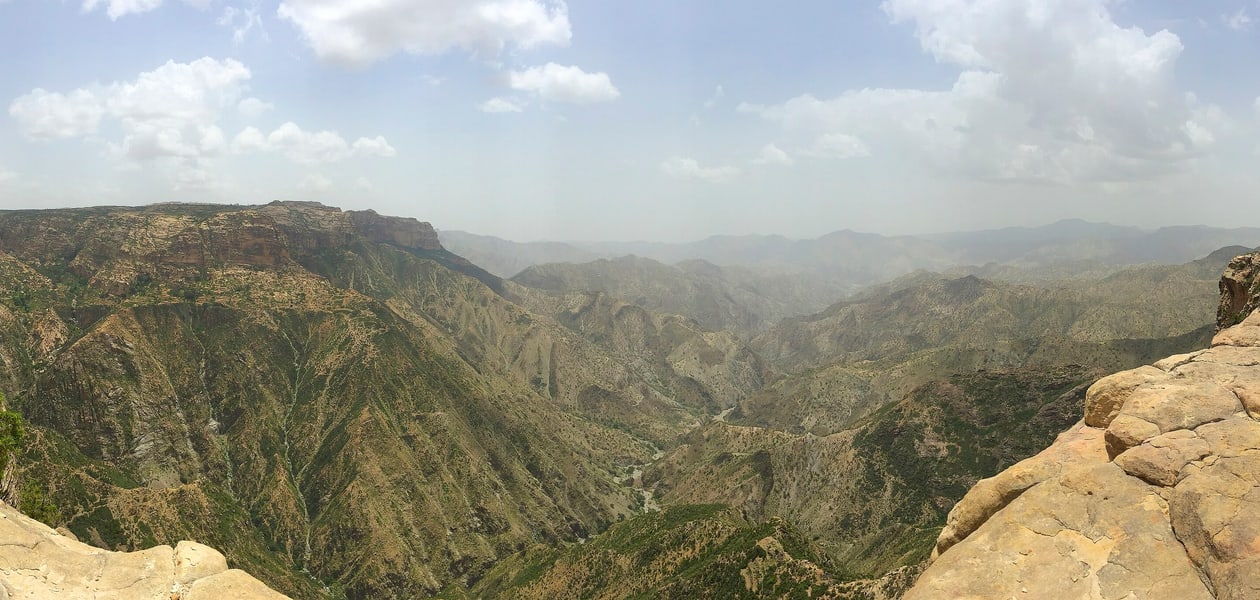
Eritrea
Clay Gilliland / Wikimedia Commons · CC BY-SA 2.0 · cropped
Eritrea occupies about 117,600 km² of the Horn of Africa, with a long Red Sea coastline and the Dahlak Archipelago offshore. Sudan lies to the west, Ethiopia to the south and Djibouti to the south-east. The capital, Asmara, sits at 2,325 m on the highland plateau, and the country falls away from it in two directions at once: west into the Barka lowlands, and east down an escarpment to the coastal desert and the port of Massawa, one of the hottest inhabited places on earth. That descent — around 2,300 m in roughly 100 km as the crow flies — is the defining fact of Eritrean geography, and of its railway.
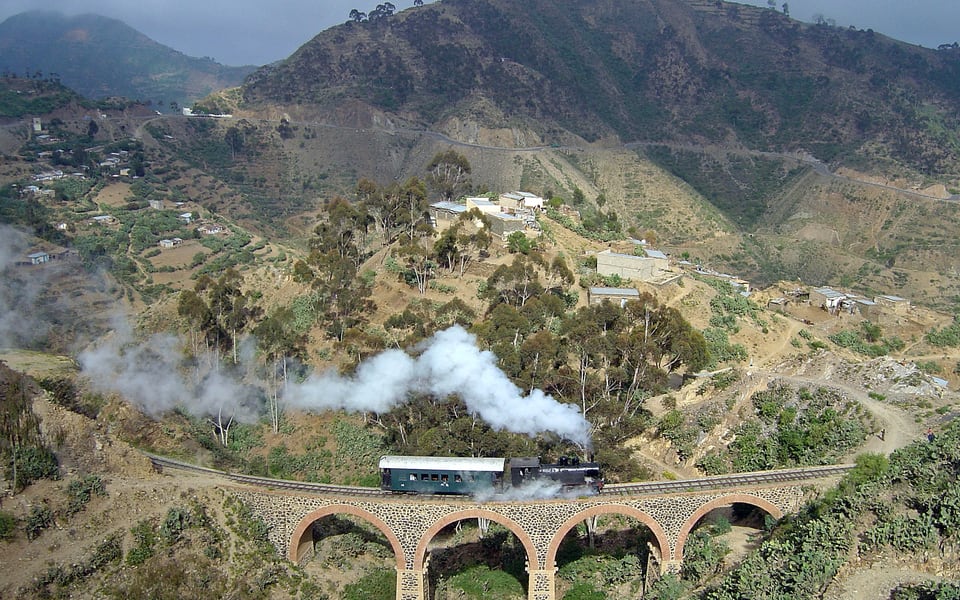
There is one railway and it is unlike any other still running. The Eritrean Railway is a 950 mm narrow-gauge mountain line built between 1887 and 1932 under Italian rule, climbing from Massawa to Asmara through tunnels, stone viaducts and hairpins. It was wrecked in the wars of the second half of the twentieth century — rails were lifted for military use — and then rebuilt in the 1990s by Eritrean crews, largely by veterans who had worked on it before. It still runs 1930s steam locomotives and Fiat railcars.
Rail journeys in Eritrea
Good to know
Does the Eritrean Railway run to a timetable?
No. There is no scheduled passenger service and no public timetable. What runs is chartered, arranged in advance through tour operators, and the arrangement is genuinely the substance of any trip rather than a formality — coal supply and permits both take time. A traveller cannot turn up at Asmara station and buy a ticket for a departure.
Why is the gauge 950 mm?
Because Italy built it. 950 mm was the standard Italian narrow gauge, used on colonial and secondary lines at home and abroad, and Eritrea was an Italian colony from 1890. The gauge came with the engineers, and so did the locomotives, the railcars and the vocabulary — the railway is still Italian in almost every technical detail.
What is left of the original equipment?
A remarkable amount. Eleven steam locomotives survived the wars and at least six have been rebuilt to working order; several 1930s Fiat railcars survive and have been made operational, along with two 1957 Krupp diesel-hydraulics and a Drewry shunter. The carriages have wooden seats and no continuous brakes — braking is done on the locomotive, or by hand, car by car.
Are there rail passes for Eritrea?
No, and there is nothing for one to cover: the country has a single line and no scheduled service on it. Travel outside Asmara also requires a permit, which is a practical fact about any railway trip here rather than an aside.