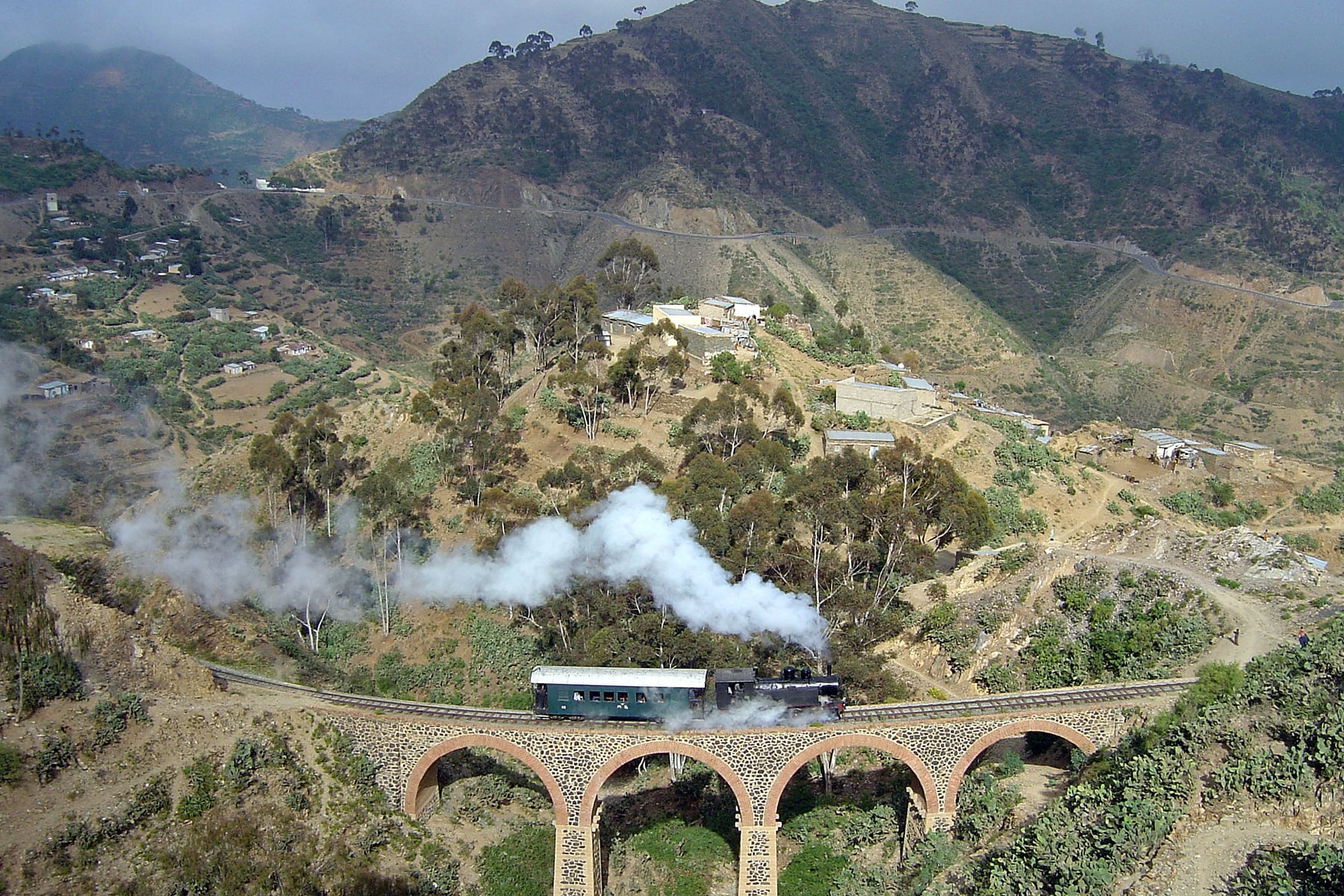
Asmara to Arbaroba
Voice of Clam, edited by jjron and Citypeek / Wikimedia Commons · public domain · 2008 · cropped
- DistanceAbout 25 km, Asmara to Arbaroba and back
- DurationAbout 4 to 5 hours, there and back
- Best seasonCharter, any day · clearest October to April
Introduction
There is no ticket window for this train and there never has been. The Eritrean Railway Corporation runs one thing for visitors: a chartered steam working out of Asmara, down the edge of the Hamasien plateau to Arbaroba and back, and the whole train is hired rather than a seat in it. It leaves at nine in the morning, takes four to five hours for the round trip, and is booked days in advance because a 1938 Ansaldo Mallet needs that long to be coaled and steamed. The gauge is 950 mm, the Italian narrow gauge, and the coaches have wooden seats, open platforms and no continuous brakes — a brakeman screws them down car by car on the way down.
What makes the ride worth the arranging is that nothing about it is a reconstruction. The line was built from the Red Sea at Massawa between 1887 and 1932, reaching Asmara in 1911 through 39 tunnels and 65 bridges; it was systematically destroyed in 1975 by the Derg, its steel sleepers welded into front-line bunkers; and it was put back in the 1990s by Eritrean crews who had worked it in its last years, without foreign contractors, reopening as far as Asmara in 2003. The locomotives that pull the charter are the ones that survived that, and the section they work — the twelve kilometres between Asmara and Arbaroba, on a steady 3.3 per cent — is the part the engineers had the most trouble with in the first place.
The Journey
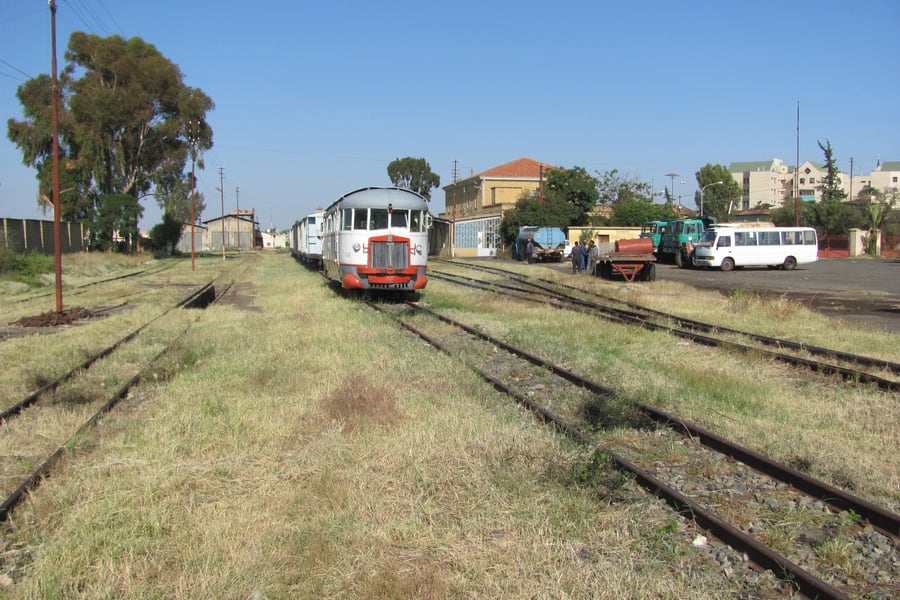
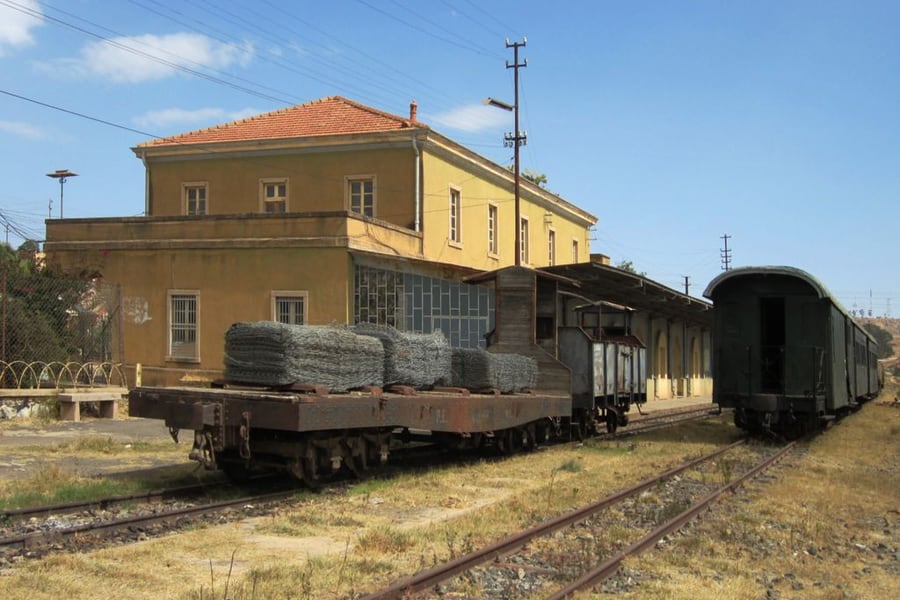
The train is already alive when you reach the yard. Asmara station stands on Liberation Avenue in the middle of the city, a low Italian building with the running shed and the works immediately behind it, and on a charter morning the locomotive has been in steam since before dawn. Departure is at nine o'clock, and the operator's own advice is to be there by half past eight, partly for the photographs and partly because the train does not wait.
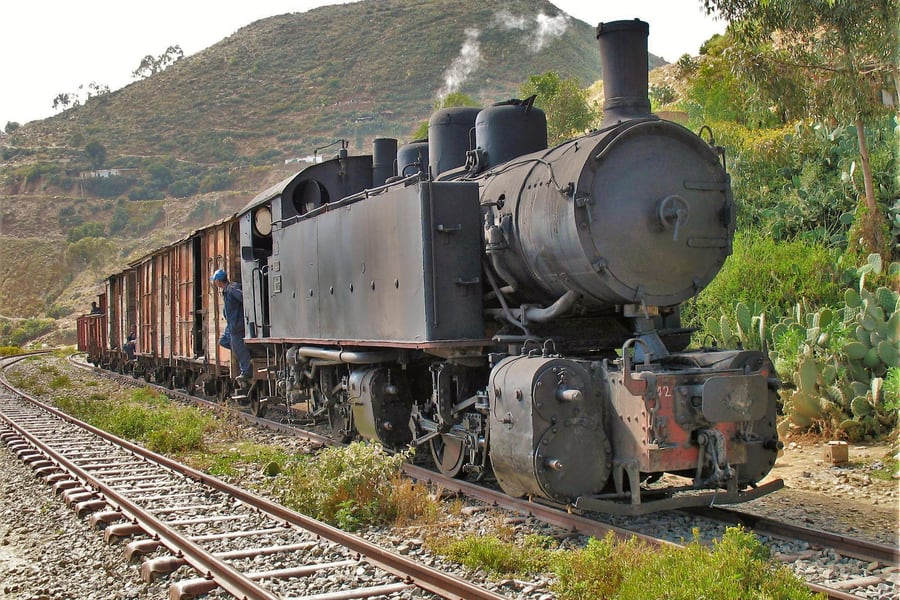
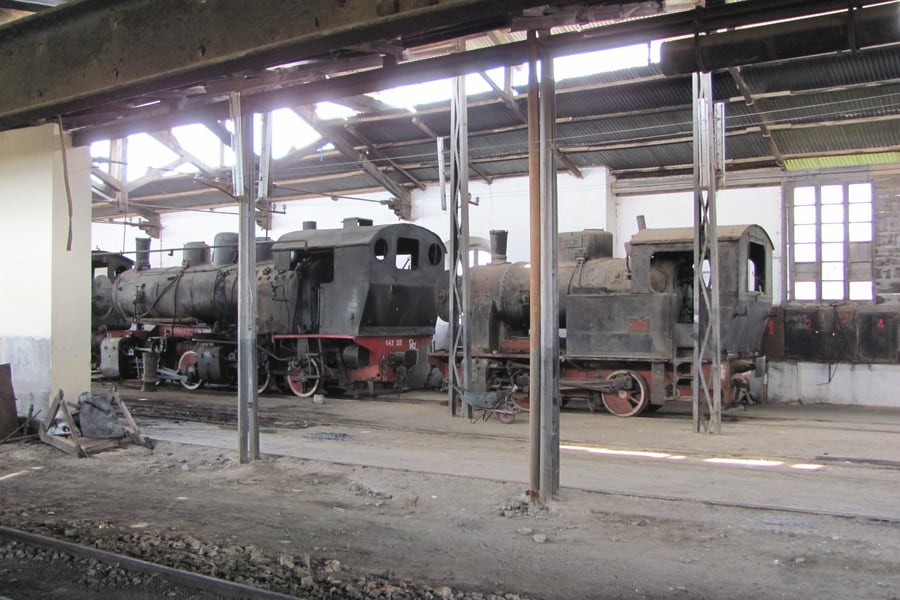
The engine is almost always one of the 442-series Mallets, built by Ansaldo of Genoa in 1938: an articulated 0-4-4-0 compound tank, two sets of driving wheels on separate frames so that the machine can bend into curves a rigid locomotive could not take. Four survive and three have been kept in working order. On the heaviest loads two of them work in front, double-headed, which is the only way a train of any length gets up the last of the bank. For a small party the railway sometimes turns out a Fiat Littorina railcar instead — Art Deco, cream and grey with red bumpers, built in the 1930s and still licensed to run.
Down the escarpment
Out of the station the line climbs briefly to the highest point on the whole railway, 2,394 m, just east of the city, and then it starts to fall. Asmara station is at 117.6 km from Massawa and 2,342 m; Arbaroba is at 104.9 km and 2,064 m. That is 278 metres of descent in under thirteen kilometres, and the railway takes it at a steady 3.3 per cent — about the limit of what a steam locomotive can hold on a wet rail.
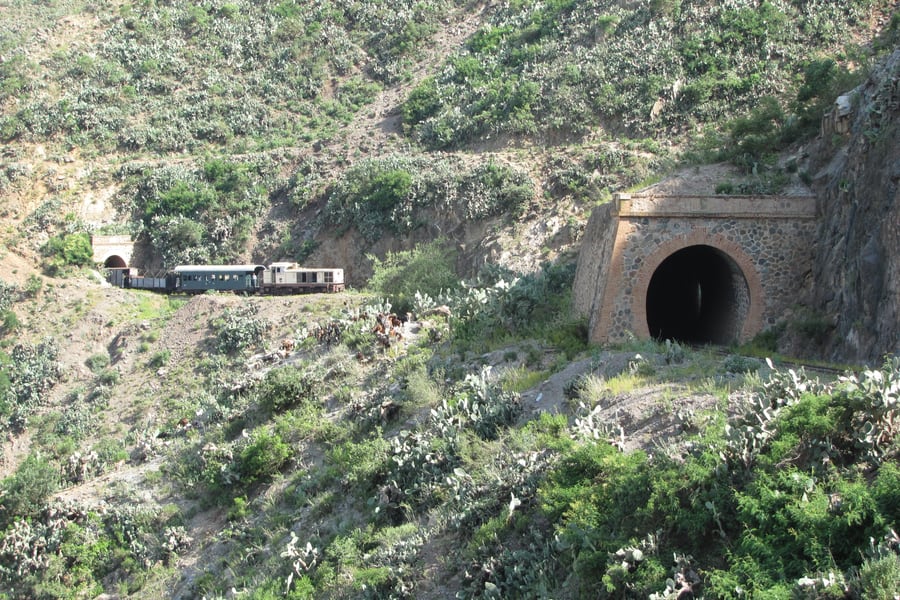
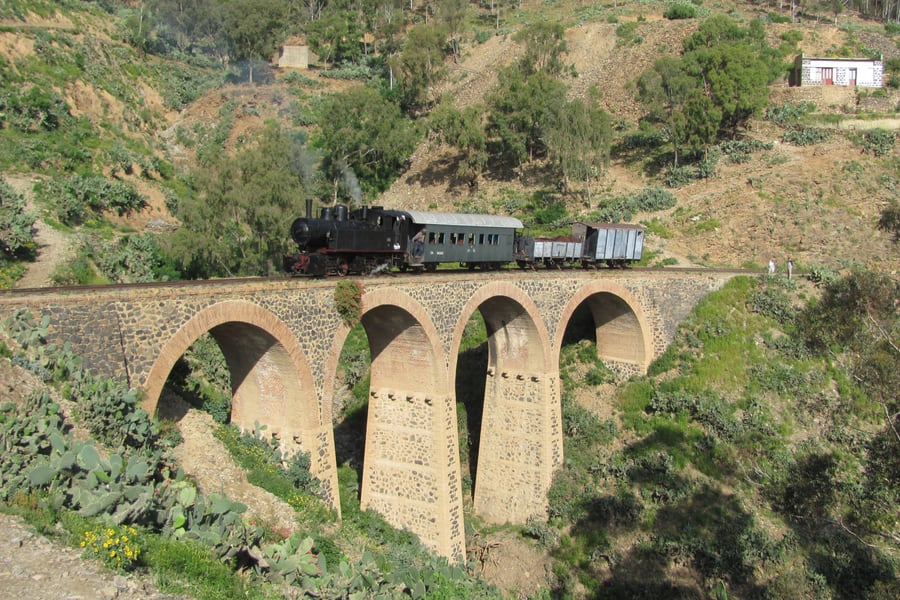
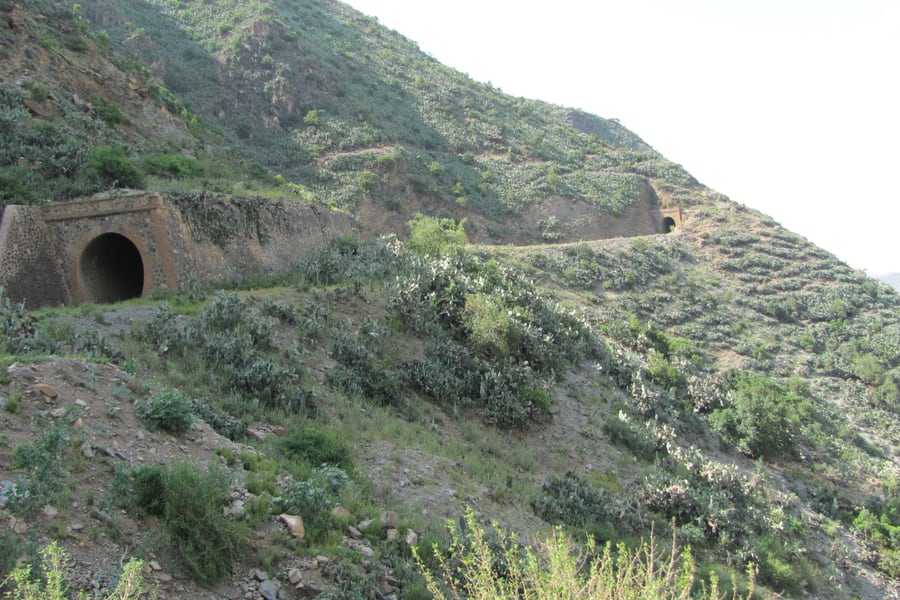
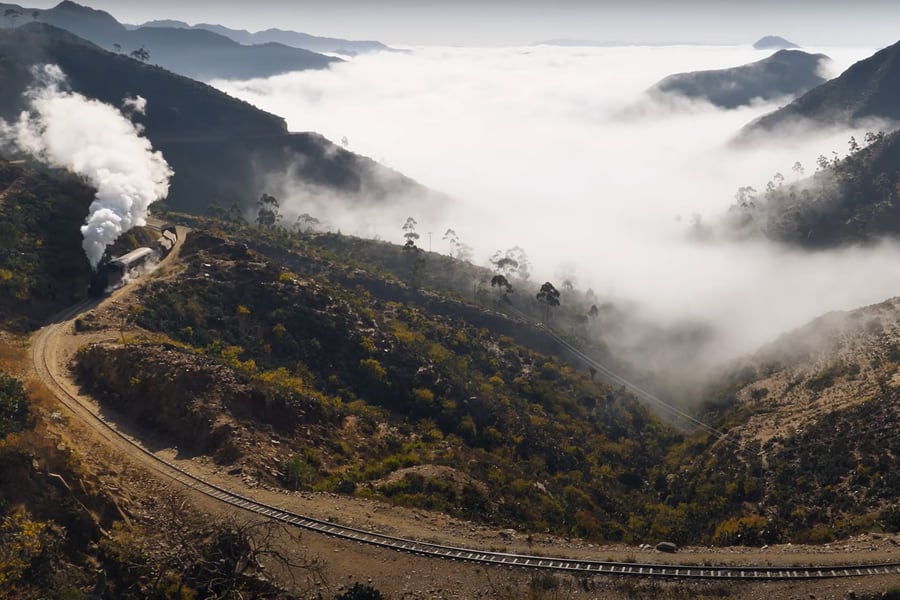
Roughly three quarters of an hour out, the train reaches the switchback, where the engineers gave up on a continuous curve and built a zig-zag instead: the train runs forward onto a higher siding, stops, reverses, and carries on in the other direction with several more metres of height gained. It stops there, and everyone gets out to watch. After it the line runs along the open face of the escarpment with the ground dropping away below, in and out of stone-arched tunnel mouths, across viaducts built up out of the hillside, with terraced fields and scattered flat-roofed houses below the formation.
Arbaroba, and the turn
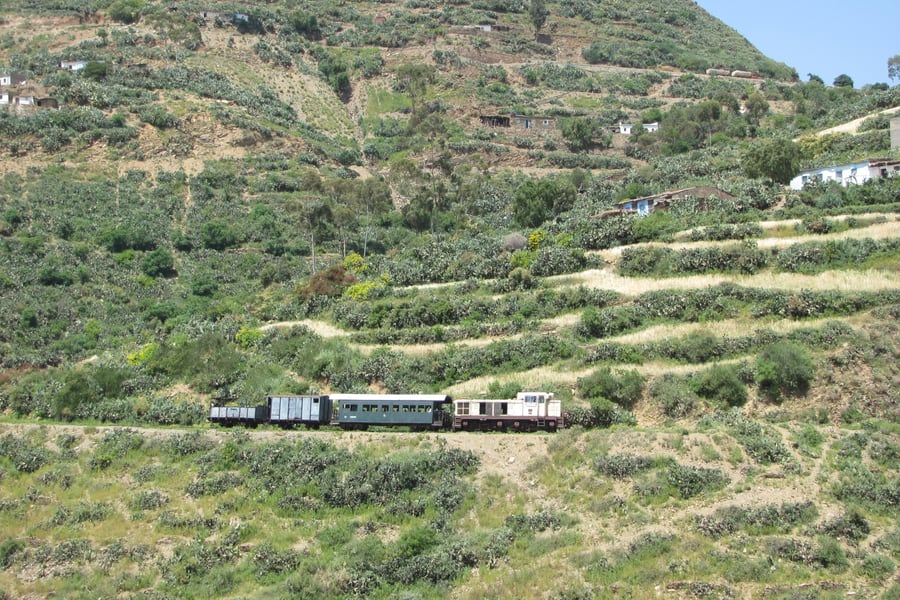
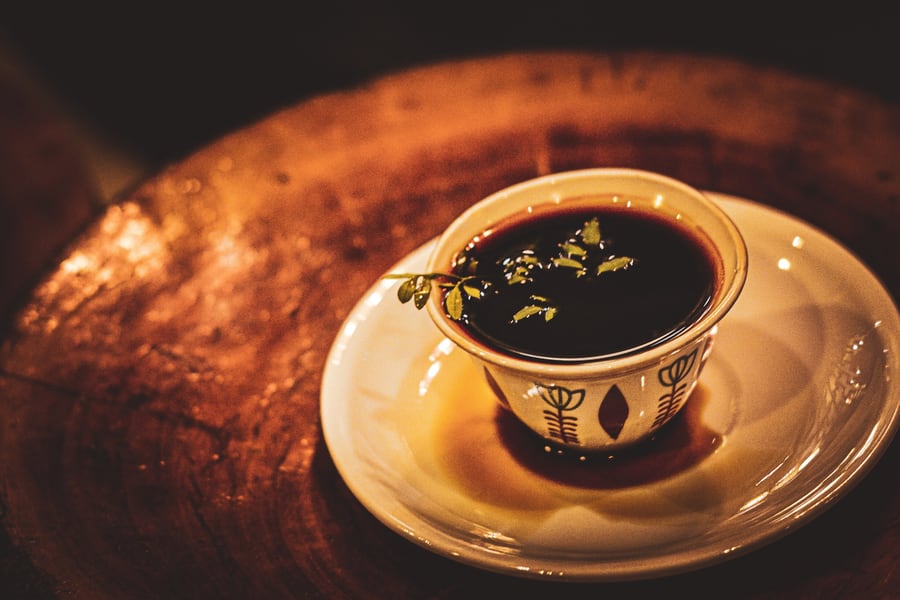
Arbaroba is a village station of the same colonial pattern as the rest — whitewashed, pantiled, with the name laid in raised letters across the gable. It is where the charter turns. The locomotive uncouples, runs round its train on the loop, and reattaches at the other end, which takes about twenty minutes and is the best mechanical spectacle of the day. Some charters have an Eritrean coffee ceremony waiting at the turnaround. There are no shops and the facilities are minimal; whatever you want for the four to five hours has to come with you.
Then the same road back, uphill, which is when the locomotive earns its keep and the exhaust beat carries across the valley. The train is normally back in Asmara around one o'clock.
What is not on offer
The railway does not stop at Nefasit any more. Until recently the tourist working ran the full escarpment section down to Nefasit at 93 km, and the classic Eritrean photographs — trains on the Shegerini viaducts, the double tunnel mouths above the Devil's Gate — were taken on that stretch below Arbaroba. As of 2026 the charter runs Asmara to Arbaroba and back, and no further.
The whole line to Massawa, 118 km and the full 2,339 metres of descent to the Red Sea, is intact and worked by the railway, but it is not what is sold as a day out. Specialist photographic charters, booked months ahead by tour companies from Europe, still cover the lower sections and run double-headers over the viaducts; a visitor to Asmara gets the top twelve kilometres.
Along the route
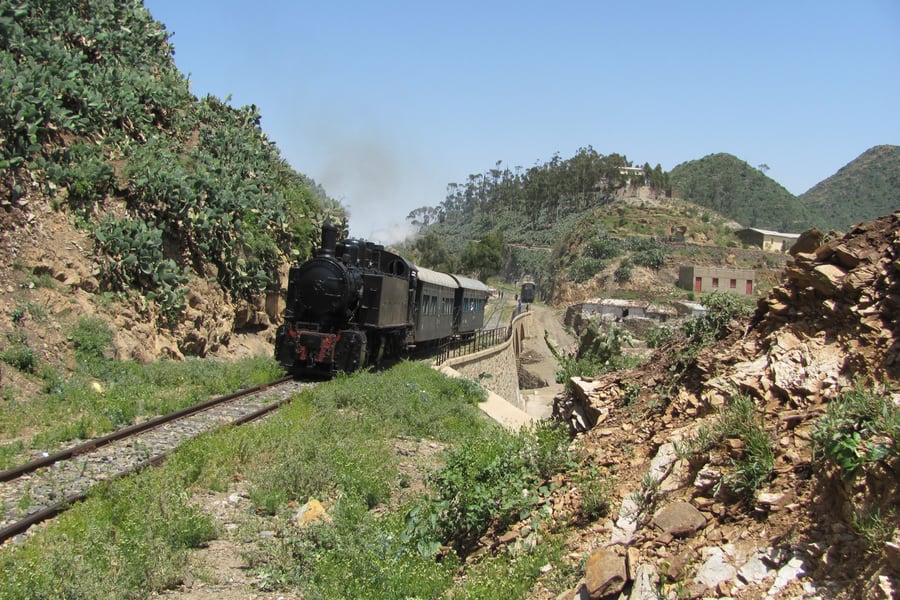
 David Stanley / Wikimedia Commons · CC BY 2.0 · 2012 · cropped
Nine o'clock at Asmara
A low Italian station on Liberation Avenue with the works immediately behind it. The locomotive has been in steam since before dawn, and the train does not wait.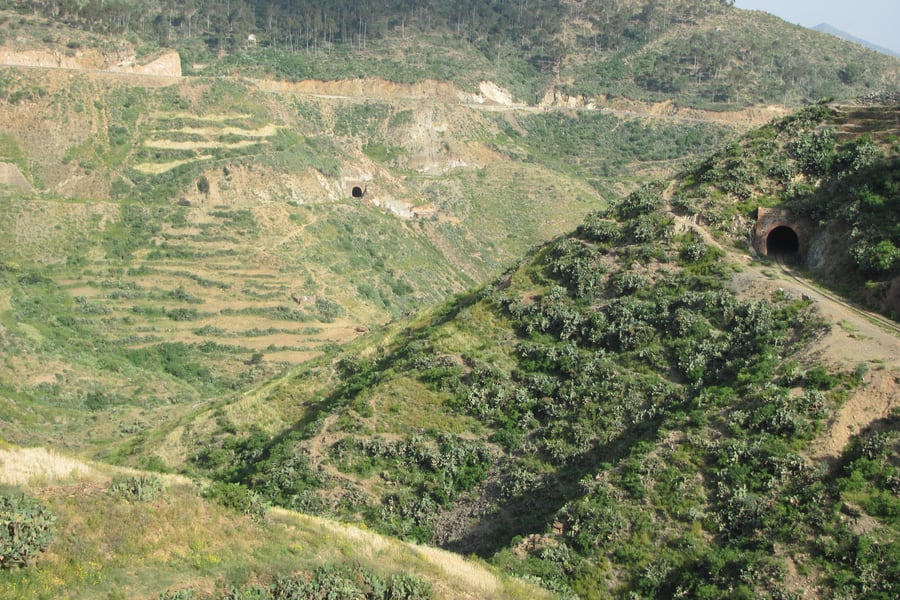 Reinhard Dietrich / Wikimedia Commons · CC0 · 2011 · cropped
The switchback
About three quarters of an hour out the engineers ran out of hillside. The train goes forward onto a higher siding, reverses, and carries on the other way with height gained.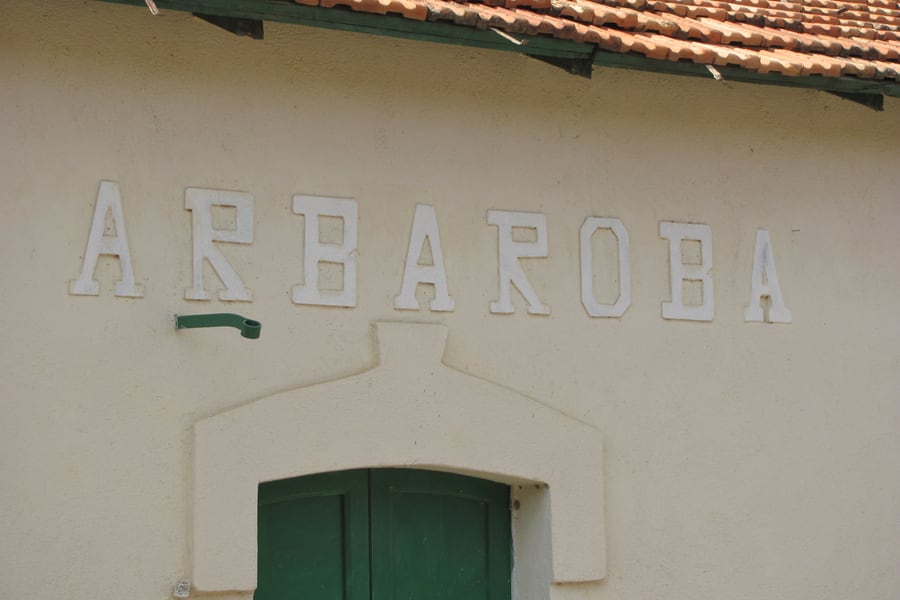 Reinhard Dietrich / Wikimedia Commons · CC0 · 2011 · cropped
Arbaroba, 2,064 m
Kilometre 104.9, and the turn. The locomotive uncouples, runs round its train on the loop and reattaches at the other end — about twenty minutes, and the best of the day.A bit of history
Culture & experiences along the way
 ProtoplasmaKid / Wikimedia Commons · CC BY-SA 4.0 · cropped
Coffee, three rounds of it
The beans are roasted in front of you in a flat pan, carried round so everyone can take the smoke, ground by hand, and brewed in a clay jebena. It is poured from a height into small handleless cups and drunk in three rounds, often over popcorn and always slowly. Accepting the first and leaving is not done.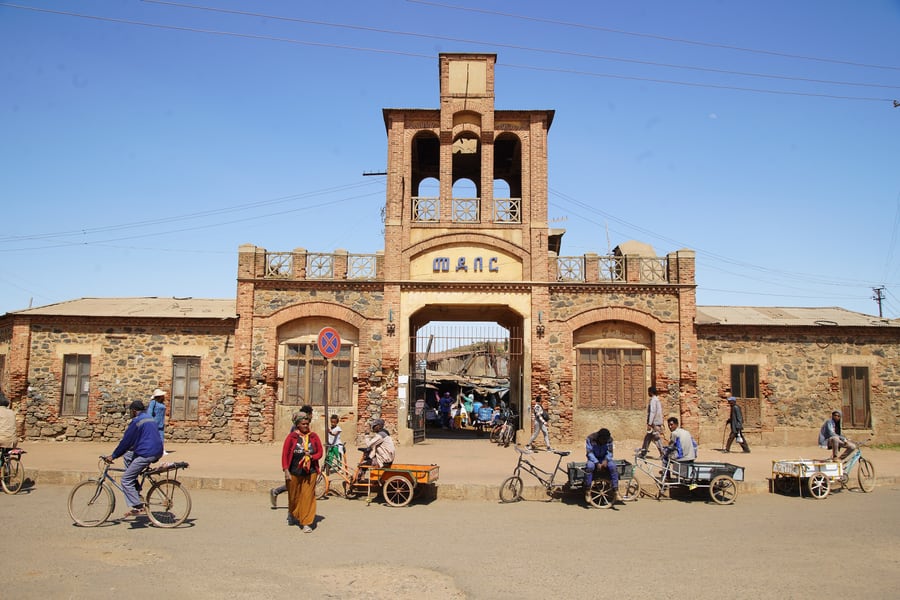 Mheidegger / Wikimedia Commons · CC BY 4.0 · cropped
Medebar, where nothing is thrown away
Behind an arched gate east of the centre, Asmara's recycling market is street after street of open workshops turning scrap into goods — oil drums beaten into buckets, stoves, funnels and coffee pans, tyres cut into sandals, tin cut into lamps. It is loud, sooty and completely unstaged, and it is the most alive place in the city.Timetables
There is no public timetable for the Eritrean Railway, and that is the honest answer rather than a hedge. The railway runs no scheduled passenger service at all. What a visitor can ride is a charter: the whole train is hired for a group, on whatever day the group wants it, and the railway needs several days' notice to coal and steam a locomotive. Nobody can turn up at Asmara station and buy a ticket for a departure, because there are no departures to buy a ticket for.
What is fixed is the shape of the day, which the railway's booking partners publish and which has not changed for the 2026 season.
| Point | Time |
|---|---|
| Asmara — be at the station | 08:30 |
| Asmara — depart | 09:00 |
| The switchback — stop, everyone off | about 09:45 |
| Arbaroba — arrive, locomotive runs round | about 11:30 |
| Arbaroba — depart, about twenty minutes later | about 11:50 |
| Asmara — arrive | about 13:00 |
Days: any day of the week, by arrangement. Duration: four to five hours for the round trip. Notice: three to seven days as a minimum, and two to three months for dates around Eritrean National Day on 24 May, when demand is highest.
Season. The train runs all year. The clearest weather on the escarpment is the dry season, roughly October to April; July and August bring afternoon rain to the highlands, which is worth knowing when the point of the trip is the view off the side of the mountain.
Distance. The railway's own kilometre posts put Asmara at 117.6 km from Massawa and Arbaroba at 104.9 km, so the run is 12.7 km each way — about 25 km there and back. The operator's partners advertise the round trip as roughly 32 km; the figure quoted here is the one the kilometre posts support.
As of September 2026, from the published 2026 arrangements of Adulis Travel (opens in a new tab), an authorised partner of the Eritrean Railway Corporation. The Corporation itself publishes no website and no timetable.
Tickets
Nothing is sold by the seat. The Eritrean Railway Corporation hires out the whole train — engine, crew, coal and coaches — and the cost is divided among whoever is aboard, so the price per person falls sharply with the size of the party and no fixed fare exists to quote. The Corporation has no website and no online sales; bookings go through Asmara tour operators that hold a working relationship with it.
A tour company is not the railway, and the two are worth keeping apart when a price is quoted. What is being bought is a share of a charter plus whatever the company puts around it, so the useful questions are what the charter alone costs, whether the coffee ceremony at Arbaroba and the hotel transfer are in it, and what happens if the locomotive is not steamed in time.
Things to do
Charter the train through an Asmara operator
Adulis Travel, an authorised partner of the Eritrean Railway Corporation
An Asmara-based company that arranges the locomotive, the crew, the permit and the hotel pickup, with three to seven days' notice.
Book Experience (opens in a new tab, on adulistravel.com)via adulistravel.comJoin a group tour that already has the train
Young Pioneer Tours, which restarted the ride in 2025
The charter cost is split across the group, so a scheduled tour with the train already booked is usually far cheaper than arranging one alone.
Book Experience (opens in a new tab, on youngpioneertours.com)via youngpioneertours.comRail Passes
No rail pass covers Eritrea, and there is nothing for one to cover. The country has a single railway, 118 km of it, and no scheduled passenger service running on any part of it. Interrail and Eurail have never included the country; no African regional pass exists that reaches it; and the one train a visitor can ride is a private charter of the whole formation rather than a journey with a fare.
The nearest thing to a pass here is group size. Because the charter price is for the train and not for the seat, the cost per person on a party of a dozen is a fraction of the cost on a party of two — which is why joining a scheduled group tour that already has the train booked is usually much cheaper than arranging one alone.
Places to Visit
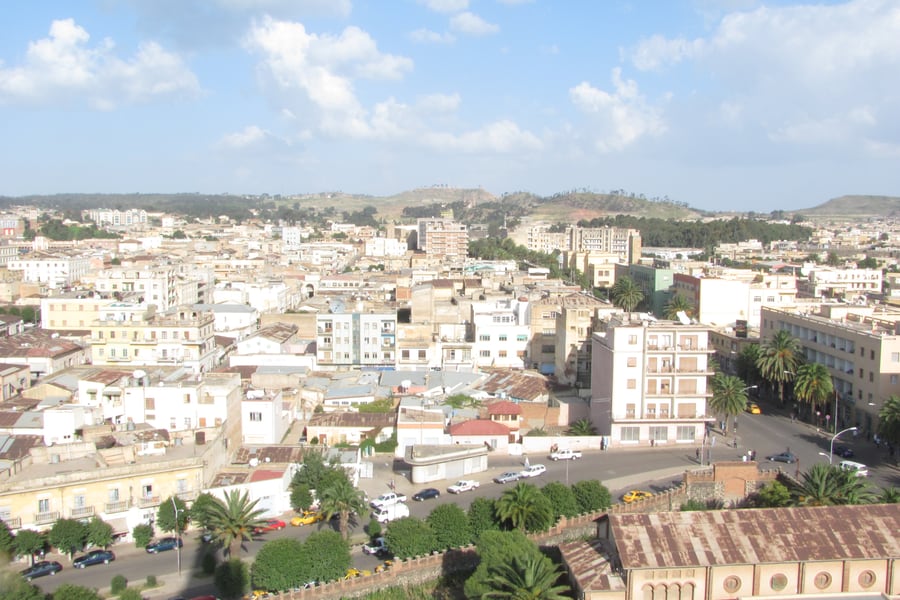
The ride is half a day, and the rest of a visit is Asmara itself — which is the reason most people are in Eritrea at all. The city sits above 2,300 m on the Hamasien plateau, and it was inscribed on the UNESCO World Heritage List in 2017 as Asmara: A Modernist City of Africa: 481 hectares of a colonial planned city laid out in phases between 1893 and 1941, with a 1,203-hectare buffer zone around it.
Travel outside Asmara needs a permit, arranged in advance, and that includes the road down to Massawa. It is a fact about planning any of the below rather than an aside.
 Reinhard Dietrich / Wikimedia Commons · CC0 · 2011 · cropped
Asmara itself
The reason most visitors are in the country. Asmara was inscribed by UNESCO in 2017 as Asmara: A Modernist City of Africa — 481 hectares of a colonial planned city built in phases between 1893 and 1941, on an orthogonal grid that later took in radial streets. The listing singles out Harnet and Sematat avenues, the Mai Jah Jah park and the cinemas — Impero, Roma, Odeon, Capitol, Hamasien — as what makes it exceptional. It is small, flat and walkable.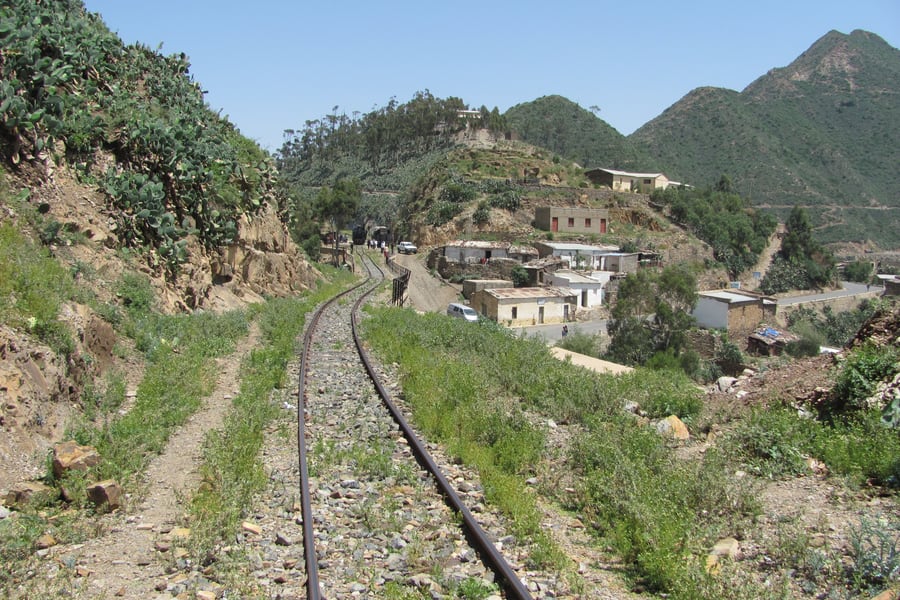 Reinhard Dietrich / Wikimedia Commons · CC0 · 2011 · cropped
Arbaroba
Where the train turns: a village on the lip of the escarpment at 2,064 m, kilometre 104.9 of a railway measured from the sea. The station is the standard colonial pattern — whitewashed, pantiled, its name laid in raised letters on the gable — and the track runs straight through the middle of the houses. There is nothing to buy and about twenty minutes to walk around in before the locomotive is ready.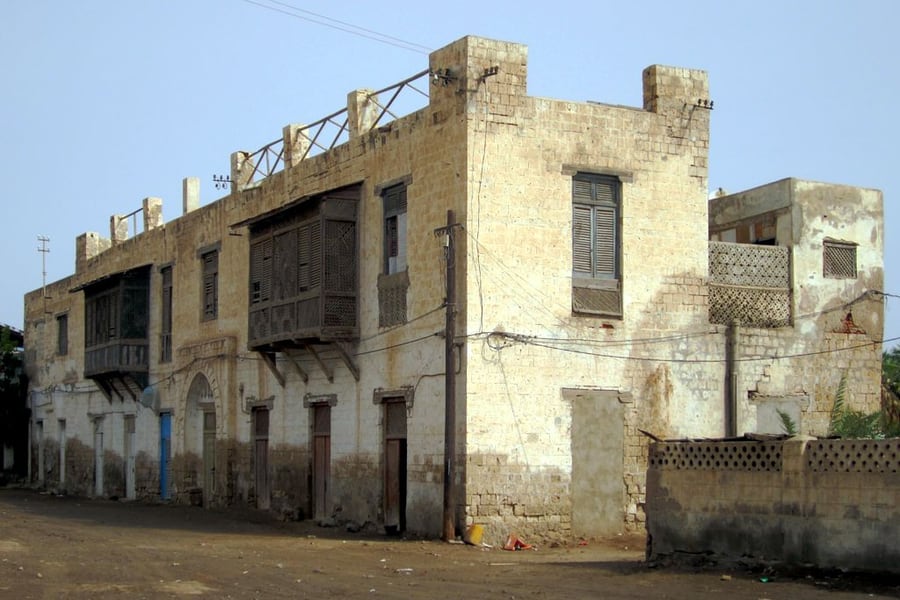 David Stanley / Wikimedia Commons · CC BY 2.0 · 2012 · cropped
Massawa, the other end of the line
Kilometre zero, three metres above the sea, and 118 km and 2,339 metres below Asmara by rail. The charter does not go there and the road needs a permit, but the old town is worth the arranging: coral-block houses with mashrabiya balconies, built to let the sea breeze through, from the centuries when Massawa was an Ottoman and then an Egyptian port. The railway was begun here in 1887 and worked its way up.Where to Sleep
Everybody sleeps in Asmara. The train starts and finishes there, Arbaroba is a village with no accommodation, and the station is central enough that a taxi from most hotels costs a couple of dollars — the operator will collect you from the door if the ride is booked as part of a tour.
Eritrean hotels are almost entirely absent from the internet, and that is not a gap in this page. Most of the well-known Asmara names have no working website: rooms are taken by telephone, or through whoever is arranging the trip. One hotel keeps a site of its own, and it is the card below. For a first visit the practical answer is to let the tour operator book the room along with the train, because the same office is already handling the visa paperwork and the travel permit.
Where to stay
 sailko / Wikimedia Commons · CC BY-SA 3.0 · 2015 · cropped
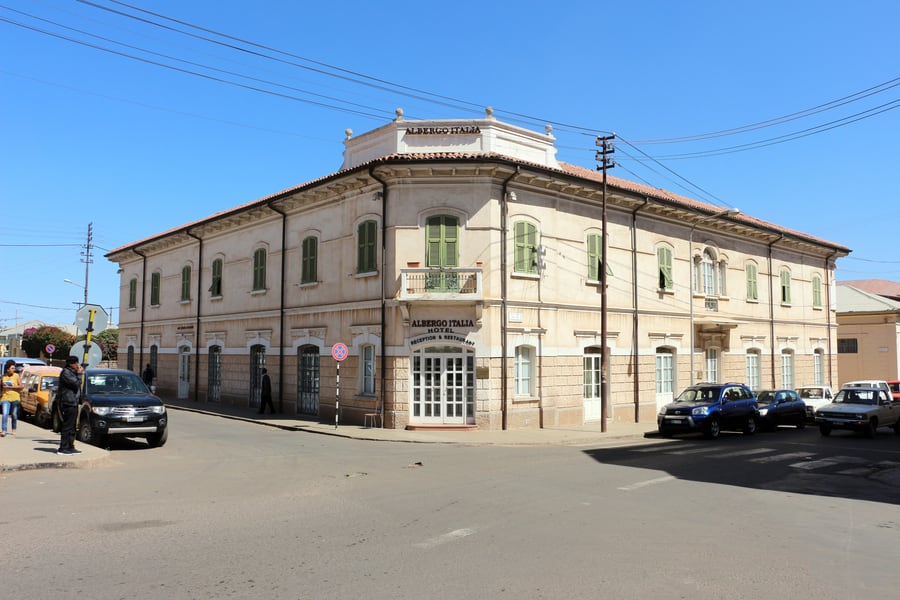
Albergo Italia
Nafka Avenue 13, central Asmara
Built in 1899 and restored in 2004, with an imperial suite, three suites, eight rooms with a loft and six doubles.
Check Availability (opens in a new tab, on albergoitaliaasmara.com)via albergoitaliaasmara.comPractical information
Visas and permits. Most nationalities need a tourist visa for Eritrea, arranged before arrival. Travel outside Asmara additionally requires a permit, and the run down to Arbaroba counts as travel outside Asmara — which is part of why the railway wants several days' notice rather than several hours. A tour operator arranging the charter normally handles both.
Altitude and cold. Asmara is at 2,342 m at the station, and mornings there run about 12–15 °C before the day warms up. The train leaves at nine, the windows are open and the carriages are unheated, so a fleece or a light jacket matters more than it sounds.
On the train. There are no toilets on board and none of consequence at Arbaroba, so the station lavatory before departure is the last one for four or five hours. Nothing is sold anywhere on the trip: water and something to eat have to come with you. The track is narrow gauge and the coaches are a century old, so the ride sways; anyone prone to motion sickness is better off medicated before boarding. Coal dust settles on everything, clothes included.
Photography. The classic picture is taken at the switchback, about three quarters of an hour out, by walking up the bank above the track while the locomotive is manoeuvring — the whole train curves below you against the escarpment. A long lens is worth carrying; the run-round at Arbaroba and the locomotive at rest before departure are the two other set pieces.
Language. The currency is the Eritrean nakfa. Tigrinya and Arabic are the working languages; Italian survives all over the railway's own hardware, where the plates, the gauges and the classes are still labelled in it — the coaches are marked 3ª classe and the locomotives carry Ansaldo and Breda works plates.
Questions or corrections
Planning this trip and stuck on something, or spotted a time, fare or detail that has changed? Send us a message about Asmara to Arbaroba. We read every one, and we update this page when something has changed.