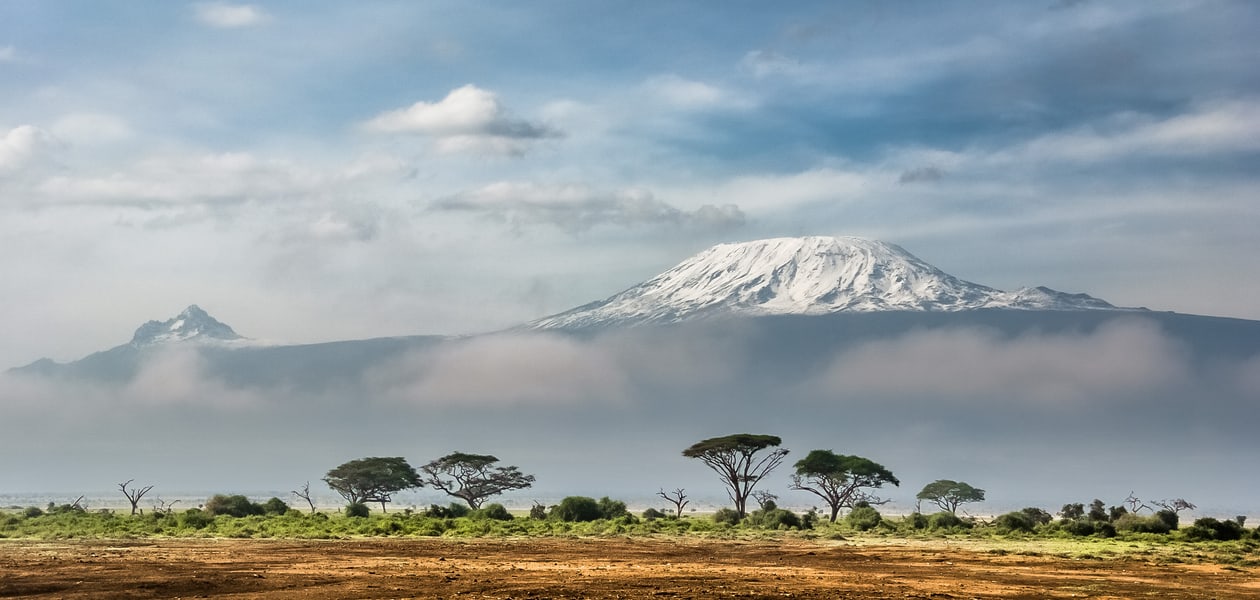
Kenya
© Sergey Pesterev / Wikimedia Commons · CC BY-SA 4.0 · cropped
Kenya spans 581,309 km² from the Indian Ocean to Lake Victoria and holds more than 54 million people, with its capital at Nairobi. Ethiopia and South Sudan lie to the north, Somalia to the east, Tanzania to the south and Uganda to the west. The equator runs across the middle of it. Behind a hot coastal strip the ground climbs to a temperate highland plateau, split from north to south by the Great Rift Valley — and it is the highlands, not the coast, where most Kenyans live. Mount Kenya, at 5,199 m, is the second-highest mountain in Africa.
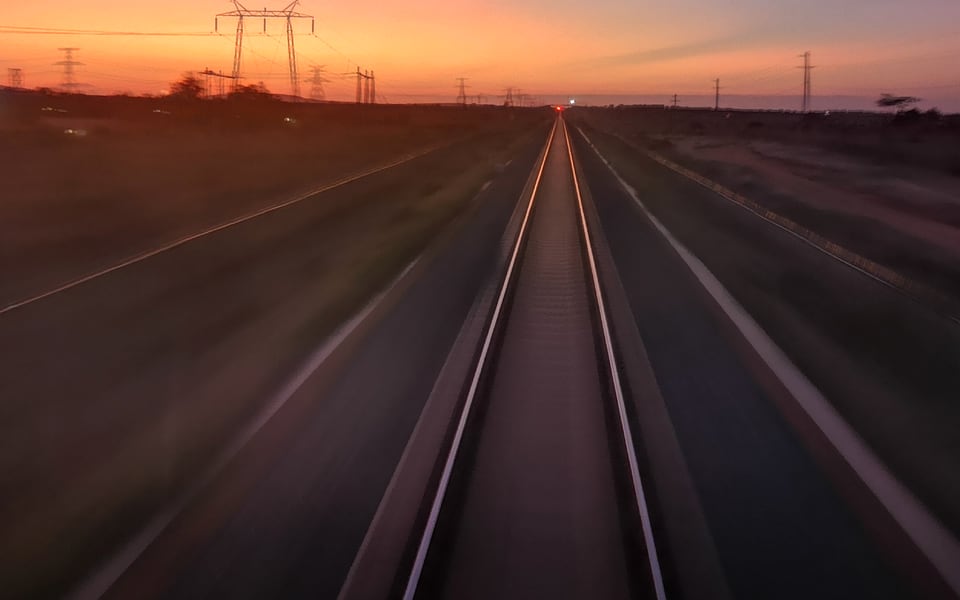
There are two railways here rather than one, running broadly the same way. The older is a metre-gauge system reaching from Mombasa through Nairobi to the Ugandan border, and beside it now runs the standard-gauge railway opened in 2017, financed by Chinese loan, which carries the Madaraka Express from the coast up to Nairobi and on to Suswa. Kenya Railways works both, and is unusually open about it: named services, online booking for the express, and dated timetable-and-fare documents for the metre-gauge trains to Nanyuki and along the coast.
Rail journeys in Kenya
Good to know
What does "Madaraka" mean?
Self-rule. Madaraka Day, 1 June, marks the day in 1963 when Kenya attained internal self-government, and the standard-gauge express was named for it. The choice was pointed: the new railway does the job the colonial Uganda Railway was built to do, over broadly the same ground, and it was named for independence rather than for a place.
Why does Kenya have two railways side by side?
Because the second was built new rather than as an upgrade. The metre-gauge line of the 1890s could not be converted to modern axle loads and speeds, so the standard-gauge railway was laid as a separate route with its own alignment and its own stations, generally outside the town centres. The old network still exists and still carries trains, but the through metre-gauge passenger service is a shadow of what it was.
Can you see wildlife from the train?
Yes, and the route is the reason. The standard-gauge line runs up the corridor between Tsavo East and Tsavo West national parks, and its viaducts and embankments were deliberately raised above ground level so that wildlife can pass underneath — the old metre-gauge line and the road were laid at ground level and animals were being killed on both. The metre-gauge run north to Nanyuki heads for Mount Kenya and crosses the equator on the way. Neither is a game drive, but neither is ordinary countryside either.
Are there rail passes for Kenya?
No. Kenya belongs to no pass scheme and there is no national multi-journey ticket. Seats on the Madaraka Express are booked individually through Kenya Railways, in economy or first class, and the metre-gauge services are sold to the operator's published fare tables.