Luxembourg

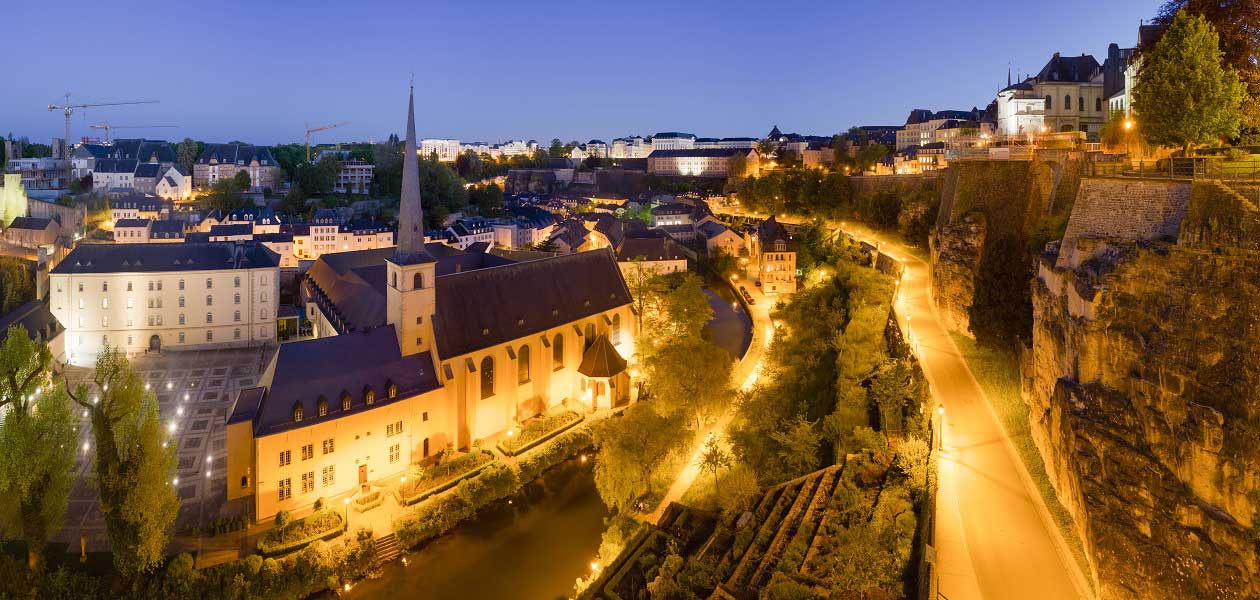
Luxembourg is a grand duchy of 2,586 km² and about 691,000 people, wedged between Belgium to the west and north, Germany to the east and France to the south. It is small enough to cross in an hour by road, and divided cleanly in two: the wooded hills and deep river valleys of the Ardennes in the north, and the flatter, richer Gutland in the south, where the capital stands on its gorge and where the iron-ore country known as the Minett meets the French border.
The railway matches the country — 275 route-kilometres, almost entirely electrified, advertised by the national operator CFL as just seven lines. It carried about 31.4 million passengers in 2025, and CFL is the country's largest corporate employer. What sets it apart is not its size but its price: since 1 March 2020 Luxembourg has made all public transport free throughout its territory, funded from general taxation, the first country in the world to do so.
Rail journeys in Luxembourg
Good to know
Is train travel in Luxembourg really free?
Within the country, yes. Since 1 March 2020 all public transport — buses, trams and trains — has been free throughout the territory of the Grand Duchy, paid for out of general taxation, and Luxembourg was the first country in the world to do it. The important limit is the word territory: a journey that continues into Belgium, Germany or France is only free as far as the border, and the rest of it is an ordinary ticket.
Is an Interrail or Eurail pass worth buying for Luxembourg?
Almost certainly not for Luxembourg itself, because domestic travel costs nothing. Interrail does not sell a Luxembourg one-country pass at all; the country is included in the Benelux pass alongside Belgium and the Netherlands. If Luxembourg is one stop on a wider European trip, a pass may still make sense for everything either side of it.
Where does the railway actually go?
CFL groups its network into seven lines radiating from Luxembourg City. The one that matters most for scenery is Line 10, running north through the Ardennes to Troisvierges and on into Belgium, with branches to Wiltz and Diekirch. The others reach the steel towns of the south, and cross the borders to Trier, Brussels, Thionville and Longwy.
Which line is worth going out of your way for?
Line 10, the northern line. It is the longest continuous railway in the Grand Duchy at 68.9 km from Luxembourg to Troisvierges, and it spends its last 38 kilometres inside the river meanders of the Oesling, through eighteen tunnels and over fifty-one river bridges. Trains run twice an hour, and the Intercity carries straight on across the Belgian border to Liège.
Is there any heritage railway?
Yes, in the old iron-mining country of the south. The Fond-de-Gras industrial and railway park near Pétange runs a volunteer steam train, and a narrow-gauge mine railway runs from the same site into the former workings. Both are seasonal rather than year-round, so the operating dates are worth checking before travelling out.