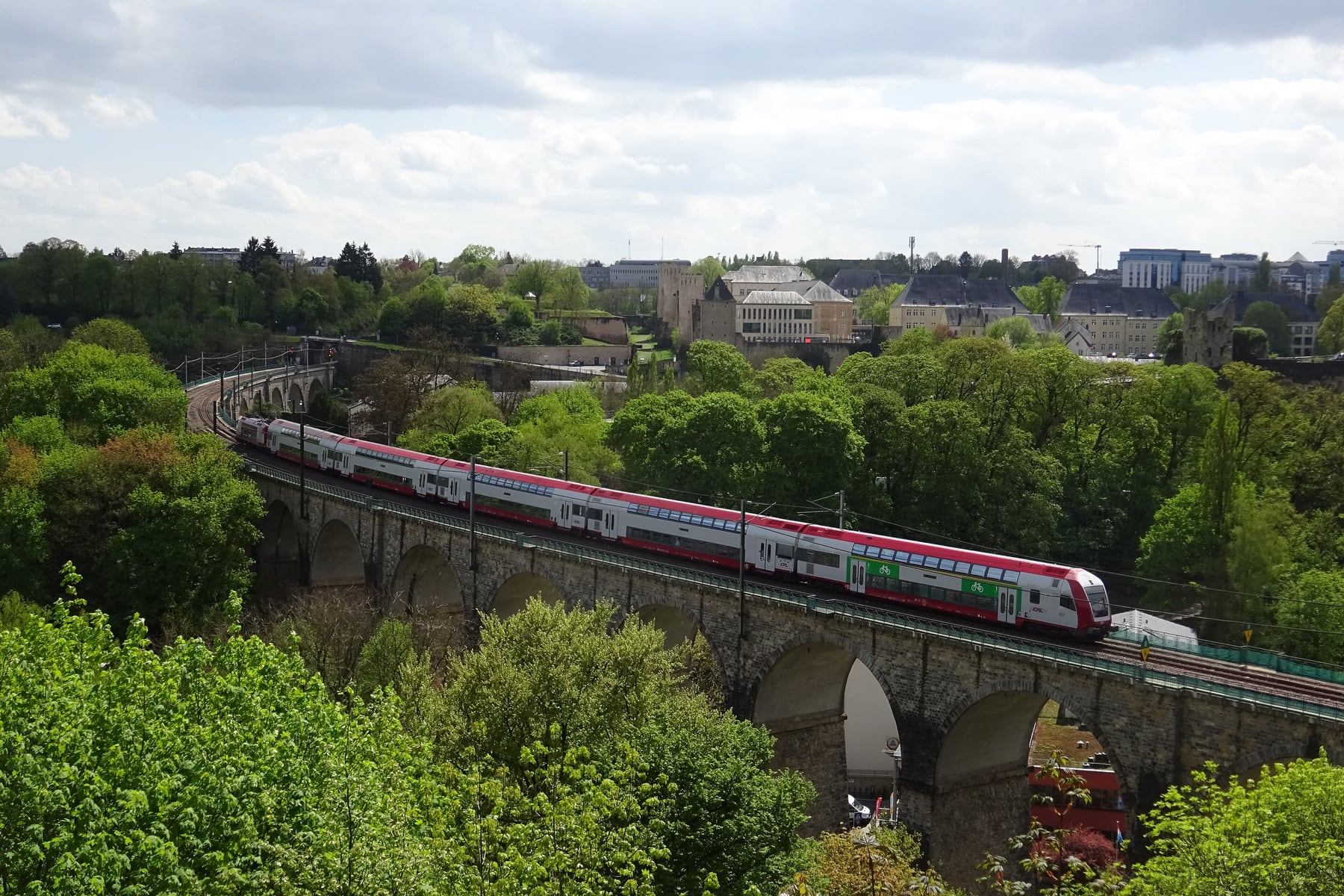
CFL Line 10 — Luxembourg City to Troisvierges through the Ardennes
Entbert / Wikimedia Commons · CC BY 4.0 · 2026 · cropped
- Distance68.9 km, Luxembourg to Troisvierges
- Duration1 hr 8 min to Troisvierges; 2 hr 39 min through to Liège
- Best seasonAll year, twice an hour · the beech woods of the Oesling turn through October
Introduction
CFL's national ticket page has four products on it, and every one of them is first class. A short-duration first-class ticket costs €3 and lasts two hours; a first-class day ticket is €6. Second class is not discounted and it is not cheap — it is not sold at all. Since 1 March 2020 the Grand Duchy has carried everybody free of charge on every bus, tram and train inside its own borders, residents, cross-border workers and visitors alike, the first country in the world to do it. What that leaves a traveller is a 68.9-kilometre railway you can simply get on.
Line 10 is the one worth the journey. It leaves Luxembourg City northwards on viaducts above the Alzette gorge, crosses the open farmland of the Gutland to Ettelbruck, and then turns into the Oesling — Luxembourg's share of the Ardennes — where it spends the last 38 kilometres inside the meanders of the Sûre, the Wiltz and the Clerve, through eighteen tunnels and over fifty-one river bridges, to Troisvierges in the far north. It is the longest continuous railway line in the country, and the Intercity that works it carries straight on over the Belgian border to Liège.
The Journey
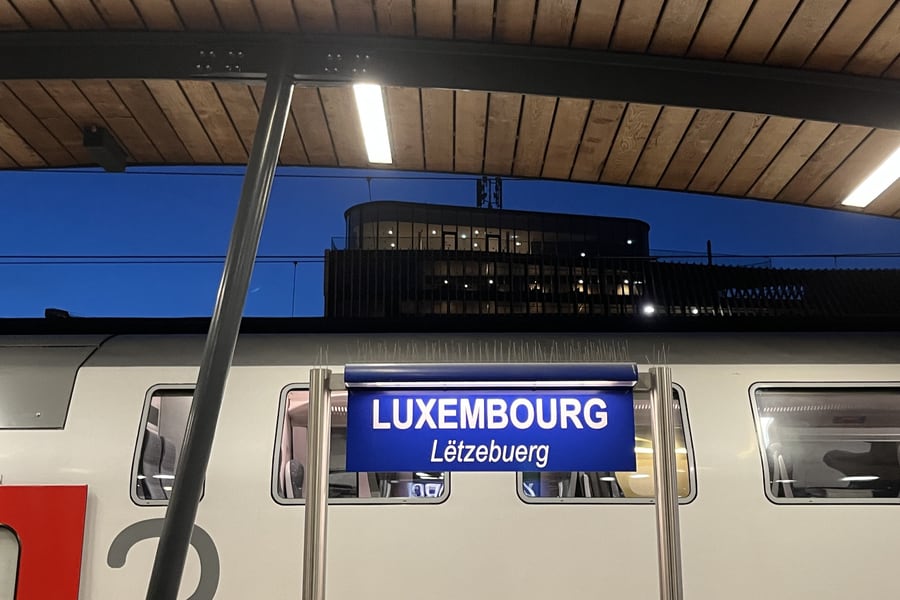
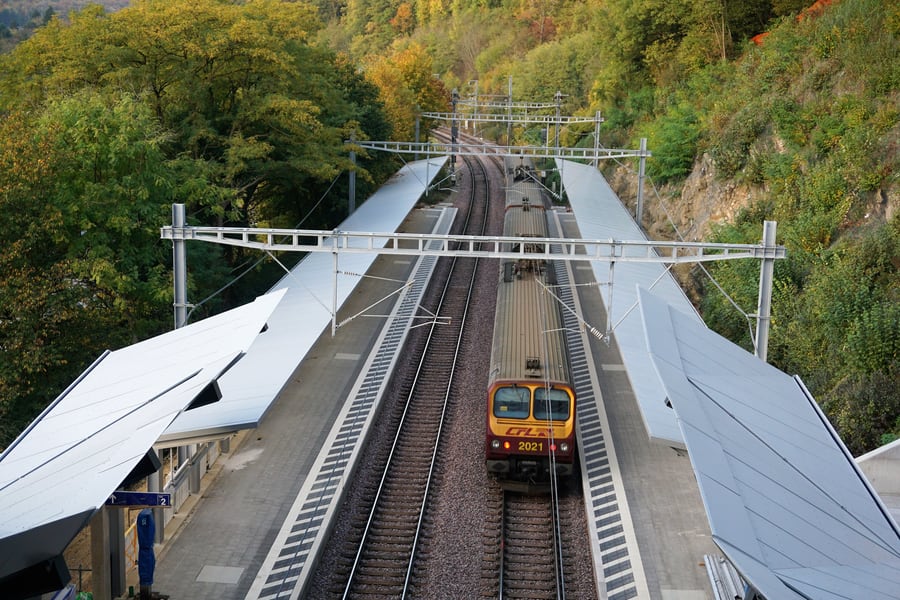
Luxembourg's main station stands south of the old town, and the northern line leaves it in the wrong direction — swinging east and then north across the Alzette on the viaducts below the fortifications, past the Rham plateau, and into the gorge that splits the capital in two. The first stop is four minutes out: Pfaffenthal-Kirchberg, a two-platform station wedged between rock walls in the bottom of that gorge, under the Grand Duchess Charlotte Bridge. It opened on 10 December 2017 along with the 200-metre funicular that lifts passengers from the platform up to the tram on the Kirchberg plateau, and it is the only place on the line where the railway is the thing at the bottom of the valley rather than the thing on the ledge.
The Gutland
From Dommeldange the line runs up the Alzette through the Gutland, the softer, lower, richer southern half of the country: Walferdange, Heisdorf, Lorentzweiler, Lintgen, and then Mersch at the confluence of the Alzette, the Mamer and the Eisch. This is commuter territory, and it is double-track throughout — the Wilhelm-Luxemburg-Bahn opened Luxembourg to Ettelbruck on 21 July 1862 and a second track went in between 1907 and 1917. Cruchten, Colmar-Berg and Schieren follow, and 30.55 kilometres out the train reaches Ettelbruck.
Ettelbruck is where the line stops being simple. A branch goes east to Diekirch, five minutes away, worked every half hour; the signal box here controls the whole railway from Ettelbruck to the Belgian border; and the platform boards start listing places nobody outside Luxembourg has heard of. The trains that continue north change character within a few minutes of leaving.
Into the Oesling
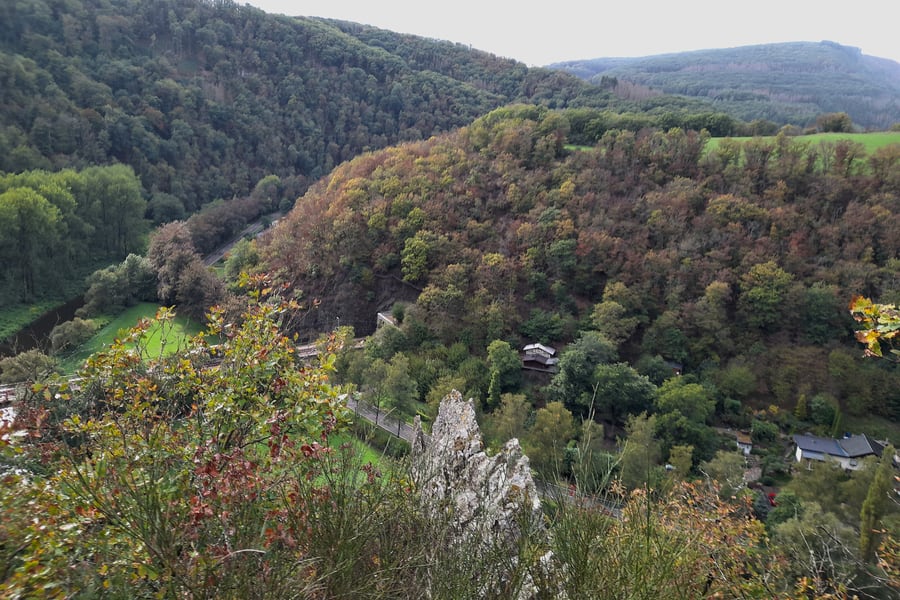
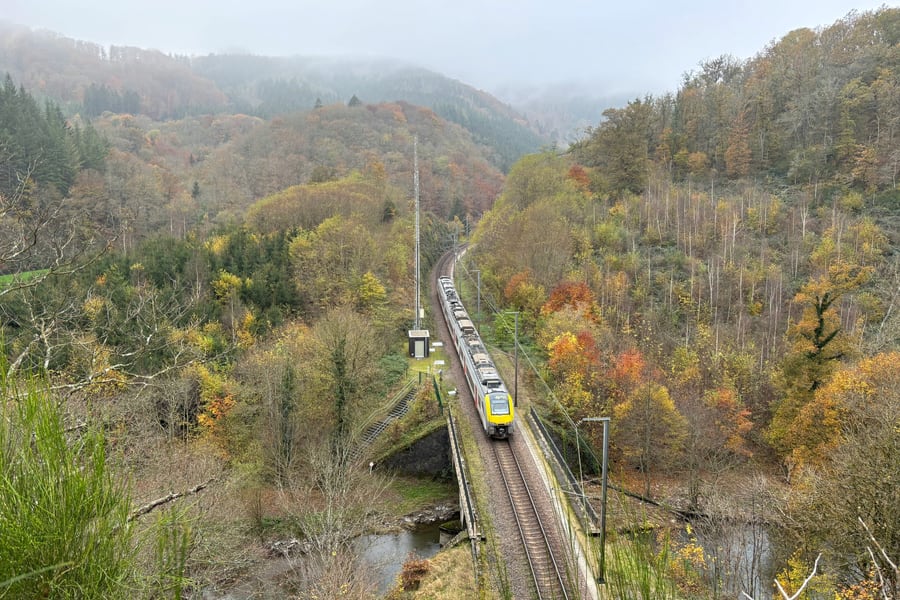
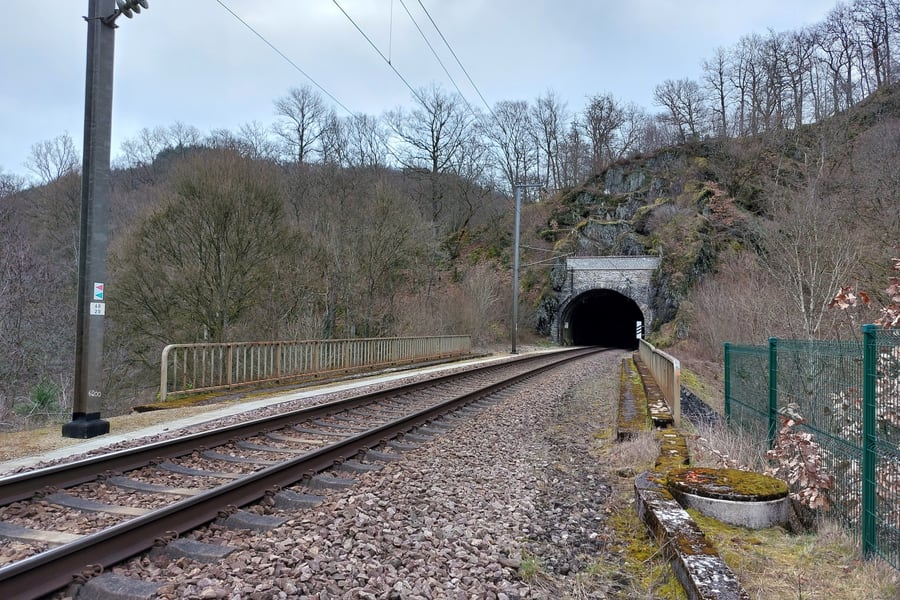
The Ettelbruck–Troisvierges section was built between 1862 and 1866 and opened on 15 December of that year, and its engineers made one decision that shaped everything since: rather than climb over the plateau, they followed the rivers. The Sûre, the Wiltz and the Clerve wind through the Oesling in tight meanders, so the railway winds with them. Minimum curve radius, as a rule, 400 metres. Maximum gradient 1.5 per cent. Eighteen tunnels and fifty-one river bridges over 38 kilometres, and a run that is almost never straight for a kilometre together.
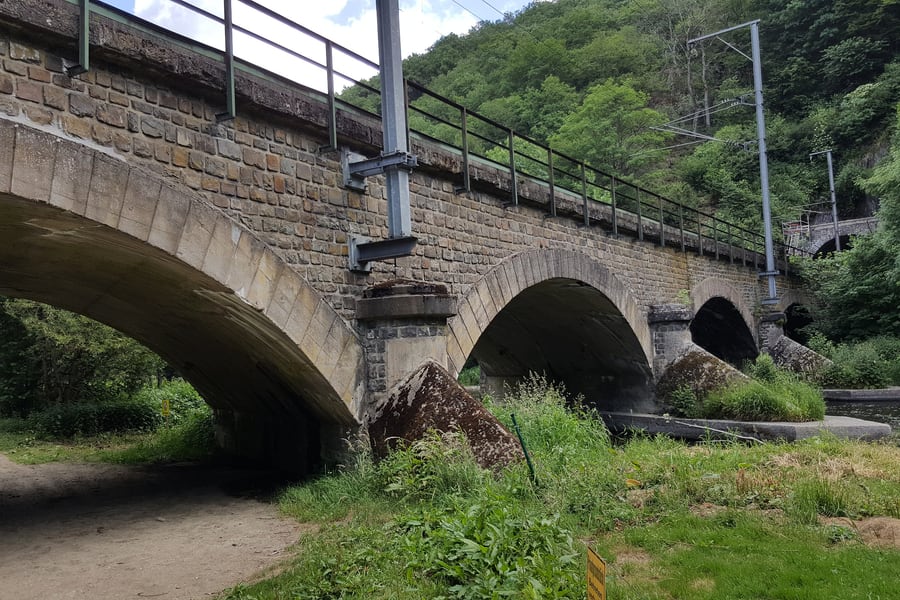
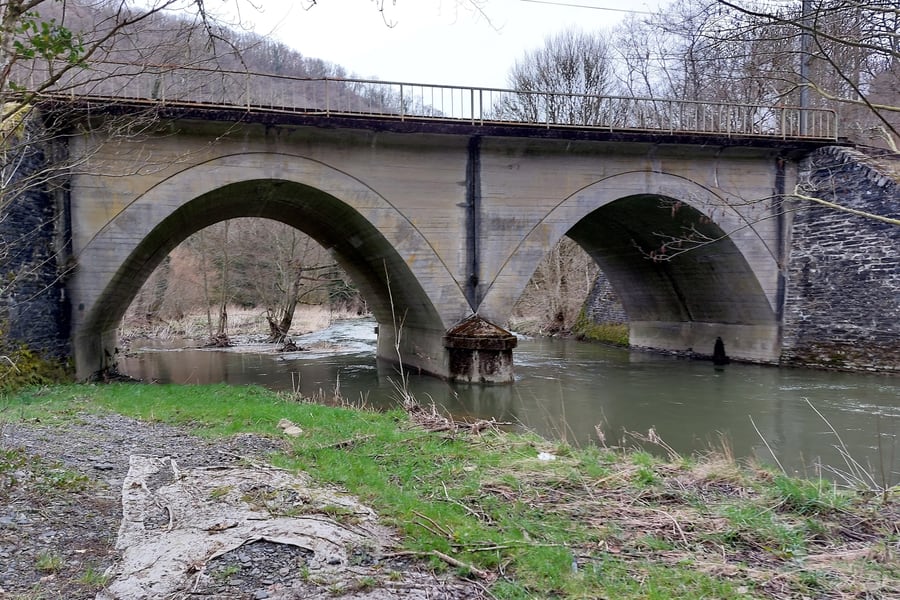
Michelau and Goebelsmühle come first, in the Sûre valley, with the wooded ridge of Bourscheid and its castle standing 150 metres above the river. At Goebelsmühle the Wiltz joins the Sûre and the line changes rivers; the stone arch bridge there, and the twin-arch bridge over the Wiltz a little further on, are typical of the whole section — squat, unadorned, and 160 years old.
Kautenbach
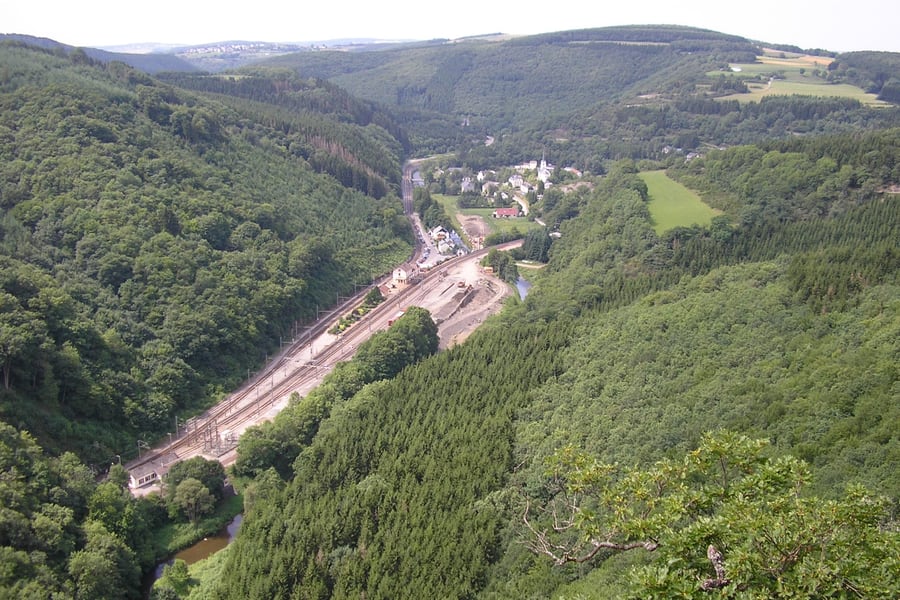
Kautenbach is a village of about 150 people with a junction station, and it is the best place on the line to get off. Two valleys meet here at a right angle. The main line goes north up the Clerve; a branch turns west up the Wiltz, through the Schwaarzepull tunnel and over the river, to Merkholtz, Paradiso and Wiltz itself, twelve minutes away and worked every half hour. The station sits in the bottom of the fork with wooded slopes rising on three sides, and the marked footpaths of the Kiischpelt start at the platform end.
Clervaux and Troisvierges
North of Kautenbach the Clerve valley narrows again through Wilwerwiltz and Drauffelt. Clervaux, an hour from the capital, is the one town on the northern half with something to detain a visitor: a white twelfth-century castle on a spur above the river, rebuilt after it burned in the Battle of the Bulge, and inside it Edward Steichen's The Family of Man.
Troisvierges is the end of the Luxembourg service and the northernmost and highest commune in the country — the two highest hills in the Grand Duchy, the Kneiff and the Buurgplaatz, are both in it. The station keeps a long iron-and-glass canopy over its platforms, and the Intercity waits here for a few minutes before running the last 7.8 kilometres to the Belgian border.
The traction
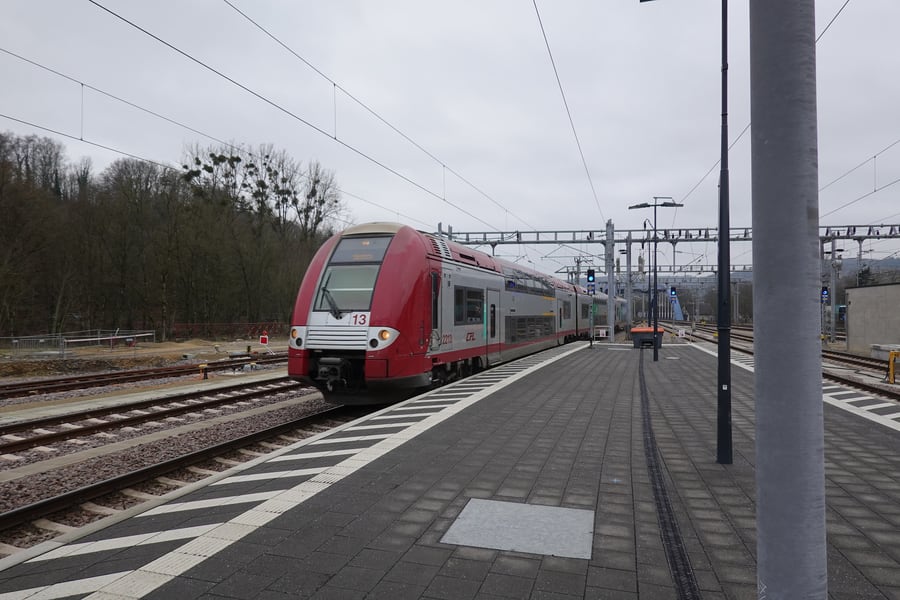
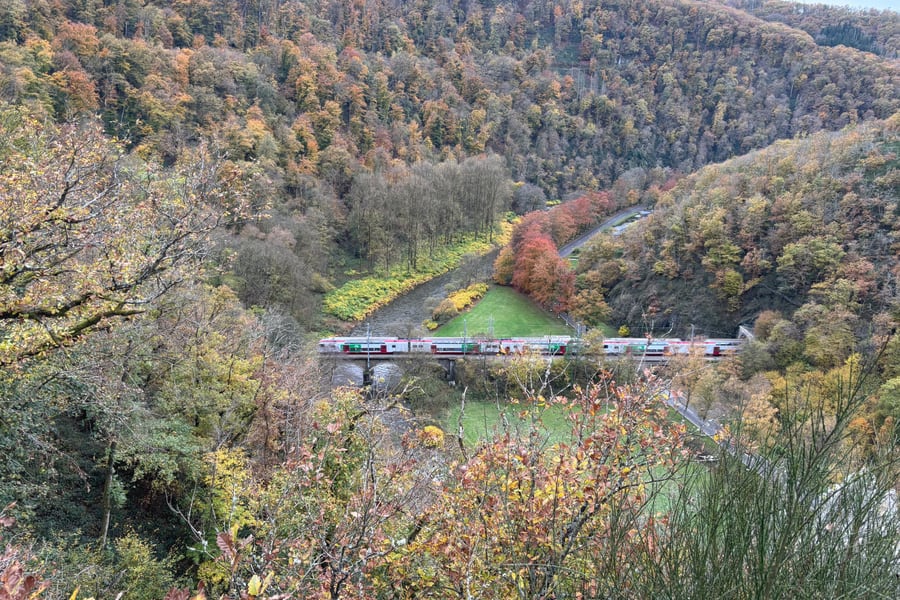
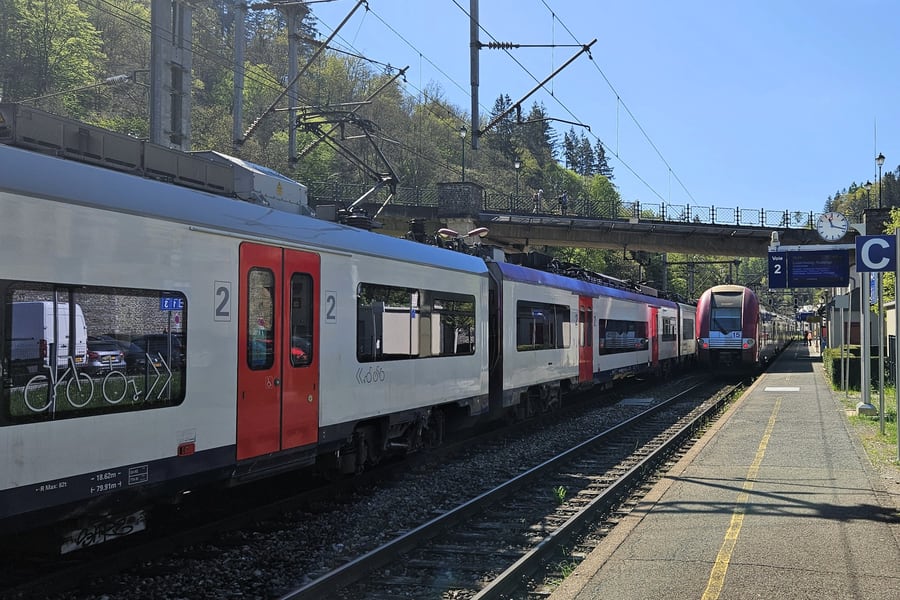
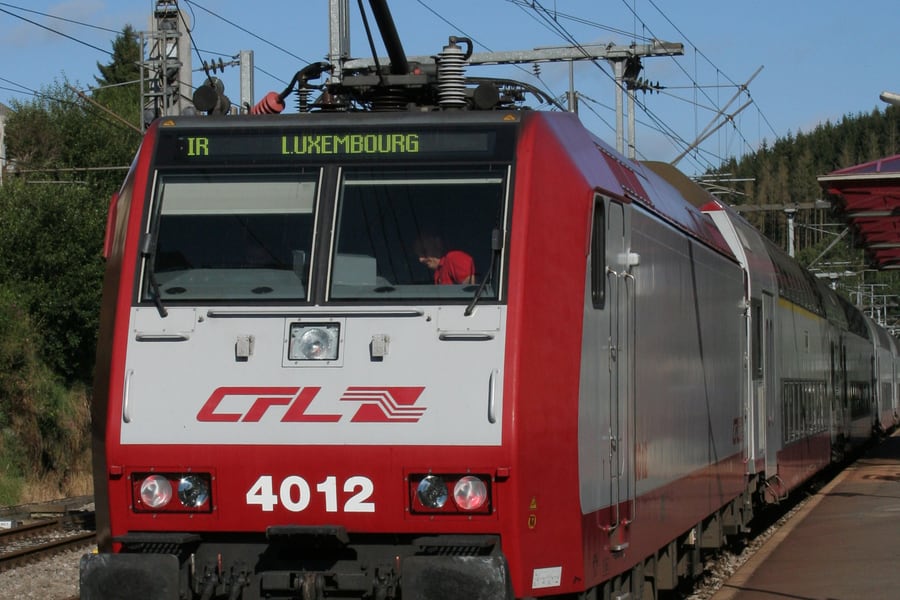
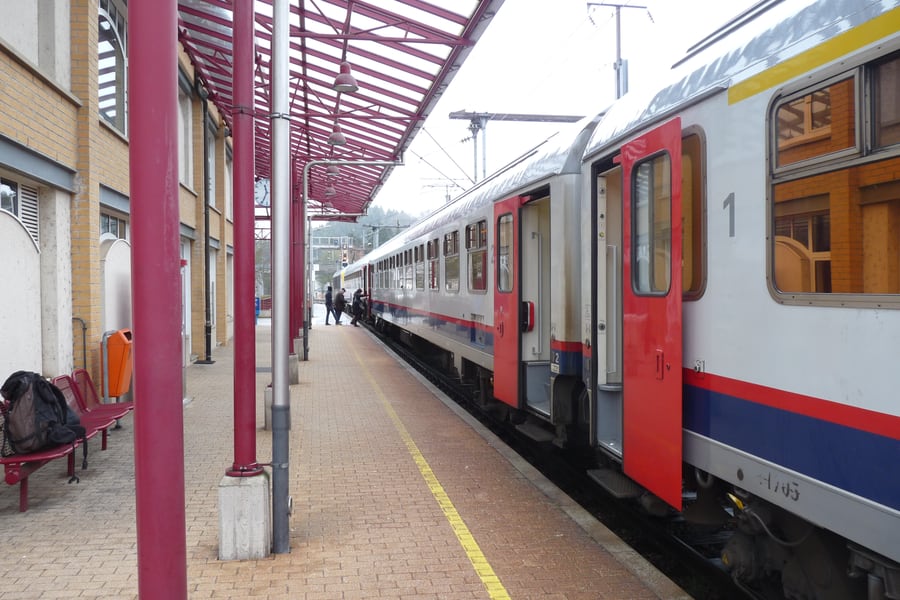
Nothing on this line is exotic and all of it is new. The half-hourly domestic services are worked by CFL's double-deck electric units — the Class 2200, an Alstom Coradia Duplex, now in the red and white livery it was given at its half-life refurbishment, and the Class 2300, a Stadler KISS — or by Class 4000 electric locomotives pushing and pulling double-deck coaches. The through Intercity to Liège has been in the hands of Belgian Class AM08 units since December 2019, silver and yellow Siemens Desiro ML sets that look nothing like the rest of the traffic. The whole line is electrified at 25 kV: Luxembourg to Ettelbruck from 9 June 1988, Ettelbruck to Kautenbach from 20 April 1991, Kautenbach to Troisvierges from 25 September 1993.
Along the route
 CFLTunnels / Wikimedia Commons · CC BY-SA 4.0 · 2023 · cropped
Eighteen tunnels, fifty-one bridges
The engineers who cut Ettelbruck to Troisvierges between 1862 and 1866 refused to climb. They followed the water instead — the Sûre, then the Wiltz, then the Clerve — and paid for it with eighteen tunnels and fifty-one river bridges in thirty-eight kilometres.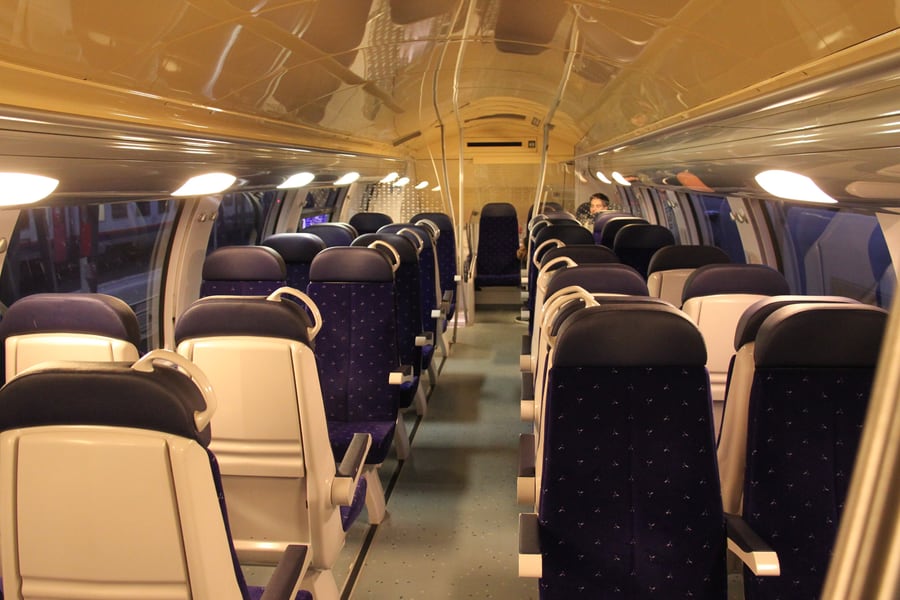 Willem 90 / Wikimedia Commons · CC0 · 2015 · cropped
The seat costs nothing
Second class here is not discounted or capped. It is free, and has been since 1 March 2020, when Luxembourg abolished fares on every bus, tram and train inside its borders and became the first country in the world to do it.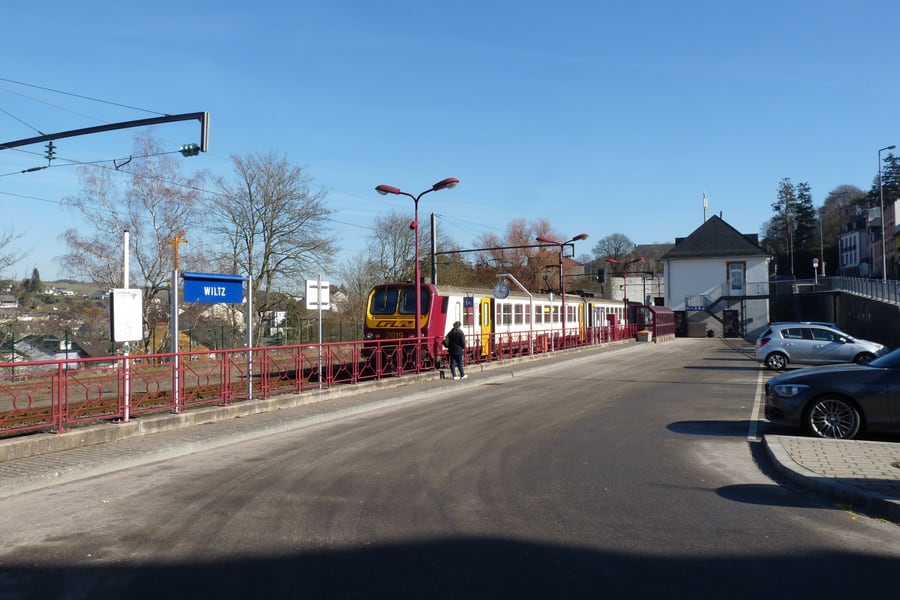 Smiley.toerist / Wikimedia Commons · CC BY-SA 4.0 · 2019 · cropped
Two branches, not afterthoughts
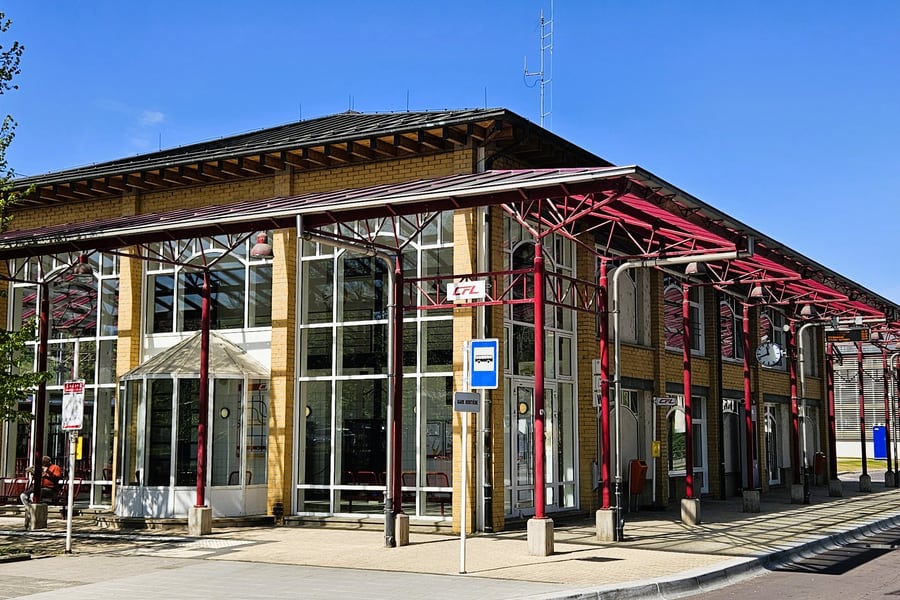
Line 10 has three northern ends. A five-minute spur runs east from Ettelbruck to Diekirch, and a twelve-minute branch climbs west from Kautenbach up the Wiltz. Both are electrified, both run half-hourly, and both are timed to connect.A bit of history
Culture & experiences along the way
 Smiley.toerist / Wikimedia Commons · CC BY-SA 4.0 · 2018 · cropped
Straight on into Belgium
The train at :16 out of Luxembourg does not stop at the border. It runs the whole length of Line 10, waits a few minutes at Troisvierges, crosses into Belgium at Gouvy and carries on down the Salm and the Amblève to Liège-Guillemins, two hours and thirty-nine minutes from the capital. It is Belgian Intercity line 33, worked by SNCB's silver and yellow Class AM08 units since December 2019. Free travel stops at the frontier, so the Belgian half needs a ticket.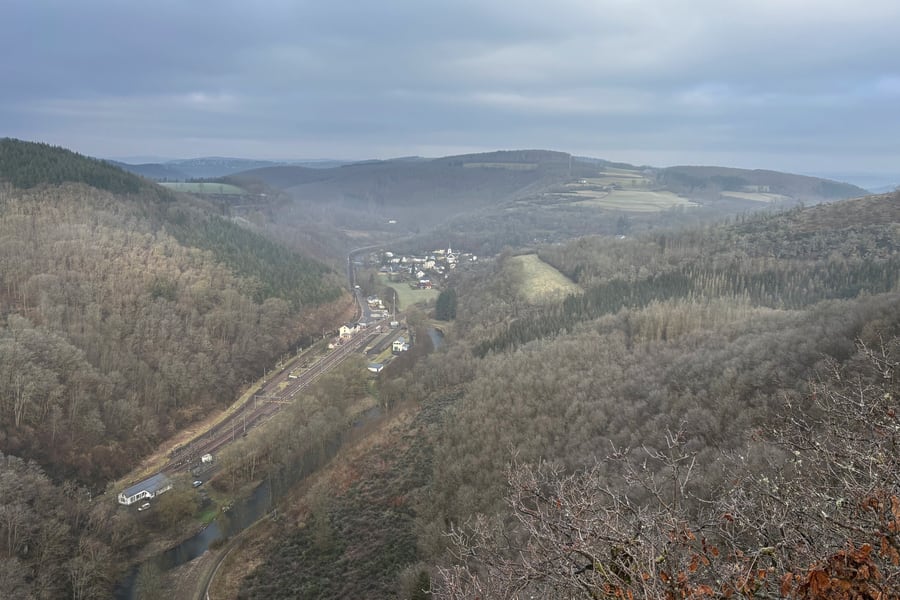 Hejnjahns / Wikimedia Commons · CC BY-SA 4.0 · 2025 · cropped
Getting off at Kautenbach
Kautenbach has about 150 inhabitants, a junction station and two valleys meeting at a right angle, and it is the best place on the line to stop walking distance from the platform. The Wiltz comes in from the west, the Clerve from the north, and the wooded slopes of the Kiischpelt rise on three sides of the station. Trains call twice an hour in each direction on the main line and twice an hour on the Wiltz branch, so a walk here can be as long or as short as the next departure allows.Timetables
Line 10 runs to a clock-face timetable, twice an hour in each direction, every day of the year. Northbound departures from Luxembourg are at :16 and :44 past every hour; southbound departures from Troisvierges are at :05 and :35. The train at :16 out of Luxembourg is the through Intercity for Gouvy and Liège; the one at :44 is a Regional Express that terminates at Troisvierges. The two call at slightly different places between Ettelbruck and Kautenbach — the Intercity stops at Michelau and runs past Goebelsmühle, and the Regional Express does the opposite.
Times below are from CFL's own Line 10 timetable sheet, valid from 14 December 2025 to 12 December 2026, checked against the national journey planner in August 2026.
Northbound — Luxembourg to Troisvierges and Liège
| Station | Intercity | Regional Express |
|---|---|---|
| Luxembourg | 06:16 | 06:44 |
| Pfaffenthal-Kirchberg | 06:20 | 06:48 |
| Dommeldange | — | 06:51 |
| Mersch | 06:33 | 07:03 |
| Ettelbruck | 06:45 | 07:15 |
| Michelau | 06:50 | — |
| Goebelsmühle | — | 07:24 |
| Kautenbach | 07:00 | 07:30 |
| Wilwerwiltz | 07:05 | 07:35 |
| Drauffelt | 07:09 | 07:39 |
| Clervaux | 07:16 | 07:46 |
| Troisvierges | 07:33 | 07:54 arr |
| Gouvy (Belgium) | 07:40 | — |
| Liège-Guillemins | 08:55 arr | — |
Southbound — Liège and Troisvierges to Luxembourg
| Station | Regional Express | Intercity |
|---|---|---|
| Liège-Guillemins | — | 06:07 |
| Gouvy (Belgium) | — | 07:24 |
| Troisvierges | 07:05 | 07:35 |
| Clervaux | 07:14 | 07:44 |
| Drauffelt | 07:20 | 07:50 |
| Wilwerwiltz | 07:24 | 07:54 |
| Kautenbach | 07:31 | 08:01 |
| Goebelsmühle | 07:35 | — |
| Michelau | — | 08:08 |
| Ettelbruck | 07:46 | 08:16 |
| Mersch | 07:56 | 08:28 |
| Dommeldange | 08:08 | — |
| Pfaffenthal-Kirchberg | 08:11 | 08:42 |
| Luxembourg | 08:15 arr | 08:46 arr |
Luxembourg to Troisvierges takes 1 hr 8 min by Intercity and 1 hr 10 min by Regional Express; Luxembourg to Liège-Guillemins takes 2 hr 39 min in either direction. The first northbound train of the day leaves Luxembourg at 01:10 and the last at 22:44; the first southbound leaves Troisvierges at 04:05 and the last at 22:35.
Frequency, branches and closures
The through Intercity to Liège runs hourly Monday to Friday and every two hours on Saturdays, Sundays and Luxembourg public holidays, when a Regional Express takes the remaining :16 paths as far as Troisvierges. Both branches keep a half-hourly service of their own: Ettelbruck to Diekirch takes 5 minutes, with departures back from Diekirch at :21 and :51, and Kautenbach to Wiltz takes 12 minutes, with departures back from Wiltz at :16 and :46.
⚠️ The northern half of the line is shut for track renewal until Monday 14 September 2026. CFL closed Ettelbruck–Troisvierges–Gouvy and Kautenbach–Wiltz on 24 August 2026 to renew 2.6 km of track between Cinqfontaines and Troisvierges and 1.1 km between Kautenbach and Paradiso. Replacement buses L14 to L17 cover every station in the meantime, and a free bicycle shuttle runs every two hours from Ettelbruck bus station towards Clervaux and Troisvierges. Trains resume on 14 September 2026. Blockades of this kind recur in the summer school holidays most years, and CFL lists them at cfl.lu/en-gb/works (opens in a new tab); the current timetable sheet is at cfl.lu/en-gb/timetable/sheets (opens in a new tab).
Tickets
There is nothing to buy. Every bus, tram and train inside Luxembourg has been free to everybody since 1 March 2020 — residents, the 200,000 cross-border workers who commute in each day, and visitors alike. No ticket, no validation, no zones, the whole way from Luxembourg to Troisvierges and on both branches.
First class is the only thing CFL still sells for a domestic journey. It is a marked section of the same double-deck train everyone else is riding: a quieter compartment and a slightly better seat, sold at ticket machines and in the CFL go app. Free travel stops at the frontier, so a train continuing to Gouvy, Liège, Trier or Thionville needs an ordinary ticket for the part beyond it. Fares checked August 2026 against cfl.lu (opens in a new tab).
Book your tickets
First class, two hours
Valid anywhere on CFL inside Luxembourg
A two-hour first-class ticket, or a booklet of ten for €24.00.
Book Tickets (opens in a new tab, on cfl.lu)via cfl.luFirst class, all day
Valid until 04:00 the next morning
A first-class day ticket, or a booklet of five for €24.00.
Book Tickets (opens in a new tab, on cfl.lu)via cfl.luBeyond the border
Gouvy, Liège, Trier, Thionville, Arlon
Free travel ends at the frontier; cross-border legs need an ordinary ticket.
Book Tickets (opens in a new tab, on cfl.lu)via cfl.luRail Passes
For Line 10 itself, a rail pass is money thrown away. Everything between Luxembourg and Troisvierges is free without one, and a pass cannot make a free journey cheaper. Interrail does not sell a Luxembourg one-country pass at all — the country is folded into the Benelux Pass, shared with Belgium and the Netherlands.
That pass is worth considering for one thing only: the part of this journey that is not free. The Intercity carries on over the border to Gouvy and Liège, and the Benelux Pass covers travel between the three Benelux countries, so it pays for the Belgian half of a Luxembourg–Liège run. Adult second-class prices in August 2026 were €137 for 3 travel days within a month, €165 for 4, €191 for 5, €216 for 6 and €259 for 8. Two conditions matter here: a One Country Pass cannot be bought by someone who lives in the country it covers, and the Benelux Pass allows only the borders between Belgium, the Netherlands and Luxembourg — a leg to Trier or Metz is outside it.
On the trains themselves, Interrail's own operator table lists CFL's Regional Bahn, Regional Express, Intercity and TER services as included, with no reservation needed on anything that runs on this line. The one CFL product excluded is the FernBus. Checked August 2026 against interrail.com (opens in a new tab).
The honest summary: if Luxembourg is one stop on a wider European trip, carry whatever pass that trip needs and use it here for free. If Luxembourg is the trip, buy nothing.
Places to Visit
Line 10 is short enough that its whole length is a day out, and free travel makes getting off and back on again cost nothing. Four of the five places below are within a walk of a station; the fifth, Vianden, is reached by bus 180 from Ettelbruck bus station, which takes 28 minutes, or by bus 181 from Diekirch. Those buses are free as well. Between them the five cover most of what northern Luxembourg keeps: a fortress capital, three castles in three different river valleys, and one of the most travelled photographic exhibitions ever assembled.
 P. Hughes / Wikimedia Commons · CC BY-SA 4.0 · 2024 · cropped
The Bock, at the start of the line
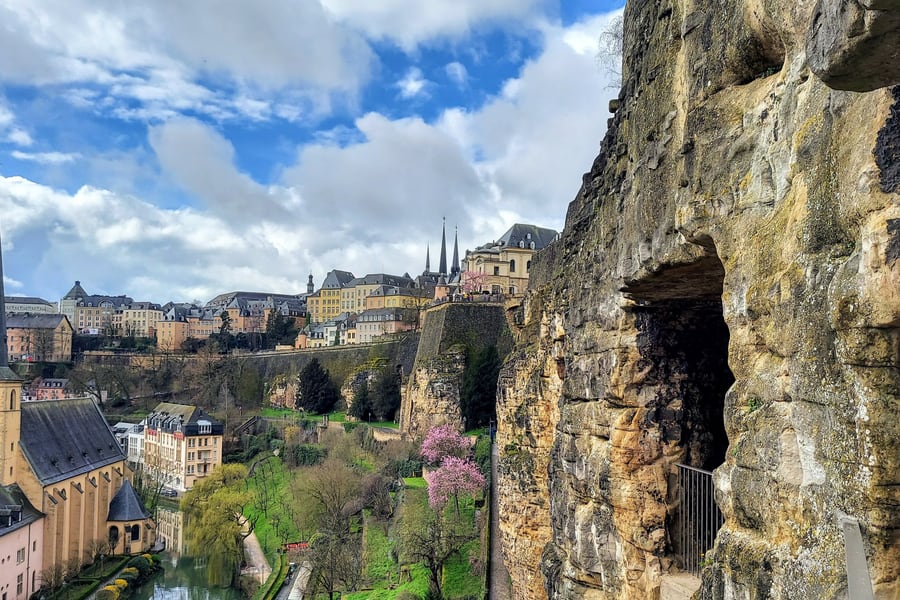
Count Siegfried built his castle of Lucilinburhuc on this promontory in 963, and the town that grew below it took its name. The Bock and the fortress around it were besieged and rebuilt for nine centuries by Burgundians, Habsburgs, Spaniards, Prussians and French, until the Treaty of London of 1867 ordered the fortifications demolished. What survived is underground: the casemates, a system of galleries cut through the rock, and the view down into the Grund from above them.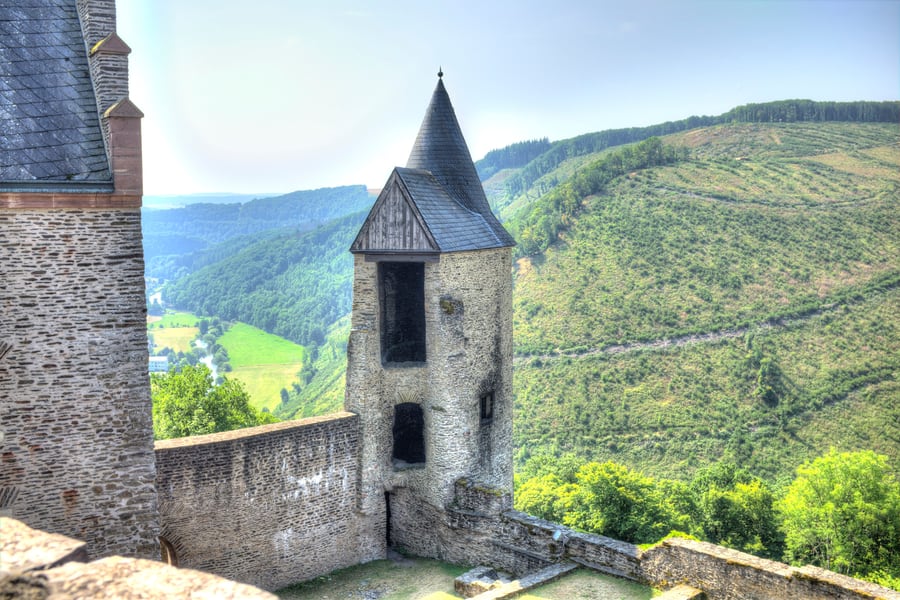 Colin Viney / Wikimedia Commons · CC BY-SA 4.0 · 2022 · cropped
Bourscheid Castle, above the Sûre
The railway passes below it between Michelau and Goebelsmühle: a ring wall with eleven watchtowers on a spur 150 metres above the river, on ground that has produced archaeological evidence of building back to Roman times. It is the largest castle site in Luxembourg and among the least restored — much of it is still the ruin it became, which is most of the appeal. The valley walk up from Michelau is steep and long enough to count as a day's exercise.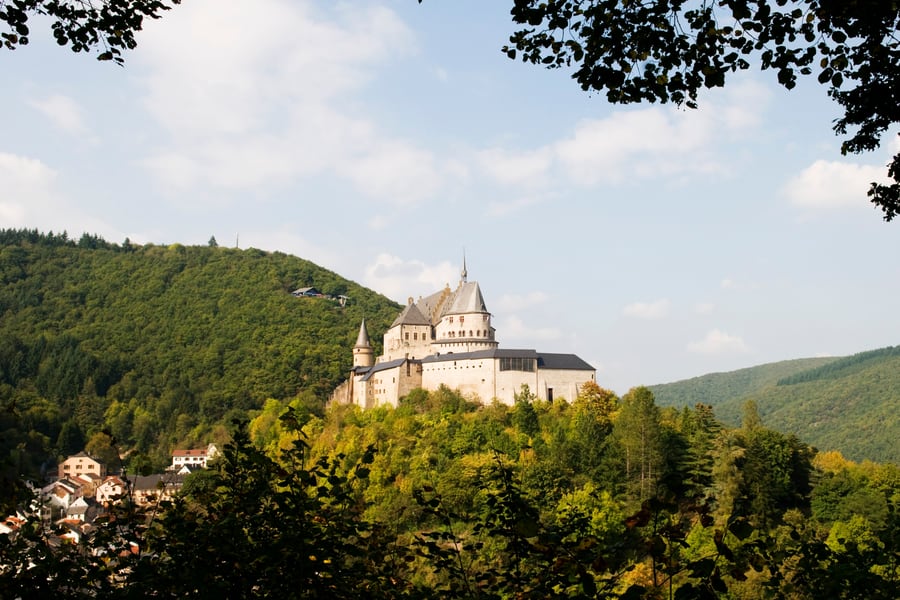 Michal Osmenda / Wikimedia Commons · CC BY-SA 2.0 · 2009 · cropped
Vianden Castle, a free bus from Ettelbruck
The best-known castle in the country stands on a ridge above the Our, and is one of the largest fortified castles west of the Rhine. There was a Roman outpost on the site in the fourth century; the Romanesque castle went up between the eleventh and fourteenth, Gothic work was added at the end of that period and a Renaissance mansion in the seventeenth, after which it was left to fall down. The restoration that brought it back is recent. Bus 180 from Ettelbruck bus station takes 28 minutes.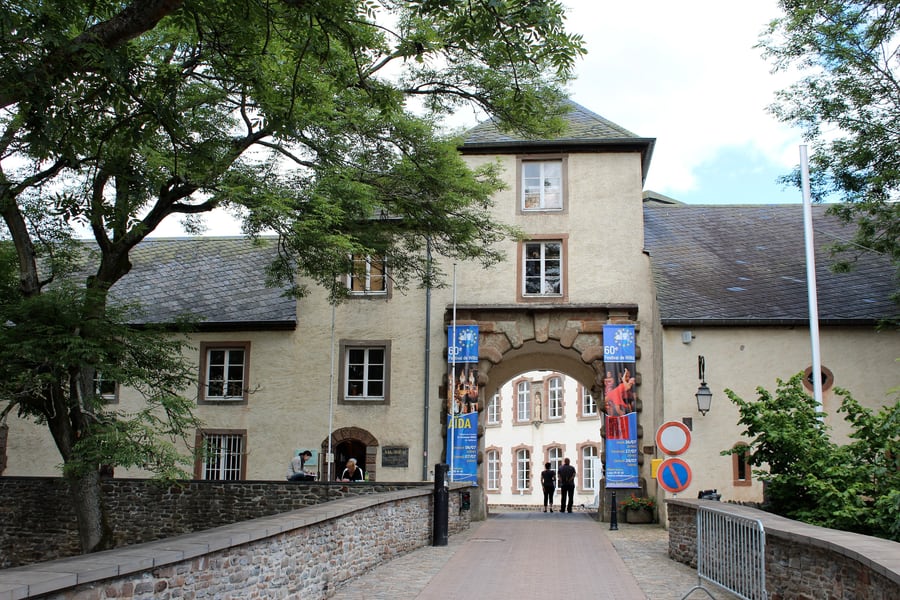 Zinneke / Wikimedia Commons · CC BY-SA 3.0 LU · 2012 · cropped
Wiltz Castle, at the end of the branch
The Lords of Wiltz put a fortified castle on this promontory in the thirteenth century; the French burned it in 1388 and Philip of Burgundy's troops came back in 1453, and the round Witches' Tower east of the gardens is what is left of that. The Renaissance house in front of it was begun in 1631 under Count John VI, delayed by the Thirty Years War and not finished until about 1720. Since 1953 the courtyard has held an international music festival each summer.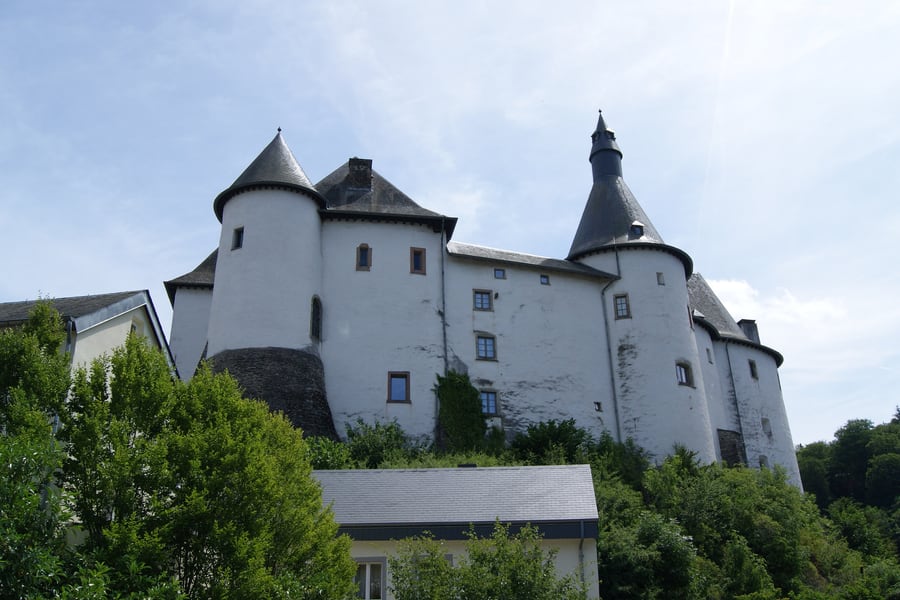 Asurnipal / Wikimedia Commons · CC BY-SA 4.0 · 2019 · cropped
Clervaux Castle and The Family of Man
The white castle above Clervaux dates from the twelfth century, burned in the Battle of the Bulge and was rebuilt afterwards. What is inside it is the reason to come: 503 photographs from 68 countries, assembled by the Luxembourg-born Edward Steichen for the Museum of Modern Art in New York, shown there in 1955 and then toured the world for eight years. The prints came to Clervaux in 1994, and in 2003 UNESCO added the collection to its Memory of the World Register.Where to Sleep
There is a case for not staying anywhere. The whole line is 68.9 kilometres and the capital is an hour from the northernmost station, so Troisvierges and back is a comfortable day return from a bed in Luxembourg City — and the return costs nothing. What the north offers instead is the chance to wake up in the Oesling, and the two towns that make that worth doing are Clervaux, on the line, and Vianden, a free bus ride from Ettelbruck or Diekirch.
Northern Luxembourg is small and so is its stock of rooms, which is worth knowing before arriving without a booking. All three houses below were open and taking bookings when this page was written in August 2026.
Where to stay
Grand Hotel Cravat
In the upper town, at the start of the line
A family hotel on the Boulevard Roosevelt in the Ville Haute, a short walk from Luxembourg station and about eight kilometres from the airport. It has its own bar, Le Trianon, and a breakfast room called Le Normandy.
Check Availability (opens in a new tab, on hotelcravat.lu)via hotelcravat.luKoener Hotel & Spa
On the Grand-Rue in Clervaux
A hotel at 14 Grand-Rue in the pedestrian centre of Clervaux, minutes from the station and below the castle. It has a spa with an indoor pool and a sauna area, and rooms ranging from comfort doubles to suites in the older part of the building.
Check Availability (opens in a new tab, on koener.excellence-group.lu)via koener.excellence-group.luHotel Heintz
A former monastery in Vianden
A family-run hotel in the historic part of Vianden, next to the Trinitarian church and its gothic cloister, in a completely renovated former monastery. The same family has run it for five generations; it has 28 rooms, all reached by lift, a rustic bar, a terrace and a garden.
Check Availability (opens in a new tab, on hotel-heintz.lu)via hotel-heintz.luQuestions or corrections
Planning this trip and stuck on something, or spotted a time, fare or detail that has changed? Send us a message about CFL Line 10 — Luxembourg City to Troisvierges through the Ardennes. We read every one, and we update this page when something has changed.