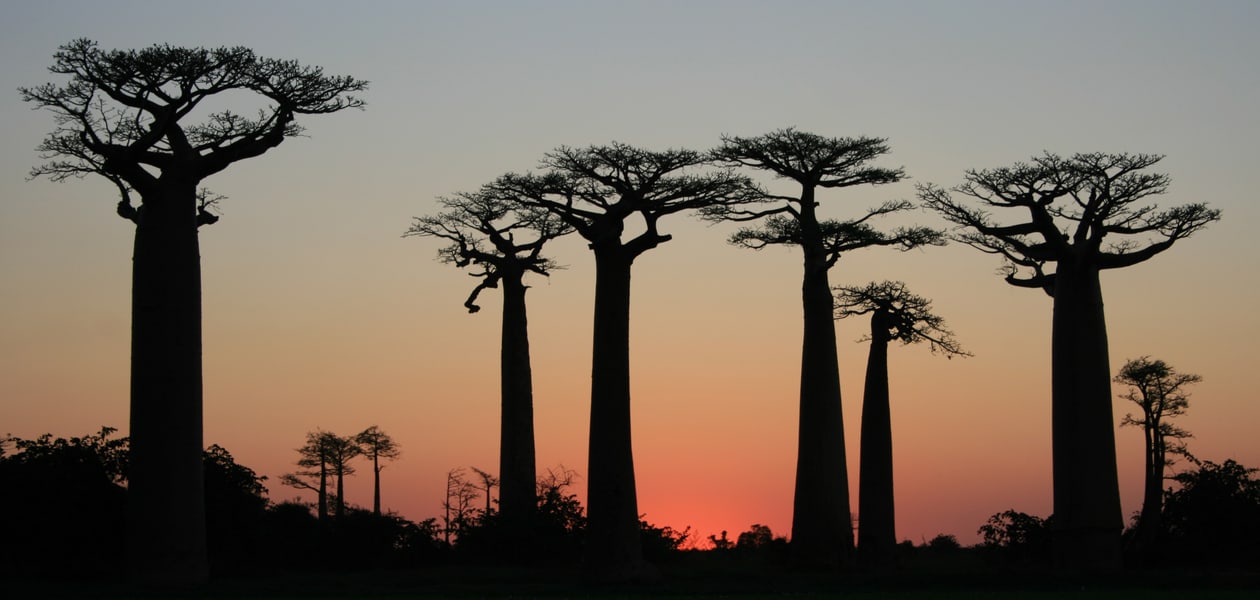
Madagascar
Gavinevans / Wikimedia Commons · CC BY-SA 3.0 · cropped
Madagascar is the fourth-largest island in the world, 587,295 km² lying off the south-east coast of Africa across the Mozambique Channel, with about 32 million people and its capital at Antananarivo. It has no land borders; its neighbours across the water are Mozambique, the Comoros, Mayotte and the Seychelles. A spine of highlands runs the length of the island, dropping steeply east to a narrow, wet coastal strip and more gently west to drier plains. The isolation is the point: the great majority of its plants and animals are found nowhere else, which is what most visitors come for.
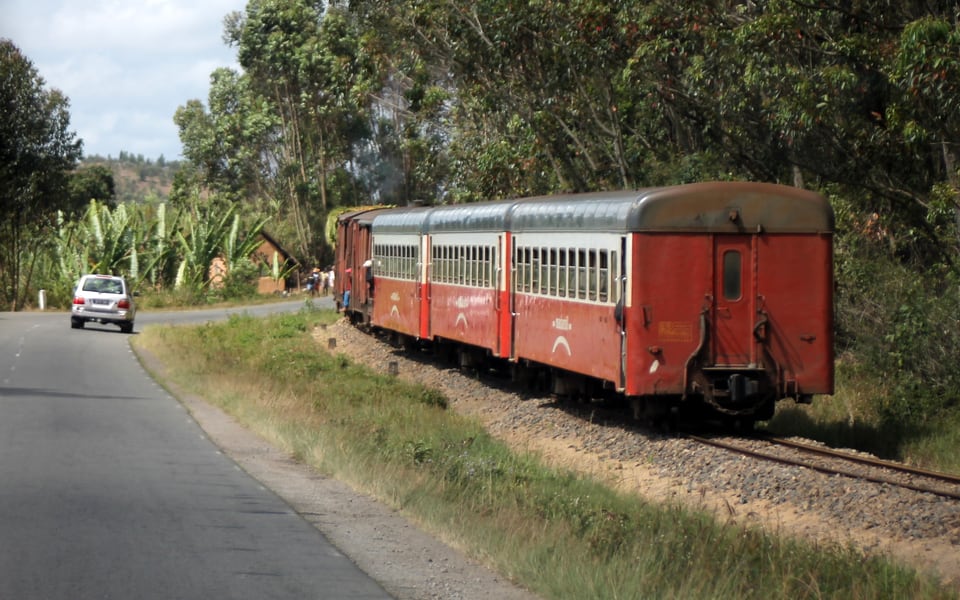
The railway is small, old and split in two. There are 855 km of metre gauge in two systems that do not touch: a northern network from Antananarivo to the port of Toamasina with a branch to Ambatondrazaka, and, far to the south, the Fianarantsoa–Côte Est line down from the highlands to the Indian Ocean at Manakara. The northern network is worked under concession by Madarail, wholly state-owned since April 2022; the southern line is a separate state undertaking. Both were built by France in the first half of the twentieth century.
Rail journeys in Madagascar
Good to know
Why are Madagascar's railways not connected?
Because they were built for two different purposes at two different ends of a very long island. The northern lines link the capital to its port at Toamasina and to the Lake Alaotra rice country; the southern line was laid to bring coffee, bananas and other produce down from the Betsileo highlands to the coast at Manakara. Nothing was ever built through the long stretch of island between them, and nothing is likely to be.
What is the FCE?
The Fianarantsoa–Côte Est railway, the southern line: 163 km of metre gauge dropping from the highland city of Fianarantsoa to the sea, built by the French between 1926 and 1936. It matters out of all proportion to its length because much of the country it passes through has no usable road, so the train is the only mechanical link many villages along it have to a market.
How reliable is the railway?
It is vulnerable, and honestly so. Madagascar lies in a cyclone belt and both networks have been cut for months at a time by storm damage to embankments and bridges. Any plan built around a Malagasy train should be checked close to the date of travel rather than assumed from a published schedule.
Are there rail passes for Madagascar?
No. There is no pass scheme, no multi-journey ticket and — with two unconnected systems — no network across which one would be useful. Tickets are bought for the individual train.