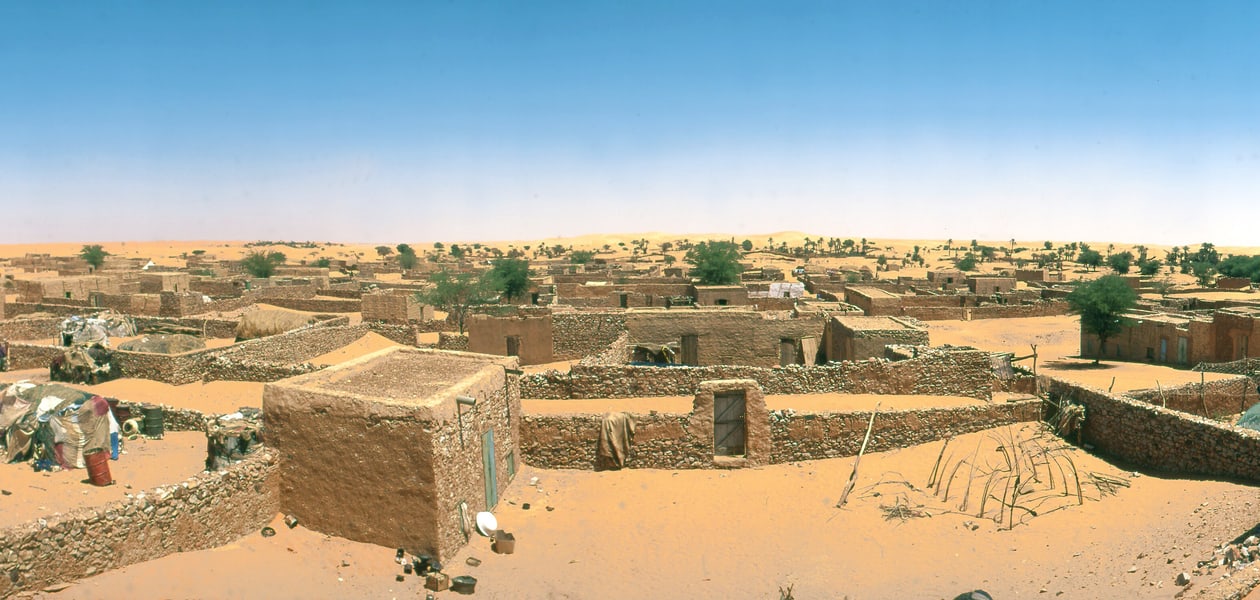
Mauritania
LBM1948 / Wikimedia Commons · CC BY-SA 4.0 · cropped
Mauritania is a very large, very empty country on the Atlantic edge of the Sahara — 1,030,700 km² with only about 4.3 million people, a third of them in the capital, Nouakchott. Western Sahara lies to the north-west and Algeria to the north-east, Mali wraps around the east and south-east, and Senegal is to the south-west across the Senegal river. Most of the country is desert; the habitable part is the strip of Sahel in the south and the coast, where the cold Canary current makes the offshore waters some of the richest fishing grounds in the world.
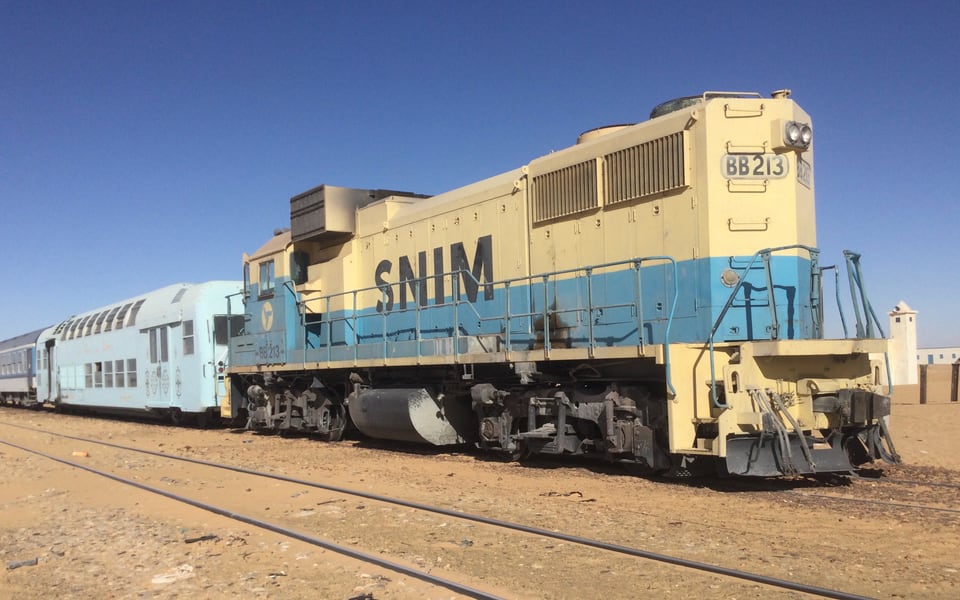
Rail travel here means one line and one purpose. The Mauritania Railway runs 704 km from the iron mines at Zouérat across the desert to the Atlantic port of Nouadhibou, by way of Fderîck and Choum. It was begun in 1960, opened in 1963 and is controlled by the state mining company SNIM. It is a mineral railway that also moves people, not a passenger network with a mineral sideline — there is no other line, no branch to the capital, and no railway at all in the south of the country.
Rail journeys in Mauritania
Good to know
Why does the railway detour through Western Sahara?
Because of a tunnel. The line was routed to stay inside Mauritanian territory by driving the Choum tunnel through the rock rather than swinging around it through what was then Spanish Sahara. Since the tunnel's closure, about 5 km of the working railway runs through the part of Western Sahara controlled by the Polisario Front — a detail of the map that is easy to miss and hard to unsee.
Is this a passenger railway?
Not primarily, and the distinction matters. The line exists to move iron ore, and passenger accommodation is what SNIM's subsidiary attaches to it. There are two very different things often described as the same ride: a working with proper passenger carriages, and the practice of riding free on top of the open ore hoppers. The second is genuinely hazardous — daytime heat above 40 °C, near-freezing nights, and no safe way off between stops — and SNIM has not authorised it since 2024.
How long are the trains?
Among the longest and heaviest anywhere. A loaded ore working can run to more than 200 wagons and over two kilometres end to end, hauled by diesels in multiple. That scale is the reason the railway is famous well beyond Mauritania, and it is what a traveller actually goes to see.
Are there rail passes for Mauritania?
No. With a single line owned by a mining company there is nothing for a pass to cover, and Mauritania belongs to no regional scheme. Arabic and French are the working languages.