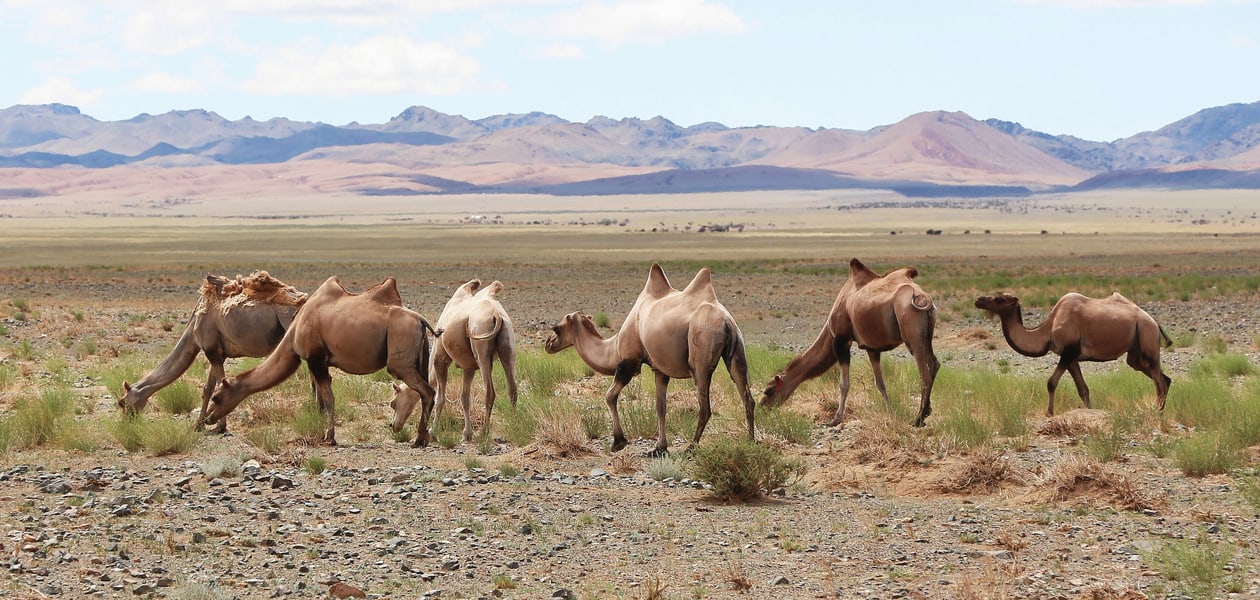
Mongolia
Bernard Gagnon / Wikimedia Commons · CC0 · cropped
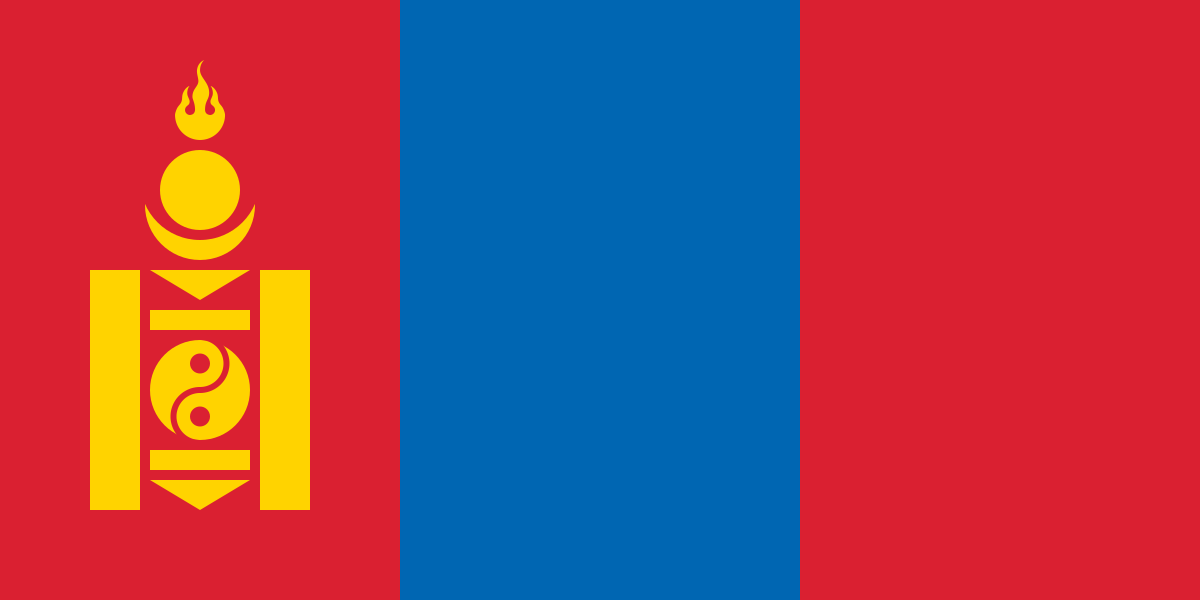
Mongolia is 1,564,116 km² of plateau between Russia and China — the eighteenth-largest country in the world, the second-largest landlocked one, and the most sparsely populated sovereign state on earth. About 3.5 million people live in it, and roughly half of them are in the capital, Ulaanbaatar. Grassy steppe covers the centre, mountains rise in the north and west, and the Gobi runs along the southern frontier — the sixth-largest desert in the world, and a cold one: desert and grassland rather than a sea of sand.
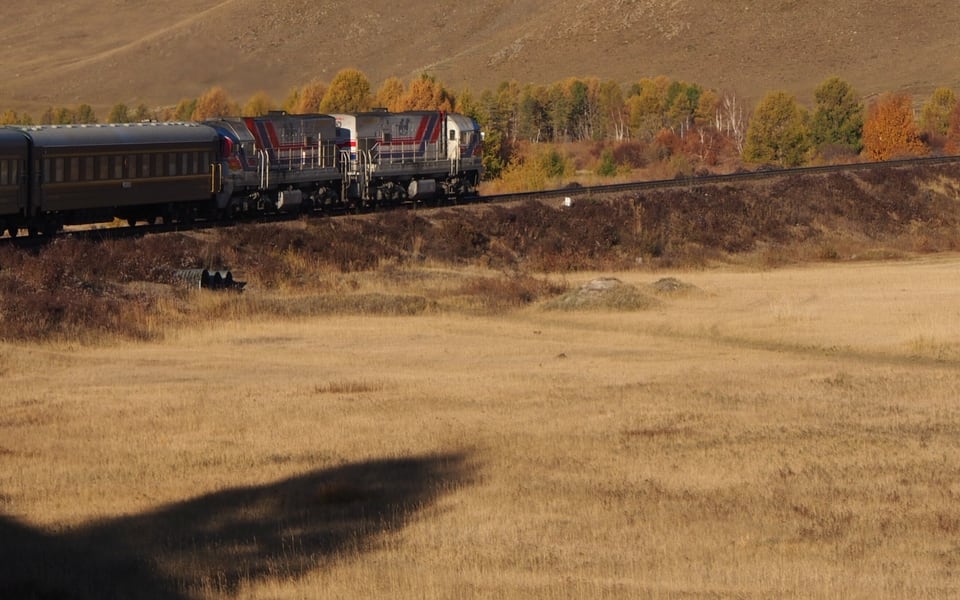
With so few paved roads across so much ground, almost everything the country moves by land moves on one line. It runs north to south, from the Russian frontier at Sükhbaatar through Ulaanbaatar to the Chinese one at Zamyn-Üüd, throwing off branches to the copper at Erdenet, the coal at Sharyngol and Baganuur and the fluorspar at Bor-Öndör. A second line in the east, from Choibalsan towards the Russian border, is not connected to the first and is closed to passengers at the frontier. The rails are laid to the Russian gauge, so a train arriving from China has its wheels changed at the border and a train from Russia does not. No rail pass scheme covers any of it.
Rail journeys in Mongolia
Good to know
What happens at the Chinese border?
The gauge changes. Mongolia is 1,520 mm Russian broad gauge and China is 1,435 mm standard, so at Zamyn-Üüd / Erenhot a through train cannot simply carry on. The carriages are lifted in a shed at Erenhot and their bogies exchanged underneath them — a border crossing measured in millimetres, and a stop of about five hours once the two sets of formalities are added. Passengers could once stay aboard and watch; since the Beijing–Ulaanbaatar train came back in June 2025 they wait in the station building instead.
Is the Trans-Mongolian the same as the Trans-Siberian?
No, though they share track. The Trans-Siberian runs entirely across Russia to Vladivostok. The Trans-Mongolian branches off it at Ulan-Ude, crosses into Mongolia at Sükhbaatar, runs through Ulaanbaatar and the Gobi and enters China at Erenhot on the way to Beijing. It is the shorter route between Moscow and Beijing and the only one that crosses Mongolia.
How cold does it get?
Ulaanbaatar is the coldest capital city in the world by average yearly temperature, and the Mongolian winter has its own word — the dzud, a season severe enough to kill livestock by starvation in very large numbers. Summer on the steppe is warm and short. Any rail journey here is a different proposition in January from in July, and the timetable is the least of the differences.
Are there rail passes for Mongolia?
No. Mongolia belongs to no pass scheme and there is no national multi-journey ticket. International seats on the Trans-Mongolian are usually bought through the railway at either end or through an agency; domestic tickets are sold by the operator. Place names are written in Mongolian Cyrillic.