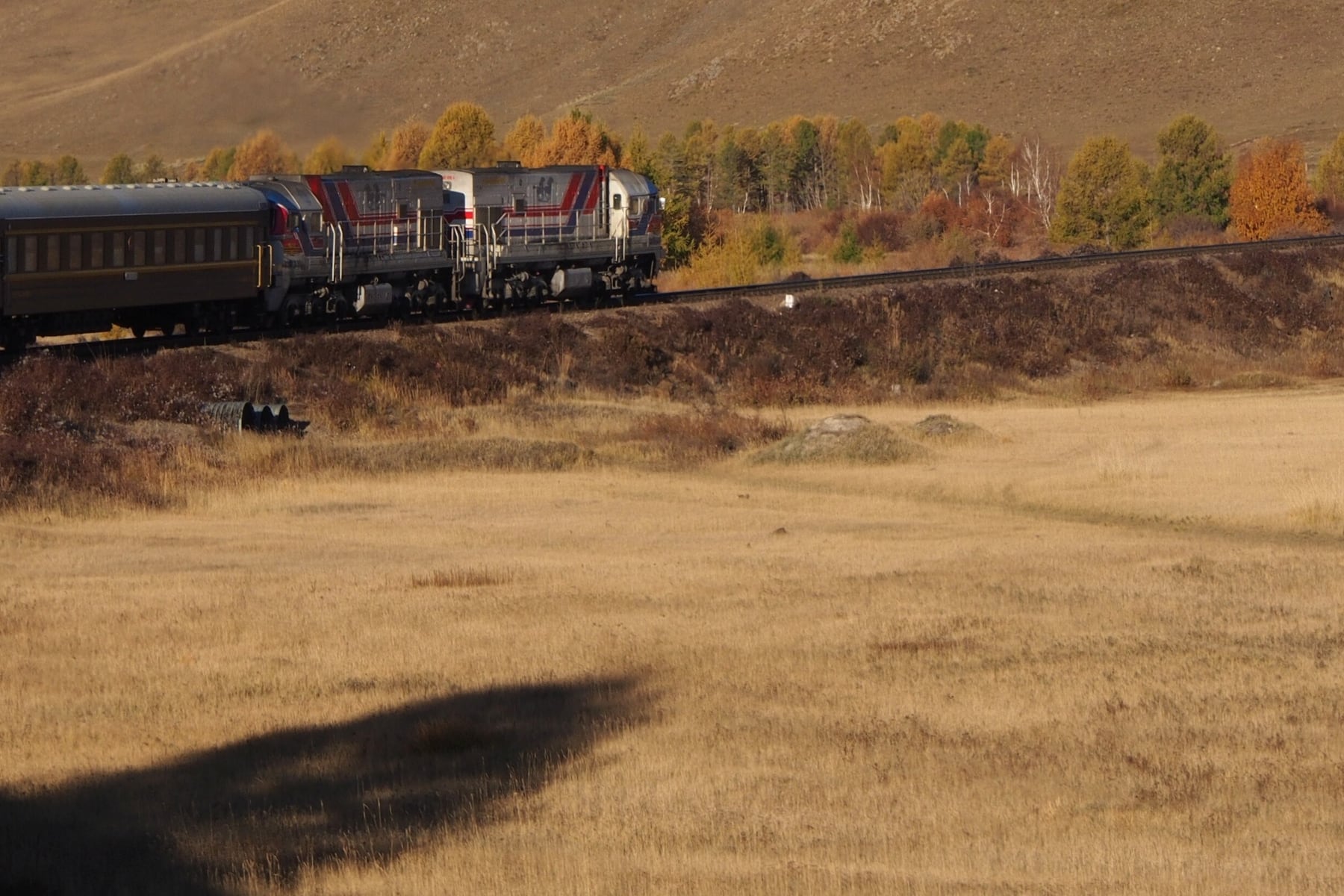
The Trans-Mongolian — Beijing to Ulaanbaatar
Clay Gilliland / Wikimedia Commons · CC BY-SA 2.0 · 2013 · cropped
- Distance1,553 km
- Duration31 hr 8 min
- Best seasonOne departure a week, all year
Introduction
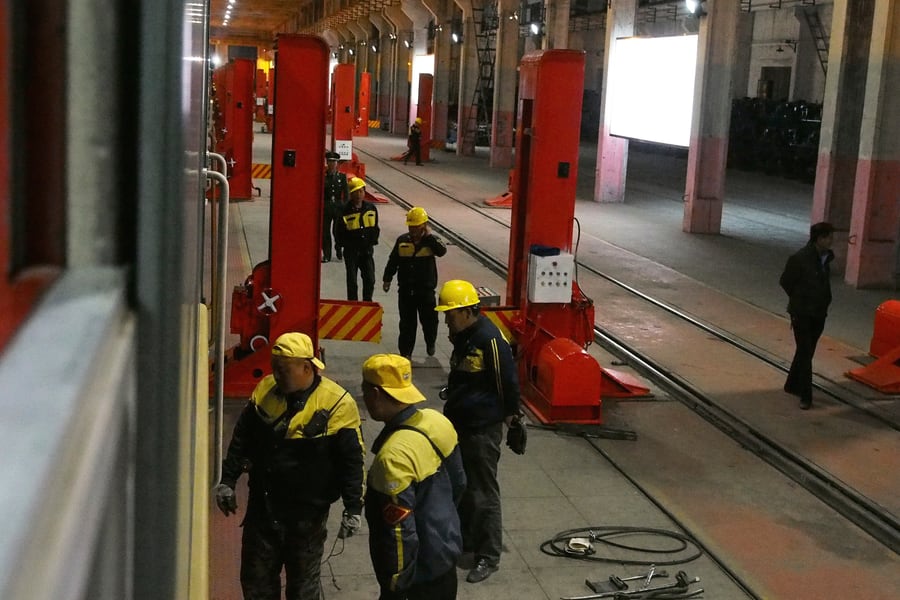
China lays its rails 1,435 millimetres apart. Mongolia and Russia lay theirs 1,520. The two gauges meet at Erenhot, the last station on the Chinese side, and the train between Beijing and Ulaanbaatar deals with the difference in the most literal way available: it is drawn into a shed, lifted clear of the track on jacks, and its bogies are rolled out from underneath and replaced with a set that fits the other gauge. With the frontier formalities either side of it, the stop runs to about five hours. Until 2020 passengers could stay in their compartments and watch the floor rise; since the service came back in June 2025 everyone waits in the station building instead.
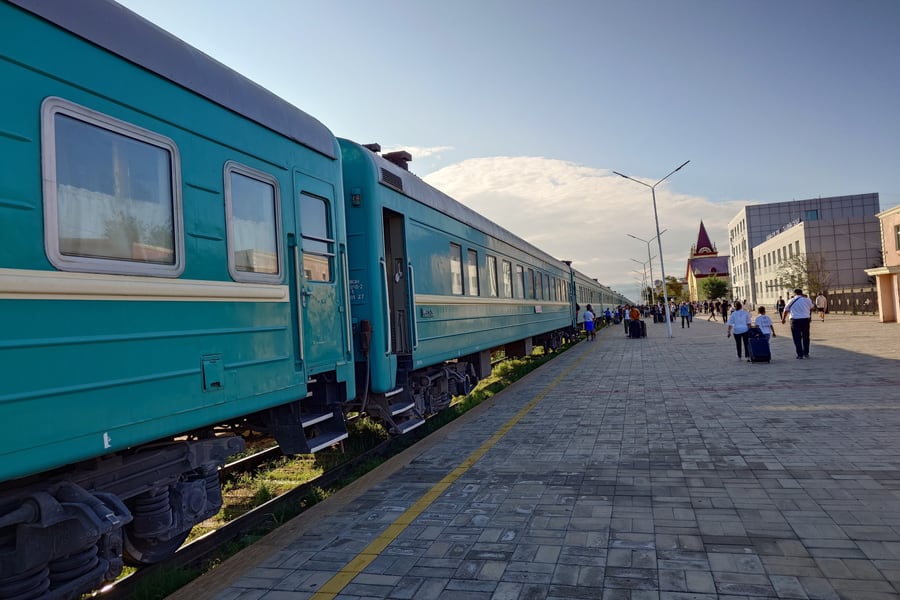
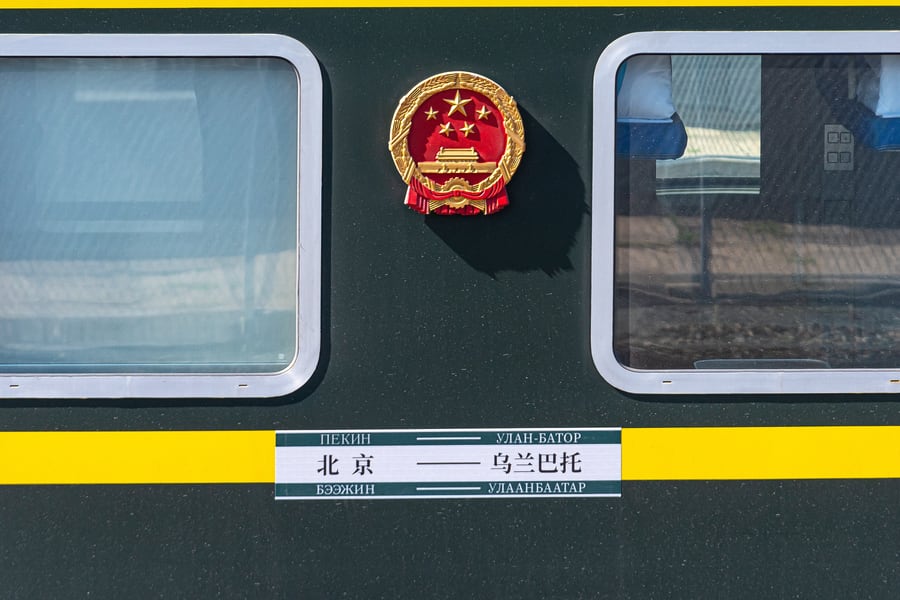
Train K23 — 023 once it is over the line — leaves Beijing at 07:27 on a Saturday morning and reaches Ulaanbaatar at 14:35 the following afternoon, 1,553 kilometres and thirty-one hours later. There is one departure a week in each direction, and the two railways take the whole service in turn, a year at a time. From June 2026 it is Mongolia's train: Russian-pattern coaches built at Tangshan and lettered МЕСТ, white since 2018, with a dining car that is coupled on at the border and taken off again at the other end of the country. Beyond Zamyn-Üüd the timetable lists no call at all until Ulaanbaatar — most of a day across the Gobi, past Sainshand and Choir, before the grass comes back for the last hour into the capital.
The Journey
The Trans-Mongolian is the short way between Moscow and Beijing. It leaves the Trans-Siberian at Ulan-Ude, crosses into Mongolia at Naushki and Sükhbaatar, runs down through Ulaanbaatar and the Gobi and enters China at Erenhot — 1,110 kilometres of it inside Mongolia, single track almost all the way, on the 1,520 mm gauge the country shares with Russia. The Mongolian half was finished first: the line from Naushki up to Ulaanbaatar was completed in November 1949, built by the Soviet 505th Penal Unit, made up largely of soldiers imprisoned for having surrendered during the war. The extension south to the Chinese border opened on 1 January 1956.
What made it a through route was 331 kilometres of new railway on the Chinese side. The Jining to Erenhot line was begun in May 1953 and finished in 1955, and under the agreement between China, the Soviet Union and Mongolia it was laid to Russian broad gauge, and while it stayed that way it was the only railway in China that ran on the right rather than the left. Through carriages began working to Ulaanbaatar on 4 January 1956, changing their bogies at Jining. The new route cut 1,141 kilometres off the run from Beijing to Moscow compared with going round by Manzhouli.
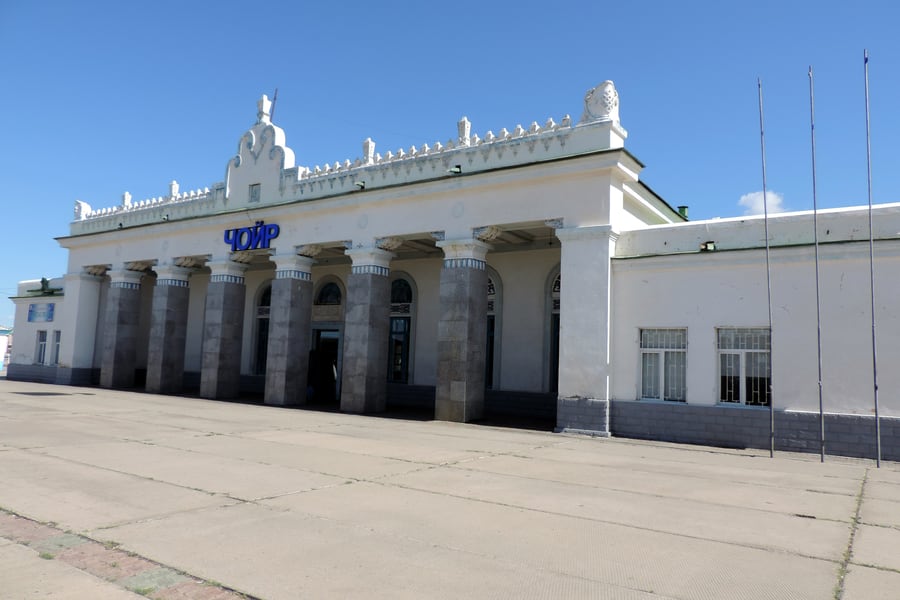
Then the politics changed. On 12 October 1965, with relations between Beijing and Moscow at their worst, China narrowed the Jining–Erenhot line back to standard gauge, and the shed where wheels are changed moved to Erenhot, nine hundred and sixty-six metres up on the edge of the Gobi, where it has been ever since.
Out of Beijing
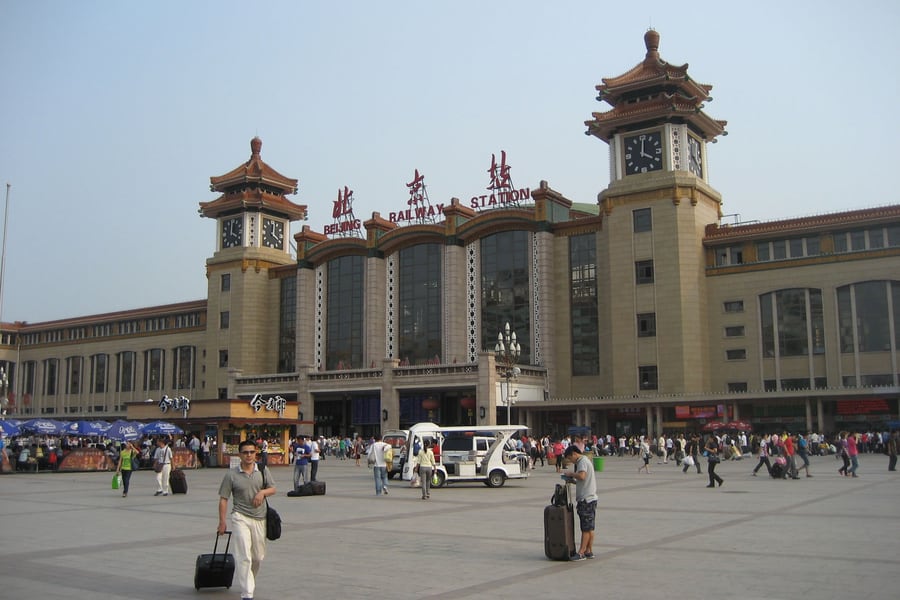
Departure is from Beijing station, the 1959 building with the clock towers inside the old walled city, and for the first eight hours the journey is an ordinary Chinese one. An HXD3C electric takes the train under the wires as far as Jining South, with a change of driver at Datong; a Hohhot-based DF4D diesel takes over for the last stretch north across the grassland to the frontier. The train calls at Shalingzi West and at Jining South, and nowhere else.
It reaches Erenhot at 20:18 and leaves at 00:59. Chinese exit formalities are done first, then the carriages are drawn into the bogie shed and lifted, one set of trucks is pushed out and another pushed in, and the train is set down on rails 85 millimetres further apart. The five hours are not padding. Before the pandemic passengers could stay aboard for it, at the windows of a carriage standing on jacks while its wheels were pushed out from underneath; since the service resumed everyone is asked to wait in the station building.
Mongolia, and the Gobi
Zamyn-Üüd is the next station north, and takes an hour and a quarter of its own. The name means the gate of the road, and the place has been one since long before there were rails: it stands on the old caravan track from Beijing to Urga, and it is now the busiest crossing on the Mongolia–China border. Here the composition changes as well as the gauge. Each railway's dining car works only its own country's section, so the Chinese one comes off and the Mongolian one — carved inside like the interior of a temple, in blond wood, with the tables laid — is coupled on for the run north.
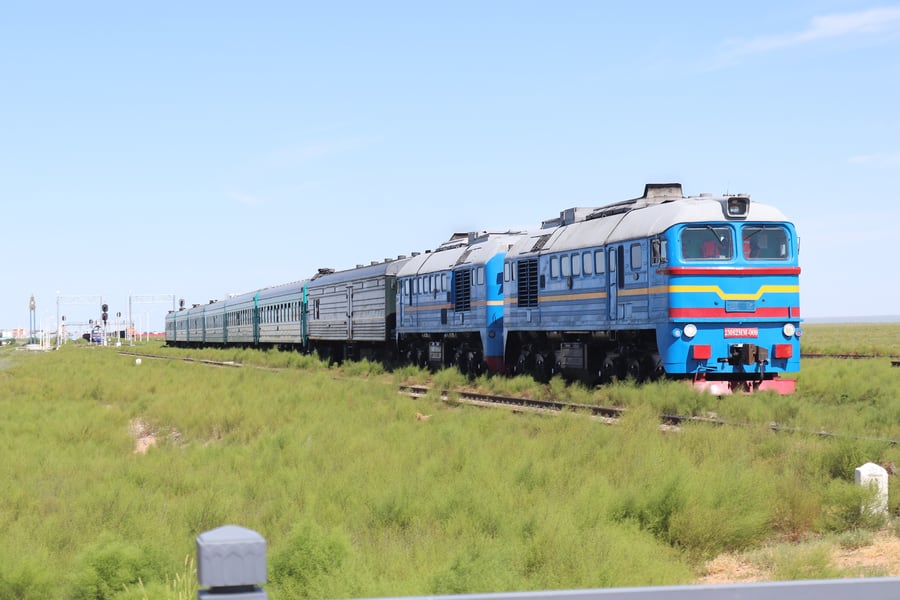
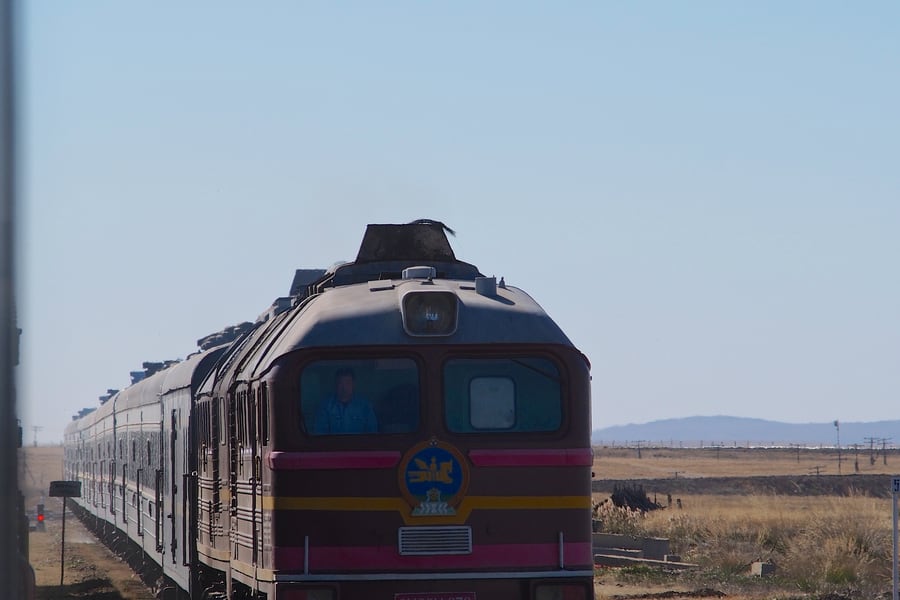
A Mongolian CKD4B brings the train up from the border and hands over to a twin-section 2M62MM or a 2TE116 for the rest. Mongolia bought sixty-six twin 2M62 machines from the Soviet Union between 1980 and 1990 and their rebuilt descendants are still the standard power here, two half-locomotives permanently coupled back to back, which is why the front of the train looks twice as long as it should.
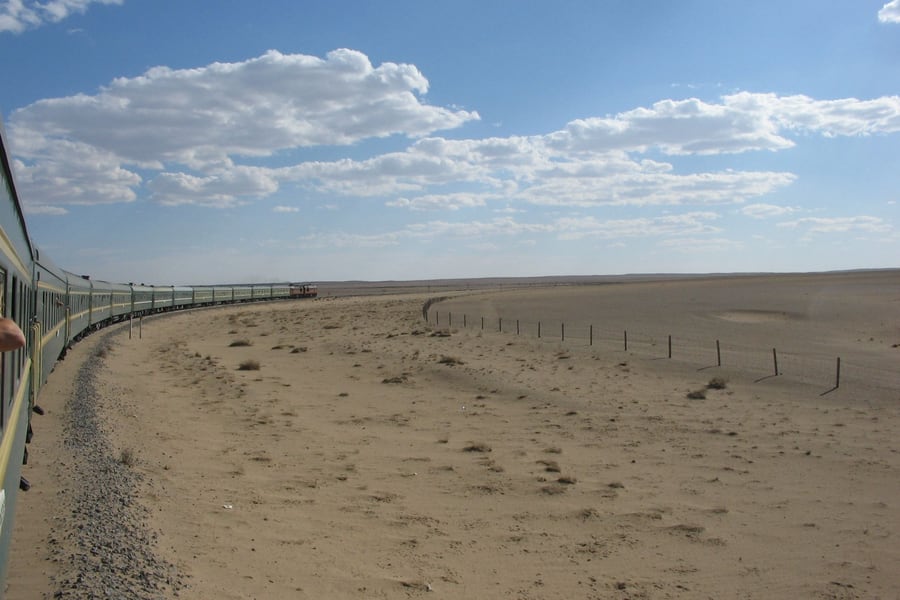
From Zamyn-Üüd to Ulaanbaatar the timetable shows nothing: no booked call for the whole width of the country. The train runs through Sainshand, the capital of Dornogovi and the last real town of the desert, and through Choir, 250 kilometres short of Ulaanbaatar in a depression five hundred metres below the surrounding upland, where a silver cosmonaut stands on a plinth beside the railway. What passes the window between them is the Gobi — a cold desert of gravel plain and thin grass rather than dunes, the sixth largest in the world — and, at intervals, a container train coming the other way. Ninety-three per cent of Mongolian freight moves by rail, and this single track is also the shortest land route between Chinese factories and European sidings.
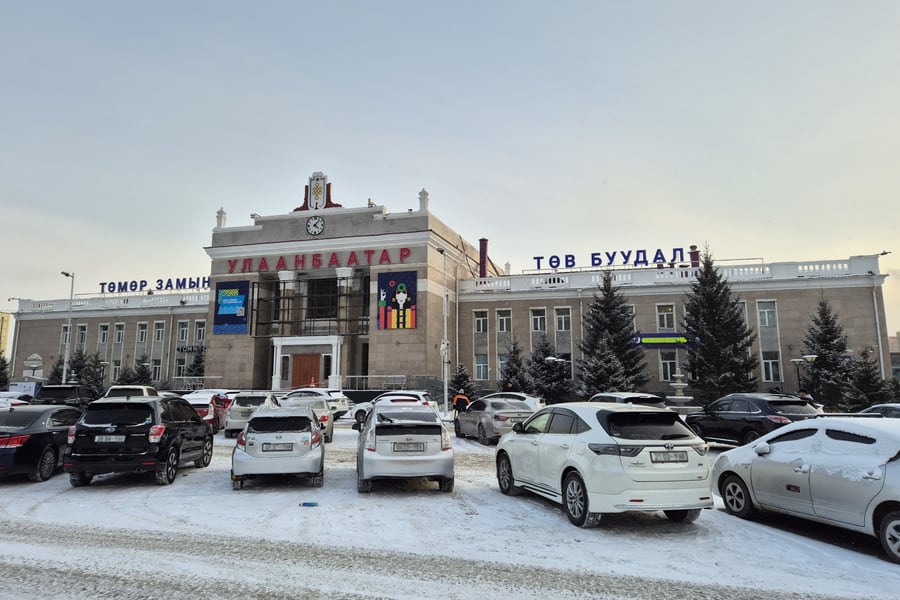
The grass thickens through the morning. Ulaanbaatar arrives at 14:35, at a station opened in 1949 that is still the centre of everything the Mongolian network does, in a city holding about half the population of the country.
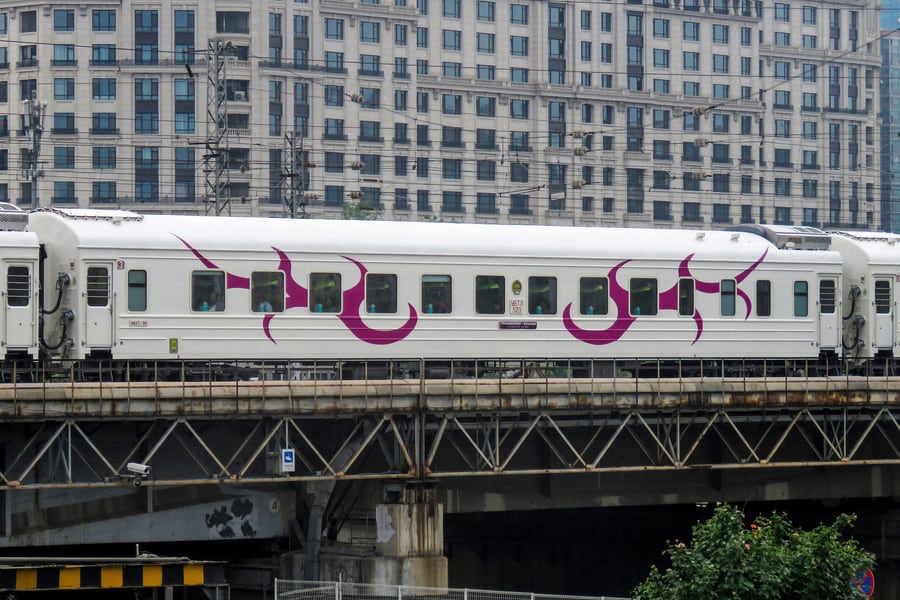
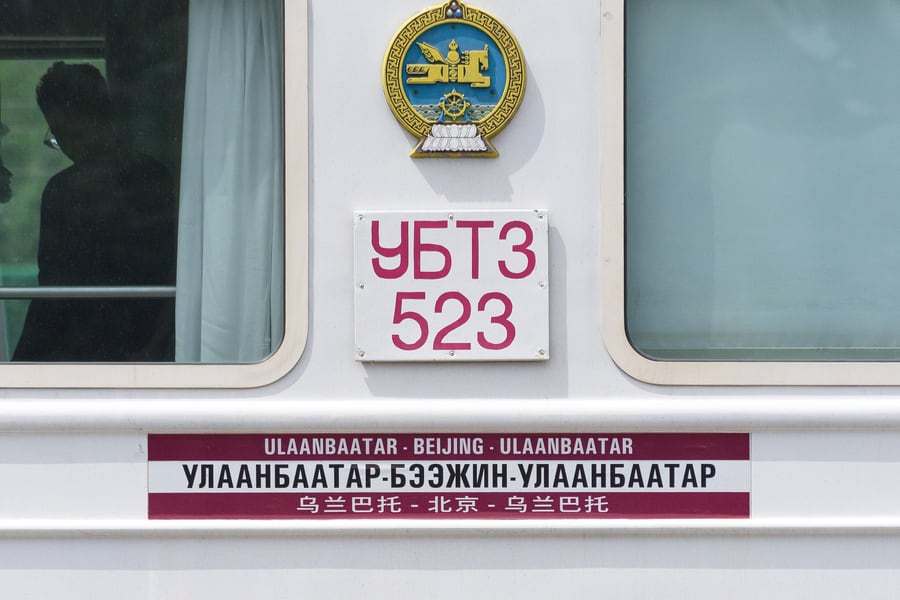
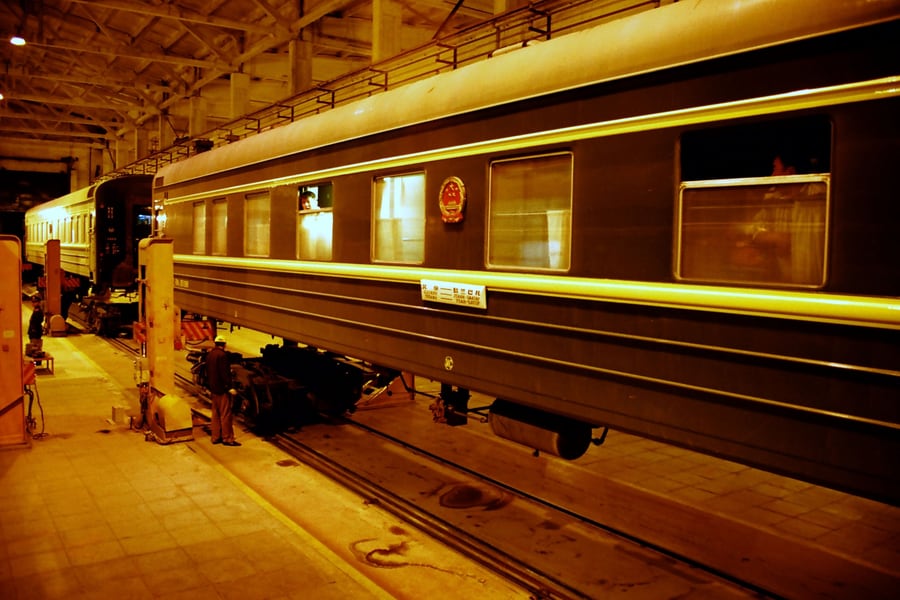
Along the route
 Clay Gilliland / Wikimedia Commons · CC BY-SA 2.0 · 2013 · cropped
Five hours in the bogie shed
Erenhot is where 1,435 mm meets 1,520 mm. The carriages are drawn in over pits, jacked clear of the rails, and their bogies rolled out and replaced a coach at a time, with the two countries' border formalities either side. The stop runs to about five hours.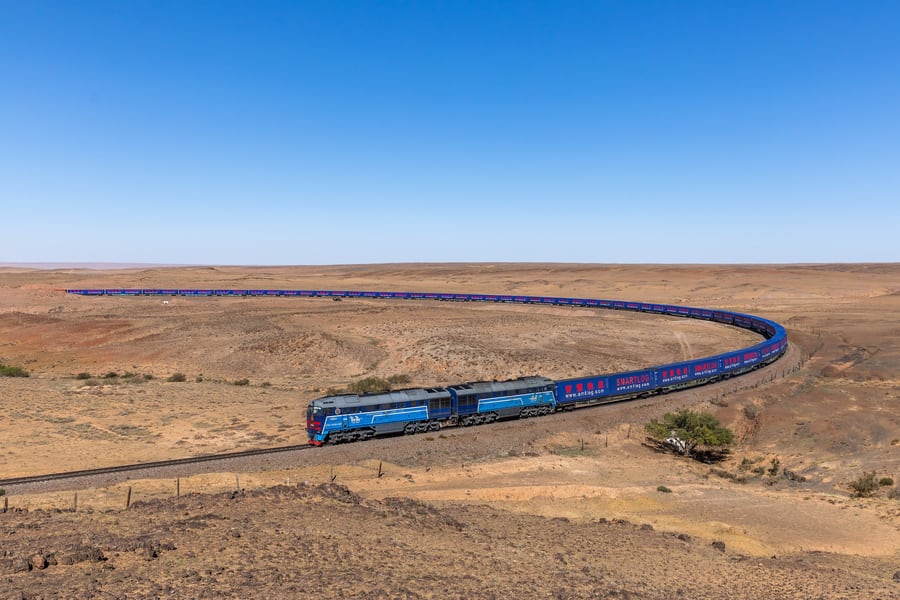 Kabelleger / David Gubler / Wikimedia Commons · CC BY-SA 4.0 · 2023 · cropped
A corridor for containers
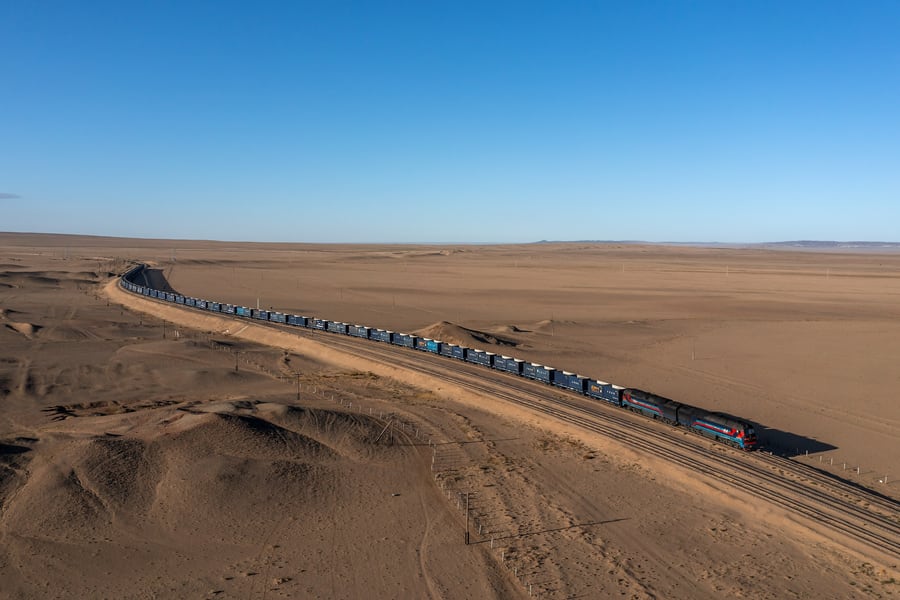
The single track across the Gobi is the shortest land route between Chinese factories and European sidings. What the passenger train shares the line with, all day, is container traffic: fifty or sixty flats behind a twin diesel, running the other way.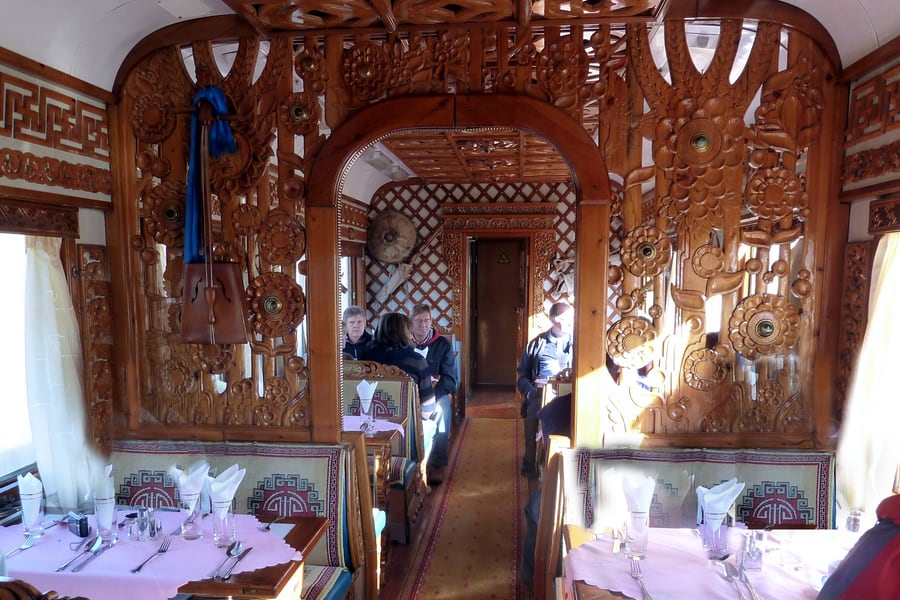 Pierre André Leclercq / Wikimedia Commons · CC BY-SA 4.0 · 2011 · cropped
The dining car that changes at the border
Each railway feeds its own country, so the restaurant car is coupled on when the train enters and taken off before it leaves. The Mongolian one is why people remember the journey: carved end to end in pale wood, a room built like the inside of a temple and run like a canteen.A bit of history
Culture & experiences along the way
 Clay Gilliland / Wikimedia Commons · CC BY-SA 2.0 · 2013 · cropped
The train that has not come back
The K3/4 is the famous one: Beijing to Moscow by this same railway, about 7,800 kilometres and five and a half days, running since June 1959. It stopped in February 2020 and has not restarted. A twelve-coach set ran empty over the route between 25 February and 11 March 2025 to test the ground, and nothing has followed. What exists today is the Ulaanbaatar train, which covers the first fifth of it.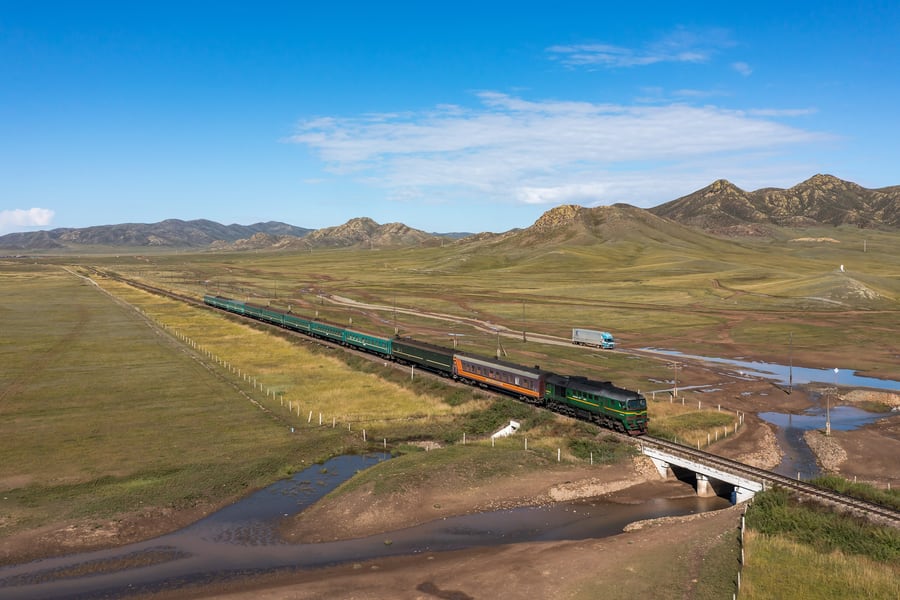 Kabelleger / David Gubler / Wikimedia Commons · CC BY-SA 4.0 · 2023 · cropped
The other half of the line
North of Ulaanbaatar the Trans-Mongolian runs on through Darkhan to Sükhbaatar and the Russian border at Naushki, and the country changes completely — river valleys, larch and birch, hills with trees on them. Domestic trains 271/272 work that half from Ulaanbaatar, and the international 305/306 carries on to Irkutsk. It is the same railway and it looks nothing like the Gobi.Timetables
One train a week runs in each direction. All the times below are taken from China Railway's own international-trains page on 12306, read in August 2026. Beijing and Ulaanbaatar keep the same clock, so nothing has to be converted at the border.
| Train | Runs | Leaves | Arrives | Journey |
|---|---|---|---|---|
| K23 (023 in Mongolia) | every Saturday | Beijing 07:27 | Ulaanbaatar 14:35 next day | 31 hr 8 min |
| K24 (024 in Mongolia) | every Thursday | Ulaanbaatar 07:30 | Beijing 14:35 next day | 31 hr 5 min |
Beijing to Ulaanbaatar
| Station | Arrives | Leaves |
|---|---|---|
| Beijing | — | 07:27 |
| Shalingzi West | 10:40 | 10:50 |
| Jining South | 15:27 | 15:43 |
| Erenhot | 20:18 | 00:59 |
| Zamyn-Üüd | 01:25 | 02:40 |
| Ulaanbaatar | 14:35 | — |
Ulaanbaatar to Beijing
| Station | Arrives | Leaves |
|---|---|---|
| Ulaanbaatar | — | 07:30 |
| Zamyn-Üüd | 18:50 | 20:35 |
| Erenhot | 21:00 | 02:00 |
| Jining South | 06:37 | 06:55 |
| Shalingzi West | 11:09 | 11:15 |
| Beijing | 14:35 | — |
Those are the only booked calls. The stop at Erenhot — four hours and forty-one minutes on the way north, five hours on the way south — is the gauge change and the Chinese half of the frontier formalities; the stop at Zamyn-Üüd, an hour and a quarter northbound and an hour and three quarters southbound, is the Mongolian half.
The days change with the rotation
China Railway and the Ulaanbaatar Railway work the service in alternate years, and the days move when the handover happens. The train came back on 3 June 2025 after five years out of service, Chinese-operated, leaving Beijing on Tuesdays. From 1 June 2026 it has been Mongolian-operated and leaves Beijing on Saturdays, returning from Ulaanbaatar on Thursdays. The published departure time from Ulaanbaatar has been given as both 07:18 and 07:30 in different years of the rotation; 12306 currently shows 07:30.
The other ways over this border
- Hohhot – Erenhot – Ulaanbaatar, trains 4652/4653/33 and 34/4654/4651, also worked by the two railways in turn. The Chinese working leaves Hohhot on Fridays and reaches Ulaanbaatar on Sundays, and leaves Ulaanbaatar on Mondays for a Tuesday arrival; the Mongolian working leaves Ulaanbaatar on Fridays for Saturday, and Hohhot on Mondays for Wednesday. Tickets are sold at Hohhot, Jining South and Erenhot stations.
- Ulaanbaatar – Irkutsk, trains 305/306, over the northern half of the Trans-Mongolian and the Russian border at Sükhbaatar and Naushki.
- Beijing – Ulaanbaatar – Moscow, the K3/4, about 7,800 kilometres and five and a half days, has not run since February 2020. A twelve-coach set made an empty trial run between 25 February and 11 March 2025 and the service has not resumed since.
Times and days are published by the operator: China Railway · 12306 international trains (opens in a new tab).
Tickets
This is one of the few trains out of Beijing that 12306 does not sell. Every international service from the capital except the Hanoi train is handled by China International Travel Service, from room 717 of the CITS Building at 1 Dongdan North Street, which asks for bookings at least thirty days ahead and issues the tickets over its counter. At the other end they are sold by the Ulaanbaatar Railway. Beijing to Ulaanbaatar is ¥1,361 in a four-berth hard sleeper and ¥2,033 in a two-berth deluxe.
Two things to know before booking. International tickets are point to point and end if you get off part-way. And exit and entry formalities for this train are completed at Erenhot, which is not one of the ports covered by China's 240-hour visa-free transit — so that scheme is no help here. It is a single weekly working: a missed connection costs a week, not a day.
Book your tickets
 N509FZ / Wikimedia Commons · CC BY-SA 4.0 · 2025 · cropped
Beijing to Ulaanbaatar
Hard sleeper from ¥1,361, deluxe soft sleeper ¥2,033
Not sold on 12306. China International Travel Service handles the international trains out of Beijing, from room 717 of the CITS Building at 1 Dongdan North Street in Dongcheng District, weekdays 09:00–12:30 and 13:30–17:00 and Saturday mornings, and it asks for bookings at least thirty days ahead. Fares published by China Railway include the ¥50 agency fee; CITS quotes the same berths for the 2026 season at US$255 hard sleeper and US$365 deluxe, its US$30 service fee included. Tickets are point to point and end if the journey is broken.
Book Tickets (opens in a new tab, on cits.net)via cits.netRail Passes
No rail pass covers any part of this journey, and there is no near miss worth chasing.
Interrail and Eurail run to 33 countries, all of them European. China and Mongolia are outside that network entirely, and so is Russia at the far end of the same railway. The Beijing–Ulaanbaatar train is in any case sold one journey at a time through an agency rather than through either railway's ordinary channels, so there is nothing for a pass to be presented against.
The saving that does exist is a shorter ticket. Beijing to Zamyn-Üüd costs a little over half the Beijing to Ulaanbaatar fare and still includes the whole of the border — the gauge change, the shed and the five hours — and from Zamyn-Üüd the Mongolian domestic trains 275/276 run up to Ulaanbaatar. That is two tickets instead of one, and a night in a border town, in exchange for seeing the country from a train Mongolians actually use.
Checked against the operators' published conditions in August 2026.
Places to Visit
Two of these are the ends of the line and one is the border. The other two are places the international train passes without stopping, in the middle of the night or the middle of the desert. Both are reached instead on a domestic Mongolian service: trains 275/276 work Ulaanbaatar to Zamyn-Üüd and 285/286 Ulaanbaatar to Sainshand, and both run south through Choir.
 David Stanley / Wikimedia Commons · CC BY 2.0 · 2010 · cropped
Beijing
The train leaves from Beijing station, which opened in 1959 and was the largest in China when it did — gilded eaves, two clock towers, and the only one of the capital's main stations still standing inside the line of the old city wall. It replaced Zhengyangmen East, the 1901 terminus beside Tiananmen, which is now the China Railway Museum. Trains leaving here run past the Dongbianmen corner tower on their way out of the city.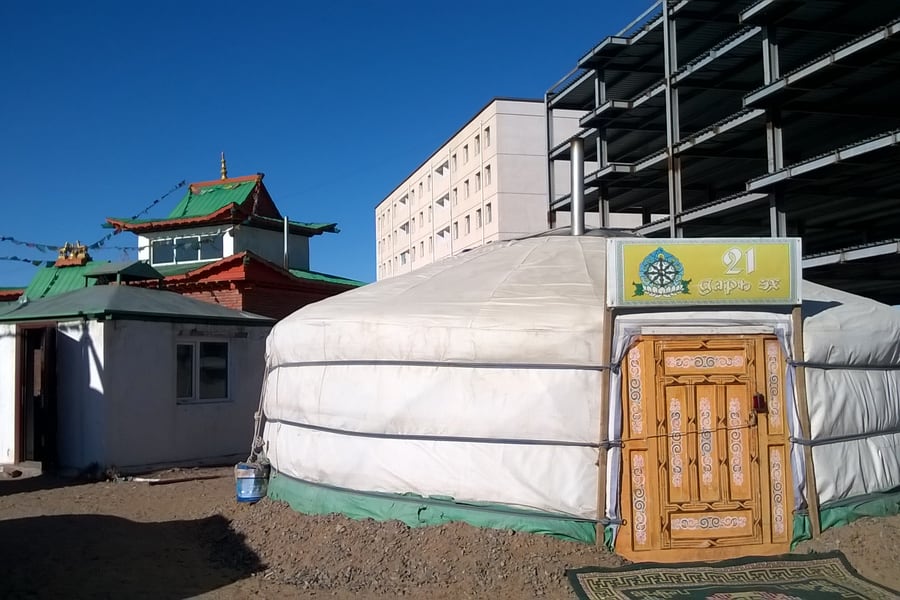 三猎 / Wikimedia Commons · CC BY-SA 4.0 · 2016 · cropped
Zamyn-Üüd
Eleven and a half thousand people, a free economic zone of nine hundred hectares laid out between the town and the frontier in 2004, and the busiest crossing on the whole Mongolia–China border — more than 950,000 crossings were counted in a single year. The name means the gate of the road, and it is an old one: this is where the caravan track from Beijing to Urga came through, long before there were rails to change the wheels of.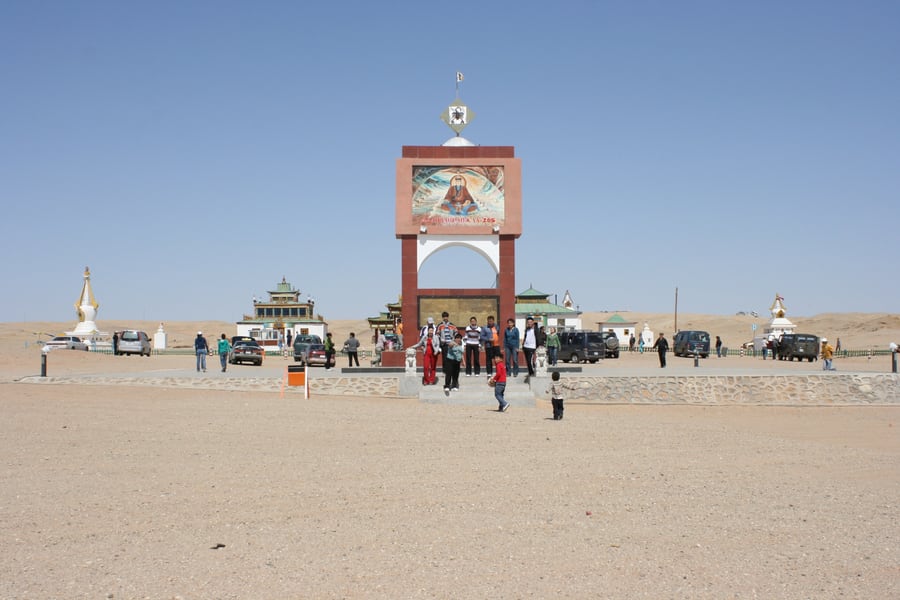 Tsend / Wikimedia Commons · CC BY 3.0 · 2009 · cropped
Sainshand
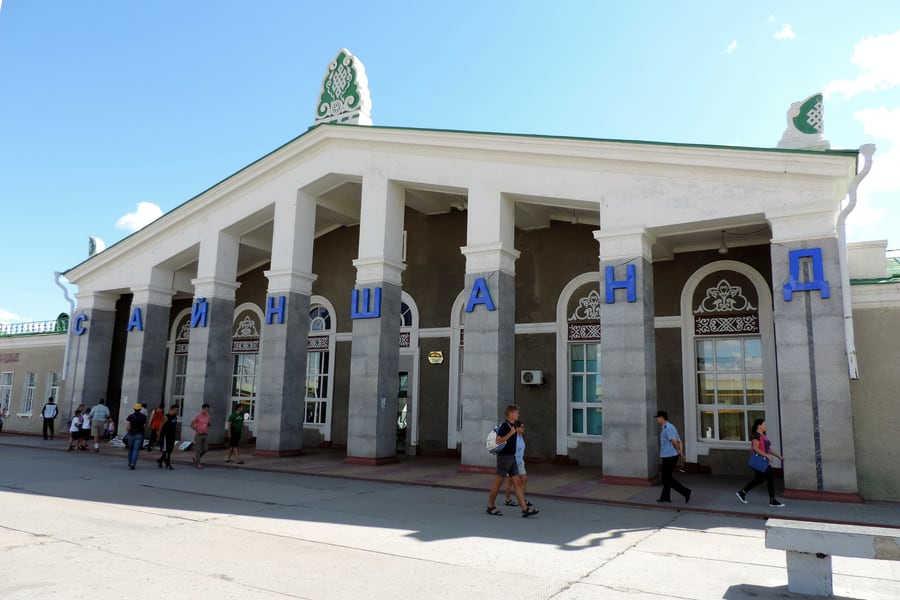
Twenty-five thousand people on the eastern Gobi steppe, and the only town of any size the line passes between the border and the capital. The reason to stop is Khamar Monastery, out in the desert to the south, founded by the nineteenth-century monk and writer Danzanravjaa, whose museum is in the town. The oil settlement of Züünbayan lies 46 kilometres further on, at the end of its own branch.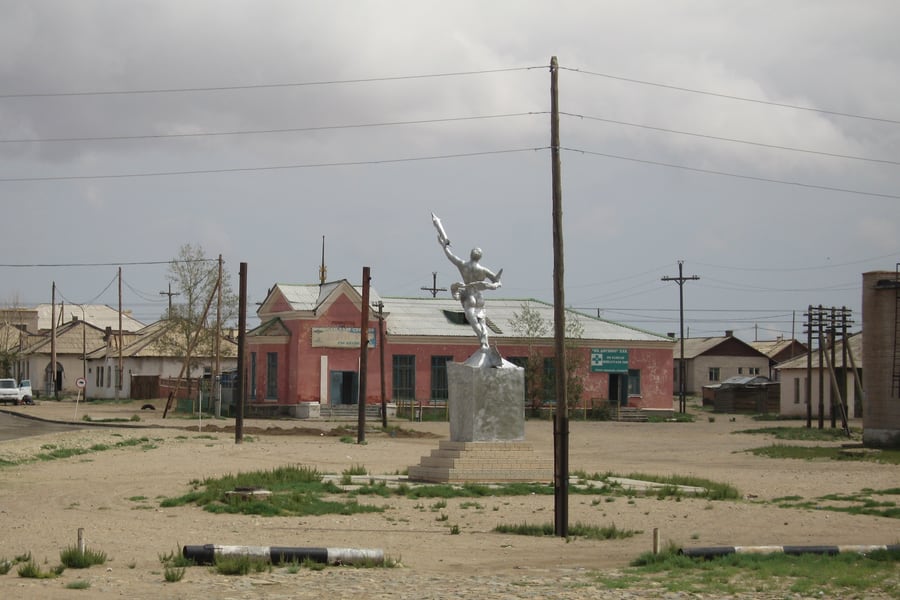 Vidor / Wikimedia Commons · Public domain · 2009 · cropped
Choir
A town of eight thousand and the capital of Govisümber, in a lowland strip five hundred metres below the country around it. It was a Soviet base until the anti-aircraft missile units left in 1989, and Mongolia's longest runway is still out there, 25 kilometres north and abandoned. Beside the station stands a silver figure of Jügderdemidiin Gürragchaa, the first Mongolian in space, who went up on Soyuz in 1981.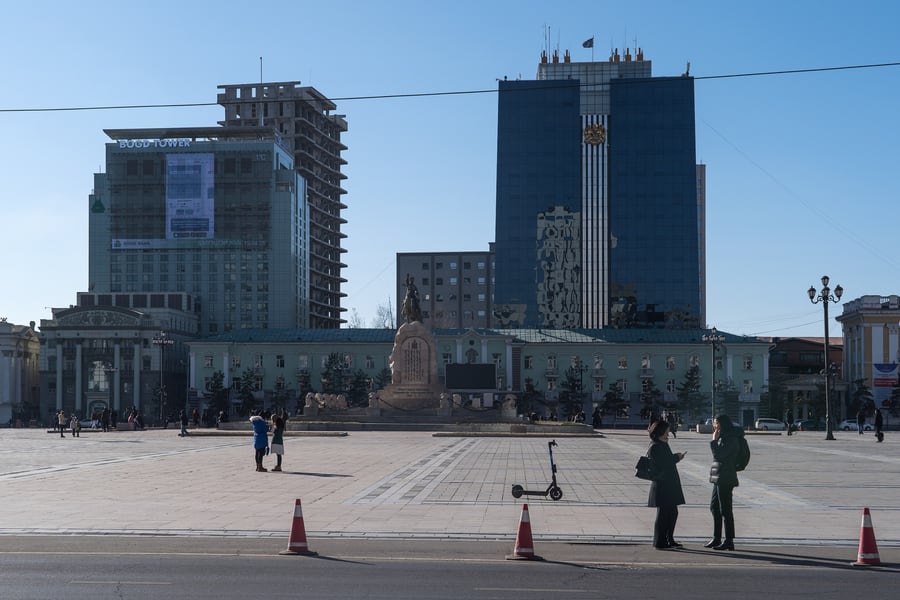 Alexkom000 / Wikimedia Commons · CC BY 4.0 · 2024 · cropped
Ulaanbaatar
About half the population of Mongolia lives here, in the coldest capital city in the world measured by yearly average temperature. The station opened in 1949, before the line to China existed, and everything the network does still runs through it: the Beijing train, the Irkutsk train, the domestic services to Sainshand, Zamyn-Üüd, Erdenet and Sükhbaatar. Sükhbaatar Square, with its statues of the khans, is a couple of kilometres east.Where to Sleep
The train leaves Beijing at 07:27 and arrives in Ulaanbaatar at 14:35, so it is the two ends of the journey that need a bed and not the middle: the single night on board is spent standing at Erenhot and then crossing the Gobi. Two houses below, one at each end.
There is nothing to book at the border. The international train's passengers are inside the frontier formalities for the whole of the stop at Erenhot, and breaking the journey there means a separate ticket and a separate entry.
Where to stay
Beijing International Hotel
9 Jianguomennei Avenue, a few minutes from Beijing station
The hotel's own site places it on the central axis of Chang'an Avenue with the Forbidden City and Tiananmen Square a short walk away, and counts more than five hundred rooms and over thirty meeting rooms, among them a two-thousand-square-metre grand hall. On the twenty-eighth floor, 108 metres up, is what it calls the only revolving restaurant in central Beijing; the third floor holds Tan Restaurant, which cooks the Tan family's mandarin-household dishes.
Check Availability (opens in a new tab, on bih.com.cn)via bih.com.cnUlaanbaatar Hotel
On Sükhbaatar Square, open since 1961
By its own account the house has taken guests since 1961 and has served as a meeting place for heads of state. It lists eight room types from a 15 m² comfort single to a 75 m² executive suite, a fitness centre on the top floor with a view over the city, a Japanese noodle restaurant, a coffee shop, and a bar that opened with the hotel and is still furnished with the pieces it opened with.
Check Availability (opens in a new tab, on ubhotel.mn)via ubhotel.mnQuestions or corrections
Planning this trip and stuck on something, or spotted a time, fare or detail that has changed? Send us a message about The Trans-Mongolian — Beijing to Ulaanbaatar. We read every one, and we update this page when something has changed.