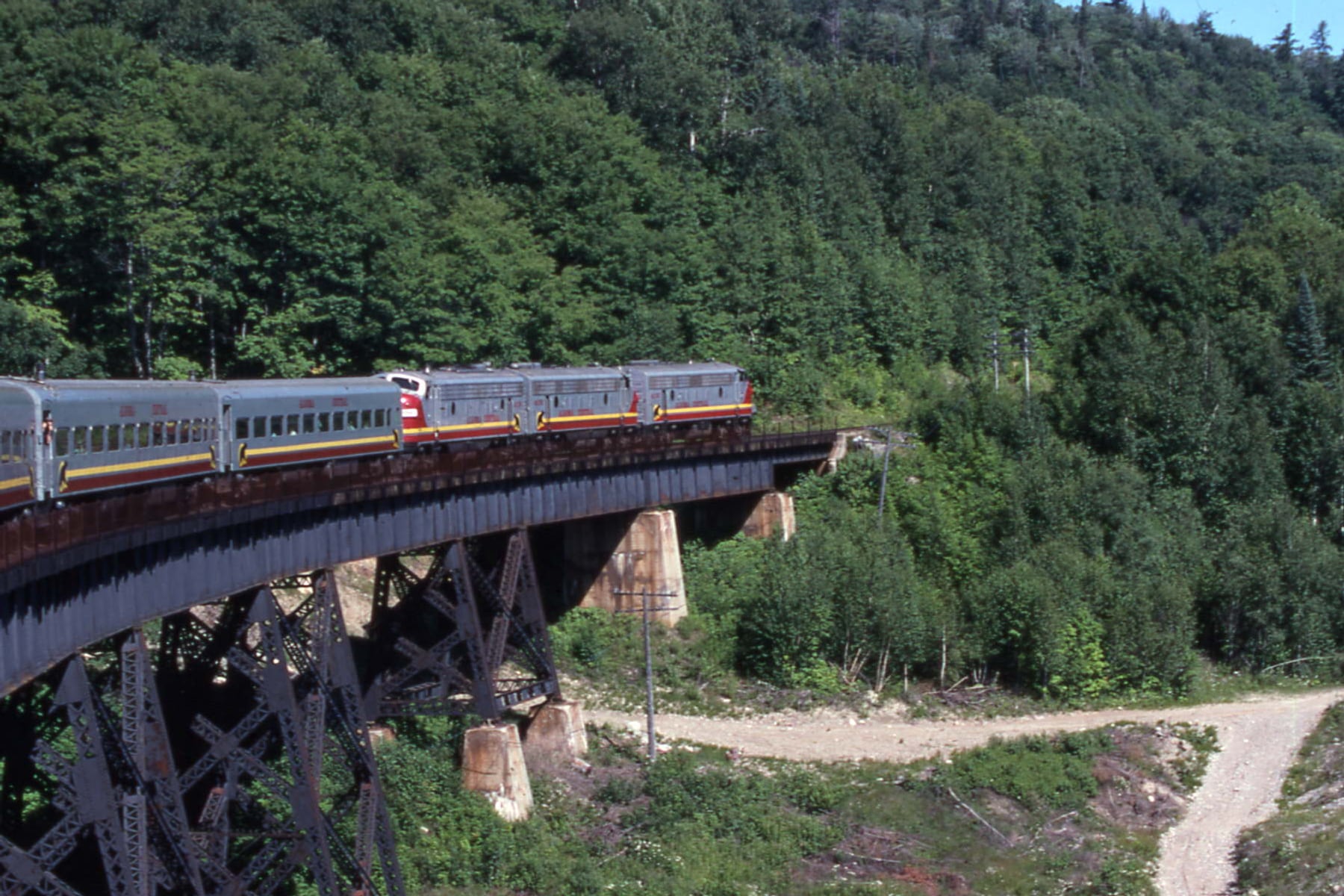
Agawa Canyon Tour Train
David Wilson / Wikimedia Commons · CC BY 2.0 · July 1997 · cropped
- Distance183 km each way
- Duration10 hours
- Best season1 August – 18 October · daily
Introduction
In September 1918 three painters had a railway company shunt them a boxcar. It was number 10557, painted red, and the Algoma Central left it on sidings north of Sault Ste. Marie wherever Lawren Harris, J. E. H. MacDonald and Frank Johnston wanted to work. Its first stop was the Agawa River, in the gorge that is now the Agawa Canyon. They came back every year until 1923, and what they brought out of that country became the Group of Seven — the closest thing Canada has to a national school of painting. The railway they used is still there, and the canyon still has no road.
What runs today is a single train, once a day, for eleven weeks a year. It leaves the depot at 87 Huron Street at eight in the morning, climbs 114 miles north through the hills of the Canadian Shield, drops 500 feet down the wall of the canyon in the last ten of them, and stops on the floor of a park you cannot drive to. Ninety minutes later it turns round and comes back, reaching the Sault at six. There is no other passenger train left on the Algoma Central: the service to Hearst, 296 miles up the line, was withdrawn in 2015.
That gives the day an unusual shape. This is not a train that takes you somewhere — it is a train that takes you and brings you back, and the whole point is the four hours of forest, trestle and river in between. The autumn fortnight is what the operator sells hardest and what the season is built around, but the canyon is the same canyon in August, with fewer people on the stairs.
The Journey
The Algoma Central was never meant to carry tourists. Francis Hector Clergue chartered it on 11 August 1899 to bring logs to his pulp mill and iron ore from the Helen Mine, near Wawa, down to the steelworks he was building at Sault Ste. Marie. His holding company went bankrupt in 1903 with the line 56 miles from anywhere; construction resumed in 1909, and in 1914 the rails finally reached Hearst, 296 miles north, where they met the National Transcontinental. For most of the century after that the railway hauled ore, pulpwood and lumber, and ran a passenger train for the trappers, cottagers and canoeists who had no other way in.
The excursion grew out of that. Track was laid through the Agawa Canyon in the winter of 1911; in 1952 the railway cleared a picnic ground on the canyon floor; and in the 1960s it began advertising the place. It worked far better than anyone expected. Through the 1970s and 1980s about a hundred thousand people a year came, and to move them the Algoma Central ran the longest passenger trains in North America — twenty to twenty-four cars, occasionally thirty, with two dining cars in the middle.
The line has changed hands three times since. Wisconsin Central bought it in February 1995, Canadian National bought Wisconsin Central in October 2001, and CN withdrew the Sault–Hearst passenger train in 2015, leaving the tour train as a separate business. In March 2021 Watco announced it was buying the railway; the sale closed in 2022, and the southern half — Sault Ste. Marie to Oba — now trades as the Agawa Canyon Railroad. The tour train came with it. The 2020 season was cancelled for the pandemic; every year since has run.
What pulls it, and what you sit in
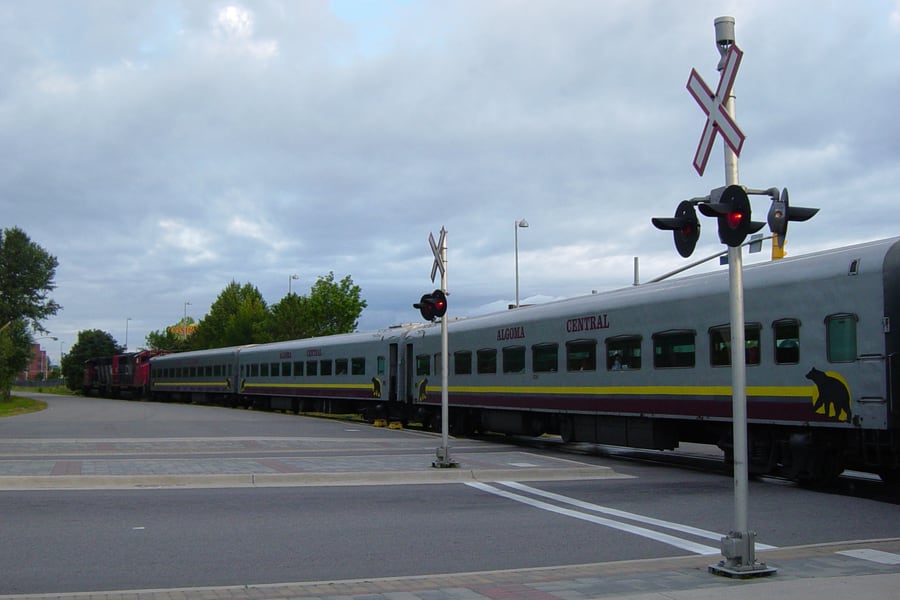
Two EMD F40PHs in maroon, carrying the Agawa Canyon Tour Train's own crest on the nose and Watco's WAMX leasing marks on the flank; 112 is one of them. It is a locomotive with a good pedigree for this work — a 3,000-horsepower cowl unit built from 1975 with a generator on board to light and heat the train, the type that became the backbone of Amtrak's diesel fleet and still leads VIA Rail's long-distance trains today. Behind them come the stainless-steel coaches with their big tinted windows, and at the tail, newly added to the consist, the Stone Gardner: a restored twenty-four-seat theatre car with a plate-glass rear window and eight swivel chairs, which costs three times the coach fare and includes everything you eat.
The commentary is triggered by GPS rather than a guard with a microphone, so it fires as each landmark arrives: the Ojibway history of the country, the fur traders, the entrepreneurs who cut it open. It plays in English through the coaches, with French, German, Japanese, Korean and Mandarin on wireless headsets. Cameras on the locomotive feed flat screens down the length of the train, which is the only way anyone in a coach gets the engineer's view of the canyon descent. There is no Wi-Fi.
Four hours up
The forest closes in within minutes of leaving the Sault and does not really open again. This is the Canadian Shield: mixed hardwood and conifer over granite, broken by lakes and rivers, with the line picking its way between them on cuttings and steel trestles. Searchmont — named for the treasurer of Clergue's holding company — comes and goes; so does Hubert. There is no road alongside for most of it, which is exactly what made this country worth painting and still makes it worth riding.
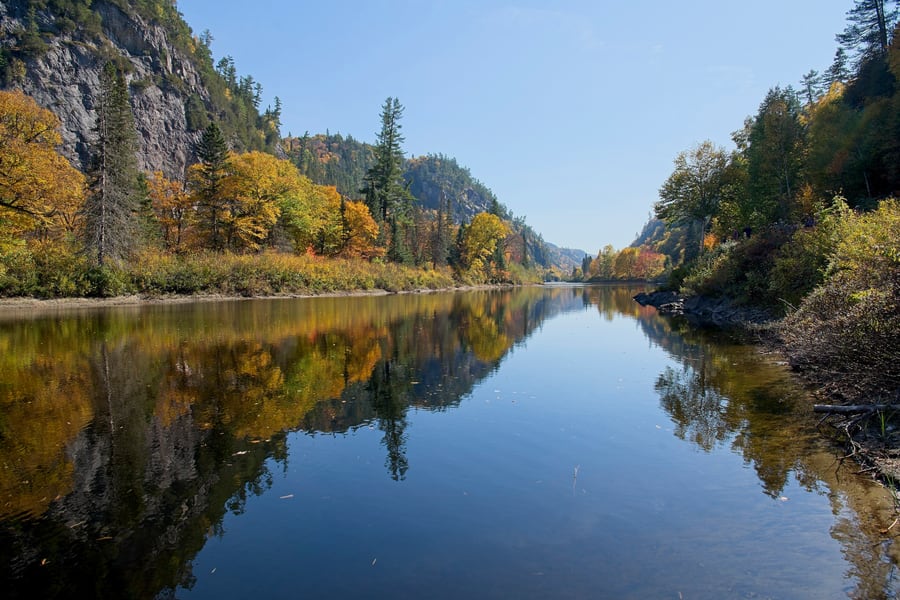
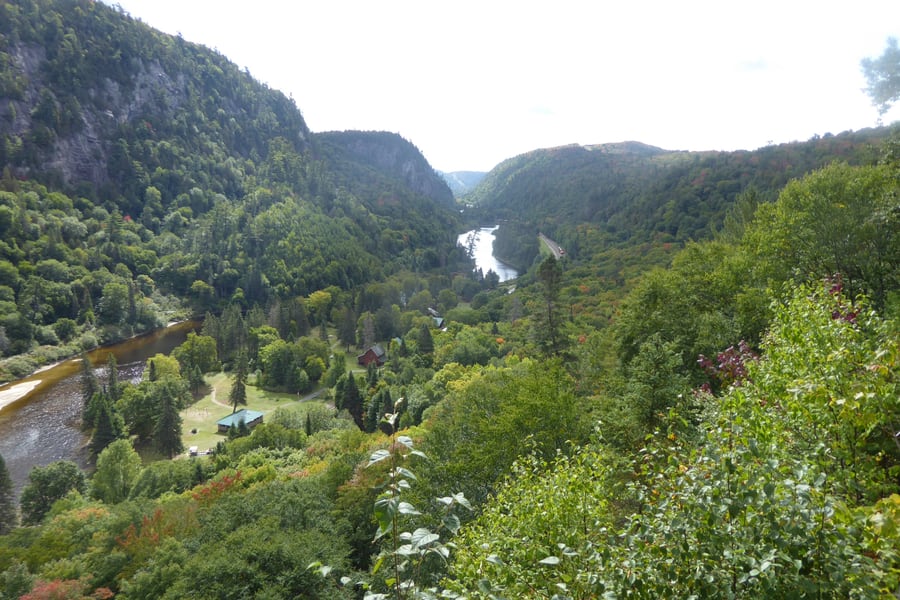
The one moment everybody photographs before the canyon is mile 92, where the railway crosses the Montreal River on 1,550 feet of curved steel trestle, 130 feet above the water and its hydroelectric dam. Nothing on the ground gets you there. Ten miles short of the end, at mile 102, the line tips over the rim and begins the descent: 500 feet in ten miles, hard against the top of the canyon wall, with the river appearing and disappearing below. The walls stand 575 feet above the water at their highest. The gorge itself was opened by faulting more than 1.2 billion years ago, widened by ice that retreated ten thousand years back, and finished by the Agawa River.
Ninety minutes at mile 114
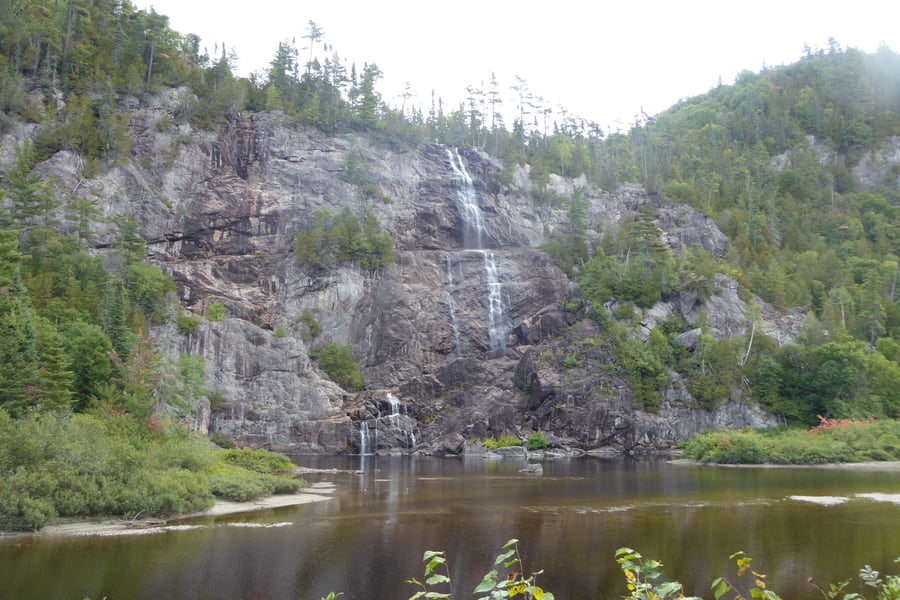
Then the rails stop. The park is a strip of flat ground beside the river with a few wooden buildings, picnic tables, restrooms and five short trails: Ed Foote, Otter Creek, River, Talus and the Lookout. The stop is a picnic and the operator plans for it: bring a small lunch cooler and non-alcoholic drinks, or pre-order a box when you book and collect it on board. There is a snack and beverage canteen in the cars and a gift shop, and neither takes cash — nothing on the train does. Four waterfalls come off the rim — Bridal Veil at 68.5 metres, the two Black Beaver falls at 53.3, Otter Creek at 13.7. The Lookout Trail is 300 steps and gravel path up the wall to a platform 250 feet above the rails, and ninety minutes is enough to climb it and get back only if you go straight there. While you are up on the wall the locomotives uncouple and run round to the other end of the train, and at the appointed moment it leaves, with or without you. The return takes four and a half hours.
Along the route
 Dustin M. Ramsey / Wikimedia Commons · CC BY-SA 2.5 · cropped
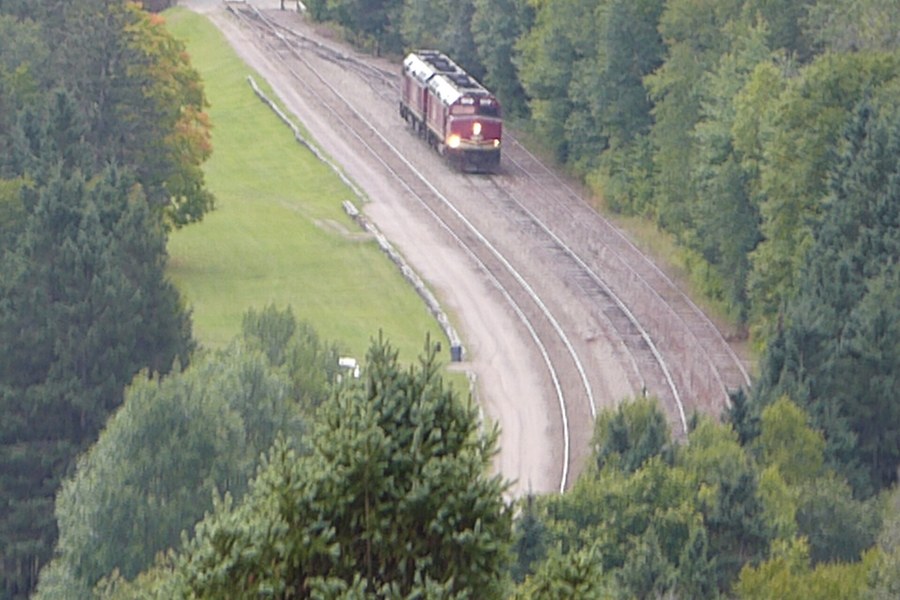
Out of the Sault at eight
The depot is at 87 Huron Street, ten minutes' walk from the waterfront, with free parking and a gift shop. The train leaves promptly at eight and the city is behind you inside a few minutes.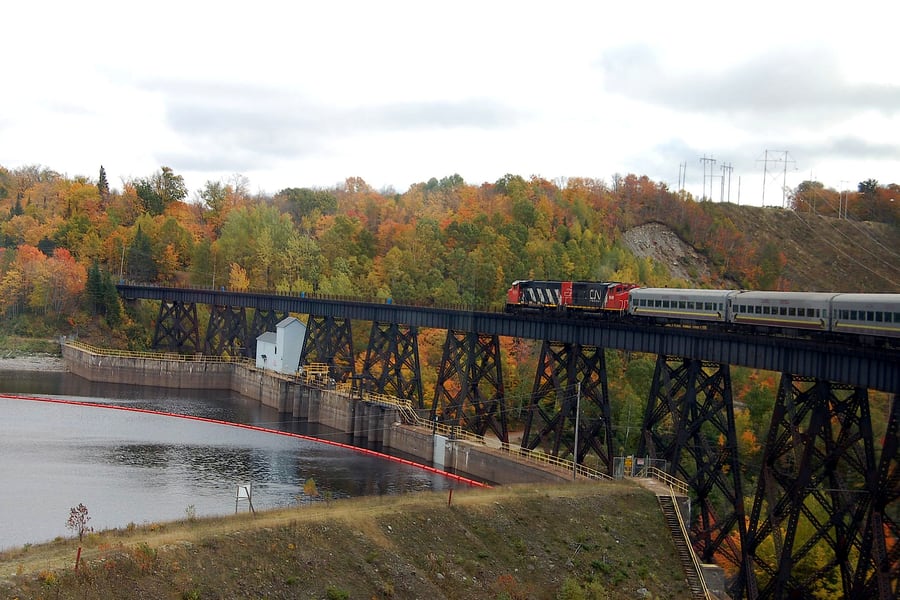 Joe Ross / Wikimedia Commons · CC BY-SA 2.0 · cropped
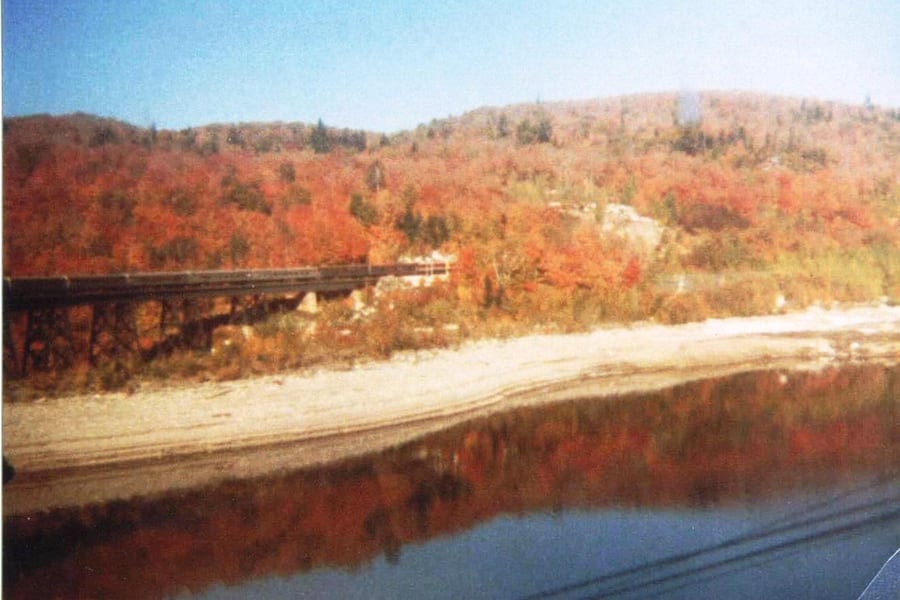
The Montreal River trestle, mile 92
The best structure on the line: 1,550 feet of steel trestle curving 130 feet above the Montreal River and its hydro dam. There is no road to it and no way to see it except from a train.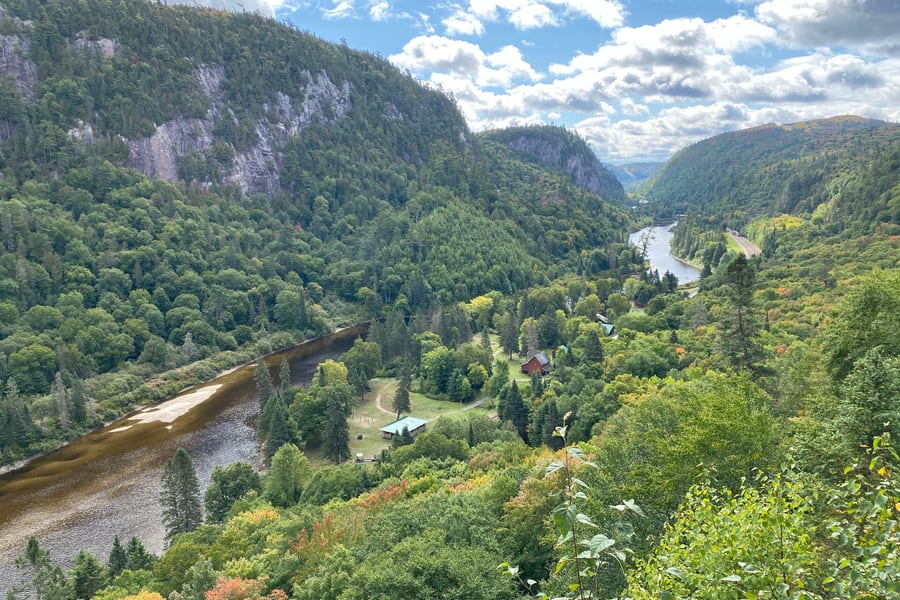 WabbitWanderer / Wikimedia Commons · CC BY-SA 2.0 · cropped
Over the rim at mile 102
Twelve miles short of the end the line tips over the canyon edge and starts down, hugging the top of the wall and losing 500 feet in the next ten. This is the part everyone remembers.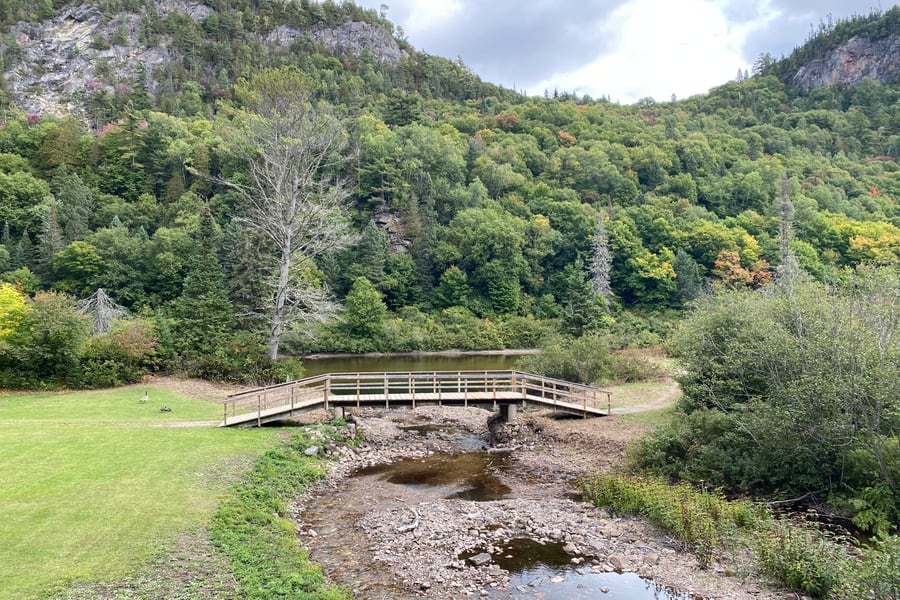 WabbitWanderer / Wikimedia Commons · CC BY-SA 2.0 · cropped
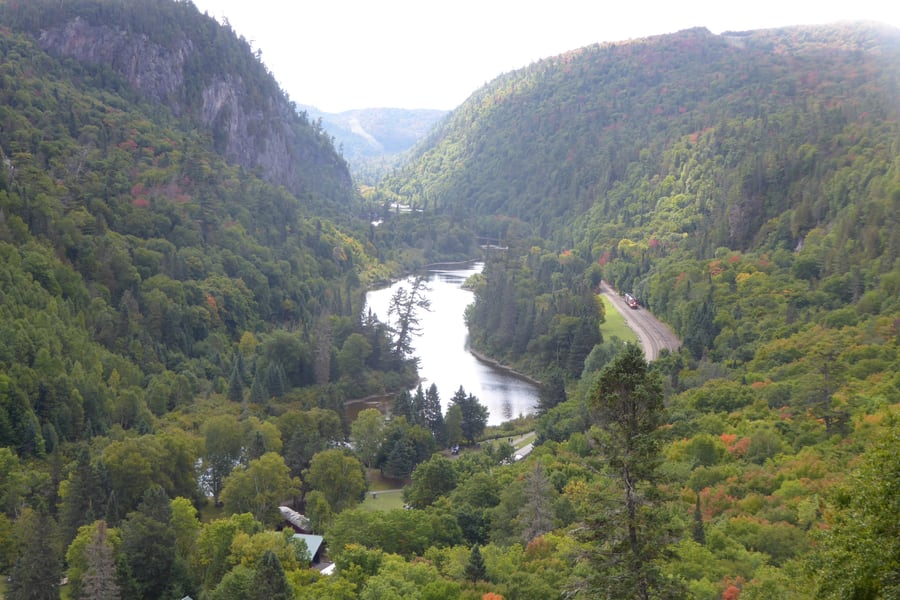
Mile 114, and the rails stop
The train halts on the canyon floor beside a park with a handful of wooden buildings, picnic tables and five short trails. No road reaches it. Ninety minutes later it leaves again.A bit of history
Culture & experiences along the way
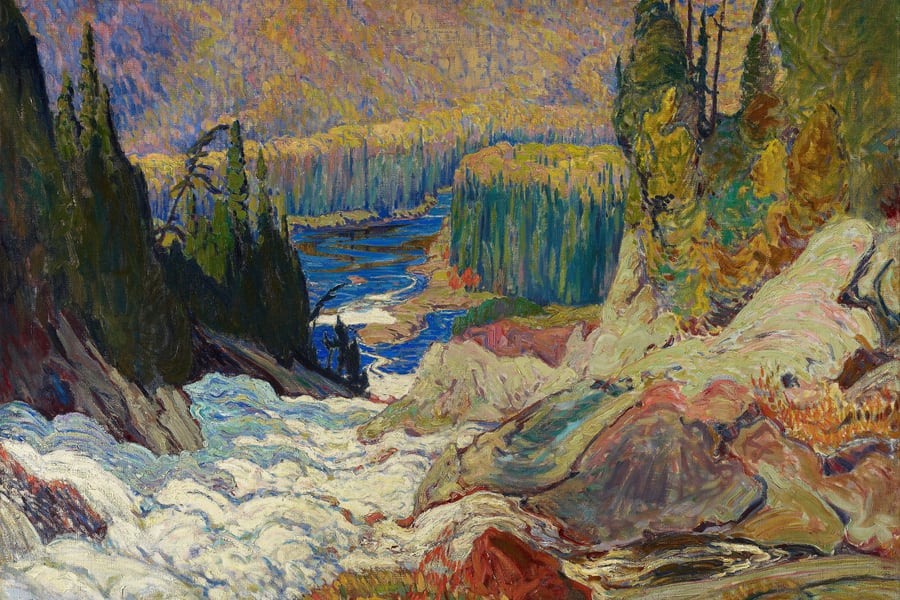 J. E. H. MacDonald, *Falls, Montreal River*, 1920, Art Gallery of Ontario · Google Art Project / Wikimedia Commons · public domain · cropped
The boxcar that made a school of painting
In September 1918 Lawren Harris, J. E. H. MacDonald and Frank Johnston had the Algoma Central shunt them a boxcar — number 10557, painted red, fitted with bunks and a stove — and leave it on sidings wherever they wanted to paint. They came back until 1923; the Group of Seven held its first exhibition in the middle of it.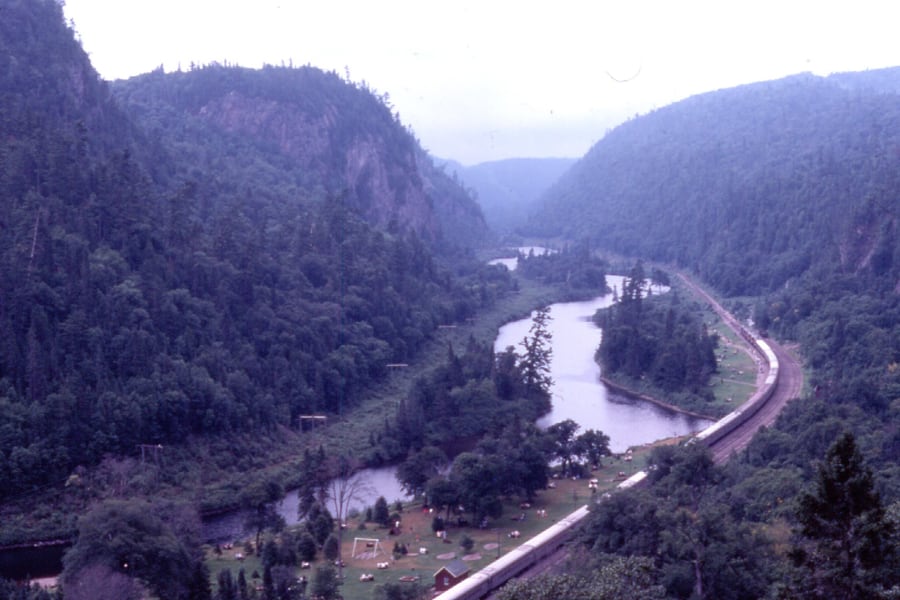 Robert Taylor / Wikimedia Commons · CC BY 2.0 · cropped
When the excursion ran thirty cars
This train was once the biggest thing on the North American passenger network. Through the 1970s and 1980s about a hundred thousand people a year rode it, and the Algoma Central ran the longest passenger trains on the continent to carry them — twenty to twenty-four cars, sometimes more. The photograph above is July 1978: thirty cars, two of them dining cars, laid out along the canyon floor.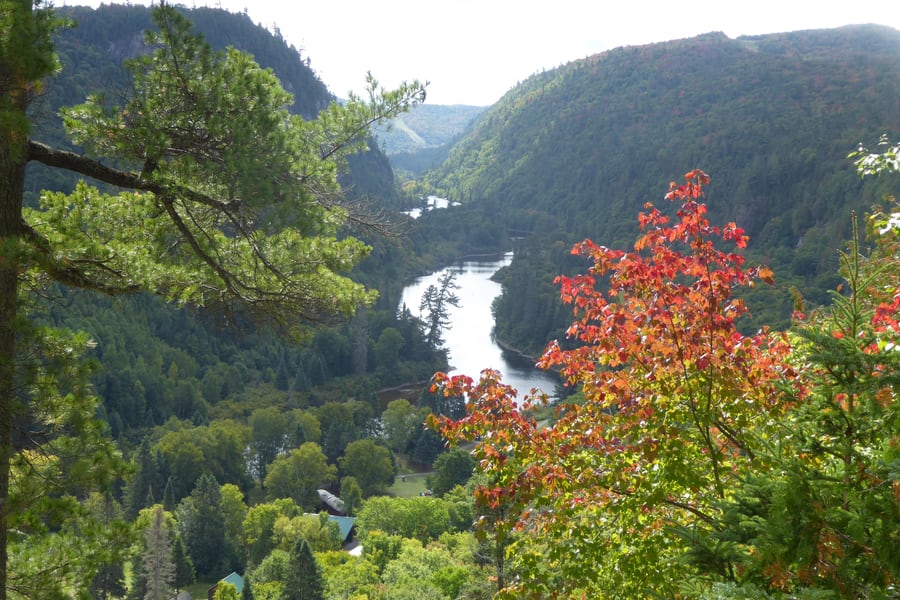 WabbitWanderer / Wikimedia Commons · CC BY-SA 2.0 · cropped
The fortnight the whole season turns on
Fares are flat from 15 September to 18 October and the operator calls that stretch peak season, which tells you what it is selling: hardwood on the canyon walls turning red and gold at the same moment the light gets low. Book the last two weeks of September and the first fortnight of October and you are buying the colour, not the mileage.Timetables
There is one departure a day and it is the same departure every day. The train leaves Sault Ste. Marie at 08:00, reaches Agawa Canyon at about 12:00, stands there for ninety minutes, and is back at the depot at 18:00. The operator's own words are that it "will leave promptly at 8 a.m."; boarding opens beforehand, so allow time for parking and the gift shop.
| Sault Ste. Marie | Agawa Canyon | Agawa Canyon | Sault Ste. Marie | ||
|---|---|---|---|---|---|
| Daily, 1 Aug – 18 Oct | 08:00 dep | 12:00 arr | 13:30 dep | 18:00 arr |
The 2026 season runs from 1 August to 18 October, seven days a week, with no rest day and no extra service. That is the whole year: nothing runs in winter, spring or early summer, and the booking calendar is empty on either side of those dates. The season is short and it moves — check before you plan a trip around it.
Timings within the day are the operator's own split, not a station-by-station timetable: four hours up, ninety minutes at the canyon, four and a half hours back. There are no intermediate stops and no way to join or leave the train anywhere but the Sault. The extra half hour on the return is in the published schedule, not a delay.
Every seat is reserved and the train sells out, most reliably in the peak weeks from mid- September. The Stone Gardner car at the tail has twenty-four seats and was already on a waiting list for early-September dates when this page was checked.
As of September 2026. Departures confirmed against the operator's live booking calendar, which was swept day by day across the whole season. Check current dates and times at agawatrain.com (opens in a new tab).
Tickets
Two fare bands, both sold direct by the operator and confirmed at the checkout. From 1 August to 14 September an adult pays CA$154, a senior over sixty CA$125, a child of three to twelve CA$78, and an infant under two travels free on a lap. From 15 September to 18 October there is one flat fare of CA$170 for everybody, which is the operator's way of saying that this is the fortnight people actually come for.
Everything is reserved and the train has no walk-up option. Refunds do not exist unless you add Trip Protection at checkout, at ten per cent of the ticket, which then buys a full refund at any time before departure; if the operator cancels for weather you get your money back either way. Parking at the depot is free, food and drink can be pre-ordered when you book, and nothing on board takes cash — the canteen and the gift shop are card only.
Fares as of September 2026.
Book your tickets
Adult, summer season
1 August to 14 September
The full ten-hour round trip in a standard coach, with seniors at CA$125 and children aged three to twelve at CA$78.
Book Tickets (opens in a new tab, on agawatrain.com)via agawatrain.comPeak season, all ages
15 September to 18 October
One flat fare for everybody during the autumn colour, when the train sells out furthest ahead.
Book Tickets (opens in a new tab, on agawatrain.com)via agawatrain.comThe Stone Gardner car
Twenty-four seats behind a plate-glass window
A restored theatre car at the tail of the train with breakfast, lunch and drinks included.
Book Tickets (opens in a new tab, on agawatrain.com)via agawatrain.comRail Passes
No rail pass applies to this train, and there is nothing to research further.
The Agawa Canyon Tour Train is a private excursion sold by the ticket, not a scheduled service on anybody's network. It is not VIA Rail, so VIA's two Corridor discount cards — which in any case only cover Québec City to Windsor — have nothing to do with it. Interrail and Eurail do not exist in Canada. The Canrailpass is gone. Ontario Northland, the province's other passenger operator, sells no pass either.
What does exist is the operator's own concession structure, applied automatically at booking rather than bought in advance: seniors over sixty and children of three to twelve pay less in the summer band, and infants under two travel free on a lap all season. In the peak band from 15 September the concessions disappear and everyone pays the same flat fare. Group bookings for parties large enough to need their own car are arranged directly with the operator.
Checked September 2026 against the operator's fare table and its booking engine.
Places to Visit
This journey has exactly two stops, and one of them has no road. Agawa Canyon Park is the whole reason for the train, and ninety minutes is what you get: enough for the falls, or for the Lookout Trail, but not comfortably for both. Decide which before you arrive, and start walking as soon as you are off the steps.
Everything else is in Sault Ste. Marie, and the train's schedule leaves you no daylight for it — out at eight, back at six. The city is worth a second day either side. The waterfront boardwalk starts a few minutes from the depot and runs east past the 1895 canal; the Bushplane Centre and the Ermatinger Clergue site are both within a short walk or a very short drive of it; and the Art Gallery of Algoma on East Street, free to enter and closed on Sundays, holds Group of Seven work painted on the line you have just ridden.
Bring proof of citizenship if you are crossing from Michigan. Americans from Washington, Minnesota, South Dakota, Michigan, New York or Vermont may use an enhanced driver's licence or identification card; everyone else needs a passport.
 WabbitWanderer / Wikimedia Commons · CC BY-SA 2.0 · cropped
Sault Ste. Marie
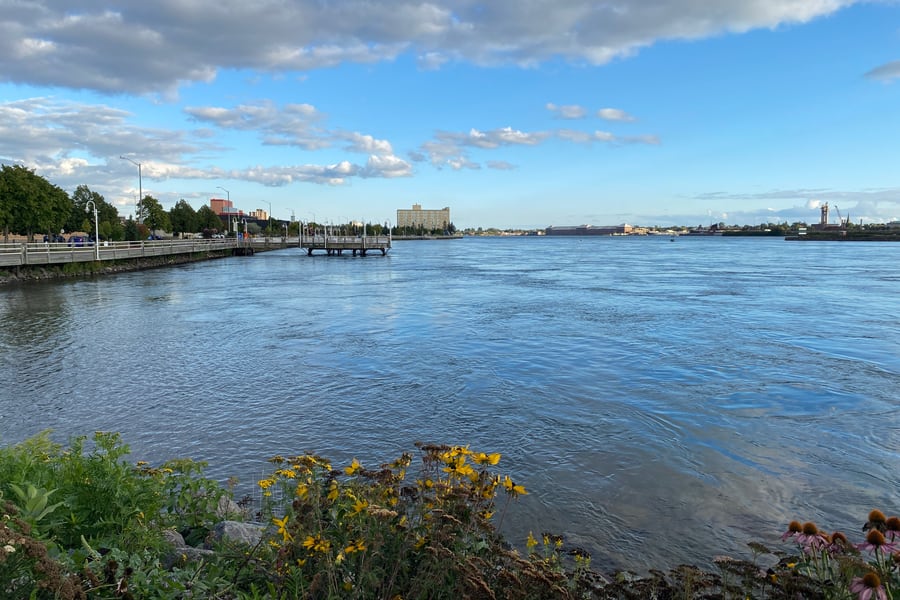
Seventy-two thousand people on the north bank of the St. Marys River, facing its American twin across the water. The Ojibwe called the place Baawitigong, the place of the rapids, and everything since — the fur post, the canal, the steelworks, the railway — has been about getting past them. The waterfront boardwalk runs east from the train depot past the locks; the town is small enough to do the whole of it on foot.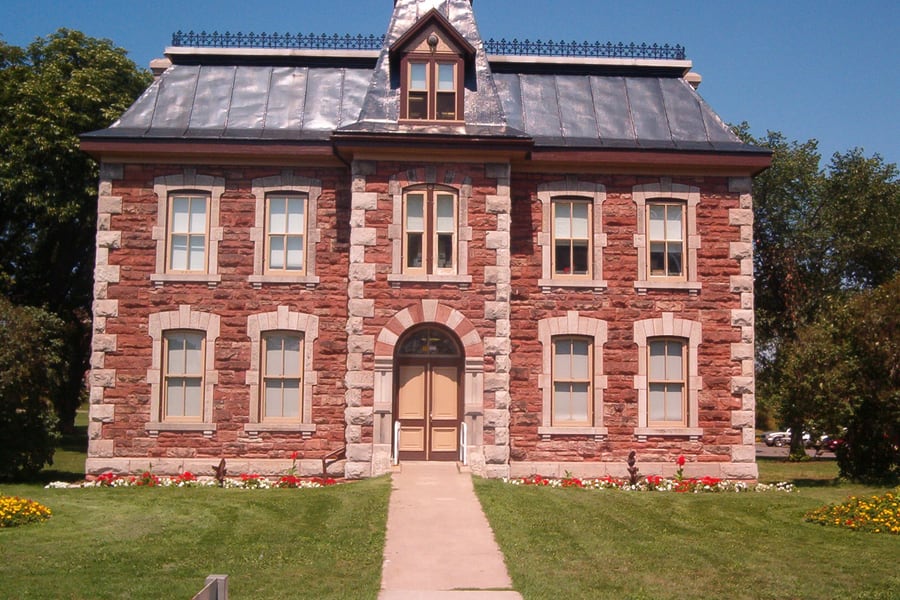 Fungus Guy / Wikimedia Commons · CC BY-SA 3.0 · cropped
The Sault Ste. Marie Canal
Canada built its own lock here in 1895 because in 1870 the Americans refused a Canadian steamer passage through theirs. It was the largest lock in the world when it opened, and the first anywhere to be worked by electricity. A wall failed in 1987; a smaller lock was built inside the old one in 1998 and now passes pleasure craft. The red sandstone buildings around it came out of the cutting.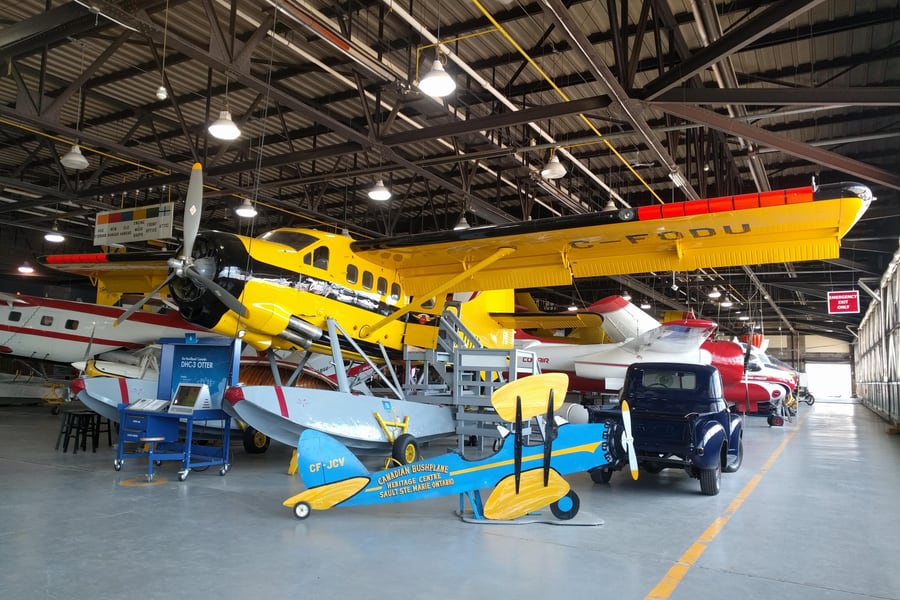 jockrutherford / Wikimedia Commons · CC BY-SA 2.0 · cropped
Canadian Bushplane Heritage Centre
A 64,000-square-foot hangar on the waterfront holding more than thirty aircraft, on an air base the Ontario Provincial Air Service established in 1924 to spot and fight forest fires. Founded by local volunteers in 1987 and still run without operating subsidy, it keeps floatplanes, water bombers and a flight simulator, and houses the Entomica insectarium as well.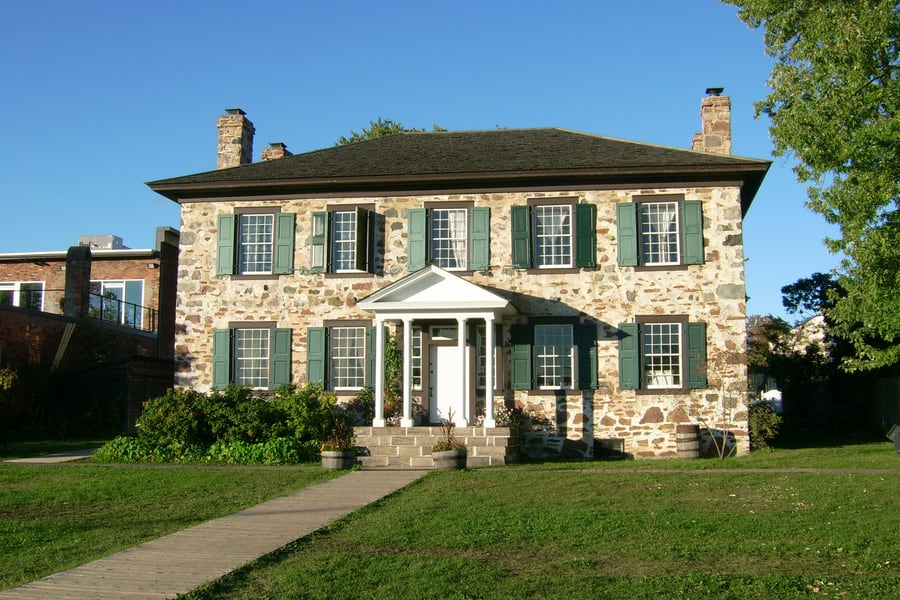 Fungus Guy / Wikimedia Commons · CC BY-SA 3.0 · cropped
Ermatinger Clergue National Historic Site
Two of the oldest buildings north-west of Toronto, on Bay Street. The Old Stone House was built between 1814 and 1823 by Charles Oakes Ermatinger of the North West Company and has since been a mission, a tavern, a courthouse, a post office and a dance hall. Beside it stands the post's powder magazine, which Francis Clergue — the man who chartered the Algoma Central — converted and lived in from 1894 to 1902.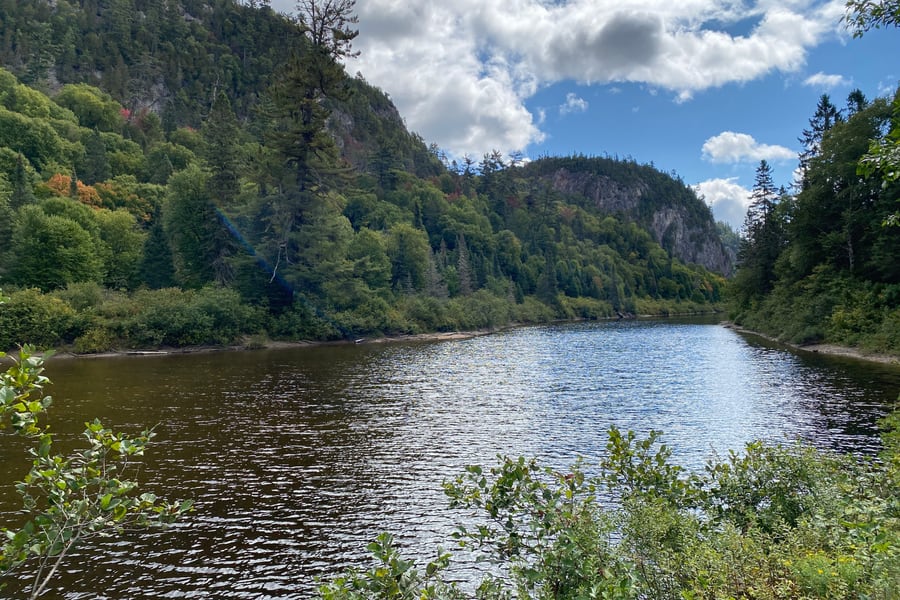 WabbitWanderer / Wikimedia Commons · CC BY-SA 2.0 · cropped
Agawa Canyon Park
The reason the train exists, and reachable no other way. The Algoma Central cleared a picnic ground on the canyon floor in 1952 and more than three million people have got off here since. Five short trails cross the flat ground beside the Agawa River — Ed Foote, Otter Creek, River, Talus and the Lookout — and the walls above them rise 575 feet.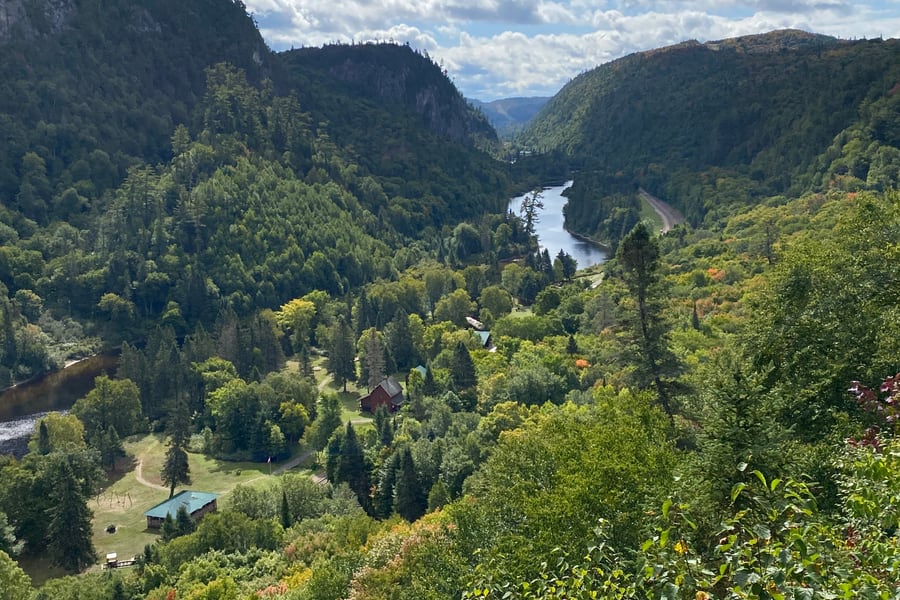 WabbitWanderer / Wikimedia Commons · CC BY-SA 2.0 · cropped
The Lookout Trail
Three hundred steps and a stretch of gravel path climb the canyon wall to a platform 250 feet above the rails, and the ninety-minute stop is just long enough to do it and get back if you start immediately. It is steep, and the operator says so. The reward is the whole canyon at once, with your own train laid out on the floor of it.Where to Sleep
There is nowhere to stay along the route. The canyon has no accommodation of any kind, the line has no intermediate stop, and the train comes back the same day — so every bed on this journey is in Sault Ste. Marie, and the only question is how far from the depot at 87 Huron Street you want to be.
An eight o'clock departure with boarding beforehand argues for walking distance. Downtown, along Bay Street and the waterfront boardwalk, is close enough to walk from; the larger places out on Great Northern Road towards the highway are a short drive and have more space and more pools. Parking at the depot is free either way, so a car is no obstacle.
Book early for the peak weeks. The train sells out from mid-September, and the town fills up with it.
Where to stay
Days Inn & Suites Sault Ste. Marie
Downtown on Bay Street, by the boardwalk
A short walk from the depot with free covered parking, free breakfast and a bowling alley and arcade on site.
Check Availability (opens in a new tab, on wyndhamhotels.com)via wyndhamhotels.comThe Water Tower Inn
Independent, family-run, north of the centre
A full-service inn of more than forty-five years standing, with its own restaurant and four pools including a year-round outdoor whirlpool.
Check Availability (opens in a new tab, on watertowerinn.com)via watertowerinn.comQuattro Hotel & Conference Centre
All-suite, with breakfast included
Every room is an oversized suite with a fridge and microwave, and there is an indoor pool, a sauna and two restaurants on site.
Check Availability (opens in a new tab, on quattrossm.com)via quattrossm.comQuestions or corrections
Planning this trip and stuck on something, or spotted a time, fare or detail that has changed? Send us a message about Agawa Canyon Tour Train. We read every one, and we update this page when something has changed.