Almaty to Turkistan
TheGreatSteppe / Wikimedia Commons · CC BY-SA 4.0 · 2021 · cropped
- Duration14 hr 18 min on the Talgo
- Best seasonEvery other day all year; Shymkent to Turkistan by daylight
Introduction
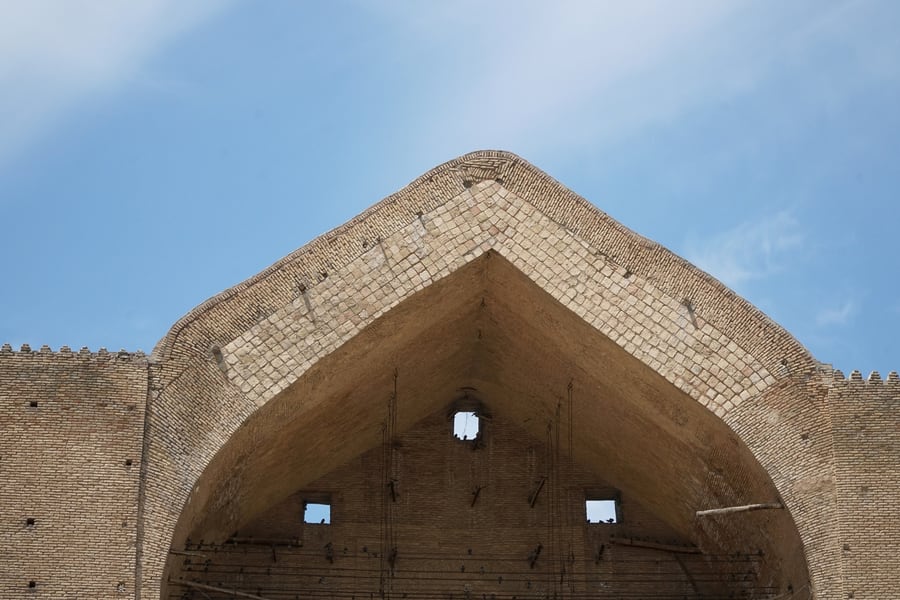
The main entrance of the Mausoleum of Khoja Ahmed Yasawi in Turkistan has never been finished. Its great arch is bare brick, never faced with tile like the walls around it, and wooden beams still jut from it in rows. Timur ordered the building in 1389 to replace the small tomb of a Sufi poet who had died here in 1166, and the work stopped when Timur died in 1405, at Otrar, some fifty kilometres to the south. UNESCO made it Kazakhstan's first World Heritage Site in 2003 and counts the unfinished entrance as part of the reason: it is documentary evidence of how the building was put up.
The way there from Almaty is the Talgo. Train 027 leaves Almaty-2 at 20:10 every other evening and reaches Turkistan at 10:28 the next morning, 14 hours 18 minutes later — the quickest of seven trains on the route. It runs west through the night on the Turksib by Shu and Taraz, reaches Shymkent at breakfast, and at Arys turns north-west on to the railway of 1906, between the Karatau range and the Syr Darya. The train goes on past the Aral and Aktobe to Oral, another day and a night; Turkistan is a twenty-minute stop.
The Journey
Train 027 leaves Almaty-2 at 20:10 and runs west on the Turksib in the dark. Its first stop is Shu, at 00:26, for ten minutes. The town began in 1928 with the building of the Turksib and is still its biggest junction — the place where the line north to Astana leaves the one to the south, and known informally as the capital of the Turksib. Taraz follows at 03:27, twenty minutes on the platform: a city of some 430,000 on the Talas river that celebrated its two-thousandth anniversary in 2001; the battle of 751 between the armies of the Tang dynasty and the Abbasid caliphate was fought along the same river.
Shymkent by morning
Beyond Taraz the line passes Tulkubas, in the valley under the Talas Alatau, the north-western end of the Tian Shan; the Talgo goes through before dawn without stopping, but the slower daily train 033 calls there at 08:39. Shymkent, the third city of Kazakhstan and one of three that answer to the national government rather than a region, comes at 07:13. It lies about 690 kilometres west of Almaty and 120 north of Tashkent, and the train stops ten minutes.
Arys and the line of 1906
At 08:32 the Talgo reaches Arys and stands twenty minutes. Arys was founded in 1900 as a station on the railway from Orenburg to Tashkent, and its station building, put up in 1901–04, still carries the monograms of Nicholas II. This is where the Turksib begins: it branches here off the Trans-Aral line, opened in January 1906 across the steppe from Kinel to Tashkent, which for much of the early twentieth century was the only railway between European Russia and Central Asia.
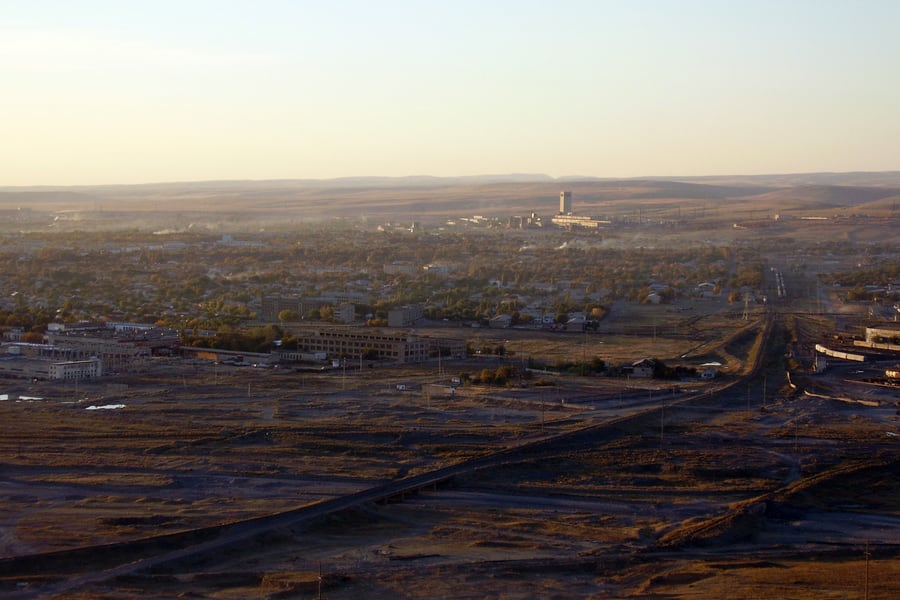
The Talgo takes that line north-west. The slower trains stop on the way at a station called Timur; the ruins of Otrar, where Timur died in February 1405, lie south of Turkistan towards the Syr Darya. To the north-east the Karatau, the westernmost spur of the Tian Shan, rises over the plain, with the town of Kentau at its foot. Turkistan comes at 10:28. When the old town around the mausoleum was abandoned, the new centre was built to the west of it, around the railway station.
The train
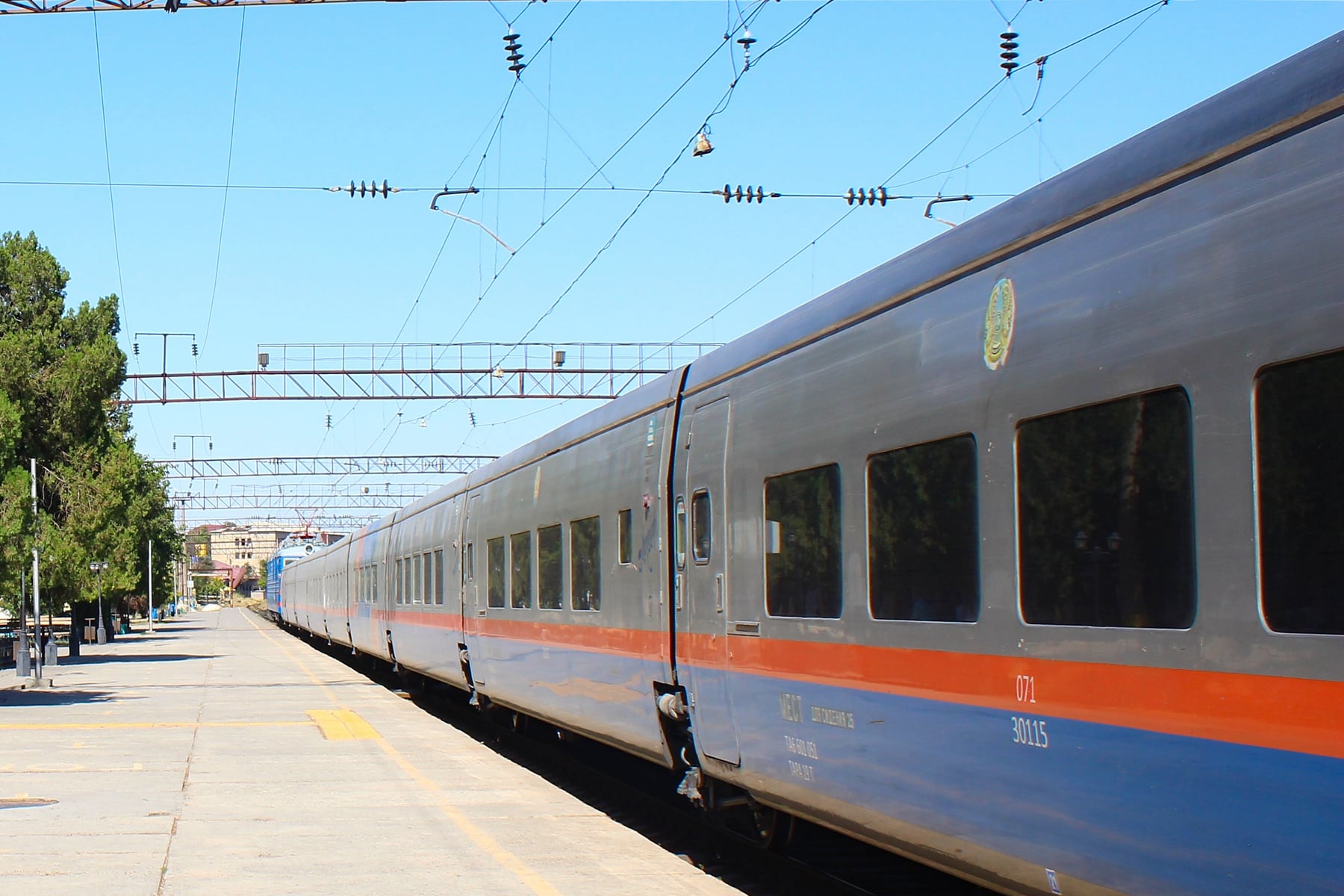
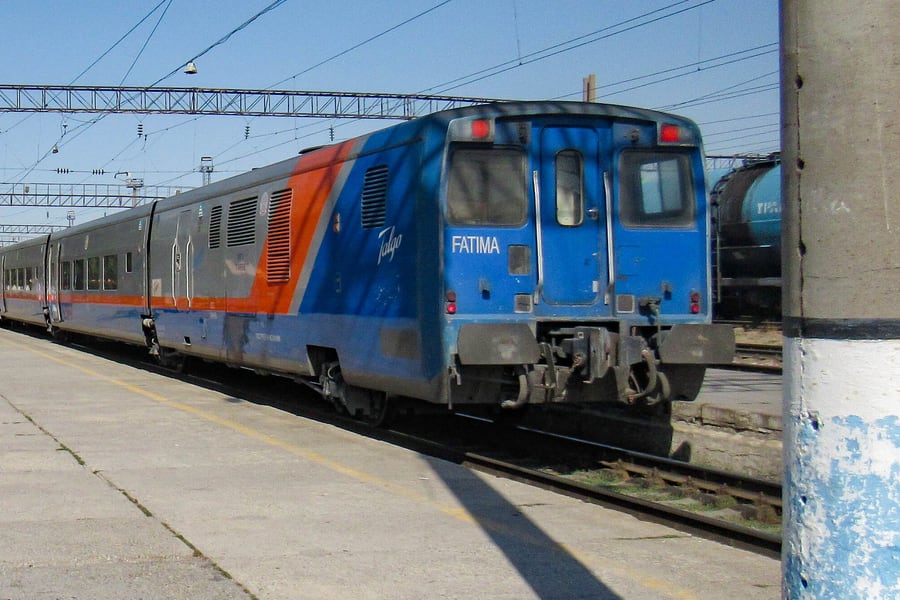
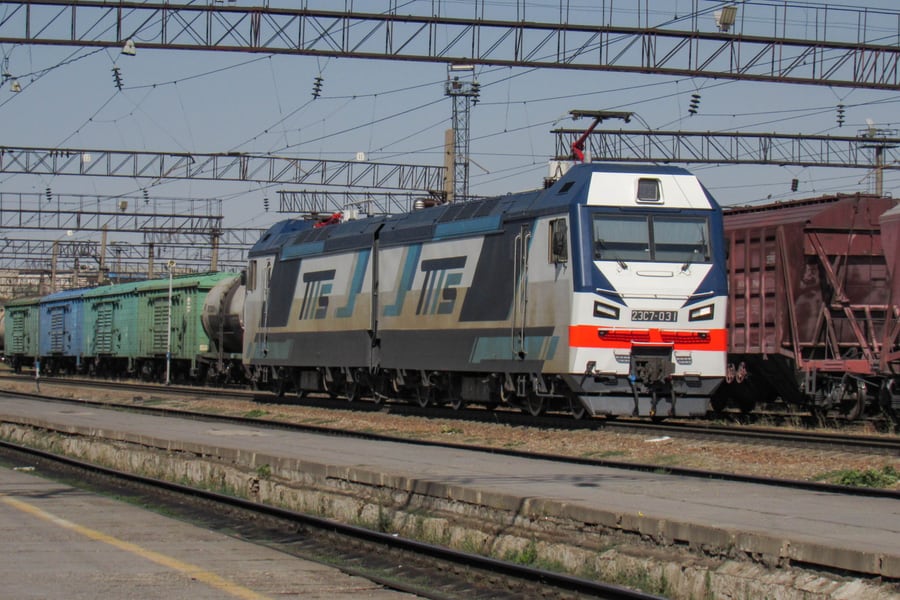
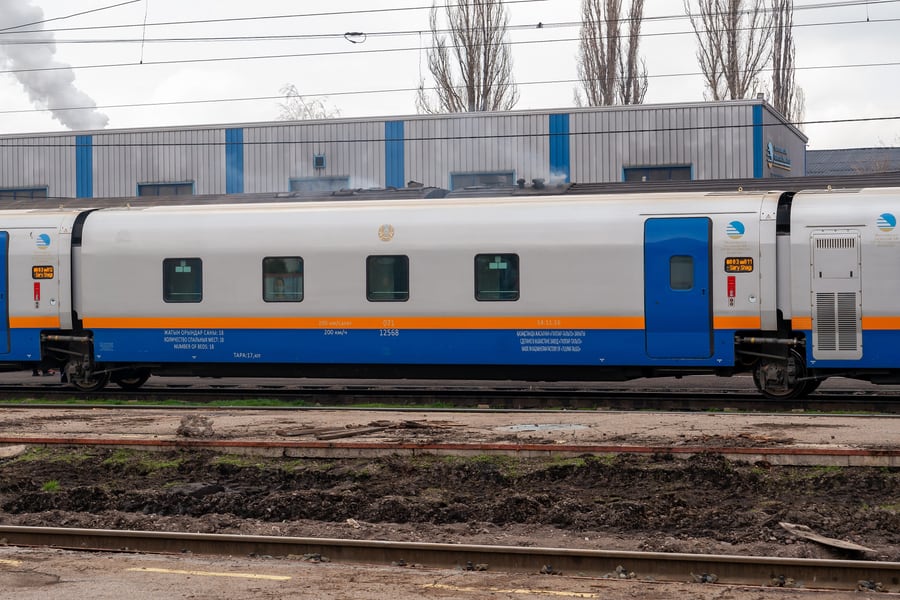
Trains 027 and 028 run between Almaty and Oral in coaches built in 2015 by Tulpar-Talgo, light and articulated, of the Spanish Talgo design. The operator lists four-berth Tourist compartments, two-berth Business compartments with a washbasin, Grand compartments with their own shower and toilet — one coach with a compartment adapted for passengers with reduced mobility — and a restaurant car and a café car. The photograph at the head of this page is a whole Tulpar-Talgo set at Shymkent in July 2021, its locomotive far down the platform. Photographed there again in August 2023, a Talgo had KZ4AT-0020 at its head, one of the 200 km/h electrics delivered from 2013.
Along the route
 TheGreatSteppe / Wikimedia Commons · CC BY-SA 4.0 · 2021 · cropped
Aksu-Zhabagly
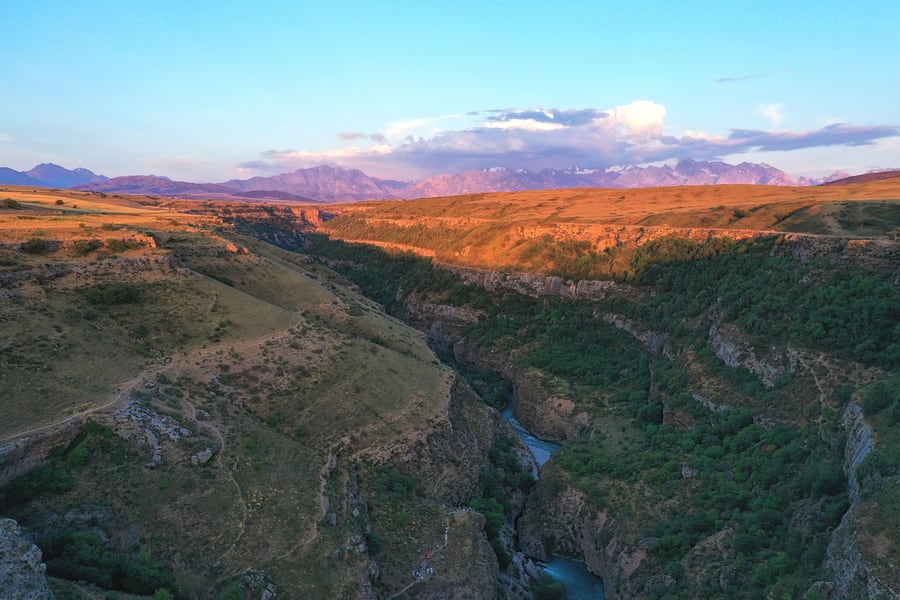
In the mountains of the Tulkubas district, the western Talas Alatau, lies the oldest nature reserve in Central Asia, set up in July 1926. Its river, the Aksu, has cut a canyon 500 metres deep.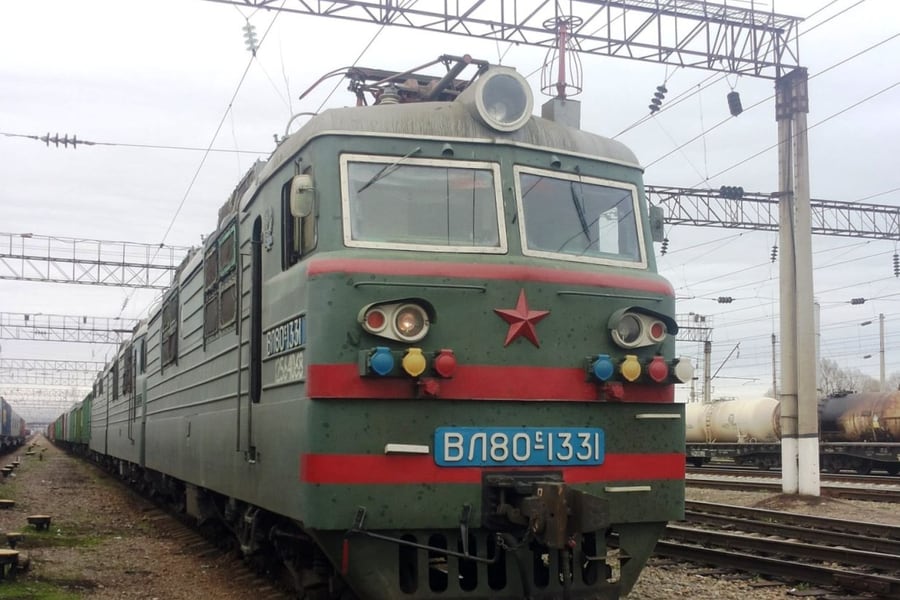 Asabist / Wikimedia Commons · CC BY-SA 4.0 · 2015 · cropped
Arys, a railway town
Founded in 1900 as a station on the Orenburg–Tashkent line, Arys is where the Turksib begins. Its biggest employers are still the railway's: the locomotive and repair depots and a sleeper-impregnating plant. This VL80S, a Soviet twin-section freight electric, was built in 1985.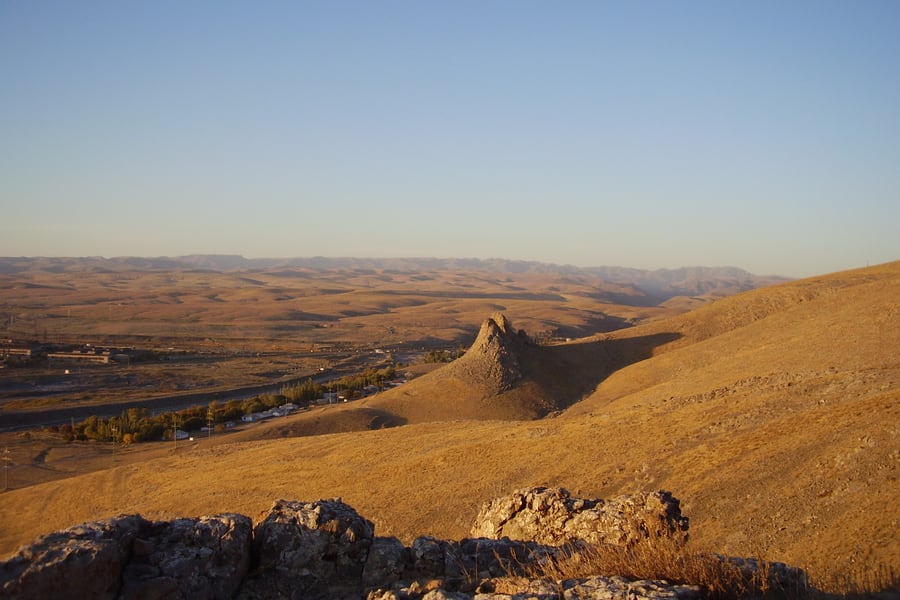 Yuriy75 / Wikimedia Commons · CC BY-SA 3.0 · 2007 · cropped
The Karatau
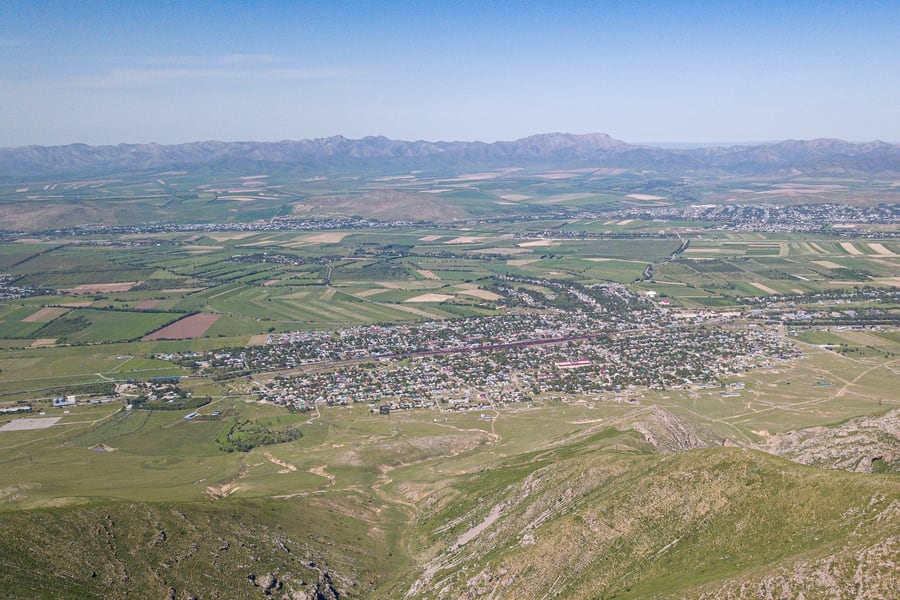
Kazakh for the Black Mountain: a range some 420 kilometres long north of the Syr Darya, the westernmost spur of the Tian Shan. Its foothills hold sites from the early Palaeolithic to the Neolithic, on UNESCO's tentative list since 1998.A bit of history
Culture & experiences along the way
 Matti Blume / Wikimedia Commons · CC BY-SA 4.0 · 2024 · cropped
A Talgo with a shower
The coaches of trains 027 and 028 were built by Tulpar-Talgo in 2015. Besides the four-berth Tourist compartments, whose lower berths turn into seats by day, the operator lists two-berth Business compartments with a washbasin, and Grand compartments with their own shower and toilet, in one coach adapted for disabled passengers.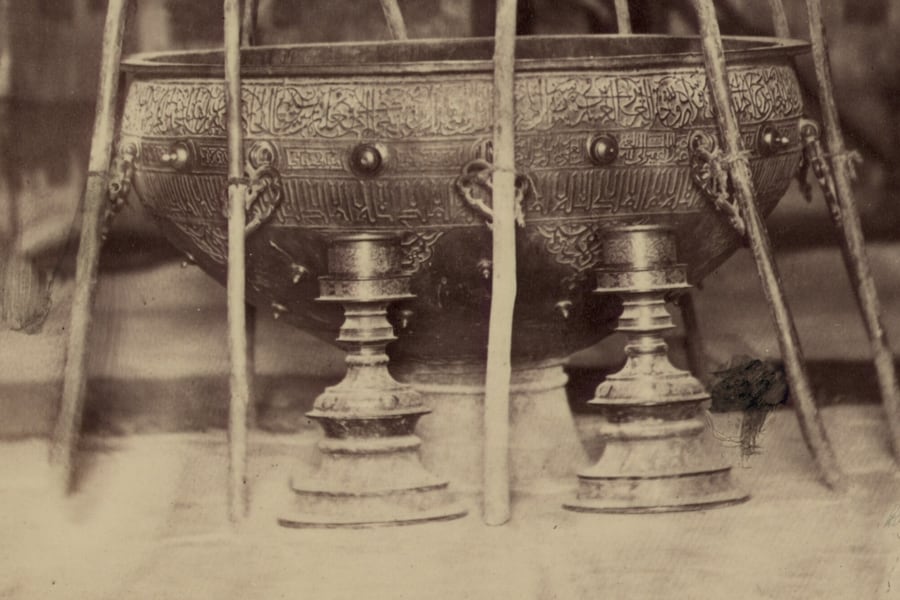 Turkestan Album / Library of Congress / Wikimedia Commons · Public domain · cropped
Timur's cauldron
In the great hall of the mausoleum stands a bronze bowl 2.2 metres across, two tonnes and 3,000 litres, inscribed as Timur's gift and dated 25 May 1399, the work of Abdulaziz ibn Sharafuddin of Tabriz. It held holy water for pilgrims on feast days. From 1934 it was shown at the Hermitage in Leningrad; it came home in 1988.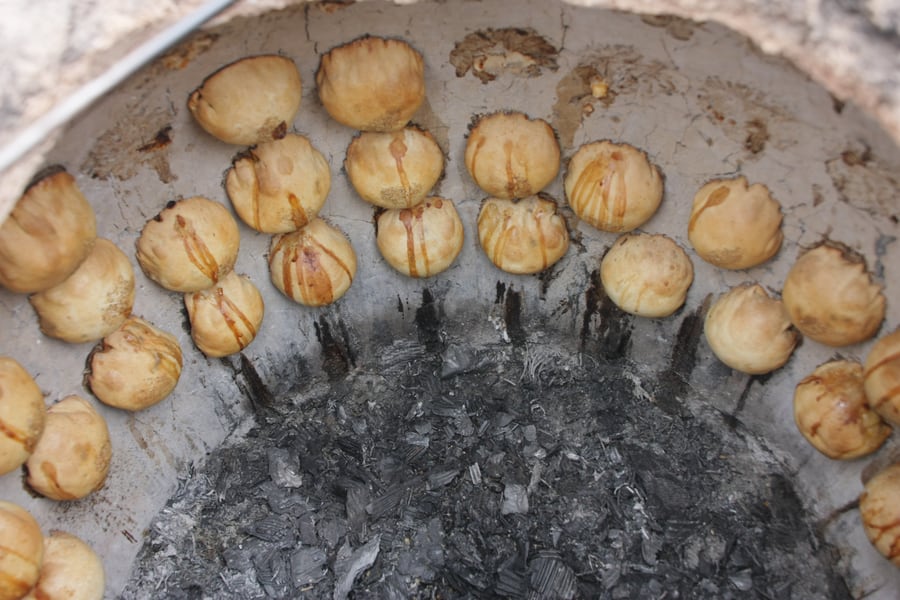 Davide Mauro / Wikimedia Commons · CC BY-SA 4.0 · 2017 · cropped
Samsa from the tandoor
Central Asia's baked pastry, almost never fried: a bun of bread or layered dough round minced lamb and onion, baked in a clay tandoor. It is sold hot from street kiosks that bake nothing else, and Turkistan, almost half Uzbek, is a good town to find it.Timetables
The Talgo runs every other day in each direction: train 027 from Almaty-2 to Oral, and 028 back. In November 2026 it leaves Almaty on the odd-numbered dates and Turkistan on the even-numbered ones. The times below are the operator's own, read from the route detail behind each train on bilet.railways.kz in October 2026; the Almaty and Turkistan times were the same on every date scanned between 25 October and 6 December 2026. Kazakhstan keeps a single time zone.
Almaty to Turkistan — Talgo 027
| Station | Arrives | Departs |
|---|---|---|
| Almaty-2 | — | 20:10 day 1 |
| Shu | 00:26 day 2 | 00:36 |
| Taraz | 03:27 | 03:47 |
| Shymkent | 07:13 | 07:23 |
| Arys-2 | 08:32 | 08:52 |
| Turkistan | 10:28 | 10:48, on to Oral |
Turkistan to Almaty — Talgo 028
| Station | Arrives | Departs |
|---|---|---|
| Turkistan | 19:51, from Oral | 20:11 day 1 |
| Arys-2 | 21:57 | 22:17 |
| Shymkent | 23:33 | 23:43 |
| Taraz | 03:20 day 2 | 03:40 |
| Shu | 06:38 | 06:48 |
| Almaty-2 | 11:09 | — |
The other trains
Six more trains link Almaty and Turkistan, with four-berth compartment (kupe) and open (platskart) coaches. The daily 033 suits anyone who wants the south by day: it passes Tulkubas at 08:39 and Shymkent at 10:20.
| Train | Leaves Almaty | Reaches Turkistan | Runs |
|---|---|---|---|
| 021 | 08:55 | 01:05 next day | daily |
| 023 | 14:35 | 07:15 next day | every other day |
| 033 | 21:12 | 13:59 next day | daily |
| 007 | 21:56 | 14:34 next day | every other day |
| 041 | 22:30 | 15:53 next day | daily |
| 077 | 23:57 | 18:06 next day | daily |
Back, the daily trains leave Turkistan at 00:27 (041), 18:40 (022), 20:57 (077) and 23:44 (034), all about 17 to 19 hours to Almaty.
Departures are published by the operator: Qazaqstan Temır Joly · bilet.railways.kz (opens in a new tab).
Tickets
Tickets are sold by Qazaqstan Temır Joly through its own system at bilet.railways.kz, in Kazakh, Russian and partial English, and at station ticket offices; sales open about six weeks ahead. On the Talgo, a berth in a four-berth Tourist compartment was 13,736 ₸ on every date sampled between 25 October and 6 December 2026, and a berth in a two-berth compartment 16,486 – 20,355 ₸.
The other trains are cheaper and slower: a kupe berth cost 8,815 – 15,590 ₸ and an open platskart berth 6,475 – 9,720 ₸, depending on train and date. Bedding is included. Close to departure the Talgo's two-berth compartments sell out first.
Book your tickets
Almaty to Turkistan by Talgo, four-berth compartment
13,736 ₸ on every sampled date
A berth in a four-berth Tourist compartment on train 027 or 028, bedding included.
Book Tickets (opens in a new tab, on bilet.railways.kz)via bilet.railways.kzAlmaty to Turkistan by Talgo, two-berth compartment
16,486 – 20,355 ₸ depending on date
A berth in a two-berth compartment on the Talgo, the first to sell out.
Book Tickets (opens in a new tab, on bilet.railways.kz)via bilet.railways.kzAlmaty to Turkistan, kupe on the other trains
8,815 – 15,590 ₸ depending on train and date
A berth in a four-berth compartment on any of the six slower trains.
Book Tickets (opens in a new tab, on bilet.railways.kz)via bilet.railways.kzRail Passes
No rail pass covers Kazakhstan, so there is nothing to buy instead of a ticket. Interrail describes a network of 33 countries, and Kazakhstan is not one of them.
The answer for this journey is the plain fare, bought from the operator: about 14,000 tenge for a Tourist berth on the Talgo, which is the night's bed as well as the ride. Checked against interrail.com in October 2026.
Places to Visit
Five places, each older than the railway by five centuries or more: a mausoleum outside Taraz, the town where Yasawi was born, on the edge of Shymkent, the city where Timur died, the mausoleum itself, and the walls of Sauran out in the plain beyond it.
 Дмитрий Кошелев / Wikimedia Commons · CC BY-SA 4.0 · cropped
Aisha Bibi
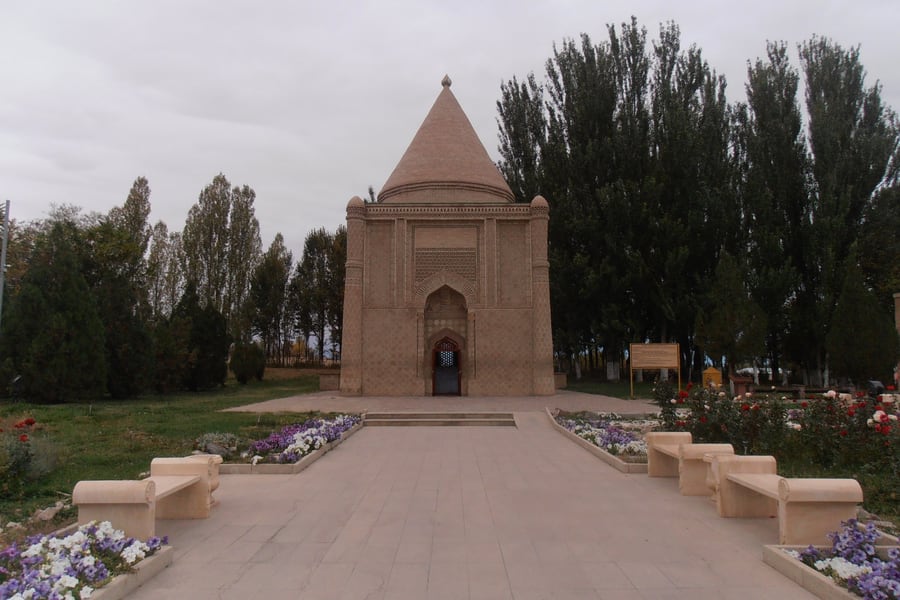
An eleventh- or twelfth-century mausoleum for a noble woman, its walls covered in carved terracotta in some sixty patterns that work with light and shadow rather than colour, in the style before the Mongols. Legend makes it the tomb of a girl from Otrar, bitten by a snake on her way to marry the emir of Taraz. A second mausoleum, Babaji Khatun, stands ten metres away.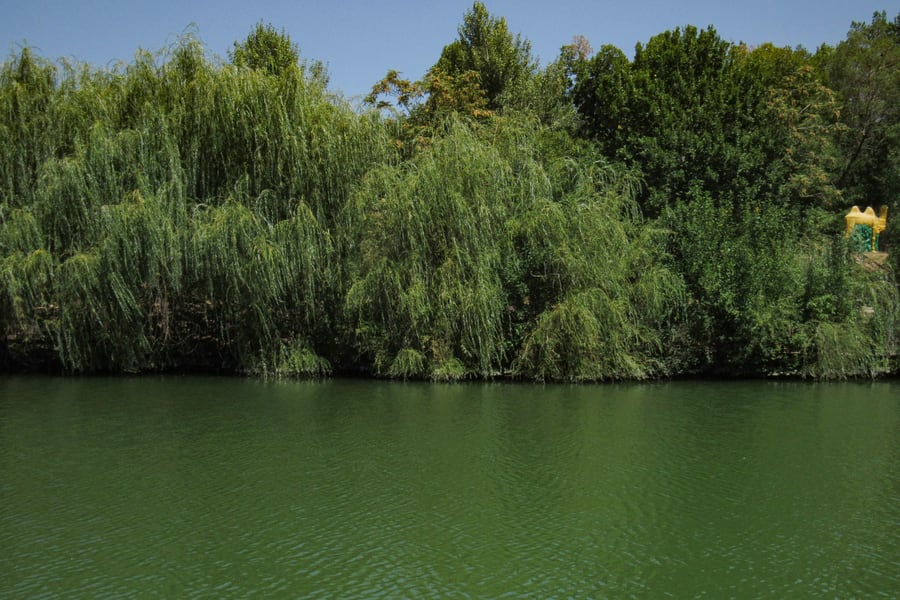 Nikolai Bulykin / Wikimedia Commons · CC BY-SA 4.0 · cropped
Shymkent and Sayram
Kazakhstan's third city grew on the caravan route and is now a major railway junction. On its eastern edge is Sayram, part of the city since 2018: the medieval Isfijab, which celebrated three thousand years in 1999, and where Yasawi was born in 1093. It still keeps its mud-brick architecture and many mausoleums older than the twentieth century.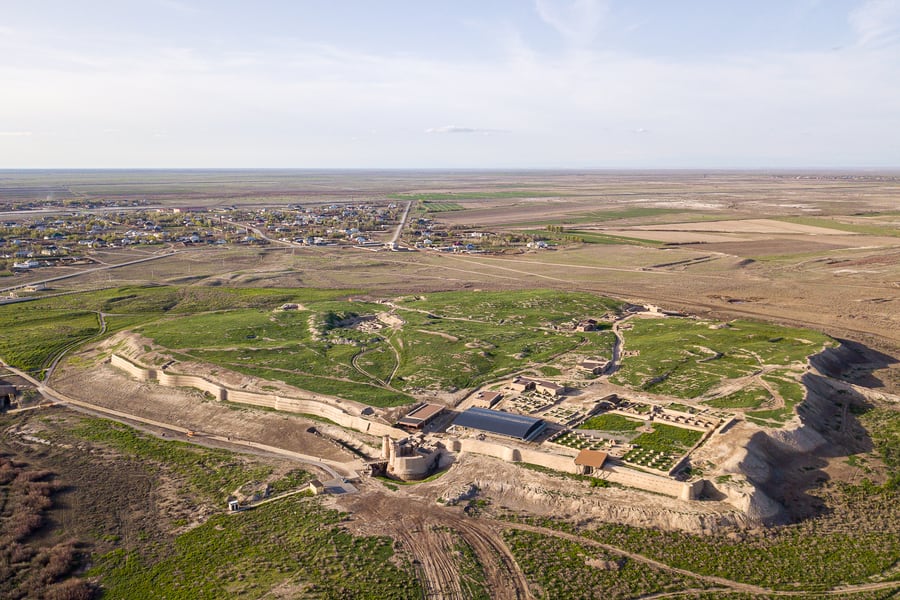 Coopypasted / Wikimedia Commons · CC BY-SA 4.0 · 2024 · cropped
Otrar and Arystan Bab
A Silk Road city at the centre of an oasis on the Syr Darya. Genghis Khan besieged it for five months in 1219 and killed its people; in February 1405 Timur, gathering an army against China, fell ill and died in one of its palaces. Nearby is the mausoleum of Arystan Bab, Yasawi's teacher — legend says Timur had to build it before his work at Turkistan would stand.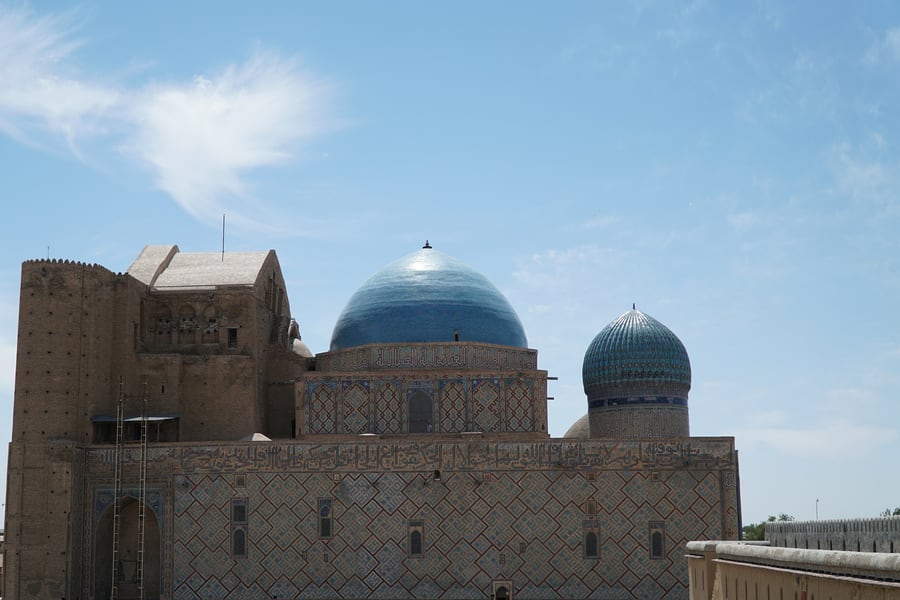 Adam Harangozó / Wikimedia Commons · CC BY-SA 4.0 · 2018 · cropped
Turkistan and the mausoleum
Over Yasawi's tomb Timur's builders, brought from Shiraz and Isfahan, raised a hall 38.7 metres high with thirty-five rooms and the largest surviving brick dome in Central Asia. Beside it is the mausoleum of Rabiya Sultan Begim, Timur's great-granddaughter. The town was the capital of the Kazakh Khanate, and local tradition holds that three visits here equal one pilgrimage to Mecca.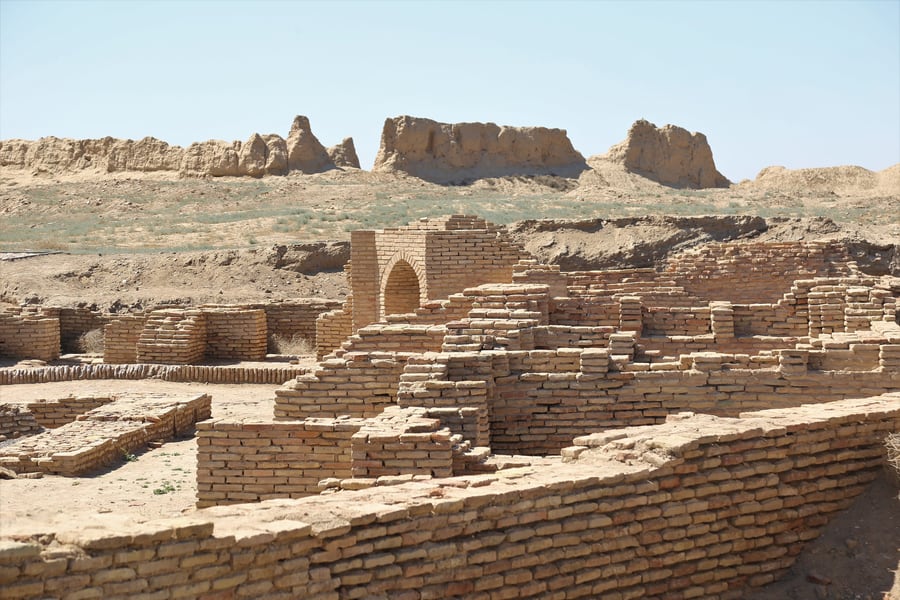 Yakov Fedorov / Wikimedia Commons · CC BY-SA 4.0 · 2018 · cropped
Sauran
In the tenth century the Arab geographer al-Muqaddasi described a large city with seven walls; it made the brick and tile for the Yasawi mausoleum, and in the fifteenth century the Ming court knew it by name. It declined with the Silk Road, and its mud-brick walls and excavated ruins stand alone on the plain.Where to Sleep
The Talgo is the bed on the way out. Arriving at 10:28, the day is long enough for the mausoleum, but Sauran and Otrar each want a day of their own, and the return Talgo leaves at 20:11 every other evening — so plan a night or two in Turkistan. Both hotels below are within walking distance of the mausoleum.
Where to stay
Yassy Hotel
344 Tauke Khan Avenue, beside the mausoleum
Fifty rooms run by the Khoja Akhmet Yassawi International Kazakh-Turkish University, 400 metres from the mausoleum, with breakfast included.
Check Availability (opens in a new tab, on yessi-hotel.ayu.edu.kz)via yessi-hotel.ayu.edu.kzHampton by Hilton Turkistan
6A Zholbarys Khan Street, Turkistan
A hotel within walking distance of the mausoleum and the Museum of Turkestan, with breakfast, wi-fi and parking included.
Check Availability (opens in a new tab, on hilton.com)via hilton.comQuestions or corrections
Planning this trip and stuck on something, or spotted a time, fare or detail that has changed? Send us a message about Almaty to Turkistan. We read every one, and we update this page when something has changed.