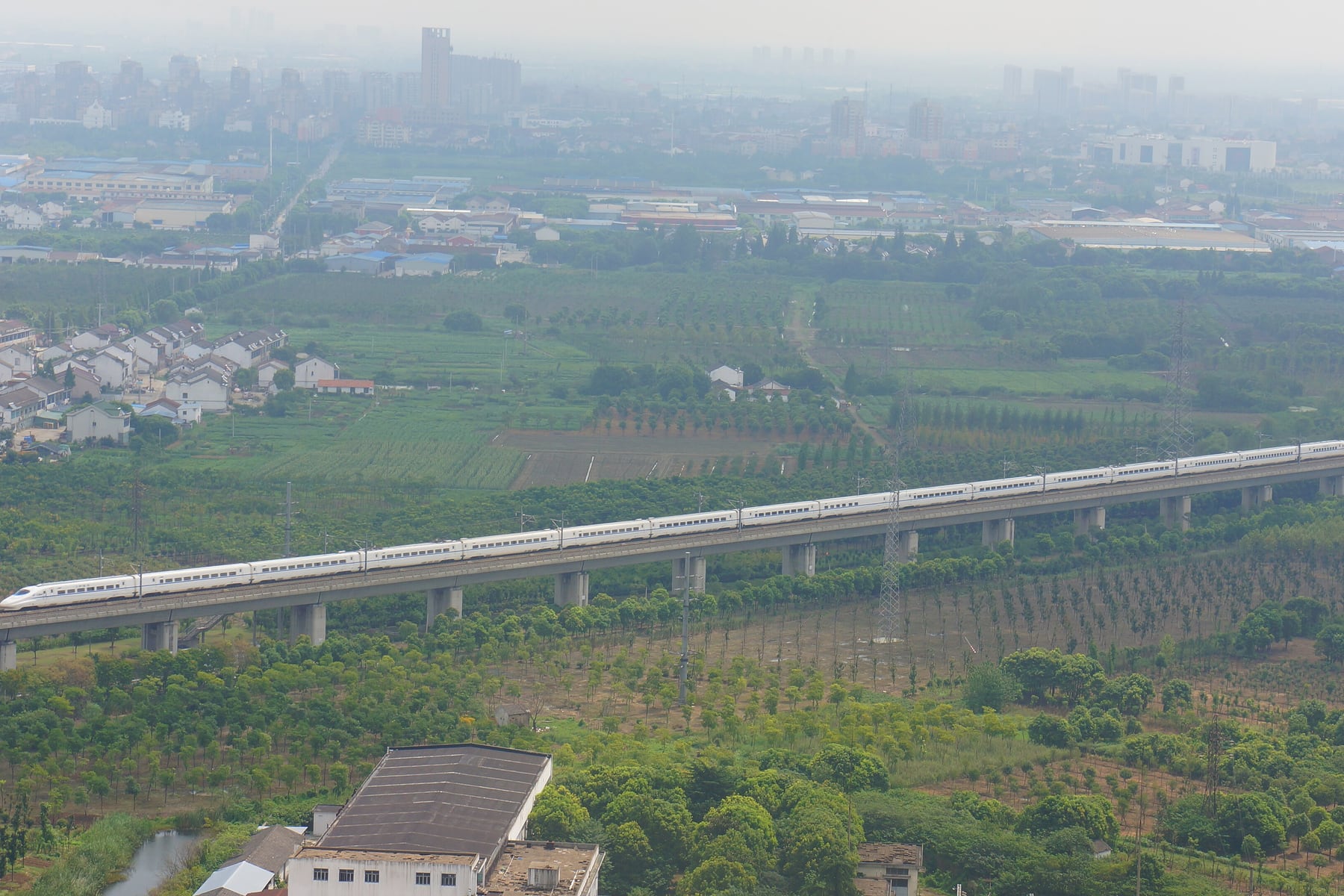
The Beijing–Shanghai High-Speed Railway
MNXANL / Wikimedia Commons · CC BY-SA 4.0 · 2015 · cropped
- Distance1,318 km, Beijing South to Shanghai Hongqiao
- Duration4 hours 18 minutes on the fastest train
- Best seasonYear-round
Introduction
The Beijing–Shanghai high-speed railway — 京沪高速铁路, Jīnghù Gāosù Tiělù — opened on 30 June 2011, 1,318 kilometres from Beijing South to Shanghai Hongqiao, built in one phase in a little over three years. The fastest train now covers it in 4 hours 18 minutes, with a single stop at Nanjing South.
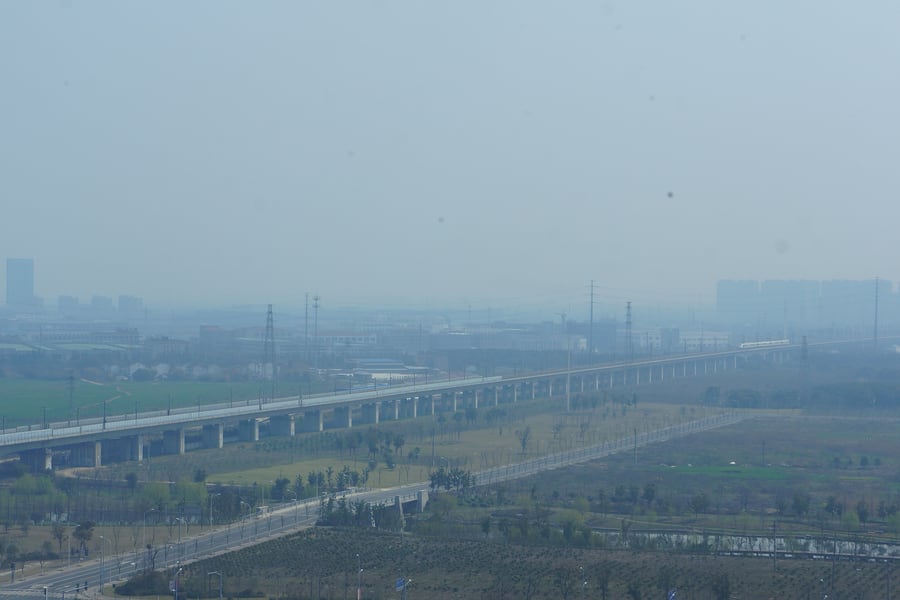
For most of that time the train is not on the ground. About 1,140 kilometres of the line, 86.5 per cent, runs on bridges and viaducts. The longest of them, the Danyang–Kunshan Grand Bridge in Jiangsu, is 164.851 kilometres long, and holds the Guinness World Record as the longest bridge in the world; south of Beijing, the viaduct between Langfang and Qingxian runs for 114 kilometres. The line crosses the soft ground of the North China Plain and the Yangtze delta, and the Hai, the Yellow River, the Huai and the Yangtze. In the delta, where the soil is soft, the canals and lakes are dense and land is short, the viaduct was the answer: it keeps the track from settling, uses less land than an embankment, and keeps people and vehicles off the line.
This page rides the whole line by day, from Beijing South to Shanghai Hongqiao.
The Journey
Beijing to the Yellow River
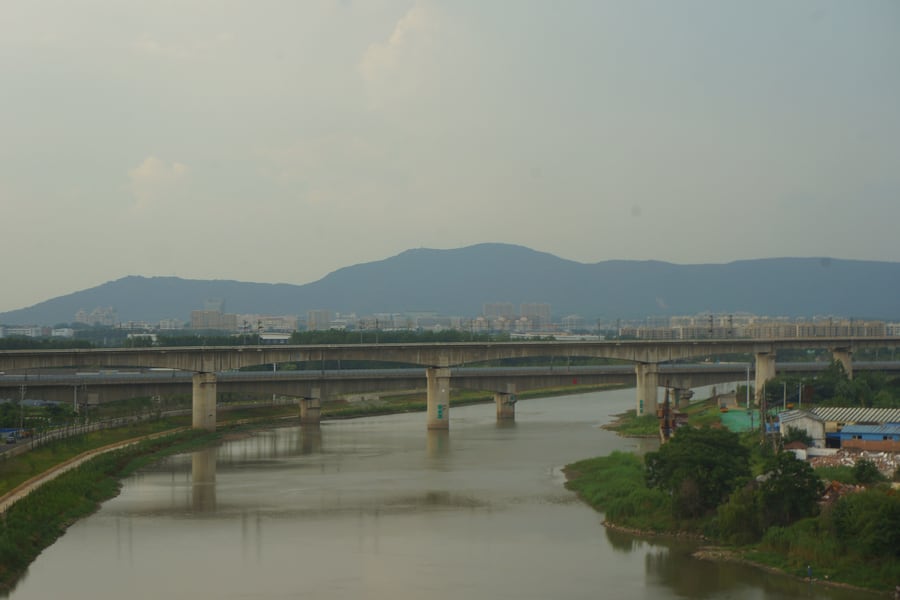
The trains leave Beijing South heading south-east, beside the old Beijing–Shanghai railway. From Langfang, past Tianjin South, to Qingxian, the train runs on one viaduct 114 kilometres long, and from the window the North China Plain is fields and villages seen from above; the lowest ground of the whole route is around Tuanbowa, south of Tianjin. The line then follows the Beijing–Taipei expressway south, past Dezhou, crosses the Yellow River three kilometres downstream of the expressway's bridge, and reaches Jinan West.
Mount Tai to the Yangtze
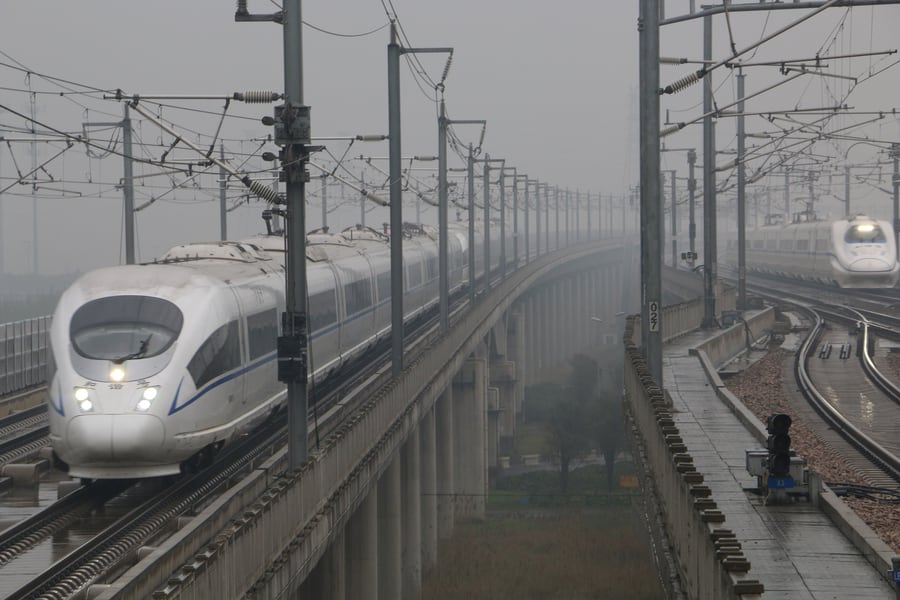
South of Jinan the line runs into the low hills of central and southern Shandong. Around Tai'an, at the foot of Mount Tai, it reaches the highest section of the route; then come Qufu East, for the home of Confucius, and Xuzhou East. South of Xuzhou the line comes down to the plain of the Huai, and crosses the Huai River at Bengbu, 1.2 kilometres downstream of the city's newer rail bridge. Approaching Nanjing it crosses the Yangtze on the Dashengguan Bridge, 20 kilometres upstream of the city's first Yangtze bridge of 1968, and runs into Nanjing South.
Across the delta
East of Nanjing the line runs alongside the Shanghai–Nanjing intercity railway. From Danyang it is on the Danyang–Kunshan Grand Bridge, past Changzhou, Wuxi and Suzhou, through a country of rice paddies, canals and lakes, with nine kilometres straight over the water of Yangcheng Lake. The bridge ends at Kunshan, and the train runs on into Shanghai Hongqiao.
The train
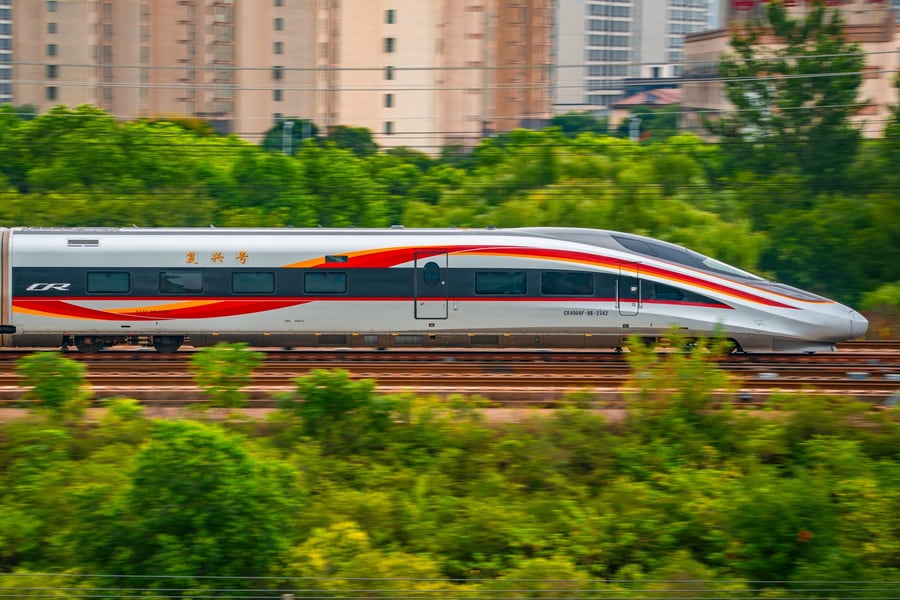
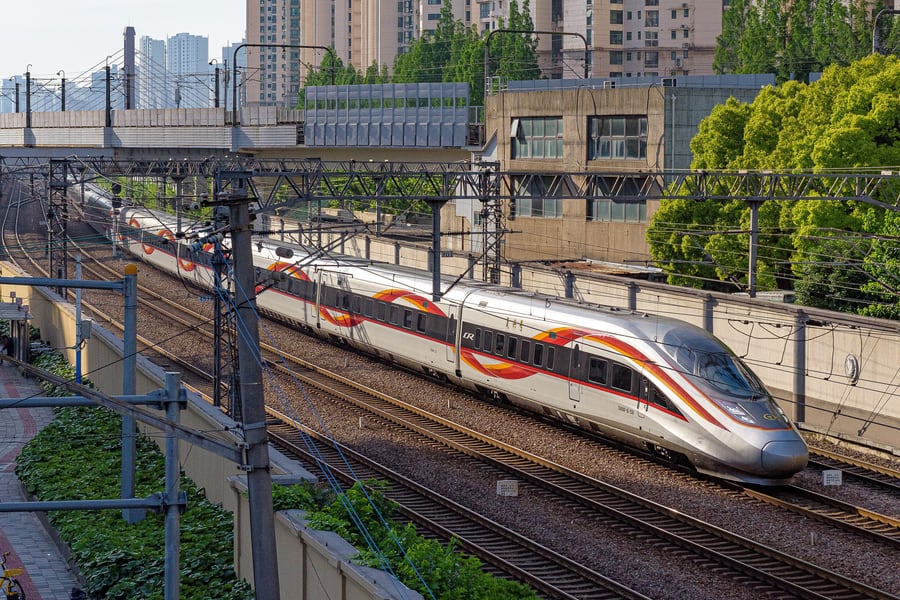
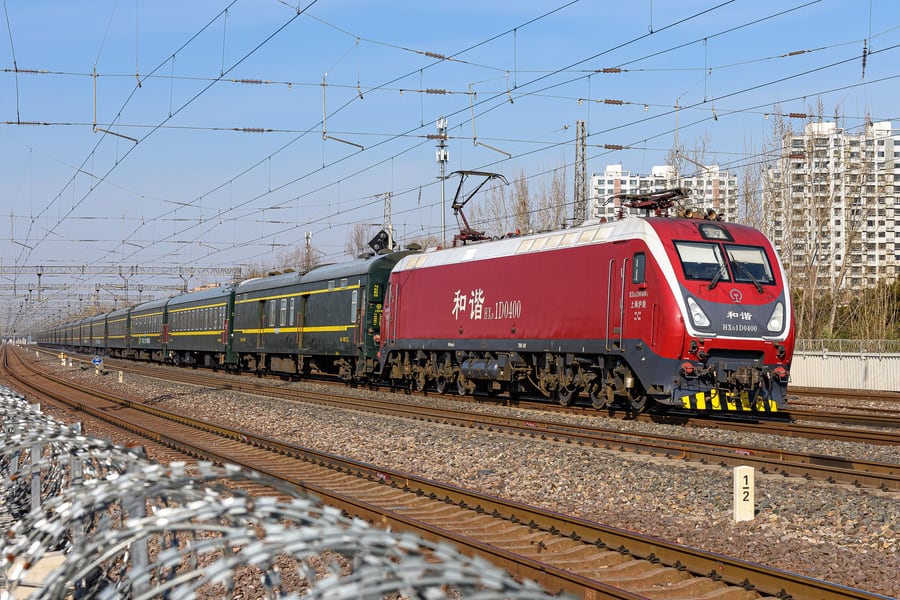
The line opened in 2011 with CRH380 trains, and today it is worked mainly by Fuxing trains — 复兴号, rejuvenation — the first high-speed trains designed and built in China. The first two ran in opposite directions on this line on 26 June 2017, and from 21 September that year they brought 350 km/h running back to it. The CR400AF is built by CRRC Qingdao Sifang and nicknamed the Red Dragon; the CR400BF, from CRRC Changchun, is the Golden Phoenix. The busiest workings use 17-car sets, 440 metres long with 1,283 seats, and since June 2024 the CR400AF-BS and CR400BF-BS versions have added a Premium First class between first and business.
Along the route
 MNXANL / Wikimedia Commons · CC BY-SA 4.0 · 2016 · cropped
The Danyang–Kunshan Grand Bridge
From Danyang to Kunshan the train runs on one viaduct, 164.851 kilometres long, the longest bridge in the world. It was built across the soft ground of the delta to keep the track from settling and to use less farmland.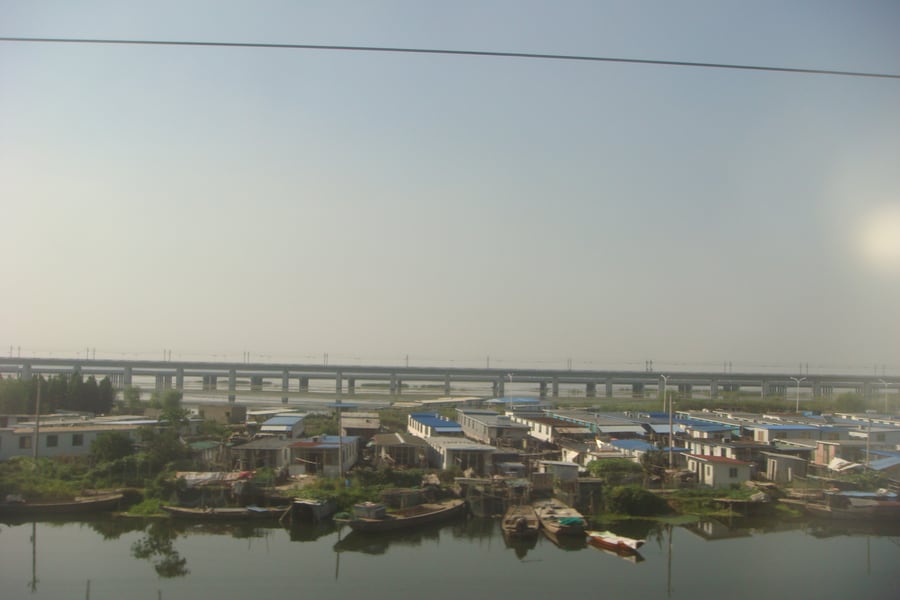 MNXANL / Wikimedia Commons · CC BY-SA 4.0 · 2013 · cropped
Across Yangcheng Lake
Near Suzhou the viaduct goes straight over Yangcheng Lake for nine kilometres. To protect the water, the builders shipped the drilling mud away instead of leaving it in the lake.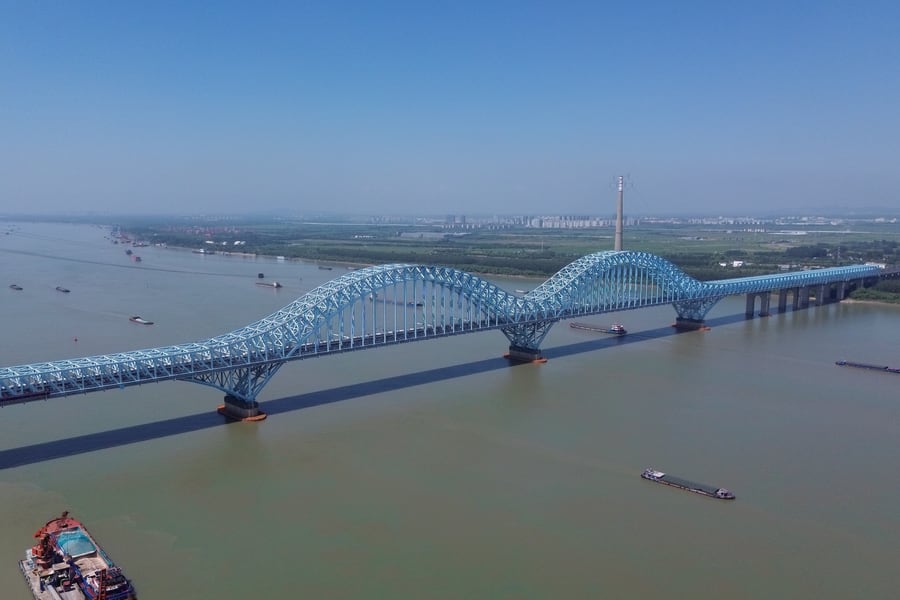 Glabb / Wikimedia Commons · CC BY-SA 3.0 · 2025 · cropped
The Dashengguan Bridge
The line crosses the Yangtze at Nanjing on two steel arches of 336 metres each. The bridge, designed by China Railway Major Bridge Reconnaissance & Design Institute, carries six tracks: this line, the Shanghai–Wuhan–Chengdu railway and Nanjing Metro line S3.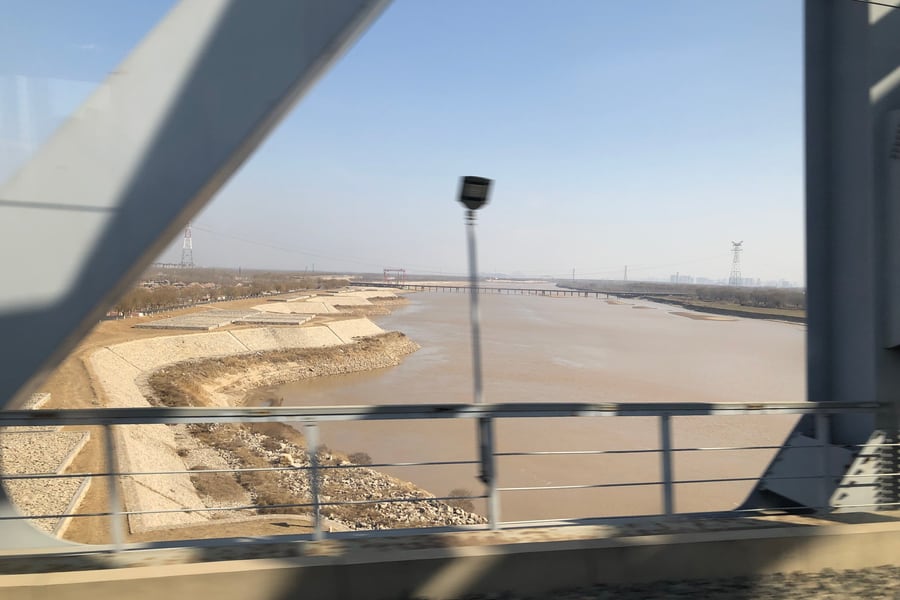 Stang / Wikimedia Commons · CC BY 4.0 · 2019 · cropped
The Yellow River
Just before Jinan West the train crosses the Yellow River, the second of the four great river systems on the line, after the Hai and before the Huai and the Yangtze.A bit of history
Culture & experiences along the way
 TurnOnTheNight / Wikimedia Commons · CC BY-SA 4.0 · 2024 · cropped
Dezhou braised chicken
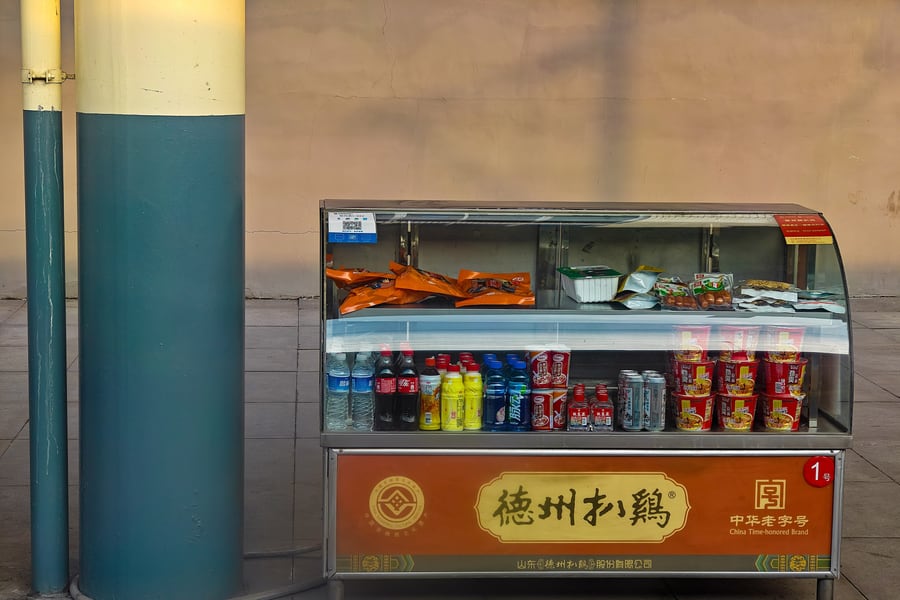
For most of the last century, trains stopping at Dezhou on the old line were met by platform trolleys selling braised chicken. The bird is shaped, glazed with honey, fried and then braised until the meat falls from the bone, a method listed as national intangible heritage in 2014. The platform carts still sell it, vacuum-packed.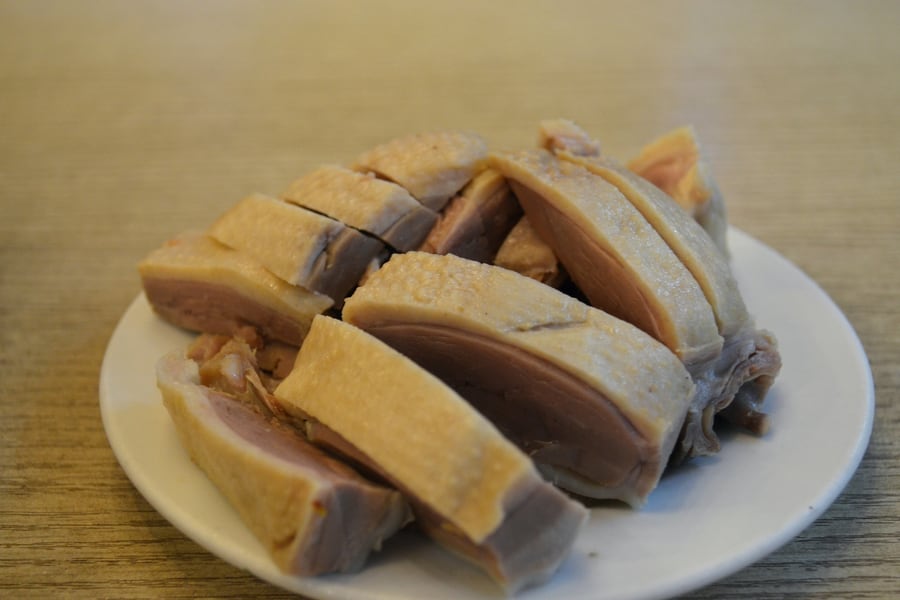 AddisWang / Wikimedia Commons · CC BY-SA 3.0 · 2013 · cropped
Nanjing salted duck
Nanjing's own duck is rubbed with salt roasted hot with Sichuan pepper and star anise, then brined, dried and gently cooked until the meat is tender. It is made all year, but the batch made in the eighth lunar month, when the osmanthus flowers, is held to be the best, which is why it is also called osmanthus duck.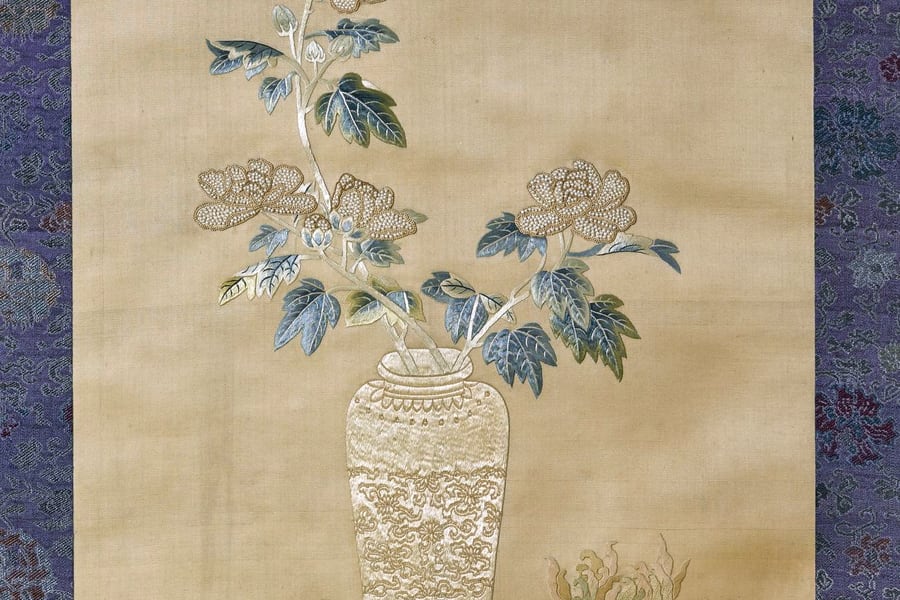 Wikimedia Commons · public domain · Qing dynasty · cropped
Suzhou embroidery
Su embroidery has been worked in silk around Suzhou for more than 2,000 years and is one of China's four great embroidery traditions, listed as national intangible heritage in 2006. By the late Qing its embroiderers could make a picture identical on both sides of the silk. The Suzhou Embroidery Museum shows work from many periods.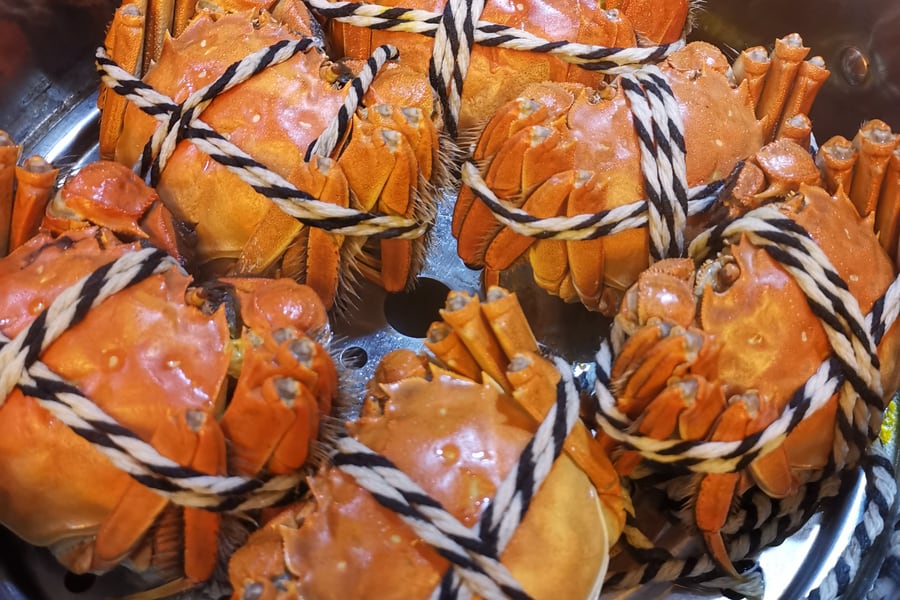 Walter Grassroot / Wikimedia Commons · CC BY-SA 3.0 · 2019 · cropped
Yangcheng Lake hairy crabs
The lake the train crosses on its viaduct gives its name to China's best-known hairy crab, a protected geographical indication. The 2026 season opened on 28 September. A Yangcheng crab is judged by four signs: a blue-grey back, a white belly, yellow hair and golden claws.Timetables
About 45 high-speed trains a day run from Beijing South to Shanghai, the first at 06:18 and the last at 19:24; most go to Shanghai Hongqiao, and a few to Shanghai station. They differ in how often they stop, so the time varies from 4 hours 18 minutes to about 6 hours. A few of them, all daily:
| Train | Beijing South | Shanghai Hongqiao | Calls at |
|---|---|---|---|
| G1 | 06:30 | 11:24 | Cangzhou West, Dezhou East, Qufu East, Nanjing South, Suzhou North |
| G547 | 06:18 | 12:11 | eleven stations, including Jinan West, Nanjing South and Wuxi East |
| G7 | 09:00 | 13:37 | Jinan West, Nanjing South, Suzhou North |
| G25 | 17:00 | 21:18 | Nanjing South only |
The other way, the first train, G532, leaves Shanghai Hongqiao at 06:31, and the G2 leaves at 06:43 and reaches Beijing South at 11:32. The fastest northbound trains, G12 at 10:00 and G32 at 19:25, take 4 hours 24 minutes.
By night, and on the old line. The D7 sleeper leaves Beijing at 19:18 and reaches Shanghai at 07:25. The 1461 still runs the whole of the old line, leaving Beijing at 11:59 and stopping at 20 stations, including Tianjin West, Jinan, Taishan and Nanjing, before it reaches Shanghai at 06:45 the next morning, 18 hours 46 minutes later.
Times are from 12306 for Thursday 15 and Sunday 18 October 2026, and were the same on both days — as of October 2026. 12306 sells about two weeks ahead. Times are published by the operator: China Railway · 12306 (opens in a new tab).
Tickets
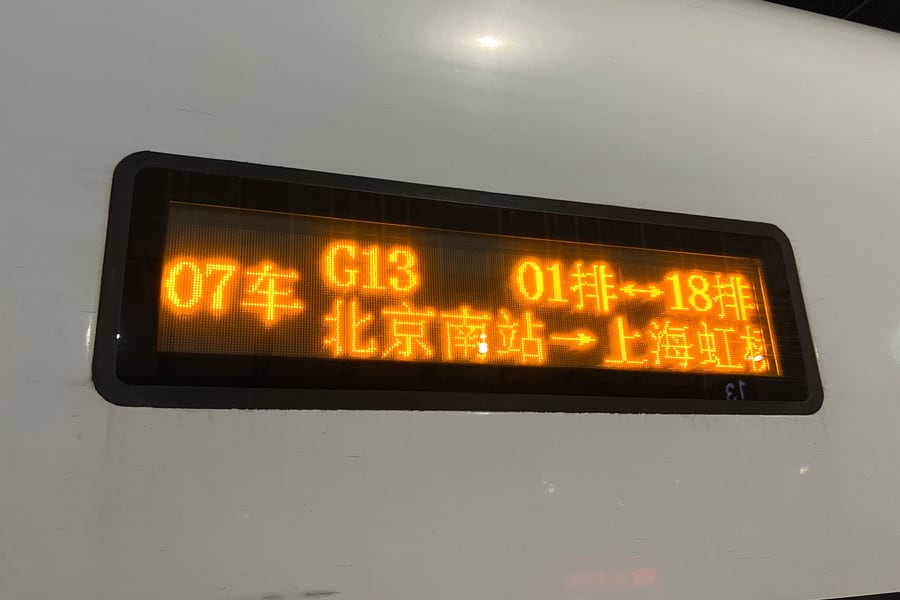
Every ticket is sold on 12306 against your passport, which is then your ticket at the gates. Fares vary by train: on the fastest, the G1, G7 and G25, Beijing South to Shanghai Hongqiao is ¥661 in second class, ¥1,058 in first and ¥2,315 in business, with Premium First at ¥1,455 where a train has it. The slower G547 is ¥553, ¥929 and ¥1,995.
On the old line, the 1461 is ¥156.5 in hard seat and ¥283.5 for a hard sleeper berth, and a second-class berth on the D7 sleeper is ¥440.
Book your tickets
 N509FZ / Wikimedia Commons · CC BY-SA 4.0 · 2026 · cropped
High-speed · Beijing South to Shanghai Hongqiao
¥661 second class, ¥1,058 first, ¥2,315 business on the fastest trains
Sold on 12306 against your passport, from ¥553 in second class on the slower trains.
Book Tickets (opens in a new tab, on 12306.cn)via 12306.cn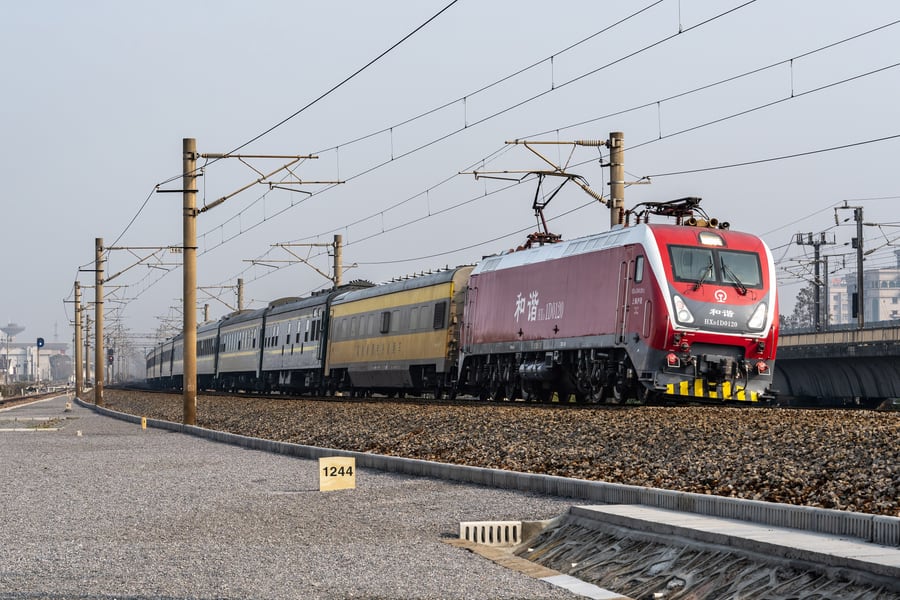 昂括 / Wikimedia Commons · CC BY 4.0 · 2026 · cropped
The old line · Beijing to Shanghai
¥156.5 hard seat, ¥283.5 hard sleeper on the 1461
The 1461 takes 18 hours 46 minutes over the old Beijing–Shanghai railway, stopping at twenty stations.
Book Tickets (opens in a new tab, on 12306.cn)via 12306.cnRail Passes
No rail pass covers this line. Interrail and Eurail are European passes and do not reach China, and China Railway sells its seats one journey at a time on 12306, so the fare is simply the ticket.
Checked in October 2026.
Places to Visit
Every place below is in Beijing or near a station on the line. Not every train stops everywhere, so pick one that calls where you want to get off: Jinan West for the springs, Tai'an for Mount Tai, Qufu East for the Confucian sites, Nanjing South for the city wall and Suzhou North for the gardens.
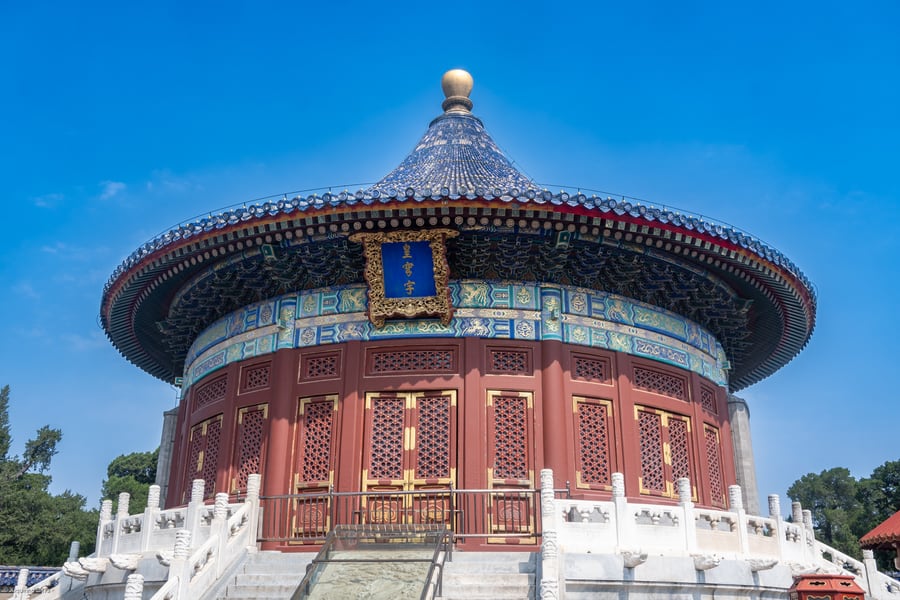 xiquinhosilva / Wikimedia Commons · CC BY 2.0 · 2024 · cropped
The Temple of Heaven
First built in 1420 under the Yongle Emperor, who also built the Forbidden City, the Temple of Heaven is where the Ming and Qing emperors came to pray for a good harvest. Its layout was largely fixed by 1749, after the Qing rebuilding, and it was inscribed as a World Heritage Site in 1998. The picture shows the Imperial Vault of Heaven.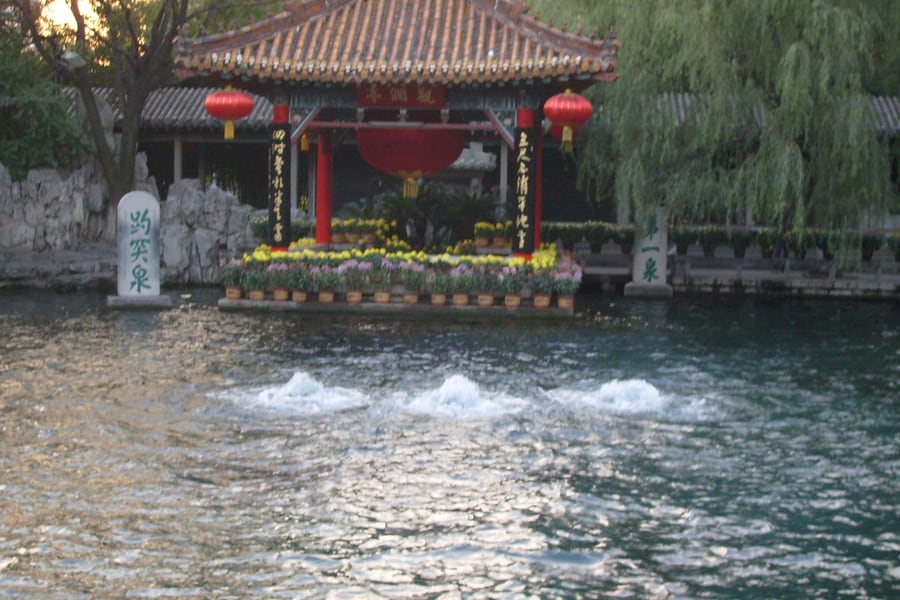 Xiehechaotian / Wikimedia Commons · public domain · 2010 · cropped
Baotu Spring
Jinan is a city of springs, more than seventy of them named in its centre, all fed by a limestone aquifer under the hills to the south. Baotu is the best known, three jets rising from a pool that the Qianlong Emperor called the first spring under heaven. The water stays at about 18 °C all year, though over-pumping has stopped it flowing more than once since the 1970s.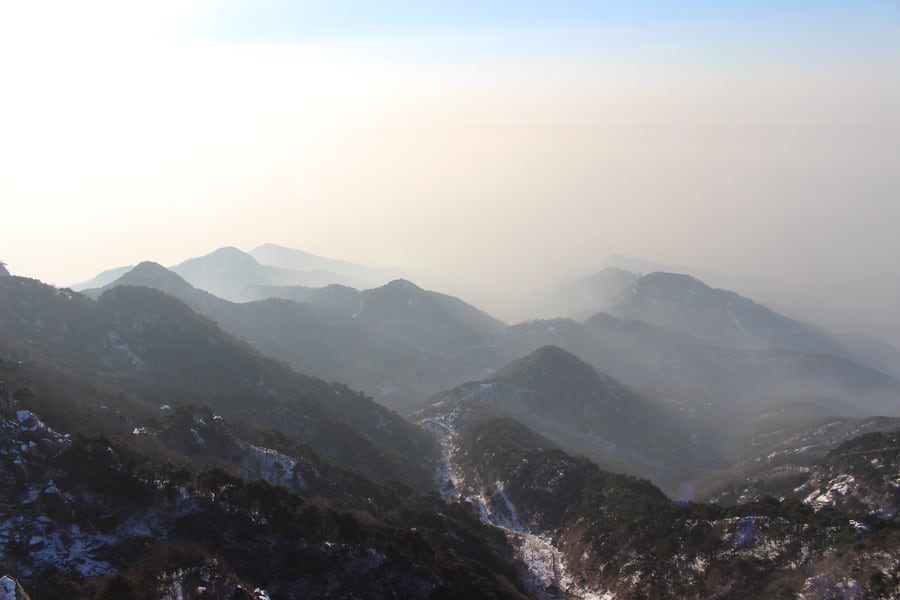 Queshav / Wikimedia Commons · CC BY-SA 4.0 · 2016 · cropped
Mount Tai
The eastern of China's sacred mountains, and often counted the first of the five, rises north of Tai'an to the Jade Emperor Peak, at 1,545 metres the highest point in Shandong. It has been a place of worship for at least 3,000 years, and was made a World Heritage Site in 1987 for its sacred importance and its landscape.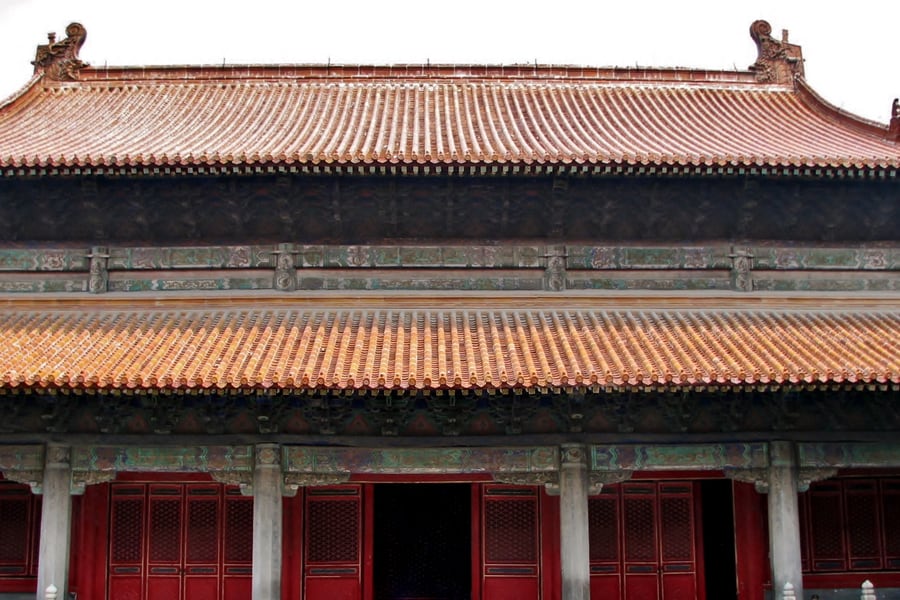 Kyle Magnuson / Wikimedia Commons · CC BY 2.0 · 2006 · cropped
The Temple of Confucius and the Kong Family Mansion
Qufu was the home of Confucius, and his house was made a temple within two years of his death. The Temple of Confucius here is the largest in East Asia; with the Kong Family Mansion, where his descendants lived, and the cemetery where he is buried, it has been a World Heritage Site since 1994. Twelve emperors came here in person, twenty times between them.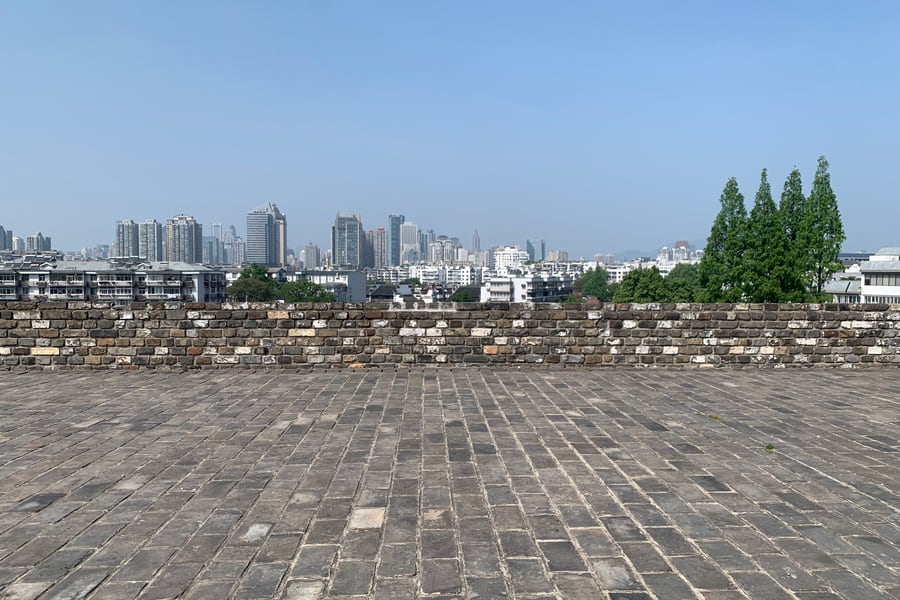 Chainwit. / Wikimedia Commons · CC BY 4.0 · 2024 · cropped
The City Wall of Nanjing
When the first Ming emperor made Nanjing his capital in 1368, he walled it on a scale few Chinese cities have matched: 200,000 workers spent twenty-one years on it, moving some seven million cubic metres of earth, and the wall enclosed about 55 square kilometres. Long stretches survive, and you can walk along the top.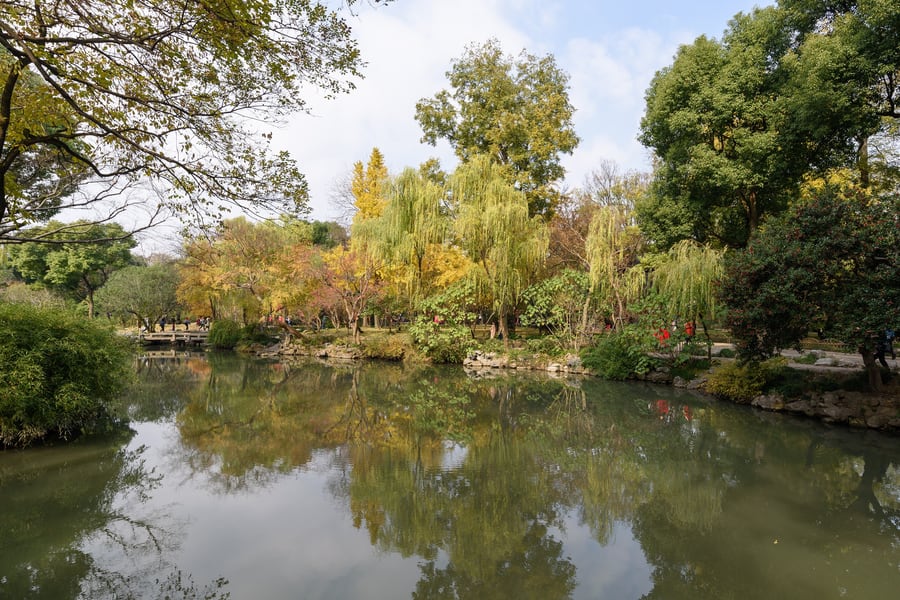 King of Hearts / Wikimedia Commons · CC BY-SA 4.0 · 2017 · cropped
The Humble Administrator's Garden
At 5.2 hectares, the largest of Suzhou's classical gardens was laid out from 1513 by Wang Xianchen, a Ming official who had retired home, with advice from the painter Wen Zhengming, on the site of a ruined temple. It has been one of the Classical Gardens of Suzhou on the World Heritage List since 1997.Where to Sleep
The two hotels below are at either end of the line: one beside Beijing South, for an early train, and one in Shanghai's Hongqiao district, where the trains arrive.
Where to stay
Four Points by Sheraton Beijing, South Railway Station
On Youwai West Road, Fengtai District
Near Beijing South, with The Mesh restaurant's open kitchen and live cooking stations, and free parking.
Check Availability (opens in a new tab, on marriott.com)via marriott.comHilton Shanghai Hongqiao International Airport
At Terminal 1 of Hongqiao airport, Changning District
Connected to the airport terminal, with an indoor rooftop pool and metro lines 2, 10 and 17 five minutes' walk away.
Check Availability (opens in a new tab, on hilton.com)via hilton.comQuestions or corrections
Planning this trip and stuck on something, or spotted a time, fare or detail that has changed? Send us a message about The Beijing–Shanghai High-Speed Railway. We read every one, and we update this page when something has changed.