The Bohinj Railway — Lake Bled, the Alps and the Solkan Bridge
Larsvr6 / Wikimedia Commons · CC BY-SA 4.0
- DistanceJesenice–Nova Gorica · about 89 km
- DurationAbout 2 hours by regional train
- Best seasonLate spring to autumn for green valleys; the museum steam train runs on selected dates
Introduction
Some railways were built to make money, some to win wars, and a few — the lucky ones — turned out to be beautiful almost by accident. The Bohinj Railway is one of these. Austria-Hungary drove it through the Julian Alps in the first years of the twentieth century to give Vienna a fast, imperial route to its great port at Trieste. The empire is long gone, the through trains with it, but the line remains: a superbly engineered mountain railway that runs past one of the loveliest lakes in Europe, disappears into the heart of a mountain, and finishes by crossing a bridge that still holds a world record.
It begins at Jesenice, in the shadow of the Alps near the Austrian border, and threads south-west to Nova Gorica, hard against Italy. In between it does more sightseeing than most special tourist trains manage in a week. It skirts Lake Bled, with its island church and clifftop castle. It bores clean through the mountains in the 6.3-kilometre Bohinj Tunnel, the longest in Slovenia. It comes down the Bača gorge to the impossibly green Soča, and follows that turquoise river through tunnel after tunnel and bridge after bridge to the Solkan Bridge — a single stone arch of eighty-five metres, the longest of its kind anywhere on earth.
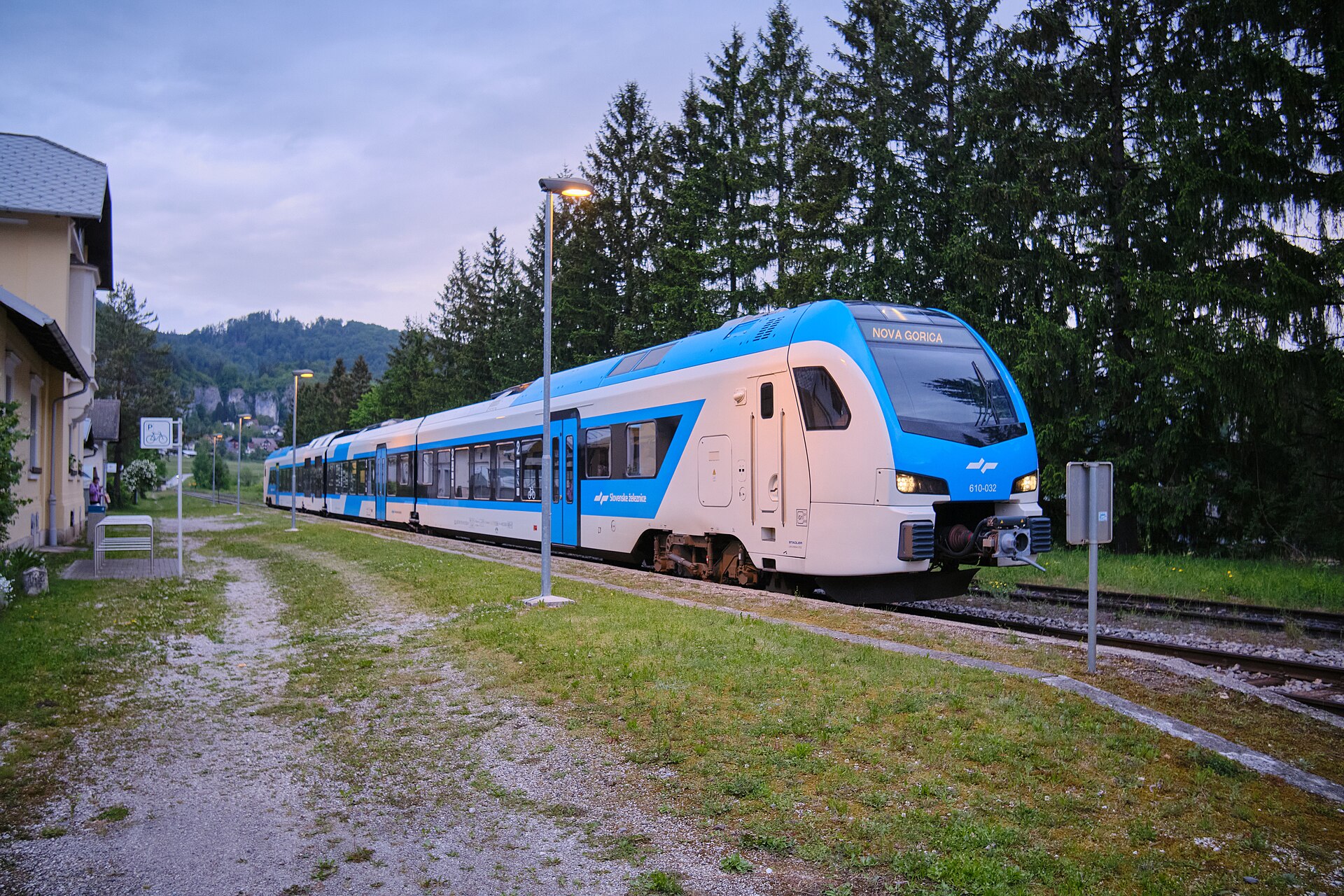
The wonderful thing is how little fuss it asks of you. This is not a dear-priced heritage train that runs twice a week. It is an ordinary Slovenske železnice regional service, a modest diesel unit that trundles the whole line for the price of a couple of coffees, several times a day, all year round. For a little more romance, the railway has two party pieces: a vintage steam museum train that steams the line on special days, and a car-carrying motorail that will ferry you — and your car — through the great tunnel beneath the mountains.
Ride it end to end and you cross Slovenia's watershed, from the Alpine north to the Mediterranean light of the Primorska, in about two hours. Few railways pack so much into so short a run, and fewer still let you do it so cheaply.
The Journey
An imperial line through the Alps
At the turn of the twentieth century Austria-Hungary set about building a whole clutch of "New Alpine Railways" to bind the empire more tightly to the Adriatic. The Bohinj Railway — the Wocheinerbahn, the central link in the so-called Transalpina — was the hardest and the finest of them. Between 1900 and 1906 an army of workers pushed the line through the Julian Alps under the direction of chief engineer Maks Klodič, blasting tunnels, raising viaducts and, at Solkan, throwing the largest stone arch anyone had yet attempted across a river. The whole route was ceremonially opened on 19 July 1906, giving Vienna its coveted fast run to the port of Trieste.
Empires fell, borders moved, and the through traffic drained away — after 1945 the line found itself hard against a hostile frontier and its glory days ended. But the railway itself, standard gauge and beautifully made, still carries trains from Jesenice to Nova Gorica and on toward Italy. What was once a strategic artery is now, happily, one of the most scenic branch lines in Europe.
Lake Bled and the climb to the tunnel
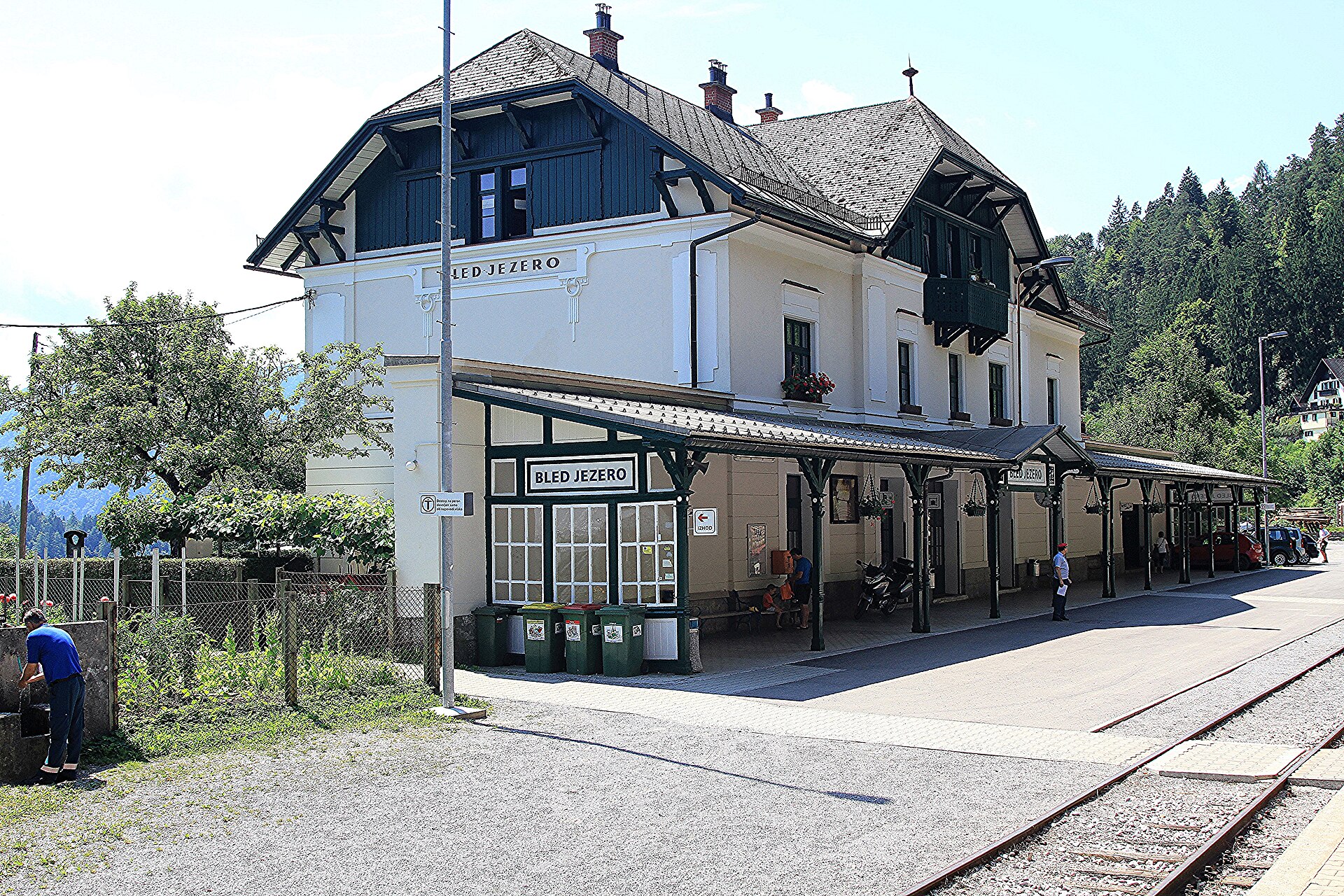
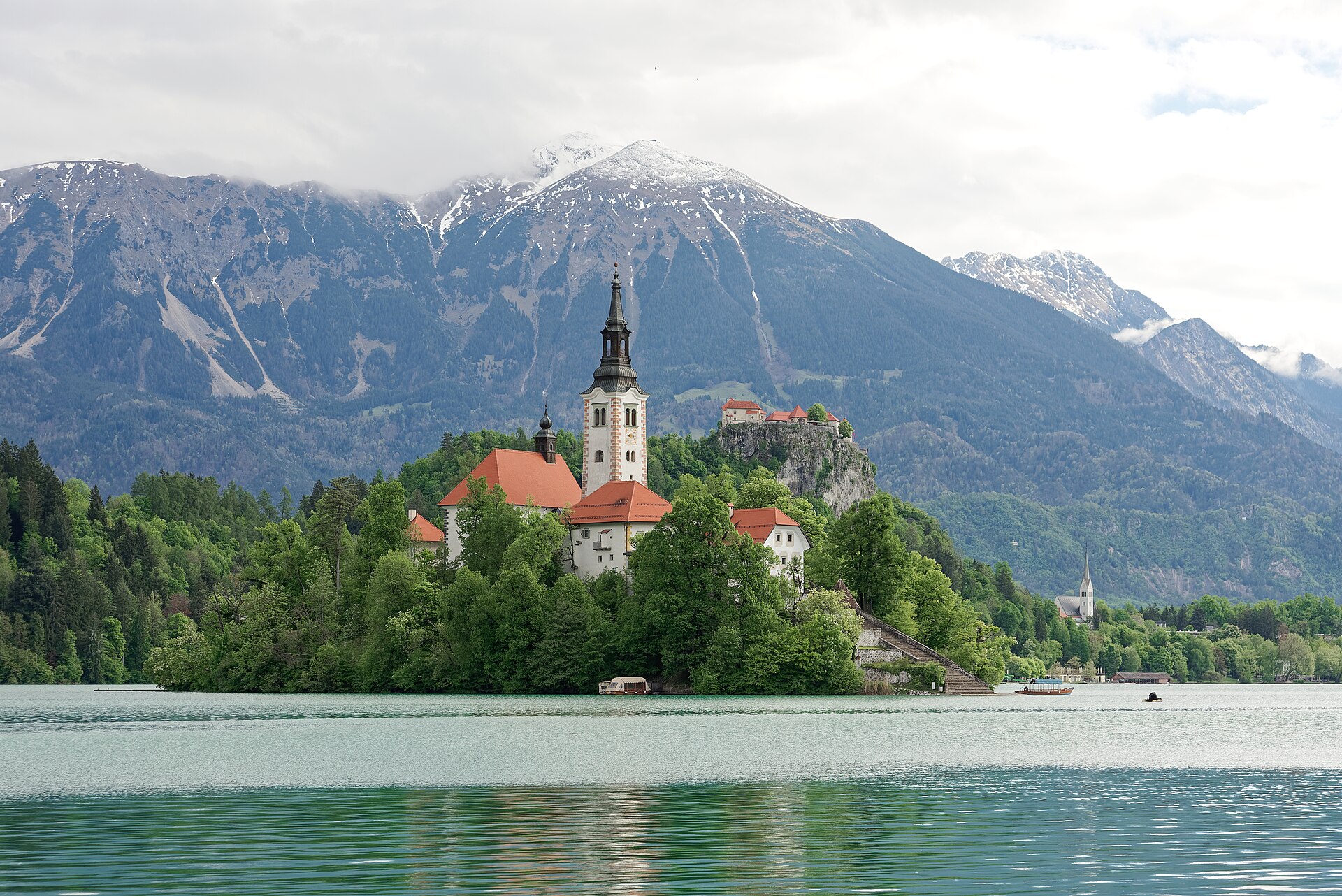
Leaving Jesenice the train runs up the Sava valley to Bled Jezero, the line's period station for Lake Bled. It sits on the hillside a short walk above the water, and from its platforms it is downhill to a scene that needs no introduction: the little island church afloat on the turquoise lake, the castle on its cliff, the Alps ranged behind. The railway carries on through Bohinjska Bistrica, gateway to the wild Bohinj valley and the Triglav National Park, and then, quite suddenly, the mountainside swallows it whole.
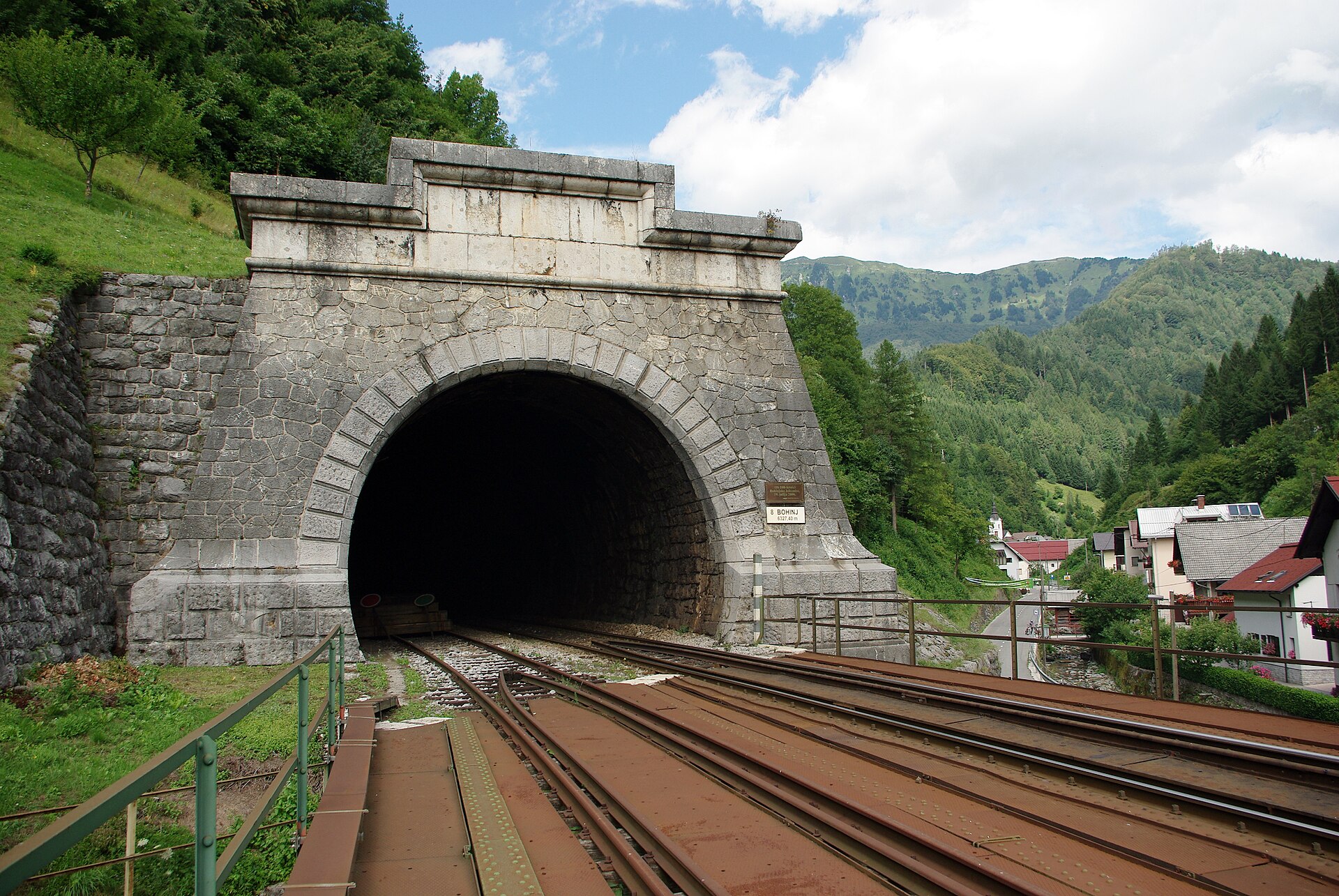
This is the Bohinj Tunnel — 6.3 kilometres of darkness beneath Mount Kobla, the longest railway tunnel in the country. It is the reason the line exists, the pass the engineers could not go over and so went under, and it takes a good ten minutes to clear. Emerge on the far side at Podbrdo and you are in a different Slovenia: the light is softer, the valleys drop toward the sea, and the river running beside you is the astonishing green Soča.
Down the Soča to a world-record bridge
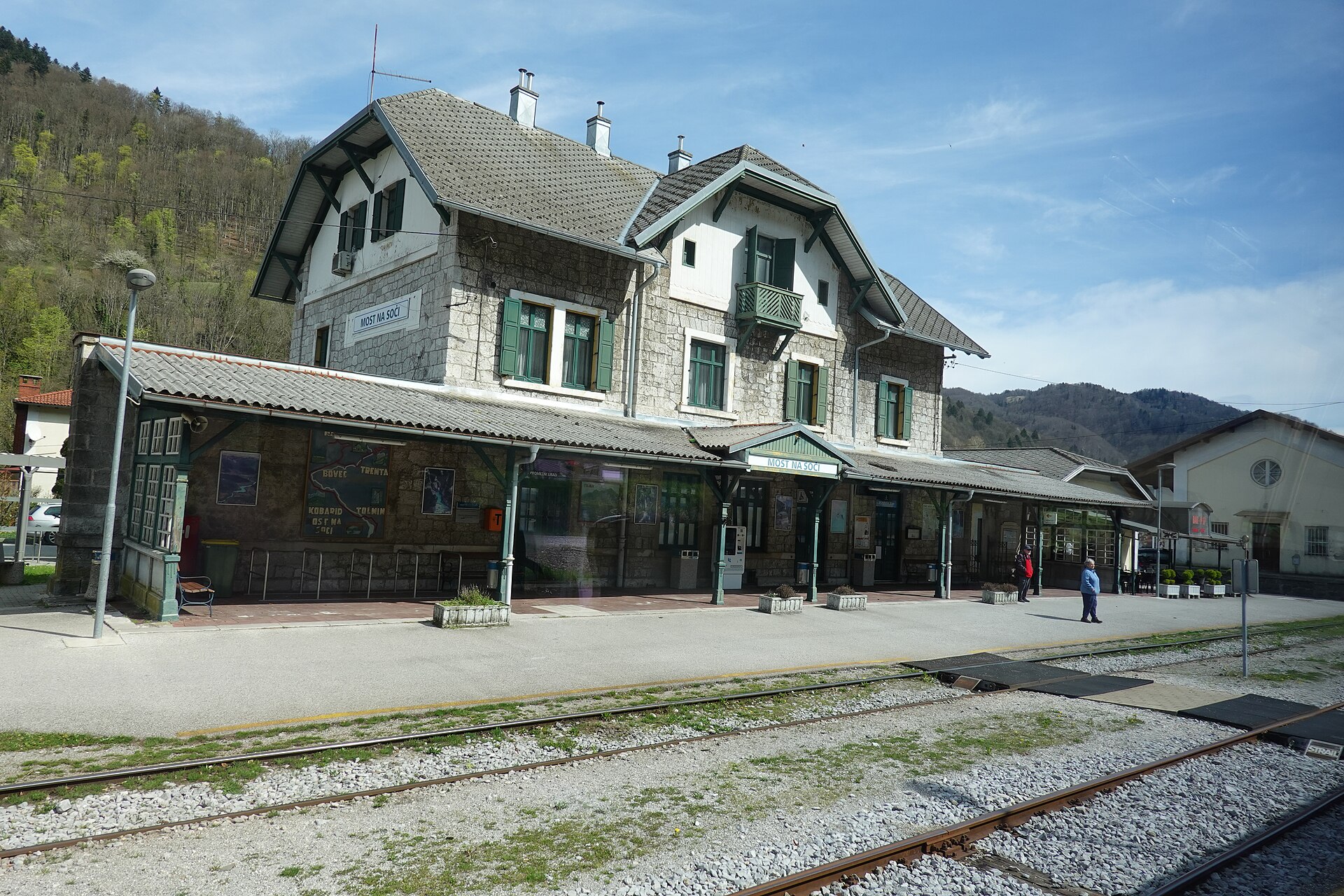
The descent to the coast is the loveliest stretch of all. Down the Bača gorge and along the Soča the railway is a continuous feat of engineering — the section between Bohinjska Bistrica and Most na Soči alone has some 28 tunnels, five galleries and more than 65 bridges, each one framing another view of the emerald water below. At Most na Soči, a handsome stone station little changed in a century, the line meets the river properly and turns south.
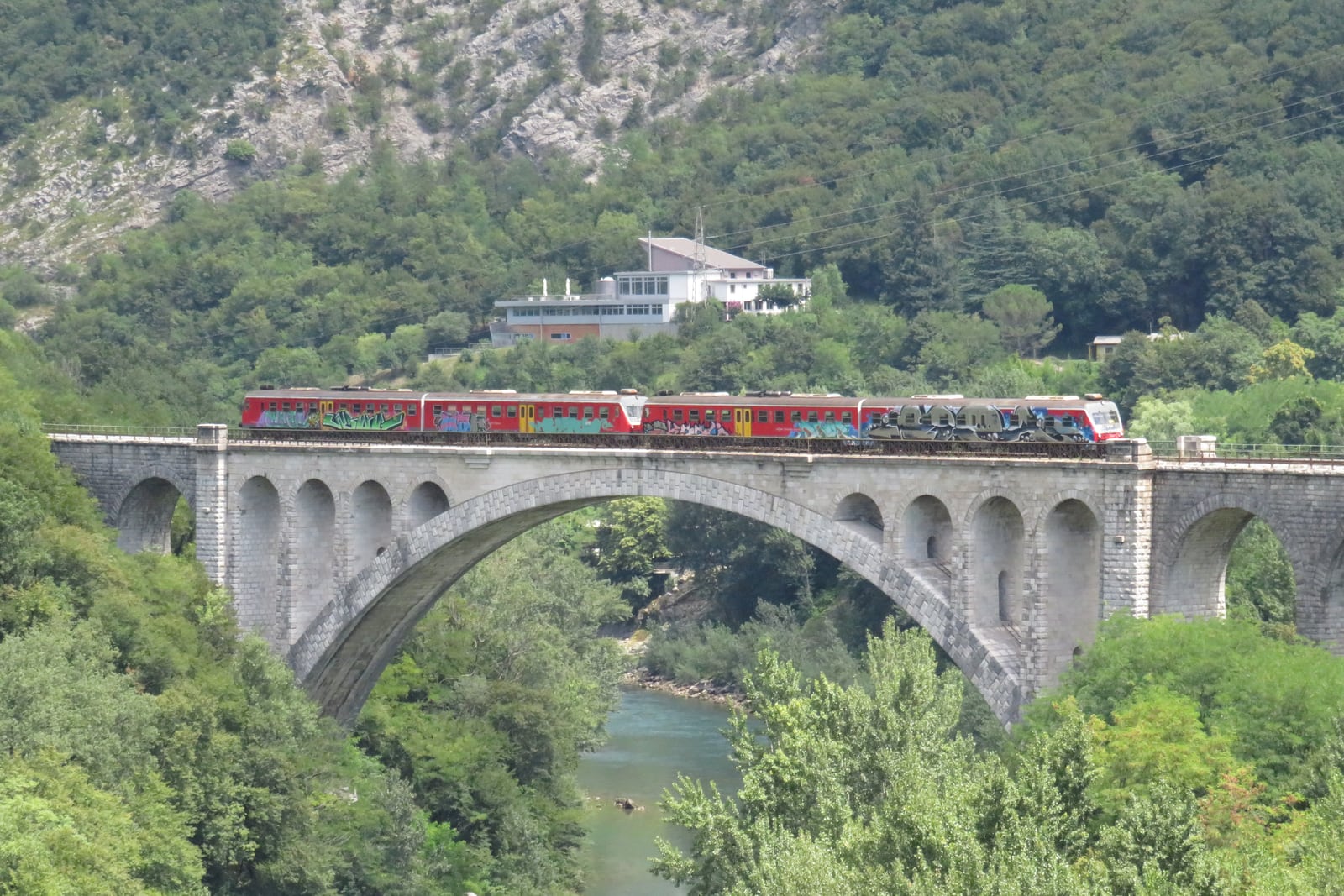
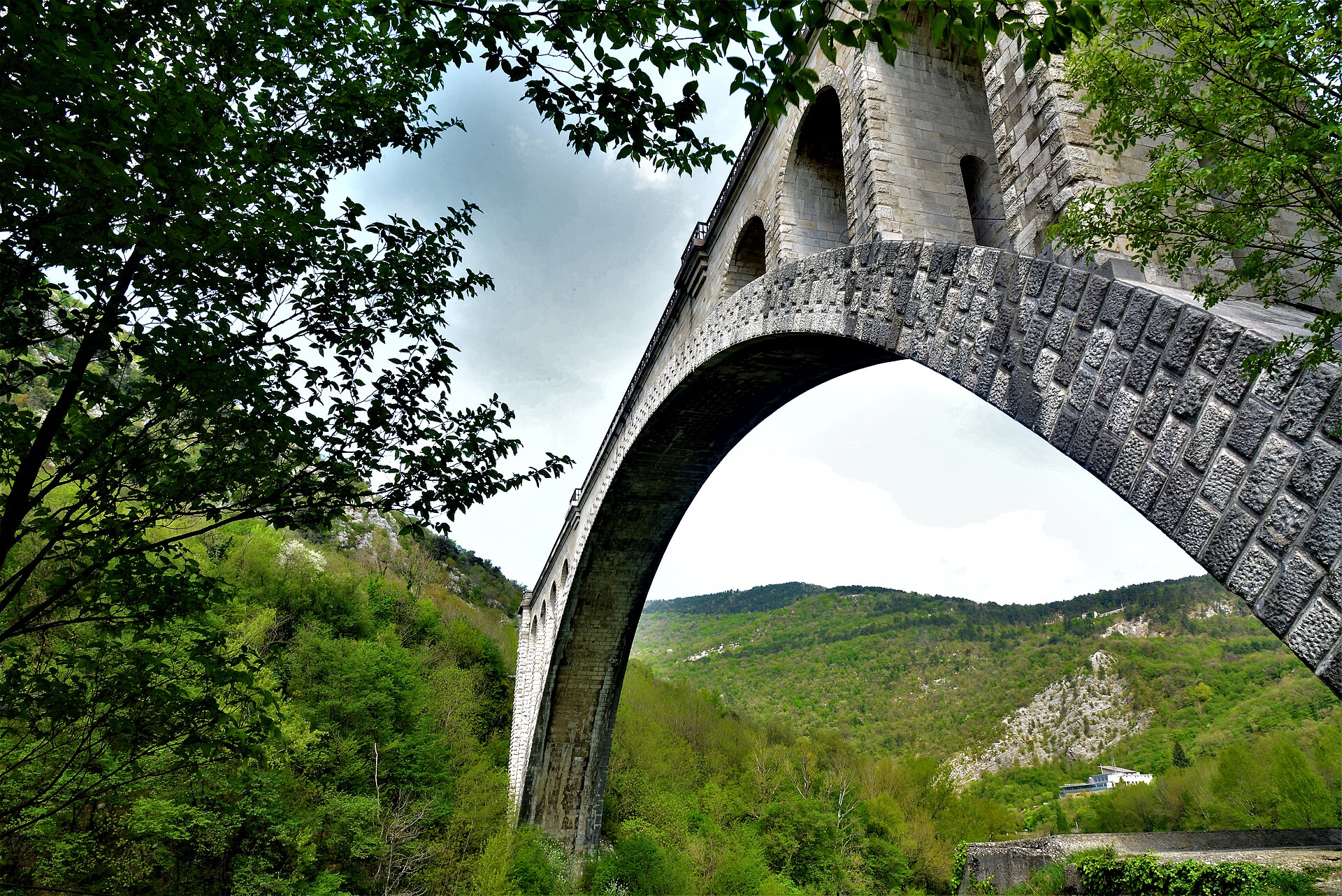
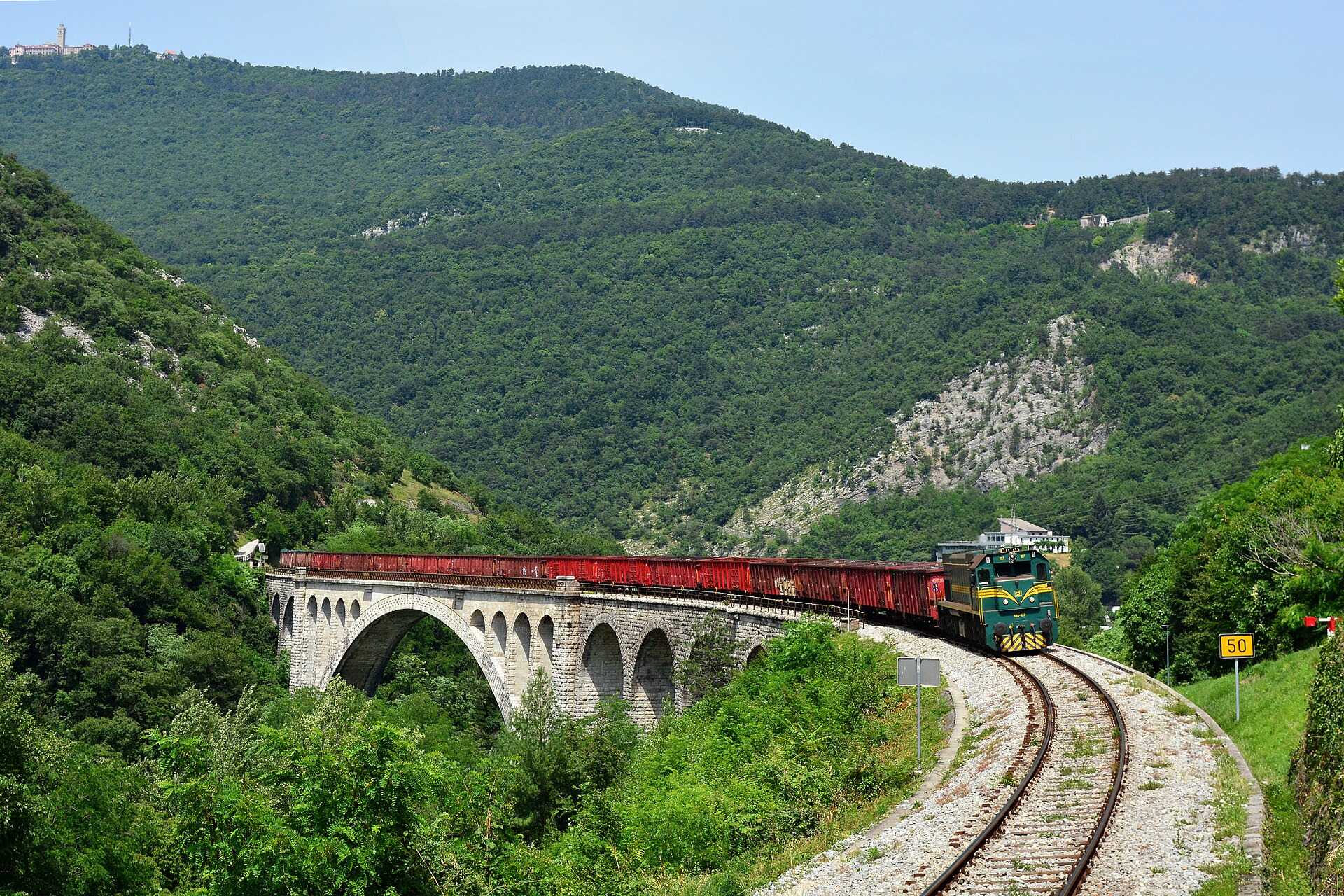
The finale comes at Solkan, on the edge of Nova Gorica. Here the railway crosses the Soča on the Solkan Bridge, a single arch of 85 metres built from more than 4,500 blocks of cut limestone — the longest stone arch railway bridge in the world. Austrian troops dynamited it in 1916 to slow the Italian advance; it was rebuilt, faithfully, in the 1920s. Stand on the riverbank beneath it as a train crosses and you understand why the Bohinj Railway is remembered less as a piece of transport than as a work of art. A few minutes later the train rolls into Nova Gorica, with Italy — and the old town of Gorizia — just across the square.
Along the route
Salvadi83 / Wikimedia Commons · CC BY 4.0The Solkan Bridge
At Solkan, just before Nova Gorica, the railway leaps the Soča on a single 85-metre stone arch — the longest stone arch railway bridge in the world. Built in 1904 from over 4,500 blocks of limestone, blown up in the First World War and rebuilt in the 1920s.Matija Podhraški / Wikimedia Commons · CC BY-SA 3.0Through the mountain
Beyond Bohinjska Bistrica the line vanishes into the hillside, threading the 6.3-kilometre Bohinj Tunnel beneath Mount Kobla — the longest in Slovenia, and what let the engineers carry the railway from the Alps to the Adriatic side of the watershed.Jakub Hałun / Wikimedia Commons · CC BY 4.0Lake Bled from the train
Near the Alpine end the railway skirts Lake Bled, and its period station is a short walk above the water. Downhill from the platforms are the island church adrift on the turquoise lake and the castle on its crag.A bit of history
Culture & experiences along the way
Bvcmz248.5 / Wikimedia Commons · CC0Ride the everyday regional train
You need nothing special: an ordinary Slovenske železnice regional train runs the whole line Jesenice–Nova Gorica in about two hours, roughly seven times a day, for a handful of euros. Sit back for Lake Bled, the tunnel and the Soča valley — this is one of Europe's best-value scenic rides.Ines Zgonc (Amazone7) / Wikimedia Commons · CC BY-SA 2.5 SICatch the vintage museum train
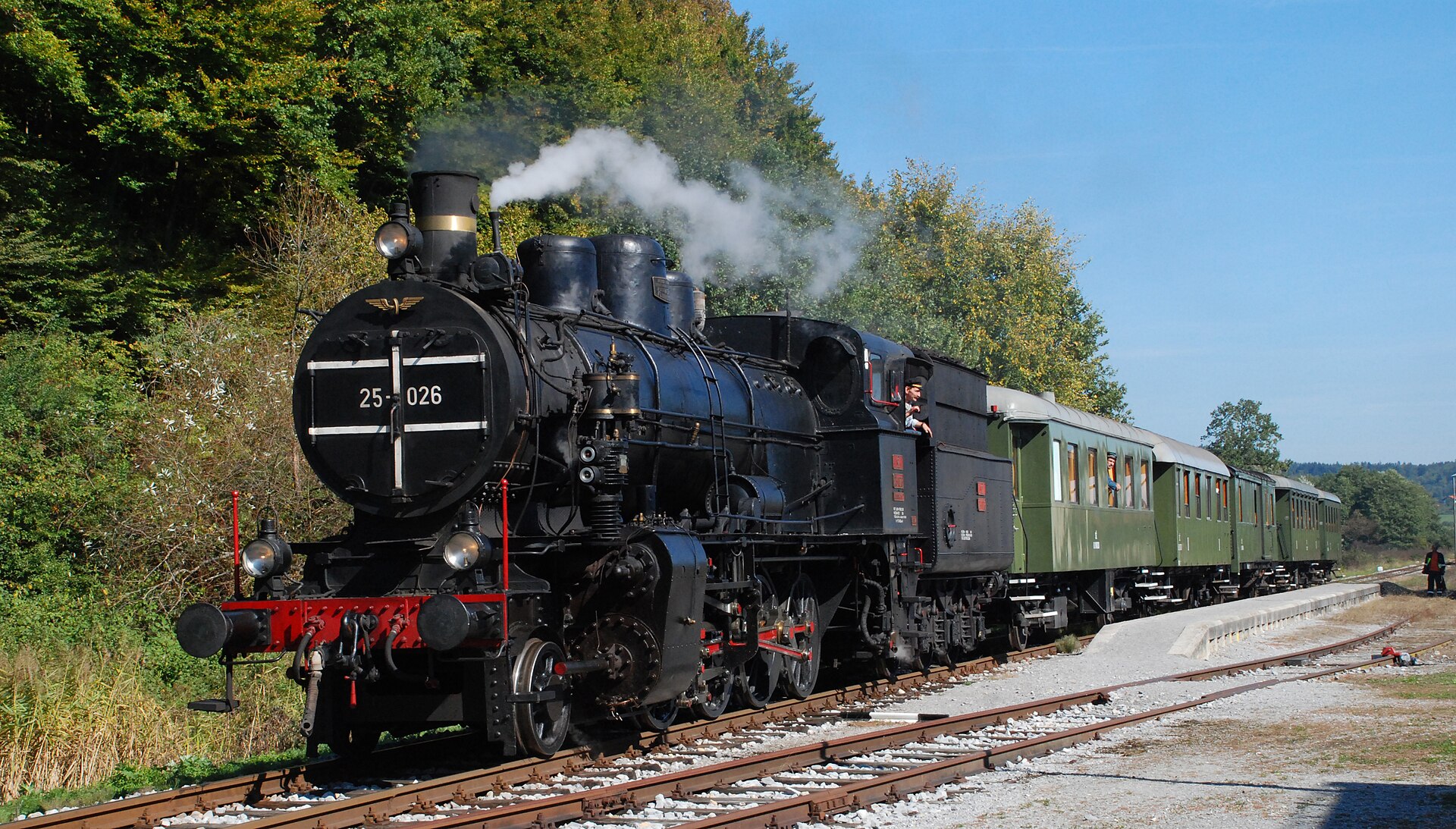
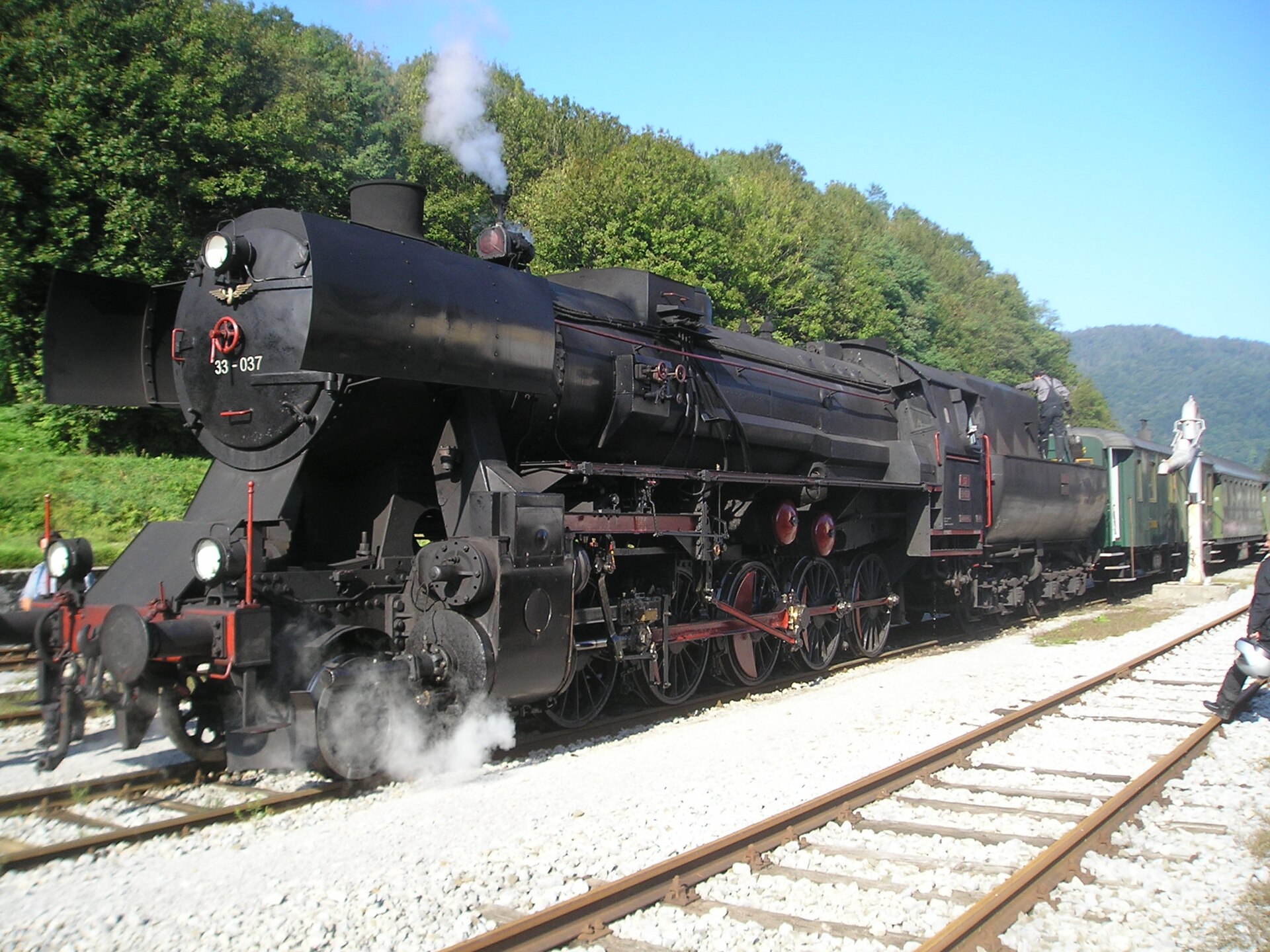
On selected days Slovenian Railways fires up its museum train — an early-1900s steam locomotive and restored period carriages, complete with a conductor in old uniform and an accordion aboard. It runs a short season only, with no summer departures for fire safety, so check the operator's calendar and book ahead.Smiley.toerist / Wikimedia Commons · CC BY-SA 4.0Take your car through the tunnel
The line's quirkiest service is the motorail (avtovlak): drive onto a flat wagon at Bohinjska Bistrica and be carried through the Bohinj Tunnel to Podbrdo, Most na Soči or Nova Gorica, saving a long mountain road. Foot passengers and cyclists ride too, in a carriage with a little onboard museum about the railway.Timetables
The Bohinj Railway is worked by everyday Slovenske železnice regional trains, so you can simply turn up and ride. About seven trains a day run the full length in each direction, taking a little over two hours; you can also join at Bled Jezero, Bohinjska Bistrica or Most na Soči for a shorter hop.
Jesenice → Nova Gorica (regional trains)
Representative through departures, as of July 2026 (timetable valid to December 2026):
| Depart Jesenice | Arrive Nova Gorica | Journey |
|---|---|---|
| 04:05 | 06:08 | ~2 h 03 |
| 06:07 | 08:11 | ~2 h 04 |
| 08:52 | 11:00 | ~2 h 08 |
| 11:18 | 13:14 | ~1 h 56 |
| 14:28 | 16:33 | ~2 h 05 |
| 16:51 | 18:45 | ~1 h 54 |
| 19:22 | 21:27 | ~2 h 05 |
Trains call at Bled Jezero, Bohinjska Bistrica, Podbrdo, Grahovo and Most na Soči among other halts. In the reverse direction, Nova Gorica → Jesenice runs to a similar pattern through the day. Fares are modest — a few euros end to end — and no reservation is needed.
The motorail through the tunnel
Separately, the car-carrying motorail (avtovlak) shuttles through the Bohinj Tunnel between Bohinjska Bistrica and the Soča side (Podbrdo, Most na Soči and, on some runs, Nova Gorica). Southbound departures from Bohinjska Bistrica leave at roughly 09:10, 11:40, 13:30 and 16:49, with an extra late run around 21:28 in the summer season; northbound services return through the day. Foot passengers and cyclists can ride too. A car with driver costs around €16 for the Bohinjska Bistrica–Most na Soči crossing (from July 2026); vehicle spaces are first-come, first-served, so arrive well before departure, as loading closes ten minutes ahead of time.
The steam museum train
Slovenske železnice also runs a vintage museum train on the line, hauled by early-twentieth-century steam locomotives. It operates only on selected dates in a short season — with no summer runs, because of fire-safety rules — plus autumn services and a Santa Claus special. Dates and bookings are published by the operator each year.
Always confirm the day's times on the Slovenske železnice timetable before travelling, as engineering works can alter services.
Tickets
There is nothing complicated about riding the Bohinj Railway. For the scenery all you need is an ordinary Slovenske železnice regional ticket, bought at a window, from a machine, or on the SŽ site and app. Regional trains carry no compulsory reservation, so you can take whichever service suits, break the journey at Bled or Most na Soči and pick up a later train. Jesenice to Nova Gorica — Lake Bled, the Bohinj Tunnel and the Soča valley — costs a few euros.
If you are based at Bled, join at Bled Jezero, a short walk above the lake, not the main-line Lesce-Bled station, which is on a different route. The motorail through the tunnel is ticketed separately and paid on board; a limited number of wagons run, so arrive early. The steam museum train is a seasonal special with its own tickets, and it sells out.
Book your tickets
Jesenice – Nova Gorica regional train
The everyday scenic ride over the whole line
Ordinary Slovenske železnice regional trains run the full Bohinj line — Lake Bled, the Bohinj Tunnel and the Soča valley to the Solkan Bridge — in about two hours, roughly seven times a day. No reservation needed; buy at the station or on the SŽ site and app.
Book Tickets (opens in a new tab, on Slovenske železnice (Slovenian Railways))via Slovenske železnice (Slovenian Railways)Motorail through the Bohinj Tunnel
Car-shuttle Bohinjska Bistrica – Most na Soči / Nova Gorica
The car-carrying motorail runs several times a day through the tunnel between Bohinjska Bistrica and the Soča side; you can also ride as a foot passenger. Check current departures and fares, and arrive early — vehicle spaces go first-come, first-served.
Book Tickets (opens in a new tab, on Slovenske železnice (Slovenian Railways))via Slovenske železnice (Slovenian Railways)Rail Passes
Interrail passes are valid. Interrail's table of railway companies lists Slovenske železnice's regional trains as included in Slovenia, so Jesenice to Nova Gorica is covered by an Interrail Slovenia Pass or a Global Pass, with no reservation. Interrail excludes all private companies running tourist trains in Slovenia.
For this journey alone, a pass is not worth buying. The whole line costs a few euros.
Checked October 2026 against interrail.com (opens in a new tab).
Places to Visit
The Bohinj Railway is threaded with places worth breaking the journey for. In seventy-odd kilometres it crosses two very different countries — the glacial lakes and Alpine meadows of Upper Carniola on one side of the tunnel, and the emerald Soča and its Mediterranean light on the other — and almost everything below is a short walk or a short bus from a station.
Beyond the six places carded here, Lake Bohinj is the doorstep of Triglav itself, Slovenia's highest mountain and national symbol; Most na Soči and Tolmin make good bases for the middle valley; and the Soča's First World War is remembered along the Walk of Peace, which runs the length of the front from the Alps to the sea.
And of course the Solkan Bridge, just upstream of Nova Gorica, is worth the short walk from the station to stand beneath the greatest stone arch on any railway in the world.
 Ymon / Wikimedia Commons · CC0 · cropped
Lake Bled
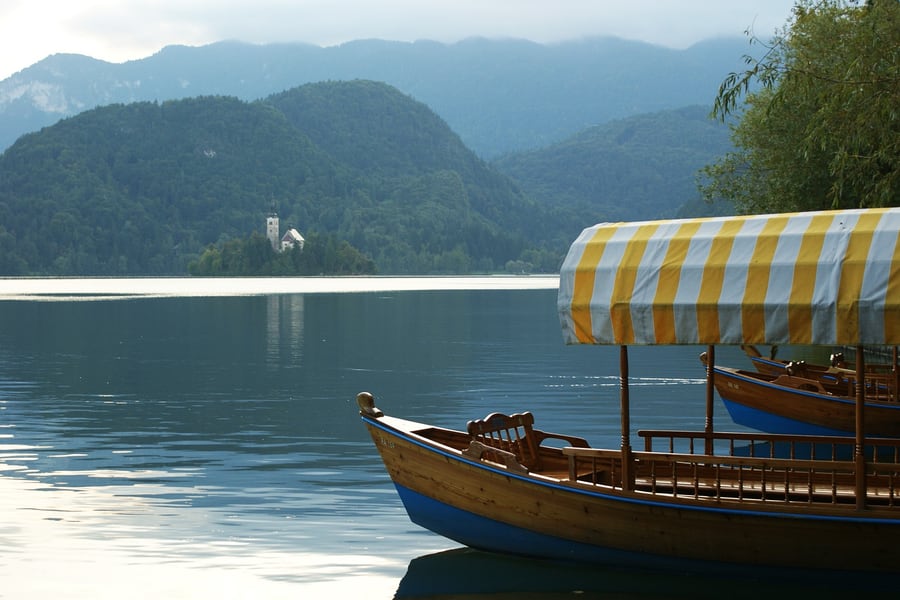
The lake is 2,120 m long and 29.5 m deep, and everything about it is arranged around the island in the middle. The pilgrimage church took its present form in the late 17th century; a Baroque stairway of 99 steps, built in 1655, climbs to the door, and grooms still carry their brides up it before ringing the wishing bell. You get there by pletna — a flat-bottomed boat rowed standing up, a right Maria Theresa granted to 22 local families in 1740.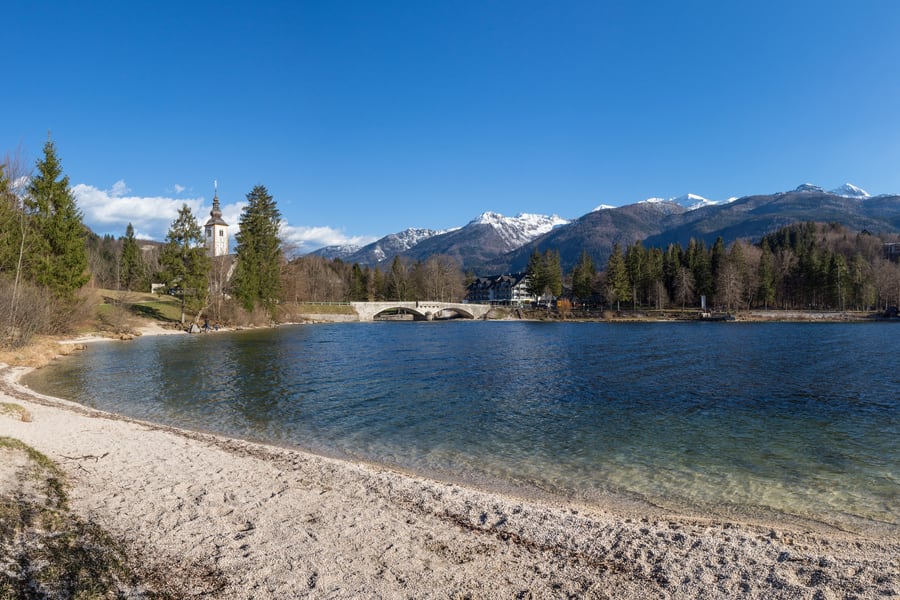 Dmitry A. Mottl / Wikimedia Commons · CC BY-SA 4.0 · cropped
Lake Bohinj
Bled's big sister, and at 318 hectares the largest permanent lake in Slovenia — but where Bled is a resort, Bohinj is a valley of hay meadows and grey stone hamlets inside Triglav National Park. It is a short bus ride from Bohinjska Bistrica station, and it is the doorstep of the high Julian Alps. Swim off the shingle, walk the shore, or take the cable car up Vogel for the whole ring of peaks at once.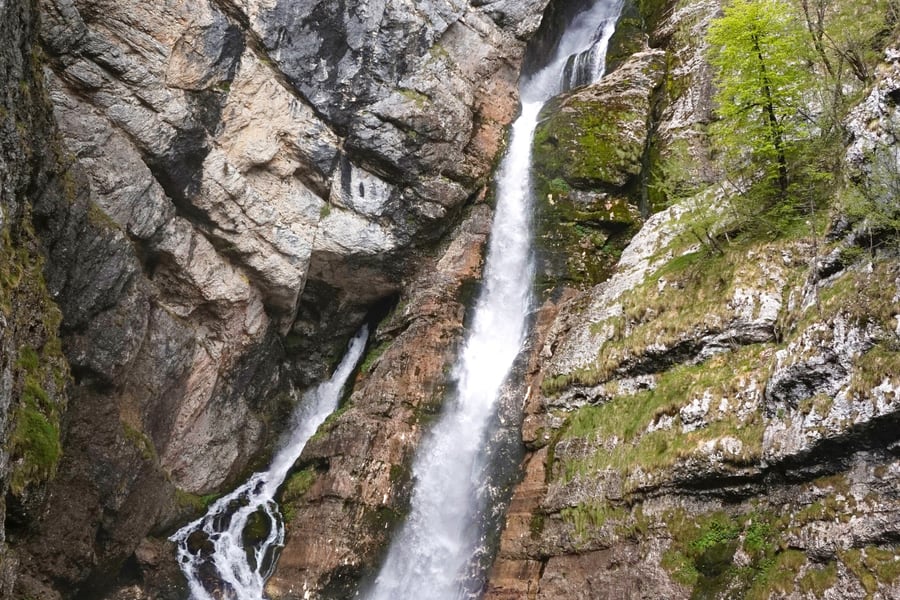 Tiia Monto / Wikimedia Commons · CC BY-SA 3.0 · cropped
The Savica waterfall
A 78-metre fall at the head of the Bohinj valley, fed by a karst spring that bursts straight out of the mountain just above it. The water splits inside the rock and rejoins in the open as a hard white A against the cliff. It is a 15-minute climb of stepped path from the Savica lodge at the western end of the lake, and the stream below it is the main feeder of Lake Bohinj — and so of the Sava Bohinjka, one of the two headwaters of the Sava.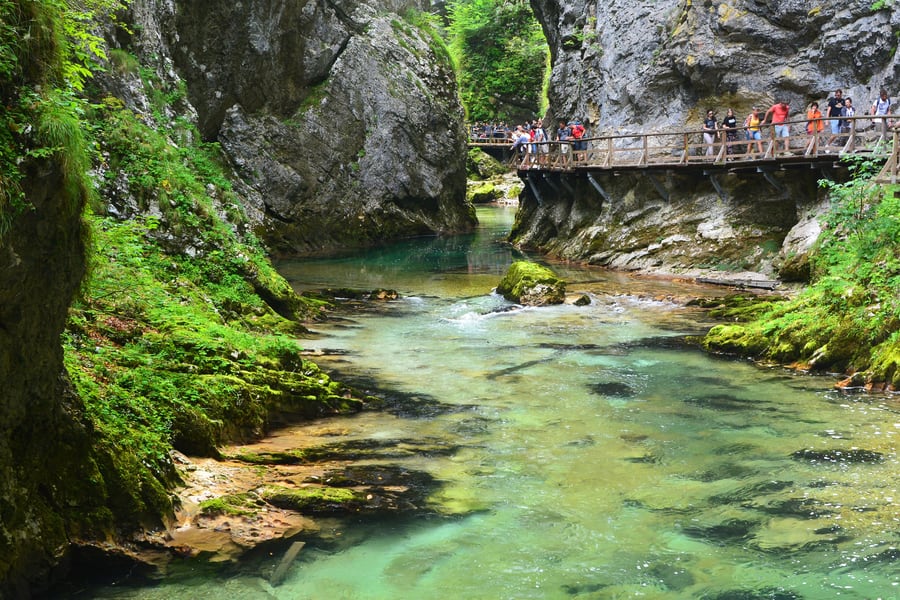 Veronika.szappanos / Wikimedia Commons · CC BY-SA 4.0 · cropped
Vintgar Gorge
1.6 kilometres of walkway pinned to the wall of a canyon cut by the Radovna, with the rock rising 50 to 100 metres on either side and green water sliding underneath. The galleries and bridges were opened in 1893 and have been rebuilt many times since; the walk ends at Šum Falls, at 13 metres the largest river waterfall in the country. Entry is now capped at 245 people at a time, so book your slot online before you go.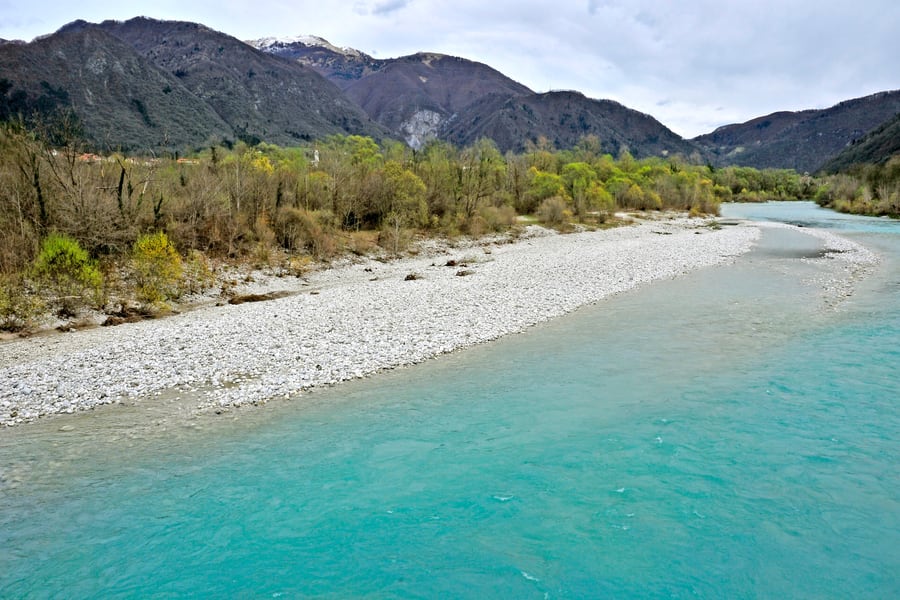 LBM1948 / Wikimedia Commons · CC BY-SA 4.0 · cropped
The Soča valley
The train comes out of the Bohinj tunnel into a different country. The 138 km Soča is one of the very few rivers in the world that hold that emerald colour along their whole length, and it draws anglers, rafters and walkers all summer. It is also a war grave: twelve battles of the Isonzo were fought along it between May 1915 and November 1917, and over half a million men died. Kobarid and Tolmin are the places to stop.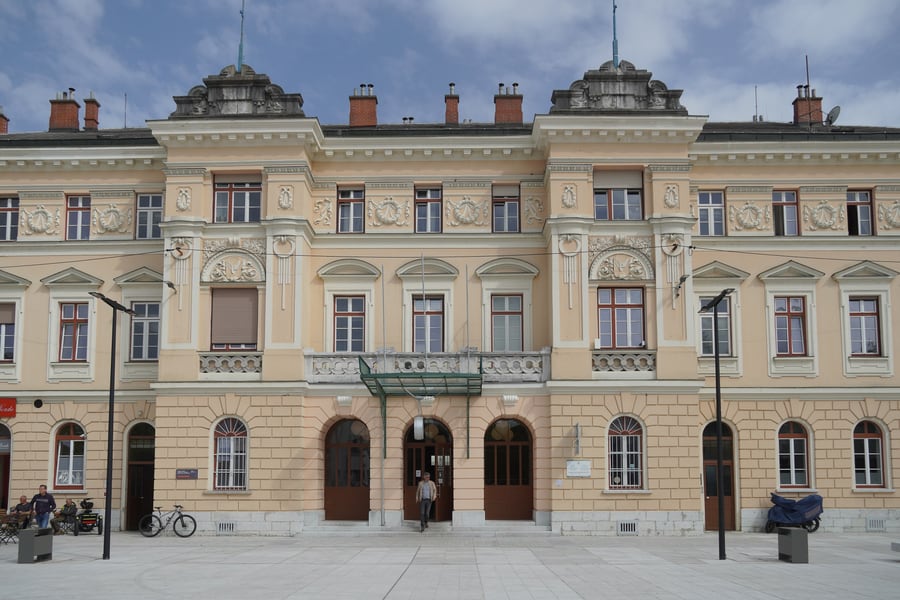 Naturpuur / Wikimedia Commons · CC BY-SA 4.0 · cropped
Nova Gorica & Gorizia
The oddest square in Europe, and the reason the line exists. Transalpina Square is split down the middle by the Italian–Slovenian border, with the 1906 station — built for this very railway — standing on the Slovene side. A wall divided it until 2004; today you step between countries without noticing. The two towns held the title of European Capital of Culture together in 2025, the first cross-border pair to do it.Where to Sleep
The Bohinj line runs through some of Slovenia's best-loved holiday country, so there is no shortage of places to stay along it — the only question is which kind of Slovenia you want to wake up in.
Bled is the natural choice at the Alpine end: everything from grand lakeside hotels with balconies over the water to family guesthouses and apartments up the hill. It is busy in summer, so book ahead, and consider staying a night to catch the lake at dawn before the crowds.
Bohinj, around the quieter lake, is the place for walkers and anyone who prefers pine forest to promenades — small hotels and rooms in the villages of Ribčev Laz, Stara Fužina and Bohinjska Bistrica, right by the station.
On the Mediterranean side, Tolmin and Most na Soči offer riverside guesthouses and campsites in the heart of the Soča valley, ideal if you are combining the train with rafting or the war-history trail. At the end of the line, Nova Gorica has practical town hotels, and staying here lets you step across into Italy for dinner.
Wherever you land, distances are small and the trains cheap, so it is easy to base yourself in one spot and ride out along the line for the day.
Questions or corrections
Planning this trip and stuck on something, or spotted a time, fare or detail that has changed? Send us a message about The Bohinj Railway — Lake Bled, the Alps and the Solkan Bridge. We read every one, and we update this page when something has changed.