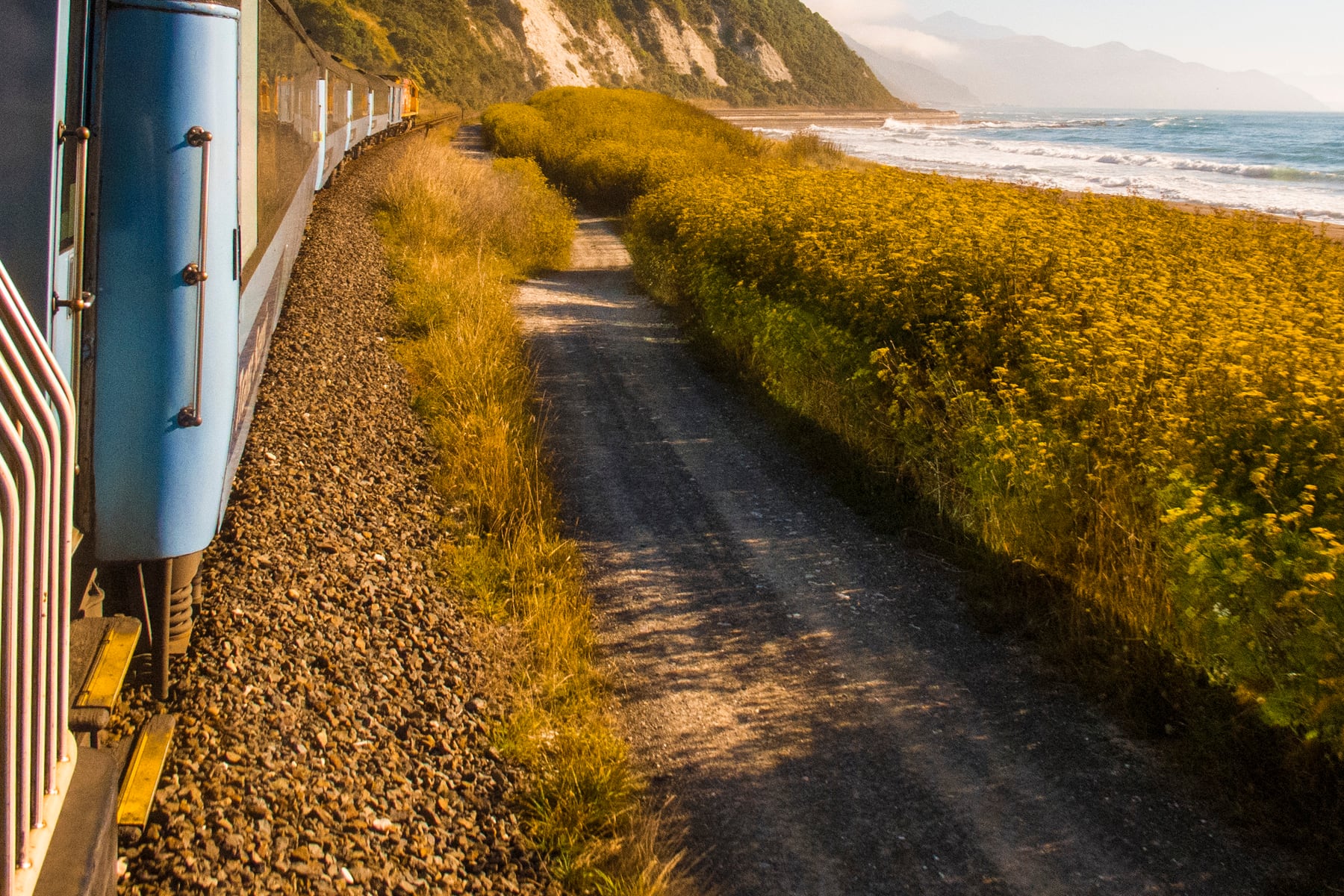
Coastal Pacific
Johannes Vogel / Wikimedia Commons · CC BY-SA 3.0 · cropped
- Distance348 km
- Duration~5h 40m
- Best seasonSeptember to April
Introduction
There is a stretch of the New Zealand coast between Oaro and Wharanui where the Kaikōura ranges come down into the Pacific and leave almost nothing in between. No plain, no dunes, barely a road. When the surveyors reached it they had two options — go inland and around, or thread a railway along the very edge. They went along the edge, through nineteen tunnels, and the Coastal Pacific is what you ride to see the result.
It runs the full length of the Main North Line, 348 kilometres from Christchurch to the ferry port at Picton — five hours and forty minutes northbound, ten minutes more coming back. The first half crosses the Canterbury Plains, New Zealand's largest expanse of flat land, with the Torlesse Range visible seventy kilometres to the west. Then the mountains arrive, the line turns to meet the sea, and for the next two hours the water is close enough that the spray reaches the windows. Seals, gulls and dolphins are ordinary sightings; whales are not unusual. At the northern end the country changes again — salt pans, vineyards, and the drowned valleys of the Marlborough Sounds.
What makes this more than a scenic ride is that the railway you are on should not exist any more. Shortly after midnight on 14 November 2016, a magnitude 7.8 earthquake tore 160 kilometres across the fault lines beneath this coast and dropped two long sections of the Main North Line into the sea. The government spent a year deciding whether to rebuild it or abandon the route. It rebuilt: twelve kilometres of new track, five kilometres realigned, tunnels reopened, the whole formation shifted several metres in places. Freight came back in September 2017 and passengers in December 2018. The scars are still there beside the track — the lifted seabed, the raw fault line at Waipapa Bay — and the guides point them out, because on this line the geology is not the backdrop. It is the story.
The Journey
The Main North Line is the longest railway construction project in New Zealand's history. The first stage opened out of Christchurch on 29 April 1872, running north into farming country on the Canterbury Plains; the last rails were joined in 1945. Seventy-three years, for 348 kilometres. The reason is the middle: two railways crept towards each other, one north from Christchurch and one south from Picton, and between Parnassus and Mirza the Kaikōura ranges refused to let them meet anywhere except the shoreline.
Out of Christchurch
The train leaves Christchurch at seven in the morning and spends its first hour on the flat. The Canterbury Plains run 200 kilometres north to south and 70 east to west, the largest continuous lowland in the country, bought by the Canterbury Association in 1850 precisely because they were flat enough to farm at scale. Little has changed. Kaiapoi comes first, where the line crosses the braided Waimakariri River — the same river the TranzAlpine follows west into the Southern Alps. Rangiora, thirty kilometres out, is the only intermediate stop before Kaikōura.
Past Waipara the hills close in, and at Claverley the line reaches the sea. What follows is the reason the train exists.
The cliffs
Between Claverley and Okiwi Bay, thirteen tunnels come in nineteen kilometres. Most of them are there not to get through a hill but to keep the curves inside the 240-metre radius the railway's speed standard demanded; others are cut-and-cover barrel vaults built purely to hold the slope off the track. The 899-metre Paratitahi does both — conventional bore at each end, barrel vault through the middle, with ventilation slits cut into the seaward wall so that the ocean strobes past in slices.
Between the tunnels the line is out in the open on ledges above the water. The Okarahia Viaduct, 21 metres high and 115 metres long, appears with no warning: the southern approach is screened by trees and the northern one by the 975-metre Amuri Tunnel, so you come out of shadow already flying over a beach. At Spy Glass Point the train runs along a cliff edge; at Oaro it drops to stony bays at sea level. Emerging from the thirteenth tunnel it crosses the Kahutara River on a 241-metre bridge, with the Pacific on one side and, on the other, the first full view of the Seaward Kaikōuras rising to 2,610 metres at Manakau.
Then Kaikōura itself, the only town on this stretch, and north of it the beaches — kilometre after kilometre of them, with the ranges dropping straight into the sea ahead and the peninsula sweeping out behind. At Mangamaunu the line curves round a huge crescent bay that is also one of the country's better right-hand point breaks; at Ōhau Point it glides past a fur seal colony close enough that the seals barely look up.
The train
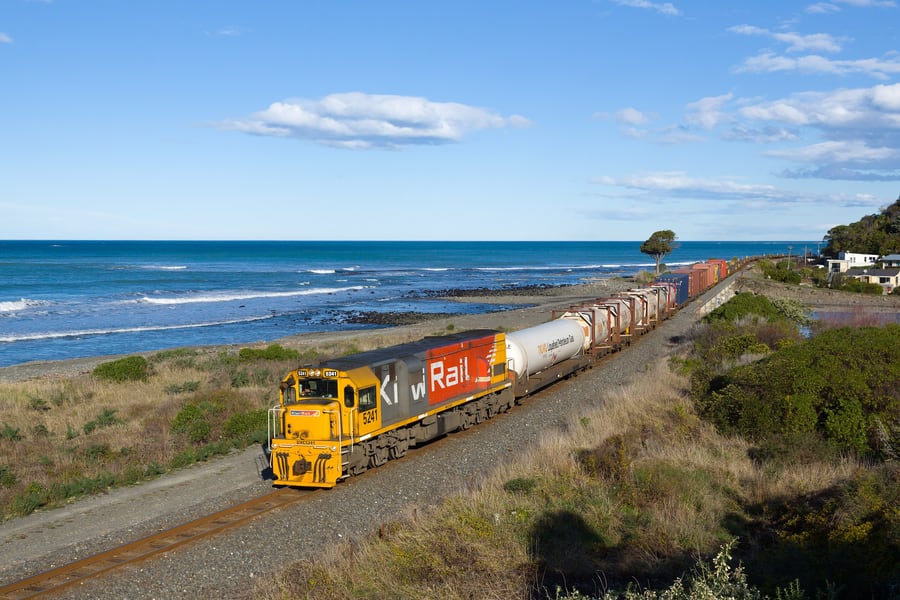
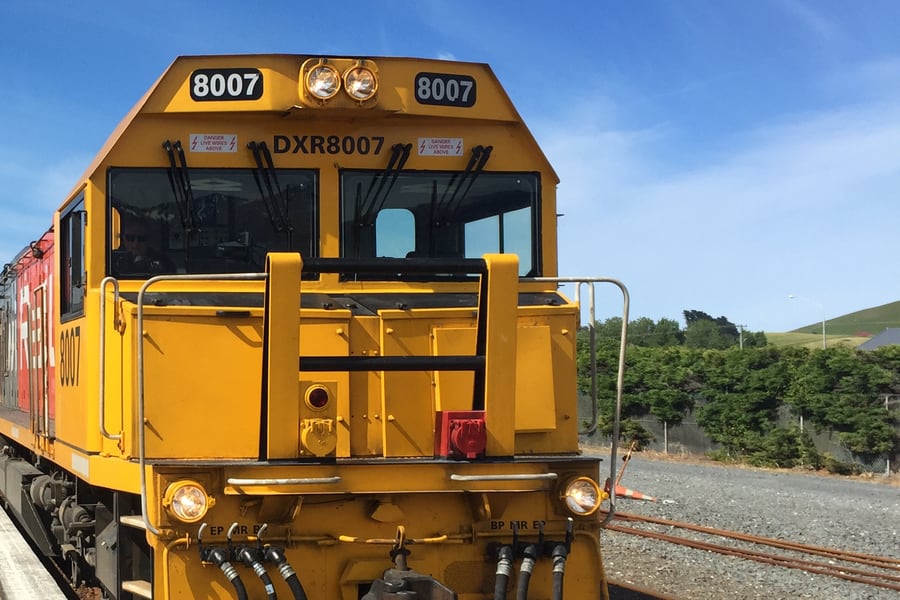
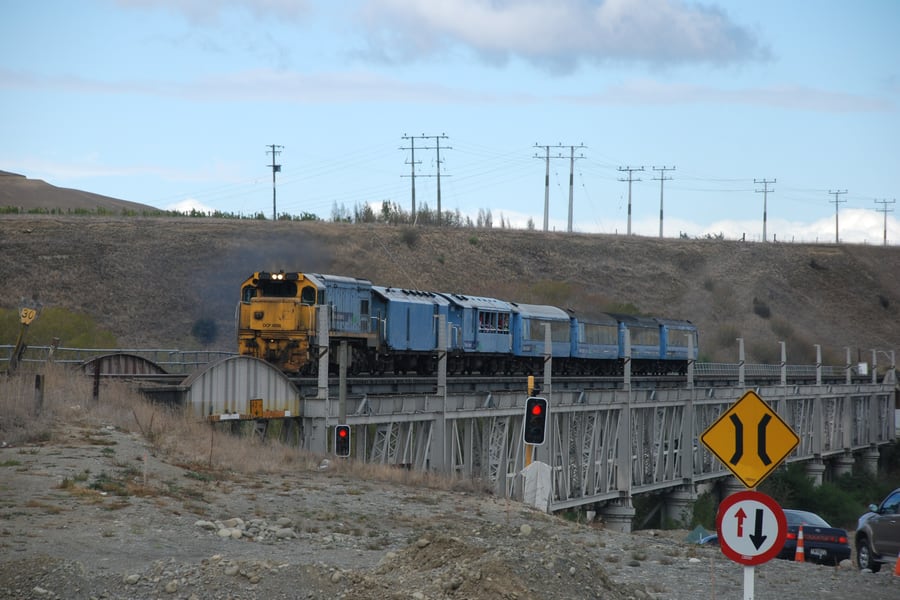
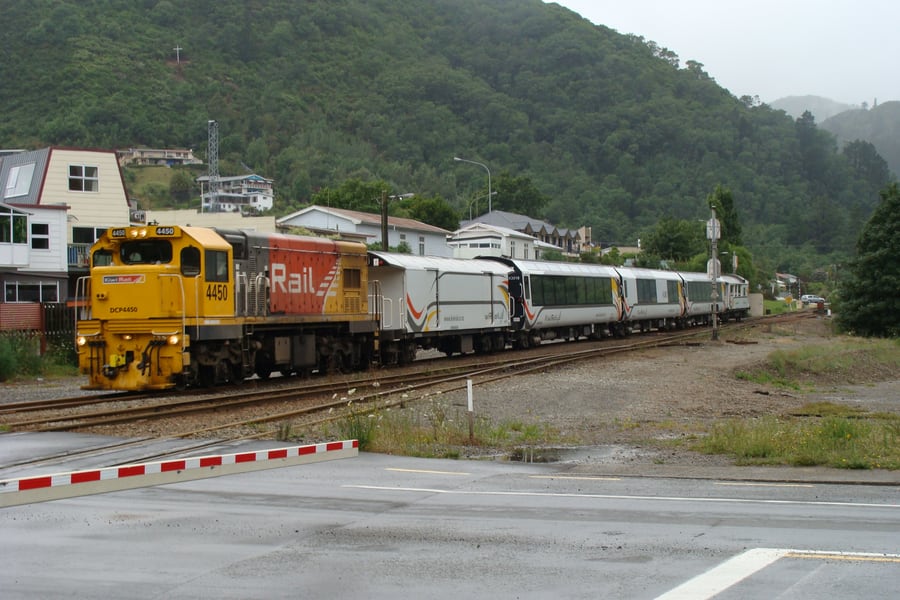
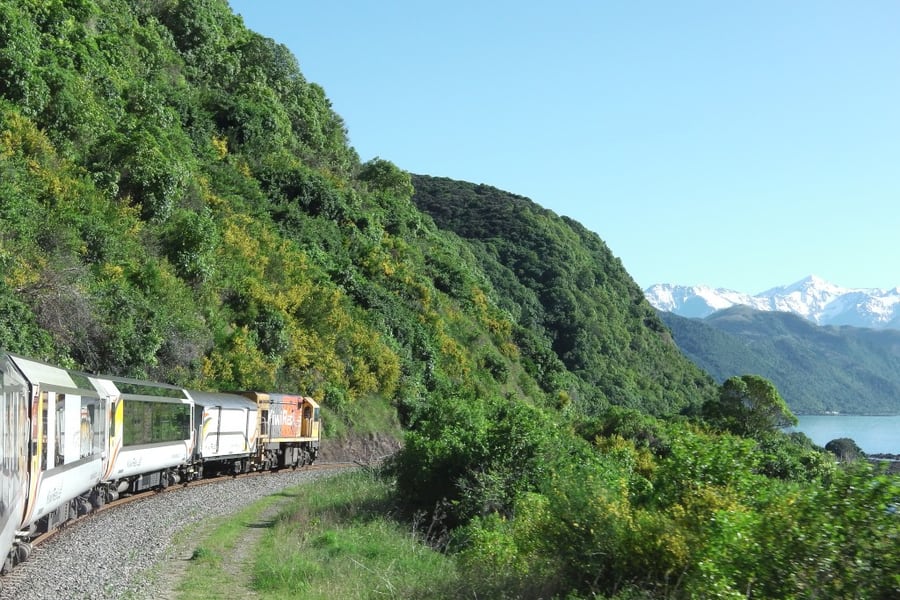
Motive power is a DX-family diesel-electric — usually a DXR, occasionally a DXB or DXC, all of them in KiwiRail's orange and yellow, and all of them shared with the freight trains that use this line overnight. Behind the locomotive come AK-class carriages — 17 cars built at Hillside Workshops in Dunedin between 2010 and 2012, the first new passenger carriages made in New Zealand since 1943, and the Coastal Pacific was the service they entered on, on 2 November 2011. Panoramic side windows, skylights in the roof, tables set for four, and a café car running the length of the train. There is also an open-air viewing carriage — an unglazed, railed van rebuilt from an older AG luggage van, and where most passengers spend most of the journey.
The quake
Just after midnight on 14 November 2016, a magnitude 7.8 earthquake began near Culverden, 70 kilometres south of Kaikōura, and unzipped 160 kilometres of fault line — including one nobody knew was there — before it stopped at Seddon. Landslides took two long sections of the Main North Line into the sea. State Highway 1 was buried in the same places. A freight train sat stranded north of Kaikōura, cut off at both ends.
The rebuild ran between Oaro in the south and Ward in the north. More than twelve kilometres of track was rebuilt and five kilometres realigned; in places the formation had to be moved several metres sideways and tunnels re-driven. The last weld was made on 8 August 2017, and on 15 September 2017 the first freight train ran into Kaikōura station, driven by Paul Foskett, who had been at the controls the night the quake struck. A memorial of twisted rails by the local sculptor Ben Foster was unveiled outside the station that day. Passengers had to wait longer: KiwiRail announced the reopening on 1 August 2018 and the Coastal Pacific returned on 1 December 2018.
You can still read all of it from the window. North of Kaikōura the raised seabed is unmistakable — a pale shelf of rock and dead kelp standing clear of the water where it used to be submerged — and at Waipapa Bay the Papatea fault line runs beside the track as a visible step in the ground.
Salt, vines and the Sounds
The last hour is a different country. South of Blenheim the train runs straight through the middle of Lake Grassmere, a shallow coastal lagoon that produces more than 60 per cent of New Zealand's salt: seawater is pumped into ponds and left to a climate dry enough to evaporate it, and in the warm months salt-tolerant algae turn the concentrating brine pink. Then vines, in two valleys — the Awatere, crossed at Seddon on a two-level bridge that once carried the road underneath the rails, and the broader Wairau around Blenheim.
Picton arrives quietly: a small port at the head of Queen Charlotte Sound, the Interislander berths a few metres from the platform, and the Marlborough Sounds beginning immediately beyond the breakwater.
Along the route
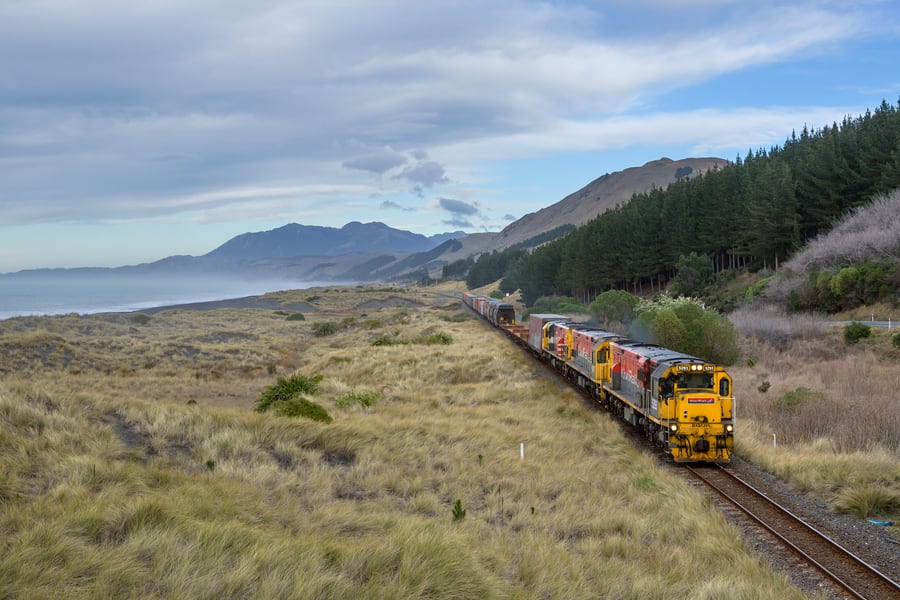 Kabelleger / David Gubler / Wikimedia Commons · CC BY-SA 4.0 · cropped
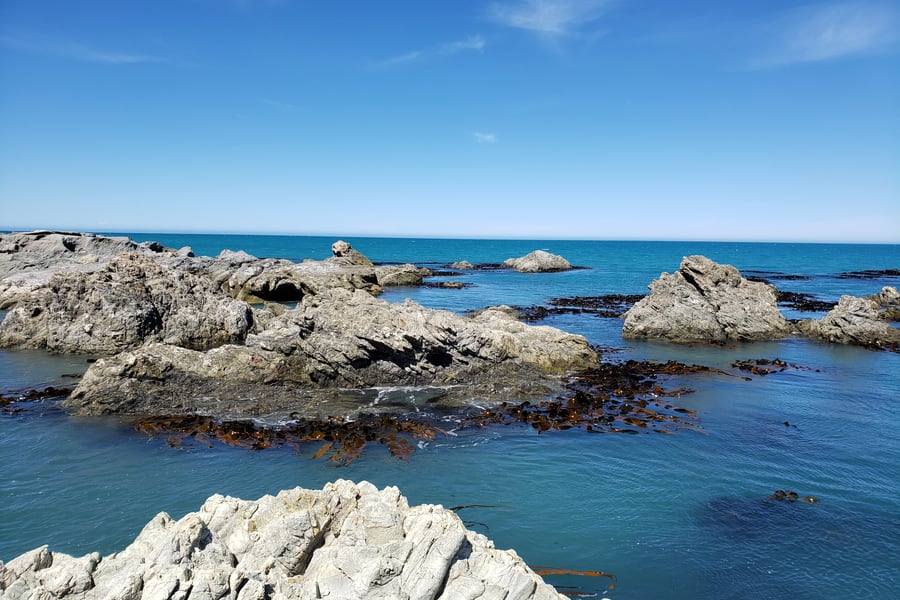
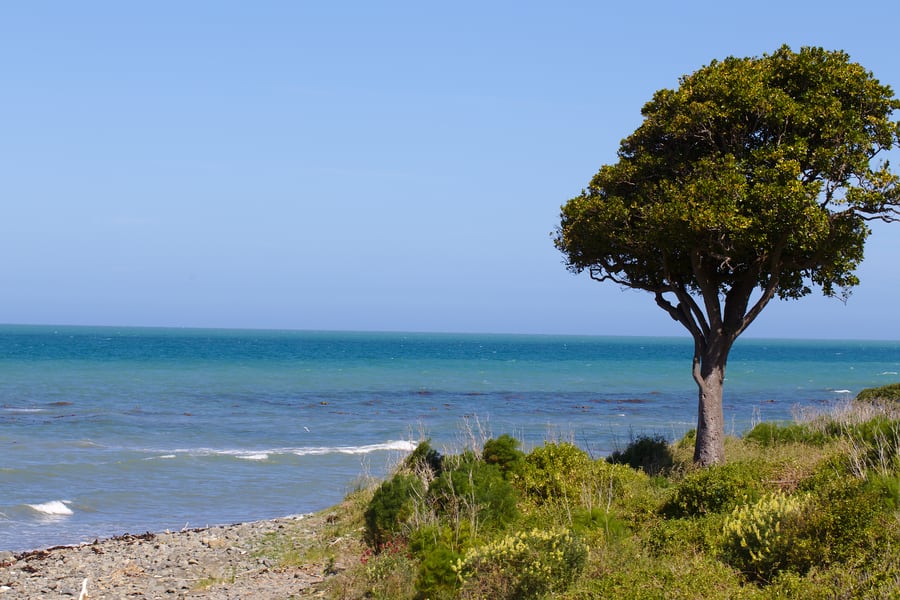
The edge of the world
Between Oaro and Wharanui the line runs almost entirely beside the ocean, cliff on one side and surf on the other. At Spy Glass Point it is high above the water; at Mangamaunu it sweeps round a moon-shaped bay full of surfers.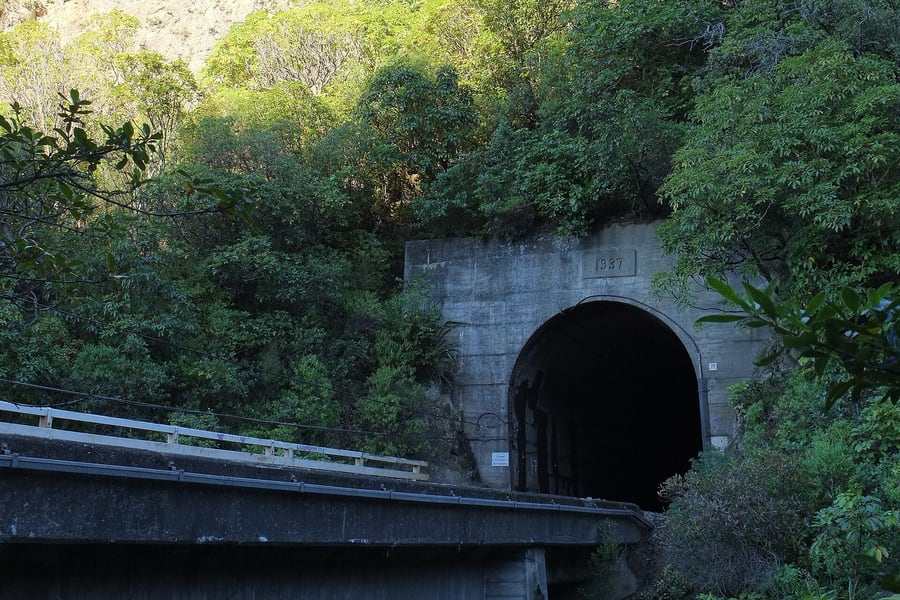 Pseudopanax / Wikimedia Commons · Public domain · cropped
Nineteen tunnels
Thirteen of them come in a 19-kilometre stretch alone. The 899-metre Paratitahi is the strange one — its middle section is barrel-vaulted with ventilation slits, so the sea flickers past through the gaps like a zoetrope.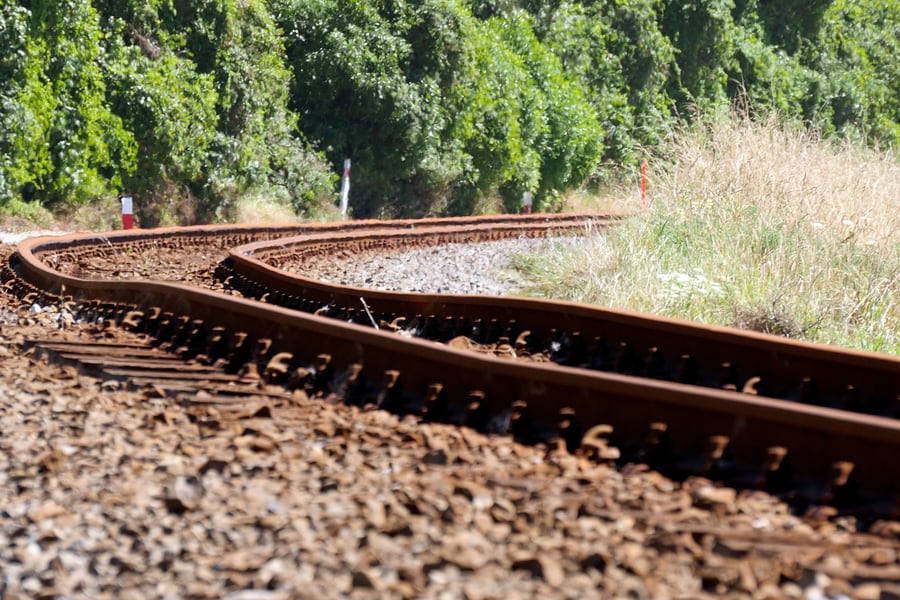 Ulrich Lange, Bochum, Germany / Wikimedia Commons · CC BY 3.0 · cropped
The scars of 2016
Between Oaro and Ward the railway had to be physically moved several metres and its tunnels rebuilt. North of Kaikōura the raised seabed is unmistakable, and the Papatea fault line runs beside the track at Waipapa Bay.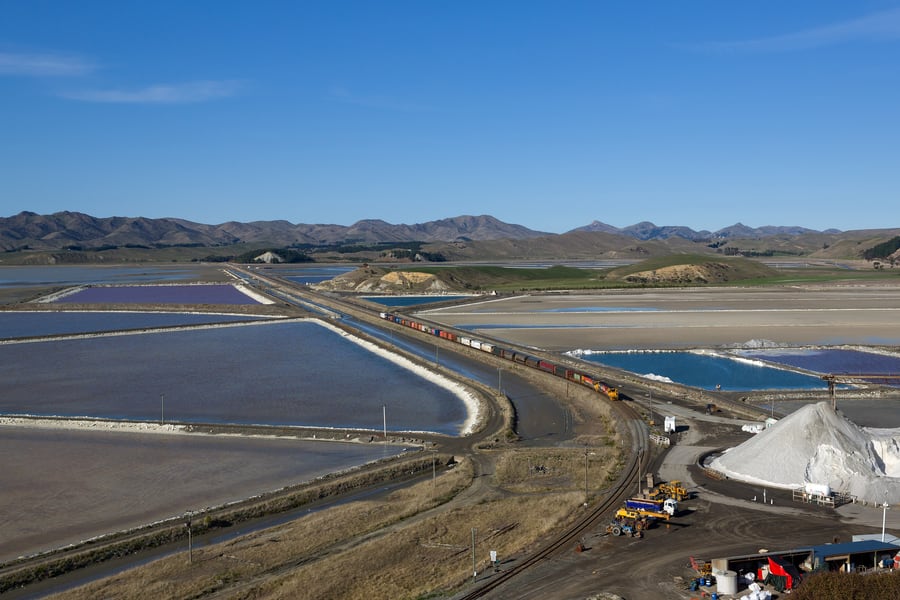 Kabelleger / David Gubler / Wikimedia Commons · CC BY-SA 4.0 · cropped
Straight through the salt
South of Blenheim the train slices through the middle of the Lake Grassmere salt works. In the warm months the ponds turn pink as algae bloom in the concentrating brine — the same effect that colours the Red Sea.A bit of history
Culture & experiences along the way
 Alex Burgess / Wikimedia Commons · CC BY-SA 4.0 · cropped
The open-air viewing carriage
Every Scenic train carries one, and it is where most of the journey gets spent — an unglazed car you stand in, with the salt wind coming straight off the Pacific and the train curving away ahead of you towards the Kaikōura ranges. No window between you and any of it.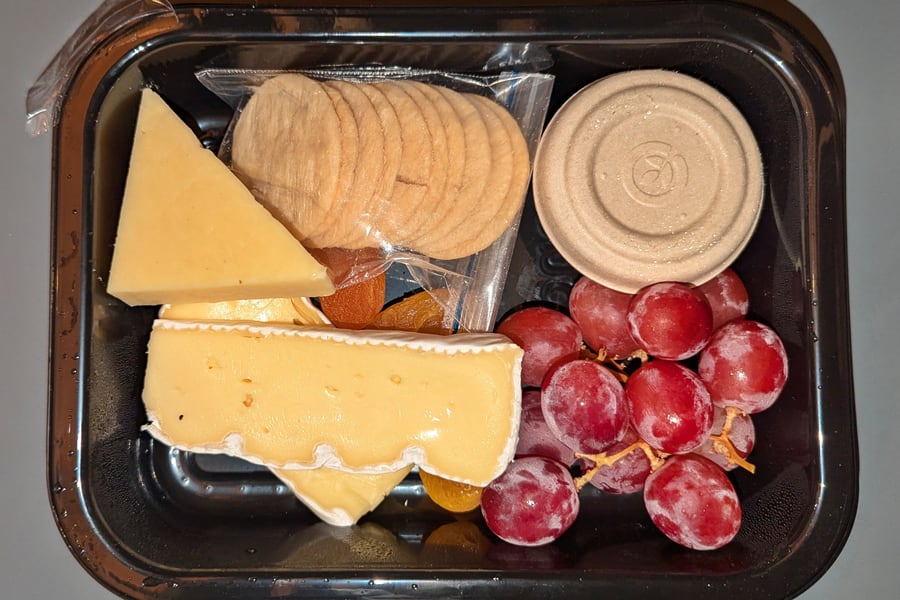 Daderot / Wikimedia Commons · CC0
Eating the coast you are crossing
The Scenic Café runs the length of the train. Upgrade to Scenic Plus and lunch becomes a seated menu drawn from the regions outside the window — South Island salmon, Canterbury produce, Marlborough wine poured as the vineyards go past.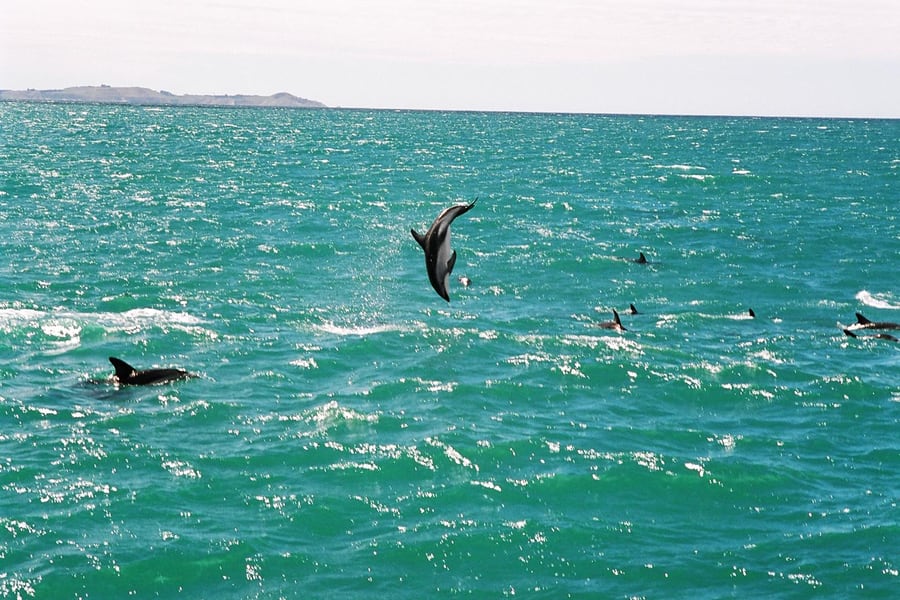 Sami Keinänen / Wikimedia Commons · CC BY-SA 2.0 · cropped
Dolphins, seals and whales
Kaikōura sits above a submarine canyon that brings deep-water feeding almost to the shore. Dusky dolphins travel in pods of hundreds, fur seals line the rocks at Ōhau Point, and sperm whales are resident year-round a few kilometres out.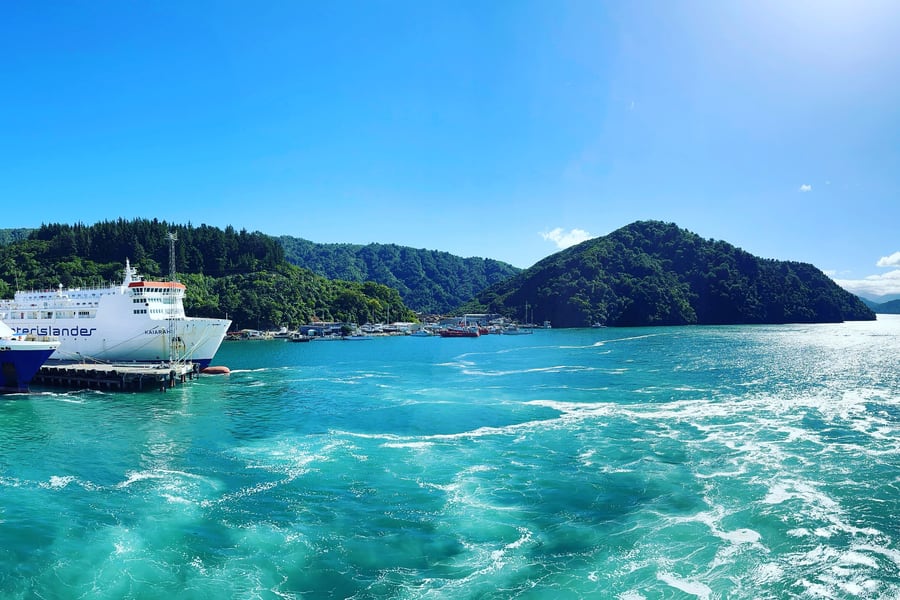 AnnWoolliams / Wikimedia Commons · CC BY-SA 4.0 · cropped
Onward across Cook Strait
The train ends at Picton beside the ferry berths. The Interislander crossing to Wellington is 93 kilometres and about three and a half hours, and two-thirds of it is spent winding through the Marlborough Sounds rather than at sea.Timetables
One train each way, every day of the season. It runs north from Christchurch in the morning and south from Picton in the afternoon, so the same set does both legs and there is no second departure to catch if you miss it.
| Station | Northbound | Southbound |
|---|---|---|
| Christchurch | dep 07:00 | arr 19:30 |
| Rangiora | 07:30 | 18:45 |
| Kaikōura | arr 09:50 · dep 10:00 | arr 16:15 · dep 16:25 |
| Blenheim | 12:10 | 14:05 |
| Picton | arr 12:40 | dep 13:40 |
Northbound takes 5h 40m, southbound 5h 50m — the extra ten minutes are the longer stop at Kaikōura.
The season is the fact to plan around. Great Journeys New Zealand states plainly that the Coastal Pacific does not operate from 26 April through to 31 August. In the months it does run, we searched the operator's own booking engine day by day across a full week in September 2026, in both directions: there was a service on every one of the seven days. Independent references still describe this train as running a few days a week, which was true in earlier seasons and is not true now — but the season shortens and lengthens, so check the dates you want before you book flights around it.
Good to know:
- It is reservation-only. The operator will not take walk-on passengers once a train is full, and says so on its own timetable page. Book ahead.
- You need not ride the whole line. The train calls at five stations and sells between any pair of them, which makes Christchurch–Kaikōura (2h 50m) or Blenheim–Picton (30 min) perfectly normal tickets.
- Arrival times are not published anywhere except the booking flow. The operator's public timetable page gives only the season and the morning/afternoon pattern, then directs you to an automated line on 0800 872 467. The times above come from the operator's own systems.
- Allow for delays. Great Journeys warns that heat and weather affect running times on this route, which is fair — the track is single, shared with overnight freight, and threaded along a coast that moves.
- The Picton connection is tight by design. The northbound arrival at 12:40 is timed to hand passengers to the Interislander ferry; the southbound departure at 13:40 picks up from it.
Times and days as of September 2026, taken from Great Journeys New Zealand's published stop times and verified against its live booking system. Confirm before travelling at greatjourneysnz.com (opens in a new tab).
Tickets
Great Journeys New Zealand sells this train direct, in two classes and in either direction for the same money. A Scenic seat, Christchurch to Picton, was NZD 239 one way when we checked the operator's booking system in September 2026; Scenic Plus, which adds a seated regional menu and matched Marlborough wines, was NZD 529. Both include the open-air viewing carriage. Two wheelchair spaces are sold at the Scenic fare.
Fares are dynamic and the train sells out, so book early rather than late. Bicycles travel for NZD 35 each way and there are only four spaces; a bike with a trailer is NZD 50, and excess baggage or sporting equipment NZD 35. Shorter journeys between any two of the five stations are sold at proportionate fares, which makes Kaikōura or Blenheim an easy stopover rather than an expensive one.
Book your tickets
Scenic — one way
Christchurch ⇄ Picton
A reserved seat in an AK panoramic carriage, with the open-air viewing car and the Scenic Café.
Book Tickets (opens in a new tab, on Great Journeys New Zealand)via Great Journeys New ZealandScenic Plus — one way
The all-inclusive carriage
The same journey with a seated regional menu, matched Marlborough wines and dedicated hosts.
Book Tickets (opens in a new tab, on Great Journeys New Zealand)via Great Journeys New ZealandShort hops
Kaikōura · Blenheim · Rangiora
The train stops at five stations and sells between any pair of them, so you need not ride the whole line.
Book Tickets (opens in a new tab, on Great Journeys New Zealand)via Great Journeys New ZealandRail Passes
There is no rail pass worth buying for this journey, and no pass that covers it. Interrail and Eurail are European products and do not apply anywhere in New Zealand. KiwiRail has in the past sold a multi-trip Scenic Rail Pass covering its three scenic trains and the Interislander ferry, but no such product appears anywhere on Great Journeys New Zealand's current website — we read its full sitemap, 235 pages, in September 2026 and found none. Treat any pass you are offered by a third party with care, and check what it actually covers before paying for it.
What the operator does sell instead is packages — the Coastal Pacific bundled with the ferry, or with accommodation in Kaikōura, or as one leg of a longer guided tour running the length of the country. Those are worth comparing if you are riding more than one of the three scenic trains, since the pricing is done as a whole. For a single Christchurch–Picton run, a point-to-point ticket is the straightforward answer.
Checked against greatjourneysnz.com in September 2026.
Places to Visit
The Coastal Pacific stops five times in 348 kilometres, which sounds thin until you notice that three of those stops are places people cross the world for. Kaikōura is the obvious break — it is the halfway point, the train reaches it before ten in the morning, and the return service picks up again at 16:25, so a day there costs you nothing but the ticket split in two.
North of it the country changes twice in an hour. Blenheim puts you in the middle of Marlborough with cellar doors within cycling distance of the platform, and Picton is both the end of the line and the door to the Marlborough Sounds — where the roads mostly stop and the water taxis take over. Everything below is reachable from a station on this railway.
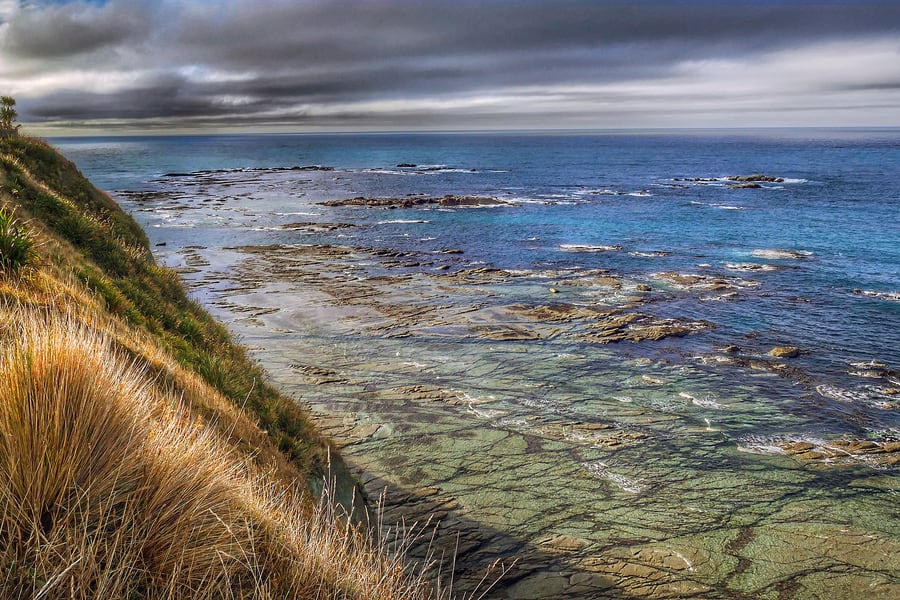 Bernard Spragg / Wikimedia Commons · CC0 · cropped
Kaikōura
The peninsula pushes out into the Pacific below mountains that reach 2,610 m at Manakau, and just offshore the Hikurangi Trench drops three kilometres — which is why sperm whales feed within sight of the beach all year. That geography is the whole town. Walk the peninsula clifftop circuit for the seal colony and the seabirds, and eat crayfish: the name means to eat crayfish. The station shares its site with the whale-watching centre.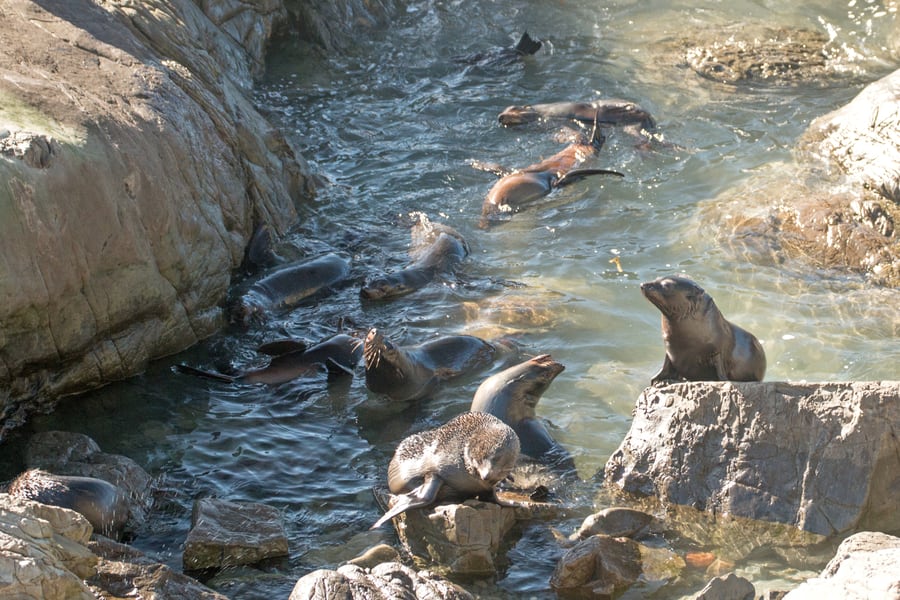 Andrea Schaffer / Wikimedia Commons · CC BY 2.0 · cropped
Ōhau Point
A New Zealand fur seal colony on the rocks north of Kaikōura, close enough to the line that sightings from the carriage are near-certain. The 2016 earthquake destroyed the waterfall and pool behind the railway where the seals bred, and killed pups and mothers with it. The colony has since recovered — the uplifted seabed gave it more rock to haul out on than it had before.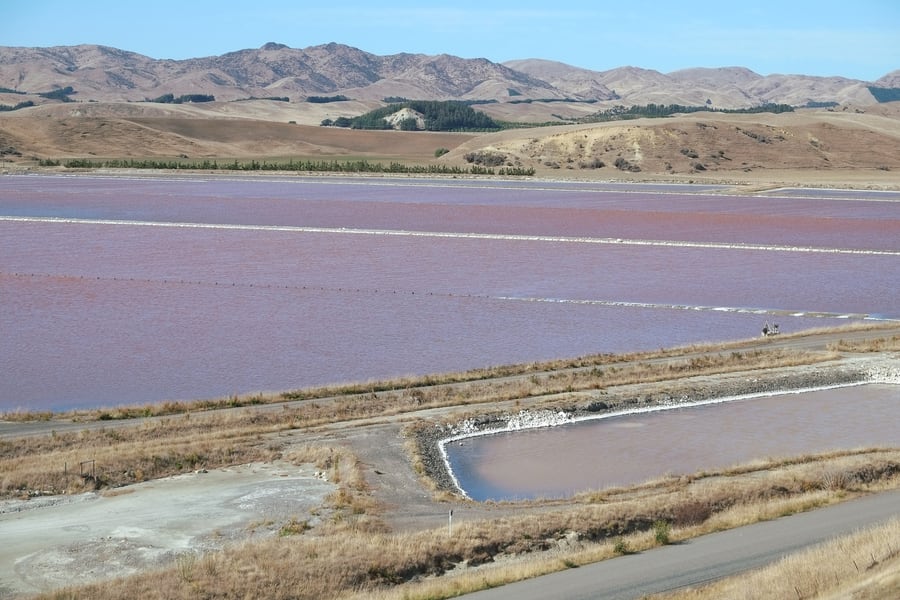 Pseudopanax / Wikimedia Commons · Public domain · cropped
Lake Grassmere
More than 60 per cent of New Zealand's salt comes from this shallow coastal lagoon, south of Blenheim, where seawater is pumped into ponds and left to the Marlborough sun and wind. As the brine concentrates, salt-tolerant algae bloom and the ponds turn pink, strongest in late summer. The railway runs straight through the middle of the pans, so the best view of it is from the train.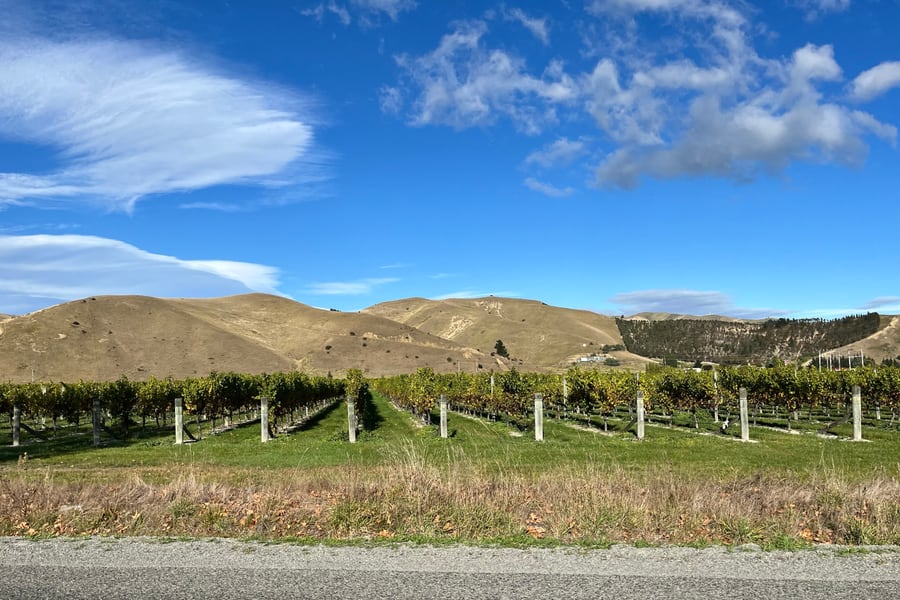 AnnWoolliams / Wikimedia Commons · CC BY-SA 4.0 · cropped
Marlborough
Two valleys make the wine: the Awatere, which the train crosses at Seddon, and the broader Wairau around Blenheim. Between them they are why New Zealand Sauvignon Blanc exists as a category at all. Cellar doors are thick on the ground within cycling distance of Blenheim station, and bicycles travel on the train for NZD 35 — which makes the wine country a day of its own without a car.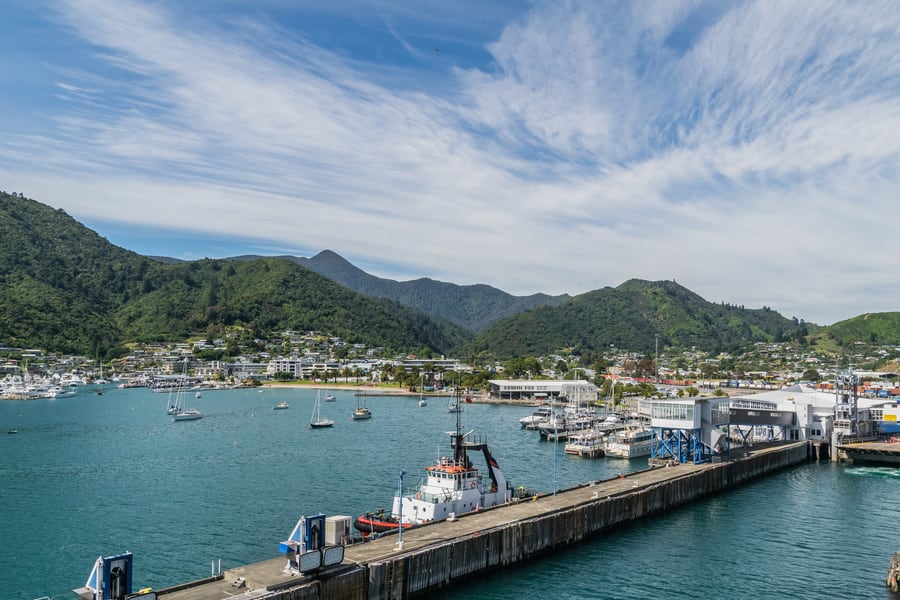 Krzysztof Golik / Wikimedia Commons · CC BY-SA 4.0 · cropped
Picton
A small port at the head of Queen Charlotte Sound where the railway, the ferry and the road all stop at once. The Interislander berths are a short walk from the platform, and the foreshore is a working harbour rather than a resort strip. Most people pass straight through to the ferry; a night here buys the Sounds instead, and the town is quiet once the last sailing has gone.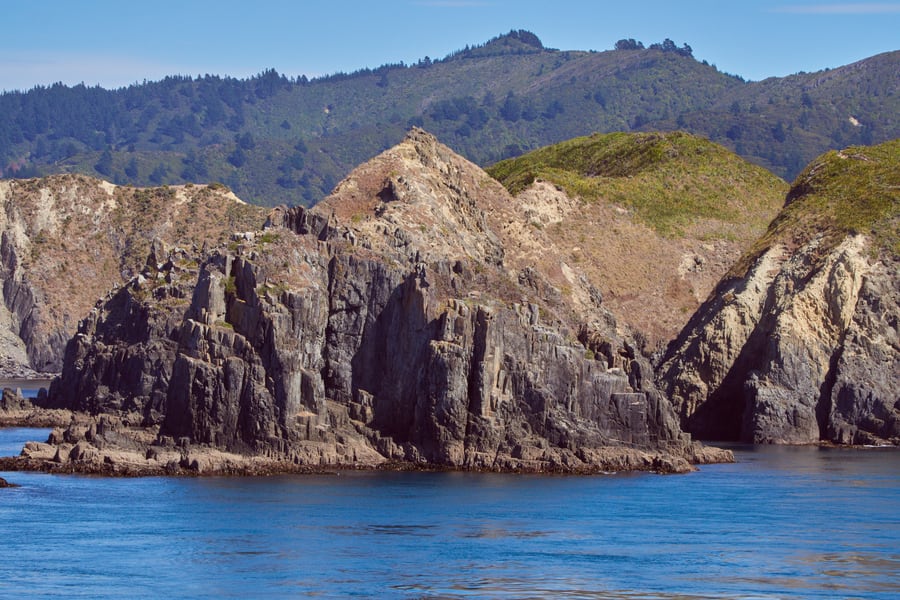 lumoplank / Wikimedia Commons · CC0 · cropped
The Marlborough Sounds
Drowned river valleys, flooded when this corner of the South Island tilted and sank, now a maze of bays and headlands with more coastline than roads. The Queen Charlotte Track runs 73.5 km along the ridges above them, from Meretoto/Ship Cove to Anakiwa, and is walked or ridden in sections — water taxis from Picton drop you at one bay and collect you from another.Where to Sleep
Three stations on this line are worth sleeping at, and they are completely different propositions. Christchurch is a city with the full range and a rebuilt centre; the useful thing to know is that the railway station is at Addington, a few kilometres out, so pick somewhere with a plan for getting to a seven o'clock departure. Kaikōura is compact enough to walk end to end, and most places there will collect you from the platform if you ask — the operator says so itself. Picton is small, and books out around ferry sailings rather than around the train.
If you want the Marlborough Sounds properly, the lodges out in the bays are reached by water taxi from Picton and by nothing else, which is the point of them.
Where to stay
The George
Christchurch, opposite Hagley Park
A boutique hotel on Park Terrace with the Avon and the park across the road, and 50 Bistro downstairs.
Check Availability (opens in a new tab, on thegeorge.com)via thegeorge.comHapuku Lodge + Tree Houses
Kaikōura, between the ranges and the sea
Rooms built up in the canopy of a working deer farm at Hapuku, a few kilometres north of Kaikōura.
Check Availability (opens in a new tab, on hapukulodge.com)via hapukulodge.comBay of Many Coves
Queen Charlotte Sound, no road in or out
Apartments in a bush-clad bay reached only by a 30-minute water taxi from Picton, which the lodge arranges.
Check Availability (opens in a new tab, on bayofmanycoves.co.nz)via bayofmanycoves.co.nzQuestions or corrections
Planning this trip and stuck on something, or spotted a time, fare or detail that has changed? Send us a message about Coastal Pacific. We read every one, and we update this page when something has changed.