Da Lat Railway
Dragfyre / Wikimedia Commons · CC BY-SA 3.0
- Distance7 km (of an original 84 km)
- DurationA short round trip
- Best seasonNov–Apr (dry season)
Introduction
This is a story about a magnificent railway that no longer exists, and the small, charming fragment of it that does.
In 1898 the French surveyed a line to carry themselves up out of the coastal heat to Da Lat, a cool plateau at 1,500 metres where they could grow strawberries, build villas and pretend, briefly, to be somewhere near Europe. Construction began in 1908. The problem was the mountain: to climb roughly a kilometre of altitude, the engineers had to lay 34 kilometres of rack-and-pinion — cog rail, gripping a toothed track, on gradients as steep as 120‰. In French they called it the Crémaillère. Five tunnels were driven through the escarpment. The lower section to Tháp Chàm opened in 1919; the mountain itself was not conquered until 1932.
The finished line ran 84 kilometres and was one of the most remarkable railways in Asia — one of only a handful of rack railways ever built outside Europe.
It is gone. Regular services ended in 1968, and after 1975 the line was gradually pulled up: the rails lifted, the cog track sold, the tunnels abandoned to the hillside. Some of the locomotives were sold to Switzerland, where they still work.
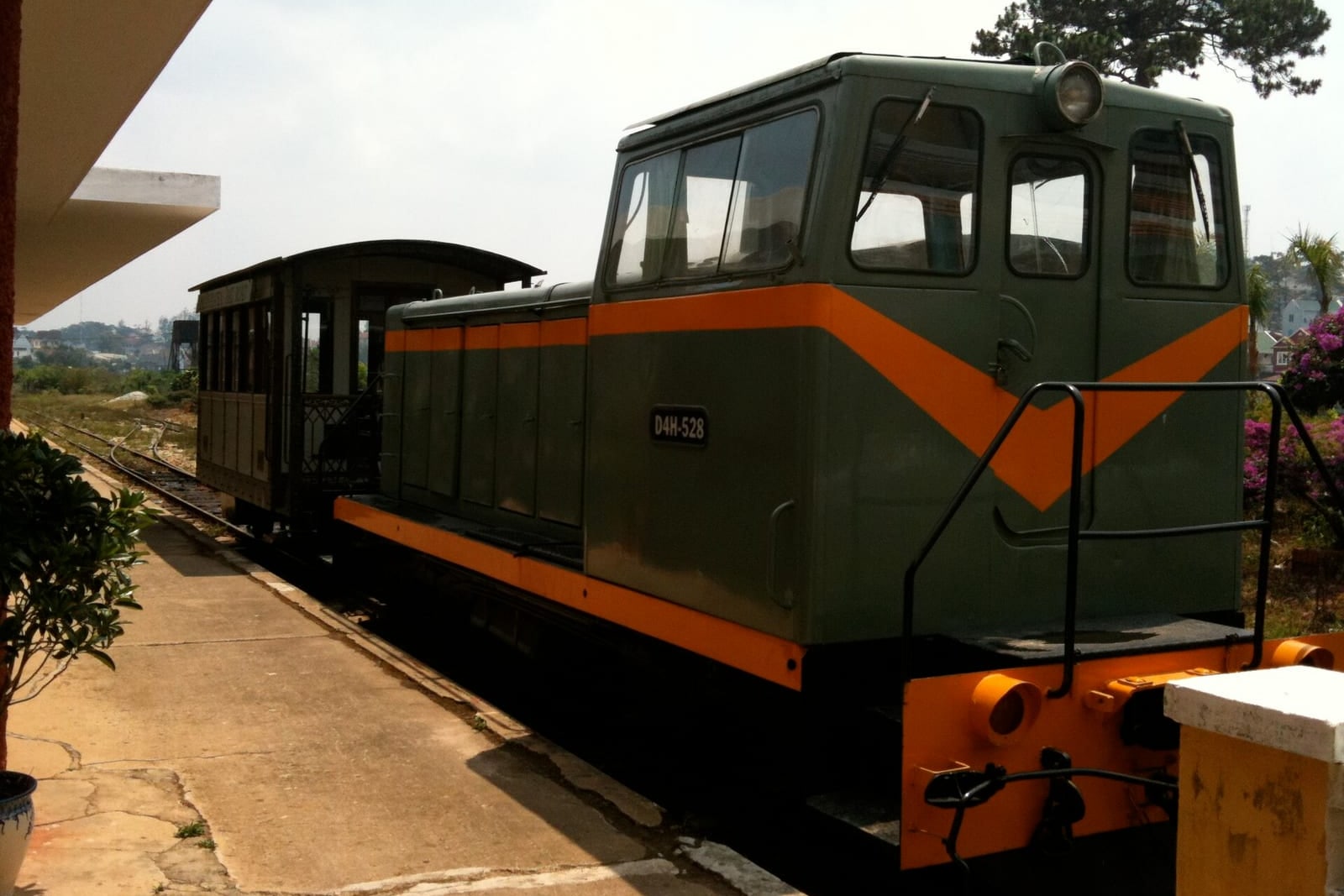
What survives is seven kilometres on the top. Restored in the 1990s, a vintage train still trundles from Da Lat out through the market gardens to the village of Trại Mát, and back. It is flat, gentle and unhurried, and it climbs nothing at all — the rack sections were on the mountain that no longer has a railway.
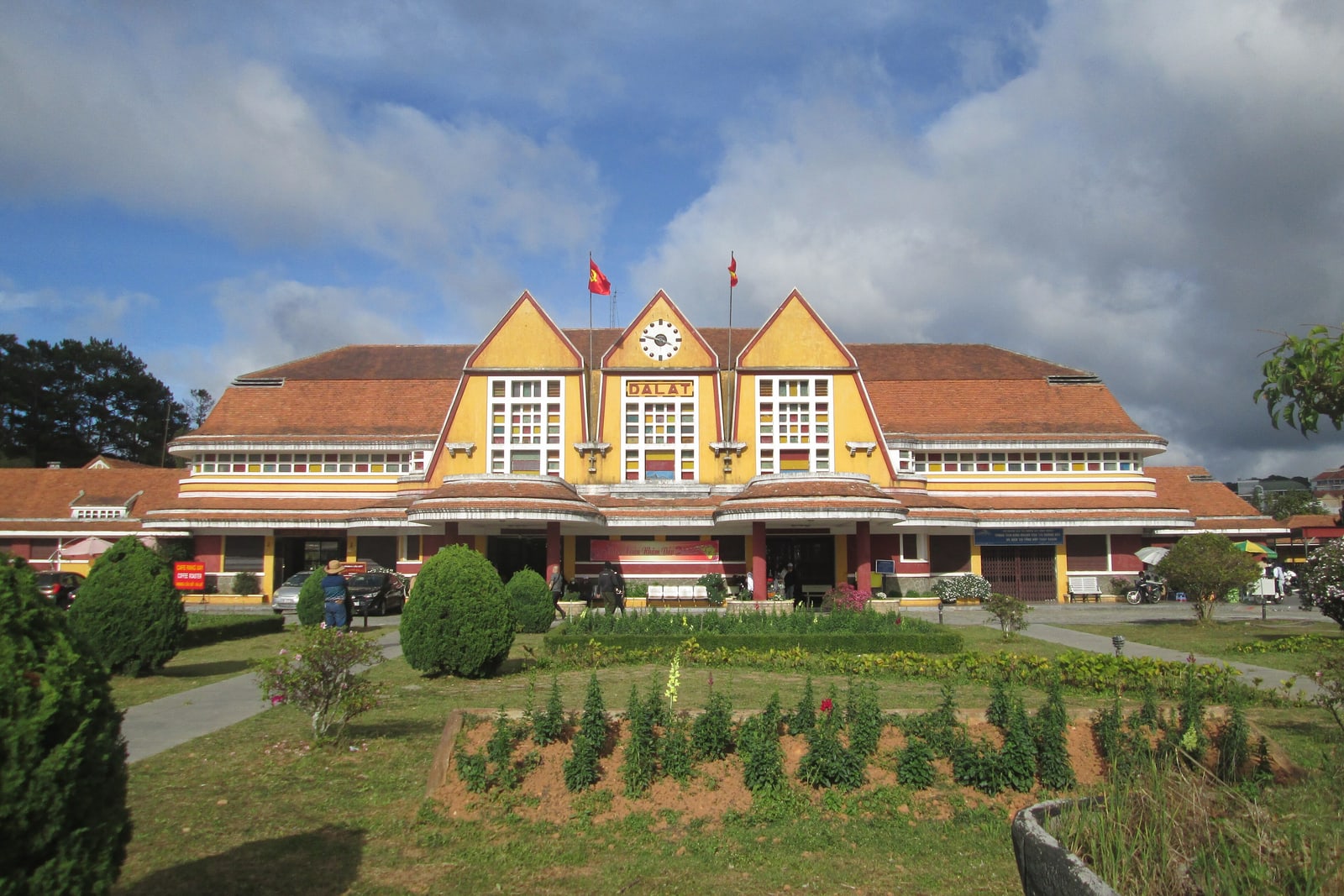
But it starts from Da Lat station, finished in 1938 and a national monument since 2001: Art Deco, three steep roofs borrowed from the highland communal houses, arguably the most beautiful railway building in Vietnam. On its own, that is worth the trip.
The Journey
Start at the building. Da Lat station was completed in 1938 to a design by two French architects, Moncet and Reveron, and it is a genuine oddity: unmistakably Art Deco — the geometry, the colour, the great arched windows — but topped with three steep pitched roofs lifted from the communal houses of the Central Highlands. Somebody was trying, rather thoughtfully, to build a French station that belonged where it stood. It has been a national historical monument since 2001, and most visitors spend longer photographing it than they do riding the train.
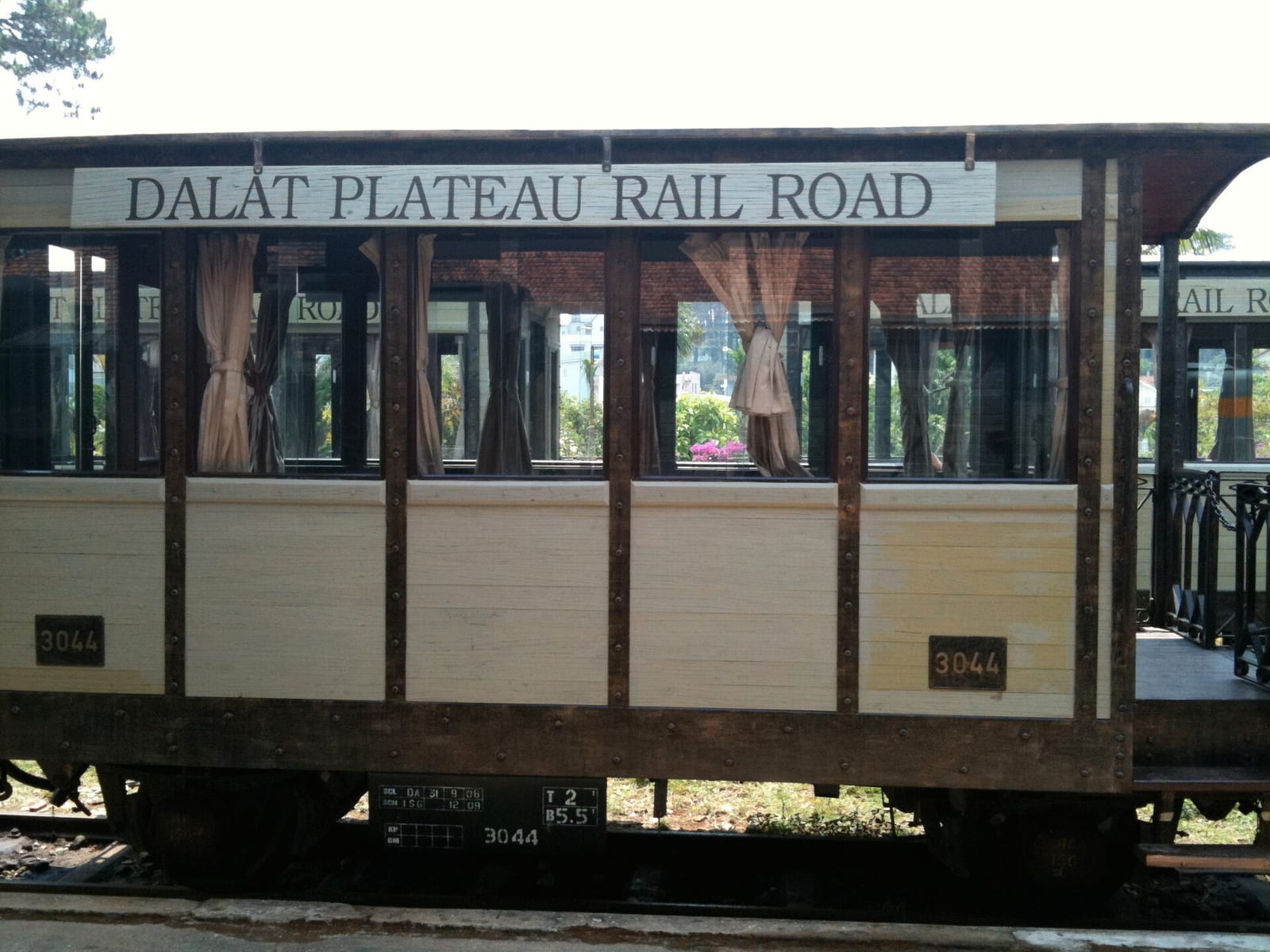
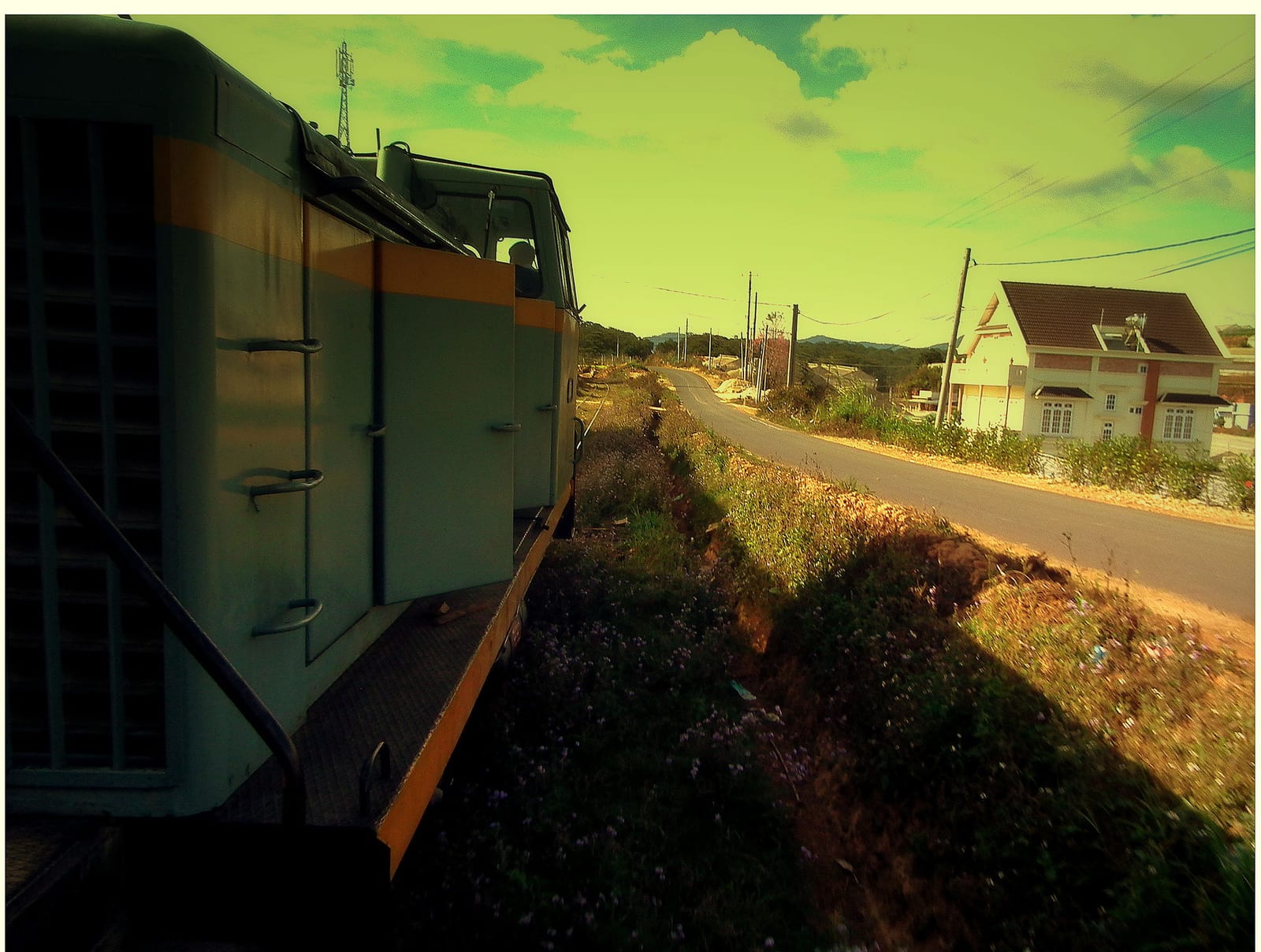
The train, when it goes, is a short vintage rake lettered Dalat Plateau Rail Road — wooden benches, open windows, a small diesel on the front. It leaves when there are enough people to justify it, which is a sentence that tells you everything about the operation.
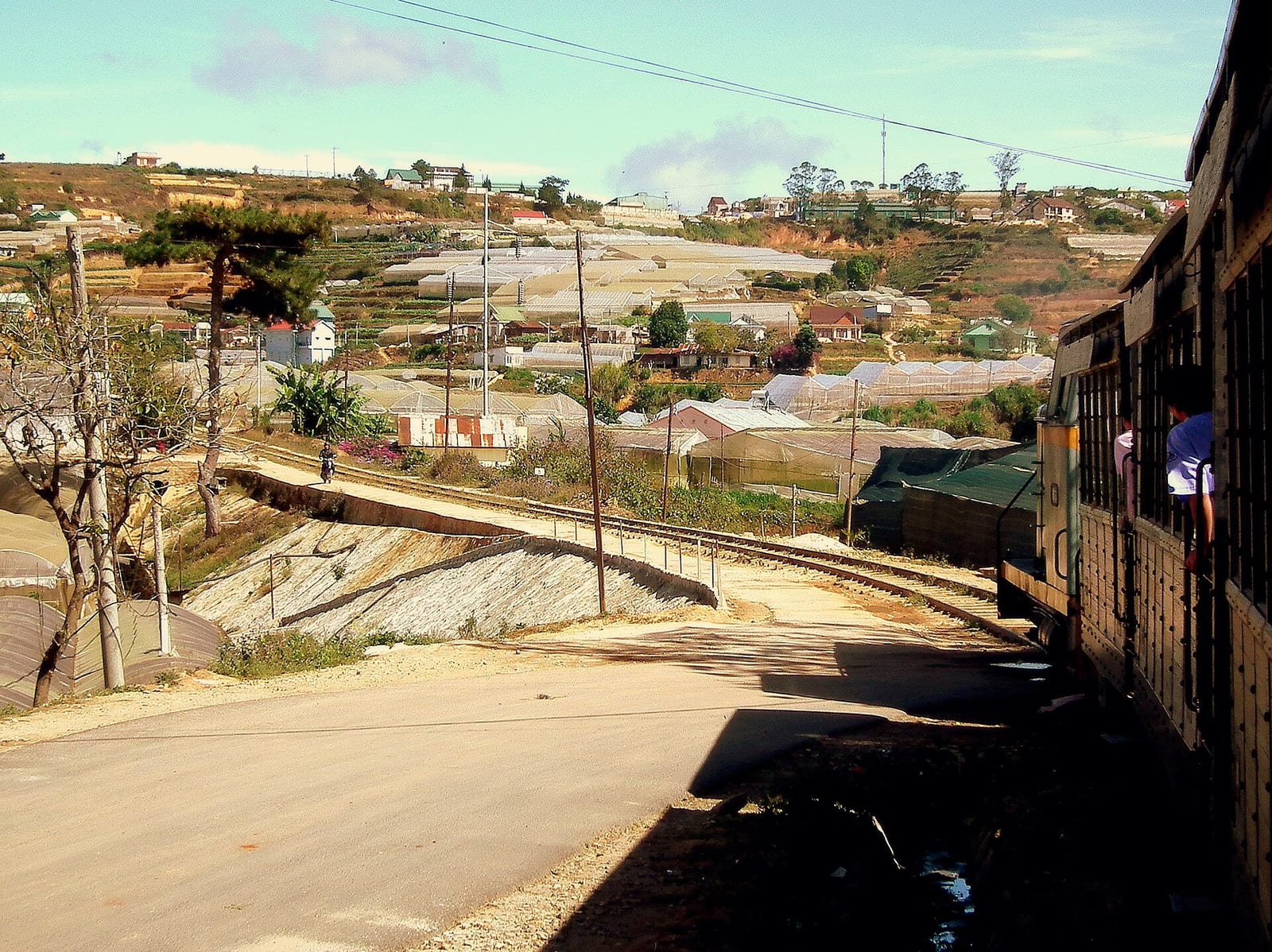
The run out is seven kilometres and gentle. Da Lat's outskirts give way almost at once to the plateau's market gardens: rank after rank of greenhouses, vegetable fields, flower farms and strawberry rows. This is the vegetable basket of Vietnam — the cool highland air grows the produce the rest of the country can't — and the line simply potters through the middle of it, close enough to see what's being picked.
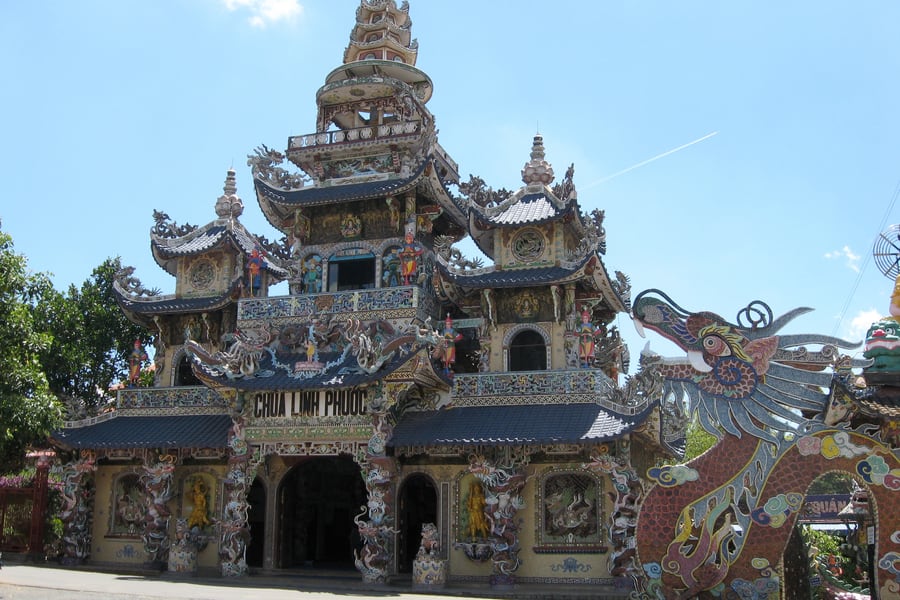
Twenty-odd minutes later the train stops at Trại Mát, and you walk five minutes to the reason there's a destination at all: Linh Phước Pagoda. It is covered, inside and out, floor to spire, in mosaic made from broken glass, smashed crockery and beer bottles — dragons made of bottle-ends, a 49-metre bell tower, a dragon in the courtyard built from twelve thousand bottles. It is completely over the top and thoroughly wonderful.
Then the same train takes you back.
It is worth being honest about what this is. You are not riding the rack railway. The cog sections, the five tunnels and the mile-high descent to the coast were all on the stretch that was lifted after 1975; what's left is the flat stub on top of a mountain the railway no longer climbs. It's a twenty-minute pleasure ride through vegetable fields, not an engineering pilgrimage.
But it is the last living piece of a genuinely extraordinary line, it leaves from one of the loveliest stations in Asia, and it costs almost nothing. Go for the building, stay for the pagoda, and think about the mountain while you're up there.
Along the route
Huynhdat1909 / Wikimedia Commons · CC BY-SA 4.0A station worth the trip alone
Da Lat station was finished in 1938 to a design by the French architects Moncet and Reveron: Art Deco, but with three steep roofs echoing the communal houses of the Central Highlands. It has been a national historical monument since 2001, and it is one of the loveliest railway buildings in Asia.Dragfyre / Wikimedia Commons · CC BY-SA 3.0The ghost of a rack railway
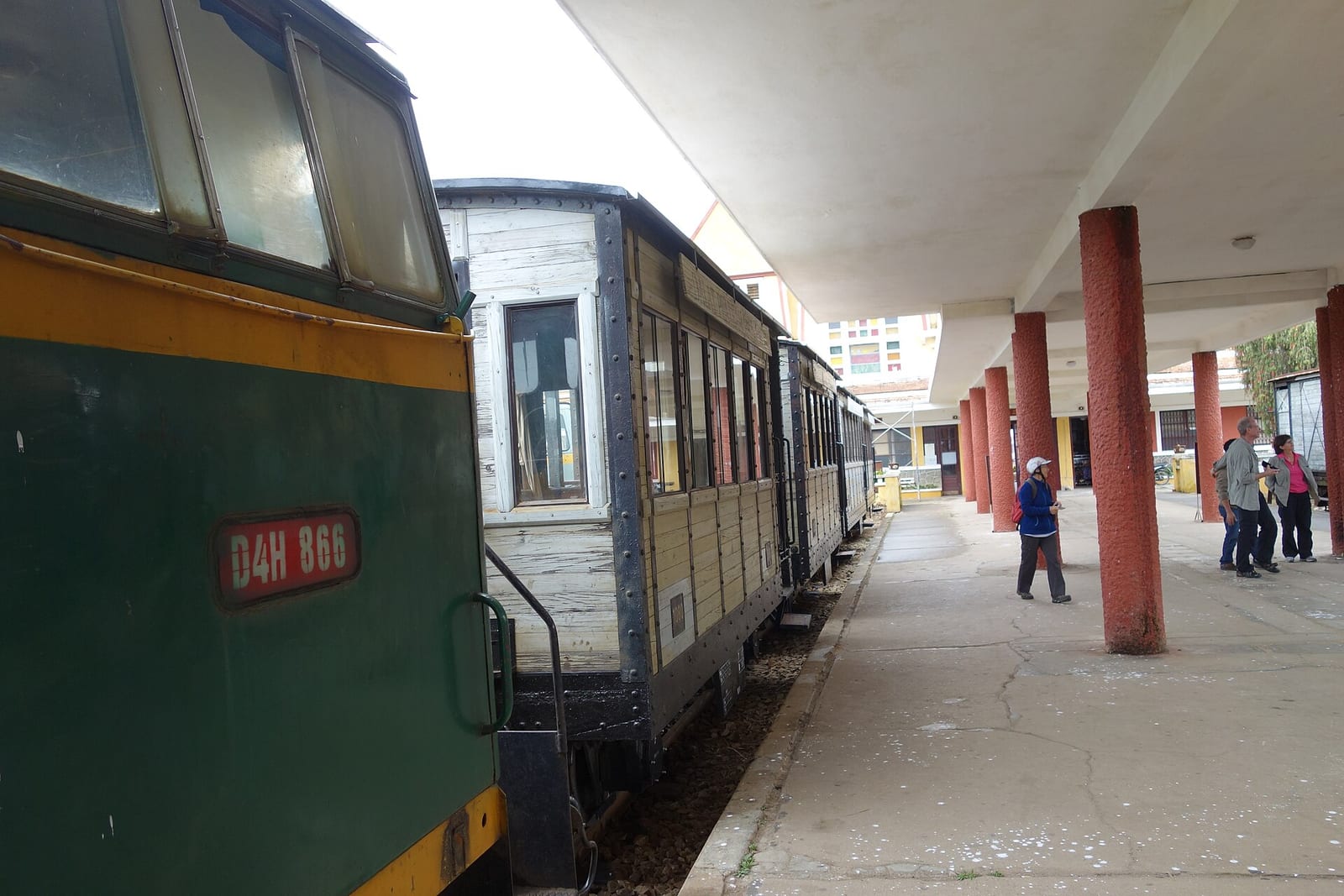
The original line ran 84 km down to Tháp Chàm on the coast, and 34 km of it was rack-and-pinion — cog rail, on gradients up to 120‰, to get down off the plateau. It was a genuine engineering marvel. Regular services ended in 1968 and the mountain was lifted after 1975.calflier001 / Wikimedia Commons · CC BY-SA 2.0Seven kilometres of survivor
What's left is the flat stub on top: 7 km from Da Lat out to the village of Trại Mát, restored in the 1990s and still running. It is short, slow and gentle — and it is the only piece of the whole extraordinary railway you can still ride.A bit of history
Culture & experiences along the way
Dragfyre / Wikimedia Commons · CC BY-SA 3.0The vintage carriages
Wooden-benched heritage stock lettered "Dalat Plateau Rail Road", trundling out through the market gardens at a pace that lets you photograph everything twice. It is unashamedly a tourist ride, and none the worse for it.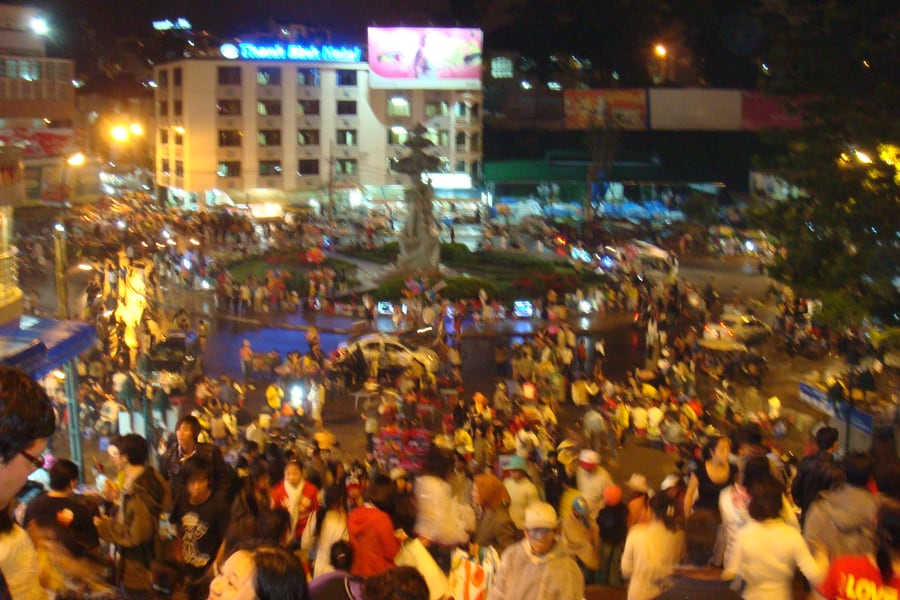 The Erica Chang / Wikimedia Commons · CC BY 3.0 · cropped
The night market, and what to order in it
Da Lat calls its night market Chợ Âm Phủ, the ghost market, after the years it traded past midnight by oil lamp. The thing to eat is bánh tráng nướng — rice paper grilled over charcoal with egg, spring onion and dried shrimp — with a glass of hot soy milk, because the evenings up here are cold.Schwede66 / Wikimedia Commons · CC BY-SA 3.0Da Lat itself
The French came up here to escape the heat, and it shows: pine forest, a lake, villas, strawberries and coffee, at 1,500 m. It is Vietnam with the temperature turned down, and the railway is a piece of that same colonial daydream.Timetables
This is a tourist shuttle, not a transport service, and it behaves like one — several short departures a day, some of which run only if enough passengers turn up.
Real departures (2026 — confirm on the day):
| Service | Depart Da Lat |
|---|---|
| Da Lat Coffee Train | 07:05 |
| Regular services | roughly every 2 hours from ~07:45 |
| Guaranteed daily | 09:55 (return from Trại Mát ~11:25) |
| Da Lat Night Journey | 18:15 and 20:20 |
The operator schedules up to about seven pairs a day, but a departure needs a minimum number booked or it is cancelled and rolled into the next — so the 09:55 is the reliable one. The trip is 7 km, about 30 minutes each way, plus time at Trại Mát.
Good to know:
- You cannot get to Da Lat by train. The line to the coast is gone — come by road from Ho Chi Minh City (~6–8 h) or Nha Trang (~4–5 h), or fly into Liên Khương.
- Go in the morning if you want to be sure a train runs — the early and midday services are the best-attended.
- Allow time at Trại Mát — the Linh Phước pagoda is the point of the destination; the round trip typically leaves you around half an hour there.
- The station is open regardless — even if no train runs, you can see the Art Deco building and the old steam locomotive outside.
- November to April is the dry season; Da Lat is cool year-round, so bring a layer.
Times as of the 2026 timetable. Confirm current schedules with the operator — see the Tickets section below.
Tickets
Tickets are bought at Da Lat station on the day, for a few tens of thousands of đồng. There is nothing to book and nothing to plan. The choice is between the ordinary carriages and a slightly smarter "VIP" one; the difference is upholstery and the view is identical. There is also a small entry charge for the station itself, which is fair enough for a national monument most visitors come only to look at.
⚠️ The catch is the minimum-passenger rule: a departure with too few takers simply does not run, so mornings and weekends are safer than a quiet weekday afternoon. And do not come expecting the rack railway — if you have read about the Crémaillère and its 120‰ gradients, none of that is here any more. Come for the station, the carriages and the pagoda.
Book your tickets
Da Lat ⇄ Trại Mát
The heritage run · 7 km
The surviving section, in vintage carriages, out to Trại Mát and back with time to visit the Linh Phước Pagoda. Sold at Da Lat station; departures run to demand rather than a rigid clock, and trains need a minimum number of passengers.
Book Tickets (opens in a new tab, on Vietnam Railways)via Vietnam RailwaysGetting to Da Lat
There is no train
Worth being clear: the line to Da Lat was dismantled, so you cannot reach the city by rail. Come by road from Ho Chi Minh City or Nha Trang, or fly to Liên Khương — then ride the seven kilometres that are left.
Book Tickets (opens in a new tab, on Vietnam Railways)via Vietnam RailwaysRail Passes
No rail pass is needed or worth buying. Interrail and Eurail are European schemes, and Vietnam is not among the 33 countries in Interrail's list of covered railway companies. The Da Lat train is bought at Da Lat station on the day, for a few tens of thousands of đồng.
Checked October 2026 against Interrail's list of railway companies (opens in a new tab).
Places to Visit
The railway is a morning. Da Lat is worth several days, and it is unlike anywhere else in Vietnam.
Start with the station itself — the 1938 Art Deco monument, with an old steam locomotive standing outside and the vintage carriages under the canopy. Go even if the train isn't running. Then there is the Crémaillère's ghost: the old rack line's course still exists in places below the city, and the escarpment it descended, and the tunnels, are down there in the hillside. There has long been talk of rebuilding the railway to Tháp Chàm. Nothing has come of it yet.
The French left several hundred villas up here, and the plateau around them grows strawberries, artichokes, flowers and some of Vietnam's best coffee — plenty of the farms take visitors, and the greenhouses run to the horizon on every road out of town.
Everything else is below.
 Diane Selwyn / Wikimedia Commons · public domain · cropped
Linh Phước Pagoda
The reason the train runs at all. At Trại Mát, 8 km out along Highway 20, stands a temple sheathed inside and out in mosaic made from broken glass, crockery and bottles. The dragon coiled through its grounds is 49 metres long, built from some 12,000 bottles, with a head 7 metres high. Construction began in 1949 and finished in 1952; almost everything spectacular about it was added from 1990 onwards.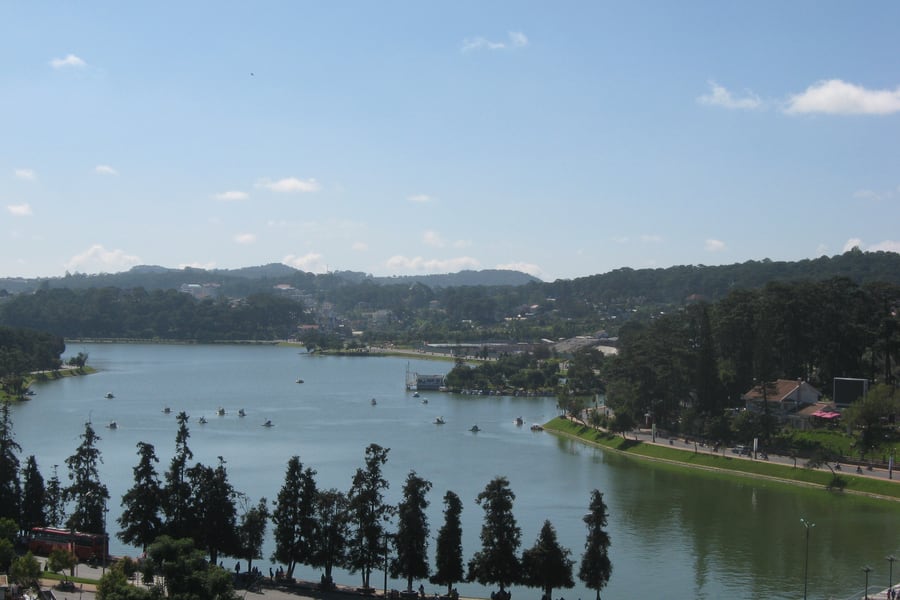 Diane Selwyn / Wikimedia Commons · CC BY-SA 3.0 · cropped
Xuân Hương Lake
The crescent of water at the centre of Da Lat, with the town wrapped around it and pine slopes behind. A path runs the whole way round — an hour at a stroll — past cafés, flower beds and a fleet of pedalos shaped like swans, because of course there are. It is the quickest way to understand why the French built a hill station up here at 1,500 metres and why Vietnamese honeymooners have been coming ever since.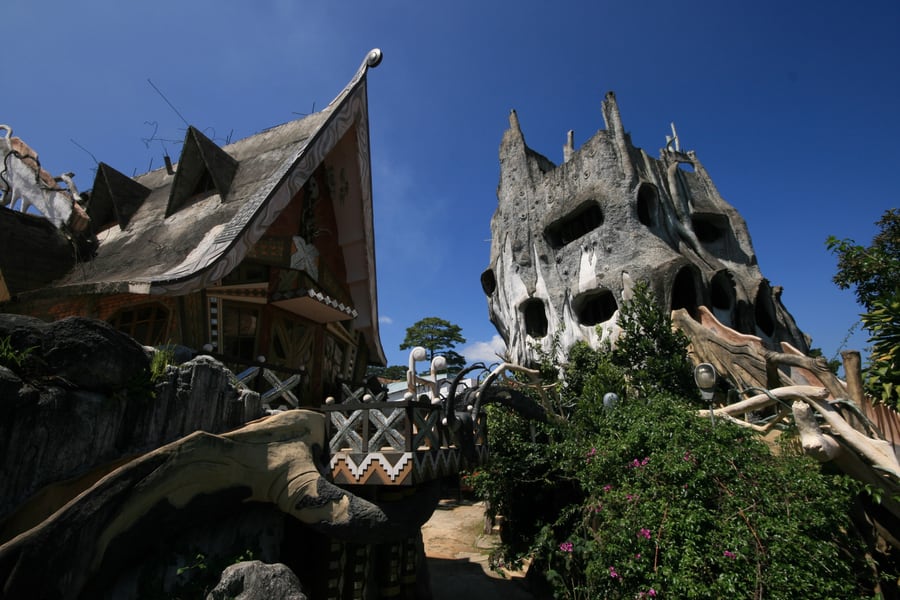 ruben i / Wikimedia Commons · CC BY 1.0 · cropped
The Crazy House
The Hằng Nga guesthouse is one genuinely unhinged building in a town of tidy villas — a concrete structure shaped like a vast hollow tree, threaded with tunnels, cobwebs, mushrooms and animals, designed and built by the Vietnamese architect Đặng Việt Nga. She has openly acknowledged Gaudí. You can walk through it for a small fee, or, if you are brave, book one of the themed rooms and sleep inside the tree.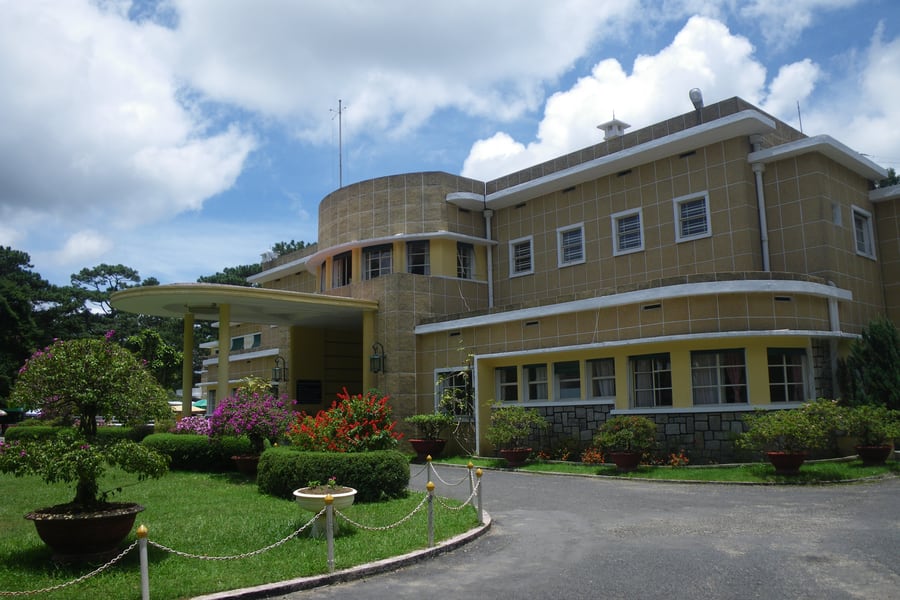 hiyori13 / Wikimedia Commons · CC BY-SA 2.0 · cropped
Bảo Đại's Summer Palace
Da Lat's other architectural surprise, and the opposite of the Crazy House: a low, calm moderne villa of the 1930s, built for Bảo Đại, the last emperor of Vietnam, as his summer residence and working office on the plateau. The rooms are kept much as he left them, down to the desks and the family photographs, which makes it one of the more affecting small museums in the country. Locally it is simply "Dinh III".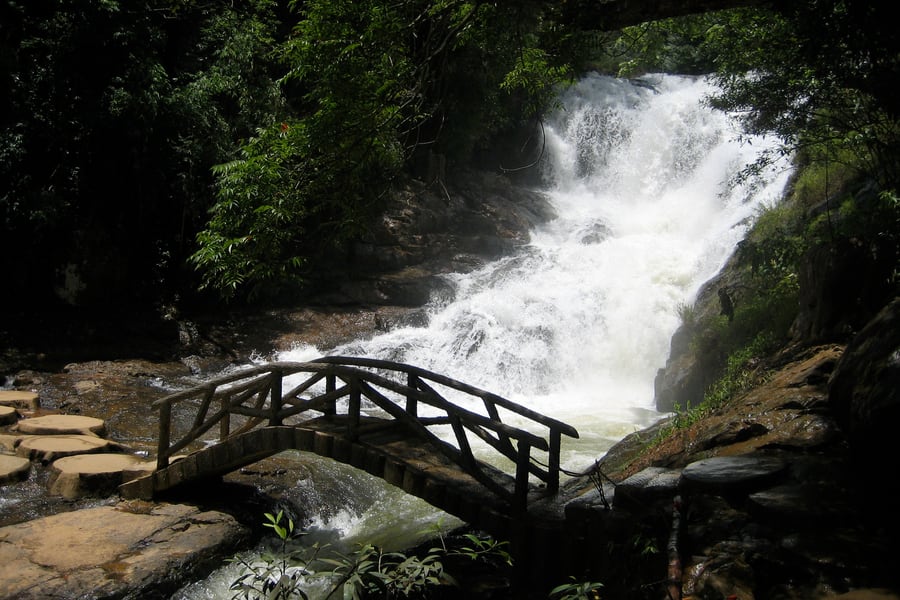 thalling55 / Wikimedia Commons · CC BY 2.0 · cropped
Datanla Falls
The closest of the waterfalls ringing the city, in pine forest just outside town, and reached — this being Da Lat — by an alpine coaster that drops you down through the trees to the foot of the falls. Bridges and walkways cross the stream below. Elephant Falls, heavier and wilder, lies further out towards Nam Ban and is the better one if you have a driver and half a day rather than an hour.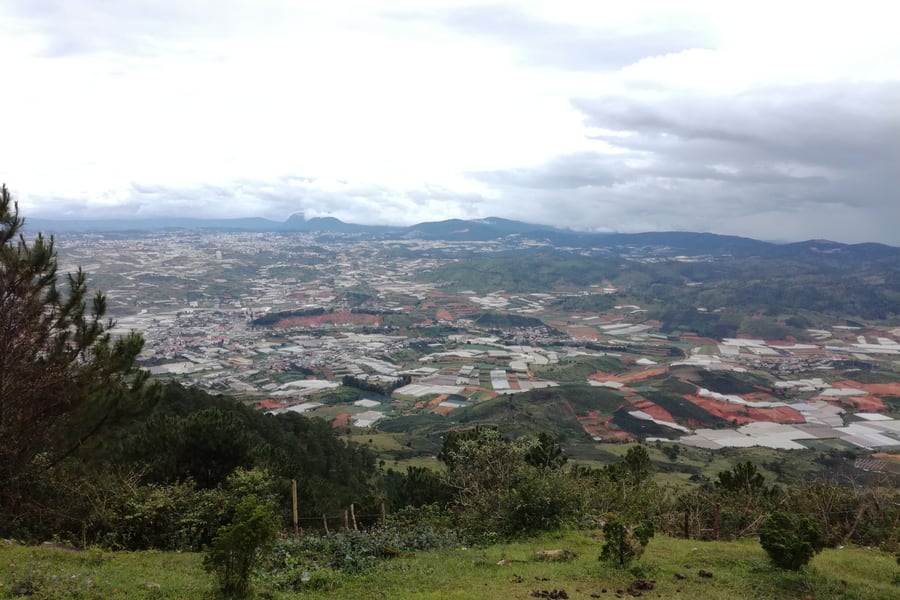 Damian Vo / Wikimedia Commons · CC BY-SA 2.0 · cropped
Lang Biang
The peak that gives the plateau its name, standing over Da Lat to the north. Jeeps run to a lower viewpoint and a footpath climbs beyond it, and on a clear morning the whole plateau opens out below — pine ridges, coffee slopes, and the sheeted plastic of the market gardens running to the horizon. Go early: by midday the cloud that keeps Da Lat cool has usually closed the view down completely.Where to Sleep
Nobody sleeps on this train — it's a twenty-minute ride. But Da Lat is a place people extend their trip for, and it has the most characterful rooms in Vietnam.
- The French villas — the colonists built several hundred up here, and a number are now hotels. Staying in one, with a fire lit and pine trees outside the window, is the whole Da Lat proposition in a single night. The grand old Dalat Palace, above the lake, is the landmark.
- Around Xuân Hương Lake — the central district, walkable to the market, the night market and the station. Most people stay here, and it's the sensible choice.
- Out in the pines — quieter guesthouses and lodges in the hills around the city, good if you're here for Lang Biang or the coffee farms.
- The Crazy House — you can actually sleep in the Hằng Nga guesthouse, inside a concrete tree. It's a novelty rather than a comfortable night, and it's busy with day visitors until closing, but people do it anyway.
Timing: November to April is the dry season. Da Lat sits at 1,500 m and is cool all year — genuinely chilly after dark, which is why the French came and why Vietnamese honeymooners still do. Pack a jumper.
One note: Da Lat is a major domestic holiday town, so Vietnamese public holidays and weekends fill it up and push prices hard. A midweek stay is cheaper, quieter, and much more likely to get your train running.
Questions or corrections
Planning this trip and stuck on something, or spotted a time, fare or detail that has changed? Send us a message about Da Lat Railway. We read every one, and we update this page when something has changed.