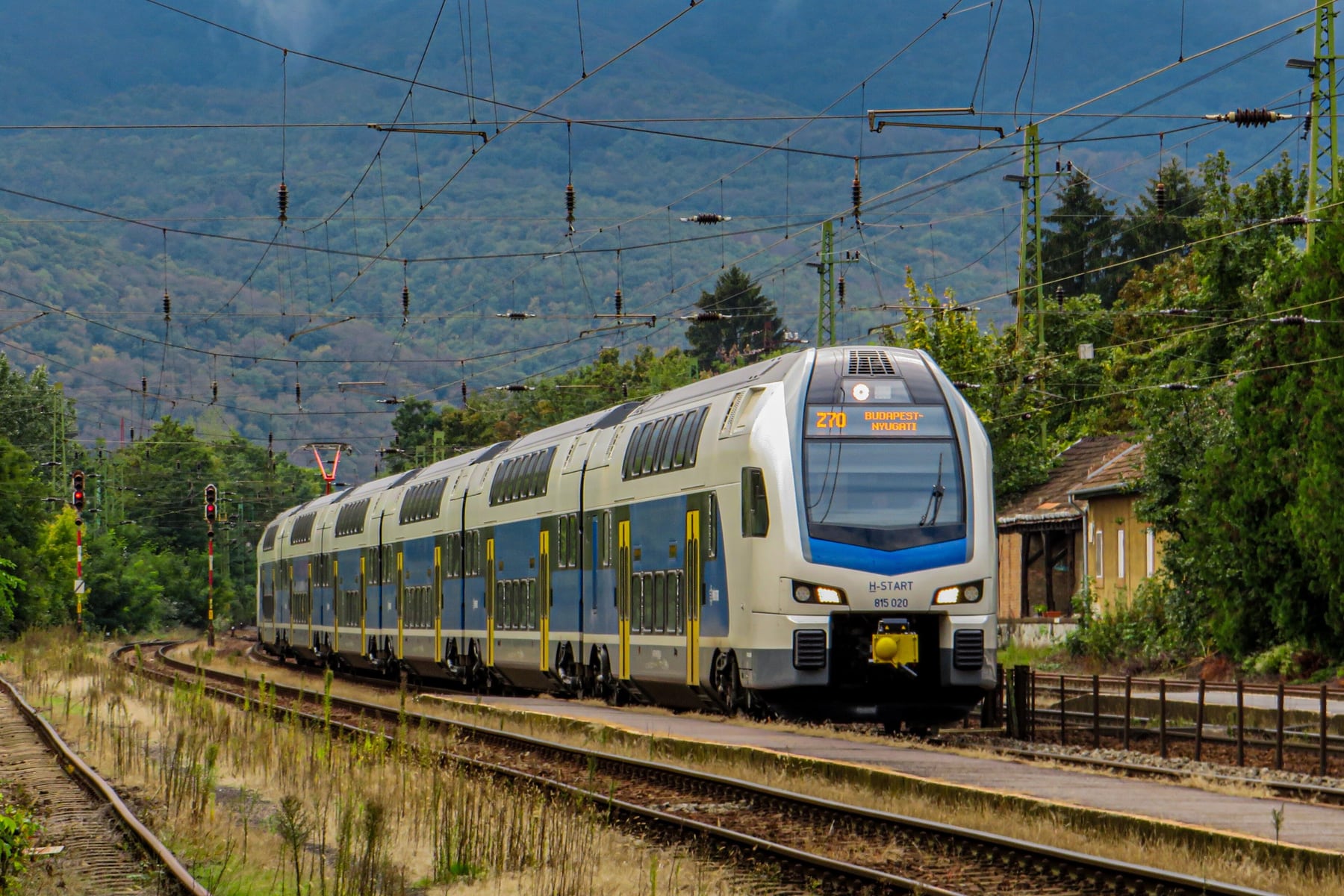
The Danube Bend Railway
Hungaria895 / Wikimedia Commons · CC BY-SA 4.0 · cropped
- Distance63 km · standard gauge, electrified
- Duration52–56 minutes on the fastest trains
- Best seasonAll year; the woods turn in late October
Introduction
This was built as the first stretch of the railway from Pest to Vienna. Since 1920 it has stopped at a border, 63 kilometres out of Budapest.
Hungary's first steam railway opened between Pest and Vác on 15 July 1846. The Palatine Joseph and his family rode the special train, which covered the 33.6 kilometres in 59 minutes, ten of them spent at Dunakeszi, and the poet Sándor Petőfi rode the line and wrote a poem about it, Vasúton — On the Railway. It was always meant to go further, and it did: along the north bank of the Danube, so that it never had to bridge the river, to Párkánynána in 1850 and Pozsony, today's Bratislava, in 1851. For seventy years this was the main line from Pest towards Vienna.
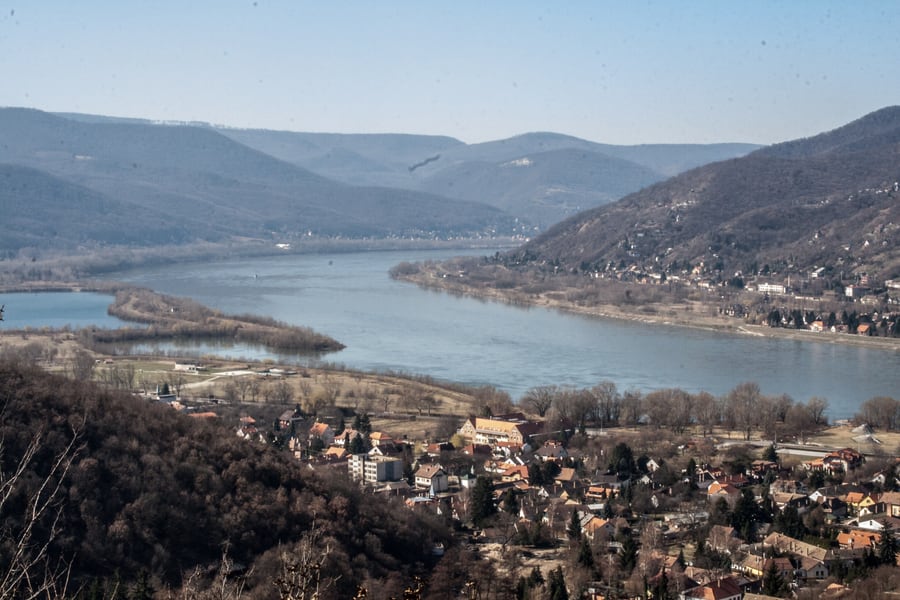
The Treaty of Trianon in 1920 gave most of it to Czechoslovakia. Hungary kept Budapest to Szob, where the Ipoly meets the Danube, and Szob became a frontier station. The traffic for Vienna moved to the line through Győr and Hegyeshalom, and the old main line became something else: Hungary's busiest suburban railway, carrying about 34,500 people a day in 2019, with double-deck trains every hour through the Danube Bend, the gorge where the river turns south between the Börzsöny and the Visegrád hills. The international trains to Bratislava and Prague still run over it, and stop on the way.
The Journey
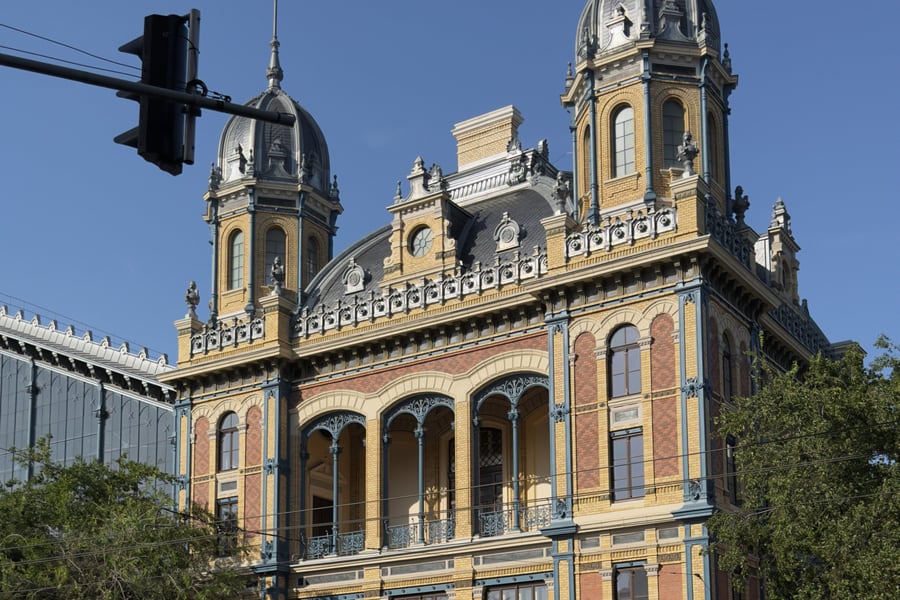
The trains leave from Budapest-Nyugati on the Grand Boulevard. Its iron train hall was designed by August de Serres for the Eiffel company of Paris and opened on 28 October 1877, on the site of the line's first terminus of 1846. Sit on the left: the river is on that side all the way.
Through the suburbs to Vác
For the first half hour the line runs north through Újpest, Dunakeszi and Göd, past housing estates, factories and gardens. This is the stretch where Kálmán Kandó tested his electric locomotives: from 1923 to 1928 a trial overhead wire at 15 kV, 50 Hz, ran from Nyugati to Dunakeszi-Alag. The Z70 trains run non-stop to Vác in 24 minutes; the G70 and S70 call at the suburban stations.
The Danube Bend
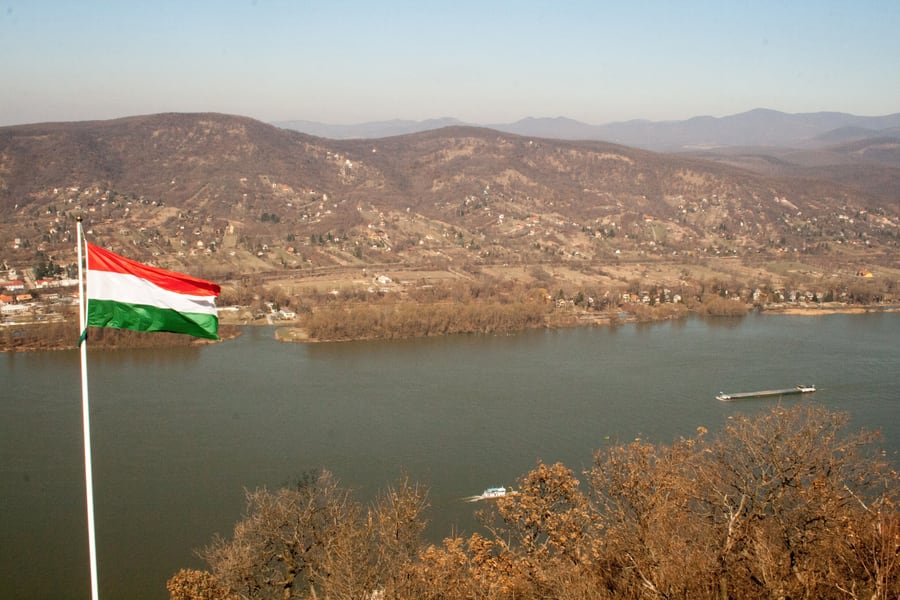
Beyond Vác the river comes alongside. The line runs on a shelf between the water and the Börzsöny hills, through Verőce and Kismaros, to Nagymaros-Visegrád, where the castle of Visegrád stands on its hill across the river and a ferry crosses to it. Past Nagymaros the bend tightens and the track runs along the steep foot of the Szent Mihály-hegy. Mud and rock came down onto the line here in June 2020, and again in June 2022, when it closed for two months; trains now pass slowly, and the halt at the old Dömös ferry crossing has not been served since June 2021.
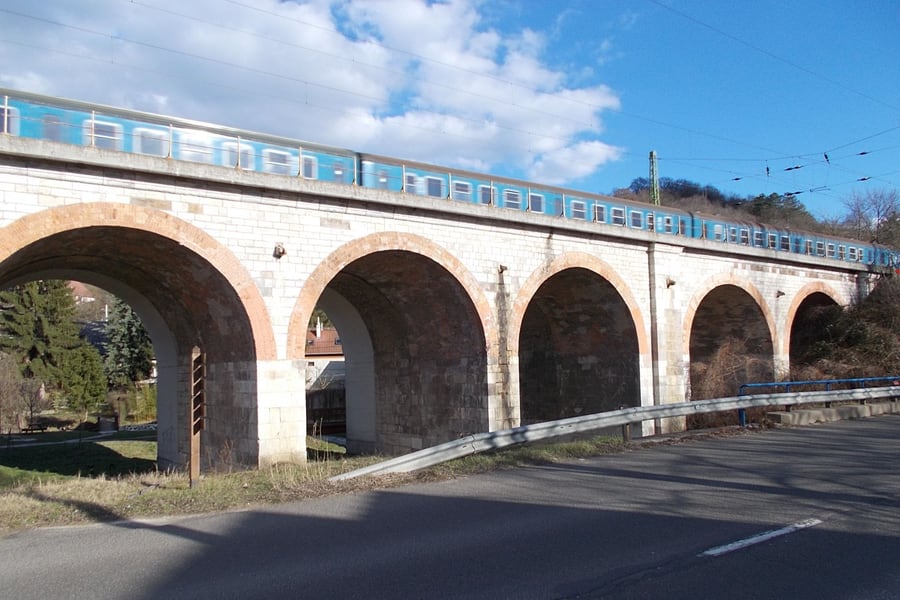
At Zebegény the train crosses the seven-arch viaduct of 1850. Szob, a few minutes on, is the end of the domestic line: a border station beside the mouth of the Ipoly, with Slovakia on the other bank. The international trains run on to Štúrovo and Bratislava.
The locomotives and coaches
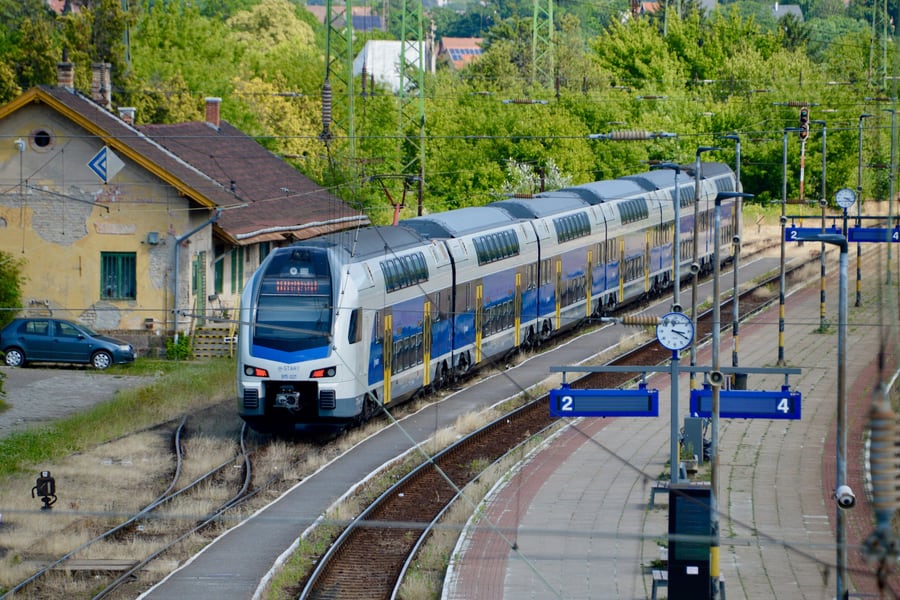
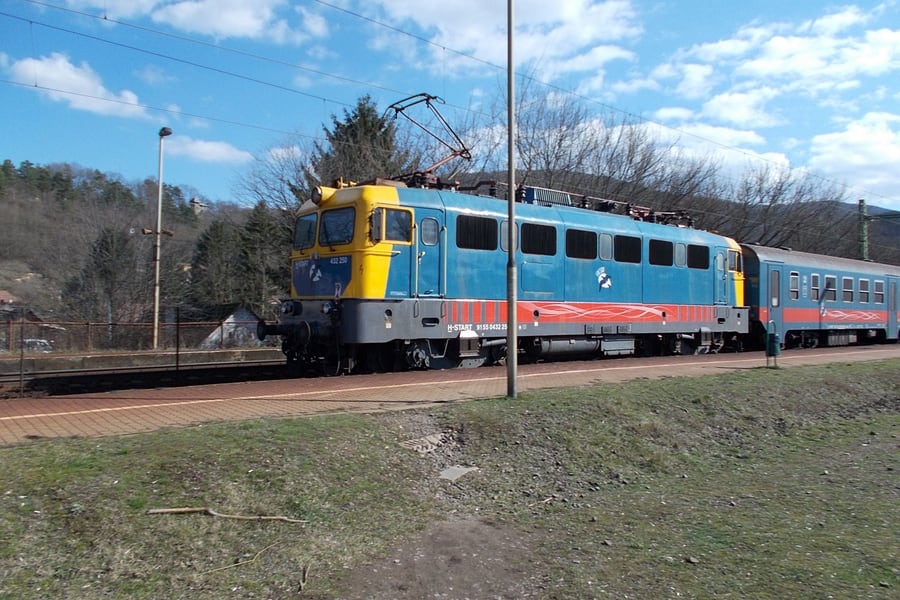
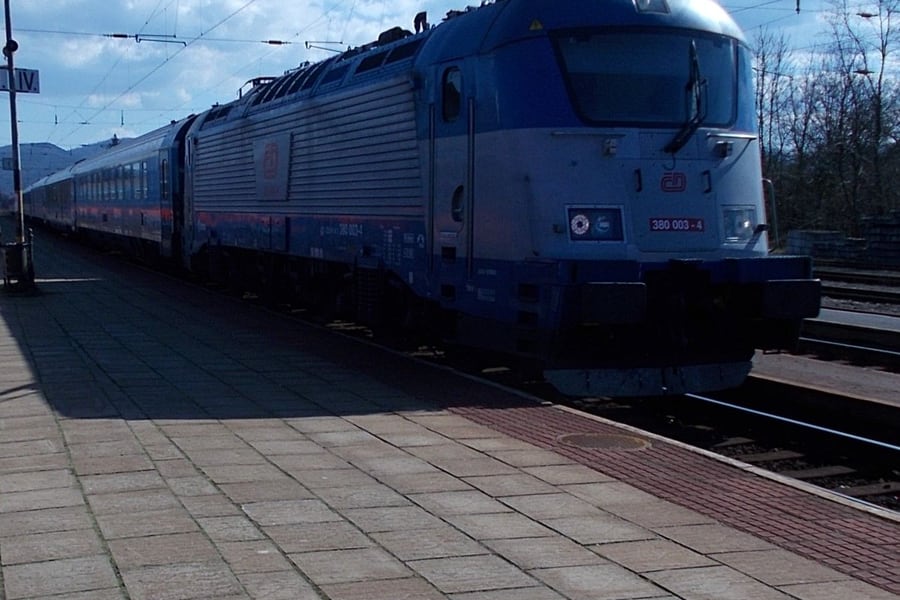
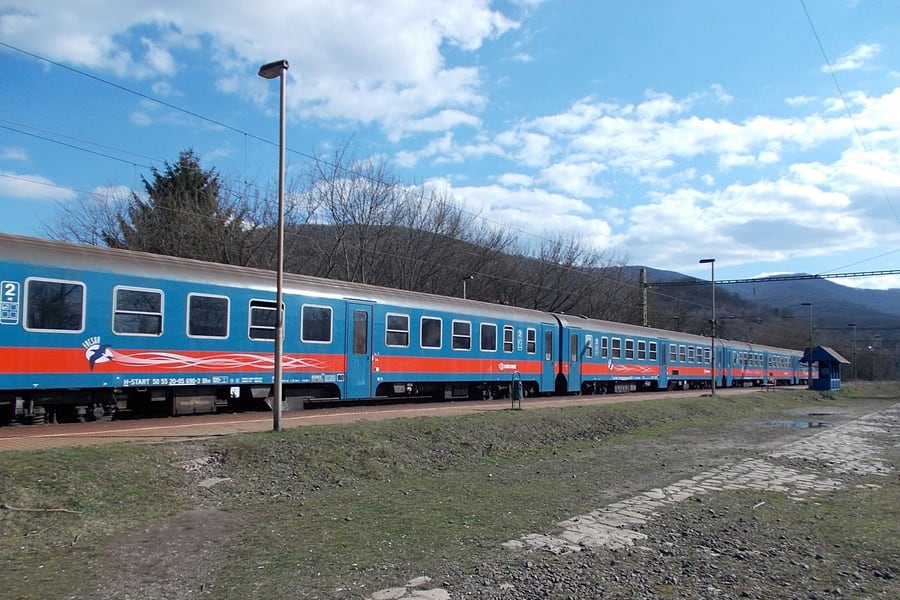
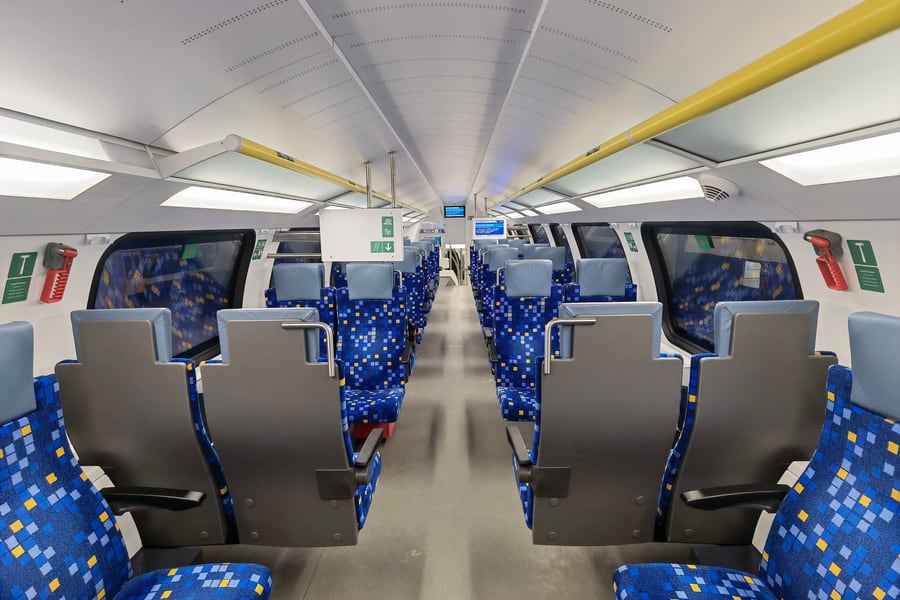
Most domestic trains are Stadler KISS double-deckers, MÁV class 815: forty six-car units, delivered from 2019 and in service from 2020. Some are FLIRT single-deckers, class 415, and some are push-pull sets hauled by a V43, the most numerous electric locomotive MÁV ever had — 379 built between 1963 and 1982, still about 200 at work in 2024, and called the Szili for its silicon rectifiers. The EuroCity and railjet trains to Prague are mostly hauled by Slovak class 350 or Czech class 380 locomotives, and since December 2025 have run with ČD's ComfortJet coaches.
Along the route
 Mike is Michi / Wikimedia Commons · CC BY-SA 4.0 · cropped
Nyugati, built around its predecessor
The first Pest station of 1846 stood where Nyugati is now. When the new iron hall went up in 1874–77, designed by August de Serres for the Eiffel company, it was built around the old shed, which was then taken down.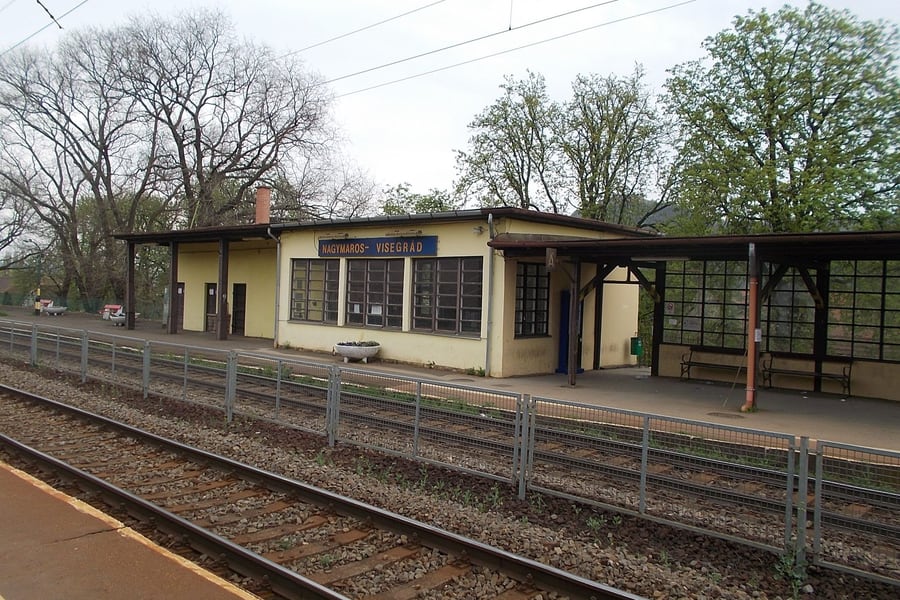 Globetrotter19 / Wikimedia Commons · CC BY-SA 3.0 · cropped
Nagymaros-Visegrád
The station is named for two towns on opposite banks. Visegrád's citadel stands on the hill across the river, and a ferry runs over to it from Nagymaros about every hour from early morning until 8 pm.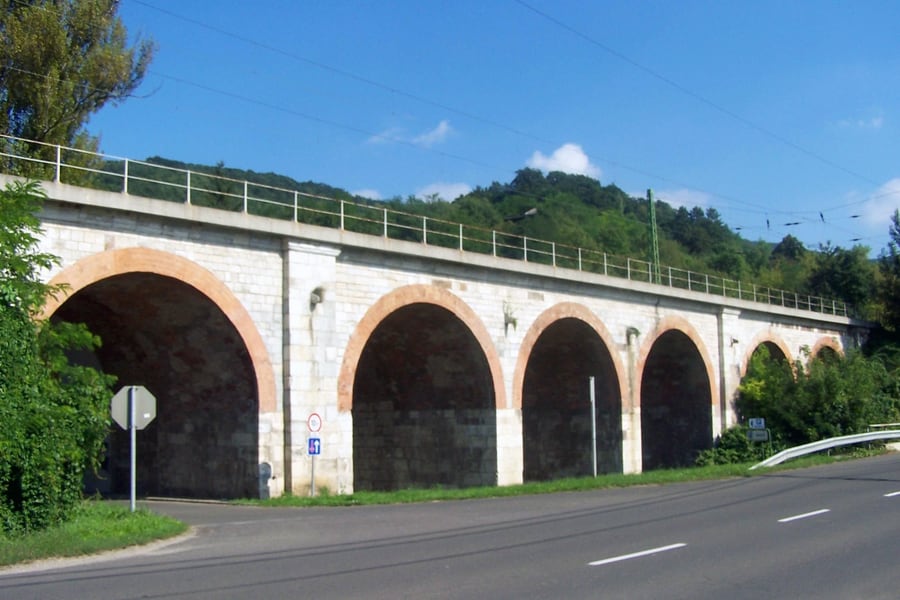 B Kekesi / Wikimedia Commons · CC0 · cropped
The seven-arch viaduct
At Zebegény the line crosses a side valley on the Hétlyukú híd, a viaduct of seven arches, rubble stone with brick vaults, built in 1850 and widened in 1890 for a second track. Every train on the line still crosses it.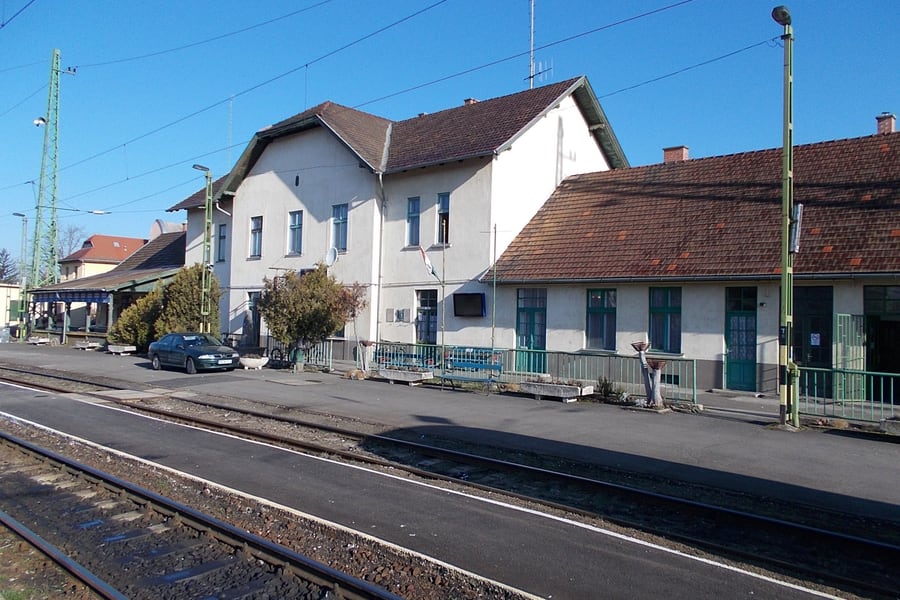 Globetrotter19 / Wikimedia Commons · CC BY-SA 3.0 · cropped
Szob, a frontier since 1920
Szob stands where the Ipoly meets the Danube, beside the Slovak border. Until 1920 it was a wayside station on the line to Pozsony; since Trianon it has been the end of Hungary's half of the line and a border crossing.A bit of history
Culture & experiences along the way
 Pasztilla aka Attila Terbócs / Wikimedia Commons · CC BY-SA 4.0 · cropped
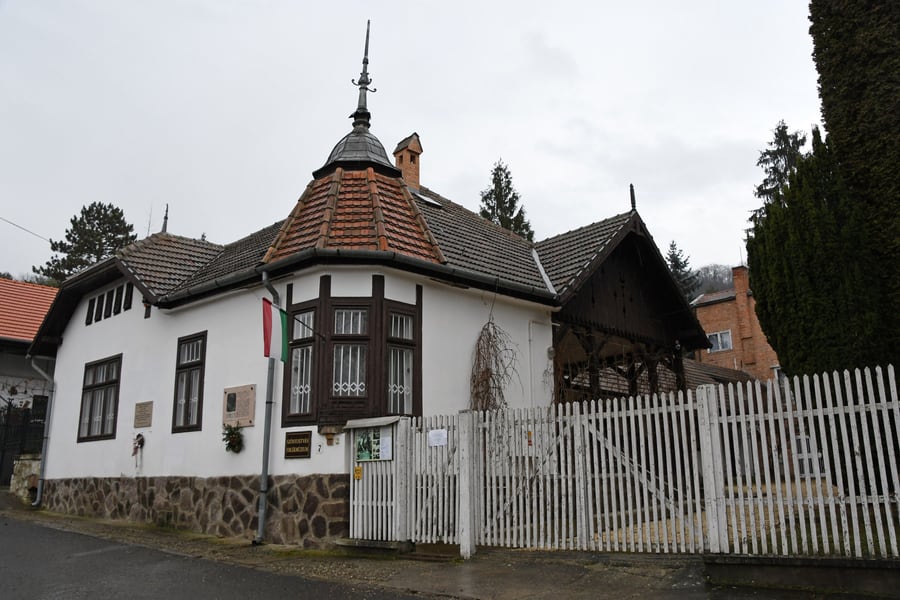
Szőnyi's Zebegény
In 1924 the painter István Szőnyi (1894–1960) married the daughter of a family with a summer house in Zebegény and moved to the village. He painted its people and the Danube Bend for the rest of his life, and spent his last years here. His flat and studio have been a memorial museum since 1967.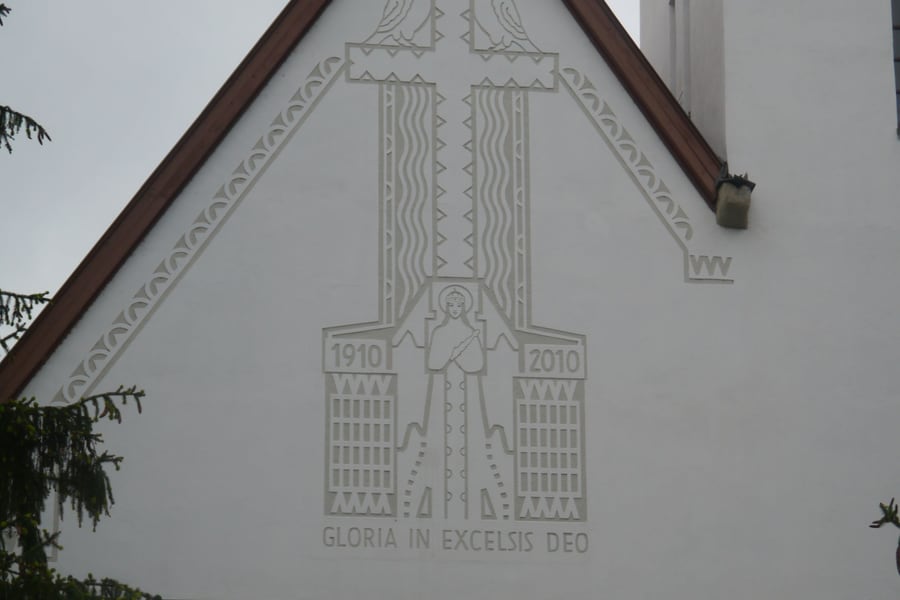 Zairon / Wikimedia Commons · CC BY-SA 3.0 · cropped
Kós Károly's church
Zebegény's parish church of 1910 was designed by Károly Kós and Béla Jánszky after the wooden churches of Transylvania, and its frescoes were painted by Aladár Körösfői-Kriesch's pupils to his designs. The white gable carries the dates 1910 and 2010.Timetables
Trains run every day and there is nothing to book: buy a ticket and board. Three kinds of domestic train share the line, each marked on the front: the Z70 runs non-stop to Vác and then calls everywhere to Szob; the G70 calls at the larger suburban stations; the S70 stops everywhere. Eight times a day a EuroCity or railjet to Bratislava and beyond also stops at Vác, Nagymaros-Visegrád and Szob.
Budapest-Nyugati to Szob — weekdays
| Budapest-Nyugati | Train | Vác | Nagymaros-Visegrád | Szob |
|---|---|---|---|---|
| 04:50 | S70 | 05:29 | 05:47 | 06:04 |
| 05:30 | EuroCity Metropolitan | 05:56 | 06:10 | 06:22 |
| 06:08 … (hourly until 22:08) | Z70 | 06:32 … | 06:47 … | 07:04 … |
| 06:15 | S70 | 06:55 | 07:14 | 07:31 |
| 07:30 | railjet Hungária | 07:56 | 08:10 | 08:22 |
| 08:12 | EuroCity Báthory | 08:37 | 08:56 | 09:08 |
| 09:30 | EuroCity Metropolitan | 09:56 | 10:10 | 10:22 |
| 11:30 | railjet Metropolitan | 11:56 | 12:10 | 12:22 |
| 13:30 | railjet Metropolitan | 13:56 | 14:10 | 14:22 |
| 13:40 … (hourly until 21:40) | G70 | 14:13 … | 14:28 … | 14:45 … |
| 15:30 | railjet Metropolitan | 15:56 | 16:10 | 16:22 |
| 17:30 | railjet Metropolitan | 17:56 | 18:10 | 18:22 |
| 22:50 | S70 | 23:29 | 23:47 | 00:04 |
| 23:50 | S70 | 00:29 | 00:47 | 01:04 |
| 00:50 | S70 | 01:29 | 01:47 | 02:04 |
Szob to Budapest-Nyugati — weekday afternoons
| Szob | Train | Budapest-Nyugati |
|---|---|---|
| 15:38 | railjet Metropolitan | 16:28 |
| 15:56 | Z70 | 16:54 |
| 16:56 | Z70 | 17:54 |
| 17:38 | EuroCity Metropolitan | 18:28 |
| 18:51 | EuroCity Báthory | 19:49 |
| 19:38 | EuroCity Metropolitan | 20:28 |
| 19:56 | Z70 | 20:54 |
| 21:38 | railjet Hungária | 22:28 |
| 21:59 | S70 | 23:14 |
The Z70 takes 56 minutes from end to end, the EuroCity and railjet 52, the S70 1 hour 14. Zebegény is 49 minutes out on a Z70. On Saturdays there are G70s at 08:40, 09:40 and 10:40 as well, and the rest of the pattern is much the same.
As of October 2026, from MÁV's own journey planner, for Wednesday 21 and Saturday 24 October. Times change with the new timetable each December and with engineering work, which on this line can close stretches for weeks; check MÁV's journey planner (opens in a new tab) before you go.
The ferry to Visegrád
From Nagymaros-Visegrád it is a short walk down to the river, where a car ferry crosses to Visegrád. It leaves Nagymaros at 06:30 and then on the hour from 08:00 to 20:00, and Visegrád at 06:20 and at 45 past from 07:45 to 19:45 — see the operator's timetable (opens in a new tab), which it calls a guide only.
Tickets
Buy from MÁV's website, a ticket machine or the ticket office at Nyugati, or from the MÁVPlusz app, which takes 15% off domestic point-to-point tickets; at a station with neither an office nor a machine you can buy on board without a surcharge. Inside Hungary the EuroCity and railjet cost the same as the stopping trains. A ticket for up to 100 kilometres is valid for four hours, long enough to stop off at Vác or Zebegény on the way.
MÁV lists children under 14 and anyone over 65 as travelling free on domestic trains, whatever their nationality. A ticket to Štúrovo or Bratislava is an international ticket and is priced separately. Full second-class fares from MÁV's own planner, October 2026.
Book your tickets
Budapest to Szob
1,300 Ft single, second class
The whole line, valid for four hours, the same fare on the EuroCity and railjet trains as on the stopping ones.
Book Tickets (opens in a new tab, on MÁV)via MÁVBudapest to Nagymaros-Visegrád or Zebegény
1,120 Ft single, second class
For the ferry to Visegrád, or the viaduct and the Szőnyi museum at Zebegény.
Book Tickets (opens in a new tab, on MÁV)via MÁVBudapest to Vác
650 Ft single, second class
For the cathedral and the triumphal arch, 24 minutes non-stop on a Z70.
Book Tickets (opens in a new tab, on MÁV)via MÁVRail Passes
An Interrail or Eurail pass covers the whole line. MÁV's regional trains need no reservation, and on the EuroCity and railjet trains a reservation is optional; a One Country Pass for Hungary covers them for a journey inside Hungary only, so not across the border to Štúrovo.
For this trip alone a pass is not worth buying: the single fare to Szob is 1,300 Ft, and under-14s and over-65s ride free anyway. It pays only if the Danube Bend is one day of a longer journey through Hungary or beyond.
Checked October 2026 against Interrail's table of railway companies (opens in a new tab) and MÁV's journey planner (opens in a new tab).
Places to Visit
Vác is a stop on the way; Visegrád is a ferry ride across the river from Nagymaros; and Esztergom is the far side of the border, reached on the international trains from Szob.
 Mister No / Wikimedia Commons · CC BY 3.0 · cropped
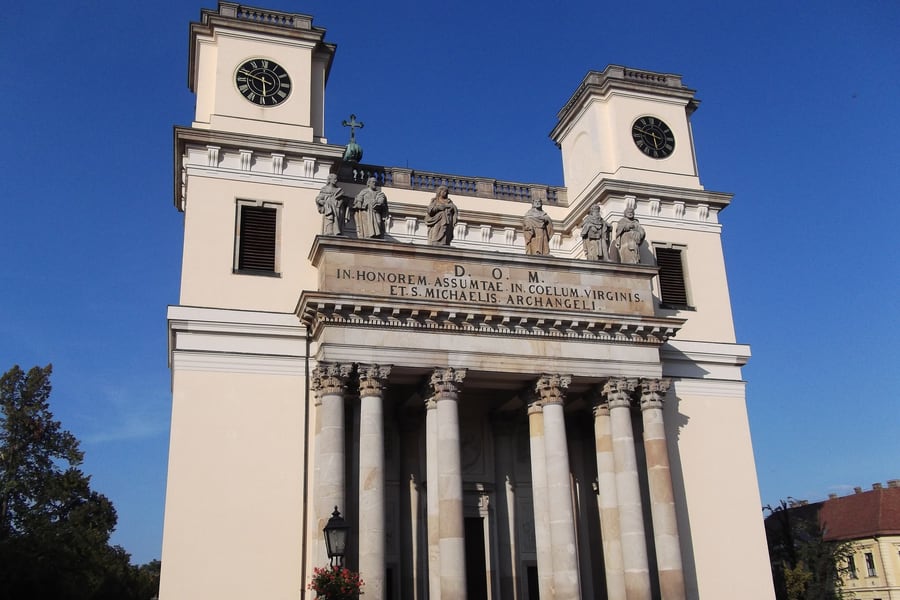
Vác Cathedral
Built in 1761–77 to Isidore Canevale's design, it is one of the largest cathedrals in Hungary and perhaps the country's only example of French "revolutionary" architecture: a columned portico under statues, a dome 55 metres high, and towers that face the Danube. A short walk north of the main square, Canevale's triumphal arch of 1764, put up for Maria Theresa, is the only one in Hungary.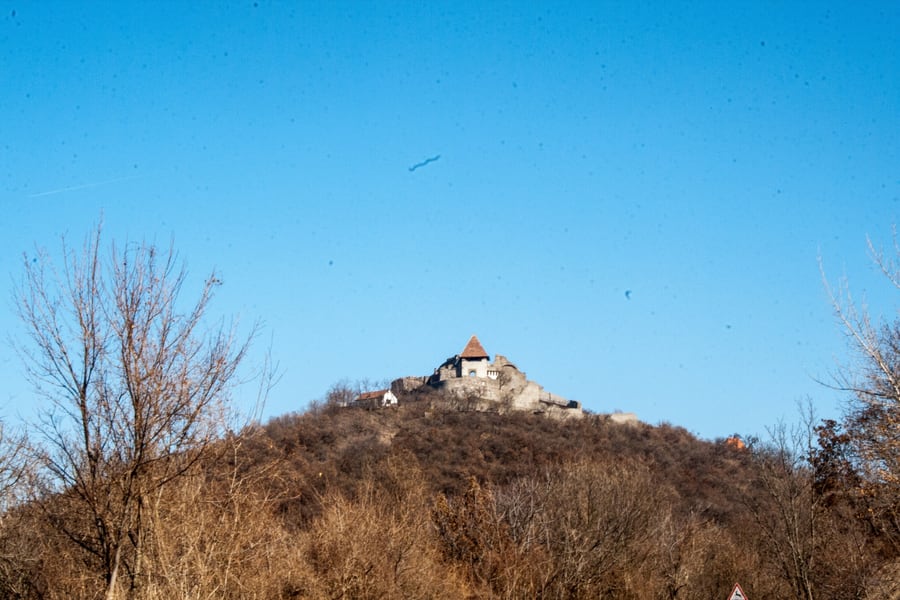 Szilas / Wikimedia Commons · Public domain · cropped
The Visegrád citadel
Béla IV built the upper castle on its hilltop after the Mongol invasion, in the 1240s and 1250s, on a triangular plan with a tower at each corner. Later kings enlarged it, and from the 14th century until 1526 it held the Hungarian crown jewels. The Ottomans took it in 1544, and it was never used again. It is open to visitors, with the whole bend below.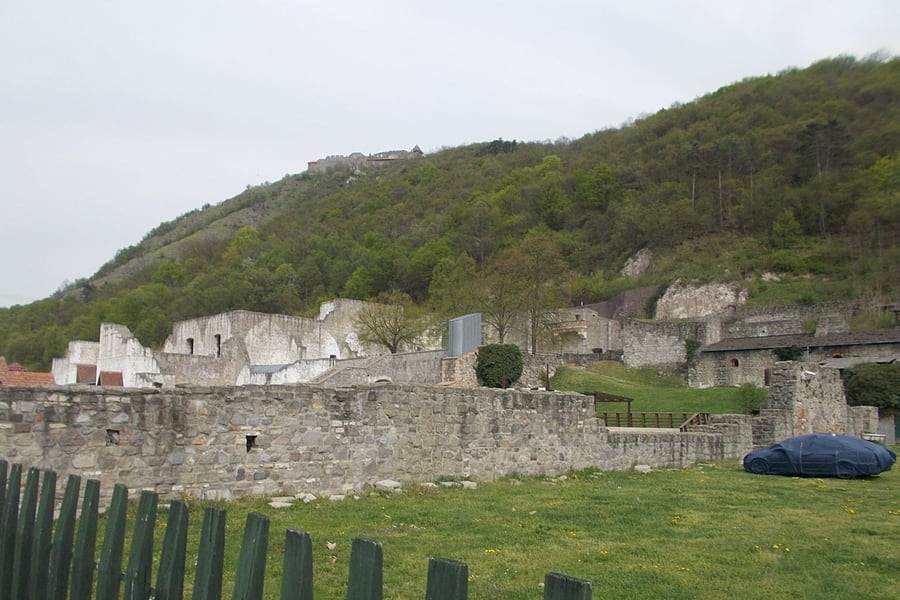 Globetrotter19 / Wikimedia Commons · CC BY-SA 3.0 · cropped
The royal palace at Visegrád
Louis I and Sigismund built a palace here 123 metres square, the seat of the kings of Hungary until about 1405–08. Matthias Corvinus rebuilt it in 1477–84 with Renaissance decoration, the first time the style appeared outside Italy. Buried by the 18th century, it has been excavated since 1934 and is now the King Matthias Museum.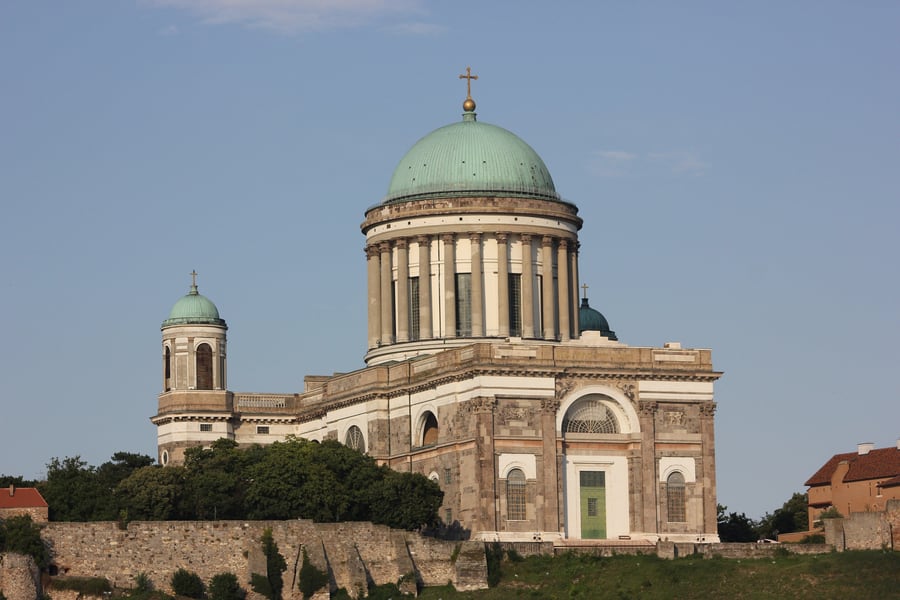 Andrzej Otrębski / Wikimedia Commons · CC BY-SA 4.0 · cropped
Esztergom Basilica
Hungary's largest church, 100 metres from its crypt to the top of the dome, stands on Esztergom's castle hill above the Danube. The international trains run on from Szob to Štúrovo in Slovakia, and from there the Mária Valéria bridge, opened in 1895, blown up in both world wars and reopened in 2001, crosses back into Hungary below it.Where to Sleep
The whole line is under an hour from Budapest, so most people ride it as a day out from the city. To wake up above the river, cross on the ferry and stay at Visegrád.
Where to stay
Hotel Silvanus
On Fekete-hegy above Visegrád
A hotel of 148 rooms, open since 1971, at 352 metres on the hill beside the citadel, with rooms facing the forest, the citadel or the Danube Bend.
Check Availability (opens in a new tab, on hotelsilvanus.hu)via hotelsilvanus.huQuestions or corrections
Planning this trip and stuck on something, or spotted a time, fare or detail that has changed? Send us a message about The Danube Bend Railway. We read every one, and we update this page when something has changed.