Death Railway
Krzysztof Golik / Wikimedia Commons · CC BY-SA 4.0
- Distance130 km (Nong Pladuk–Nam Tok)
- DurationAbout 2½ hours to Nam Tok
- Best seasonNovember–February
Introduction
The train runs west out of Kanchanaburi with the windows open, crosses an iron bridge over a green river, and then spends an hour easing along a timber trestle bolted to a limestone cliff, the water sliding past a few metres below. It is, by any measure, one of the most beautiful short rail journeys in Asia. It costs almost nothing. Third class, wooden benches, a vendor selling sticky rice.
It is also a war grave.
Properly, it is the Burma Railway — also called the Thai–Burma Railway or the Siam–Burma Railway, and the surviving Thai stretch is the Nam Tok Line. But almost nobody calls it any of those. It is the Death Railway, and it earned the name.
It was driven through 415 kilometres of jungle and rock by the Japanese army between 16 September 1942 and 25 October 1943 — a little over a year for a line that engineers had previously judged would take five. It was built by forced labour, and the arithmetic of it is the reason nobody should ride this line casually.
61,811 Allied prisoners of war worked on the railway; 12,621 of them died — roughly one in five. That is the part of the story the world knows, largely because of a 1957 film that invented most of its plot.
The part the world mostly does not know is larger. At least 250,000 Southeast Asian civilians — Malayans, Tamils, Burmese, Javanese — were conscripted onto the same railway, and more than 90,000 of them died. They outnumber the POW dead roughly seven to one. They have no war cemeteries, no headstones and, for the most part, no names recorded anywhere.
The railway no longer reaches Burma. The section beyond the border was pulled up from 1946 — the rails gathered, the roadbed left to the jungle — and what survives is 130 kilometres in Thailand, from Nong Pladuk to Nam Tok, reopened on 1 July 1958. You can ride it this afternoon for the price of a coffee. It is a lovely trip through beautiful country, and it is worth going — but go knowing what it is, and what it cost.
The Journey
Trains for the line leave from Bangkok's Thonburi station, on the far bank of the Chao Phraya — a small, unhurried terminus that feels a century away from the modern city. The run out through Nakhon Pathom, with its vast orange stupa, is flat and green and busy with level crossings.
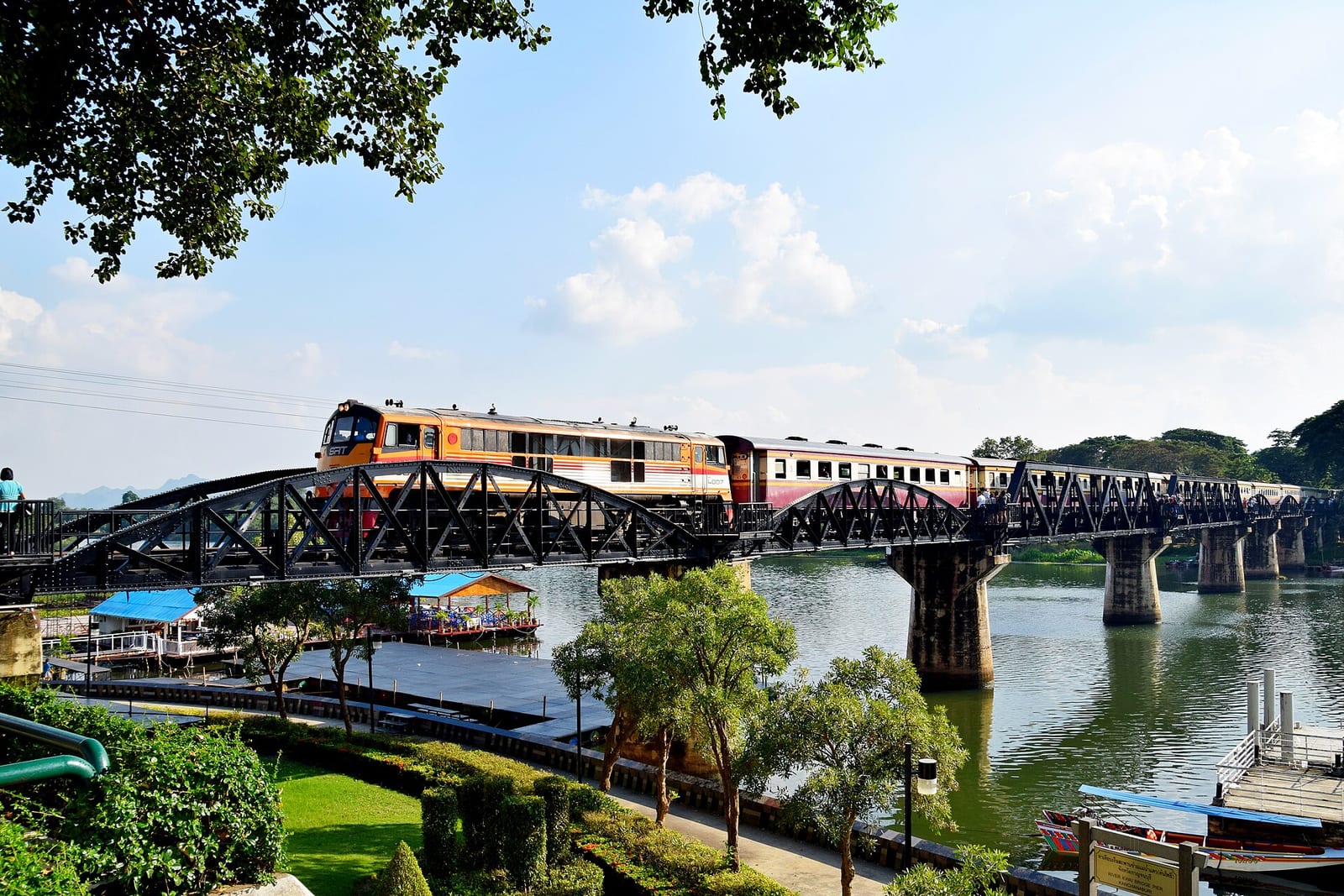
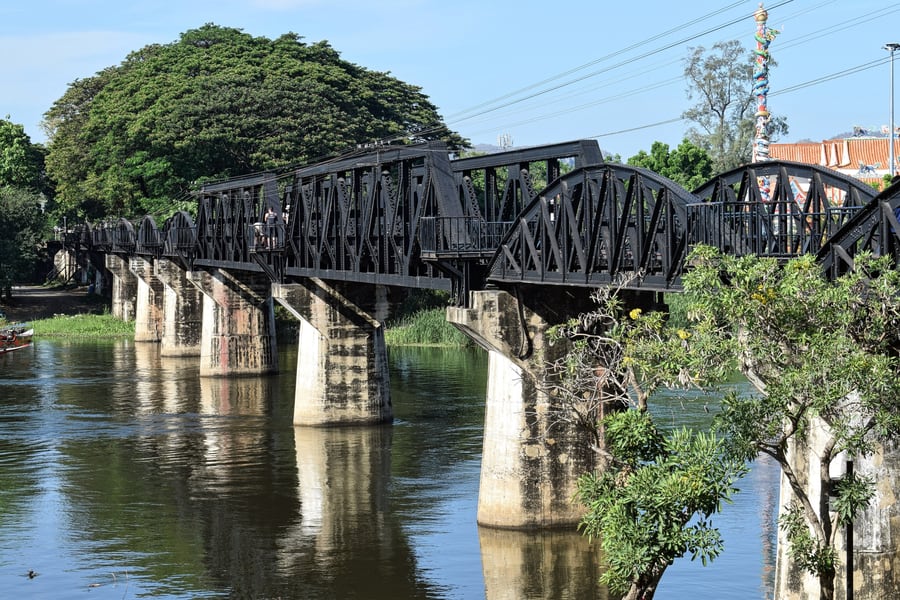
Most people, sensibly, start at Kanchanaburi. The town sits on the Khwae Noi, and a few minutes out of its station the train slows onto the iron bridge over the Khwae Yai — 322 metres of black steel finished in June 1943. It is the famous one. The curved spans are original; the straight ones in the middle were replaced after Allied bombing destroyed them. Passengers hang out of the windows; walkers step into the refuges cut into the parapet as the train edges past.
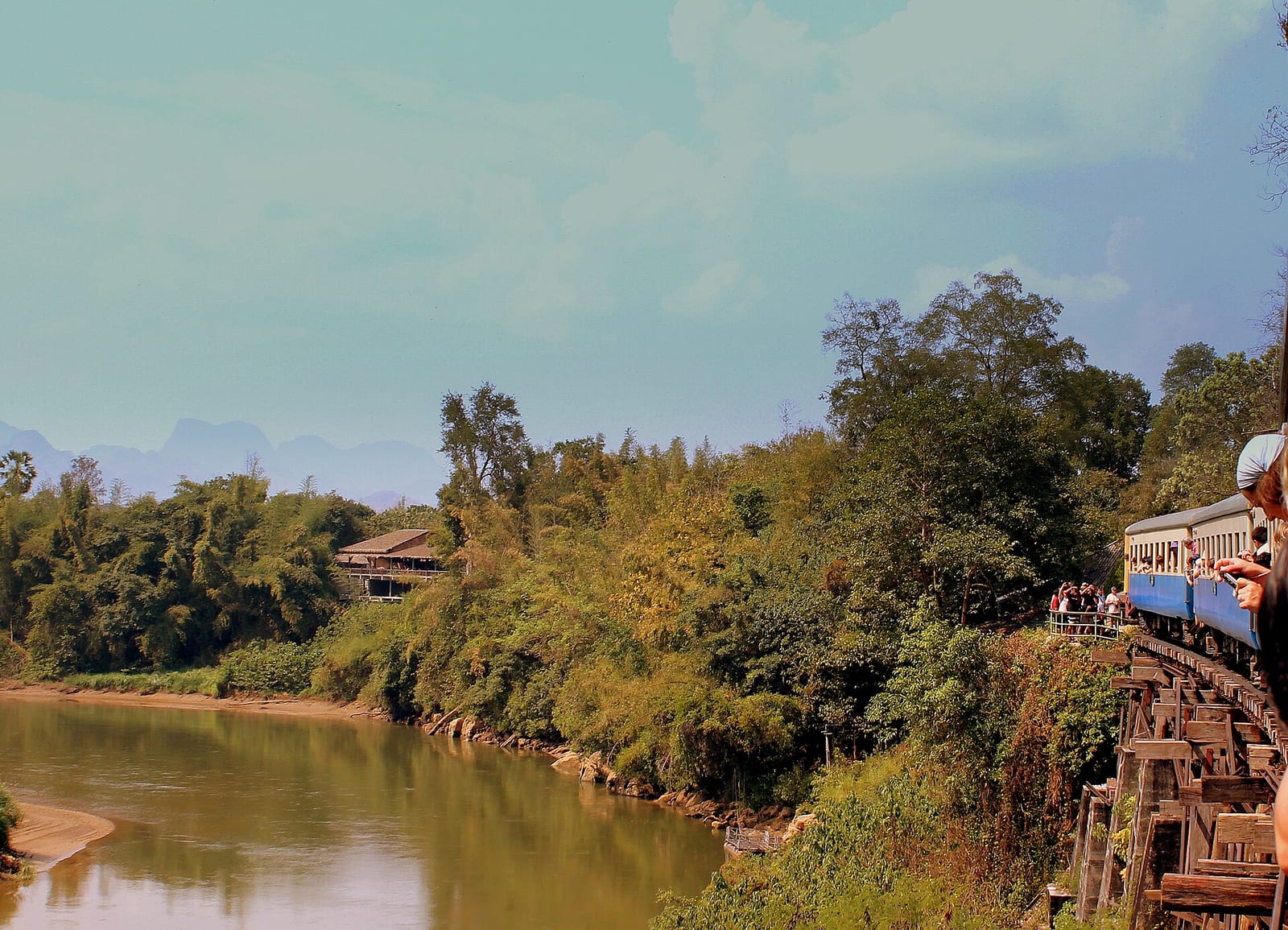
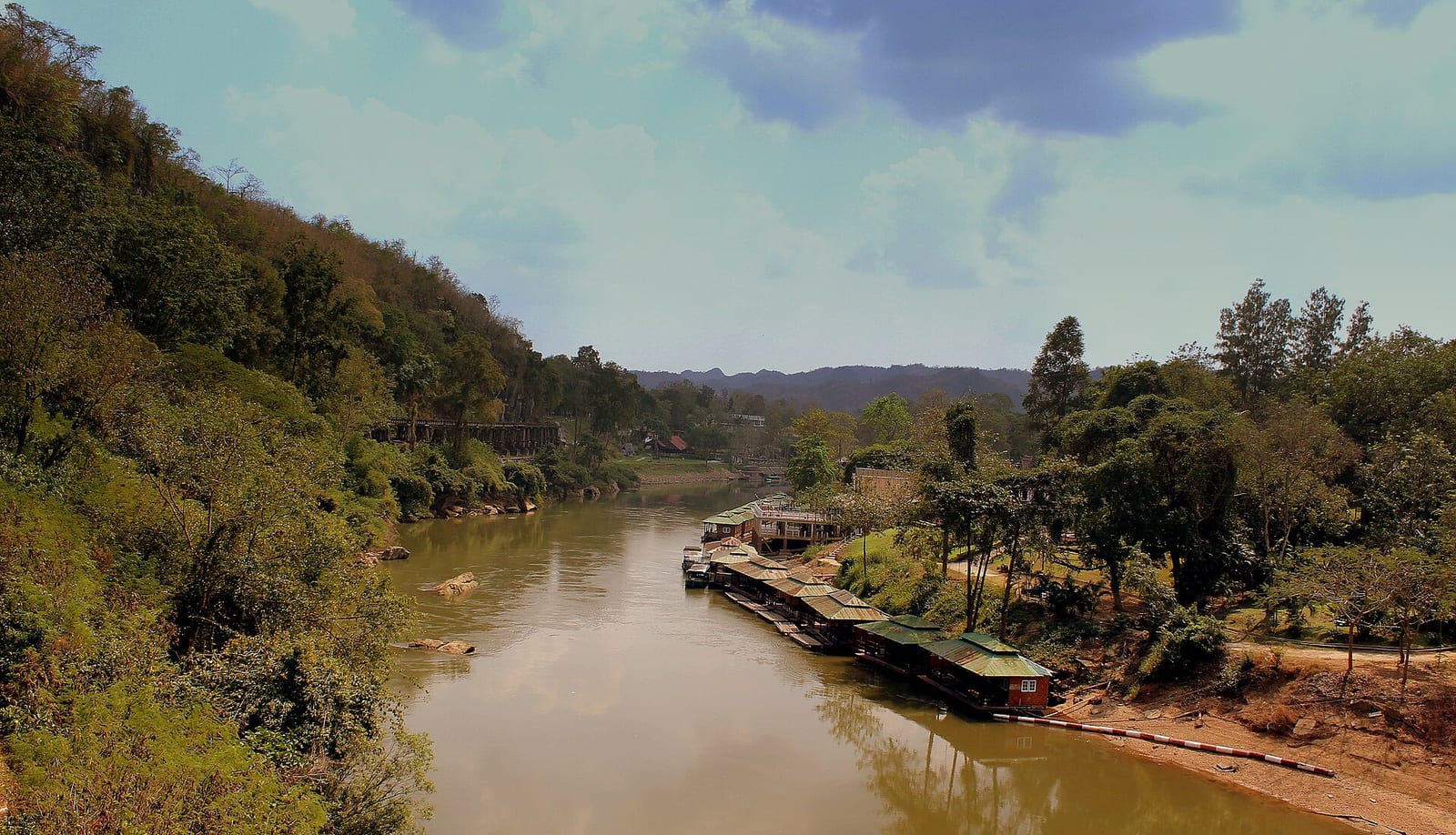
Beyond the bridge the country opens out — sugar cane, banana, limestone karst standing up out of the fields like teeth — and then the line reaches the stretch it is loved for. At Tham Krasae, the railway leaves the ground entirely and runs onto the Wang Pho viaduct: 400 metres of timber trestle pinned to the side of a cliff, curving above the river. The train crawls. The wood creaks. Below the window there is nothing but the green water of the Khwae Noi, and the view is genuinely magnificent.
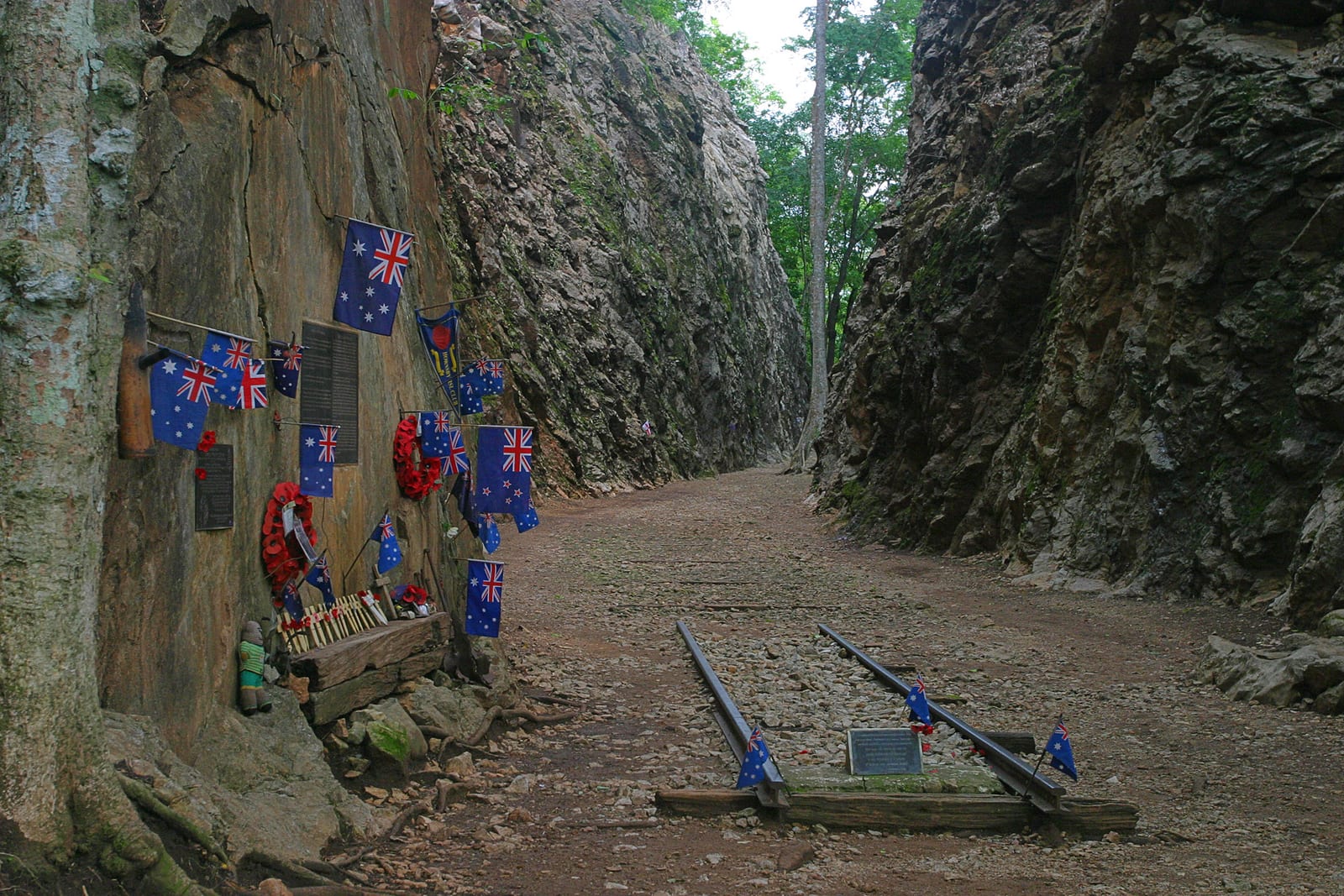
It is also the exact place to remember what you are sitting on. This trestle was built by hand in 1943 by men who were starving, malarial, dysenteric and beaten, using timber cut from the surrounding jungle. The stretch beyond, at Konyu, is worse: Hellfire Pass, the largest cutting on the railway, was hacked through solid rock with hammers and chisels and carried out in baskets. It got its name from what it looked like at night — skeletal men working by torchlight in a slot in the stone.
The train terminates at Nam Tok, about two and a half hours from Kanchanaburi. This is the end of the line now, but not the end of the railway: the formation carried on north-west through Hellfire Pass and over the border to Thanbyuzayat in Burma. That section was lifted after the war. You can walk part of it at the Hellfire Pass Memorial, a few kilometres beyond Nam Tok, where the cutting still stands open in the rock and Australia maintains a museum that tells the story honestly.
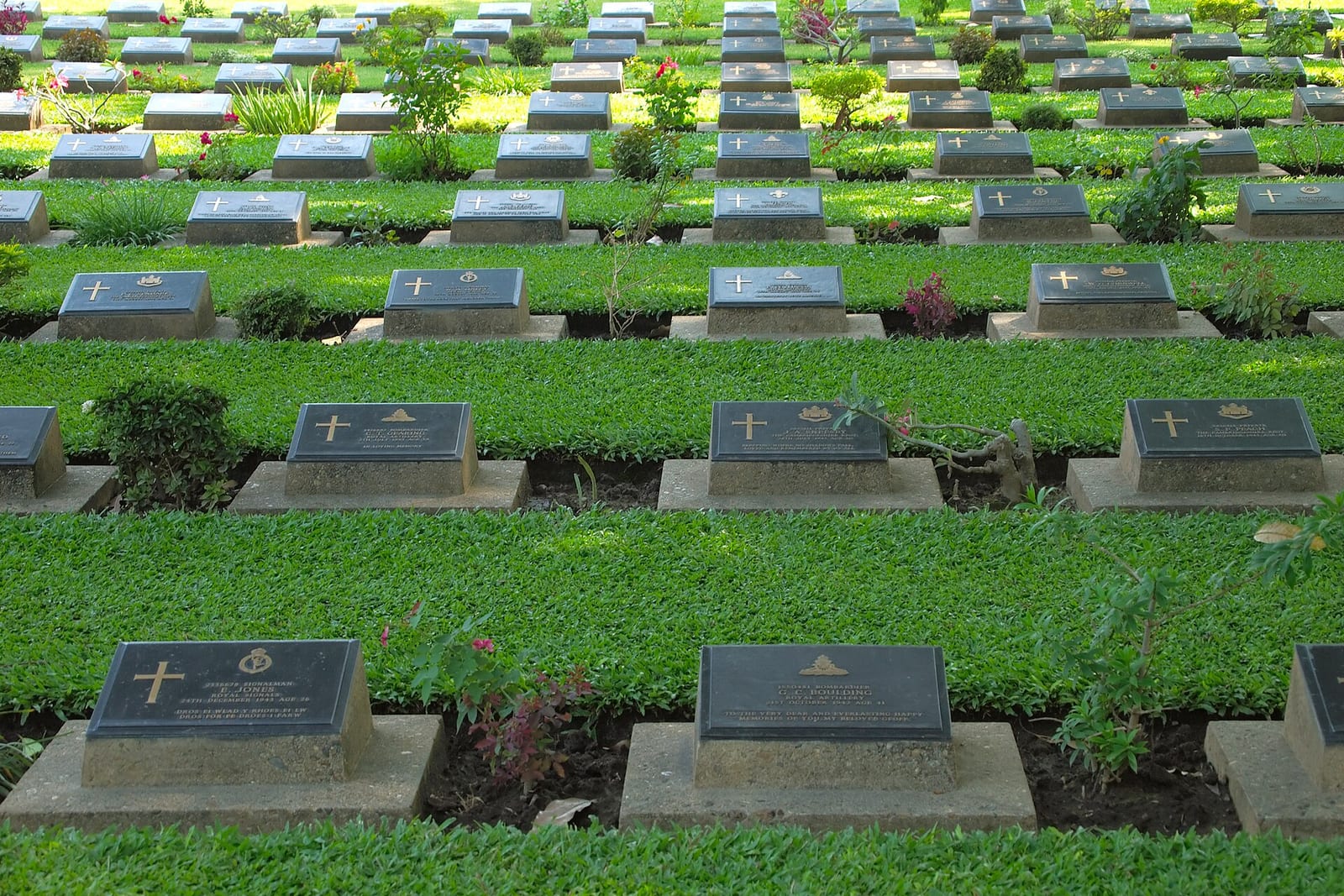
Come back to Kanchanaburi and there are two cemeteries: Kanchanaburi War Cemetery, with nearly seven thousand graves, and Chungkai, quieter, above the river. Both are immaculate. Neither commemorates the ninety thousand Asian labourers who died here, because nobody counted them properly and nobody buried them in rows.
Along the route
calflier001 / Wikimedia Commons · CC BY-SA 2.0The Wang Pho viaduct
The signature of the line: 400 metres of timber trestle bolted to a limestone cliff above the Khwae Noi, where the train slows to walking pace and the river slides past below the window. It was built by hand, by starving men, in 1943.Diliff / Wikimedia Commons · CC BY-SA 2.5Hellfire Pass
The largest cutting on the railway, driven through solid rock with hammers, chisels and baskets. It took its name from the sight of emaciated men working by torchlight through the night. There is a memorial museum, and a walk along the old formation.Krzysztof Golik / Wikimedia Commons · CC BY-SA 4.0The bridge, and the truth about it
The iron bridge over the Khwae Yai is 322 metres long and was finished in June 1943. It is famous because of a 1957 film that invented most of its story — the reality was far worse, and far less heroic, than the version Hollywood sold.A bit of history
Culture & experiences along the way
calflier001 / Wikimedia Commons · CC BY-SA 2.0Third class to Nam Tok
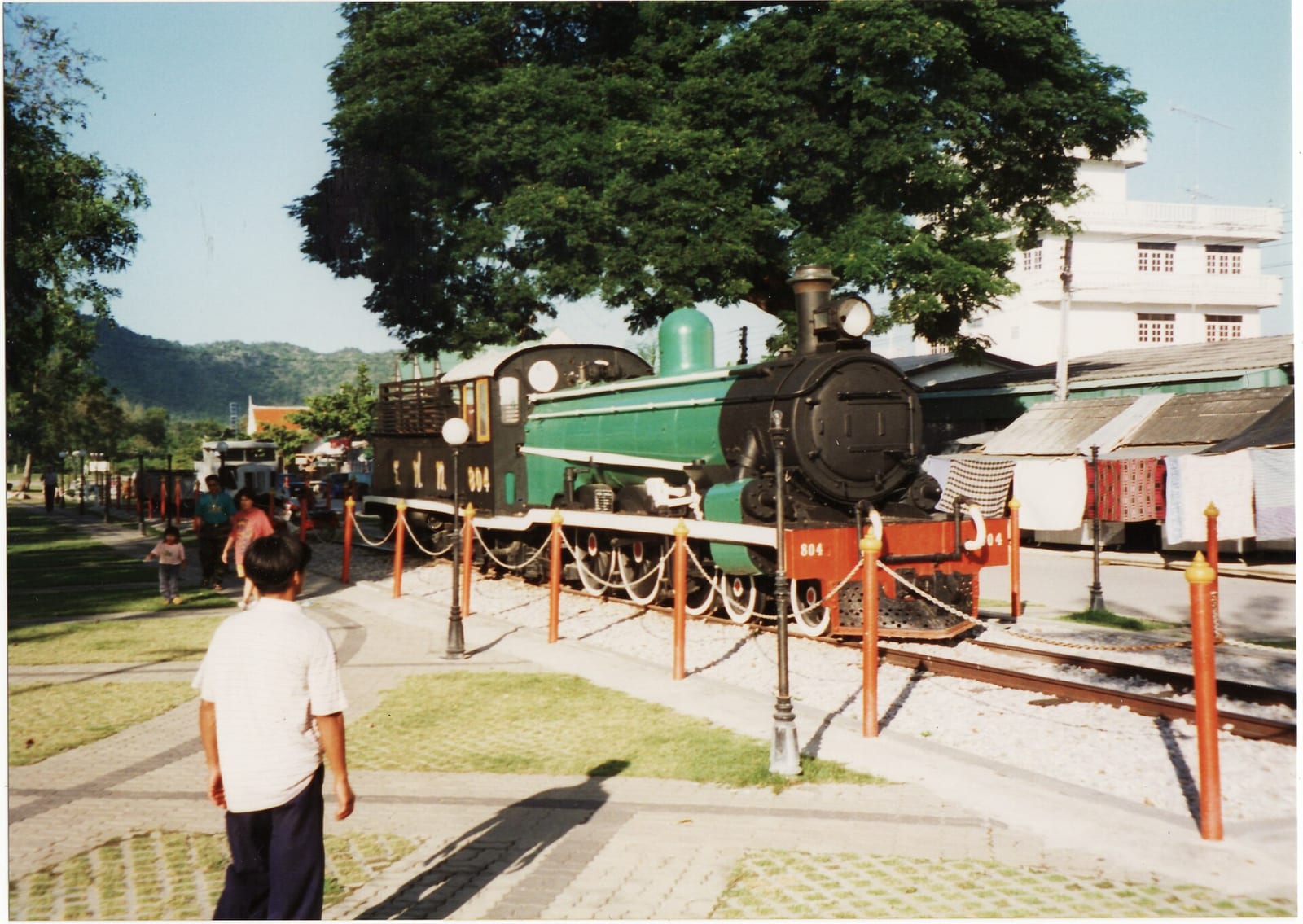
The trains to the end of the line are ordinary third-class stock: wooden benches, no air-conditioning, windows wide open, vendors working the aisle. Sit on the left leaving Kanchanaburi for the river. It costs almost nothing.© Vyacheslav Argenberg / http://www.vascoplanet.com/ · CC BY 4.0The cemeteries
Kanchanaburi War Cemetery holds nearly seven thousand Allied dead, Chungkai several thousand more. They are immaculate, quiet and worth an hour of anyone's time — the reason this is not merely a scenic railway.Andrew Bone / Wikimedia Commons · CC BY 2.0Understanding what you're riding
The Thailand–Burma Railway Centre in Kanchanaburi and the Hellfire Pass museum both explain the line properly — including the quarter of a million conscripted Asian labourers whose dead outnumber the POWs seven to one, and who have no cemeteries.Timetables
The surviving line is an ordinary State Railway of Thailand service, not a tourist special — which is exactly why it's worth taking. Only two trains a day run the full way from Bangkok, so plan around them.
Real times from Bangkok (Thonburi) to Nam Tok (as of the 2025–26 SRT timetable — confirm before travelling):
| Train | Thonburi | Kanchanaburi | Nam Tok |
|---|---|---|---|
| No. 257 | 07:45 | 10:20 / 10:30 | 12:05 |
| No. 259 | 13:55 | ~16:25 | ~18:15 |
Northbound, trains 258 and 260 work back down from Nam Tok in the afternoon and evening, and short workings (e.g. No. 486) run only as far as Kanchanaburi. Journey time Thonburi–Nam Tok is about 4½ hours; from Kanchanaburi to Nam Tok, the scenic part, roughly 2½ hours.
Good to know:
- Foreigners pay a flat 100 baht on this line, bought on the day — no reservation.
- Sit on the left leaving Kanchanaburi — the river side for both the bridge and the Wang Pho viaduct.
- Plan the return before you go out. With only a couple of trains a day, Nam Tok is a small place to be stranded; a Kanchanaburi overnight is far better than a Bangkok day trip.
- Hellfire Pass is beyond the line — about 18 km past Nam Tok by taxi, songthaew or tour. It is the most important thing here; don't skip it.
- November to February is the comfortable window; April is brutally hot.
Times as of the 2025–26 SRT timetable. Confirm current schedules with the operator — see the Tickets section below.
Tickets
There is nothing to arrange. Tickets are sold at the station minutes before departure by the State Railway of Thailand, and the fare for one of the world's most extraordinary train rides is roughly what an airport charges for a bottle of water. Kanchanaburi to Nam Tok is the essential bit — the bridge, the river, the Wang Pho viaduct, about two and a half hours to the end of the line, in third class with the windows down. Foreigners are sometimes charged a flat tourist fare on that section, and it is still trivial.
Buy the return when you arrive at Nam Tok, or at least know the departure time, because services are sparse. Bring water and a hat. And budget half a day for Hellfire Pass separately, by road: if you only ride the train and photograph the bridge, you have seen the scenery and missed the point.
Book your tickets
Third class to Nam Tok
Kanchanaburi ⇄ end of the line
The ordinary SRT service along the surviving 130 km — wooden benches, open windows, and the bridge and the Wang Pho viaduct along the way. Among the cheapest memorable train rides in the world. Turn up and buy at the station.
Book Tickets (opens in a new tab, on State Railway of Thailand)via State Railway of ThailandFrom Bangkok Thonburi
The full day trip
Trains run from Bangkok's Thonburi station through Nakhon Pathom to Kanchanaburi and on to Nam Tok, making a long but straightforward day out of the capital — or, better, an overnight stop in Kanchanaburi.
Book Tickets (opens in a new tab, on State Railway of Thailand)via State Railway of ThailandRail Passes
No rail pass is needed or worth buying. Interrail and Eurail are European schemes, and Thailand is not among the 33 countries in Interrail's list of covered railway companies. Tickets for the line to Nam Tok are bought at the station minutes before departure, and the fare is tiny.
Checked October 2026 against Interrail's list of railway companies (opens in a new tab).
Places to Visit
Kanchanaburi is a pleasant river town with a very heavy history, and almost everything worth seeing is tied to the railway. Give it two days rather than one — the museums in the morning, while you can still take them in, and the river and the waterfalls afterwards.
The JEATH War Museum by the river, named for Japan, England, America and Australia, Thailand and Holland, is a small and idiosyncratic place built around a reconstruction of a prisoners' bamboo hut. It is worth an hour if you have one to spare.
 PumpkinSky / Wikimedia Commons · CC BY-SA 4.0 · cropped
The bridge over the Khwae Yai
Three hundred and twenty-two metres of iron, finished in June 1943, bombed by the Allies and rebuilt afterwards — the curved spans are the wartime originals and the straight ones are the post-war replacements. You can walk it between trains, which is the only way to feel how narrow it is. Ignore the 1957 film: it is fiction, widely held to misrepresent what happened here, and this is not the bridge it describes.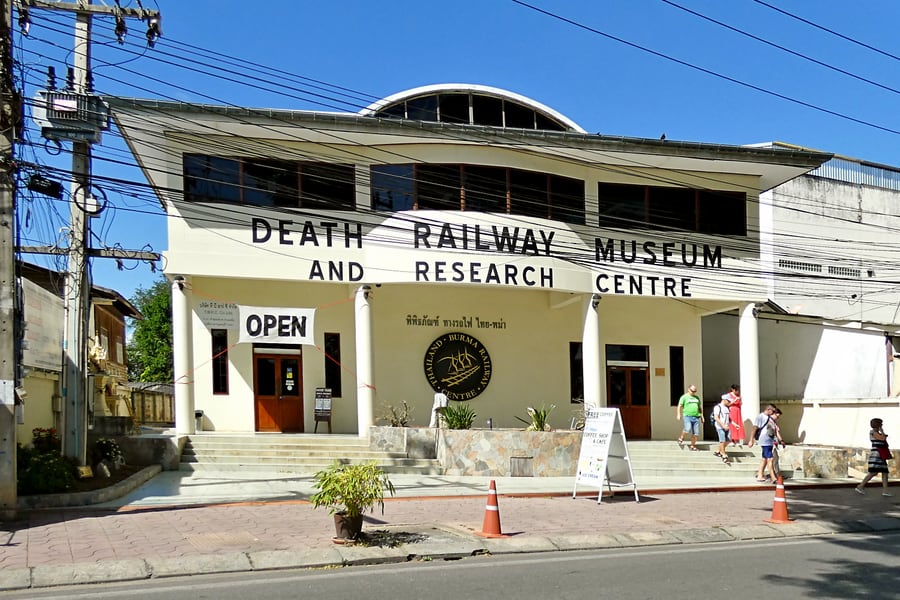 Roweromaniak / Wikimedia Commons · CC BY-SA 4.0 · cropped
Thailand–Burma Railway Centre
The best museum in Kanchanaburi and the clearest account of how and why the line was built. Go before you ride anything. It is unsparing about the arithmetic: 61,811 Allied prisoners worked on the railway and 12,621 died — but at least 250,000 conscripted Asian labourers were put to work on it, and more than 90,000 of them died. They are the great majority of the dead, and the part of the story usually missing.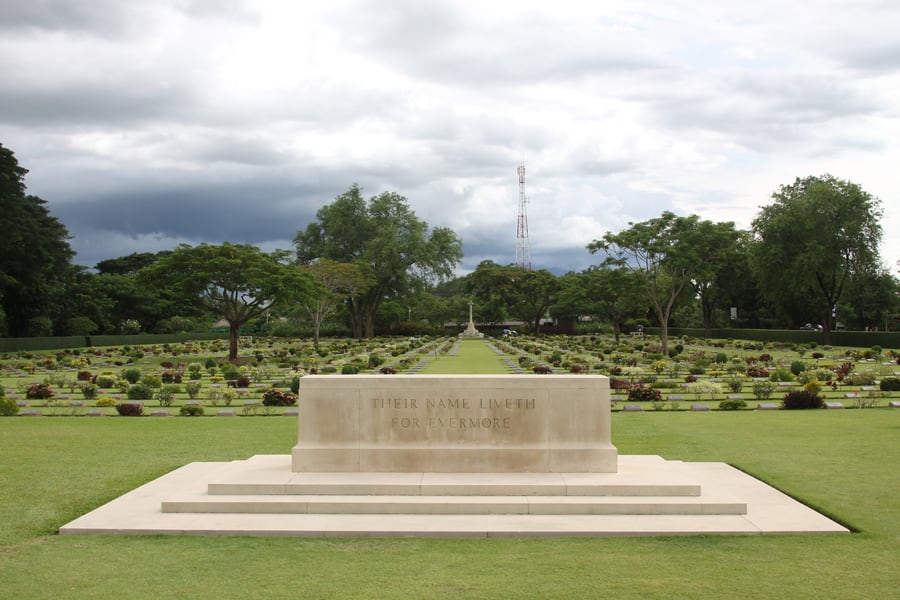 JurriaanH / Wikimedia Commons · CC BY-SA 3.0 · cropped
Kanchanaburi War Cemetery
6,982 graves in immaculate rows in the middle of town, maintained by the Commonwealth War Graves Commission — 5,085 Commonwealth and 1,896 Dutch, of whom 6,858 have been identified. Chungkai War Cemetery, across the river, is smaller and quieter still. Neither holds the Asian labourers: they died in far greater numbers and have no equivalent memorial anywhere along the line.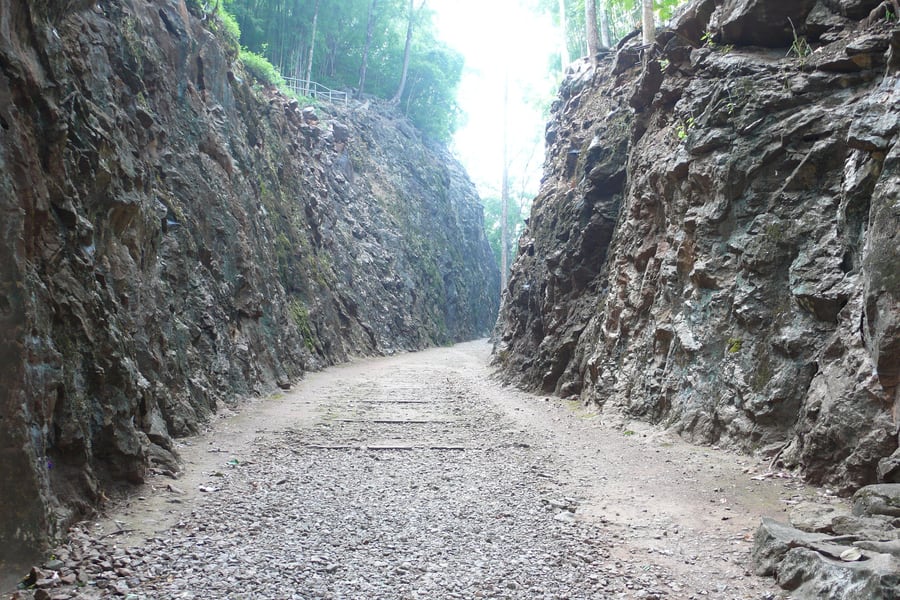 Niels Mickers / Wikimedia Commons · CC BY 3.0 NL · cropped
Hellfire Pass
About 80 km from Kanchanaburi, and the most important site on the railway: the largest rock cutting on the line, driven through solid stone by hand. The name comes from the look of the torch-lit night shifts. There is an Australian-run memorial museum at the top and a walking trail along the old formation below it. Allow half a day, go early, and take more water than you think you need.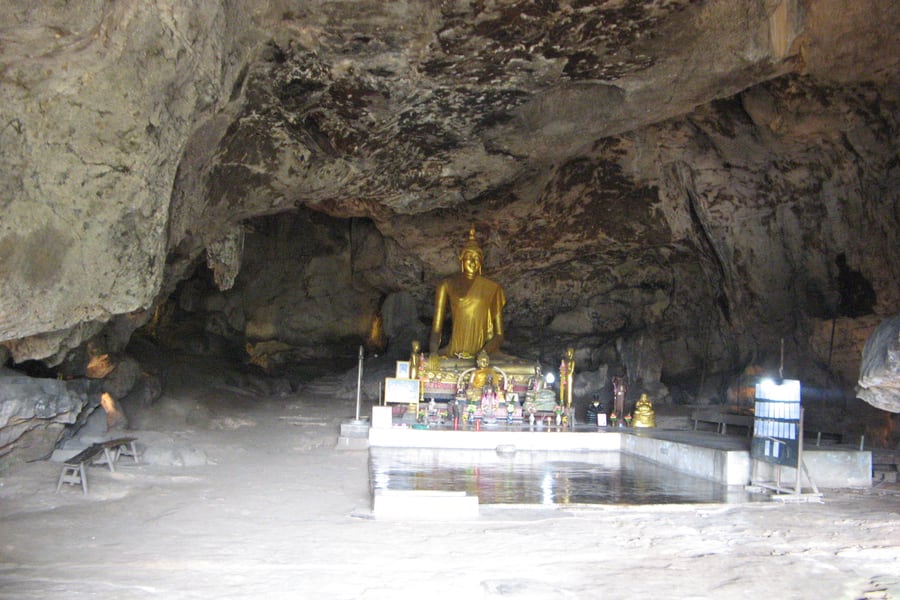 khanawoot / Wikimedia Commons · CC BY 3.0 · cropped
Tham Krasae
You cross the Wang Pho viaduct on the train — 400 metres of timber trestle pinned to the cliff above the river — but it is worth coming back on foot. You can walk the trestle, look straight down at the water through the sleepers, and visit the cave shrine cut into the rock beside it, where a gilded Buddha sits back in the dark. Then wait, and watch the train come round the cliff towards you.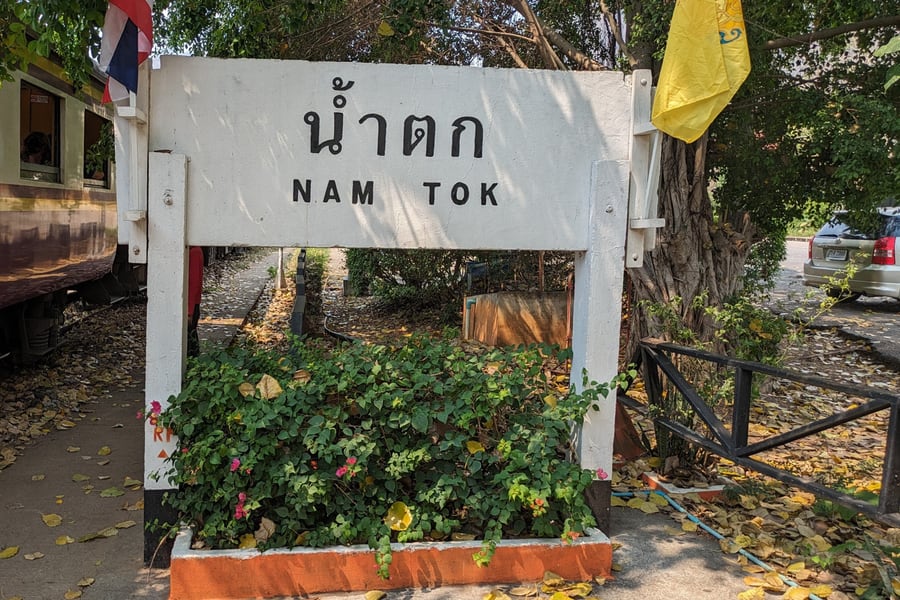 Suikotei / Wikimedia Commons · CC BY 4.0 · cropped
Nam Tok
The end of the surviving railway. The Thai remnant runs 130 km from Nong Pladuk and stops here, reopened on 1 July 1958 after the rest had been lifted; beyond the buffers the old formation simply disappears into the trees. Sai Yok Noi waterfall is a short walk from the platform — modest, but a natural place to stop and take stock before the ride back.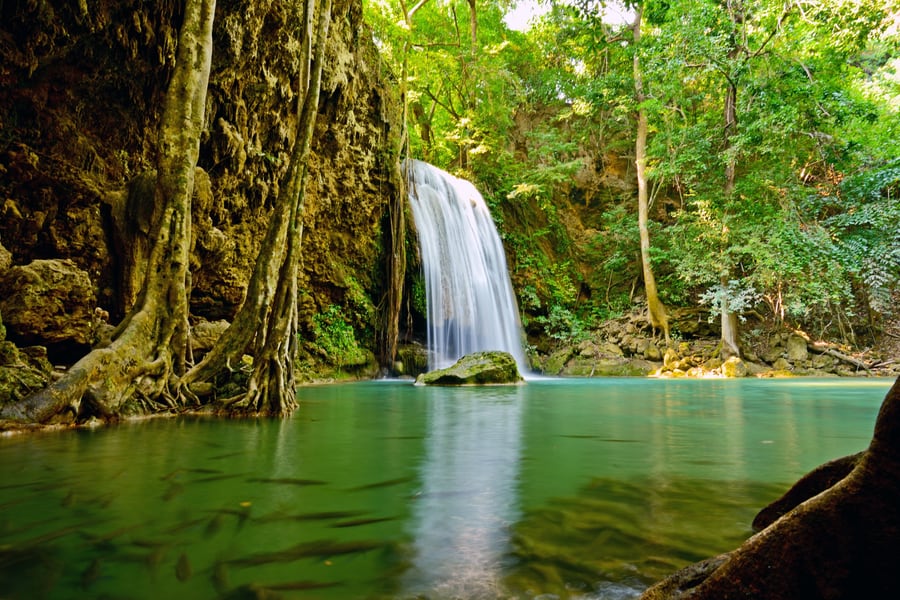 Kanchanaphum Jantrathip / Wikimedia Commons · CC BY-SA 4.0 · cropped
Erawan National Park
North of Kanchanaburi, and the counterweight to a heavy morning: seven tiers of limestone falls dropping through the forest into pools of an improbable green, most of which you can swim in. It is a full day out and a genuinely restorative one. Go on a weekday if you can — Thai families fill it at the weekend, which is cheerful but leaves little water to yourself.Where to Sleep
Stay in Kanchanaburi. The Bangkok day trip is possible, but it turns a serious place into a photo stop and leaves no time for Hellfire Pass or the museums. A night — better, two — changes the whole visit.
- On the river — Kanchanaburi's speciality is the raft house: simple rooms on floating pontoons moored along the Khwae Noi, where you wake with the water a foot below the window and mist on the far bank. They range from backpacker-basic to rather smart. Note that a few of the party rafts play music late; ask before booking.
- In town — plenty of straightforward guesthouses and small hotels near the station and along Maenam Khwae Road, which is where the bars and travel agents are.
- Upriver, towards Sai Yok — resorts and floating lodges strung along the Khwae Noi between Nam Tok and Hellfire Pass. Quiet, green, and well placed if you want an early start at the Pass or at Erawan.
- Bangkok — if you must do it in a day, stay near Thonburi station rather than the modern centre, since that's where the train leaves from.
Timing: November to February is cool and dry and the obvious window. April is ferociously hot. The monsoon makes the jungle spectacular and the trains unreliable.
One suggestion. Kanchanaburi is a resort town built next to a mass grave, and it can feel strange — cocktails and floating discos a few hundred metres from seven thousand headstones. Doing the museum and the cemetery first, and the river and the waterfalls afterwards, makes rather more sense of the place than the other way round.
Questions or corrections
Planning this trip and stuck on something, or spotted a time, fare or detail that has changed? Send us a message about Death Railway. We read every one, and we update this page when something has changed.