Doğu Ekspresi
Oyuncubaba / Wikimedia Commons · CC BY-SA 4.0
- DistanceAnkara–Kars · 1,446 km line
- DurationAbout 26½ hours
- Best seasonWinter for snow · May–Oct otherwise
Introduction
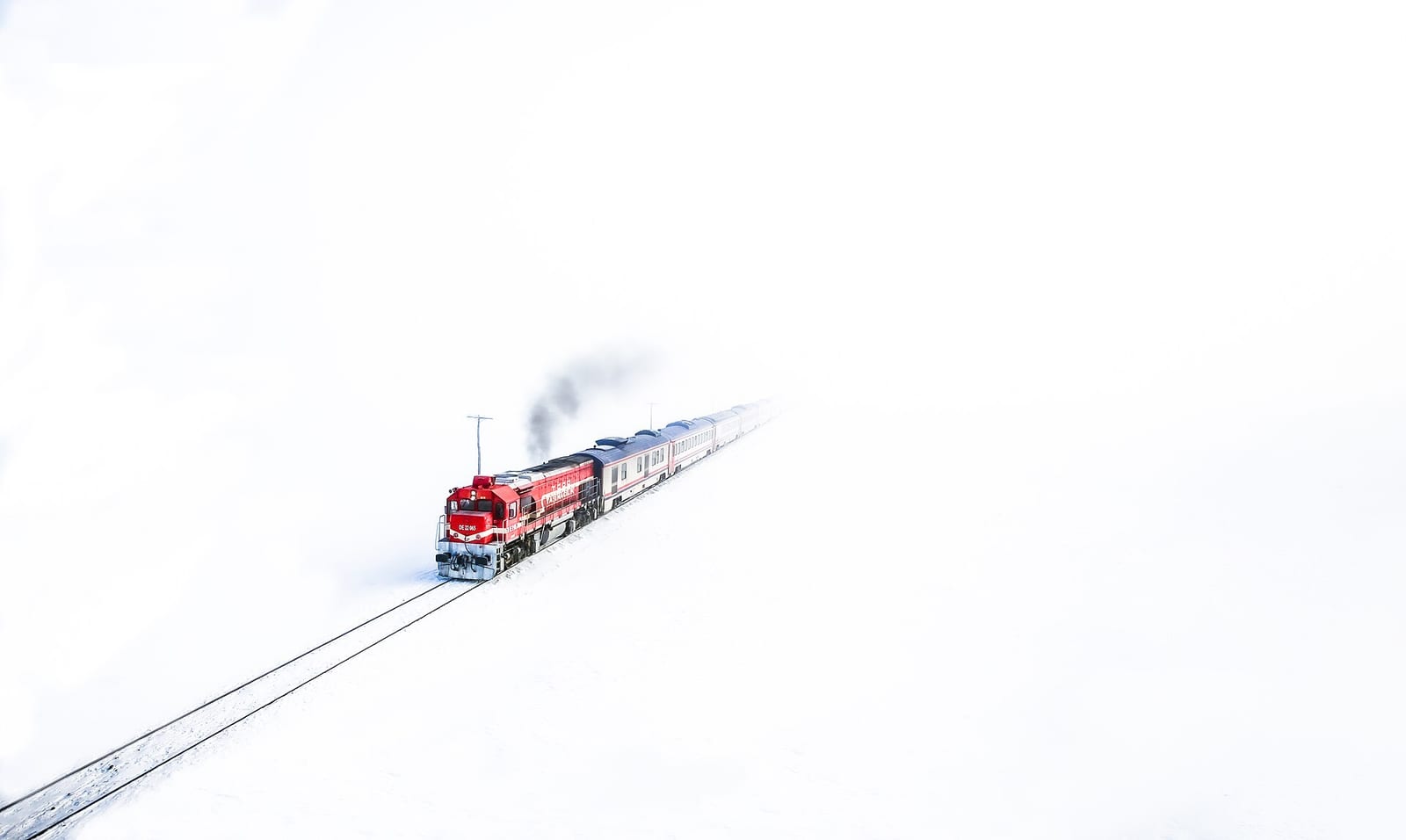
There is a photograph that did this train a great deal of good: a single red locomotive and a string of blue coaches, cutting a thin line across an entirely white world somewhere in eastern Anatolia. It went around Turkish social media, and then around everyone else's, and a slow, cheap, unglamorous overnight service became a national obsession. Tickets for the Doğu Ekspresi now vanish within minutes of the booking window opening.
The train itself is not new. The first one ran in 1936, and it was pushed through to Kars in 1962, once the eastern line had been converted to standard gauge. It runs daily, all year, the length of the 1,446-kilometre Ankara–Kars railway — a line built in stages between 1910 and 1939, mostly single track, curling through gorges and across an enormous emptiness.
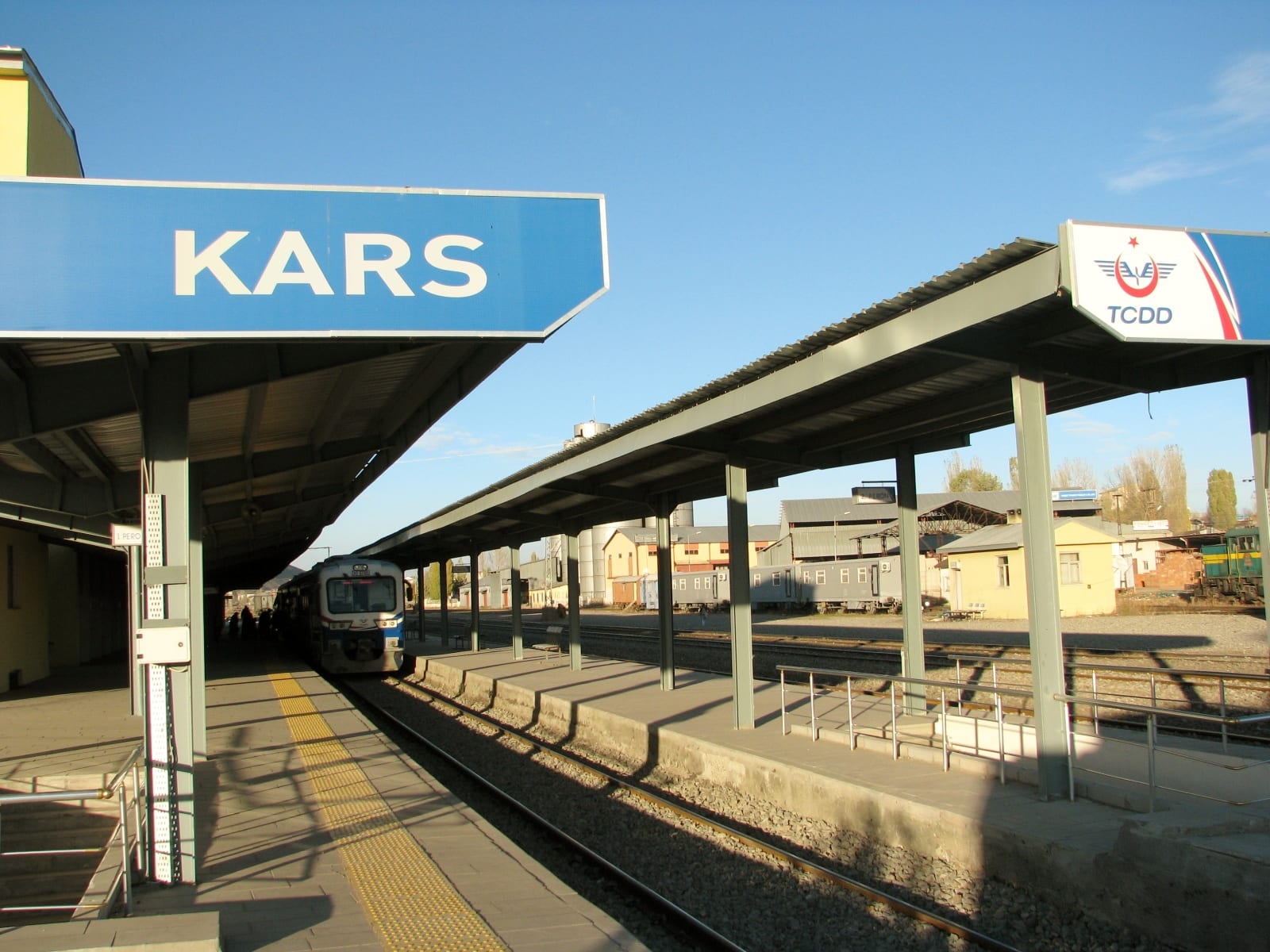
It takes about twenty-six and a half hours. That is the point. You leave Ankara in the early evening, eat in the dining car, sleep as the train grinds across the plateau, wake somewhere near Erzincan with the Euphrates running beside you, and spend a whole second day climbing into the highlands until you reach Kars — a cold Russian-built town near the Armenian border, where it can hit −30°C and the ruined city of Ani waits an hour away on the steppe.
In between there is tea, endlessly. There are families, students, soldiers and grandmothers who will feed you whether you like it or not. It is one of the last great sociable train journeys, and one of the cheapest.
The Journey
The train leaves Ankara at six in the evening and spends its first hours on the dry, rolling plateau of central Anatolia — brown hills, grain silos, small towns, the occasional flock. It calls at Kırıkkale, then runs on through the evening to Kayseri, sitting under the great extinct volcano of Erciyes, and on to Sivas, a Seljuk city with some of the finest medieval stone carving in Turkey. By now it is deep night, and the corridor has gone quiet.
You wake to the best of it. Somewhere before Erzincan the line drops into the valleys of the upper Euphrates, and for hours the train hangs above green-brown water in a series of gorges, crossing and recrossing, tunnelling through spurs. In winter the river runs between banks of ice. This is the stretch people stand in the corridor for.
Then the long climb. Eastern Turkey is high — Erzurum sits near 1,900 metres — and the train works its way up onto a bare, enormous plateau where the villages are low and flat-roofed and the horizon does not stop. Erzurum itself is a serious mountain city with Seljuk medreses and a ski resort above it. Beyond, the country empties out further still, through Sarıkamış and its pine forests, until the train finally rolls into Kars in the afternoon of the second day.
The rhythm of it is the thing. Twenty-six hours is long enough that the train stops being transport and becomes a place: you learn the corridor, the dining car, which window is best, whose children are running which length of the carriage. Tea comes past on trays. Somebody produces bread and cheese and hands it over without asking. You arrive at Kars knowing half the coach.
The Turistik Doğu Ekspresi runs the same rails differently. Introduced in 2019 because the regular train was impossible to book, it carries 120 passengers in nine cars — all sleeping accommodation — and stops for two to three hours at points along the way so passengers can get off and actually see somewhere. It runs from December to March, which is exactly when you want to be here.
Along the route
Kabelleger / David Gubler / Wikimedia Commons · CC BY-SA 4.0A night and a day of Anatolia
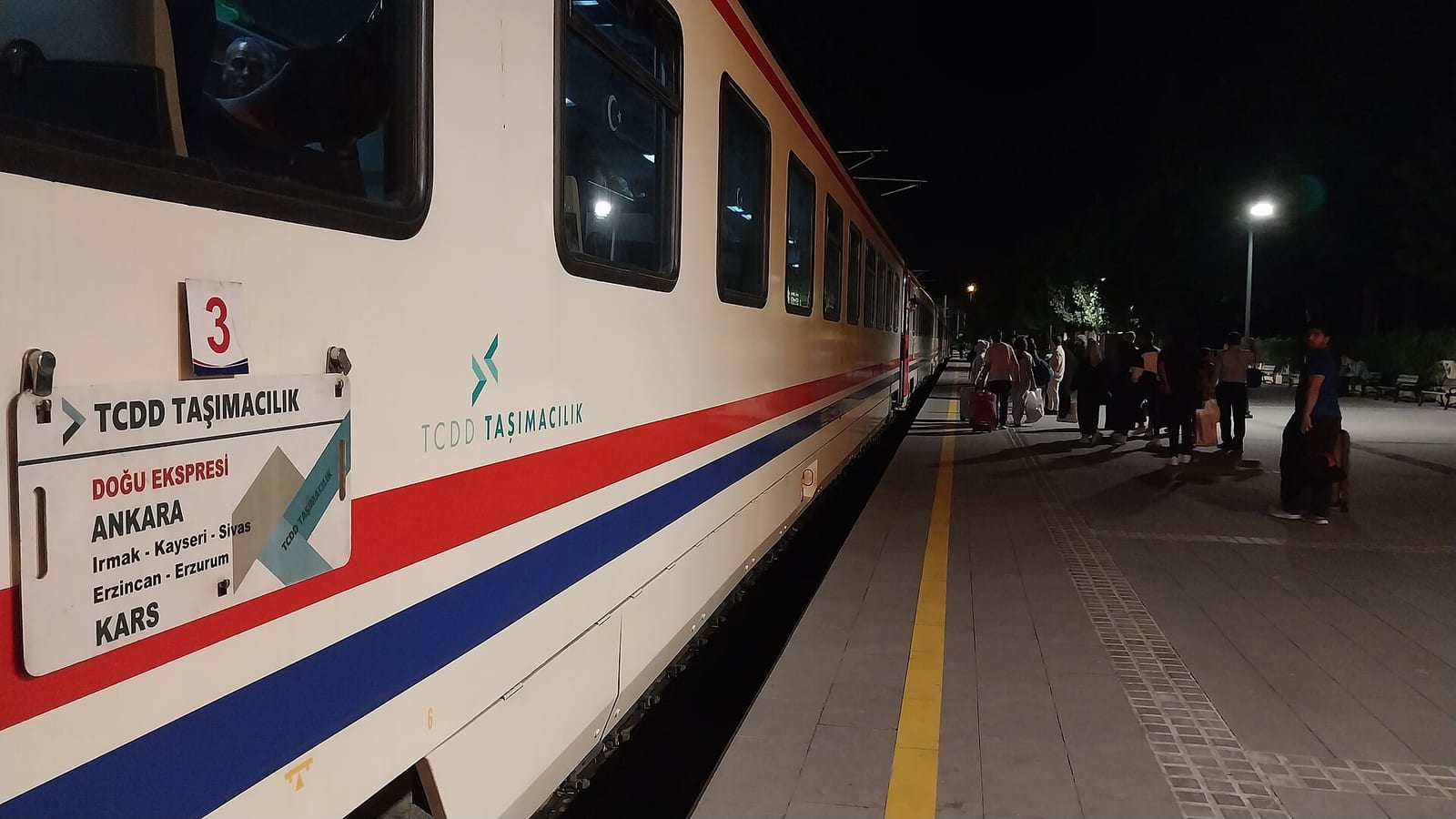
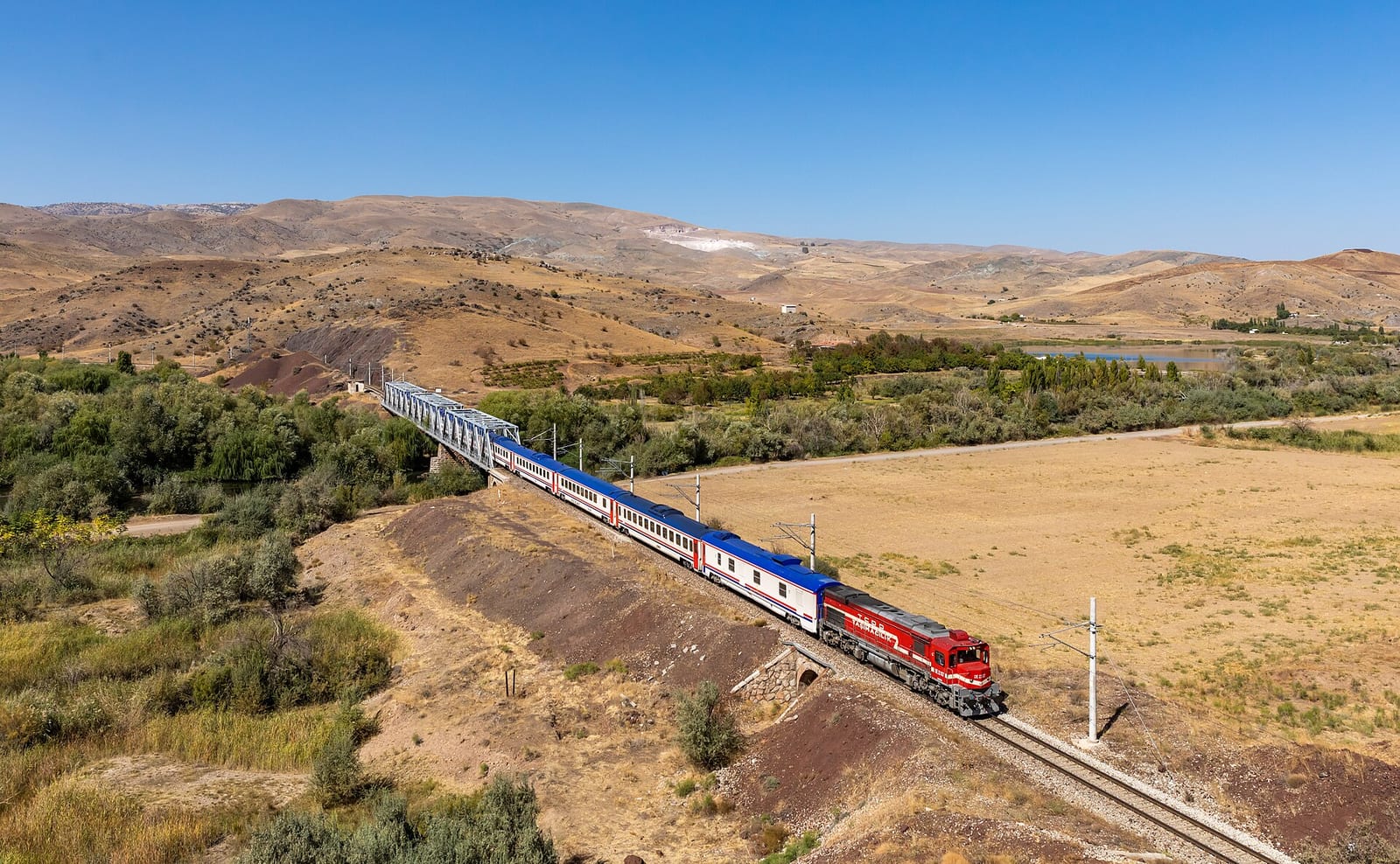
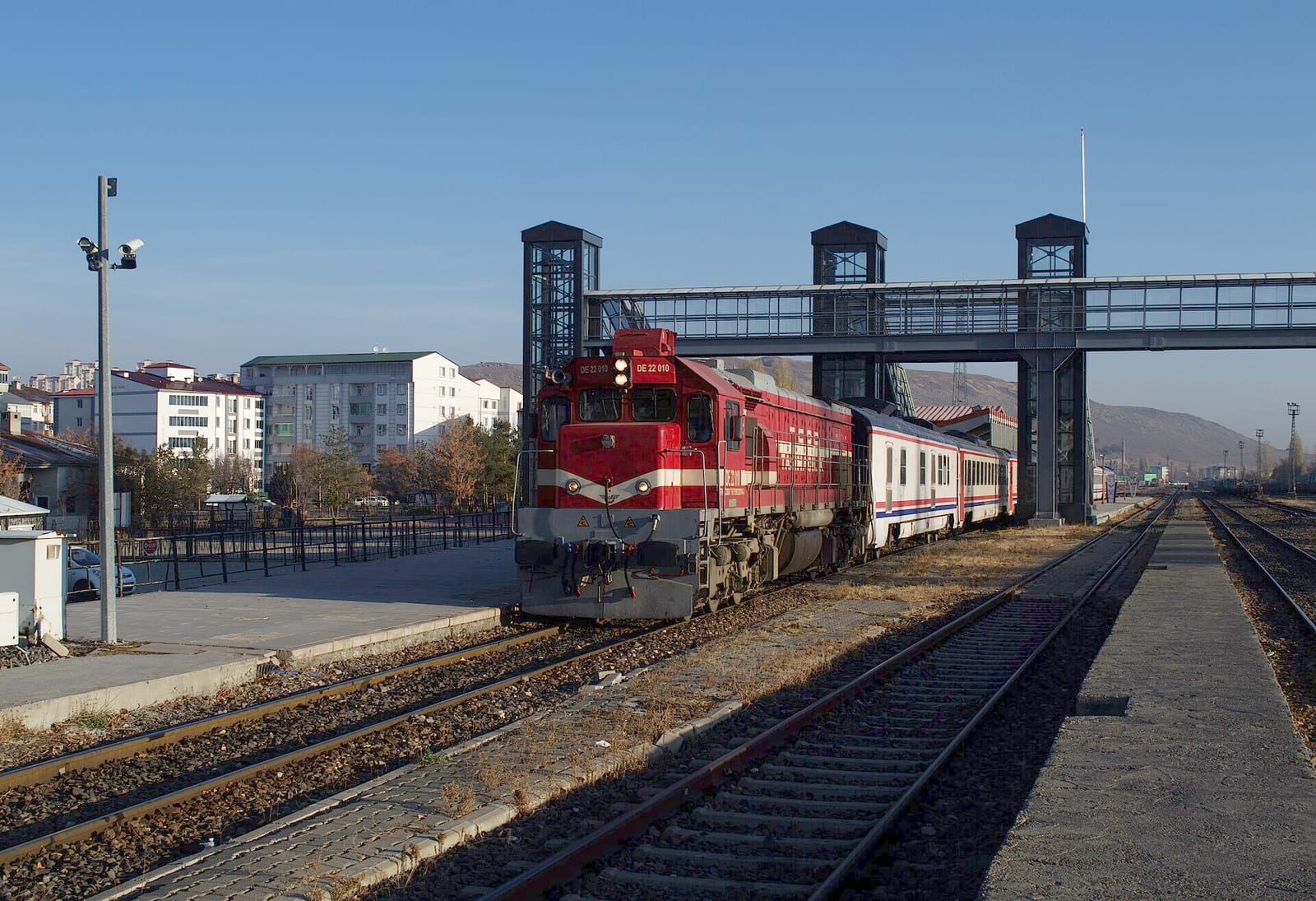
This is the long way east: about twenty-six and a half hours and seven provincial capitals, from the dry plateau around Ankara through Kayseri and Sivas, along the Euphrates gorges near Erzincan, and up onto the roof of Turkey at Erzurum and Kars.Oyuncubaba / Wikimedia Commons · CC BY-SA 4.0The winter train
The Doğu Ekspresi became a phenomenon because of snow. From December the east turns white and the train runs through a frozen world for hours on end — which is why winter tickets disappear within minutes of the booking window opening.Panegyrics of Granovetter / Wikimedia Commons · CC BY-SA 2.0Kars and the ruins of Ani
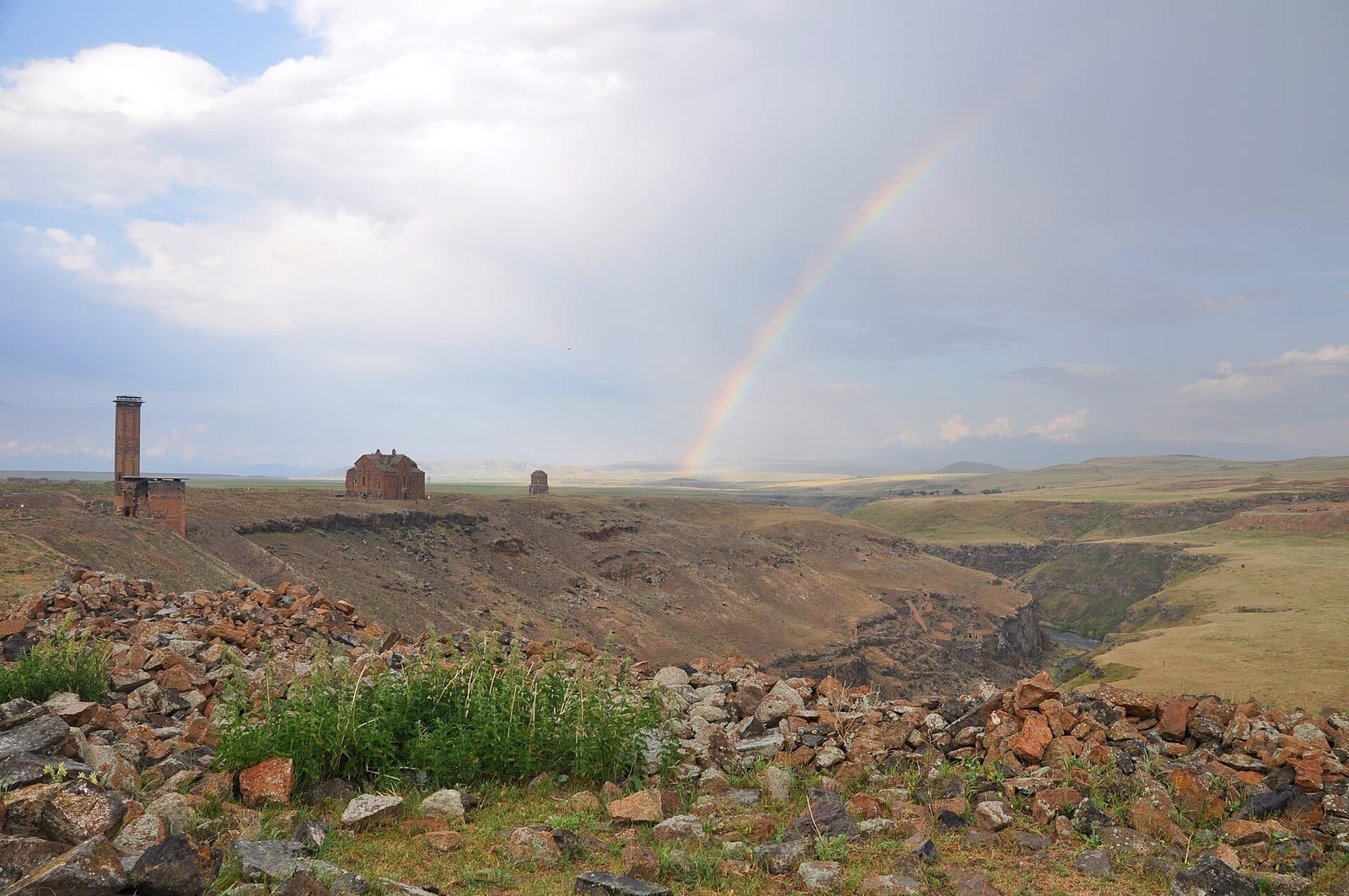
At the far end sits Kars, a cold, handsome town with Russian-built streets — and an hour away, on a gorge marking the Armenian border, the ghost city of Ani: a medieval Armenian capital of a hundred thousand people, now empty on the steppe.A bit of history
Culture & experiences along the way
Alikam1896 / Wikimedia Commons · CC BY-SA 4.0The most sociable train in Turkey
Nobody rides this train in a hurry. Compartments fill with families, students and backpackers; tea arrives constantly; strangers share food and by hour twenty you have been adopted by somebody's grandmother. That is the journey, as much as the window is.Phil Richards / Wikimedia Commons · CC BY-SA 4.0Couchette or seat
There are two ways to ride: four-berth couchettes, made up with sheets, a blanket and a pillow, and ordinary coach seats for the hardy. A dining car runs the length of the trip. It remains one of the great rail bargains.Ex13 / Wikimedia Commons · CC BY-SA 3.0The Touristic alternative
Because the regular train sells out weeks ahead, TCDD launched the Turistik Doğu Ekspresi in 2019 — same line, all sleeping cars, and two- to three-hour sightseeing stops so you can actually get off and look around. It runs December to March.Timetables
There are two different trains on this line, and knowing which one you want is most of the battle.
| Doğu Ekspresi | Turistik Doğu Ekspresi | |
|---|---|---|
| Runs | Daily, all year | 3×/week, December–March only |
| Duration | About 26½ hours | Longer — it stops to sightsee |
| Accommodation | Couchette or seat | All sleeping cars (nine cars, 120 passengers) |
| Stops | Normal station calls | 2–3 hour excursion stops with TCDD tours |
| Fare | Very cheap | Considerably more |
Times for the regular Doğu Ekspresi, trains 22010 and 92009:
| Depart | Arrive | |
|---|---|---|
| Ankara → Kars | 18:00 | 20:26 (next day) |
| Kars → Ankara | 08:00 | 10:27 (next day) |
Both run Ankara ⇄ Kars, calling at Kırıkkale, Kayseri, Sivas, Erzincan and Erzurum.
Good to know:
- Booking is the hard part. The regular train is famous for selling out within minutes of the window opening — TCDD created the Touristic service purely because of it. Know your date, be online the moment tickets drop.
- Westbound is a different trip. Kars→Ankara reverses which scenery you get in daylight; many prefer starting in Kars.
- Erzurum to Kars in daylight. In winter TCDD also runs the Turistik Erzurum–Kars Bölgesel Treni, a regional train of Pullman seats over the last stretch of this line, stopping five minutes at Sarıkamış. It leaves Erzurum on Saturdays at 13:00, reaching Kars at 17:30, and comes back on Sundays, leaving Kars at 09:30 and reaching Erzurum at 14:00, from 26 December 2026 to 7 February 2027. A seat costs 850 TL, and tickets go on sale in December. See TCDD's page for the train (opens in a new tab).
- Winter is the draw and the risk. Snow is the whole reason people come, but it also means delays — build slack into onward plans.
Times are TCDD's own, as of September 2026, from its Trenim Nerede page (opens in a new tab), where each station's board lists the train and its stops.
Tickets
Tickets come from TCDD Taşımacılık, online or at a station counter. The daily train carries four-berth couchettes and ordinary seats, with a dining car: Ankara to Kars costs 920 TL in a seat and 1,585 TL in a couchette. The difficulty is not the price but getting a place — winter dates can sell out in minutes, so be online the moment booking opens.
The winter Turistik Doğu Ekspresi sells two-bed sleeping compartments by the room: 16,500 TL from Ankara until mid-January and 20,000 TL after, or 15,000 and 18,000 TL from Kars. Tickets go on sale on 26 October 2026; excursions and meals are extra. Dress for Kars, not Ankara: the Kars platform at eight in the morning is not heated. Prices checked in September 2026.
Book your tickets
Doğu Ekspresi
Daily · couchette or seat
The regular service, running daily in both directions between Ankara and Kars, with four-berth couchettes, coach seats and a dining car. Astonishingly cheap for the distance — and correspondingly hard to book. Sold through TCDD.
Book Tickets (opens in a new tab, on TCDD Taşımacılık)via TCDD TaşımacılıkTuristik Doğu Ekspresi
Winter · sleeping cars + stops
The touristic version, launched in 2019 for travellers who couldn't get on the regular train: 120 passengers in nine cars, all sleeping accommodation, and two- to three-hour excursion stops along the way. Runs three times a week from December to March.
Book Tickets (opens in a new tab, on TCDD Taşımacılık)via TCDD TaşımacılıkRail Passes
Interrail passes are valid on the Doğu Ekspresi. Interrail's table of railway companies lists TCDD Taşımacılık's night trains as included in Türkiye, so the daily train from Ankara to Kars is covered by an Interrail Türkiye Pass or a Global Pass. Reservations are compulsory, and Interrail says they can be made only at a station ticket desk in Türkiye, not online.
The winter Turistik Doğu Ekspresi is different: Interrail names it among the trains excluded, so its compartments are bought from TCDD at full price.
For this journey alone, a pass is not worth buying. The fares are low. A pass pays when Kars is one leg of a longer trip, with the high-speed lines west of Ankara.
Checked October 2026 against Interrail's railway companies (opens in a new tab) and its Türkiye page (opens in a new tab).
Places to Visit
The line strings together a set of places most visitors to Turkey never reach — and the far end is worth the day and a half on its own.
Between Sivas and Erzurum comes the scenic heart of the ride. Around Erzincan the train spends hours above the Euphrates in a chain of gorges, and if you are passing in daylight this is the stretch to stand in the corridor for. Higher and further east, the pine forests of Sarıkamış hold the snow into spring; the town is also remembered for the Battle of Sarıkamış, one of the major engagements of the Caucasus front in the First World War, in which an army was destroyed as much by cold as by fighting.
Kars is the terminus, and a strange, likeable place: broad straight streets and Russian-built stone houses left from the decades of tsarist rule, a castle above the river, and some of the best honey and cheese in Turkey. It was itself the capital of the Bagratid Armenian kingdom from 929 to 961, before the court moved on to Ani — so the two ends of the excursion are two capitals of the same vanished state.
Give yourself two nights in Kars if you can. Everything below is reachable from a stop along the way.
 Bjørn Christian Tørrissen / Wikimedia Commons · CC BY-SA 3.0 · cropped
Ankara
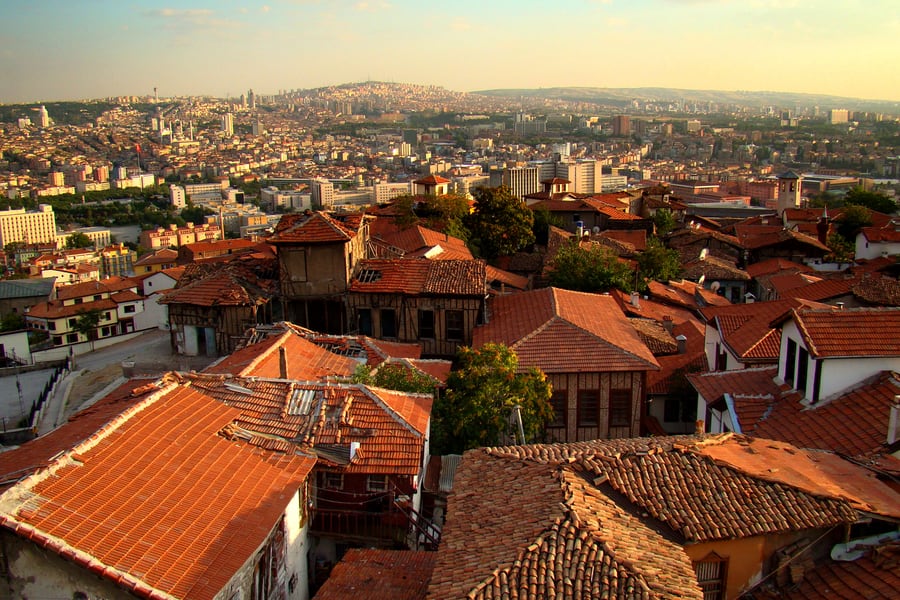
Not a tourist city, but give it an afternoon before the train. The citadel still stands on its hill with a knot of old Ottoman houses inside the walls and red roofs falling away towards the modern capital, and just below the gate is the Museum of Anatolian Civilisations — Hittite, Urartian and Phrygian, and one of the best museums in the country. Atatürk's mausoleum is across the city.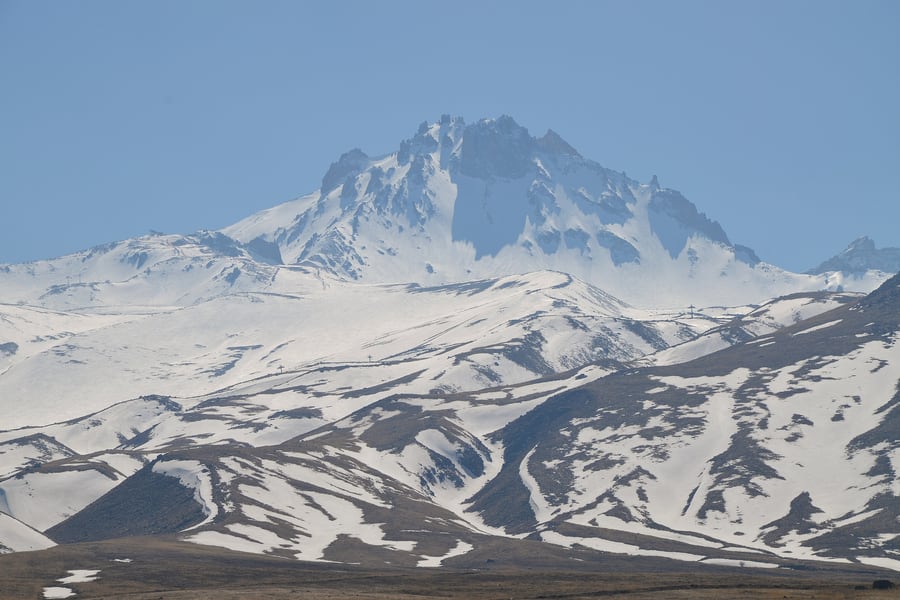 Carole Raddato / Wikimedia Commons · CC BY-SA 2.0 · cropped
Mount Erciyes
The train reaches Kayseri under Erciyes, an extinct volcano of 3,917 m standing almost alone above the plain and carrying snow for most of the year — one small glacier survives on it, though it is retreating, and its last eruptions were in the early Holocene. Kayseri is also the practical place to break the journey for Cappadocia, an hour or so west.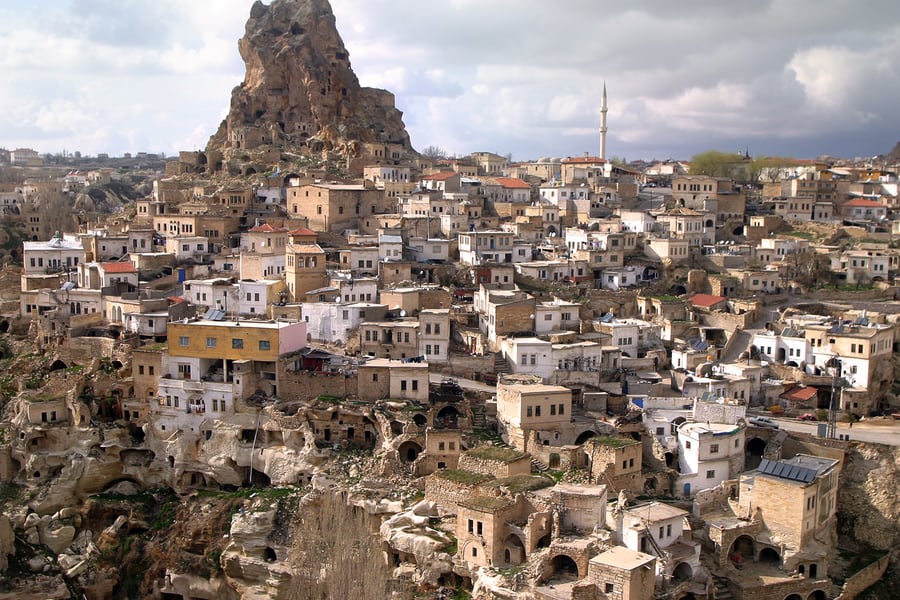 Brocken Inaglory / Wikimedia Commons · CC BY-SA 3.0 · cropped
Cappadocia
If you get off at Kayseri, this is why. Uçhisar — the name means outer citadel — is a whole village burrowed into and around one enormous cone of tuff on the edge of the Göreme national park, honeycombed with rooms and stairways and topped by the highest viewpoint in Cappadocia. Fairy chimneys, rock-cut churches and the dawn balloons are all within a few kilometres.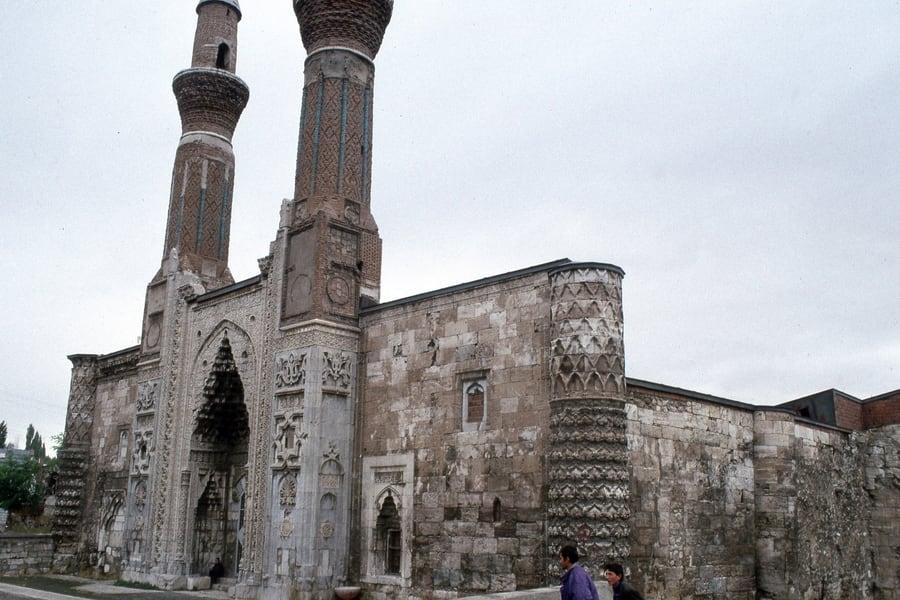 Dick Osseman / Wikimedia Commons · CC BY-SA 4.0 · cropped
Sivas
Sivas keeps a remarkable group of thirteenth-century Seljuk colleges within a few minutes' walk of one another. The Gök Medrese — the "sky-blue madrasa", named for its tiles — was completed in 1271 for Sahip Ata Fahrettin Ali, vizier of the Sultanate of Rûm, and built by an architect from Konya known as Kaloyan: a Greek Christian raising one of the great monuments of Seljuk Islam.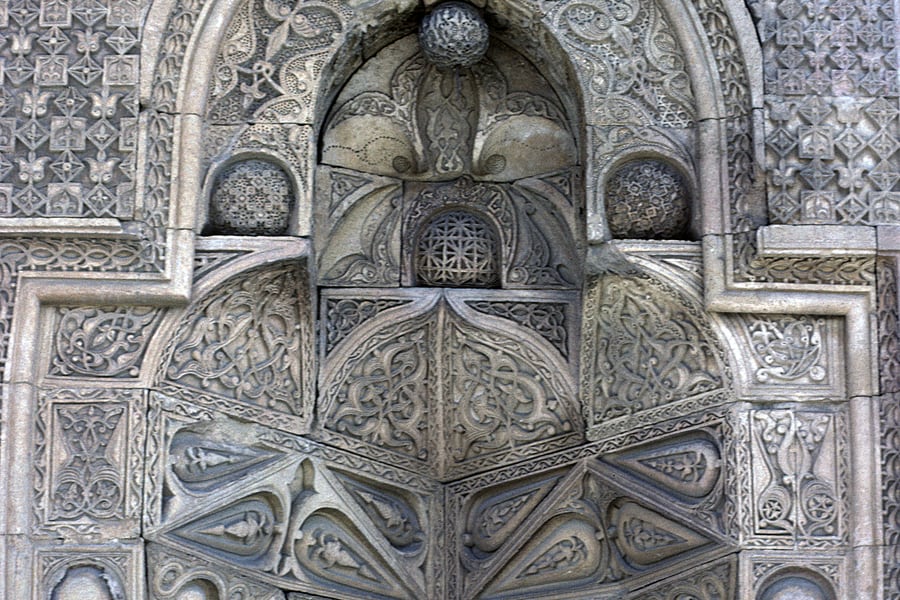 Dick Osseman / Wikimedia Commons · CC BY-SA 4.0 · cropped
Divriği
The Great Mosque and Hospital, built in 1228–29 by the Mengujekid ruler Ahmet Shah and his wife Melike Turan Melek, carries doorways carved like nothing else in the Islamic world — vast blossoming portals, almost three-dimensional, closer to baroque than to anything around them. It was Turkey's first UNESCO World Heritage Site (1985) and reopened in May 2024 after a nine-year restoration.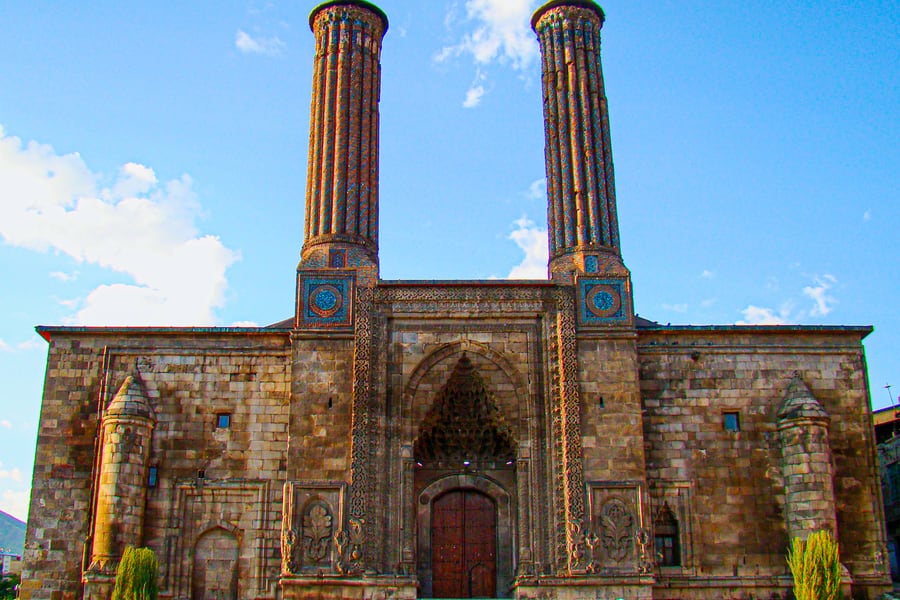 Bjørn Christian Tørrissen / Wikimedia Commons · CC BY-SA 3.0 · cropped
Erzurum
A tough, handsome mountain city near 1,900 m, where the train arrives in real cold for much of the year. The Çifte Minareli Medrese, a theological school finished a few years before 1265, takes its name from the two fluted, tile-set minarets that crown its carved façade. More Seljuk and Ilkhanid monuments stand within a short walk, and there is skiing at Palandöken above the town.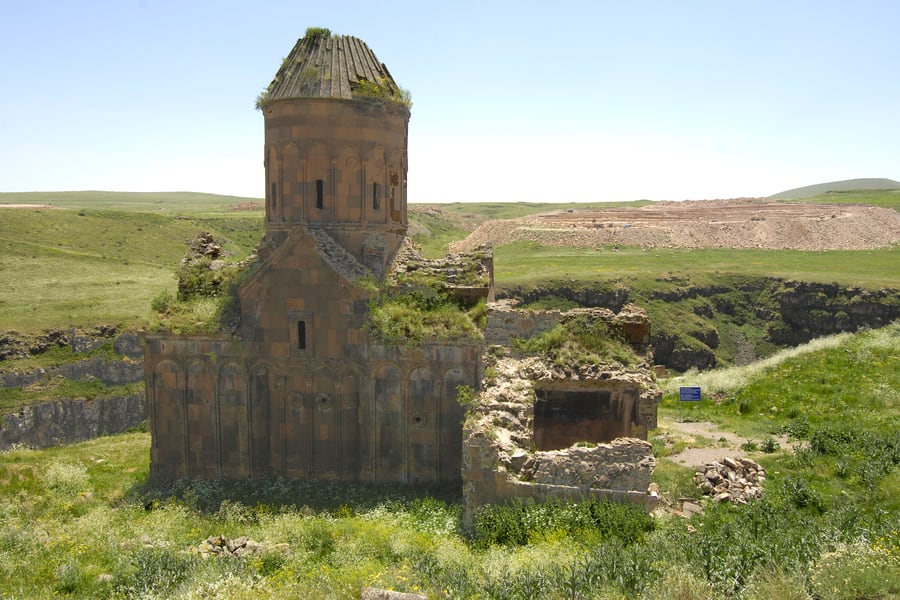 Dick Osseman / Wikimedia Commons · CC BY-SA 4.0 · cropped
Ani
The reason many people ride this train at all. Ani was capital of the Bagratuni Armenian kingdom from 961 to 1045 and was known as the City of 1,001 Churches; some 50 churches and more than fifty chapels have been excavated. What survives stands alone on empty grassland above the gorge that is now the closed Armenian border — including a cathedral whose ribbed vaulting anticipates European Gothic by two centuries.Where to Sleep
For the journey itself the decision is simply which class you book — and at about twenty-six and a half hours, it matters more than it would on a normal overnight run.
- Couchette — four berths to a compartment, made up with sheets, a blanket and a pillow, and shared with whoever turns up. The way to arrive in Kars rested, and where the sociable side of the train really lives.
- Coach seat — a proper seat for a day and a half. Fine if you're young, stubborn and travelling in summer. Less fine in January.
The daily train has no private sleeping cars; those are on the winter Turistik Doğu Ekspresi only.
At the ends of the line:
- Ankara — plenty of business hotels near the station; nobody lingers, and there's no need to.
- Kars — stay at least two nights. You need one to recover and one to get out to Ani, which is the reason you came. The town has a growing set of small hotels, some in restored Russian-era buildings, and the local honey and kaşar cheese are famous.
- Erzurum — a good place to break the trip, especially if you want to ski at Palandöken or see the Seljuk medreses.
- Kayseri — break here for Cappadocia, which is an easy add-on and a completely different Turkey.
Two notes. Winter is the reason to come and the reason to plan — Kars can sit at −30°C, and delays happen. And book everything early for December to March, when the whole country wants to be on this train.
Questions or corrections
Planning this trip and stuck on something, or spotted a time, fare or detail that has changed? Send us a message about Doğu Ekspresi. We read every one, and we update this page when something has changed.