Driving Creek Railway
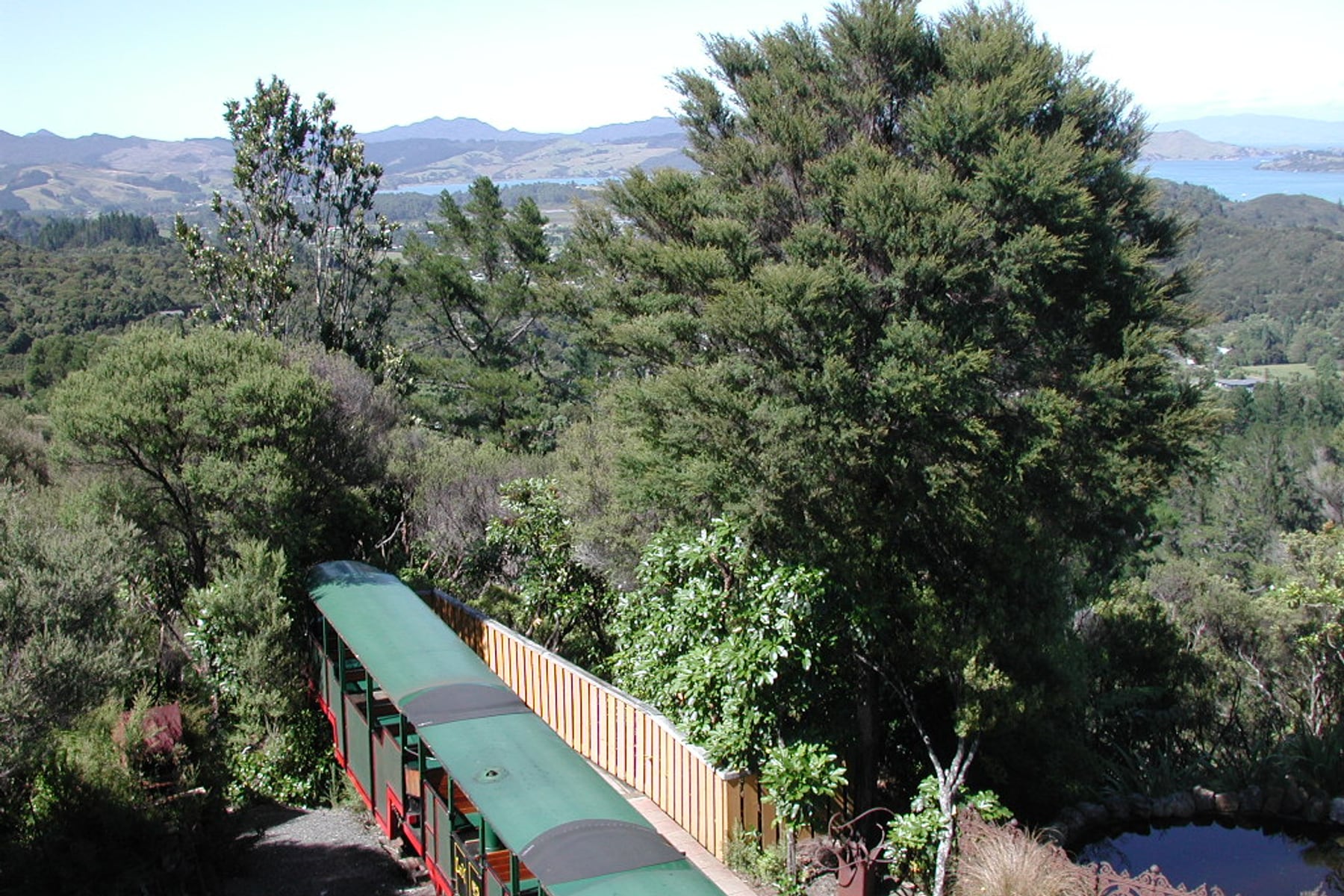
Pseudopanax / Wikimedia Commons · Public domain · cropped
- Distance2.7 km each way
- Duration1h 15m return
- Best seasonYear-round · daily
Introduction
A potter needed clay. The clay was up a hill behind his pottery, on a hillside three kilometres north of Coromandel Town that a century of kauri logging, gold mining and farming had stripped bare, and the cheapest way to bring it down was a railway. So Barry Brickell built one — by hand, on a budget, out of second-hand rails bought at scrap-steel price from closing Waikato coal mines, on sleepers cut from his own pines and ballast traded for pottery.
He never stopped. Over the next quarter of a century the line climbed away from the clay pit and kept going: five zigzag reversing points stacked up the face of the hill, three tunnels dug by hand, ten bridges — among them a double-deck viaduct its builders reckon has no equal anywhere in the railway world — and two spirals. It is 381 millimetres between the rails — fifteen inches — and it climbs 112 metres in 2.7 kilometres, on gradients as steep as 1 in 14. In 1990, after a cousin who happened to be a civil engineer had test-loaded every structure to one and a half times its design weight, the Ministry of Transport licensed it to carry fare-paying passengers at six dollars a head.
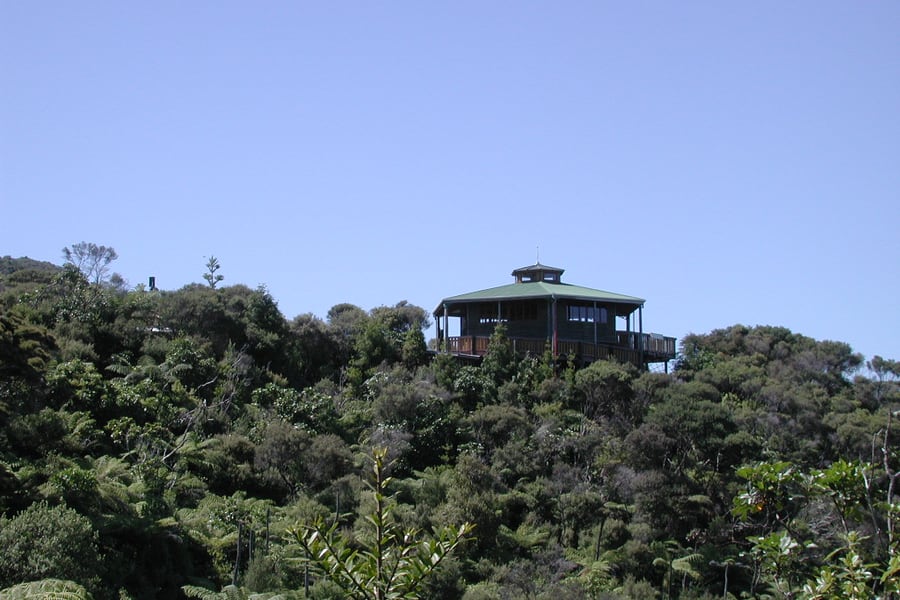
What you ride today is that railway, finished. The train leaves the potteries, crosses the gully on No. 1 bridge, works up through the tunnels and the switchbacks and over the double-decker, and stops after 2.7 kilometres at the EyeFull Tower — an octagonal wooden lookout modelled on an Auckland harbour lighthouse, standing clear of the canopy with the Hauraki Gulf laid out below it. It takes an hour and a quarter, there and back. The forest the line runs through was planted by the man who built it, tree by tree, and the whole property is now held by a conservation trust that thinks in centuries.
The Journey
The train sits under a canopy beside the pottery, and the first thing you notice is that it is not a toy. The rails came from Waikato coal mines. The carriages were designed and built in the workshop forty metres away. The line ahead of you was surveyed with a home-made instrument its builder called a gradimeter — a Vickers gun sight on a tripod with levelling screws — because a proper theodolite was heavier than he wanted to carry through scrub.
Out of the yard the track crosses No. 1 bridge, a 43.6-metre span thrown across two diverging streams in 1977 to reach the clay and the firewood higher up. Everything above that point exists because the hill kept refusing to be climbed. Where the gradient beat him, Brickell doubled back: five reversing points — Ravington, Hoki Mai, Cascade, Horopito and Rima — each one a short level shelf where the driver walks to the other end and the train sets off the other way, gaining height on every leg. Where doubling back was not enough, he tunnelled, or spiralled, or both.
The double-decker
Between Cascade and Hoki Mai the line does something its builders reckon no other railway anywhere does. Three years of surveying, hand-dug earthworks and overlapping cuttings produced a viaduct with a track on each deck: the train crosses the lower level, climbs away round a spiral, and comes back to cross the same structure on the deck above, the top span running 45.9 metres across the gully. It opened in 1991. In 2004 unseasonal rain put a slip across the approaches and trains terminated short of it for a season; two new bridges and a concrete retaining wall at Cascade fixed that, and the line has run since.
The forest, and the top
For most of the climb you are inside bush — tree ferns closing overhead, the track a metre wide between them, the sea appearing and disappearing as the train swings through another reversal. Very little of this forest is original. The property was pasture and wild pine when Brickell bought it, and more than 27,000 native trees — kauri, rimu, tōtara, mataī, miro, kōwhai — were carried up this railway in wagons over thirty years and planted by hand. What closes over the carriage roof is a plantation that grew up while the line was being built.
The last stretch above Rima was the hardest to survey: old slips, a steep face, a third tunnel and a forty-metre bridge. The first passengers reached it in December 2001, and the EyeFull Tower — the pun is on the view as much as on Paris — was finished two years later and opened by Dame Catherine Tizard. You get off, climb the deck, and look out over Coromandel Town, its harbour, the mussel farms and the islands of the Hauraki Gulf. Then the same train takes you back down through the same forest, and the whole thing has taken an hour and a quarter.
Along the route
 Reinhard Dietrich / Wikimedia Commons · CC0 · cropped
Out of the potteries
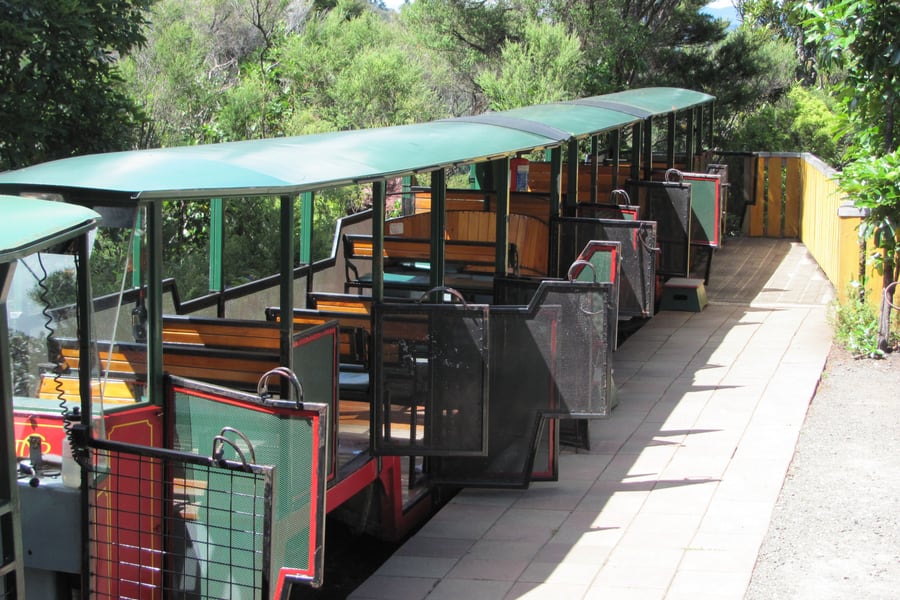
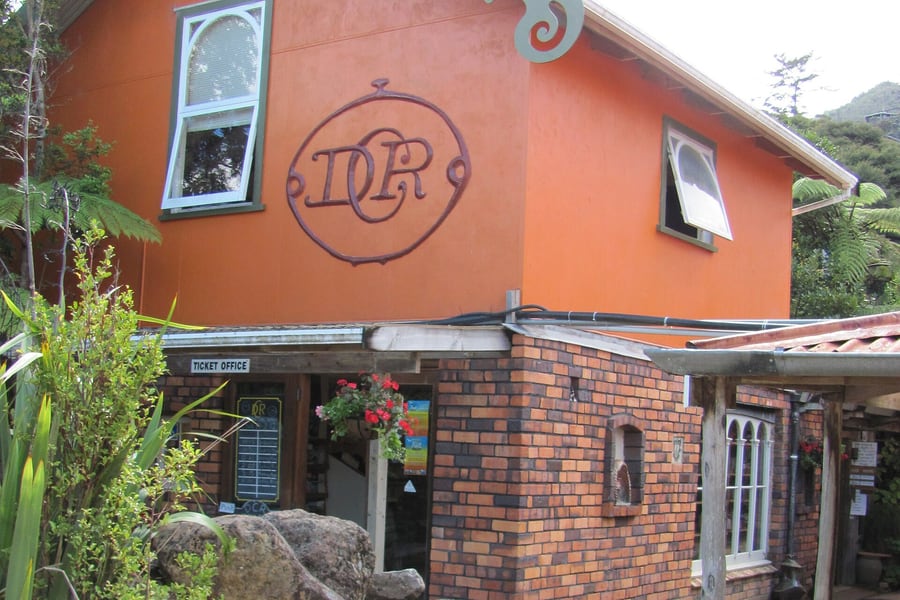
The train starts beside the kilns, under a canopy, at a ticket office with the railway's monogram on the gable. Everything you are about to ride was surveyed with a home-made gradimeter — a gun sight on a tripod — because a theodolite was too heavy to carry through scrub.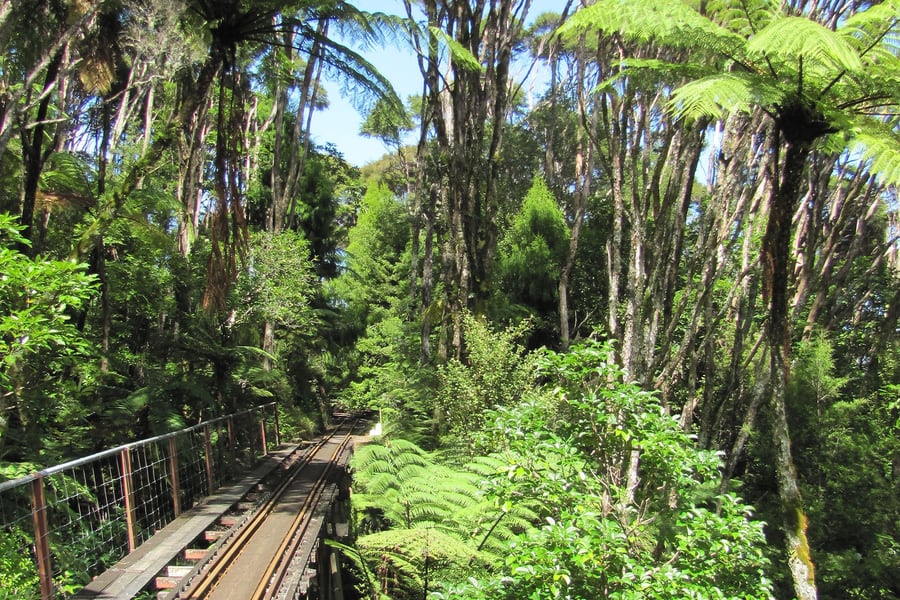 Reinhard Dietrich / Wikimedia Commons · CC0 · cropped
No. 1 bridge and the lower spiral
A 43.6-metre span on piers up to five metres high, thrown across two diverging streams in 1977 so the line could reach the clay and the firewood above. It was the first of eight viaducts, and its steel beams came out of scrap yards.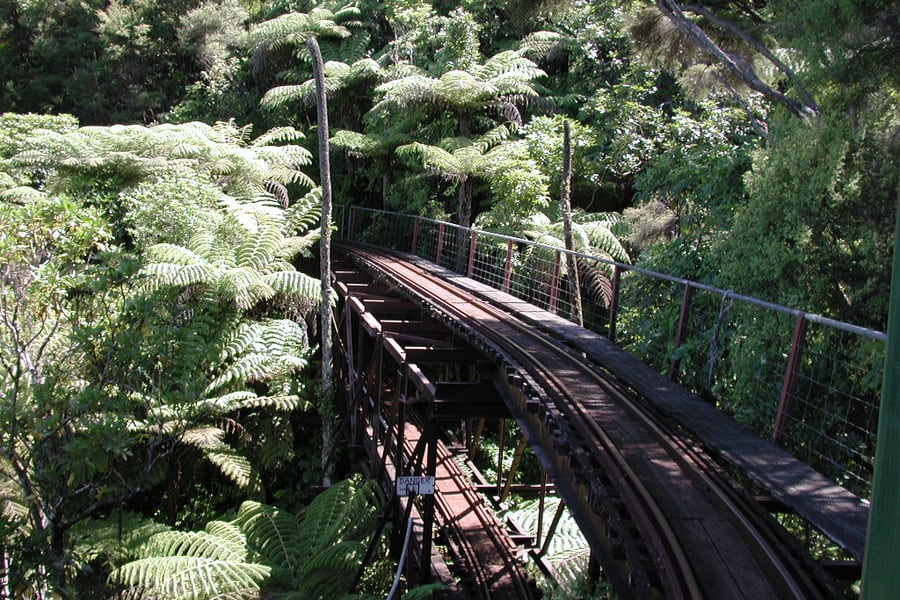 Pseudopanax / Wikimedia Commons · Public domain · cropped
The double-deck viaduct
The train crosses the lower deck, climbs away round a spiral and comes back over the same structure on the deck above, the top level spanning 45.9 metres. Three years of surveying and hand-dug earthworks went into it; it opened in 1991, and its builders reckon nothing else in the railway world is put together this way.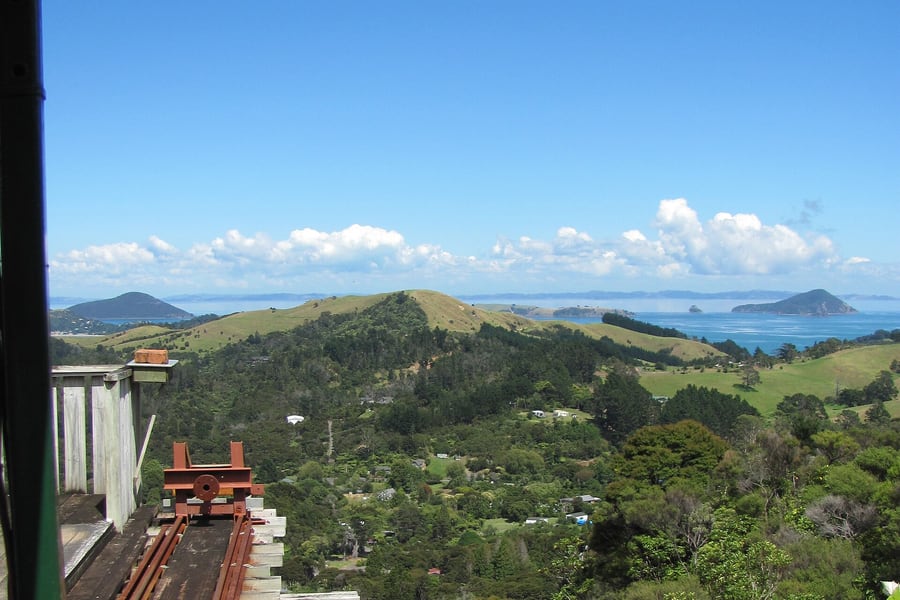 Reinhard Dietrich / Wikimedia Commons · CC0 · cropped
Five zigzags to Rima
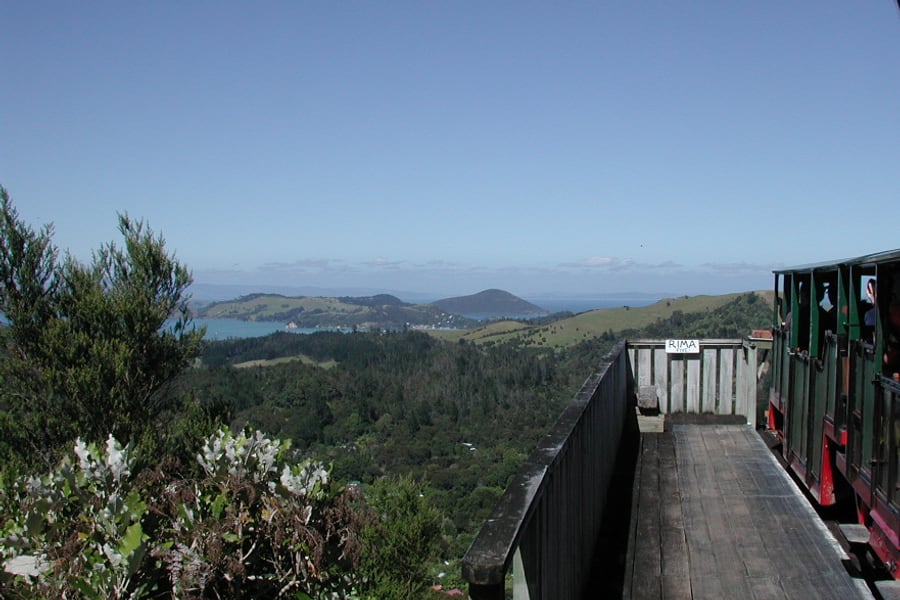
Where the hill beat the gradient, the line simply doubles back. Ravington, Hoki Mai, Cascade, Horopito, Rima — five short shelves where the driver walks to the other end and the train sets off the other way. Rima is a trestle with the Gulf laid out below it.A bit of history
Culture & experiences along the way
 Emmamccleary / Wikimedia Commons · CC BY 2.0 · cropped
A railway built out of brick and sculpture
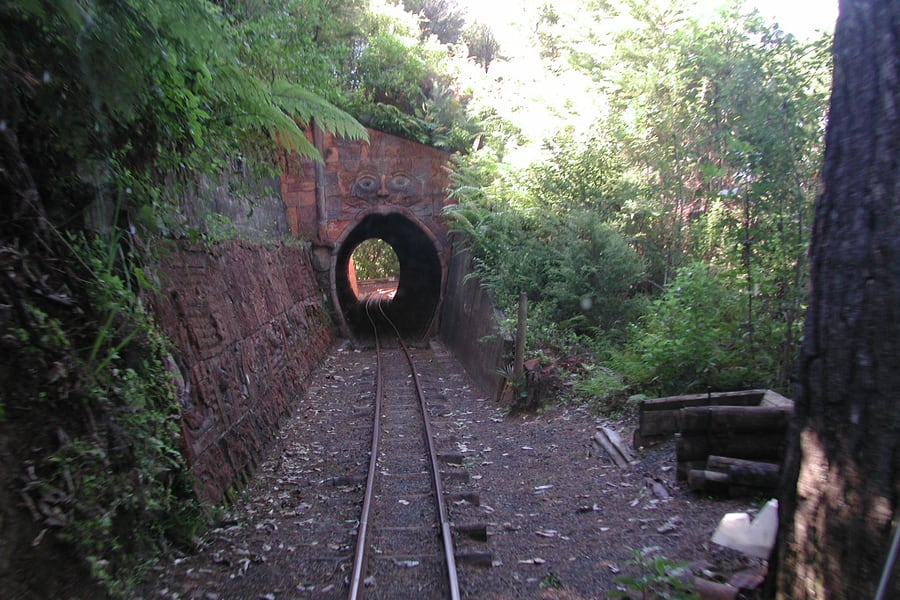
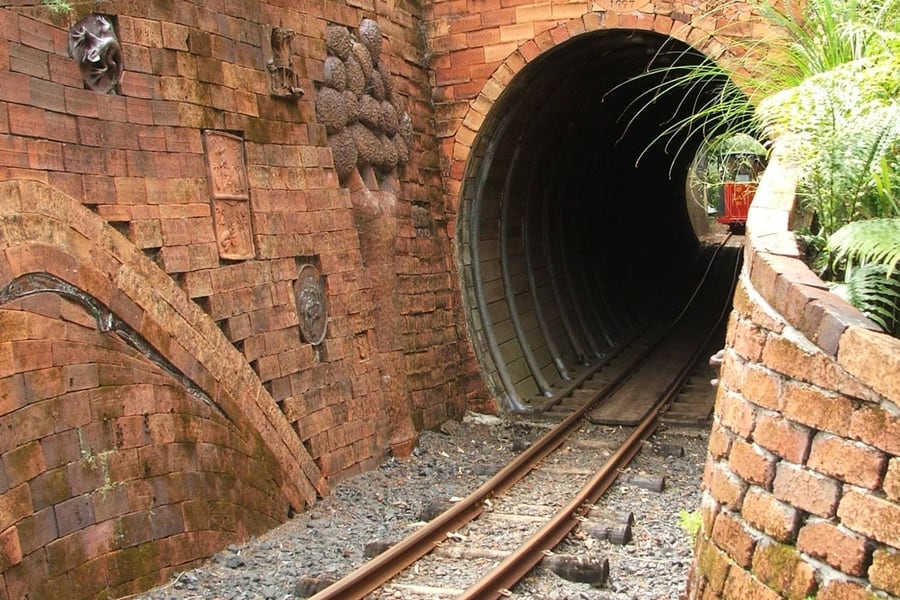
Brickell was a potter first, and it shows: the tunnel portals are faced in brick fired on the property, with modelled faces set into the arches, and terracotta pots stand along the line like mileposts. He established a handmade brickworks here in 1992 and its bricks went into retaining walls, buildings and the railway itself.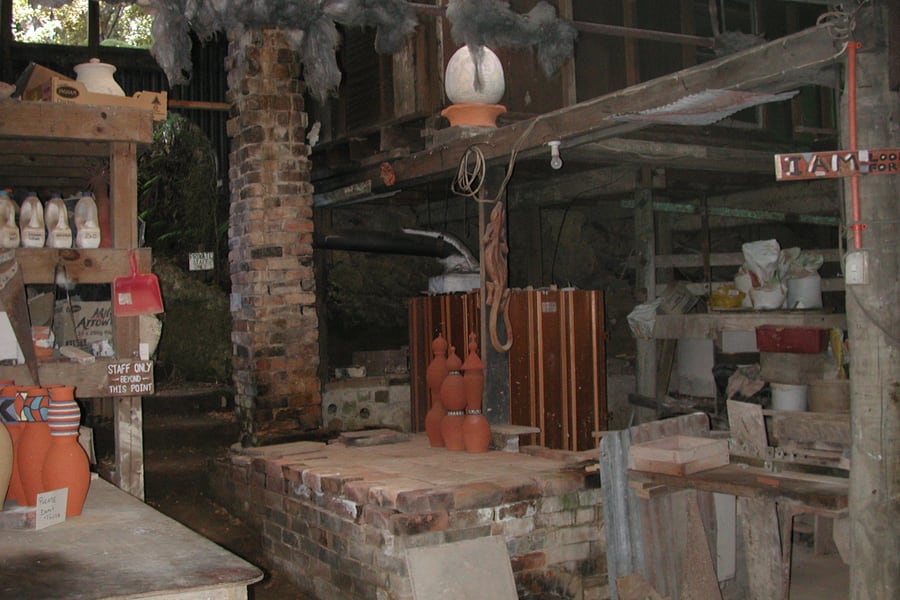 Pseudopanax / Wikimedia Commons · Public domain · cropped
The pottery the line was built to serve
The clay came first. Brickell was New Zealand's first full-time handcraft potter, and in 1974 he built the country's first wood-fired stoneware kiln here, out of bricks salvaged from a demolished hotel chimney. The studio still works, still takes artists in residence, and now runs wheel-throwing classes for visitors.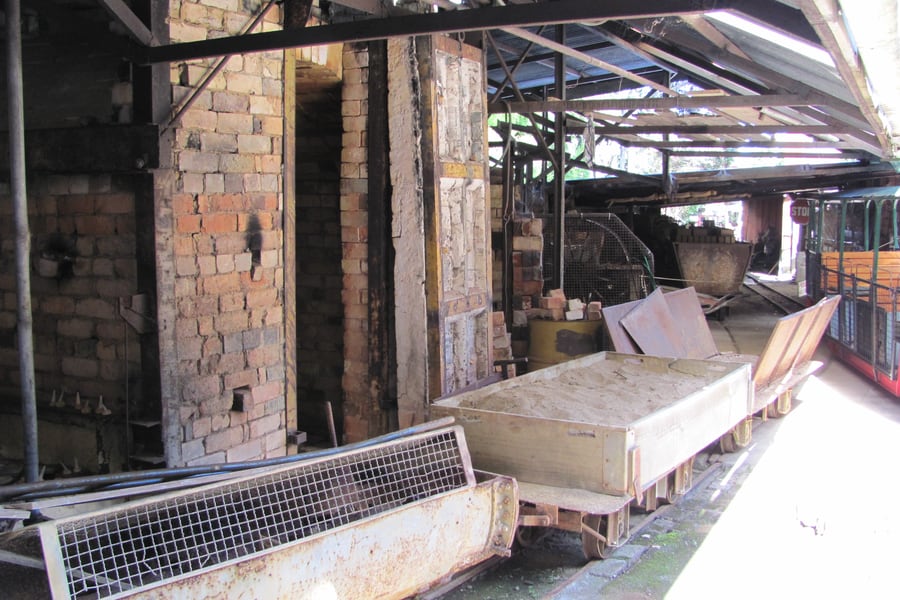 Reinhard Dietrich / Wikimedia Commons · CC0 · cropped
A fleet with names, not numbers
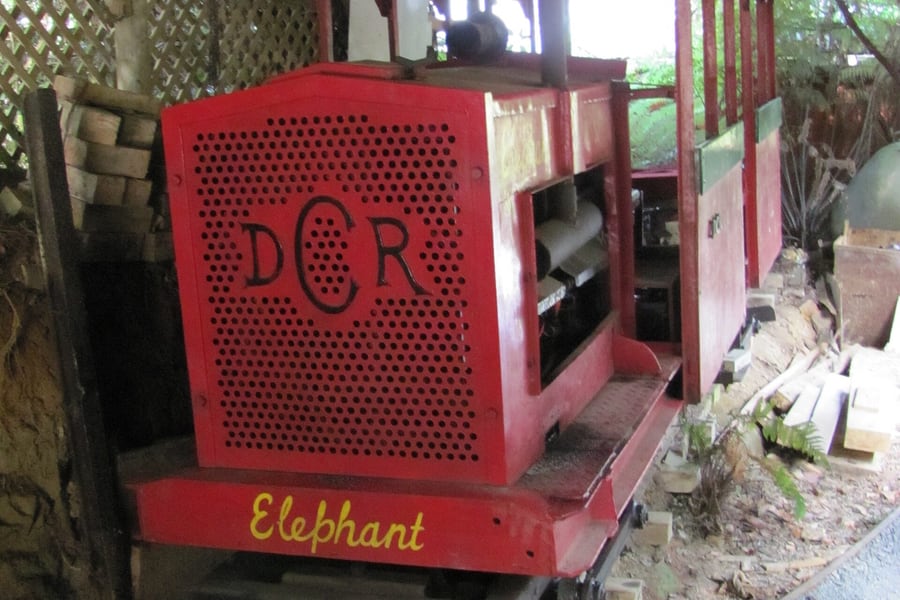
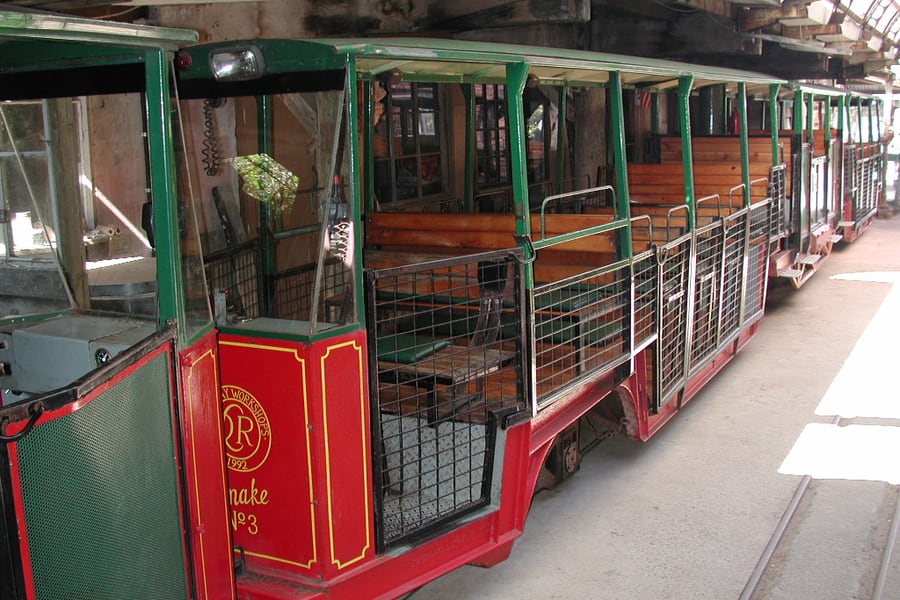
Every machine here was built in the workshop. Dieselmouse, the first, ran on a single-cylinder engine and a gearbox salvaged from the Auckland Harbour Bridge contractors. Then Elephant, then Possum — a carriage converted after it lost adhesion in the wet — then Snake and Linx, the articulated railcars that carry you today.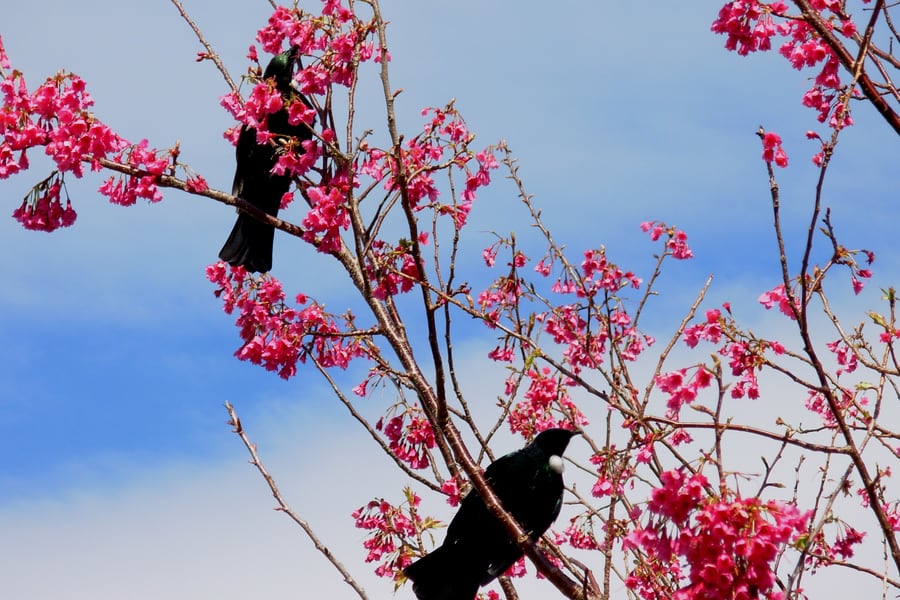 Walter Rumsby / Wikimedia Commons · CC BY-SA 2.0 · cropped
What the trapping bought
Tūī, kererū, pīwakawaka and kiwi are back in this valley because somebody put more than 400 traps across the hills and has kept them running. A 1.4-hectare predator-proof sanctuary — the first on the Coromandel Peninsula — was fenced in 2008, and every ticket still pays for the pest control around it.Timetables
Four departures a day, every day of the year except Christmas Day. The site is open 9.00am to 4.30pm and the railway runs to a fixed board that does not change with the season.
| Departure | Back at | Notes |
|---|---|---|
| 09:45 | ~11:00 | First train of the day |
| 11:15 | ~12:30 | |
| 13:30 | ~14:45 | |
| 15:00 | ~16:15 | Last train of the day |
The operator publishes the departure times and a duration of 75 minutes, which includes the climb, the stop at the tower and the run back down; the return times above are that duration added to each departure rather than a separately published figure.
Good to know:
- The four times above run all year. We swept the operator's booking system month by month from September 2026 to June 2027 and found the same four departures loaded on every single date, with 25 December the only day missing.
- School holidays and long weekends add four more. In the peak blocks the board doubles to 09:45, 10:30, 11:15, 12:00, 13:30, 14:15, 15:00 and 15:45 — that pattern was loaded solid for 26 September to 11 October 2026, and single extra departures appear on scattered dates through the summer. If the day you want looks full, check it again nearer the time; capacity is added rather than moved.
- Book ahead and arrive fifteen minutes early. Seating is limited to one train at a time and payment is taken at booking; check-in is at the reception by the pottery, where the guide collects tickets and gives the safety briefing.
- It runs in the rain. Most of the route is inside sheltered forest and ponchos are lent out at reception. Only severe weather stops it, and the operator then offers a later departure, a new date or a full refund.
- Wheelchair users are carried, with a space that has to be reserved at the time of booking. Driving Creek is a Hāpai Access Card partner: a support person travels free, or a cardholder travelling alone gets ten per cent off.
Times and running days as of September 2026, read from Driving Creek's own published information and confirmed date by date in its live booking system. Confirm before travelling at drivingcreek.nz (opens in a new tab).
Tickets
Driving Creek sells this train itself, online or at the reception desk, and there is one class of travel. When we checked its booking system in September 2026 a return ride was NZD 57 for an adult and NZD 32 for a child aged four to sixteen. Infants under four travel free but must be declared when booking, and a child under two who is not yet walking has to be carried in a front pack. Anyone thirteen or under must be with an adult.
A family pass for two adults and two children is NZD 155, with further children added at NZD 22 each — cheaper than four singles by a clear margin. Wheelchair spaces are sold at the same adult and child fares and have to be reserved when booking. Driving Creek is a not-for-profit: the fare goes to the trapping, the replanting and the pottery, not to a shareholder.
Book your tickets
Railway tour · adult
Return to the EyeFull Tower
Seventy-five minutes with a guide, ten bridges, three tunnels and the lookout at the top.
Book Tickets (opens in a new tab, on drivingcreek.nz)via drivingcreek.nzFamily pass
Two adults and two children
Sold as one fare rather than four, with further children added at NZD 22 each.
Book Tickets (opens in a new tab, on drivingcreek.nz)via drivingcreek.nzChild fare
Ages four to sixteen
Under-fours travel free but have to be declared when the booking is made.
Book Tickets (opens in a new tab, on drivingcreek.nz)via drivingcreek.nzRail Passes
No rail pass covers this railway, and none ever will. Interrail and Eurail are European products with no validity in New Zealand, and KiwiRail's Great Journeys brand — which has sold multi-trip passes for its own scenic trains and the Interislander ferry — has nothing to do with Driving Creek. This is a private 381 mm line on private land, owned by a charitable trust, and its only seller is itself.
Two things do reduce what you pay. Book two Driving Creek activities in the same transaction and fifteen per cent comes off the total — the railway pairs with the eight-line zipline canopy tour or a wheel-throwing pottery class, the two bookings can be on different days, and the discount is applied automatically at checkout. That offer is advertised as ending on 27 September 2026, so check it is still running before you count on it. And a Hāpai Access Card holder brings a support person free, or takes ten per cent off if travelling independently.
Checked against drivingcreek.nz in September 2026.
Places to Visit
The railway is a seventy-five-minute ride three kilometres north of a town of about 1,800 people, which means the rest of the day is the Coromandel's problem to solve. It solves it well. Within half an hour of the station there is a gold battery from 1899 that still crushes rock under New Zealand's largest working water wheel, a harbour farmed for mussels, two kauri groves that the sawmillers somehow missed, and — over the range on the eastern coast — a beach a British newspaper once called one of the twenty most deserted in the world.
There is a neat historical joke in the geography. The valley the train climbs out of is the one named in the claim Charles Ring registered in November 1852, later recorded by the Geological Survey as the first authenticated gold discovery in New Zealand. Prospectors came for the metal, loggers for the kauri, and a potter came for the clay that was under both of them.
 Ulrich Lange, Bochum, Germany / Wikimedia Commons · CC BY 3.0 · cropped
Coromandel Town
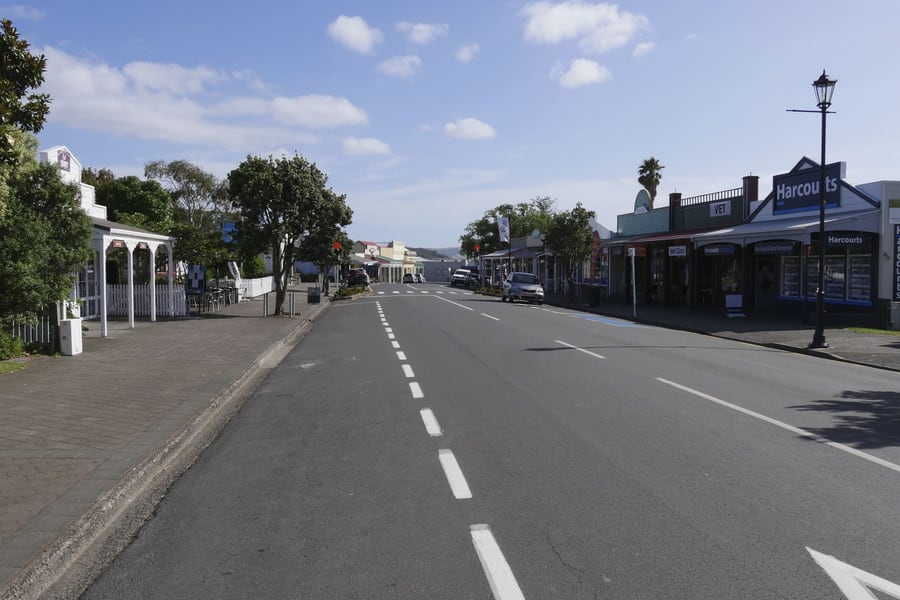
About 1,800 people, a verandahed main street and a harbour that was once a major port for gold and kauri. The town takes its name from HMS Coromandel, which sailed in for spars in 1820; it is 75 kilometres from Auckland in a straight line and 190 by road, which is most of what you need to know about the peninsula. Today it lives on mussels, art and visitors.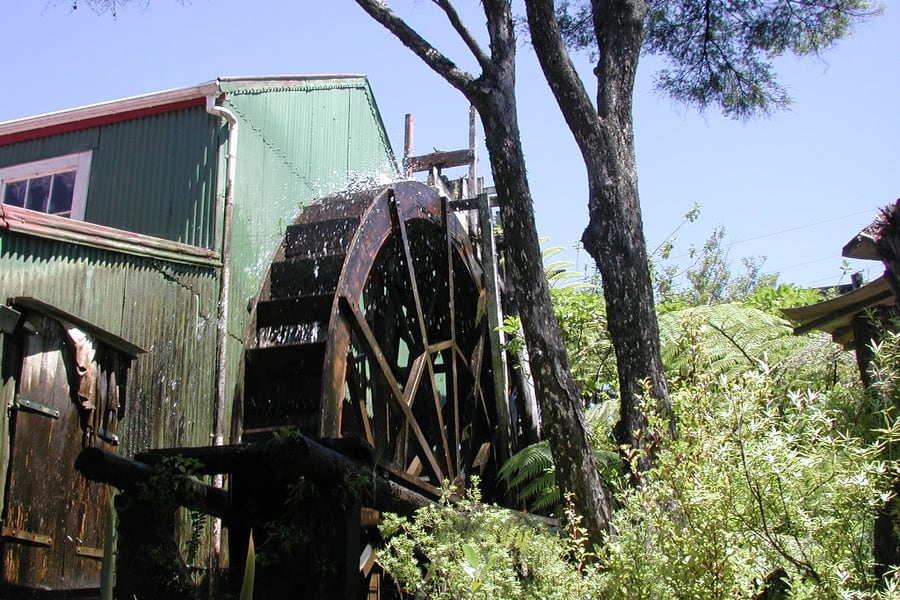 Pseudopanax / Wikimedia Commons · Public domain · cropped
The Coromandel Gold Stamper Battery
A quartz-crushing battery put up by the Coromandel School of Mines in 1899 and still running: a guided half-hour takes you inside to watch the century-old stampers and the jaw crusher work, then out to New Zealand's largest working water wheel. There is gold panning at midday and 140 steps up to a lookout. Weekends, 10am to 3pm.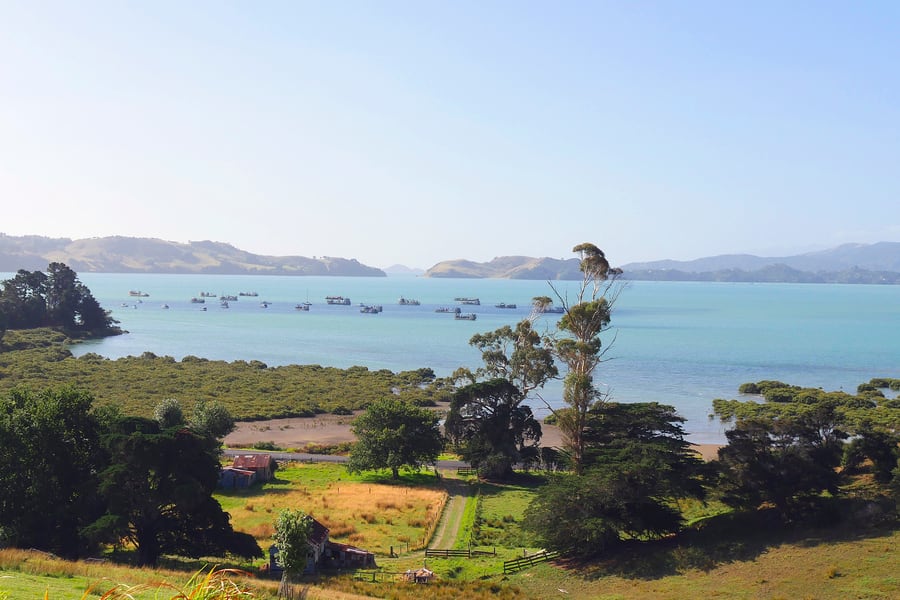 Ulrich Lange, Bochum, Germany / Wikimedia Commons · CC BY 3.0 · cropped
Coromandel Harbour
The wide bay you look down on from the top of the railway, sheltered by a scatter of islands of which Whanganui Island is the largest. The dark rectangles on the water are mussel lines — farming them is one of the town's two industries, and Coromandel Harbour is one of the country's main growing grounds. Boats leave the wharf for the islands.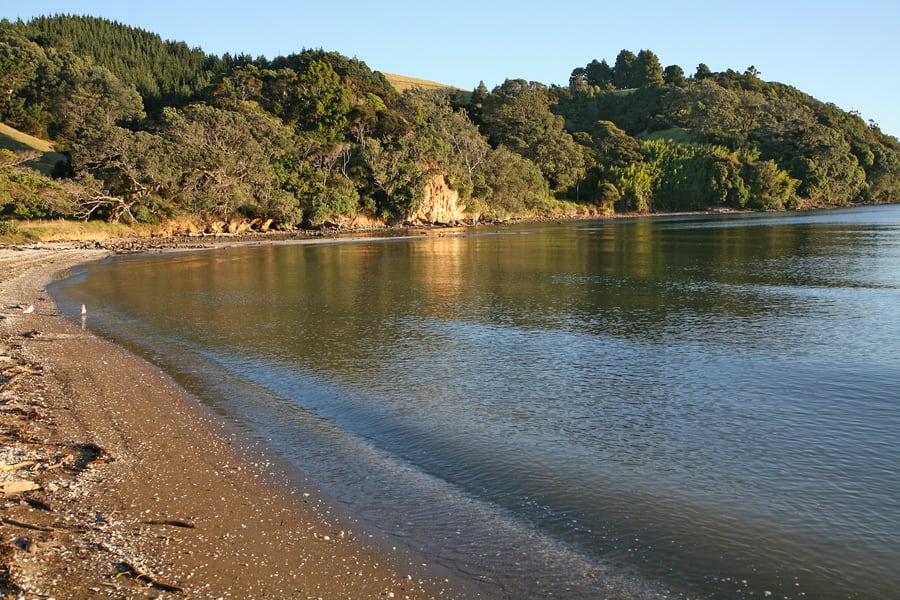 W. Bulach / Wikimedia Commons · CC BY-SA 4.0 · cropped
Long Bay and its kauri
A sheltered beach and campground at the end of Long Bay Road, and behind it a bush loop of about an hour that reaches a kauri thought to be 1,200 years old and a stand of younger ones, then climbs above Tucks Bay for the sea view. Scrub your boots at the station at both ends — kauri dieback travels in soil.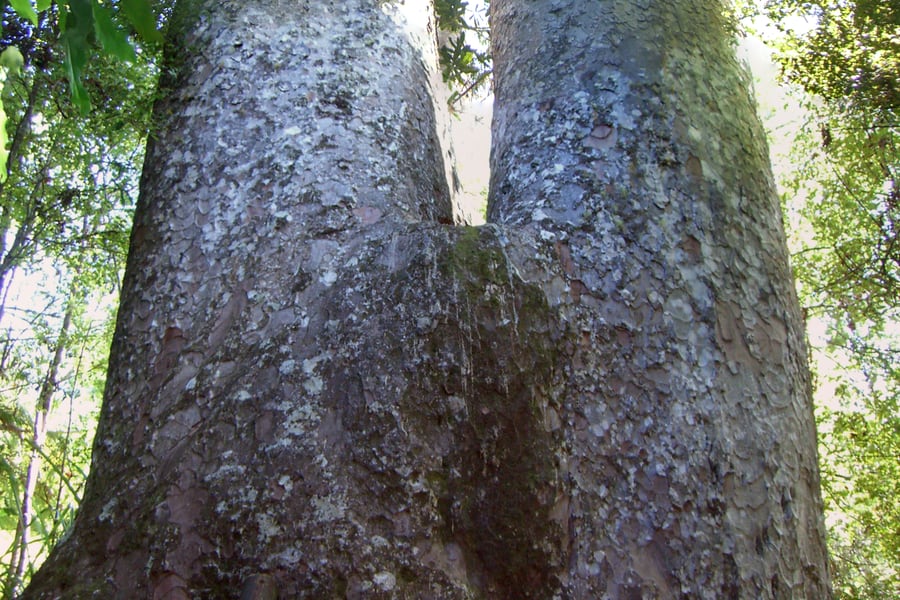 Alexander Carroll / Wikimedia Commons · CC BY-SA 3.0 · cropped
Waiau Falls and the 309 Road
The 309 Road cuts across the range towards Whitianga and is the peninsula's best detour. Seven kilometres along it there is a waterfall with a swimming hole below it, and a kilometre further a short track into the most accessible mature kauri stand on the peninsula — including a "Siamese" kauri that forks into two trunks just above the ground.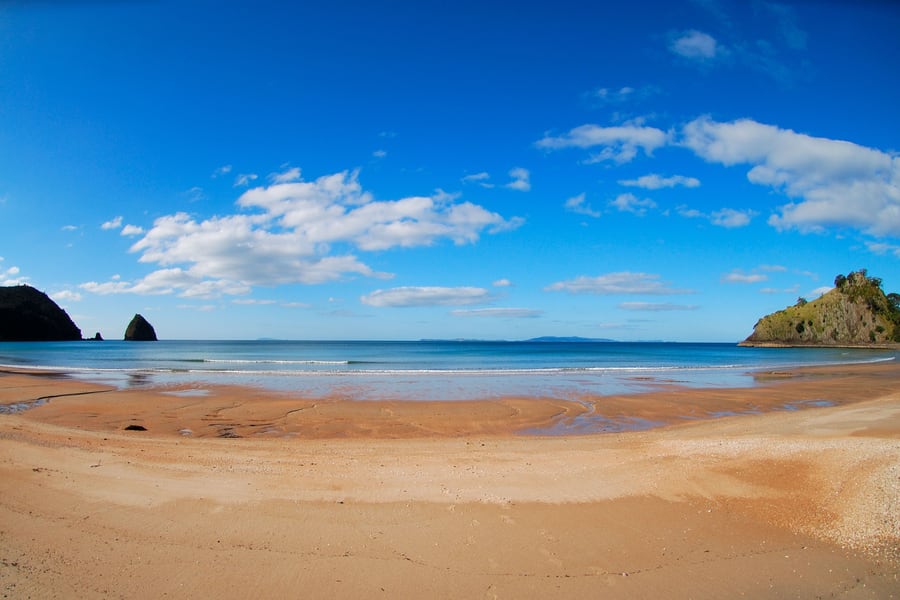 Piotr Zurek / Wikimedia Commons · CC BY 2.0 · cropped
New Chums Beach
A kilometre of white sand with nothing built behind it — no road, no houses, only bush — which is why The Observer put it among the world's twenty best deserted beaches in 2006 and why a plan to build twenty houses on it was fought off. You reach it on foot from the north end of Whangapoua Beach, and only at low tide, or by boat.Where to Sleep
The ride is an hour and a quarter and the last train leaves at three in the afternoon, so nobody stays here for the railway alone — you stay because Coromandel Town is two and a half hours from Auckland by a road that winds the whole way, and arriving in the dark to catch a 9.45am departure is a poor plan. The town has around 1,800 residents and a short main street; everything in it is within a few minutes' walk of everything else, and the railway is three kilometres up the coast road from the roundabout.
Two kinds of bed suit this trip. In the town itself you are walking distance from the cafés, the wharf and the Saturday market, and five minutes' drive from the station. Up in the bush on the hills behind — Buffalo Road climbs past the gold battery, and the smaller lodges sit in the same regenerating forest the railway runs through — you get the birdsong that the railway's forty years of trapping and planting paid for. Book ahead between late December and February, when the peninsula's population multiplies and the train doubles its departures.
Where to stay
Anchor Lodge Coromandel
Wharf Road, 400 m from the town centre
Twenty motel and apartment units, some with harbour views, five minutes' drive from the railway.
Check Availability (opens in a new tab, on anchorlodgecoromandel.co.nz)via anchorlodgecoromandel.co.nzBuffalo Lodge
Buffalo Road, in regenerating bush above the town
Four rooms, all facing the sea, on the same hill road as the gold battery and five minutes from Coromandel Town.
Check Availability (opens in a new tab, on buffalolodge.co.nz)via buffalolodge.co.nzTidewater
Motel units, cabins and a small campground
Self-contained units and two cabins a three-minute walk from the main street, with a grassed campground behind.
Check Availability (opens in a new tab, on tidewater.co.nz)via tidewater.co.nzQuestions or corrections
Planning this trip and stuck on something, or spotted a time, fare or detail that has changed? Send us a message about Driving Creek Railway. We read every one, and we update this page when something has changed.