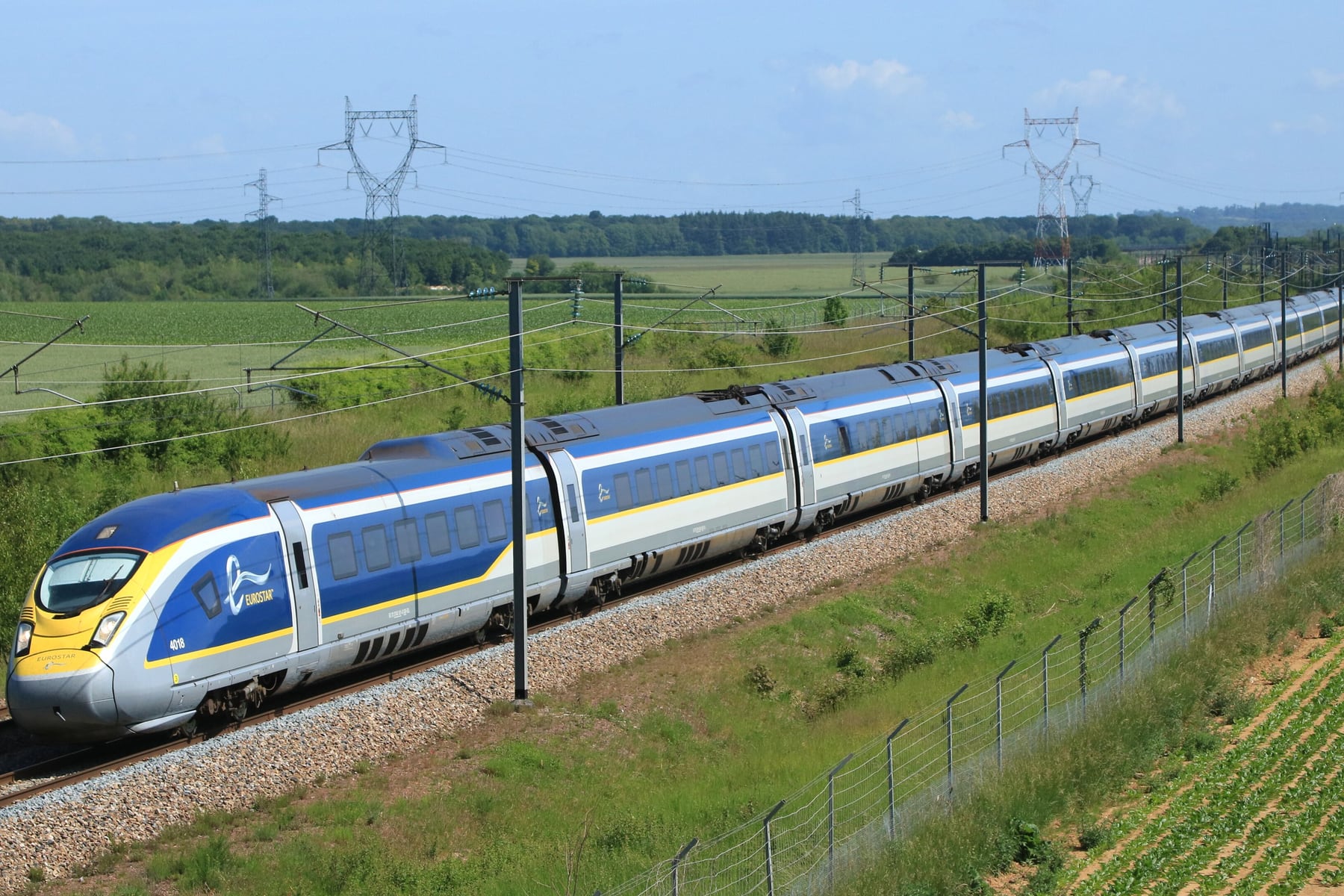
Eurostar: London to Paris
Cramos / Wikimedia Commons · CC BY-SA 4.0 · cropped
- DistanceAbout 490 km, St Pancras to the Gare du Nord
- DurationAbout 2 h 15 min – 2 h 30 min
- Best seasonAll year · up to 15 trains a day each way
Introduction
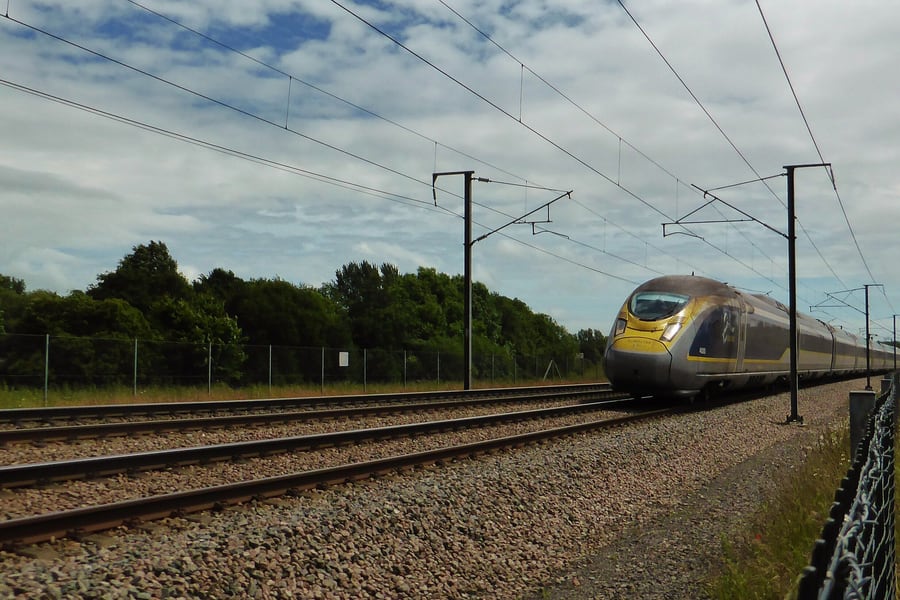
Eurostar is the train under the Channel. From St Pancras International in London it runs on High Speed 1 across Kent, through the Channel Tunnel and down the LGV Nord to the Gare du Nord in Paris, city centre to city centre, at up to 300 km/h for most of the way. It is not a scenic railway in the way the Highland lines are, but no other journey on this site does as much in two and a quarter hours: under the Thames, over the Medway, through the chalk of the North Downs and 38 km under the sea.
The first Eurostars ran from Waterloo in November 1994, six months after the tunnel opened. Since 2007 they have left from the restored St Pancras, one of the great Victorian stations, and since 2023 Eurostar has also run the former Thalys trains between Paris, Brussels, Amsterdam and Cologne. In 2025 it carried a record 20 million passengers.
On weekdays there are about fifteen trains a day each way between London and Paris, all non-stop, and passport and security checks are done before you board, so you simply step off in Paris.
The Journey
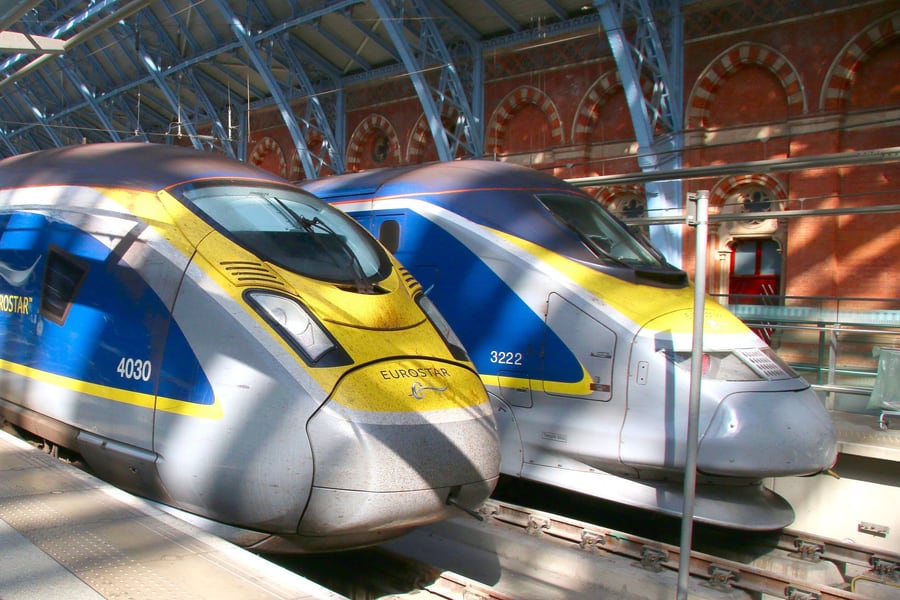
Eurostar leaves from the international platforms at the north end of St Pancras, under William Barlow's great iron and glass roof. Departures are downstairs in the old undercroft: check in, go through security and both countries' border controls, and wait in the departure lounge until your train is called.
Under London and the Thames
The train slips out past King's Cross and almost at once goes underground. High Speed 1 runs through two long tunnels, of 10.1 and 7.5 km, beneath east London, coming close to the surface at Stratford and coming out at Dagenham. It runs beside the London, Tilbury and Southend line, then dives under the river in a 3.1 km tunnel at Swanscombe and comes out in Kent.
Across Kent
Past Ebbsfleet the line crosses the River Medway on its 1.2 km viaduct and enters the North Downs Tunnel. Much of the way on through Kent runs beside the M2 and M20 motorways, past Ashford. Eurostar trains used to call at Ebbsfleet, Ashford and Calais-Fréthun, but those stops ended in 2020, and every London–Paris train is now non-stop.
Under the Channel
At Folkestone the line passes the Eurotunnel shuttle terminal and enters the Channel Tunnel. It is 50.46 km long, and 37.9 km of it lie under the sea, the longest undersea section of any tunnel in the world, reaching 75 metres below sea level. Trains are limited to 160 km/h inside, and come out at Coquelles, near Calais.
Across northern France
From the tunnel the train joins the LGV Nord, the high-speed line opened in 1993, and runs at up to 300 km/h across the open farmland of the Pas-de-Calais and Picardy, for much of the way beside the A1 motorway. It passes non-stop through Haute-Picardie, a station built in the middle of the fields and nicknamed the "Beetroot Station". At Arnouville-lès-Gonesse, 16.6 km from the terminus, it leaves the high-speed line for the last run in through the northern suburbs to the Gare du Nord.
The trains
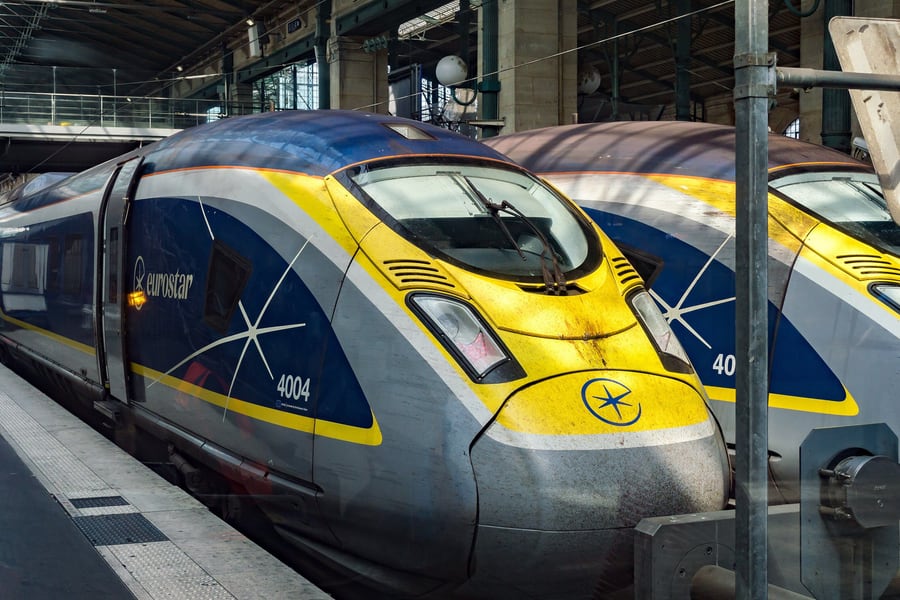
Most trains are Eurostar e320s (British Class 374), sixteen-coach Siemens Velaro sets 400 metres long, which entered service in November 2015 and can reach 320 km/h. The rest are the older e300s (Class 373), the original TGV-based trains of 1994, built with a smaller cross-section to fit Britain's loading gauge; eight of them remain in regular service, refurbished.
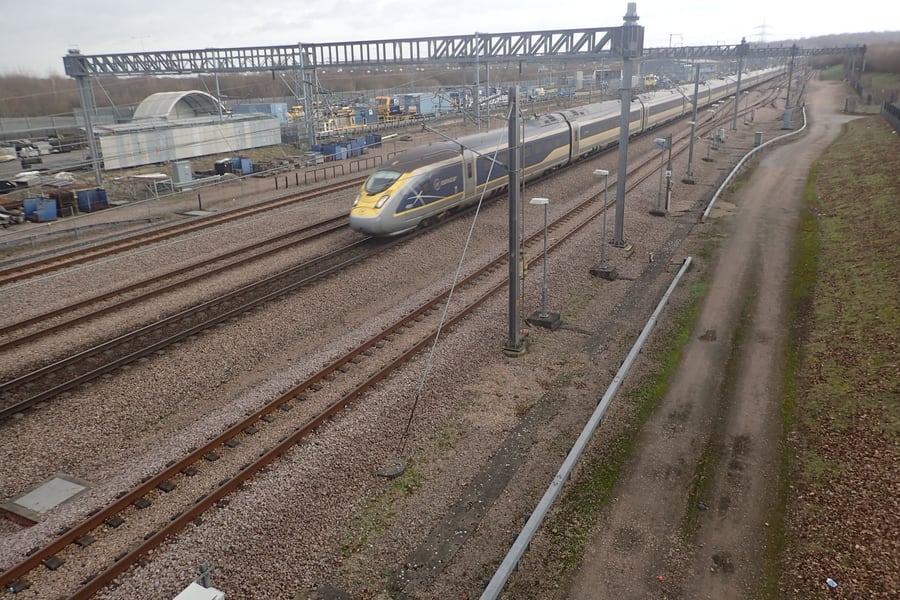
Along the route
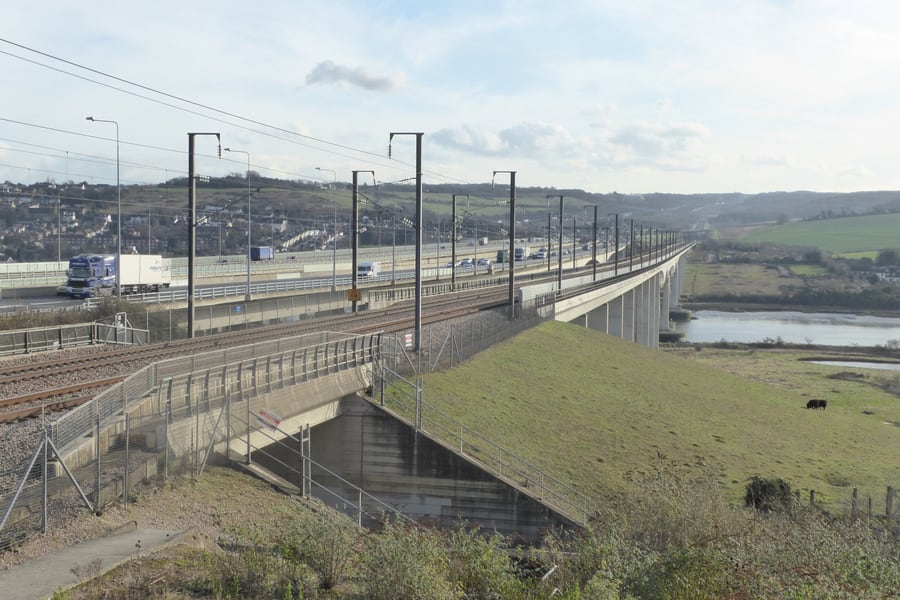 Marathon / Wikimedia Commons · CC BY-SA 2.0 · cropped
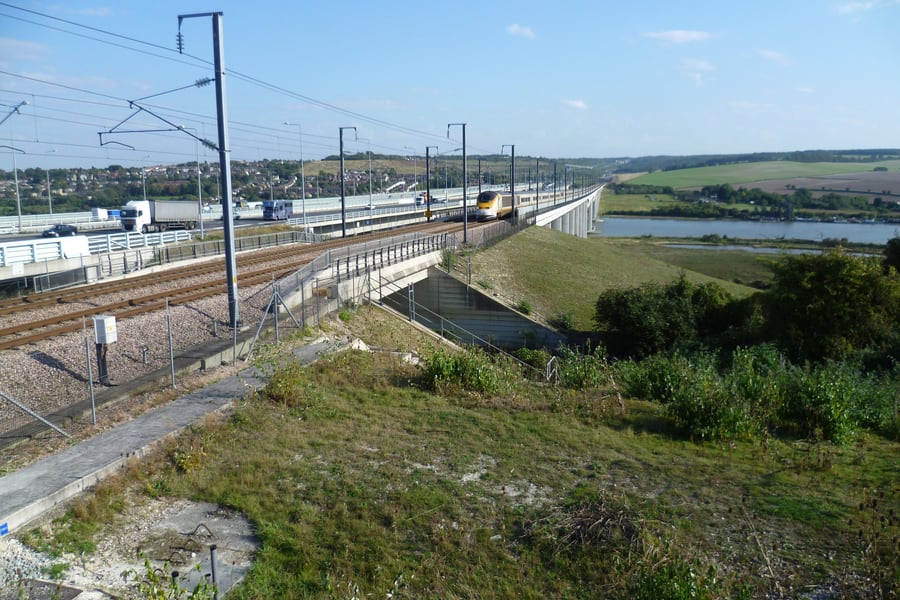
Medway Viaduct
Between Cuxton and Borstal the line crosses the River Medway on a 1.2 km viaduct beside the two M2 bridges. In 2003 a test train crossed it at 208 mph, a British speed record, before the line opened.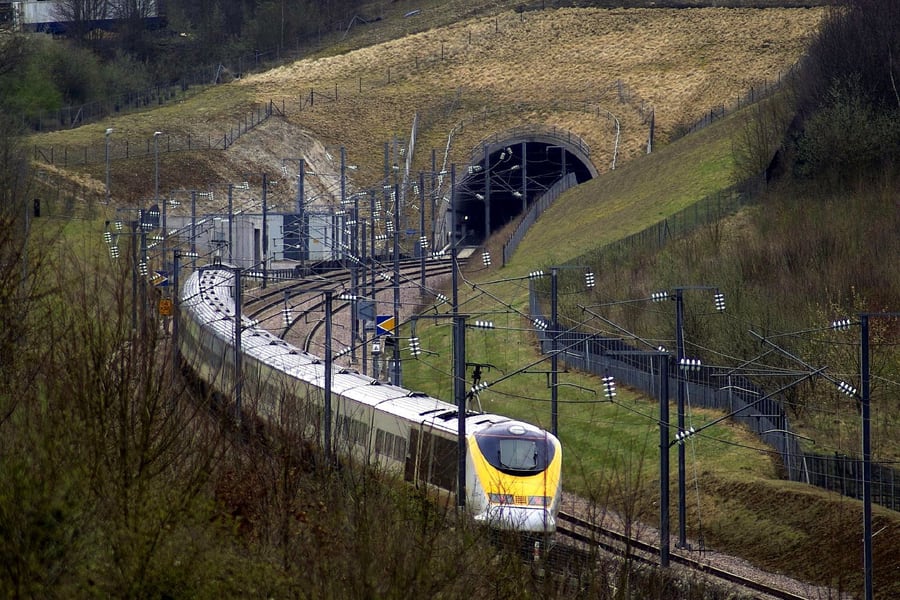 Paul Johnston / Wikimedia Commons · CC BY-SA 2.0 · cropped
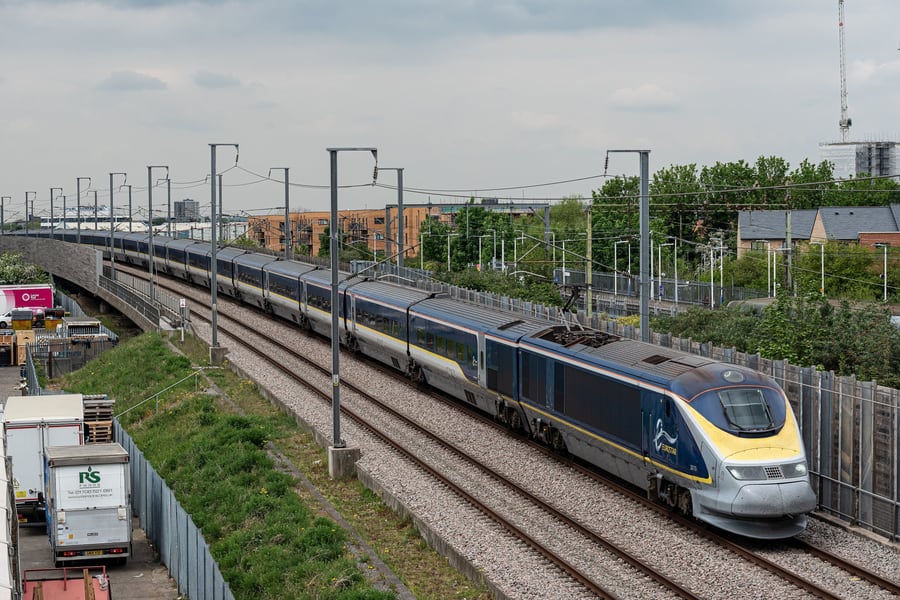
North Downs Tunnel
Just beyond the Medway the train dives into the chalk of the North Downs: a tunnel 3.2 km long and 12 m across. Much of the line through Kent runs beside the M2 and M20 motorways.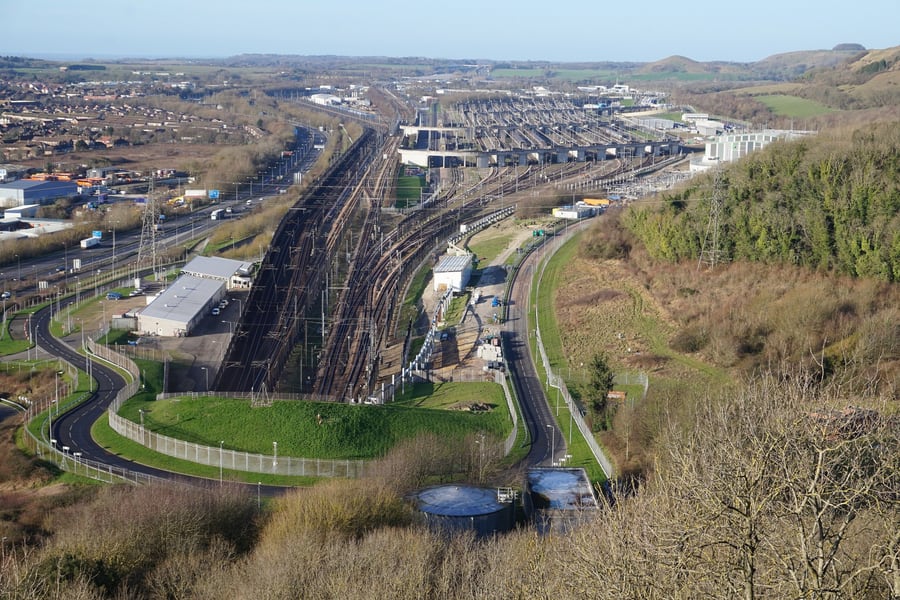 Ian S / Wikimedia Commons · CC BY-SA 2.0
The Channel Tunnel
At Folkestone the line passes the shuttle terminal and enters the tunnel: 50 km long, 38 km of it under the sea and up to 75 m below sea level. Trains are limited to 160 km/h inside it.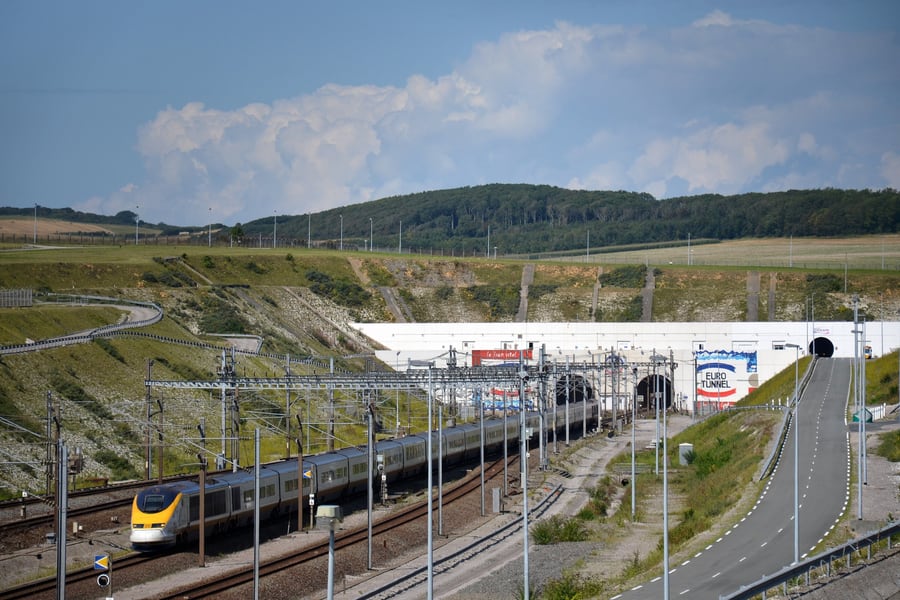 Florian Fèvre (Mobilys) / Wikimedia Commons · CC BY-SA 4.0 · cropped
Coquelles
The train comes out into daylight at Coquelles, near Calais, and joins the LGV Nord, the high-speed line to Paris. Clocks here are an hour ahead of London's, which is why the timetable looks longer than the journey.A bit of history
Culture & experiences along the way
 mgaylard.co.uk / Wikimedia Commons · CC BY 2.0 · cropped
The Meeting Place
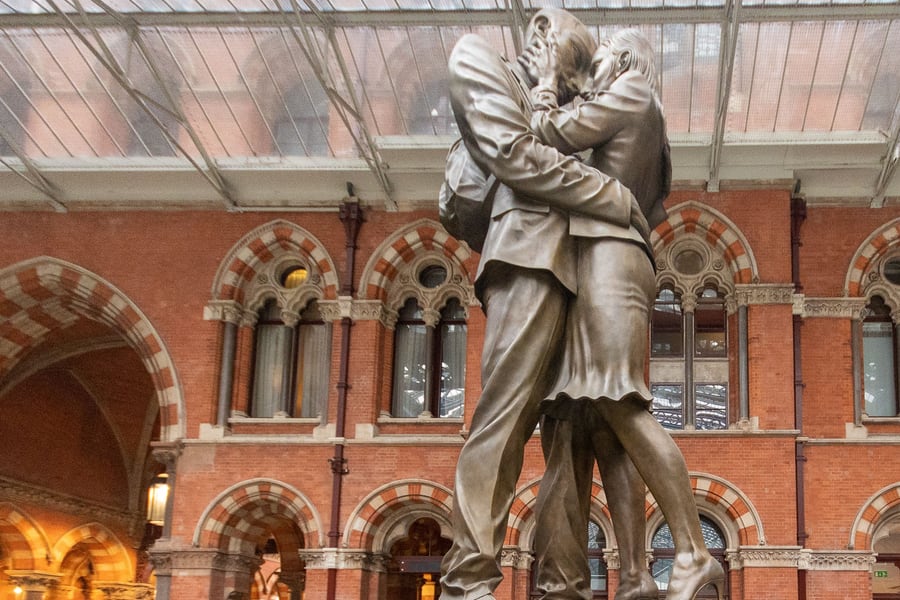
At the south end of the upper level, under the station clock, stands Paul Day's bronze of a couple in an embrace, 9 metres high and weighing 20 tonnes. It was unveiled when Eurostar moved to St Pancras in 2007, to evoke the romance of travel.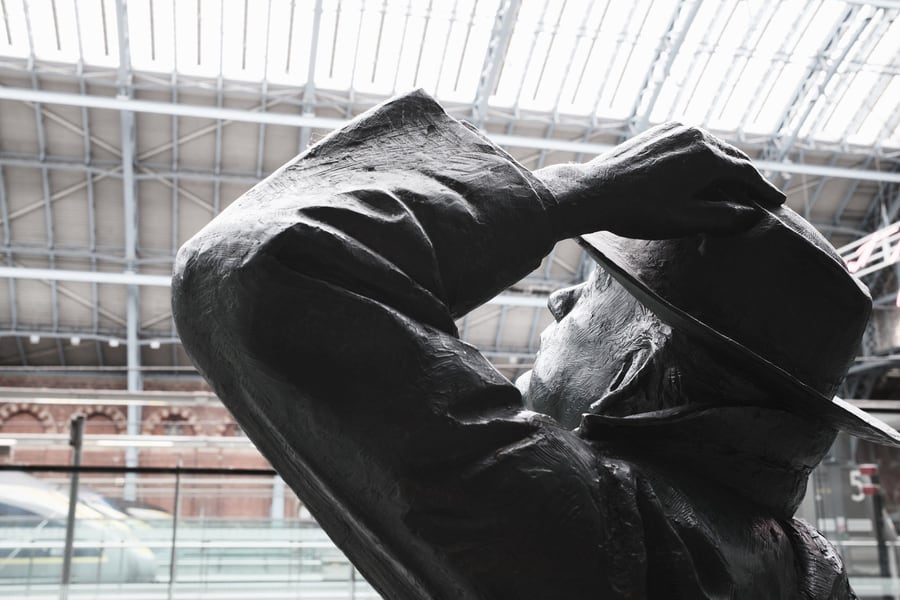 Tom Page / Wikimedia Commons · CC BY-SA 2.0
Sir John Betjeman
The poet led the campaign that saved St Pancras from demolition in the 1960s. Martin Jennings' bronze shows him holding on to his hat and gazing up at Barlow's roof. It was unveiled by his daughter and the Poet Laureate on 12 November 2007, two days before the first Eurostar left.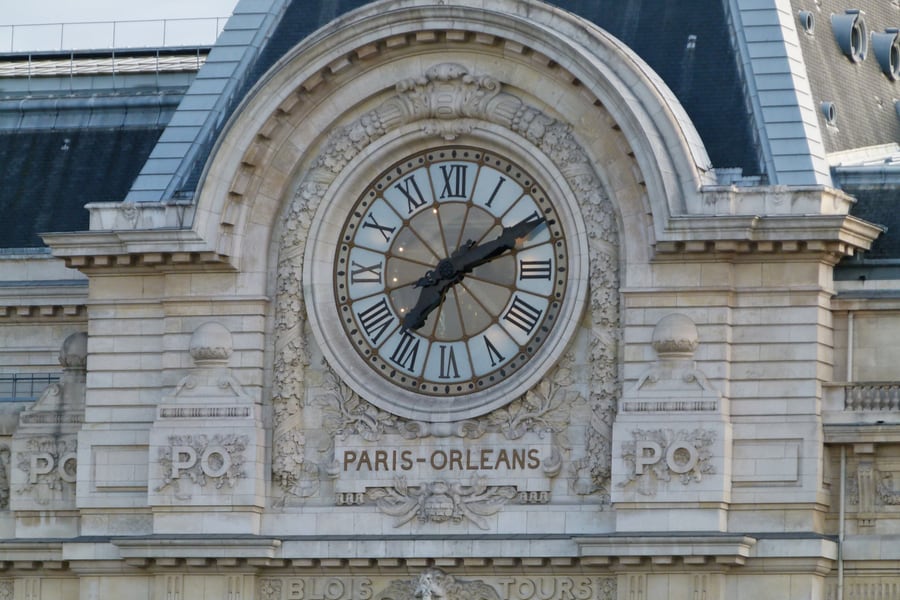 Dinkum / Wikimedia Commons · CC0 · cropped
Musée d'Orsay
Another railway station, now a museum. The Gare d'Orsay was built between 1898 and 1900 and reopened in 1986 as the Musée d'Orsay, which holds the largest collection of Impressionist and post-Impressionist paintings in the world: Monet, Renoir, Degas, Cézanne and van Gogh.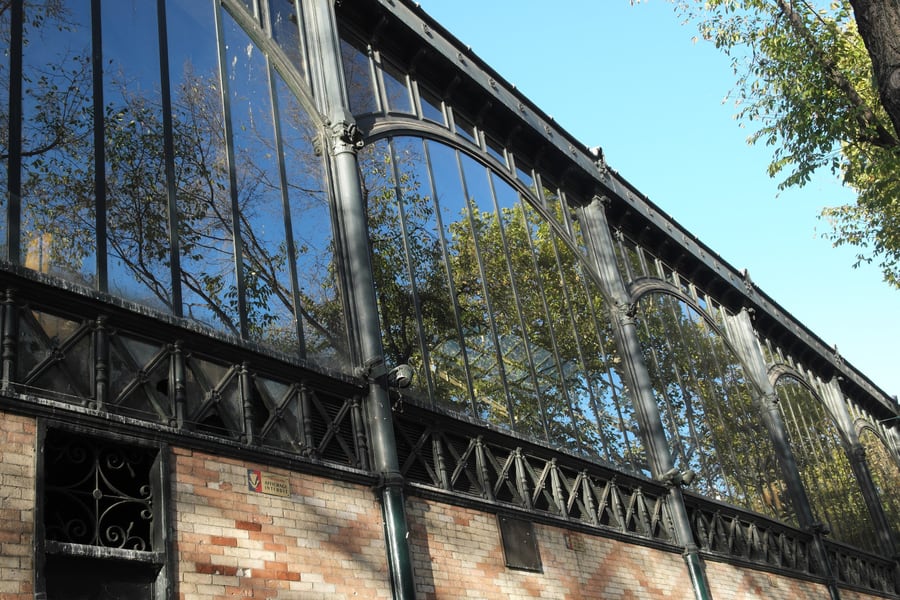 GFreihalter / Wikimedia Commons · CC BY-SA 4.0
Marché Saint-Quentin
Between the Gare du Nord and the Gare de l'Est, on the boulevard de Magenta, stands a covered market built in 1866 of pink brick and green cast iron. It is still a working neighbourhood market, and a good place to stock up for the journey home.Timetables
Eurostar runs fifteen trains a day each way between London and Paris on weekdays, nine to ten at weekends. Every one is non-stop. Times below are local: Paris is an hour ahead of London, so a train that leaves St Pancras at 06:01 and reaches Paris at 09:29 has taken 2 h 28 min.
London St Pancras to Paris Gare du Nord, Tuesday
| Depart London | Arrive Paris | Depart London | Arrive Paris | |
|---|---|---|---|---|
| 06:01 | 09:29 | 13:31 | 16:59 | |
| 07:01 | 10:29 | 14:31 | 17:59 | |
| 08:01 | 11:29 | 15:31 | 18:59 | |
| 09:31 | 12:59 | 16:31 | 20:20 | |
| 10:31 | 13:59 | 17:31 | 21:00 | |
| 11:31 | 14:59 | 18:01 | 21:29 | |
| 12:01 | 15:30 | 19:01 | 22:29 | |
| 12:31 | 15:59 |
Paris Gare du Nord to London St Pancras, Tuesday
| Depart Paris | Arrive London | Depart Paris | Arrive London | |
|---|---|---|---|---|
| 07:02 | 08:30 | 14:30 | 16:05 | |
| 07:32 | 09:00 | 15:02 | 16:30 | |
| 08:32 | 10:00 | 16:02 | 17:35 | |
| 09:02 | 10:30 | 17:02 | 18:30 | |
| 10:01 | 11:30 | 18:02 | 19:39 | |
| 11:02 | 12:30 | 19:11 | 20:30 | |
| 12:02 | 13:30 | 19:59 | 21:30 | |
| 13:11 | 14:30 |
Good to know:
- Weekends. On Saturday 17 October there were nine trains from London, from 06:31 to 19:01; on Sunday 18 October, ten, from 08:01 to 19:01.
- Journey time. Eurostar says most trains take 2 h 16 min. In October 2026 most were timed at 2 h 28 min, and the 16:31 at 2 h 49 min, so check the time on your own date.
- Arrive early. At St Pancras, Eurostar asks Standard and Plus passengers to arrive 75 minutes before departure, and Premier passengers 45; the gates close 30 minutes before (15 for Premier). At the Gare du Nord it asks for 75 to 90 minutes.
- Brussels and Amsterdam. Ten trains a day run from London to Brussels-Midi, from 06:16 to 19:34, in about two hours; eight of them call at Lille Europe, 1 h 22 min from London. Four continue to Amsterdam without a change, leaving London at 06:16, 11:04, 15:04 and 18:04.
Times as of October 2026, from the Eurostar booking engine for Tuesday 13, Saturday 17 and Sunday 18 October. Check your date on eurostar.com (opens in a new tab).
Tickets
Eurostar sells three classes: Standard, Plus and Premier. Fares rise as trains fill, so book early: Eurostar advertises London to Paris from £39 one way in Standard, and on a Tuesday in January 2027 the lowest Standard fare sampled was £53. Eight days ahead, for Tuesday 13 October 2026, it ranged from £102 to £180 depending on the train, with Plus from £168 and Premier at £330.
There are no seat or luggage fees: Standard includes two large bags and a small one, there is no limit on liquids, and you can bring your own food. Standard and Plus tickets can be exchanged free up to an hour before departure. Fares checked October 2026 on eurostar.com (opens in a new tab), one adult, one way; pounds sterling.
Book your tickets
Eurostar Standard
One way · London to Paris
Two large bags and a small one, the café bar on board, and free exchanges up to an hour before departure.
Book Tickets (opens in a new tab, on eurostar.com)via eurostar.comEurostar Plus
One way · more space, meal at your seat
Larger seats in quieter coaches, with a light meal and drinks served at your seat on routes from London.
Book Tickets (opens in a new tab, on eurostar.com)via eurostar.com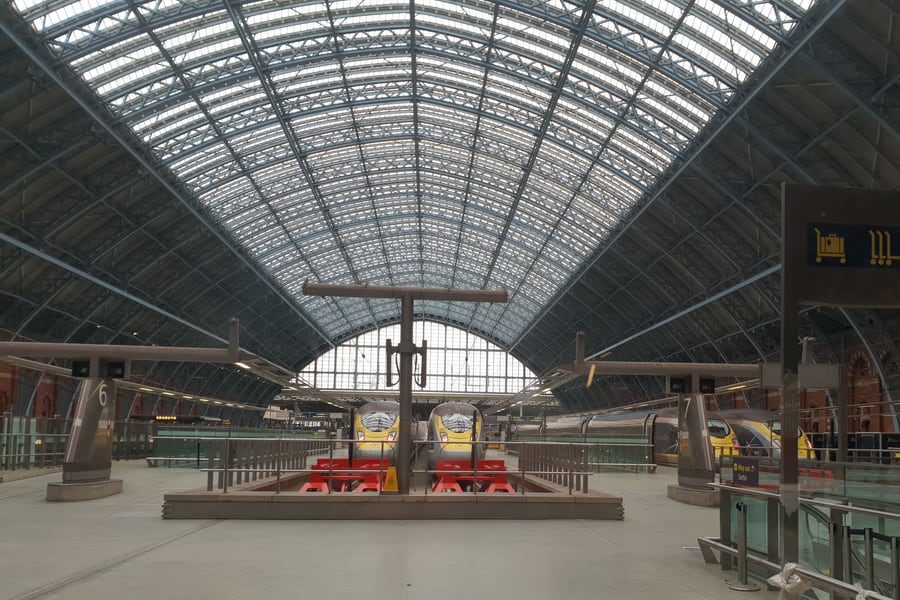
Eurostar Premier
One way · lounge and fine dining
Lounge access, priority gates, a later check-in and a meal on board, with exchanges until after travel.
Book Tickets (opens in a new tab, on eurostar.com)via eurostar.comRail Passes
Only an Interrail Global Pass is valid. Interrail's own Eurostar page says trains to and from London "can only be used by travellers with a Global Pass": a one-country pass for Great Britain or France does not cover the crossing.
Even with a Global Pass, a reservation is compulsory, and pass holders get only a limited number of seats on each train. Between London and France it costs €35 in Standard and €40 in Plus; Premier cannot be booked with a pass at all.
For this journey alone, a pass is not worth buying. Add the reservation to the cost of a pass day and an early Standard ticket is usually cheaper. A Global Pass pays when Eurostar is one leg of a longer trip across Europe.
Checked October 2026 against interrail.com (opens in a new tab).
Places to Visit
Both ends of the line are sights in themselves. Arrive at St Pancras early, as you must anyway, and look round the station before check-in; in Paris, the Gare du Nord sits in a district with a few things worth a short walk before you head into the centre.
andreboeni / Wikimedia Commons · CC BY 2.0 · croppedSt Pancras International
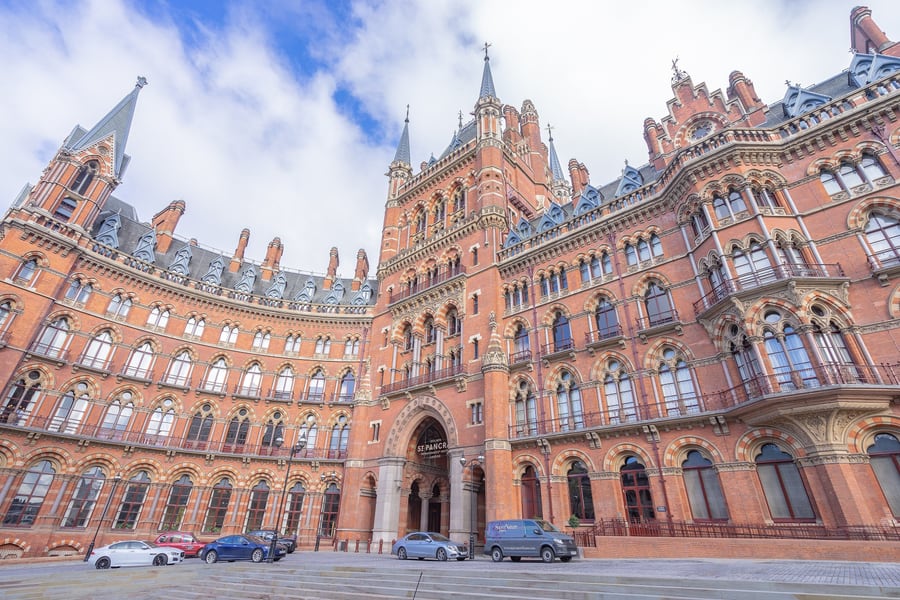
When it opened in 1868, William Barlow's single-span iron and glass roof covered the largest enclosed space in the world. George Gilbert Scott's Gothic Midland Grand Hotel was built across its front. In the 1960s the station was due to be demolished, and was listed Grade I only after a campaign led by the Victorian Society and John Betjeman. An £800 million restoration reopened it for Eurostar in 2007.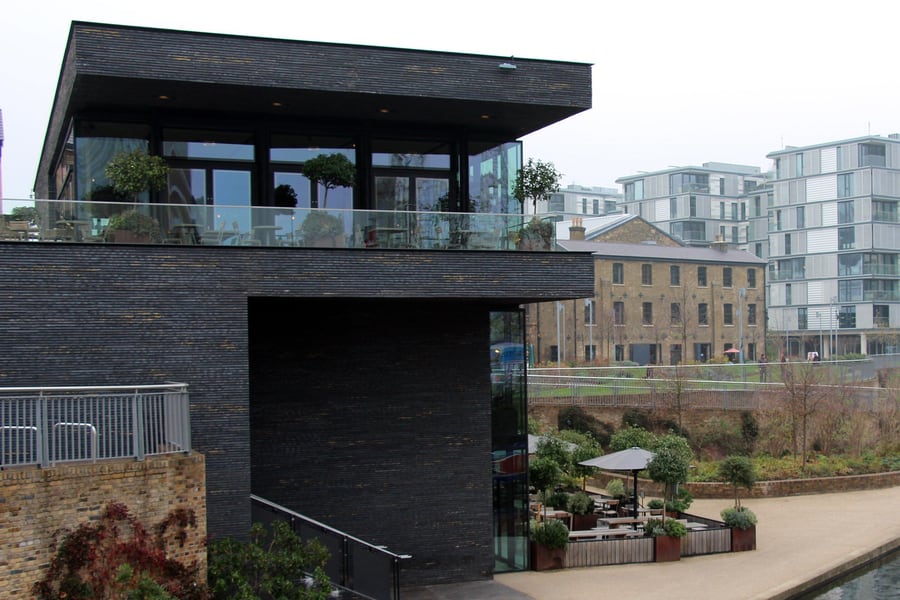 Fred Romero / Wikimedia Commons · CC BY 2.0 · cropped
King's Cross and the Regent's Canal
North of St Pancras and King's Cross, the old Railway Lands, once a tangle of sidings crossed by the Regent's Canal, have been rebuilt as King's Cross Central. At its heart, on the canal, is Granary Square, comparable in size to Trafalgar Square, beside the Central Saint Martins art school and the Queer Britain museum. Chabe01 / Wikimedia Commons · CC BY-SA 4.0 · cropped
Gare du Nord
Jacques Ignace Hittorff built the station between 1861 and 1865 behind a stone front shaped like a triumphal arch. Along the top stand statues of the cities the Nord company served: Paris at the summit, with London, Brussels and Amsterdam among the eight around her. Some 700,000 people pass through it on a typical day, most of them commuters.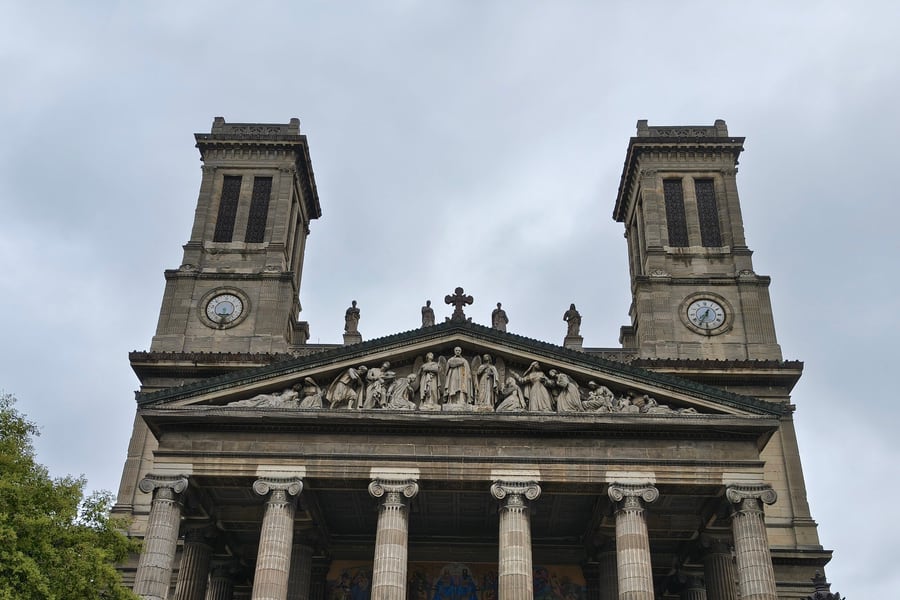 Gargarapalvin / Wikimedia Commons · CC BY-SA 4.0 · cropped
Saint-Vincent-de-Paul
In the same arrondissement, at the top of a long flight of steps above the place Franz-Liszt, stands the church the same architect finished in 1844. Its portico has twelve Ionic columns, for the twelve apostles, and inside a gilded frieze by Hippolyte Flandrin shows 235 figures. Louis Braille was among its organists.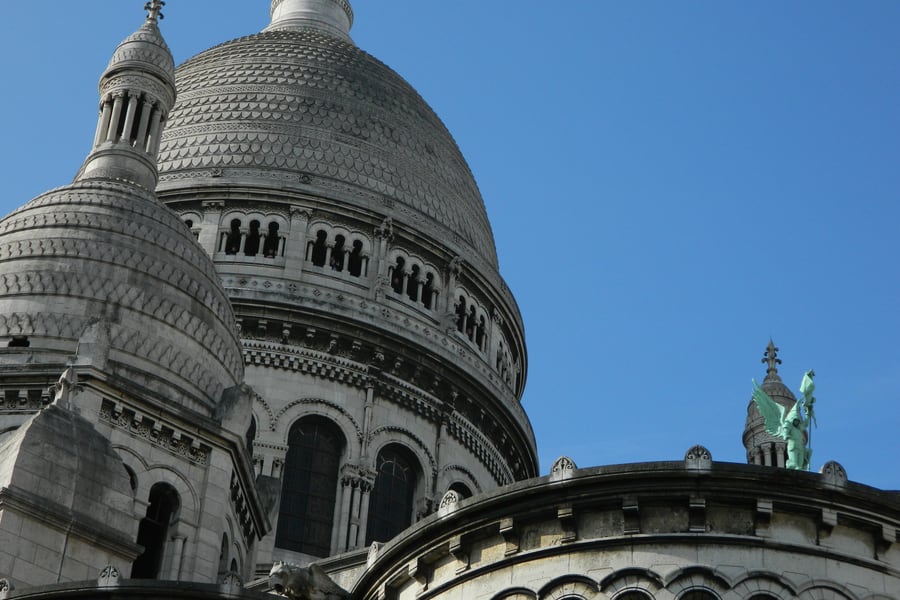 Murflez / Wikimedia Commons · CC BY-SA 4.0 · cropped
Sacré-Cœur and Montmartre
The white basilica stands on the summit of the butte of Montmartre, its dome some 200 metres above the Seine, and it is the second most visited sight in Paris after the Eiffel Tower. Begun in 1875 to designs by Paul Abadie, it took forty years and five architects to finish; it was completed in 1914 and consecrated in 1919, after the First World War.Where to Sleep
For an early train, the St. Pancras London hotel is directly above the platforms. At the other end, the New Hotel is across the street from the Gare du Nord.
Where to stay
 Wei-Te Wong / Wikimedia Commons · CC BY-SA 2.0
St. Pancras London
Above the Eurostar platforms · 243 rooms and suites
George Gilbert Scott's Gothic Revival hotel, built across the front of the station.
Check Availability (opens in a new tab, on stpancraslondon.com)via stpancraslondon.comNew Hotel Gare du Nord
Paris · opposite the station
A hotel in a stone building of about 1850, with breakfast served in its 19th-century vaulted cellar.
Check Availability (opens in a new tab, on newhotelparis.com)via newhotelparis.comQuestions or corrections
Planning this trip and stuck on something, or spotted a time, fare or detail that has changed? Send us a message about Eurostar: London to Paris. We read every one, and we update this page when something has changed.