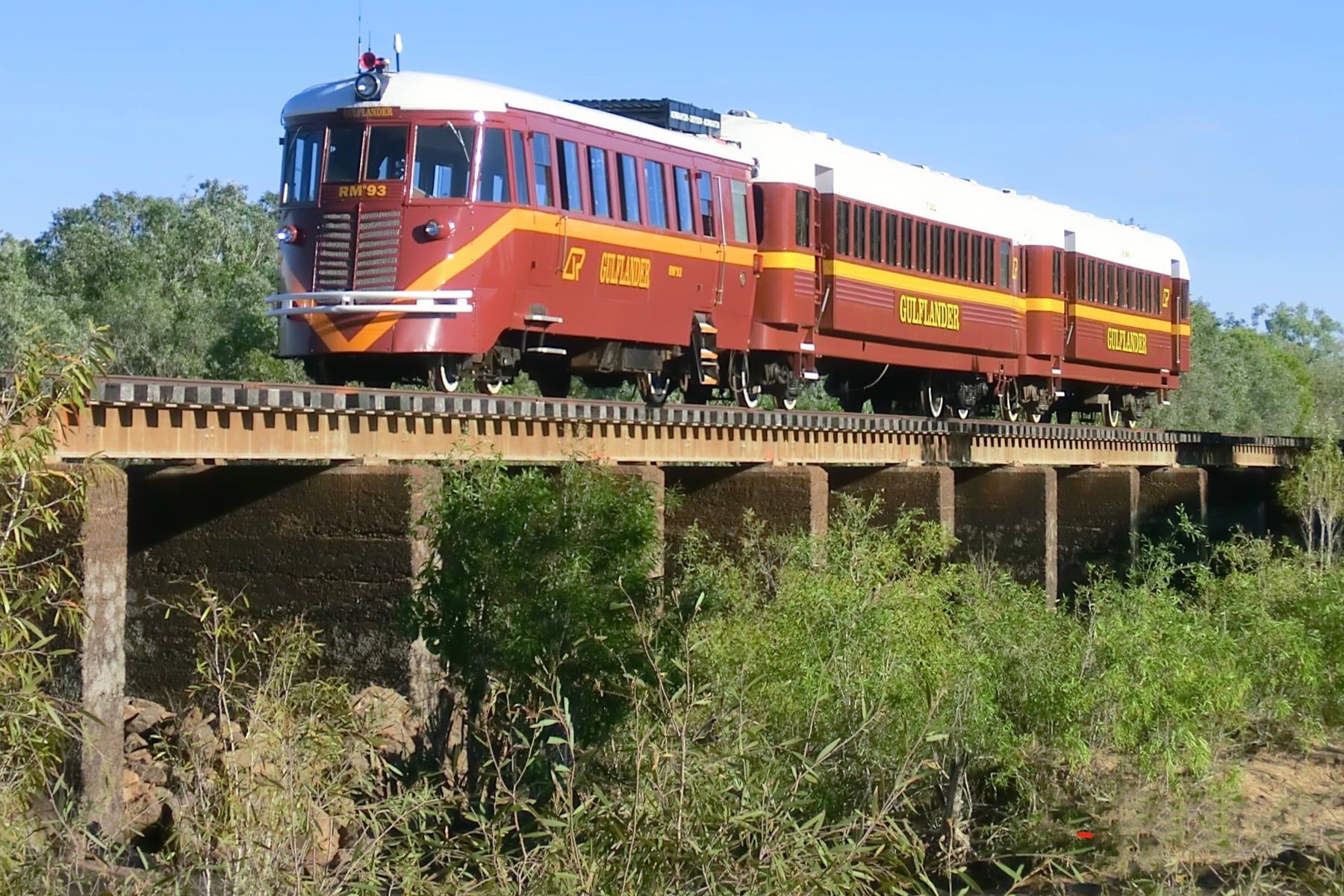
Gulflander
Lobster1 / Wikimedia Commons · CC BY-SA 3.0 · cropped
- Distance152 km (94 miles), Normanton to Croydon
- Duration5 h each way
- Best seasonApril to October; out Wednesday, back Thursday
Introduction
The Gulflander runs 152 kilometres across the Gulf Country of north-west Queensland, from Normanton, an old river port near the Gulf of Carpentaria, to Croydon, a gold-rush town on the edge of the savannah. It takes five hours, makes the trip once a week in each direction between April and October, and its railway is joined to no other: the nearest line in Queensland is 190 kilometres away, and this is the only one in the state still measured in miles.
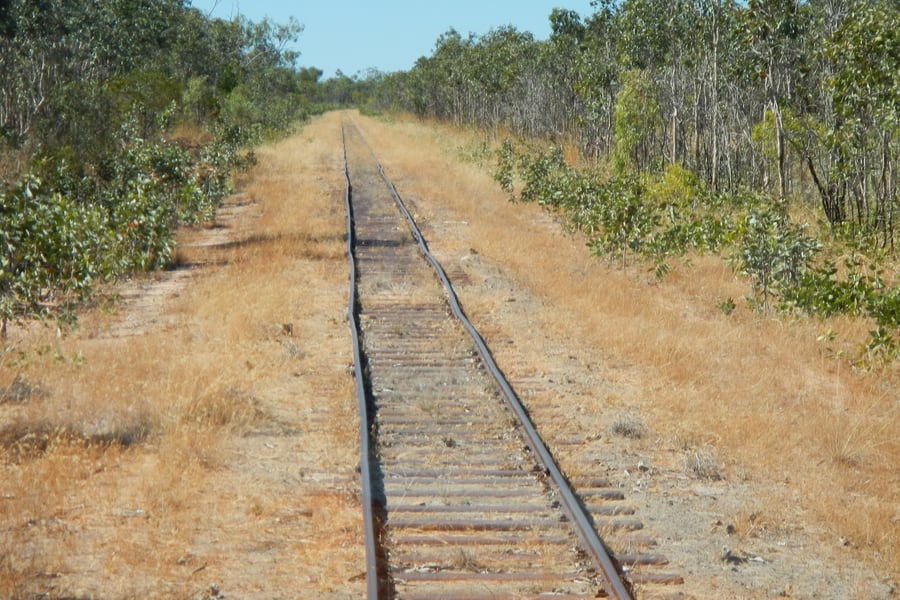
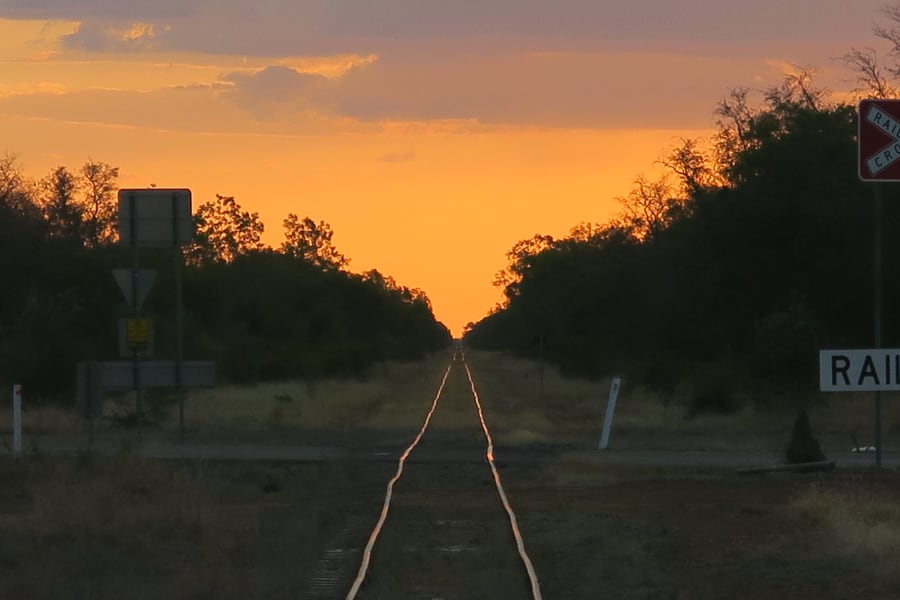
The line was built between 1888 and 1891 to be drowned. The Gulf Country floods every wet season, termites eat timber, and there was little suitable timber to begin with, so the engineer George Phillips laid the rails on his own patented steel sleepers, pressed into the bare earth with almost no ballast and no embankments for the water to wash away. When the rivers rose the floods simply passed over the top, and the line could be put back into use as soon as they fell — long before the roads dried out. Most of the original rail and sleepers are still there.
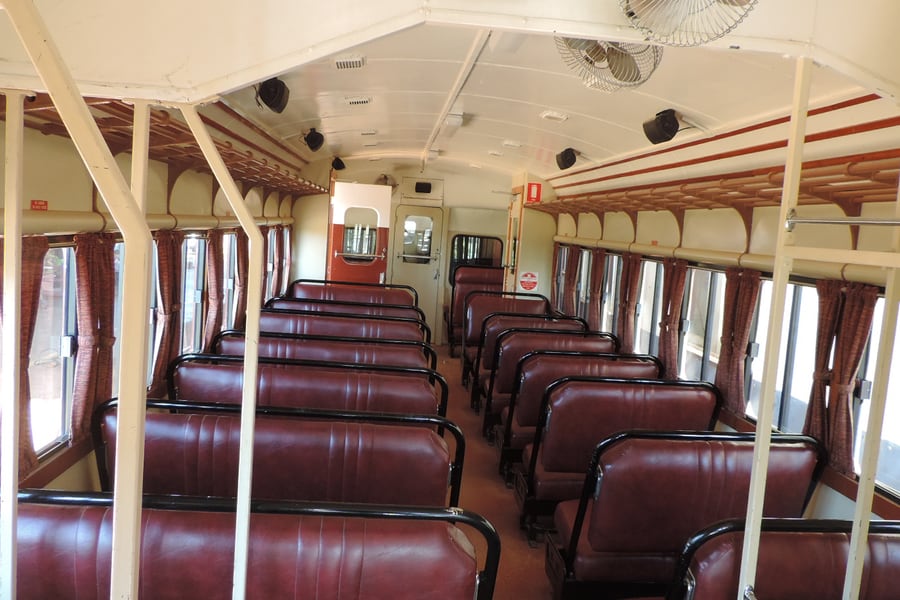
The train is a railmotor, the 1950 RM93, nicknamed the Tin Hare, pulling two carriages at an unhurried pace. It is not air-conditioned; the windows open. The crew double as guides and stop to point things out, and the whole train halts for morning tea at Blackbull, as it has since 1891.
The Journey
Normanton to Blackbull
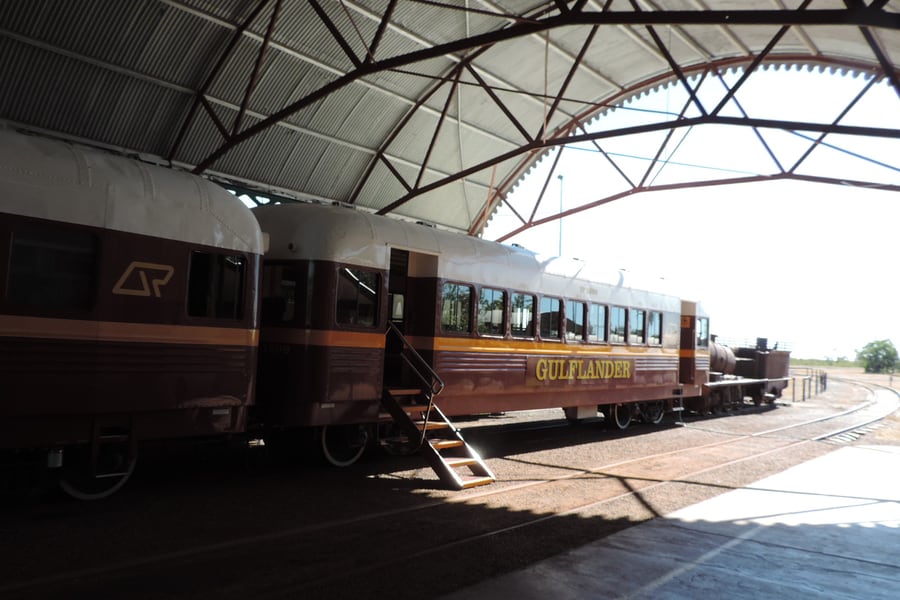
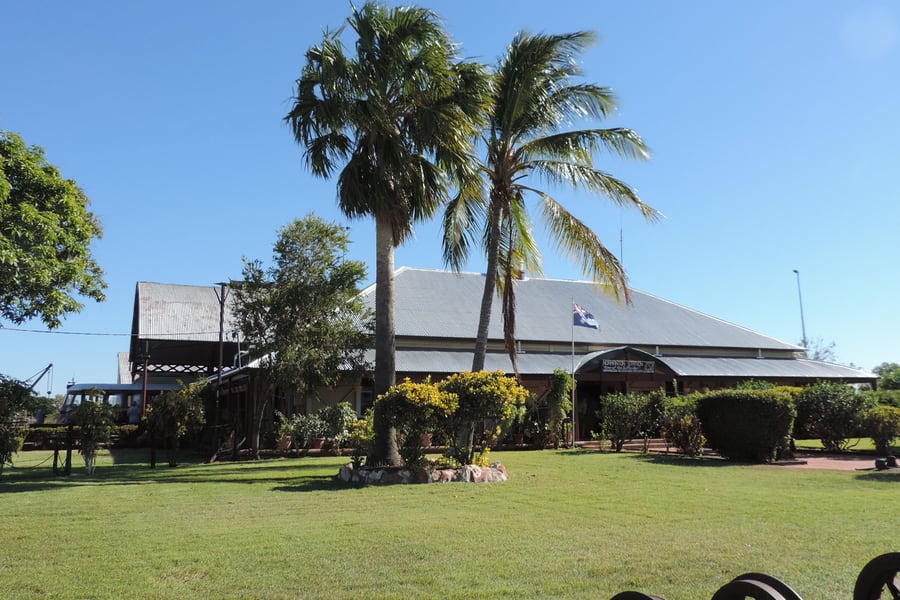
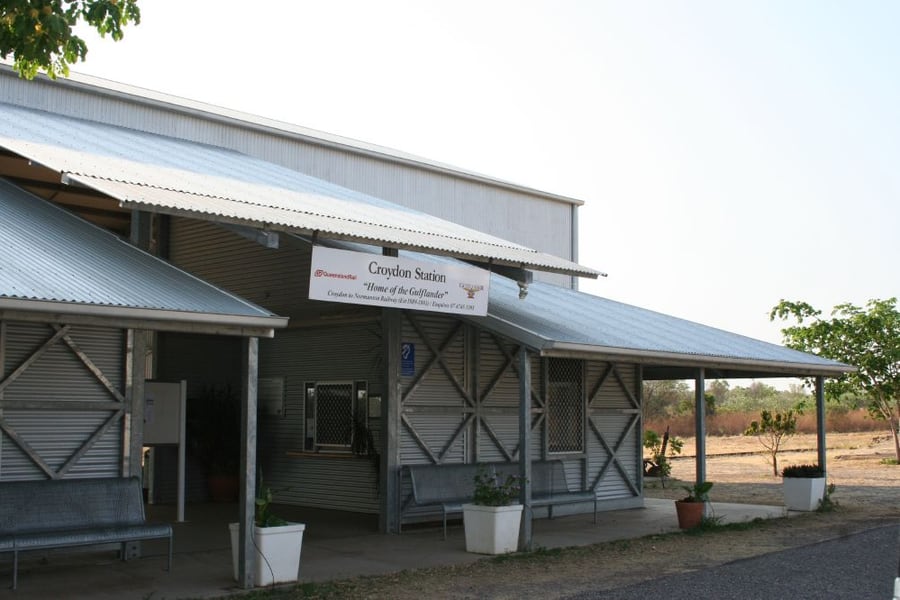
The train leaves Normanton at half past eight on Wednesday mornings, from a station of 1889 built of corrugated iron on a timber frame, with an arched carriage shade over three tracks. It runs out past Clarina and across the Norman River at Glenore on low-level bridges, built to go under in the wet like the rest of the line, then through grassland and open woodland to Critters Camp, 16 miles out, where a turning angle was laid in 1891. At the Haydon mail stop it still drops the mail for the cattle stations around. The country is flat from end to end, and the line is marked by the mile, not the kilometre.
Blackbull to Croydon
About halfway the train stops at Blackbull, where morning tea has been served since 1891, beside a cast-iron water tank of 1890 and the old railway workers' quarters. Beyond, it passes Timber Cutters, an abandoned camp that once cut hardwood for the steam engines, and Ellavale, until the 1980s simply the 80 Miles 35 Chains siding. Near the end it reaches Golden Gate, a mining township of the 1890s, before running into Croydon at half past one. On Thursday it makes the same journey back.
The train
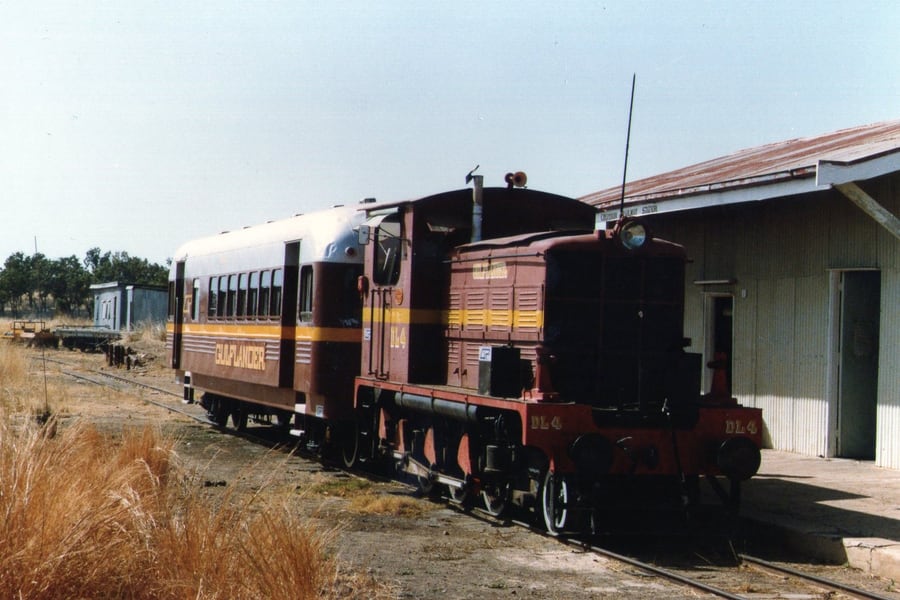
RM93 was built at the Ipswich Railway Workshops in 1950 and has a 102-horsepower Gardner diesel engine; it came to Normanton in 1982, and by 1987 it had Gulflander painted on its sides. It seats 24, and its two carriages, TP1811 and TP1809, take 44 and 32 more. It is the latest of a line of railmotors here: steam gave way in 1929, after the first, a converted Panhard-Levassor road vehicle, arrived in 1922. The diesel locomotive DL4, built by Walkers of Maryborough in 1964, is kept at Normanton for maintenance work.
Along the route
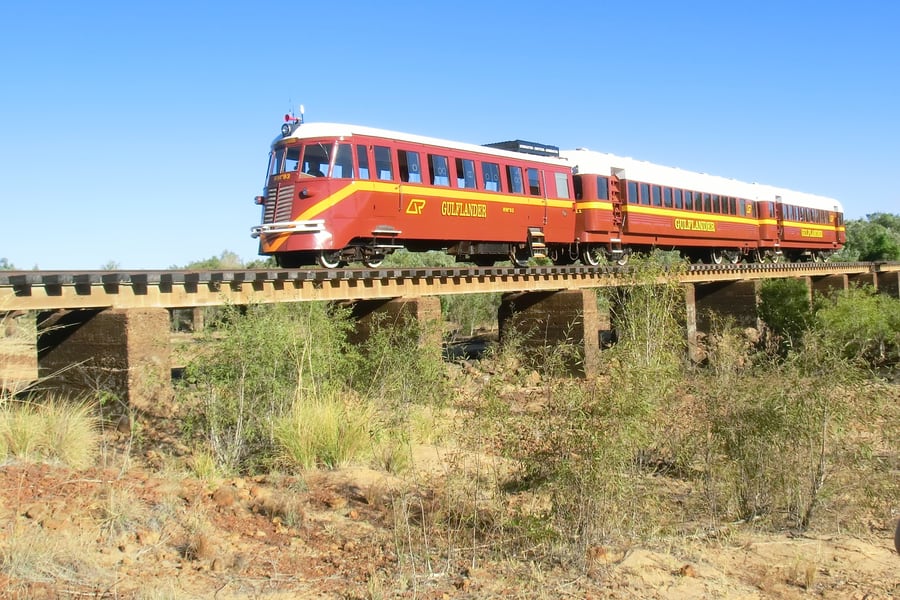 Lobster1 / Wikimedia Commons · CC BY-SA 3.0 · cropped
The Norman River bridges
About 14 miles out, at Glenore, the line crosses the Norman River on low-level bridges built to be flooded. The third Glenore crossing, rebuilt in 1900, carries fishbelly girders reused from the first Albert Bridge in Brisbane, of 1876.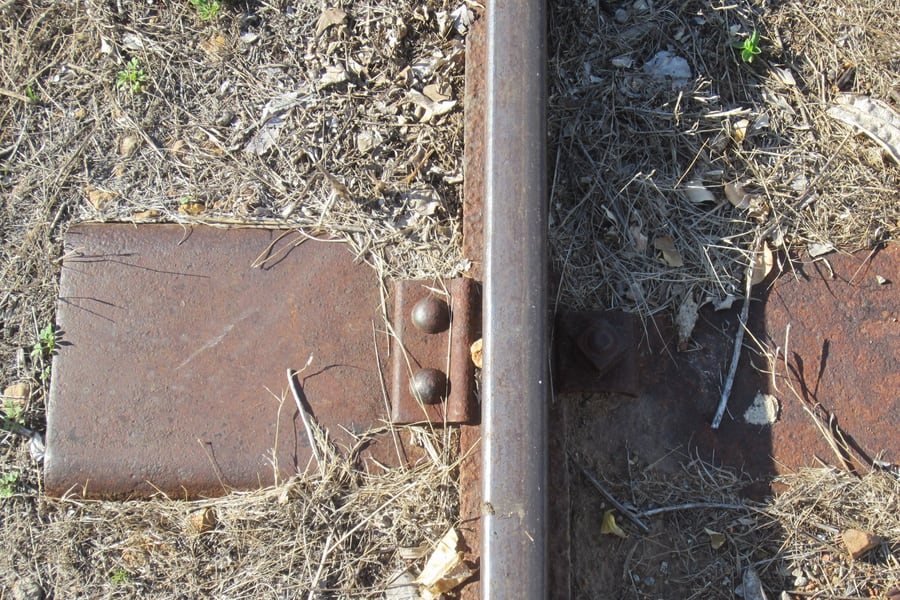 Olle Gustavsson / Wikimedia Commons · CC BY-SA 4.0 · cropped
Phillips' steel sleepers
George Phillips patented his U-shaped steel sleepers in 1884 for exactly this country: laid on bare earth, pressed in by the construction train, with the rails clipped on. Termites cannot eat them, and a flood leaves nothing to wash away.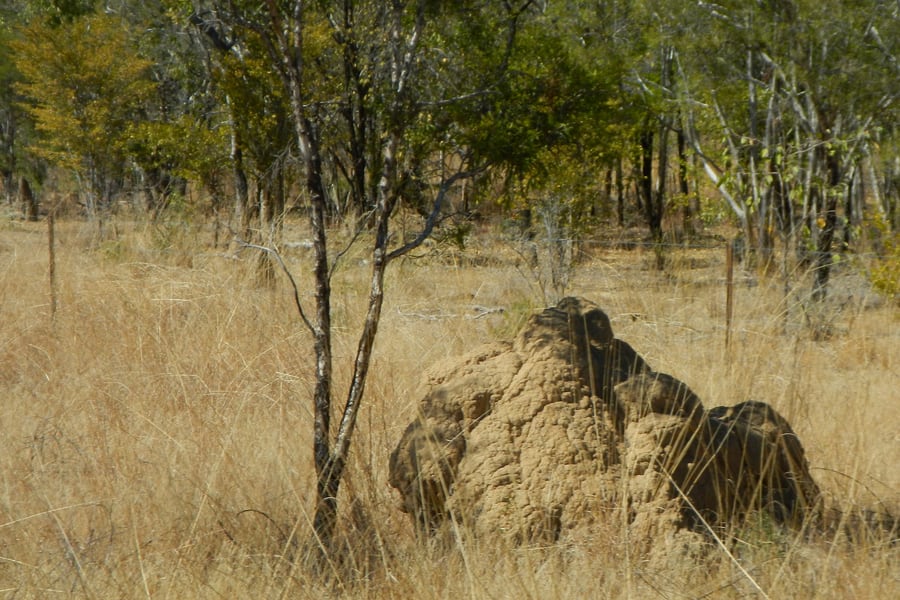 Lobster1 / Wikimedia Commons · CC BY-SA 3.0 · cropped
Termite country
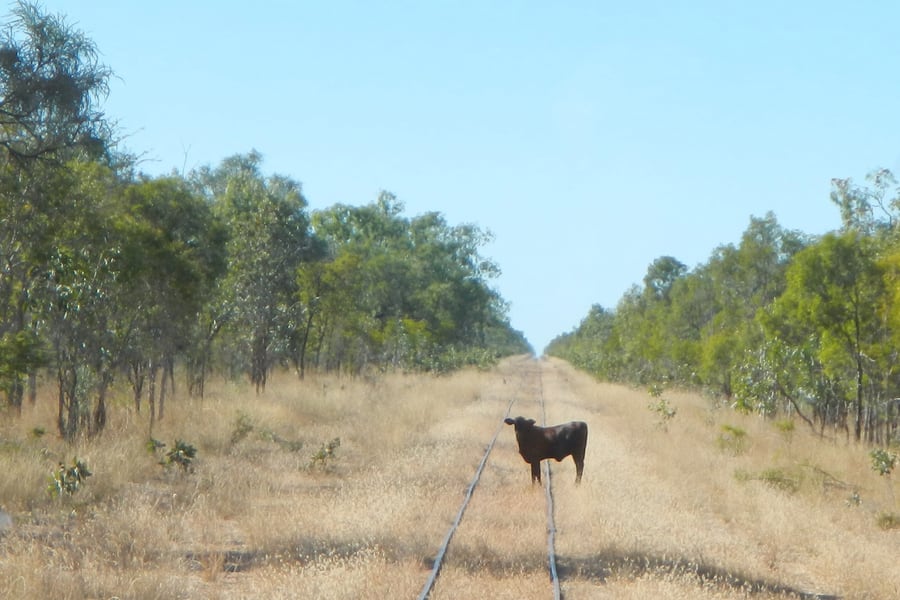
Termite mounds stand in the grass beside the line, the reason timber sleepers did not last here. Most of those laid when steel ran short were soon replaced, except on a stretch of salt pan, where steel would have rusted.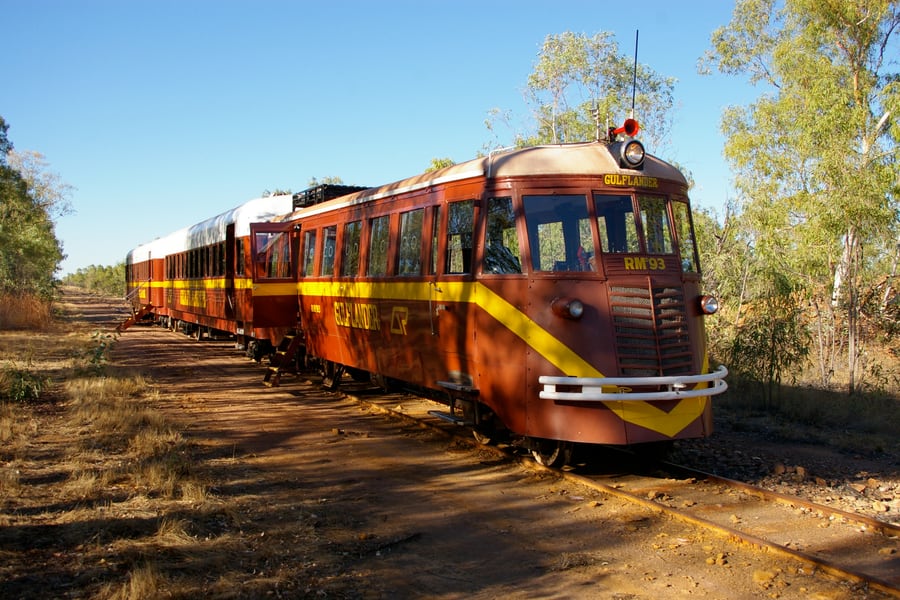 Kenneth Fairbairn / Wikimedia Commons · CC BY 3.0 · cropped
Golden Gate
Four miles short of Croydon the train passes Golden Gate, one of the richest mines on the Croydon field. Around 1900 its township held 1,500 people, and weekend trains ran out from Croydon; the site is now heritage-listed.A bit of history
Culture & experiences along the way
 Felix Dance / Wikimedia Commons · CC BY 2.0 · cropped
Morning tea at Blackbull
Halfway along, the train stops at Blackbull, the refreshment stop since 1891, and everyone gets down for morning tea, served in a souvenir mug to keep. Beside the track stand a cast-iron water tank of 1890 and the old railway workers' quarters, now an interpretive centre.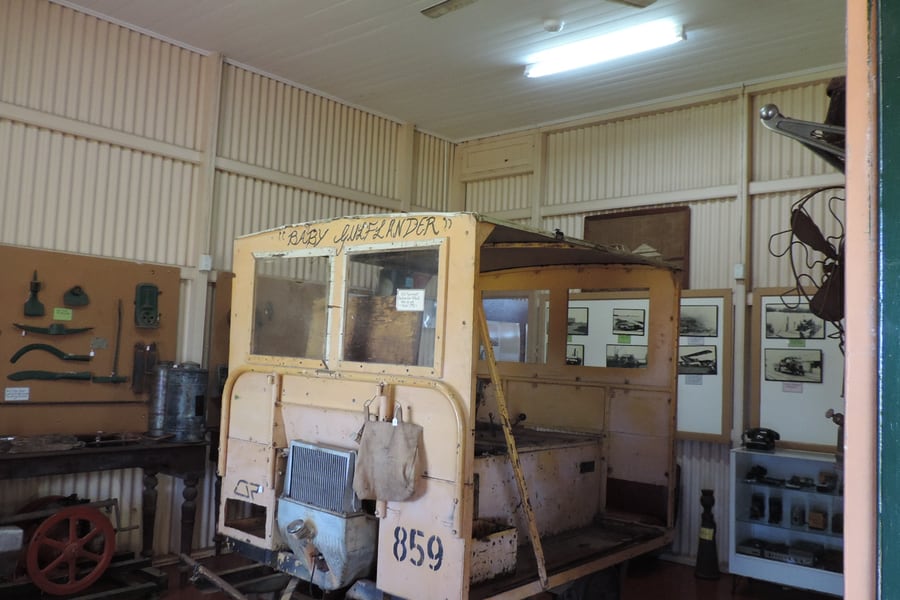 Kerry Raymond / Wikimedia Commons · CC BY 4.0 · cropped
The station museum
Normanton station is a museum as well as a terminus. Inside are railway relics from the gold-rush years, and a self-guided heritage walk leads round the yard: the goods shed and its crane, old locomotive frames, and the railmotors that ran the line before RM93. It opens when the station is staffed.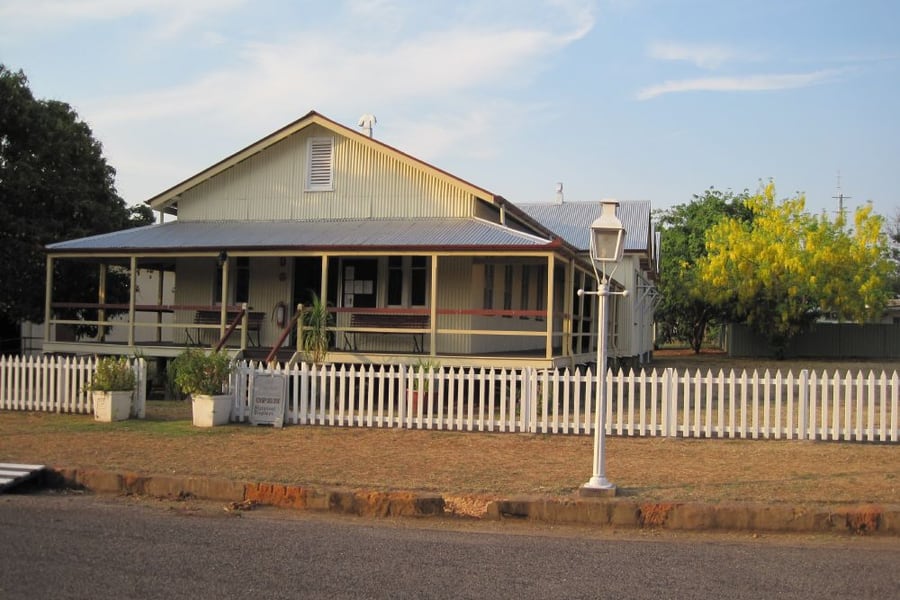 Heritage branch staff / Wikimedia Commons · CC BY 3.0 · cropped
Croydon's courthouse
Croydon's heritage precinct is free to walk into. The courthouse of 1887, the oldest building in town, held its last court in 1926; today a recording of a case from 1902 plays inside. The police station, the gaol and the town hall, still a picture theatre, stand alongside.Timetables
The Gulflander runs from April to October, the dry season, and the weather can still change the dates. The full journey, the Classic Experience, runs once a week in each direction: out to Croydon on Wednesday, back to Normanton on Thursday, in five hours each way.
Normanton to Croydon — Wednesdays
| Train | Normanton | Blackbull | Croydon |
|---|---|---|---|
| 5U02 | 08:30 | morning tea | 13:30 |
Croydon to Normanton — Thursdays
| Train | Croydon | Blackbull | Normanton |
|---|---|---|---|
| 5D01 | 08:30 | morning tea | 13:30 |
Shorter trips
The Critters Camp Excursion leaves Normanton at 09:00 on selected days, mostly Mondays, and takes about two hours there and back. The Croydon Golden Sunset Tour leaves Croydon at 17:00 on Wednesdays in July and August, with an evening meal at Golden Gate, and takes an hour and a half.
Getting back the same day
A coach leaves Croydon for Normanton on Wednesday afternoons, so the outward trip can be done as a day out; seats are limited, and it is booked with Trans North Bus and Coach, not with the railway. Driving between the two towns is the other way back, and the operator sells a self-drive share: one traveller rides as far as Blackbull while the other drives to meet the train, and the two swap there.
The 2026 timetable runs until 29 October 2026; the 2027 dates had not been published when this was checked — as of October 2026. Check the Gulflander departure times (opens in a new tab) before travelling.
Tickets
Tickets are sold by Queensland Rail Travel, through the Gulflander's booking enquiry form or its reservations line on 1800 577 245; the two short trips must be booked ahead. The Classic Experience is sold one way or return, either with morning tea at Blackbull, served in a souvenir mug, or for the ride alone. Stations are cashless, and tickets carry no seat number: you are given a carriage on the day.
Children aged 4 to 14 travel at a child fare and infants under 4 free, and holders of an Australian pensioner or seniors card at a concession fare. The prices below are for the 2026 season, which ends on 29 October; fares rise by about 3.4% from 1 April 2027.
Book your tickets
Kerry Raymond / Wikimedia Commons · CC BY 4.0 · croppedClassic Experience, Normanton to Croydon
The full line · 5 hours
One way from A$79 for the ride alone or A$94 with morning tea at Blackbull; return A$132 or A$154.
Book Tickets (opens in a new tab, on gulflander.com.au)via gulflander.com.auLobster1 / Wikimedia Commons · CC BY-SA 3.0 · croppedCritters Camp Excursion
From Normanton · about 2 hours
A$56 return for an adult, a short ride out to the 16-mile turning angle and back.
Book Tickets (opens in a new tab, on gulflander.com.au)via gulflander.com.auKenneth Fairbairn / Wikimedia Commons · CC BY 3.0 · croppedCroydon Golden Sunset Tour
From Croydon · 1 h 30 min
A$61.50 for an adult, with an outback-style meal at Golden Gate as the sun goes down.
Book Tickets (opens in a new tab, on gulflander.com.au)via gulflander.com.auRail Passes
No rail pass covers the Gulflander. Queensland Rail Travel's Queensland Explorer Pass (A$299 for a month, A$389 for two) is valid on the Spirit of Queensland, the Tilt Train, the Spirit of the Outback, the Inlander and the Westlander, and the Gulflander is not on the list. Interrail and Eurail do not cover Australia.
Is it worth it? Not for this trip. The Gulflander's line is joined to no other railway, so no pass journey ends at Normanton anyway, and the fare is a single small ticket bought direct from the operator.
Checked October 2026 against Queensland Rail Travel's Queensland Explorer Pass page (opens in a new tab).
Places to Visit
Normanton and Croydon are the two ends of the line, and a night in each is the natural way to do the round trip. Karumba is about an hour's drive from Normanton, on the coast of the Gulf.
 Heritage branch staff / Wikimedia Commons · CC BY 3.0 · cropped
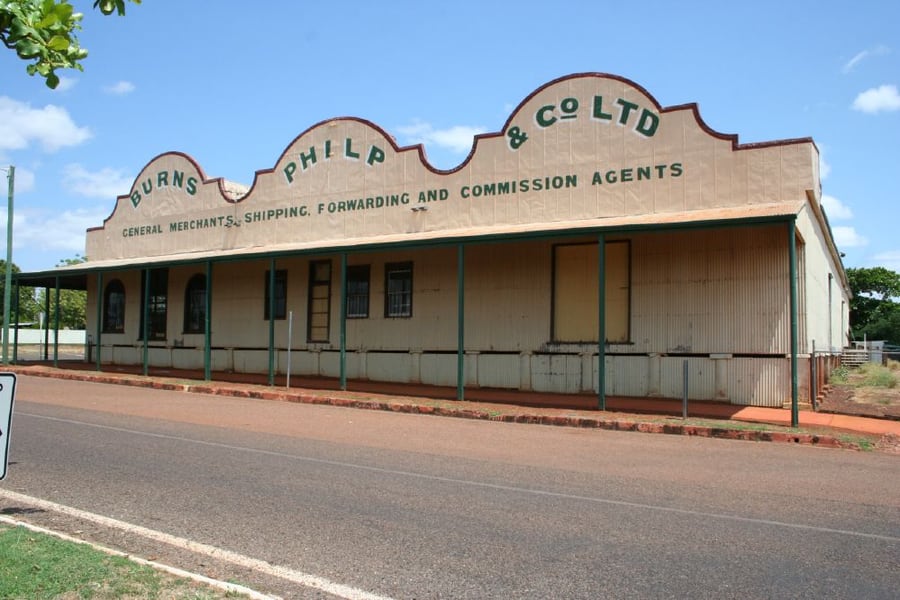
Normanton
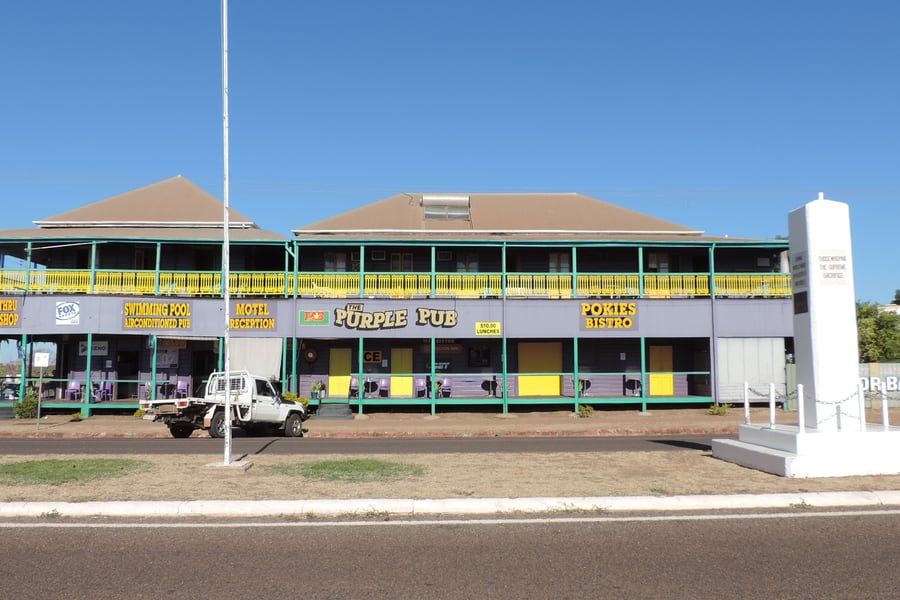
The old port on the Norman River grew with the Croydon gold rush. Its Burns Philp store, opened in 1884 and the oldest intact one in Queensland, is now the visitor centre. In town are the Purple Pub and Krys, a replica of an 8.64-metre saltwater crocodile shot in the Norman River in 1957, and the cemetery dates from 1867.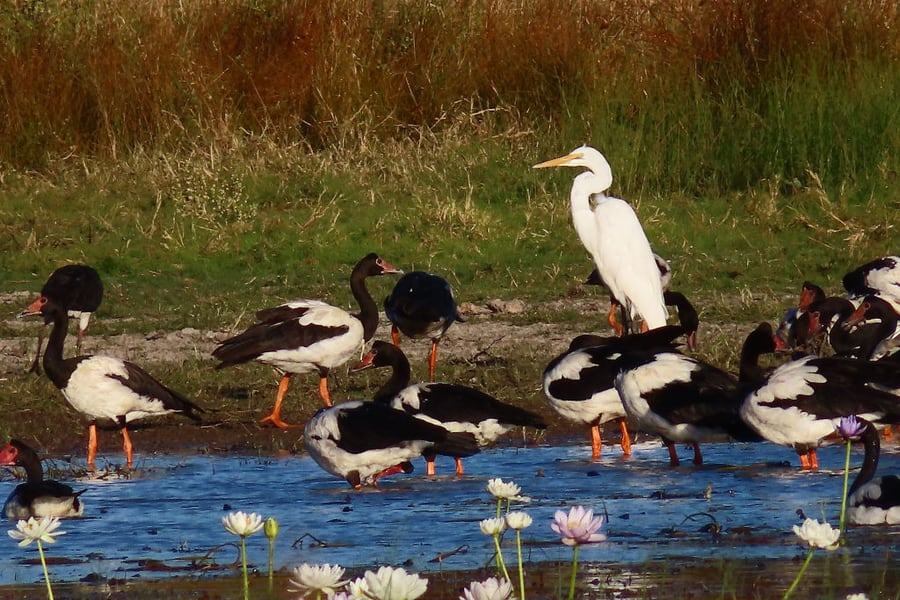 Ron Owen / Wikimedia Commons · CC BY 4.0 · cropped
Mutton Hole Wetlands
From November to April the monsoon refills the lagoons of the Mutton Hole Wetlands and they fill with birds: brolgas, pelicans, jabirus and magpie geese. In the Gulflander's dry season the water retreats, leaving a landscape of mangroves and grassland.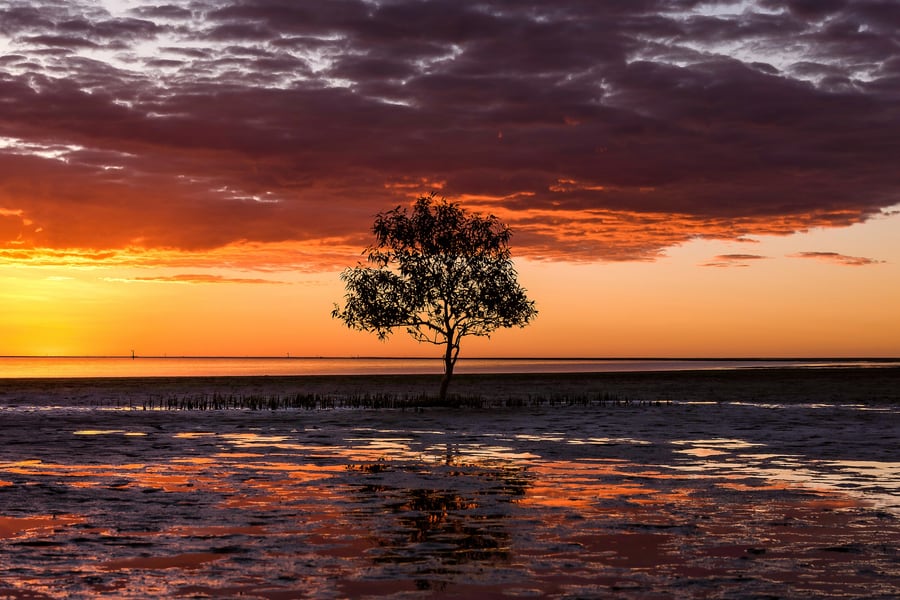 Ben Cordia / Wikimedia Commons · CC BY-SA 4.0 · cropped
Karumba
At the mouth of the Norman River, 71 kilometres by road from Normanton, Karumba is the only town on the southern Gulf of Carpentaria within sight of the Gulf itself, and the beach at Karumba Point faces the sunset over the water. It lives by fishing and prawning; the Barramundi Discovery Centre runs guided tours of its hatchery.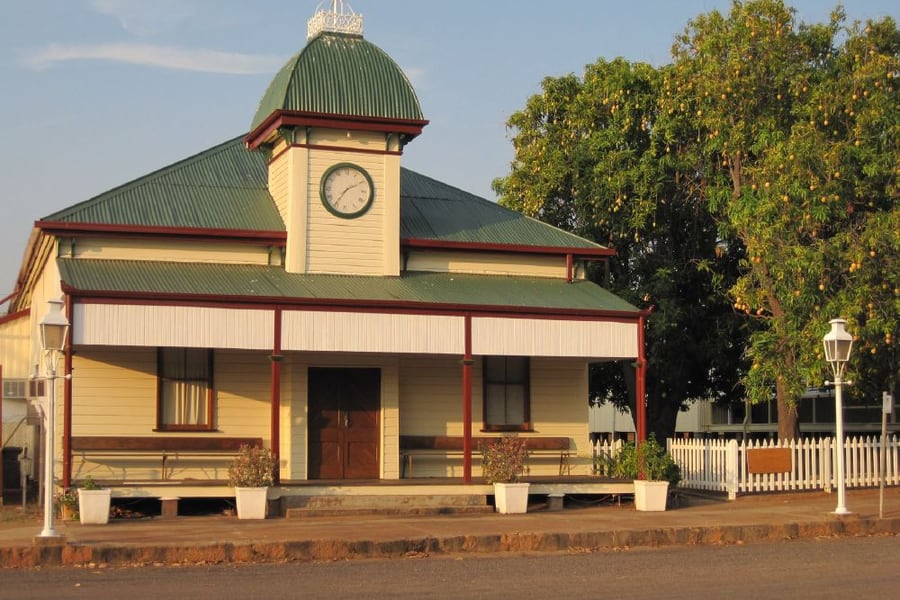 Heritage branch staff / Wikimedia Commons · CC BY 3.0 · cropped
Croydon
In its gold-rush heyday Croydon was the fourth-largest town in the colony of Queensland; a few hundred people live there now. Copies of its gold-rush kerosene lamps line the heritage precinct, the old town hall still shows films, and Lake Belmore, four kilometres out, is the place to swim. The council also looks after the Iguana Consul Mining Museum and the site of the Chinese temple, from the years when Chinese miners and market gardeners fed the goldfield.Where to Sleep
The train goes out on Wednesday and comes back on Thursday, so the full return trip means a night in Croydon; a night before in Normanton, or in Karumba on the coast, makes the 08:30 start easy.
Where to stay
 Kerry Raymond / Wikimedia Commons · CC BY 4.0 · cropped
The Purple Pub
Normanton, on the main street
The National Hotel, painted purple, with motel-style air-conditioned rooms and a bistro on Landsborough Street.
Check Availability (opens in a new tab, on purplepub.com.au)via purplepub.com.auEnd of the Road Motel
Karumba Point, on the beach
Self-contained apartments on the beach at Karumba Point, facing the Gulf, with a bar and café on the beachfront.
Check Availability (opens in a new tab, on endoftheroadmotel.com.au)via endoftheroadmotel.com.auCroydon Club Hotel
Croydon, built in 1887
The gold-rush pub of 1887 at the end of the line, with three kinds of room and meals served daily.
Check Availability (opens in a new tab, on croydonclubhotel.com.au)via croydonclubhotel.com.auQuestions or corrections
Planning this trip and stuck on something, or spotted a time, fare or detail that has changed? Send us a message about Gulflander. We read every one, and we update this page when something has changed.