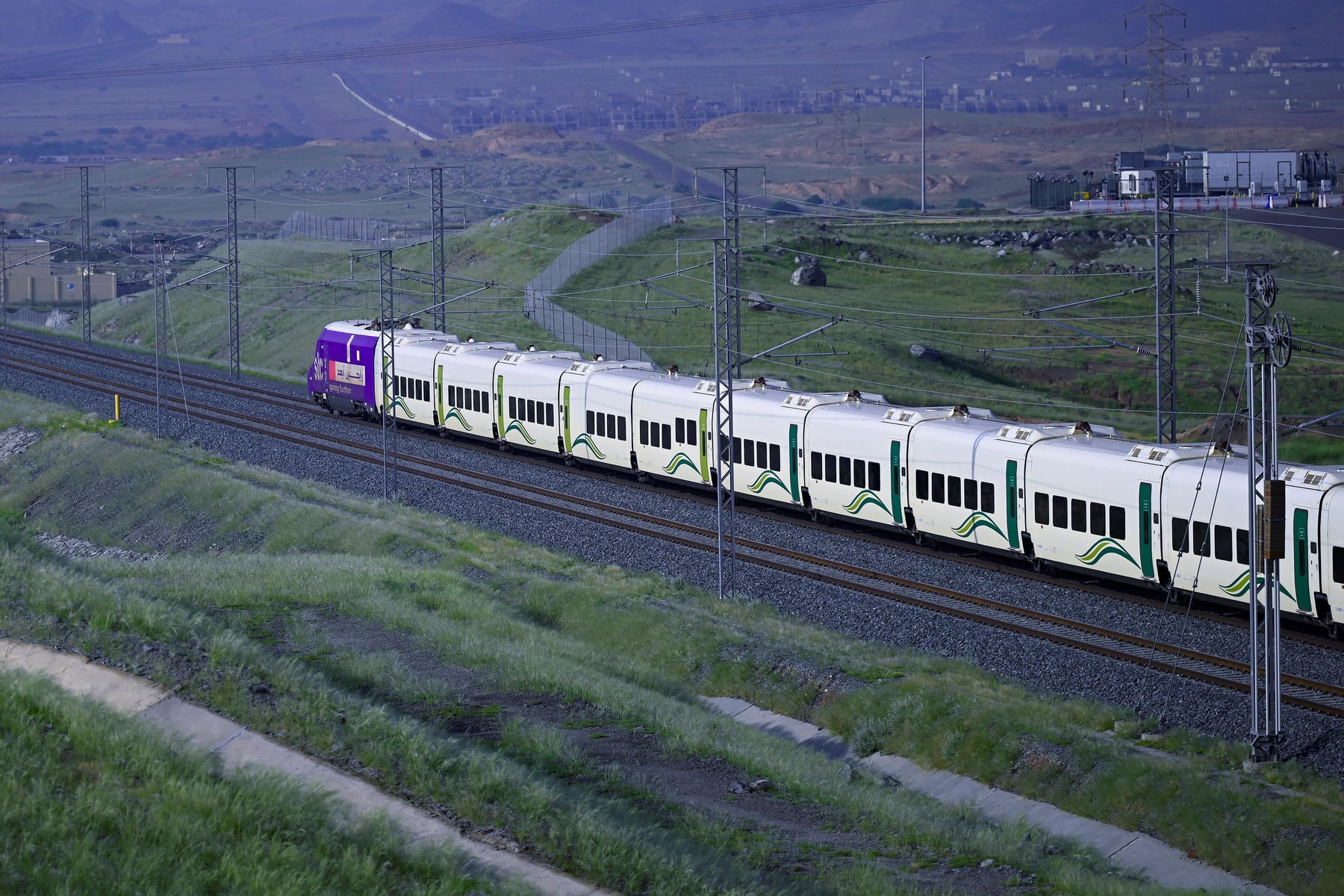
The Haramain High Speed Railway
Saudi Press Agency / Wikimedia Commons · CC BY-SA 4.0 · 2023 · cropped
- DistanceMakkah to Madinah · 449 km, plus a 3.75 km branch to Jeddah airport
- Duration2h 20m end to end · 1h 48m Jeddah to Madinah
- Best seasonNovember to March — Jeddah averages a daily high near 39 °C in July
Introduction
Before you plan this one. The Haramain links Islam's two holiest cities, and access to them is not the same for every traveller. Entry to Mecca is restricted to Muslims, which closes the southern terminus and the 77 kilometres of line below Jeddah to everyone else — the Government of Canada's travel advice puts it in a single sentence. Medina is different. The city itself is open to all visitors; the restriction there covers the Prophet's Mosque and the courtyard around it, as the US State Department's religious-freedom reporting sets out. So one stretch of this railway is open to every traveller who can get a visa: Jeddah to Medina, 372 kilometres in about an hour and fifty minutes, on the fastest railway in the Middle East.
Saudi Arabia built the Haramain to move pilgrims. Four hundred and forty-nine kilometres of double track run north from Mecca through Jeddah and King Abdullah Economic City to Medina, with a short branch into Jeddah's airport, and the trains hold 300 km/h along most of it. It opened to the public on 11 October 2018 after nine years of construction and about US$9.4 billion, and it was sized from the start for crowds that arrive all at once: thirty-six trainsets, 417 seats apiece, and a design brief that spoke of sixty million passengers a year. Nothing else in the Middle East runs this fast. Nothing else anywhere was built quite so single-mindedly for one purpose.
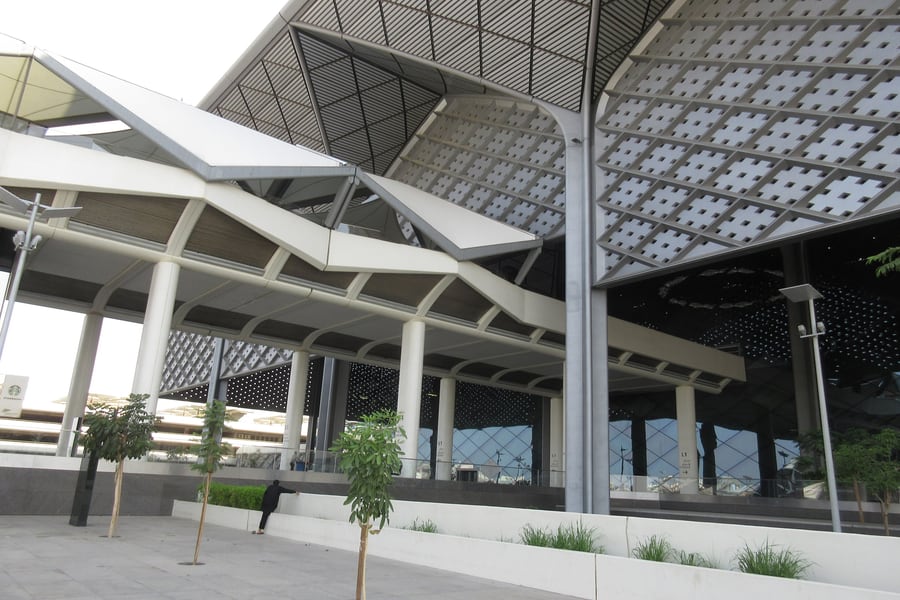
What makes it worth a page rather than a footnote is that it is also a very good train. The Talgo 350 sets were built in Spain, they are quiet and low-slung, and the ride across the Hejaz plain is glassy at a speed most of the world's railways never see. The four main stations are Foster + Partners buildings — vaulted, perforated, engineered with Buro Happold to throw shade the way an old souk does — and they are among the best new architecture in the Kingdom. You can board at Jeddah after breakfast, be in Medina before lunch, and have crossed a landscape of black lava and pale sand at something close to the speed of a jet on final approach.
The Journey
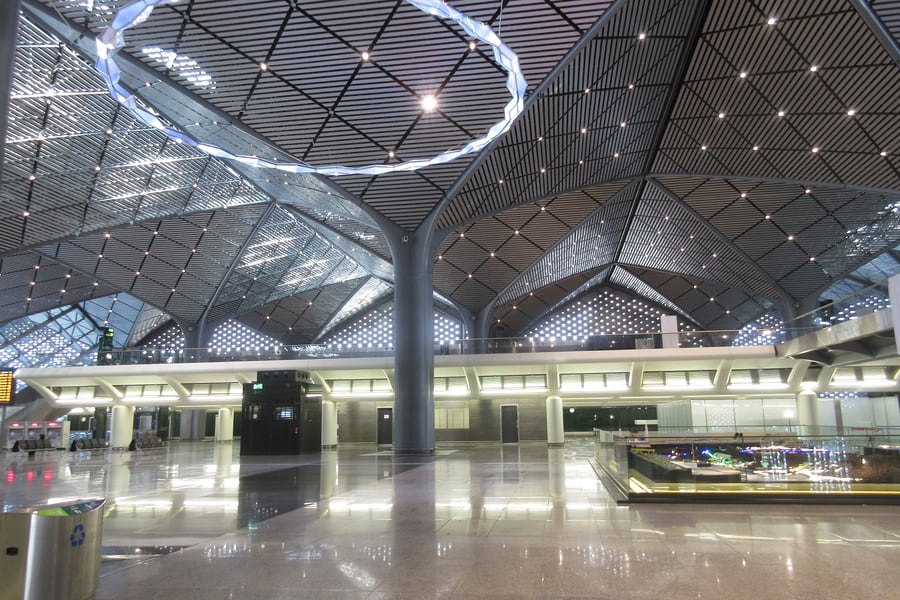
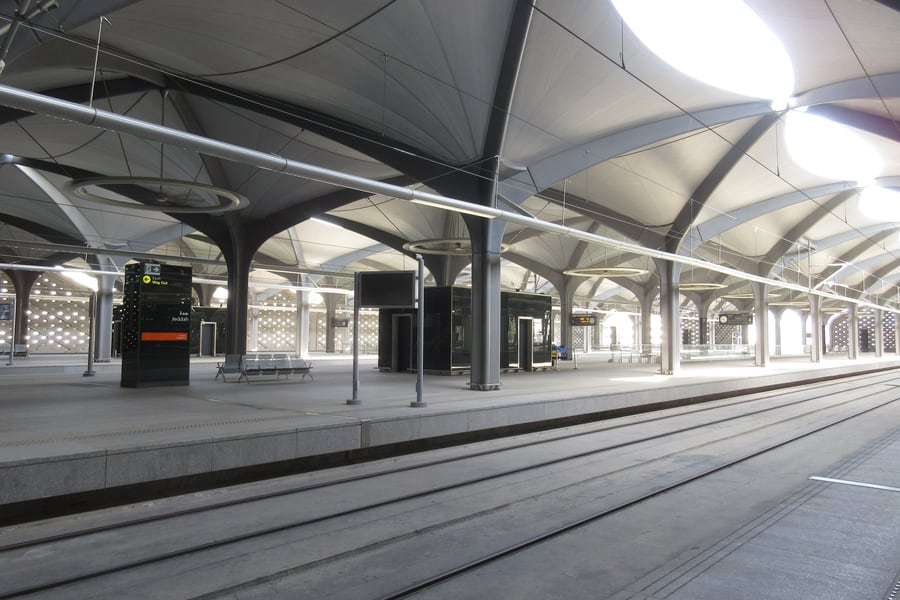
Jeddah's Haramain station stands at Al-Sulimaniyah, on the median of the Haramain Road, and the approach is by taxi off a six-lane highway into a building that looks like a tent pitched by engineers. Inside, a lattice vault runs the length of the concourse, pierced with thousands of small openings so that the light arriving on the marble is dappled rather than flat. A ring of light hangs under the dome. Escalators drop to the platforms, which sit in the shade of the same structure, and in the fifteen minutes before departure the hall fills with families and their luggage trolleys, Medina-bound pilgrims, and businessmen who have worked out that this beats the airport.
This is not the building that opened in 2018. On 29 September 2019, less than a year into service, fire took hold in the station's fibre-reinforced plastic roof panels and destroyed it; firefighters needed twelve hours to bring it under control. A 1.5-kilometre bypass was thrown around the site so that Mecca–Medina trains could keep running, and Jeddah Al-Sulimaniyah did not resume until 13 July 2021. What you walk through now is the rebuild.
The train
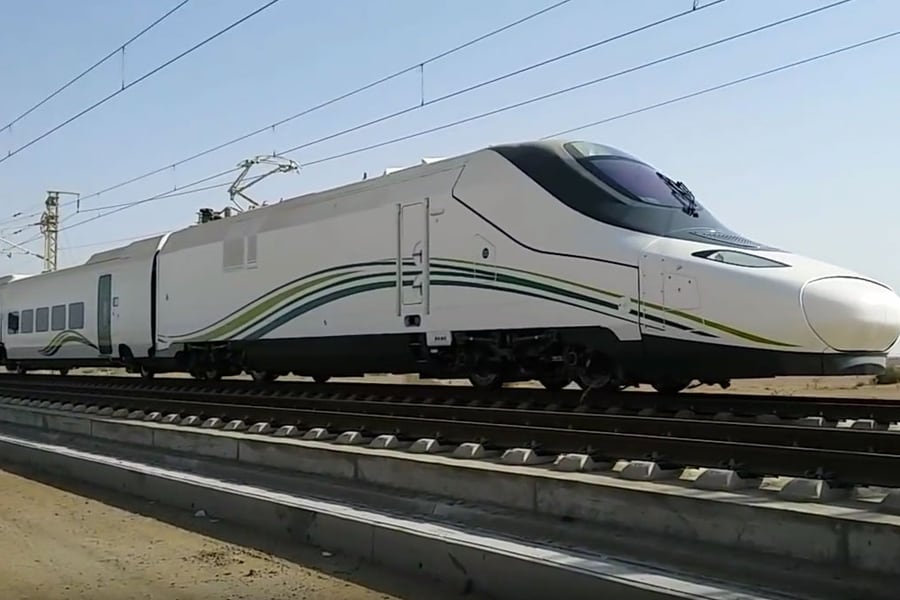
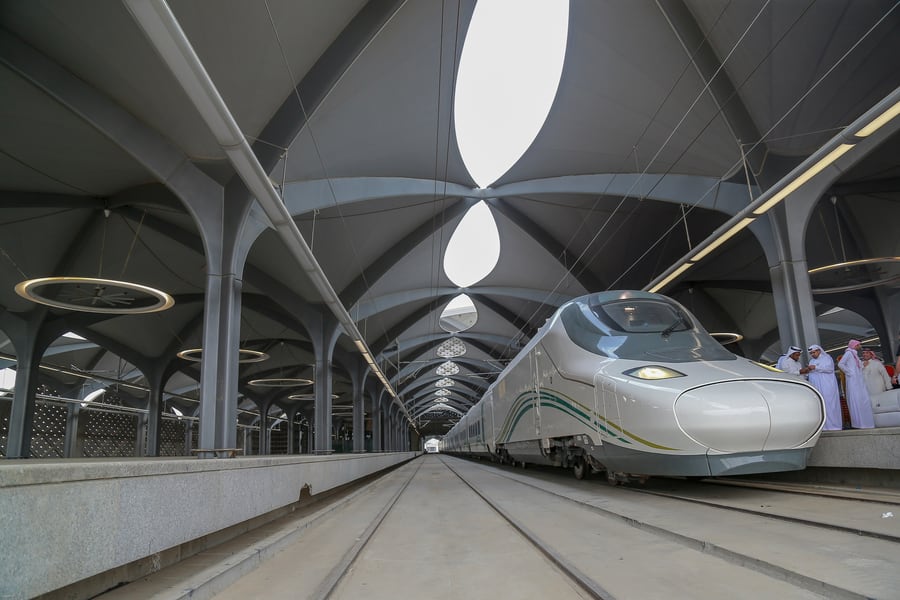
The traction is Spanish. Talgo supplied thirty-six Talgo 350 SRO push-pull sets — the family Renfe runs as Class 102, and the reason Spaniards call the type pato, the duck, for the beaked power car at each end. Propulsion and bogies came from Bombardier plants in Spain; the interiors are Talgo's own, articulated and low-slung, which is why the floor is barely a step above the platform. Each train seats 417: 113 in Business and 304 in Economy, with the cafeteria in coach five. Track and stock alike were specified to work between 0 °C and 50 °C, which in the Hejaz is not a theoretical range.
Out of the city
North of Jeddah the line lifts onto the coastal plain and the driver takes it to line speed. At 300 km/h the sensation is mostly absence: no sway, no rail joints, a faint pressure change in the ears when the train meets one of the forty-six rail bridges or drops into the line's single cut-and-cover tunnel. The engineering count reads like a description of the country it crosses — nine wadi bridges for the flash floods, thirty vehicular underpasses, and twelve camel crossings.
King Abdullah Economic City is the only intermediate stop north of Jeddah, ninety-four kilometres up, and the booked stand is three minutes: a city being built from nothing on the Red Sea, whose station serves a grid of streets that in places is still waiting for its buildings. After it the country empties. The Hejaz here is basalt and gravel, and away to the east lies Harrat Rahat, the largest lava field in Saudi Arabia, which last erupted in the summer of 1256 and sent a flow to within four kilometres of Medina.
Medina
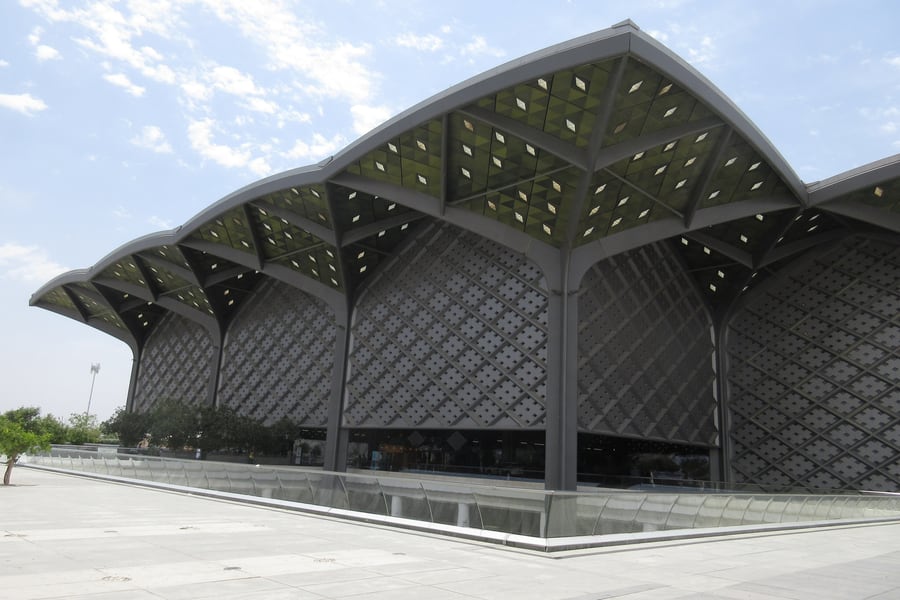
The last two hundred and sixty-one kilometres are the fast ones, and the arrival is abrupt. Medina's station is Foster + Partners again, a broader and lower building than Jeddah's, with a roof of folded planes carried on splayed columns and a facade of perforated screen the colour of the desert. Trains stand on the through platforms under it with their power cars uncoupled from nothing at all — Talgo push-pull sets simply change ends. Outside, the city begins: a modern grid laid across a volcanic plain, date palms in the gardens, and — ten kilometres west, near the old walls — the Hejaz Railway terminus of 1908, the line this one replaced by a century and a different route.
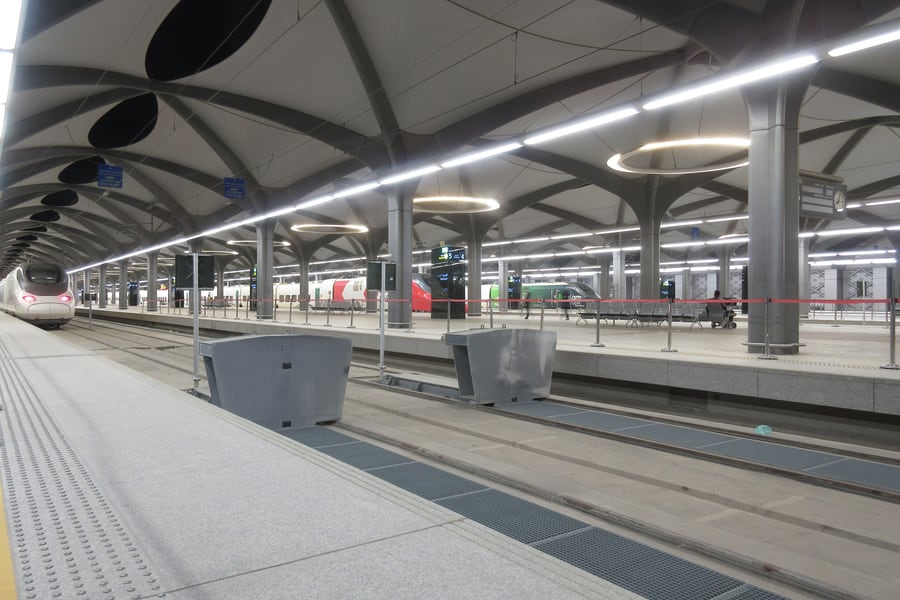
Along the route
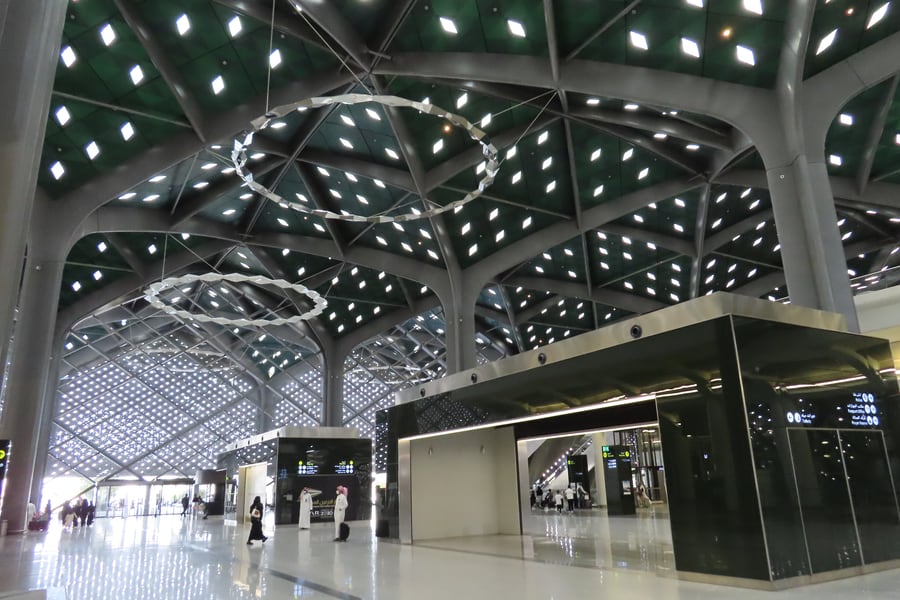 amanderson2 / Wikimedia Commons · CC BY 2.0 · 2022 · cropped
The roof
Foster + Partners and Buro Happold designed four stations as one family: a vault of perforated steel that shades the concourse the way a mashrabiya shades a room, and turns the light on the floor into a pattern.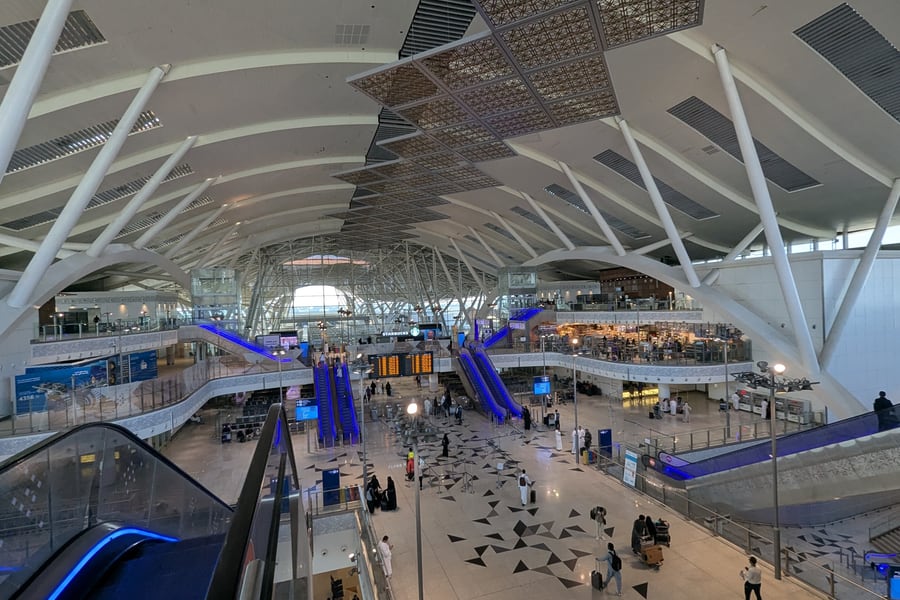 Tweenet / Wikimedia Commons · CC BY-SA 4.0 · 2025 · cropped
Straight off the plane
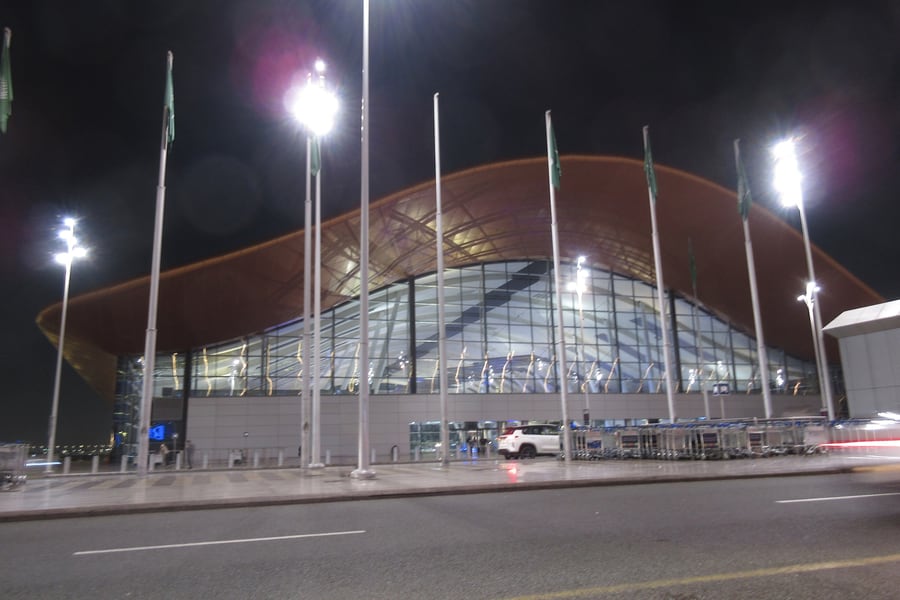
A 3.75 km branch runs into King Abdulaziz International, so you can land at Jeddah and be on a 300 km/h train north without entering the city. Ten departures a day to Madinah.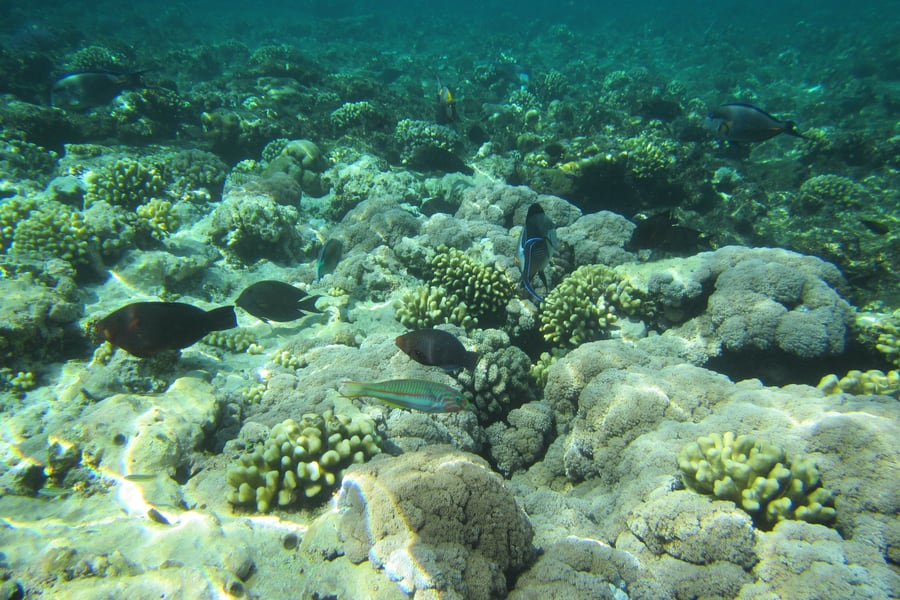 juhotski / Wikimedia Commons · CC BY-SA 3.0 · 2015 · cropped
The reef off KAEC
The line runs within sight of the Red Sea for its middle third, and this is what is under it — hard coral and reef fish twenty minutes from the station at King Abdullah Economic City.A bit of history
Culture & experiences along the way
 Imam Khairul Annas / Wikimedia Commons · CC BY-SA 4.0 · 2015 · cropped
The railway this one replaced
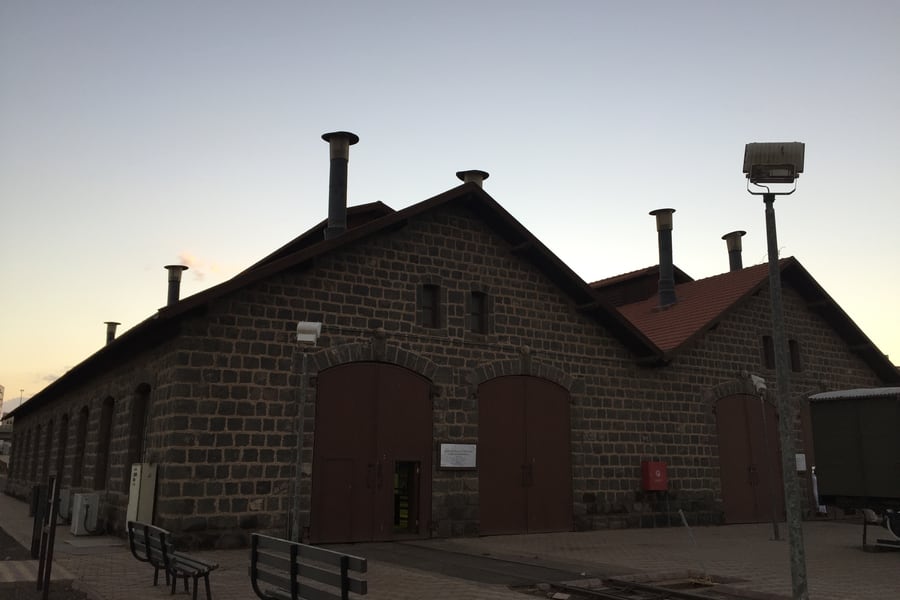
The Hejaz Railway reached Medina from Damascus on 1 September 1908, on 1,050 mm gauge and Ottoman money raised by public subscription across the Muslim world. It never got to Mecca, and the Arab Revolt finished it. Its Medina engine shed still stands, ten kilometres west of the high-speed station.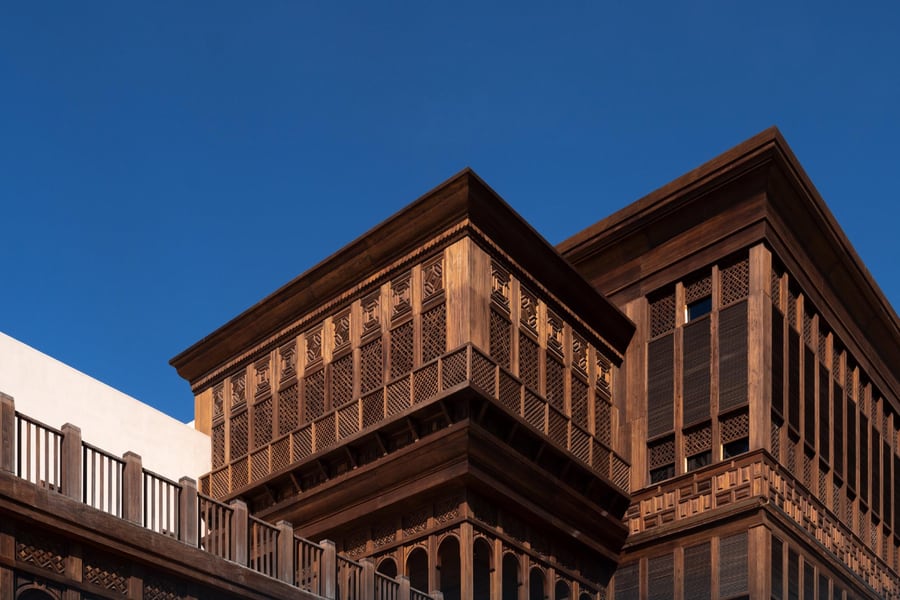 Saudi Press Agency / Wikimedia Commons · CC BY-SA 4.0 · 2025 · cropped
Rawasheen
Old Jeddah's signature is the rawshan — a carved wooden bay window, sometimes three storeys of it, hung off a coral-stone wall to catch the sea breeze and keep the room private. UNESCO listed the whole quarter for them in 2014, and the joinery is being rebuilt street by street.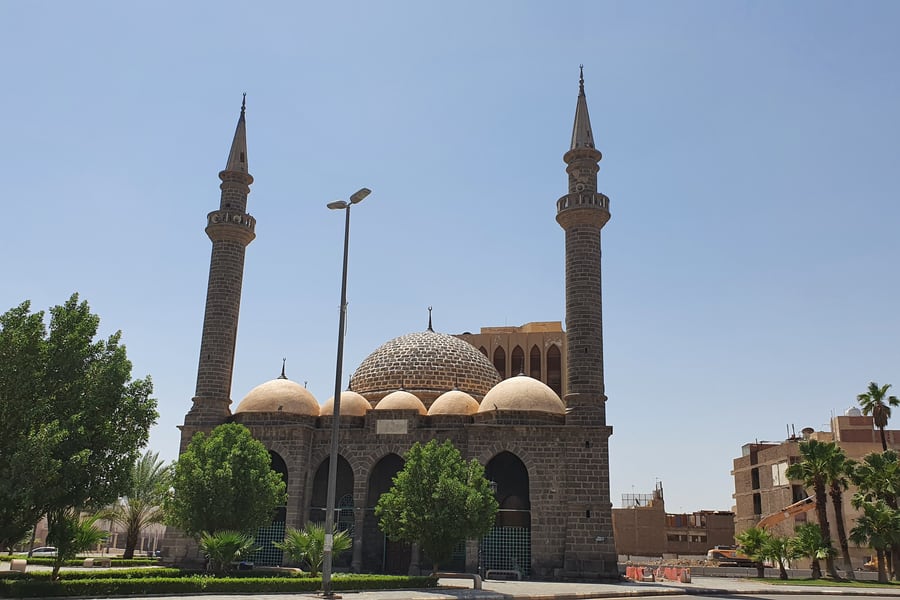 Richard Mortel / Wikimedia Commons · CC BY 2.0 · cropped
The mosque the railway built
The Anbariya Mosque went up beside the Hejaz Railway terminus in 1908, paid for by Abdul Hamid II as part of the same project — Ottoman, two minarets, six domes, and quite unlike anything else in the city. Non-Muslims cannot go in, but it stands in an open square and is worth the detour to see.Timetables
The Haramain runs every day, all year, and it runs often. On a representative weekday there are twenty-four trains each way between Mecca and Medina, the first out of Mecca at 06:00 and the last at 21:20, taking 2 h 20 m non-stop through Jeddah or 2 h 25 m with a call at King Abdullah Economic City as well. Every seat is reserved for a named train; there is no walk-up carriage.
On the stretch that is open to every traveller, Jeddah to Madinah, the pattern is roughly hourly.
Jeddah Al-Sulimaniyah → Madinah — 19 trains, Tuesday 8 September 2026
| Depart | Arrive | Calls at KAEC | Train |
|---|---|---|---|
| 06:32 | 08:25 | yes | 00060 |
| 07:32 | 09:20 | — | 01070 |
| 07:52 | 09:40 | — | 01072 |
| 08:32 | 10:25 | yes | 00080 |
| 09:32 | 11:20 | — | 01090 |
| 10:32 | 12:20 | — | 01100 |
| 10:52 | 12:40 | — | 01102 |
| 11:32 | 13:25 | yes | 00110 |
| 12:32 | 14:20 | — | 01120 |
| 13:32 | 15:20 | — | 01130 |
| 14:32 | 16:25 | yes | 00140 |
| 15:32 | 17:20 | — | 01150 |
| 16:32 | 18:20 | — | 01160 |
| 17:32 | 19:25 | yes | 00170 |
| 18:32 | 20:20 | — | 01180 |
| 19:32 | 21:25 | yes | 00190 |
| 20:32 | 22:20 | — | 01200 |
| 21:32 | 23:25 | yes | 00210 |
| 21:52 | 23:40 | — | 01212 |
Non-stop is 1 h 48 m; the KAEC call adds five minutes and the stand there is three.
Madinah → Jeddah Al-Sulimaniyah — 19 trains, same day
| Depart | Arrive | Calls at KAEC | Train |
|---|---|---|---|
| 06:30 | 08:17 | yes | 00061 |
| 08:30 | 10:17 | yes | 00081 |
| 09:30 | 11:11 | — | 01091 |
| 10:30 | 12:11 | — | 01101 |
| 10:50 | 12:31 | — | 01103 |
| 11:30 | 13:17 | yes | 00111 |
| 11:50 | 13:31 | — | 01113 |
| 12:30 | 14:11 | — | 01121 |
| 13:30 | 15:11 | — | 01131 |
| 14:30 | 16:17 | yes | 00141 |
| 15:30 | 17:11 | — | 01151 |
| 16:30 | 18:11 | — | 01161 |
| 17:30 | 19:11 | — | 01171 |
| 18:30 | 20:11 | — | 01181 |
| 19:30 | 21:17 | yes | 00191 |
| 19:50 | 21:31 | — | 01193 |
| 20:30 | 22:11 | — | 01201 |
| 20:50 | 22:31 | — | 01203 |
| 21:30 | 23:17 | yes | 00211 |
The airport branch, and the short hops
Not every Mecca–Medina train calls at Al-Sulimaniyah: some run into Airport–Jeddah on the 3.75 km branch instead, which is why the Jeddah tables above are shorter than the Mecca ones. On the same Tuesday there were ten departures from the airport station to Madinah, on the hour from 12:00 to 22:00, taking 1 h 48 m non-stop or 1 h 54 m by way of KAEC.
The shortest useful ride on the line is Jeddah to King Abdullah Economic City — thirty-two minutes, with eight departures a day when we looked, the first at 08:32 and the last at 22:52. It is ninety-four kilometres, and the train is doing 300 km/h for most of it.
As of September 2026, read from the operator's own board. Times change with the season and with the pilgrimage calendar; confirm yours at the Haramain High Speed Railway timetable (opens in a new tab), which takes a station pair and a date, or by calling 920 004 433 free within Saudi Arabia.
Tickets
There are two classes and 417 seats: 113 Business and 304 Economy, with the cafeteria in coach five. Business includes complimentary drinks and a meal served at the seat; Economy has the same cafeteria coach and a trolley you buy from. Seat selection is free in both. Every ticket is for a named train, a named coach and a numbered seat, and it is non-transferable — bring the ID it was issued against.
HHR publishes a base fare for each station pair, before VAT and fees, and warns that what you
actually pay moves with the date and how full the train is. Jeddah to Madinah is SAR 135 in
Economy and SAR 375 in Business; end to end, Makkah to Madinah, it is 162 and 455; the short hop
from Jeddah to King Abdullah Economic City is 54 and 110. Children get 50% off in Economy and 40%
in Business, an infant sharing an adult's seat 90%, and passengers with an eligible disability
document 50%. Buy at hhr.sa, in the apps, at station offices and machines, or on 920 004 433 —
but note that anything bought at a station counter or vending machine cannot be changed or refunded.
Fares read from the operator's own table, September 2026.
Book your tickets
Economy
304 seats of the 417 · Jeddah to Madinah
A reserved seat, the cafeteria in coach five, and a trolley you buy from.
Book Tickets (opens in a new tab, on hhr.sa)via hhr.saBusiness
113 seats at the ends of the train · Jeddah to Madinah
Wider seating with complimentary drinks and a meal served at the seat.
Book Tickets (opens in a new tab, on hhr.sa)via hhr.saJeddah to KAEC
Economy, ninety-four kilometres
Thirty-two minutes, and the cheapest way there is to ride at 300 km/h.
Book Tickets (opens in a new tab, on hhr.sa)via hhr.saRail Passes
There is no rail pass for Saudi Arabia, and no multi-journey ticket that covers the Haramain.
Interrail and Eurail do not reach the Kingdom, and the Haramain sells only its own point-to-point
tickets — through hhr.sa, the HHR apps, the call centre on 920 004 433, or the ticket offices and
vending machines at the stations. Saudi Arabia Railways, which runs the separate network east and
north out of Riyadh, sells through its own channels again; a Haramain ticket is not valid on it and
there is no through fare between the two.
Every seat is reserved and sold for a named train, so a "pass" would not save you the booking in any case. Buy the individual legs you want, and buy them early: HHR's own travel advice warns that luggage space and seats are hardest to come by in the peak travelling seasons, which here means Ramadan and the weeks around the hajj.
As of September 2026.
Places to Visit
The Haramain has five stations and four of them are open to every traveller. Entry to Mecca is restricted to Muslims, so nothing below is south of Jeddah — a guide to a city under those rules belongs somewhere written for the people who go there, not here. What is left is still a good week: a UNESCO-listed old town on the Red Sea, a city being invented from scratch halfway up the line, and — at the northern end — Medina, its Ottoman railway terminus, and the road out to the Nabataean tombs at Hegra.
In Medina, know where the boundary runs: the city is open to all visitors, and the Prophet's Mosque and its courtyard are open to Muslims only. The perimeter is signposted and stewarded, and it is not a line to test.
 Diego Delso / Wikimedia Commons · CC BY-SA 4.0 · 2025 · cropped
Historic Jeddah
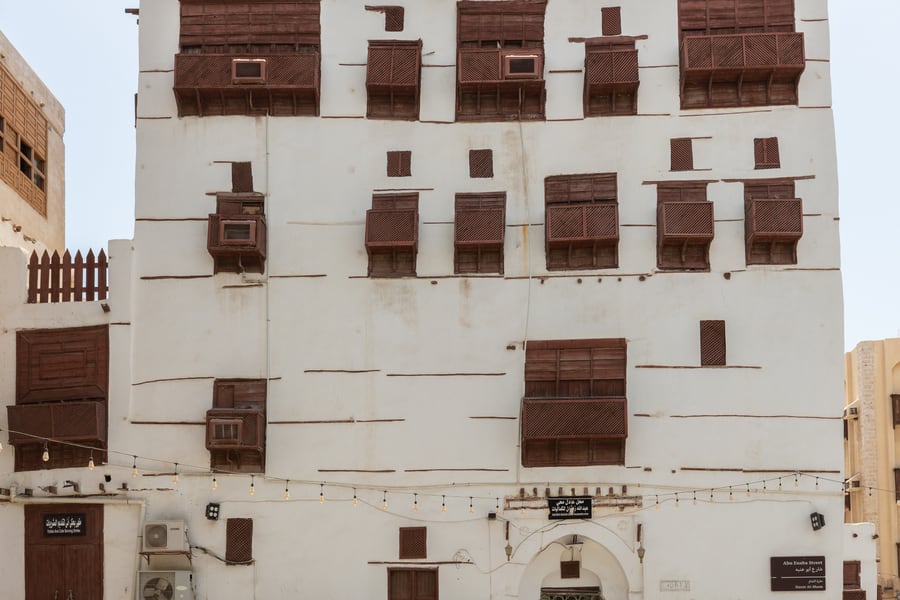
Al-Balad is the reason to give the departure city a day. UNESCO listed it in 2014 as the last surviving urban ensemble of the Red Sea world: tower houses of coral stone hung with carved wooden rawasheen, built by merchants who grew rich on the sea route to Mecca, and around them mosques, ribat-s, souks and small squares. Much of it is scaffolded, being put back together; enough is finished to walk for an afternoon.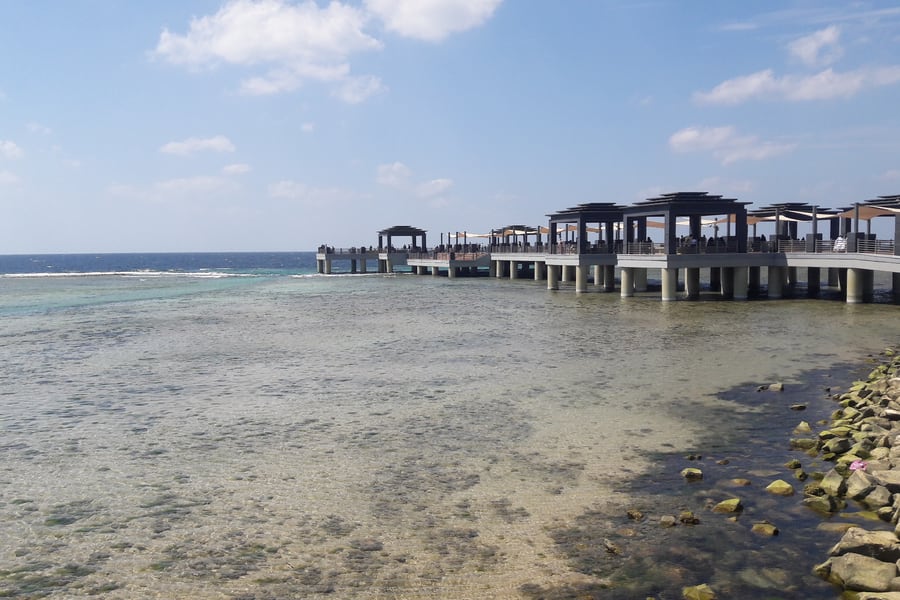 Tahir mq / Wikimedia Commons · CC BY-SA 4.0 · 2019 · cropped
The Red Sea at Jeddah
The Corniche runs for kilometres along the front, and the water at the foot of it is the real thing: fringing reef in clear shallows, close enough to the promenade to see the fish from a jetty. Jeddah has been a port for fourteen centuries and still feels like one, which is the sharpest contrast the line offers with the desert at the other end.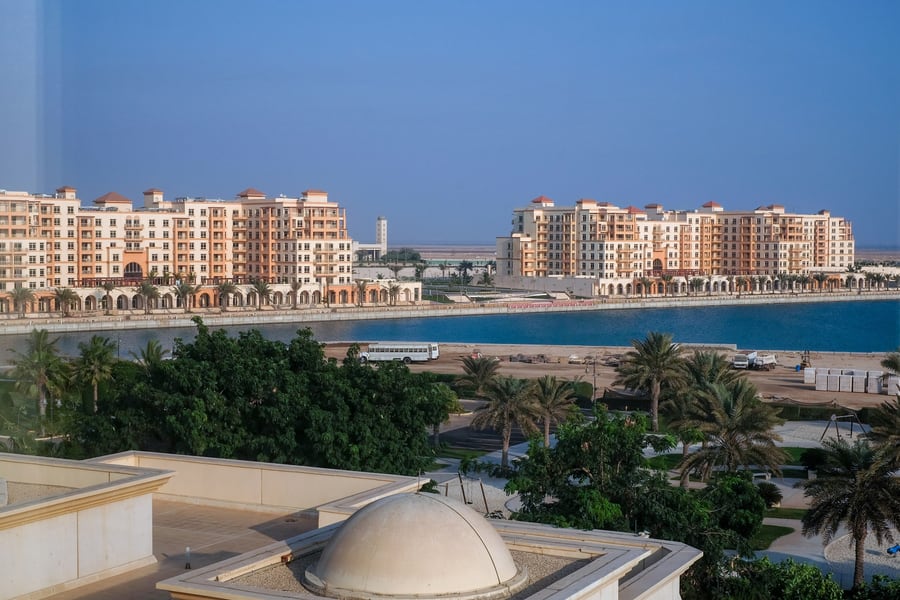 Mrcosch / Wikimedia Commons · CC BY-SA 4.0 · 2016 · cropped
King Abdullah Economic City
Ninety-four kilometres north of Jeddah, a city is being built from nothing on the Red Sea coast, and the Haramain stops in it. The waterfront and marina at Bay La Sun are finished and pleasant; the grid behind them is still filling in. It is a genuinely strange place to break a journey, and the only chance most travellers will get to see a 21st-century city while it is still under construction.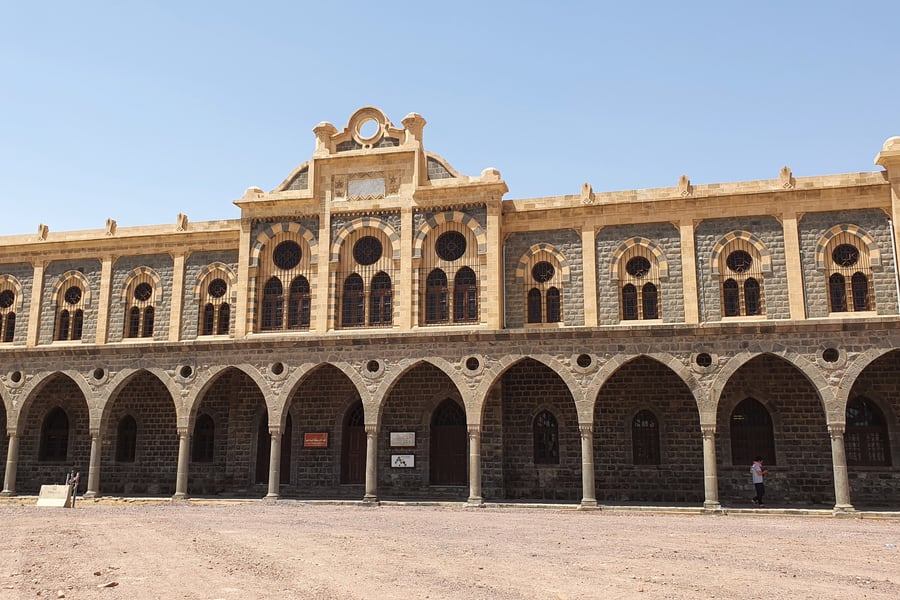 Richard Mortel / Wikimedia Commons · CC BY 2.0 · 2020 · cropped
The Hejaz Railway station, Medina
The old terminus of 1908 stands ten kilometres west of the new one: a long arcaded front of basalt and pale stone, Ottoman to its bones, with the engine shed and workshops behind it. It is now the Hejaz Railway Museum, and it is the single best thing on this route for anyone who came for the trains — the line that was meant to reach Mecca and never did, left where it stopped.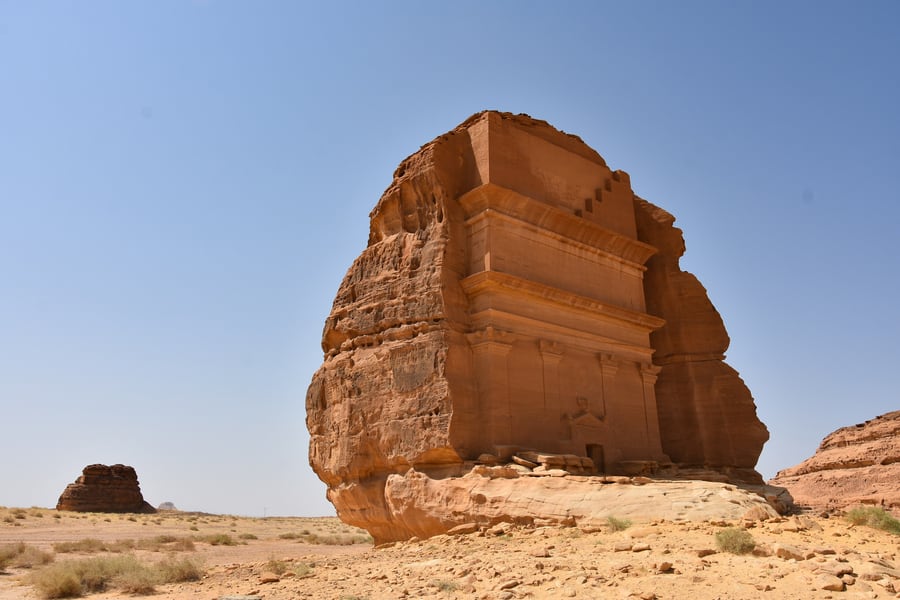 Richard Mortel / Wikimedia Commons · CC BY 2.0 · 2021 · cropped
Hegra, beyond Medina
Saudi Arabia's first World Heritage site is three hundred kilometres north-east of Medina at AlUla, and it is the reason a lot of people come. Hegra is the largest Nabataean city after Petra: 111 monumental tombs cut into sandstone outcrops, 94 of them with carved facades, and Qasr al-Farid standing alone in the open desert with its facade unfinished at the base. Hire a car or take the internal flight.Where to Sleep
Jeddah is the sensible base for this line. It is the Hejaz's international gateway, it has the widest choice of rooms, and both the Haramain station at Al-Sulimaniyah and the airport are a taxi ride away. The airport has its own platform on the branch line, so it is perfectly possible to land, cross to the station and go straight north without seeing a Jeddah street at all.
At the northern end, be clear about the geography before you book. Medina's hotel district is packed around the Prophet's Mosque, and the mosque and its courtyard are open to Muslims only; the streets around them and the rest of the city are open to everyone. If you are choosing a room for its view of the green dome, that is the boundary to have in mind.
King Abdullah Economic City, halfway up, is the odd one: a station stop with a marina, a hotel and almost nothing else yet. It makes a strange and rather good overnight if you want to see what a 21st-century Saudi city looks like while it is still being drawn.
No prices, ratings or star counts appear on these cards. We have verified that each hotel is open and that the link goes to its own website; we have not verified anybody's marketing.
Where to stay
Rosewood Jeddah
On the North Corniche, facing the Red Sea
A waterfront tower on the promenade, a taxi ride from the Haramain station.
Check Availability (opens in a new tab, on rosewoodhotels.com)via rosewoodhotels.comBay La Sun Hotel & Marina
In the marina district at King Abdullah Economic City
The hotel at the halfway stop, with rooms over the marina and the Red Sea.
Check Availability (opens in a new tab, on baylasunhotel.com)via baylasunhotel.comMysk Al Balad, Madinah
Walking distance from the Madinah dates market
A hundred and fifty rooms under Shaza's Mysk brand, 13.7 km from the airport.
Check Availability (opens in a new tab, on myskhotels.com)via myskhotels.comPractical Information
Who can go where. Entry to Mecca is restricted to Muslims; the rule is enforced, signposted on the approach roads, and treated as a serious matter. Medina is open to visitors of any faith, and the Prophet's Mosque and the courtyard around it are open to Muslims only. Saudi Arabia issues a one-year, multiple-entry tourist e-visa to nationals of about sixty-six countries, valid for a total of ninety days in the year and including basic health insurance; everyone else applies through a Saudi embassy. Check your own government's travel advice before you book — the FCDO advises against all travel within 10 km of the Yemen border and against all but essential travel between 10 and 80 km of it, which is nowhere near this railway but is the reason Saudi Arabia carries a warning at all.
Getting to the trains. Jeddah's station is at Al-Sulimaniyah, on the median of the Haramain Road, and the airport has its own station on a 3.75 km branch, so you can land at King Abdulaziz International and be on a train without entering the city. There are no car hire or limousine desks at the stations; taxis are.
At the station. Ticket offices close twenty minutes before departure and the boarding gates close ten. Bring the photo ID that matches the ticket — tickets are non-transferable and staff do check. One bag per passenger, not over 65 × 55 × 35 cm and 25 kg, plus a handbag or laptop bag. No animals, no smoking anywhere in the stations or on the trains, and dress in line with Saudi custom. Stations have prayer rooms, restaurants, waiting and business lounges, shops, ATMs and paid parking by the hour.
Heat. Jeddah averages a daily high of about 29 °C in January and 39 °C in July, and has recorded 52 °C. The track and the trains are engineered for anything between 0 °C and 50 °C; you are not. November to March is the half of the year in which walking round Al-Balad or Hegra is a pleasure rather than an ordeal.
If something goes wrong. HHR's customer care number is 920 004 433, free within Saudi Arabia. Tickets can be changed or refunded through whichever channel sold them, on a sliding scale: free changes in Business more than 24 hours out, 10% in Economy, and rising to half the fare for an Economy cancellation inside 24 hours. Nothing can be changed inside the last twenty minutes, and a missed train is a forfeited ticket. One exception worth knowing before you queue: a ticket bought at a station counter or vending machine cannot be changed or refunded at all. Buy online or in the app if there is any chance your plans will move.
Questions or corrections
Planning this trip and stuck on something, or spotted a time, fare or detail that has changed? Send us a message about The Haramain High Speed Railway. We read every one, and we update this page when something has changed.