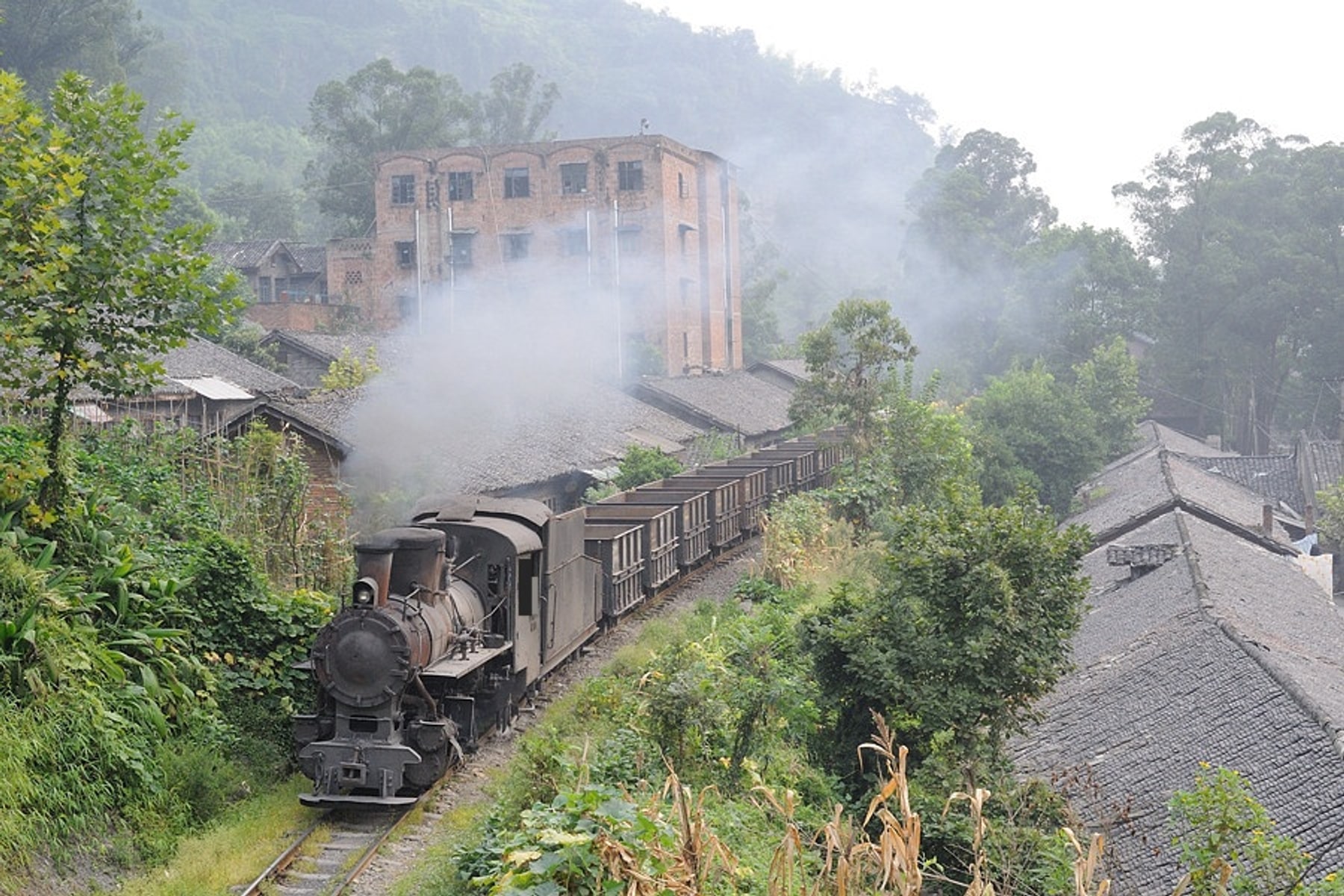
The Jiayang Steam Railway
MBxd1 / Wikimedia Commons · CC BY-SA 3.0 · 2011 · retouched
- Distance13.8 km, Yuejin to Bajiaogou
- DurationAbout 1 h 10 min, Yuejin to Bajiaogou
- Best seasonFebruary and March, for the rapeseed
Introduction
The Jiayang steam railway — 嘉阳小火车, Jiāyáng Xiǎohuǒchē, "the little Jiayang train" — runs in Qianwei County, south of Leshan in Sichuan, on track only 762 millimetres wide. It was laid in 1958 to carry coal 19.84 kilometres from the mines at Bajiaogou down to Shixi, and opened on 12 July 1959. Its engines are C2 steam locomotives, and they are still fired with a shovel, braked by hand and switched by hand.
The coal is gone. The last coal train beyond Yuejin ran in 2003, and the mining company meant to close the railway; in 2004 the local government objected that it was worth keeping for its visitors, and it was kept. It is now a listed monument of Sichuan, and its steam trains run every day for the people who come to ride them.
This page rides the line from Yuejin, through a zig-zag and over a C-shaped bend, to the old mining town of Bajiaogou, at about 20 kilometres an hour.
The Journey
Yuejin to Mifengyan
The steam trains start at Yuejin, 4.4 kilometres up the line from Shixi. The stretch below it, down to the Min at Shixi, was electrified in 2000, and small electric locomotives worked coal over it until 2016; it carries no passengers now. From Yuejin the line climbs into the hills on gradients of up to 36 per thousand and round 109 curves, which make up nearly half its length. At Mifengyan it gains height by a zig-zag, reversing up the hillside.
Caiziba and Liangshuituo
Beyond the fifth tunnel the line reaches Caiziba and swings through a C-shaped bend with a radius of 70 metres. The train stops at Caiziba, among fields that are planted with flowers — rapeseed in early spring — and again at Liangshuituo, where the crew put on a steam show beside the train; on a sunny day the steam can throw a rainbow.
Bajiaogou
After four more tunnels the line ends for the steam trains at Bajiaogou, 18.24 kilometres from Shixi, the town that grew up around the mine opened here in 1938. Its mining buildings make up the Jiayang mine park, with a museum, and two of them, the Great Hall and the Soviet Experts' Building, are now hotels. A trolley car goes on to Huangcunjing, the last mine, where visitors can go underground.
The train
The engines are C2s, class ZM16-4, the narrow-gauge type the line took when it was regauged in 1960. The cab is laid out for two: the fireman on the left, shovelling coal, and the driver on the right. Two of the engines, Nos. 08 and 16, came in 2006 from the Pengzhou line after it closed, and Nos. 17 and 18 were built new in 2015, followed by No. 19 in 2017.
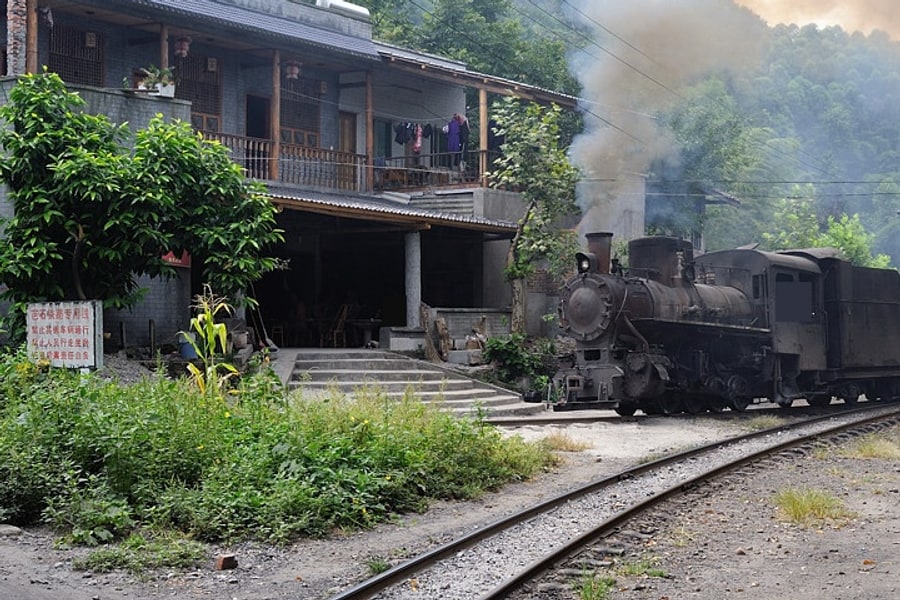
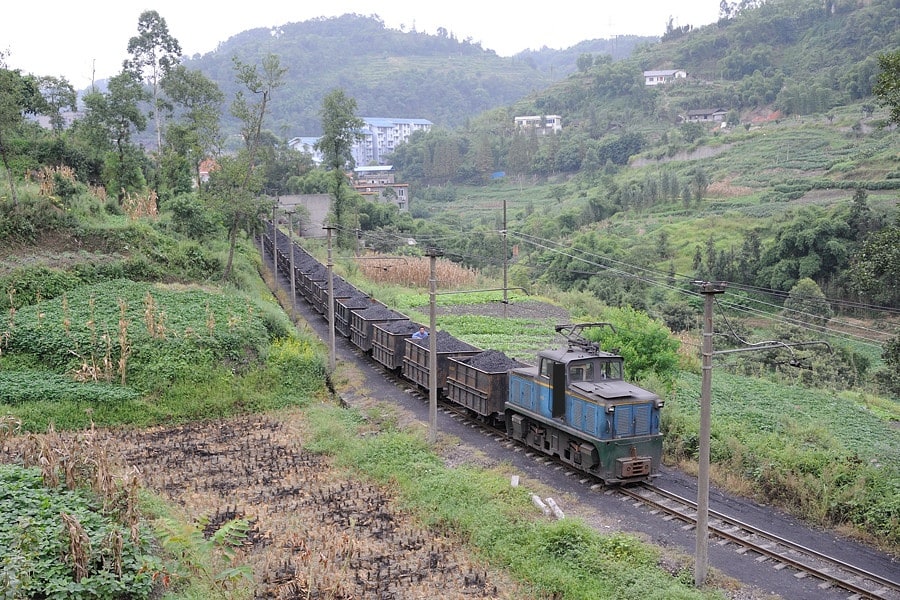
Along the route
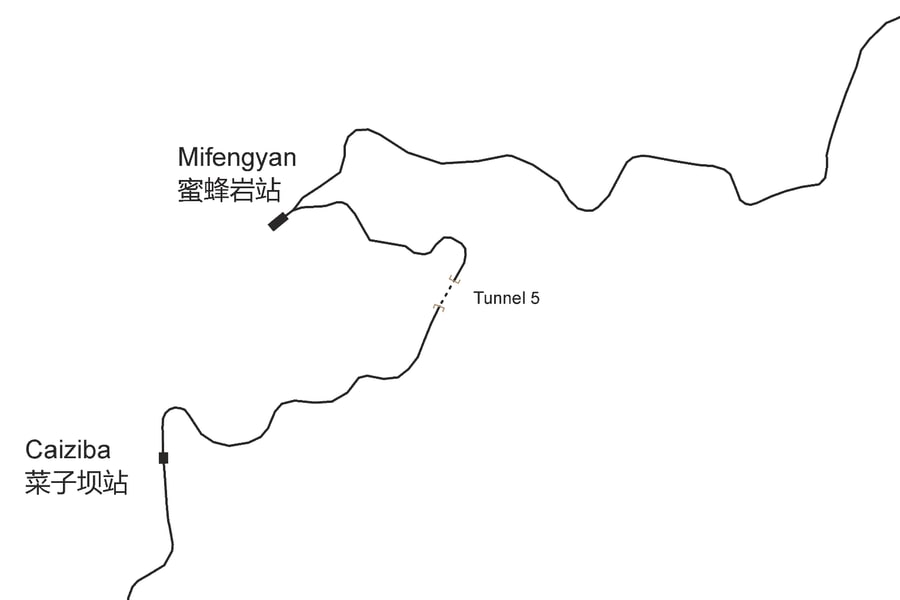 MBxd1 / Wikimedia Commons · CC BY-SA 3.0 · cropped
The zig-zag at Mifengyan
The hillside above Mifengyan is too steep to climb in a curve, so the line climbs it in a zig-zag. The train runs into a dead-end spur, the points are changed by hand, and it climbs the next leg going the other way.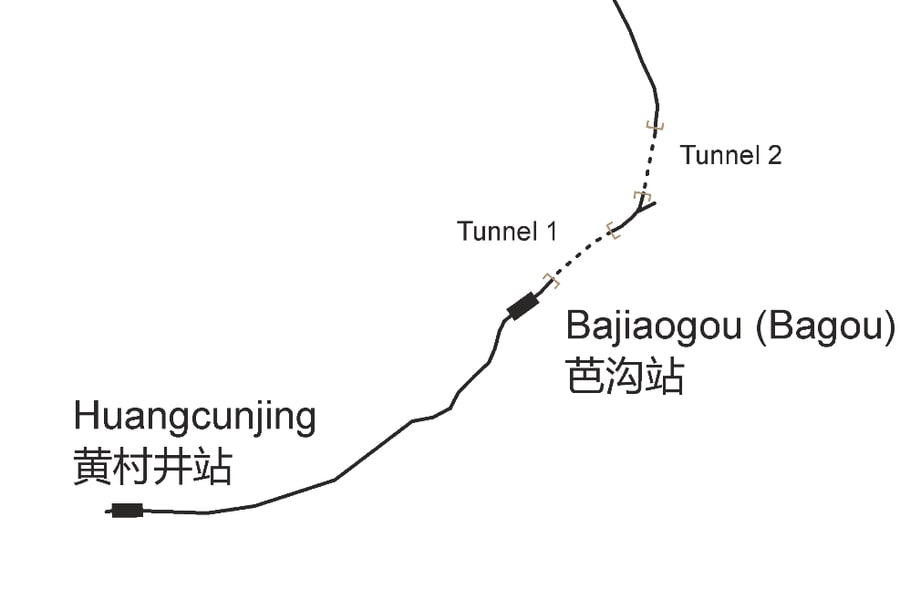 MBxd1 / Wikimedia Commons · CC BY-SA 3.0 · cropped
Through the tunnels to Bajiaogou
Four of the line's six tunnels come in its last few kilometres, past Jiaoba, before the mining town of Bajiaogou. The last 1.6 kilometres on to Huangcunjing, the old mine, are covered by a small trolley car rather than the steam train.A bit of history
Culture & experiences along the way
 Zheng Zhou / Wikimedia Commons · CC BY-SA 4.0 · 2019 · cropped
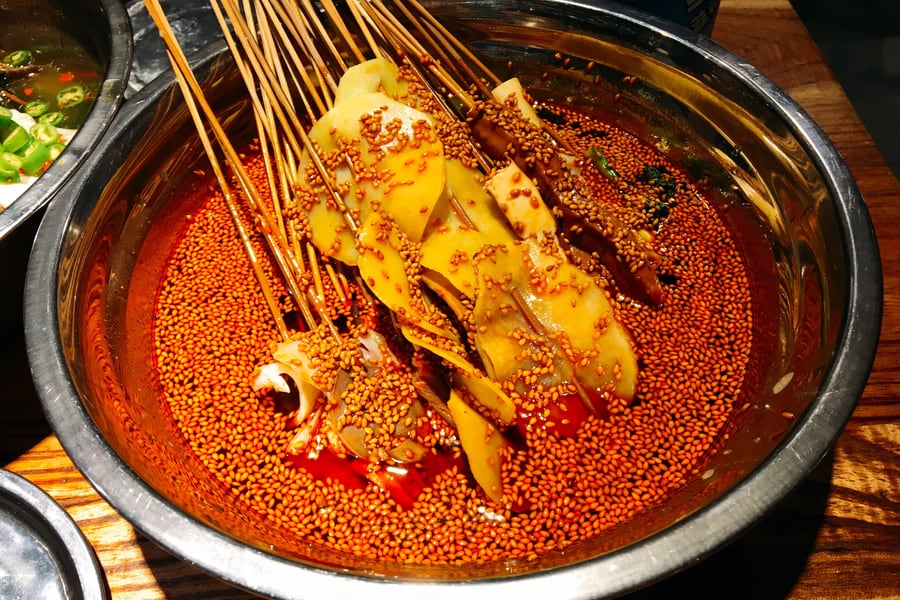
Bobo chicken
Bōbō jī comes from Leshan and Meishan: boned chicken, and now almost anything else, cooked, threaded on bamboo skewers and left to steep in a clay bowl of chilli oil or green Sichuan pepper, then eaten cold. It has been made this way since the Qing dynasty.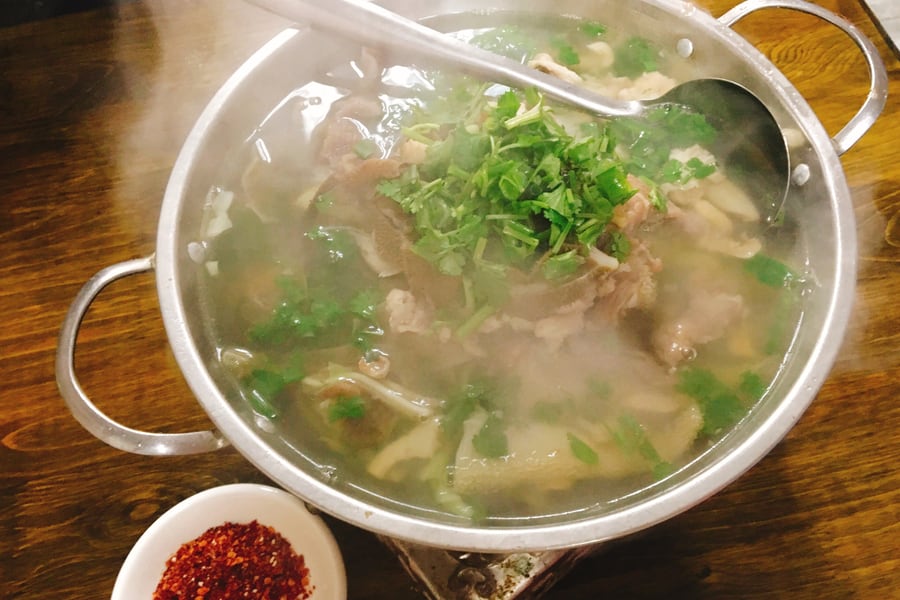 ZhengZhou / Wikimedia Commons · CC BY-SA 4.0 · 2019 · cropped
Qiaojiao beef
"Crossed-leg beef" comes from Suji, outside Leshan. The story is of a herbal doctor named Luo in the 1930s who boiled the offal richer families threw away with his medicinal herbs, and of customers who ate it sitting with one leg crossed over the other.Timetables
The steam trains run every day. From 11 October 2026 there is one full-line train each way and two short return trips from Bajiaogou.
| Train | Leaves | Arrives |
|---|---|---|
| Full line | Yuejin 10:30 | Bajiaogou, about 1 h 10 min later |
| Full line | Bajiaogou 16:00 | Yuejin, about 1 h 10 min later |
| Short return | Bajiaogou 13:00 | back about 45 min later, via Xianrenjiao |
| Short return | Bajiaogou 15:00 | back about 45 min later, via Xianrenjiao |
The full-line trains stop at Caiziba and Liangshuituo for photographs and the steam show; the short trips stop at Liangshuituo only. In the flower season and over holidays more trains run — over the Spring Festival in February 2026 there were two full-line trains each way and three short trips. The operator warns that stops and times can change with the weather, the flowers or operating needs.
Getting there
Yuejin is reached from Qianwei station on the high-speed line: the G3707 leaves Chengdu East at 07:00 and arrives at 08:15, and the Qianwei–Sanjing bus runs on to Yuejin. The last train back to Chengdu East is the G3708, Qianwei 20:29, Chengdu East 21:32.
Steam-train times are from the operator's notice of 9 October 2026, and the high-speed times from 12306 for 15 and 18 October 2026 — as of October 2026. The operator, the Jiayang · Suoluo Lake scenic area, publishes changes on its WeChat account, 嘉阳桫椤湖; tickets and times are also on Ctrip (opens in a new tab), and the high-speed trains on China Railway · 12306 (opens in a new tab).
Tickets
Tickets are sold by the scenic area: at the station windows, through its WeChat account and on Ctrip, and the self-service machines need an ID card. The full line is ¥80 one way and ¥160 return, and the short trip from Bajiaogou to Xianrenjiao and back is ¥80. Children up to 1.2 metres ride free if they do not take a seat. Book ahead in the flower season.
At Bajiaogou the trolley car to Huangcunjing is ¥20, and the mine tour there ¥80. The G3707 from Chengdu East to Qianwei is ¥47 in second class and ¥75 in first, sold on 12306 against your passport.
Book your tickets
 Gcycaas / Wikimedia Commons · CC BY-SA 4.0 · 2023 · cropped
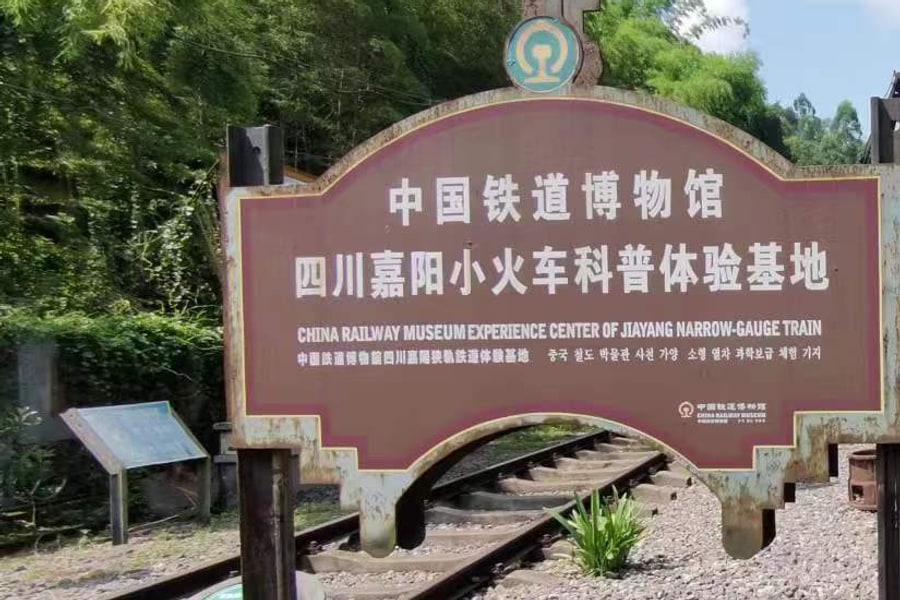
Steam train · Yuejin to Bajiaogou
¥80 one way, ¥160 return
The short return trip from Bajiaogou to Xianrenjiao is ¥80 too, and children up to 1.2 m ride free without a seat.
Book Tickets (opens in a new tab, on ctrip.com)via ctrip.comRail Passes
No rail pass covers this line. Interrail and Eurail are European passes and do not reach China, and the steam railway is run by the scenic area, which sells its own tickets — so the fare is simply the ticket.
Checked in October 2026.
Places to Visit
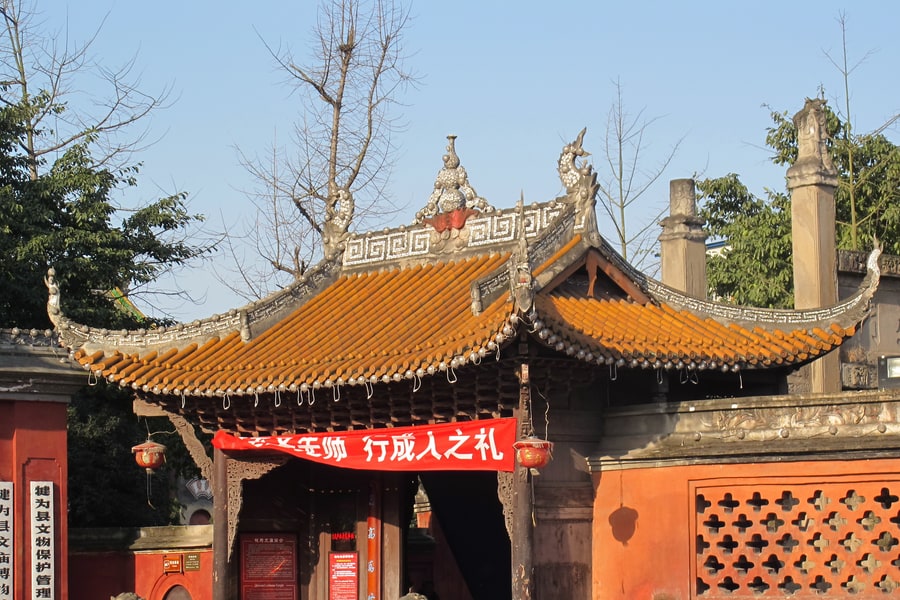
The temple is in Qianwei, the county town and the high-speed station for the line. The Giant Buddha and Mount Emei are further north, around Leshan.
 Nyx Ning / Wikimedia Commons · CC BY-SA 3.0 · 2012 · cropped
The Confucian Temple of Qianwei
Founded in the Northern Song, between 1008 and 1016, the temple has been rebuilt three times and moved three times in more than nine hundred years. It covers 200 by 120 metres behind a double wall, the largest Confucian temple in Sichuan and the fourth largest in China, and it has been a national protected monument since 2006.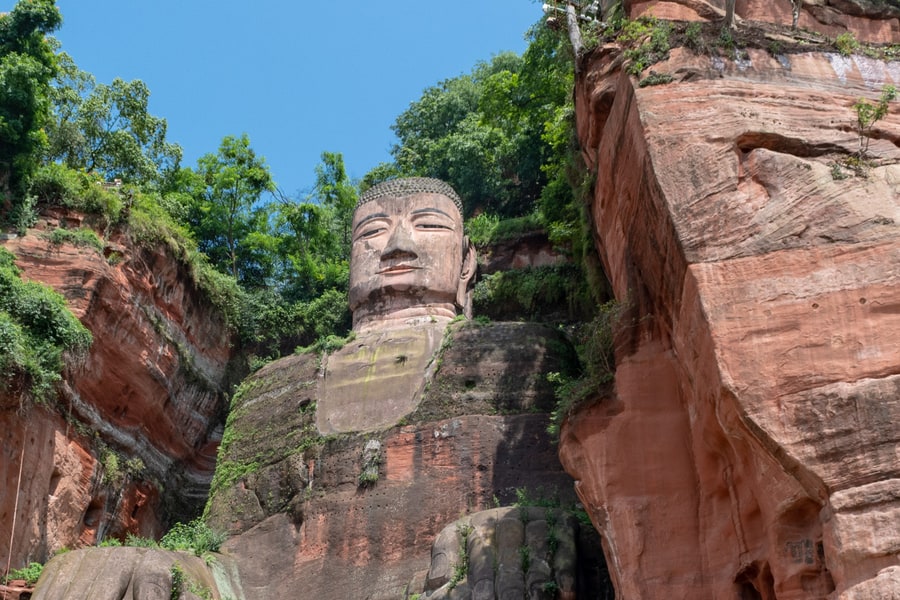 xiquinhosilva / Wikimedia Commons · CC BY 2.0 · 2018 · cropped
The Giant Buddha of Leshan
A Maitreya Buddha 71 metres tall, cut from the red sandstone cliff where the Min and Dadu rivers meet. The monk Haitong began it in the eighth century to calm the water that wrecked boats below, and his disciples finished it in 803. It is the tallest stone Buddha in the world, faces Mount Emei, and shares its World Heritage listing.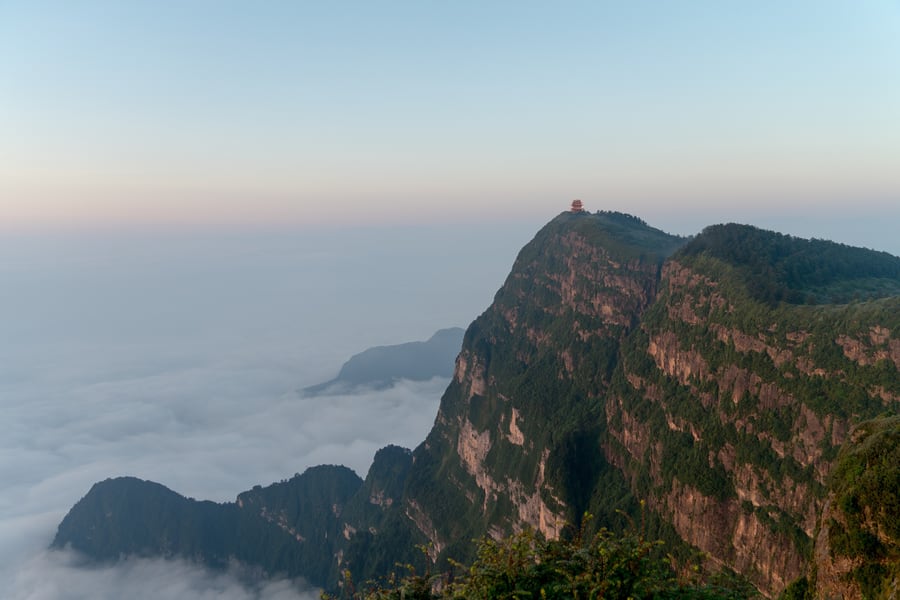 George N / Wikimedia Commons · CC BY 2.0 · 2017 · cropped
Mount Emei
At 3,099 metres the highest of China's Four Sacred Buddhist Mountains, on the western rim of the Sichuan Basin, held to be the place of enlightenment of the bodhisattva Puxian, and still a pilgrimage for Chinese Buddhists. Its name means "towering eyebrows". It has been a World Heritage Site since 1996.Where to Sleep
At the end of the line, two of Bajiaogou's old mining buildings, the Great Hall and the Soviet Experts' Building, are now hotels. The hotel below is at Wutongqiao, on the Min between Leshan and Qianwei.
Where to stay
Four Points by Sheraton Leshan
On the Min, at Wutongqiao
211 rooms and suites on the bank of the Min, with floor-to-ceiling windows.
Check Availability (opens in a new tab, on marriott.com)via marriott.comQuestions or corrections
Planning this trip and stuck on something, or spotted a time, fare or detail that has changed? Send us a message about The Jiayang Steam Railway. We read every one, and we update this page when something has changed.