Khartoum to Port Sudan
Bertramz / Wikimedia Commons · CC BY-SA 3.0 · 2008 · cropped
- DistanceAbout 900 km in two legs, changing at Atbara
- DurationSeven to eight hours to Atbara, then about twelve to Port Sudan
- Best seasonNovember to February · services run on announced dates, not a fixed timetable
Introduction
Where this railway stands, November 2026. Sudan has been at war since April 2023, and the UK Foreign Office advises against all travel to the country. Passenger trains stopped when the fighting began. The Port Sudan–Atbara line reopened in December 2024, the Nile Train returned to Khartoum in February 2026, and in October 2026 the Sudan Railways Corporation said one of its four passenger trainsets was in service. There is no published timetable: trips are announced a few days ahead and tickets are sold at the stations. Everything below is dated to the announcement it comes from.
Sudan's busiest railway runs from the confluence of the Niles at Khartoum to the Red Sea, first beside the river and then across the desert. The Nile Train works the first stretch: from Khartoum Bahri, on the north bank of the Blue Nile, through Shendi and Ad-Damer to Atbara, close to 300 kilometres in seven or eight hours, past the royal pyramids of Meroë standing on the hills a few kilometres from the line.
At Atbara, the railway's own town, the journey turns east. The second leg crosses about 600 kilometres of desert to Port Sudan in roughly twelve hours, and it was the first passenger service anywhere in Sudan to run again after the war began. The two legs run on different days, so the whole trip is two journeys with a night in Atbara between them.
The Journey
The railway began as a weapon. In 1896 and 1897 Kitchener's engineers laid a line across the desert from Wadi Halfa to Abu Hamad to supply the army moving up the Nile, and Kitchener insisted on the 3 ft 6 in Cape gauge rather than something narrower. Every main line built in Sudan since has followed it. The track reached Khartoum on the last day of 1899, and in 1906 the line from Atbara reached the new harbour at Port Sudan. The Khartoum–Port Sudan route has long carried more than two-thirds of the railway's traffic.
Atbara became the railway's headquarters and workshop town, and the workers there shaped the country as well as the railway. Sudan's first trade union was formed among them in 1946, and in December 2018 Atbara was the starting point of the protests against the government.
The Nile Train
The Nile Train began running on 20 January 2014: two trainsets bought from China for about $13 million, each of four air-conditioned coaches, on a run of close to 300 kilometres that took six hours and forty minutes. It left from a long-abandoned station in the industrial district of Khartoum North, and within two months it was running twice a day.
The war stopped it. When the corporation brought it back in February 2026, after a full overhaul, it was on a different footing: one set, alternating between Atbara and Khartoum Bahri on announced dates, calling at Ad-Damer and Shendi, in seven to eight hours. The same set had already been worked hard on the Port Sudan run, the first line in Sudan to reopen — a train of six carriages with room for 432 passengers, leaving Port Sudan on a Thursday evening and reaching Atbara the next day, once a fortnight.
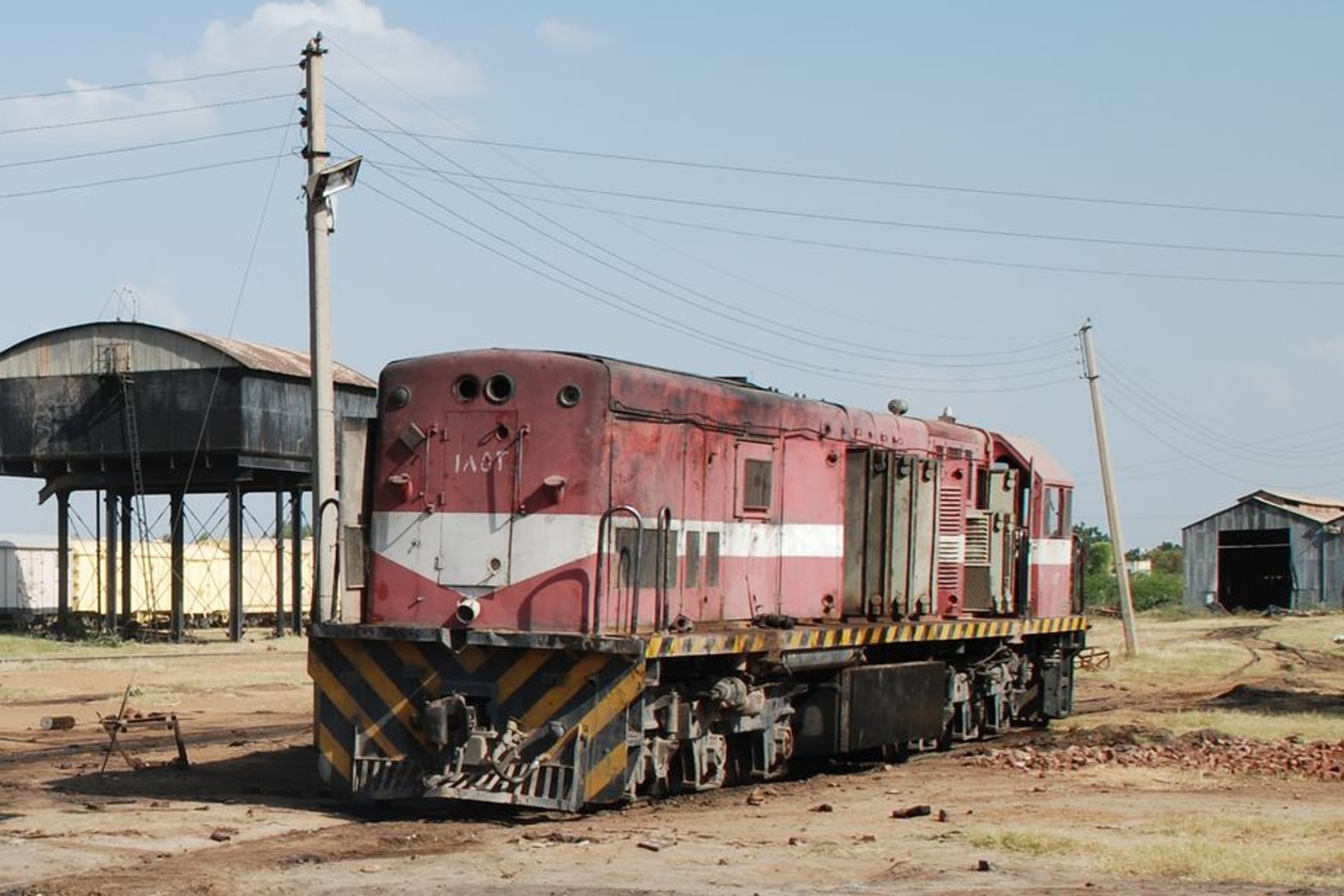
The locomotive at the top of the page is a Sudan Railways GE diesel, number 1857, photographed at Kosti on the White Nile line in 2008.
Along the route
 Clemens Schmillen / Wikimedia Commons · CC BY-SA 4.0 · 2017 · cropped
The line past the royal cemeteries
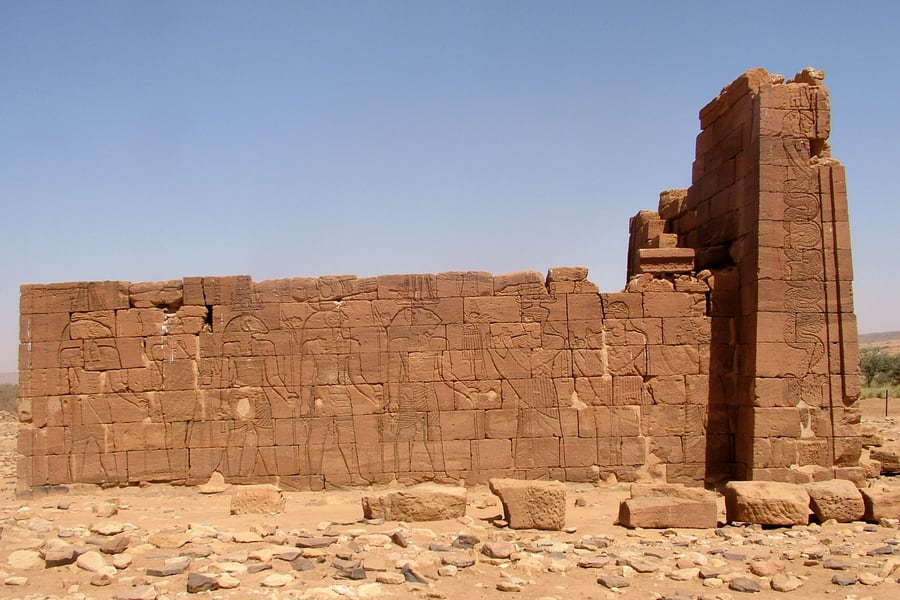
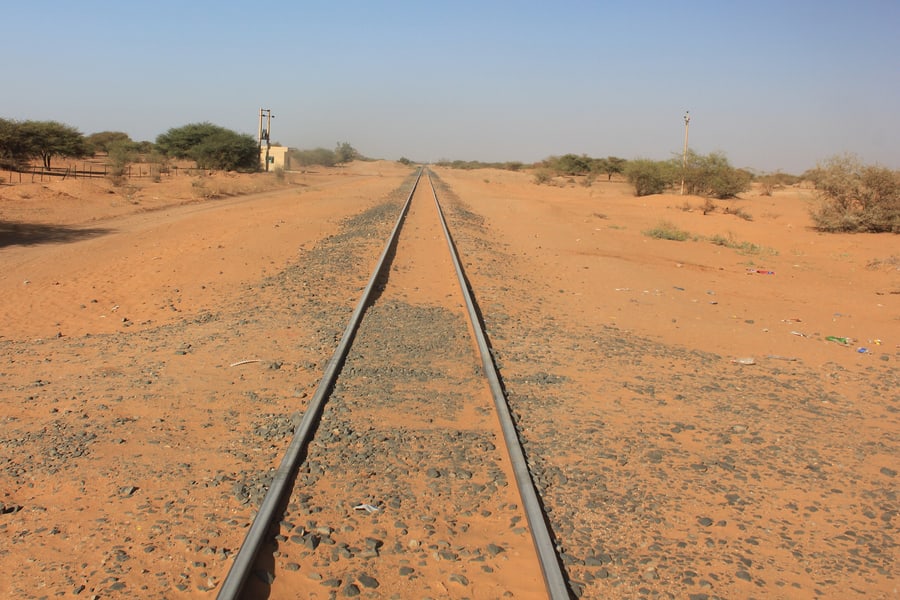
North of Shendi the track runs straight across red sand, and Meroë stands six kilometres from Kabushiya station. The pyramids of the Kushite kings stand on the low hills near Bagrawiya.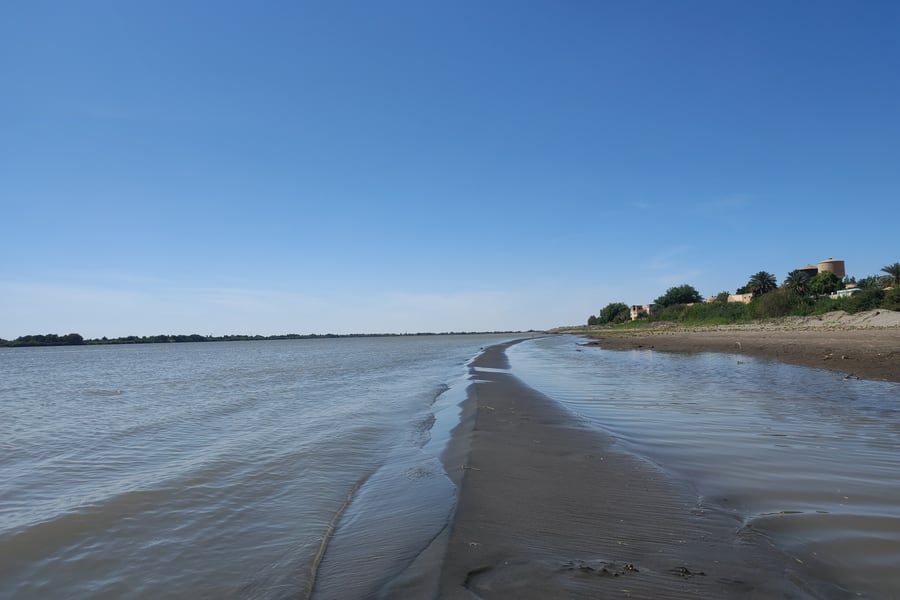 Hosam sudan / Wikimedia Commons · CC0 · 2024 · cropped
Atbara, where two rivers meet
The Atbara river joins the Nile here. The town is the railway's headquarters and its workshops — Sudan's "Railway City", and the change of train for the Red Sea.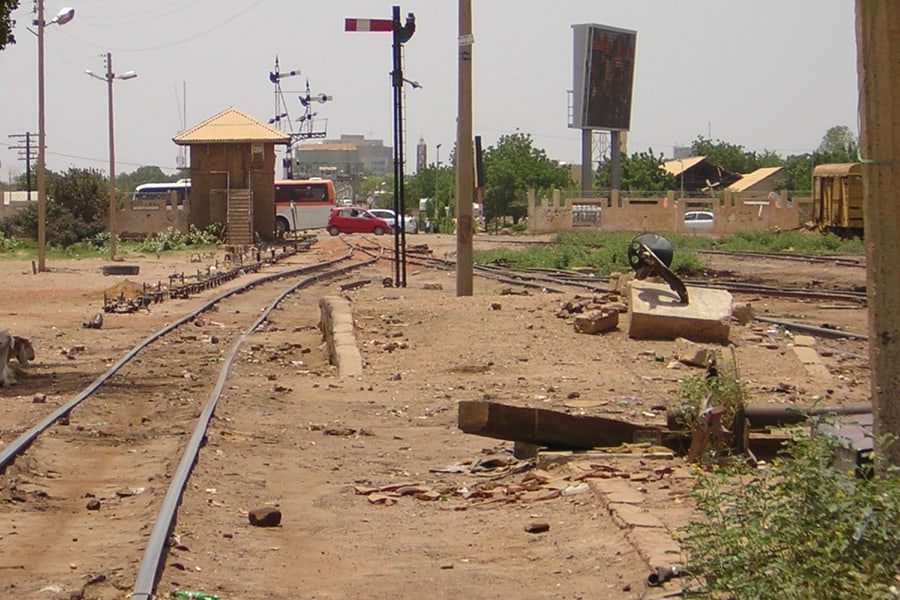 Petr Adam Dohnálek / Wikimedia Commons · CC BY-SA 3.0 CZ · 2009 · cropped
Khartoum Bahri
The Nile Train ends on the north bank of the Blue Nile, across the water from central Khartoum, among semaphore signals and sidings — the end of the line that came south from Wadi Halfa in 1899.A bit of history
Culture & experiences along the way
 Hassan Hassoon / Wikimedia Commons · CC BY-SA 4.0 · 2019 · cropped
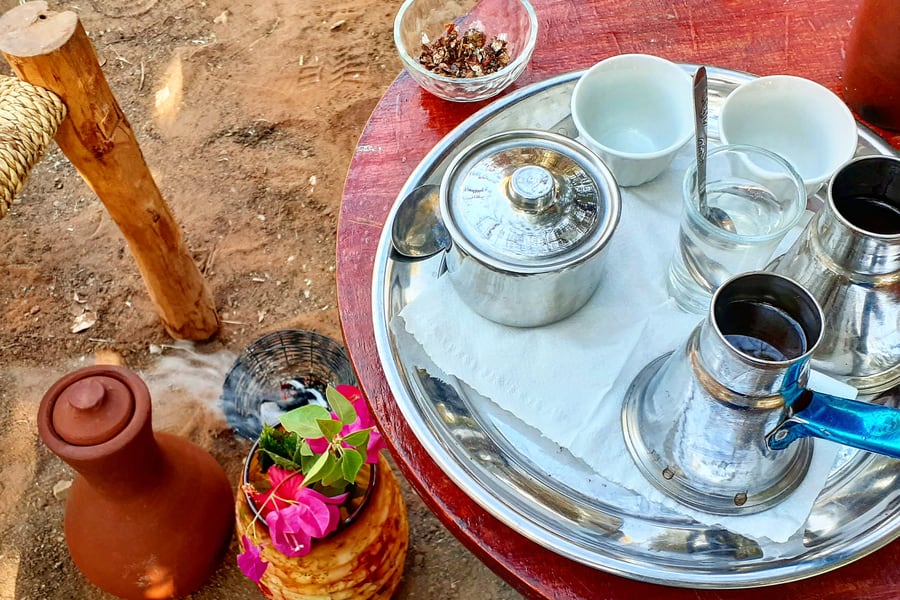
Jabana coffee
Sudanese coffee is roasted fresh in an iron pan over a charcoal stove, pounded in a mortar called a funduk, and brewed in the clay jabana that gives it its name — with ginger, cinnamon or cardamom if you ask. It is drunk across Sudan, and in the east by everyone, at every hour.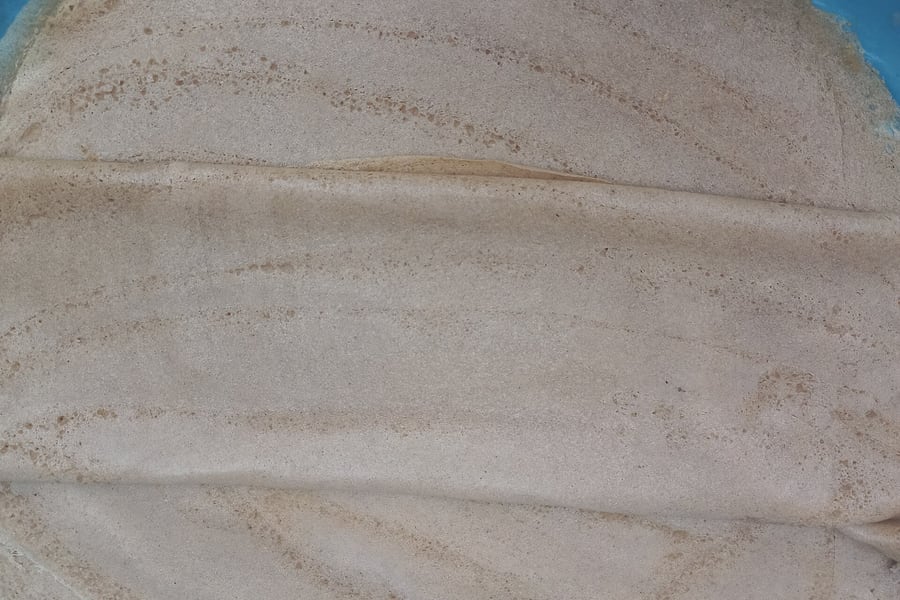 Marwa Siddig Aljally Altaueb / Wikimedia Commons · CC0 · 2025 · cropped
Kisra, the everyday bread
Kisra is sorghum batter left overnight to sour, then spread paper-thin on a hot griddle, the douka, where it cooks in about half a minute. The sheets are torn and used to scoop mullah, the stews of meat, okra or peanut that make up an ordinary Sudanese meal.Timetables
There is no fixed timetable. The Sudan Railways Corporation announces each run a few days ahead, through the Sudanese press and the stations, and a single trainset alternates between the routes. These are the last published departures for each leg.
| Leg | Departs | Arrives | Journey | Pattern |
|---|---|---|---|---|
| Atbara → Khartoum Bahri | Atbara 08:30 | — | 7–8 hours | Tuesday 10 February 2026 |
| Khartoum Bahri → Atbara | Khartoum Bahri 09:00 | — | 7–8 hours | Thursday 12 February 2026 |
| Port Sudan → Atbara | Port Sudan, Thursday evening | Atbara, Friday | About 12 hours | Every two weeks, from December 2024 |
Intermediate stops on the Nile Train: Shendi · Ad-Damer.
No arrival times are published for either leg. The Nile Train's run is quoted at seven to eight hours, and the Port Sudan leg at about twelve.
As of November 2026. The Nile Train times are those the corporation announced on 7 February 2026 for its first trips back to Khartoum since the war; the Port Sudan pattern is the one its director general gave in December 2024. On 29 October 2026 the corporation said one of its four passenger sets was running. ⚠️ The timetable page on the Sudan Railways Corporation website (opens in a new tab) still shows a pre-war service and should not be relied on — ask at Atbara, Khartoum Bahri or Port Sudan station.
Tickets
Tickets are sold only at the stations. The corporation's website says online booking is unavailable, that fares and schedules should be confirmed when buying at the main stations, and that ticket offices open from 09:00 to 15:00, or three hours before departure. For the February 2026 Nile Train, sales opened two days ahead at each end.
Fares are in Sudanese pounds: 30,000 from Atbara to Khartoum Bahri, and 15,000 from Atbara to Ad-Damer or Shendi, or from Khartoum Bahri to Shendi. When the service returned, that was reported as less than half the cost of any other way to make the trip. No fare for the Port Sudan–Atbara leg has been published.
Book your tickets
Atbara – Khartoum Bahri
Nile Train, end to end · 30,000 Sudanese pounds
The full run of the Nile Train, sold at Atbara and Khartoum Bahri stations only.
via sudanrailways.gov.sdShendi or Ad-Damer
Part of the Nile Train · 15,000 Sudanese pounds
Atbara to Ad-Damer or Shendi, or Khartoum Bahri to Shendi, at the same fare.
via sudanrailways.gov.sdRail Passes
No rail pass covers Sudan, and the Sudan Railways Corporation sells no multi-journey ticket.
Nor would one help. The whole Nile Train costs 30,000 Sudanese pounds, and what limits this journey is not the fare but the calendar: which day the single trainset is announced for each leg.
As of November 2026.
Places to Visit
The Nile Train runs through the heartland of the Kingdom of Kush, a power from the eighth century BC to the fourth century AD whose kings once ruled Egypt. Its royal city, its pyramids and two of its desert temples make up the Archaeological Sites of the Island of Meroe, a World Heritage site since 2011, and all of them lie within reach of the line between Shendi and Atbara.
 Petr Adam Dohnálek / Wikimedia Commons · CC BY-SA 3.0 CZ · 2009 · cropped
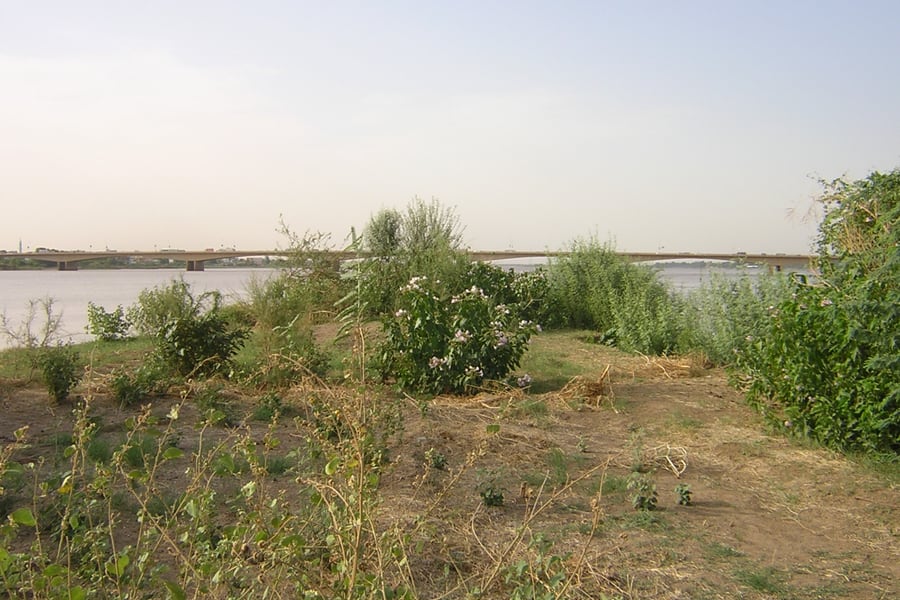
The confluence of the Niles, Khartoum
At the tip of Tuti Island the White Nile and the Blue Nile meet and become one river. Tuti is barely four square kilometres of grassland and a single village, ringed by Khartoum, Omdurman and Khartoum Bahri — the three towns that grew up around the meeting of the waters.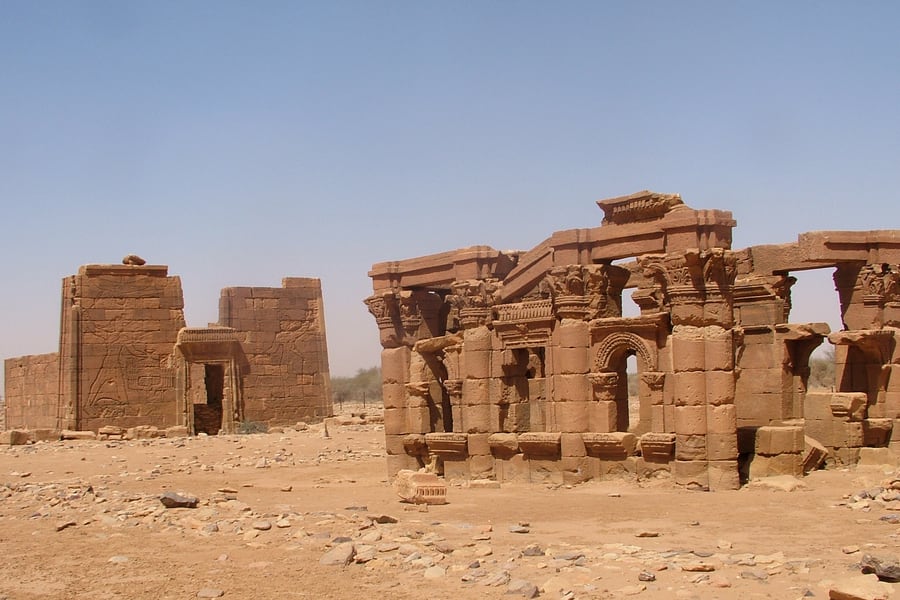 LassiHU / Wikimedia Commons · CC BY-SA 4.0 · 2005 · cropped
Naqa, from Shendi
Fifty kilometres east of the Nile, where wadis come down off the Butana plain, stands Naqa: a temple to the lion-headed god Apedemak and, beside it, the small colonnaded building known as the Roman Kiosk. Naqa was a trading station on the way east, a camel ride from the river, and is part of the UNESCO site inscribed in 2011.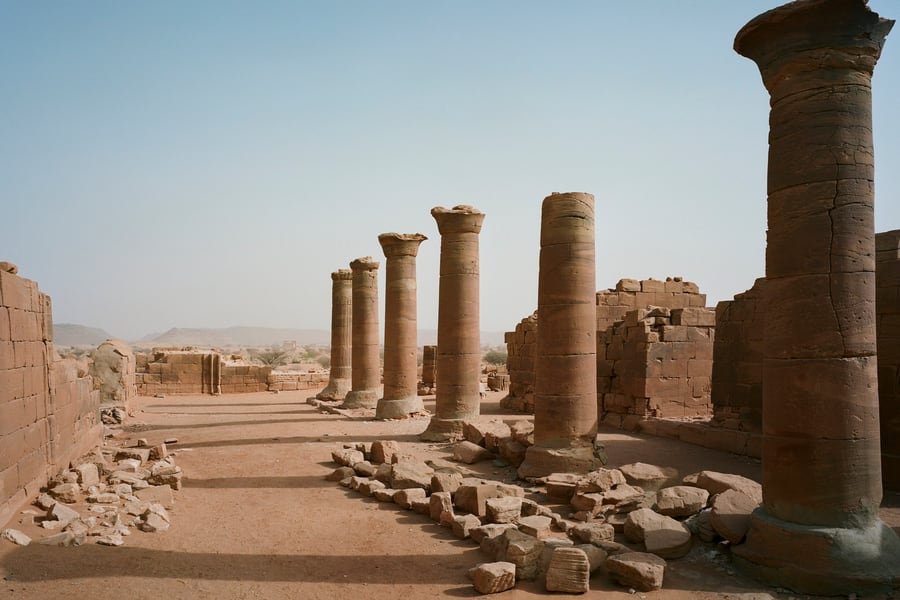 Christopher Michel / Wikimedia Commons · CC BY 2.0 · 2017 · cropped
Musawwarat es-Sufra
Twenty kilometres north of Naqa, in a basin of low sandstone hills, is a great Meroitic temple complex from the third century BC: the Great Enclosure, the Lion Temple of Apedemak and a vast reservoir. What sets it apart is the number of elephants carved into it, which suggests the animal mattered here as nowhere else.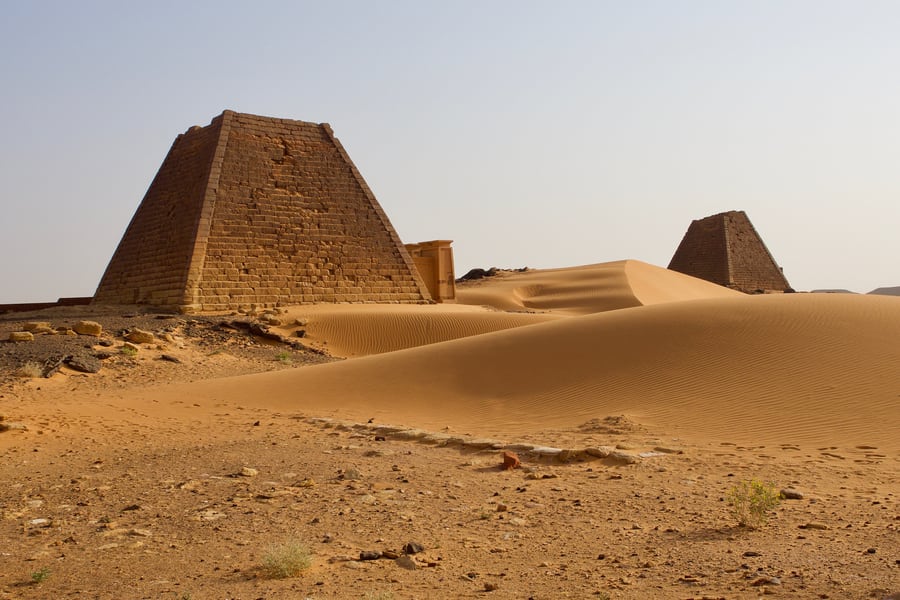 Laurent de Walick / Wikimedia Commons · CC BY 2.0 · 2019 · cropped
The pyramids of Meroë
Meroë was the capital of the Kingdom of Kush from around 590 BC until the fourth century AD, and its rulers were buried in three cemeteries of steep, narrow pyramids on the low hills near Bagrawiya. They stand six kilometres from Kabushiya station, about 35 kilometres beyond Shendi, at the heart of the World Heritage site.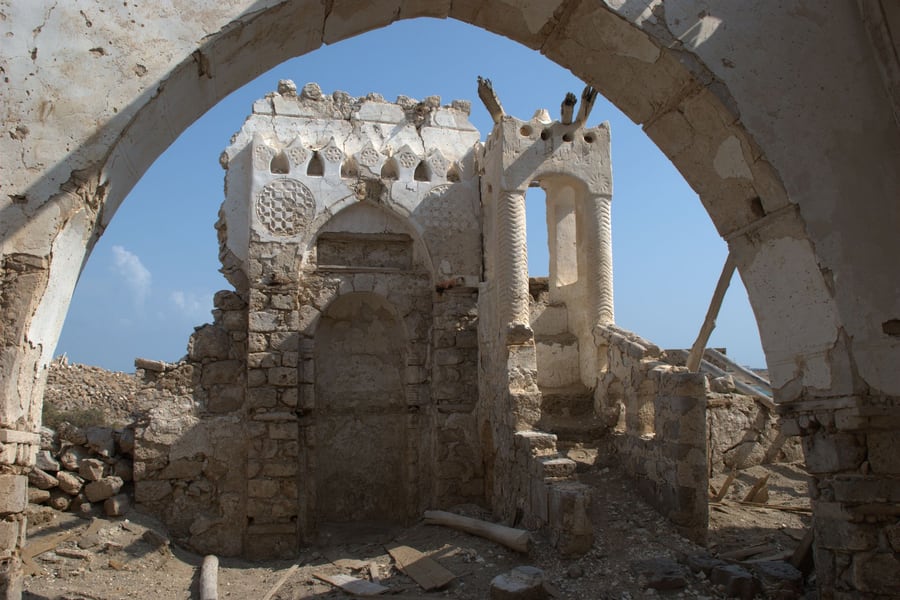 Bertramz / Wikimedia Commons · CC BY 3.0 · 2008 · cropped
Suakin, south of Port Sudan
Fifty kilometres down the coast from Port Sudan, Suakin was the region's chief port until the Anglo-Egyptian administration built Port Sudan between 1905 and 1909 to replace it. The old town is now largely ruins; its mosques still stand among them, roofs gone, their prayer niches open to the sky.Where to Sleep
No hotel on this route publishes a website of its own that could be checked for this page, so no hotel is recommended here.
Atbara is where the two legs of the journey meet, and where most travellers will need a night. Port Sudan, which served as the seat of government from April 2023 to January 2026, and Khartoum both have hotels listed on the international booking sites, but none of those listings leads to a hotel site that states its address, rooms or reservations. Confirm a room by telephone before travelling.
Practical information
Travel advice. The UK Foreign, Commonwealth & Development Office advises against all travel to Sudan because of the military conflict, and the British Embassy in Khartoum is closed. Check your own government's advice, and what your travel insurance covers, before planning anything.
Finding out when the train runs. Runs are announced a few days ahead in the Sudanese press and at the stations, not on the corporation's website. Ticket offices open from 09:00 to 15:00, or three hours before a departure.
Two legs, two days. The Nile Train and the Port Sudan train are worked by the same set on different days. Plan a night in Atbara between them.
Money. Fares are paid in Sudanese pounds at the ticket office.
Questions or corrections
Planning this trip and stuck on something, or spotted a time, fare or detail that has changed? Send us a message about Khartoum to Port Sudan. We read every one, and we update this page when something has changed.