Krøderbanen
Espen Franck-Nielsen / Wikimedia Commons · CC BY-SA 4.0 · cropped
- DistanceVikersund–Krøderen · 26 km
- DurationAbout an hour each way
- Best seasonSundays from late June to the end of August
Introduction
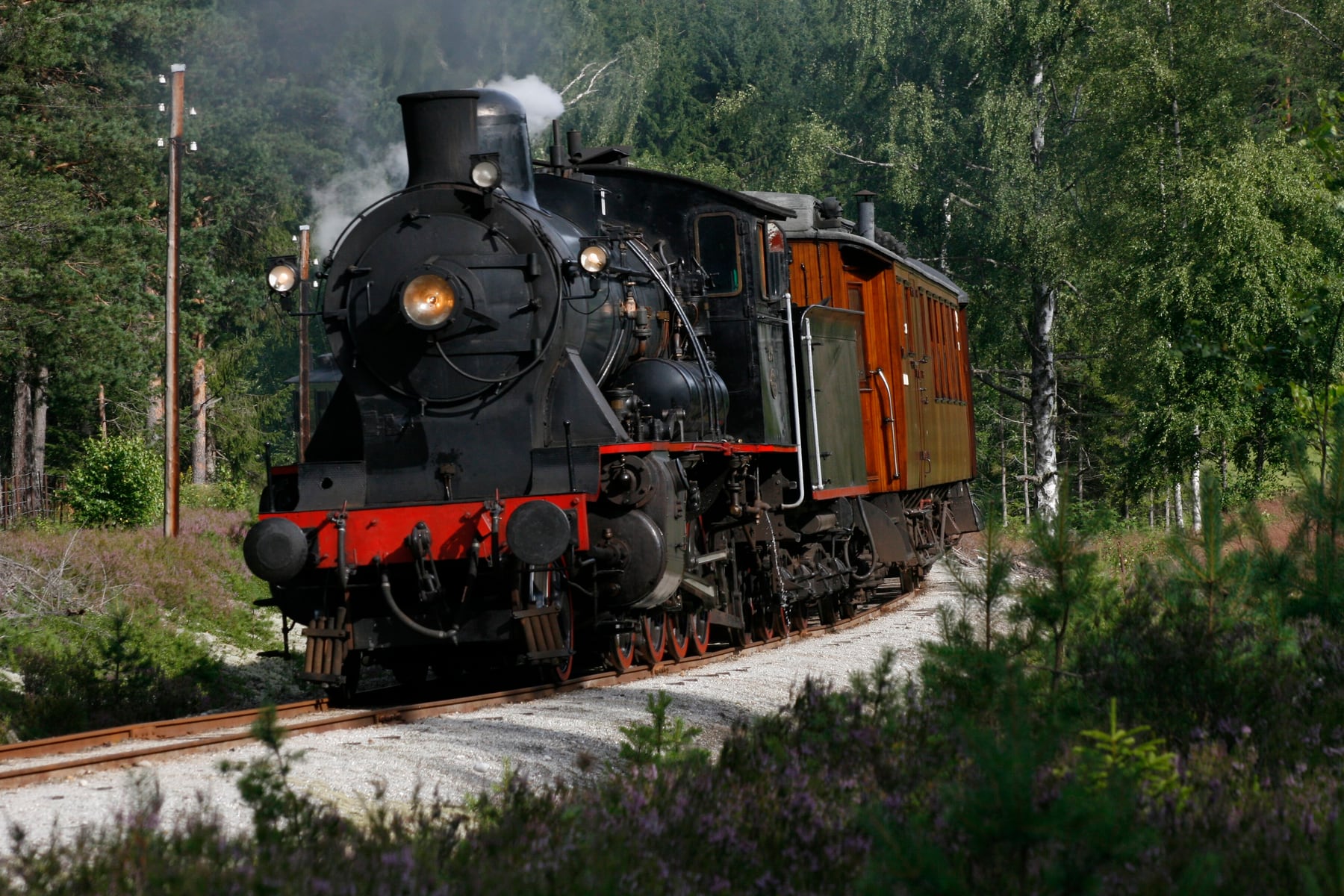
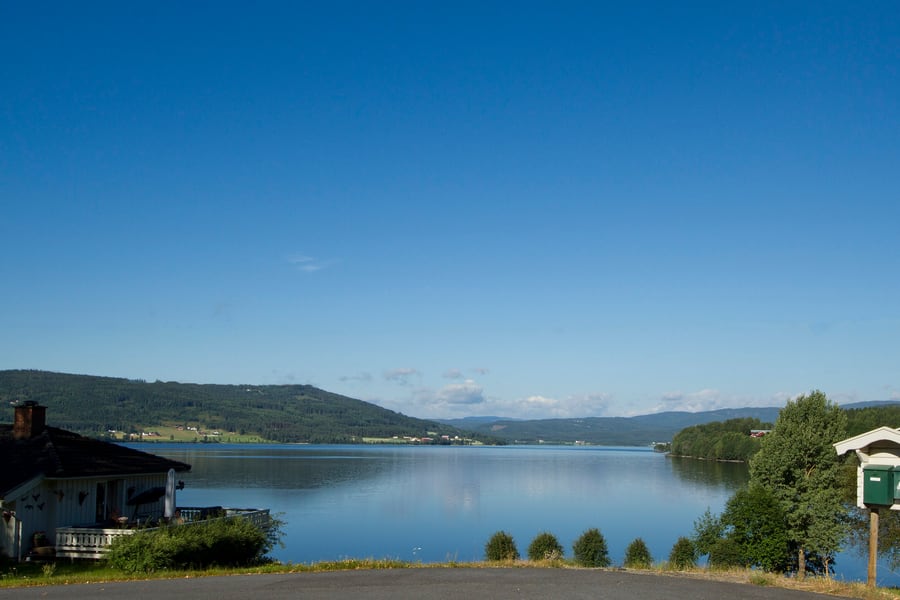
Its own people call it Norway's longest museum. Krøderbanen is a whole railway kept as one exhibit: 26 kilometres of track from Vikersund to Krøderen, opened in 1872, with its stations, its goods sheds and its water tower, and steam trains that run on summer Sundays as the line's own trains did a century ago.
It was built narrow gauge to link the lake and rivers of Hallingdal, where timber was floated, with Drammen and the coast, and rebuilt to standard gauge in 1909. For eighteen months before that it was part of the Bergen Line: from June 1908 travellers from Bergen came down the lake by steamer to Krøderen and took this train south. When the Bergen Line opened through Hønefoss at the end of 1909, the traffic left. Passenger trains stopped in 1958 and goods in 1985, and in the same year the Storting, Norway's parliament, decided that the line should be kept as a museum railway.
Norsk Jernbaneklubb, the Norwegian Railway Club, has run veteran trains here since 1977, and its volunteers still drive, fire and guard them. Buskerudmuseene looks after the track and the buildings. The ride takes about an hour each way, through the woods and farms of Modum, at a pace that leaves time to look.
The Journey
The steam train's day starts at Krøderen, at the south end of the lake of the same name. At 10:30 it leaves for Vikersund, and at 12:00 it sets off back. Either end makes a start: Vikersund is on the main line, with Bergen Line trains and buses from Drammen, and Krøderen has the parking, the café and the museum.
Up from Vikersund
From Vikersund the line leaves the main line and climbs. The builders gave it a gradient of 1 in 45 out of Vikersund and six sharp curves, some of the sharpest on any Norwegian railway, and it crosses the main road six times on the way up. The train calls at Sysle, a red station of 1894, and Snarum, one of the line's two original stations of 1872, both now owned by the railway's foundation. At Kløftefoss it meets the railcar coming the other way, and the two trains cross the old way, at a staffed station, with flag signals and points thrown by hand. On Sundays in early summer many passengers get off here for the western show in "Deadwood City", about 100 metres from the platform.
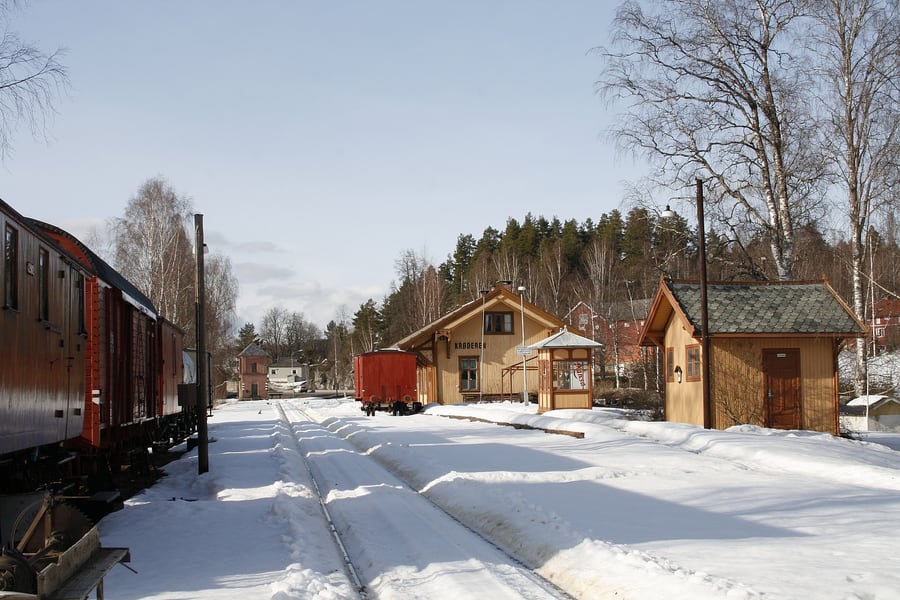
The last stretch runs to Krøderen, where the station has been protected as a technical monument. Its buildings date from the steam age and so does its equipment: an engine shed, a turntable, a water tower and a goods shed, now an exhibition. The steam train arrives at 13:08 and waits until 14:50, long enough for waffles at the outdoor café and a swim from the bathing place on the lake, 100 metres away.
The trains
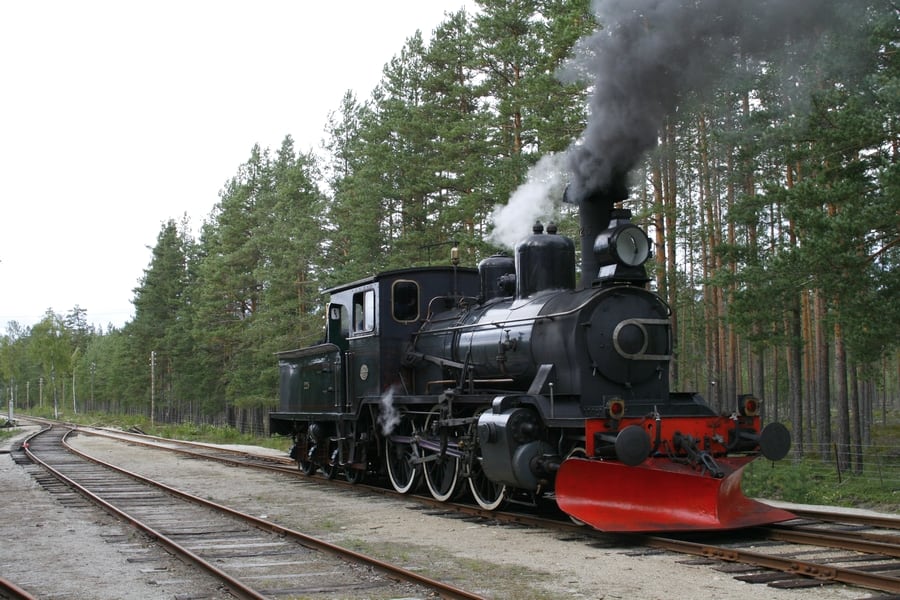
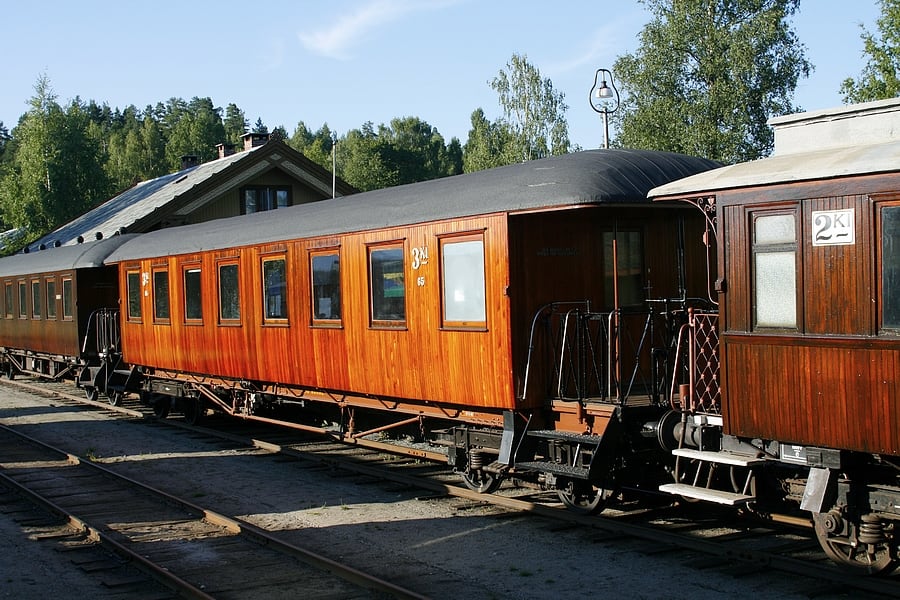
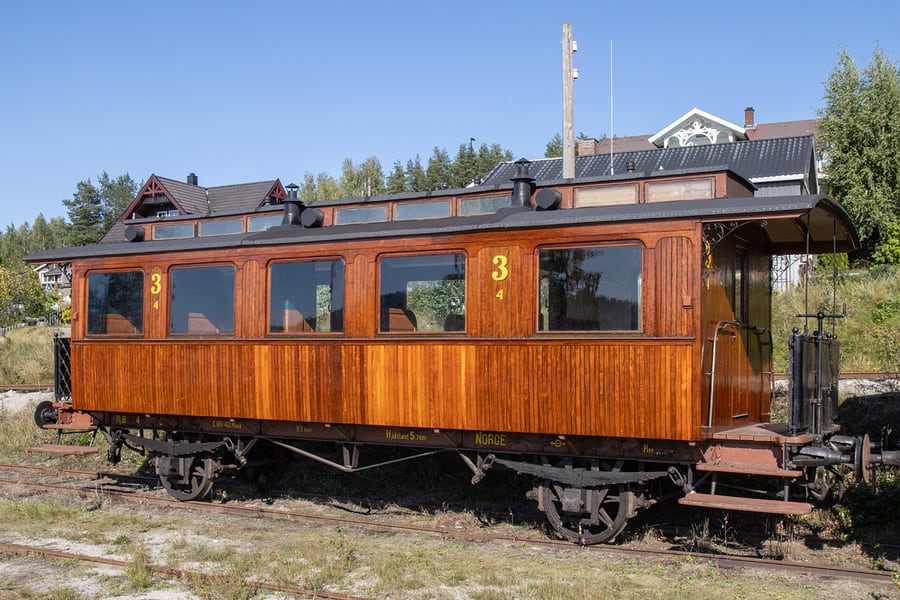
The steam trains are pulled by 411, a 104-tonne four-cylinder engine built in 1922 for the Gjøvik Line and newly restored, or by 225, a smaller Thunes engine of 1911. Behind them run wooden carriages of the early twentieth century and a kiosk wagon. The shorter trips between Krøderen, Kløftefoss and Snarum are worked by a red type 91 railcar of the 1950s and its driving trailer.
Along the route
 Mahlum / Wikimedia Commons · Public domain · cropped
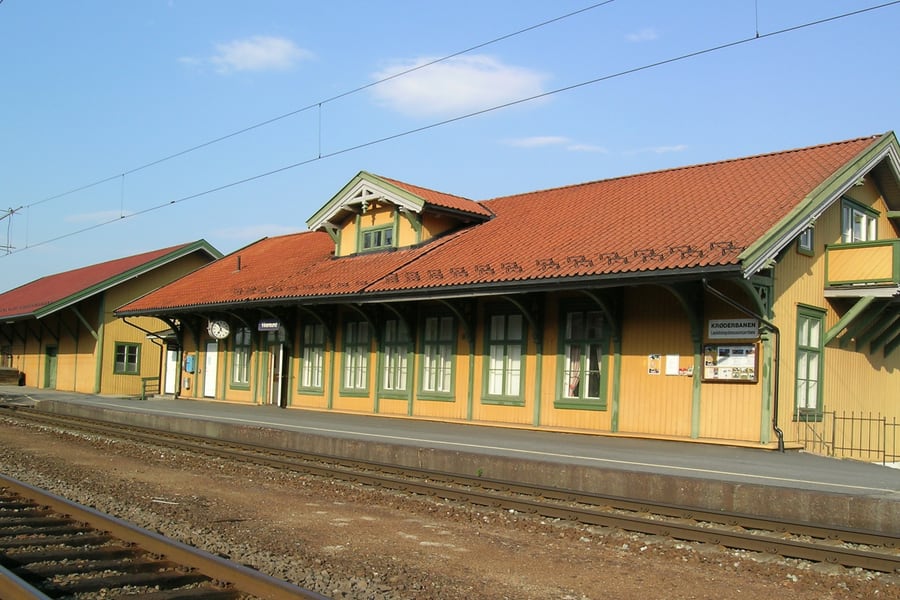
Vikersund
The station opened in 1866 on the Randsfjord Line and became a junction in 1872, when the branch to Krøderen was added. Bergen Line trains between Oslo and Bergen still call here, and since 1977 it has been the far end of the museum trains' run.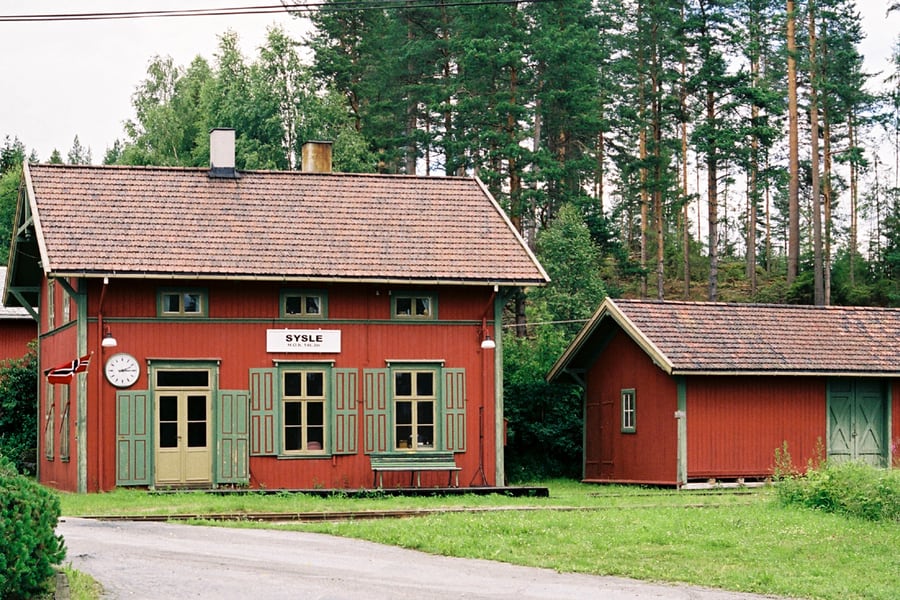 Mahlum / Wikimedia Commons · Public domain · cropped
Sysle
A halt called Hole opened here in 1873, a year after the line. The red station building followed in 1894, and the name Sysle in 1895. From 1912 to 1949 the Hole dairy was one of the station's most important goods customers.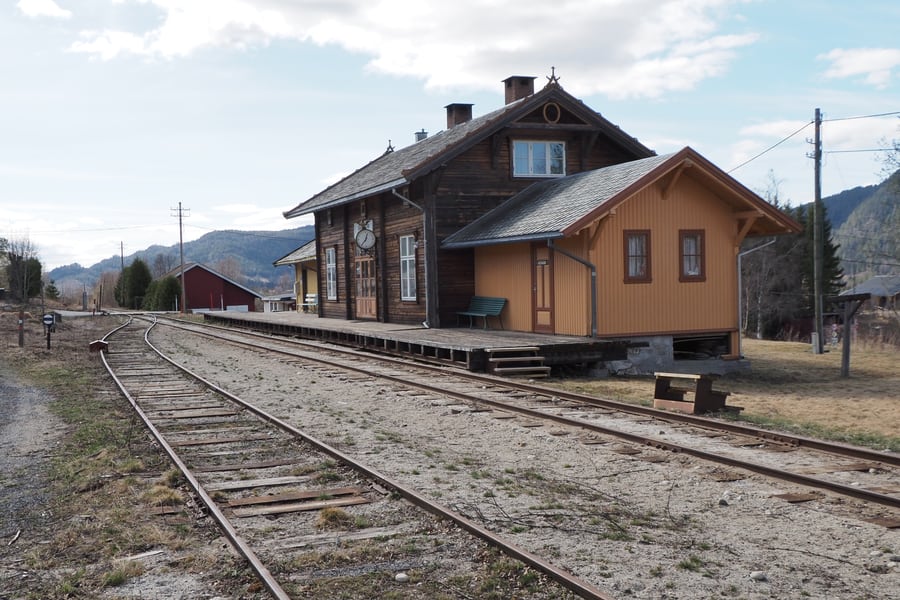 Svein Julton / Wikimedia Commons · CC BY 4.0 · cropped
Snarum
One of the line's two original stations, open since 28 November 1872. Its timber building lost its passengers to the bus in 1958 and its goods in 1985; in September the steam train runs only between here and Krøderen.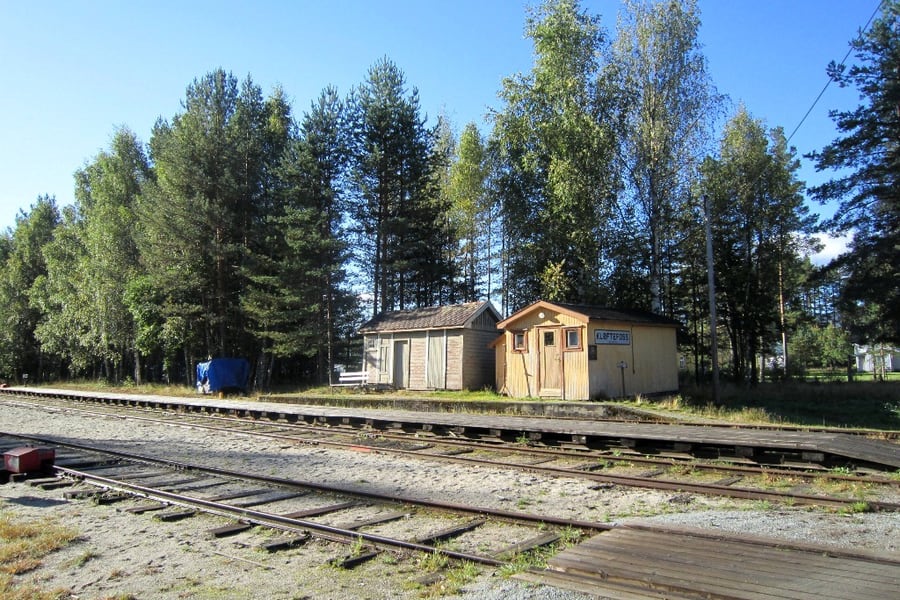 Jan-Tore Egge / Wikimedia Commons · CC BY-SA 3.0 · cropped
Kløftefoss
The passing place, where the steam train meets the railcar at a staffed station, with flag signals and points thrown by hand. On Sundays in early summer a western town, "Deadwood City", stages its show about 100 metres from the platform.A bit of history
Culture & experiences along the way
 Jan-Tore Egge / Wikimedia Commons · CC BY-SA 4.0 · cropped
The Bergen Line by steamer
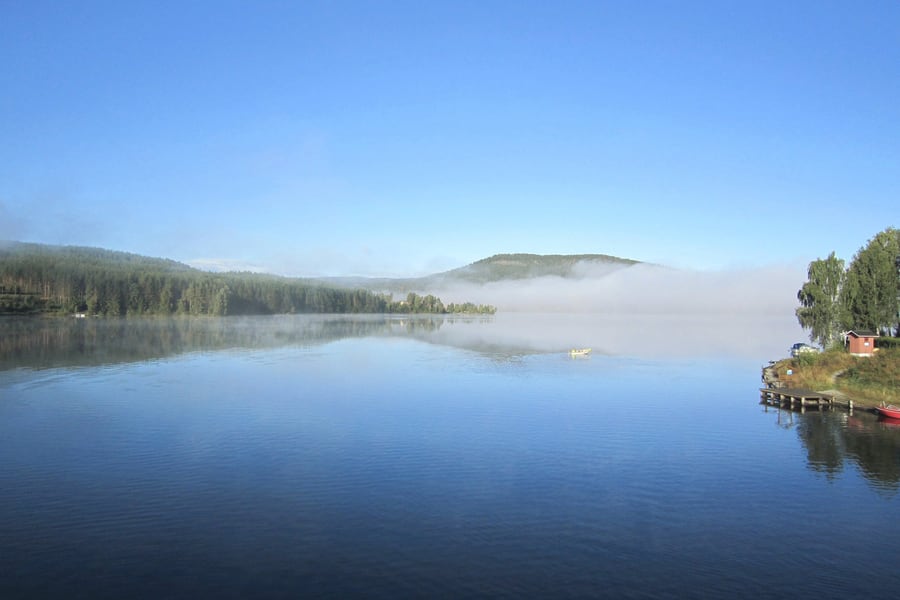
When the Bergen Line opened from Voss to Gulsvik in June 1908, the way on to Oslo was this lake and this railway: a steamer down Krøderfjorden, then the train from Krøderen. Over 700 travellers a day could pass through, and the station gained a restaurant. The through line opened at the end of 1909, and the last steamer sailed in 1925.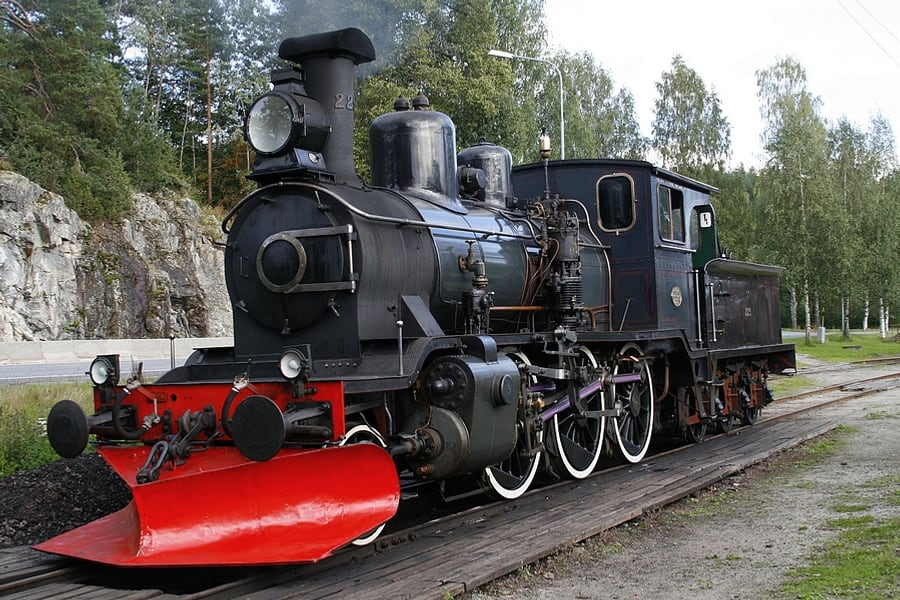 Espen Franck-Nielsen / Wikimedia Commons · CC BY-SA 3.0
Two engines from Thunes
Lok 225 was built in 1911 for the Østfold Line and 411 in 1922 for the Gjøvik Line, both by the Thunes works, 411 together with Hamar Jernstøberi. Both worked for the state railway until 1970. At 104 tonnes, newly restored 411 can take the full Sunday train without a second engine.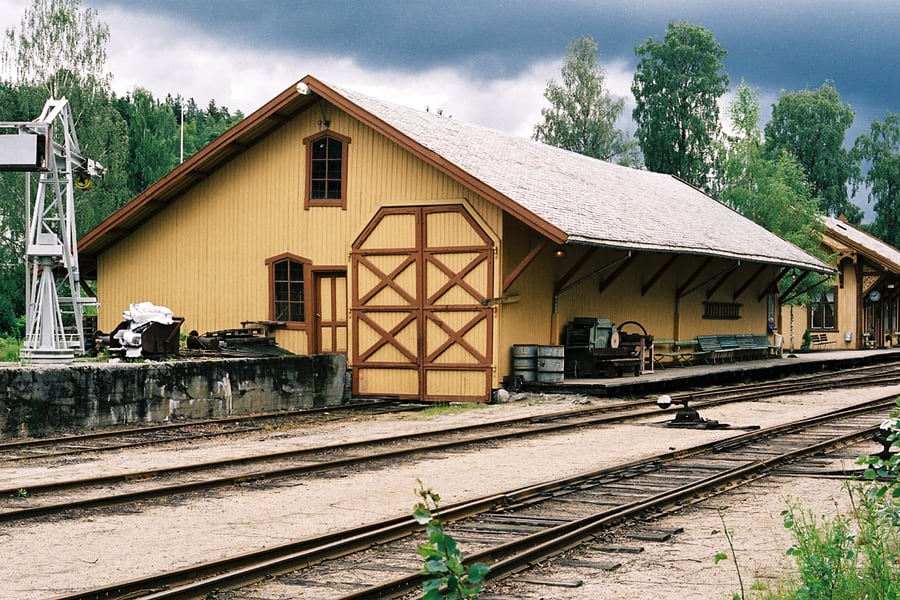 Mahlum / Wikimedia Commons · Public domain
For full damp
Krøderen's goods shed holds the exhibition "For full damp", the line's story told hands-on: how a steam engine works, and a turn as a telegraph operator. It is free with a train ticket. The station played "Olderdalen" in the 1974 film Bør Børson Jr.Timetables
Krøderbanen runs on summer Sundays, with a few extra days in August and a short autumn season. Tickets are sold in advance, and you collect yours at the station at least 20 minutes before the train leaves.
Summer Sundays, 28 June – 30 August 2026
The steam train makes two round trips over the whole line.
| Steam train | Krøderen | Kløftefoss | Snarum | Sysle | Vikersund |
|---|---|---|---|---|---|
| Morning | 10:30 | 10:44 | 11:03 | 11:12 | 11:30 |
| Afternoon | 14:50 | 15:04 | 15:23 | 15:32 | 15:50 |
| Steam train | Vikersund | Sysle | Snarum | Kløftefoss | Krøderen |
|---|---|---|---|---|---|
| Midday | 12:00 | 12:21 | 12:33 | 12:56 | 13:08 |
| Afternoon | 16:15 | 16:34 | 16:43 | 17:03 | 17:15 |
Between them the railcar makes short trips from Krøderen: 12:30 to Kløftefoss and on to Snarum (back at 14:07), and 14:15 to Kløftefoss. On 16 and 30 August a railcar also leaves Krøderen at 17:50 for Vikersund (18:44) and returns at 18:55 as far as Kløftefoss. Snarum and Sysle are request stops on some trains. On some Sundays the railcar's trips are run with steam as well.
Special days and autumn
- 8 and 9 August — the train robbery days: a staged western hold-up of the 12:05 from Vikersund, with both steam engines in one train.
- 22 August — a Saturday dusk train. 23 August — the big operating day, on day tickets.
- 6 and 13 September — steam between Krøderen and Snarum only, at 11:30 and 13:30, back from Snarum at 12:25 and 14:25.
- 31 October — a ghost train from Krøderen to Kløftefoss at 17:00, 18:00 and 19:00.
- 29 November — the Christmas train, on the first Sunday of Advent.
The 2027 season is not yet published. Times as of October 2026, from Krøderbanen (opens in a new tab).
Getting there
On a Sunday from Oslo, take the Vy train to Drammen (09:19 from Oslo S) and Brakar bus 100, which reaches Vikersund at 11:10, in time for the noon steam train. Going home, the Bergen Line train leaves Vikersund at 17:44 and reaches Oslo S at 19:05. Krøderen is about 105 km from Oslo by road, and both end stations have free parking. Connections from Entur (opens in a new tab), for a Sunday in November 2026; check the summer timetable before you go.
Tickets
Tickets are sold in advance through Krøderbanen's own pages, and any seats left can be bought at Krøderen before the train. A return between Vikersund and Krøderen is NOK 360 for an adult and NOK 180 for a child of 4 to 15; a single is NOK 240. Children under four travel free but need a ticket of their own, and a family ticket for two adults and up to three children is NOK 830.
At the station you swap your booking for an old-style card ticket, which you keep. The goods-shed exhibition at Krøderen is included, and dogs travel free. 2026 fares, checked October 2026.
Book your tickets
Espen Franck-Nielsen / Wikimedia Commons · CC BY-SA 3.0Adult return
Vikersund to Krøderen and back
The whole line both ways, by steam; a single costs NOK 240.
Book Tickets (opens in a new tab, on Krøderbanen)via KrøderbanenJan-Tore Egge / Wikimedia Commons · CC BY-SA 3.0 · croppedShort trip
Krøderen to Kløftefoss and back
Out by steam or railcar and back by the other, in about forty minutes.
Book Tickets (opens in a new tab, on Krøderbanen)via Krøderbanentrolvag / Wikimedia Commons · CC BY-SA 3.0 · croppedTrain, boat and fairy tales
Steam train, lake boat and Villa Fridheim
A round trip by steam train, M/S Kryllingen II and a veteran bus, with entry to Villa Fridheim.
Book Tickets (opens in a new tab, on Krøderbanen)via KrøderbanenRail Passes
No rail pass covers Krøderbanen. It is a museum railway with its own fares, and it is not among the Norwegian railway companies whose trains Interrail and Eurail cover. Everyone pays the museum's fare.
A pass can bring you to the start. Vy's trains are covered by an Interrail Norway Pass or a Global Pass: the local train from Oslo to Drammen needs no reservation, while the Bergen Line trains that stop at Vikersund are regional trains with a compulsory one. The Brakar bus from Drammen is not covered. For this trip alone a pass is not worth buying — it pays only when the Krøderen Line is one day of a longer journey through Norway.
Checked October 2026 against Interrail's table of railway companies (opens in a new tab).
Places to Visit
The line sits between two lakes, the Tyrifjord at Vikersund and Krøderfjorden at Krøderen, and these four are within a short drive of either end.
 John Erling Blad / Wikimedia Commons · CC BY-SA 2.5 · cropped
Villa Fridheim
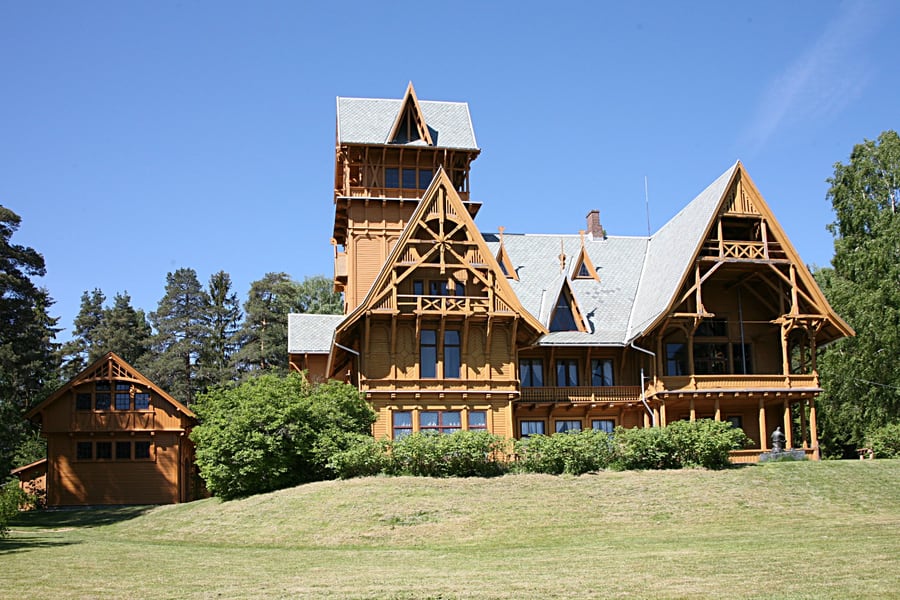
The timber merchant Svend Haug had the architect Herman Major Backer design a summer house on the island of Bjørøya, built from 1890 and finished in 1892, after Haug's death. It was one of Norway's first prefabricated houses: the parts were made at Haug's sawmill in Drammen and came by rail to Krøderen, then on by horse and sleigh or boat. Today it is a fairy-tale museum, open in summer.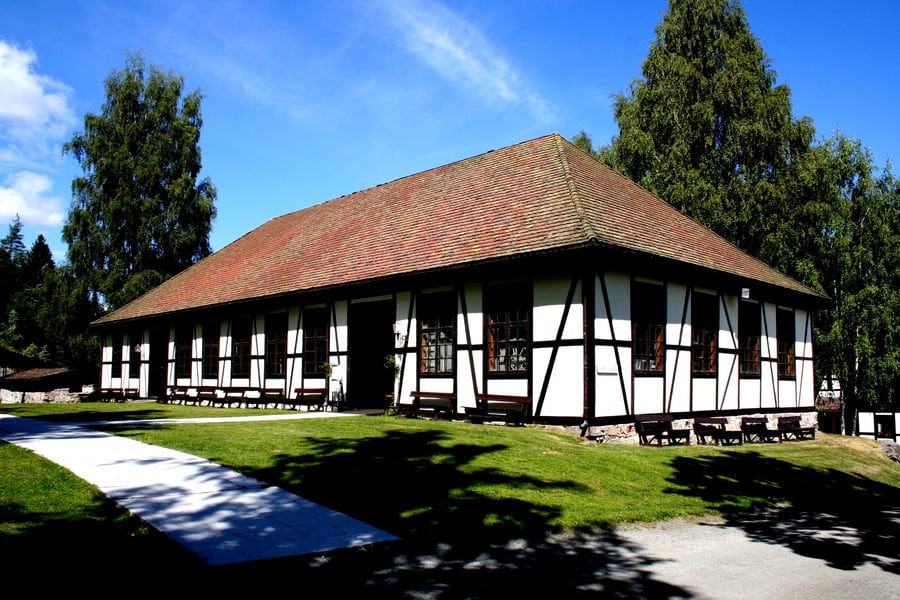 Sindre Skrede / Wikimedia Commons · CC BY 2.5
Blaafarveværket
King Christian VII founded the Blue Colour Works in 1776 to mine cobalt and make cobalt-blue glass and pigment, and in the first half of the 1800s it was Norway's largest mining company. Since 1968 it has been an open-air industrial museum and art gallery, with the old cobalt mines and a museum of the painter Theodor Kittelsen. The 2027 summer season opens on 15 May.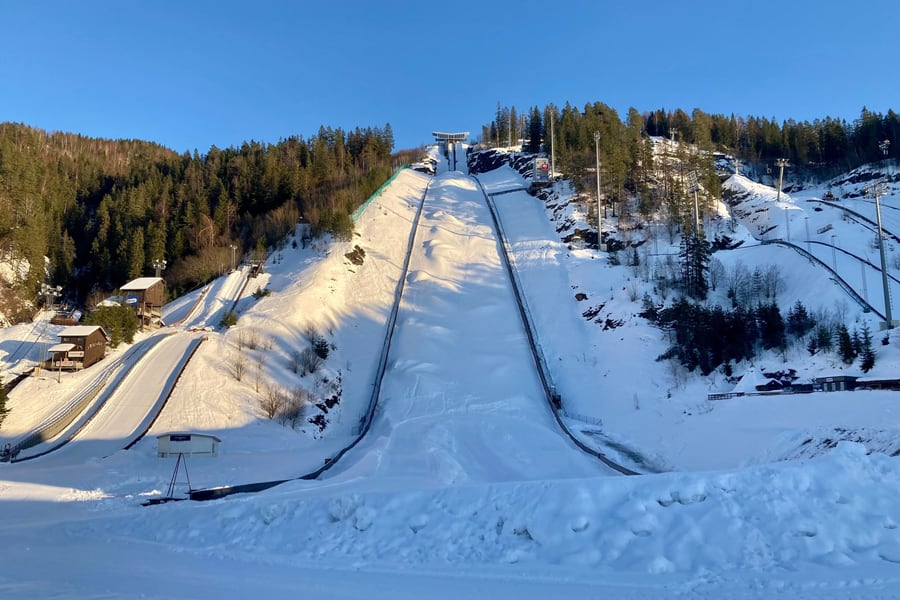 Kallerna / Wikimedia Commons · CC BY-SA 4.0 · cropped
Vikersundbakken
Above Vikersund stands one of the two largest ski-flying hills in the world. It opened in 1936 as a jumping hill, was rebuilt for ski flying in 1964, and has hosted the Ski Flying World Championships five times, most recently in 2022, and nine world records have been set on it.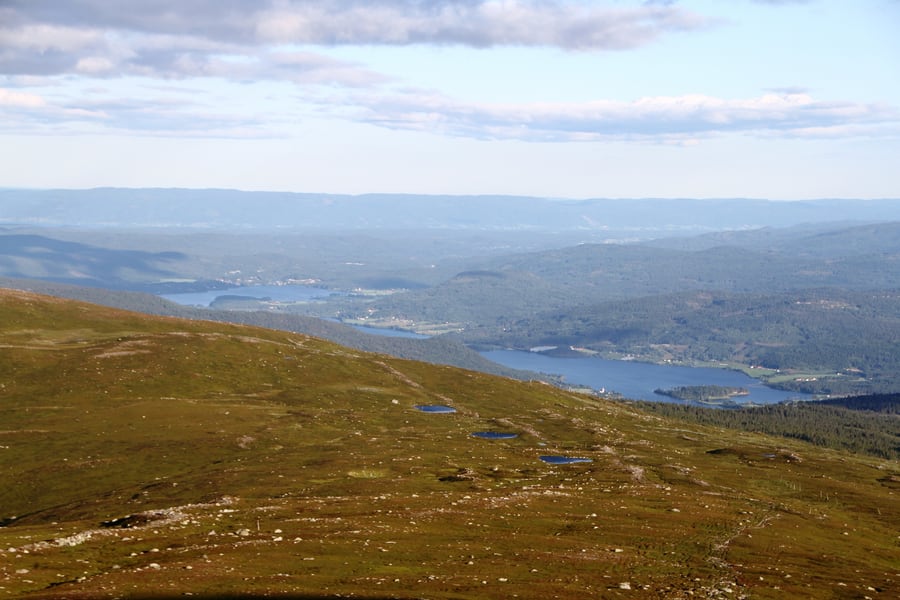 Bjoertvedt / Wikimedia Commons · CC BY-SA 3.0
Norefjell
The Norefjell range rises above the lake to 1,468 metres at Gråfjell. Its ski slopes in Krødsherad held the downhill and giant slalom of the 1952 Winter Olympics, and in summer the plateau is open walking country, with Krøderfjorden below.Where to Sleep
The trains run only by day, and most visitors come out from Oslo, about an hour and twenty minutes from Vikersund by road. To stay over, there is a hotel on the Tyrifjord near Vikersund, and at the Krøderen end the hotels are further up the lake, around Noresund and on Norefjell.
Where to stay
Tyrifjord Hotell
On the Tyrifjord at Vikersund
A hotel on the shore of the Tyrifjord, five minutes from the Vikersund ski-flying hill, with its own restaurant.
Check Availability (opens in a new tab, on tyrifjord.no)via tyrifjord.noNorefjell Ski & Spa
On Norefjell, above Noresund
A ski and spa hotel on Norefjell, above Noresund on Krøderfjorden.
Check Availability (opens in a new tab, on norefjellskiogspa.no)via norefjellskiogspa.noQuestions or corrections
Planning this trip and stuck on something, or spotted a time, fare or detail that has changed? Send us a message about Krøderbanen. We read every one, and we update this page when something has changed.