The Lijiang–Shangri-La Railway
瑞丽江的河水 / Wikimedia Commons · CC BY-SA 4.0 · 2025 · cropped
- Distance139.7 km, Lijiang to Shangri-La
- Duration1 h 10 min to 1 h 50 min
- Best seasonApril to May, and October
Introduction
The Lijiang–Shangri-La railway — 丽香铁路, Lìxiāng Tiělù — opened on 26 November 2023, 139.7 kilometres from Lijiang, at about 2,400 metres, up to Shangri-La on the plateau at over 3,200. It is the first railway in Diqing, the Tibetan prefecture of north-west Yunnan; before it, the only way up was a road that took more than three hours, longer in the rains. The fastest train now takes 1 hour 10 minutes.
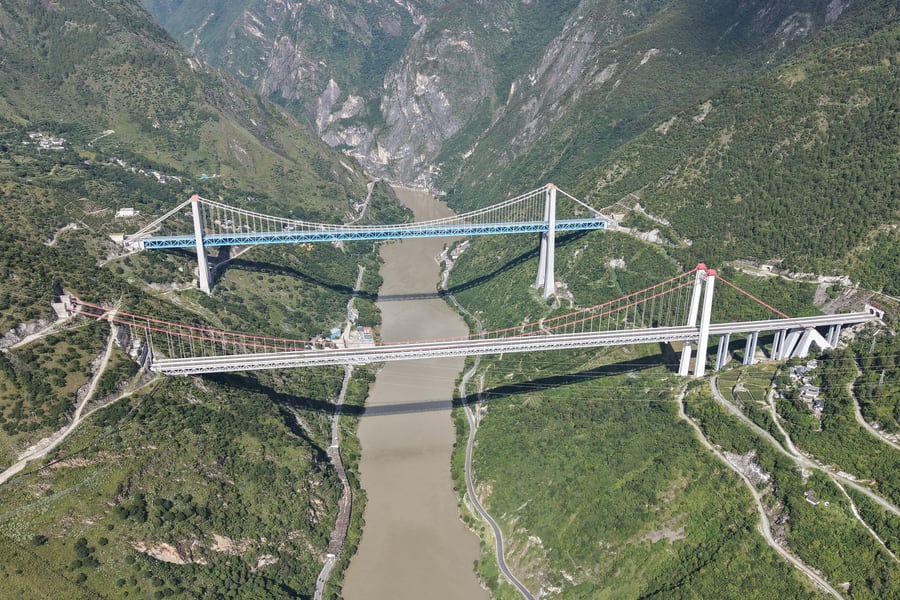
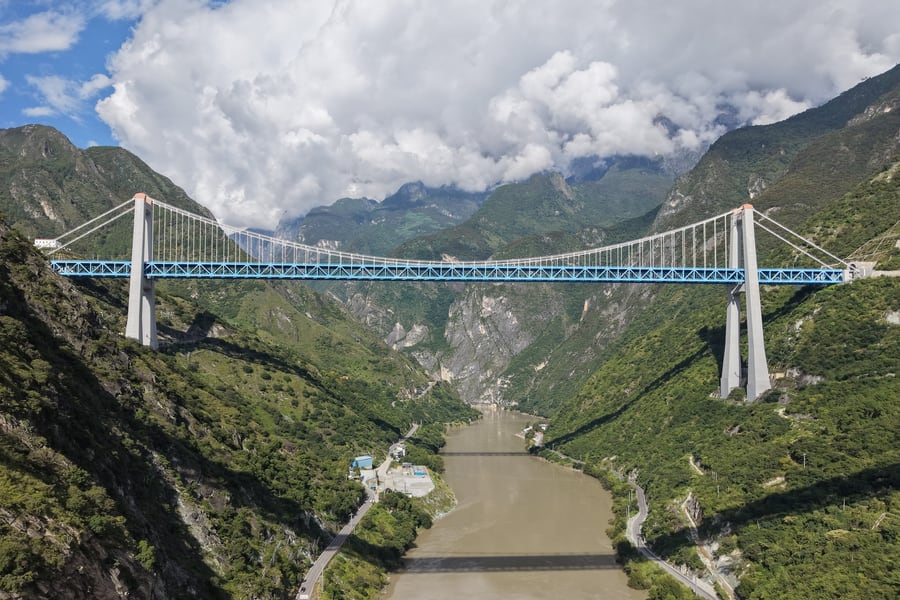
The two cities are separated by two snow mountains and the river between them, and the railway goes through rather than round. It runs into a 14.7-kilometre tunnel under Jade Dragon Snow Mountain, comes out high on the side of the Jinsha — the upper Yangtze — above Tiger Leaping Gorge, crosses on a suspension bridge with a 660-metre span about 250 metres above the water, and goes straight into a tunnel under Haba Snow Mountain.
This page rides the line from Lijiang to Shangri-La, a town that was called Zhongdian until 2001, when it was renamed after the fictional land in James Hilton's novel Lost Horizon.
The Journey
Lijiang to the Jinsha
Trains leave from Lijiang station, the end of the line from Dali. The railway runs west across the basin past Lashi Lake, where it has a station that no passenger train calls at, and climbs into the Jade Dragon range. Most of what follows is underground: the line has 20 tunnels and 34 bridges, and between them they make up 73.4 per cent of its length. The longest is the Jade Dragon Snow Mountain Tunnel, 14.7 kilometres through rock that deformed so badly that long stretches had to be dug by hand.
Across the gorge
The train leaves the tunnel high on the side of the Jinsha and is straight onto the bridge: 882.5 metres long, slung between towers that reach 194.5 metres on the Lijiang bank, with the river about 250 metres below. The Tiger Leaping Stone, in the gorge, is three kilometres downstream. On the far side the line goes directly into the Haba Snow Mountain Tunnel, 9,523 metres long, where the rock pressed in so hard that it was the last tunnel on the line to be finished, after more than eight years.
Onto the plateau
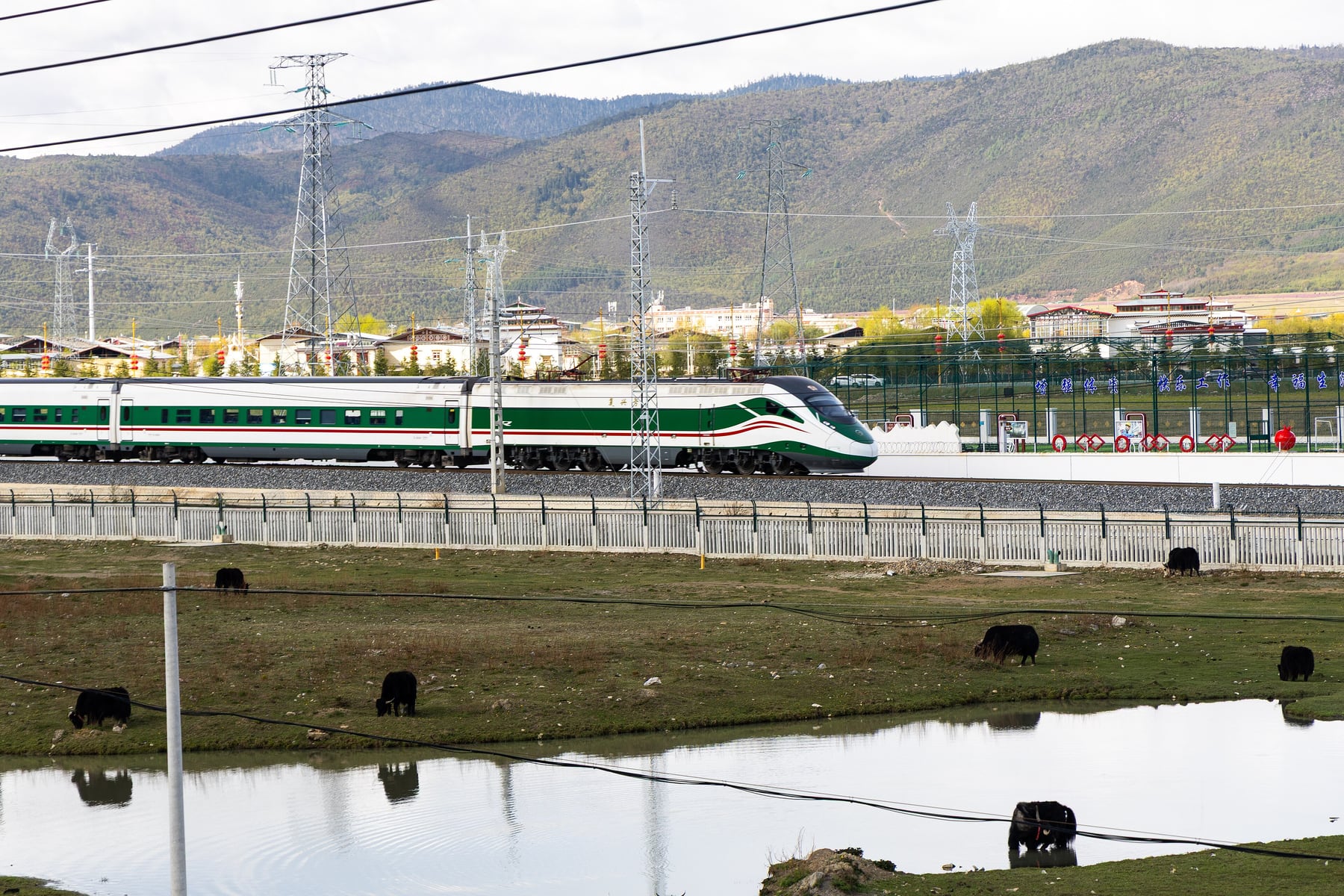
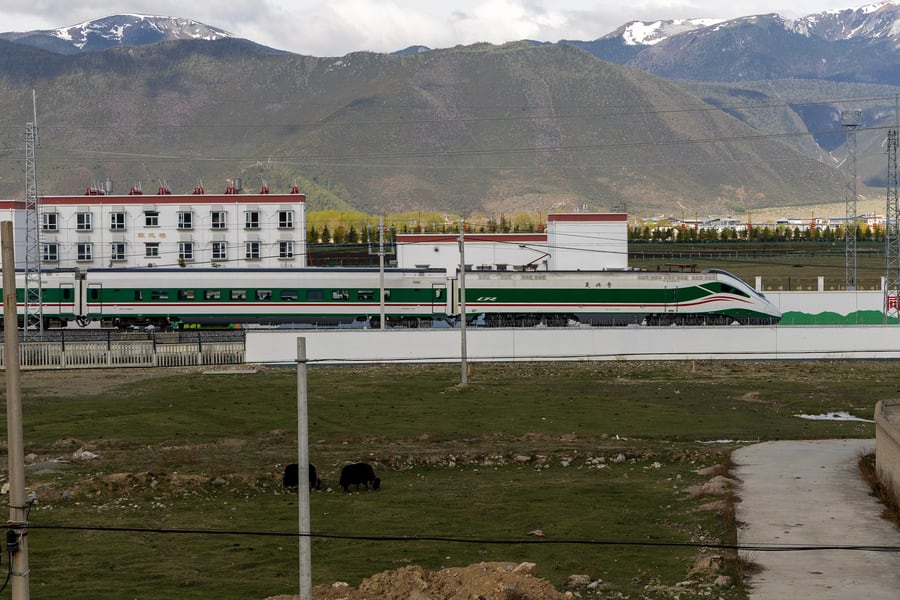
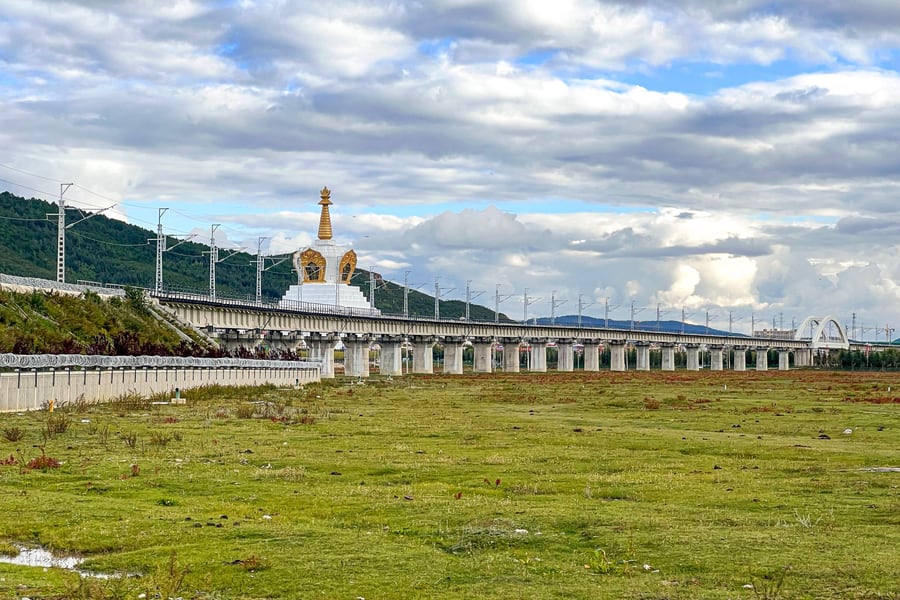
North of the mountains the line climbs, on gradients of up to 28.5 per thousand, to the open plateau, and the only stop on the way is Xiaozhongdian, where five of the ten trains a day from Lijiang call. The highest point, 3,283 metres, is just beyond it. The last stretch runs across grassland with yaks grazing beside the fence, past Tibetan farmhouses and a white stupa, into Shangri-La.
The train
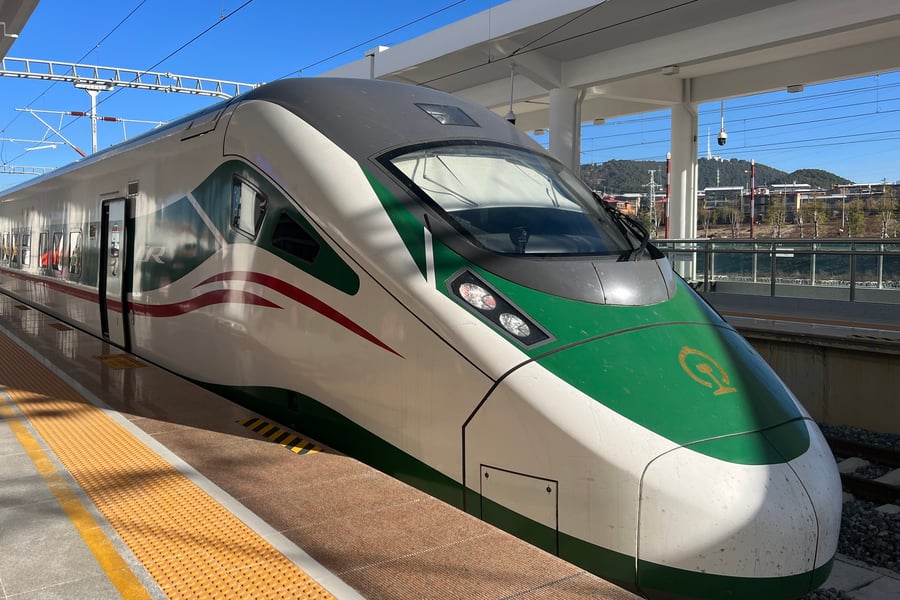
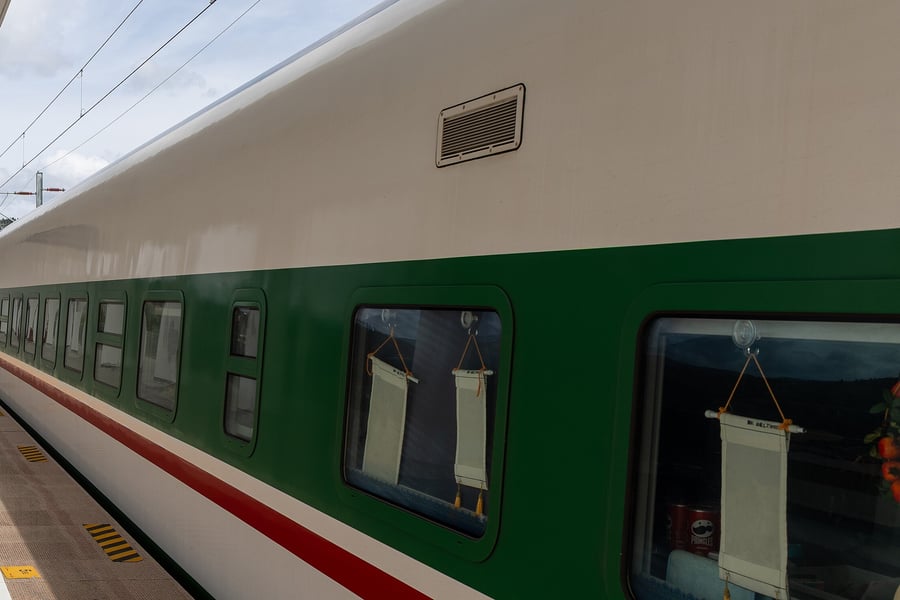
The line was given its own train: the Fuxing CR200J1-D, a version of China's locomotive-hauled Fuxing built for its altitude. An electric locomotive of 7,200 kilowatts is at one end and a driving car at the other; the coaches are fitted with an oxygen supply, as the Tibet trains are, the seats all turn to face the way the train is going, and there are six business-class seats behind the driving cab. The first two sets left the factory for Yunnan on 23 November 2022, in a new livery of white with a dark-green front and window band and a red stripe.
Along the route
 Glabb / Wikimedia Commons · CC BY-SA 3.0 · 2026 · cropped
The Jinsha River bridge
China's first long-span suspension bridge built for trains alone, by China Railway Major Bridge Engineering Group: 882.5 metres long, with a 660-metre main span about 250 metres above the Jinsha, joining two tunnels.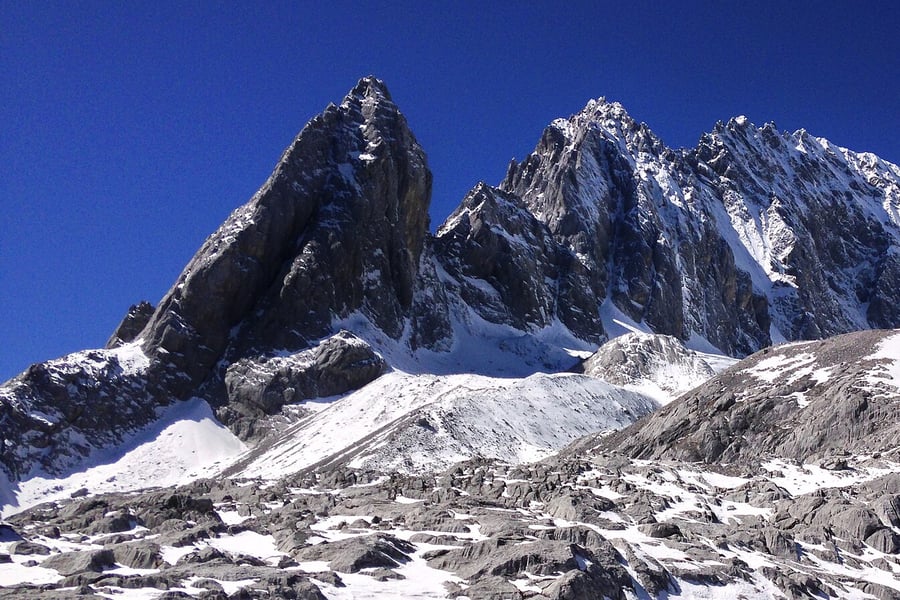 Lai.jack / Wikimedia Commons · CC BY-SA 3.0 · 2013 · cropped
Under Jade Dragon Snow Mountain
The longest tunnel on the line runs 14.7 kilometres beneath the massif, with up to 1,240 metres of rock overhead, and crosses six geological faults. It was holed through on 5 May 2022.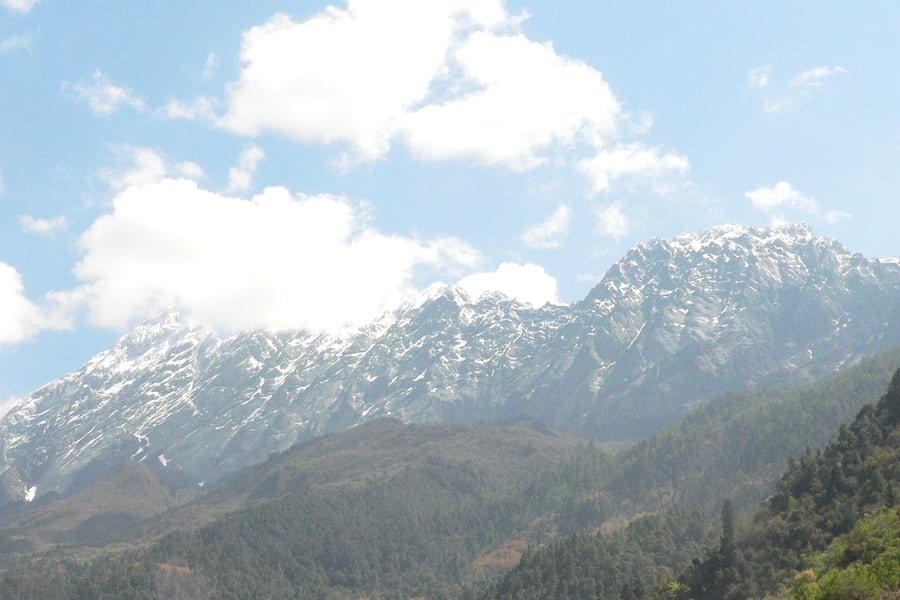 Dqsxz10002 / Wikimedia Commons · CC BY-SA 3.0 · 2010 · cropped
Under Haba Snow Mountain
At 9,523 metres it is shorter, and it took eight years. The rock pressed in so hard that a bore dug 11.67 metres wide closed to under three within 20 days. It was the last tunnel on the line to be finished, on 8 July 2023.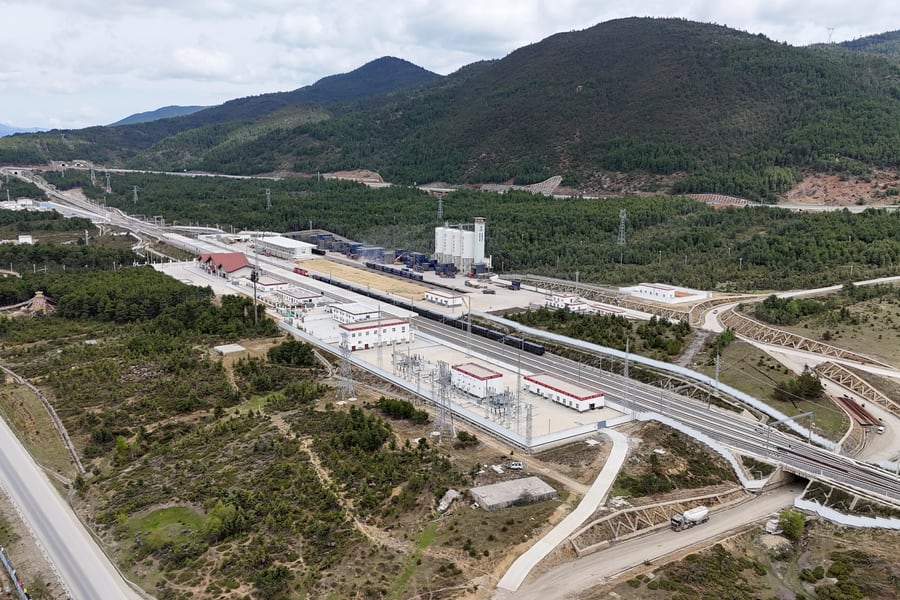 瑞丽江的河水 / Wikimedia Commons · CC BY-SA 4.0 · 2025 · cropped
The plateau at Xiaozhongdian
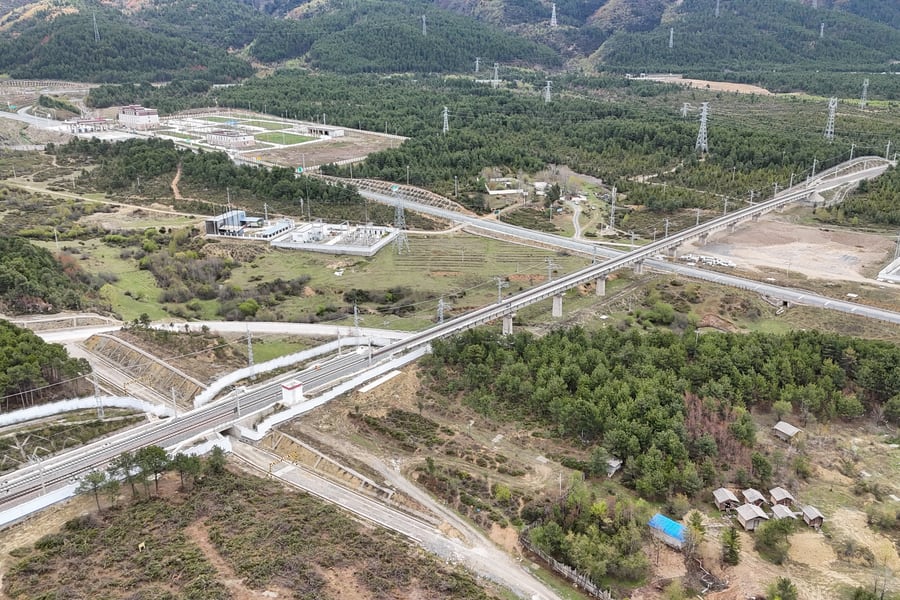
Beyond the mountains the line climbs on gradients of up to 28.5 per thousand to the plateau. Its highest point, 3,283 metres, is between Xiaozhongdian and Juduguu, on the last run in to Shangri-La.A bit of history
Culture & experiences along the way
 BrokenSphere / Wikimedia Commons · CC BY-SA 3.0 · 2008 · cropped
Dongba, the Naxi pictographs
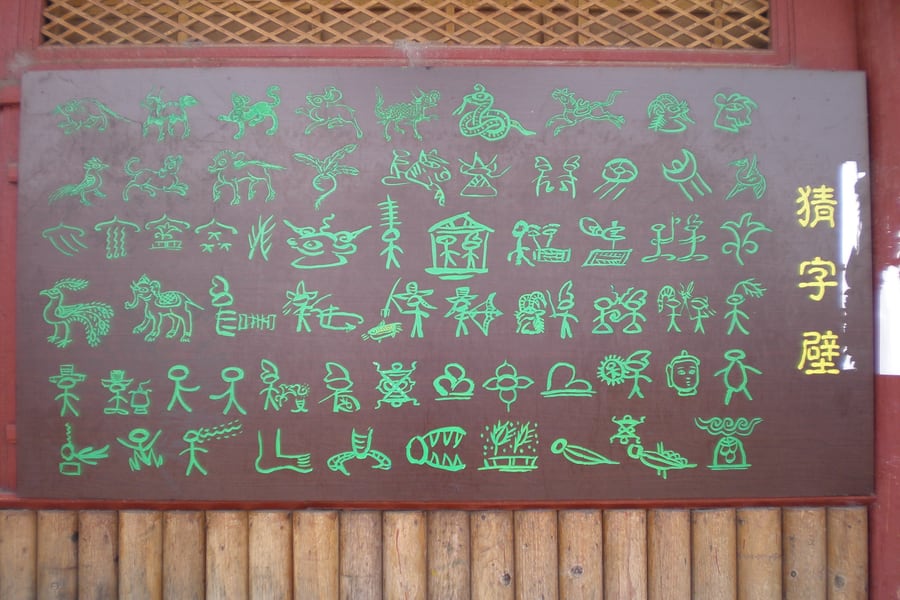
Lijiang is the home of the Naxi, whose Dongba priests wrote their ritual texts in pictographs — by one account the only pictographic script still in use anywhere. The Dongba manuscripts were added to UNESCO's Memory of the World register in 2003, and Lijiang still writes the script on its street signs.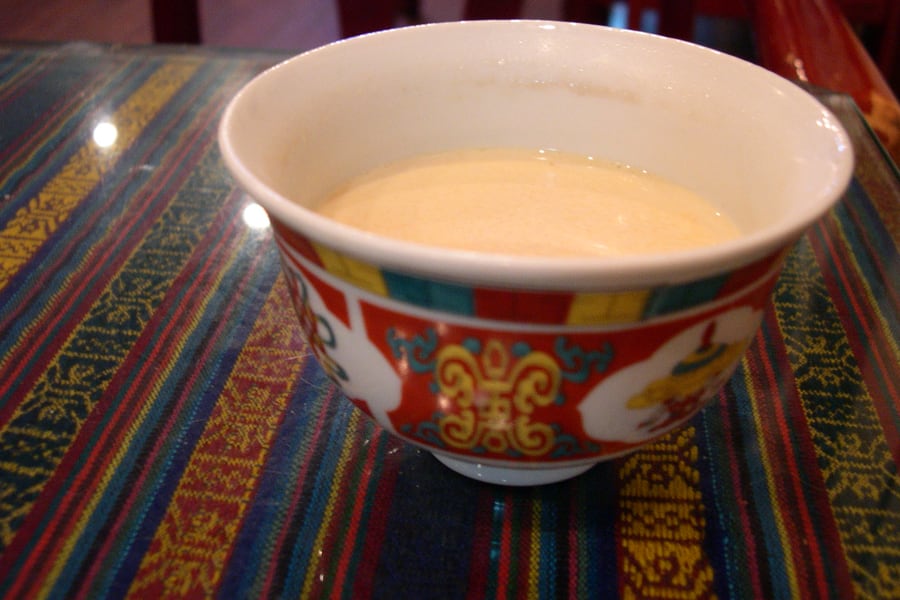 Yosomono / Wikimedia Commons · CC BY 2.0 · 2005 · cropped
Butter tea
Sūyóu chá is tea boiled dark, then churned with yak butter and salt until it is as thick as a broth. It is the everyday drink of the Tibetan plateau, poured into small bowls and topped up again and again — Tibetans can drink as many as sixty small cups a day.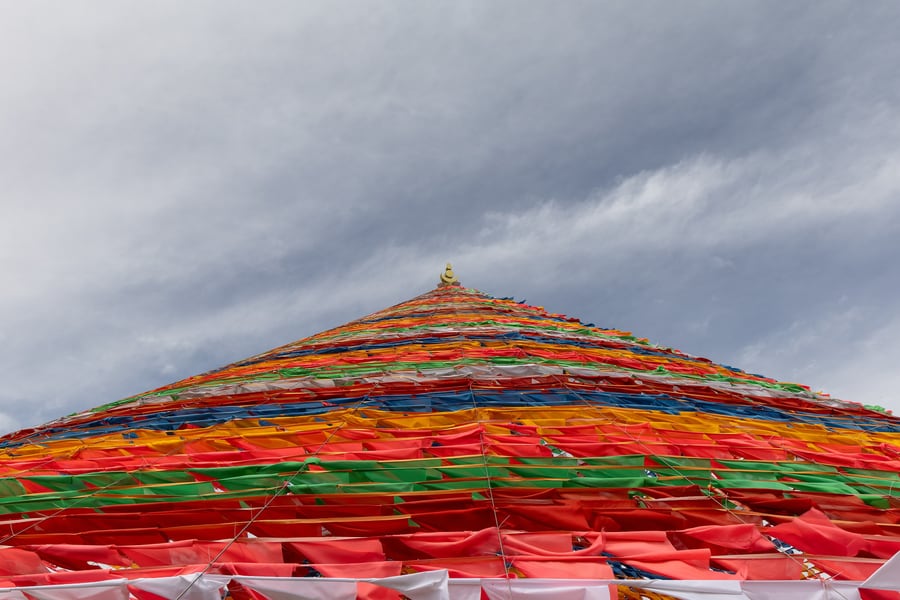 瑞丽江的河水 / Wikimedia Commons · CC BY-SA 4.0 · 2025 · cropped
Prayer flags
Tibetan prayer flags come in sets of five colours, always in the same order: blue for the sky, white for the wind, red for fire, green for water and yellow for earth. Printed with prayers and the lung ta, the wind horse, they are hung in high places for the wind to carry the blessing.Timetables
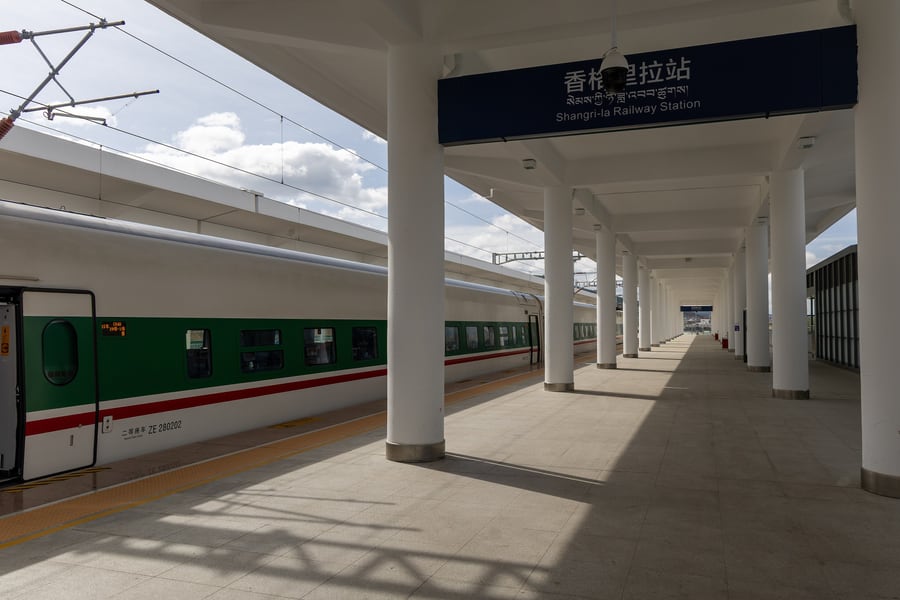
Ten trains a day run each way between Lijiang and Shangri-La, all of them daily. Some start further back — at Kunming, Dali, Baoshan, and one, the D239, at Chengdu South — and every one runs to the end of the line. Five of the trains from Lijiang call at Xiaozhongdian, and three of those from Shangri-La: the D240, C640 and C984.
Lijiang to Shangri-La
| Train | Starts at | Lijiang | Xiaozhongdian | Shangri-La |
|---|---|---|---|---|
| C989 | Lijiang | 07:30 | — | 08:54 |
| C441 | Lijiang | 07:50 | 09:00 | 09:25 |
| C985 | Dali 07:45 | 09:41 | 10:57 | 11:22 |
| C987 | Dali 09:58 | 12:05 | — | 13:18 |
| C119 | Kunming 09:08 | 13:02 | 14:00 | 14:25 |
| C87 | Kunming 10:15 | 13:50 | — | 15:00 |
| C377 | Baoshan 09:56 | 14:23 | 15:33 | 16:05 |
| C639 | Kunming 13:11 | 16:59 | — | 18:40 |
| D239 | Chengdu South 08:33 | 17:52 | 19:15 | 19:42 |
| C643 | Kunming 16:39 | 21:12 | — | 22:25 |
Shangri-La to Lijiang
| Train | Shangri-La | Lijiang | Goes on to |
|---|---|---|---|
| C644 | 07:22 | 08:32 | Kunming 12:50 |
| D240 | 09:36 | 10:57 | Chengdu South 20:18 |
| C640 | 10:05 | 11:26 | Kunming 16:03 |
| C984 | 12:00 | 13:40 | Dali 16:02 |
| C986 | 13:46 | 15:26 | Dali 17:53 |
| C988 | 15:01 | 16:14 | Dali 18:16 |
| C374 | 15:25 | 16:48 | Baoshan 21:00 |
| C88 | 17:25 | 18:35 | Kunming 22:04 |
| C442 | 19:02 | 20:15 | Dali 22:21 |
| C990 | 20:25 | 21:51 | — |
Trains from Kunming change their number at Lijiang: the C86 becomes the C87, the C118 the C119, and so on. Times are from 12306 for Thursday 15 and Sunday 18 October 2026, and were the same on both days — as of October 2026. 12306 sells about two weeks ahead. Times are published by the operator: China Railway · 12306 (opens in a new tab).
Tickets
Every ticket is sold on 12306 against your passport, which is then your ticket at the gates. Between Lijiang and Shangri-La most trains charge ¥70 in second class and ¥111 in first, and business class is ¥219 or ¥243 depending on the train; on the C985 and the D239 the fares are ¥63 and ¥100.
From Kunming the through trains charge ¥260 in second class, ¥414 in first and ¥811 in business.
Book your tickets
 瑞丽江的河水 / Wikimedia Commons · CC BY-SA 4.0 · 2025 · cropped
Lijiang to Shangri-La
¥63–70 second class, ¥100–111 first
Sold on 12306 against your passport, which is then your ticket at the gates.
Book Tickets (opens in a new tab, on 12306.cn)via 12306.cn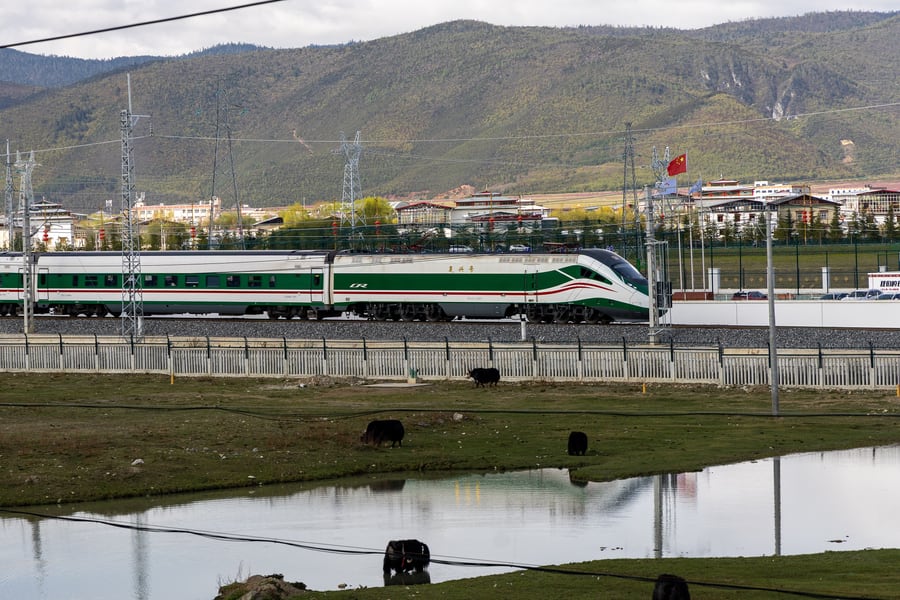 瑞丽江的河水 / Wikimedia Commons · CC BY-SA 4.0 · 2025 · cropped
Kunming to Shangri-La
¥260 second class, ¥414 first
The C86 runs through from Kunming by way of Lijiang in 4 hours 45 minutes.
Book Tickets (opens in a new tab, on 12306.cn)via 12306.cnRail Passes
No rail pass covers this line. Interrail and Eurail are European passes and do not reach China, and China Railway sells its seats one journey at a time on 12306, so the fare is simply the ticket.
Checked in October 2026.
Places to Visit
The first three places are around Lijiang, where the line starts; the gorge is reached by road, about 60 kilometres north of the city. The last three are in and around Shangri-La, more than 3,200 metres up.
 BrokenSphere / Wikimedia Commons · CC BY-SA 3.0 · 2008 · cropped
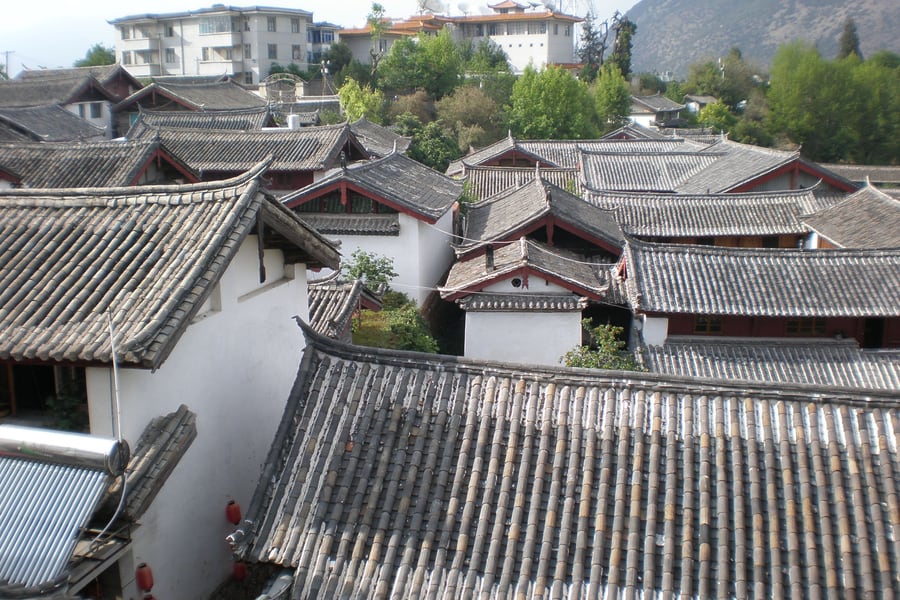
The Old Town of Lijiang
Dayan, the old town of Lijiang, has stood at about 2,400 metres for more than eight hundred years, a market town of the Naxi on the old tea-and-horse caravan route. It is known for its canals and bridges, has never had a city wall, and was inscribed as a World Heritage Site in December 1997.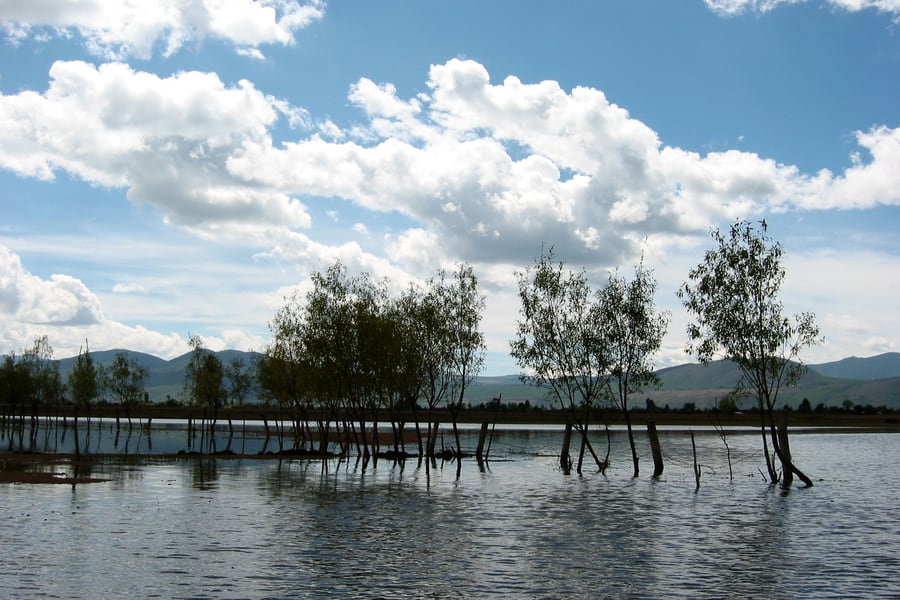 KingPilaf / Wikimedia Commons · CC BY-SA 3.0 · 2005 · cropped
Lashi Lake
A high lake at 2,437 metres on the slopes below Jade Dragon Snow Mountain, at the heart of a wetland reserve set up in 1998. It became a Ramsar site in 2004, and tens of thousands of migrating birds winter here. The railway has a station named after it, but no passenger trains call.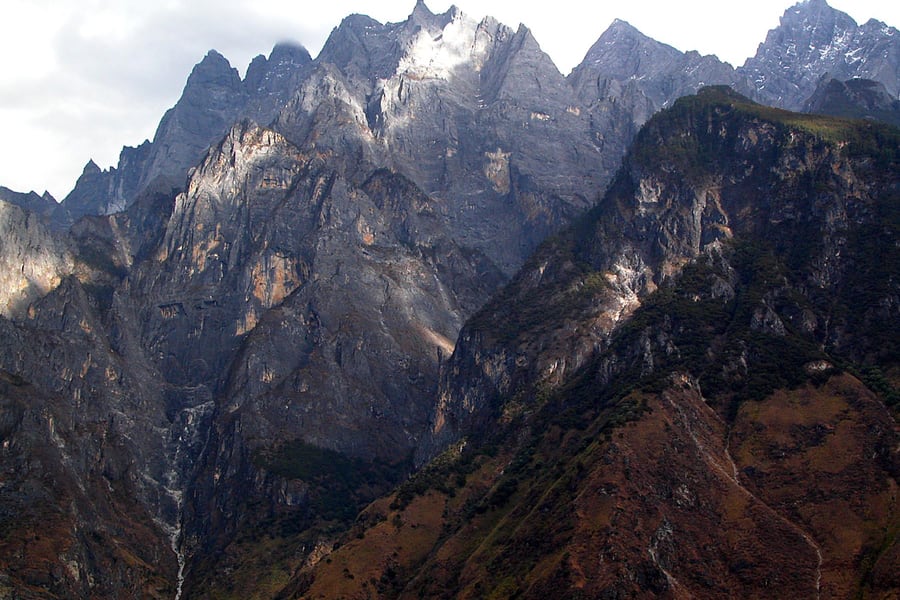 Peter Morgan / Wikimedia Commons · CC BY 2.0 · 2005 · cropped
Tiger Leaping Gorge
The Jinsha runs for about 15 kilometres between Jade Dragon and Haba Snow Mountains, in rapids under cliffs 2,000 metres high, in one of the deepest river canyons in the world. At its narrowest it is 25 metres wide, and legend has a tiger escaping across it by the rock in the middle. It is part of the Three Parallel Rivers World Heritage Site.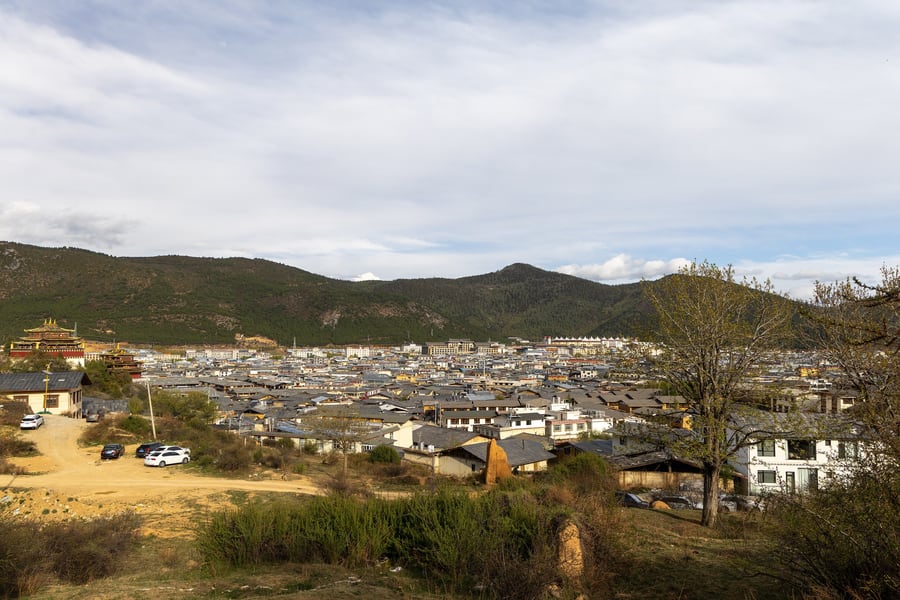 瑞丽江的河水 / Wikimedia Commons · CC BY-SA 4.0 · 2025 · cropped
Dukezong
Dukezong, from the Tibetan for "white stone castle", grew from a stronghold built in 634, and was a staging post on the Yunnan–Tibet tea-and-horse road. A fire on 11 January 2014 destroyed most of it; the town was rebuilt as it had been and reopened on 1 January 2016.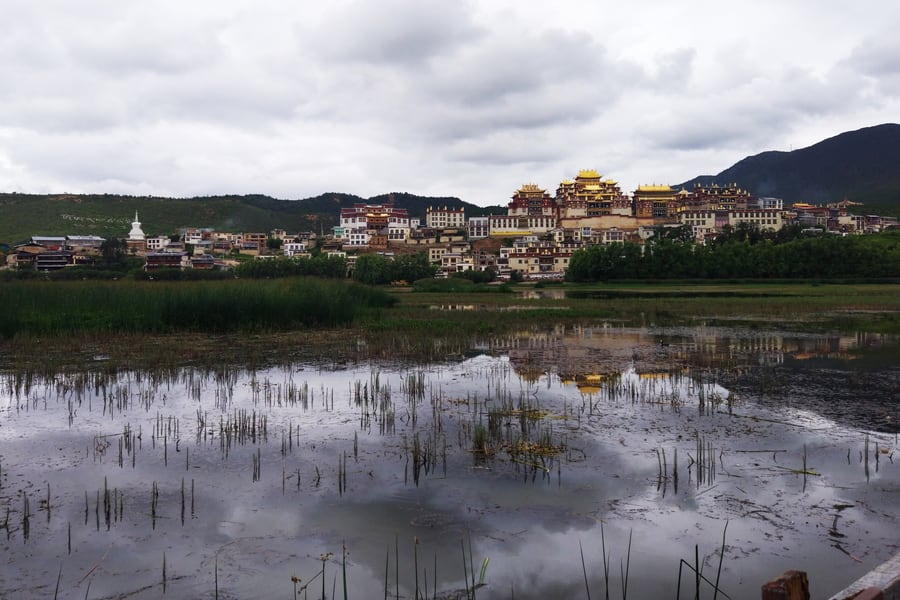 Kcx36 / Wikimedia Commons · CC BY-SA 4.0 · 2019 · cropped
Ganden Sumtseling Monastery
Founded in 1679 under the Fifth Dalai Lama, Ganden Sumtseling is the largest Tibetan Buddhist monastery in Diqing, and is often called the Little Potala. It stands at 3,380 metres beside a small lake. Damaged in 1959 and again in the Cultural Revolution, it was rebuilt from 1983, and 146 steps lead up to its main hall.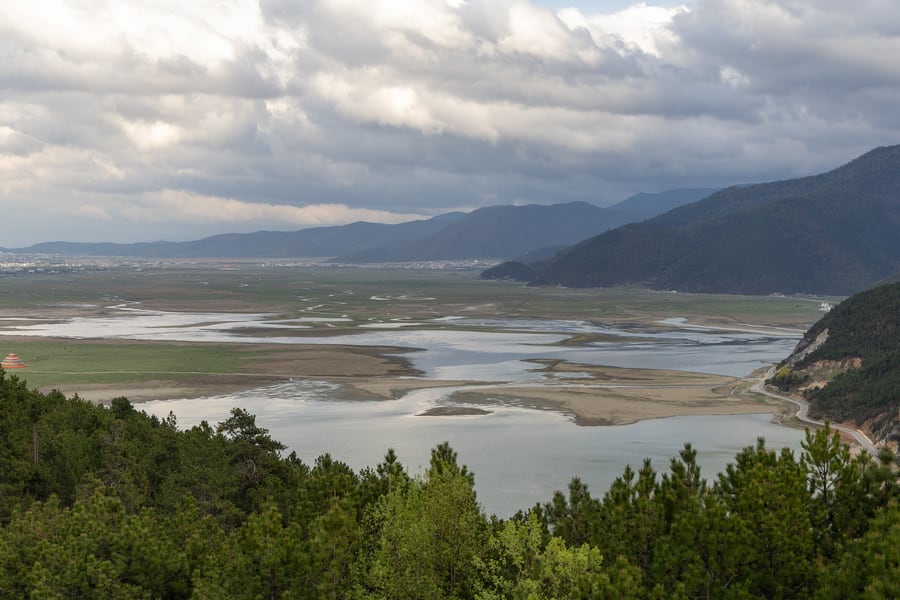 瑞丽江的河水 / Wikimedia Commons · CC BY-SA 4.0 · 2025 · cropped
Napa Lake
A seasonal lake at 3,266 metres, ringed on three sides by mountains. Snowmelt fills it in summer; in autumn and winter the water draws back and leaves grassland, and black-necked cranes and bar-headed geese come to spend the winter. It is a nature reserve.Where to Sleep
The two hotels below are at either end of the line: one at Shuhe, outside Lijiang, and one in Shangri-La, beside the monastery.
Where to stay
Banyan Tree Lijiang
At Shuhe, below Jade Dragon Snow Mountain
123 villas and suites built in the Naxi style, with grey-tiled roofs and courtyards, beside Shuhe old town.
Check Availability (opens in a new tab, on banyantree.com)via banyantree.comSongtsam Linka Retreat Shangri-La
Behind Ganden Sumtseling Monastery
92 rooms in Tibetan style, almost all of them facing south across the fields to the monastery.
Check Availability (opens in a new tab, on songtsam.com)via songtsam.comQuestions or corrections
Planning this trip and stuck on something, or spotted a time, fare or detail that has changed? Send us a message about The Lijiang–Shangri-La Railway. We read every one, and we update this page when something has changed.