Lviv to Uzhhorod
Bas Meijer / Wikimedia Commons · CC BY-SA 4.0 · 2017 · cropped
- Distance271 km, Lviv to Uzhhorod
- Duration5 hr 29 min
- Best seasonDaily except Tuesdays, all year
Introduction
Ukraine's railway is a country of sleepers. The distances are continental, and the ordinary way to travel between cities is a berth and a night. The line from Lviv to Uzhhorod is the exception worth taking in daylight: 271 kilometres across the only real mountains Ukraine has, with one train a day timed so that a traveller sees all of it. Train 831 leaves Lviv at 07:46 and is in Uzhhorod at 13:15, five hours and twenty-nine minutes later.
What it crosses is the Carpathian watershed. The line climbs the Opir valley through Stryi, Skole and Tukhlia, bridge after bridge, then goes under the ridge at the Volovets Pass and comes down into Zakarpattia — the corner of Ukraine that was Hungarian until 1918 and Czechoslovak between the wars, and which still cooks and speaks like neither of its neighbours. By Mukachevo the mountains are behind you and the train is running across a warm plain towards the Slovak and Hungarian borders.
The tunnel under that ridge is why the line matters to more than travellers. The old Beskydy tunnel of 1886 was single-track and 1,750 metres long; the double-track bore that replaced it in May 2018 is 1,822 metres, and something close to sixty per cent of all rail traffic between Ukraine and the European Union passes through it. Since 2022 that has stopped being an economic statistic and become a lifeline, which is a strange thing to think about from a window seat in the Beskids on a summer morning.
The Journey
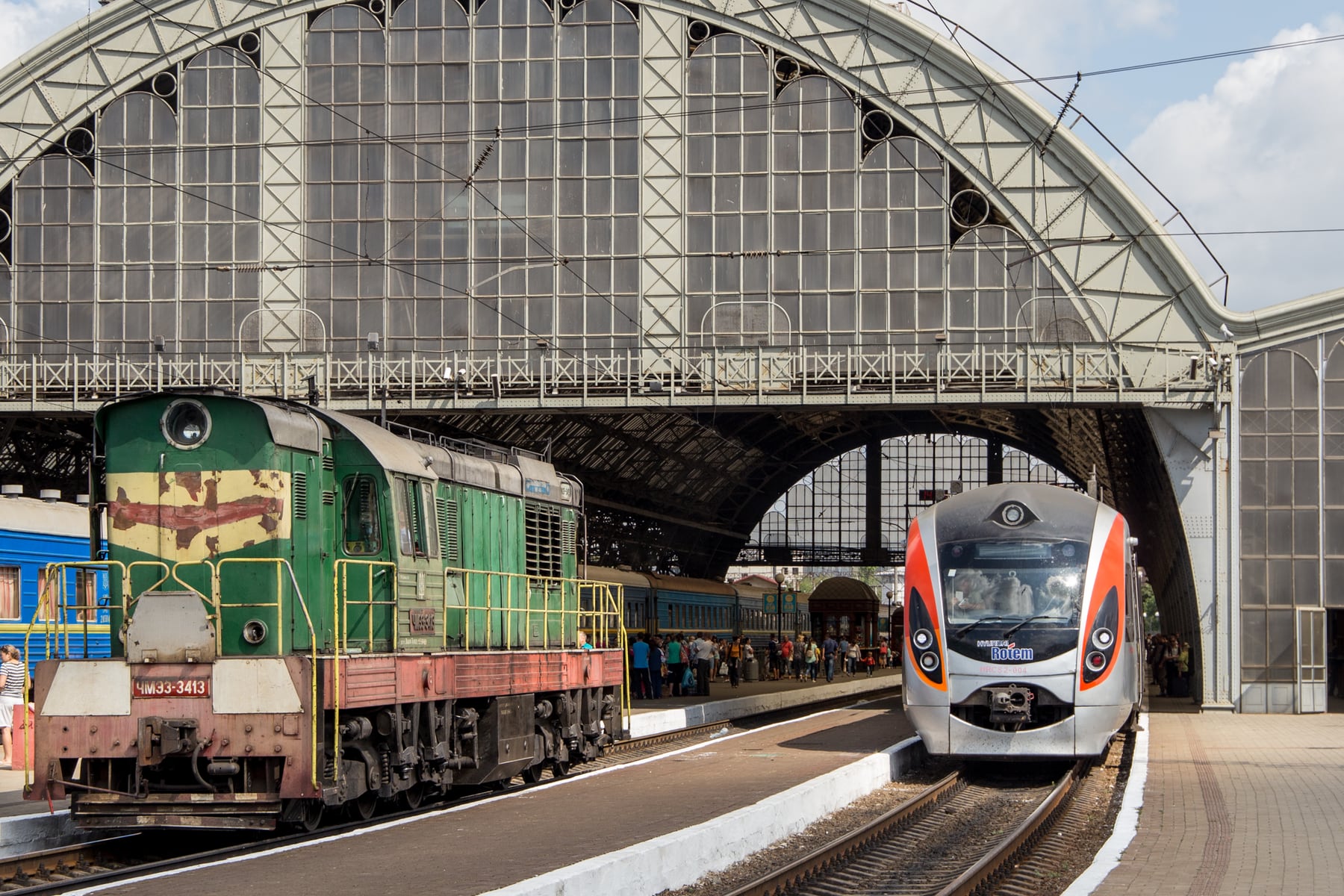
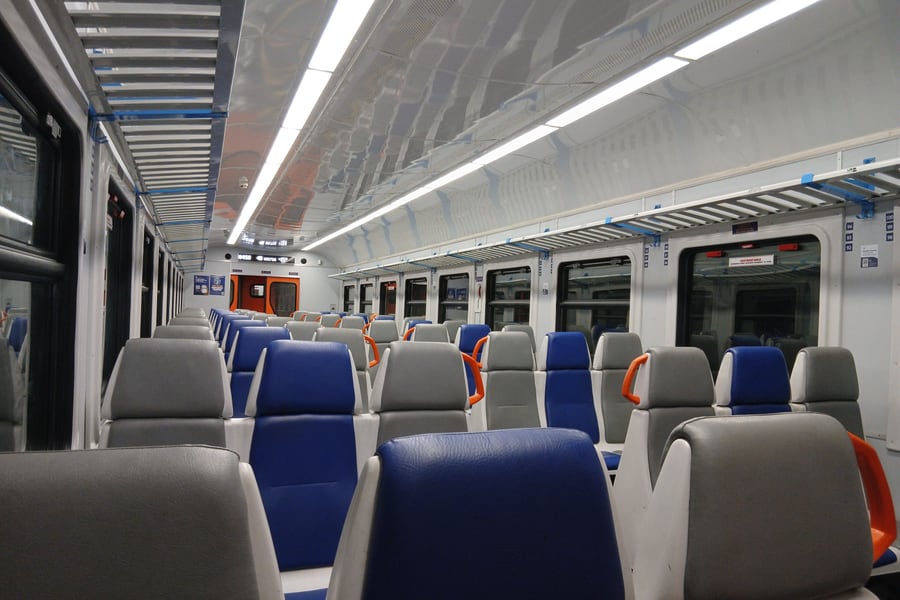
Lviv's station is the departure that sets the tone. Opened in 1904 to Władysław Sadłowski's design, it put a pair of glazed iron train sheds behind a stone front with a sculpted pediment, and both are still there — shunters in faded Soviet green working under the arches, blue-and-yellow sleeping cars on one road and a white Hyundai Rotem Intercity unit on the next. Train 831 is the modest one: a short electric set for the mountains rather than a flagship, and it goes out southward past the locomotive depot with the whole day ahead of it.
For the first hour the country is flat and agricultural. Stryi, an hour out, is where the railway's own history begins — the 73.5 kilometres from Lviv to Stryi opened on 16 October 1873, built by the Archduke Albrecht Railway, and there the line stopped for fourteen years because neither Galicia nor Hungary would pay for the mountains. Beyond Stryi the valley narrows, the river turns from a stream into the Opir, and the train begins to work.
Up the Opir
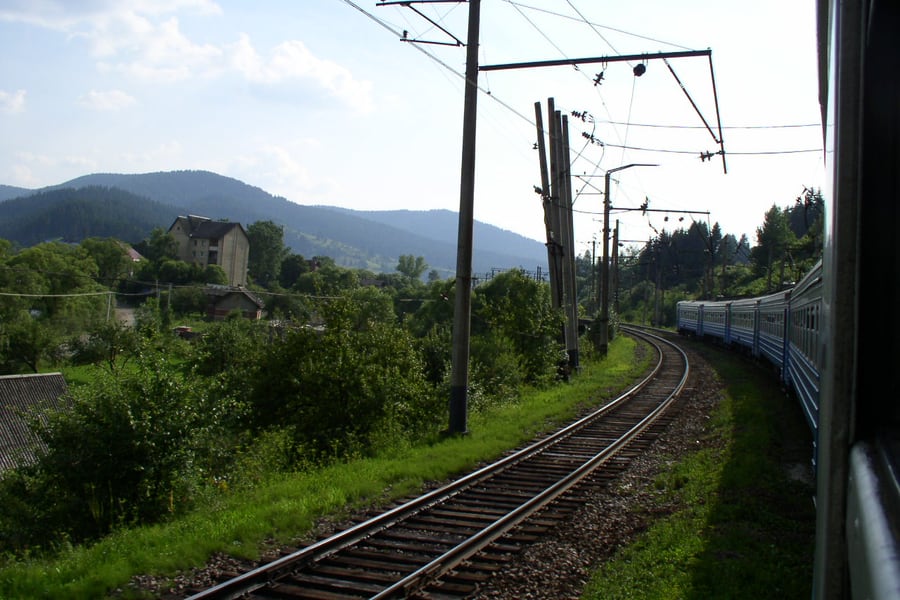
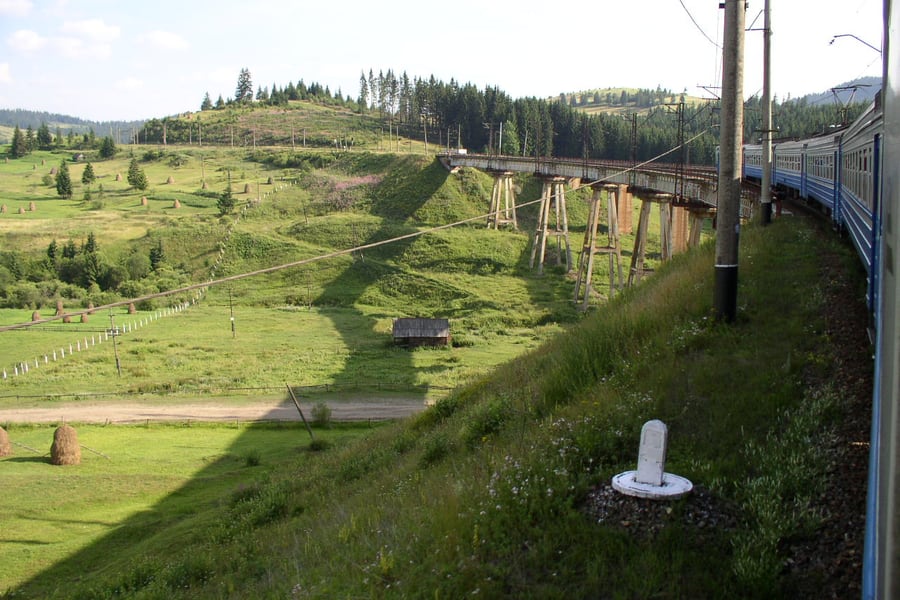
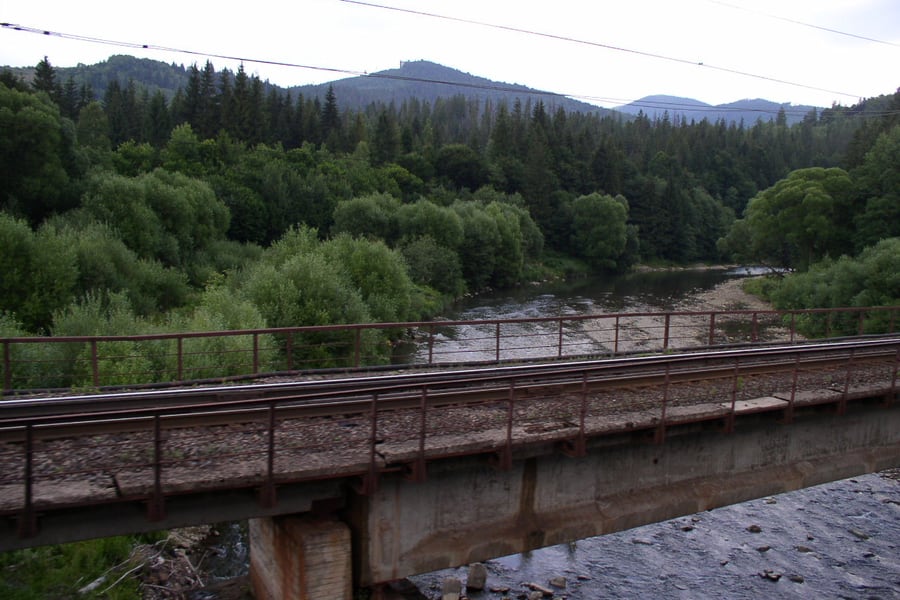
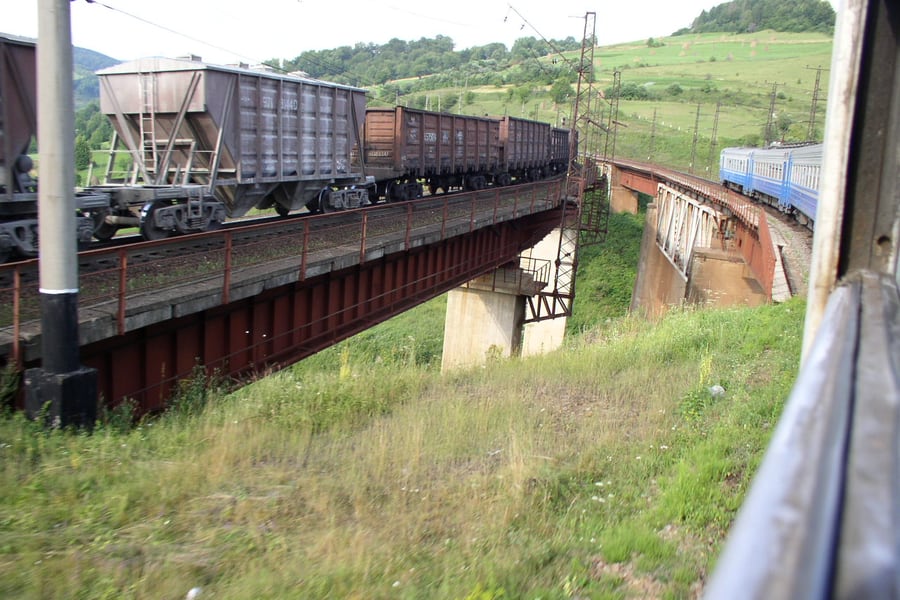
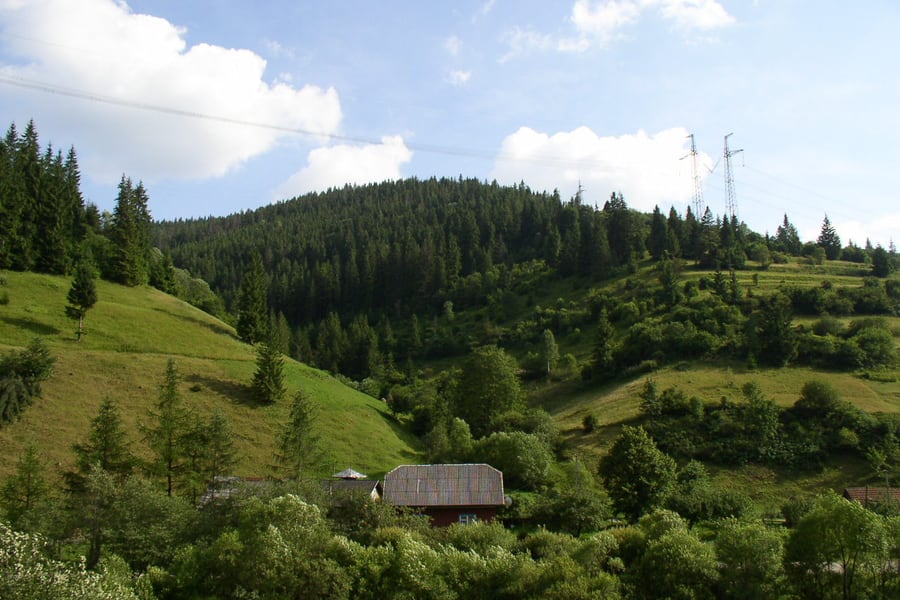
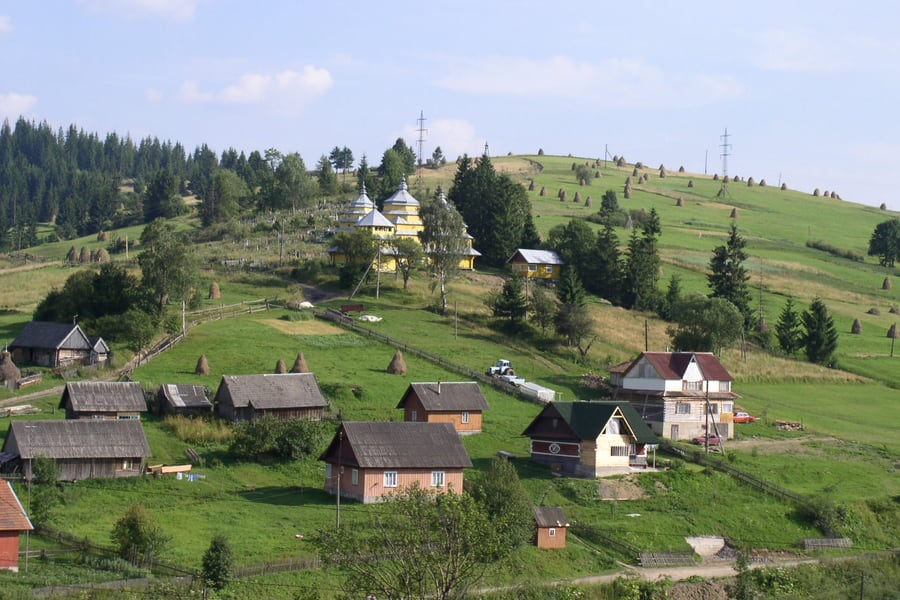
This is the best hour of the journey and it is all bridges. The line crosses and recrosses the Opir on plate girders and stone piers, threading villages — Skole, Tukhlia, Slavske — whose houses stand in tight green meadows with hay drying in stooks and the forest starting a few hundred metres up the slope. Wooden churches appear and vanish. On the left, from Tukhlia onward, the pylons of a 750 kV transmission line march over the ridge on their own alignment, which is oddly companionable.
The engineering here dates from 5 April 1887, when the Imperial-Royal Austrian State Railways finished the 79.3 kilometres from Stryi to Beskyd and carried the line over the frontier into Hungary. All of it was built to standard gauge; the Soviet Union regauged the lot to 1,520 mm after 1945, when the border in the Carpathians simply stopped existing.
Under the ridge
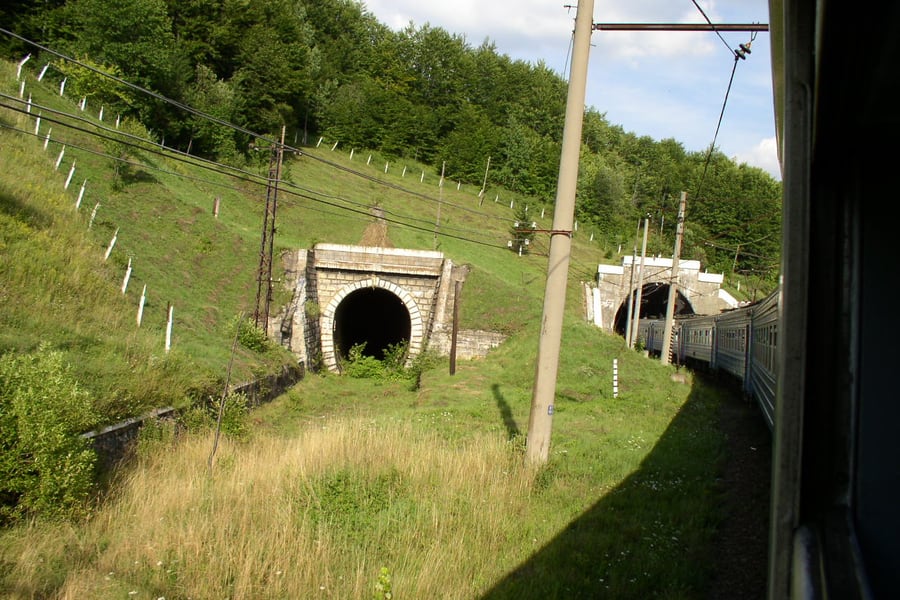
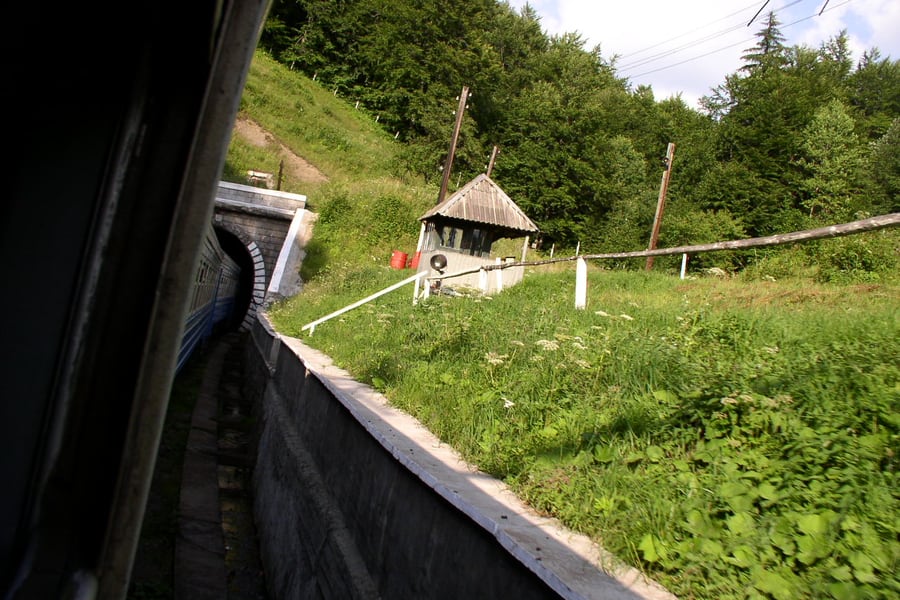
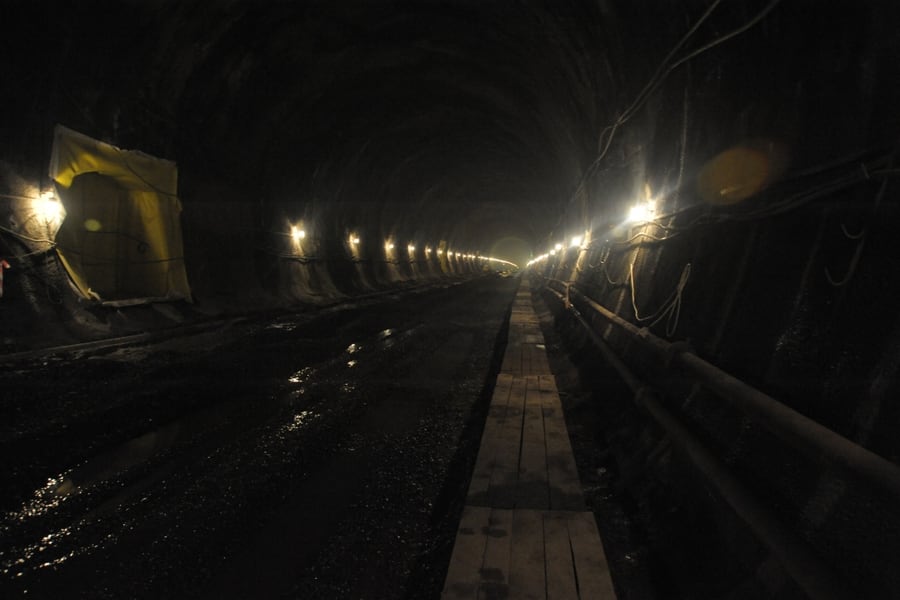
Near Skotarske the train passes one of the more eloquent sights on any European main line: two tunnel mouths side by side, one bricked and disused under its stone arch, the other carrying the running line. The old Beskydy tunnel was bored in 1886, 1,750 metres of single track under the Volovets Pass, and by the 2010s it was the bottleneck on Ukraine's westward corridor. Its replacement — 1,822 metres, double track, 8.5 metres high and 10.5 wide — was opened in May 2018 and paid for with US$40 million from the EBRD and €55 million from the EIB.
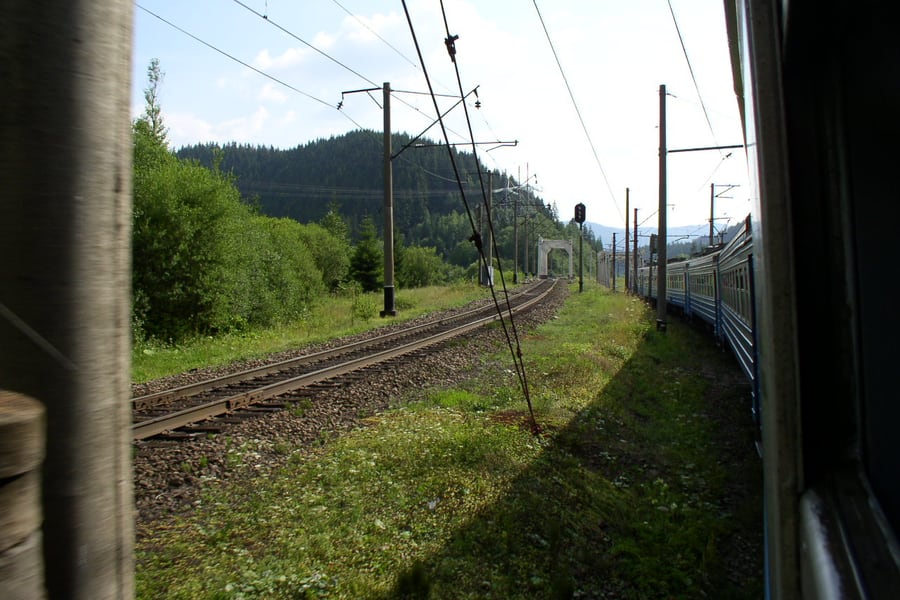
The other side is a different country in feel. Volovets is a junction of grass and overhead wire where an elderly green electric locomotive is usually standing; below it the valley opens, the roofs turn red, and the train drops through Svaliava on the Latorica towards the plain. At Mukachevo it stops for ten minutes — the one real pause of the day, and long enough to see the volcanic hill with Palanok Castle on it from the platform end.
Out to the Tisza plain
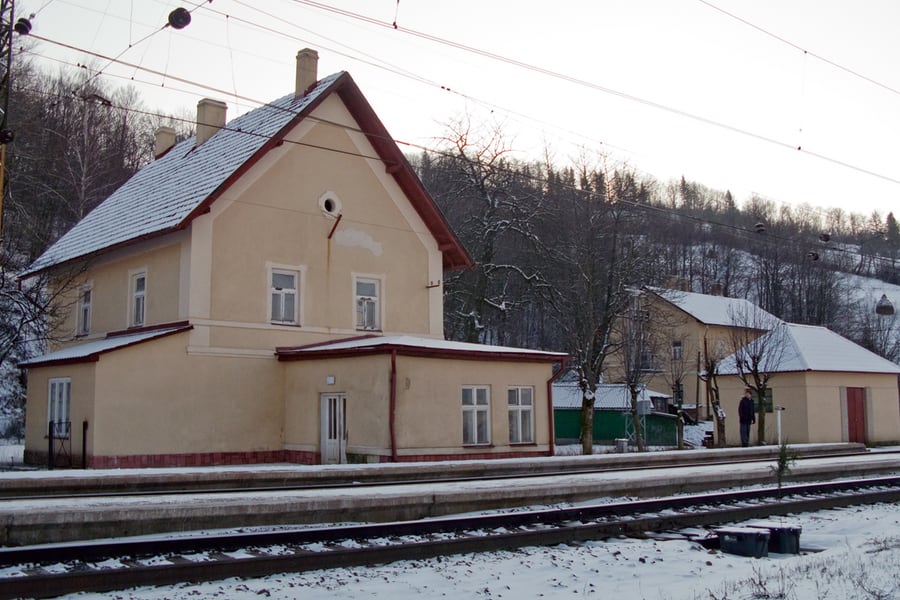
From Mukachevo the line runs flat and fast across Zakarpattia, past orchards and vineyards and the four-railed track around Chop, where broad gauge and standard gauge are laid together so that freight can run to Slovakia, Hungary and Romania without a change of bogies. Uzhhorod's station opened on 28 August 1872 and was wired at 3 kV in 1968; the train comes to a stand under the canopy at 13:15, twenty-two kilometres from Chop and about the same again from the Slovak frontier. Outside, the Uzh runs past the longest lime avenue in Europe and a castle on the hill, and the Carpathians you spent the morning inside are a blue line on the northern horizon.
Along the route
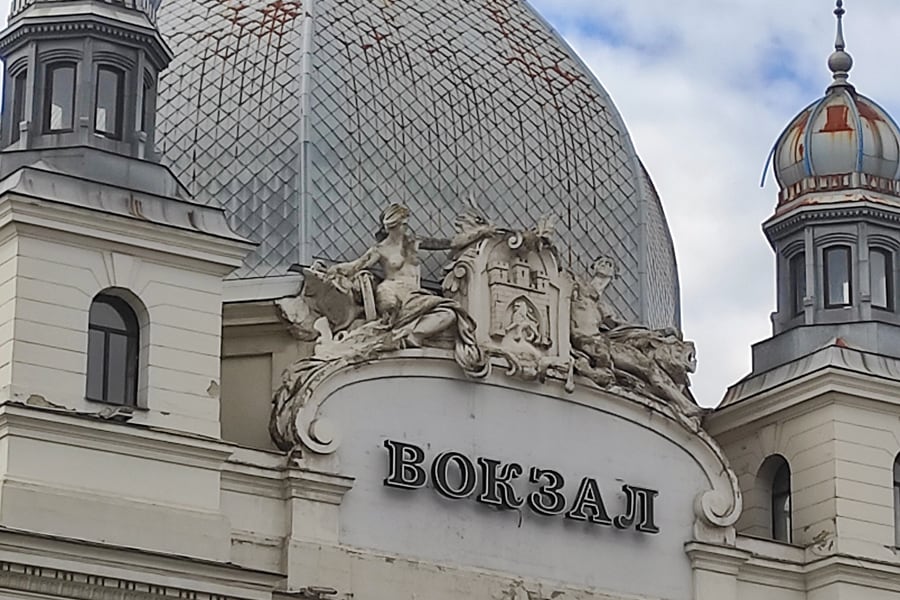 Rewega1 / Wikimedia Commons · CC BY-SA 4.0 · 2025 · cropped
Out of Lviv
A 1904 station with two glazed iron sheds, Soviet-green shunters under the arches and the Intercity units on the next road. Train 831 leaves at 07:46.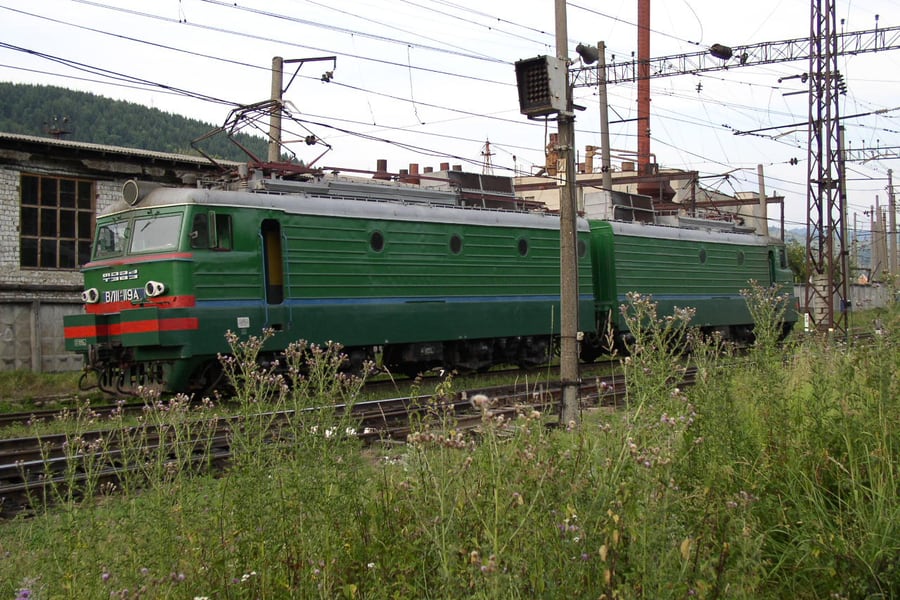 Alex Zelenko / Wikimedia Commons · CC BY-SA 4.0 · 2006 · cropped
Over the Volovets Pass
Two hours of bridges up the Opir, the tunnel under the ridge, then Volovets — a junction of grass and overhead wire where the old electrics stand.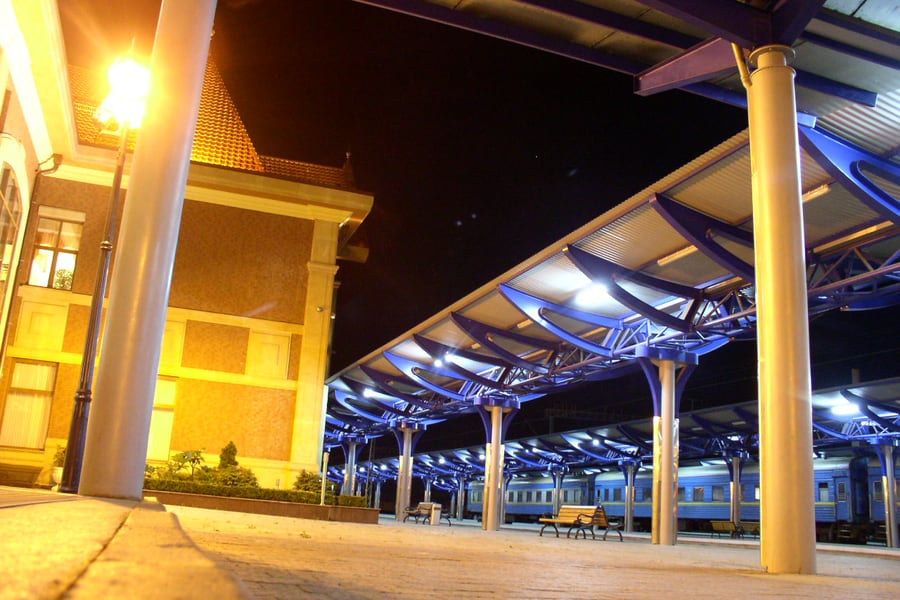 Alex Zelenko / Wikimedia Commons · CC BY-SA 4.0 · 2006 · cropped
Into Uzhhorod
Across the Zakarpattia plain to a station that opened in 1872 and was electrified in 1968, twenty-two kilometres short of the Chop frontier junction.A bit of history
Culture & experiences along the way
 Alex Zelenko / Wikimedia Commons · CC BY-SA 4.0 · 2006 · cropped
Boyko country, and the hay
For two hours above Skole the line runs through Boyko villages where the meadow hay is still cut by hand and stacked on wooden stakes to dry, and a wooden church stands on the ridge above almost every one. Sixteen tserkvas built in that tradition — horizontal logs, 16th to 19th century — were made World Heritage in 2013.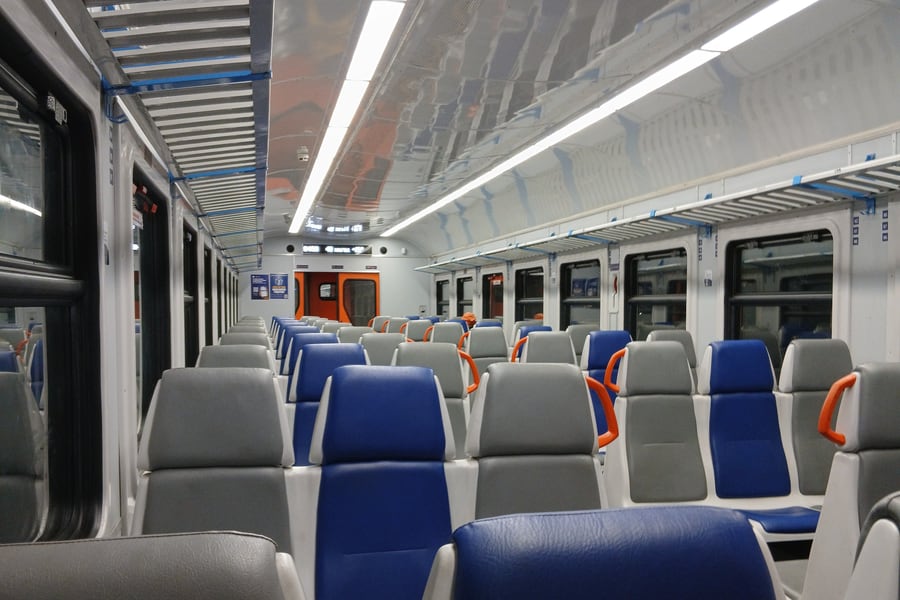 Микола Василечко / Wikimedia Commons · CC BY-SA 4.0 · 2026 · cropped
Gauge, and why the border is slow
Ukraine runs on 1,520 mm broad gauge and its western neighbours on 1,435 mm standard, so a through train either changes bogies or you change trains. Around Chop the two are laid together on four rails, which is how freight reaches Slovakia, Hungary and Romania — and why nearly sixty per cent of Ukraine's rail trade with the EU goes under one tunnel.Timetables
Train 831 is the daylight train, and the only one timed to show a traveller the whole crossing. It runs daily except Tuesdays and works the round trip in a day. Times below are Ukrainian Railways' own published schedule, read on 2 September 2026.
| Station | Arrive | Depart |
|---|---|---|
| Lviv | — | 07:46 |
| Stryi | 08:46 | 08:47 |
| Skole | 09:17 | 09:18 |
| Tukhlia | 09:38 | 09:39 |
| Volovets | 10:38 | 10:39 |
| Svaliava | 11:09 | 11:11 |
| Mukachevo | 11:35 | 11:45 |
| Uzhhorod | 13:15 | — |
The same set turns and comes back the same afternoon, leaving Uzhhorod at 14:30 and reaching Lviv at 20:12, calling at Mukachevo 16:26, Svaliava 16:51, Volovets 17:23, Tukhlia 18:20, Skole 18:39 and Stryi 19:08.
The rest of the day
Nine other trains cover the route, most of them long-distance workings that pass through Lviv in the small hours on their way to the border. They are worth knowing about — 831 does not run on Tuesdays, and several of these are sleepers with berths.
| Train | Route | Lviv | Uzhhorod | Runs |
|---|---|---|---|---|
| 29 | Kyiv – Uzhhorod | 03:01 | 07:50 | daily |
| 17 Skovoroda Express | Kharkiv – Uzhhorod | 04:41 | 09:30 | odd-numbered days to 31 Oct |
| 3 | Dnipro – Uzhhorod | 06:12 | 11:10 | daily |
| 38 | Odesa – Uzhhorod | 07:04 | 12:13 | daily |
| 831 | Lviv – Uzhhorod | 07:46 | 13:15 | daily except Tuesdays |
| 81 Desna | Kyiv – Uzhhorod | 07:32 | 12:26 | daily |
| 829 | Lviv – Uzhhorod | 16:30 | 22:10 | Thursdays to Sundays |
| 835 | Lviv – Uzhhorod | 17:28 | 22:46 | daily except Mondays and Tuesdays |
| 749 Intercity | Kyiv – Uzhhorod | 19:18 | 00:23 | daily |
Ukrainian Railways publishes the live timetable and any changes at uz.gov.ua (opens in a new tab). Wartime disruption is real and the operator reschedules at short notice; the live board is the place to see changes.
Tickets
Tickets are sold by Ukrainian Railways and nobody else: online at booking.uz.gov.ua (opens in a new tab), in the UZ app, or at any station window. Booking opens well ahead and the Uzhhorod trains fill in summer and around holidays, so a seat on 831 is worth reserving rather than turning up for. Every seat on every long-distance Ukrainian train is reserved — there is no walk-on, sit-anywhere fare.
Classes follow the Soviet pattern the network still uses. On the sleepers that share this route, kupe is a four-berth compartment and platskart an open saloon of bunks; the daytime sets and the Intercity work with reserved seats instead. Fares are set by UZ, quoted in hryvnia, and shown at the point of sale. Foreign cards are accepted on the booking site, and a ticket bought online is a QR code the conductor scans at the door.
Book your tickets
Train 831, Lviv to Uzhhorod
The daylight crossing, 5 hr 29 min
Reserved seats on the one train timed to show the whole Carpathian crossing, sold by Ukrainian Railways.
Book Tickets (opens in a new tab, on booking.uz.gov.ua)via booking.uz.gov.uaThe overnight trains to Uzhhorod
Kupe and platskart berths from Kyiv, Kharkiv, Dnipro and Odesa
Nine long-distance workings pass through Lviv for Uzhhorod, most of them sleepers reaching Zakarpattia at breakfast.
Book Tickets (opens in a new tab, on booking.uz.gov.ua)via booking.uz.gov.uaUkrainian Railways timetable
The operator's live schedule and changes
The route and station boards this page's times were read from, kept current by the operator.
Book Tickets (opens in a new tab, on uz.gov.ua)via uz.gov.uaRail Passes
No rail pass covers this journey. Interrail sells One Country Passes for thirty-one European countries and Ukraine is not among them, and Ukraine is not one of the thirty-three countries in the Interrail and Eurail pass network at all — so neither a Global Pass nor any country pass buys a kilometre of Ukrainian track. Checked on the operators' own pass pages, September 2026.
That matters less than it would elsewhere, because Ukrainian fares are low by European standards and every seat has to be reserved individually in any case. The practical route in is to buy a pass for the country you arrive from — Poland, Slovakia or Hungary all have them — use it to the frontier, and buy the Ukrainian leg separately from Ukrainian Railways.
Places to Visit
The journey is a line drawn between two of the most distinctive cities in Ukraine, and it passes through a national park and a mountain range on the way. Nothing below is more than a short walk or a local bus from a station where train 831 stops, and the ten-minute pause at Mukachevo is the one place on the route where the castle is visible from the platform.
 Aeou / Wikimedia Commons · CC BY-SA 4.0 · 2014 · cropped
Lviv's old town
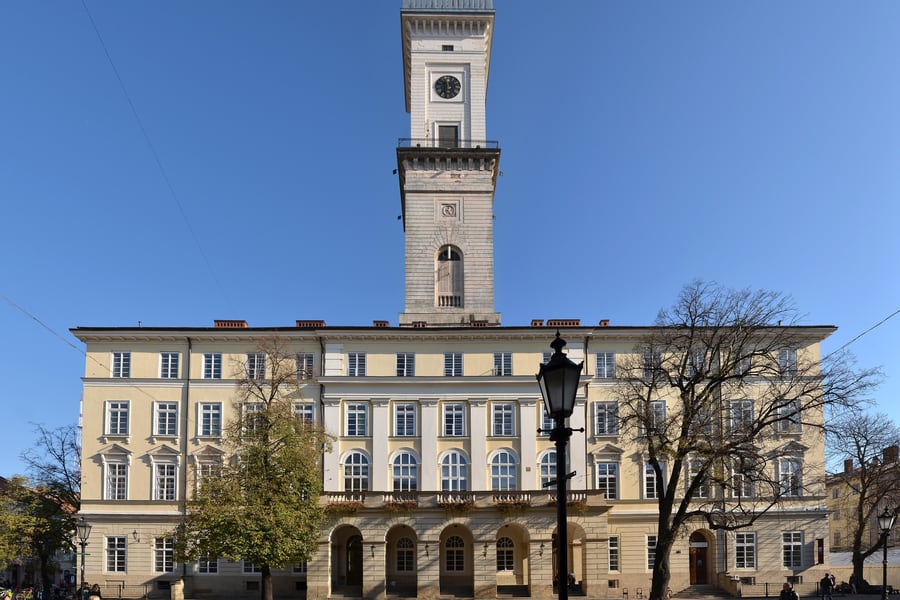
A UNESCO World Heritage centre that came through the twentieth century largely intact, and the reason most travellers are in the city at all. Market Square is ringed by merchants' houses and centred on the Ratusha, the town hall of 1827–1835 whose tower can be climbed for the roofscape. The station is twenty minutes away by tram.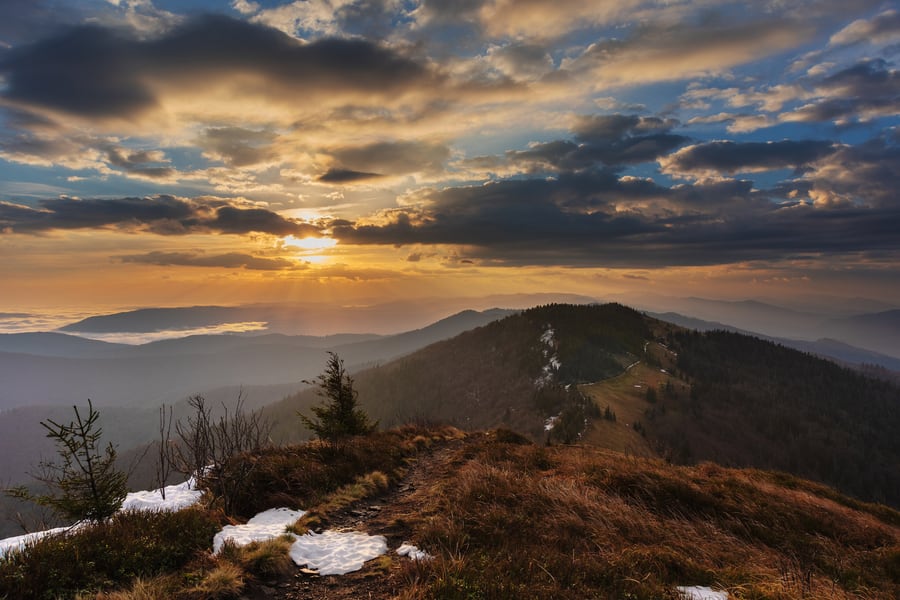 Misha Reme / Wikimedia Commons · CC BY-SA 4.0 · 2018 · cropped
Skole Beskids National Nature Park
The train spends an hour inside it. Established in 1999, the park covers the forested ridges either side of the Opir, and Mount Parashka at 1,268 metres is the walk most people come for — a long day up from Skole, where 831 stops at 09:17. Beech and fir to the treeline, and the hay meadows the villages still cut by hand.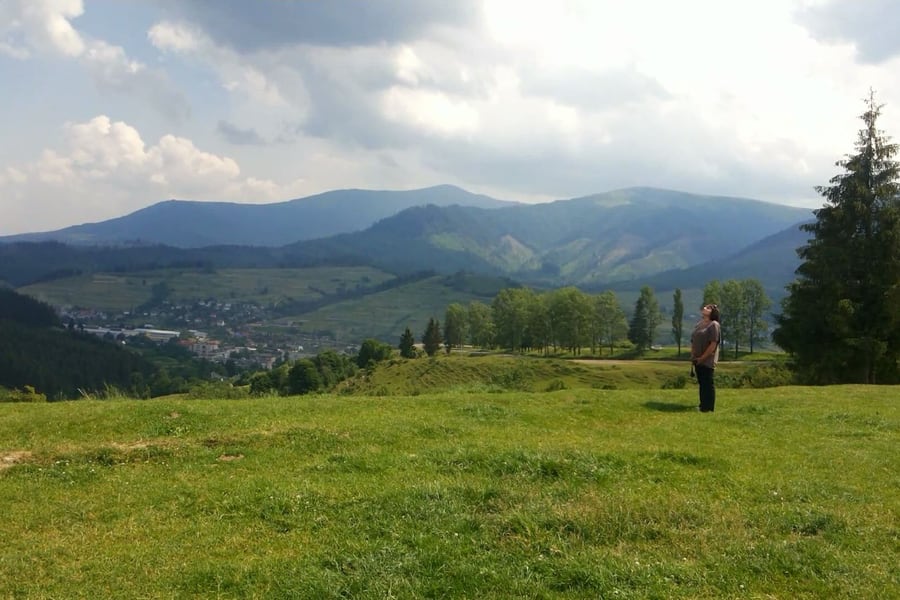 Ircha86 / Wikimedia Commons · CC BY-SA 4.0 · 2016 · cropped
The Carpathian passes around Volovets
Volovets sits under the pass the railway tunnels through, and it is the usual jumping-off point for the polonyny — the high open pastures on the ridges above the treeline, still grazed through the summer. The village itself is a working railway junction rather than a resort, which is much of its charm.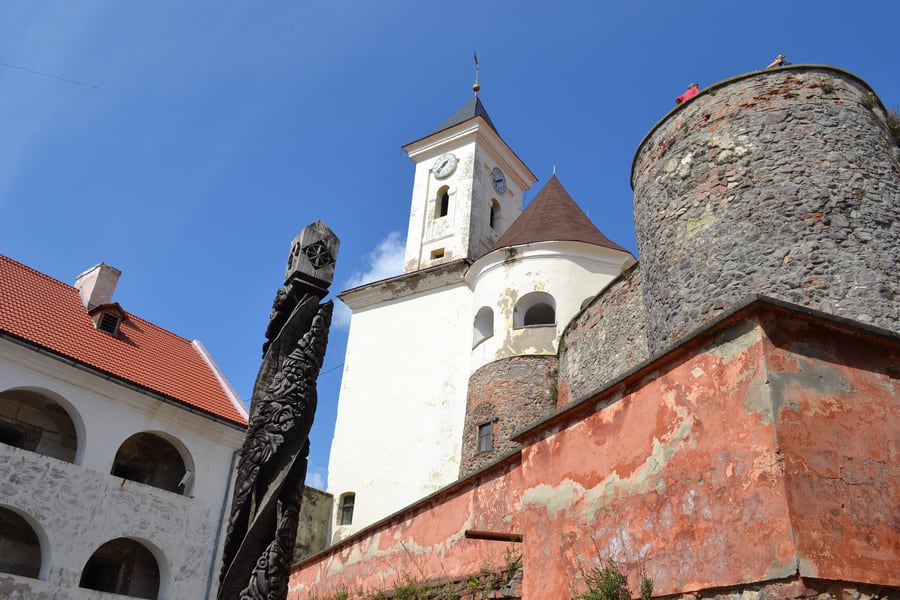 Alionyshka / Wikimedia Commons · CC BY-SA 4.0 · 2014 · cropped
Palanok Castle, Mukachevo
Visible from the platform during the train's ten-minute stop, standing on a volcanic hill sixty-eight metres above the town. The castle is medieval in origin and was rebuilt as a bastioned fortress; it held out under Ilona Zrínyi through a three-year Habsburg siege in the 1680s, and later served as a prison. It is a twenty-minute walk from the station.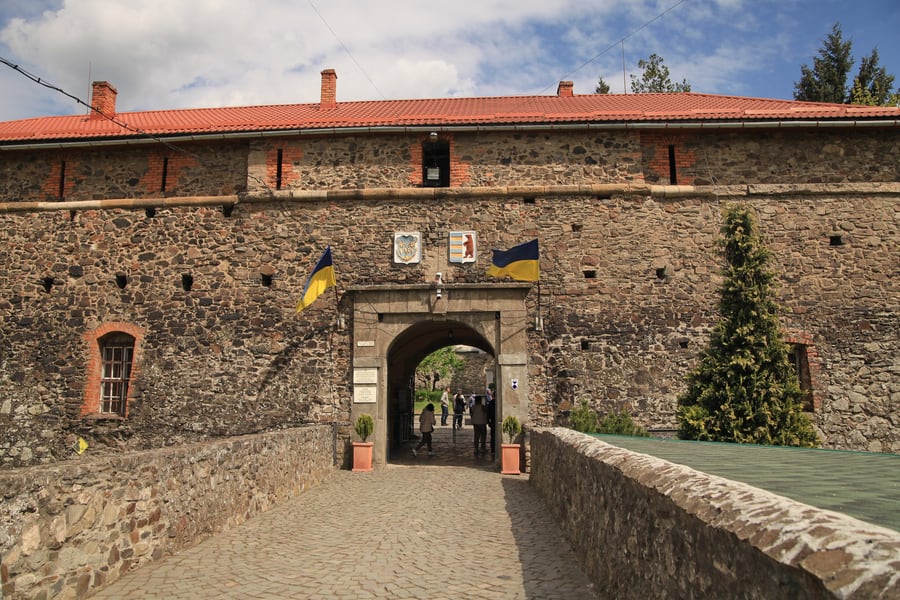 Oleksandr Malyon / Wikimedia Commons · CC BY-SA 4.0 · 2024 · cropped
Uzhhorod Castle and the lime avenue
The castle above the town keeps its Renaissance bastions, with a skansen of Zakarpattia's wooden architecture in the grounds below. Down at the river, the embankments of the Uzh carry what the city claims as the longest lime avenue in Europe — a couple of kilometres of them, and a spectacle when the sakura between them flowers in April.Where to Sleep
Train 831 is a day train in both directions, so a night at each end makes the round trip work: out of Lviv in the morning, a night in Uzhhorod, and back the following afternoon. Both cities keep their hotels in the historic centre, within a walk or a couple of kilometres of the station.
One practical point that has nothing to do with hotels and everything to do with arrival times. Ukraine is under martial law, and a curfew applies — its hours are set by each regional military administration rather than nationally, they change with the security situation, and some communities have had theirs lifted. Two of the trains on this route are booked into Uzhhorod at 22:46 and 00:23. Check the current hours for the oblast you are arriving in, and tell the hotel when to expect you.
Where to stay
Astoria
Vulytsia Horodotska, Lviv
Built in 1914 to Tadeusz Gardel's Art Nouveau design for the Lviv Opera, a listed building that spent sixty years as the Hotel Kyiv and took its first name back in 2013.
Check Availability (opens in a new tab, on astoriahotel.ua)via astoriahotel.uaHotel Old Continent
Petőfi Square, Uzhhorod
On the central pedestrian square, refurbished throughout, with rooms of 31 to 37 square metres and a restaurant and spa in the building.
Check Availability (opens in a new tab, on hotel-oldcontinent.com)via hotel-oldcontinent.comApartel Uzhhorod
Sobranetska Street, Uzhhorod
Sixty-three rooms laid out as apartments, each with its own kitchen and washing machine, fifteen minutes from the centre, with a spa and restaurant.
Check Availability (opens in a new tab, on apartel.ua)via apartel.uaQuestions or corrections
Planning this trip and stuck on something, or spotted a time, fare or detail that has changed? Send us a message about Lviv to Uzhhorod. We read every one, and we update this page when something has changed.