Maeklong Railway
© ProtoplasmaKid / Wikimedia Commons · CC BY-SA 4.0
- DistanceNearly 65 km (Wongwian Yai–Maeklong)
- DurationHalf a day, with the boat
- Best seasonNovember–February
Introduction
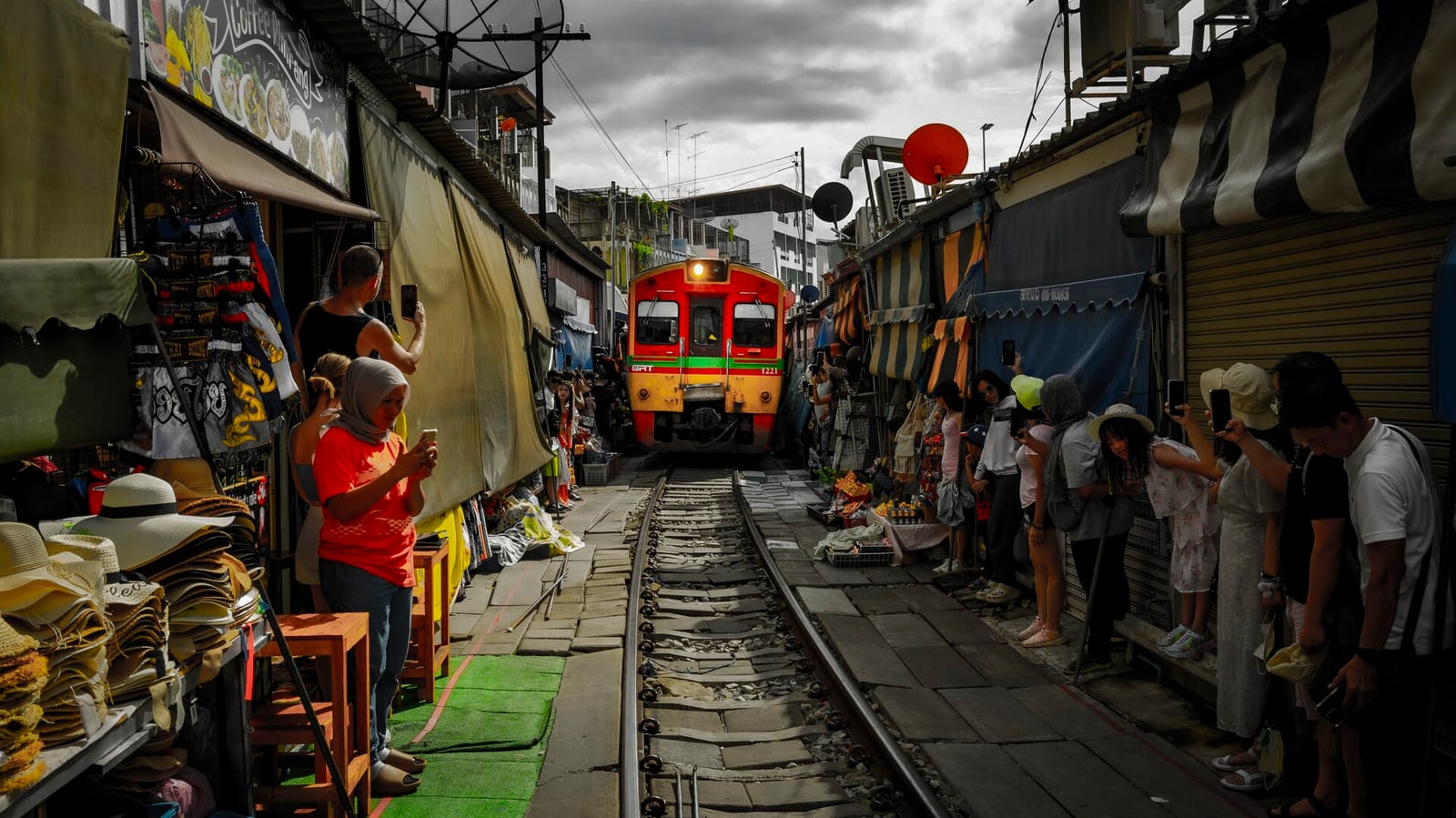
Somewhere in the fresh market at Samut Songkhram, a bell goes. What happens next takes about fifteen seconds and is one of the strangest sights in world transport.
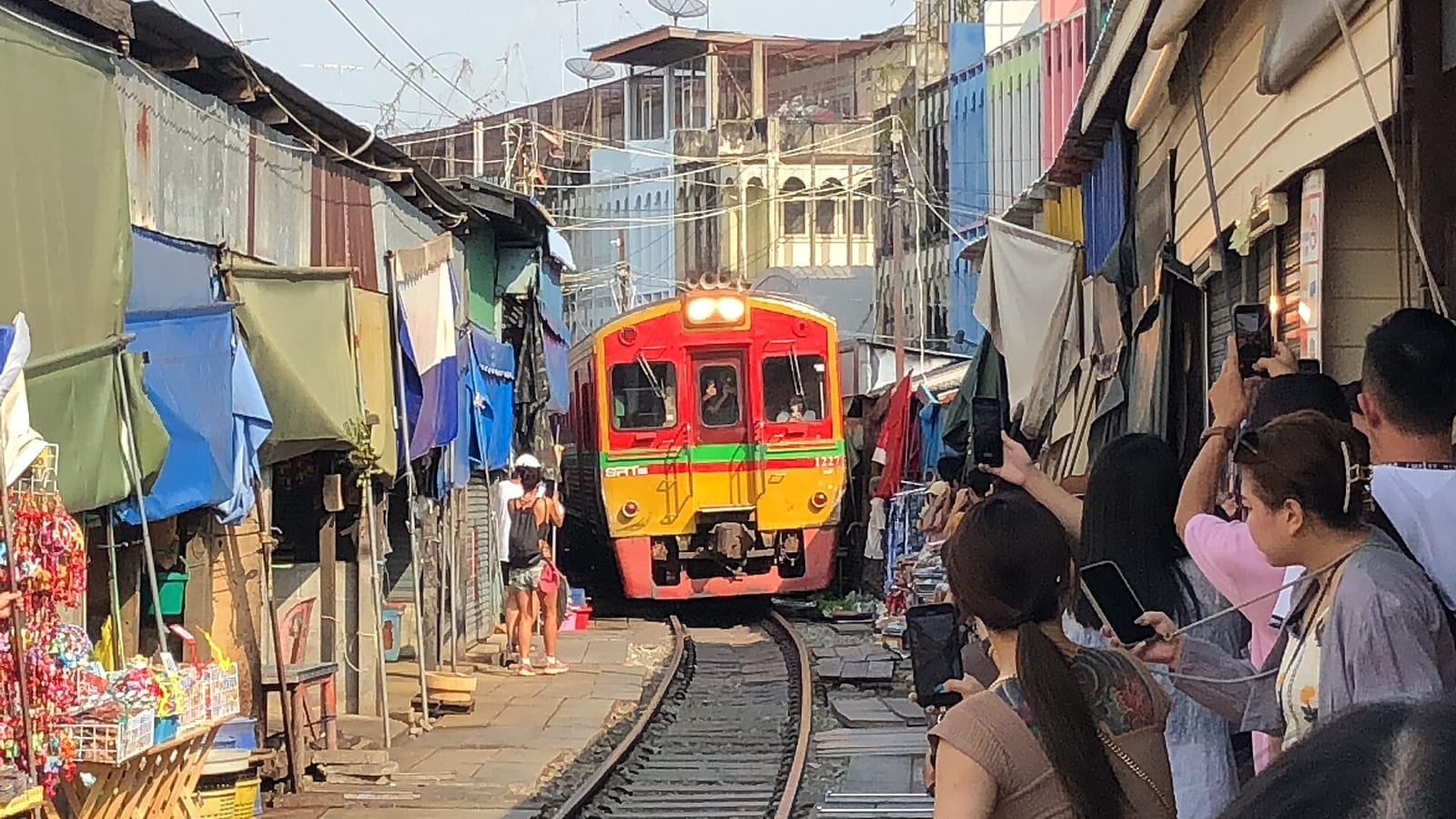
The traders reach up without looking, fold their awnings back against the shopfronts, and slide their trays a hand's width clear of the rails. The customers step into doorways. The mangoes, the fish, the buckets of live prawns mostly stay exactly where they are. And then a train — a full-sized diesel railcar, not a toy — comes down the aisle at walking pace with centimetres to spare on either side, brushing the canopies as it goes. It reaches the station at the end. The awnings flip back out. Trading resumes. It happens roughly eight times a day.
This is Talat Rom Hup — the "umbrella pulldown market" — and it is the reason the world knows about the Maeklong Railway. What makes it wonderful is that it is not a show. Nobody staged it. The market was there, the railway came in 1905, neither would move, and after a century they simply learned to share.
The rest of the line is just as odd. It runs nearly 65 kilometres from Wongwian Yai in Bangkok to Maeklong, at a top speed of 31 km/h — and it has never been joined up. The Tha Chin river cuts it in half, the Mahachai Line on one bank and the Ban Laem Line on the other, and in over a hundred and twenty years nobody has built the bridge. You get off one train, take a boat across a fishing harbour, and get on another.
It is a half-day, it costs a few baht, and there is nothing else like it anywhere.
The Journey
Done properly, this is a journey in three acts, and the middle one involves a boat.
It starts at Wongwian Yai, a small terminus tucked behind a roundabout in Thonburi, on the western side of Bangkok — no grand concourse, just a couple of platforms and a railcar with its doors open. The Mahachai Line opened in 1904, and it leaves the city in the most intimate way imaginable: the track runs between houses, close enough to see what people are cooking, past shrines and washing lines and dogs asleep in the four-foot. Then the city thins into salt flats — shallow evaporation pans with wooden windmills and heaps of drying salt — and canals full of water hyacinth.
Twenty stations later the line ends at Mahachai, a serious fishing port at the mouth of the Tha Chin. And here the railway simply stops. There is no bridge. There has never been a bridge. You walk through the market on the quayside — a chaos of crushed ice, squid, mantis shrimp and things still moving — and take a longtail ferry across the river among the trawlers to Ban Laem.
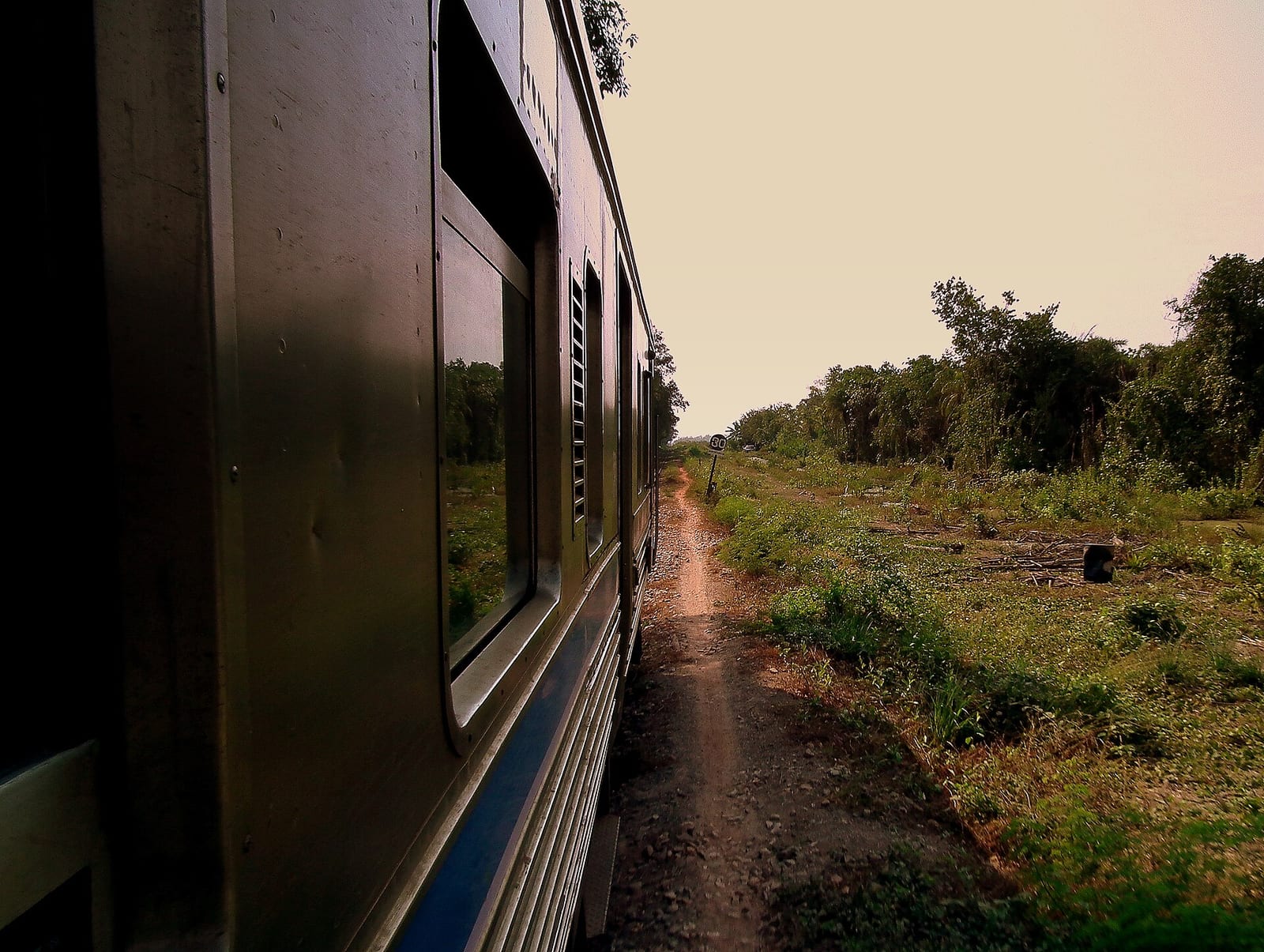
On the far bank the second railway is waiting: the Ban Laem Line, opened in 1905, fifteen stations, another metre-gauge railcar. This half runs through coconut groves, shrimp farms and salt pans, over creeks on low bridges, at a pace that makes 31 km/h feel optimistic. It is quiet, green and almost entirely local.
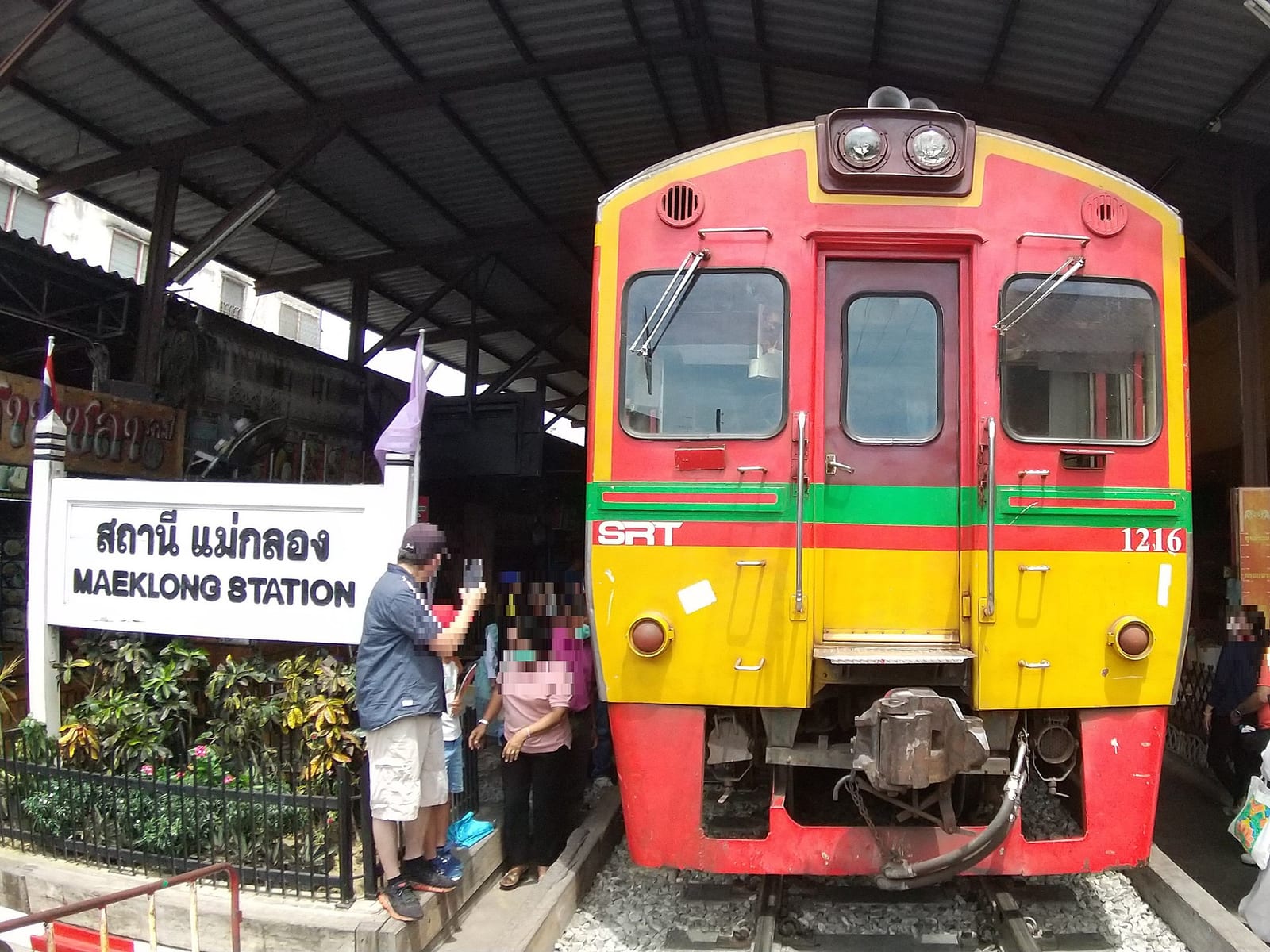
And then the third act. Somewhere on the approach to Maeklong, the train slows to a crawl, the horn starts, and the world closes in. The track becomes an aisle. Awnings fold back overhead in a wave running ahead of the locomotive. Baskets of limes sit a few centimetres from the wheels. Traders glance up, unhurried, and go back to what they were doing. The railcar noses through the whole length of the market and stops at the platform — and behind it, already, the canopies are swinging out again and the market has closed over the rails as if the train had never existed.
Then you get out, walk back down the track through the stalls you have just ridden through, and wait for the next one so you can watch it from the outside. Everybody does. It is worth it.
Along the route
© ProtoplasmaKid / Wikimedia Commons · CC BY-SA 4.0Talat Rom Hup
The "umbrella pulldown market": a working fresh market laid out on the rails themselves. Eight times a day a bell sounds, the awnings fold back, the produce stays exactly where it is, and a train passes through with centimetres to spare.Suikotei / Wikimedia Commons · CC BY-SA 4.0A railway in two halves
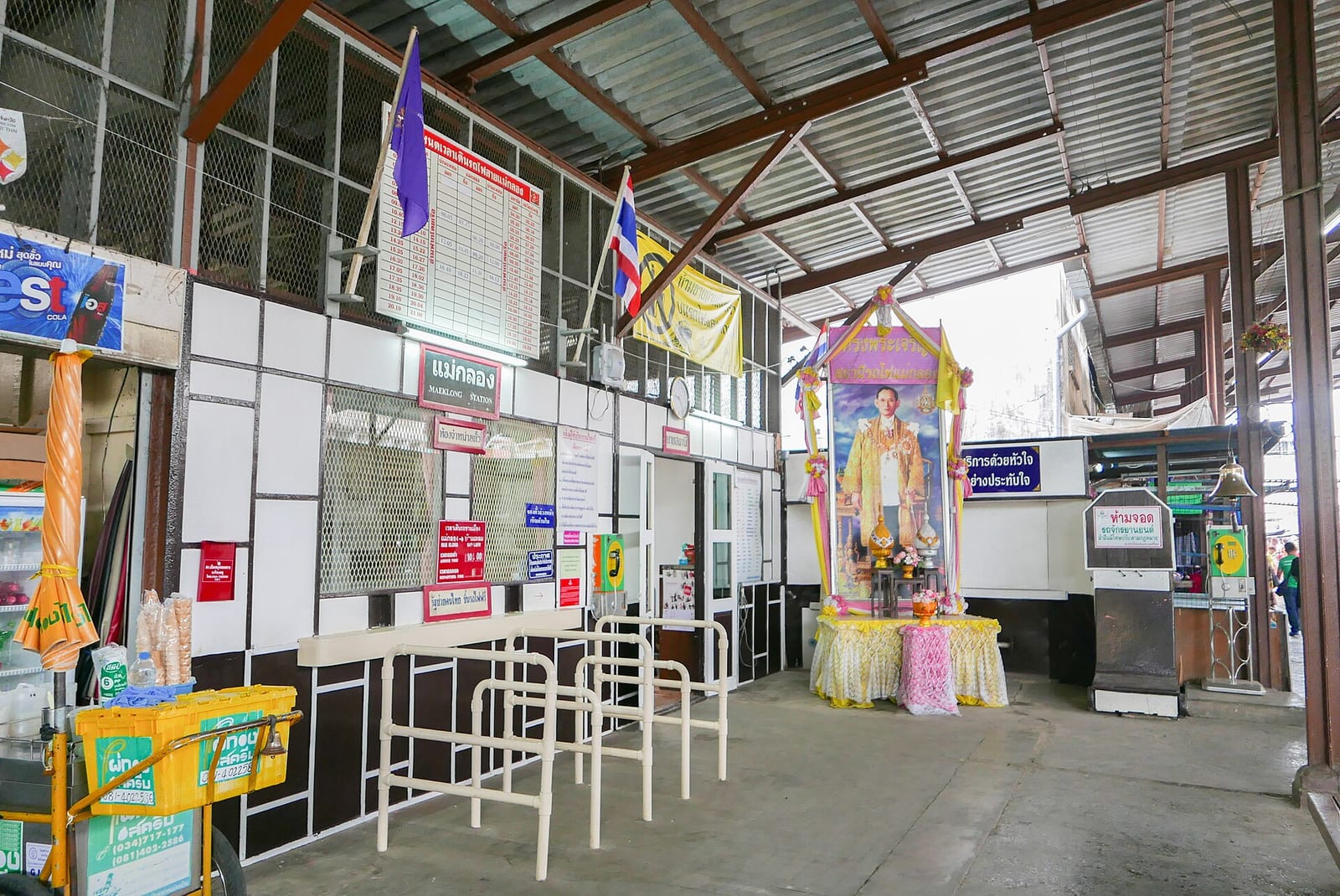
The Maeklong line has never been joined up. The Tha Chin river splits it in two — the Mahachai Line on one bank, the Ban Laem Line on the other — and in over a century nobody has bridged it. You get off, take a ferry, and get on another train.Codas / Wikimedia Commons · CC BY-SA 4.0Thirty-one kilometres an hour
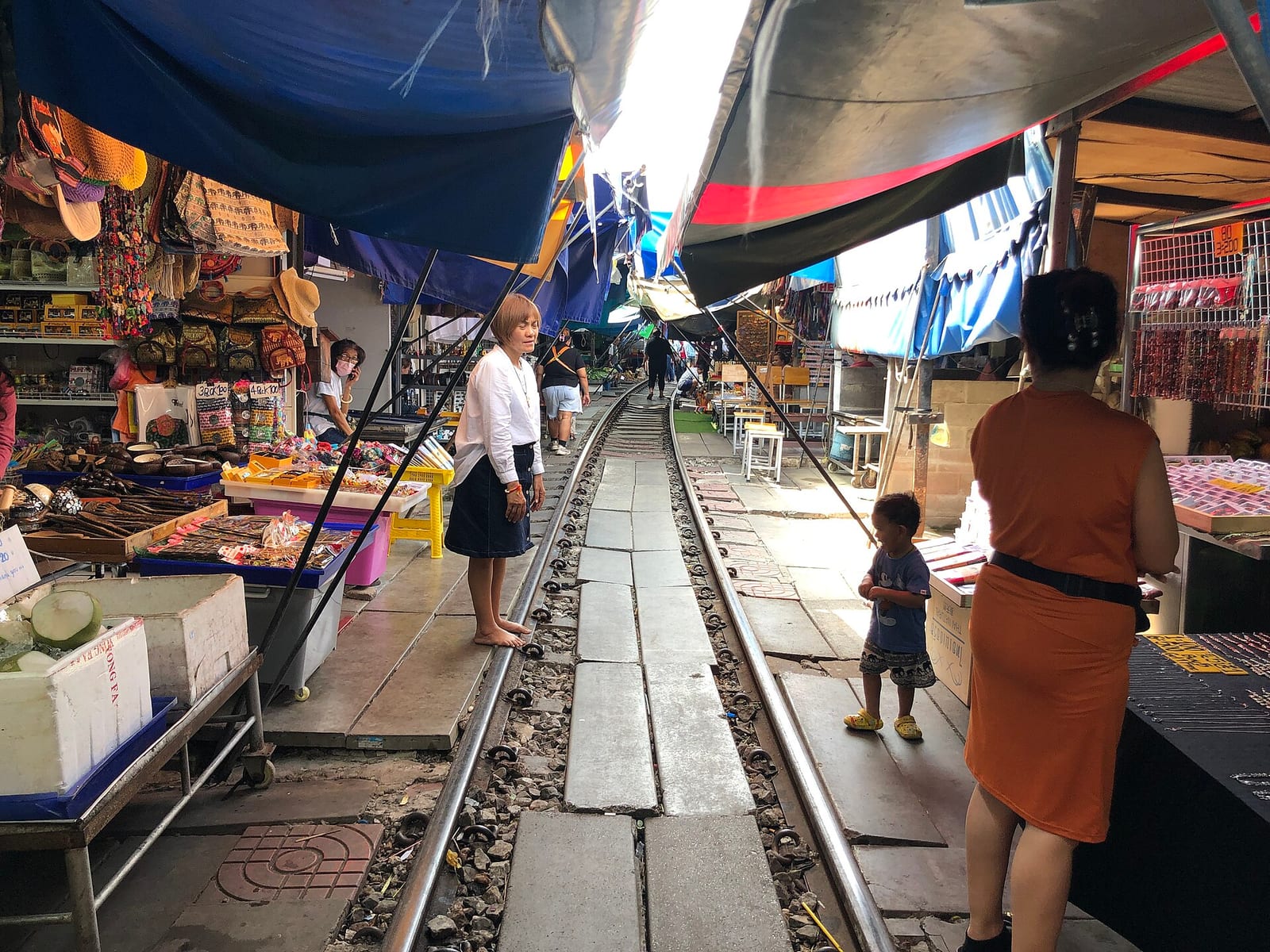
This is not a train in a hurry. Its top speed is 31 km/h, and much of the time it goes slower — through backyards, past kitchen windows, over klongs, along an aisle of fish and mangoes. Half a day for 65 km, and worth every minute.A bit of history
Culture & experiences along the way
Codas / Wikimedia Commons · CC BY-SA 4.0Watch it from the market
The trick is to see it from both sides. Stand in the market as the train comes through — the awnings coming down around you is the memory — and then ride it out again and watch the stalls close over the rails behind you.calflier001 / Wikimedia Commons · CC BY-SA 2.0The Mahachai ferry
The break in the line is a feature. You cross the Tha Chin on a longtail among the fishing boats at Mahachai, one of Thailand's biggest seafood ports, with the catch coming ashore around you.Asacyan / Wikimedia Commons · CC BY-SA 4.0Amphawa's floating market
Maeklong is minutes from Amphawa, whose canal-side market runs on Friday to Sunday afternoons — boats cooking prawns to order, and after dark, longtails out to watch the fireflies in the mangroves.Timetables
The Maeklong Railway is two separate State Railway of Thailand local lines that happen to share a name — and the timetable is the thing that makes or breaks the day, because the umbrella-market spectacle happens only when a train is actually due.
Real times (2026 — confirm before travelling):
- Mahachai Line (Wongwian Yai ⇄ Mahachai): trains roughly every hour, first from Wongwian Yai at 05:30; the run takes about 1 hour; 10 baht.
- Cross the Tha Chin by ferry at Mahachai/Ban Laem — there is no bridge.
- Ban Laem Line (Ban Laem ⇄ Mae Klong): only four trains a day, departing Ban Laem at 07:30, 10:10, 13:30 and 16:40; ~1 hour; 10 baht.
- The market pull-downs at Mae Klong (Talat Rom Hup) happen as trains arrive and depart — roughly 08:30, 11:10, 14:30 and 17:40 for arrivals (and around 06:20, 09:00, 11:30 and 15:30 as they leave). Build your day around one of these.
Good to know:
- The Ban Laem line has only a handful of services — miss one and you wait a long time; plan this half first.
- The ferry isn't optional — there is no through train; boats run constantly across the Tha Chin.
- Get there early for a spot — the market is packed around the popular midday train; an earlier or later working feels far more like the real thing.
- Stand where the traders tell you — they do this several times a day and know exactly where the train's mirrors sweep.
Times as of the 2026 timetable. Confirm current schedules with the operator — see the Tickets section below.
Tickets
There is nothing to book. Tickets are sold at the station for a handful of baht by the State Railway of Thailand, and the whole line — both halves and the ferry — costs less than a sandwich. Buy each leg separately, because there is no through ticket: there is no through railway. Ban Laem to Maeklong is the market section and the one to do if you only do one; Wongwian Yai to Mahachai is the Bangkok half, out through suburbs and salt flats to the fishing port, with the ferry across the Tha Chin between them.
Bring small notes, both for the halts and for the market, which is a working fresh market with excellent and absurdly cheap food. And be a decent guest: these are people's livelihoods, not a theme park. Do not move produce for a photograph, do not stand where you are in the way, and buy something.
Book your tickets
Ban Laem ⇄ Maeklong
The market section
The short line that runs through Talat Rom Hup — the reason to come. A handful of services a day, a few baht, and the most extraordinary approach to any terminus in the world. Buy at the station.
Book Tickets (opens in a new tab, on State Railway of Thailand)via State Railway of ThailandWongwian Yai ⇄ Mahachai
The Bangkok section
The other half of the line, running from Wongwian Yai in Bangkok out through the suburbs and salt flats to the fishing port of Mahachai. Ride it, take the ferry, then pick up the Ban Laem train to complete the whole thing.
Book Tickets (opens in a new tab, on State Railway of Thailand)via State Railway of ThailandRail Passes
No rail pass is needed or worth buying. Interrail and Eurail are European schemes, and Thailand is not among the 33 countries in Interrail's list of covered railway companies. Each leg of the Maeklong line is bought at the station for a handful of baht.
Checked October 2026 against Interrail's list of railway companies (opens in a new tab).
Places to Visit
The line is short, and the pleasure of it is how ordinary most of it is — right up until it isn't. Talat Rom Hup, the market laid out on the running rails, is what everybody comes for, and it earns the trip; stay for at least two trains, one from the carriage and one from the kerb. But the stretches either side of it — salt pans, fishing quays, canal villages — are what turn a photo stop into a day.
Maeklong itself is a likeable provincial town at the mouth of the river, with a good night market and none of the self-consciousness of the tourist circuit.
 Supanut Arunoprayote / Wikimedia Commons · CC BY 4.0 · cropped
Amphawa
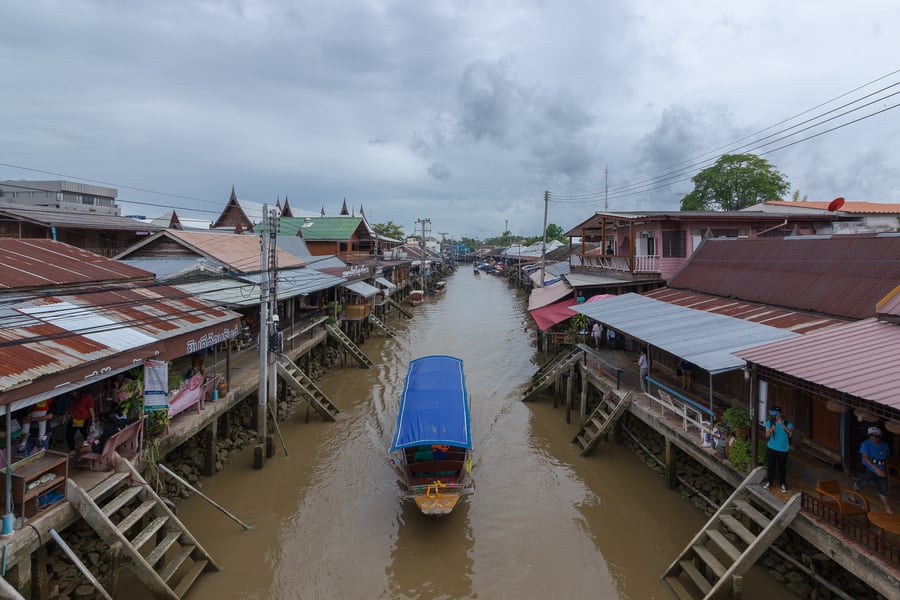
Fifteen minutes from Maeklong, and the best floating market in Thailand for anyone who finds Damnoen Saduak too staged. It runs Friday to Sunday afternoons, with boats grilling prawns and squid to order along the canal and the whole thing packing up by mid-evening. After dark, longtails run out to the mangroves to watch the fireflies in the trees — which is the better half of the visit.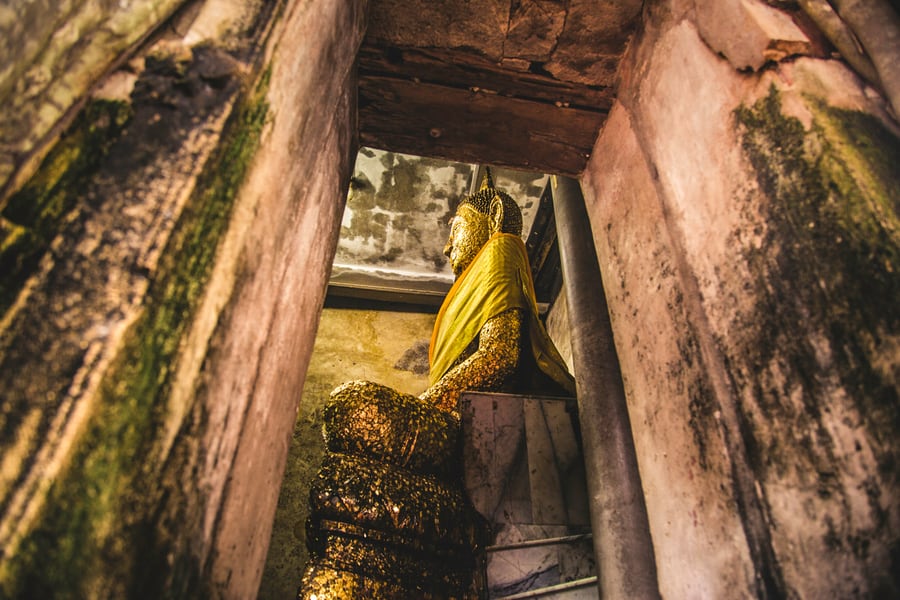 Chanida pholsen / Wikimedia Commons · CC BY-SA 4.0 · cropped
Wat Bang Kung
Near Amphawa, and one of the strangest things in the region: a small brick chapel completely swallowed by the roots of a banyan, which have closed over the walls and roof like a net until the building is more tree than temple. The Buddha image sits in the dark at the middle of it. Free, quiet, five minutes to see, and worth the detour from the canal.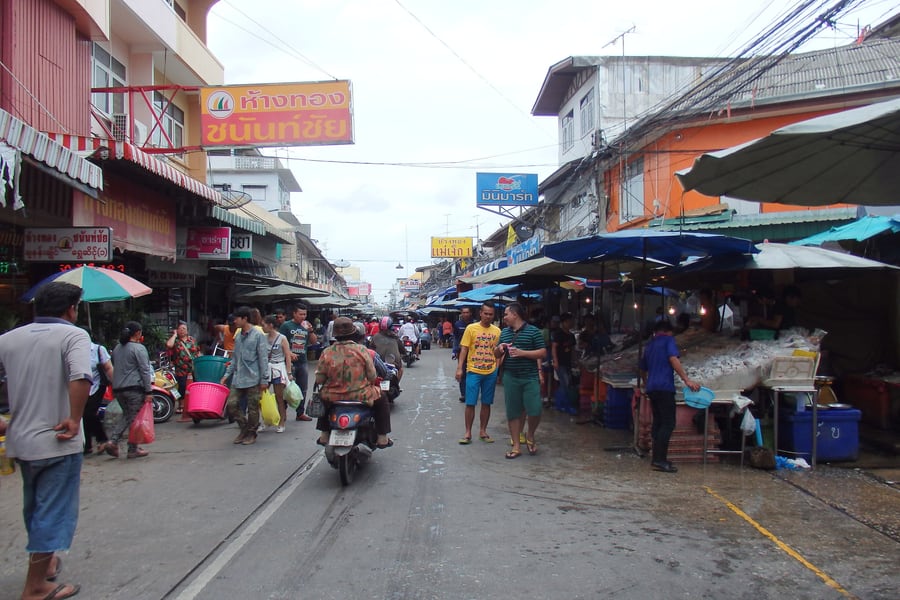 mohigan / Wikimedia Commons · CC BY-SA 3.0 · cropped
Mahachai
The fishing port at the gap in the railway, where you get off, cross the river by ferry and pick up the second half. That sounds like an inconvenience and is in fact the best part of the day: the quay carries an enormous seafood market, chaotic and cheap, and it is one of the finest places in Thailand to eat lunch while you wait for a boat.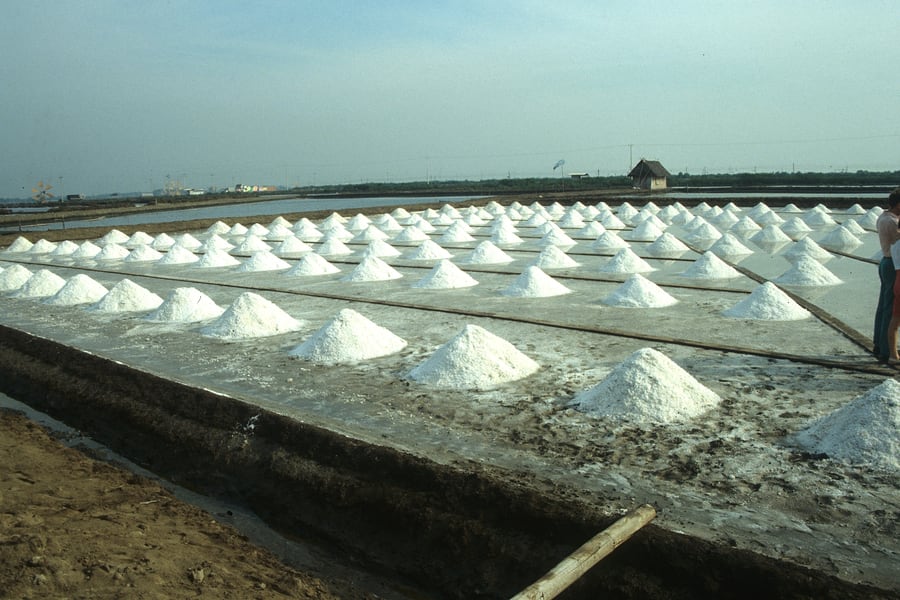 Dagmar Hollmann / Wikimedia Commons · CC BY-SA 3.0 · cropped
The salt flats
Between Bangkok and Mahachai the line runs through shallow evaporation pans worked by hand — seawater led in, left to dry, then raked into the conical white heaps you see from the carriage. There are wooden windmills standing among them. Late in the afternoon the pans go to mirror, and this becomes the quietest pleasure of the whole route.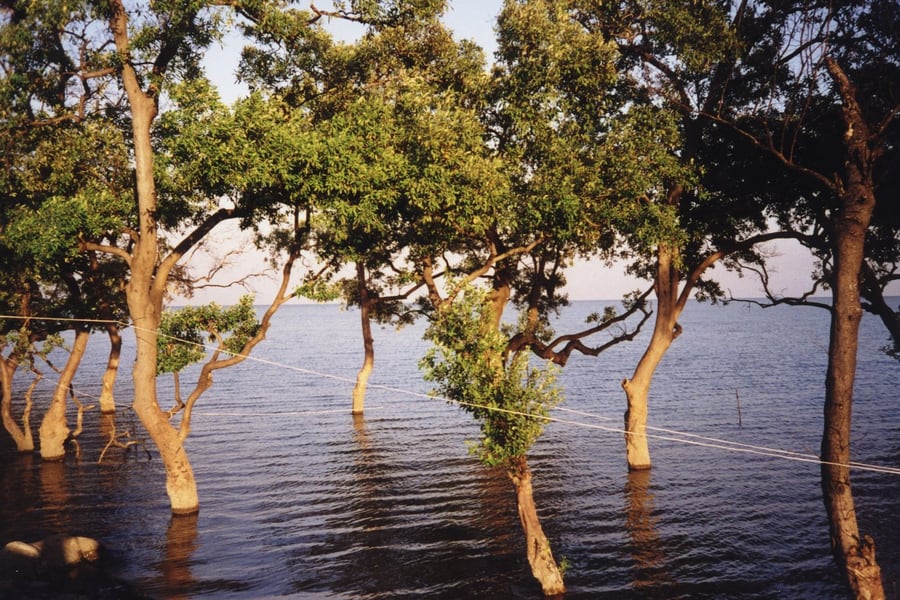 Ahoerstemeier / Wikimedia Commons · CC BY-SA 3.0 · cropped
Don Hoi Lot
The sandbar at the mouth of the Mae Klong, famous for razor clams and reached by road or boat from town. It is a Thai weekend institution rather than a foreign one — seafood shacks, families, and a stand of trees left standing out in the shallow water. Come at low tide, when the bar is actually exposed; at high water there is not a great deal to see.Where to Sleep
Most people do the Maeklong line as a day trip from Bangkok, and that works perfectly well — but staying a night turns a sightseeing stop into something better.
- Amphawa — the obvious choice, and a lovely one: wooden guesthouses on stilts along the canal, with boats passing under the window. Come on a Friday or Saturday for the floating market and the fireflies, and stay the night so you're there when the day-trippers leave. Book ahead for weekends — it's popular with Bangkok Thais, which is the best recommendation there is.
- Maeklong (Samut Songkhram) — modest hotels and guesthouses in the town itself, and the advantage of being able to walk to the market for the first train of the day, before the crowds arrive. If you want the market at its most real, sleep here.
- Bangkok — if you're day-tripping, stay anywhere with easy access to Wongwian Yai in Thonburi, which is where the line starts. The BTS reaches it.
- Along the river — a scattering of small resorts and homestays around the Maeklong estuary, quiet and green, good if you're pairing this with Don Hoi Lot or the mangroves.
Timing: November to February is the cool, dry season and the pleasant one. The market runs regardless of weather — it just gets wetter, and the awnings work harder. Weekends bring the Amphawa crowds; a weekday market visit is calmer, though you lose the floating market.
Questions or corrections
Planning this trip and stuck on something, or spotted a time, fare or detail that has changed? Send us a message about Maeklong Railway. We read every one, and we update this page when something has changed.