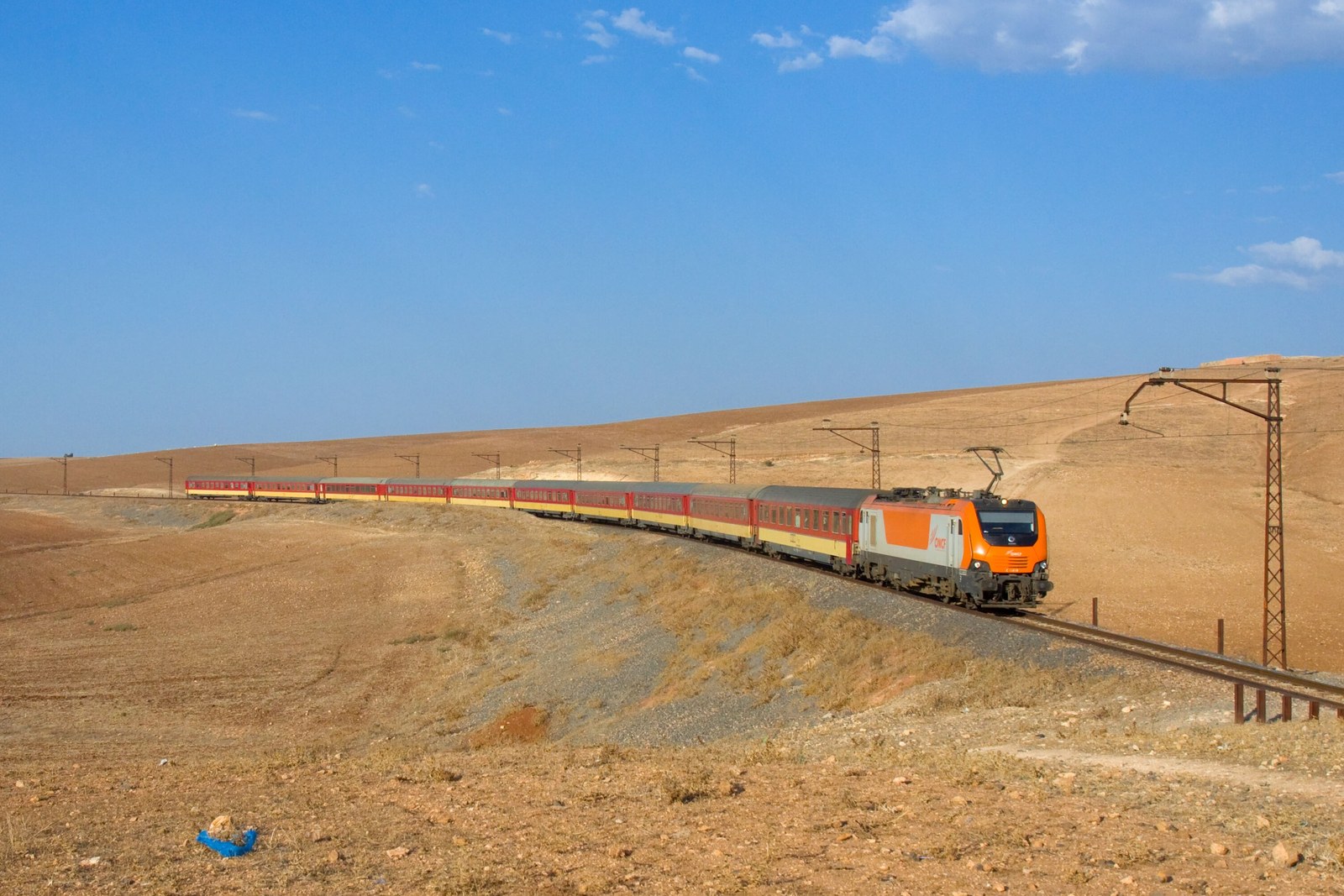
The Marrakech Express
Kabelleger / David Gubler / Wikimedia Commons · CC BY-SA 3.0 · cropped
- DistanceCasablanca–Marrakech · about 240 km (150 miles)
- DurationAbout 3 hours
- Best seasonOctober–April (Marrakech is very hot in summer)
Introduction
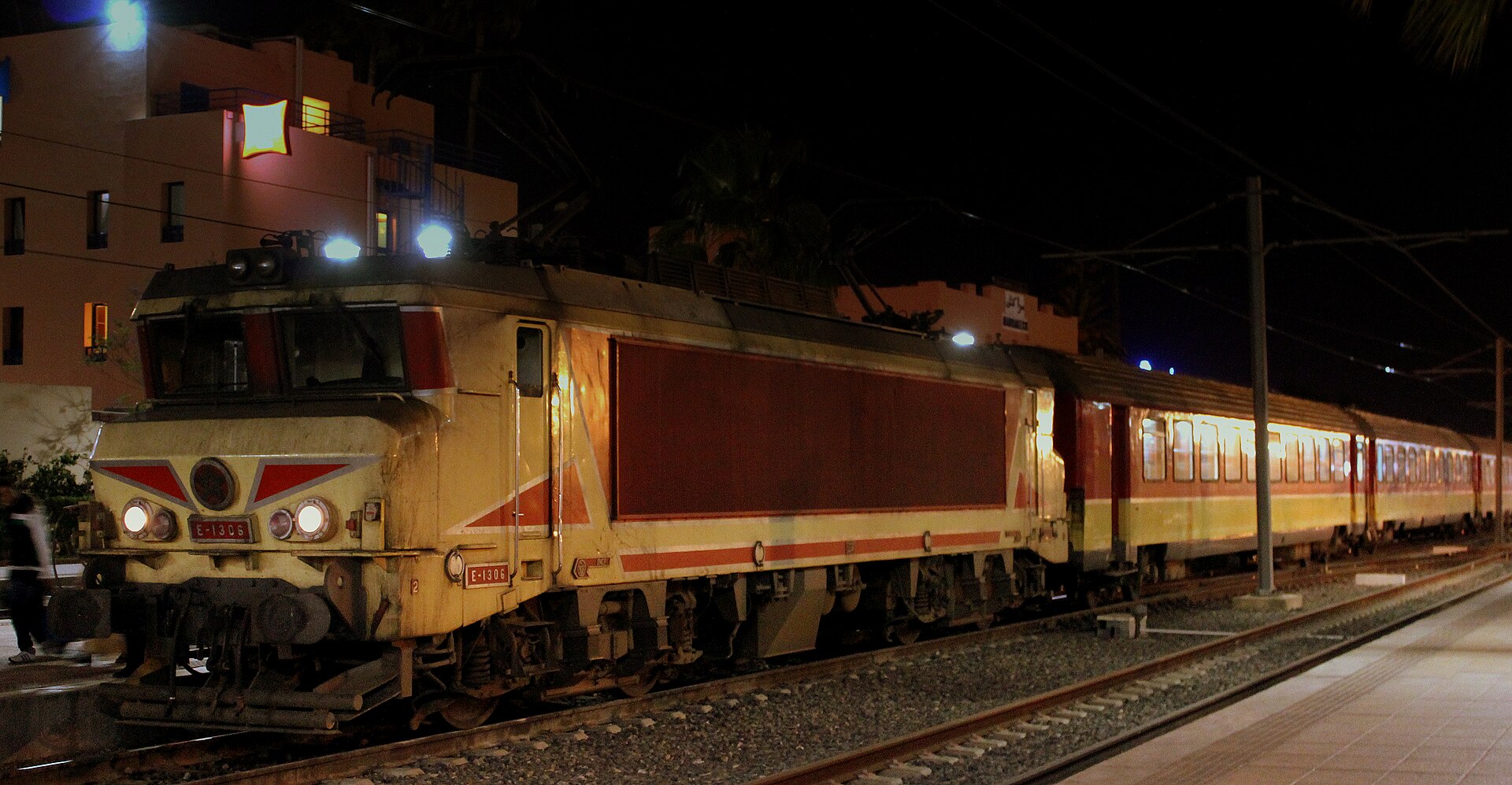
Everyone knows the song. Fewer people know that the Marrakech Express is a real train — and that you can still ride it. In 1966 a young Graham Nash took the train south from Casablanca to Marrakech, grew bored of his stuffy first-class compartment, and went to sit further down the train among the traders and the "ducks and pigs and chickens." Out of that ride came a song, rejected by his old band The Hollies and taken up by his new one; in 1969 "Marrakesh Express" became Crosby, Stills & Nash's very first single.
The train is still there. Today it is one of ONCF's Al Atlas intercity services, running the roughly 240 kilometres from Casablanca down across the plains to Marrakech in about three hours — comfortable, frequent and cheap, and every bit as full of everyday Moroccan life as it was when Nash rode it. If you're coming from the north, Al Boraq, Africa's high-speed train, whisks you to Casablanca first, and the Al Atlas takes over from there.
What waits at the end is one of the great cities of the world: Marrakech, the Red City, its ochre walls at the foot of the snow-topped High Atlas, its heart the roaring square of the Jemaa el-Fna. The train sets you down in a station like a palace, a few minutes from the medina — the perfect slow arrival at a place that rewards taking your time.
The Journey
The journey begins at Casa-Voyageurs in Casablanca — now also the southern terminus of the Al Boraq high-speed line, so many travellers arrive here off the bullet train from Tangier and simply change platforms. The Al Atlas intercity train pulls out through the sprawl of Morocco's largest city and settles onto the main line south.
Beyond the suburbs the country opens into the plains — the wide, dry farmland of the Moroccan interior, dotted with olive groves, flocks of sheep and low ochre villages. The train calls at Settat, deep in the cereal country, and at Benguerir, and the land grows steadily browner and emptier as it climbs almost imperceptibly towards the south. This is the stretch Graham Nash rode: an ordinary train, full of families and traders and their bundles, the landscape rolling by the big windows.
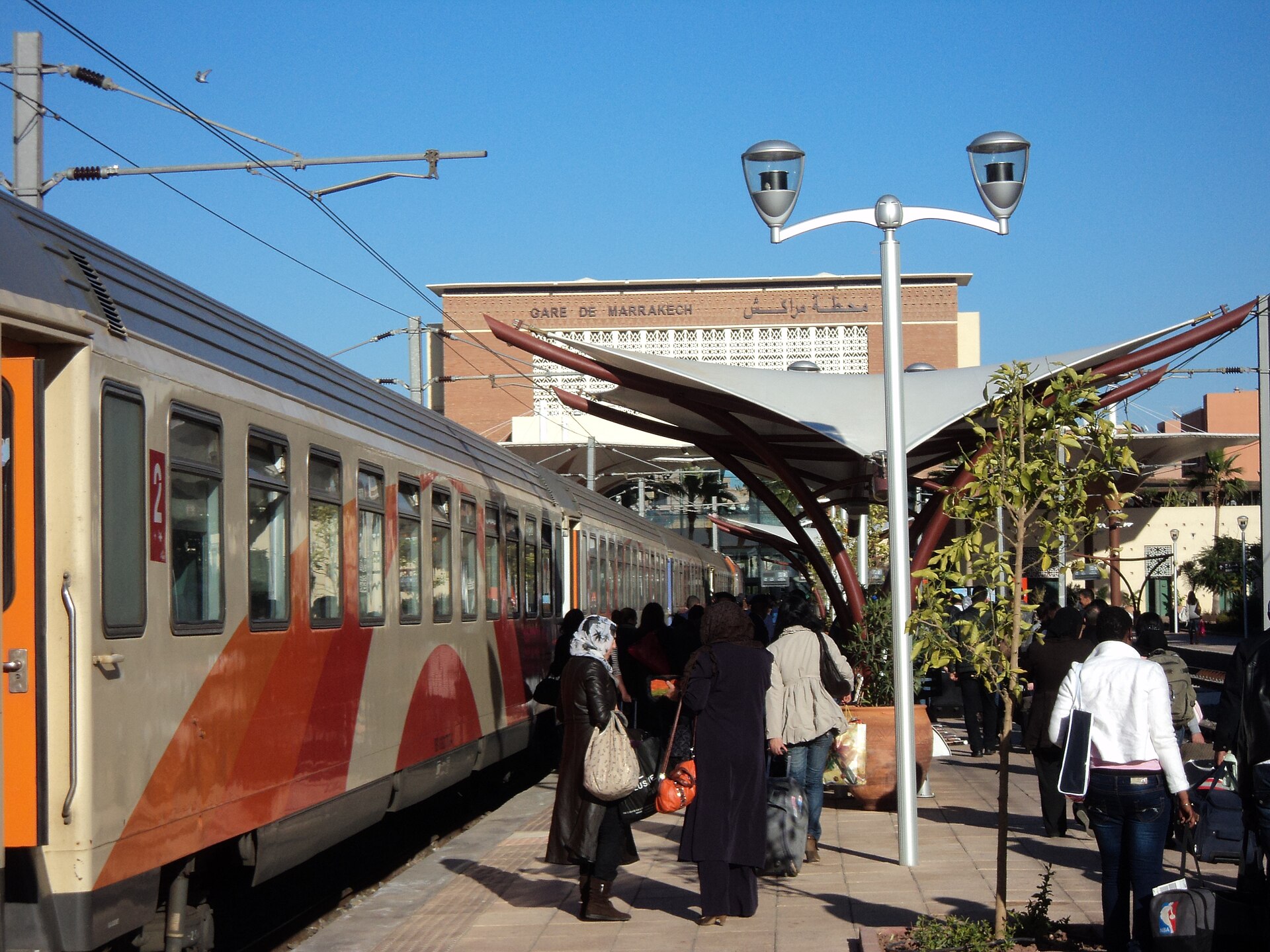
Then, ahead, the horizon changes. The plains run up against a long wall of mountains — the High Atlas, snow-topped well into spring, rising behind the city to Jbel Toubkal, the highest peak in North Africa. Beneath them, the rose-red walls of Marrakech appear, and the train draws in beneath the keyhole arches and carved palm-leaf pillars of Gare de Marrakech — one of the handsomest stations on the continent.
A few things worth knowing about the run:
- It is an ONCF Al Atlas intercity service — no train is officially called the "Marrakech Express"; the name belongs to the song.
- Casablanca to Marrakech is about 240 km and takes around three hours, with up to ten trains a day.
- Trains have first and second class; through services also run from Rabat and Tangier.
- From Casablanca you can connect straight off Al Boraq, making the whole north-to-south trip in a day.
Break the journey if you can: a night in Casablanca for the great mosque on the Atlantic, then the slow run down to Marrakech, arriving as the light turns the walls red and the Jemaa el-Fna comes to life.
Along the route
Alexdevil / Wikimedia Commons · CC BY-SA 3.0The real Marrakesh Express
The song is not a metaphor — there really is a train down to Marrakech, and Graham Nash rode it. He wrote it after a 1966 trip from Casablanca, having fled a stuffy first-class compartment to sit with the ducks and pigs and chickens further down the train.procsilas / Wikimedia Commons · CC BY 2.0Arrival at the Red City
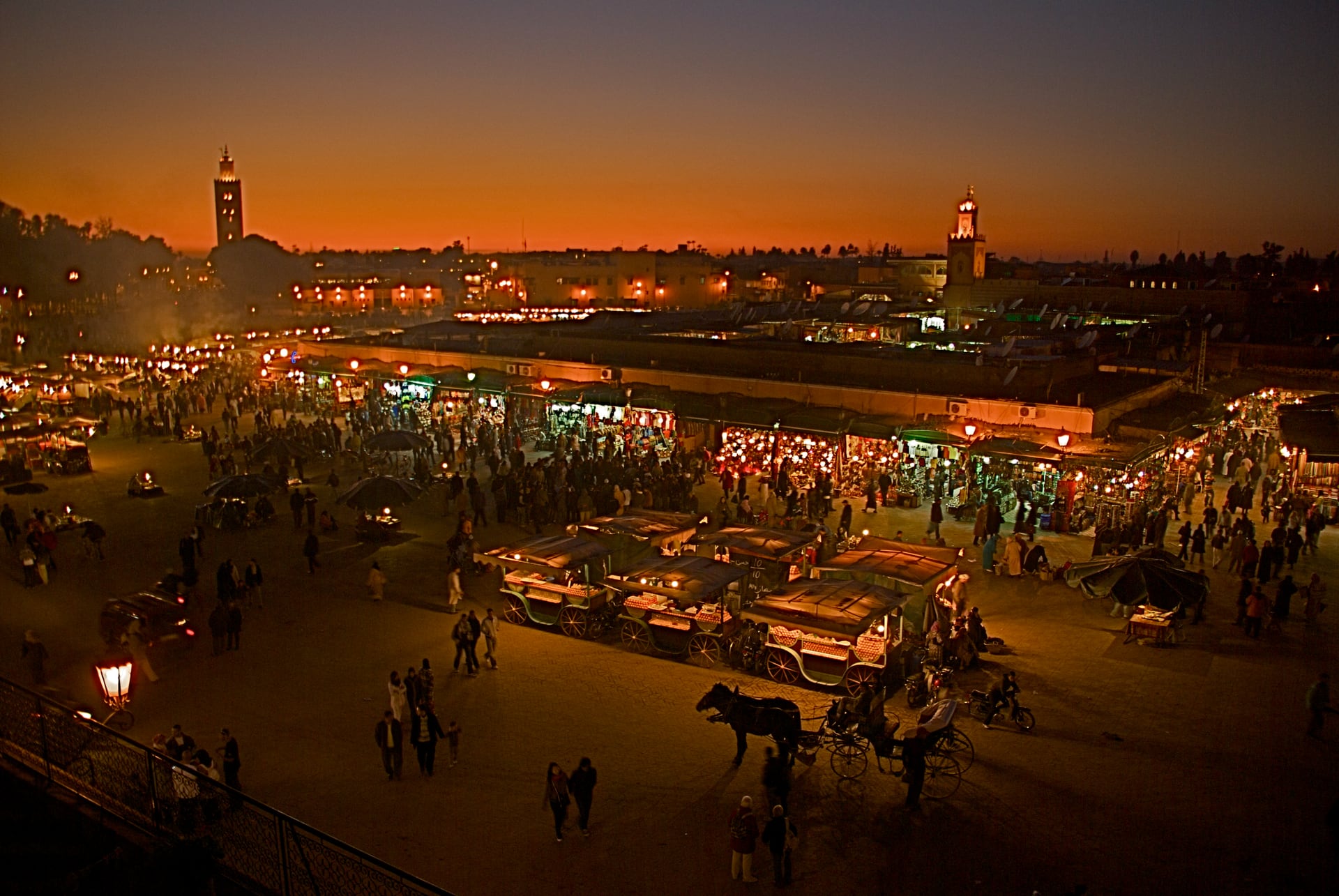
Marrakech is the great prize at the end of the line — a thousand-year-old imperial city of rose-red walls, its heart the vast square of the Jemaa el-Fna, where snake-charmers, storytellers and food stalls fill the evening under the Koutoubia minaret.Zahra IMEHLI / Wikimedia Commons · CC BY-SA 4.0The High Atlas on the skyline
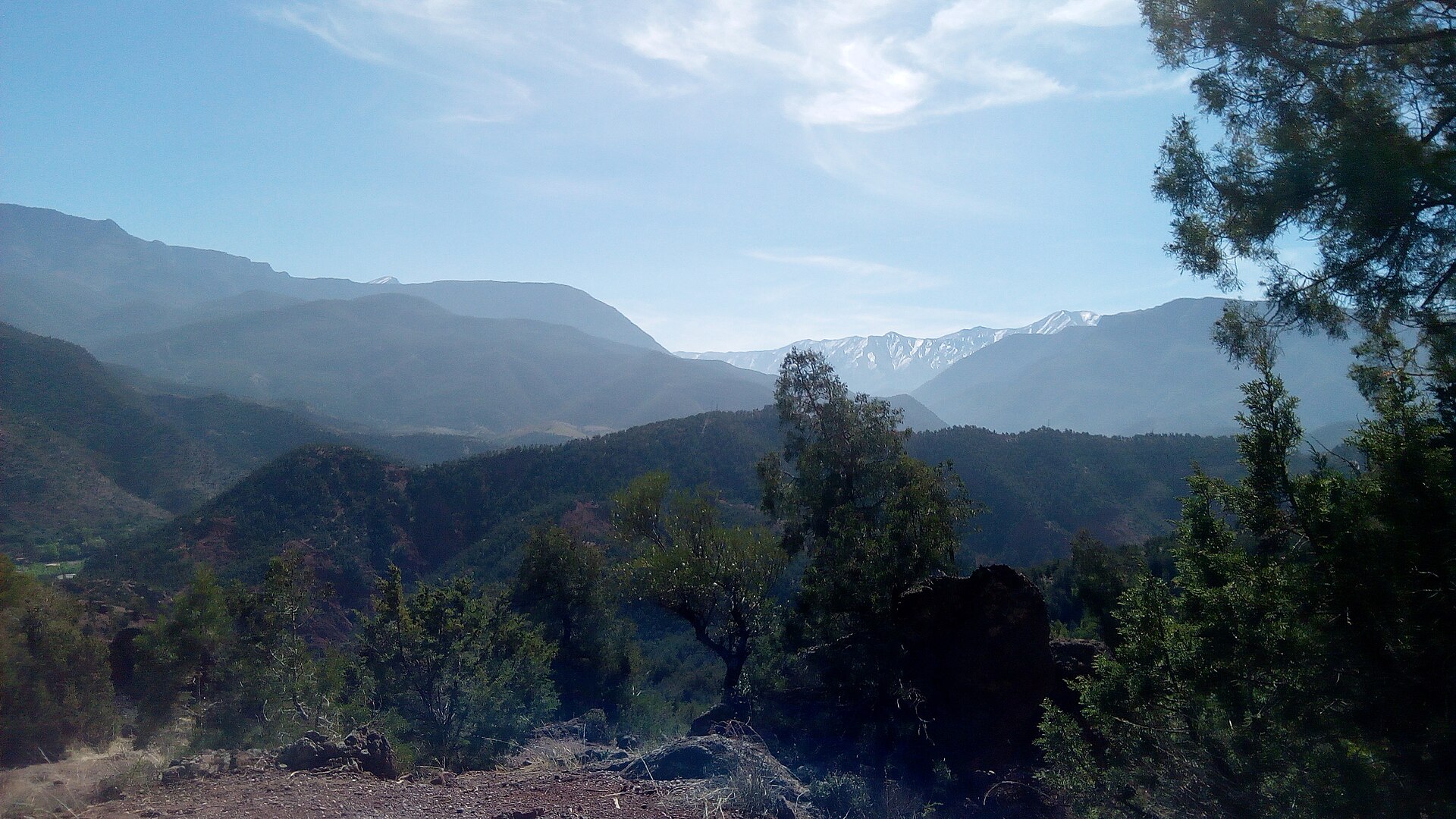
As the train nears Marrakech the plains run up against a wall of mountains: the High Atlas, snow-capped well into spring and rising to the highest peak in North Africa. The city sits right at their foot.A bit of history
Culture & experiences along the way
Alzemmouri abderrahmane / Wikimedia Commons · CC BY-SA 4.0Aboard the Al Atlas
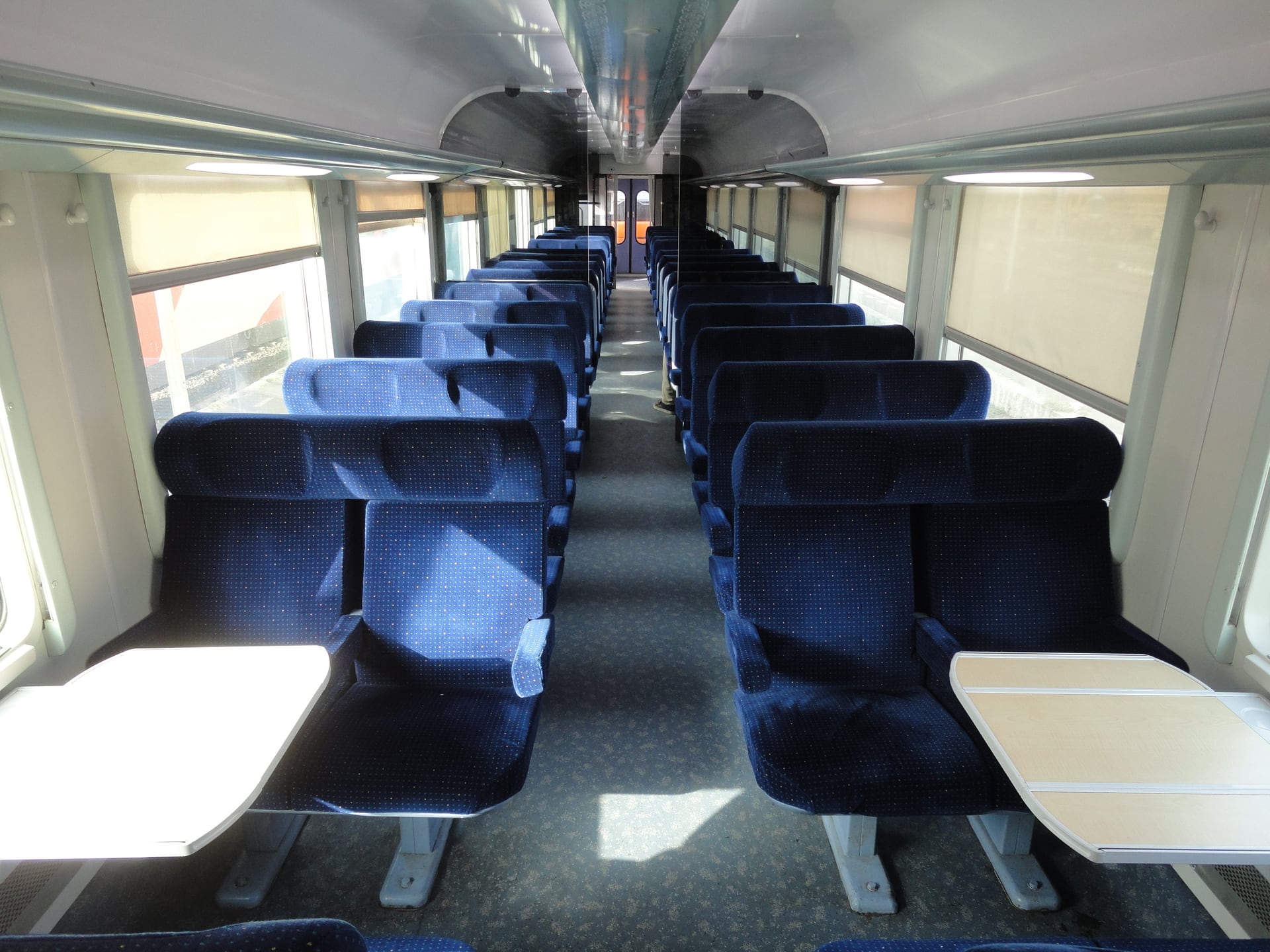
The train is one of ONCF's Al Atlas intercity services, in first or second class — an easy, comfortable three hours down from the coast, with a trolley and big windows on the passing plains. It is nothing exotic, and that is the charm: an ordinary Moroccan train full of ordinary Moroccan life, exactly as Nash found it.Val Traveler / Wikimedia Commons · CC BY-SA 4.0A palace in the medina
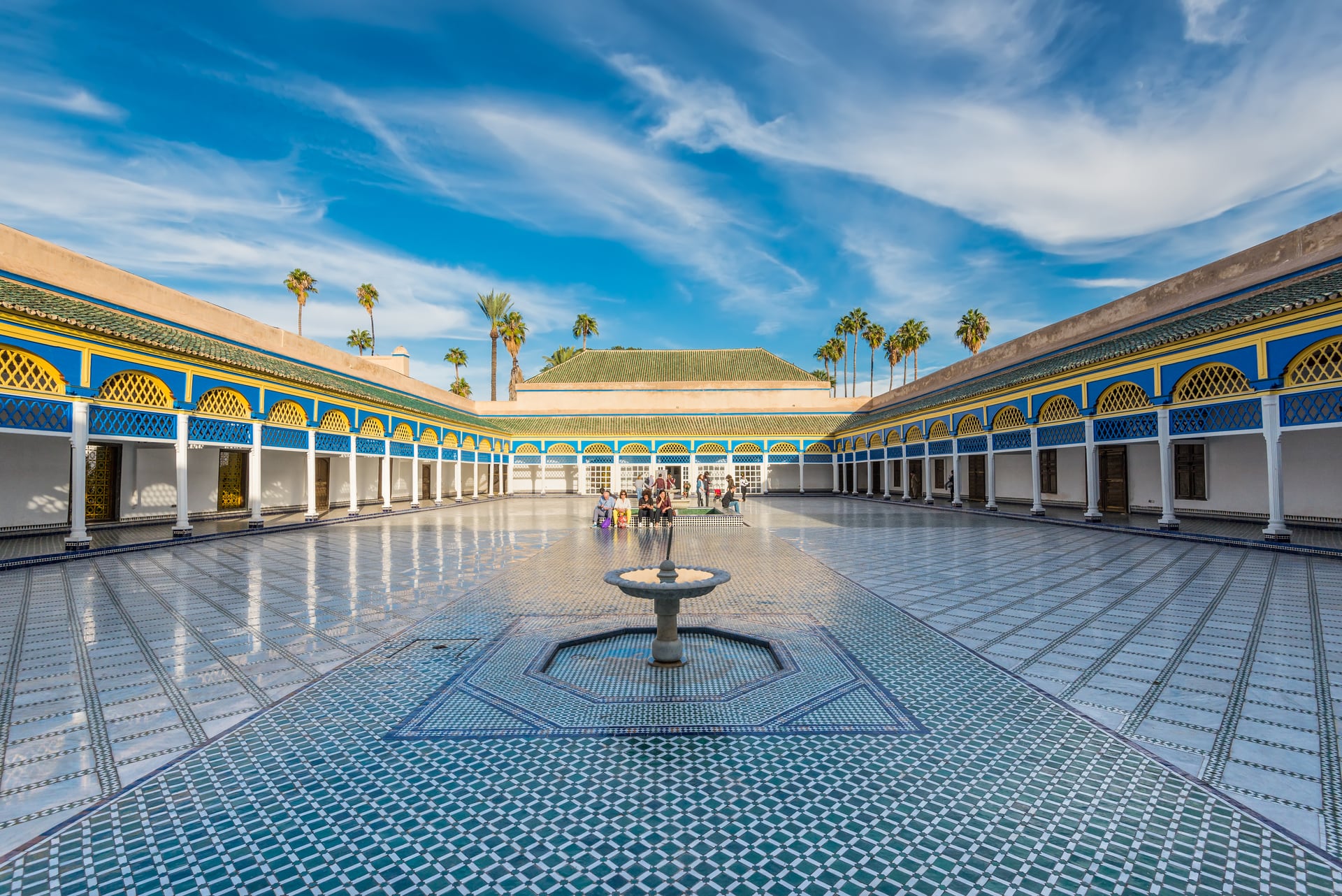
For the full weight of Moroccan craft, walk into the Bahia Palace. Begun in the 1860s for the grand vizier Si Musa and enlarged by his son Ba Ahmed, who ruled Morocco in all but name until his death in 1900, its great courtyard runs 50 metres by 30, paved in Italian Carrara marble in 1896 and ringed by a painted wooden gallery and some eighty rooms.Mike Prince / Wikimedia Commons · CC BY 2.0Souks, tombs and minarets
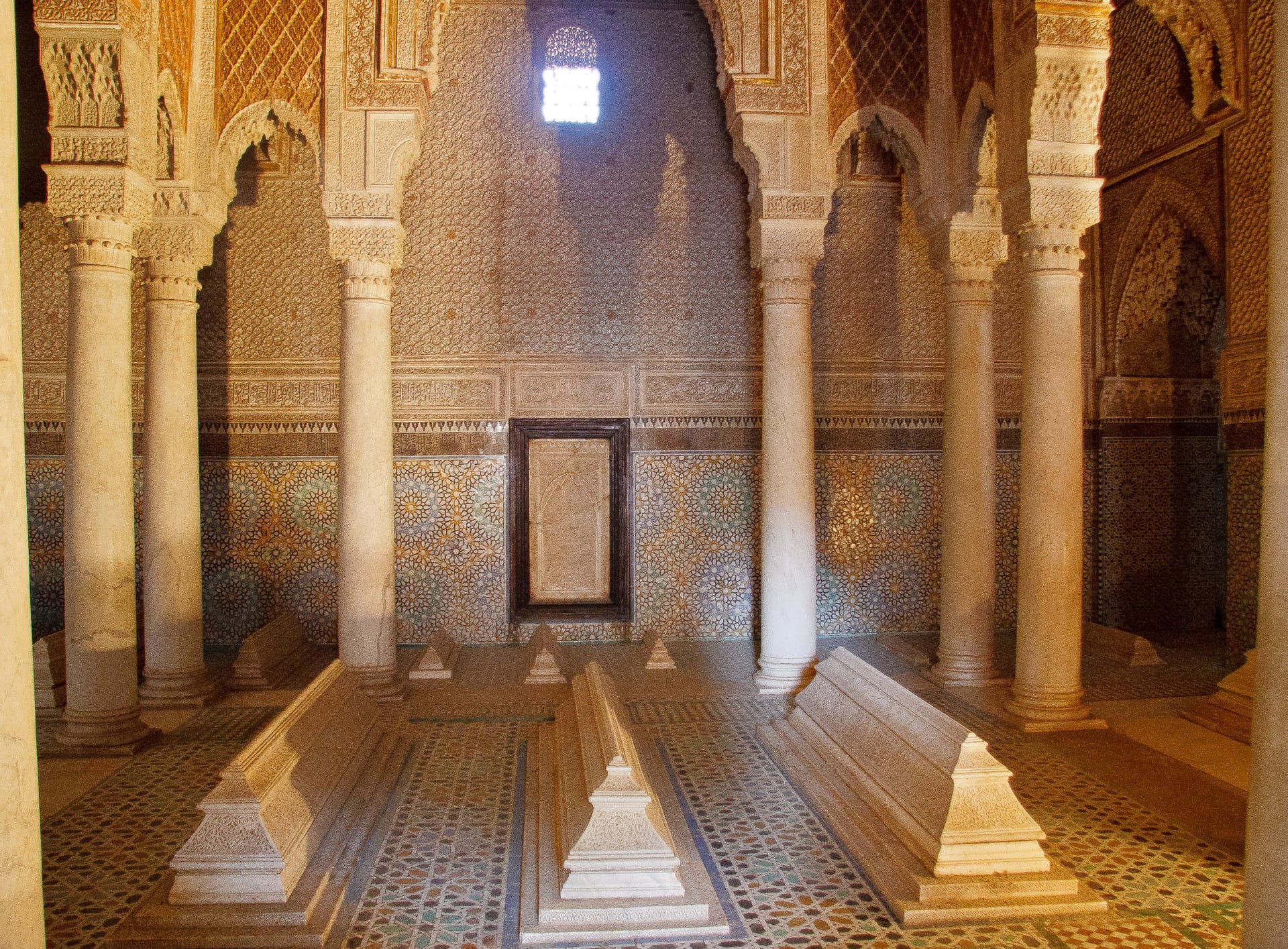
Beyond the square, Marrakech unfolds: the labyrinth of the souks, the Koutoubia with its perfect minaret, and the Saadian Tombs, where Ahmad al-Mansur was buried under a ceiling of cedar among twelve columns of Carrara marble. Sealed off by a later sultan, the necropolis was lost until 1917. Days disappear here.Timetables
The Casablanca–Marrakech line is one of ONCF's busiest: Al Atlas trains leave Casa-Voyageurs about every two hours from around 06:00 to the evening (10 or more a day), so you rarely wait long for a departure.
The journey takes about 2 hours 40 minutes, covering roughly 240 km from Casa-Voyageurs to Marrakech, calling at Settat and Benguerir on the way. Many services start further up the line at Rabat, and some run through from Tangier, so the exact timing depends on where your train began.
If you are coming down from the north on Al Boraq, ride the high-speed train to Casa-Voyageurs and change there onto the next Al Atlas for Marrakech; the two lines meet at the same station and connections are frequent.
Al Atlas trains carry first and second class, both with reserved seating, so in the high season (autumn to spring, when Marrakech is at its best) it is worth booking a day or two ahead. Note the timetable shifts during Ramadan. Summer is quieter on the train but fierce in Marrakech, where temperatures regularly top 40°C — most travellers come between October and April.
Frequency and journey time as of the 2026 timetable. Confirm current times and fares with the operator — see the Tickets section below.
Tickets
The train is run by ONCF, Morocco's national railway, and tickets are easy to arrange:
- Online, at ONCF's booking site oncf-voyages.ma (opens in a new tab), which has an English option and issues e-tickets to your phone.
- At the station, from the windows or machines at Casa-Voyageurs, Marrakech and the intermediate stops.
- Through a booking agent, several of which resell ONCF tickets in English for a small mark-up.
There are two classes — first (première) and second (deuxième). First class has wider, reserved seats in a quieter, air-conditioned car and is well worth the small premium on the three-hour run; second class is comfortable and excellent value. On the busy Al Atlas services seats are reserved, so book ahead in the autumn-to-spring high season.
Fares are inexpensive by international standards and shift a little with demand, so we don't quote a figure here — follow the links in the ticket cards above for current prices from ONCF. If you're travelling the length of the country, you can usually book Al Boraq to Casablanca and the Al Atlas onward to Marrakech in one transaction on the same site.
Book your tickets
Al Atlas · Casablanca to Marrakech
First & second class intercity
ONCF's Al Atlas intercity train down to Marrakech, from Casa-Voyageurs in about three hours, in first or second class. Up to ten a day; book online or at the station.
Book Tickets (opens in a new tab, on ONCF)via ONCFFrom Tangier via Al Boraq
High-speed connection to the north
Coming from the north? Take Al Boraq, Africa's high-speed train, from Tangier to Casablanca in about two hours, then change onto the Al Atlas for Marrakech — the whole length of Morocco by rail in a day. One operator, one booking site.
Book Tickets (opens in a new tab, on ONCF)via ONCFRail Passes
No rail pass covers this journey. Interrail and Eurail are European schemes, and Morocco is not among the 33 countries in Interrail's list of covered railway companies (opens in a new tab). ONCF sells each journey as a ticket, online, at the station or through agents.
Checked October 2026 against Interrail's list of covered railway companies (opens in a new tab).
Places to Visit
The reward at the end of the line is Marrakech itself — but the run down from the coast also gives you an easy excuse to see Casablanca first.
Marrakech, the Red City, is one of Morocco's four imperial capitals and the country's great magnet for travellers. Its heart is the Jemaa el-Fna, the vast square that fills each evening with orange-juice carts, snake-charmers, musicians, storytellers and clouds of grilled-meat smoke — a spectacle UNESCO lists as a "Masterpiece of Oral and Intangible Heritage." Around it spread the souks, a labyrinth of alleys selling lanterns, leather, carpets and spices. The perfect minaret of the 12th-century Koutoubia Mosque presides over the medina; the Bahia Palace, the Saadian Tombs and the ruined El Badi Palace recall the city's dynasties; and in the new town the cobalt-blue Jardin Majorelle — the painter's garden later saved by Yves Saint Laurent — is a cool green refuge. Beyond the walls, the High Atlas is close enough for a day trip to a Berber village or the Ourika Valley.
Casablanca, where the line begins, is worth a stop for the colossal Hassan II Mosque, one of the largest in the world, whose minaret rises straight out of the Atlantic; for the Art Deco architecture of the old French quarter; and for the seafront Corniche.
Between the two, the plains and market towns the train crosses — Settat, Benguerir — are working agricultural Morocco rather than sights, but they set the scene: the long, dry approach that makes the first glimpse of the Atlas, and of Marrakech beneath it, so striking.
 DimiTalen / Wikimedia Commons · CC0 · cropped
The souks
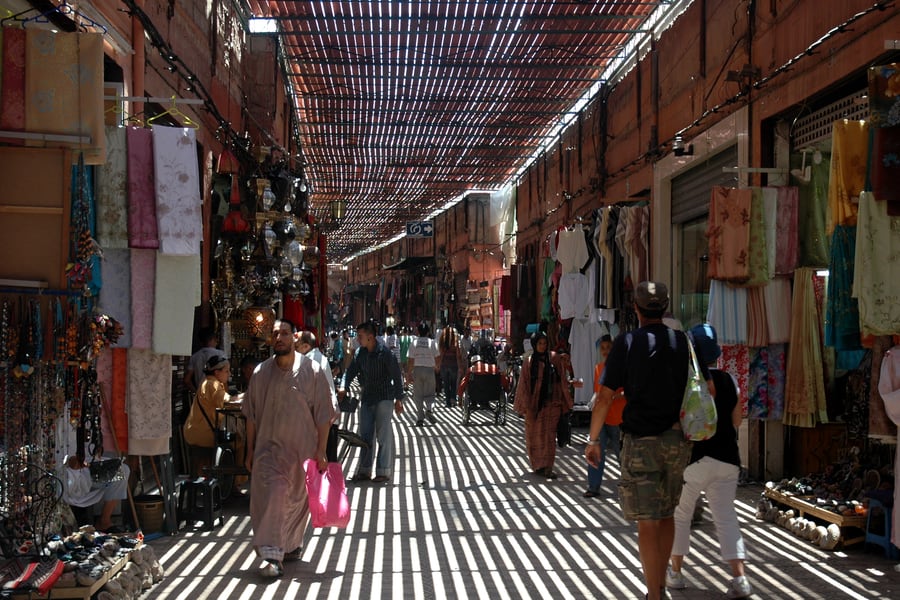
North of the great square the alleys close over your head and turn into the souks — a graded labyrinth still organised by trade, with whole lanes given over to slippers, lanterns, dyed wool, leather or spices. Souk Semmarine is the widest of them and the usual way in. The light falls through the slatted roofs in stripes, which is the thing most people remember long after the haggling.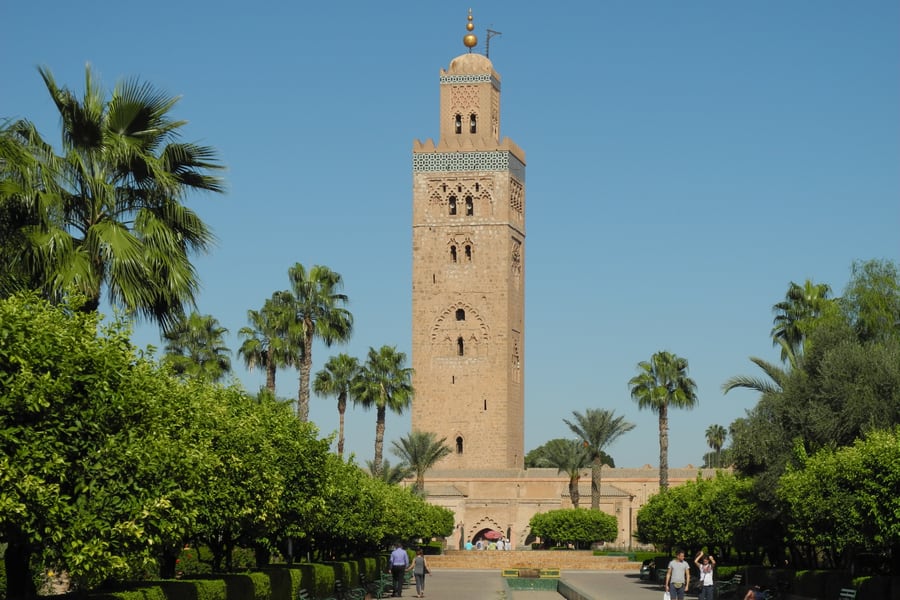 Baca12 / Wikimedia Commons · CC BY-SA 4.0 · cropped
The Koutoubia
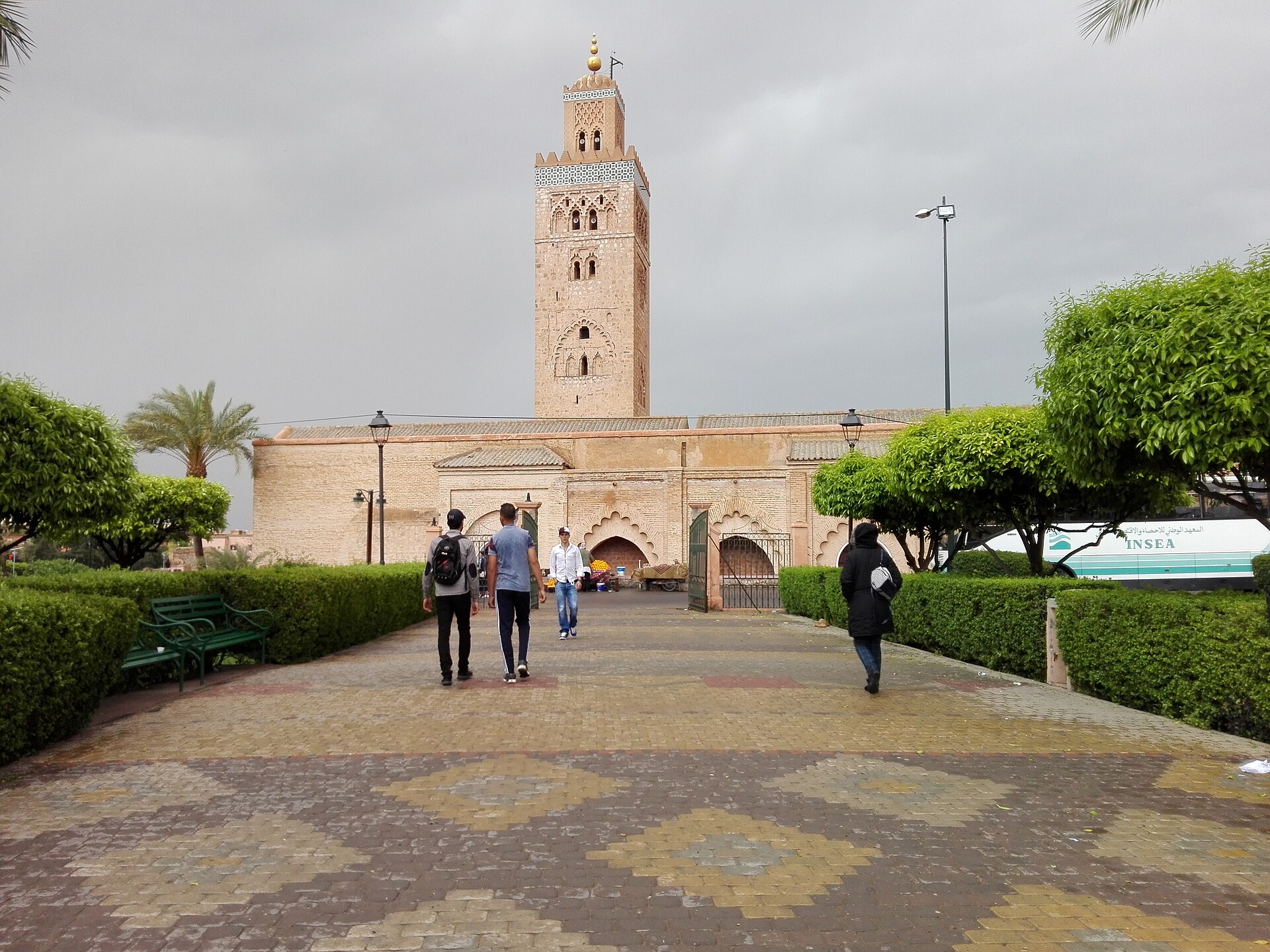
The city's largest mosque, founded in 1147 by the Almohad caliph Abd al-Mu'min just after he took Marrakesh, rebuilt entirely around 1158, with the minaret probably finished by 1195. It is the template half the minarets in Morocco follow, and since nothing near it is allowed to stand higher it doubles as the medina's compass. Non-Muslims cannot go in, but the gardens around it are open to all.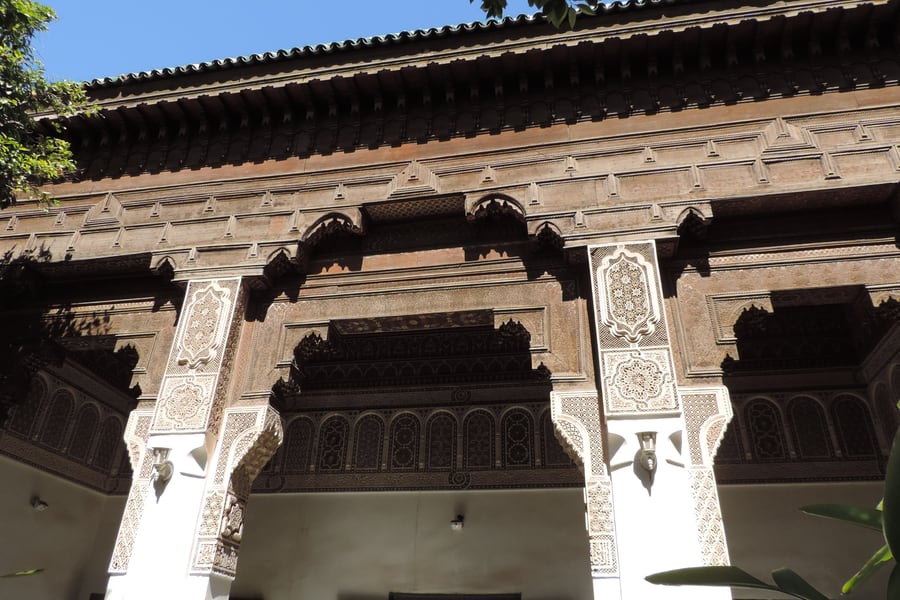 Vassia Atanassova - Spiritia / Wikimedia Commons · CC BY-SA 4.0 · cropped
The Bahia Palace
Begun in the 1860s for Si Musa, grand vizier to the sultan, then hugely extended by his son Ba Ahmed between 1894 and 1900 — roughly 150 rooms arranged around courtyards and riad gardens. The whole point of it is the surfaces: painted cedar ceilings, sculpted stucco and zellij tilework, room after room. It was built to display a vizier's power, and it still reads exactly that way.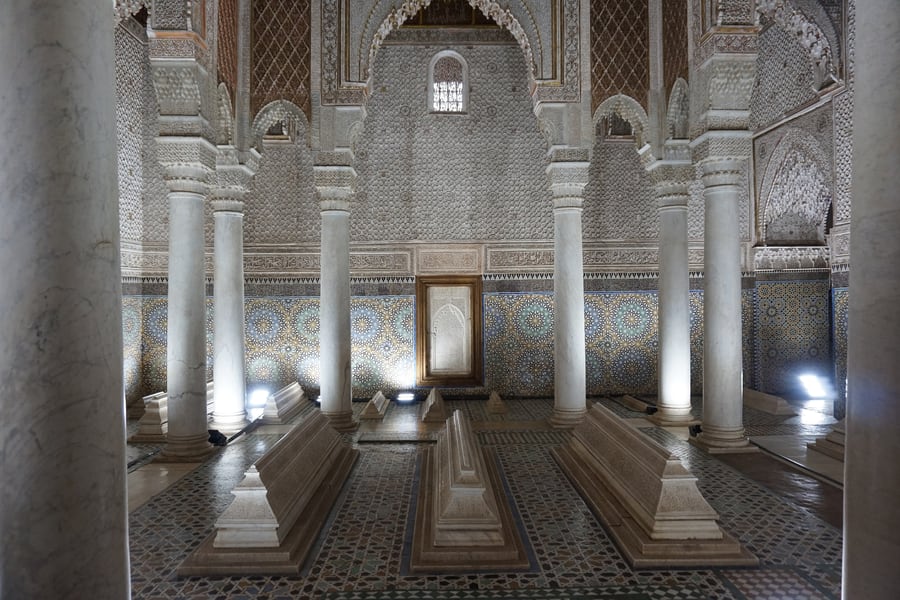 Matt Kieffer / Wikimedia Commons · CC BY-SA 2.0 · cropped
The Saadian Tombs
A royal necropolis beside the Kasbah Mosque, built in the reign of Ahmad al-Mansur (1578–1603) and reckoned by many art historians to be the high point of Moroccan architecture in the Saadian period. The finest chamber holds his own tomb among marble columns beneath a carved ceiling. Members of the monarchy went on being buried here for a long time after the dynasty itself had gone.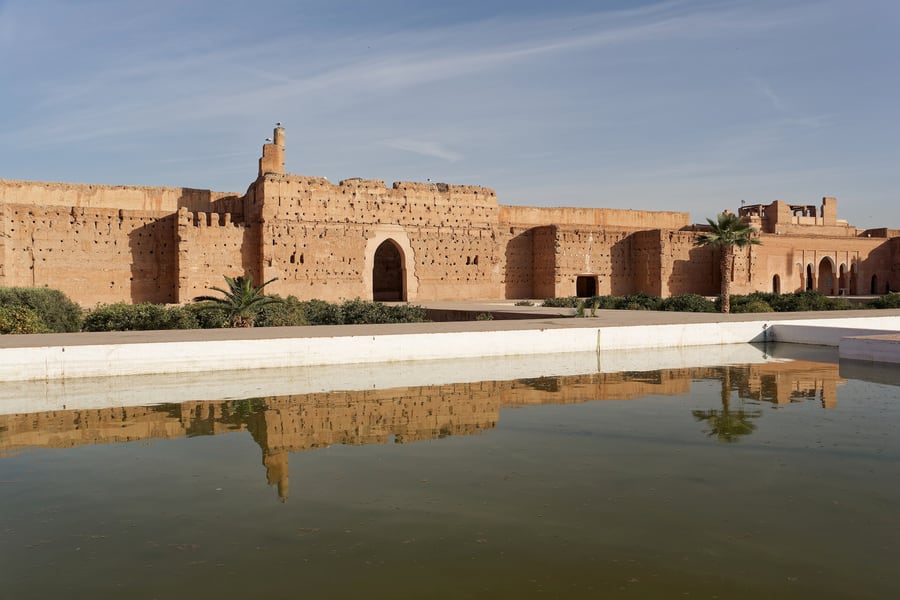 Jakub Hałun / Wikimedia Commons · CC BY 4.0 · cropped
El Badi Palace
Commissioned by Ahmad al-Mansur within months of his accession in 1578 and worked on for most of his reign, the "Incomparable Palace" was finished in materials brought from as far as Italy and Mali, and existed to show what the sultan could afford. It was stripped bare after his death. What is left is a vast rectangle of rammed-earth walls round a reflecting pool, with storks nesting along the top of them.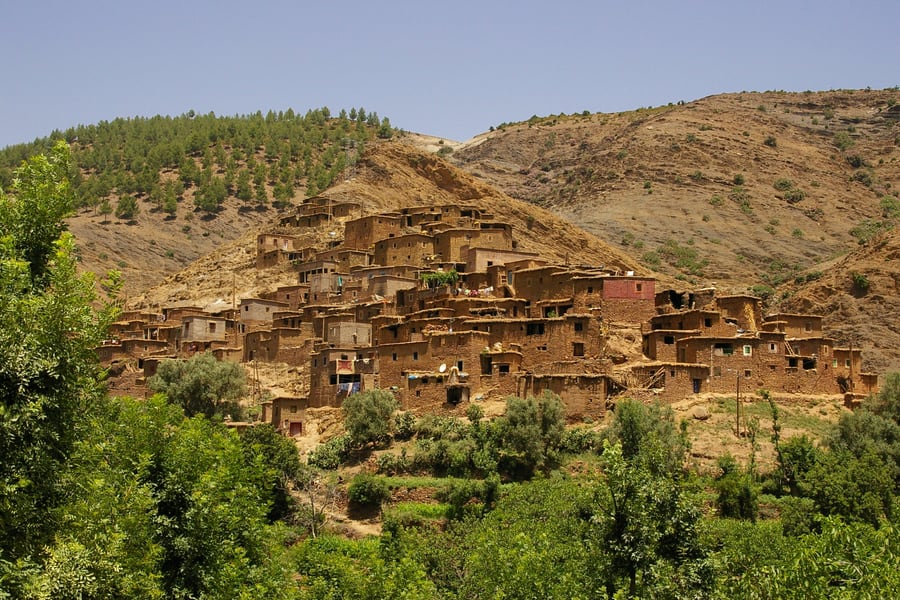 Fathzer / Jean-Marc Astesana / Wikimedia Commons · CC BY-SA 2.0 · cropped
The Ourika Valley
The easiest way into the High Atlas — a river valley about 30 kilometres from Marrakesh, where the road climbs past terraced fields and mud-brick Berber villages stacked along the hillsides. It runs markedly cooler than the city, which is most of the appeal between June and September, and short walks from the roadside lead up towards the waterfalls at the head of the valley.Where to Sleep
In Marrakech, there is really only one thing to do: sleep in a riad. These traditional courtyard houses, hidden behind plain medina walls, open inward onto tiled patios, plunge pools and orange trees, with rooftop terraces looking over the rooftops to the Koutoubia and the Atlas beyond. Dozens have been restored as small guesthouses in the medina, most within walking distance of the Jemaa el-Fna — though the lanes are a maze, so arrange for someone to meet you. For more space, pools and gardens, the palm groves and the Hivernage and Guéliz districts hold the larger hotels and the grande-dame La Mamounia, a short taxi ride from the station and the square.
The station sits in Guéliz, the modern town, a ten-minute taxi from the medina — so whether you arrive by day or after dark, you are never far from your bed.
In Casablanca, if you break the journey at the northern end, the Art Deco centre and the seafront Corniche near the Hassan II Mosque are the pleasant places to stay, both central and close to Casa-Voyageurs station.
As with all our journeys, we keep this to the lie of the land rather than specific bookings — in Marrakech, choose the medina for atmosphere or the new town for space and a pool, and let the riad or hotel follow from there.
Questions or corrections
Planning this trip and stuck on something, or spotted a time, fare or detail that has changed? Send us a message about The Marrakech Express. We read every one, and we update this page when something has changed.