Minsk to Brest
Dima Sugonyaev / Wikimedia Commons · CC BY-SA 3.0 · 2012 · cropped
- Distance347 km, Minsk-Passazhirsky to Brest-Tsentralny
- Duration3 h 11 min on the fastest train; four to five hours on the rest
- Best seasonMay to September · the plain is at its greenest and Białowieża is open
Introduction
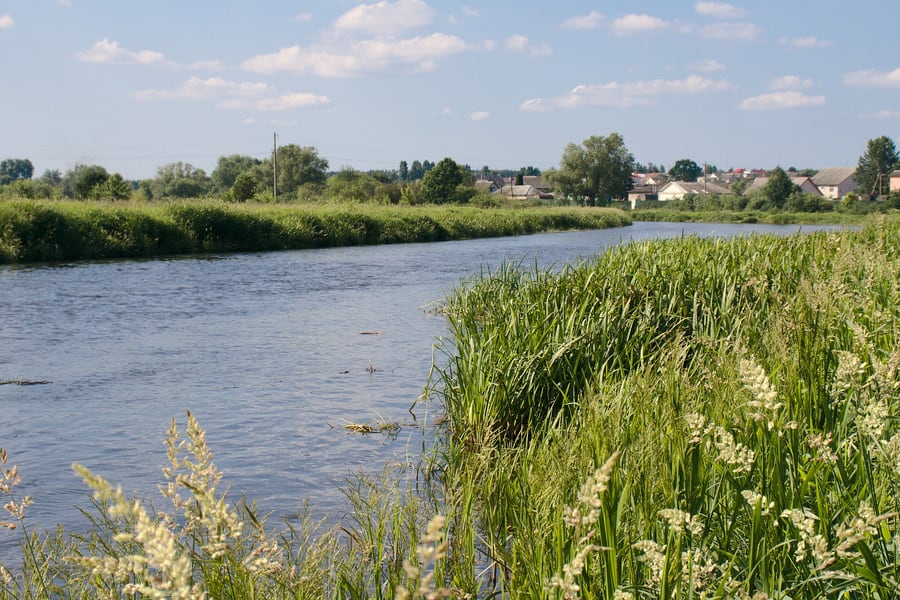
Three hundred and forty-seven kilometres separate Minsk from Brest, and there is not a gradient worth the name between them. The line runs south-west across the Belarusian plain — beet fields, birch and pine, villages of wooden houses with painted window frames, the Neman at Stowbtsy, then the long forested run through the Brest region — and it has been one of the main roads out of Russia towards Europe since 1871. The fastest train covers it in three hours eleven minutes without stopping once.
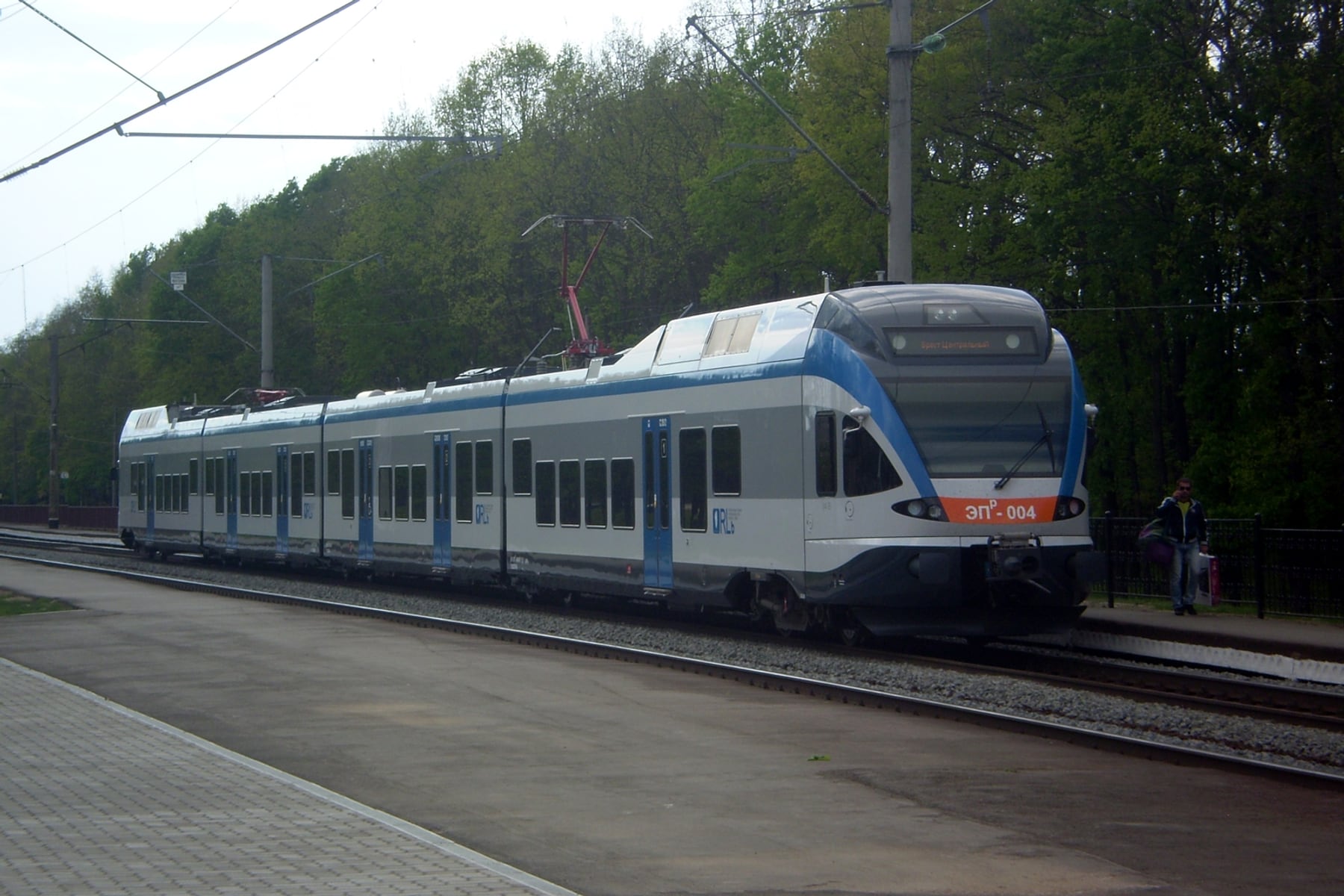
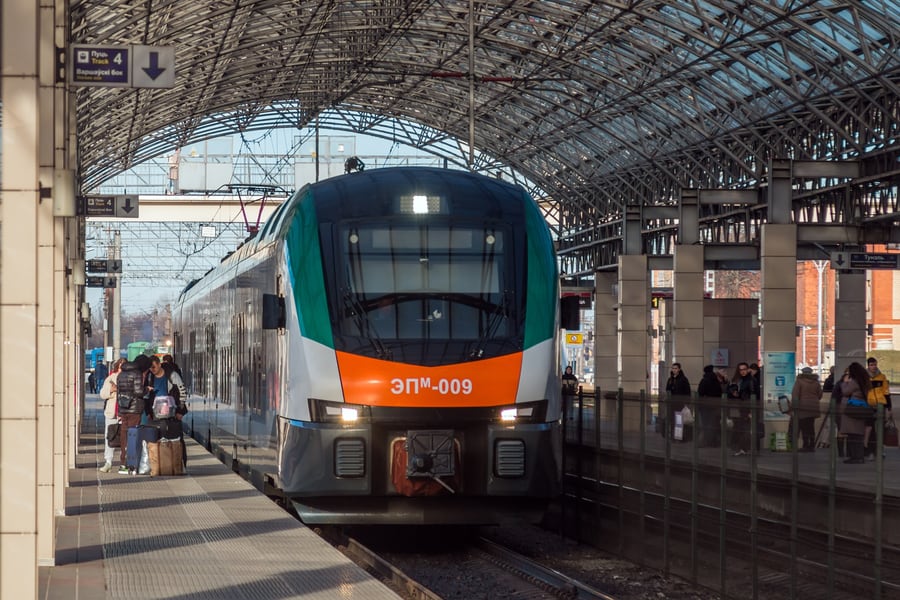
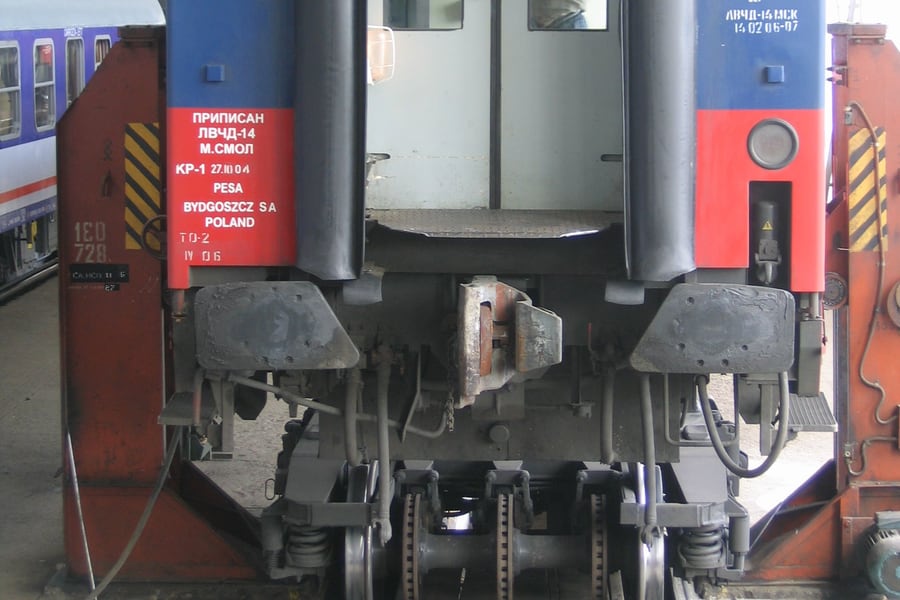
What makes it a journey rather than a fast link between two cities is what waits at the end of it. Brest is where the gauge changes. Russian broad gauge, 1,520 mm, comes to a stop here; Polish standard gauge, 1,435 mm, begins on the far platforms. A through coach bound for Warsaw is shunted into a shed, lifted on jacks, has its bogies rolled out from under it and a set of European ones rolled in, and its couplings changed before it can go any further. The trains that make the journey are worth a look too: Belarusian Railway's business-class services are worked by Stadler electric sets designed in Switzerland and built at Fanipol, twenty-four kilometres down this same line from Minsk.
The Journey
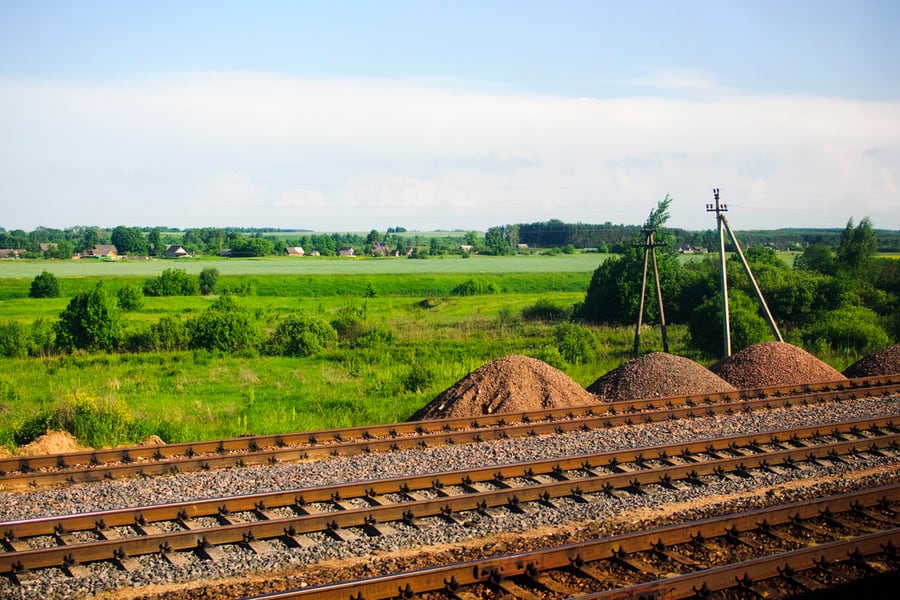
Minsk-Passazhirsky sits in the middle of the city, with a metro station under it and the whole national network fanning out from its platforms. The Brest trains leave from the Warsaw side. Once clear of the suburbs the line settles into what it does for the next three hours: two tracks under catenary, dead straight for kilometres at a time, running south-west across a plain that has no feature to bend around.
Fanipol goes by first — a satellite town twenty-four kilometres out, and the place where the trains themselves are built. The Stadler works there has been turning out electric sets for Belarusian Railway since 2015. Then Kojdanovo, then Stowbtsy, seventeen thousand people on the right bank of the Neman, the first river of any size on the route. Haradzieja follows: a small place with a sugar factory that takes in up to four thousand tonnes of beet a day in the autumn rush, and, for a traveller, the stop for Nesvizh and Mir.
Baranavichy
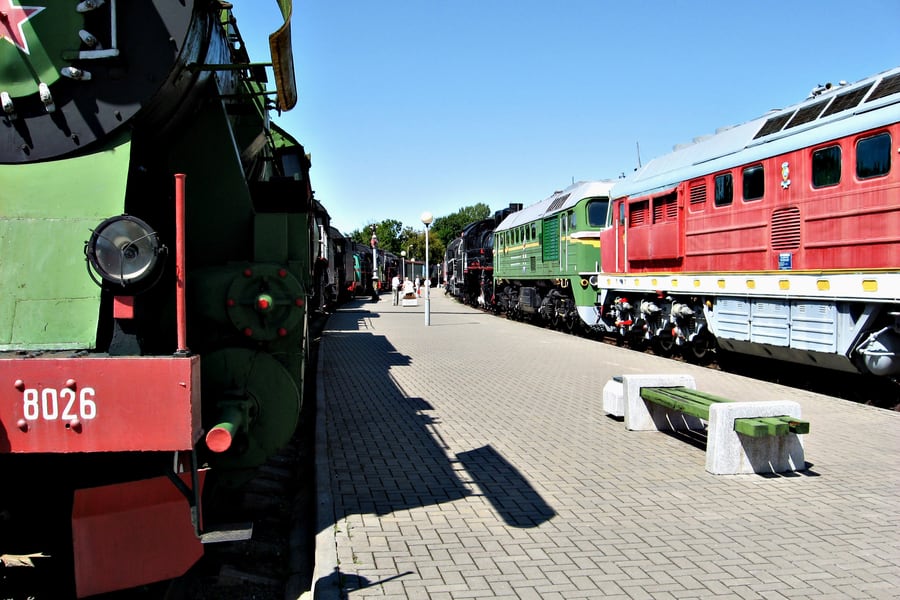
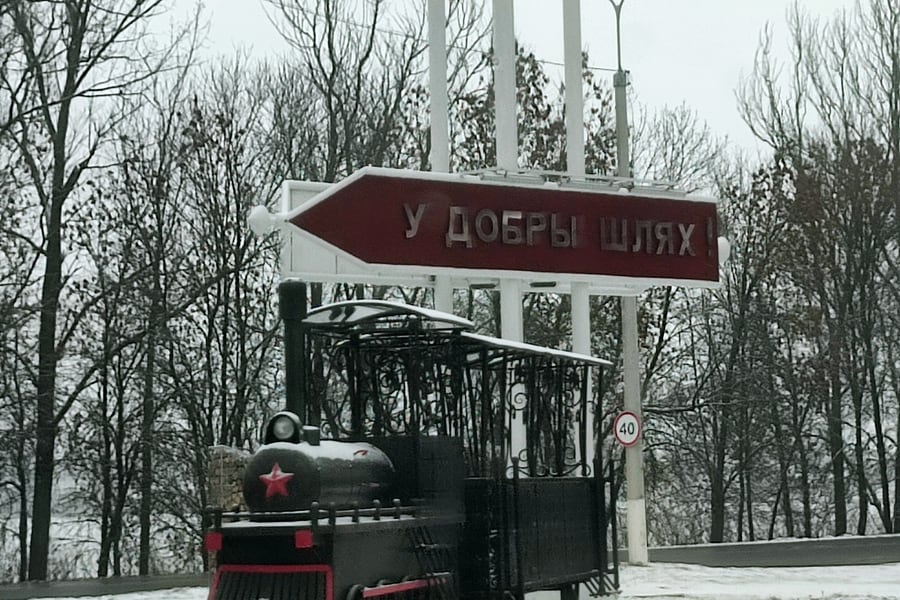
An hour and three-quarters out of Minsk the train comes into Baranavichy-Centralnye, the only town of consequence between the two ends, and it exists because of the railway rather than the other way round. The station was built as a place to change and repair locomotives; the settlement that grew around it numbered about fifteen hundred people by the mid-1880s. The Vilna–Rovno line, finished in 1884, crossed here and gave the town a second station, Baranavichy-Paleskiya. A preserved steam locomotive stands at the entrance beneath a sign reading u dobry shlyakh — bon voyage. Most trains stop here for a minute or two; the fastest does not stop at all.
West of Baranavichy the country turns to forest and marsh. Ivatsevichy, then Byaroza-Horad — the town was Byaroza Kartuskaya, Carthusian Byaroza, until the Soviet period, after the monastery on its edge — then Oranchytsy, then Zhabinka, the last stop of all. After it there is twenty minutes of flat ground to the Bug.
The gauge frontier
Brest-Tsentralny is the busiest break-of-gauge point in Europe. On the Moscow side every track is 1,520 mm; on the Warsaw side there are four, two of each gauge, and the station is also where the electrification changes from alternating current to direct.
A coach going through to Poland is dealt with in the depot beside the station. The AC electric comes off, a shunter drags the train inside, the coaches are jacked up, the 1,520 mm bogies are rolled out and a narrow-gauge tractor brings the 1,435 mm ones in underneath. Couplings are swapped for European ones. Then a shunter takes the train across to the Warsaw side and a Polish electric hooks on for Terespol. Freight gets no such treatment: it is transloaded, wagon to wagon, by the container crane.
The station itself has been rebuilt twice — once between 1953 and 1957, after Marshal Voroshilov saw the ruins in 1949, and again between 2009 and 2014. Its Victorian predecessor, opened in 1886 in front of Alexander III, was got up as a medieval castle with four water towers, and was the first station on the Russian railways to be lit by electricity: a hundred and sixty twenty-candle bulbs in the halls and on the platforms.
The trains
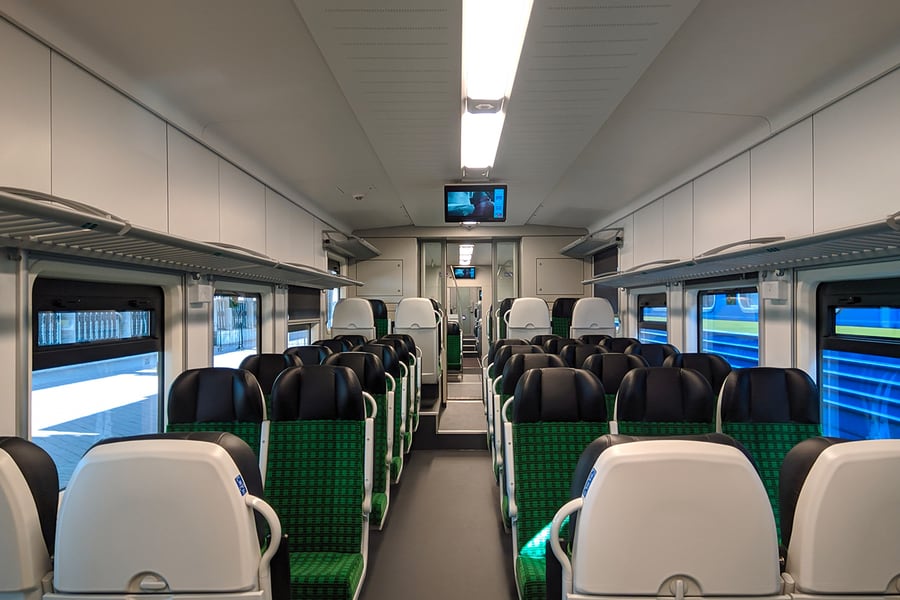
Two kinds of train do this run. The business-class interregional services are five-car Stadler sets — class ЭПм, from the FLIRT family, built at Fanipol under a 2019 contract for ten trains capable of 160 km/h. They are the fast ones: seats only, two and two, luggage racks, screens, and a running time of between three and a quarter and four hours. The economy-class interregional and the long-distance trains from Moscow, St Petersburg and Polatsk take longer, and carry sleeping accommodation — open platskart berths and four-berth kupe compartments — because for most of their passengers Brest is not where the journey started.
Along the route
 Rabbi Mendl / Wikimedia Commons · CC BY-SA 4.0 · 2021 · cropped
Baranavichy, the junction
The one town of any size on the way, and a railway town first — it grew round a locomotive depot after 1871, and the Vilna–Rovno line of 1884 made it a junction. A plinthed steam locomotive stands at the entrance under the words bon voyage.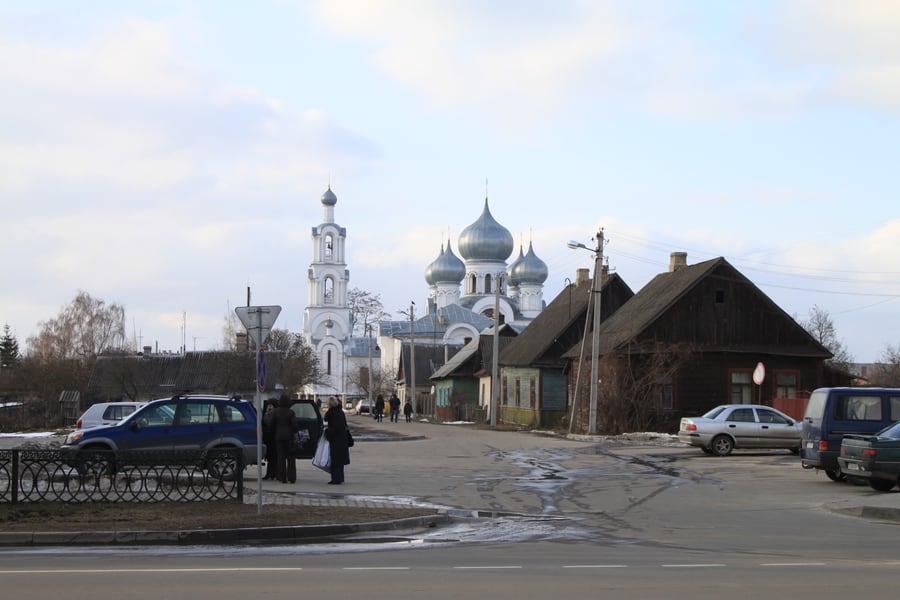 Alex Caicics / Wikimedia Commons · CC BY 3.0 · cropped
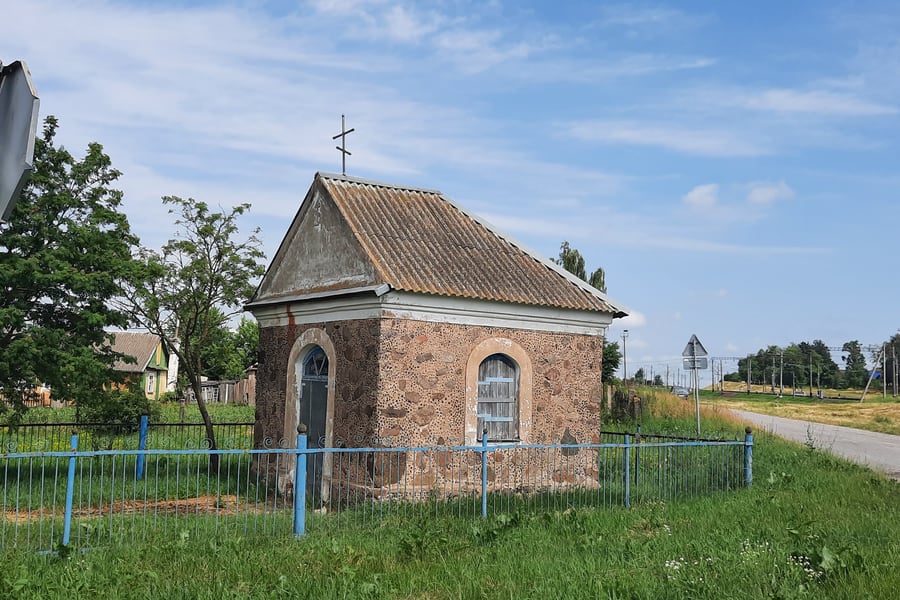
Byaroza, and the Carthusians
A quiet Brest-region town whose full name used to be Byaroza Kartuskaya — Carthusian Byaroza — after the monastery on its edge. The stop is called Byaroza-Horad, three hours out of Minsk.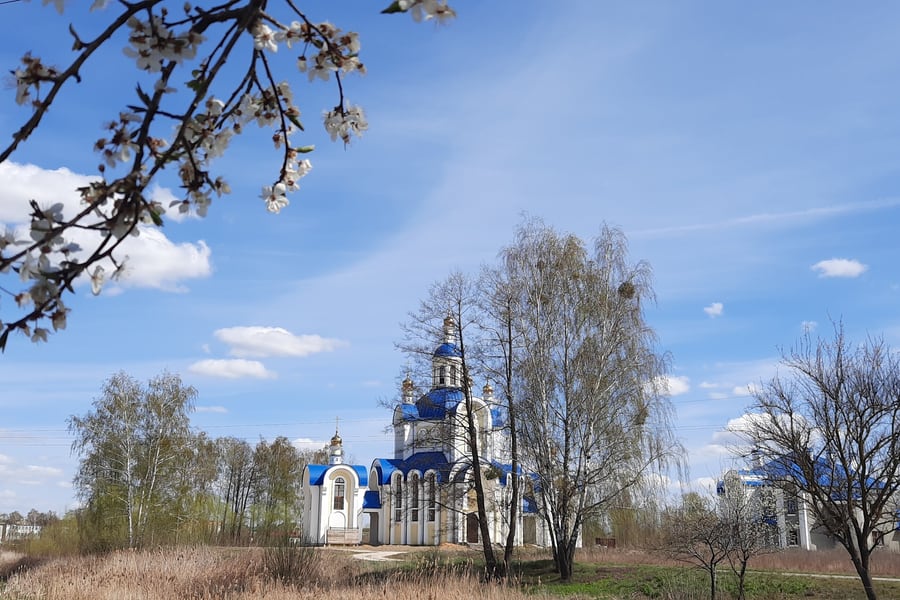 Zelyoniy.anton / Wikimedia Commons · CC BY-SA 4.0 · 2020 · cropped
Zhabinka, the last stop
Twenty minutes short of Brest the train calls at Zhabinka, where the Kobryn line comes in. After it the country flattens towards the Bug and the wires ahead belong to a different system.A bit of history
Culture & experiences along the way
 Александр Корчик / Wikimedia Commons · CC BY-SA 3.0 · 2012 · cropped
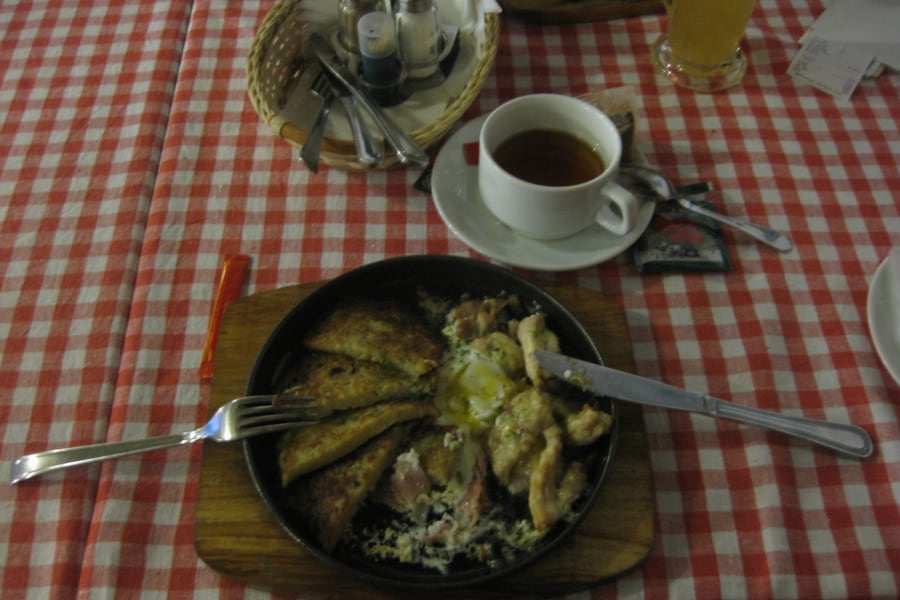
Draniki, and what goes on them
Grated potato, fried in a pan and brought to the table in it. Draniki are the national dish and the default lunch anywhere along this line — plain with sour cream, or split and filled with meat, or buried under mushrooms and onion. Order them with a glass of kvass and you have eaten the way the country eats.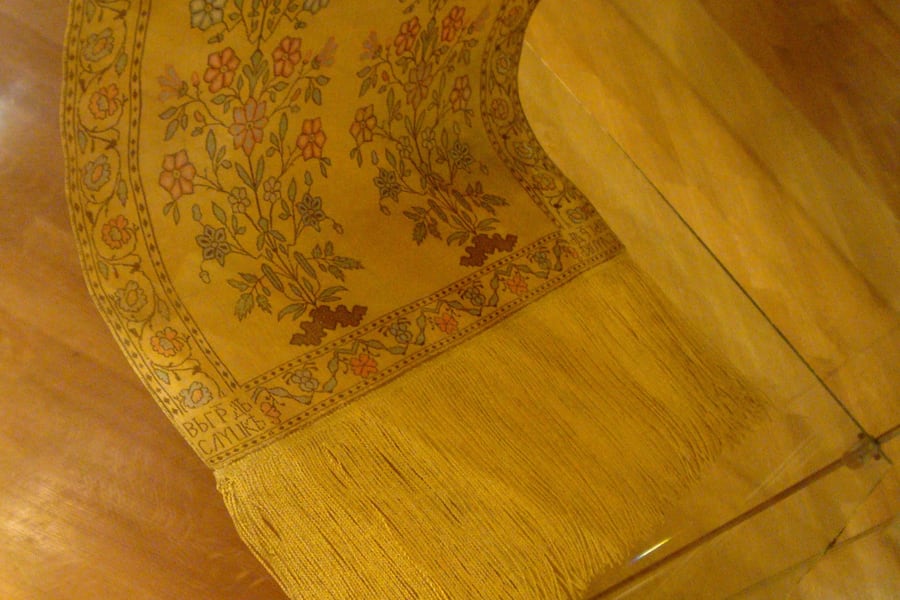 Wikimedia Commons · public domain · 1780s · cropped
The sash woven at Slutsk
A kontusz sash is three to four metres of silk, worn wound round the waist, and the finest were woven at Slutsk from the 1750s — the workshop began at Nesvizh and moved on. Each was reversible, four patterns on one belt, and signed in the corner: in the town of Slutsk. Minsk's museums keep them.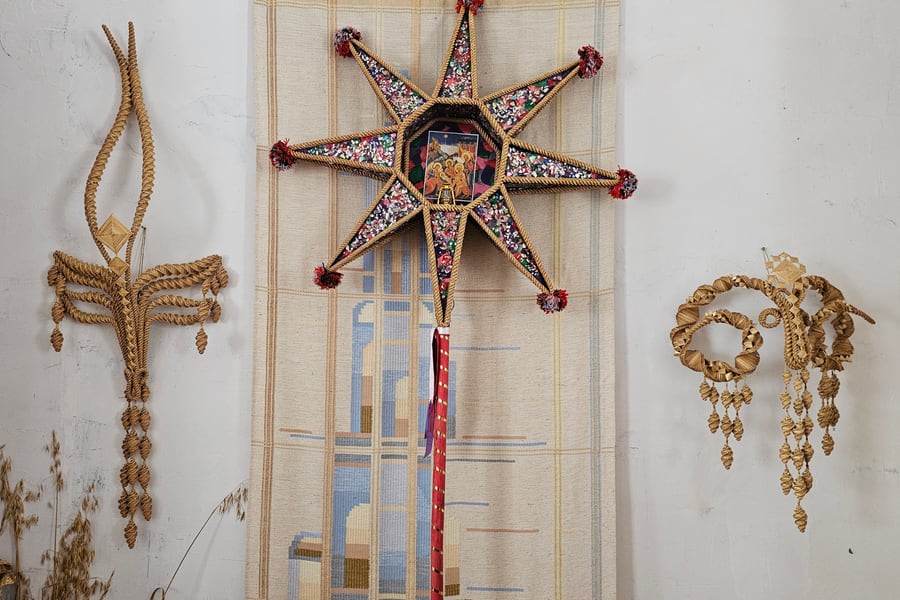 Tatiana Markina / Wikimedia Commons · CC BY-SA 4.0 · 2026 · cropped
Straw, plaited into a star
Rye straw is split, damped and plaited into spiders, dolls, wreaths and the eight-pointed Kalyady star carried house to house at midwinter. Belarusian straw weaving went onto UNESCO's Representative List in 2022, and it is sold in every craft shop between here and the border.Timetables
Ten trains a day run from Minsk to Brest, and the pattern is easy to hold in the head: long-distance trains with sleeping cars in the morning, fast Stadler sets from mid-morning until late evening, and one overnight service out of Polatsk that arrives at breakfast time. Times shift by a few minutes from date to date, because several of the morning departures are Moscow and St Petersburg trains that run on alternate days.
The departures below are those the operator sold for Thursday 10 September 2026.
| Depart Minsk-Passazhirsky | Arrive Brest-Tsentralny | Journey | Train |
|---|---|---|---|
| 07:04 | 10:58 | 3 h 54 | Long-distance, sleeping cars |
| 09:27 | 13:34 | 4 h 07 | Long-distance, sleeping cars |
| 09:55 | 14:49 | 4 h 54 | Long-distance, sleeping cars |
| 10:24 | 14:00 | 3 h 36 | 727Б, business class |
| 13:05 | 17:00 | 3 h 55 | 737Ь, business class |
| 14:52 | 18:03 | 3 h 11 | 725Ф, business class — non-stop |
| 17:20 | 21:05 | 3 h 45 | 733Б, business class |
| 18:18 | 22:04 | 3 h 46 | 735Ф, business class |
| 19:40 | 23:11 | 3 h 31 | 701Б, business class |
| 22:57 | 07:41 | 8 h 44 | Overnight from Polatsk, sleeping cars |
725Ф is the one to aim for. It is the only train that runs the 347 kilometres without a single intermediate stop, and the portal labels it samyy bystryy — the fastest. 733Б, 735Ф and 701Б run every day of the week; the earlier business-class departures at 10:24, 13:05 and 14:52 are timetabled in blocks of a few days at a time and need checking against the date of travel. Every train in the table carries reserved seats or berths, so there is no turn-up-and-go option on this route.
As of September 2026. Live times and availability: Belarusian Railway's passenger portal (opens in a new tab).
Tickets
Belarusian Railway sells this journey through its own portal at pass.rw.by, which takes cards,
holds a basket, and quotes every fare in Belarusian roubles with euro, dollar and Russian rouble
equivalents alongside. Seats are numbered and reserved, so a ticket is for one named train. The one
thing to plan for is language: the portal is in Russian and Belarusian only. Both rw.by/en and
pass.rw.by/en exist as addresses and neither works — the first serves the Russian site, the second
returns an error page with the Russian booking form inside it.
Fares are low by European standards and barely move with demand. A standard seat on a business-class Stadler was 30.99 roubles for 10 September 2026, about nine euros for 347 kilometres; the same trains carry a handful of dearer seats at 42.94 and 61.98. On the long-distance trains an open platskart berth was 19.92 and a four-berth kupe 27.65 — cheaper than sitting up on the fast train.
Book your tickets
Business-class seat
Standard seat · 30.99 roubles
The fare on the fast Stadler trains, which is what most of the day's departures now are.
Book Tickets (opens in a new tab, on pass.rw.by)via pass.rw.byBusiness-class, the dearer seats
42.94 roubles, and a handful at 61.98
The same trains sell a small number of seats in a higher class at each of two prices.
Book Tickets (opens in a new tab, on pass.rw.by)via pass.rw.byEconomy-class sleeper berths
Platskart 19.92 roubles · kupe 27.65
The long-distance trains carry open and compartment berths, cheaper than a seat on a Stadler.
Book Tickets (opens in a new tab, on pass.rw.by)via pass.rw.byRail Passes
No rail pass covers this journey. Belarus is not one of the countries in the Interrail and Eurail network — it does not appear among the railway companies the pass is valid on — and there is no Belarusian equivalent sold to visitors.
That is less of a loss than it sounds. A pass is worth buying where point-to-point fares are high, and here they are not: a seat on the fastest train costs about nine euros, and a berth on an overnight service rather less. Tickets are bought one train at a time from pass.rw.by (opens in a new tab), and the sum of a fortnight's Belarusian rail travel is unlikely to reach the price of a single pass.
Anyone arriving from Poland should note that the ticket ends at the frontier in practice as well as on paper: a Warsaw or Terespol booking is a separate transaction, on a separate railway, with a change of gauge in between.
Pass conditions checked against interrail.com in September 2026.
Places to Visit
Two of the six are reached from a single stop. Haradzieja, an hour and a quarter out of Minsk, is the railhead for both of Belarus's UNESCO-listed Radziwiłł properties: Nesvizh is a short run south, Mir a longer one north-west, and the two are twenty-nine kilometres apart. Between them they cover four centuries of the family that ran this part of the Grand Duchy of Lithuania.
The rest are at the ends of the line or a few minutes from a platform. Minsk keeps one small quarter of itself that predates 1944. Byaroza-Horad has the ruins of the only Carthusian house ever built in the Grand Duchy. And Brest has two things worth the stop in their own right — the fortress at the confluence, and, seventy kilometres to the north, the last great fragment of the forest that once covered the plain the train has just crossed.
 Bestalex / Wikimedia Commons · CC BY-SA 4.0 · 2016 · cropped
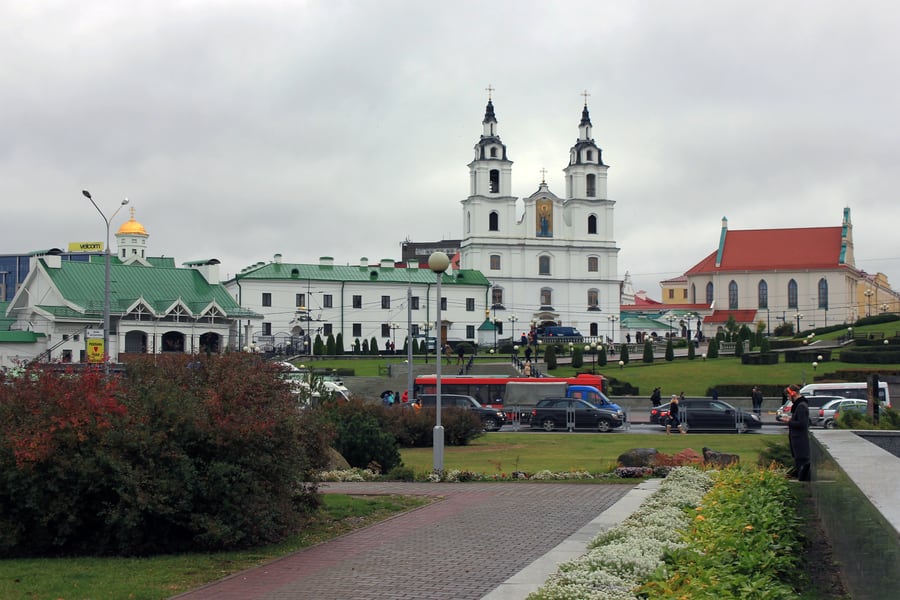
The Upper Town, Minsk
A twenty-minute walk from the station is the one piece of pre-war Minsk that survived: Freedom Square and the streets around it, with the Cathedral of the Holy Spirit — a 17th-century Bernardine church, whitewashed, twin-towered — standing over the Svislach. Almost everything else in the centre was rebuilt after 1944, which is why this corner is worth the walk before the train.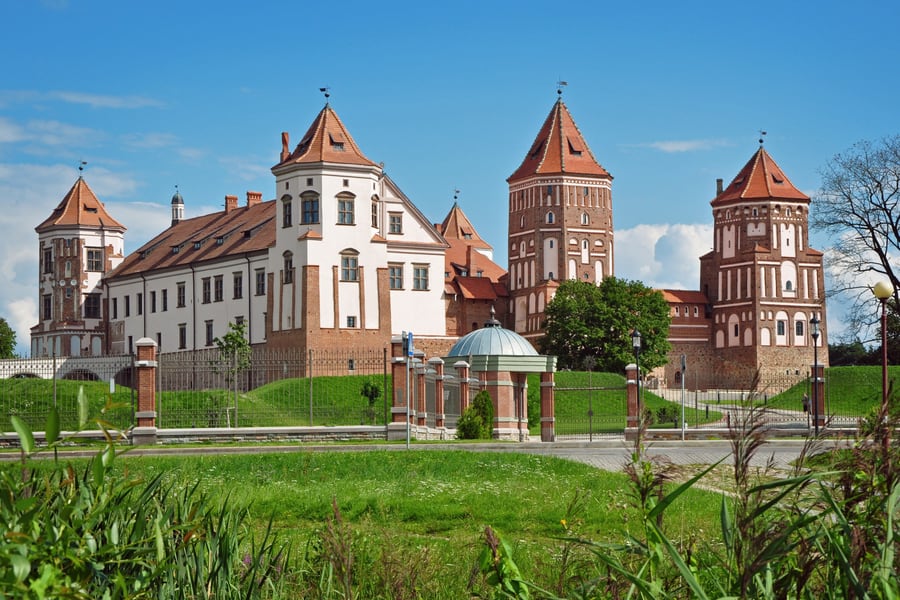 Вадзім Новікаў / Wikimedia Commons · CC BY-SA 3.0 · 2011 · cropped
Mir Castle, from Haradzieja
Begun in the early 16th century in Belarusian Gothic — five towers round a square courtyard 75 metres a side — and given a Renaissance residence by Mikalaj Radziwiłł after 1568. It has been a ghetto, a barracks and a block of flats since, and was put on the UNESCO World Heritage List in December 2000. Red brick banded with limestone, and visible from a long way off.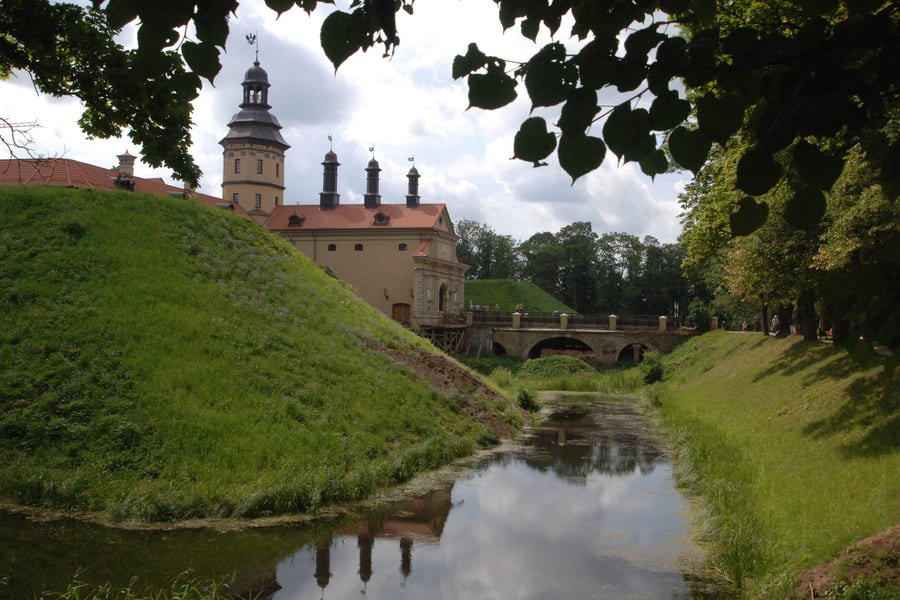 Jerrye and Roy Klotz MD / Wikimedia Commons · CC BY-SA 3.0 · 2008 · cropped
Nesvizh, from the same stop
The Radziwiłł seat, begun in 1583 and finished by 1604: a square three-storey château with four octagonal corner towers, a moat, and a park of more than a square kilometre laid out in the 1880s. UNESCO-listed in 2005 and restored between 2004 and 2012. The first Belarusian book in Latin script was printed in the town in 1562.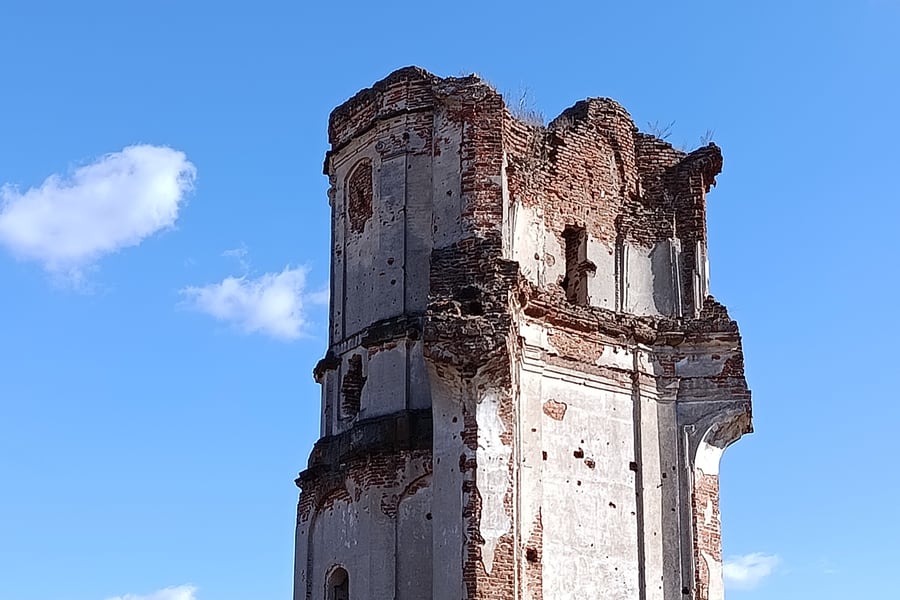 Igor Tkachiov / Wikimedia Commons · CC BY-SA 4.0 · 2026 · cropped
The Carthusian ruins at Byaroza
The only Carthusian monastery ever built in the Grand Duchy of Lithuania, begun in 1648 for monks invited from Paradyż near Gdańsk and finished in 1689 by an Italian architect whose name is lost. The rule was severe: no possessions, no beds, one shared meal a year. It was suppressed after the 1830 uprising and quarried for barracks; the gate tower still stands.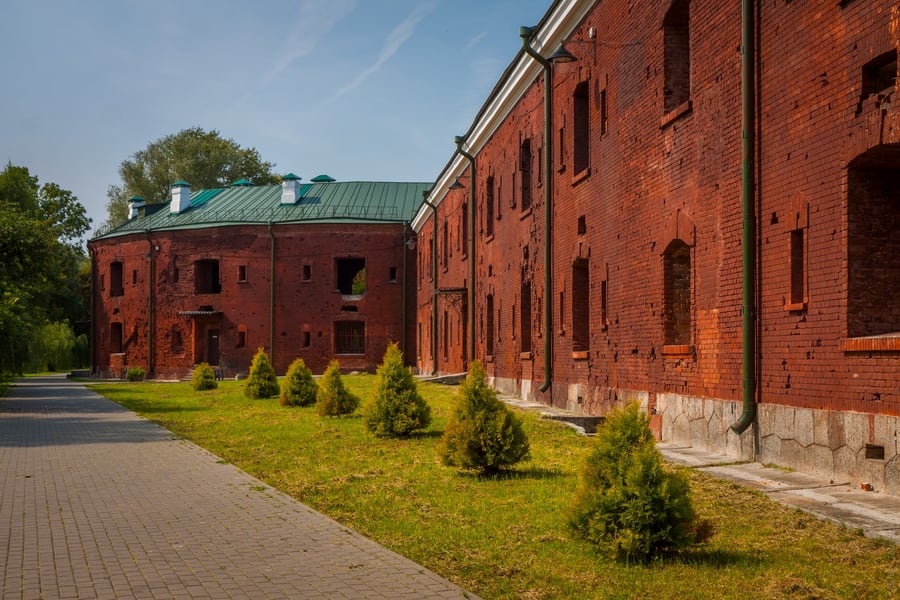 Vadim Tolbatov / Wikimedia Commons · CC BY-SA 3.0 · 2012 · cropped
Brest Fortress
Twenty minutes' walk from the station, on the island where the Mukhavets meets the Bug. The ring barracks — 1.8 km round, 500 rooms, walls of dark red brick — were begun in 1833 to Karl Opperman's design, and most of them are ruins because of what happened here in the last week of June 1941. Two of the four gates survive.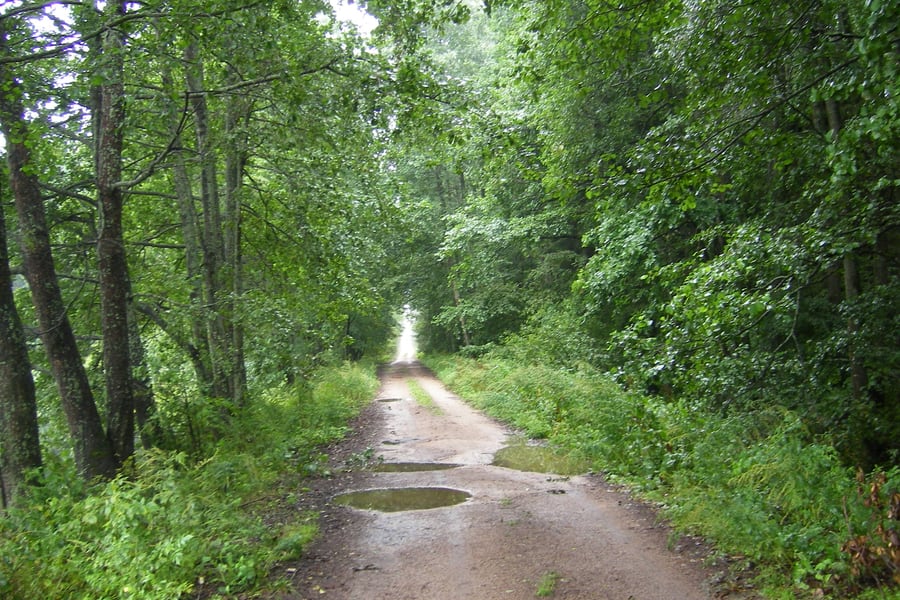 Szeder László / Wikimedia Commons · CC BY-SA 3.0 · 2006 · cropped
Białowieża Forest
Seventy kilometres north of Brest is the largest surviving fragment of the primeval forest that once covered the European plain — a UNESCO World Heritage site shared with Poland, and home to more than 800 European bison, the heaviest land animal in Europe. They were reintroduced here in 1929 after the wild population was shot out. The Belarusian side alone runs to 823 square kilometres.Where to Sleep
Both ends of this line put their hotels within walking distance of the station, which suits a journey that can be done in either direction inside a morning. In Minsk the centre is compact enough that almost anything central is ten minutes from Minsk-Passazhirsky on foot or one stop on the metro, and the Upper Town is the same walk again. In Brest, Savieckaja Street runs from near the station down towards the fortress, and the two cards below sit at either end of that walk.
Where to stay
Hotel Europe
Central Minsk, by Freedom Square
Sixty-seven rooms in a seven-storey atrium block opened in 2007, a few minutes from the Upper Town.
Check Availability (opens in a new tab, on hoteleurope.by)via hoteleurope.byHotel Hermitage
Brest, ulitsa Chkalova 7
Open since 2011 beside the city park, within walking distance of the fortress memorial.
Check Availability (opens in a new tab, on hermitagehotel.by)via hermitagehotel.byQuestions or corrections
Planning this trip and stuck on something, or spotted a time, fare or detail that has changed? Send us a message about Minsk to Brest. We read every one, and we update this page when something has changed.