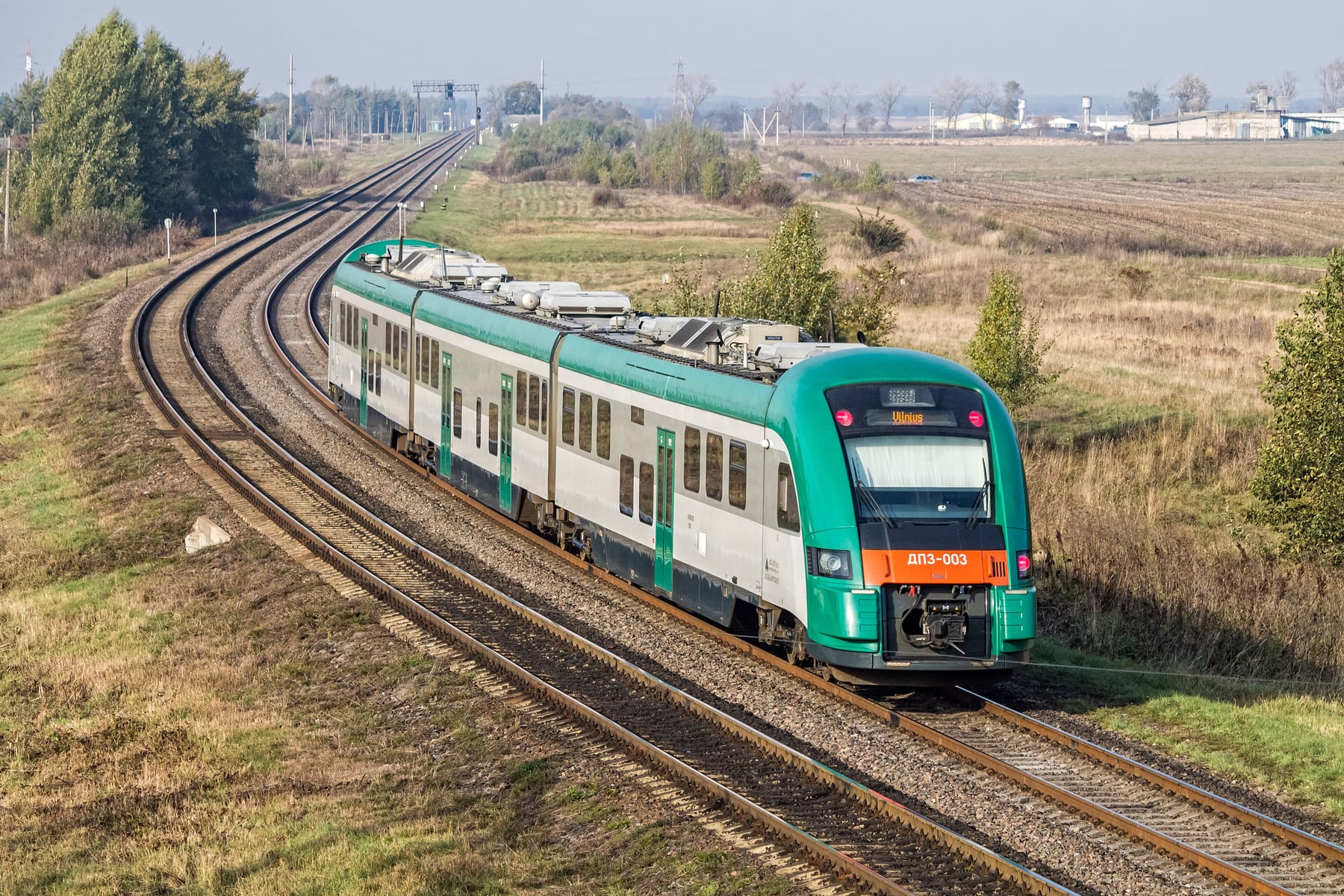
Minsk to Grodno
Neu-Zwei / Wikimedia Commons · CC BY-SA 4.0 · cropped
- DistanceBy way of Maladzyechna, Lida and Masty
- Duration3 h 52 min on the business-class train; 4 h 23 min to 6 h 35 min on the others
- Best seasonMay to September · long evenings on the Neman bluffs
Introduction
Belarusian Railway counts its birthday from 27 December 1862. That day the first train on Belarusian soil left Parechcha, a forest village thirty kilometres away, for Grodno, on a short section of the new line from St Petersburg to Warsaw. Grodno is where the country's railway began, and its station is still a frontier one, with tracks of both the Russian and the European gauge.
The way there from Minsk runs north-west to the junction at Maladzyechna, then south-west through Lida, with its fourteenth-century castle, to Masty on the Neman, and on to Grodno. At the end are a twelfth-century church on the river bluff, two castles facing each other above the Neman, and a Jesuit cathedral whose consecration in 1705 Peter the Great attended. One business-class train a day, 731Б, makes the run with three stops, in three hours fifty-two minutes.
The Journey
The departure is from Minsk-Passazhirsky, and the fast train runs north-west for its first hour without a stop, on the electrified main line towards Vilnius. Maladzyechna, reached in fifty-seven minutes, is one of the biggest junctions in the country, where lines divide for Polatsk, Vilnius and Lida; its first train ran in 1873, and its Art Nouveau station building dates from 1907. The train stands for two minutes and takes the Lida line south-west.
Lida and Masty
The next stretch is the longest: an hour and a half of forest, farmland and small stations to Lida, the junction where the lines from Vilnius, Baranavichy and Grodno cross. The town's landmark is the castle that Grand Duke Gediminas had built in 1323, a quadrilateral of rubble and brick walls on a sand mound between two rivers, which the Teutonic Knights stormed in 1383 and the Swedes blew up in the Northern War; both its towers have since been rebuilt.
Forty-three minutes on, the train calls at Masty, a town where the Zelvyanka runs into the Neman. Masty grew up where the river crossed the old road from Brest to Vilnius, and its station opened in 1886; the branch on to Grodno opened to regular traffic on 1 January 1907. The last forty minutes run through Skidel, without stopping, to the terminus.
Grodno
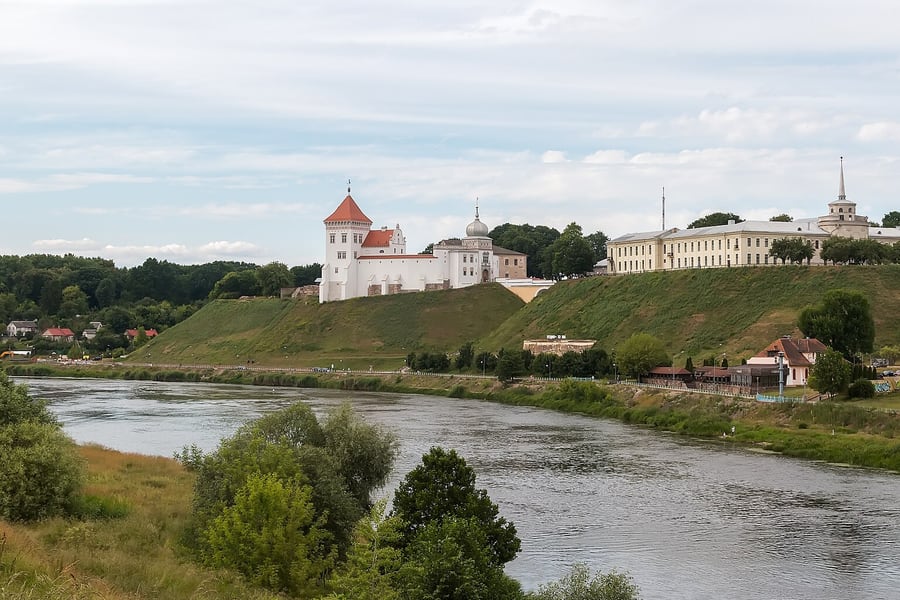
Grodno station is a building of 1986 that replaced the original of 1862. It is a border station: customs and frontier controls work here, and the tracks include standard-gauge lines from the Polish side. The old town is on the high right bank of the Neman, where the Old Castle, the New Castle of 1737–52 and the church at Kalozha look down on the river.
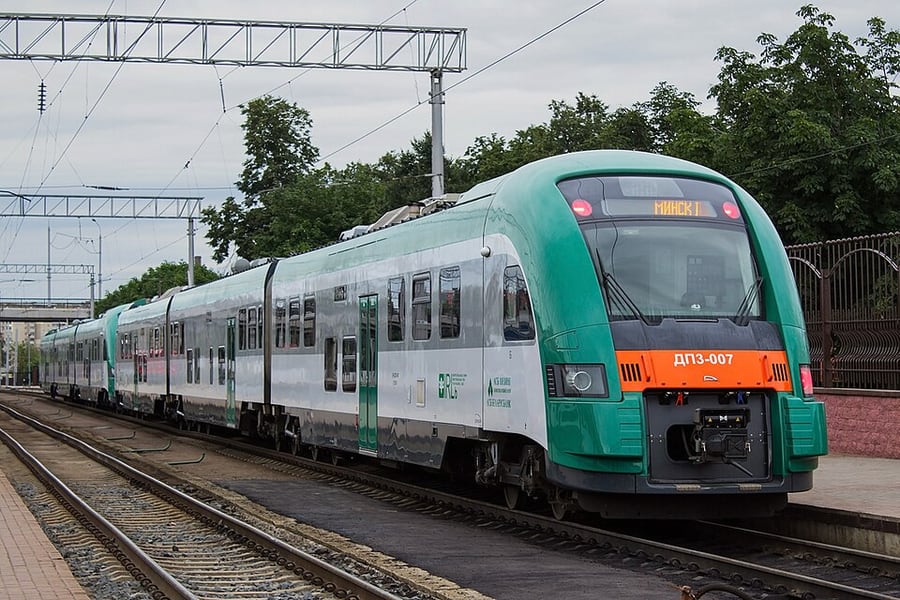
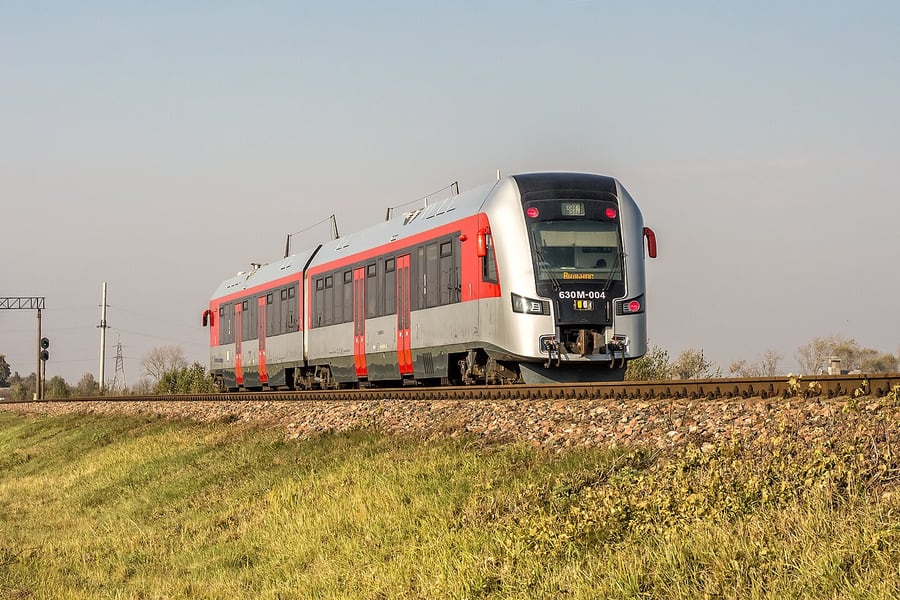
The train is a business-class working. The service began on 9 December 2018, when Belarusian Railway put a Pesa DP3 diesel unit on it, with 145 seats and two spaces for bicycles. It carried almost nine thousand passengers in its first month, and the operator's portal still marks it as the fastest train between the two cities.
Along the route
 Neu-Zwei / Wikimedia Commons · CC BY-SA 4.0 · cropped
Maladzyechna
The first big junction out of Minsk, where lines leave for Polatsk, Lida and Vilnius. Its first train ran on 14 January 1873; the Art Nouveau station building of 1907 still stands. The train stops for two minutes, then turns south-west for Lida.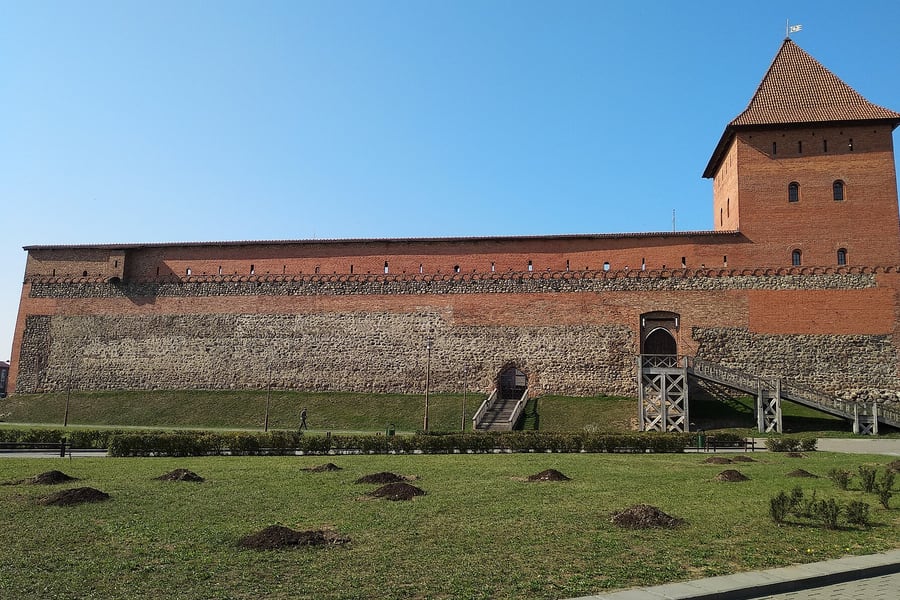 Zala / Wikimedia Commons · CC BY-SA 4.0 · 2018 · cropped
Lida and its castle
Grand Duke Gediminas had a castle built here in 1323, a walled quadrilateral of rubble and brick on a sand mound between two rivers. The Swedes blew up its towers in the Northern War; both have since been rebuilt, and hold a museum.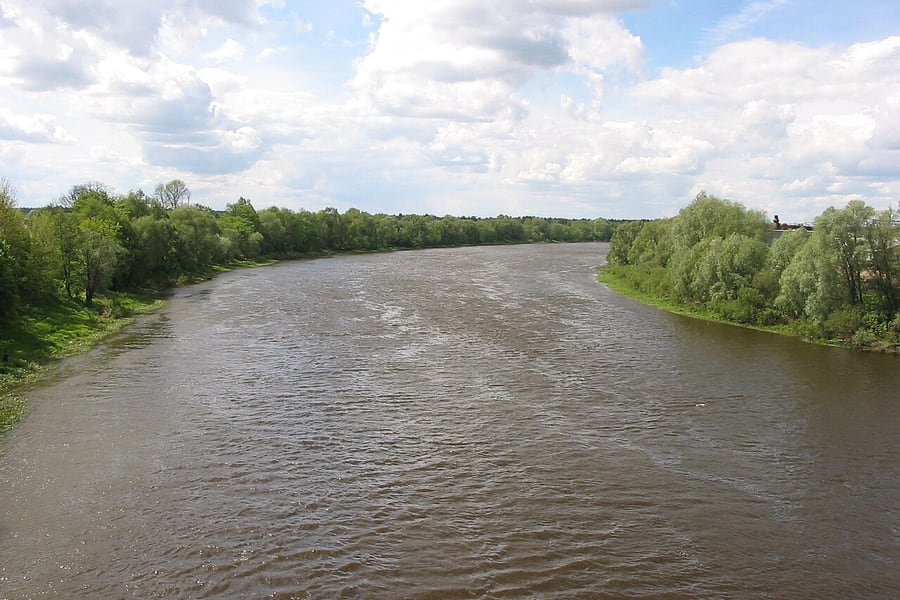 Globustut / Wikimedia Commons · CC BY 4.0 · 2004 · cropped
Masty, on the Neman
A small town where the Zelvyanka runs into the Neman, recorded as a trading place in 1486 at the crossing of the river and the road from Brest to Vilnius. Its station opened in 1886; the last stop before Grodno.A bit of history
Culture & experiences along the way
 Tess Mattew / Wikimedia Commons · CC BY 4.0 · 2024 · cropped
Draniki
Grated raw potato with salt, egg and a little flour, fried in small rounds until the edges crisp, and eaten at once — cold, they are not the same dish. Draniki are a fixture of Belarusian cooking, served with sour cream, butter, melted pork fat or machanka. Tess Mattew / Wikimedia Commons · CC BY-SA 4.0 · 2026 · cropped
The rushnik
A long linen towel, traditionally 30 to 40 cm wide and three metres or more long, its ends woven or embroidered with patterns. The rushnik is hung over icons, spread at weddings and christenings, and given as a gift; folk-art museums show the old ones.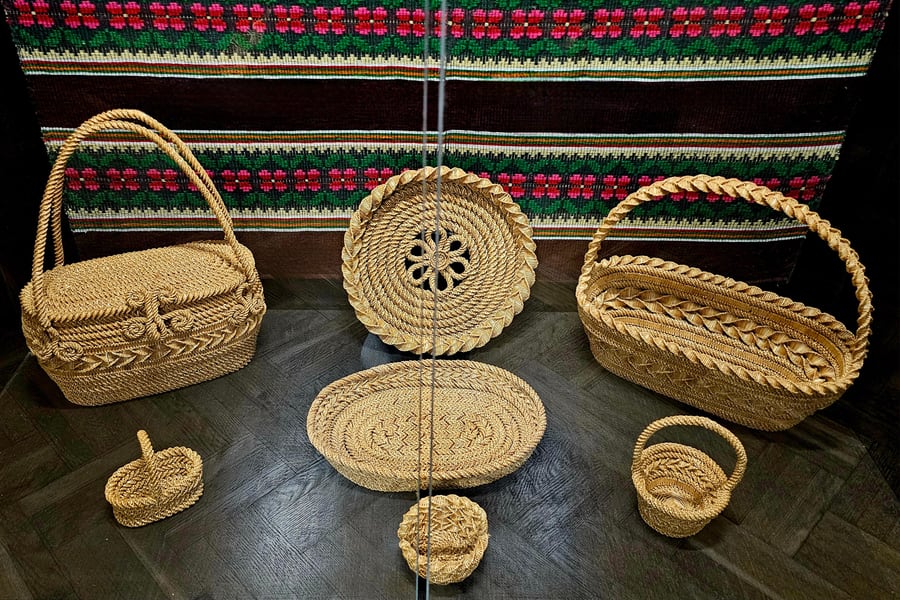 Tatiana Markina / Wikimedia Commons · CC BY-SA 4.0 · 2024 · cropped
Straw weaving
Baskets, birds, horses and whole tableaux plaited from the stalks of grasses and cereals — one of the oldest crafts there is. Belarusian straw weaving was added to UNESCO's list of the intangible cultural heritage of humanity on 1 December 2022.Timetables
Five or six trains a day leave Minsk for Grodno, by two different routes. The business-class 731Б and three long-distance trains take the line through Maladzyechna and Lida; two more go the southern way, through Baranavichy, Slonim and Vawkavysk, and take longer. The departures below are those the operator sold for Saturday 28 November 2026.
| Depart Minsk-Passazhirsky | Arrive Grodno | Journey | Train |
|---|---|---|---|
| 06:17 | 11:46 | 5 h 29 | 679Ф, from Vitebsk, via Baranavichy |
| 07:16 | 12:09 | 4 h 53 | 687Б, berths, via Lida |
| 15:18 | 19:10 | 3 h 52 | 731Б, business class — 3 stops |
| 19:25 | 23:48 | 4 h 23 | 629Б, via Lida |
| 23:17 | 05:44 | 6 h 27 | 634Б, from Kommunary, overnight |
All five run every day. A sixth, 627Б, leaves at 15:25 on Fridays and Sundays and goes the southern way, reaching Grodno at 22:00.
Back from Grodno on the same Saturday, the business-class 732Б left at 19:48 and reached Minsk at 23:42. The long-distance trains left at 06:44 (630Б, Minsk 11:20), 13:32 (680Б, 18:53), 15:34 (688Б, 20:13) and 17:36 (634Ь, 22:57).
Every seat and berth is reserved, so a ticket is for one named train. The timetable printed here runs to 12 December 2026; a new one starts on 13 December.
As of November 2026. Live times and availability: Belarusian Railway's passenger portal (opens in a new tab).
Tickets
Belarusian Railway sells this journey through its own portal at pass.rw.by, quoting every fare
in Belarusian roubles with euro, dollar and Russian rouble equivalents alongside. Seats and berths are
numbered and reserved, so a ticket is for one named train, and the portal is in Russian and
Belarusian only — its /en addresses do not lead to an English version.
A seat on the business-class 731Б was 30.99 roubles for 27 November 2026; the return, 732Б, also sold two seats at 61.98. The slower trains were cheaper: 12.97 for a seat on the overnight from Kommunary, 19.92 for an open platskart berth and 27.65 for a berth in a four-berth kupe.
Book your tickets
Business-class seat
30.99 roubles, a few seats at 61.98
The fare on 731Б and 732Б, the one fast pair of trains each day.
Book Tickets (opens in a new tab, on pass.rw.by)via pass.rw.byEconomy-class seat
From 12.97 roubles
A numbered seat on the slower long-distance trains, including the overnight from Kommunary.
Book Tickets (opens in a new tab, on pass.rw.by)via pass.rw.byBerths, open and compartment
Platskart from 19.92 · kupe from 27.65 roubles
An open berth or a place in a four-berth compartment on the long-distance trains.
Book Tickets (opens in a new tab, on pass.rw.by)via pass.rw.byRail Passes
No rail pass covers this journey. Belarus is not among the countries in the Interrail and Eurail network, and there is no Belarusian pass sold to visitors.
It is no great loss. A seat on the fastest train costs about thirty roubles, and a berth on the overnight service less, so a pass would never pay for itself here. Buy each journey as a separate ticket from pass.rw.by (opens in a new tab).
Pass coverage checked against interrail.eu in November 2026.
Places to Visit
Two of the four are in Grodno's old town, a short walk apart: the twelfth-century church at Kalozha on the river bluff, and the Jesuit cathedral on the main square. The other two are a short trip out of the city — north-west to the locks of the Augustów Canal, or thirty kilometres on the local train to Parechcha, where the first train in Belarus set off.
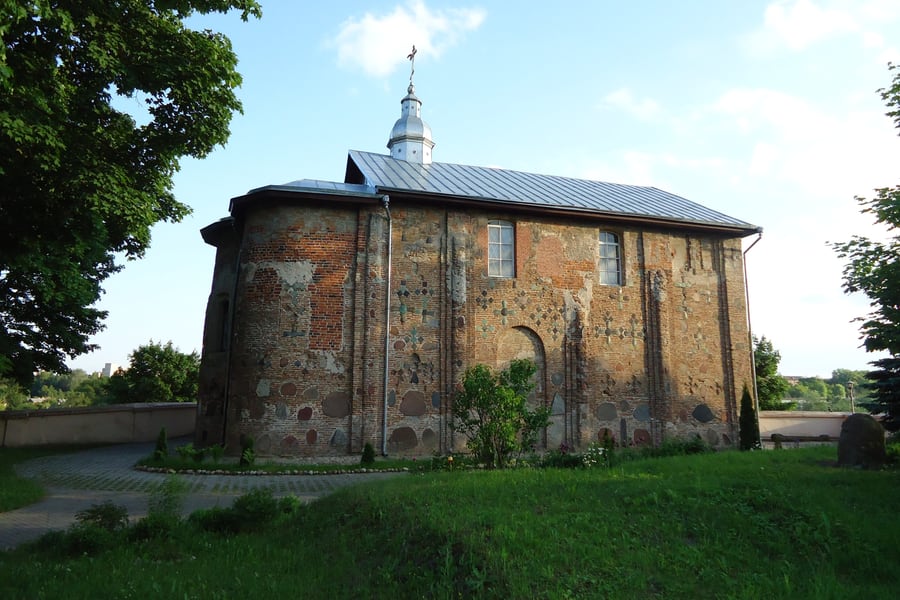 Viktar Palstsiuk / Wikimedia Commons · CC BY-SA 3.0 · cropped
Kalozha, the Church of Saints Boris and Gleb
Built in the 1180s on the high bank of the Neman, of thin brick studded with polished coloured boulders and glazed tiles; inside, clay jars set in the walls shape the sound. On the night of 2 April 1853 the south wall slid into the river, and the restorers of 1896–1906 closed the gap in timber. It is the westernmost surviving church of old Rus'.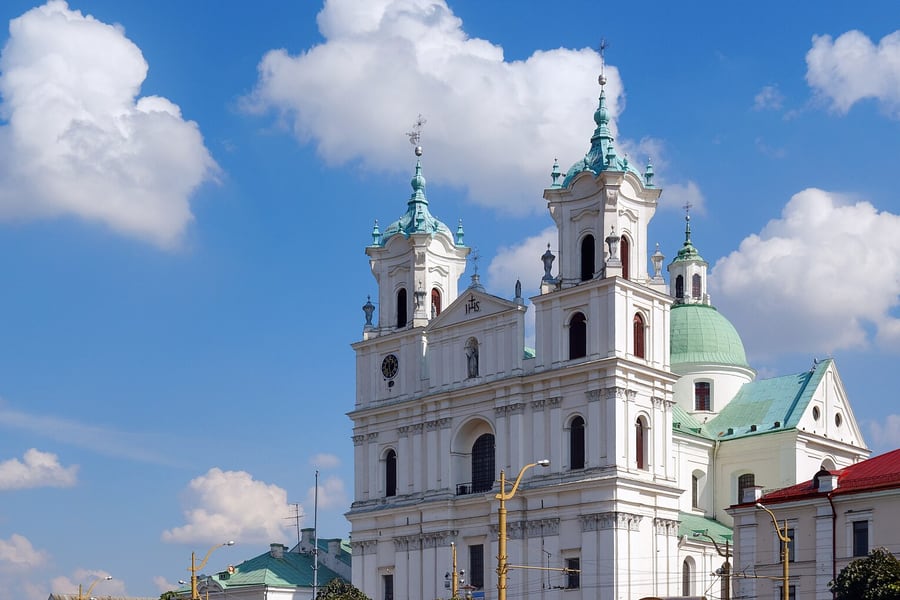 Alexxx1979 / Wikimedia Commons · CC BY-SA 4.0 · 2014 · cropped
The Cathedral of St Francis Xavier
The Jesuits began it in the 1670s, and it was consecrated in 1705 with Peter the Great and Augustus the Strong in the congregation. Its carved wooden high altar, by Jan Christian Schmidt, rises 21 metres, and the clock in the left tower is among the oldest working clocks in eastern Europe. It has been a minor basilica since 1990.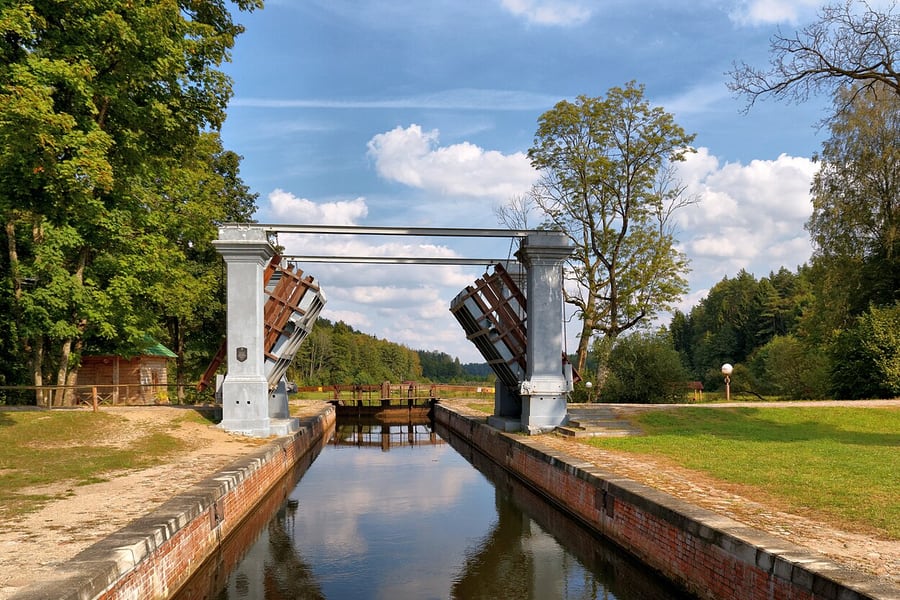 Alexxx1979 / Wikimedia Commons · CC BY-SA 4.0 · 2014 · cropped
The Augustów Canal
A waterway of 1839 that joins the Vistula basin to the Neman: 101 km, 22 of them in Belarus, north-west of Grodno. The Belarusian section has three locks — Niemnowo, the largest, Dąbrówka and Wołkuszek — restored in 2004–06, and the border runs across a fourth, at Kurzyniec. Between the wars two paddle steamers plied it from Grodno to Augustów and back.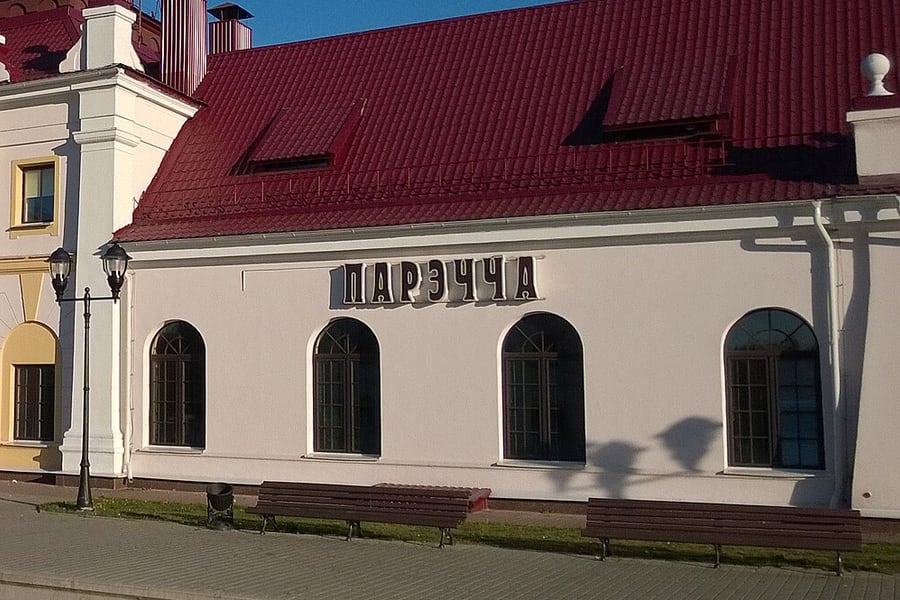 desukov / Wikimedia Commons · CC BY 3.0 · cropped
Parechcha station
Thirty kilometres from Grodno, and 54 minutes on the local diesel, this is where Belarus's railway history begins: the first train on Belarusian soil left here on 27 December 1862. The station, built in the Russian classical style, still stands, and the old engine shed beside it is now housing.Where to Sleep
The business-class train reaches Grodno at ten past seven in the evening, so a night at the far end is the natural way to do this journey. Both Grodno hotels below are in the centre, near the castles; in Minsk the station is in the centre too, and the hotel below is ten minutes' walk from it.
Where to stay
Hotel Minsk
Central Minsk, Prospekt Nezavisimosti 11
A large hotel of 252 rooms on the main avenue, about ten minutes' walk from the station.
Check Availability (opens in a new tab, on hotelminsk.by)via hotelminsk.byHotel Semashko
Grodno, Ulitsa Antonova 10
A 41-room hotel in the centre, which puts the Old and New Castles nearby and the railway station about twenty minutes away.
Check Availability (opens in a new tab, on hotel-semashko.by)via hotel-semashko.byHotel Neman
Grodno, Ulitsa Stefana Batoriya 8
A hotel in the centre on Stefan Batory Street, within walking distance of Kalozha, the cathedral and both castles.
Check Availability (opens in a new tab, on neman-hotel.by)via neman-hotel.byQuestions or corrections
Planning this trip and stuck on something, or spotted a time, fare or detail that has changed? Send us a message about Minsk to Grodno. We read every one, and we update this page when something has changed.