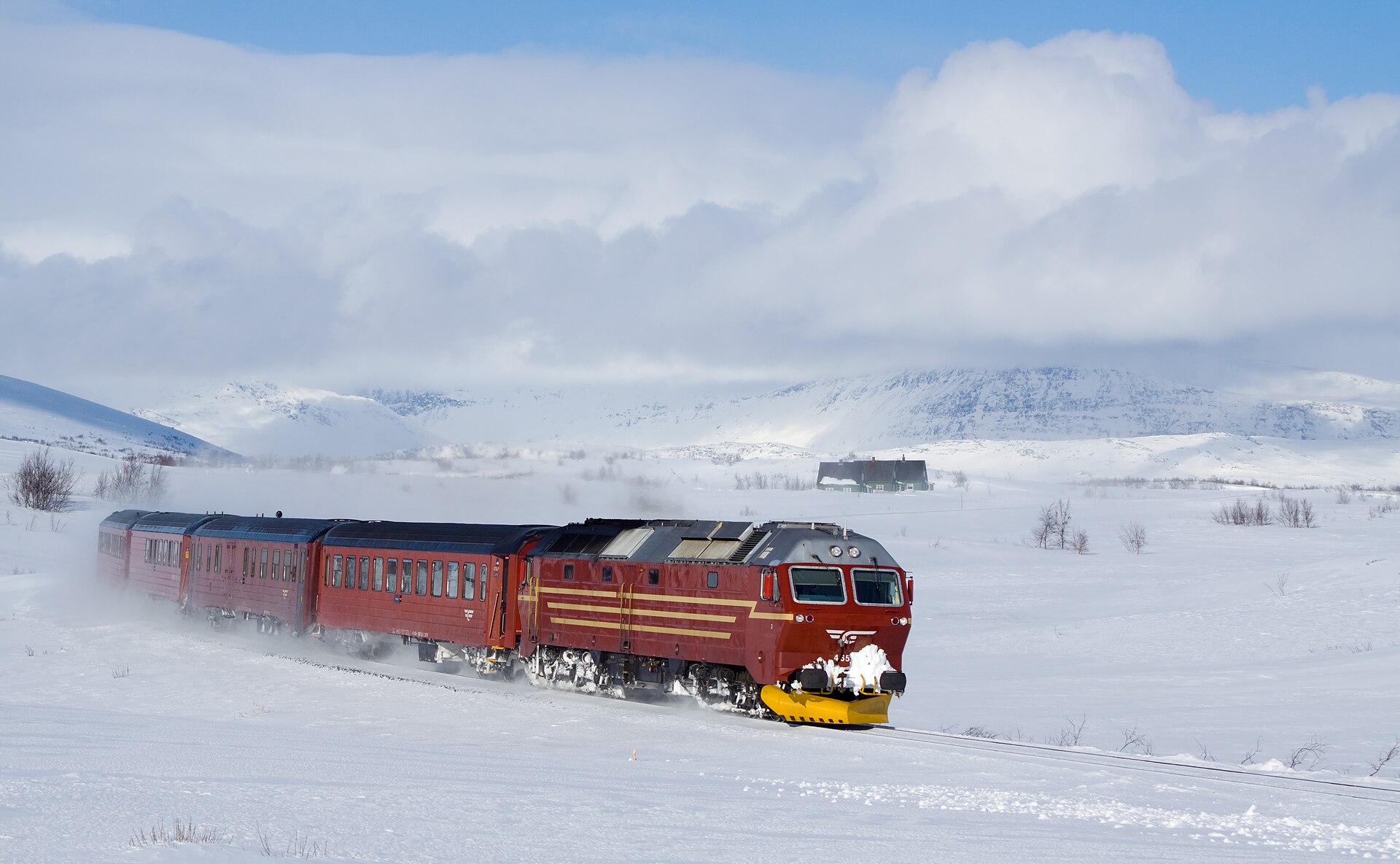
The Nordland Line
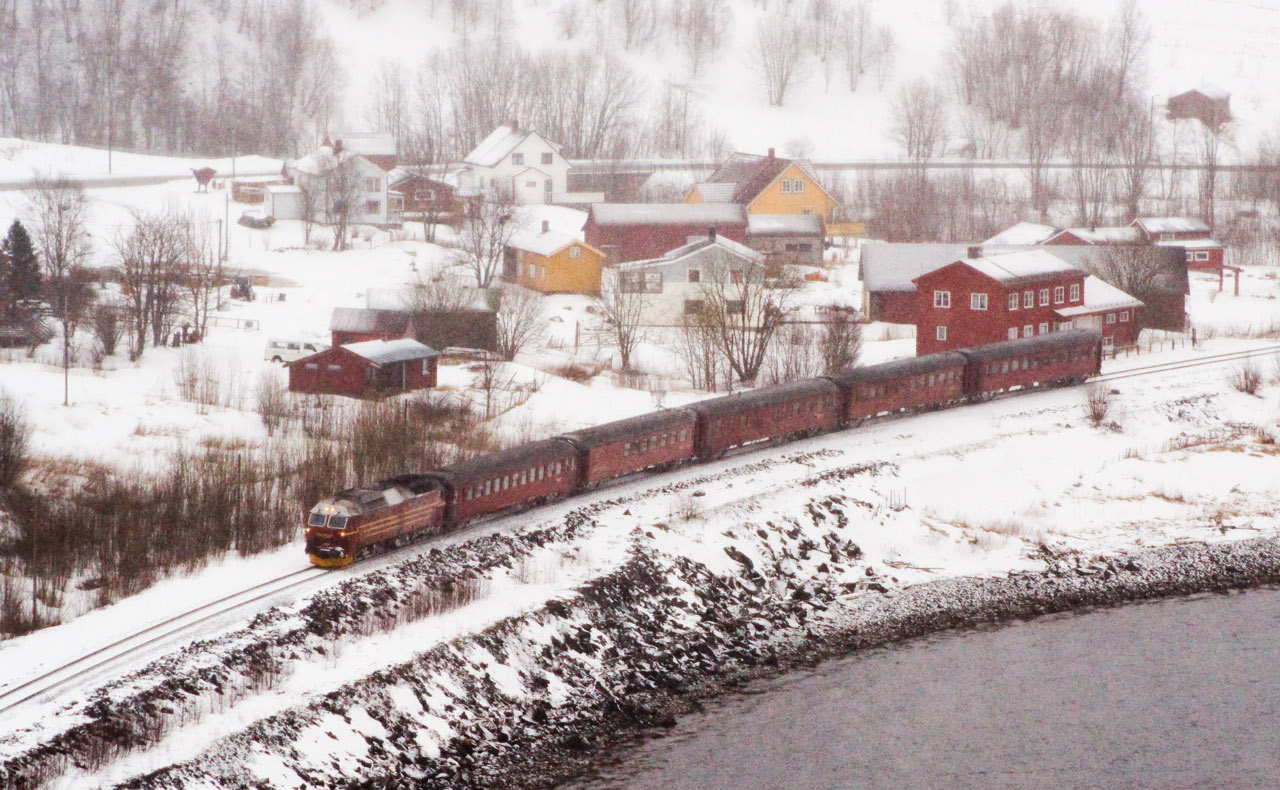
Kabelleger / David Gubler / Wikimedia Commons · CC BY-SA 3.0
- DistanceTrondheim–Bodø · 729 km
- DurationAbout 9 hours 50 minutes
- Best seasonJune–July for the midnight sun · winter for snow and northern lights
Introduction
Ten hours after leaving Trondheim, having run 729 kilometres north up the spine of Norway, the train tips over the edge of the Saltfjellet and begins its long descent to the sea. Somewhere behind you, out on a plateau of bare rock and old snow, it crossed 66 degrees 33 minutes north — the Arctic Circle — and touched its highest point, 680 metres, a mile and a bit further on. From here it is downhill to Bodø, where in June the sun does not set.
The Nordland Line is the longest railway in Norway and, by most reckonings, the finest long ride in the country. It takes in the farms of Trøndelag, the forests of Namdalen, the fjord-and-skerry coast of Helgeland with the Seven Sisters standing over it, the ore country around Mo i Rana, the treeless Arctic plateau, and finally the long green run down to the fjords of Salten. Norwegian television once filmed the whole thing four times over — once in each season — and broadcast nine hours and fifty minutes of it on a Saturday night in December 2012. More than a million people watched.
But the line has a second story, and it is not a comfortable one.
The railway crept north for eighty years, arriving at Steinkjer in 1905 and Grong in 1929, funded in fits and starts by a country that could not really afford it. Then in 1940 Germany invaded, and the occupiers decided they wanted the line pushed all the way to Kirkenes on the Russian border. Work was handed to the Organisation Todt, and from September 1942 the labour force was supplemented by prisoners of war: by 1945 there were 21,600 of them working on the Nordland and Polar Lines, held in 47 camps strung out along the route. An estimated one in ten did not survive. The embankments you ride over on the northern half of this journey were built by men who were not free, and thousands of whom died doing it.
You pass the evidence. Just beyond Rognan, two hours short of Bodø, was Botn camp, which held prisoners from Yugoslavia, the Soviet Union and Poland — the youngest of them twelve years old — and was run at first by the SS, who carried out mass executions there. The road the prisoners built alongside the fjord is still called Blodveien, the Blood Road. It got the name in July 1943, when a prisoner was shot beside it and his brother painted a cross on the rock face in his blood.
The line was finally completed to Bodø in 1962, opened by King Olav V on 7 June, and it has been an awkward, magnificent, hard-to-keep-open piece of infrastructure ever since. Recent years have been genuinely brutal: a derailment in October 2024 that killed the driver, a landslide in August 2025 that cut the railway and the main road in half and took ten months to repair, and a locomotive shortage that has kept the night train off the rails since 2024. The line reopened end-to-end only in June 2026.
So this is not a polished tourist product. It is a working railway across a hard country, with one train a day at present, a café car, and a view out of the window that almost nobody else in Europe can offer. The morning departure is the one to have, the left-hand side is the better side going north, and it is a journey that wants the whole day.
The Journey
Trøndelag: the easy part
The train leaves Trondheim S at ten to eight in the morning and spends the first two hours doing something almost suburban. It runs out along the Trondheimsfjord, calls at the airport, and works north-east through Stjørdal, Levanger and Verdal — green, prosperous, gently rolling farm country, the oldest part of the line, opened between 1902 and 1905. This is the stretch that was cut in half by the Nesvatnet landslide of August 2025 and only reopened in June 2026; the temporary railway you cross near Åsen was built out of 5,000 lorry-loads of stone.
Beyond Steinkjer the farms thin. The line follows the long lake of Snåsavatnet, then turns into Namdalen and the character changes for good: forest, river, timber, and very few people. Grong is the last town of any size for a long while. Then the train begins to climb toward Majavatn, a modest summit at 320 metres, and crosses into Nordland county.
Helgeland
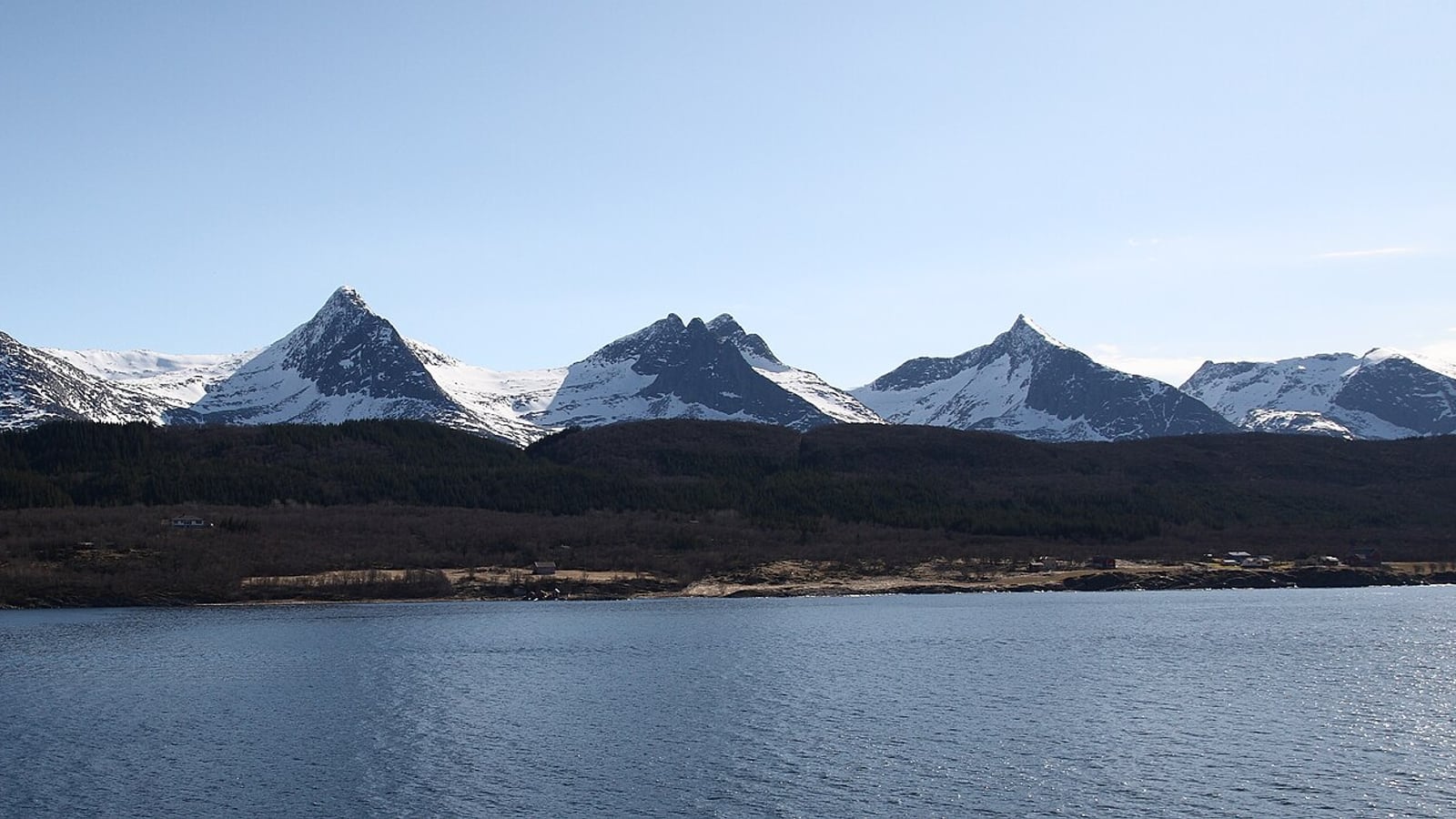
The descent to Mosjøen brings the best-kept secret on the line. From here to Mo i Rana — about ninety kilometres — the railway threads the fjords of Helgeland, a coast of skerries, white beaches, dark water and mountains that come straight up out of it. Out to the west stand De syv søstre, the Seven Sisters, seven peaks in a row along the shore. The train runs along the flanks of the fjords, over river mouths, in and out of short tunnels, with the sea appearing and disappearing.
Mosjøen itself is worth a stop for Sjøgata, a preserved street of old wooden warehouses and houses along the water. Mo i Rana, an hour and a half further on, is a steel and iron-ore town — the Dunderland Valley behind it still sends ore trains down to the smelters — and the practical base for the Svartisen glacier.
Over the Arctic Circle
Out of Mo the line turns inland and starts to climb the Dunderland Valley, at first gently and then, from Dunderland station, at a steady 1.8 per cent for thirty-eight and a half kilometres. The forest gives out. The valley opens into fell. And then you are on the Saltfjellet, a plateau of bare rock, snow patches, small lakes and nothing else at all — the emptiest place the Norwegian railway network reaches.
At kilometre 579 the train crosses the Arctic Circle. There is no announcement in the timetable, no bell, and — because the railway keeps its distance from the road — no close view of the famous stone monument, which stands out on the fell beside the E6. Watch for the cairns that mark the line instead. Less than two kilometres further on, just south of Stødi, comes the summit: 680 metres, the roof of this railway.
Lønsdal, the tiny station on the descent, is the way into Saltfjellet–Svartisen National Park. Then the line falls for the next forty kilometres at the same 1.8 per cent gradient, down through Røkland and Rognan — where the Blood Road and the site of Botn camp lie beside the fjord — to sea level again at the head of the Saltdalsfjord.
Salten and Bodø
The last stretch is a beauty and a relief in equal measure. The train hugs the shoreline north to Fauske, the junction that was the end of the line from 1958 to 1962, then turns west for the final fifty-four kilometres to the coast. Tverlandet, two stops from the end, is fifteen minutes from Saltstraumen, where the tide forces four hundred million cubic metres of seawater through a 150-metre gap every six hours and throws up whirlpools ten metres wide.
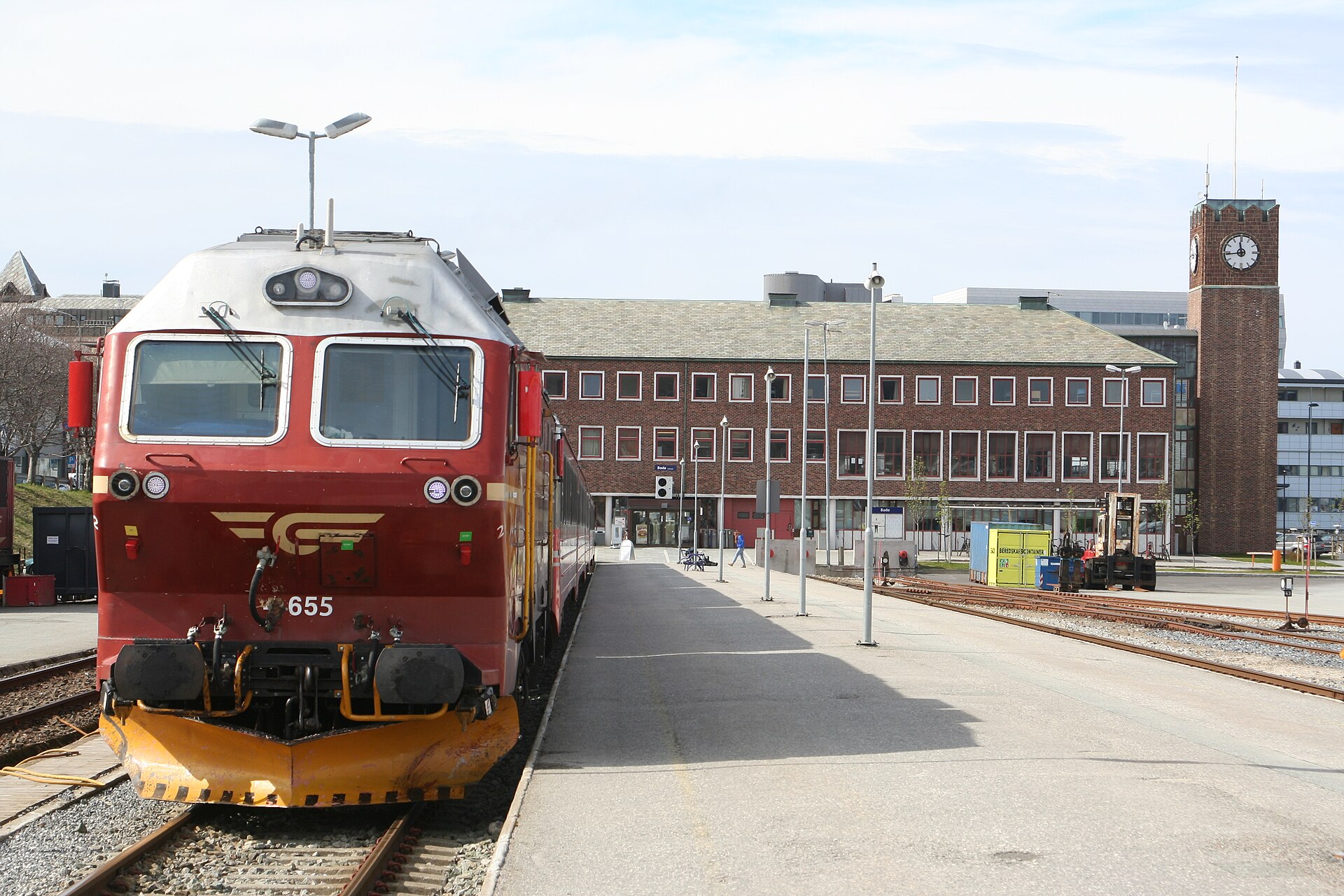
Then Bodø: a modern, low-rise town, unremarkable at first glance and completely redeemed by where it is. The station is the northernmost point of Norway's own connected railway network — Narvik, far further north, has rails, but they only reach the rest of Norway by going through Sweden. From here it is the Lofoten ferries, the coastal steamer and the buses. In June the train arrives at twenty to six in the evening and the sun stays up all night. In December it arrives in the dark, which has its own case to make.
A note on the light and the seat
Going north, the coast is on your left. Going south, it is on your right. Either way the mountains are on the other side, so nobody loses. What matters more is the season: June and early July for the midnight sun and green fells, September for autumn colour on the Helgeland rapids, and midwinter for snow, blue light and a real chance of the aurora — but with only a few hours of daylight, so you will do part of the journey blind.
Along the route
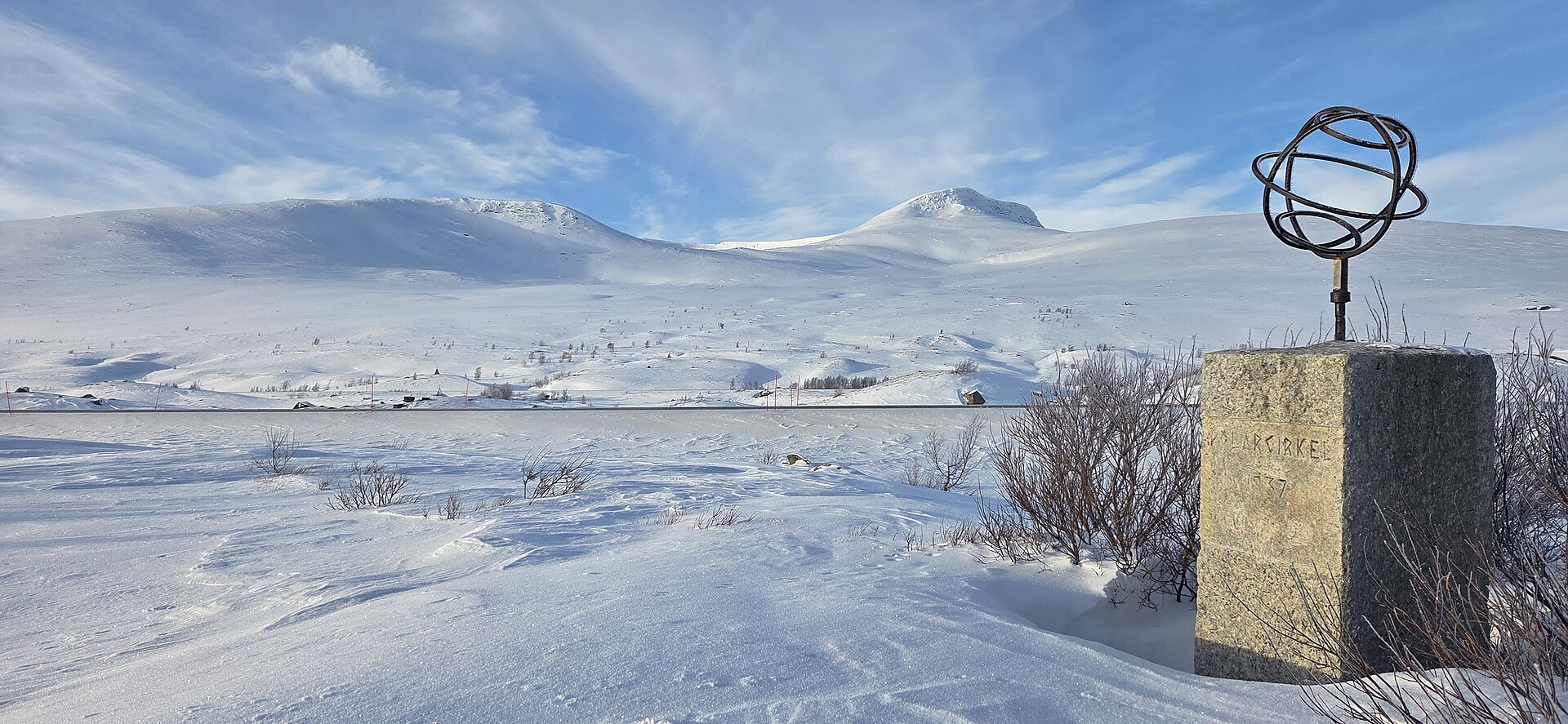
Wolfgang Hägele / Wikimedia Commons · CC BY-SA 4.0Crossing the Arctic Circle
The moment everyone waits for comes about seven hours out of Trondheim. The train climbs onto the Saltfjellet, a bare plateau above the tree line, and at kilometre 579 crosses 66°33′ north. Two kilometres later it touches its highest point and begins the long fall to the sea.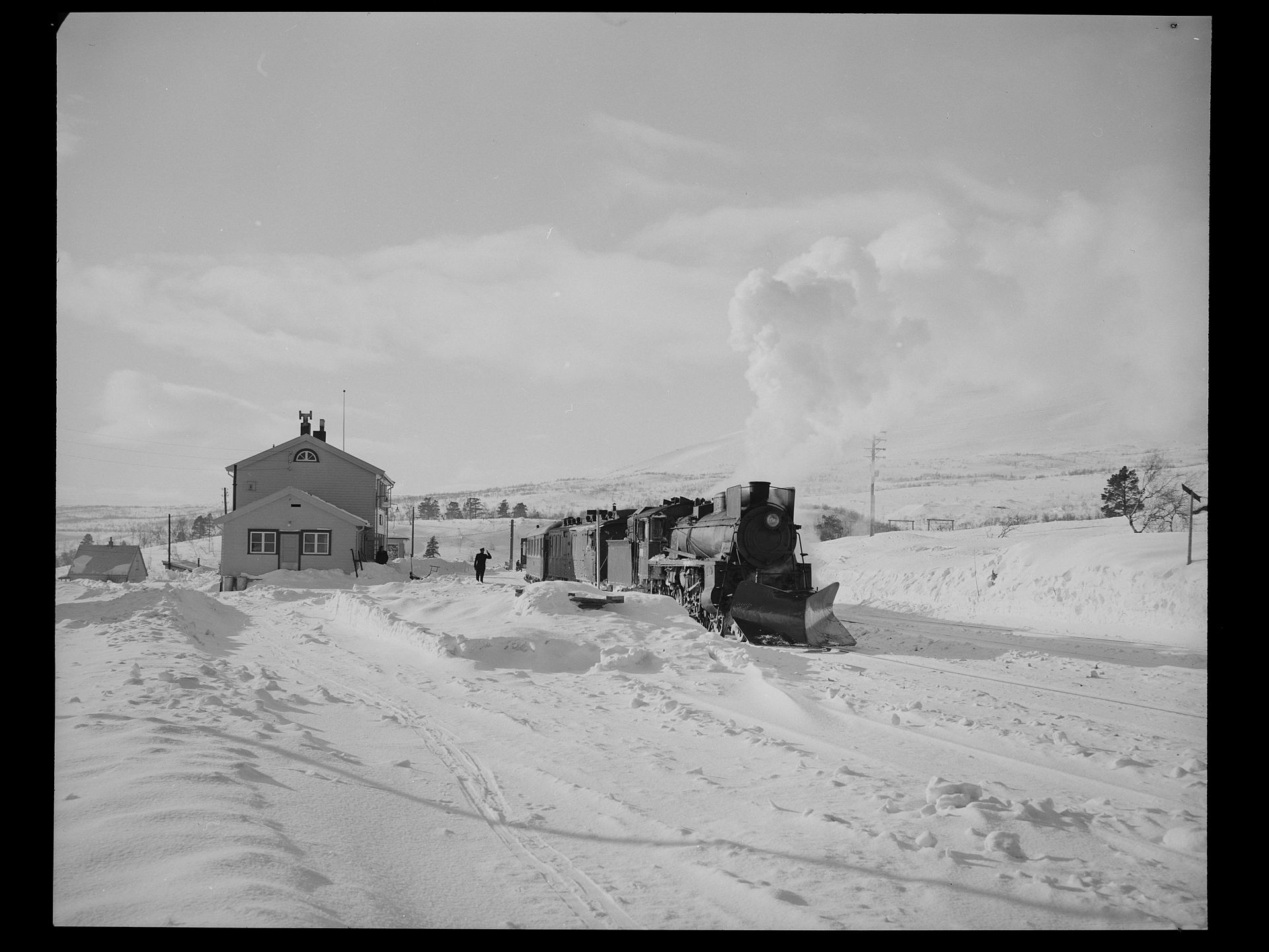 Jac Brun / National Library of Norway / Wikimedia Commons · Public domain
A line built by prisoners
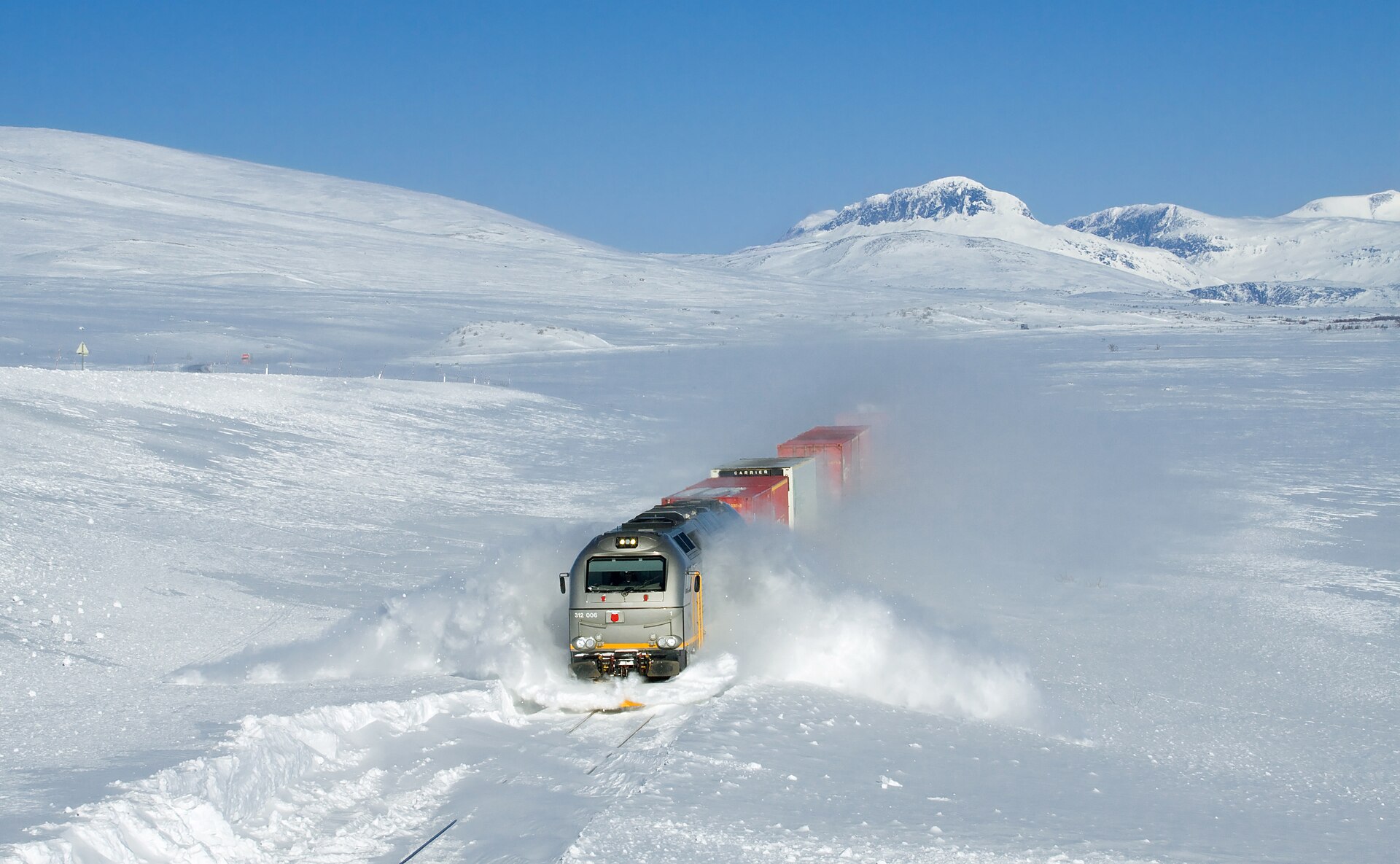
The northern half was finished under German occupation, and the men who built it were not volunteers. From September 1942 the workforce was prisoners of war — 21,600 of them by 1945, in 47 camps — and an estimated one in ten died. The track is, among other things, their monument.bobaffe / Wikimedia Commons · CC BY 2.0Ninety kilometres of the Helgeland coast
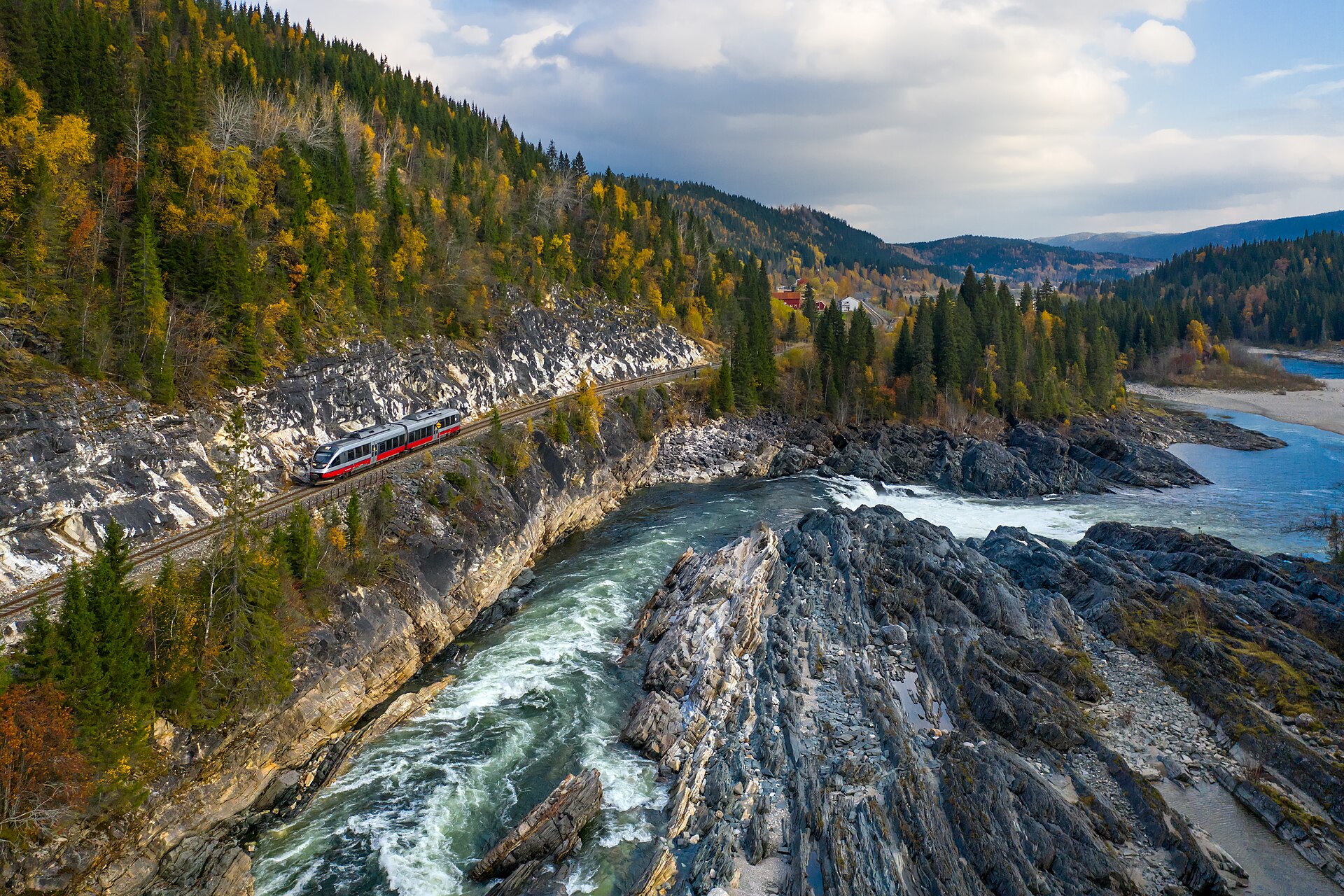
Between Mosjøen and Mo i Rana the railway works its way around the fjords of Helgeland — skerries, white-sand islands and sudden mountains. It is the loveliest stretch of the journey and the one nobody warns you about, because everyone is looking ahead to the Arctic Circle.A bit of history
Culture & experiences along the way
Kabelleger / David Gubler / Wikimedia Commons · CC BY-SA 3.0Ride it in the midnight sun
North of the Arctic Circle the sun does not set at all for several weeks around midsummer — at Bodø, from early June to early July. Take the morning train from Trondheim and you arrive in the late afternoon with an entire bright night ahead of you — no dusk, no dark, just a long amber evening that never quite ends. In midwinter the same latitude gives you the opposite: a few blue hours, and a decent chance of the northern lights.Frankemann / Wikimedia Commons · CC BY-SA 4.0Break the journey at Lønsdal
The little station of Lønsdal, up on the Saltfjellet less than two hours short of Bodø, is the doorway to Saltfjellet–Svartisen National Park — and to Svartisen, the largest glacier in northern Scandinavia. It is empty, silent country where motor vehicles are banned, and the railway is the civilised way in. Check the return times carefully first: there are very few trains.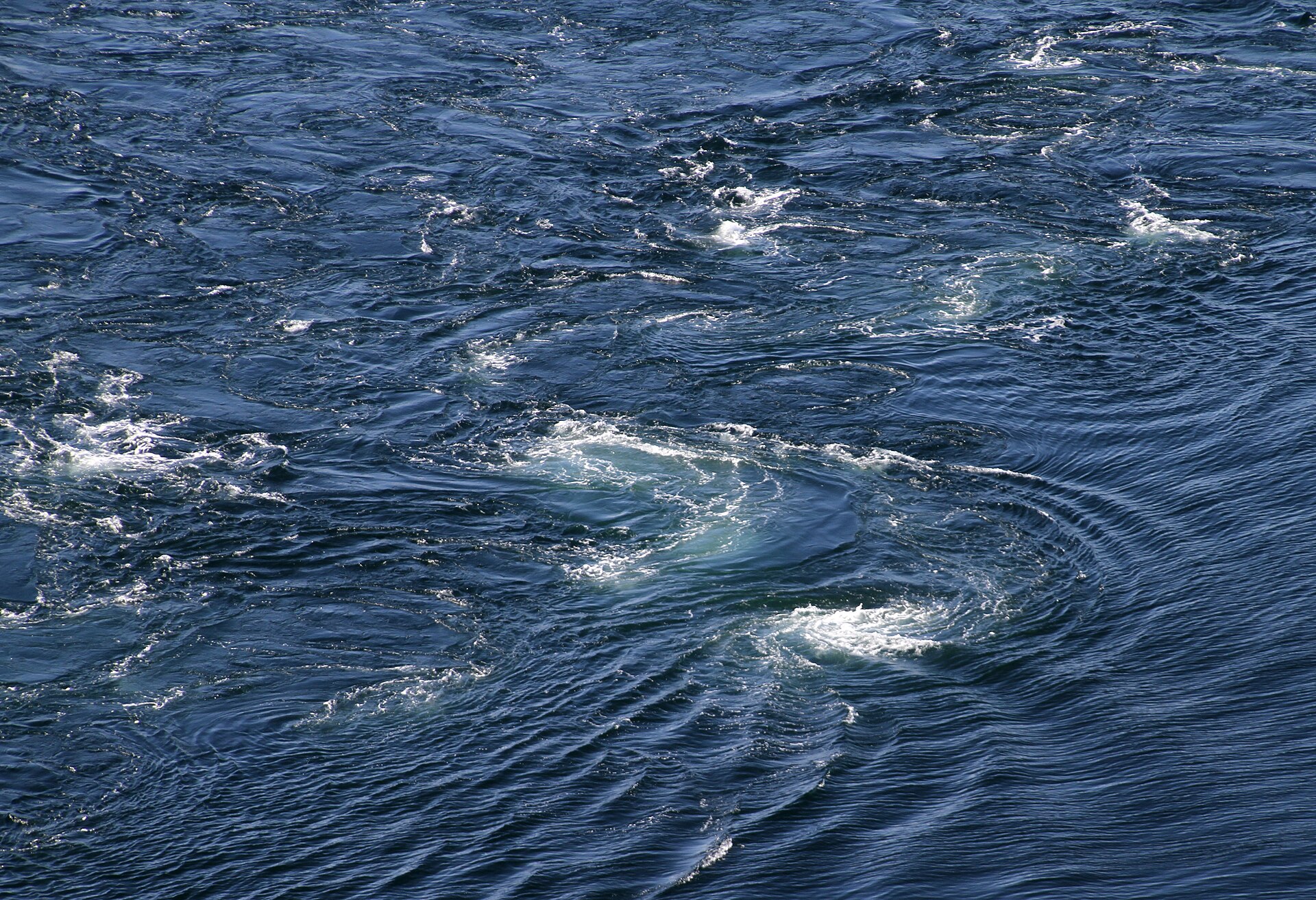 Gerd Eichmann / Wikimedia Commons · CC BY-SA 4.0
See the world's strongest tidal current
Two stops before Bodø, get off at Tverlandet and you are about fifteen minutes from Saltstraumen, where up to 400 million cubic metres of seawater force through a strait 150 metres wide every six hours. It is one of the strongest tidal currents in the world, it throws up whirlpools as much as ten metres across, and March — when the tidal range is greatest — is when it runs hardest.Timetables
Read this section before you plan anything. The Nordland Line has had an extraordinarily difficult two years and the service is currently thinner than normal.
What is actually running (July 2026)
One through train each way per day, operated by SJ Norge as line F7, plus part-route workings and the Bodø-end commuter service. There is no night train at present — see below.
| Northbound (tog 471) | Southbound (tog 472) | ||
|---|---|---|---|
| Trondheim S | 07:49 | Bodø | 12:27 |
| Steinkjer | 09:51 | Fauske | 13:16 |
| Grong | 11:00 | Lønsdal | 14:12 |
| Mosjøen | 13:20 | Mo i Rana | 15:45 |
| Mo i Rana | 14:31 | Mosjøen | 16:55 |
| Lønsdal | 15:51 | Grong | 19:14 |
| Fauske | 16:53 | Steinkjer | 20:24 |
| Bodø | 17:38 | Trondheim S | 22:13 |
That is 9 hours 49 minutes northbound and 9 hours 46 minutes southbound.
Part-route trains. Tog 477 leaves Trondheim at 16:00 for Mo i Rana, and tog 474 leaves Bodø at 17:46 for Mosjøen — useful for breaking the journey or for reaching the Helgeland coast. At the northern end, the Saltenpendelen (line R75) runs several times a day between Bodø and Fauske/Rognan, about an hour to Rognan.
The night train: suspended
The Trondheim–Bodø sleeper has not run since October 2024. The cause is a locomotive shortage: the fleet on this line is around forty-five years old with more than ten million kilometres on it, and there are not enough serviceable machines. Four diesel locomotives are being leased from Grenland Rail to plug the gap, but they need rebuilding and approval first. As of April 2026 the national broadcaster reported the night train was expected back in "early autumn" 2026, having already slipped from summer.
SJ's own route page still advertises "two daily departures each way, one of them the night train." That is out of date. Check live departures before you rely on a sleeper.
Recent disruption, and why the line looks fragile
- 24 October 2024 — a Trondheim–Bodø train struck a fallen rock near Finneidfjord and derailed down the embankment toward the E6. The driver was killed and four passengers were taken to hospital. The railway and the main road were closed for weeks; freight resumed on 30 November and passenger trains on 2 December 2024.
- 30 August 2025 — a quick-clay landslide at Nesvatnet near Levanger washed out both the railway and the E6, killing a Danish railway worker. The line was severed for about ten months. Bane NOR removed 10,000 lorry-loads of loose material, brought in 5,000 of stone and laid 750 metres of temporary railway; the first train ran past the site on 22 June 2026.
Large parts of this railway are built on quick clay, and much of the rest runs beneath loose rock. Landslides and rockfall are a recurring fact of life on it, not a freak event. That is not a reason to avoid the line — it is a reason to check the day before you travel.
Operator: SJ Norge — sj.no (opens in a new tab). Live times, tickets and disruption notices for every Norwegian train are on the national planner, Entur.
Tickets
Tickets come from SJ Norge, who hold the contract for northern Norway, or from Entur, the national planner that sells every Norwegian train and is easier if you are stringing legs together. Fares work on the advance-purchase model: a limited allocation goes on sale well ahead of each departure and the price rises as they sell, and on a ten-hour journey that difference is substantial. Premium Pluss buys SJ's best seats for a supplement, which is worth thinking about in a landscape you have come a long way to see.
Reservations are included with long-distance tickets — ask for a window, and going north the coast and the Helgeland fjords are on your left. ⚠️ Do not book a berth expecting one: the night train has been suspended since October 2024. Interrail and Eurail are valid, with the reservation payable separately.
Book your tickets
Day train · Trondheim to Bodø
The full 729 kilometres in daylight
The one through working each way, taking a little under ten hours, with a café car on board and SJ's reclining Premium Pluss seats available at a supplement. Book ahead for the cheap advance fares. In summer the northbound train arrives in Bodø in time for a bright Arctic evening.
Book Tickets (opens in a new tab, on SJ Norge)via SJ NorgePart of the line · Trondheim to Mo i Rana or Mosjøen
Shorter runs on the Helgeland section
If ten hours is too much, extra trains cover the southern and middle sections — Trondheim to Mo i Rana, and Bodø down to Mosjøen — which between them take in the Helgeland fjords and the Seven Sisters. Useful for breaking the journey, and for reaching the coastal ferries and the Helgeland islands.
Book Tickets (opens in a new tab, on SJ Norge)via SJ NorgeRail Passes
Interrail passes are valid. Interrail's table of railway companies lists SJ Norge as included in Norway, day and night trains alike, so Trondheim to Bodø is covered by a one-country Interrail Norway Pass, the Interrail Nordic Pass or a Global Pass. Interrail advises always reserving in Norway. A second-class seat reservation on SJ Norge's day train costs €4.30; on the night train a seat is €4–6 and a sleeping compartment for one or two €86–107. A seat is free to reserve with a first-class pass.
For a single trip, a pass rarely pays. Advance fares sell cheaply well ahead. A pass is worth it when the Nordland Line is one leg of a longer trip north, or when you book too late for the cheap fares.
Checked October 2026 against interrail.com (opens in a new tab), Interrail's Norway page (opens in a new tab) and its domestic (opens in a new tab) and night-train (opens in a new tab) reservation fees.
Places to Visit
The Nordland Line covers 729 km and crosses the Arctic Circle on the way, so the places along it are spread far enough apart that you have to choose rather than collect. Almost none of them is a day trip from anywhere else.
Two things worth knowing about the ends. Bodø is a Hurtigruten port, so you can step off the train and onto the coastal steamer for the run north to Tromsø; it is also the ferry port for the Lofoten islands, a little over three hours away, which for a lot of people is the real reason for taking this line at all. At the southern end, the Dunderland Valley behind Mo i Rana still carries ore trains down from the mines — 3,400-tonne loads of hopper wagons, six times a day — a reminder that this is a working freight railway that happens to run through spectacular country, not a tourist line.
The Helgeland coast west of the railway is the part most visitors miss. Buses and boats from Mosjøen and Sandnessjøen reach the island communities of Lovund and Træna, which have white beaches, improbably sharp mountains and almost no through traffic at all.
 Øyvind Nohr Søderbom / Wikimedia Commons · CC BY-SA 3.0 · cropped
Bodø and Kjerringøy
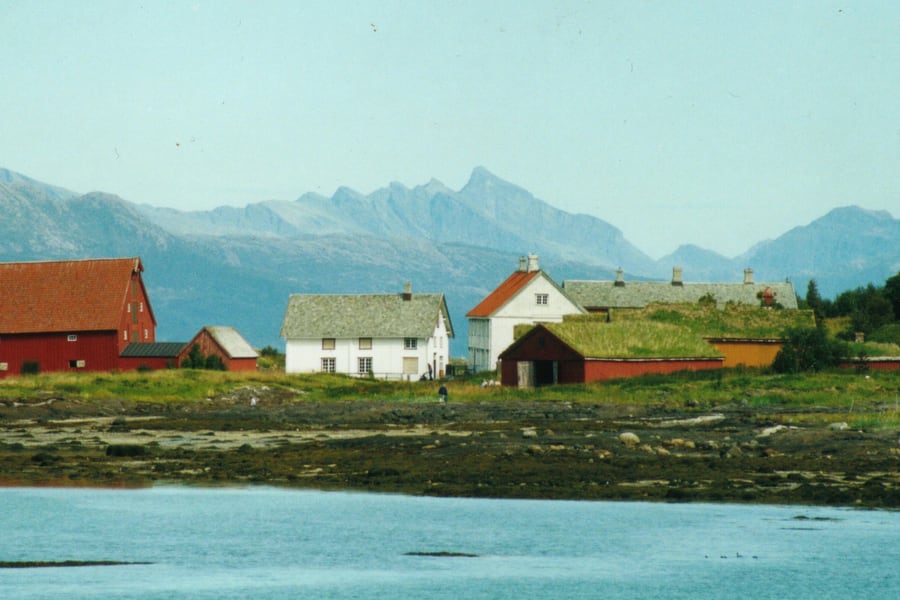
The town keeps its best cards just outside it. Saltstraumen, ten kilometres away, is one of the strongest tidal currents in the world — up to 400 million cubic metres of water through a 150-metre strait every six hours, throwing whirlpools ten metres across. Kjerringøy, up the coast, is a preserved nineteenth-century trading post.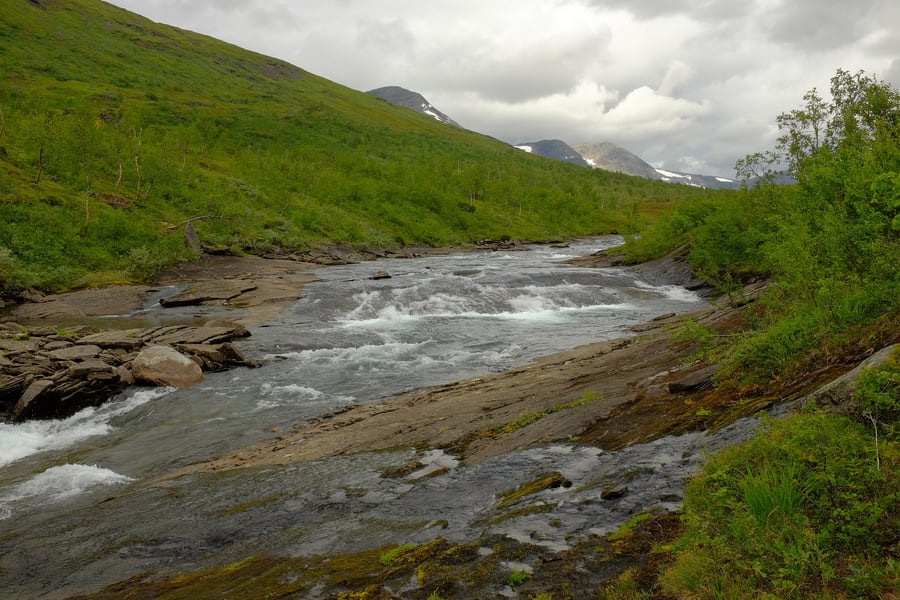 Frankemann / Wikimedia Commons · CC BY-SA 4.0 · cropped
Saltfjellet and Svartisen
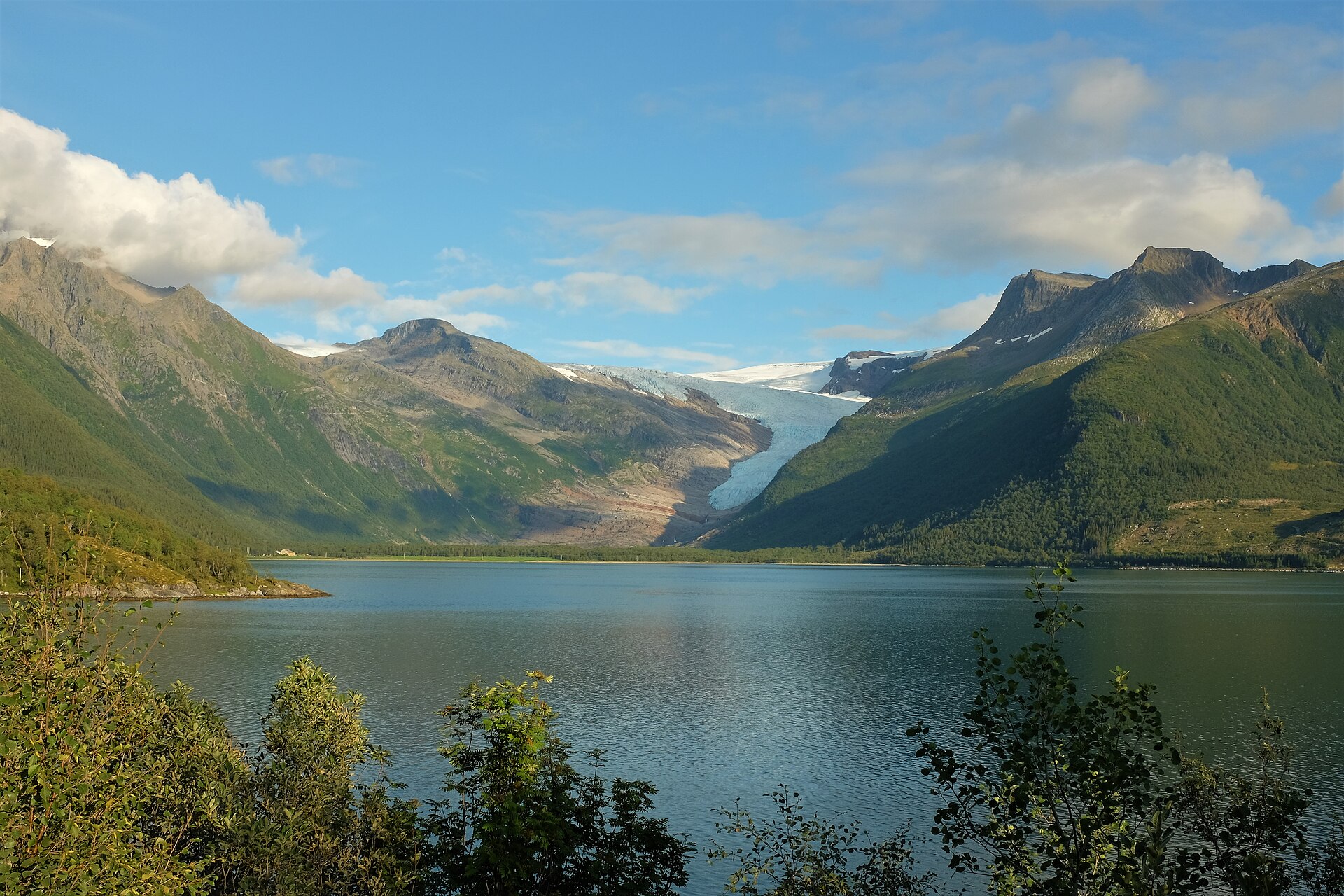
Lønsdal, up on the plateau, is the station for Saltfjellet–Svartisen National Park — high, empty country where motor vehicles are banned and the silence is the point. Svartisen, the largest ice cap in northern Scandinavia, sends glacier arms down almost to sea level; Engabreen is reachable by boat and a short walk from the coast road.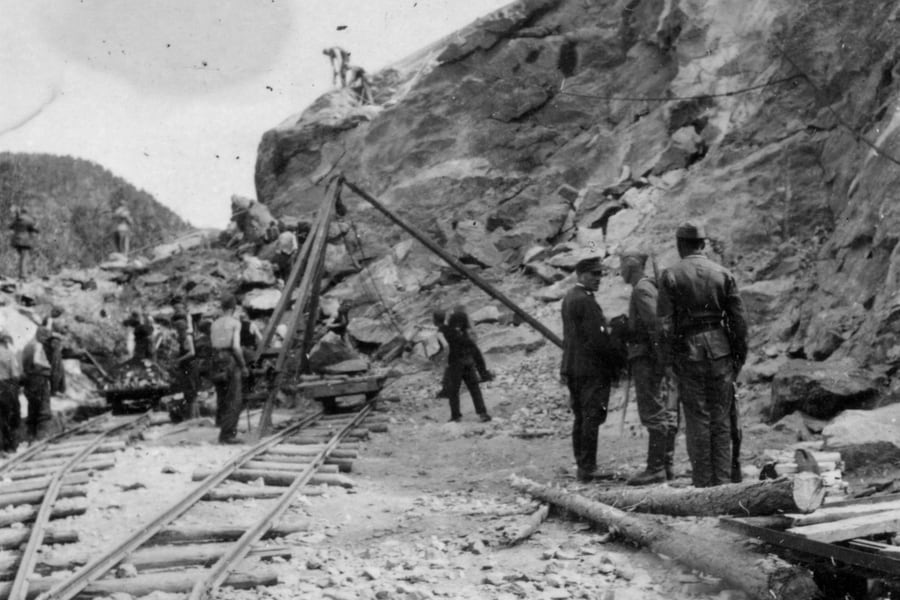 Blodveimuseet / Wikimedia Commons · CC BY-SA 4.0 · cropped
Rognan and the Blood Road
Just beyond Rognan, Botn was one of five original prisoner-of-war camps in northern Norway, holding men from Yugoslavia, the Soviet Union and Poland; the youngest were twelve years old. Of roughly 900 prisoners, about half died. The road they built is still called Blodveien — the Blood Road. There is a museum at the site, and there are war graves.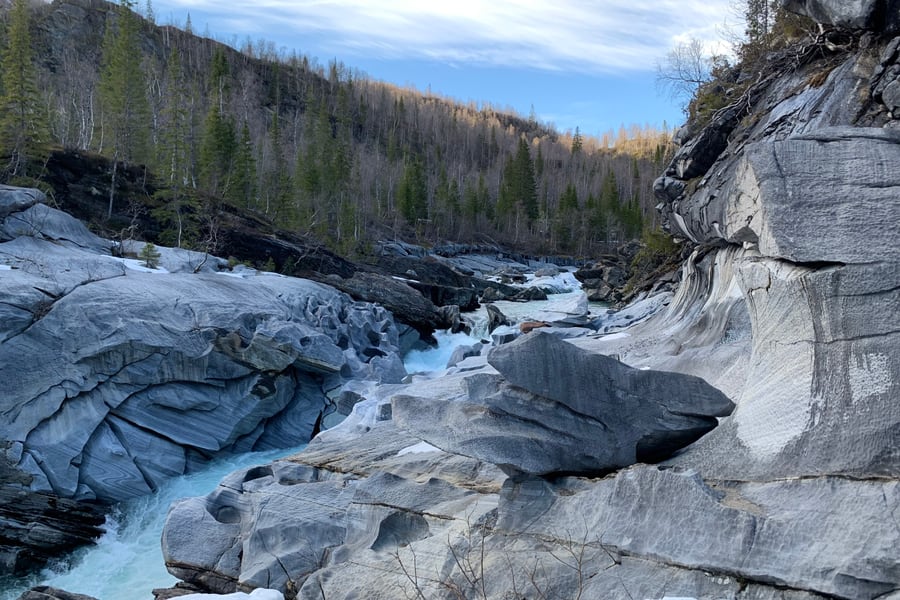 Casey Brown / Wikimedia Commons · CC BY-SA 4.0 · cropped
Mo i Rana
An iron town in a spectacular setting, and the gateway to the Grønligrotta and Setergrotta limestone caves and to the Arctic Circle Centre up on the E6. Just outside it is Marmorslottet, the "marble castle", where meltwater off Svartisen has scoured the Glomåga's pale rock into smooth bowls and channels you can walk down into.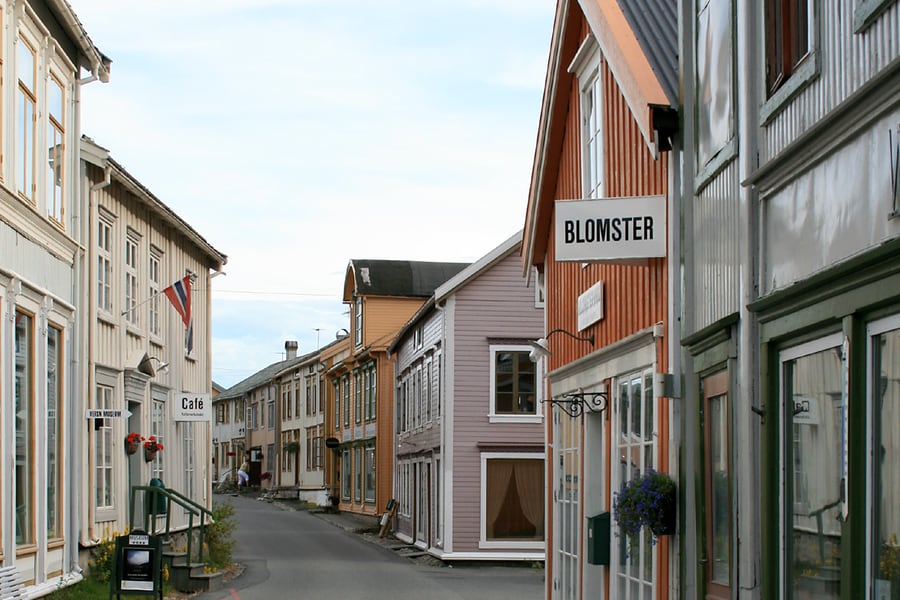 Mahlum / Wikimedia Commons · public domain · cropped
Mosjøen
Sjøgata is a long row of preserved wooden warehouses and houses along the Vefsna, and the best-kept street of its kind on this coast. The town sits under Øyfjellet, which has a via ferrata and a zip line on it, and is the railhead for Helgeland — buses and boats reach Vega, the World Heritage archipelago whose islanders farmed eider ducks for down.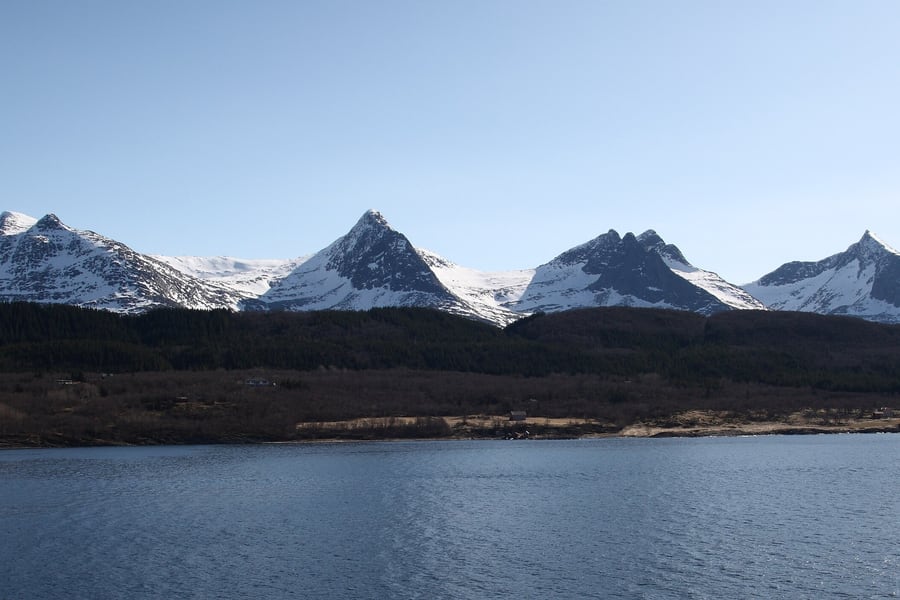 bobaffe / Wikimedia Commons · CC BY 2.0 · cropped
The Seven Sisters
Between Mosjøen and Sandnessjøen, seven peaks stand along the coast in a line: De syv søstre. They are visible from the train on the Helgeland stretch, and the whole ridge can be walked in a single very long day by the properly equipped — the classic local challenge, and one a lot of people underestimate.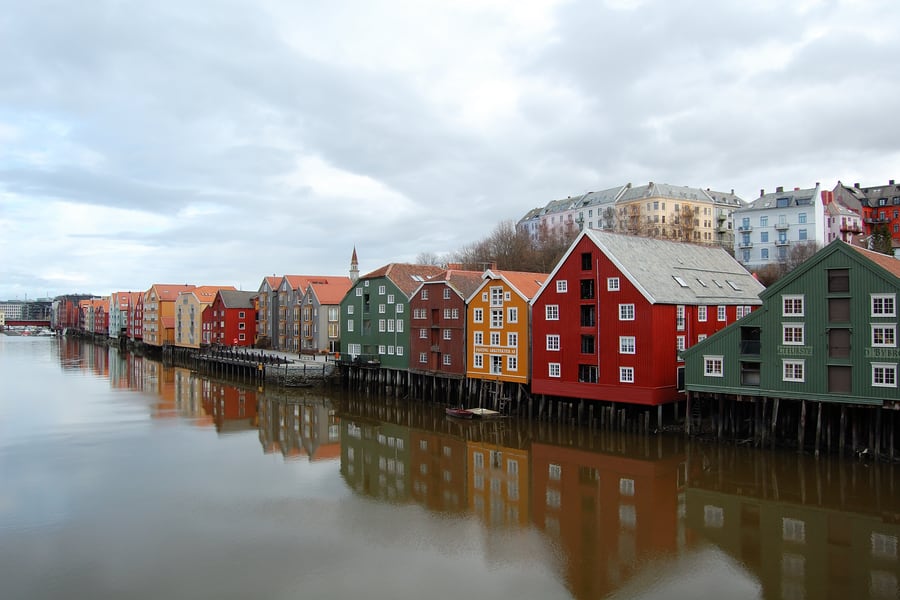 Petr Šmerkl, Wikipedia · CC BY-SA 3.0 · cropped
Trondheim
The southern end deserves a night of its own. Nidaros Cathedral, built over the grave of St Olav, is the northernmost medieval cathedral in the world and Norway's coronation church; the Old Town Bridge and the wooden warehouses on stilts along the Nidelva are the postcard view; and Bakklandet behind them is the best of the city to eat and drink in.Where to Sleep
With one through train a day in each direction at present and no sleeper running, sleeping arrangements matter more on this line than on most. The good news is that the timetable gives you a natural pattern: ride north one day, stay, ride back another — or better, break the journey in the middle and give the Helgeland coast a night of its own.
Bodø, at the northern end, has the widest choice: business hotels around the harbour and the station, apartments, a hostel and campsites out toward Saltstraumen. Everything is walkable from the platform. Book ahead in summer, when the town fills with people heading for Lofoten, and around the ferry departures.
Fauske and Rognan, an hour or so short of Bodø on the Saltenpendelen, have small hotels and cabins and are considerably cheaper. Rognan is the base for the Blood Road museum and the Saltdal valley.
Lønsdal, up on the Saltfjellet, has a mountain lodge close to the station — a genuinely remote place to spend a night above the Arctic Circle, and the right base for walking into Saltfjellet–Svartisen National Park. Check the train times both ways before committing: there are very few.
Mo i Rana and Mosjøen are the obvious mid-route stops and the two best places to break the journey. Both have proper hotels, both are on the main train, and both put you within reach of the coast — Mo for Svartisen and the caves, Mosjøen for Sjøgata and the boats out to the Helgeland islands. Splitting the journey here turns a ten-hour endurance ride into two very pleasant half-days.
Grong and Steinkjer, in the south, are useful if you are travelling from Trondheim in the afternoon on one of the part-route trains.
Trondheim itself has everything, and the area around the station and the Nidelva warehouses is the pleasant end of it. If you are taking the 07:49 north, sleep near the station — it is a very early start for a very long day.
A practical warning: do not plan a tight onward connection at Bodø. Ferries to Lofoten, the Hurtigruten sailing and the flights south all leave on their own schedules, and this railway has been unusually prone to delay and disruption over the past two years. Give yourself a night at the end.
Questions or corrections
Planning this trip and stuck on something, or spotted a time, fare or detail that has changed? Send us a message about The Nordland Line. We read every one, and we update this page when something has changed.