Nova Gorica to Venice
Moliva / Wikimedia Commons · CC BY-SA 4.0 · cropped
- DistanceNova Gorica–Venezia Mestre · about 167 km
- Duration2 h 33 to 2 h 53
- Best seasonWeekends all year · spring and autumn for the vineyards
Introduction
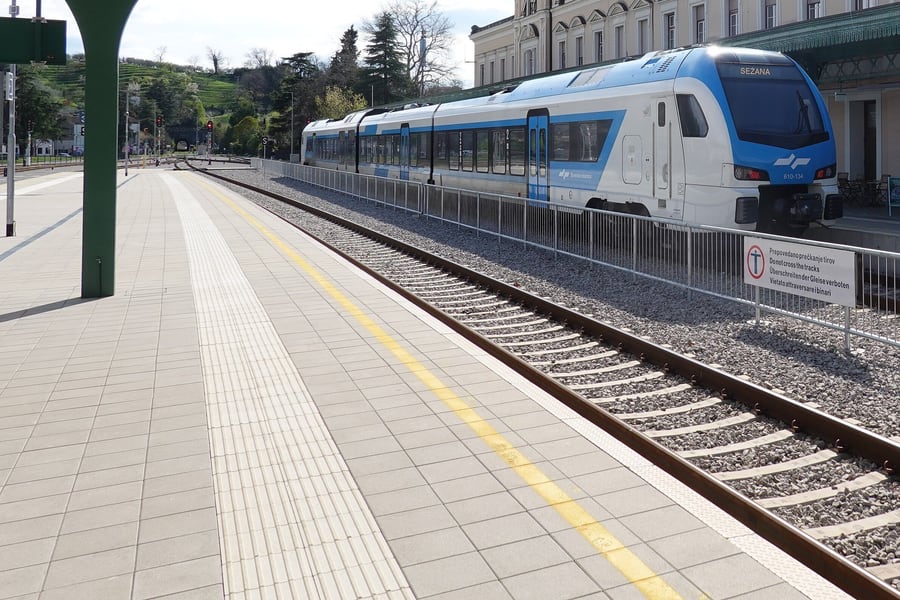
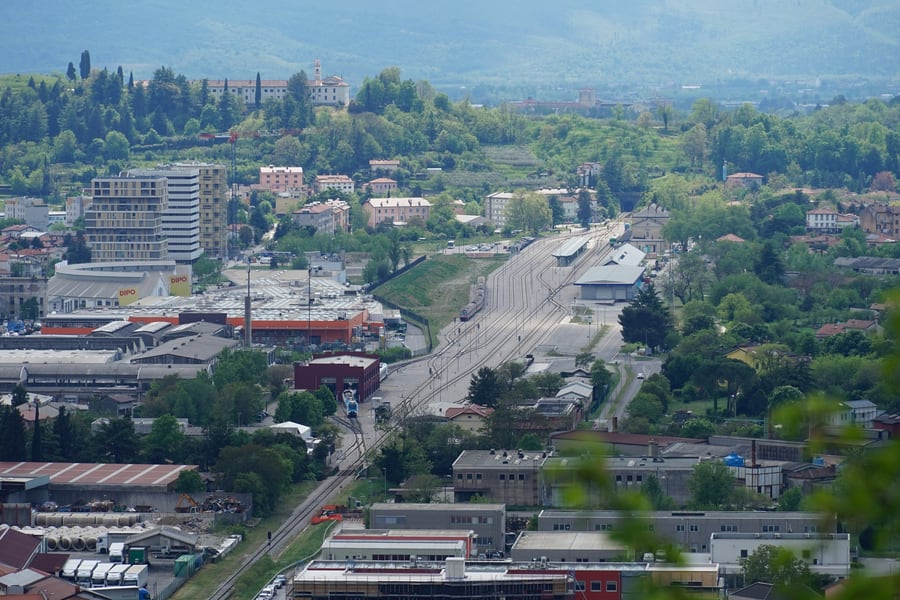
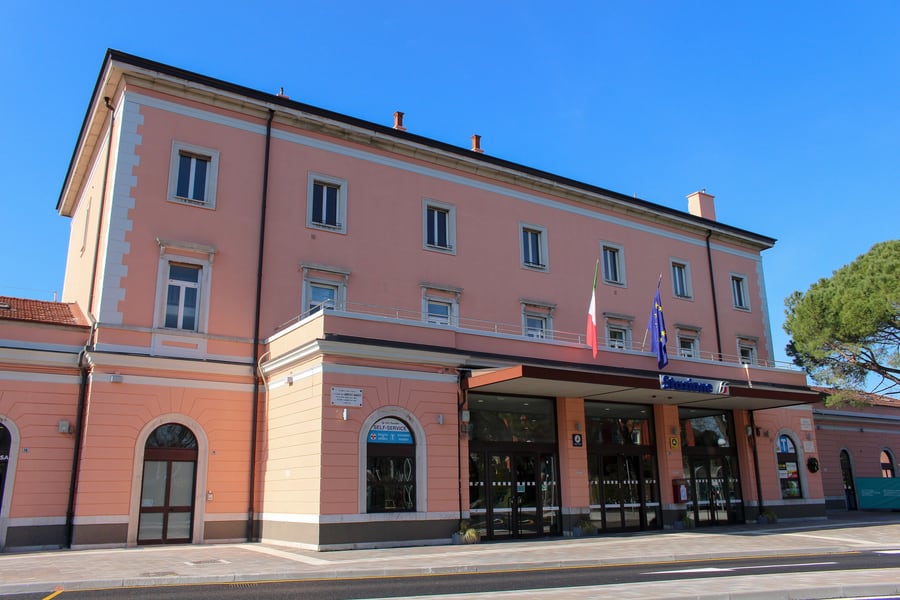
Nova Gorica station was built by Austria in 1906 to serve Gorizia, and named for it. In 1947 the Paris Peace Treaty gave Gorizia to Italy and the station to Yugoslavia, with the new frontier running across the square outside its front door. Yugoslavia built a new town behind the station and called it Nova Gorica, New Gorizia. For more than half a century a wall stood across the square, and a red star hung on the station pediment, facing Italy.
The wall came down in 2004, when Slovenia joined the European Union, and free movement across the square followed in December 2007. Through trains took longer. Since 8 February 2025, set up for the year Nova Gorica and Gorizia shared as European Capital of Culture, Trenitalia and Slovenske železnice have run a direct train from the station to Venezia Mestre every Saturday and Sunday.
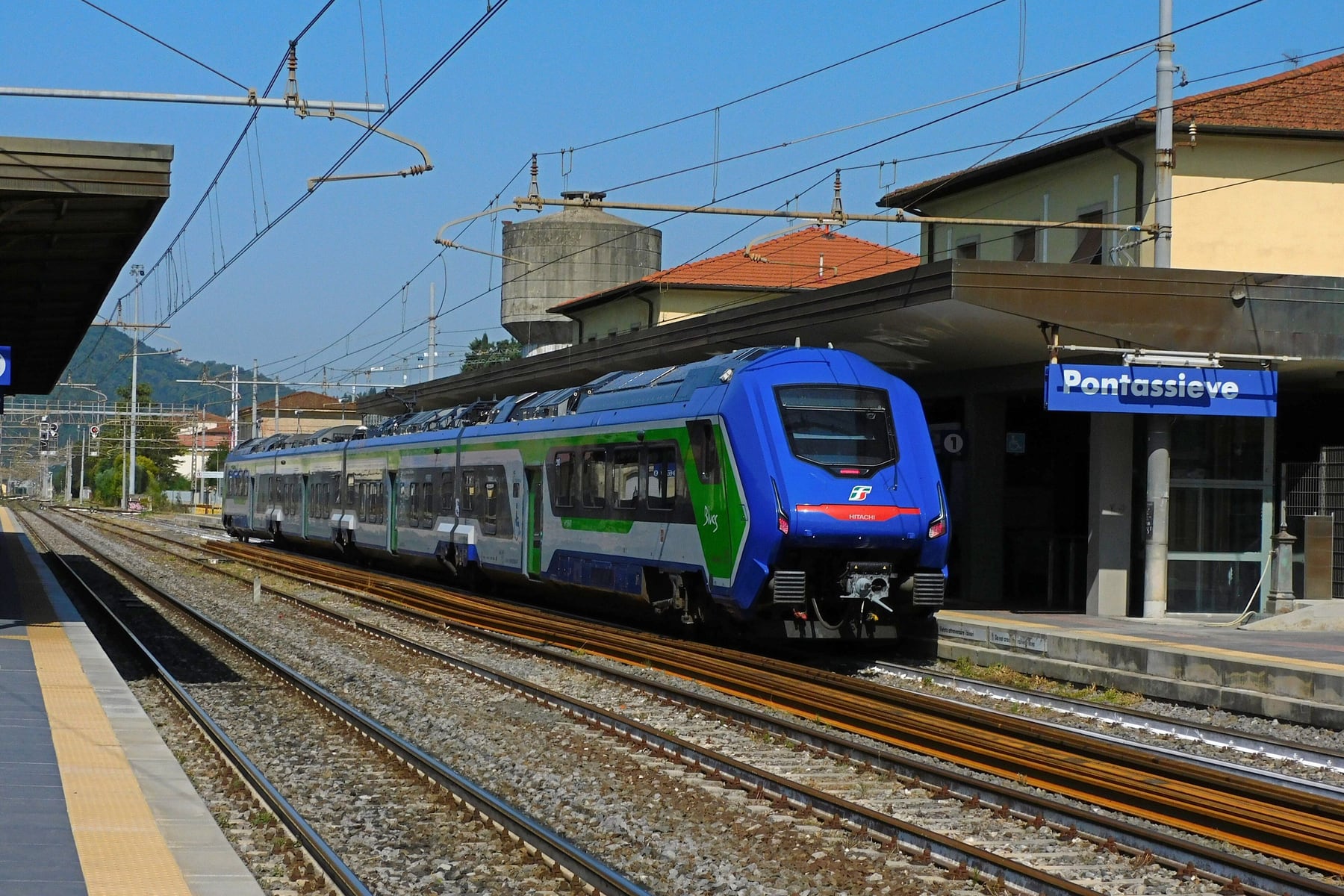
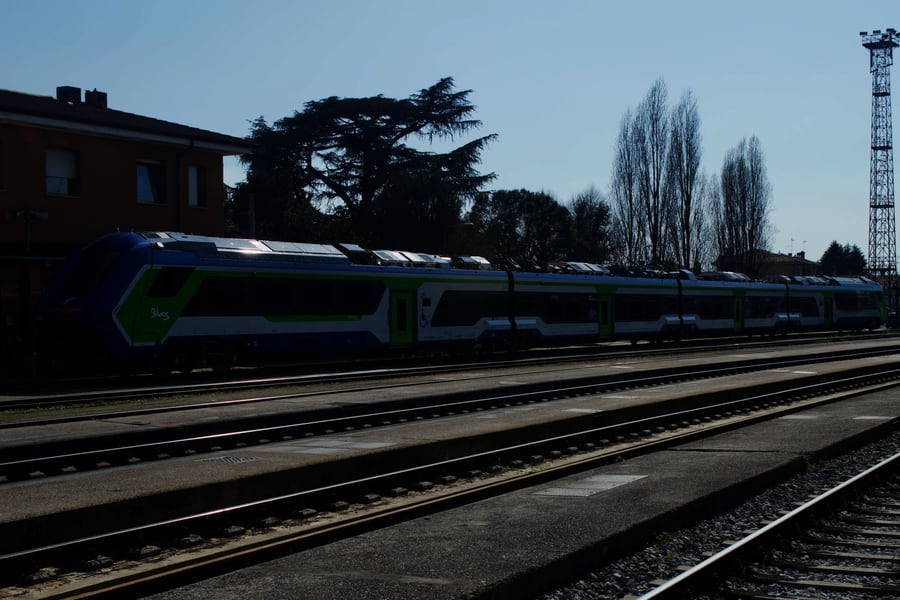
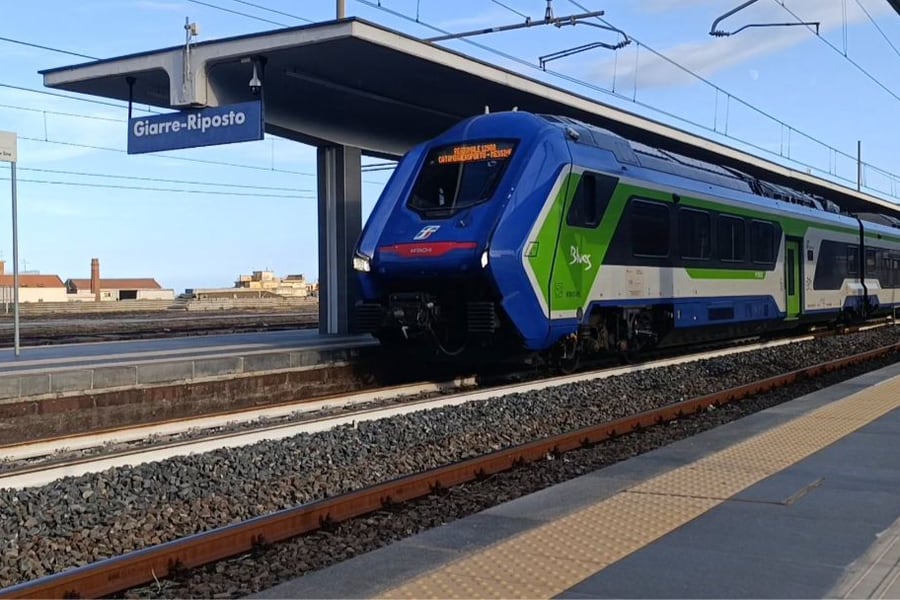
It is a short international journey. The train leaves Slovenia within five kilometres and spends the rest of its 167 kilometres in Italy: through Gorizia, across the Friulian plain to Udine, then west through Pordenone, Conegliano and Treviso to the edge of the Venetian lagoon, in under three hours. The units are Hitachi's multi-mode Blues, because the first stretch, the old link from Gorizia, has no overhead wires.
The Journey
The train starts at the platform side of the station, with the border square on the other side of the building. It runs south on the single-track link through Vrtojba and crosses into Italy after about five kilometres. The link is 7.5 kilometres long, unelectrified, and was reopened to international traffic on 13 October 1960 after thirteen years cut at the border. Until December 2021 its trains were still signalled by telephone block. With no wires to draw on, the Blues covers this stretch on its own diesel or battery power.
At Gorizia Centrale, opened in 1860 as the Austrian Southern Railway's station for Görz, the train waits about ten minutes before joining the main line from Trieste. West of the town it crosses the Isonzo, then the Torre, and passes Cormons, which was the frontier station between Austria and Italy from 1866 until 1918. It reaches Udine in about fifty minutes from Nova Gorica.
Across the plain
From Udine the train takes the Venice–Udine railway, completed in 1860 and electrified at 3,000 volts in 1960. Between Udine and Codroipo it runs on the longest straight on the Italian network: 20.8 kilometres without a curve. Beyond Codroipo it crosses the Tagliamento. The bridge is double-track, but after the Second World War the peace treaty obliged Italy to reduce lines near the border, and it was worked as single track; the signal cabin that controlled it closed only in 1991.
After Pordenone the line crosses the Livenza at Sacile and climbs gently to Conegliano, at the foot of the Prosecco hills. South of Susegana it crosses the Piave at Ponte della Priula, then runs down through Treviso, where the train pauses for up to fifteen minutes, and on across the flat country to Venezia Mestre. Mestre is on the mainland; Venice itself is ten to thirteen minutes further, across the lagoon bridge, on any of the regional trains that leave for Santa Lucia several times an hour.
Along the route
 Naturpuur / Wikimedia Commons · CC BY-SA 4.0 · cropped
One square, two countries
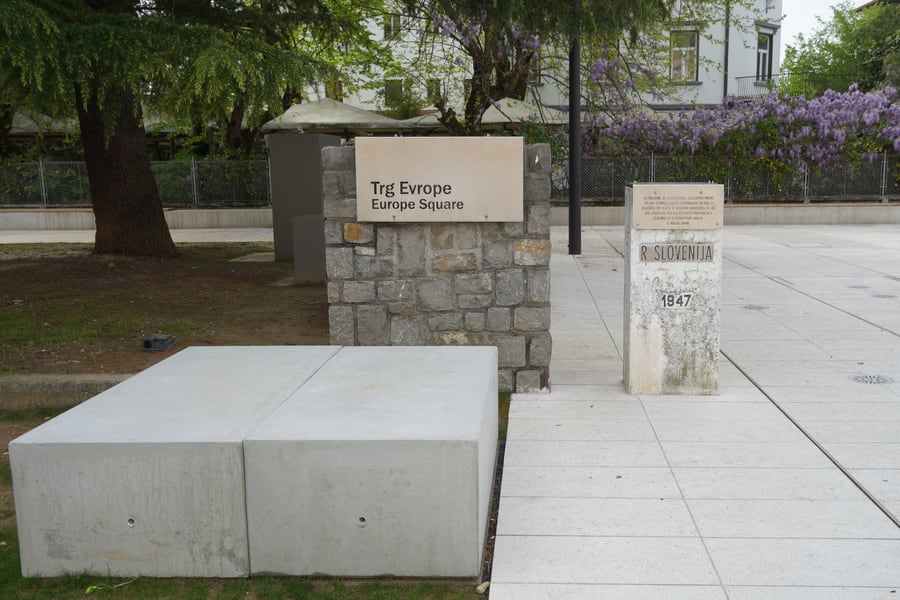
The 1947 frontier ran across the square in front of Nova Gorica station. A wall divided it until 2004, and free movement came in December 2007. The stone marked R. Slovenija 1947 still stands on the line.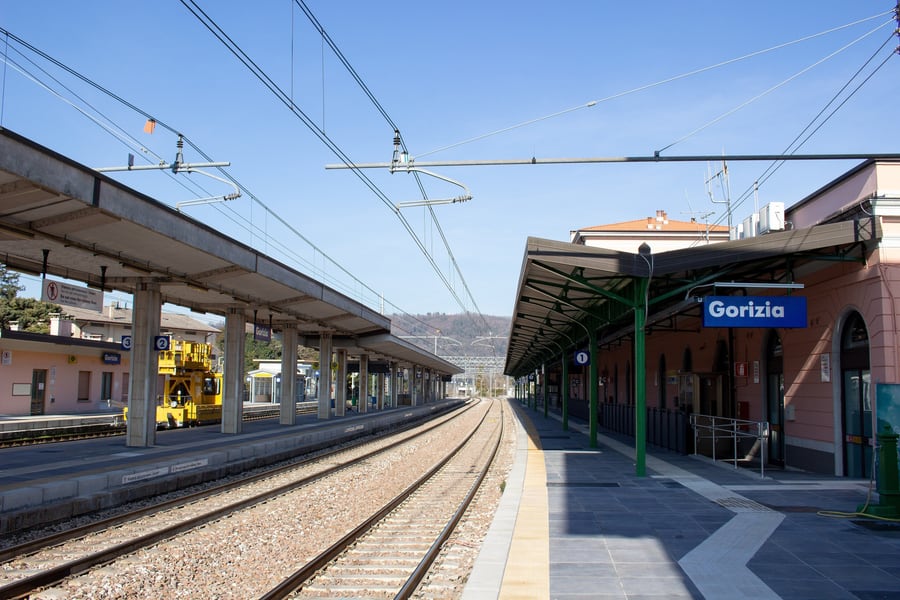 Marmolada48 / Wikimedia Commons · CC0 · cropped
7.5 kilometres without wires
The link to Gorizia Centrale is single track with no overhead line, and until December 2021 it was the last line on Italy's state network worked by telephone block. Hence the Blues: Hitachi built them to run on the wires, on diesel or on batteries.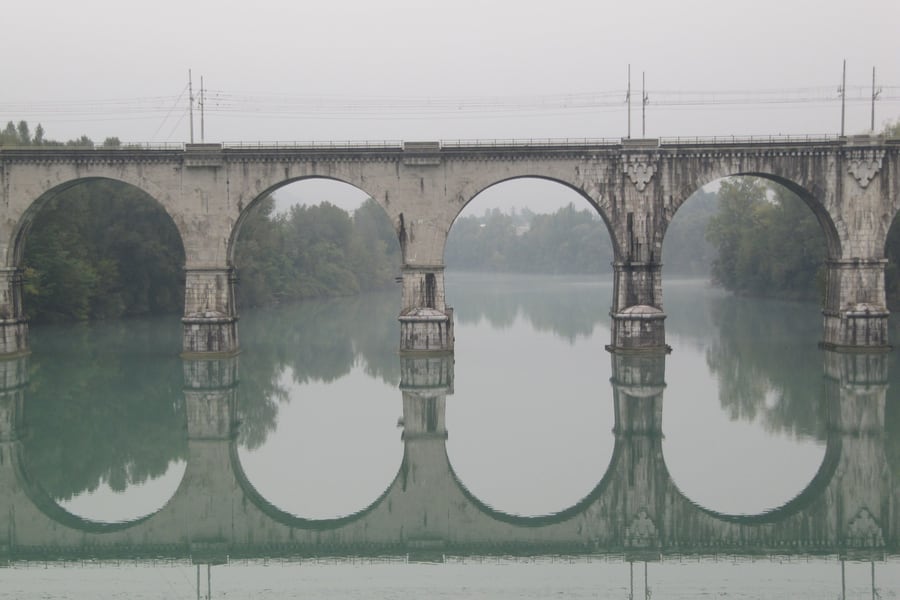 Limonadis / Wikimedia Commons · Public domain · cropped
The Isonzo
West of Gorizia the line crosses the Isonzo on a row of stone arches. Cormons, the next station, was the frontier between Austria and Italy from 1866 to 1918, so the train crosses two old borders in its first hour.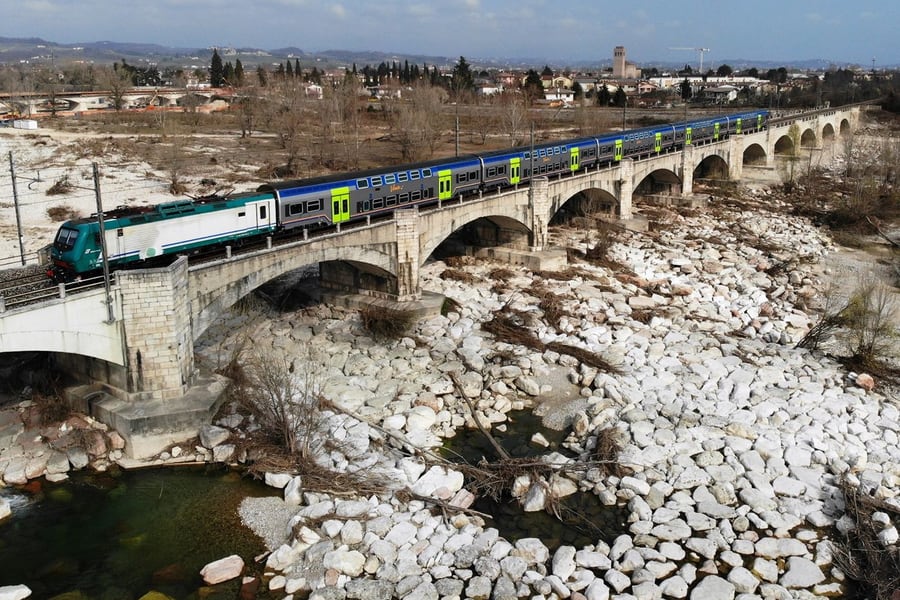 Luca Mazzucco / Wikimedia Commons · CC BY-SA 4.0 · cropped
The Piave
Five rivers lie between Nova Gorica and the lagoon: the Isonzo, Torre, Tagliamento, Livenza and Piave. The last is crossed at Ponte della Priula, just south of Susegana, on a long run of arches over a wide stony bed.A bit of history
Culture & experiences along the way
 Naturpuur / Wikimedia Commons · CC BY-SA 4.0 · cropped
The Museum on the Border
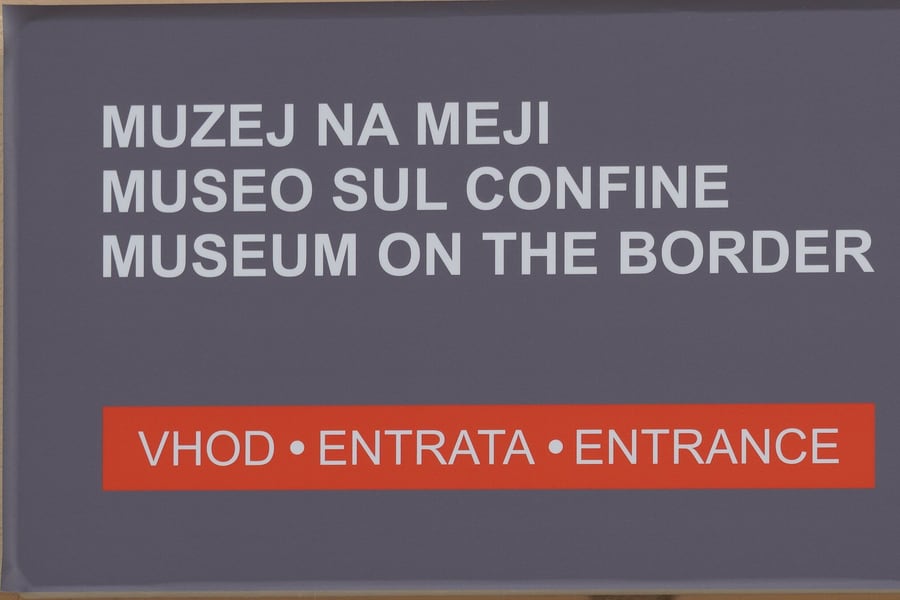
Inside Nova Gorica station, the Goriška Museum's exhibition State Border in the Goriška Region 1945–2004 has been open since 2005: uniforms, flags, maps and the stories of families the frontier split. At weekends it opens 10:00–13:00 and 13:30–18:00, which fits between the morning arrival and the 12:11 back to Venice.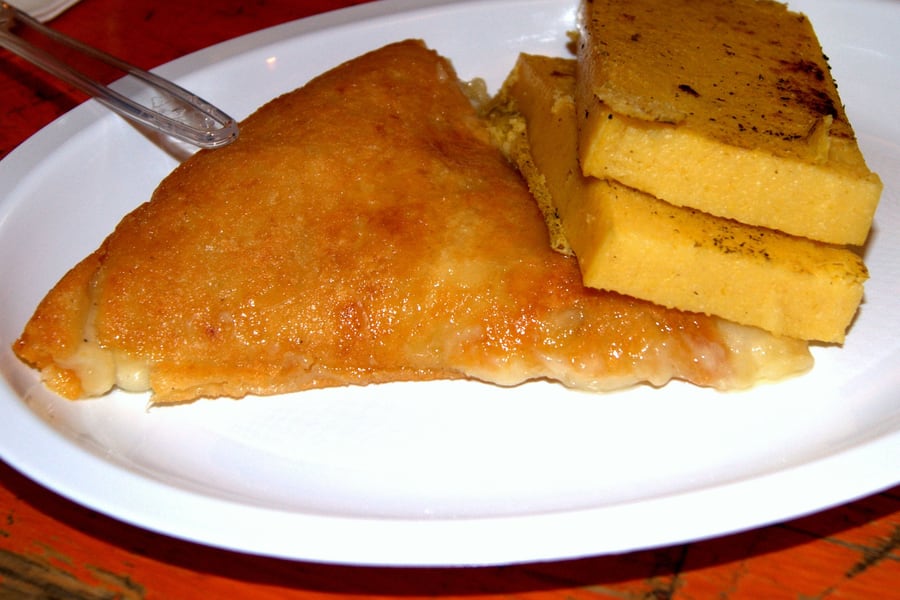 Dorothy61n1 / Wikimedia Commons · CC BY-SA 3.0 · cropped
Frico
Friuli's own dish: Montasio cheese melted with potato and onion and fried into a cake with a crisp crust, usually served with polenta. It began as a way to use up cheese rinds, and the first recipes date from about 1450, written by the cook of the Patriarch of Aquileia's chamberlain. Order it in Udine.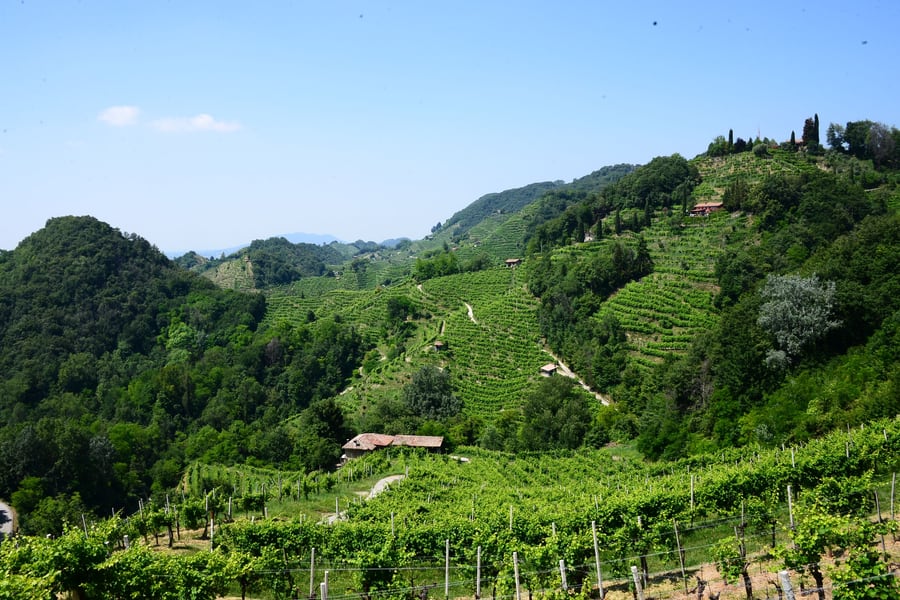 Civvì / Wikimedia Commons · CC BY-SA 4.0
Prosecco Superiore
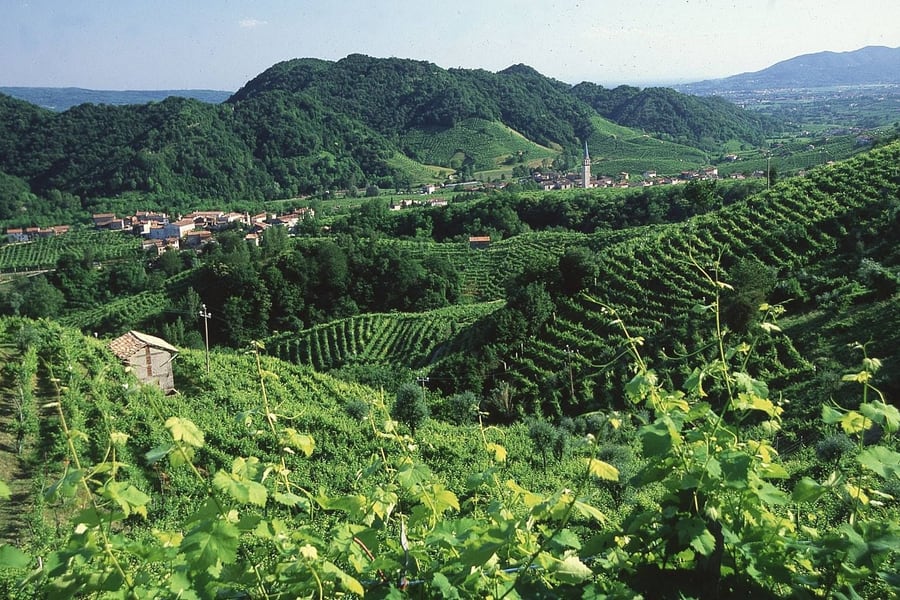
Conegliano gives half its name to the Conegliano Valdobbiadene DOCG, and the hills behind it have been a UNESCO World Heritage site since 7 July 2019: steep hogback ridges, the vines held on grassed terraces called ciglioni. All four trains stop at Conegliano.Timetables
Two direct trains run each way on Saturdays, Sundays and Italian public holidays only. They are Trenitalia regional trains, with no reservation, and the journey takes 2 hours 33 to 2 hours 53. On weekdays there is no passenger train over the border link.
Times as of November 2026, in the timetable valid until 12 December 2026, from Trenitalia's booking system. The train has run since February 2025 and was kept in the December 2025 timetable; the timetable from 13 December 2026 is not yet on sale. Check departures with Trenitalia (opens in a new tab) or on Slovenske železnice's page for the service (opens in a new tab).
Nova Gorica to Venice
| Train | Nova Gorica | Gorizia C. | Udine | Conegliano | Treviso C. | Venezia Mestre |
|---|---|---|---|---|---|---|
| R 7985 | 12:11 | 12:37 | 13:02 | 13:59 | 14:35 | 15:04 |
| R 7987 | 18:10 | 18:32 | 19:00 | 19:57 | 20:21 | 20:43 |
Venice to Nova Gorica
| Train | Venezia Mestre | Treviso C. | Conegliano | Udine | Gorizia C. | Nova Gorica |
|---|---|---|---|---|---|---|
| R 7973 | 07:50 | 08:09 | 08:32 | 09:40 | 10:18 | 10:35 |
| R 7975 | 15:16 | 15:43 | 16:03 | 16:58 | 17:38 | 17:52 |
All four trains also call at Pordenone. Intermediate times are departures. On 7 November 2026 the morning train runs to a different timetable, leaving Mestre at 07:40 and reaching Nova Gorica at 10:08.
Tickets
A second-class single from Nova Gorica to Venezia Mestre costs €16.10 at Slovenske železnice's international ticket offices, including the one at Nova Gorica station, and €18.60 from Trenitalia's website. Children aged 6 to 12 pay about half. Shorter hops are priced by distance: €1.70 to Gorizia, €6.50 to Udine, €14.50 to Conegliano and €16.40 to Treviso.
These are regional trains, so there is no reservation and no supplement. SŽ recommends buying the international ticket in advance. Venice itself is a separate €1.50 regional ticket from Mestre to Santa Lucia.
Book your tickets
Nova Gorica to Venezia Mestre
€16.10 at SŽ ticket offices · €18.60 from Trenitalia
A second-class single on the direct weekend train, with no reservation needed.
Book Tickets (opens in a new tab, on trenitalia.com)via trenitalia.comNova Gorica to Gorizia Centrale
€1.70 · children €0.90
The 7.5-kilometre hop over the border on the same train, sold by Slovenske železnice.
Book Tickets (opens in a new tab, on potniski.sz.si)via potniski.sz.siRail Passes
Interrail and Eurail passes cover this train. Interrail's list of railway companies includes Trenitalia's regional trains in both the Global Pass and the One Country Pass for Italy, with no reservation, and Slovenske železnice's regional trains in the Pass for Slovenia. A Global Pass covers the whole journey. An Italy One Country Pass covers Gorizia to Venice; the first stretch, from Nova Gorica, is in Slovenia, so buy that €1.70 ticket separately.
For this journey alone a pass is not worth buying: the full single is €16.10 to €18.60. It pays only as one leg of a longer trip through Italy or across the Alps.
Pass conditions checked against Interrail's railway-companies page, last updated 21 October 2026. Conditions change with each season, and the pass issuer's page is the one that binds.
Places to Visit
The train stops at five towns between the border and the lagoon, and each is worth breaking the journey for. With two trains a day each way, a stop means six to seven and a half hours before the next one, which suits Udine or Treviso well.
 Naturpuur / Wikimedia Commons · CC BY-SA 4.0
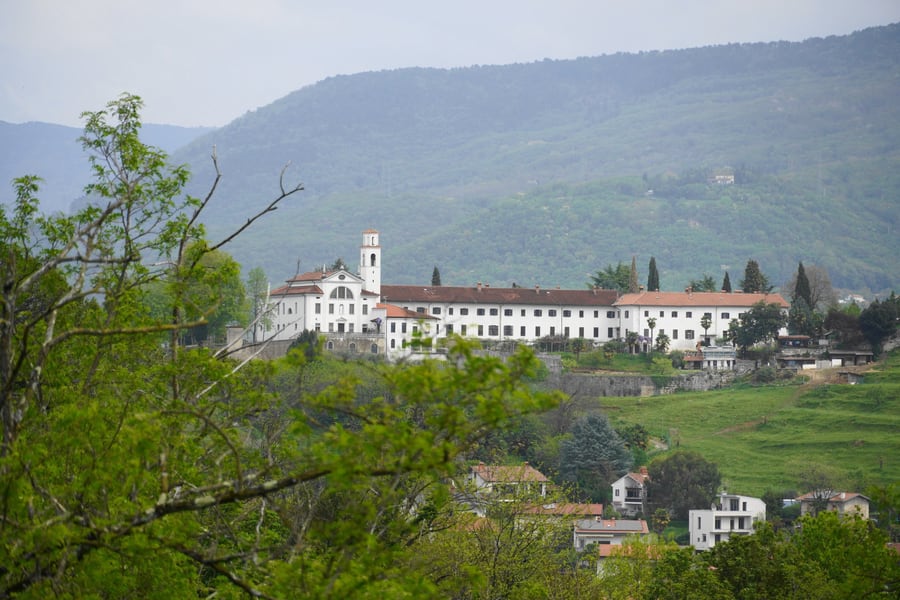
Kostanjevica Monastery
A Franciscan monastery on a 143-metre hill, about 200 metres from the Italian border, and the burial place of Charles X of France, who died in exile in Gorizia in 1836. The Franciscans moved in in 1811 and brought a library of some 10,000 books. Battered in the Isonzo fighting, the monastery was restored between 1924 and 1929.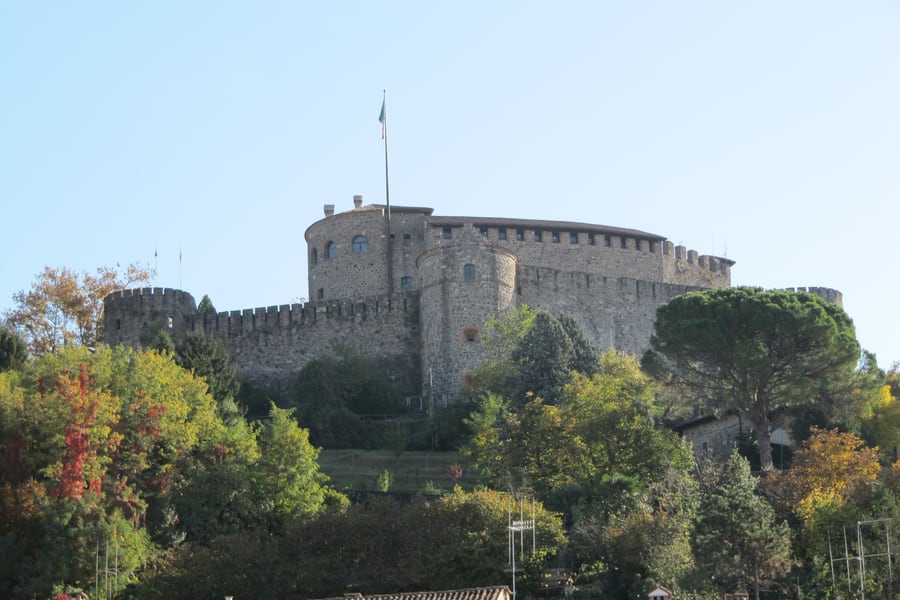 Limonadis / Wikimedia Commons · Public domain · cropped
Gorizia Castle
The hill above Gorizia has carried a castle since at least 1146, when the title Count of Gorizia first appears. Venice held it for just thirteen months, until June 1509; the Lion of St Mark carved for it went up over the gate only in 1919. Restored between 1934 and 1937, it now houses the city's Museum of the Middle Ages.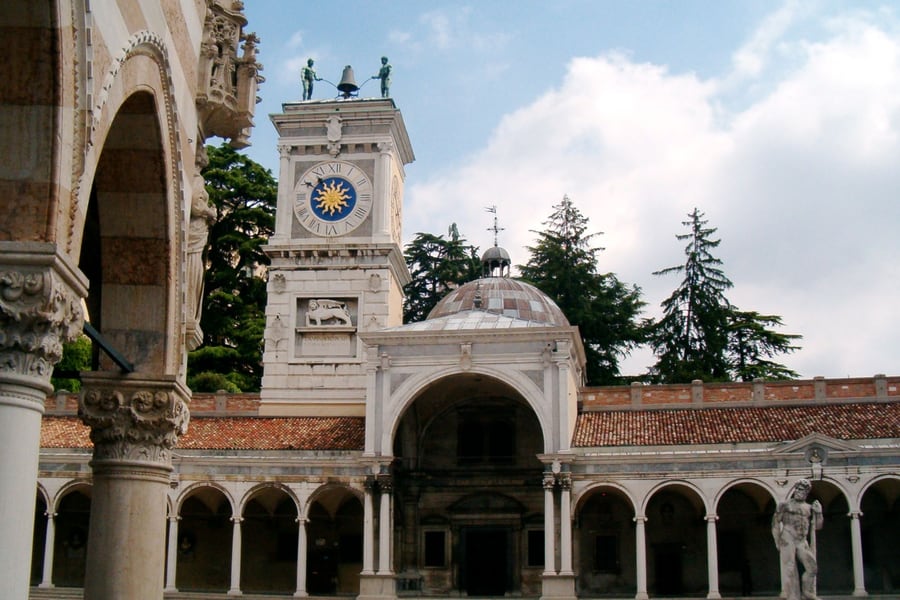 Marcok / Wikimedia Commons · CC BY-SA 2.5 · cropped
Piazza Libertà
Udine's oldest square was the Plasse dal Vin, the wine market. The pink-and-white Loggia del Lionello was begun in 1448; opposite, the clock tower of 1527, by Giovanni da Udine, has two figures that strike the hours on a bell, modelled on the tower in St Mark's Square. A bronze sun of 1798 at the end of the San Giovanni portico marks the equinoxes.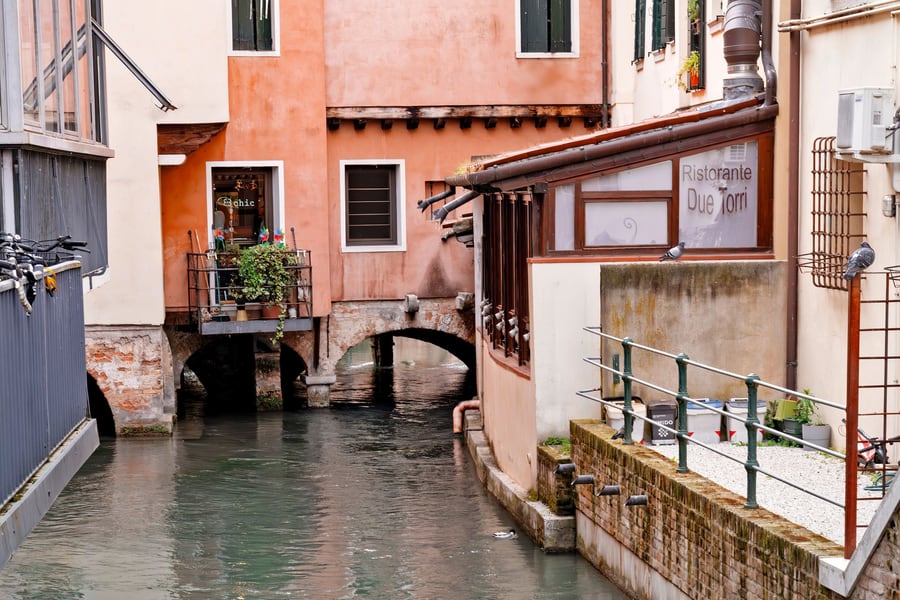 Photo by Didier Moïse / Wikimedia Commons · CC BY-SA 4.0 · cropped
The Buranelli canal
Treviso is built on water: the Botteniga splits into channels that run between the houses before joining the Sile. The best known, the canale dei Buranelli, takes its name from a sixteenth-century house of merchants from Burano in the Venetian lagoon, and passes the house of the writer Giovanni Comisso.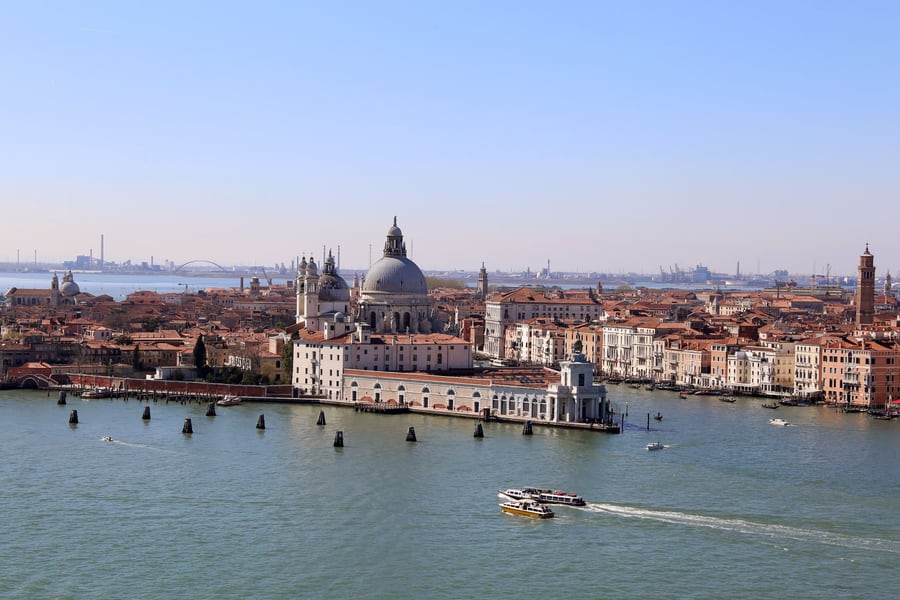 Sailko / Wikimedia Commons · CC BY 3.0 · cropped
Santa Maria della Salute
From Venezia Mestre, regional trains cross the lagoon to Santa Lucia in 10 to 13 minutes for €1.50, several times an hour. The great dome at the mouth of the Grand Canal is the Salute, vowed by the Republic during the plague of 1630–31, which killed some 46,000 people in the city. Baldassare Longhena began it in 1631.Where to Sleep
The whole ride takes under three hours, so it is easily done in a day from either end. Most travellers will sleep in Venice or in Mestre, where hotels are cheaper and the station is a short train ride from the city. To spend a weekend on the border, stay in Gorizia, across the square from Nova Gorica station.
Where to stay
Hotel Plaza
Opposite Venezia Mestre station
A large hotel right in front of the station where the train ends, ten minutes by train from Venice.
Check Availability (opens in a new tab, on hotelplazavenice.com)via hotelplazavenice.comQuestions or corrections
Planning this trip and stuck on something, or spotted a time, fare or detail that has changed? Send us a message about Nova Gorica to Venice. We read every one, and we update this page when something has changed.