The Odontotos Rack Railway
Leonidas Kourmadas / Wikimedia Commons · CC BY-SA 4.0
- DistanceDiakofto–Kalavryta · 22.3 km
- DurationAbout 1 hour each way
- Best seasonSpring & autumn (green gorge, autumn colour); check the line is running
Introduction
Some railways were built to move people from one place to another. A few were built to do something a railway has no business doing — and the Odontotos is one of those. Its name means "the toothed one", and it earns it: to climb the sheer walls of the Vouraikos Gorge in the northern Peloponnese, the little train grips a third, cogged rail with a cog of its own and hauls itself up gradients no ordinary train could hold.
In an hour it climbs from Diakofto, on the Gulf of Corinth, to the mountain town of Kalavryta, 22 kilometres and some 700 metres higher, through one of the most dramatic gorges in Greece. The mountains close to a few metres, the river runs white below, the line ducks through tunnels and out onto ledges — and there is no road down here, so the train has the whole spectacle to itself. Opened in 1896 on an unusually narrow gauge, it is one of the narrowest rack railways in the world, and, for many Greeks, the most beloved.
Please note: the Odontotos was suspended in March 2026 after landslides on the slopes of Mount Chelmos and a backlog of track works. Geological studies and preparatory works have been under way, but no firm reopening date had been announced at the time of writing. It is one of Greece's best-loved lines and is expected to return — but please confirm the current status with the operator before planning a trip. What follows describes the journey as it runs in normal service.
The Journey
The journey begins at sea level, at Diakofto, a small town on the Gulf of Corinth where the rack railway shares a platform with the ordinary trains of the coast line. The Odontotos looks almost like a toy beside them — a short, bright railcar on a narrow 750 mm track — but it is about to do something none of them could.
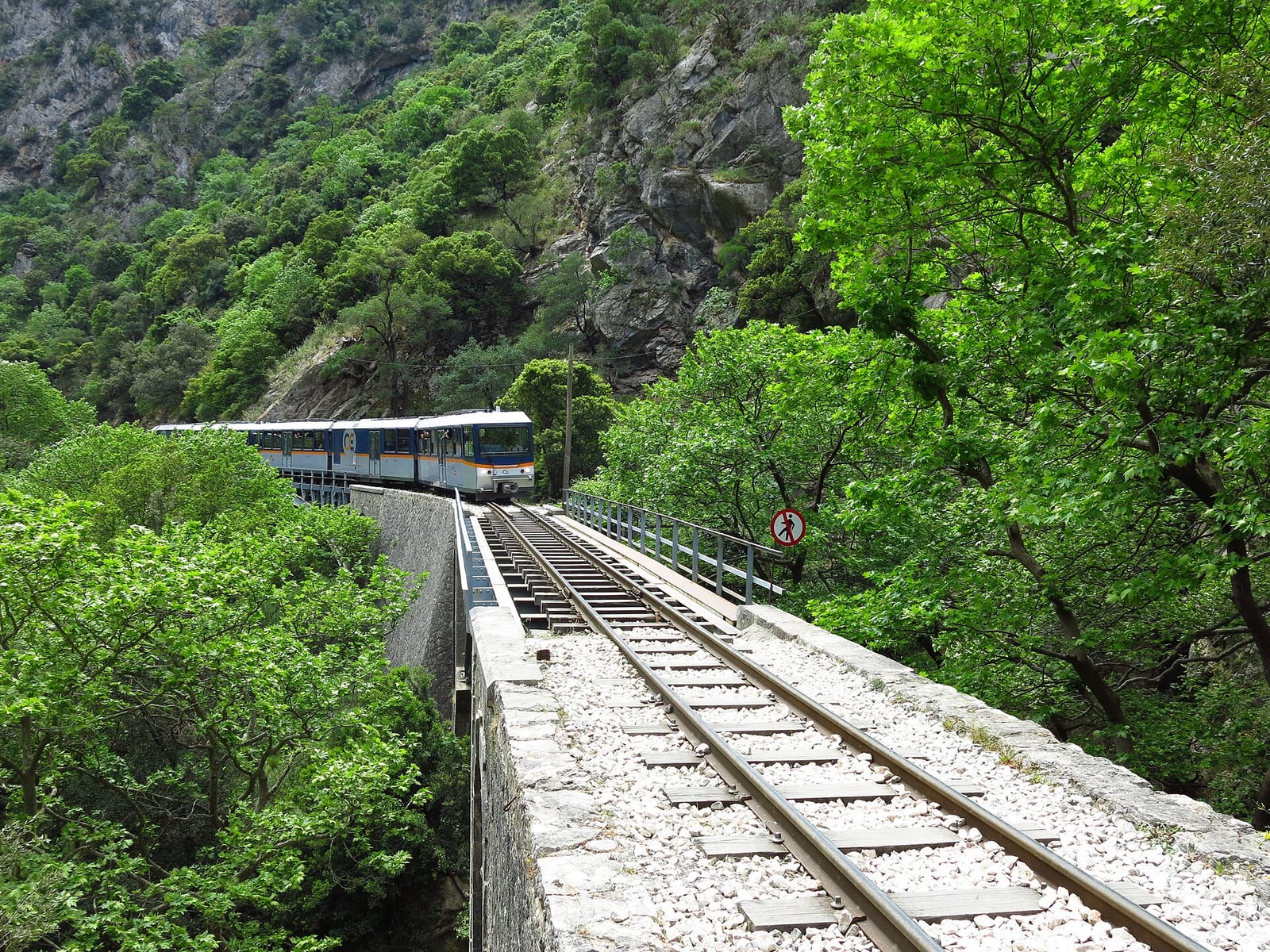
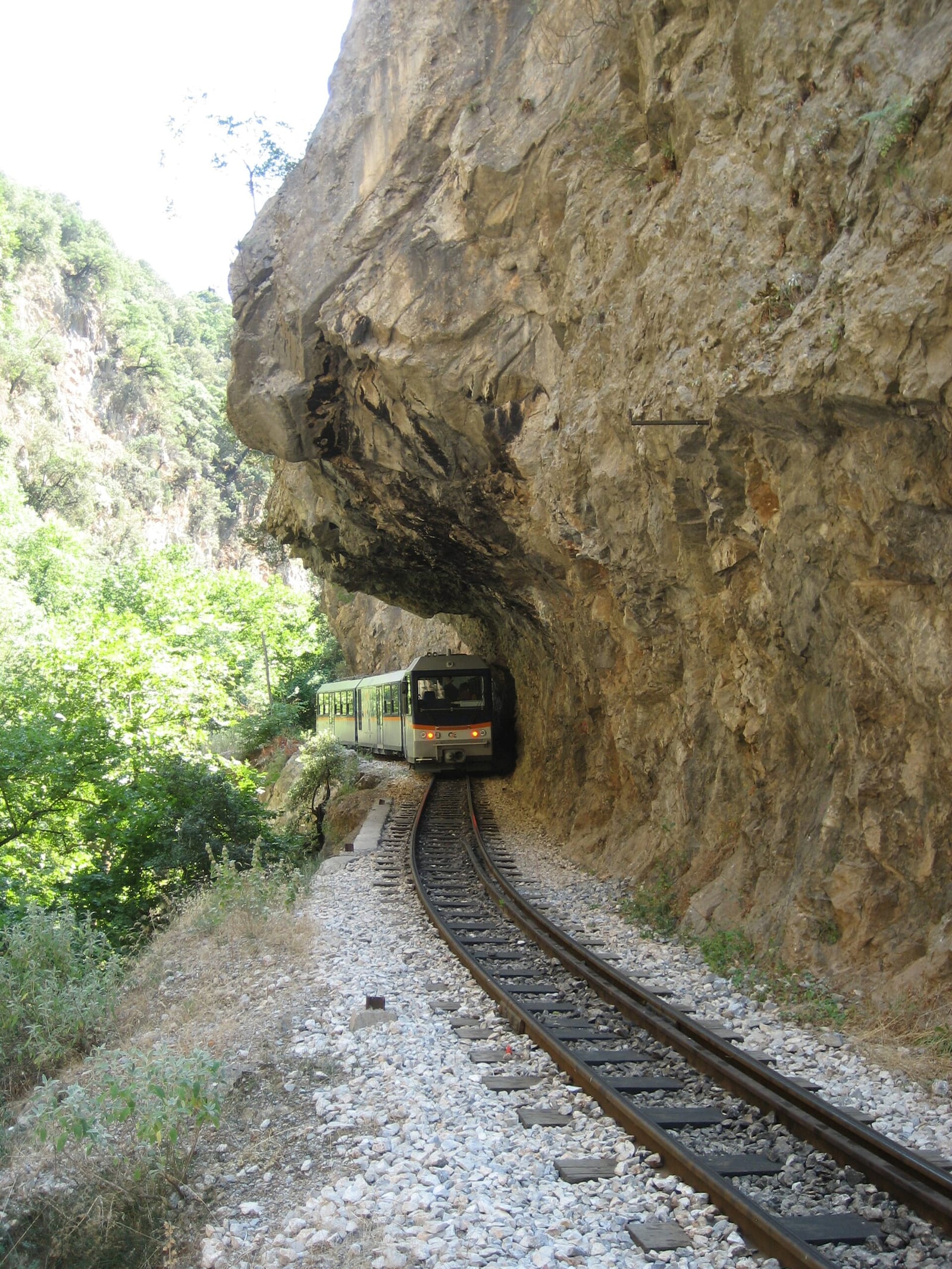
Within minutes of leaving Diakofto the mountains fold in and the Vouraikos Gorge swallows the line. This is the heart of the ride. The gorge is a deep, twisting cleft in the limestone, and the railway simply refuses to be beaten by it: it runs on ledges blasted from the cliff, dives into tunnels bored through spurs of rock, and skips across the torrent on slender bridges. The river is always there — below you, beside you, sometimes almost under the wheels — and the walls rise so close in places that you could reach out and touch them.
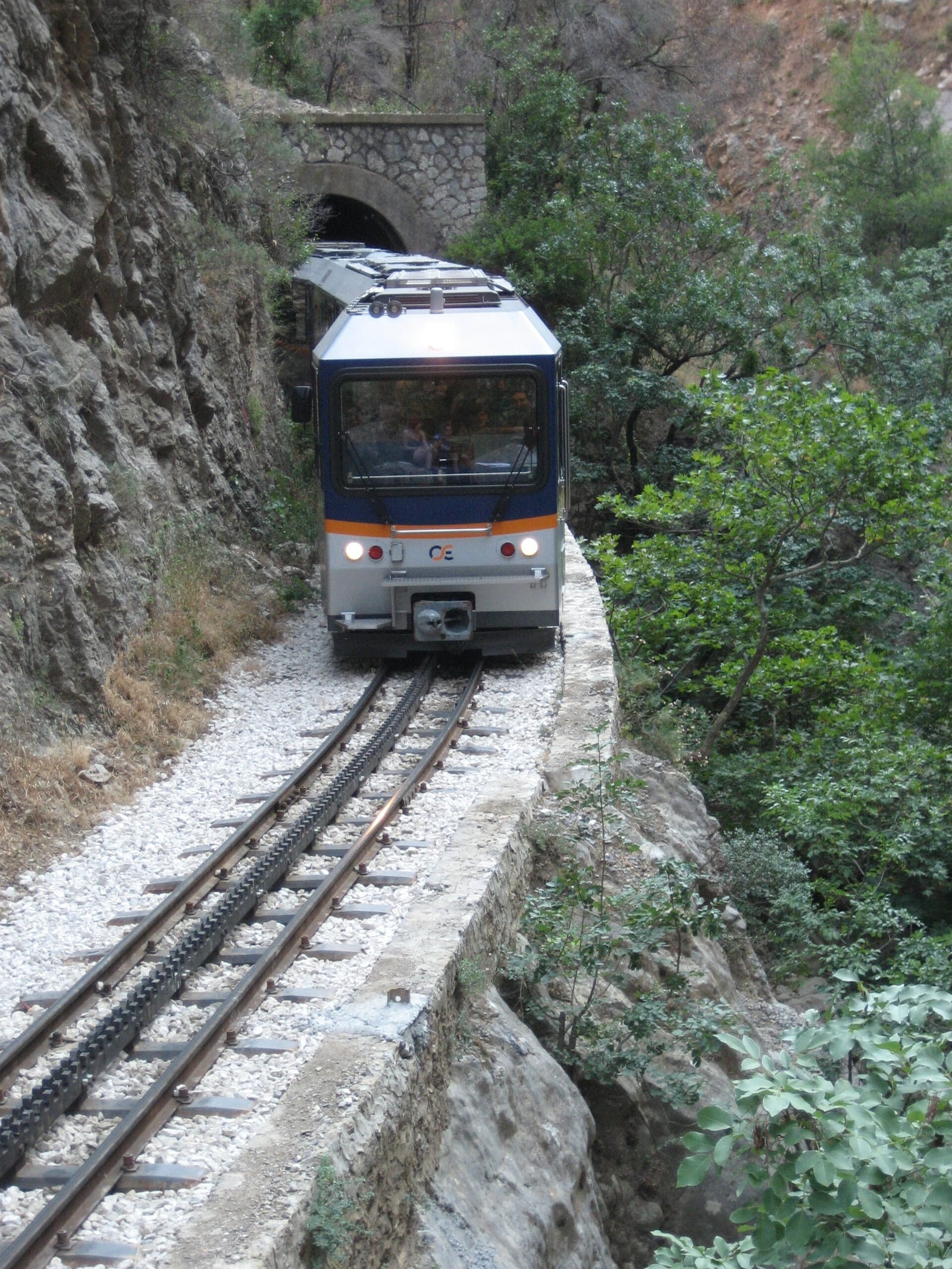
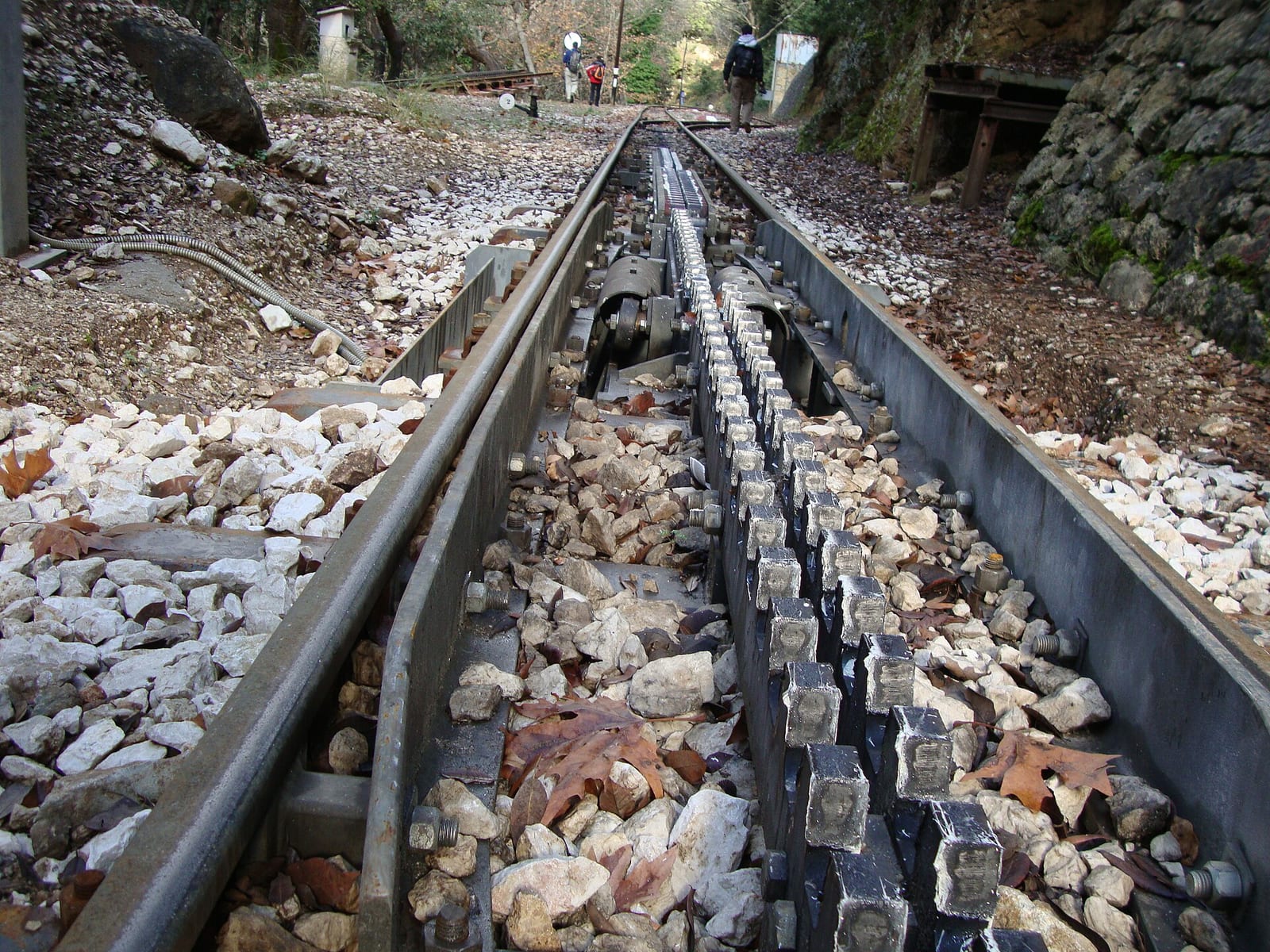
Where the gorge pitches up too steeply for wheels to grip, the rack takes over. A cog beneath the train engages a toothed centre rail, and the whole carriage slows to a walking pace and grinds upward, the engine straining, so that you have time to look straight down into the drops. There are three of these rack sections, the steepest at a remarkable 17.5%. Between them the train runs normally, gathering itself for the next climb.
A few things worth knowing about the run:
- It is a rack-and-pinion railway, Diakofto to Kalavryta, 22.3 km, climbing from about 10 m to some 720 m, in about an hour.
- The line was opened in 1896, built by a French company with Italian gorge-and-tunnel craftsmen, on an unusually narrow 750 mm gauge, using the Abt rack system.
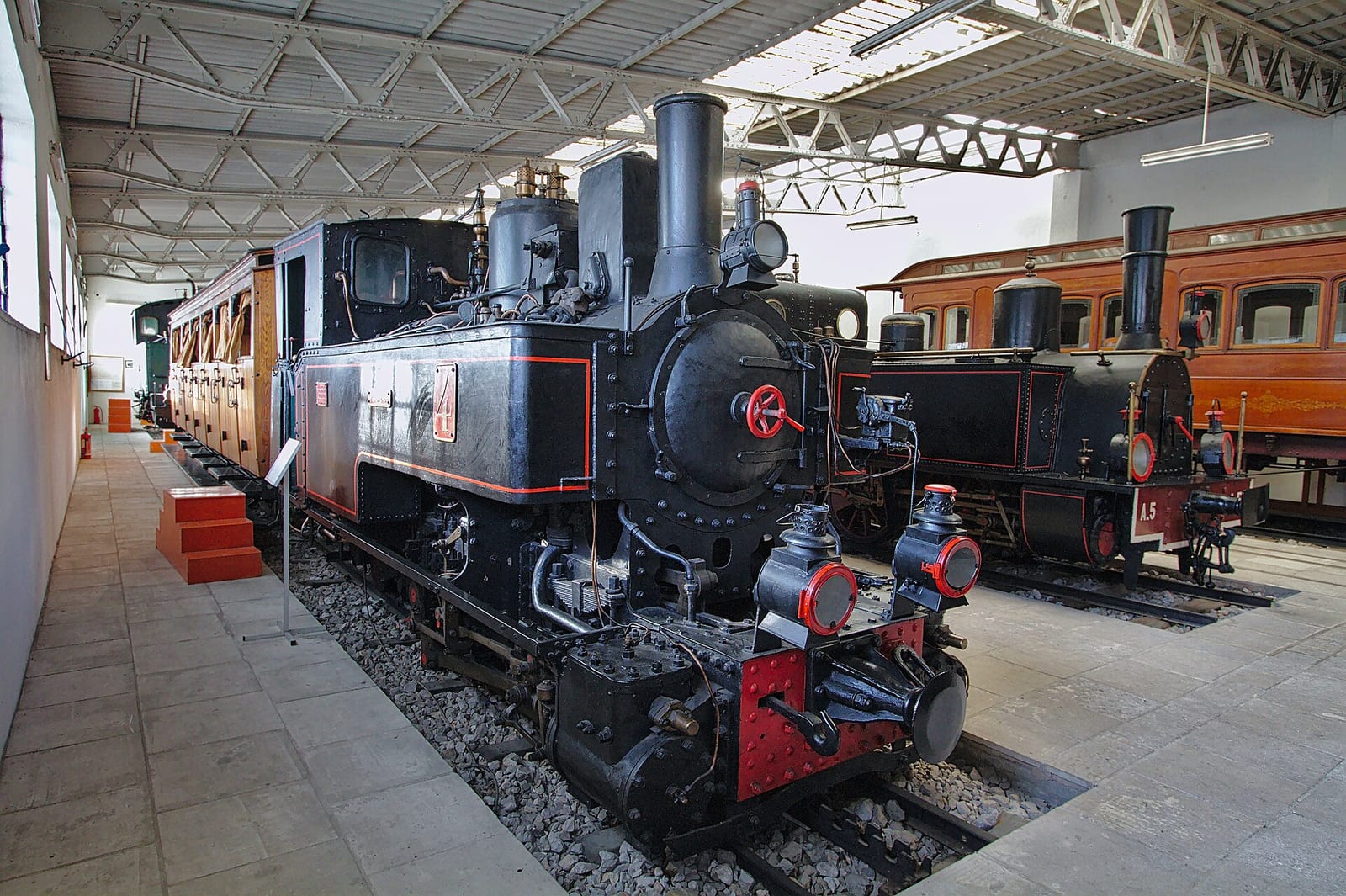
- Today it is worked by modern Stadler diesel-electric railcars; the original steam engines are preserved.
- Midway it stops at Zachlorou, deep in the gorge, at the foot of the path to Mega Spilaio monastery.
Near the top the gorge opens, the world turns green and pastoral, and the train rolls into Kalavryta, a mountain town under the peaks of Chelmos — a place of monasteries, memory and clean alpine air. You step down having covered barely 22 kilometres, and yet feeling you have crossed from one country into another.
Along the route
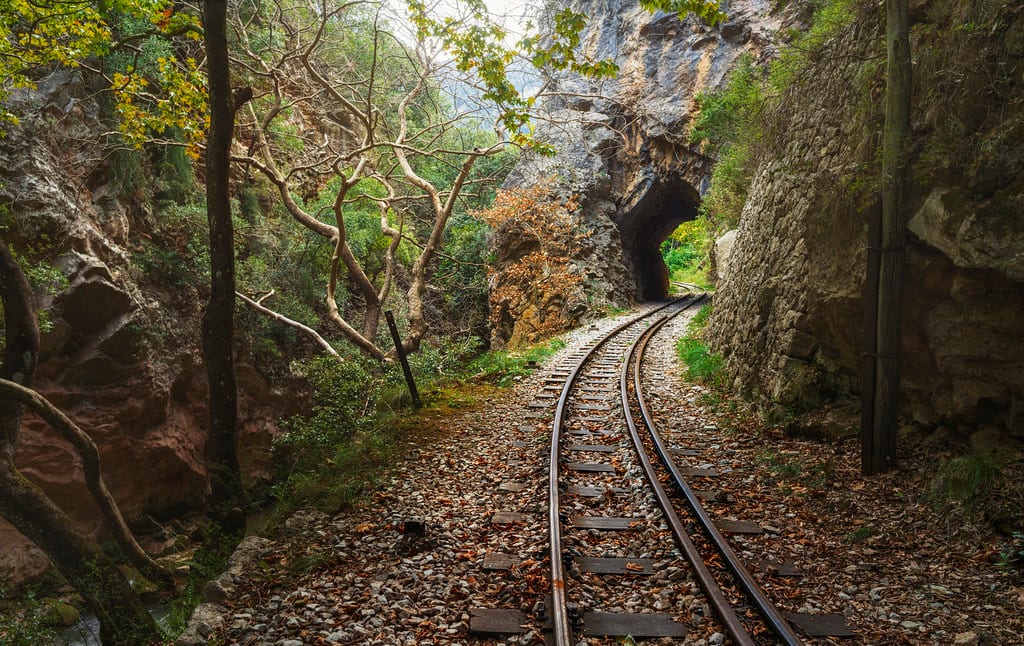
Marion Schneider & Christoph Aistleitner / Wikimedia Commons · Public domainUp the Vouraikos Gorge
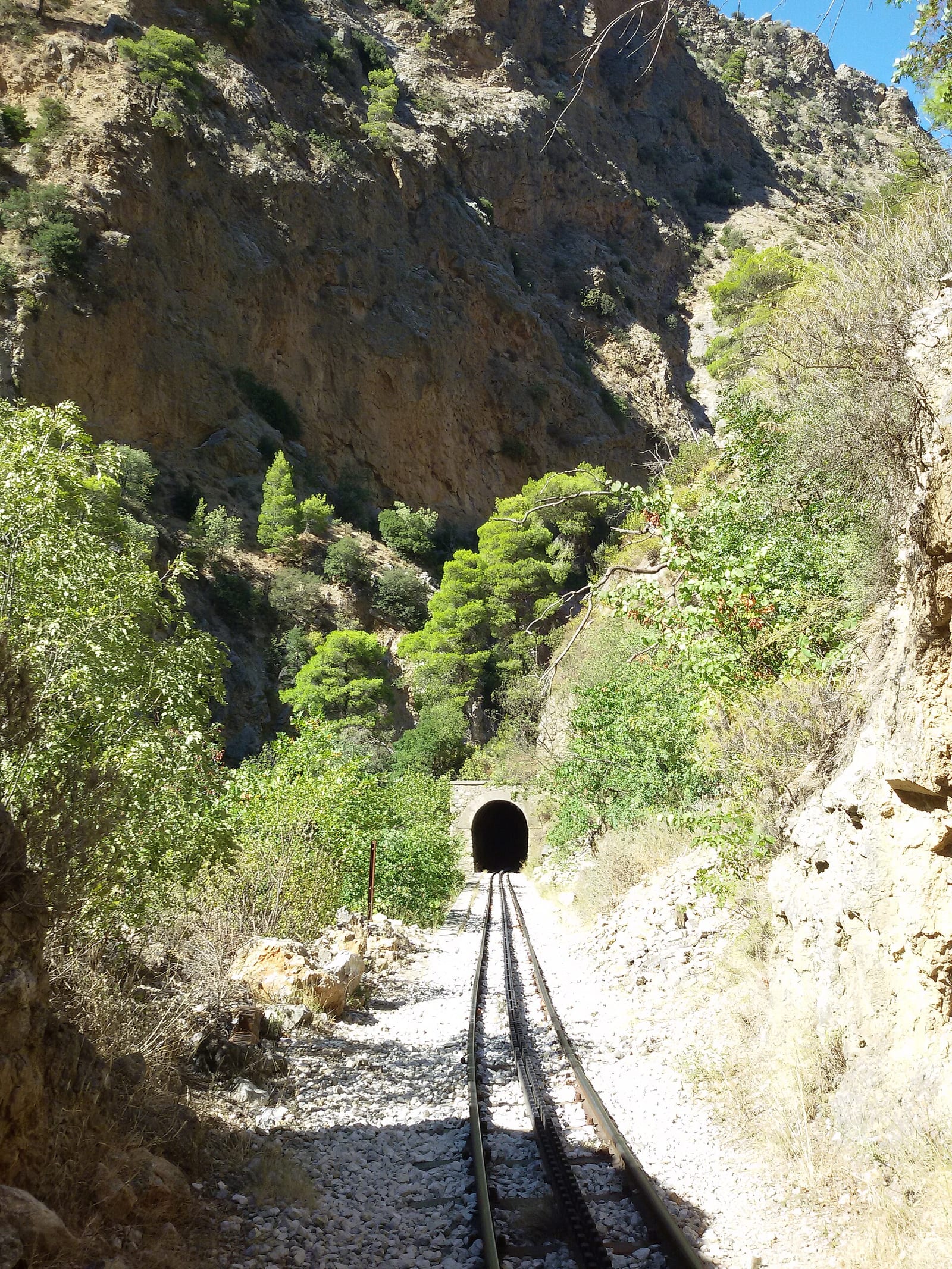
The whole point of the line is the Vouraikos Gorge, a deep cleft where the mountains close to a few metres and the river runs white below. The railway clings to ledges, dives through tunnels bored in the rock and crosses the torrent on little bridges. There is no easy road in.Geo kar / Wikimedia Commons · CC BY-SA 4.0The rack that makes it climb
Where the slope grows too steep for ordinary wheels — up to a fierce 17.5% — a cog under the train bites a third, toothed rail and hauls the carriage up like a zip. Built on an unusually narrow 750 mm gauge and opened in 1896.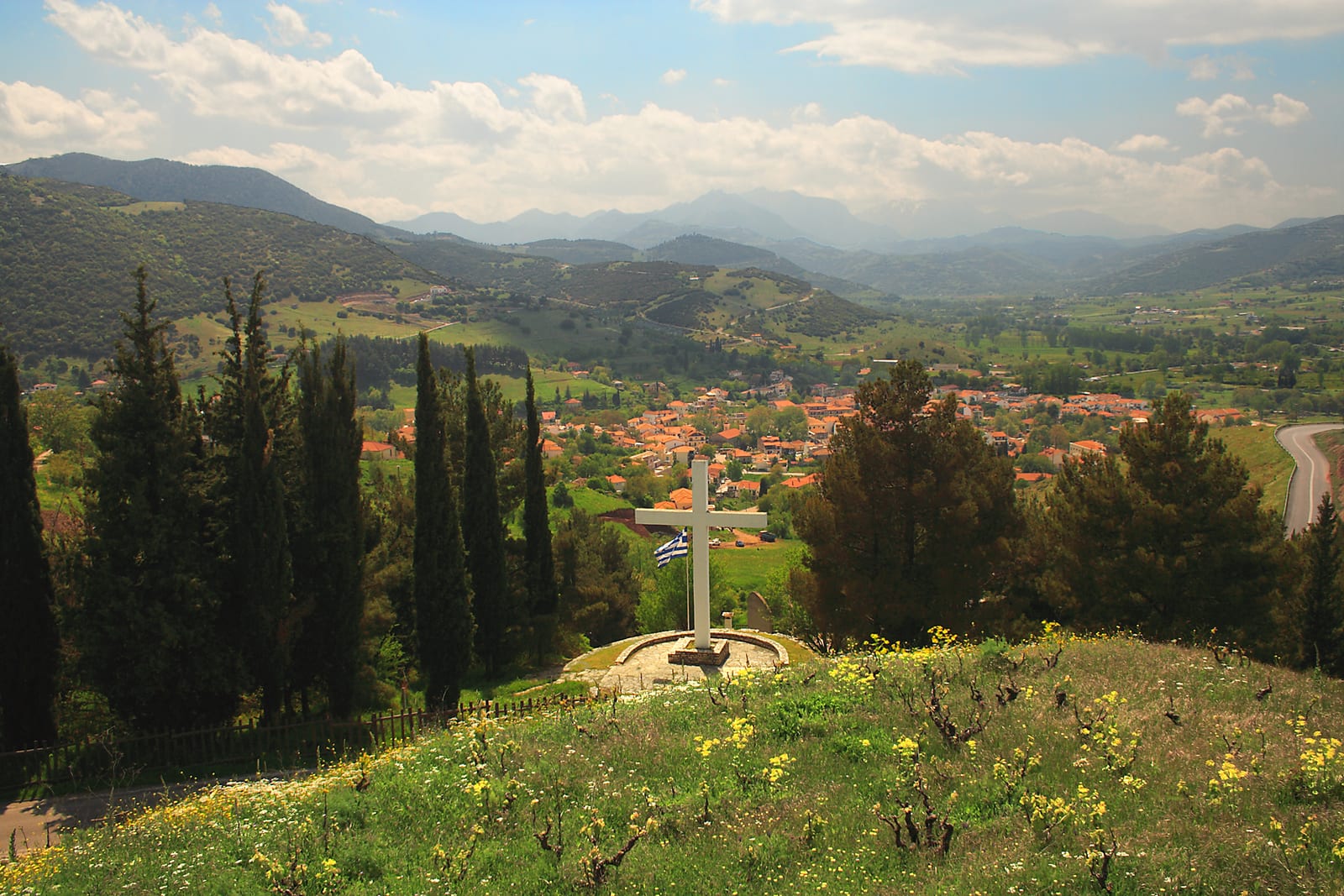 ulrichstill / Wikimedia Commons · CC BY-SA 2.0 de
Kalavryta at the top
The line ends at Kalavryta, a mountain town of huge significance to Greeks: the nearby Agia Lavra monastery is remembered as the cradle of the 1821 War of Independence, and the town was the scene of a terrible Nazi massacre in 1943.A bit of history
Culture & experiences along the way
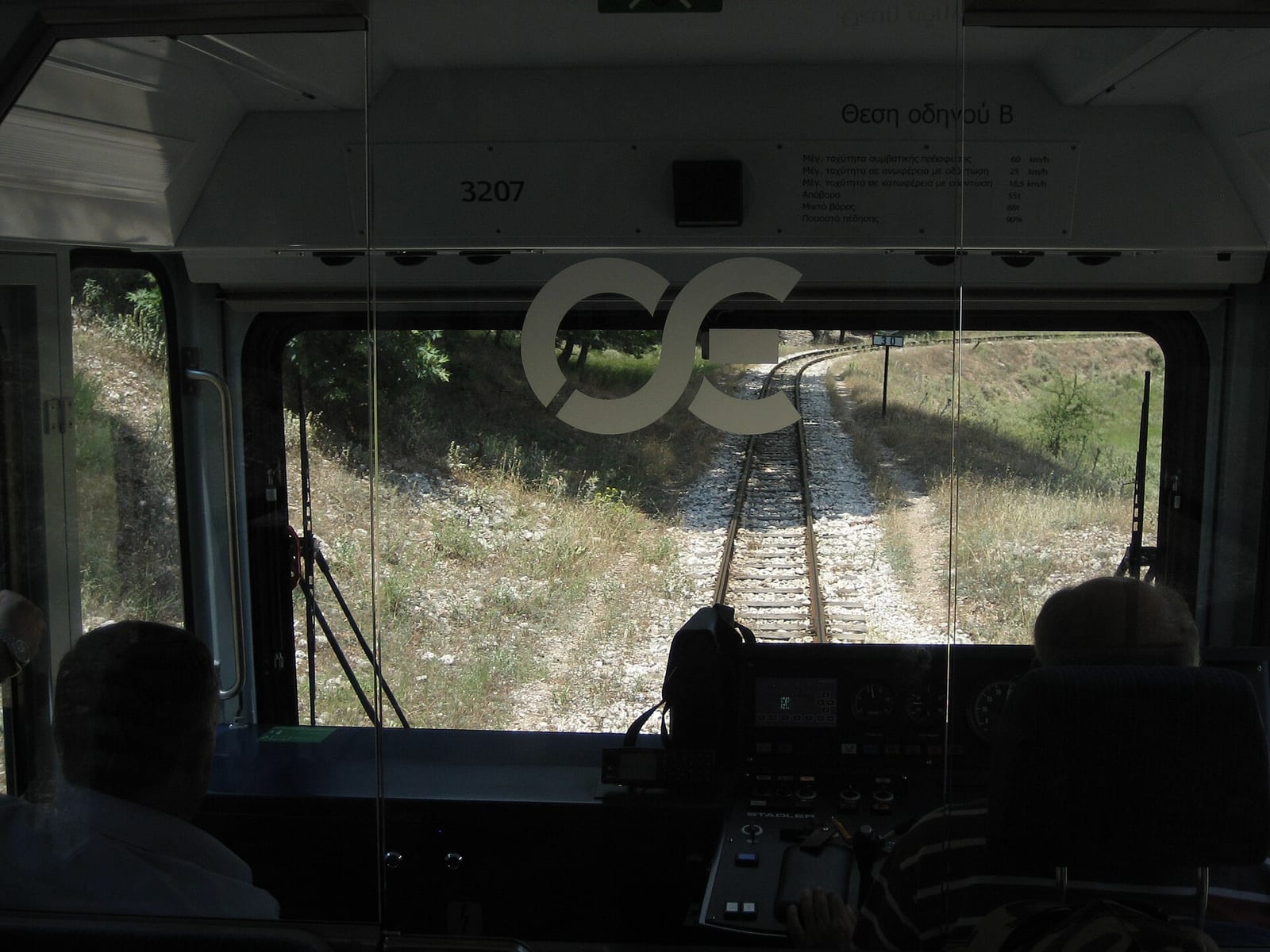
Marion Schneider & Christoph Aistleitner / Wikimedia Commons · Public domainRiding the little train
It is a short ride — about an hour, just 22 km — but an intense one: the modern Stadler railcars grind up the rack at a walking pace on the steep sections, so you have time to look straight down into the gorge from the window. Sit on the right going up for the best of the drops, and keep the window open for the sound of the river.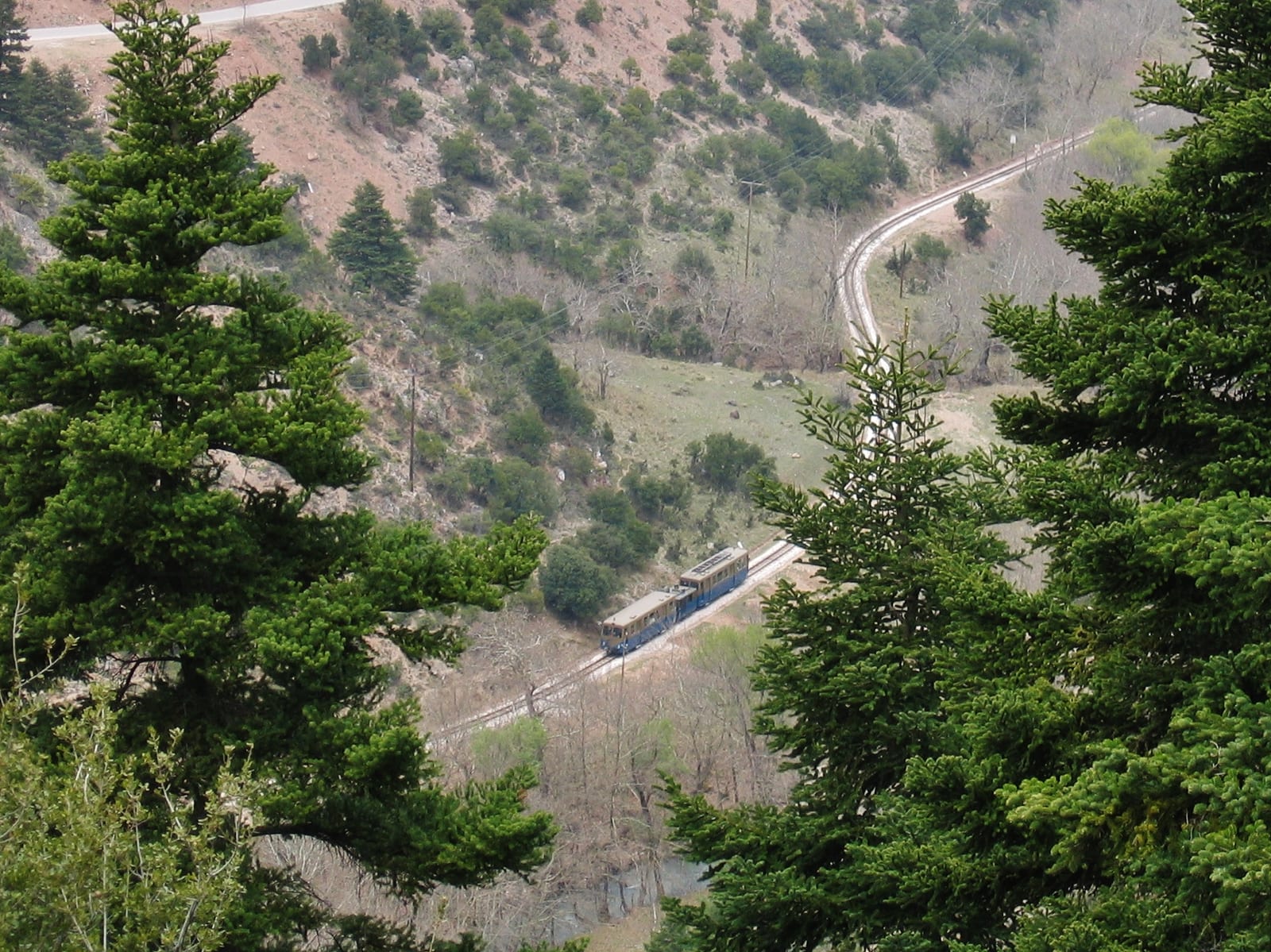 qwesy qwesy / Wikimedia Commons · CC BY 3.0
Zachlorou & Mega Spilaio
Halfway up, the train pauses at tiny Zachlorou, a hamlet of a few tavernas beside the river deep in the gorge — a lovely place to break the journey. From here a steep path (or a road) climbs to the great cliff-monastery of Mega Spilaio, one of the oldest in Greece, built into the rock face above.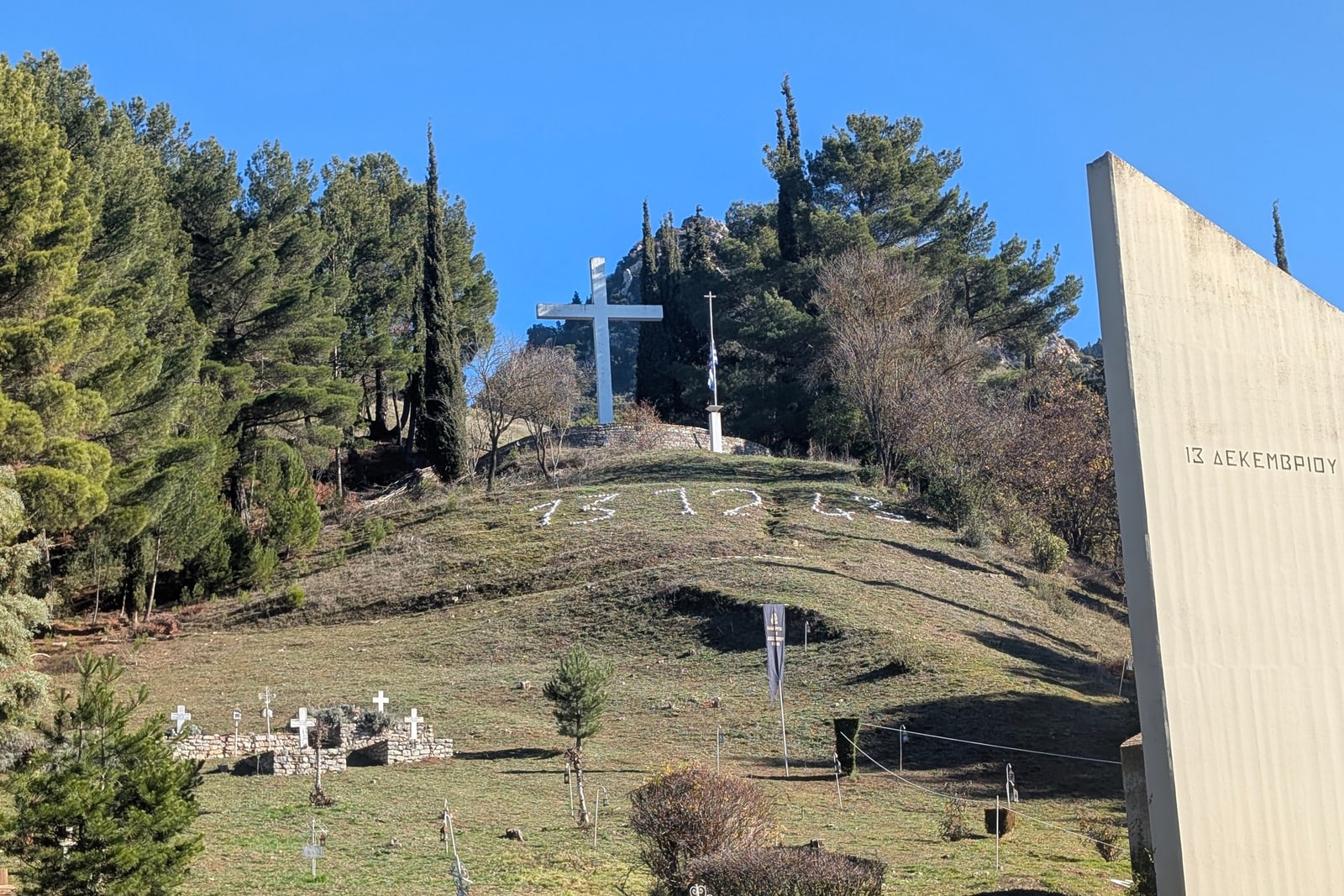 Hellas05 / Wikimedia Commons · CC BY-SA 4.0 · cropped
Remembering Kalavryta
Above the town stands the Place of Sacrifice, the memorial to the men and boys of Kalavryta killed by German troops on 13 December 1943. The Municipal Museum of the Kalavryta Holocaust, in the old school, tells the story. It is a sombre counterpoint to the joy of the ride up — and part of why the little train means so much here.Timetables
In normal operation the Odontotos runs several times a day, all year, with extra departures at weekends and in the summer season. The full climb takes about an hour each way, and there is usually time to break the journey at Zachlorou and catch a later train.
Before you go: the service was suspended in March 2026 for landslide-safety and track works, with no firm reopening date announced at the time of writing. Always confirm that the line is running — and the current departures — with the operator before you travel.
Typical departures when the line is operating (as of the 2026 timetable — confirm before travelling):
| Diakofto → Kalavryta | Kalavryta → Diakofto |
|---|---|
| 09:52 (daily) | 11:04 (daily) |
| 12:17 (daily) | 13:37 (daily) |
| 13:39 (weekends) | 15:04 (weekends) |
| 15:07 (daily) | 16:25 (daily) |
| 16:29 (weekends) | 18:04 (weekends) |
Good to know:
- It is short and it sells out. The trains are only a couple of small railcars, so seats are limited and the ride is popular — book ahead, especially at weekends, on holidays and in summer.
- Break the journey at Zachlorou. Ride up, get off in the gorge for lunch and the walk toward Mega Spilaio, then catch a later train on to Kalavryta or back down.
- Which side to sit. Going up (Diakofto → Kalavryta), the gorge and its drops are best on the right.
- Getting to Diakofto. Diakofto is on the Athens–Patras coast line; the rack railway connects with mainline and suburban services along the gulf.
Times as of the 2026 timetable and subject to change; the line's running status can change with track works. Confirm current schedules and status with the operator — see the Tickets section below.
Tickets
The Odontotos is run by Hellenic Train and tickets are simple — the difficulty is scarcity, not booking. The trains are tiny and the ride is famous, so seats go quickly and a weekend departure can be sold out days ahead; buy online or at the Diakofto and Kalavryta offices, and reserve wherever you can. Fares are modest, a few euros for a single, with reduced rates for children.
⚠️ Check the status before you build a day around it. More than most lines this one is interrupted by track and landslide works — it was suspended through 2026 — so confirm both that the service is running and the exact times. If it is not, Diakofto and Kalavryta are worth the trip anyway, and the gorge can be walked on the footpath that follows the river and the line up through the rock.
Book your tickets
Odontotos · Diakofto to Kalavryta
The rack railway up the gorge
The hour-long climb up the Vouraikos Gorge from Diakofto, on the coast, to Kalavryta, run by Hellenic Train. Several departures a day in normal operation; a handful of seats, so book ahead. Check the line is running before you travel (see the timetable notes).
Book Tickets (opens in a new tab, on Hellenic Train)via Hellenic TrainTimetable & booking · Odontotos
Departures and status
Live departures, fares and the current running status of the Diakofto–Kalavryta rack railway from the operator. The little train sells out, and its status can change with track works, so confirm both the timetable and that the service is operating before you set off.
Book Tickets (opens in a new tab, on Odontotos)via OdontotosRail Passes
Interrail passes are valid, with a reservation. Interrail's table of railway companies names Hellenic Train's Odontotos Rack Railway among the trains included in Greece, so Diakopto to Kalavryta is covered by an Interrail Greece Pass or a Global Pass. Reservations are mandatory, and the small trains sell out, so reserve as early as you can.
For this journey alone, a pass is not worth buying. A single costs a few euros. A pass pays when the rack railway is one day of a longer trip through Greece.
Checked October 2026 against interrail.com (opens in a new tab) and Interrail's Greece page (opens in a new tab).
Places to Visit
The line is short, but its two ends and its middle each reward a stop.
Halfway up, above the halt at Zachlorou, the monastery of Mega Spilaio — "the Great Cave" — clings to a vertical cliff face. It is said to have been founded in the fourth century, which would make it among the oldest in Greece, and it has been burned and rebuilt many times since. The climb up from the river is steep and takes the better part of an hour, and the view back down the gorge repays every minute of it.
Kalavryta, at the top, is the emotional heart of the journey. Just outside the town, the monastery of Agia Lavra is honoured as the place where the banner of the 1821 Greek War of Independence was raised. The town itself carries a far heavier memory: on 13 December 1943 German occupying forces murdered the men and boys of Kalavryta, burning both monasteries in the same days. The Place of Sacrifice on the hill above and the Museum of the Kalavryta Holocaust, in the old schoolhouse, commemorate them.
In winter Kalavryta doubles as a ski town; the rest of the year it is the base for the gorge, the caves and the mountain. The places below are the ones worth planning the trip around.
 TTHHAANNnn / Wikimedia Commons · CC BY-SA 4.0 · cropped
Diakofto
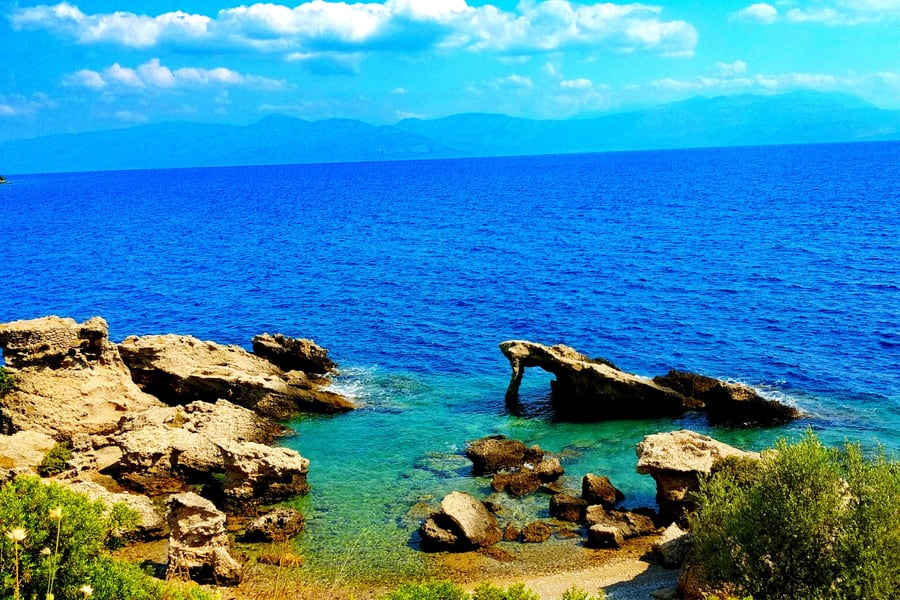
The rack railway's sea-level end, and a good place to arrive the night before. Diakofto sits on the Gulf of Corinth where the Vouraikos comes out of its gorge, with pebble and rock coves either side of the river mouth and tavernas along the water. It is about 40 km east of Patras and a stop on the Athens–Patras coast line, so you can reach the little train without a car.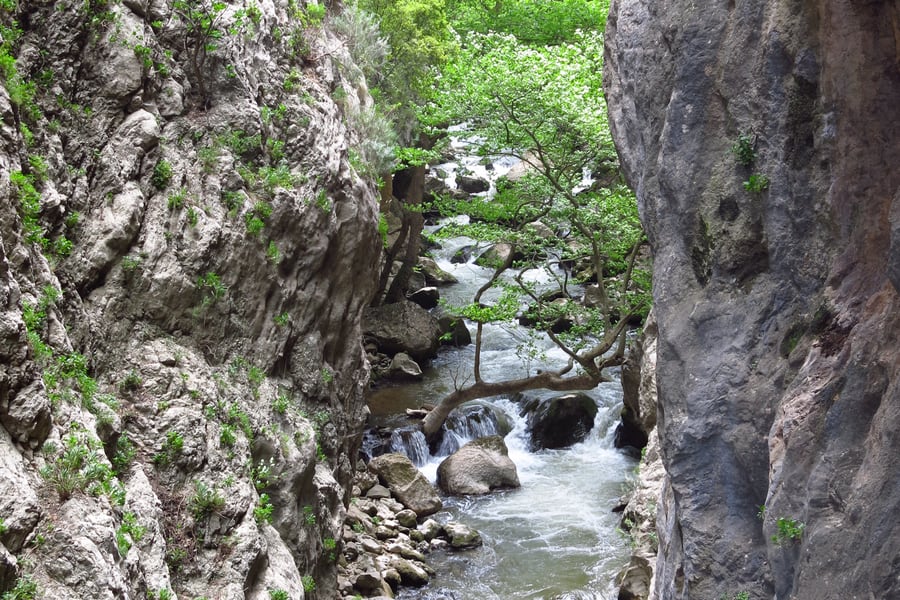 Leonidas Kourmadas / Wikimedia Commons · CC BY-SA 4.0 · cropped
The Vouraikos Gorge
The Vouraikos rises in the Aroania mountains and falls 37.5 km to the sea, and for about 20 km of that it runs in a gorge of steep cliffs, waterfalls and caves. A footpath follows the river and the railway up through the rock — one of the finest short walks in Greece, and the only way to take the narrowest sections at your own pace. Walk up one day, ride down the next.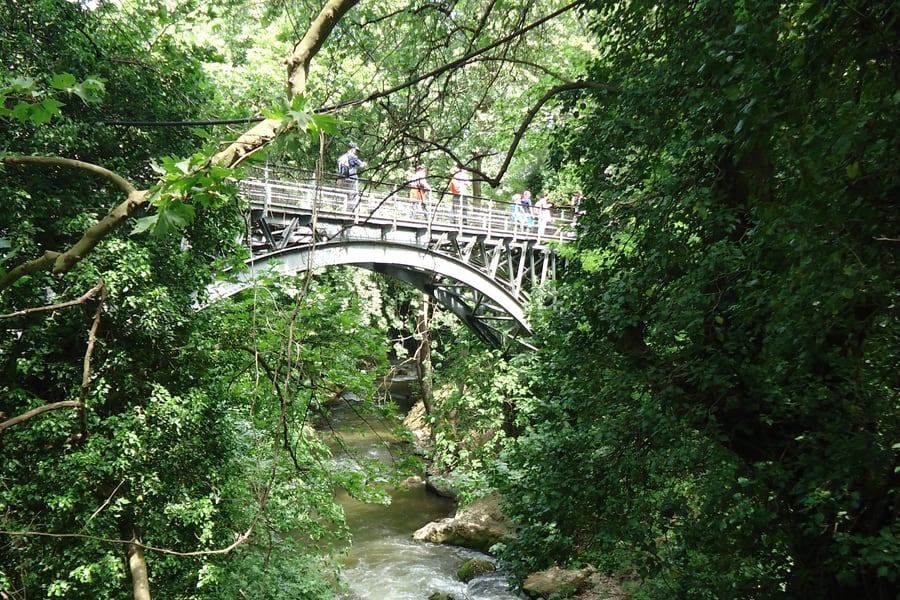 Kakolyri Maria / Wikimedia Commons · CC BY-SA 4.0 · cropped
Zachlorou
Barely a hamlet: a handful of houses and tavernas on both banks of the river, linked by footbridges, with the platform among them. There is no easy road in, so most people arrive on the train and stay for lunch under the plane trees. It is also the foot of the steep climb to Mega Spilaio, the cliff-hanging monastery that gives the halt its full name.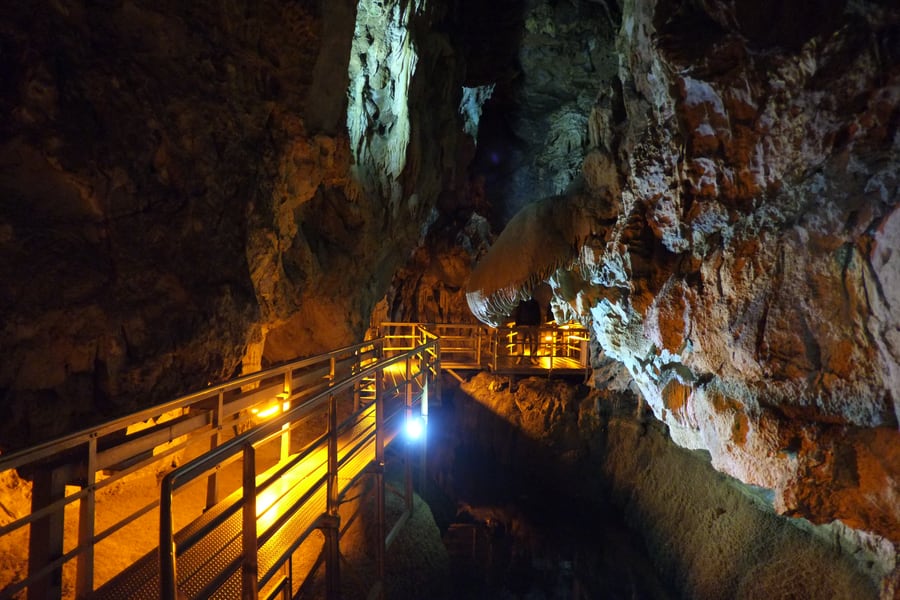 Ore.mk / Wikimedia Commons · CC BY-SA 4.0 · cropped
The Cave of the Lakes
An old underground river on three levels near Kastria. Nearly 2 km has been explored and 500 m is open to visitors, entered through a tunnel that puts you on the middle floor, with bridges carrying the path from pool to pool. In winter meltwater turns it back into a river with waterfalls; by summer it has drained to 13 terraced lakes. Open daily except Tuesdays.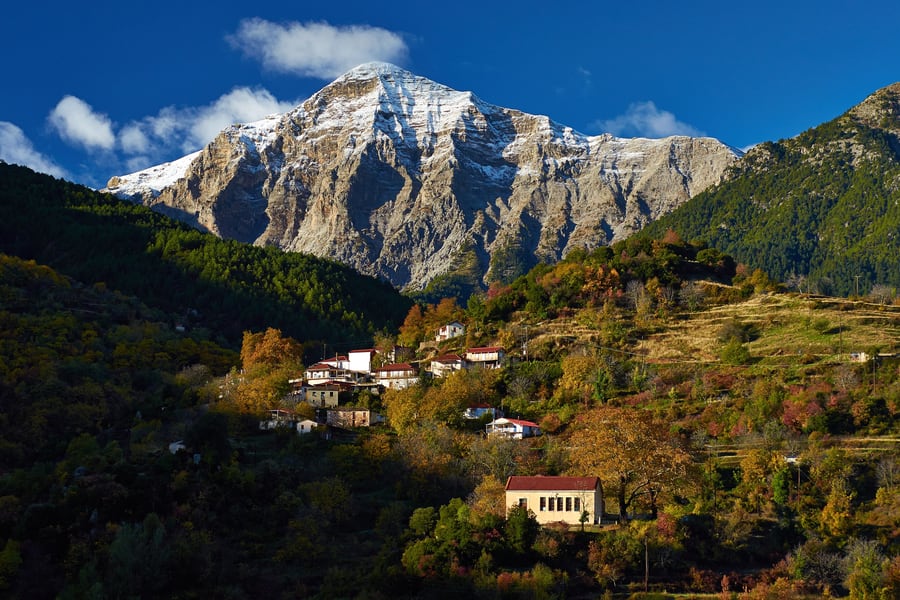 Georgikopoulos Manolis / Wikimedia Commons · CC BY-SA 4.0 · cropped
Mount Chelmos
Chelmos — properly Aroania — reaches 2,355 m, the highest mountain in Achaea and the third highest in the Peloponnese after Taygetus and Kyllini. The Kalavryta ski centre works its slopes from roughly December to April across fourteen runs; out of season the same roads open up the high country, the source of the Vouraikos, and the ravine the ancients called the Styx.Where to Sleep
This is a day-trip railway more than an overnight one, but both ends make a good base, and where you stay depends on what you want from the trip.
In Kalavryta, at the top, you sleep in a proper mountain town: stone-built guesthouses and small hotels with fireplaces, geared to skiers in winter and walkers in summer, clustered around the square and the little station. Staying up here lets you take an evening and a morning over the town's memorials, the monasteries and the mountain air, and ride the line at the quietest hours. In the ski season it is the obvious choice.
In Diakofto, at the bottom, the mood is coastal and easy — modest seaside hotels and rooms near the beach and the station, with the sound of the gulf and a taverna dinner on the water. It suits travellers arriving by the coast line who want to ride up and back in a day, or to walk the gorge.
In the villages of the gorge, a night at tiny Zachlorou — in one of its handful of rooms beside the river, with the train the main event of the day — is for those who want the wildest, quietest option of all.
As with all our journeys, we keep this to the shape of the trip rather than specific bookings: a mountain guesthouse in Kalavryta, a seaside room in Diakofto, or the deep quiet of Zachlorou — and the little train between them.
Questions or corrections
Planning this trip and stuck on something, or spotted a time, fare or detail that has changed? Send us a message about The Odontotos Rack Railway. We read every one, and we update this page when something has changed.