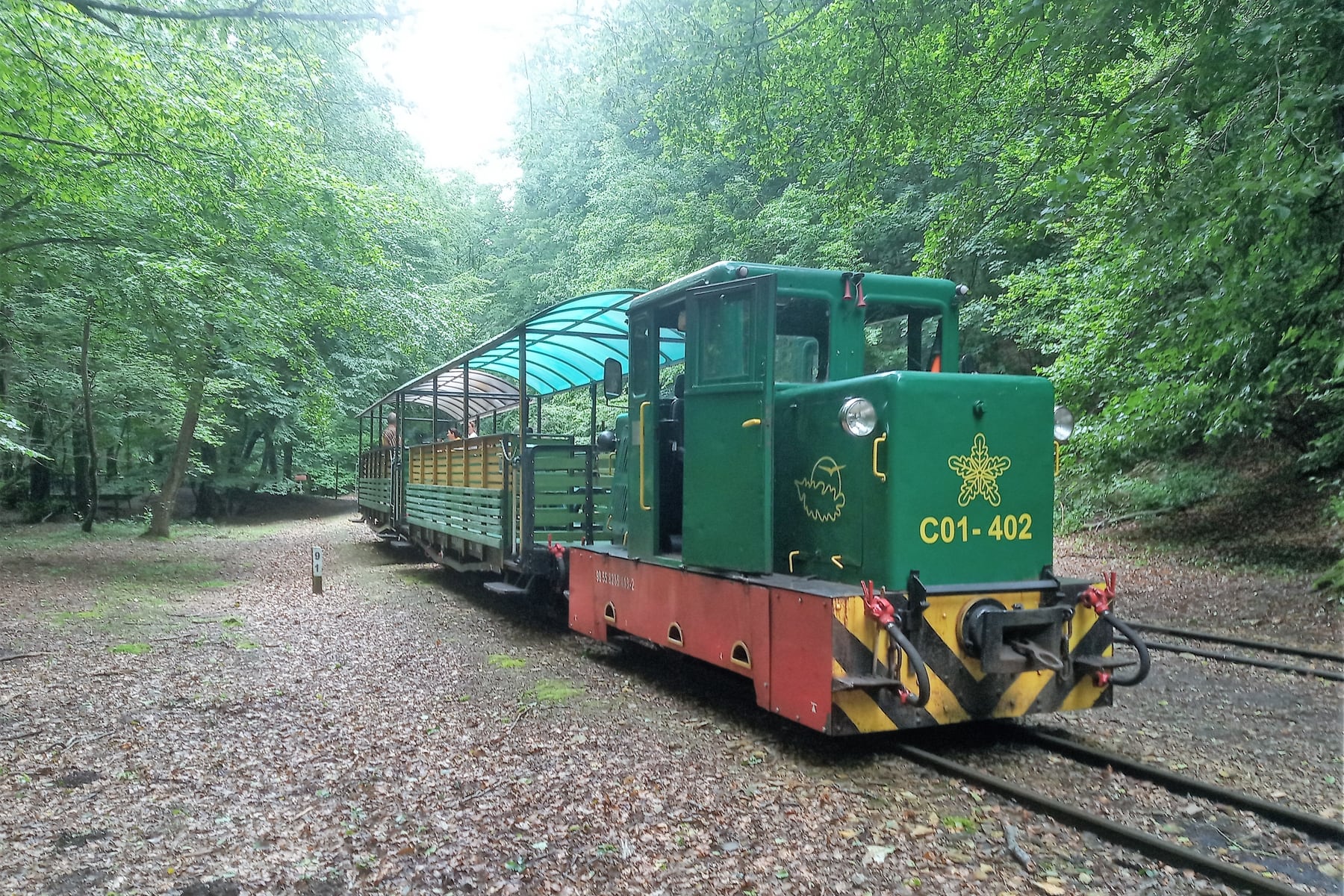
The Pálháza Forest Railway
Petrás Bence / Flickr · CC BY-SA 2.0 · cropped
- Distance9 km · 760 mm gauge
- Duration40 minutes each way
- Best seasonMid-March to late November; daily in summer
Introduction
For its first years this railway needed no engine at all. The track out of the Kemence valley fell all the way to the sawmill at Pálháza, so the loaded timber wagons simply rolled down it with only their brakes to work, and horses dragged the empties back up.
Count István Károlyi had it laid in 1888, seven kilometres of 700 mm track from the sawmill to a loading place below Kőkapu, and it is counted as Hungary's oldest forest railway. A steam engine arrived in 1902, but after only four years and several forest fires the line went back to horses. In 1903 it was pushed further up the valley through a 37-metre tunnel under the Károlyis' hunting lodge. After nationalisation in 1947 it was rebuilt to 760 mm gauge, steam came back, and in 1958 the first scheduled passenger trains ran.
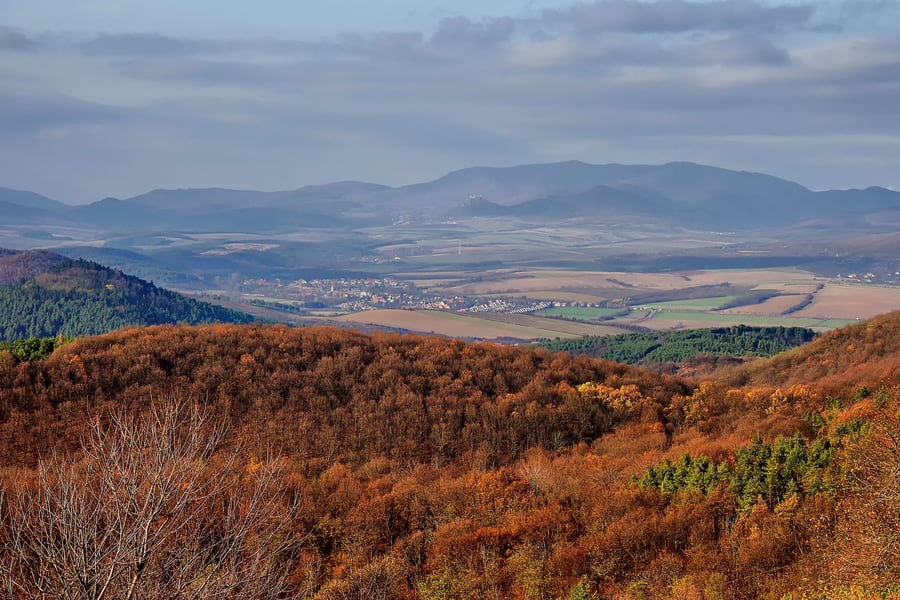
When the state tore up the Hegyköz narrow-gauge network in 1980, the forest railway was not part of it. The forestry company only suspended it, and nine years later, on 15 August 1989, local people put it back into service. It has since grown at both ends, to the woods at Rostalló in 1990 and into Pálháza in 1996, and its three little C-50 diesels now carry some 40,000 to 50,000 passengers a year, nine kilometres into the Zemplén Mountains.
The Journey
Trains start at Pálháza, a small town that counts as Hungary's least populous. The first 1.3 kilometres, out to the old sawmill yard at Pálháza-Ipartelep, were never forest railway at all: they are a short piece of the Hegyköz narrow-gauge line to Sátoraljaújhely, relaid in 1996 on its old trackbed so the trains could start in the town. At Ipartelep the forestry railway proper begins, and the line turns south-west into the valley of the Kemence stream.
Up the Kemence valley
It is a gentle climb, which is the whole point of the line: the gradient that let full timber wagons run down to the sawmill by themselves is the one the train now works up. Past the village of Kishuta, three kilometres out, the track runs on through the woods beside the stream, with halts at Kemencepatak, Komlósi-völgy and Kavicsváltó.
Through the stone gate
At Kőkapu, the stone gate, a dyke of rhyolite crosses the valley and the stream has cut a gap only a few metres wide through it. The road squeezes through the gap; the railway goes through the rock in a 37-metre tunnel dug in 1903, directly beneath the Károlyi hunting lodge that stands on the crag. The train comes out of it into Kőkapu station, the most popular stop on the line, beside the lake, the lodge and a restaurant.
The last kilometre, opened in 1990, runs on through damp alder woods to Rostalló, a clearing with a shelter and the end of the track, nine kilometres and about forty minutes from Pálháza.
The locomotives and coaches
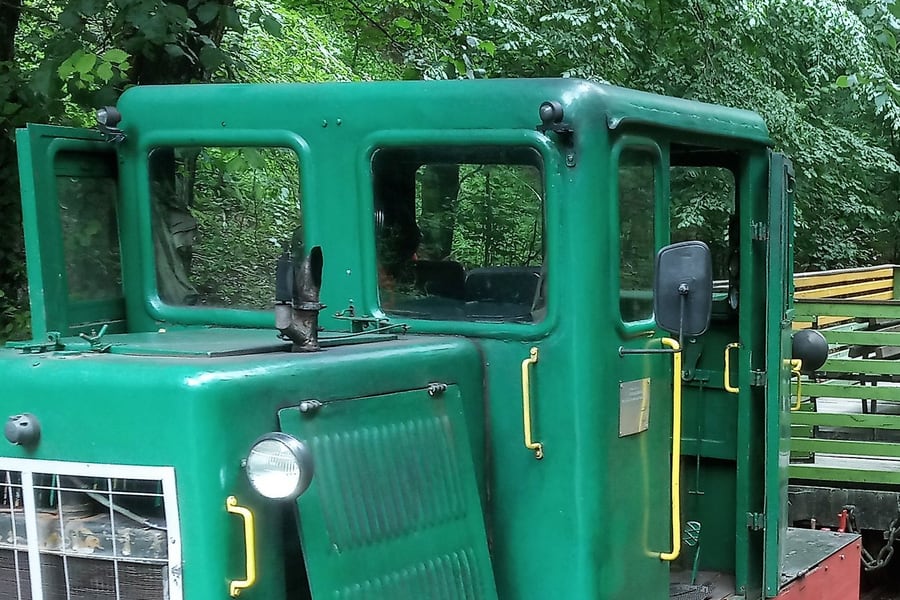
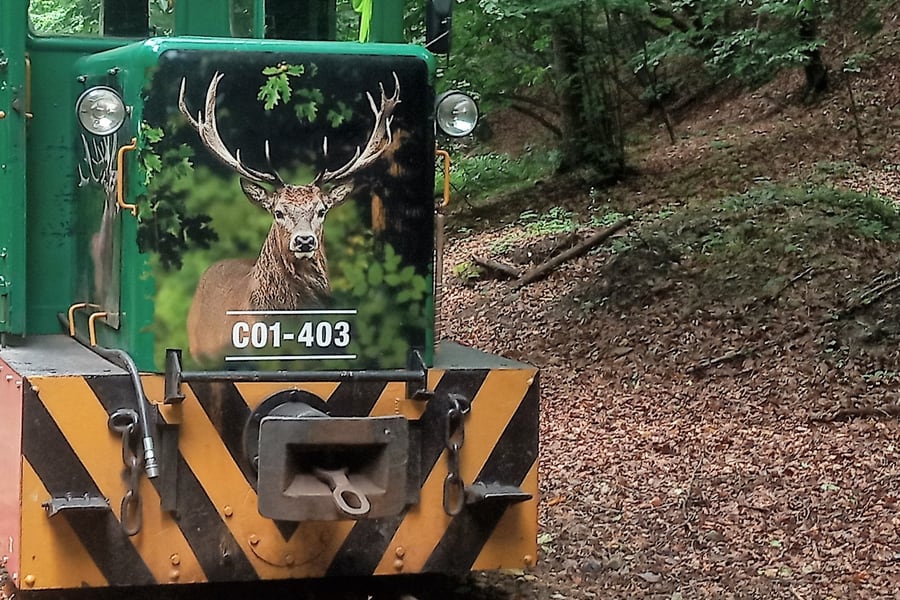
All three of the line's engines are C-50s, small narrow-gauge diesels, numbered C01-401 to C01-403; the first arrived in the late 1950s, when the line was being made ready for passengers. C01-403 carries a painted red stag on its nose. Behind them run closed coaches, an open coach and five summer coaches with open sides and canopy roofs.
Along the route
 Mjmate / Wikimedia Commons · CC BY-SA 3.0
The tunnel under the lodge
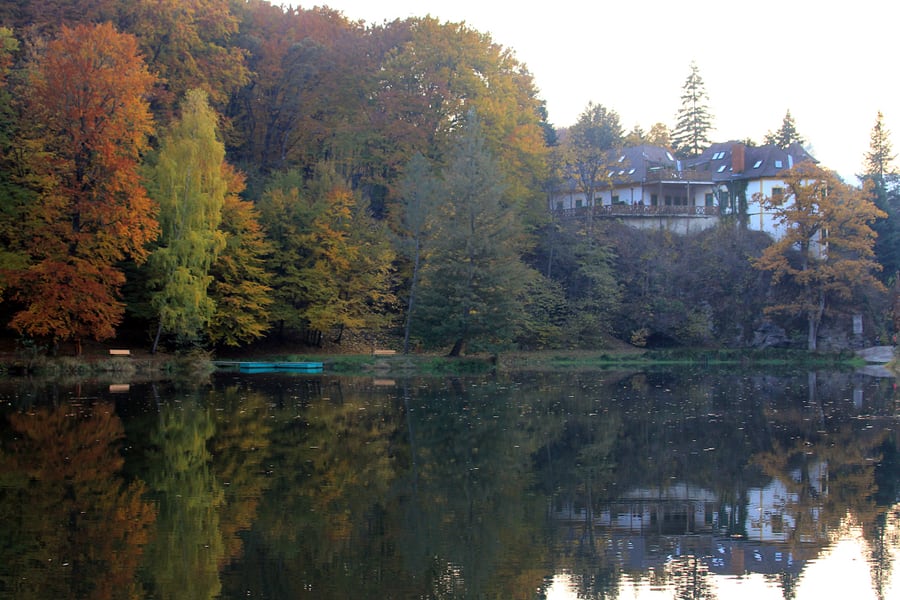
The Károlyis built their hunting lodge on the Kőkapu crag on a Swiss model, and Miklós Horthy and István Bethlen came to stalk deer here. The train runs beneath it through a 37-metre tunnel, beside Áfonyás Lake, dammed in 1968 over the old timber loading place.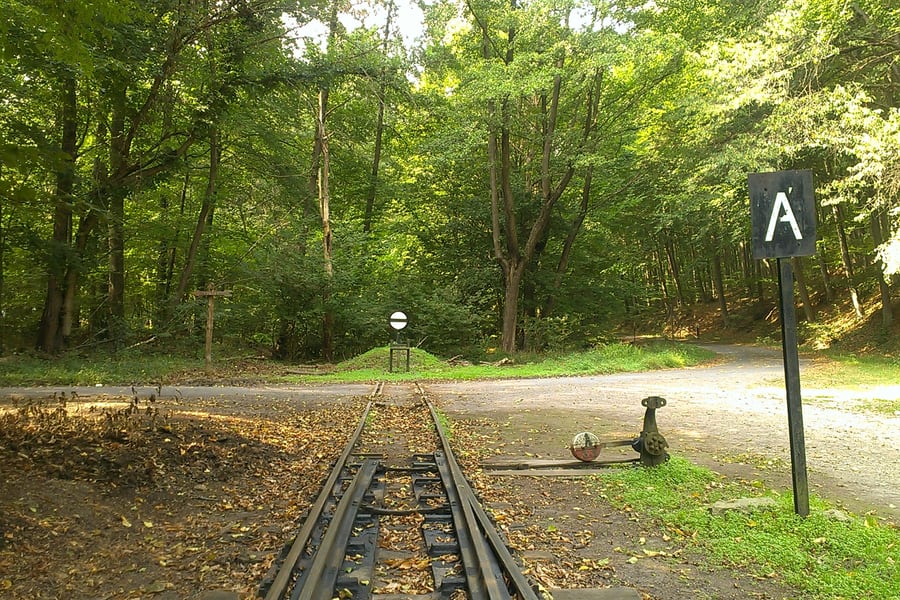 Vladimír Držík / Wikimedia Commons · CC BY 3.0 · cropped
Rostalló, the end of the track
The line has ended here since 1990, a kilometre beyond Kőkapu, in a clearing in cool, damp alder woods where rare Carpathian plants grow and fire salamanders come out after rain. Paths lead on from here into the heart of the Zemplén.A bit of history
Culture & experiences along the way
 Németh Tamás / Wikimedia Commons · CC BY-SA 4.0 · cropped
The end of the Blue Trail
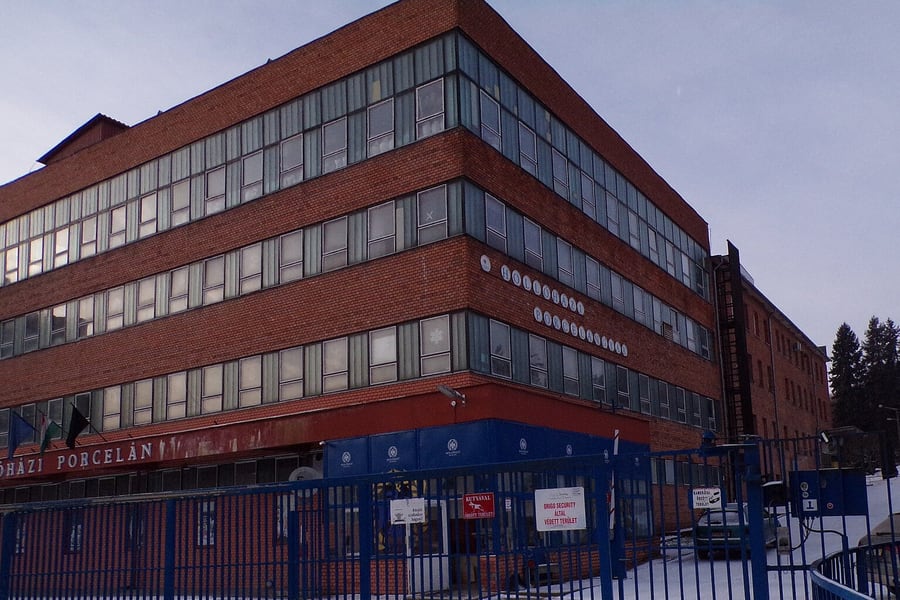
The National Blue Trail, the Országos Kéktúra, runs 1,172 kilometres across northern Hungary from Írott-kő in the Kőszeg Hills to Hollóháza, near Pálháza. It was Europe's first long-distance marked trail. Its Hollóháza stamp is at the gate of the porcelain works that Count István Károlyi founded in 1831, still making tableware today.Timetables
The PÁEV runs from mid-March to late November, and its timetable changes with the seasons: daily in summer, mostly weekends in spring and late autumn. Every train runs the whole line, Pálháza to Rostalló, in 40 minutes, and turns round at Rostalló after ten to twenty minutes. There is nothing to book: pay the crew on board, in cash.
Autumn — 30 September to 22 October 2026
To Rostalló:
| Pálháza | Kishuta | Kőkapu | Rostalló |
|---|---|---|---|
| 09:30 | 09:42 | 10:06 | 10:10 |
| 11:30 | 11:42 | 12:06 | 12:10 |
| 13:30 | 13:42 | 14:06 | 14:10 |
| 15:30 ¹ | 15:42 | 16:06 | 16:10 |
Back to Pálháza:
| Rostalló | Kőkapu | Kishuta | Pálháza |
|---|---|---|---|
| 10:20 | 10:24 | 10:48 | 11:00 |
| 12:20 | 12:24 | 12:48 | 13:00 |
| 14:20 | 14:24 | 14:48 | 15:00 |
| 16:20 ¹ | 16:24 | 16:48 | 17:00 |
¹ Weekends only. No trains on Mondays and Tuesdays, unless a group of at least ten tells the railway by phone or in writing at least two hours before the departure it wants.
23 October to 1 November 2026
Daily, from Pálháza at 10:00, 12:00, 14:00 and, until 24 October, 16:00, each reaching Rostalló 40 minutes later. Back from Rostalló at 11:00, 13:00, 15:00 and, until 24 October, 16:50.
2 to 22 November 2026 — weekends only
From Pálháza at 10:00, 12:00 and 14:00; back from Rostalló at 11:00, 13:00 and 15:00. That is the last timetable of the 2026 season.
Summer — 6 June to 19 August 2026
Daily, five trains each way: from Pálháza at 09:30, 11:30, 13:30, 15:30 and 17:30, and back from Rostalló at 10:20, 12:20, 14:20, 16:20 and 18:20.
Spring
The 2026 season opened on 14 March, with trains on weekends and holidays (and every day from 7 to 10 April) at 09:30, 11:30 and 13:30 from Pálháza, and a fourth at 15:30 from 3 April.
As of October 2026, from Északerdő's own timetables — the current one is on the PÁEV timetable page (opens in a new tab), and every season's is listed at eszakerdo.hu (opens in a new tab).
Special trains
The railway also runs evening and holiday specials, announced on Északerdő's website. On 18 and 19 September 2026, for the red deer rut, a train left Pálháza at 17:30 so that passengers could listen to the stags roaring in the woods, with hunting-horn players, bloodhounds and falcons, and game goulash for supper, back about 22:00. It cost 9,000 Ft, and had to be booked.
Getting to the start
Pálháza has no main-line station. MÁV's line 80 runs from Budapest and Miskolc to Sátoraljaújhely, and regular buses link Pálháza with Sátoraljaújhely, Hollóháza and Gönc.
Tickets
There is no ticket office: you buy your ticket from the train crew as you set off, and they take cash only. A single covers one journey between any two stations without a break, on the day it is bought, and a return is two singles. If you want to stop at Kőkapu and carry on to Rostalló later, a weekend ticket covers unlimited rides from Friday 14:00 to Sunday 19:00.
Children from 3 to 14 pay reduced fares. Bicycles, carried when there is room, and dogs, which must be muzzled and on a lead, pay the full single fare. Fares apply to scheduled trains only; special trains have their own prices. From the operator's fare table, valid from 1 March 2026.
Book your tickets
Single or return, any distance
2,500 Ft single · 5,000 Ft return · children 3–14 1,500 Ft
One fare for any trip on the line, paid in cash to the crew; a return is two singles.
Book Tickets (opens in a new tab, on PÁEV)via PÁEVWeekend ticket
6,500 Ft · 4,100 Ft for children 3–14
Unlimited rides from Friday 14:00 to Sunday 19:00, for stopping off at Kőkapu.
Book Tickets (opens in a new tab, on PÁEV)via PÁEVFamily return
Up to two adults and four children
A return trip for the family on the day bought.
Book Tickets (opens in a new tab, on PÁEV)via PÁEVRail Passes
No rail pass covers the PÁEV. Interrail's table of railway companies lists MÁV, GySEV, RegioJet and the international carriers for Hungary, and no forest railway. Everyone pays the crew in cash.
A pass still gets you most of the way. MÁV's trains on line 80 to Sátoraljaújhely are covered by an Interrail Hungary Pass or a Global Pass; regional and Interregional trains need no reservation, and InterCity trains need one. The bus on to Pálháza is outside the pass.
For this trip alone a pass is not worth buying. It pays only if the Zemplén is one stop on a longer journey through Hungary or beyond.
Checked October 2026 against Interrail's table of railway companies (opens in a new tab) and the PÁEV's fares (opens in a new tab).
Places to Visit
The line itself ends in the woods, but two of north-east Hungary's finest buildings are a few kilometres from Pálháza, both of them tied to the families who owned this valley.
 RHerczeg / Wikimedia Commons · CC BY-SA 3.0
Füzér Castle
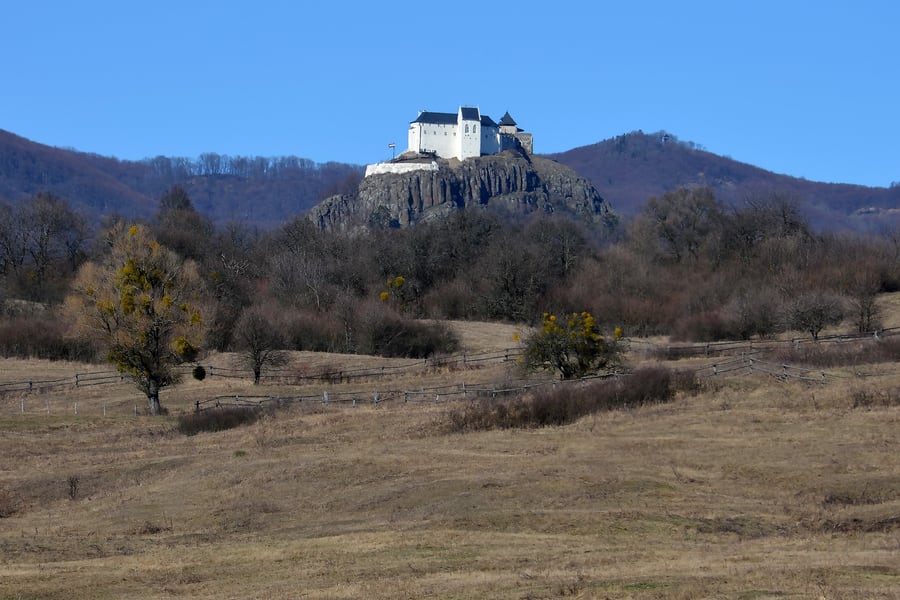
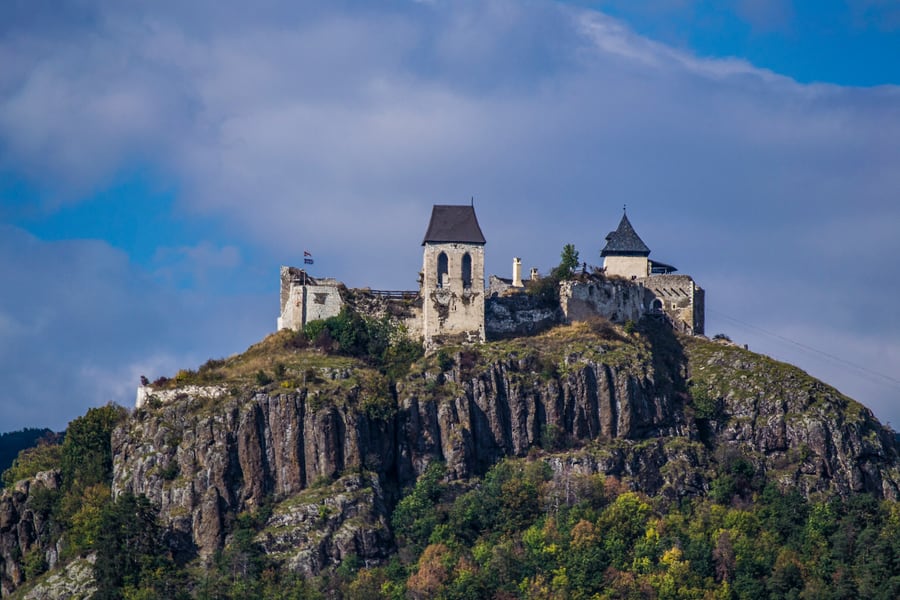
First recorded in 1264, Füzér stands on a volcanic hill 170 metres above its village and may be one of Hungary's first privately built stone castles. In 1526 the crown guardian Péter Perényi brought the Holy Crown here instead of to Visegrád and hid it for at least a year. Imperial troops left it uninhabitable in 1676; restored since 1992, with the lower castle rebuilt in 2014–16, it is now one of the best-preserved in Hungary.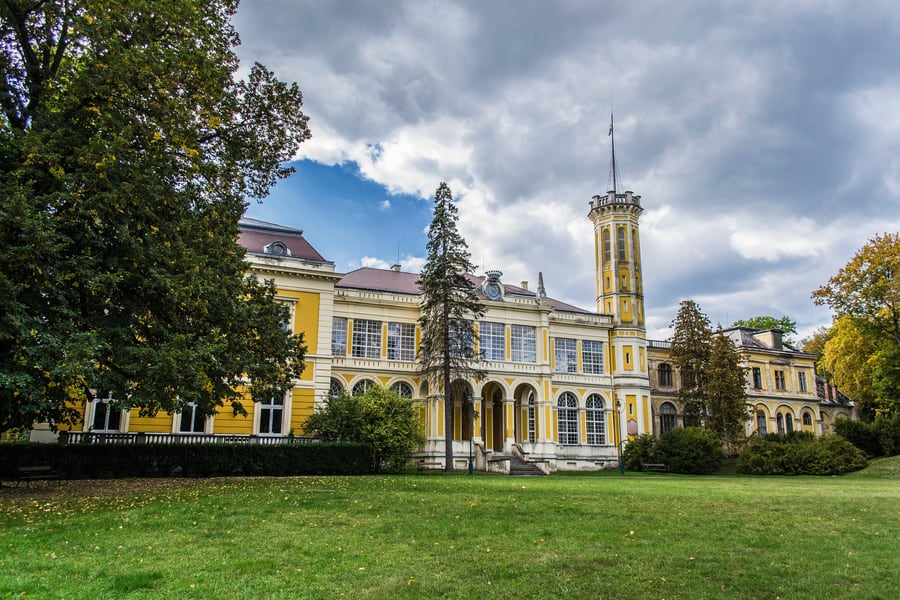 RHerczeg / Wikimedia Commons · CC BY-SA 3.0
The Károlyi Palace, Füzérradvány
Leopold I gave this estate to László Károlyi in 1686, and the family owned the forests the railway was built to work. Ede Károlyi rebuilt the old manor between about 1846 and 1877, to plans by Miklós Ybl and his own; it stands in a protected park of more than 100 hectares. The Károlyis' hunting guests stayed here and were taken up to Kőkapu to stalk.Where to Sleep
The obvious place to stay is on the line itself, in the hunting lodge the railway tunnels under.
Where to stay
Kőkapu Hunting Lodge and Hotel
On the crag above Kőkapu station
The Károlyi family's hunting lodge and its hotel, 23 rooms in the forest, with no wifi and no mobile signal on purpose.
Check Availability (opens in a new tab, on kokapu.hu)via kokapu.huQuestions or corrections
Planning this trip and stuck on something, or spotted a time, fare or detail that has changed? Send us a message about The Pálháza Forest Railway. We read every one, and we update this page when something has changed.