Patras Suburban Railway
Michal Gregor / Wikimedia Commons · CC BY-SA 4.0
- DistanceRio–Patras–Agios Andreas–Kaminia · metre gauge · two lines
- DurationAbout 50 minutes end to end, with one change
- Best seasonAll year, every day, about hourly
Introduction
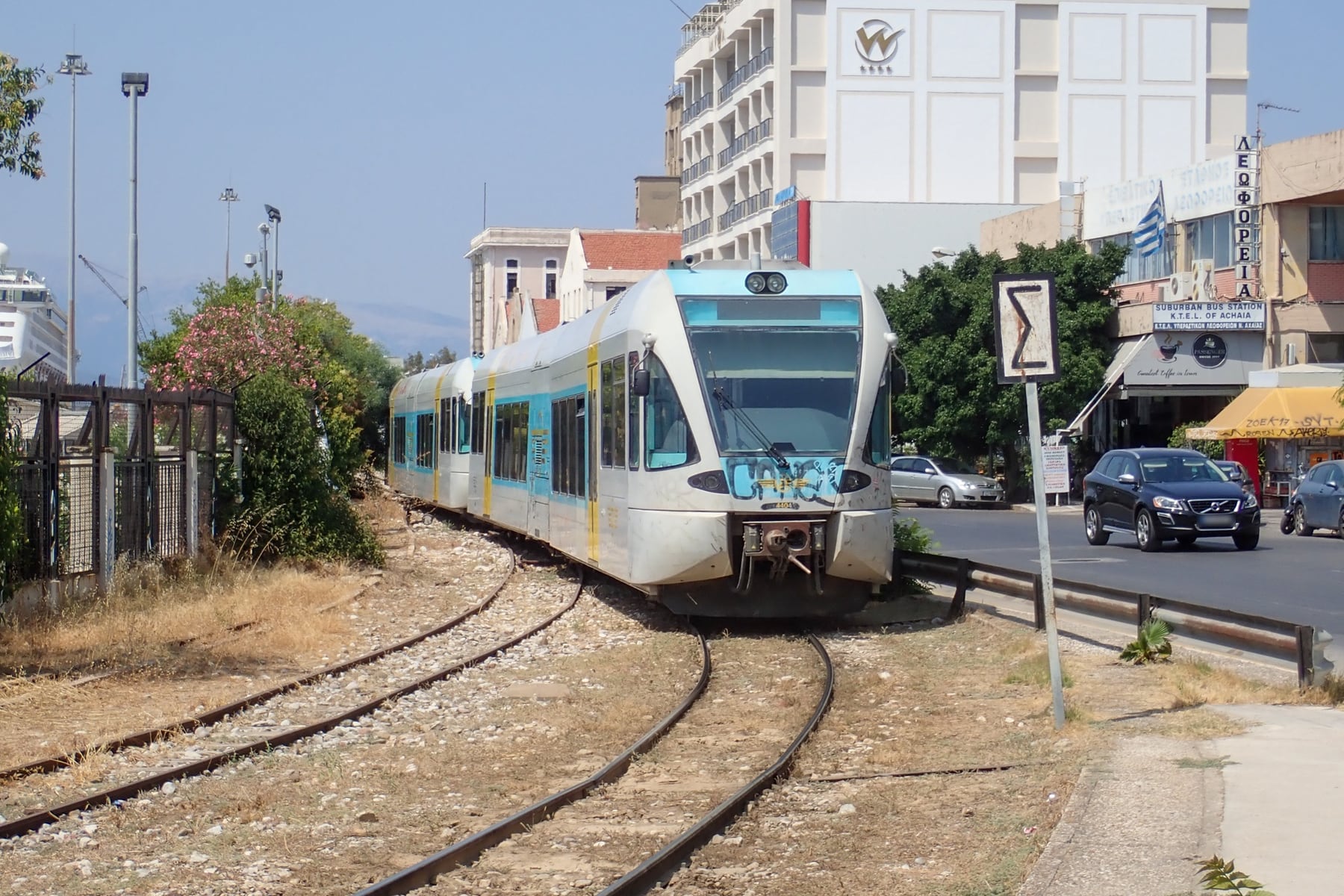
The Proastiakos, Greek for "suburban", is Hellenic Train's local railway in Patras, the port city on the north-west corner of the Peloponnese. It runs along the shore of the Gulf of Patras for its whole length: north-east from the city centre to Rio, under the mountains of the mainland across the strait, and south-west through the beach suburbs to Kaminia. The trains are hourly, every day, and the whole line costs €2.
The tracks are older than the service. They belong to the metre-gauge network the Piraeus, Athens and Peloponnese Railways built from 1884, which reached Patras in 1887 and ran on to Pyrgos and Kalamata. With its branches it came to about 731 km. Its regional trains were suspended in 2011, and new standard-gauge lines have since taken over parts of its route. What still carries passengers on the old metre gauge is this line through Patras and the short branch from Katakolo to Olympia, and of the two only Patras has a train every hour.
The Journey
The northern end of the line is Rio, where the Peloponnese reaches closest to the mainland and the Gulf of Patras narrows into the strait. The old station there closed in 2019 for the building of the new standard-gauge line from Athens, and trains now start from a temporary stop about 600 metres to the west. From Rio the train runs south-west along the shore through Kastelokampos, where buses connect for the university and the hospital, then Bozaitika, Agyia and Panachaiki, with the sea on one side and the city filling in on the other.
After sixteen minutes the train reaches Patras central station, beside the north port and the start of the waterfront avenue. Six minutes later it stops at Agios Andreas, the end of the northern line. The station opened in 1887 as Pyrgos Station, the city's terminus for trains to Pyrgos, and it is still where you change: the southern train leaves from the same station four minutes after the northern one arrives, and one ticket covers both.
South to Kaminia
The southern line keeps to the coast. It calls at Anthia by the new port, where the ferries from Italy dock, then at Ities, Paralia and Tsaousi–Mintilogli, the beach suburbs of south Patras, and at Vrachneika and Tsoukaleika before the end of the line at Kaminia, 24 minutes from Agios Andreas. The rails once ran on to Kato Achaia. In June 2024 about 550 metres of track between Kaminia and Alissos were cut for the new Patras–Pyrgos motorway, and a Hellenic Train bus now meets some trains for the last ten minutes to Kato Achaia.
The trains
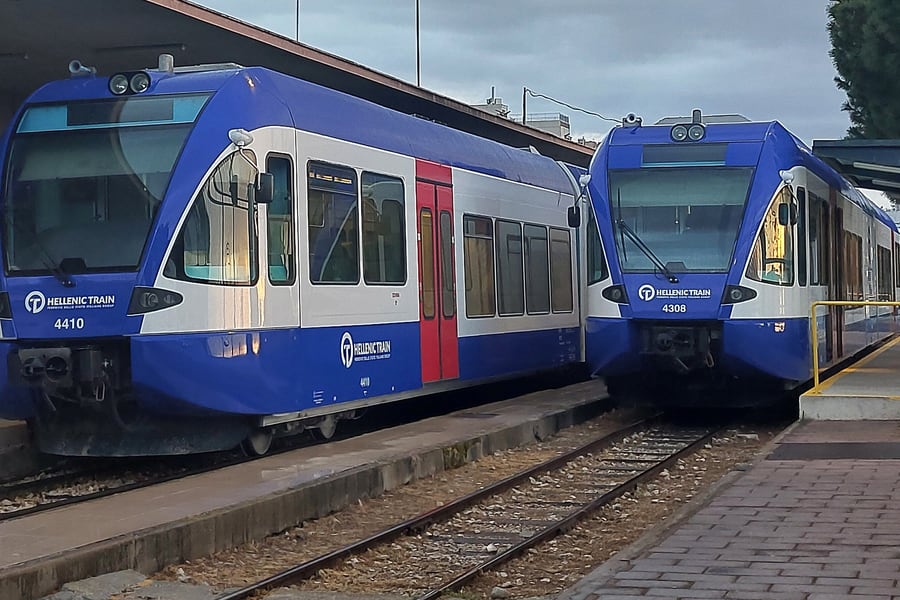
Both lines are worked by Stadler GTW 2/6 diesel railcars of the metre-gauge 4500 series, articulated units with a power module in the middle, the same type that runs from Katakolo to Olympia. They now carry Hellenic Train's blue livery in place of the white and turquoise they wore until a few years ago.
Along the route
 Awinch1001 / Wikimedia Commons · CC BY-SA 4.0
Rio, at the strait
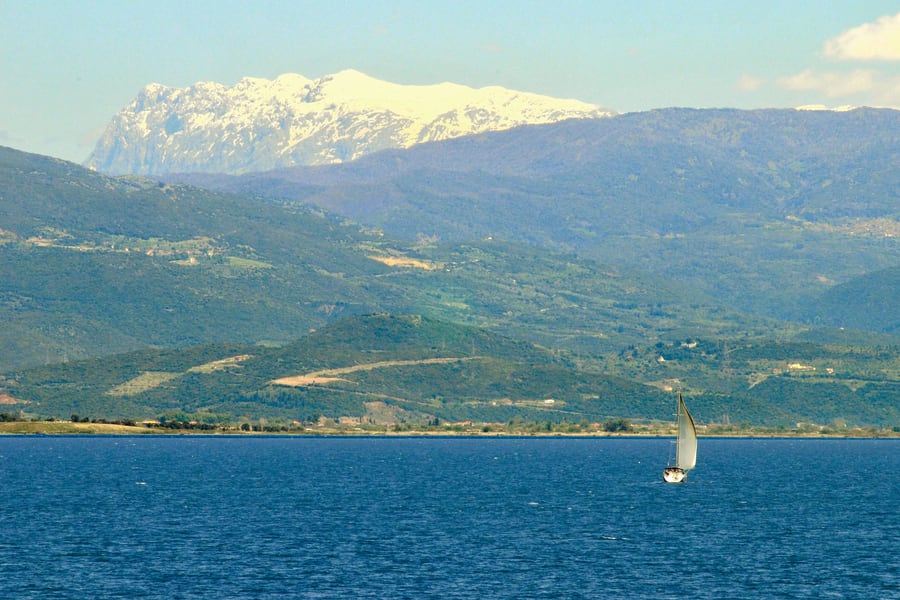
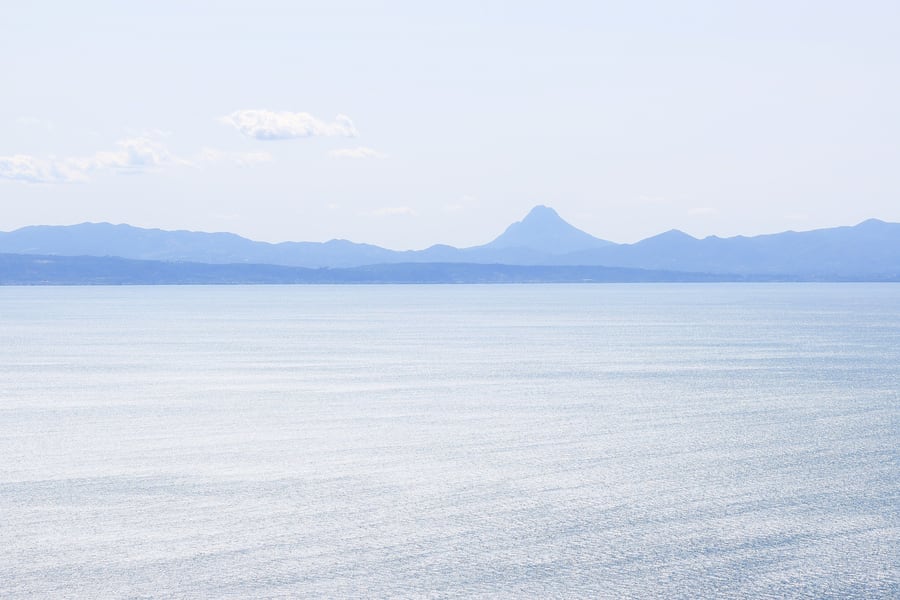
The northern line starts at Rio, where the gulf narrows to its strait and the University of Patras has its campus. Across the water rise Klokova and Varasova, and the train follows the shore into Patras in sixteen minutes.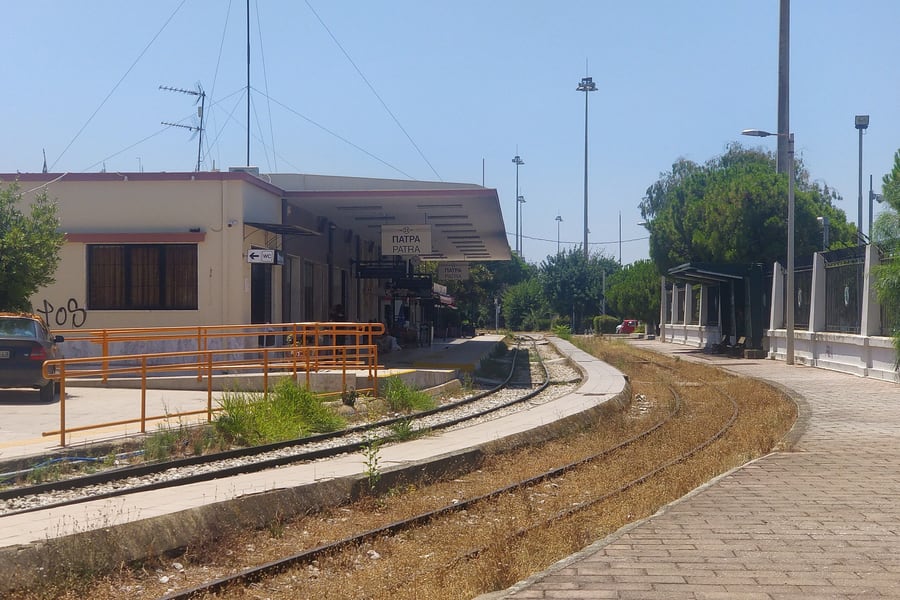 Jcornelius / Wikimedia Commons · CC BY-SA 4.0
Through Patras
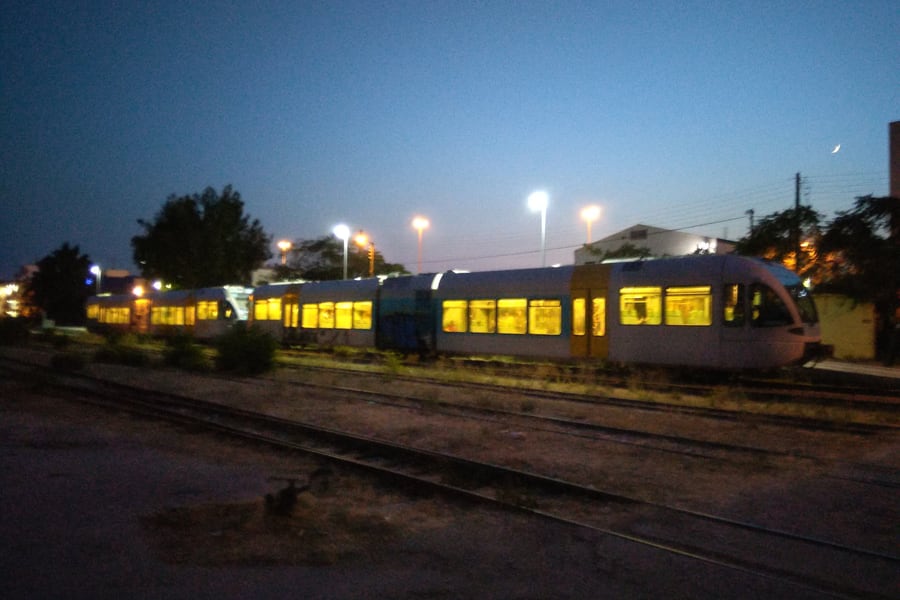
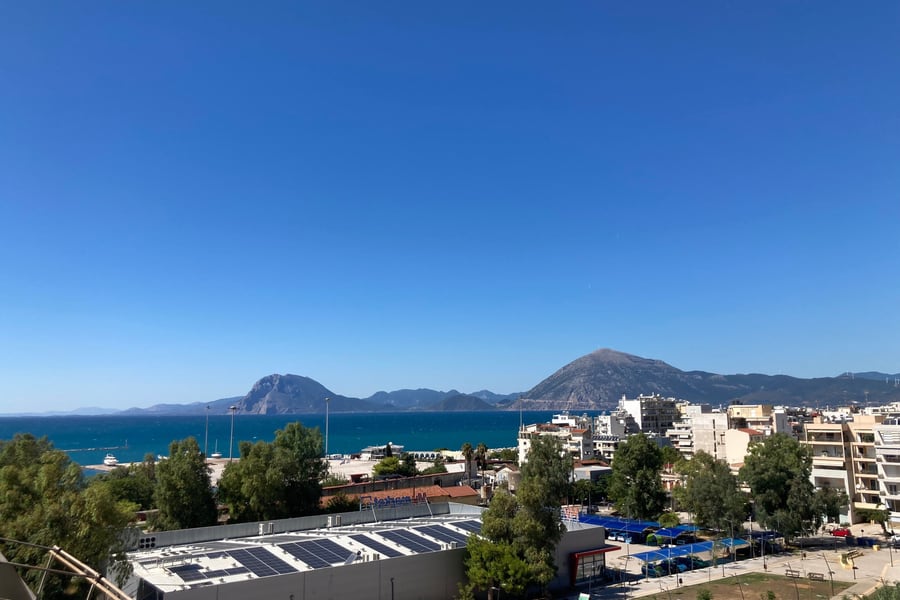
Trains call at Patras central station beside the north port, then run six minutes along the edge of the city to Agios Andreas, where the southern train leaves four minutes after the northern one arrives.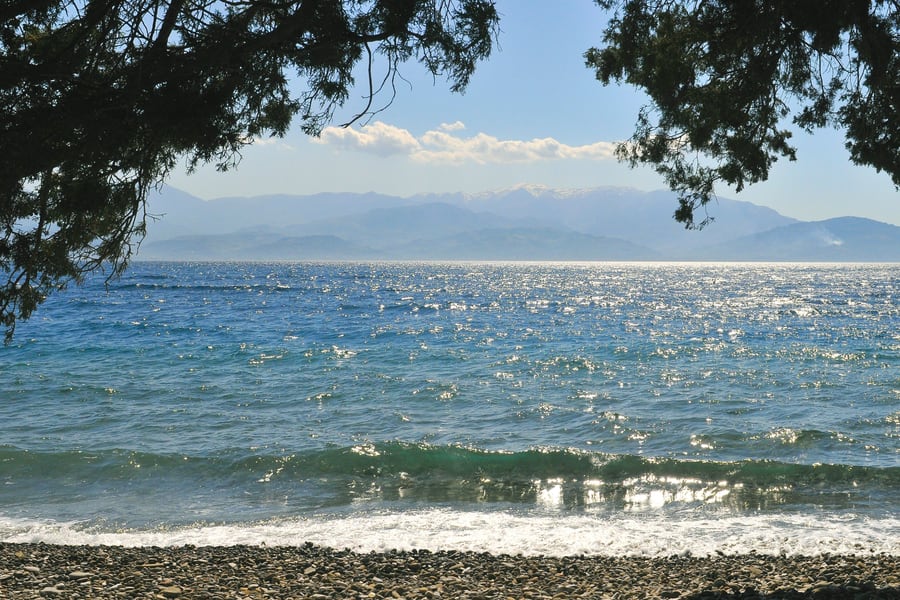 LBM1948 / Wikimedia Commons · CC BY-SA 4.0
The south shore to Kaminia
South of Agios Andreas the line keeps to the coast through Paralia and the beach suburbs, the gulf on the right and the mountains of the mainland across it, and ends at Kaminia after 24 minutes.A bit of history
Culture & experiences along the way
 Michael Paraskevas / Wikimedia Commons · CC BY-SA 3.0
Arriving by sea
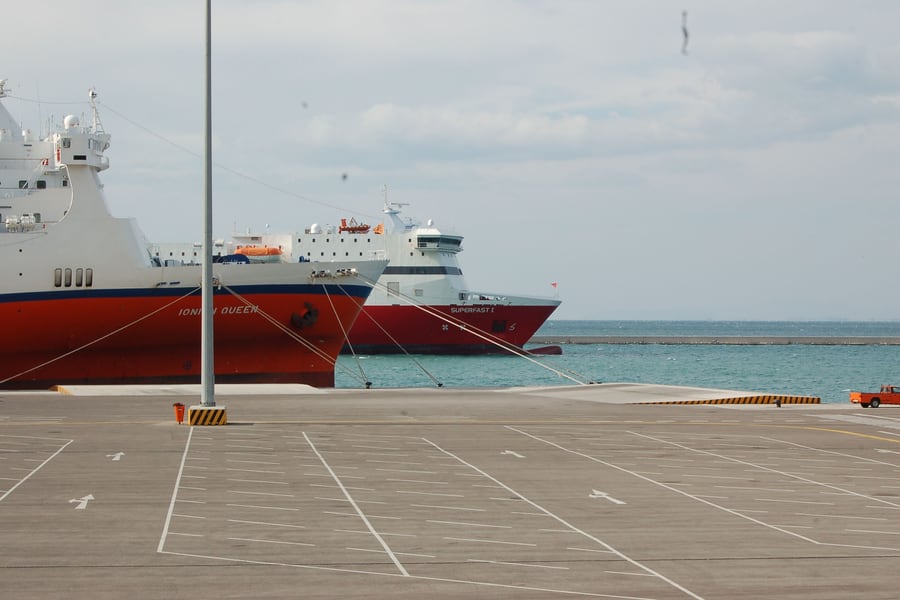
The ferries from Italy dock at Patras's new port, and Anthia, the first stop on the southern line, is beside it. Interrail counts the transfer from Patras to Piraeus as part of some passes, and the line takes you into the city or out to the beaches for €2 or less.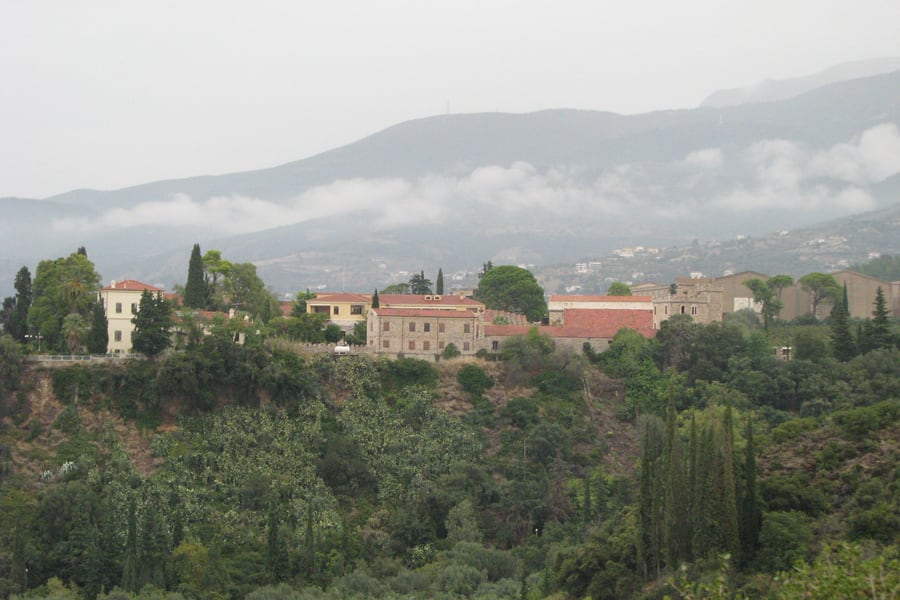 Nickos alexiou / Wikimedia Commons · CC BY-SA 4.0
Mavrodaphne
Achaia Clauss, the winery the Bavarian Gustav Clauss founded at Patras in 1861, is best known for Mavrodaphne, a fortified red wine. Its stone buildings stand among the cypresses on a hillside above the city, looking down over Patras to the gulf.Timetables
Trains run every day, about once an hour on each line, and the two lines meet at Agios Andreas, where you change.
Northern line, Rio – Patras – Agios Andreas. The same minutes past every hour all day.
| Direction | First | Then hourly | Last |
|---|---|---|---|
| Rio → Patras → Agios Andreas | Patras 06:23 | Rio :07 · Patras :23 · Agios Andreas :29 | Rio 23:07 |
| Patras → Rio | 06:39 | Patras :39 · Rio :53 | 22:38 |
Southern line, Agios Andreas – Kaminia. Hourly, with one gap in the late morning: there is no 10:33 from Agios Andreas and no 11:03 from Kaminia.
| Direction | First | Then hourly | Last |
|---|---|---|---|
| Agios Andreas → Kaminia | 06:33 | Agios Andreas :33 · Kaminia :57 | 21:33 |
| Kaminia → Agios Andreas | 07:03 | Kaminia :03 · Agios Andreas :26 | 22:03 |
Good to know:
- End to end takes about 50 minutes. Rio 07:07 reaches Kaminia at 07:57, and Kaminia 07:03 reaches Rio at 07:53, each with a four- or six-minute change at Agios Andreas.
- For Kato Achaia, a Hellenic Train bus leaves Kaminia ten times a day, at 07:00 to 10:00 and 14:00 to 19:00, and takes ten minutes.
- From Athens, take the suburban train to Kiato and Hellenic Train's connecting bus to Patras, about 1 hour 25 minutes from Kiato.
Times as of November 2026, from Hellenic Train's Rio–Agios Andreas–Kaminia timetable and its booking engine. Check your date on hellenictrain.gr (opens in a new tab) before you travel.
Tickets
Fares go by zone. A single from Patras to Rio costs €1.40, and the whole line, Rio to Kaminia with the change at Agios Andreas, is €2 on one ticket. You can buy in Hellenic Train's booking engine and app, or on board with Tap in Train: the machine by the train doors takes a contactless bank card, phone or watch, you choose the zones for your trip, and on a check you show the card you paid with.
Fares checked November 2026 in Hellenic Train's booking engine, with the Tap in Train rules from hellenictrain.gr (opens in a new tab); euros.
Book your tickets
Patras to Rio
Adult single · northern line
One zone, bought on board with a contactless card through Tap in Train or in Hellenic Train's booking engine.
Book Tickets (opens in a new tab, on hellenictrain.gr)via hellenictrain.grRio to Kaminia
Adult single · the whole line, with the change
One ticket for both trains, from one end of the line to the other.
Book Tickets (opens in a new tab, on hellenictrain.gr)via hellenictrain.grRail Passes
Interrail and Eurail passes are valid on the Proastiakos. Hellenic Train's own Interrail page says pass holders travel on its network with no extra fare and no supplement, and Interrail's table of railway companies lists Hellenic Train's suburban trains as included, with reservations optional. Residents of Greece can use only a Global Pass on Greek trains.
For this line alone, a pass is never worth buying. The longest trip costs €2. It matters if you arrive at Patras by ferry from Italy with a pass already: Interrail says the Global Pass, the One Country Pass Greece and the six-day Greek Islands Pass all include the transfer from Patras to Piraeus by Hellenic Train's bus and train.
Checked November 2026 against hellenictrain.gr (opens in a new tab) and interrail.eu (opens in a new tab).
Places to Visit
Patras is where the ferries from Italy come in, and the line touches the sea at almost every stop. The city centre, its oldest church and the beaches of the south shore are all a short walk from a station.
 AlekH / Wikimedia Commons · CC BY 3.0
Patras
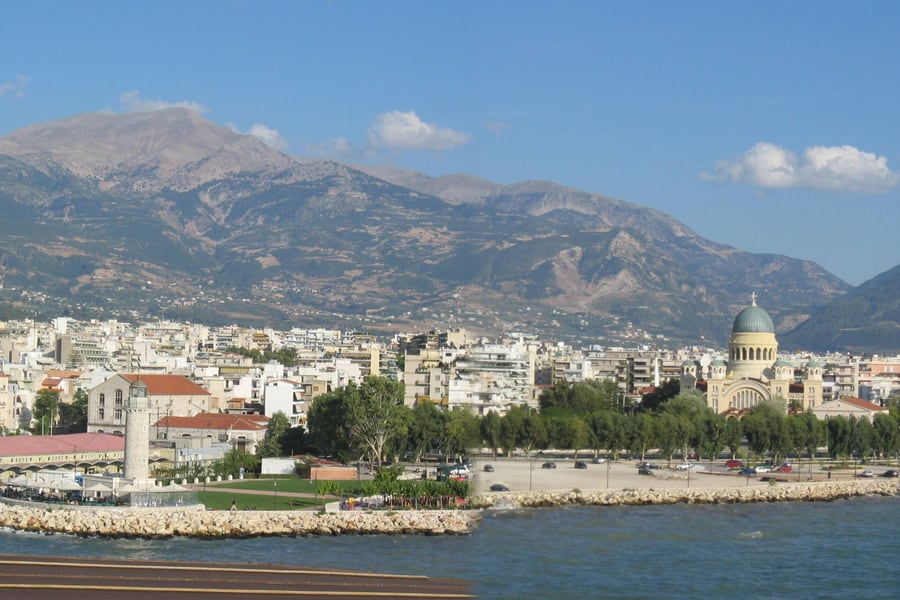
Patras is the capital of Western Greece and the country's third-largest city, built at the foot of Mount Panachaiko and overlooking the gulf, 215 km west of Athens. From the sea it reads as one long waterfront, with the lighthouse on the shore and the dome of St Andrew's cathedral above the roofs. The central station stands on the seafront avenue, Othonos Amalias, beside the north port.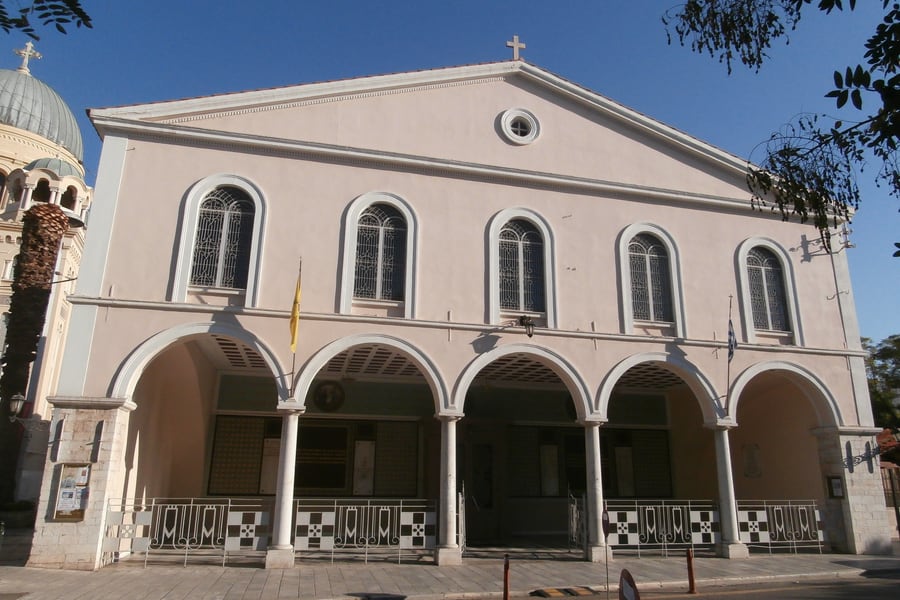 C messier / Wikimedia Commons · CC BY-SA 4.0
The churches of St Andrew
The district at the meeting of the two lines takes its name from the apostle Andrew. Its great cathedral was begun in 1908 and finished in 1974, and holds relics returned to Patras from Rome in 1964 and from Marseille in 1980. Beside it stands the much smaller old church of St Andrew, and the two together are a place of pilgrimage.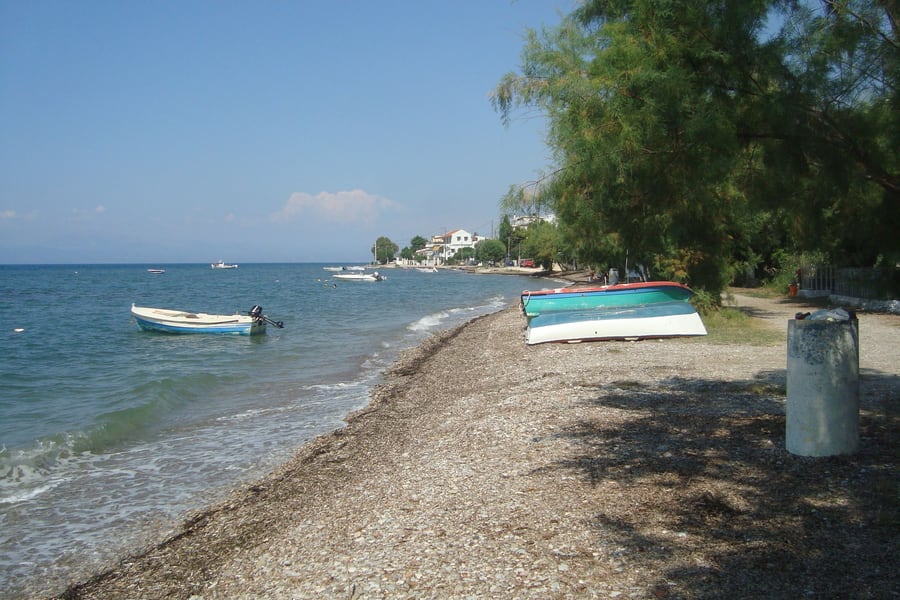 Tony Esopi / Wikimedia Commons · CC BY-SA 4.0
Kaminia
The end of the line is a small village on the coast 15 km south-west of Patras, with a shingle beach under the trees and fishing boats pulled up on the shore. It is a quiet place for a swim between trains, and the bus from the station goes on to Kato Achaia, six kilometres further west.Where to Sleep
Patras has hotels on the waterfront and in the pedestrian streets of the centre, all within walking distance of the central station.
Where to stay
Byzantino Hotel
Patras · on the Riga Feraiou pedestrian street
Twenty-two rooms and suites in a 19th-century neoclassical building in the middle of the city.
Check Availability (opens in a new tab, on byzantino-hotel.gr)via byzantino-hotel.grMy Way Hotel & Events
Patras · on Othonos Amalias Avenue
A hotel with a roof garden on the seafront avenue that runs past the central station.
Check Availability (opens in a new tab, on mywayhotel.gr)via mywayhotel.grQuestions or corrections
Planning this trip and stuck on something, or spotted a time, fare or detail that has changed? Send us a message about Patras Suburban Railway. We read every one, and we update this page when something has changed.