The Rauma Railway
SJ Norge
- DistanceDombås–Åndalsnes · 114 km
- DurationAbout 1 hour 25 minutes · 1 hour 32 on the summer tourist run
- Best seasonJune–August for the tourist train; the line runs all year
Introduction
It is a short line and a small train — two diesel cars, a branch off a branch, an hour and twenty-five minutes end to end. It goes from a windy junction on a mountain plateau to a town of three thousand people at the head of a fjord, and hardly anybody would tell you it was one of the great railway journeys of the world. Except that it is, and SJ, the operator, will tell you Lonely Planet said exactly that in 2023.
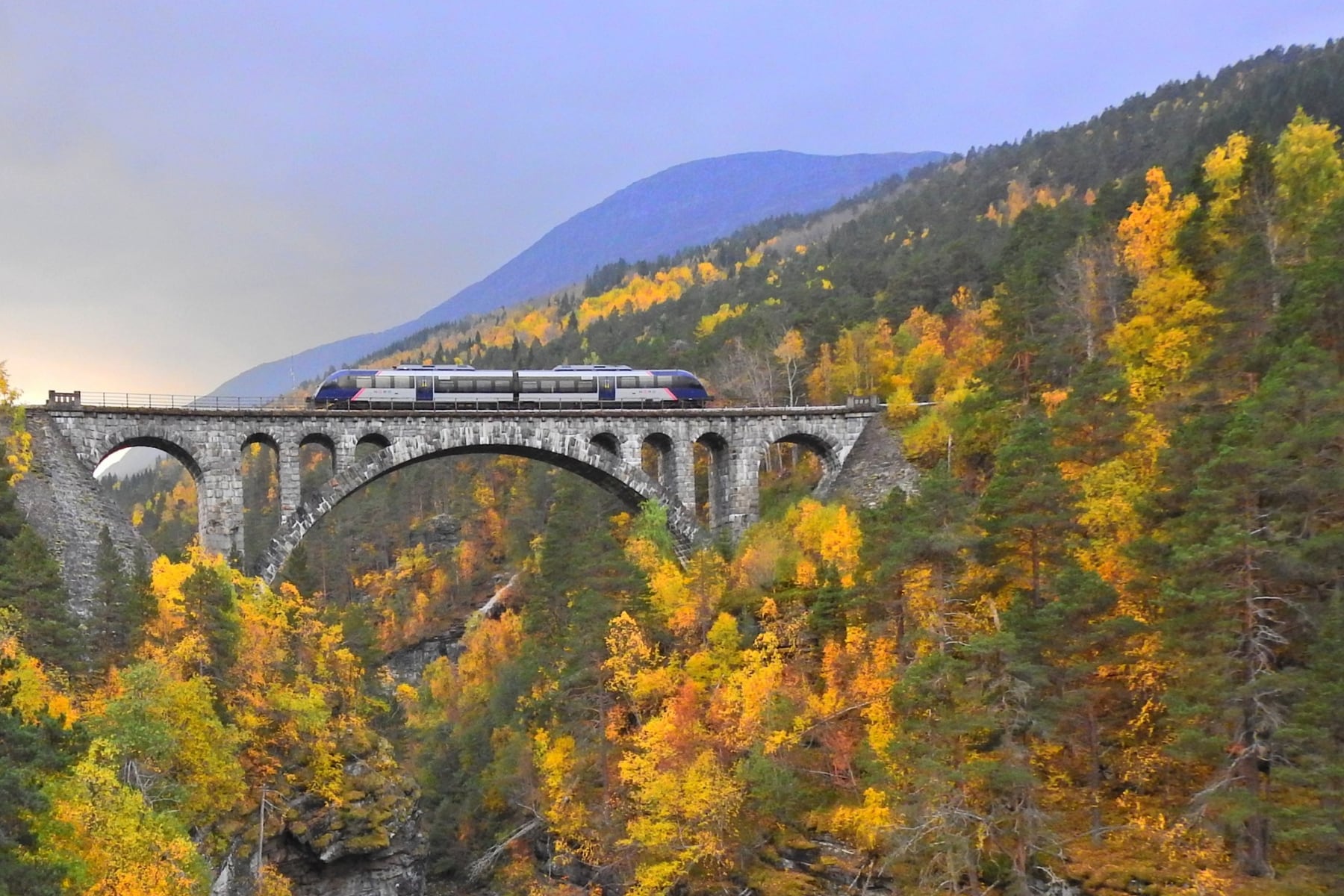
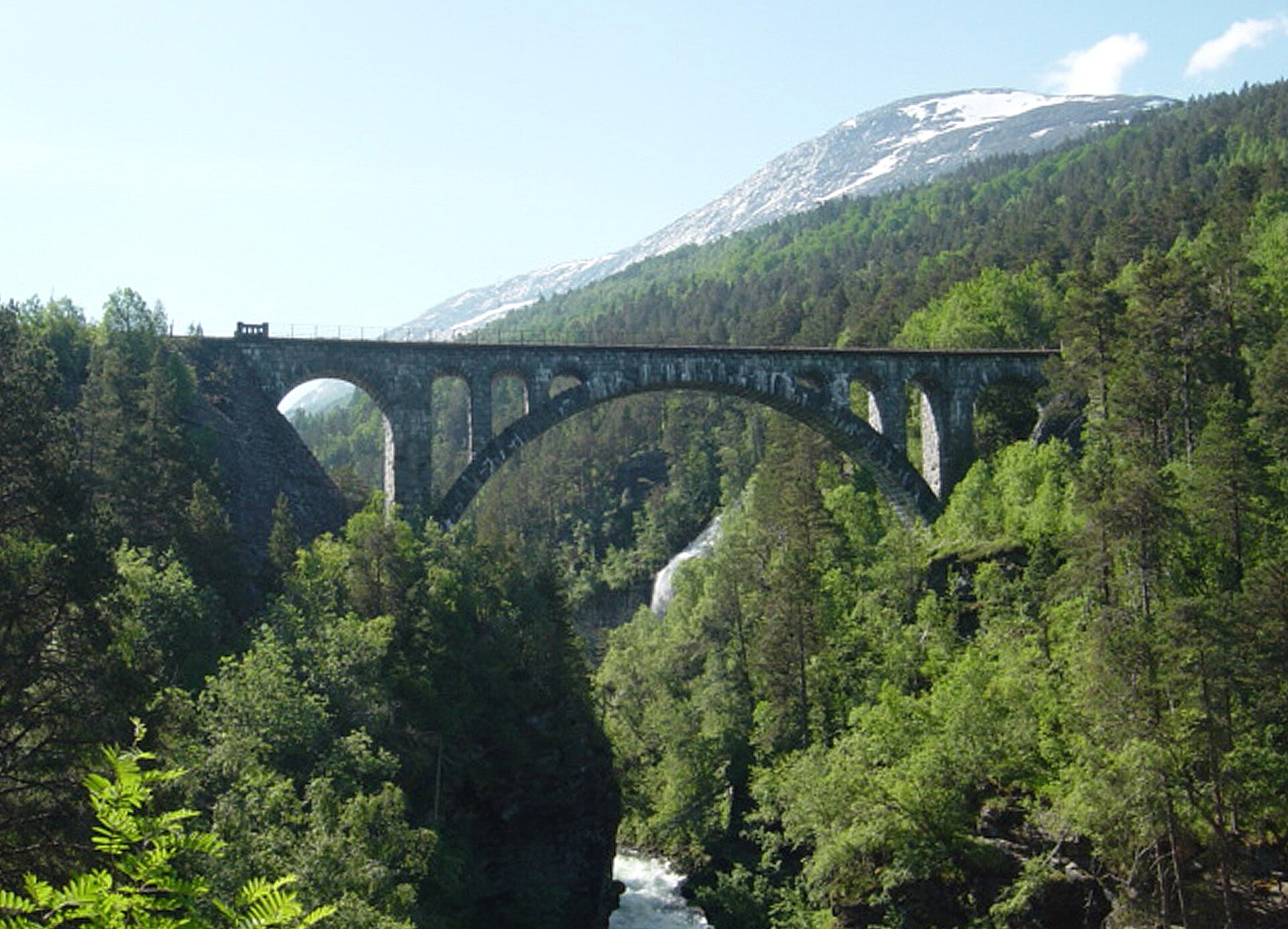
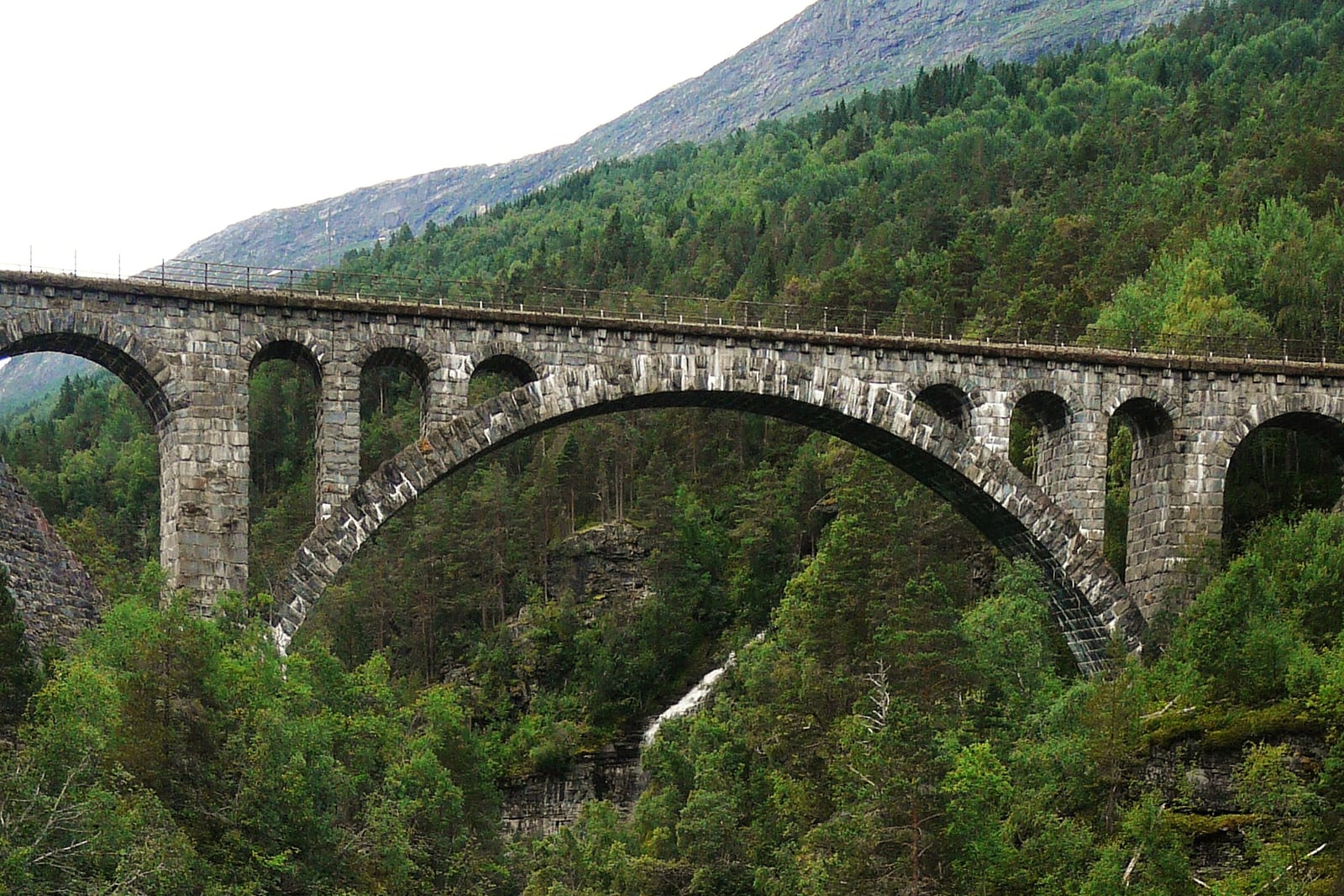
The Rauma Railway runs 114 kilometres from Dombås, high on the Dovre mountains at 659 metres, down to Åndalsnes at sea level. In between it does two extraordinary things. It descends through a valley so steep and so narrow that the engineers had to fold the line back on itself twice — a tunnel curled into a horseshoe, then a stone bridge flung across a gorge in a second horseshoe, the celebrated Kylling Bridge, standing on one 42-metre arch 59 metres above the river. And then, at the bottom, it delivers you into Romsdalen beneath Trollveggen, the Troll Wall: 1,100 metres of vertical rock, the tallest cliff face in Europe, with a summit that leans out over its own base by nearly fifty metres.
Building it took twelve years and more than fourteen million man-hours. Work started at Dombås on 12 January 1912; the rails reached Bjorli in 1921 and Verma in 1923, and the whole line opened on 29 November 1924. The Kylling Bridge alone had taken nine years.
Sixteen years later the line did something no one had planned for. In April 1940, when Germany seized Oslo, Bergen and Trondheim in a matter of days, the small port at the end of this railway was still in Norwegian hands. British troops came ashore at Åndalsnes, and up the valley went the trains that carried the King, the government and Norway's gold reserve out to the coast and away to Britain. The Luftwaffe bombed the line for it.
Today it is the least dramatic railway in the world to travel on and one of the most dramatic to look out of. In summer one train each way slows to a crawl for the scenery and stops outright at the bridge and the Troll Wall, and if it sounds like a tourist contrivance, that is because it is: they built it for the cruise ships. Ride it anyway. Eighty minutes, an ordinary ticket, and a view most railways would sell their souls for.
The Journey
Dombås — the junction on the mountain
Dombås is a place that exists because two railways meet there. It sits at 659 metres on the Dovre plateau, 343 kilometres north of Oslo on the main line to Trondheim, and it is the only way onto the Rauma Line: there is no through train from the capital, and there never has been since the night service was withdrawn in 2000. You get off the Dovre Line express, walk across the platform, and get onto something much smaller.
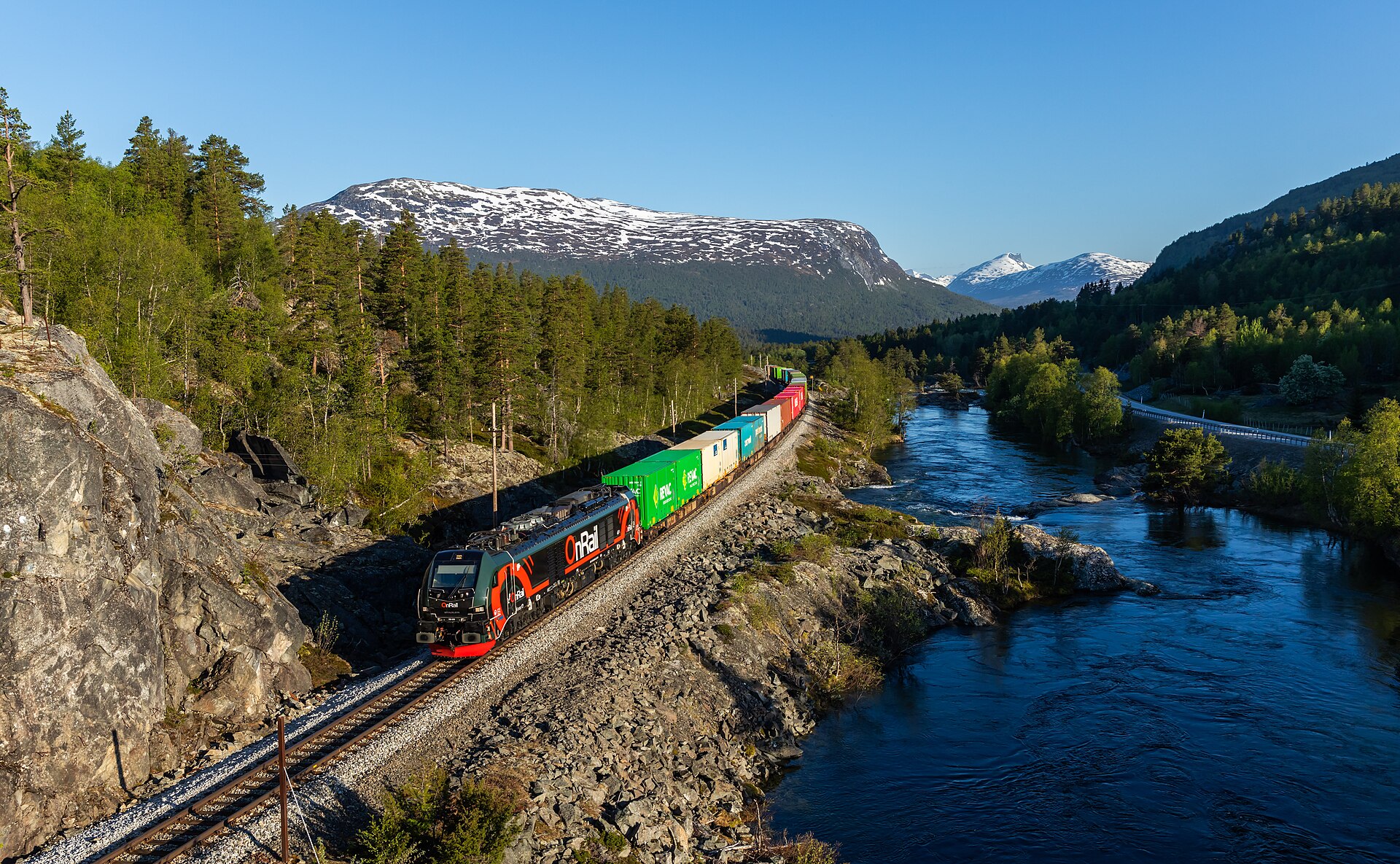
The first half-hour is deceptively gentle. The line runs north-west into the wide, flat, treeless upper valley of Lesja, crossing the Jora Bridge — an 85-metre arch — barely three and a half kilometres out, then calling at Lesja and Lesjaverk, farm country with the mountains held politely at a distance. At Bjorli, 57 kilometres from Dombås and still 575 metres up, there is a ski centre, a handsome timber station and, in winter, a great deal of snow.
The double horseshoe
Then the floor drops out of the valley.
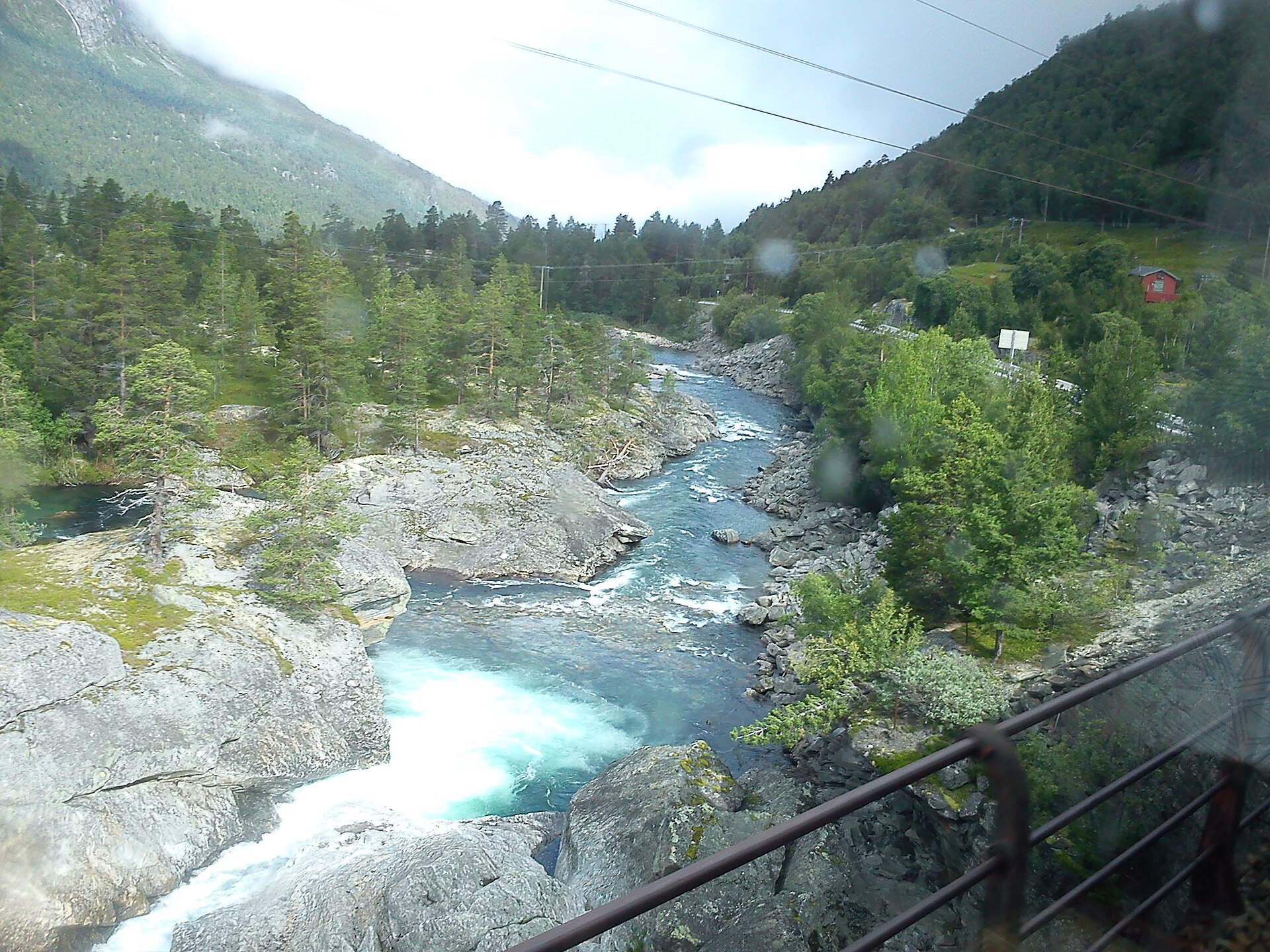
Below Bjorli the land falls away toward the fjord far faster than a railway can follow, and the solution the engineers found is the reason people ride this line. First the train crosses the Rauma on the Stuguflåt Bridge and burrows into the Stavem Tunnel — 1,396 metres bored as a horseshoe curve, so that you go in facing one way and come out facing the other, lower down the same hillside. It calls at Verma, 273 metres above the sea. And then, immediately, comes the second loop: a short 480-metre tunnel that turns the line square-on to the gorge, and the Kylling Bridge.
The bridge is the moment. A single 42-metre stone arch, 76 metres long in all, standing 59 metres above the Rauma where the river runs white through a chasm of wet rock. It was begun in September 1913 and took almost nine years to finish. In summer the tourist train stops on it; even the ordinary service slows. If you can, be on the right-hand side going down — but honestly, everyone is out of their seat by this point anyway.
Romsdalen and the Troll Wall
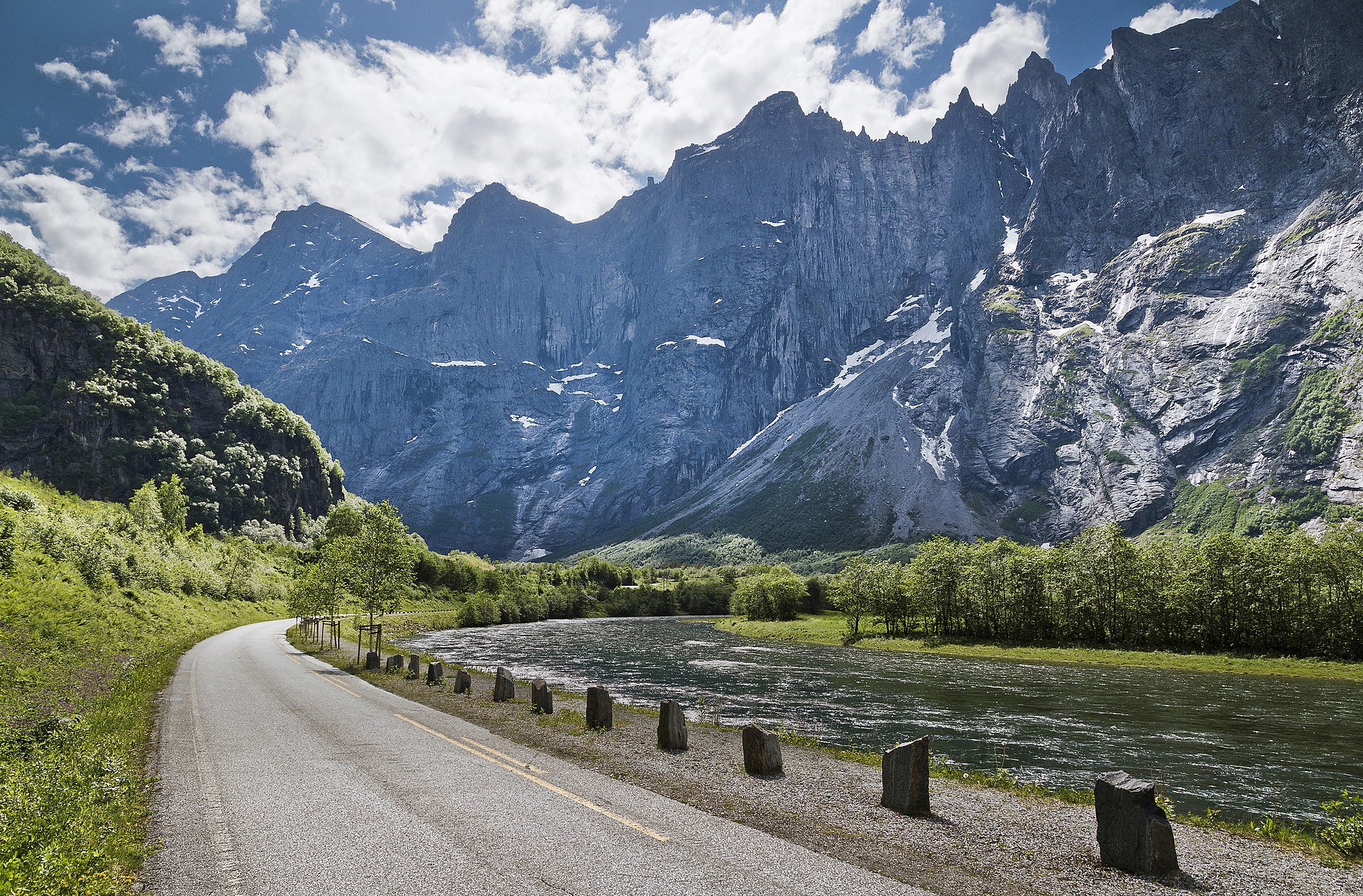
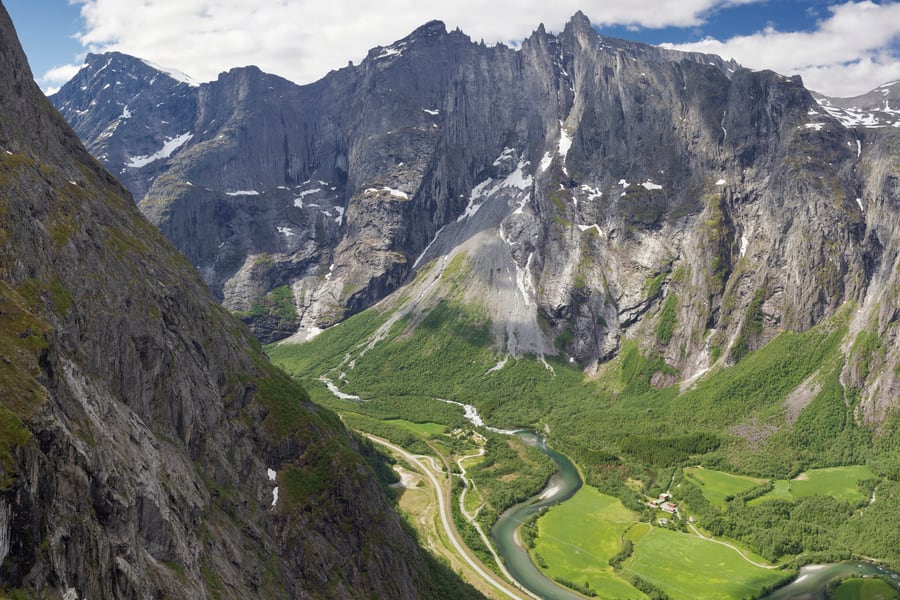
Below the bridge the valley widens into Romsdalen, and the scale of the place changes completely. The Rauma turns broad and glacial-blue. Farms appear on the flats. And on the left-hand side the Trolltindene — the Troll Peaks — rise straight off the valley floor to 1,700 metres.
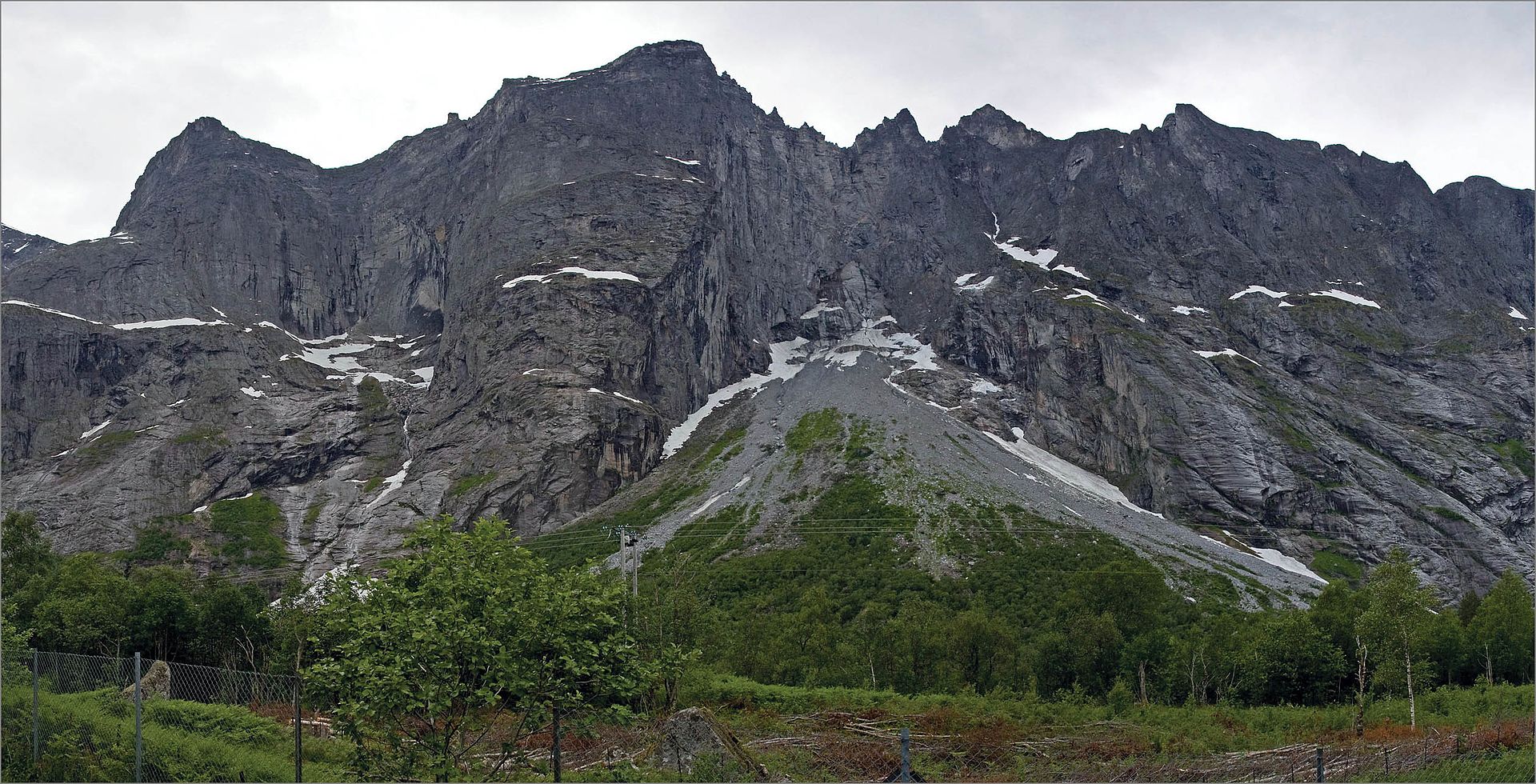
The great grey slab among them is Trollveggen, the Troll Wall: around 1,100 metres of vertical gneiss, the tallest rock face in Europe, whose summit ridge overhangs the base by nearly 50 metres. Climbers take days over it. It was also a notorious BASE-jumping site — the sport's pioneer, Carl Boenish, was killed on the wall in 1984, and jumping from it has been illegal since 1986. The summer train stops beneath it, and the scale takes a moment to resolve: those specks on the face are people.
Down to the fjord
The last stretch is a quiet victory lap. Waterfalls come off both walls of the valley. The Romsdalshorn stands up out of the flats like a child's drawing of a mountain. And then the valley simply ends, opening onto the water at Åndalsnes, where the platform, the quay and a cruise berth all sit within a few hundred metres of each other, and the mountains go straight up out of the town.
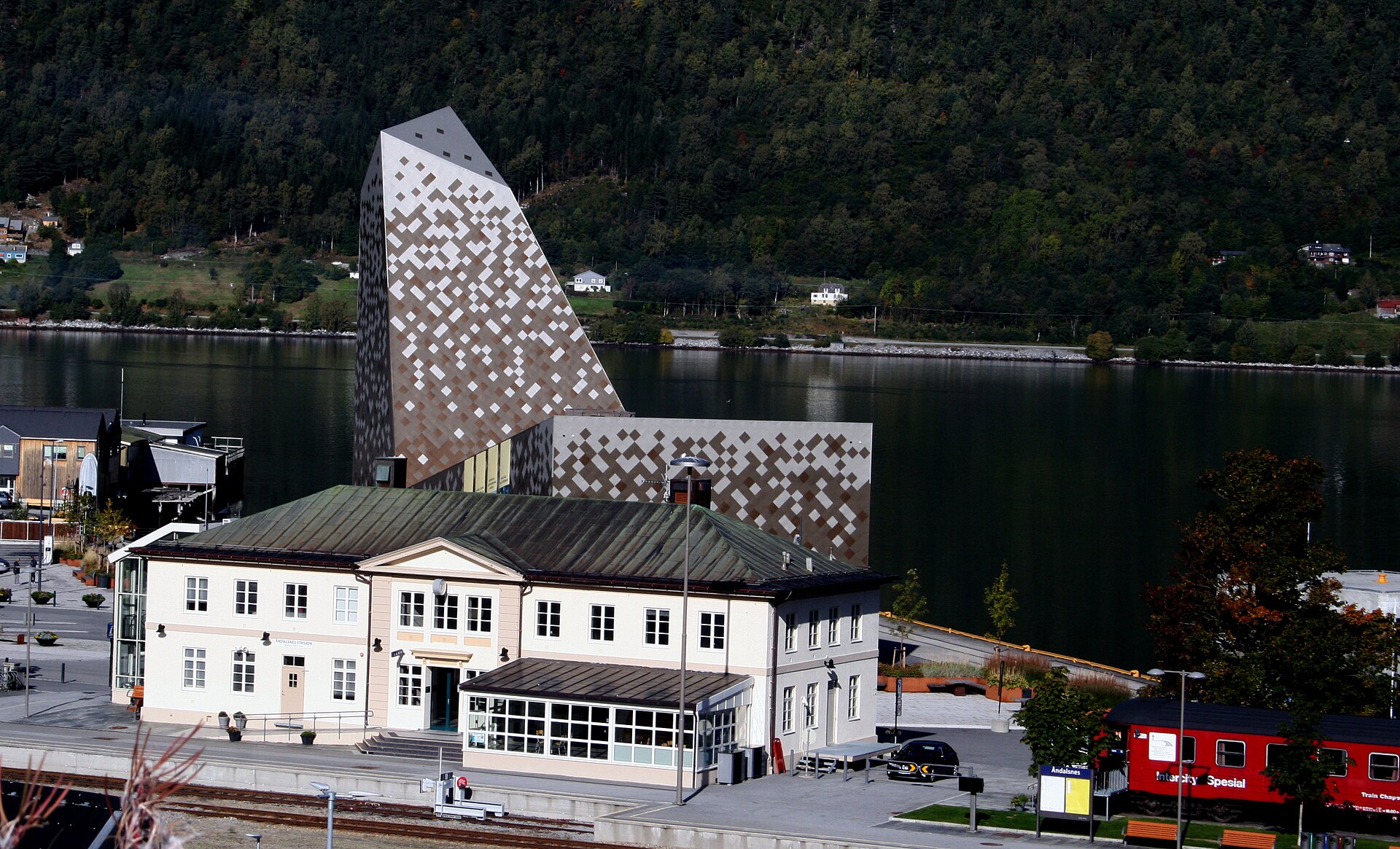
Åndalsnes calls itself Norway's peak capital, and it has earned it. From the station you can be in a gondola up Nesaksla in ten minutes, or climbing the stone Romsdal Stairs to the Rampestreken platform, hanging out over the fjord with the railway a thin line in the valley below. The Trollstigen, Norway's most famous mountain road, hairpins its way up out of the valley just south of town. Not bad for the end of a branch line.
Along the route
Halvard / Wikimedia Commons · CC BY 2.5The Kylling Bridge
The picture everyone has seen: a single 42-metre stone arch flung across the gorge, 59 metres above the water. It is only half the trick — bridge and tunnel together form a double horseshoe that drops the line through a valley too narrow to descend any other way.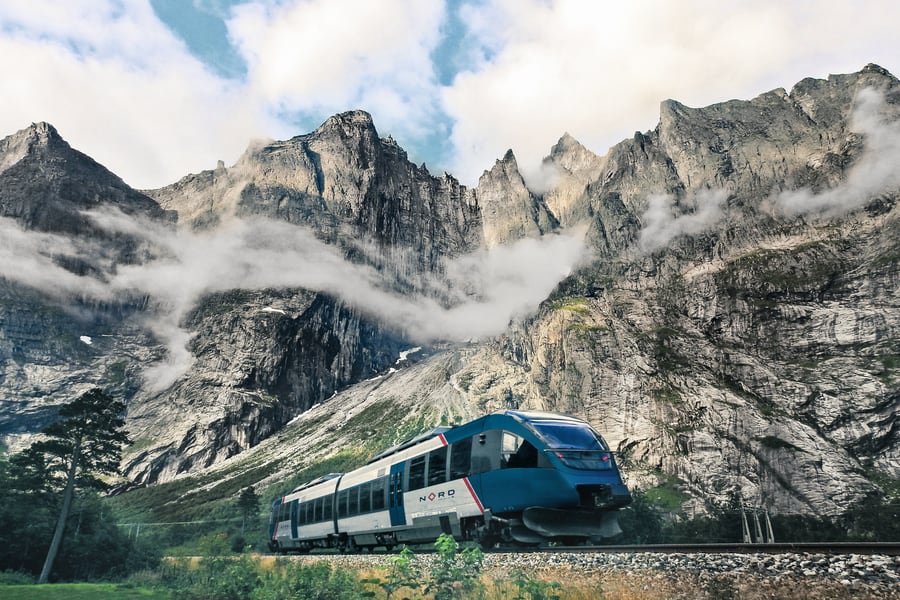 SJ Norge
Under the Troll Wall
For the last twenty minutes the train runs at the foot of Trollveggen, the tallest vertical rock face in Europe, whose ridge overhangs its base by nearly fifty metres. From the carriage window it simply fills the sky, and the summer train slows down for it.GAD / Wikimedia Commons · CC BY-SA 4.0The train that got the gold out
In April 1940, with Germany occupying Oslo and Trondheim, the little port at the end of this line was still free. Up the Rauma Line went the trains carrying the King, the government and Norway's gold reserve to the coast and away to Britain.A bit of history
Culture & experiences along the way
Ximonic, Simo Räsänen / Wikimedia Commons · CC BY-SA 3.0Take the summer tourist train
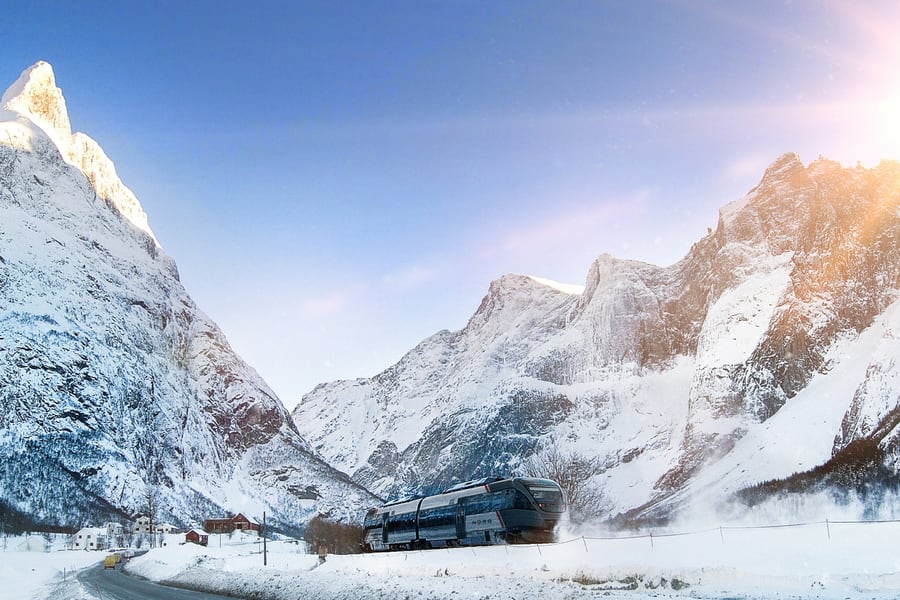
From June to August one working each way is run for the view rather than the clock: panoramic windows, commentary, a deliberate crawl past the best of it and scheduled stops at the Kylling Bridge and at Trollveggen so that everyone can get out and photograph them. It adds about ten minutes to the journey. SJ also publishes a free audio guide through the Guide To Go app, in English, German, French, Spanish and Norwegian.Espen Franck-Nielsen / Wikimedia Commons · CC BY 4.0Ride it as a day trip from a cruise ship
Åndalsnes is a cruise port, and the timetable knows it: the tourist trains were created in 2003 precisely so that passengers landing at the quay could be up the valley and back inside a morning. You do not need a ship to do the same thing — the station and the quay are a few minutes apart, and an out-and-back to Bjorli or Dombås makes a very satisfying half-day.-Any- / Wikimedia Commons · CC BY 3.0Climb above the line at Åndalsnes
The town calls itself Norway's peak capital, and the mountains start at the end of the platform. The Romsdalen Gondola lifts you straight up Nesaksla from beside the station; the Romsdal Stairs, built of stone, climb the same mountain on foot to the Rampestreken viewing platform, which juts out over the fjord and the railway you have just ridden.Timetables
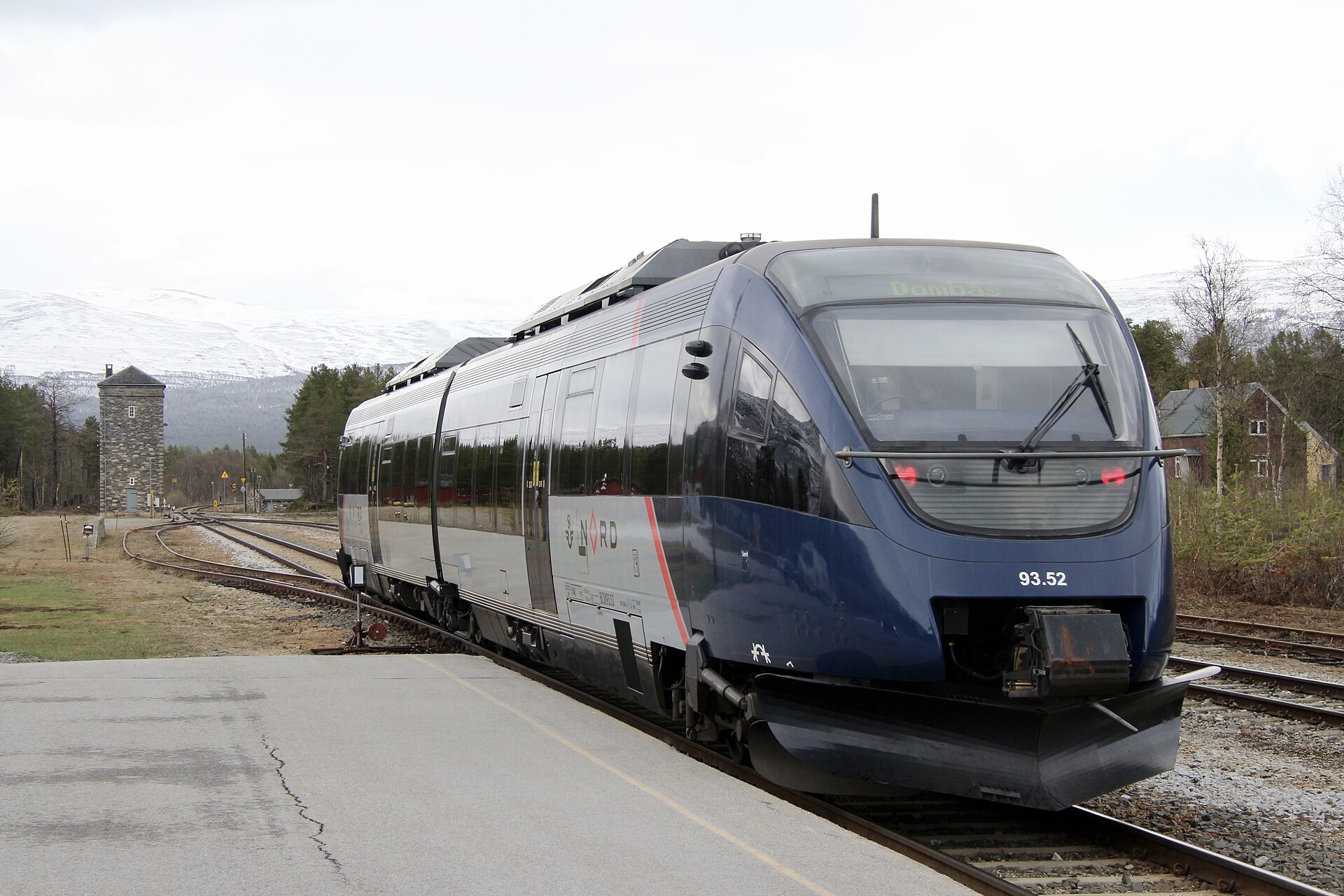
SJ Norge runs the Rauma Line as line R65, with four trains each way per day. The times below are as of July 2026.
Dombås → Åndalsnes
| Train | Dombås | Lesja | Lesjaverk | Bjorli | Åndalsnes |
|---|---|---|---|---|---|
| 2343 | 12:08 | 12:20 | 12:34 | 12:47 | 13:30 |
| 2345 (tourist) | 14:22 | 14:34 | 14:48 | 15:11 | 15:54 |
| 2347 | 18:24 | 18:36 | 18:50 | 19:03 | 19:46 |
| 2349 | 20:15 | 20:27 | 20:41 | 20:54 | 21:37 |
Åndalsnes → Dombås
| Train | Åndalsnes | Bjorli | Lesjaverk | Lesja | Dombås |
|---|---|---|---|---|---|
| 2340 | 07:18 | 08:03 | 08:16 | 08:30 | 08:42 |
| 2342 | 09:24 | 10:09 | 10:22 | 10:36 | 10:48 |
| 2346 | 14:23 | 15:08 | 15:21 | 15:35 | 15:47 |
| 2348 | 16:29 | 17:14 | 17:27 | 17:41 | 17:53 |
The slow one is the good one. Ordinary runs take about 1 hour 22 minutes. The 14:22 from Dombås takes 1 hour 32, and that extra ten minutes is the point: from roughly June to August this working is run as a tourist train, with commentary, a deliberate crawl past the best of the scenery and stops at the Kylling Bridge and at Trollveggen. If you have any choice at all, take it.
Getting there from Oslo
There is no through train. You take the Dovre Line north from Oslo S and change at Dombås:
| Oslo S | Dombås (arr) | Dombås (dep) | Åndalsnes |
|---|---|---|---|
| 07:50 | 11:58 | 12:08 | 13:30 |
| 09:50 | 14:03 | 14:22 | 15:54 (tourist train) |
That is five hours forty minutes to six hours in all, and the connection at Dombås is a ten-minute walk across the platform. From Trondheim, come south on the Dovre Line and change at Dombås the same way.
Operator: SJ Norge — sj.no (opens in a new tab). Times change with the December and June timetables, and the tourist working only runs in the summer season, so confirm the day you travel. Tickets and live times for every Norwegian train are also on the national planner, Entur.
Tickets
There is no premium fare on the Rauma Line and no special scenic ticket. It is an ordinary Norwegian regional train, priced like one — which is the quiet joy of the thing: the most photographed railway bridge in the country costs the same to cross as any other stretch of track. Buy from SJ Norge or through Entur, the national planner. No reservation is needed on the Rauma Line itself, though the Dovre Line leg from Oslo should be booked ahead, where advance fares sell out.
The summer tourist train is not a separate product: it is one of the four scheduled workings, run slowly with commentary from about June to August, on the same ticket. The audio guide is free through SJ's app — download it before you board, because coverage in the valley is patchy. Interrail and Eurail are valid.
Book your tickets
Rauma Line · Dombås to Åndalsnes
The everyday train through Romsdalen
A single on the scheduled service, four times a day in each direction, taking about an hour and twenty-five minutes. It is an ordinary regional fare — no premium, no reservation needed — which makes the finest short ride in Norway one of the cheapest. Booked through SJ Norge or the national planner, Entur.
Book Tickets (opens in a new tab, on SJ Norge)via SJ NorgeOslo to Åndalsnes · via the Dovre Line
The full run from the capital, changing at Dombås
There is no through train: you ride the Dovre Line north from Oslo across the Dovrefjell to Dombås, then change onto the Rauma Line. About five and a half to six hours in total, with connections built into the timetable. Book the two legs together and the change is a ten-minute step across the platform.
Book Tickets (opens in a new tab, on SJ Norge)via SJ NorgeRail Passes
Interrail passes are valid. Interrail's table of railway companies lists SJ Norge as included in Norway, and its Norway page names the Raumabanen among SJ Norge's lines, so Dombås to Åndalsnes is covered by a one-country Interrail Norway Pass, the Interrail Nordic Pass or a Global Pass. Where SJ Norge sells a seat reservation it costs €4.30 in second class.
Interrail also gives pass holders 50% off Veøy Buss, the bus from Åndalsnes to Molde.
For the Rauma Line alone, a pass is not worth buying. It is a short regional ride on an ordinary fare. A pass pays when the line is part of a longer journey, such as on from Oslo up the Dovre Line.
Checked October 2026 against interrail.com (opens in a new tab), Interrail's Norway page (opens in a new tab) and its reservation fees (opens in a new tab).
Places to Visit
The Rauma line runs from a mountain plateau to a fjord in ninety minutes, and the country at either end is worth far more time than the ride itself takes.
Two places on the route are best seen from the road rather than made a day of. At Verma, the Kylling Bridge can be visited on foot as well as crossed by train — the village sits just above it and paths lead down to viewpoints along the arch and into the gorge, where the Rauma drops hard enough to explain why the railway had to double back on itself twice to get down. And Bjorli, 575 metres up, is a small ski centre with a fine old timber station, good cross-country terrain, and in summer the launching point for rafting on the upper Rauma. Below it the broad Lesja valley is quiet farm country with a surprising industrial past: an ironworks ran at Lesjaverk from 1659 until 1812, with smelting recorded there as early as 1614, and the abandoned mines, smelter and charcoal kilns can still be walked.
Norsk Tindesenter, the national mountaineering centre, is on the waterfront in Åndalsnes with a climbing wall inside it — the obvious wet-afternoon option, and the best place to understand what the walls above the town actually mean to the people who climb them.
 Ximonic (Simo Räsänen) / Wikimedia Commons · CC BY-SA 3.0 · cropped
Åndalsnes and the Romsdal peaks
Three thousand people on a spit of land at the head of the Romsdalsfjord, entirely dominated by what surrounds it. The Romsdalen Gondola climbs Nesaksla from beside the station in minutes; the stone Romsdal Stairs climb the same mountain on foot to Rampestreken, a platform cantilevered out over the drop with the town laid out beneath.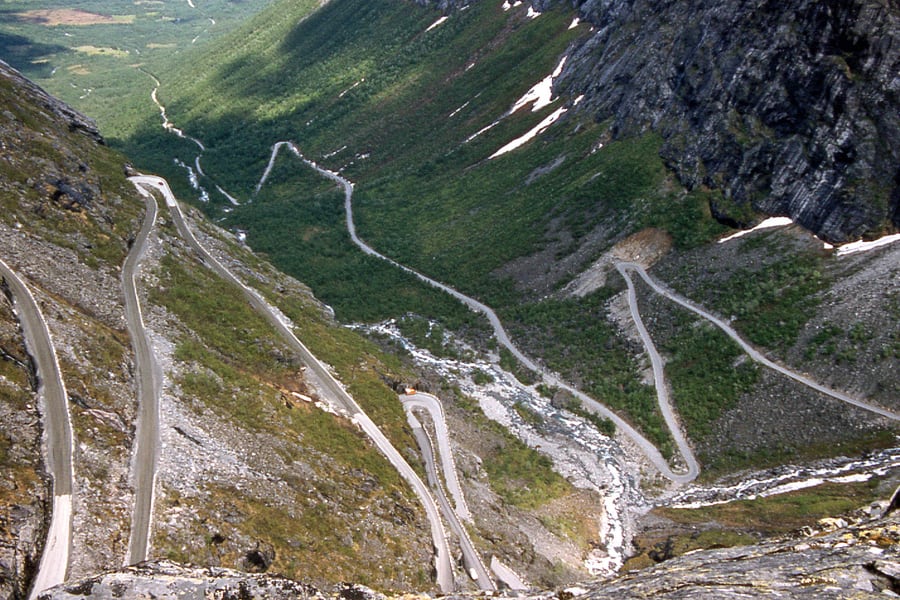 W. Bulach / Wikimedia Commons · CC BY-SA 4.0 · cropped
Trollstigen
The set-piece Norwegian mountain road, beginning a short way south of Åndalsnes: eleven hairpin bends at a gradient of roughly one in twelve, climbing out of the Isterdalen with a waterfall coming down beside them. It opened officially on 31 July 1936 and is now one of the National Tourist Routes. Closed by snow through the winter.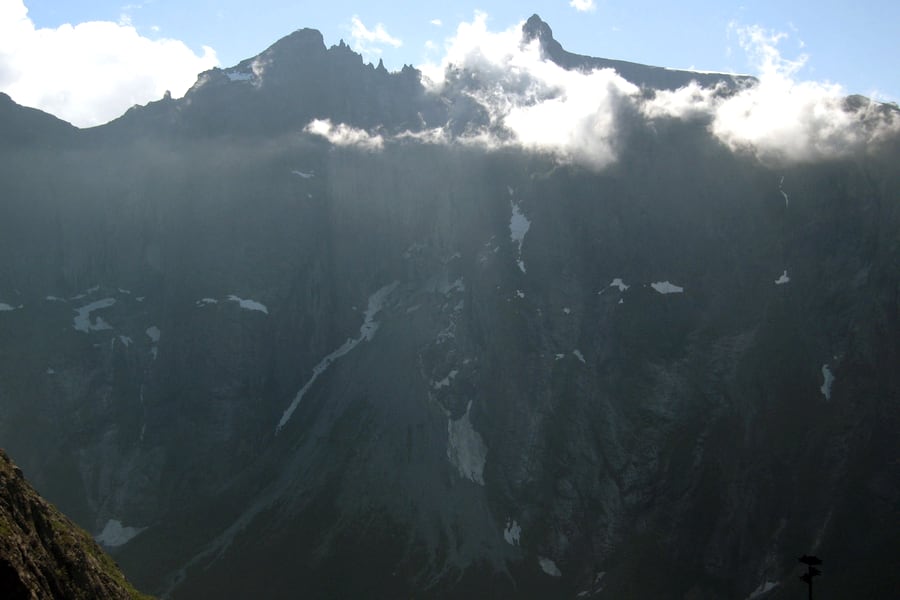 Mountain Master / Wikimedia Commons · CC BY-SA 3.0 · cropped
Trollveggen
The visitor centre sits at the foot of the wall on the E136, ten minutes from Åndalsnes, which is the civilised way to absorb the scale of it — coffee in hand, looking up. The rock is loose, north-facing gneiss, rockfall is the norm rather than the exception, and a series of large collapses in September 1998 rewrote several climbing routes overnight.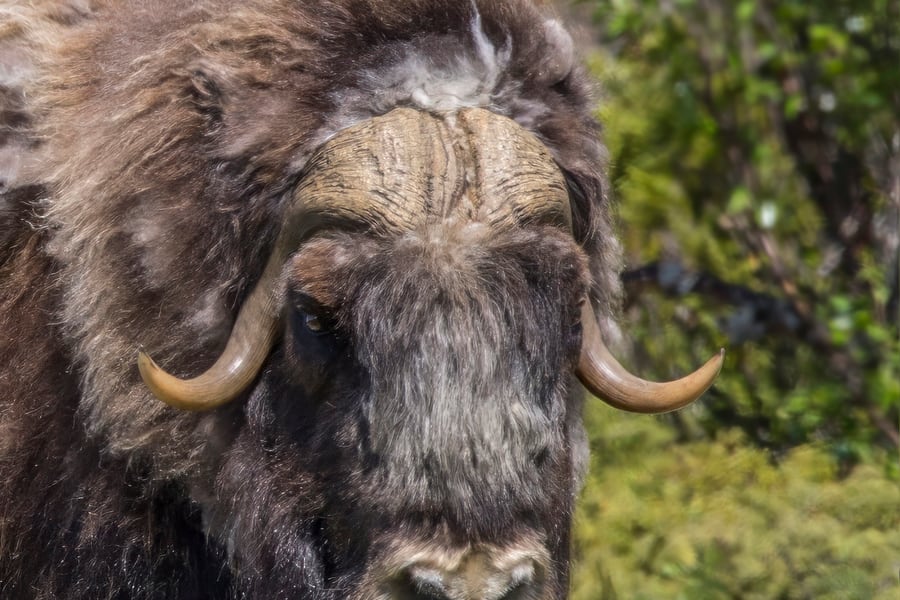 Charles J. Sharp / Wikimedia Commons · CC BY-SA 4.0 · cropped
Dombås and the Dovrefjell
At the top of the line, Dombås is the gateway to Dovrefjell–Sunndalsfjella National Park — the only place in Norway with a herd of musk oxen, imported in 1947 and now the object of guided safaris from Dombås and Oppdal. They are large, wild and genuinely dangerous; keep the distance the signs ask for. The plateau is a five-minute walk off the platform.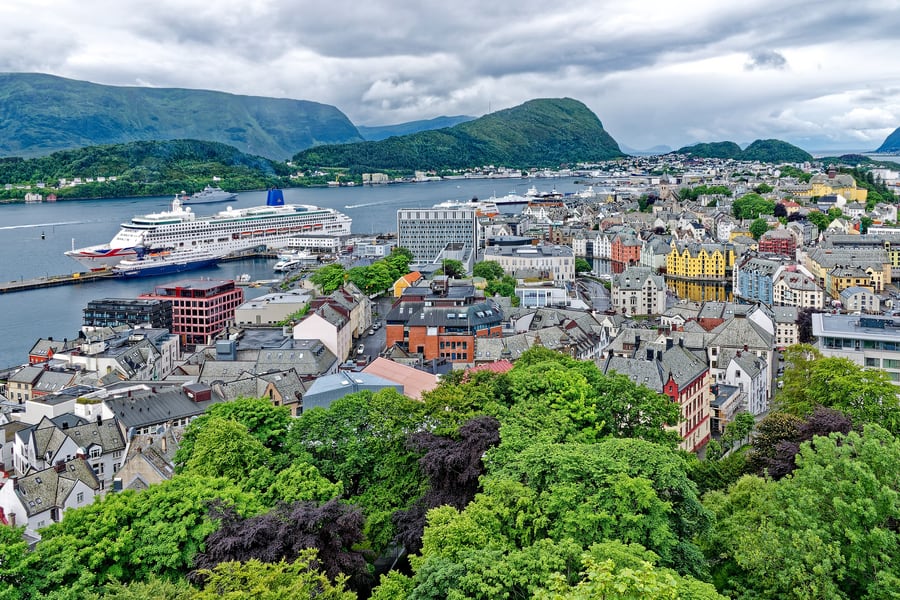 Holger Uwe Schmitt / Wikimedia Commons · CC BY-SA 4.0 · cropped
Molde and Ålesund
Buses connect Åndalsnes to the coast. Molde, the "town of roses", has hosted Moldejazz every July since 1961 — one of the oldest jazz festivals in Europe. And Ålesund, a couple of hours away, burned almost completely to the ground on the night of 23 January 1904 and was rebuilt in Art Nouveau between 1904 and 1907, which is why it looks like nowhere else in Scandinavia.Where to Sleep
Because the line is short and the connections are good, most people ride the Rauma Railway without sleeping anywhere near it — down from Dombås in the afternoon, a night in Åndalsnes, and away by bus or train the next day. That works well. But there are better options at both ends if you want the mountains for longer than eighty minutes.
Åndalsnes is the natural base. It is small, so the choice is not enormous, but it covers the range: a modern hotel on the waterfront by the mountaineering centre, guesthouses and apartments in the town, a campsite and cabins along the river, and a youth hostel. Everything is within a few minutes of the station. In July and August, and on days when a cruise ship is in, book ahead — the town fills quickly.
Bjorli, halfway up the line, is the alternative: a ski village at 575 metres with hotels, cabins and self-catering apartments, quiet in summer, busy in the winter season. It has a station on the line, which makes it an unusually satisfying place to stay — you can ride down through the horseshoes in the morning and back up in the evening.
Dombås, at the junction, has hotels and a hostel aimed at travellers changing trains and at walkers heading into the Dovrefjell. It is functional rather than beautiful, but it is the most convenient place in Norway to be if your plans involve both the Rauma Line and the mountains behind it.
Along the valley, the small settlements at Verma, Flatmark and Marstein have farm stays, cabins and campsites, several of them with the Troll Wall in view from the door. These are quiet, self-catering places, best if you have a car.
Two practical notes. First, the last train down from Dombås arrives at Åndalsnes at 21:37, so a late arrival is perfectly possible if you have somewhere booked. Second, the coast is close: Molde is about an hour and a half by bus and Ålesund around two, both with far more accommodation, if you would rather sleep by the sea and come up the valley for the day.
Questions or corrections
Planning this trip and stuck on something, or spotted a time, fare or detail that has changed? Send us a message about The Rauma Railway. We read every one, and we update this page when something has changed.