Riyadh to Dammam
Zach1055 / Wikimedia Commons · CC BY-SA 4.0 · 2025 · cropped
- DistanceRiyadh to Dammam via Hufuf and Abqaiq · about 450 km
- DurationAbout 4h 10m · seven trains a day each way
- Best seasonNovember to March, when the desert is at its mildest
Introduction
This is where the railway in Saudi Arabia began. In the 1940s the Kingdom had just started to pump oil, and it needed a port on the Gulf coast for the ships bringing in drilling equipment, and a way to move what they landed inland to the capital. Work started in October 1947, and in October 1951 King Abdulaziz inaugurated the line from Dammam to Riyadh at a ceremony in Riyadh. Everything the country has built on rails since — the North Train to the Jordanian border, the high-speed line between Mecca and Medina — came after this one.
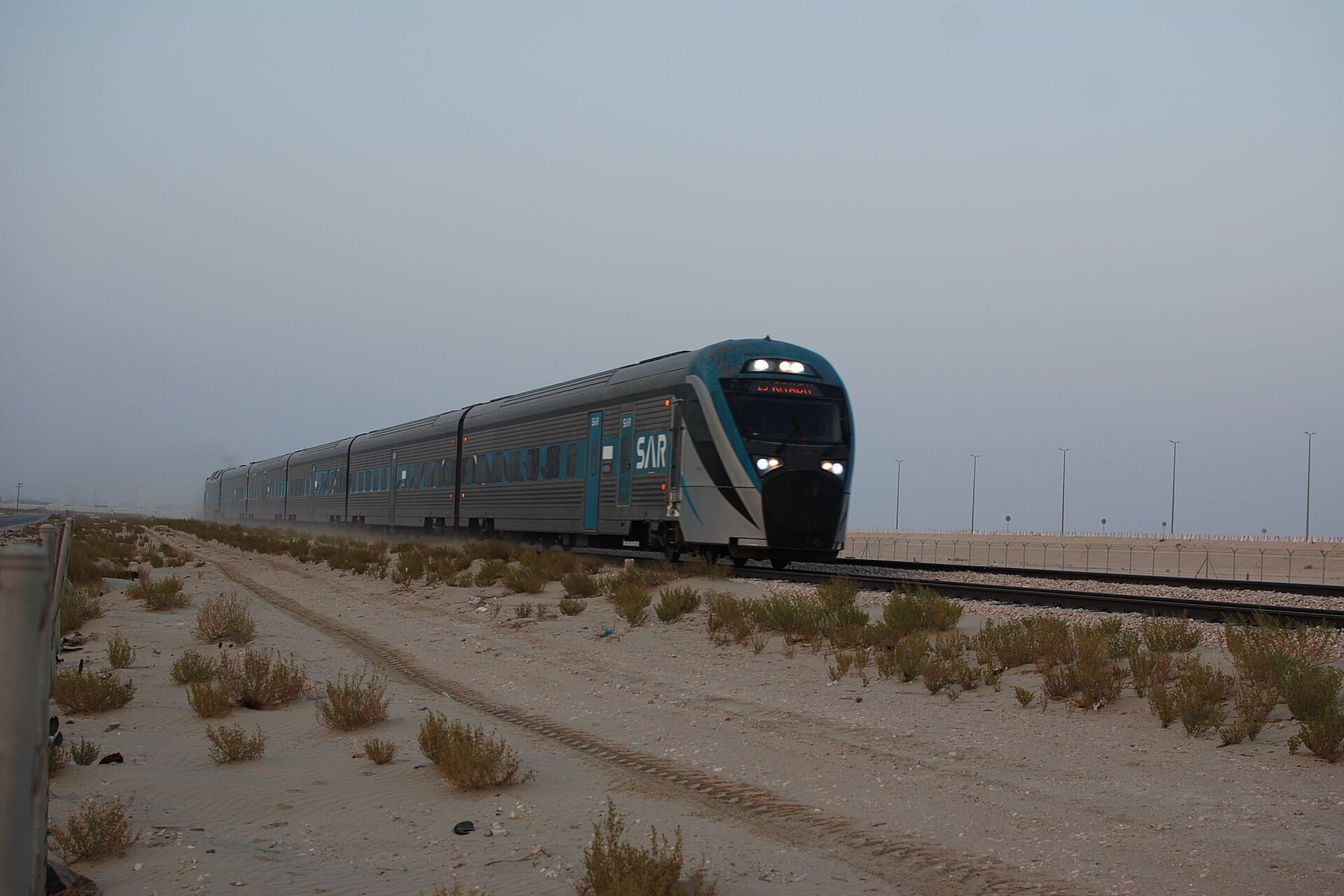
Today it is a plain, well-run intercity railway, and that is its charm. Seven trains a day leave Riyadh for Dammam and seven come back, calling at Hufuf and Abqaiq, and the whole run takes a little over four hours on double track. The trains are Spanish-built push-pull sets with a restaurant coach and a prayer area on board; tickets are cheap, reserved and bought online.
What you see from the window is the reason to take it. Riyadh is the capital of Najd; east of it the line crosses the Dahna, a band of red dunes that runs for more than a thousand kilometres between the Nafud and the Empty Quarter. Then the sand gives out into Al-Ahsa, the largest oasis in the world, two and a half million palms around Hufuf. The last stretch runs north by Abqaiq to Dammam and the Gulf. Desert, oasis and coast in about four hours, and every station on the line is open to every visitor with a visa.
The Journey
Trains leave from Riyadh East, the station that opened in 1981 to a design by the Italian architect Lucio Barbera. He drew the termini at Riyadh and Dammam as near twins: a rectangular hall of three naves divided by two lines of pillars, laid out like the prayer hall of a Mediterranean mosque, with pointed openings, arcades and stepped parapets that nod to Najdi building. Hufuf's station, built at the same time, stands to one side of the through line with the same decoration.
The original 1951 line took a long way round, by Al-Kharj and Haradh. Since 1985 the passenger trains have used a more direct line from Riyadh to Hufuf, leaving the old one to freight; the two share 139 km of route. The full passenger route is about 450 km, and it has been double track throughout since 2015.
The train
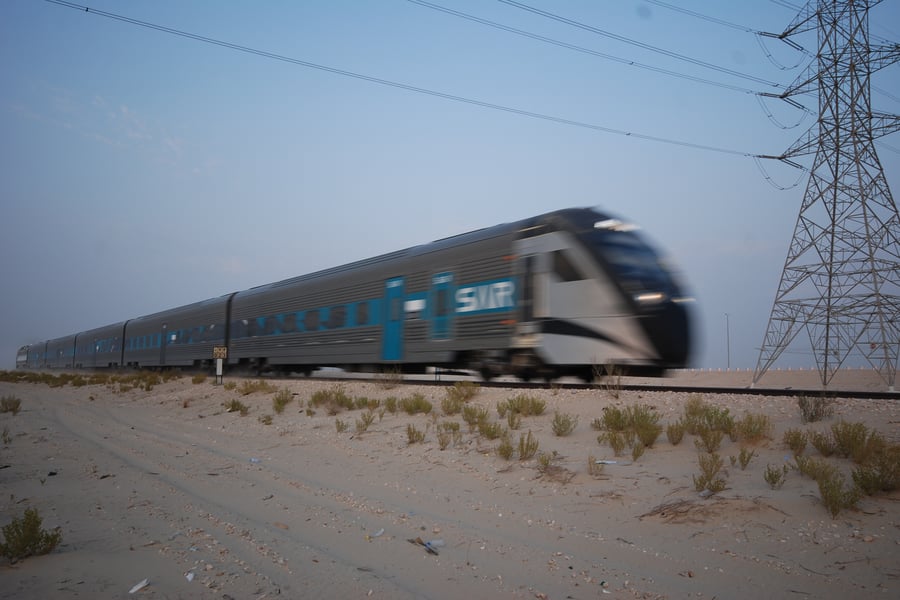
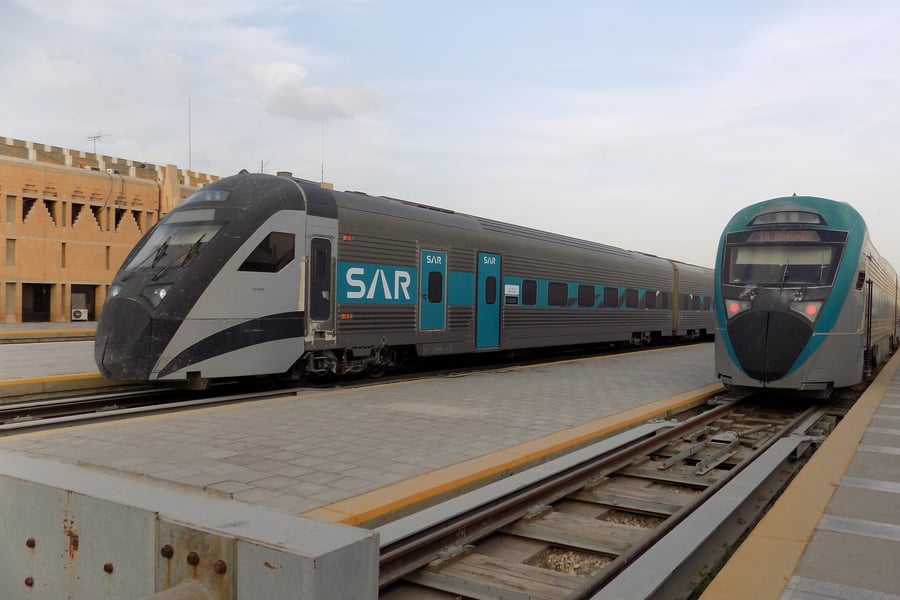
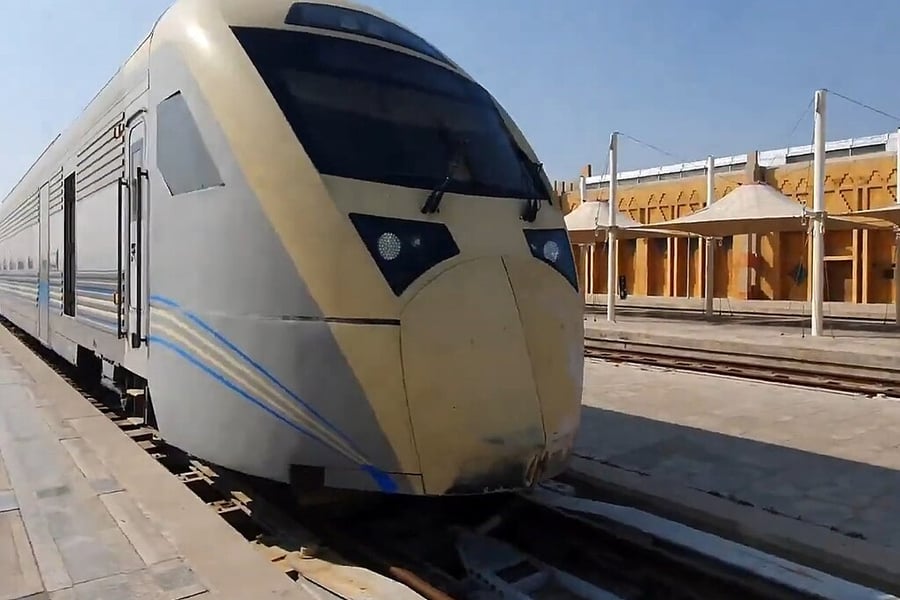
SAR's East Train fleet is eleven push-pull diesel sets, each with 94 Business seats and 194 Economy, a restaurant coach and a prayer area. The sets were ordered from CAF in Spain and took over the service on 7 December 2015, when the last of the double-tracking was finished — before that, every passenger train on the line had been hauled by a locomotive. They run at up to 180 km/h. The silver and blue SAR livery is recent: until 2021 the line belonged to the Saudi Railways Organization, and the same sets ran in its pale gold.
A new generation is coming. In February 2024 SAR signed with Stadler for ten new diesel trainsets based on its Smile design, with an option for ten more.
The ride
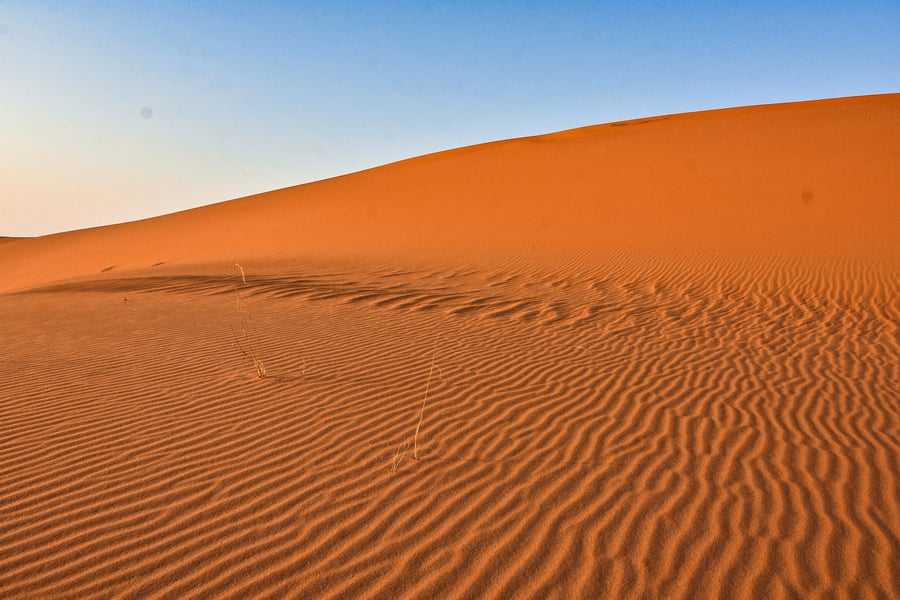
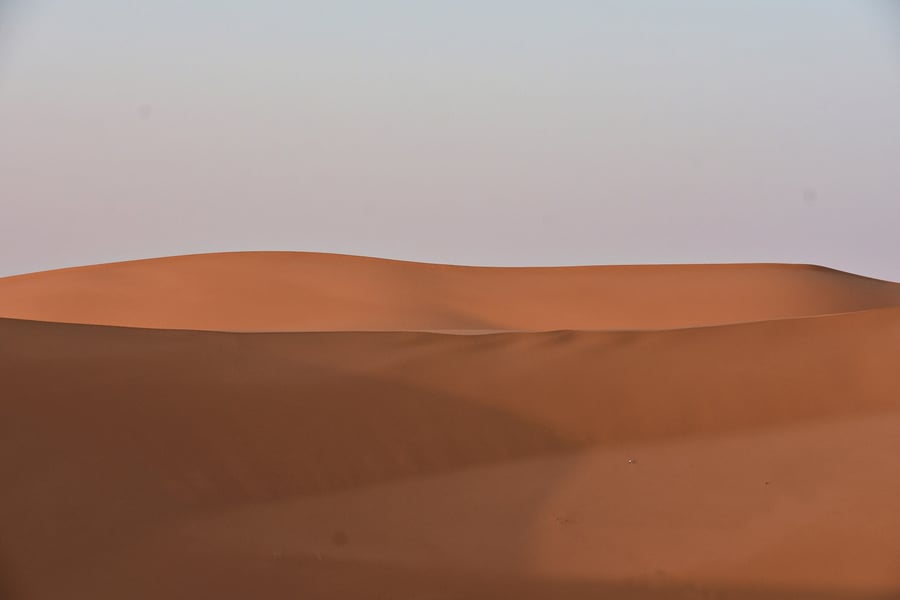
East of Riyadh the line meets the Dahna. The sand here is red with iron oxide, piled into long dunes known as ʿirq, and the corridor it forms is never more than about 80 km wide. It is the old frontier between Najd and Al-Ahsa, and the railway runs across it.
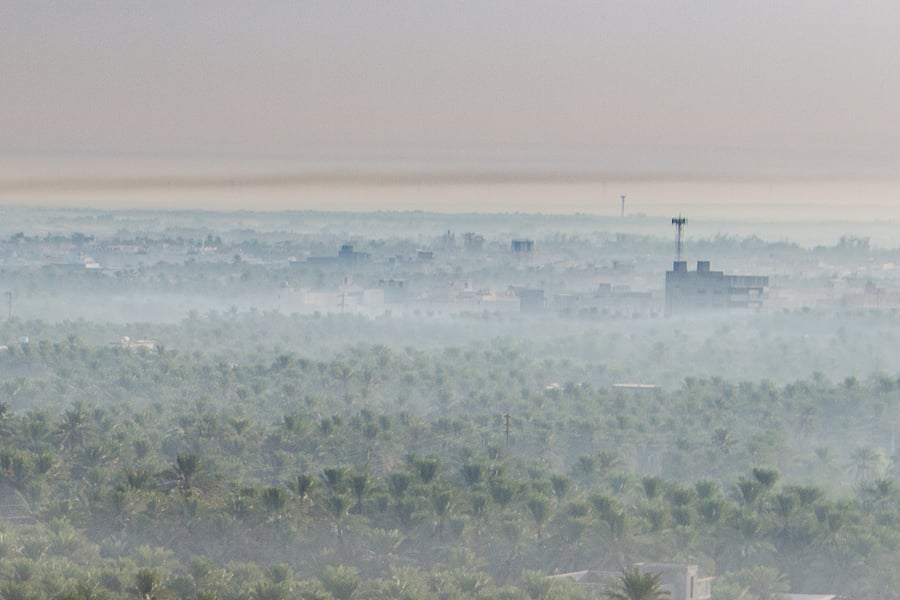
On the far side Al-Ahsa begins. UNESCO describes it as the largest oasis in the world — gardens, canals, springs and wells round Hufuf and Mubarraz, and more than 2.5 million palms watered from an aquifer that rises in over 280 artesian springs. The train stops at Hufuf about two hours twenty minutes out of Riyadh.
North of Hufuf the line calls at Abqaiq and runs on into Dammam, a little over four hours from Riyadh. The last train of the evening gets in at 23:48.
Along the route
 Richard Mortel / Wikimedia Commons · CC BY 2.0 · cropped
The red sands
East of Riyadh the line crosses the Dahna, the corridor of red dunes that links the Nafud to the Empty Quarter and divides Najd from Al-Ahsa. Iron oxide gives the sand its colour, and the line runs straight across it.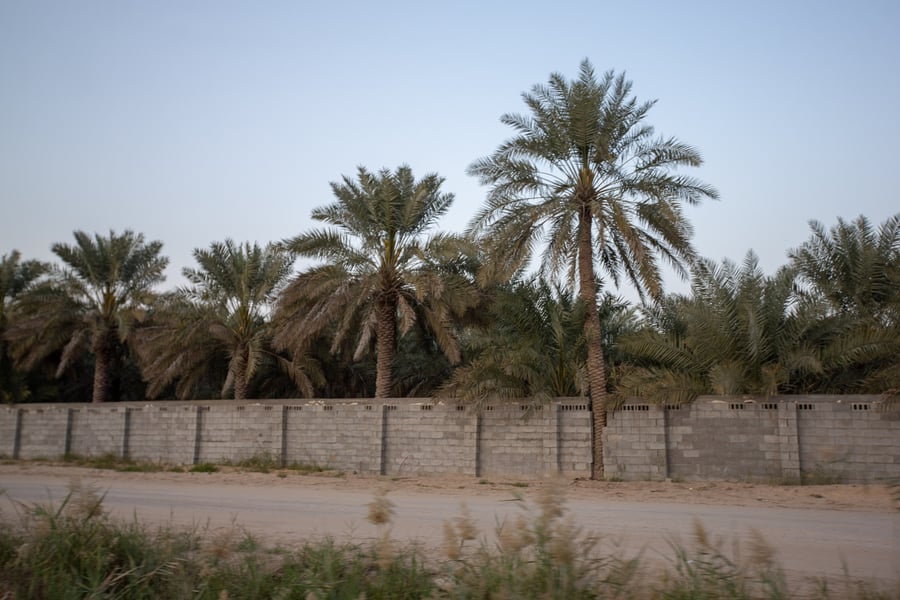 Yafa.naif / Wikimedia Commons · CC BY-SA 4.0 · 2019 · cropped
Into the palms
Hufuf sits inside Al-Ahsa, which UNESCO counts as the largest oasis in the world — more than 2.5 million palms, watered by springs and open canals, in country that is otherwise sand.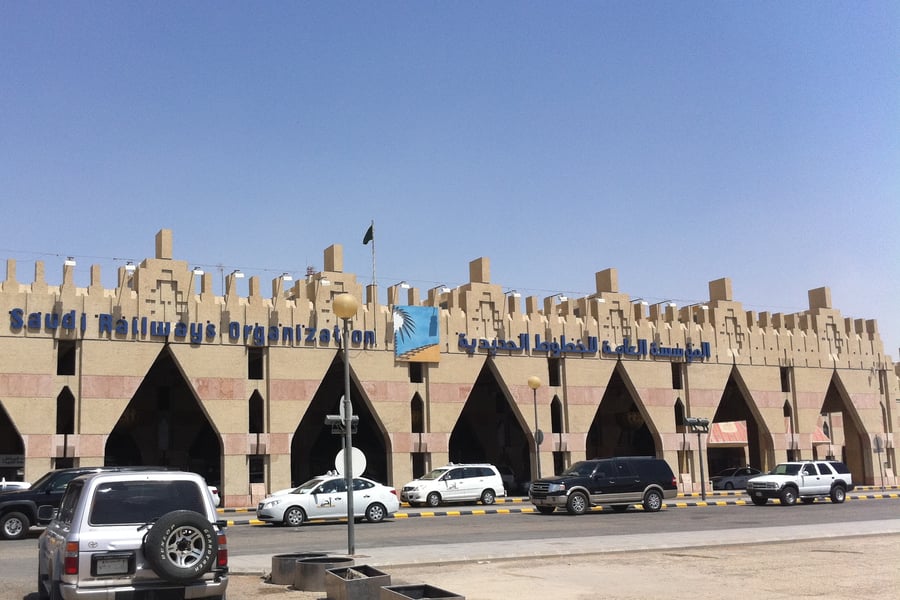 haitham alfalah / Wikimedia Commons · CC BY 3.0 · 2012 · cropped
Barbera's stations
Riyadh, Hofuf and Dammam stations were designed by Lucio Barbera and opened in 1981 — pointed arches and stepped parapets borrowed from Najdi building. The old operator's name was still over the door in 2012.A bit of history
Culture & experiences along the way
 Francisco Anzola / Wikimedia Commons · CC BY 2.0 · cropped
The fort taken in 1902
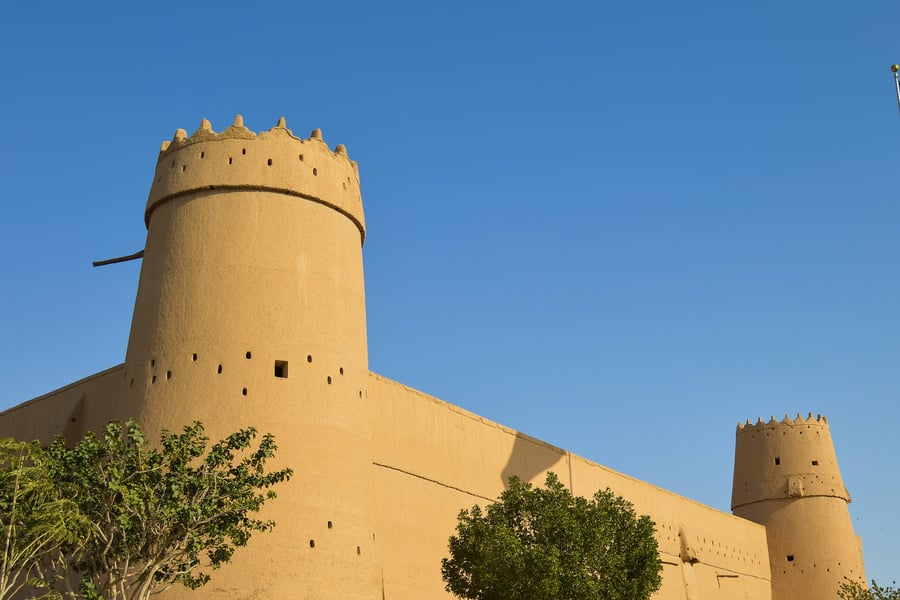
Al Masmak, the clay-and-mudbrick fort in old Riyadh, was where Abdulaziz ibn Saud retook the city in January 1902 — the opening move of the unification of Saudi Arabia. Begun in 1865, it has four watchtowers and thick walls on a stone foundation, and has been a museum since 1995.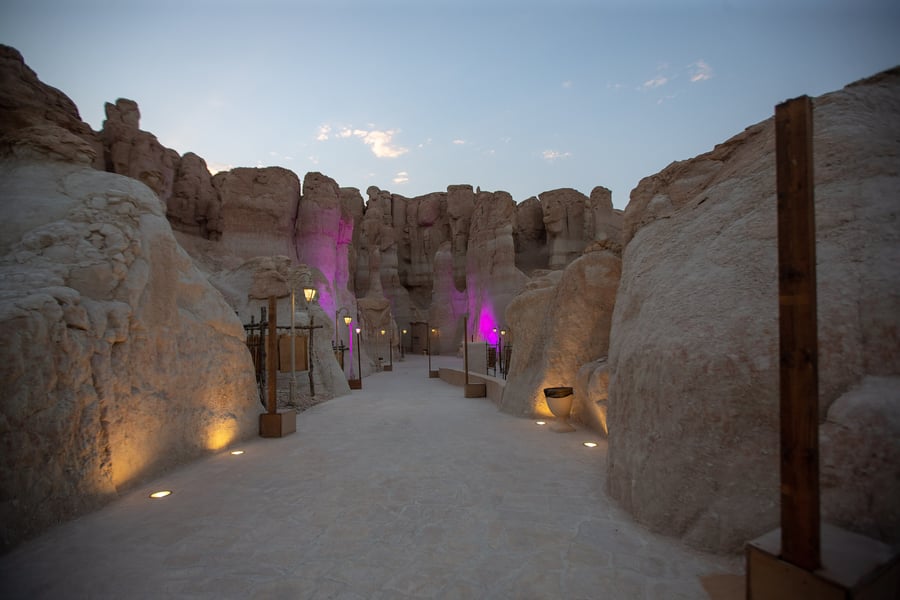 Yafa.naif / Wikimedia Commons · CC BY-SA 4.0 · 2019 · cropped
Cool air in the rock
Jabal al-Qarah, a 75-metre mesa fifteen kilometres from Hufuf, is split by narrow passages and caves that hold a moderate, steady temperature through the year, and feel cold in the summer heat. The mountain was listed with the Al-Ahsa Oasis as a World Heritage site in 2018.Timetables
The East Train runs every day, seven trains each way on most days. Every train calls at Hufuf and Abqaiq, and every seat is reserved: there is no walk-up coach, although the station ticket offices sell Waiting List tickets for full trains from an hour before departure.
Riyadh → Dammam — Sunday to Thursday
| Train | Riyadh | Hufuf | Dammam |
|---|---|---|---|
| 4 | 05:09 | 07:30 | 09:19 |
| 6 | 07:13 | 09:34 | 11:22 |
| 10 | 12:16 | 14:37 | 16:26 |
| 12 | 15:10 | 17:31 | 19:20 |
| 14 | 16:46 | 19:07 | 20:58 |
| 16 | 18:38 | 20:59 | 23:00 |
| 18 | 19:38 | 21:59 | 23:48 |
On Friday train 8 (09:15, Dammam 13:25) runs instead of 14 and 18; on Saturday train 8 runs instead of 14.
Dammam → Riyadh — Sunday to Thursday
| Train | Dammam | Riyadh |
|---|---|---|
| 1 | 04:08 | 08:24 |
| 3 | 05:57 | 10:13 |
| 5 | 09:52 | 14:08 |
| 7 | 11:53 | 16:13 |
| 9 | 14:53 | 19:09 |
| 13 | 15:37 | 20:10 |
| 17 | 19:27 | 23:43 |
On Friday trains 3 and 9 do not run and train 15 (17:48, Riyadh 22:07) is added. Two short workings serve the oasis alone: train 2 from Hufuf at 05:50 to Dammam, and train 19 from Dammam at 22:16 to Hufuf.
End to end the run takes 4 h 9 m to 4 h 33 m. Riyadh to Hufuf is about 2 h 21 m, Hufuf to Dammam about 1 h 40 m.
As of November 2026, read from Saudi Arabia Railways' own schedule for 22–28 November 2026. SAR opens sales about a week ahead, and its timetable changes for Ramadan and the Eid holidays, when it publishes special tables. Check the East Train schedule (opens in a new tab) or book on SAR's site (opens in a new tab) for your date, or call SAR on 8001262000 within the Kingdom.
Tickets
There are two classes. Economy has a 37-inch seat pitch and a power socket at every seat; Business has 44 inches, a padded headrest and table, fast-track ticket check and priority boarding. Each comes in two ticket types — Economy Saver or Economy, Business or Business Premium — which differ in baggage, seat selection and how much a change or cancellation costs. Business Premium adds lounge access and a meal. Children aged 2 to 11 pay half in Economy and 20% less in Business; infants under 2 travel free in Economy.
Fares move with demand. For the week of 22 November 2026 SAR's lowest fares were SAR 135 Economy and SAR 240 Business from Riyadh to Dammam, and SAR 95 Economy from Riyadh to Hufuf. Buy on SAR's site or app, or at any station ticket office.
Fares read from Saudi Arabia Railways' own schedule, November 2026.
Book your tickets
Economy
194 seats a train · Riyadh to Dammam
A 37-inch seat pitch, a power socket at every seat, and the restaurant coach a walk away.
Book Tickets (opens in a new tab, on sar.com.sa)via sar.com.saBusiness
94 seats a train · Riyadh to Dammam
A 44-inch pitch with a padded headrest and table, fast-track ticket check and priority boarding.
Book Tickets (opens in a new tab, on sar.com.sa)via sar.com.saRiyadh to Hufuf
Economy, for the oasis
Two hours twenty minutes to Al-Ahsa, on any of the seven daily trains.
Book Tickets (opens in a new tab, on sar.com.sa)via sar.com.saRail Passes
No rail pass covers this train. Saudi Arabia Railways sells only point-to-point tickets for the East Train, through its website, its app and the station ticket offices.
A pass would not save much here anyway: every seat is reserved for a named train, and a single Economy fare from Riyadh to Dammam costs from SAR 135. Buy the legs you need ahead instead — SAR says booking in advance saves up to 40%, and its schedule opens about a week before travel.
As of November 2026.
Places to Visit
The line has three places worth a night: the capital at one end, the oasis in the middle and the Gulf at the other. Riyadh's old core and the ruined first capital at Diriyah tell the story of the Saudi state; Hufuf, inside the Al-Ahsa World Heritage site, is the stop to break the journey for; and Dammam is where the railway was built to reach the sea.
 Radosław Botev / Wikimedia Commons · CC BY 3.0 PL · cropped
At-Turaif, Diriyah
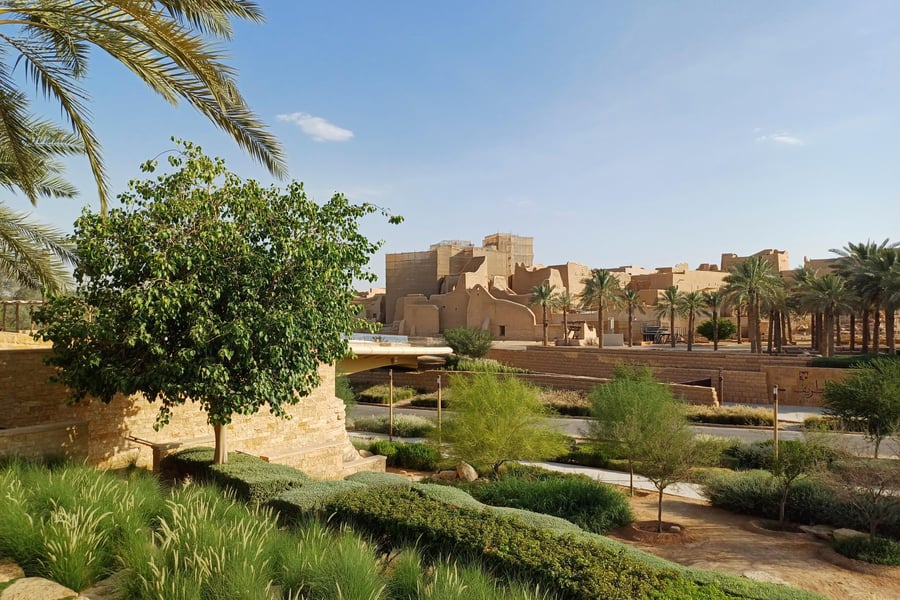
On the north-western edge of Riyadh, the mud-brick citadel of At-Turaif was the first capital of the Saudi dynasty. Founded in the fifteenth century, it rose in the eighteenth to become the seat of a state, and UNESCO lists it as an outstanding example of the Najdi style — adobe palaces with a sharp sense of geometric decoration, set on the edge of the Diriyah oasis. Many of the buildings are ruins, but the street plan is intact and can be read on foot.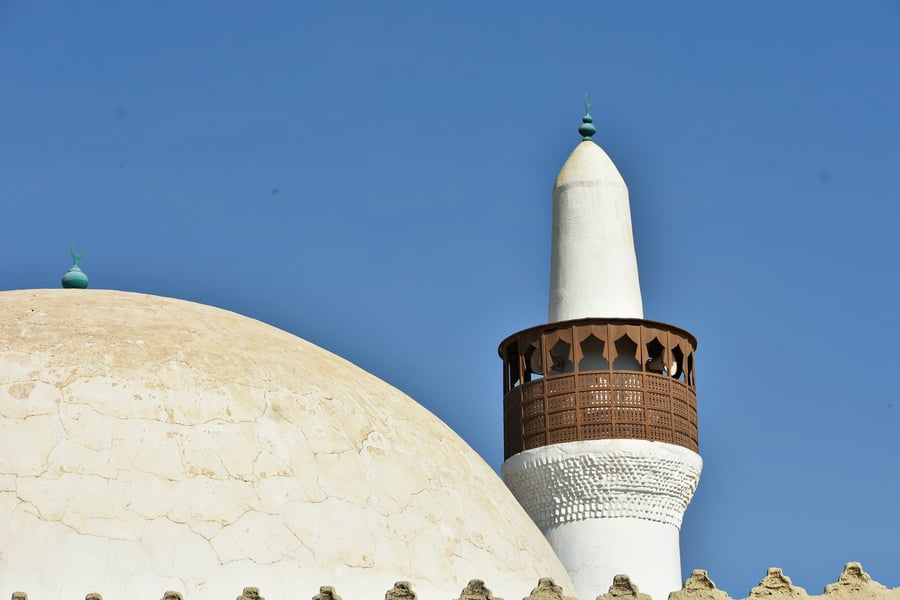 Richard Mortel / Wikimedia Commons · CC BY 2.0 · cropped
Qasr Ibrahim, Hufuf
The domed fort in the middle of Hufuf is the main Ottoman building in Al-Ahsa. Its mosque and dome date from the mid-sixteenth century; in the century that followed it grew into a castle with a prison and a hammam, and Abdulaziz ibn Saud took it on 13 April 1913. The restoration finished in 2019, and the fort now anchors Hufuf's historic centre.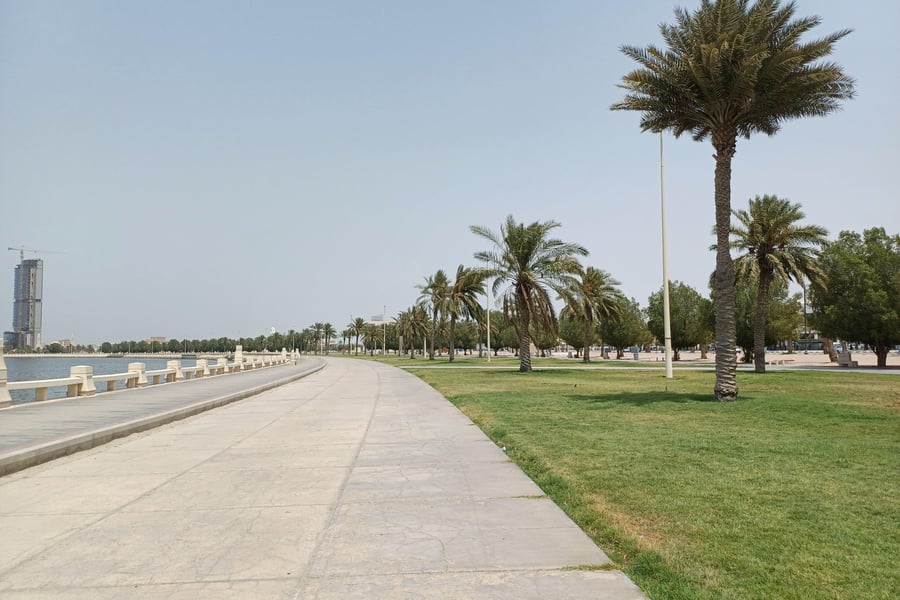 Radosław Botev / Wikimedia Commons · CC BY 3.0 PL · cropped
The waterfront at Dammam
Dammam's Corniche is a long promenade of lawns and palms along the shore of the Gulf, the obvious place to stretch your legs after four hours in a seat. It is also the water the railway was built to reach: in the 1940s the Kingdom needed a port on this coast for the ships bringing oil equipment, and a way to carry their cargo inland to Riyadh.Where to Sleep
Riyadh is the obvious base, with the widest choice of rooms. The better overnight on the line itself is Hufuf. With seven trains a day in each direction it is easy to stop for a night in the oasis, see Jabal al-Qarah and Qasr Ibrahim, and pick up a train to Dammam or back to Riyadh the next day.
No prices, ratings or star counts appear on these cards. We have verified that each hotel is open and that the link goes to its own booking page; we have not verified anybody's marketing.
Where to stay
InterContinental Riyadh
On King Saud Road, central Riyadh
A garden hotel with an outdoor pool, a taxi ride from Riyadh East station.
Check Availability (opens in a new tab, on ihg.com)via ihg.comInterContinental Al Ahsa
On Al Malik Khaled Street, Hofuf
The hotel for breaking the journey in the oasis, which names the station and Jabal al-Qarah as nearby.
Check Availability (opens in a new tab, on ihg.com)via ihg.comQuestions or corrections
Planning this trip and stuck on something, or spotted a time, fare or detail that has changed? Send us a message about Riyadh to Dammam. We read every one, and we update this page when something has changed.