Skånska Järnvägar
Kristianwhedberg / Wikimedia Commons · CC BY-SA 4.0 · 2019
- Distance13.4 km
- DurationAbout 30 min each way
- Best seasonJune–August; autumn and Christmas trains
Introduction
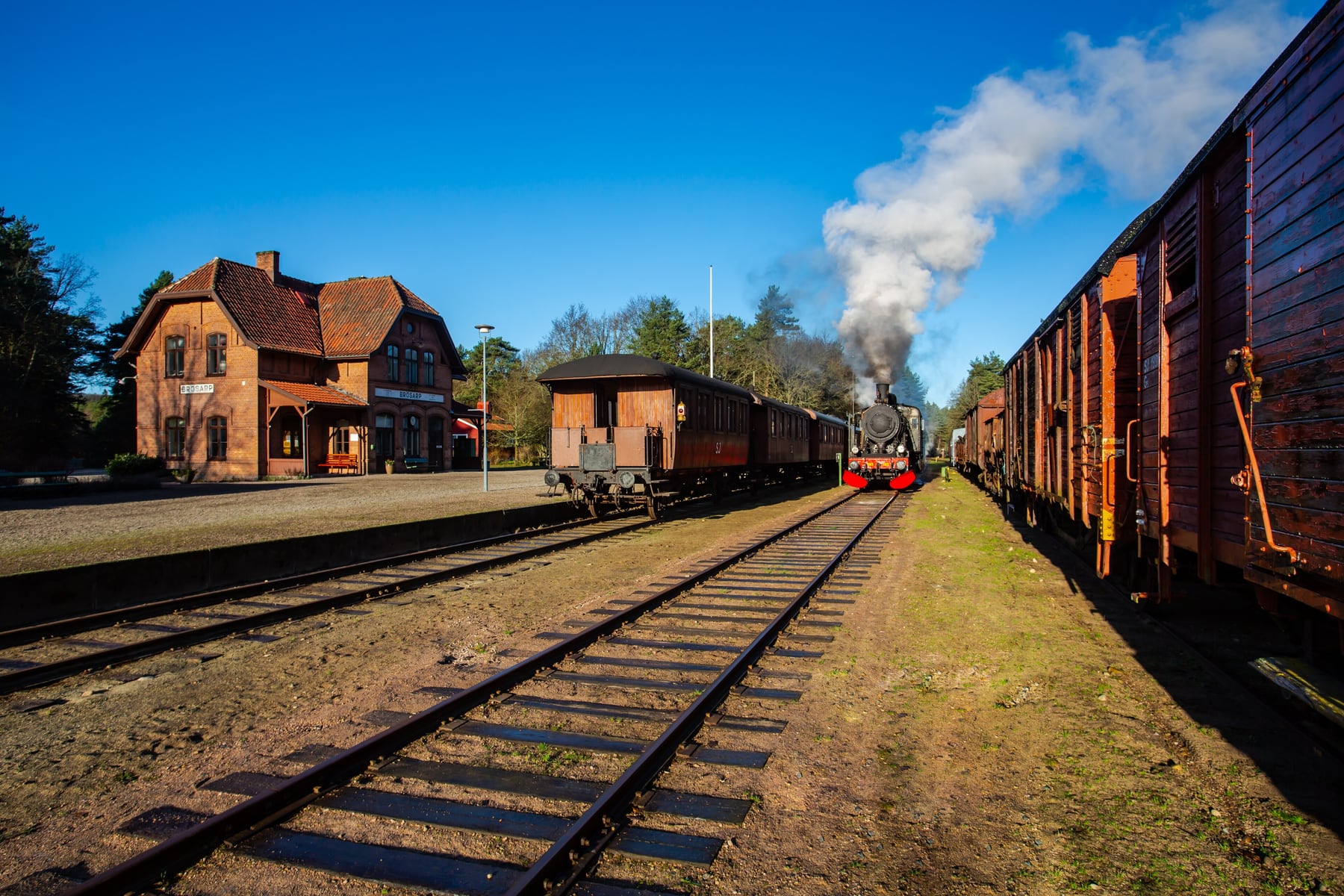
On 18 July 1971 a steam train left Brösarp for S:t Olof, run by a society of volunteers that had moved to the station only that spring. The state railway's own passenger trains were still on the line: SJ ran its last one on New Year's Eve that year. By the time the line closed, the people who meant to keep it had already been running it for five months.
They have kept it ever since. Skånska Järnvägar calls itself Sweden's oldest standard-gauge museum railway, and all the work on it is unpaid. In 2002 the society bought the track from the state, and today it runs steam, a 1950s railbus and a dining car of 1946 over 13.4 km of Österlen, the far south-east corner of Skåne: round the Brösarp hills, past two medieval churches, within sight of Hanö Bay and through deep beech woods to S:t Olof.
The Journey
The line was built as the Ystad–Brösarp railway, opened in September 1901 from Tomelilla, on the line to Ystad, to Brösarp, where Östra Skånes Järnvägar had arrived from Kristianstad the year before. It never paid: most passengers went no further than Tomelilla or Ystad, and the goods were grain, sugar beet, firewood and pit props for the mines. The state bought it in 1941 and put railbuses on it, but the car won. Tomelilla to S:t Olof lost its trains in the 1940s and 1950s and was lifted; the passenger service north of S:t Olof lasted until the end of 1971.
The train
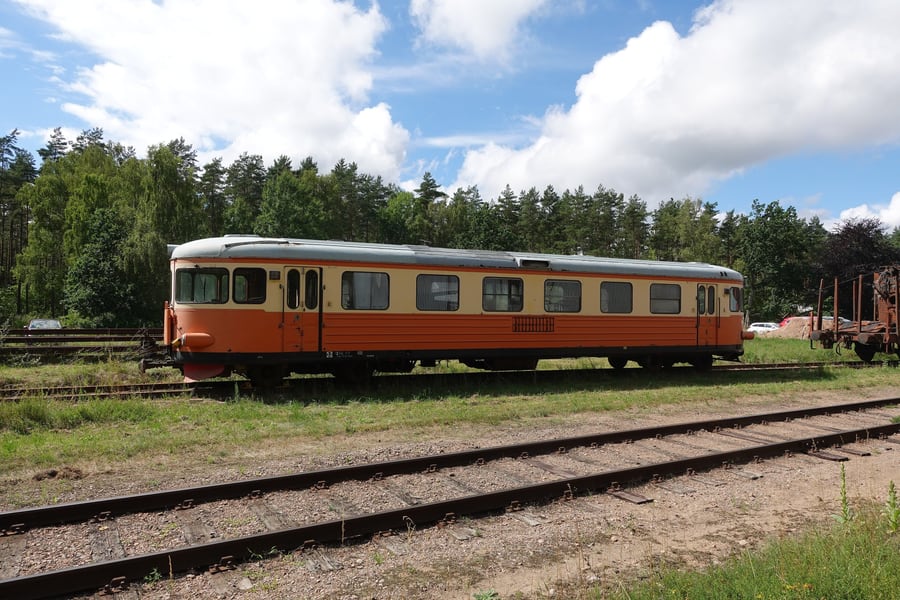
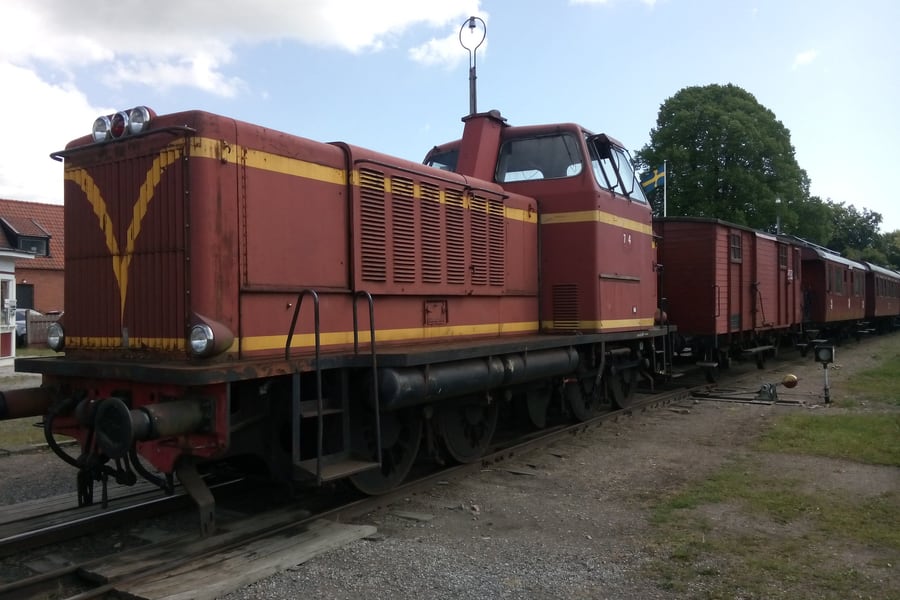
Two steam locomotives work the line. E2 1183 was built at Motala in 1914 and S1 1914, a tank engine, by NOHAB in 1952. Behind them run wooden coaches built between 1898 and 1942 and the dining car of 1946, about 150 metres and 275 tonnes in all. Each round trip burns some 600 kg of coal and 4 cubic metres of water. When the risk of forest fire is high, or an engine is out of order, a heritage diesel of 1955 takes the train instead. On some summer days a Y7 railbus, built by ASJ in Linköping in 1958, runs its own trains in between.
Brösarp to S:t Olof
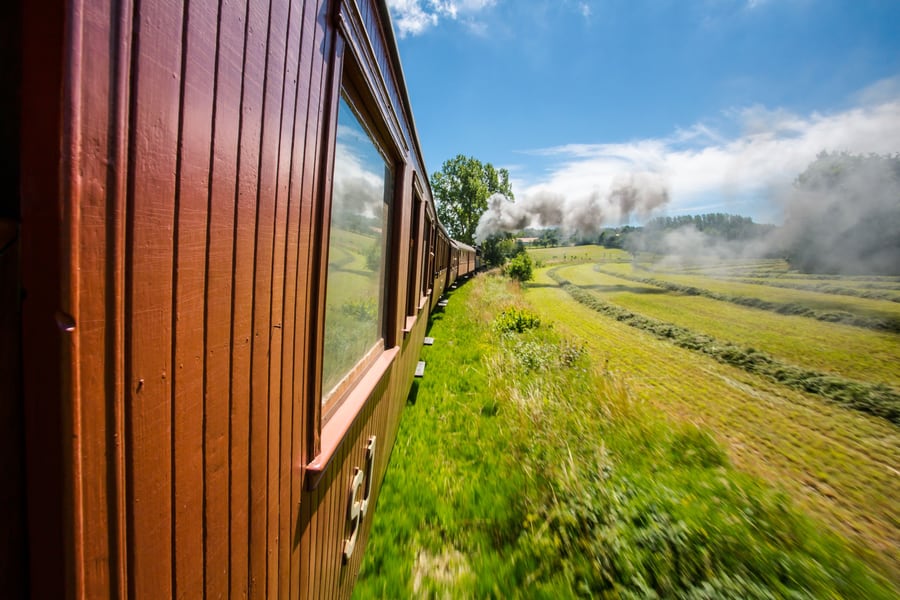
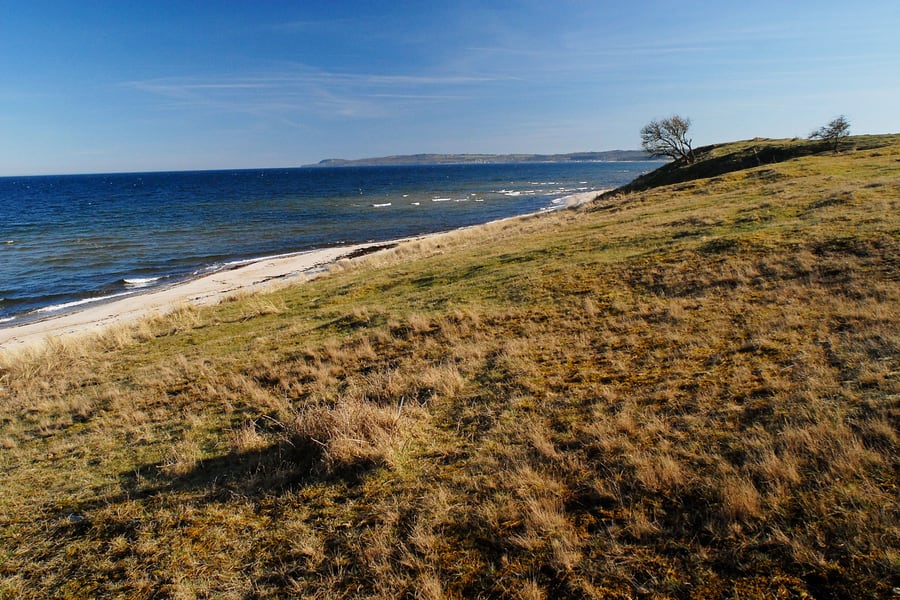
From Brösarp the line winds round the grazed slopes of Brösarps backar, past fields and through deep beech woods. Ravlundabro is a request stop, and between the medieval churches of Ravlunda and Vitaby the view opens to Hanö Bay. After Vitaby the train runs on to S:t Olof, 13 km and about half an hour from Brösarp.
The top speed is 40 km/h, and 30 when the engine runs tender first. Nobody is in a hurry: the whole return journey, with the stop at S:t Olof, takes about an hour and a half.
Along the route
 Olaf Meister / Wikimedia Commons · CC BY-SA 3.0 · 2012 · cropped
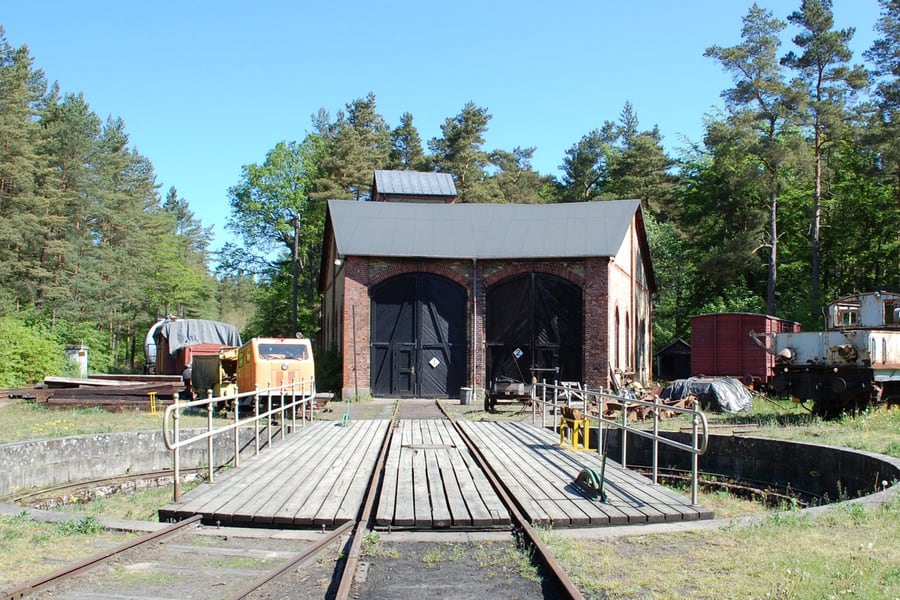
The turntable at Brösarp
Brösarp is the railway's home: the station house, the yard, the engine shed and the turntable where the locomotive is turned. The train weighs 275 tonnes, and a return trip burns about 600 kg of coal and 4 cubic metres of water.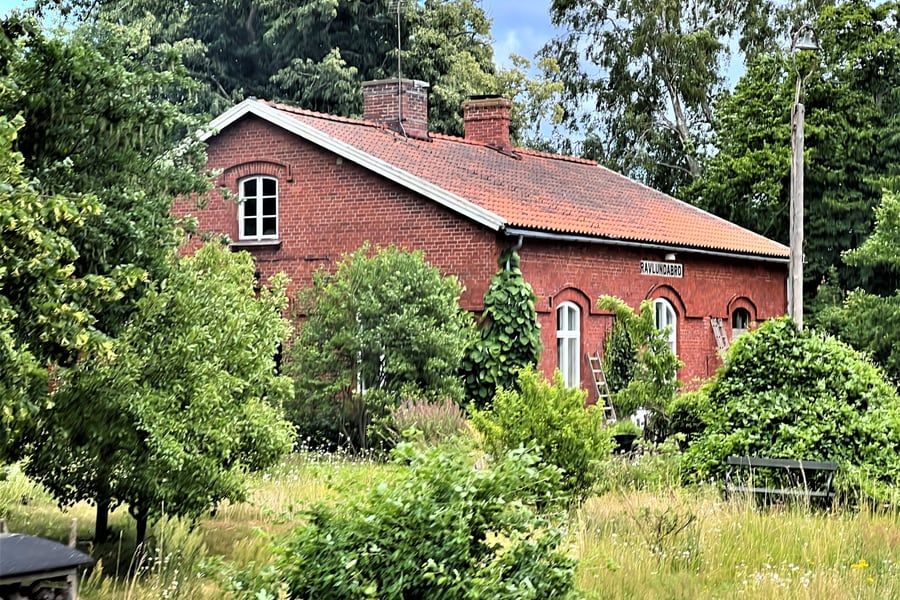 Sinikka Halme / Wikimedia Commons · CC BY-SA 4.0 · 2023 · cropped
Wave down the tin stationmaster
Ravlundabro is a request stop. To board here you set the plåtstins, a tin stationmaster on the platform, so the driver knows to stop. Beyond it the train passes Ravlunda's medieval church.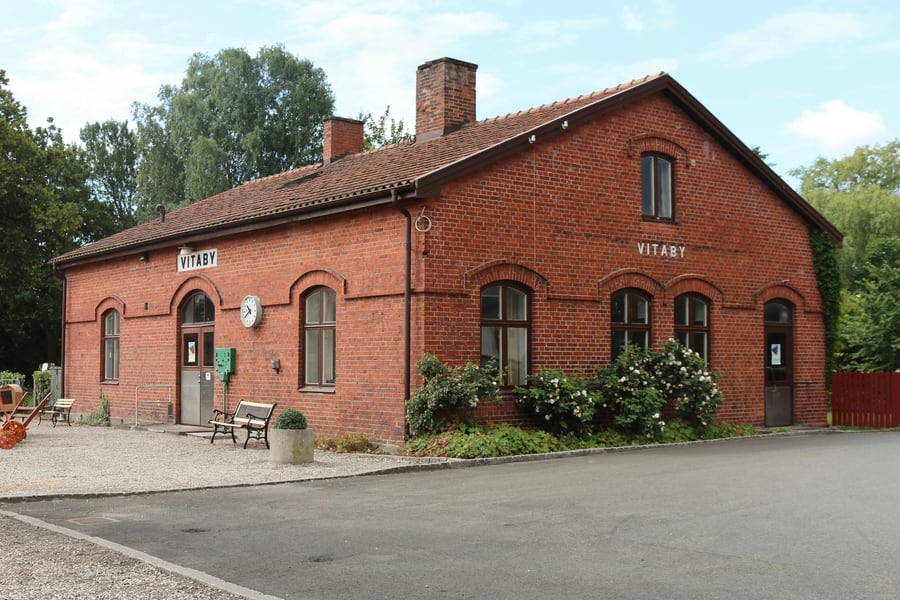 Jorchr / Wikimedia Commons · CC BY-SA 3.0 · 2015 · cropped
Past the church at Vitaby
Between Ravlundabro and Vitaby the line looks out over Hanö Bay, then crosses the road on a steel bridge of 1928 beside Vitaby church. On the evening train of the autumn holiday the church is open and lit with candles as the train goes by.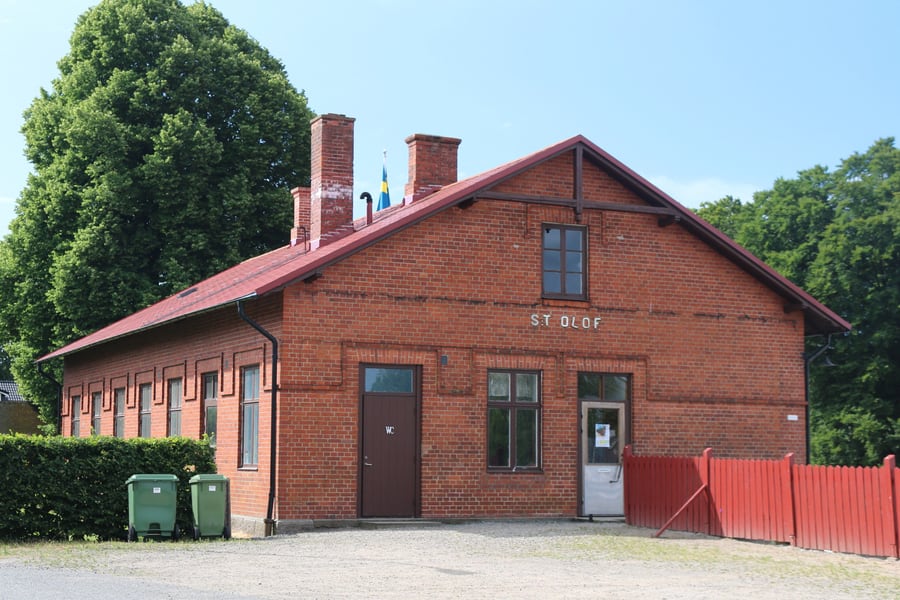 Jorchr / Wikimedia Commons · CC BY-SA 3.0 · 2015 · cropped
The end of the steam line
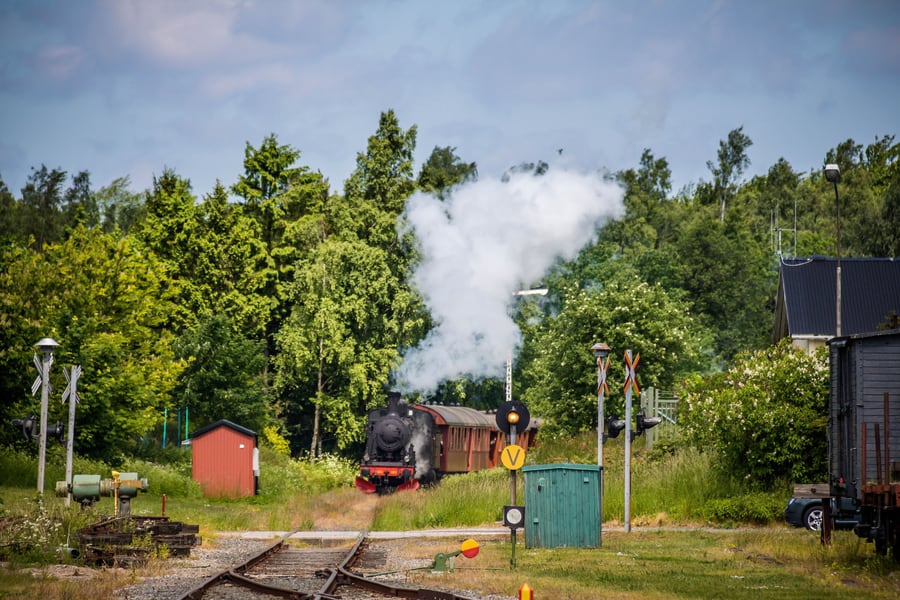
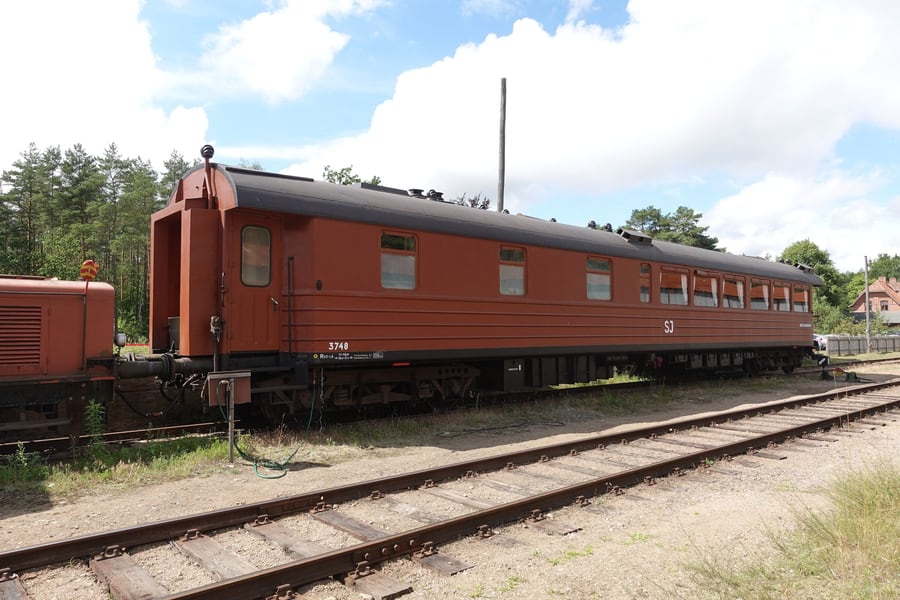
S:t Olof station stands in the middle of the village, guarded on the approach by a one-armed semaphore worked by wire. The society's track runs on south to Gärsnäs; no trains use it now, but in summer rail-bikes are let out on it as far as Gyllebosjö.A bit of history
Culture & experiences along the way
 G och J / Wikimedia Commons · CC BY 4.0 · 2025 · cropped
Dinner behind steam
The dining car of 1946 runs in the midday and afternoon steam trains on Wednesdays and Sundays. Tables are laid with white cloths and porcelain, and a three-course meal is served over the round trip, with a Christmas menu on the December trains. The journey is included; book at least 72 hours ahead.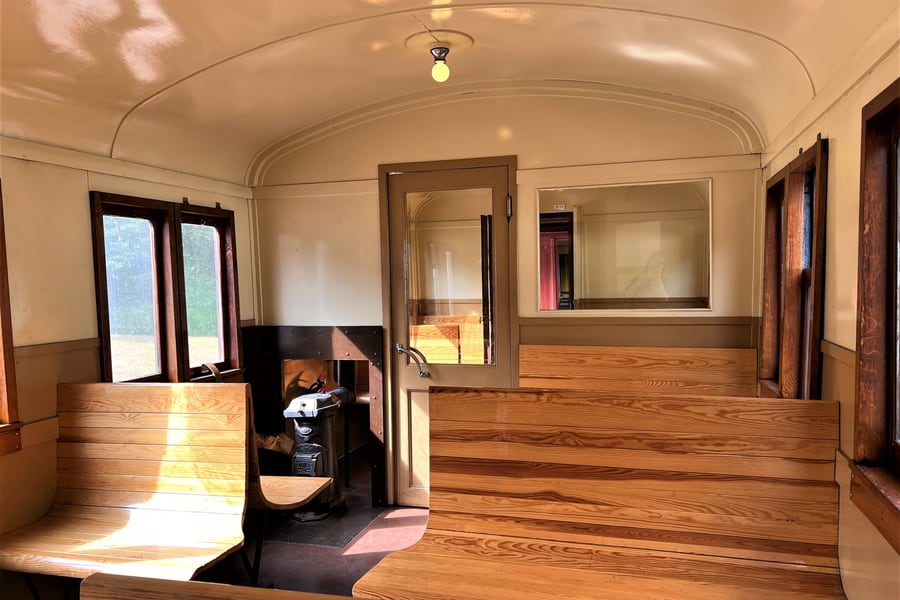 Sinikka Halme / Wikimedia Commons · CC BY-SA 4.0 · 2023 · cropped
Wooden benches and an iron stove
Coach 9058 was built by Kockums in 1898 for the Skåne–Småland railway, and it still has its wooden benches and an iron stove in the corner. The society's aim is a journey back to the days when you travelled on wooden seats and the stationmaster was king of the village.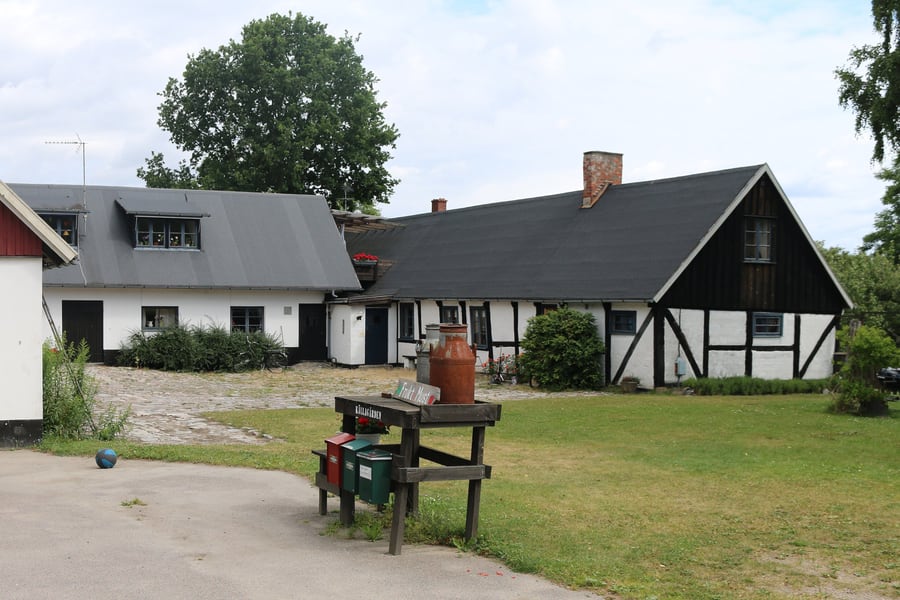 Jorchr / Wikimedia Commons · CC BY-SA 3.0 · 2015 · cropped
The apple war
In the 1970s Källagården, a farm at the edge of the southern hills, fought a long dispute with the municipality over plans for a motel, a ski slope and a golf course here. It inspired Hasse and Tage's film Äppelkriget, shot nearby, and its orchards later played the Cherry Valley in The Brothers Lionheart.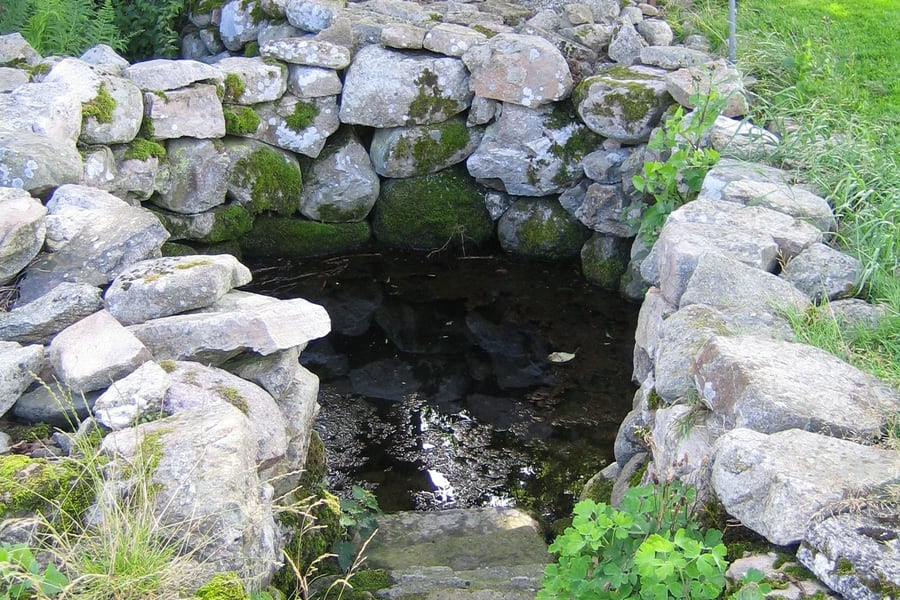 Jorchr / Wikimedia Commons · CC BY-SA 3.0 · cropped
A coin for the saint
A few hundred metres south of the church in S:t Olof is St Olof's spring, where pilgrims once left money, or scraps of meat if they had none, to ask the saint for help. Linnaeus wrote of the crowds who came on St Olof's day, 29 July. Visitors still drop a coin in.Timetables
The railway runs on chosen days, not every day: in 2026 the regular season ran from 14 June to 30 August, and the year ends with the autumn-holiday trains and two Christmas Sundays. Tickets can be booked ahead, or bought at the stations and on board if there is room. Times and days below are the operator's 2026 timetable, read in October 2026; the 2027 season has not been published yet.
Brösarp to S:t Olof
| Train | Brösarp | Ravlundabro | Vitaby | S:t Olof |
|---|---|---|---|---|
| Steam 1 | 10:00 | 10:07 | 10:17 | 10:32 |
| Railbus 21 | 10:40 | 10:46 | 10:53 | 11:05 |
| Steam 3 | 12:30 | 12:37 | 12:47 | 13:00 |
| Railbus 23 | 13:10 | 13:16 | 13:25 | 13:35 |
| Steam 5 | 14:45 | 14:52 | 15:02 | 15:15 |
S:t Olof to Brösarp
| Train | S:t Olof | Vitaby | Ravlundabro | Brösarp |
|---|---|---|---|---|
| Steam 2 | 11:10 | 11:23 | 11:30 | 11:40 |
| Railbus 22 | 11:50 | 12:00 | 12:06 | 12:15 |
| Steam 4 | 13:40 | 13:53 | 14:00 | 14:10 |
| Railbus 24 | 14:15 | 14:25 | 14:31 | 14:40 |
| Steam 6 | 15:50 | 16:03 | 16:10 | 16:20 |
Steam trains ran on Sundays from 14 June to 30 August, and on Wednesdays and Saturdays from 8 July to 8 August. Railbus trains, with limited seats, ran on Sundays from 28 June to 30 August and on the Tuesdays 21 and 28 July. Ravlundabro is a request stop. The dining car normally runs in steam trains 3–4 and 5–6 on Wednesdays and Sundays.
Still to come in 2026: on Saturday 31 October steam trains leave Brösarp at 12:30, 14:45 and 17:05, the last one in the dark, past Vitaby church lit with candles; on Sunday 1 November at 10:00 and 12:30. The Christmas trains run on Sundays 6 and 13 December, to the steam timetable above, and do not call at Ravlundabro or Vitaby.
Check the day before you go: Skånska Järnvägar · timetable (opens in a new tab).
Tickets
The usual ticket is a return, there and back from whichever end you start: 225 SEK for an adult and 60 SEK for a child of 3 to 11 travelling with an adult; under-threes ride free. A day ticket, 400 SEK or 100 SEK for a child, covers every train on one running day. Dogs may come along. Book in the operator's web shop, then show the confirmation at the ticket window in Brösarp and it is swapped for an old-fashioned card ticket; seats can also be bought at the stations and on board if there is room.
The dining car is booked in the same shop, and its ticket includes the journey. Refunds can be asked for up to 72 hours before departure. Checked against Skånska Järnvägar, October 2026.
Book your tickets
A return ticket
225 SEK · children 3–11 60 SEK
There and back from either end, returning to the station you started from.
Book Tickets (opens in a new tab, on skanskajarnvagar.se)via skanskajarnvagar.seA day ticket
400 SEK · children 3–11 100 SEK
Every train on one running day, for riding steam and railbus in turn.
Book Tickets (opens in a new tab, on skanskajarnvagar.se)via skanskajarnvagar.seRail Passes
An Interrail or Eurail pass does not cover Skånska Järnvägar, and is not worth buying for it. The railway is a museum line run by its own society, and it is missing from Interrail's table of the companies a pass is valid with — checked in October 2026, when the table carried a last updated 21 October 2026 stamp. Buy the return or day ticket from the railway itself.
A pass can still bring you most of the way. The same table lists Skånetrafiken's Pågatåg regional trains, which reach Kristianstad, Ystad and Simrishamn. From there the last leg to Brösarp is a SkåneExpressen bus — lines 3 and 4 stop at Torparebron, about ten minutes' walk from the station — and the bus is paid separately.
Conditions read on interrail.eu (opens in a new tab) and skanskajarnvagar.se (opens in a new tab) in October 2026.
Places to Visit
The times below are taken from the 10:00 steam train from Brösarp, which calls at Ravlundabro at 10:07 and Vitaby at 10:17, and reaches S:t Olof at 10:32.
They come in the order the line meets them: the grazed hills at Brösarp, and then three medieval churches, at Ravlunda, at Vitaby and at the pilgrim village of S:t Olof.
 TS Eriksson / Wikimedia Commons · CC BY-SA 3.0 · 2005 · cropped
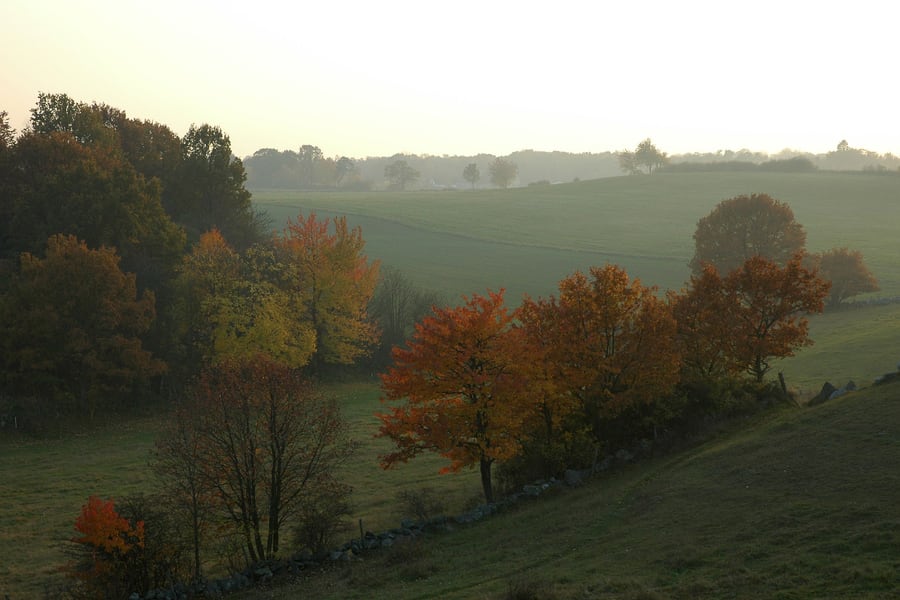
Brösarps backar
The hills around Brösarp are deposits of the last ice age, where the Linderöd ridge breaks up towards Hanö Bay. Kept open by grazing, the chalky slopes carry pasque flowers and cowslips in spring, and Prince Eugen came to paint them through several summers in the 1930s. Several trails cross them, the longest Skåneleden.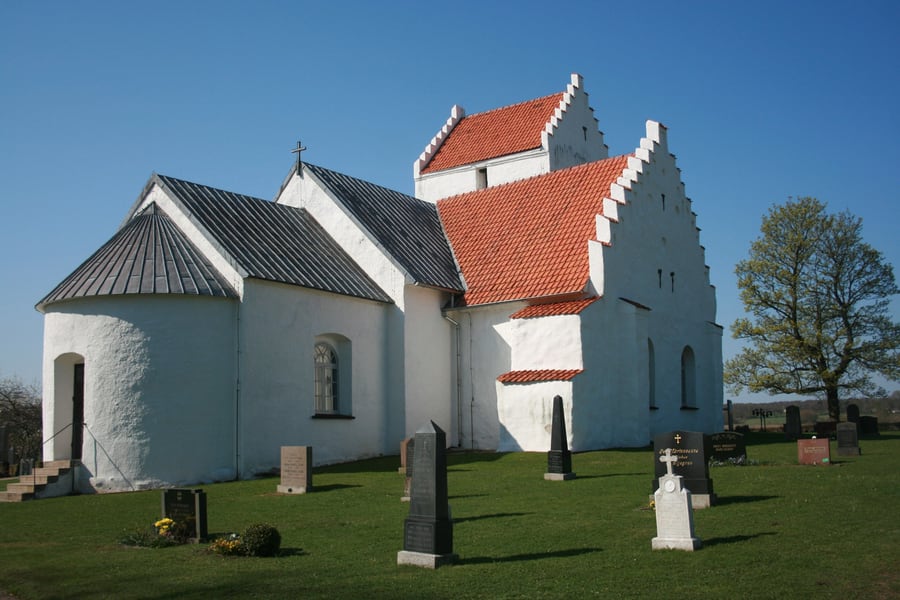 MattissonJ / Wikimedia Commons · CC BY-SA 3.0 · 2011 · cropped
Ravlunda church
Built around 1200 just south of the Brösarp hills, with a lead roof recast in the churchyard by medieval methods in 1990. The author Fritiof Nilsson Piraten lies here under a stone saying he always put things off until tomorrow, but improved at the very end and really did die, on 31 January 1972. The singer Olle Adolphson has lain here since 2004.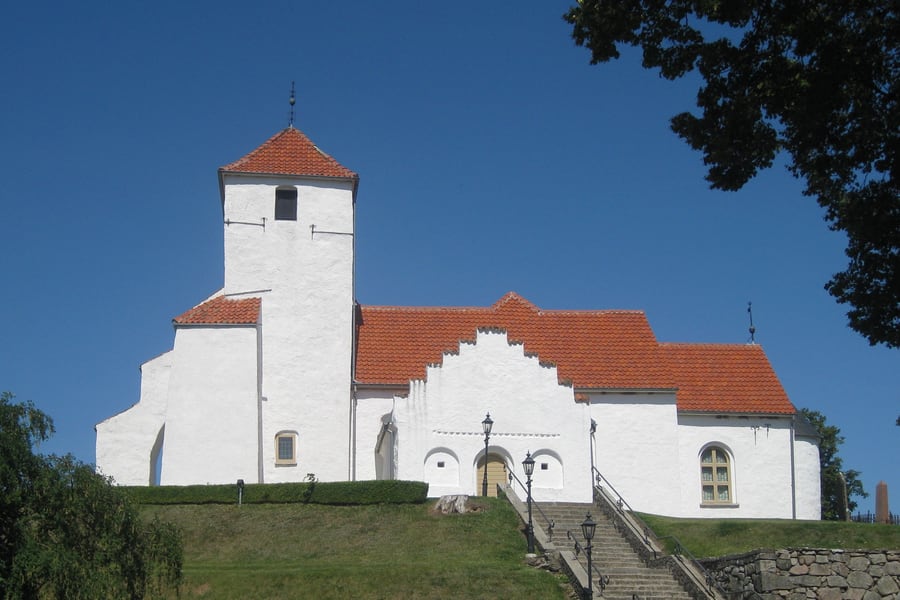 Jorchr / Wikimedia Commons · CC BY 3.0 · 2009 · cropped
Vitaby church
A 12th-century church that once served as a stronghold, its tower added in the 13th century and its buttresses built to stop it swaying when the bells were rung. Inside are wall paintings of the 14th and 15th centuries in the choir, a triumphal crucifix of the 1200s and a pulpit of 1614. The porch and the vaults came in the 15th century, and the north arm in 1781.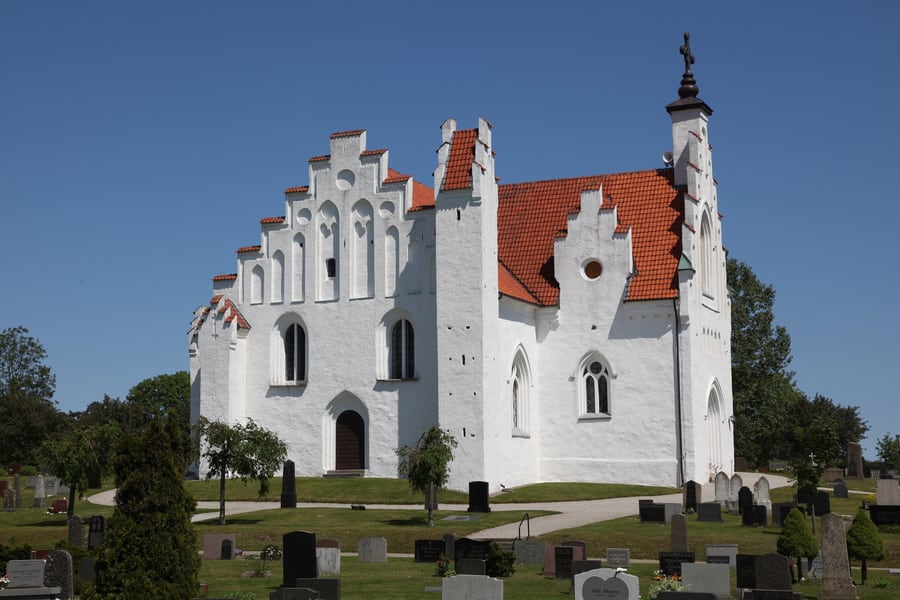 Hans A. Rosbach / Wikimedia Commons · CC BY-SA 3.0 · 2009 · cropped
S:t Olof's church
The village was once called Lunkende; its church became the largest shrine to St Olaf in the Danish realm, and the name of the saint replaced the name of the place. The two-aisled nave was built in the 15th century, perhaps for the pilgrims, and five of its saints' figures survive. It is still a pilgrimage church today.Where to Sleep
The railway starts in Brösarp, a village on the old road between Kristianstad and Ystad that has kept a coaching inn since the 17th century, and that inn is the place to stay. What it says about itself is from its own site, read in October 2026. No price, grade or star count appears here, because none has been verified.
Where to stay
 Bengt Oberger / Wikimedia Commons · CC BY-SA 4.0 · cropped
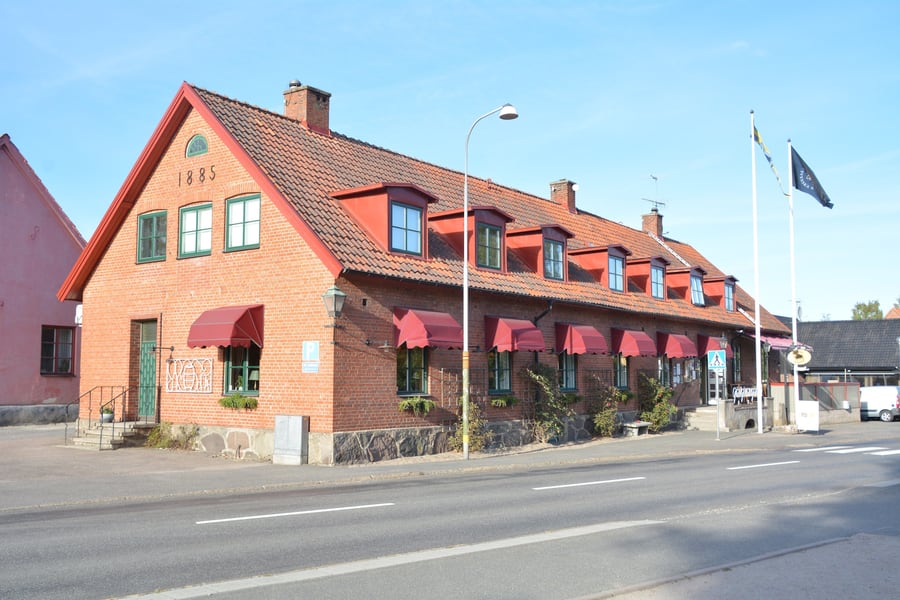
Brösarps Gästgifveri & SPA
Albovägen 21, Brösarp
A coaching inn first opened in 1684, its present brick house built 1885–1895, with 32 rooms and a spa.
Check Availability (opens in a new tab, on gastis.se)via gastis.seQuestions or corrections
Planning this trip and stuck on something, or spotted a time, fare or detail that has changed? Send us a message about Skånska Järnvägar. We read every one, and we update this page when something has changed.