The St. Kitts Scenic Railway
Richard Martin / Wikimedia Commons · CC BY 2.0
- Distance18 miles by rail · a 30-mile circle in all
- DurationAbout 3 hours · 2 by train, 45 minutes by bus
- Best seasonNovember–April · a thinner schedule May–October
Introduction
On 31 July 2005, a train came into the yard at Basseterre carrying sugar cane, the factory machinery was switched off, and three hundred and fifty years of sugar production on St Kitts came to an end.
The train, however, is still running.
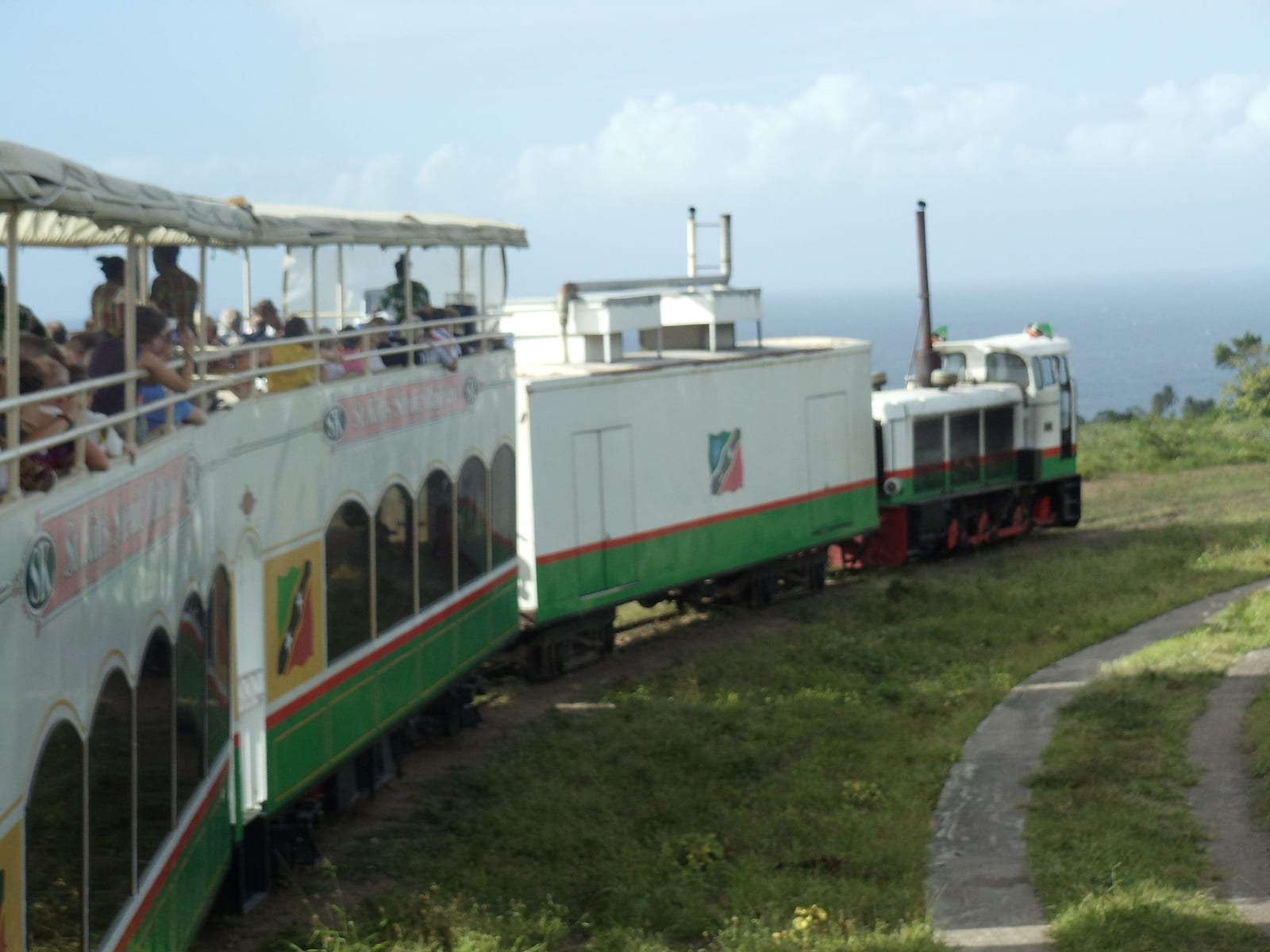
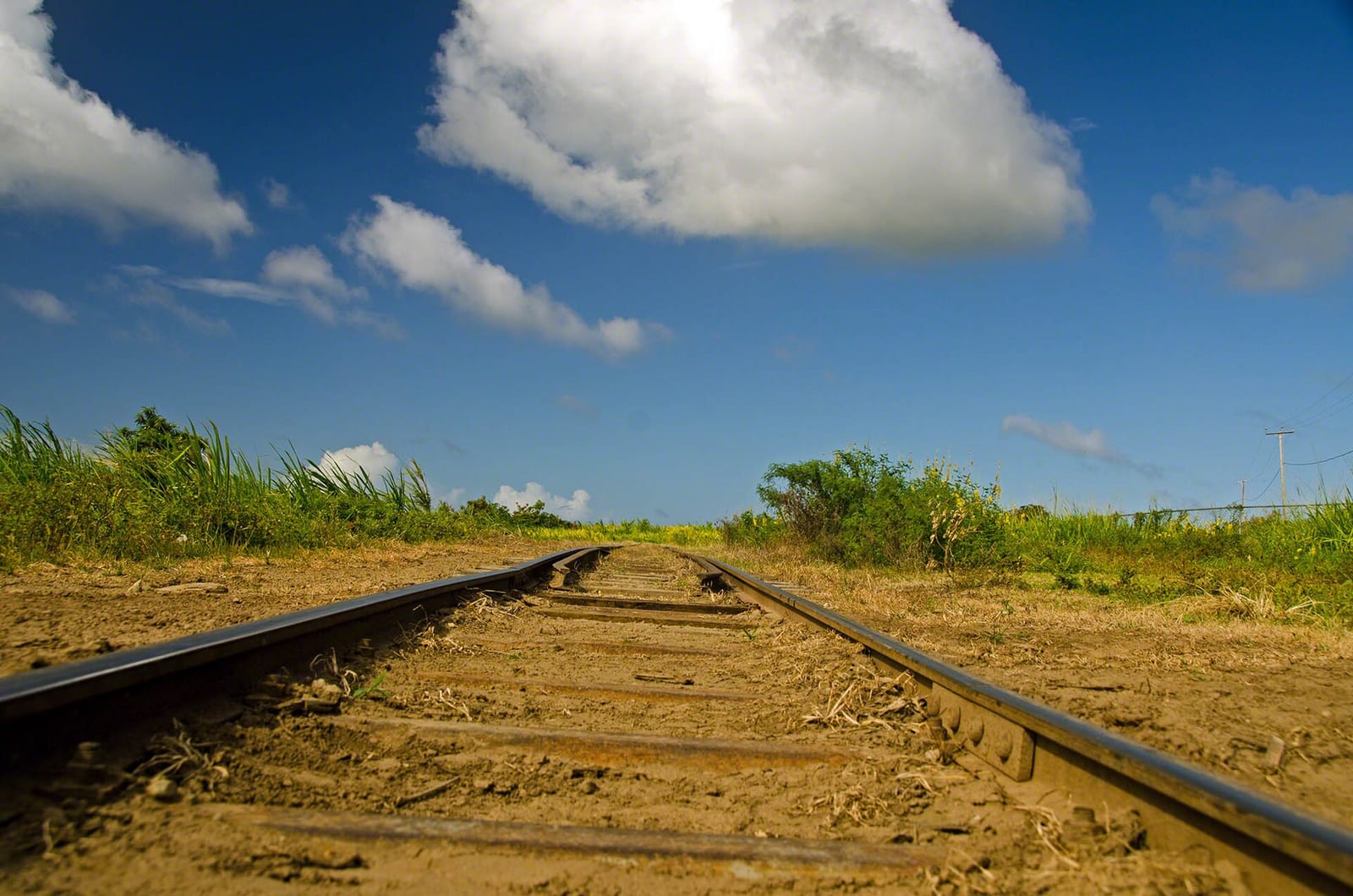
The St. Kitts Scenic Railway uses the same thirty-inch track that the cane wagons used, laid round the north and east of the island between 1912 and 1926 to feed a single central sugar factory. Today it carries visitors instead, in double-decked carriages with a bar downstairs and an open roof upstairs, on a circuit that takes about three hours and shows you an entire country.
Sugar, and what it did here
Cane arrived on St Kitts in 1643. Within a century and a half the island had two hundred estates and was, by 1775, the wealthiest of all the British possessions — wealth built on enslaved labour, on land cleared to the waterline, and on a crop that sent European navies to war with each other over islands you can walk across in a day.
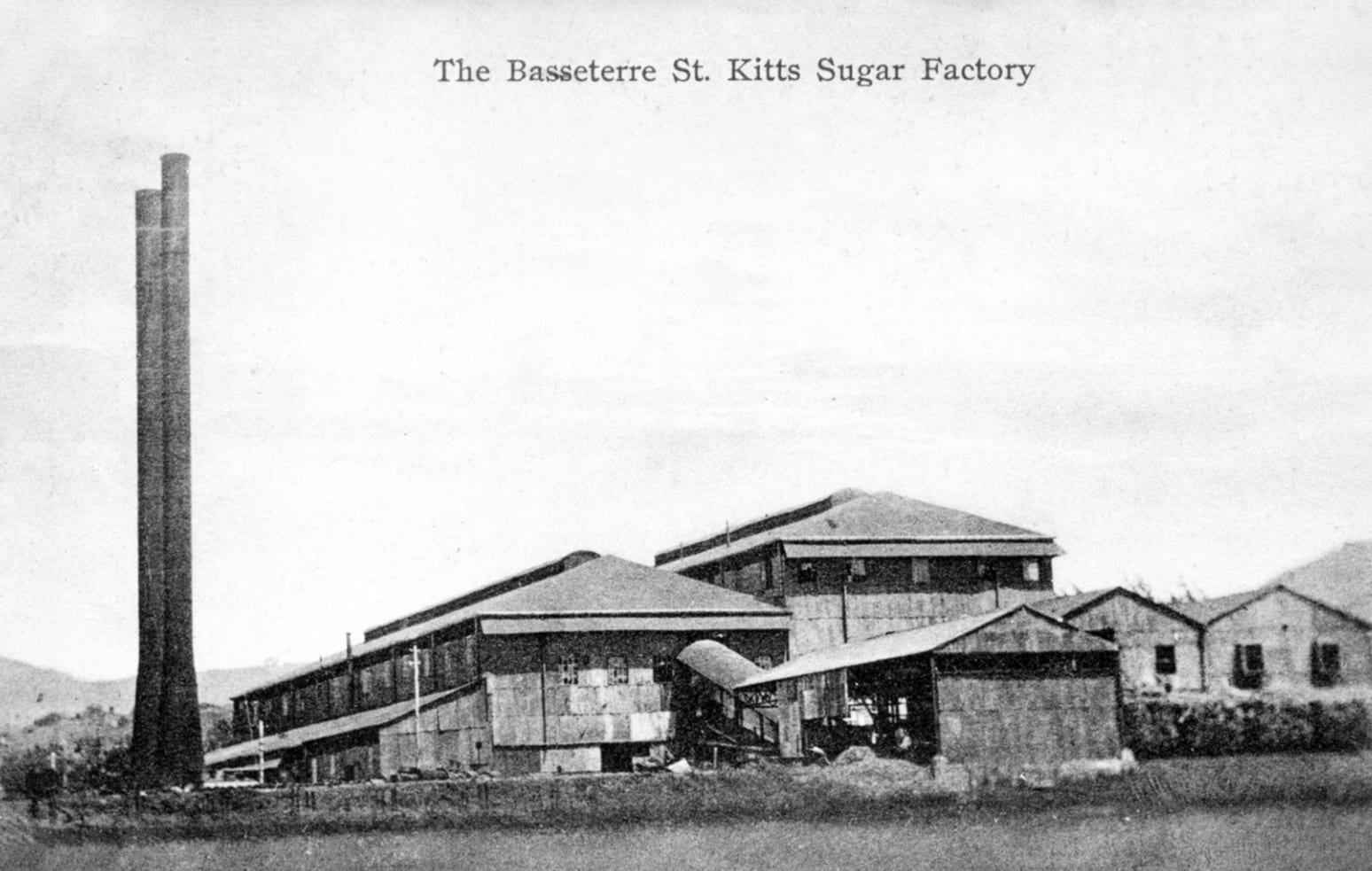
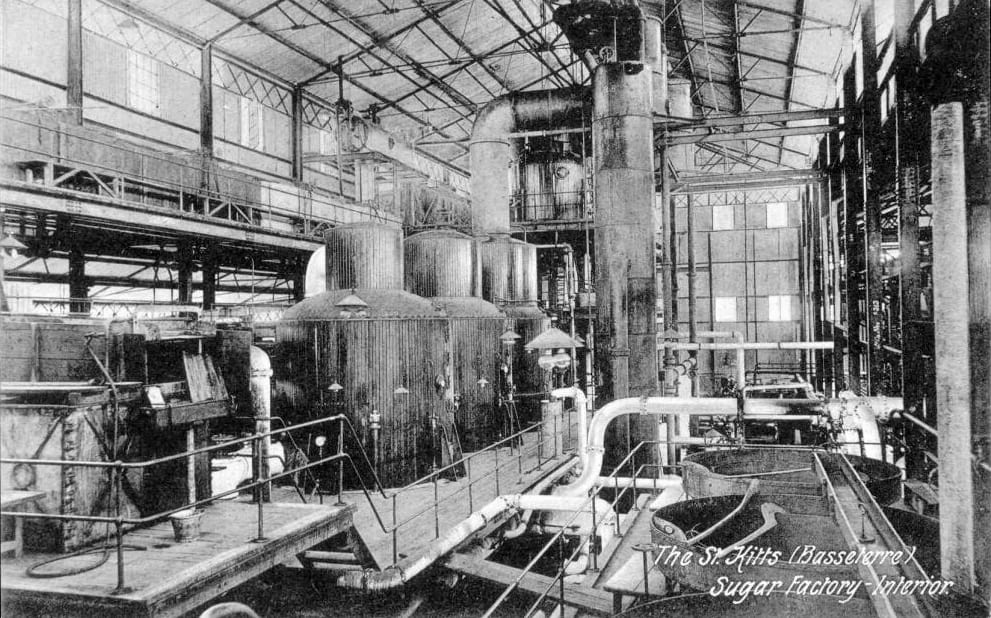
Then beet sugar arrived in Europe and the price collapsed. By 1900 the industry here was failing. The response, in 1912, was consolidation: a syndicate built one modern factory near Basseterre to replace the individual estate mills, and began a narrow-gauge railway to bring the cane in from the outlying plantations. It was finished in 1926, and it ran seasonally — February to June — for the annual harvest that Kittitians call "Crop".
It worked, for a while. St Kitts kept making sugar long after its neighbours gave up: Nevis stopped growing cane in the mid-1930s, Antigua ended production in 1971. But the factory aged, the acreage shrank, and the world price never came back. In 2005 the government closed it.
The railway survived
Two and a half years before the end, on 28 January 2003, a privately owned company began running tourist trains over the same rails in an unusual partnership with the government — so for a period the scenic train and the working sugar train shared the island's only railway.
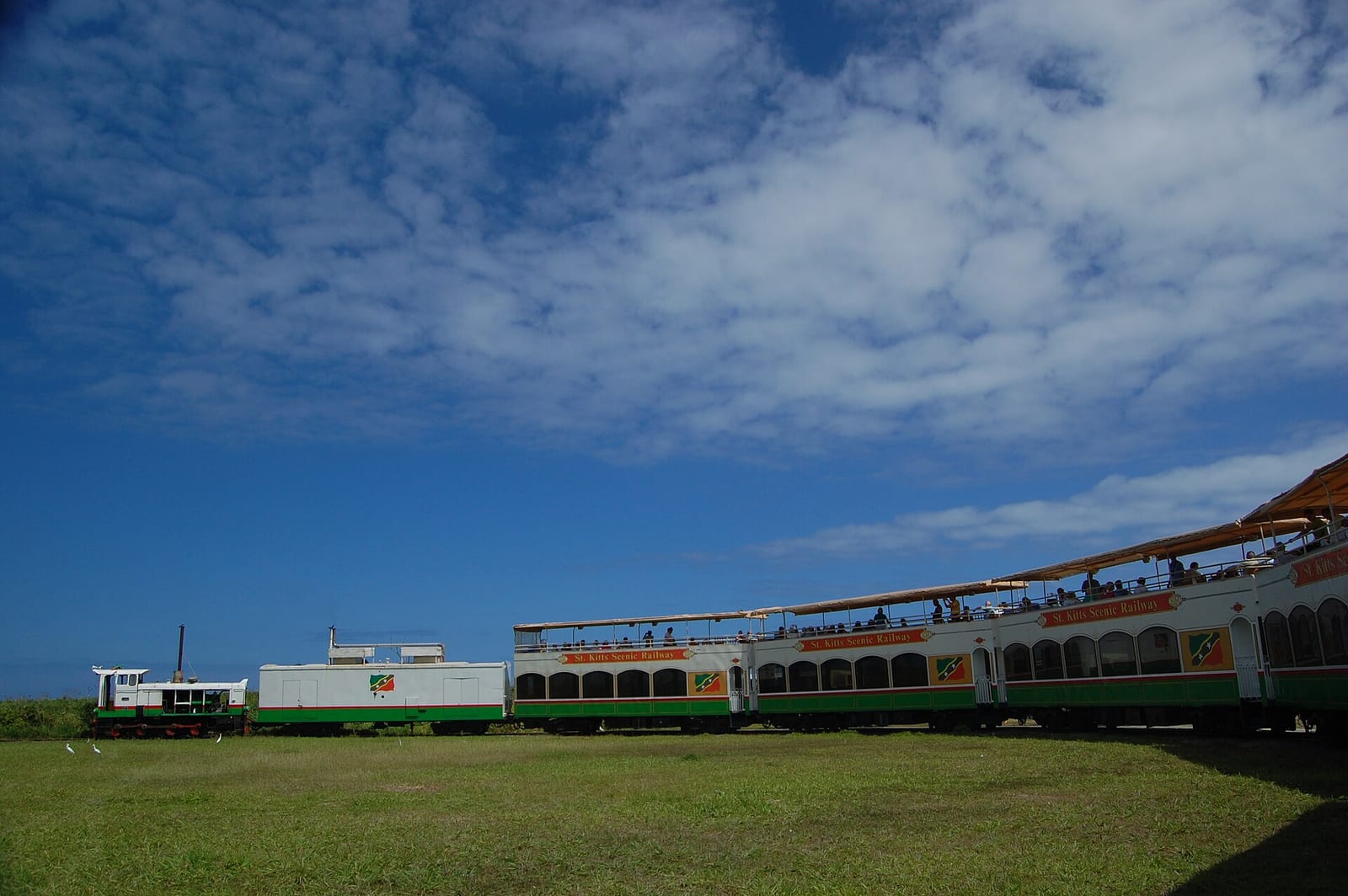
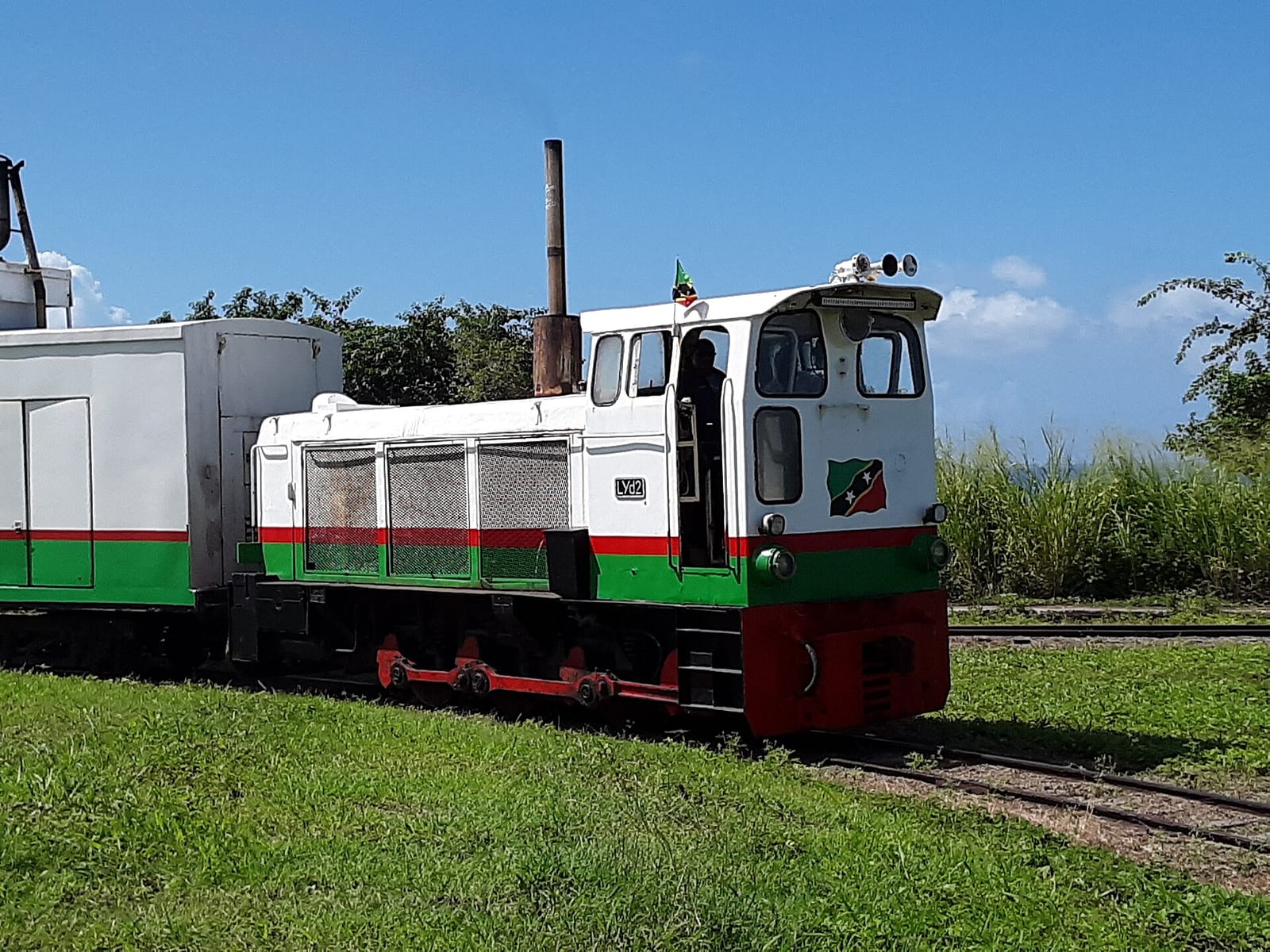
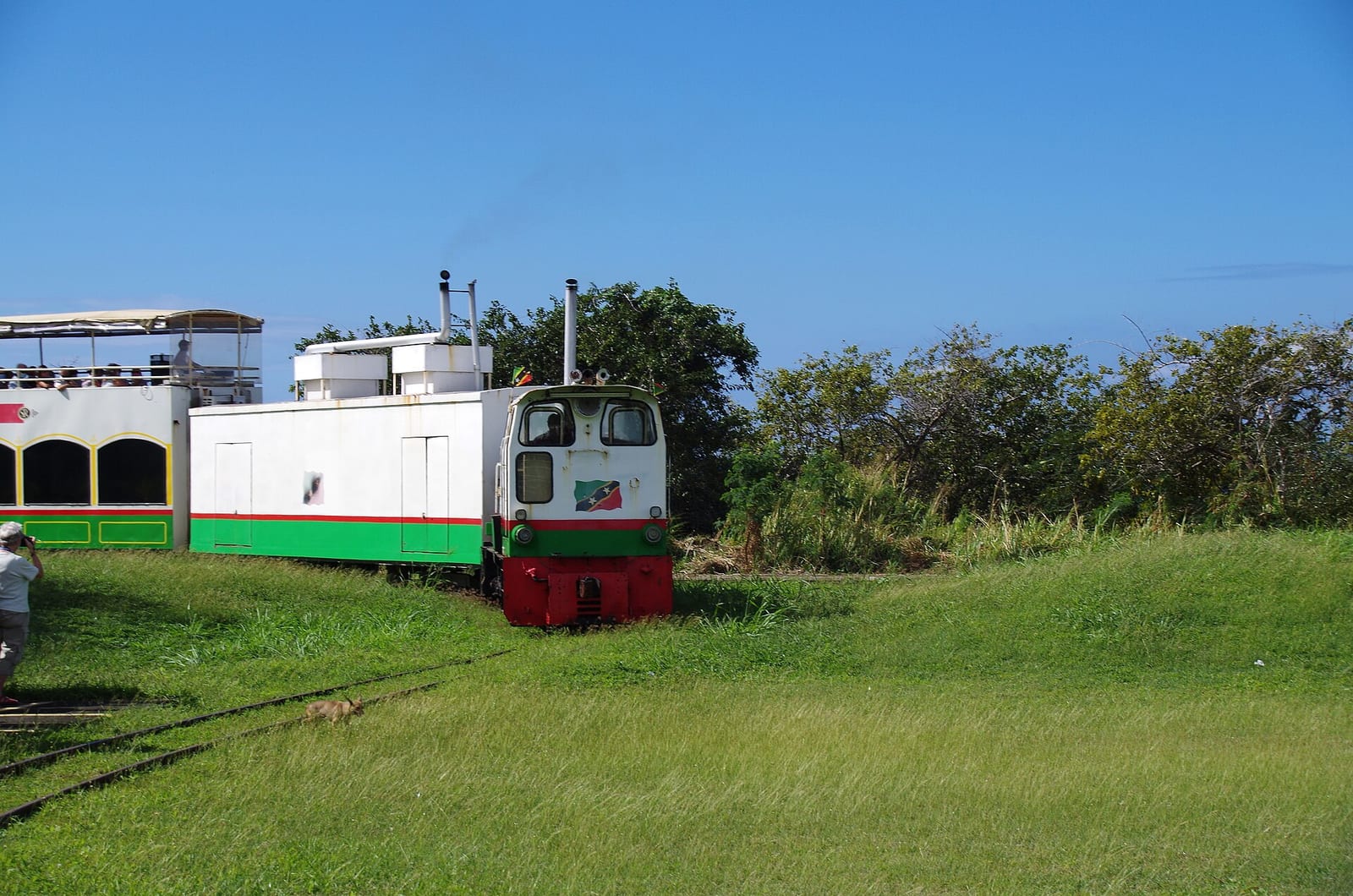
The train you ride is a genuine oddity. The three locomotives are Lyd2 diesel-hydraulics built by the 23 August Works in Romania and bought second-hand from a Polish sugar refinery when its own railway was scrapped. The five carriages are "Island Series" cars designed by Colorado Railcar and built in Washington state in 2002, with roofs that lift hydraulically so that the top deck opens to the sky. Downstairs there is carpet, six-foot vaulted windows, rattan chairs at inlaid tables, paintings by local artists, and a bar serving rum punch and frozen daiquiris from the moment you board.
And there is a choir. Three voices, unaccompanied, singing Caribbean folk songs and hymns as the train works round the coast.
Two things to know before you book
First: only 18 of the 30 miles are by train. The circuit is completed by a sightseeing bus for about 45 minutes, because the railway does not go all the way round. The operator is upfront about this, and it also warns that the tour "may operate in reverse as BUS/TRAIN" — so you might do the road half first. If you are coming for the railway, that matters.
Second: the slogan is not quite true. The railway calls itself "the Last Railway in the West Indies", and it is a good line, but there are still working railways elsewhere in the region — in Jamaica, the Dominican Republic, Martinique and above all in Cuba, which has a national network and which we cover separately.
What is fair to say is narrower and, honestly, more interesting: this is the last of the Caribbean cane railways, the last survivor of the hundreds of little industrial lines that once threaded every sugar island in the Antilles. That is a real distinction, and it is worth three hours of anybody's day.
The Journey
The railway is based at Needsmust, just outside Basseterre and near the airport. Depending on the day you will either start there by train and come back by bus, or go out by bus and return by rail — the operator runs the circuit in both directions and does not guarantee which.
Either way, the shape is the same: a 30-mile circle of the island, 18 miles of it on the railway, about two hours by train and forty-five minutes on a sightseeing bus.
On board
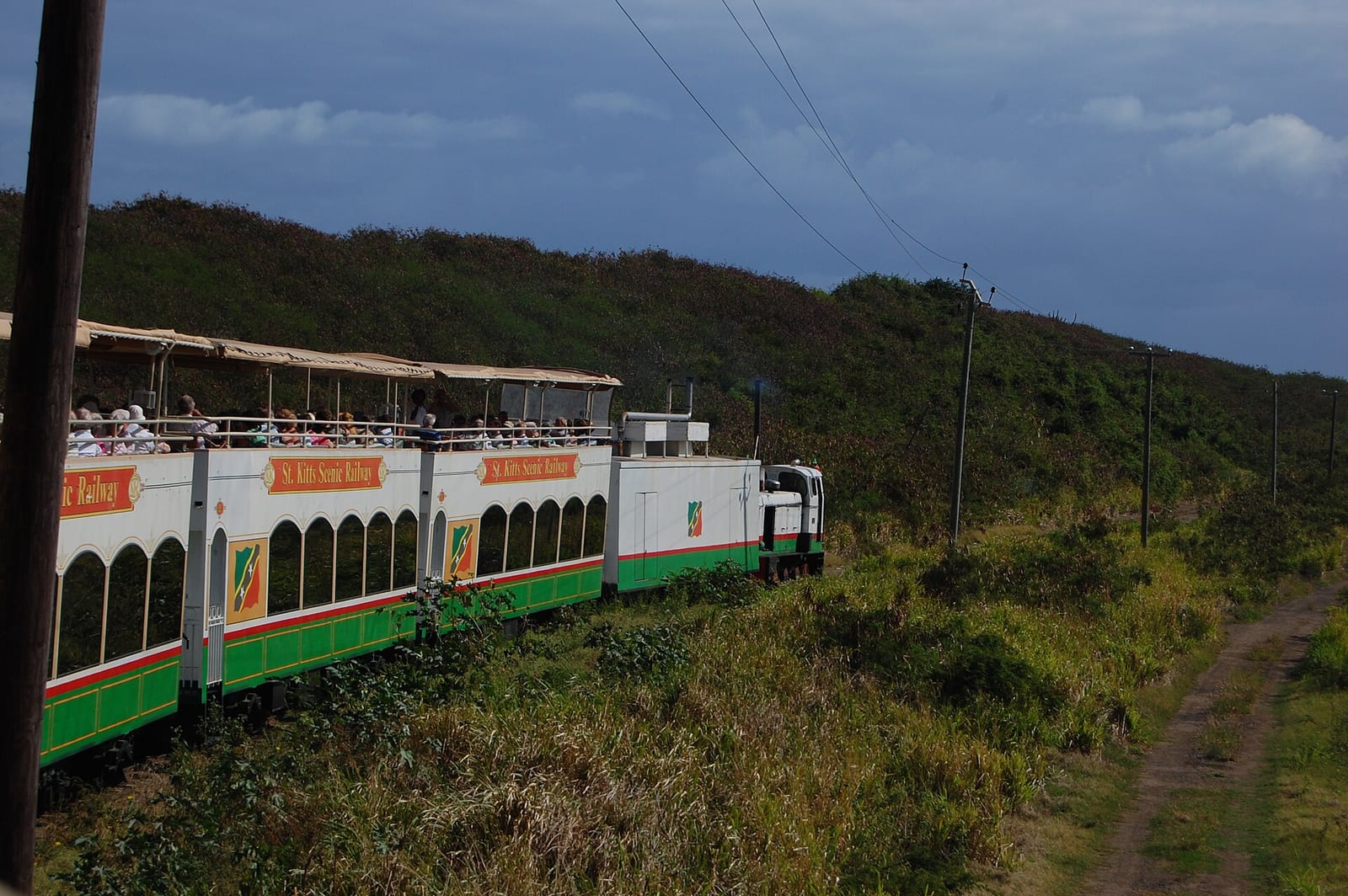
The carriages are the point. Downstairs is an air-conditioned "parlor": carpet, six-foot vaulted windows, cushioned rattan chairs at inlaid tables, paintings by Kittitian artists on the walls, a bar and a lavatory in every car. Upstairs, reached by a spiral stair, is an open-air observation deck under a canvas canopy — the roof lifts hydraulically to make it — which puts you well above the height of the cane and gives you the whole island at once.
The bar is open throughout and the drinks are included: rum punch, frozen daiquiris, soft drinks, juices, water. This is not a train on which anyone is trying to be restrained.
One genuinely useful warning, which the operator does not mention: the seats on the upper deck face inward, toward the middle of the car rather than out at the view. Sitting down, you will find your view is more restricted than you expect. The answer is simply to stand at the rail, which nobody minds.
Round the north
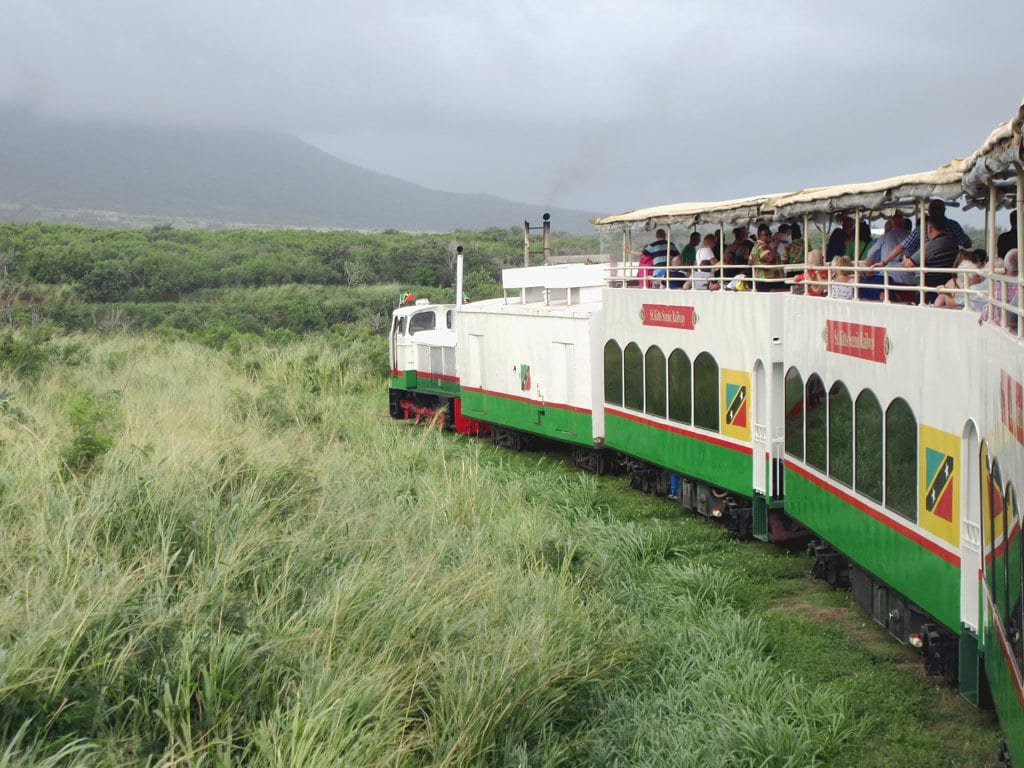
From Needsmust the line runs east and then north, up the windward side of the island. On the right is the Atlantic — a rougher, emptier coast than the Caribbean side where all the hotels are — and on the left the ground rises steadily toward Mt Liamuiga, the 1,156-metre volcano that makes up most of St Kitts.
You pass through cane. Not farmed cane, most of it, but the descendants of the 2005 crop growing wild along the embankments, taller than a person, with the rusted chimneys and roofless boiling-houses of individual estates standing in the fields behind. Every one of those chimneys was a mill before 1912, and every one was made obsolete by the railway you are riding.
Between the estates the train runs through villages — Ottley's, Lodge, Tabernacle, Saddlers — close enough to see into gardens, and the children wave. The railway makes a point of this, and it is not a performance: these are the villages the crews come from.
The ghuts
The dramatic bits are the bridges.
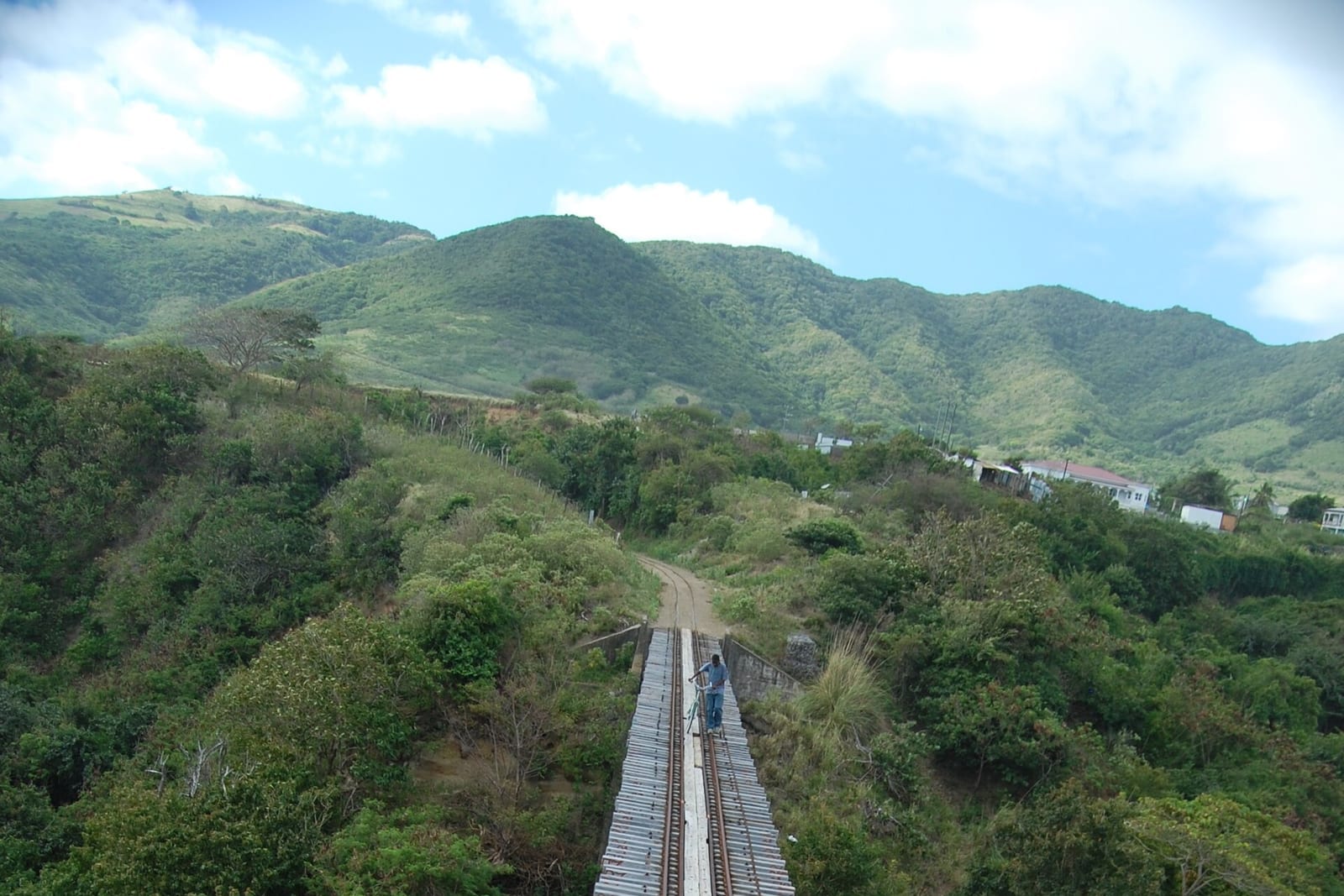
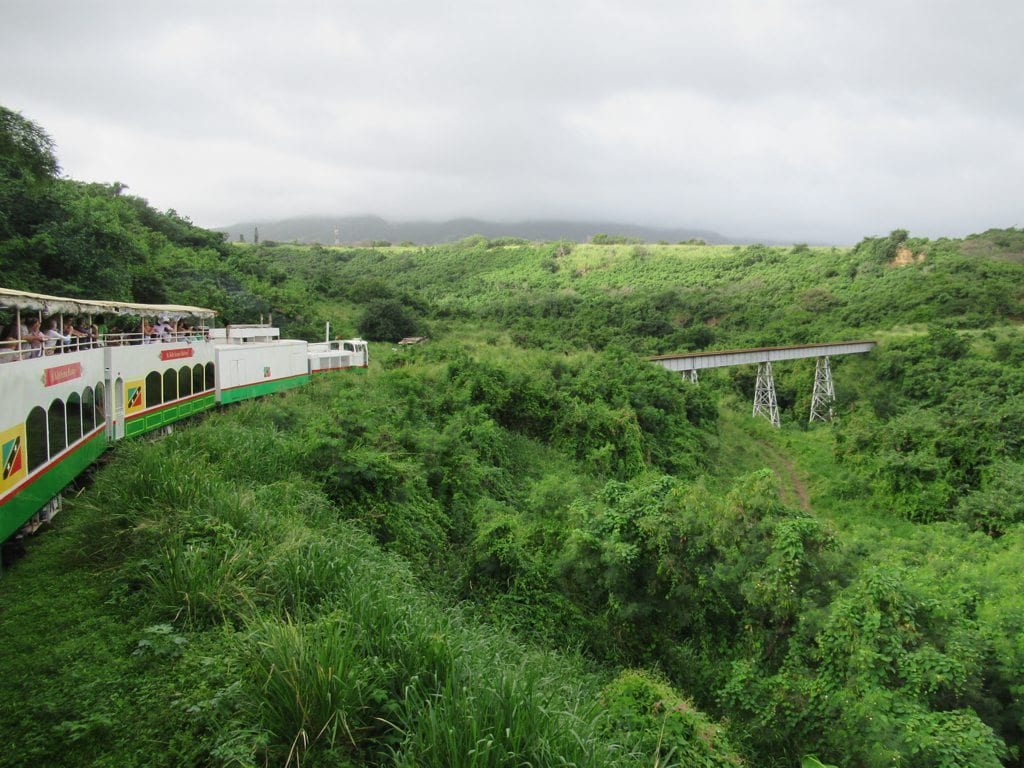
Water coming off the volcano has cut deep, steep-sided ravines down to the sea, and on St Kitts these are called ghuts. The cane railway crossed them on tall steel trestles, and the train still does — running out onto a narrow deck of girders with the tops of trees a long way below and the sea at the end of the cut. There are several of them on the circuit and they arrive without much warning.
Looking out to sea
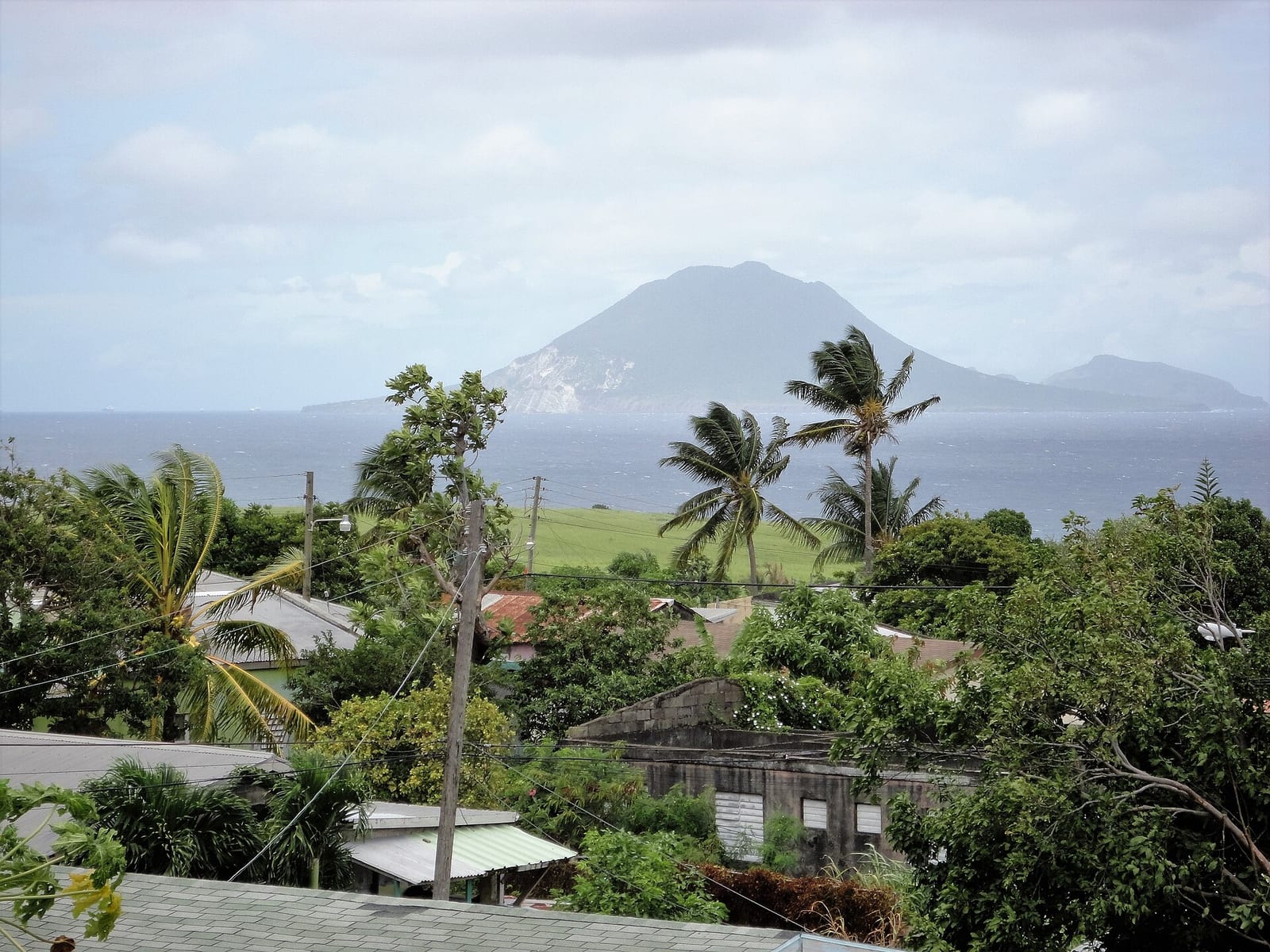
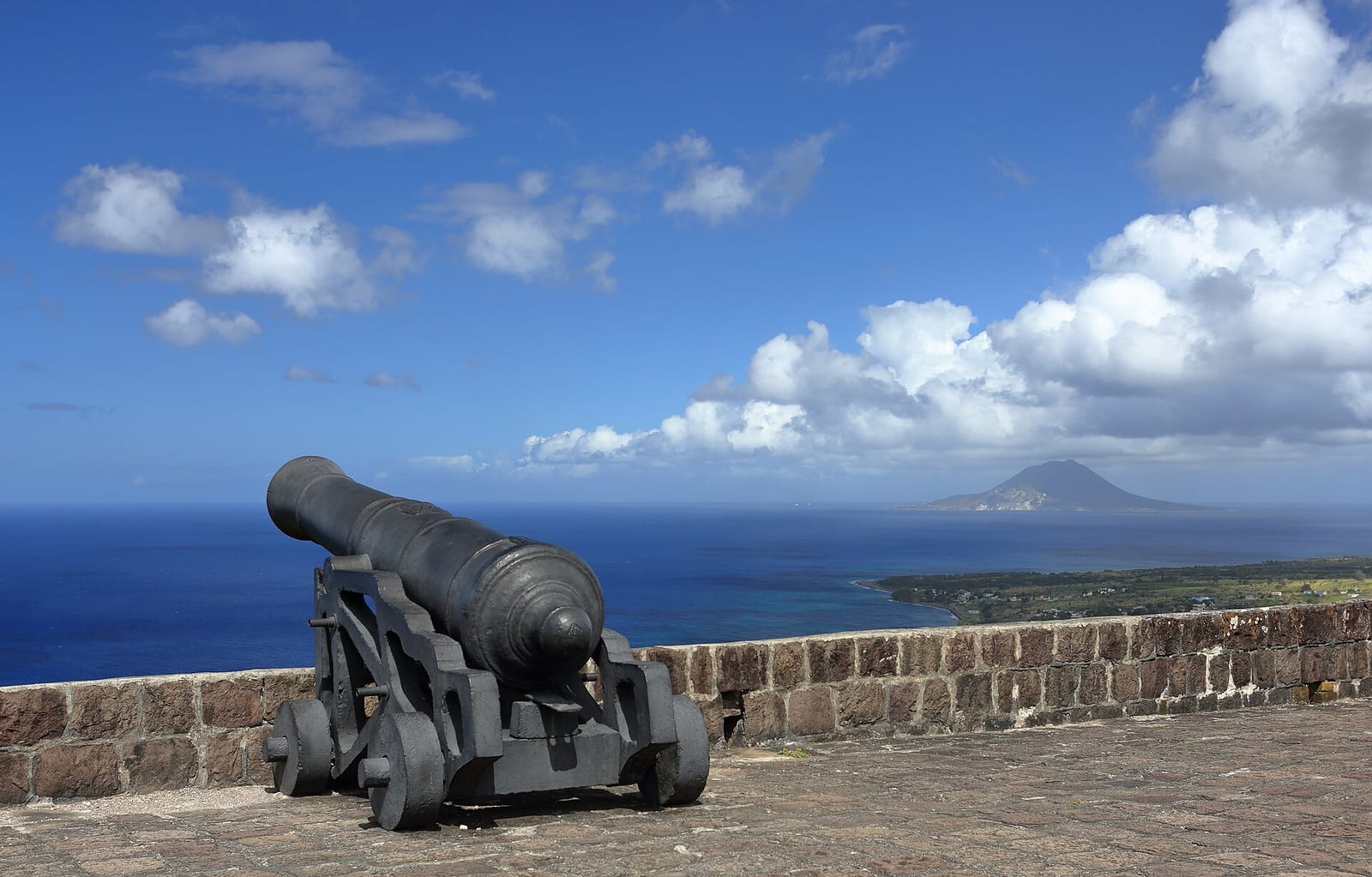
On the northern coast the view opens across the channel and there, sitting on the horizon, is the almost perfect volcanic cone of St Eustatius — Statia, a Dutch island of a few thousand people which in the 1770s was the busiest free port in the Caribbean and made itself rich supplying the American revolution, until the Royal Navy came and sacked it in 1781.
On a clear day you can also pick out Saba, St Barths, and behind you Nevis, two miles off the southern tip.
The bus half
Then the rails stop and you transfer to a coach for the run back along the leeward side. This is the part that is not a train journey, and it is fair to say so — but it is also where the island's set-piece sights are: Brimstone Hill Fortress, the vast British citadel the guides call the "Gibraltar of the Caribbean"; Old Road Town, where Sir Thomas Warner, who founded the first English colony in the Caribbean here in 1624, is buried beside Samuel Jefferson, the great-great-grandfather of Thomas Jefferson; and St Paul's, the village that produced Sir Robert Llewellyn Bradshaw, the island's first national hero.
Practical notes
- Go upstairs and stay there. Take a hat and sunscreen — there is a canopy but the sun comes in sideways.
- It is a tour, not a transport service. There is a narrator, a soundtrack and a schedule, and you cannot get off partway.
- Sit on the seaward side if you are downstairs.
- Three hours, door to door, which fits comfortably inside a cruise call.
Along the route
V. E. John / Wikimedia Commons · Public domainBuilt for sugar, and sugar is gone
By 1775 St Kitts had 200 estates and was the wealthiest British possession in the world. When beet sugar broke the price, a syndicate built one central factory and a railway round the island to feed it. In 2005 the last sugar train came in, ending 350 years of it here.RobDuch / Wikimedia Commons · CC BY-SA 4.0Romanian locomotives, American carriages
The three locomotives were built in Romania and bought second-hand from a Polish sugar refinery — a Polish cane connection landing on a Caribbean cane line. The carriages were designed in Colorado and built in Washington state, with roofs that lift hydraulically.David Stanley / Wikimedia Commons · CC BY 2.0Bridges over the ghuts
The best of the ride is where the line crosses the ghuts — steep ravines cut by water running off the volcano at the island's heart — on tall steel bridges with nothing underneath but treetops.A bit of history
Culture & experiences along the way
David Stanley / Wikimedia Commons · CC BY 2.0Ride upstairs, and know about the seats
The upper deck is open to the air and the roof lifts to make it so — this is the reason to come, and it puts you above the vegetation with a full circle of view. One honest warning that nobody else will give you: the upper-deck seats face inward, toward each other rather than out, which does restrict the view from a seated position. Stand up, and move about.Jeremy T. Hetzel / Wikimedia Commons · CC BY 2.0Listen to the choir
Somewhere on the circuit the St. Kitts Railway Choir — three voices, a cappella — starts up in the carriage: Caribbean folk songs, children's songs and hymns, sung by Kittitians rather than piped through a speaker. It is the thing everybody remembers, and it is the reason this reads as an island's own train rather than a cruise-line product with a locomotive attached.Larry Syverson / Wikimedia Commons · CC BY-SA 2.0Look across at St Eustatius
On the northern coast the train runs with the Atlantic beside it, and out across the channel stands the near-perfect volcanic cone of St Eustatius — Statia, the little Dutch island that was the busiest free port in the Caribbean in the 1770s and was sacked by the British for it. On a clear day Saba, St Barths and Nevis are all visible from various points on the circuit.Timetables
This railway does not run to a fixed timetable, and the operator says so directly. In its own words:
The St. Kitts Scenic Railway has a variable schedule. Generally, multiple daily departures are offered throughout each week from November through April. A more limited schedule is offered between May and October.
That is the whole of it. There is no published departure board, and there is a good reason: the schedule is set by the cruise ships.
What that means in practice
| High season | November to April — multiple departures most days |
| Low season | May to October — a reduced and less certain schedule |
| Duration | About 3 hours — roughly 2 by train, 45 minutes by bus |
| Distance | A 30-mile circle: 18 miles by rail, 12 by road |
| Direction | Train first, or bus first — the operator warns it "may operate in reverse as BUS/TRAIN" |
| Departs from | Needsmust Train Station, just outside Basseterre |
The railway's business is built almost entirely on cruise calls, and its partner list runs to a couple of dozen lines — Carnival, Royal Caribbean, Princess, Holland America, Cunard, MSC, Silversea and the rest. When ships are in, trains run. When the port is empty, particularly in the late-summer low season, they may not.
If you are on a cruise ship
The railway asks you to book through your ship's shore-excursion desk, not directly, because cruise seating is reserved in blocks. Consult the line's excursion webpage or hotline before you sail, or the desk on board. The timing will be arranged around your call.
If you are travelling independently
Two routes:
- Your hotel's tour desk. The operator states plainly that tickets are available this way, and for anyone staying on the island it is the simplest option — they will know which days trains are running.
- Direct with the railway. Use the contact form on stkittsscenicrailway.com (opens in a new tab), giving your travel date and the number of passengers, or telephone (869) 465-7263.
Do this well in advance in high season, and do it before you fly in low season — between May and October there is a real chance that no train runs on the day you want.
Fares
The railway publishes no fare. Third-party resellers advertise the tour "from around US$155", but that is a reseller's price, undated, and not the operator's. Ask when you book.
Saint Kitts and Nevis uses the East Caribbean dollar (XCD), pegged to the US dollar at 2.70; US dollars are accepted almost everywhere, though change may come back in EC.
Operator: St. Kitts Scenic Railway Ltd., Needsmust Train Station, Basseterre — stkittsscenicrailway.com (opens in a new tab), telephone (869) 465-7263. Position as of July 2026.
Tickets
How you buy depends entirely on how you arrived, and the railway is explicit about it. Cruise passengers book through the ship, not the railway: those seats are reserved in blocks, so buy from the shore-excursion desk before you sail. Anyone staying on the island books through a hotel tour desk — which is also where they will know whether a train is running that day — or direct through the operator's contact form.
The railway does not publish a fare and no figure is invented here; resellers list the tour from around US$155, but that is a reseller's undated price. Drinks are included, and generously. Check the season: between May and October the schedule thins and some days have no train at all, so do not fly in for this without confirming. Ask which way round you are going, too — the tour runs train-first or bus-first and the operator does not commit in advance.
Book your tickets
The Scenic Railway tour
A 30-mile circle · 18 by rail, 12 by bus
The full island circuit, about three hours: roughly two on the train and forty-five minutes on a sightseeing bus for the section where the railway no longer runs. Complimentary drinks throughout and the choir on board. Independent travellers book through the railway's own contact form or a hotel tour desk.
Book Tickets (opens in a new tab, on St. Kitts Scenic Railway)via St. Kitts Scenic RailwayAs a cruise shore excursion
Booked through the ship
Most passengers arrive by cruise ship, and the railway asks them to buy through the line's shore-excursion desk rather than direct, because those seats are reserved in blocks. More expensive than the walk-up price, but it guarantees a place on a train whose schedule is built around the ships in the first place.
Book Tickets (opens in a new tab, on St. Kitts Scenic Railway)via St. Kitts Scenic RailwayRail Passes
No rail pass covers the St Kitts Scenic Railway. It is sold as a tour, through cruise ships, hotel tour desks or the operator. Interrail and Eurail are European schemes, and St Kitts and Nevis is not among the 33 countries in Interrail's list of covered railway companies (opens in a new tab).
Checked October 2026 against Interrail's list of covered railway companies (opens in a new tab).
Places to Visit
St Kitts is 68 square miles and you can see most of it in a couple of days. The railway does one circuit of it; everything below is within half an hour of the track.
Two things that did not get a card. Mt Liamuiga, the 1,156-metre volcano, is the best thing on the island for anyone who wants more than a beach — forested to the summit, with a crater at the top, and a serious half-day climb with a guide, steep and muddy and often in cloud. And the estate ruins are less a destination than a constant presence: all round the island, visible from the train, stand the stone chimneys and windmill towers of the individual plantation mills that the 1912 central factory put out of business. There are dozens of them, and they are the clearest thing on St Kitts to read the last four hundred years from.
 xiquinhosilva / Wikimedia Commons · CC BY 4.0 · cropped
Brimstone Hill Fortress
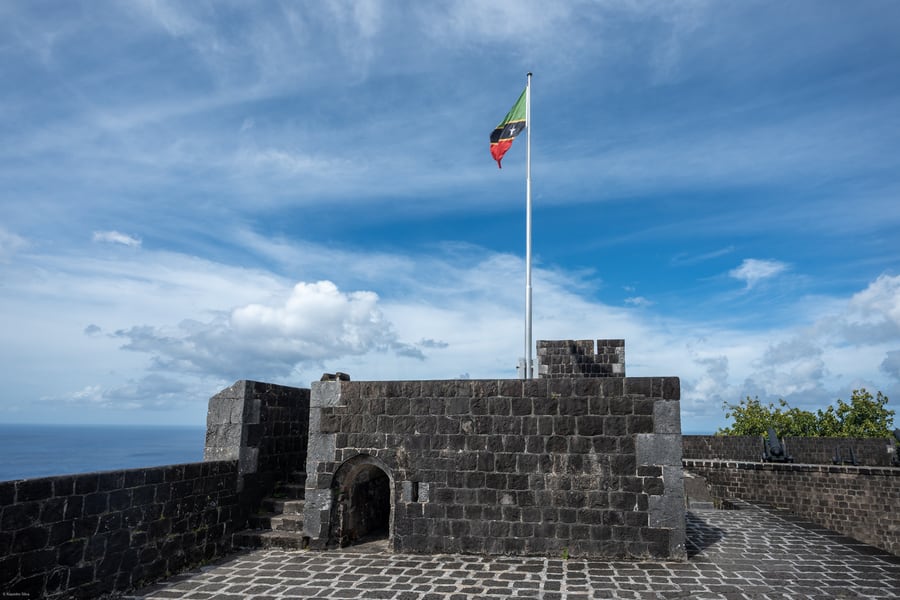
The set piece. Cannon were first mounted on this 972-foot volcanic plug in 1689, and the citadel above them was designed by British military engineers and built — over roughly a century — by enslaved Africans. De Grasse's French laid siege on 11 January 1782 and took it; the Treaty of Paris handed it back the following year. From the Fort George Citadel you can see Statia, Saba, St Barths and Nevis. UNESCO listed it in 1999.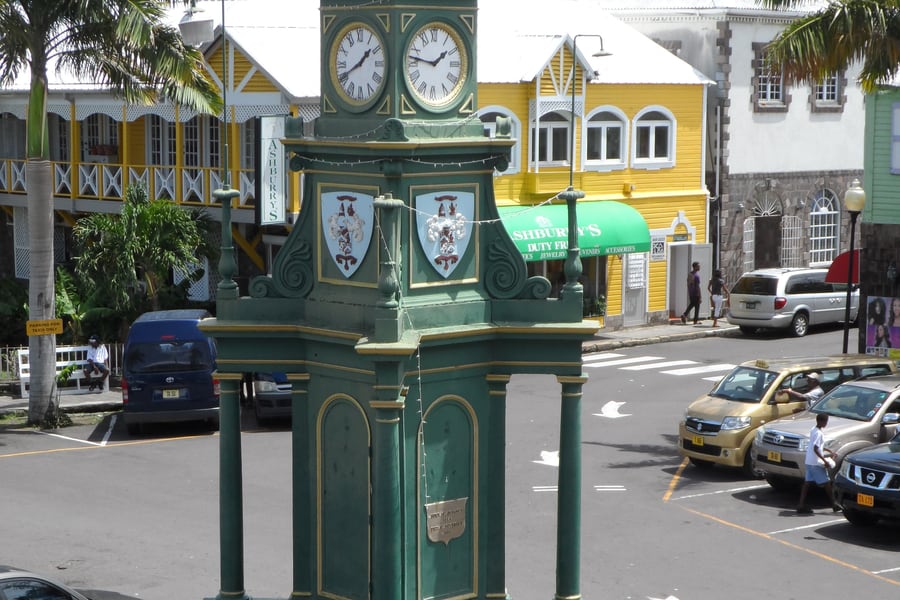 Gertjan R. / Wikimedia Commons · CC BY-SA 4.0 · cropped
Basseterre
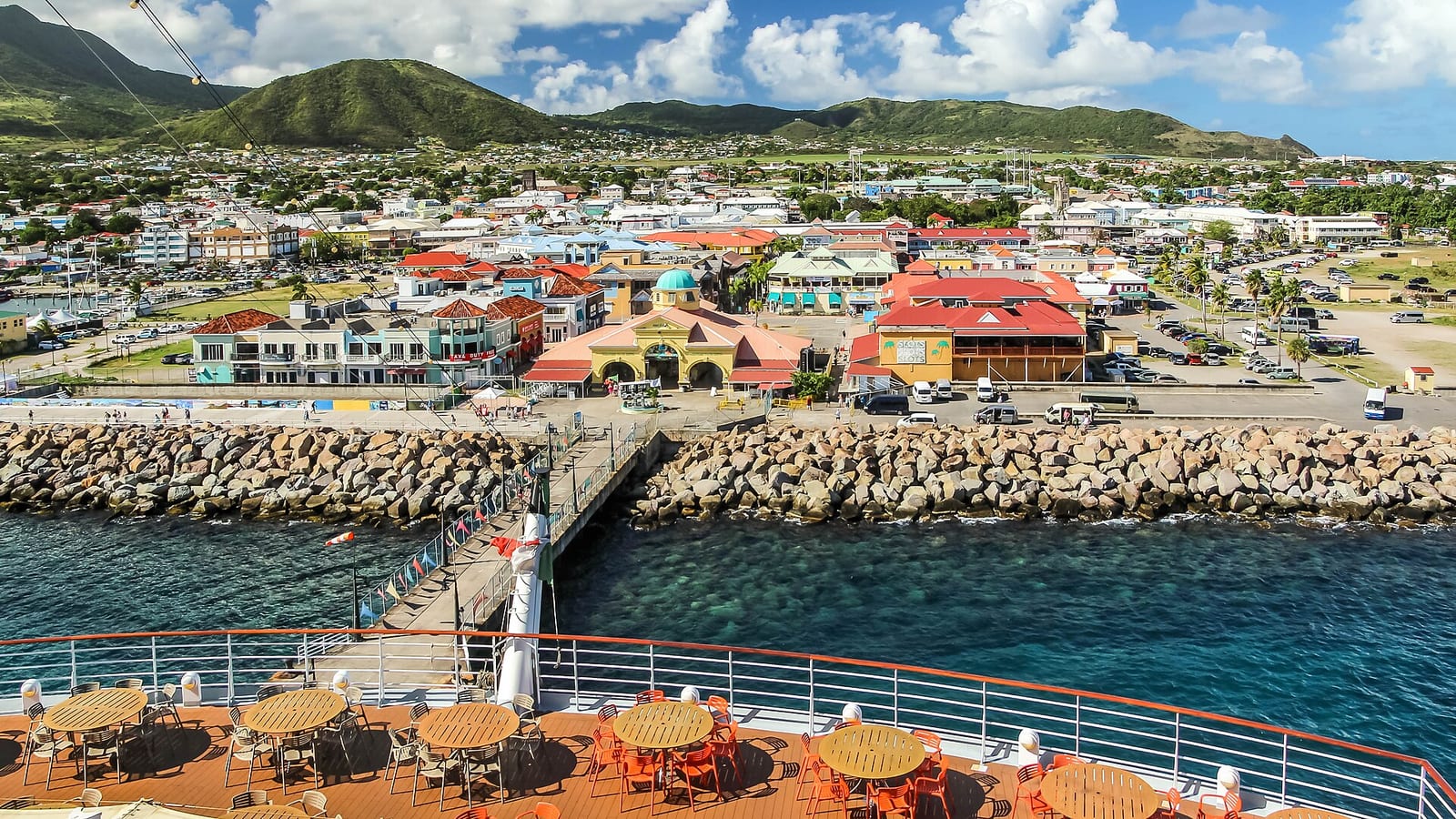
A small, hot, working town rather than a resort. Everything radiates from The Circus, a roundabout consciously modelled on Piccadilly and centred on the green Victorian Berkeley Memorial clock. Independence Square, a short walk away, was the slave market. Port Zante, where the ships tie up, is a modern duty-free quarter grafted onto the seafront — and is as far as most cruise passengers ever get.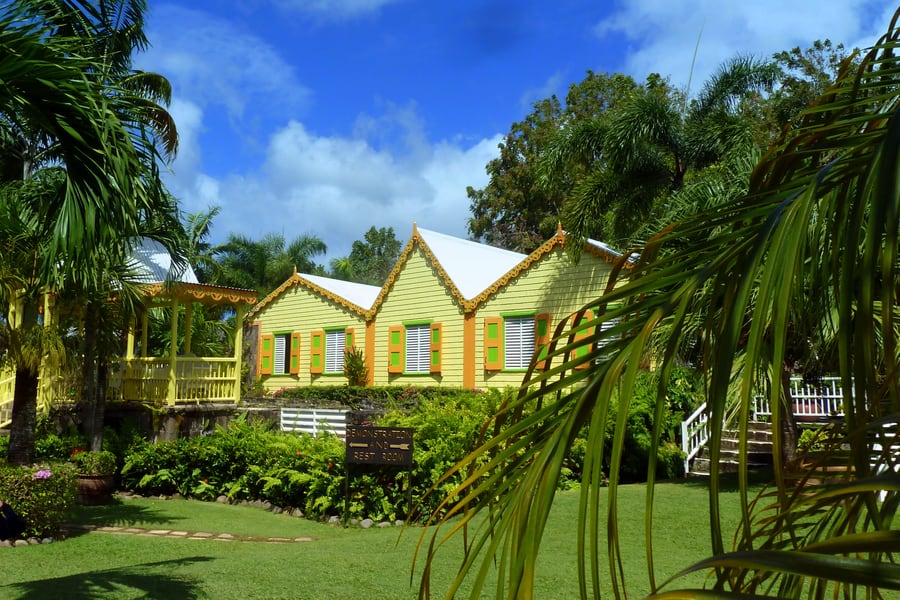 giggel / Wikimedia Commons · CC BY 3.0 · cropped
Romney Manor
Above the first English settlement in the Caribbean, founded by Sir Thomas Warner in 1624. Samuel Jefferson — great-great-grandfather of the third US President — bought this estate in 1625; the Earl of Romney bought it off the family in 1713 and gave it his name. One caveat: the house burned down in 1995, so what stands is a rebuild. The saman tree in the garden, reckoned over 400 years old, is the genuinely old thing here.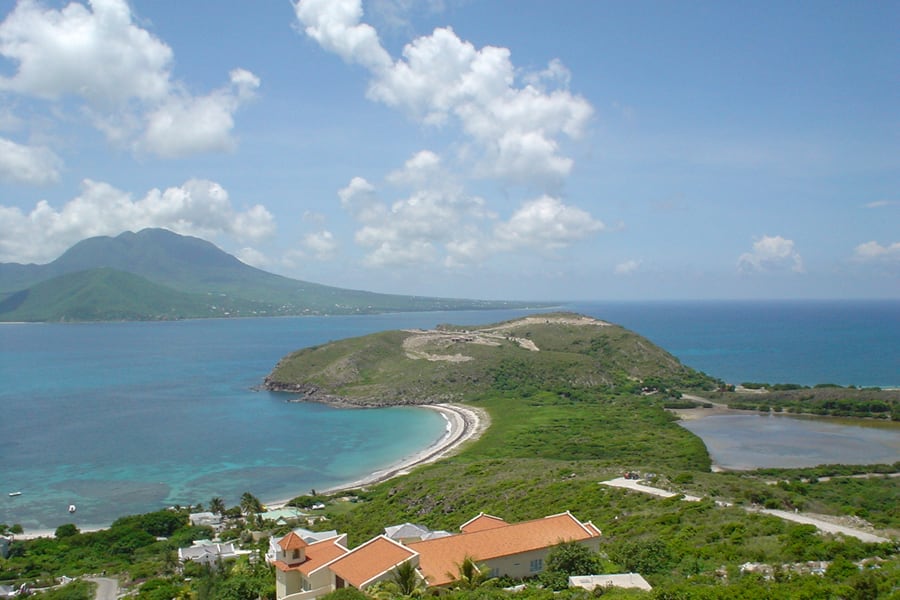 Nesnad / Wikimedia Commons · CC BY-SA 3.0 · cropped
The South-East Peninsula
A long dry arm of hills, salt ponds and white-sand beaches running down toward Nevis, and the view from Timothy Hill on the way out is the one every photograph of St Kitts is taken from — Caribbean on one side, Atlantic on the other, and the green cone of Nevis across the two-mile Narrows. Vervet monkeys are everywhere, descended from animals the French brought three hundred years ago, and they now outnumber the islanders.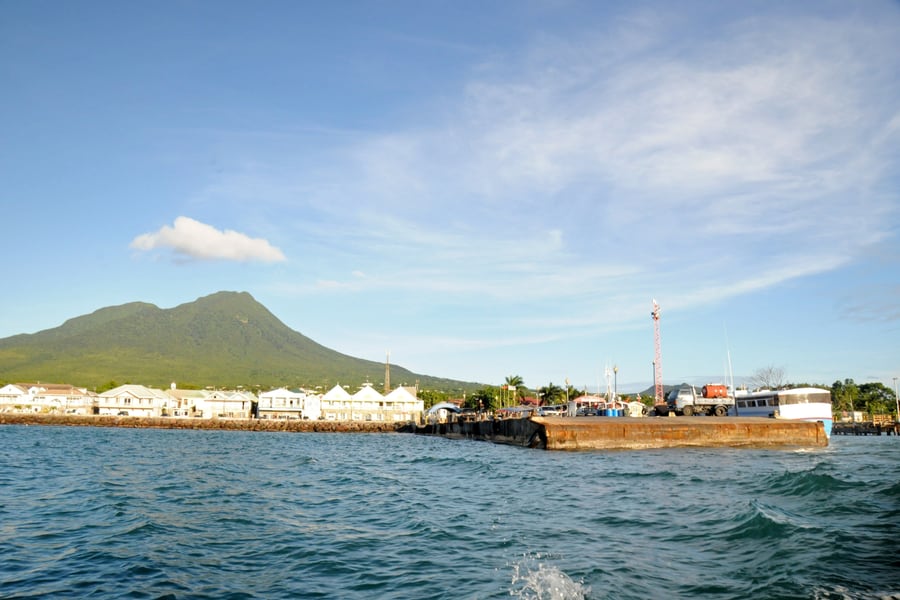 David Broad / Wikimedia Commons · CC BY 3.0 · cropped
Nevis
The ferry from Basseterre takes about three-quarters of an hour, and Nevis is quieter, greener and prettier than its bigger neighbour: restored plantation-house hotels, a botanical garden, hot springs, and Charlestown, where Alexander Hamilton was born in 1755 or 1757 — the house is a museum now. Nevis gave up sugar in the 1930s, decades before St Kitts did, and it never got a railway at all.Where to Sleep
St Kitts is small enough that anywhere on it is within half an hour of the railway, so the choice is about what kind of holiday you want.
Frigate Bay
The main resort strip, on the narrow neck of land between Basseterre and the peninsula, with an Atlantic side and a Caribbean side within a few hundred metres of each other. Large hotels, a golf course, and The Strip — a run of beach bars on South Frigate Bay that is the island's nightlife. Convenient, busy and not especially Kittitian, but it is where most of the rooms are, and it is ten minutes from the railway.
The South-East Peninsula
The newest and most expensive development, out along the dry hills toward Nevis: a handful of large luxury resorts on white-sand bays looking across the Narrows, with vervet monkeys in the grounds and very little else nearby. Beautiful and isolated — you will need a car or taxis for everything, including the train.
Basseterre
Modest guesthouses and small hotels in and around the capital. Cheap, central, close to the ferry for Nevis and about as close as you can get to Needsmust station. Basseterre empties out in the evening once the cruise ships leave, which is either peaceful or dull depending on your temperament.
The plantation inns
The most characterful option, and the one that connects to what the railway is about. Several eighteenth- and nineteenth-century sugar-estate great houses on the slopes of Mt Liamuiga have been converted into small country-house hotels — stone walls, gardens running into rainforest, a dozen rooms, dinner at a long table. Ottley's and Rawlins are the best known. They sit among the same estate ruins you see from the train, and staying in one gives the journey a good deal more meaning.
They are not on a beach. Most run a shuttle.
Nevis
If you have more than a few days, spend some of them across the water. The forty-five-minute ferry from Basseterre reaches an island with restored plantation inns of its own, a quieter pace and no cruise port. Nevis stopped growing cane in the 1930s and feels like it took a different path.
A note on timing
Accommodation prices follow the cruise and winter season: December to April is high and expensive, August to October is cheap, hot, wet and hurricane season — and is also when the railway's schedule thins out. If the train is the reason you are coming, book the room and the train together.
Questions or corrections
Planning this trip and stuck on something, or spotted a time, fare or detail that has changed? Send us a message about The St. Kitts Scenic Railway. We read every one, and we update this page when something has changed.