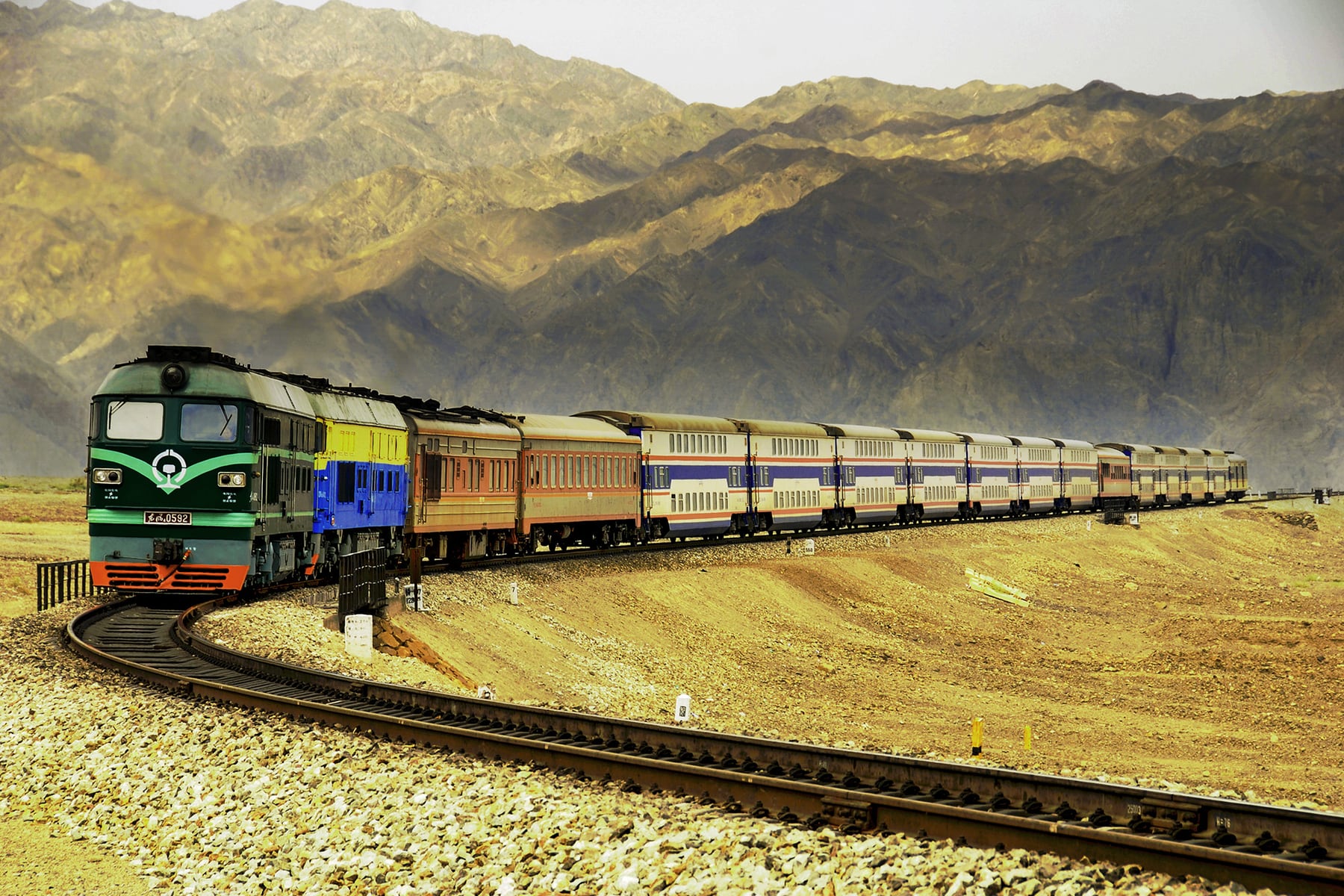
The Taklimakan Desert Loop
xue siyang (df45086) / Wikimedia Commons · CC BY-SA 3.0 · 2012 · cropped
- Distance825 km, Ruoqiang to Hotan
- Duration9 h 20 min to 10 h 36 min
- Best seasonSeptember and October
Introduction
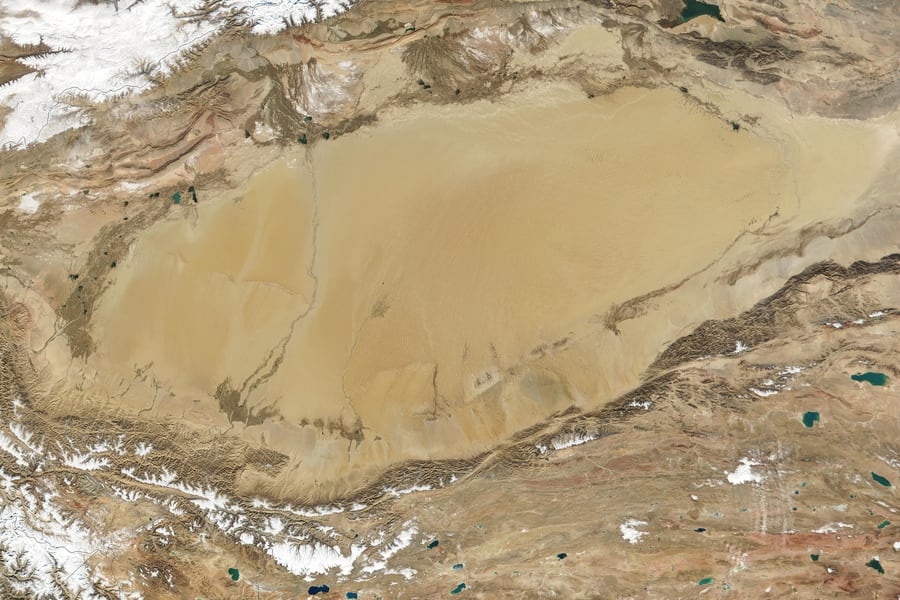
The Hotan–Ruoqiang railway — 和若铁路, Hé–Ruò Tiělù — opened on 16 June 2022, 825 kilometres along the southern rim of the Taklimakan, the world's second-largest shifting-sand desert. It closed a loop of 2,712 kilometres round the desert with three older lines — Korla to Kashgar on the north side, Kashgar to Hotan in the west and Ruoqiang to Korla in the east — and China Railway calls it the first railway loop round a desert anywhere. Five of the oasis towns it serves, Luopu, Cele, Yutian, Minfeng and Qiemo, had never had a railway before.
534 kilometres of the line, almost two-thirds of it, run through wind-blown sand, where low dunes can move twenty metres in a year. Where they move most, the railway does not try to hold them back: it goes up on bridges and lets the sand blow underneath.
This page rides the desert line from Ruoqiang to Hotan on the 5817, which makes the whole crossing in daylight, and the K9787, which takes three sides of the loop from Ürümqi to Kashgar in 29 hours.
The Journey
Ruoqiang to Qiemo
The 5817 has come down overnight from Ürümqi by way of Korla, and leaves Ruoqiang at 09:35, turning west off the line to Golmud onto the desert line proper. This is the corridor the old Southern Silk Road took: the Altyn-Tagh and the Kunlun to the south, the Tarim Basin and its desert to the north, and a string of oases between them where the rivers come down from the mountains. Washixia is a town station; then Qiemo, the seat of the second-largest county in China, is reached at a little after midday.
Over the sand
Beyond Qiemo the train calls at Jinshan and Nantun, which serve regiments of the Xinjiang Production and Construction Corps, and then comes to Minfeng. In Minfeng County are the line's two great bridges: the Niya River bridge, 18.6 kilometres long on 560 piers, the longest on the line, and the Ruokeya bridge, 9.7 kilometres long, with piers up to 35 metres high — the highest. Altogether 434 of the line's bridge piers were cast in a factory and assembled on site, the first time the method had been used on railway bridges, so that no water had to be carried into the desert to mix concrete.
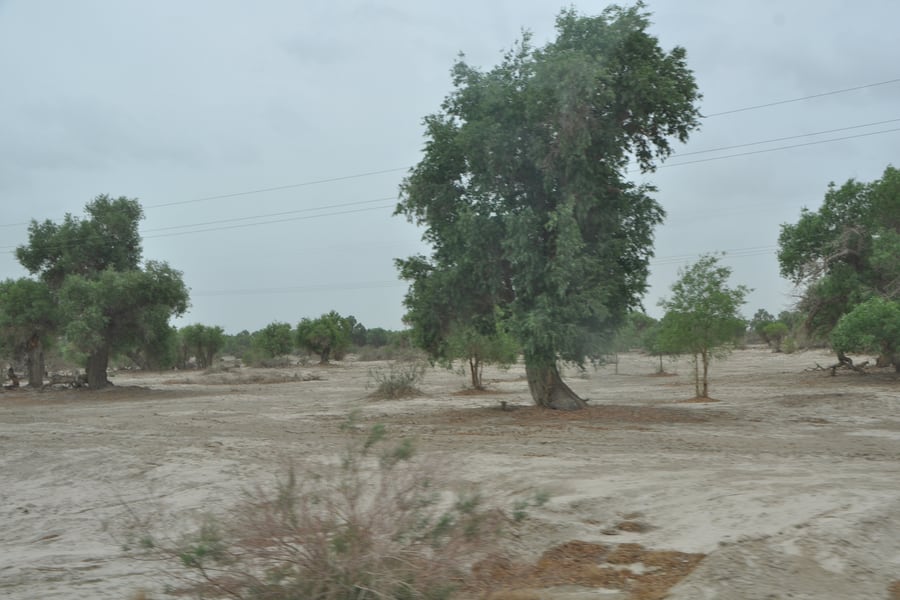
Where the line runs on the ground it is protected by a green belt planted as it was being built: 50 million square metres of straw grids, squares of straw pushed into the sand to hold it, and 13 million shrubs and trees — saxaul, red willow and sea buckthorn — with the taller trees on the outside to break the wind.
The oases to Hotan
West of Minfeng the train calls at Yutian on the Keriya, the Corps' station at Yuquanzhen, Cele and Luopu. The line crosses the Yurungkash, the White Jade River, and the 5817 arrives in Hotan at 18:55, nine hours and twenty minutes after Ruoqiang.
The train
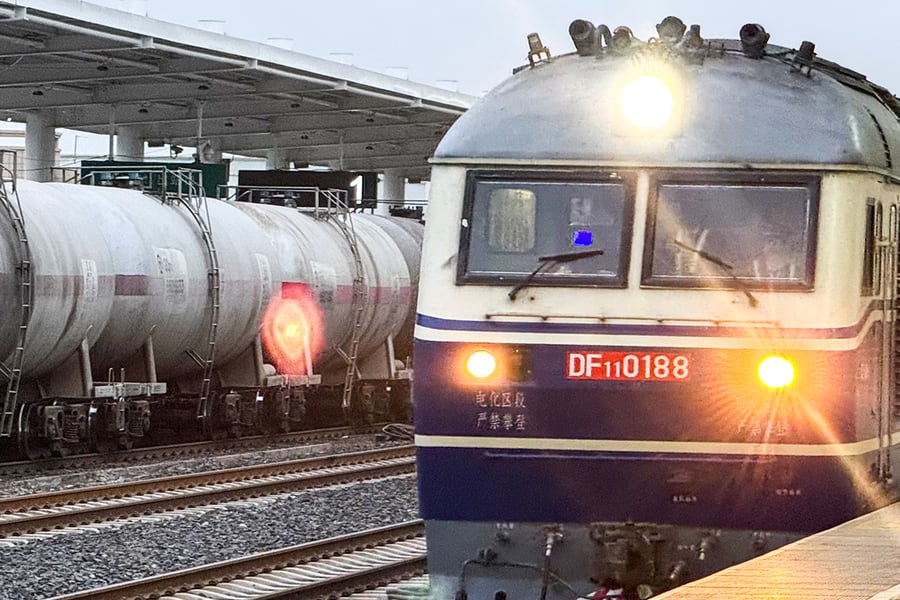
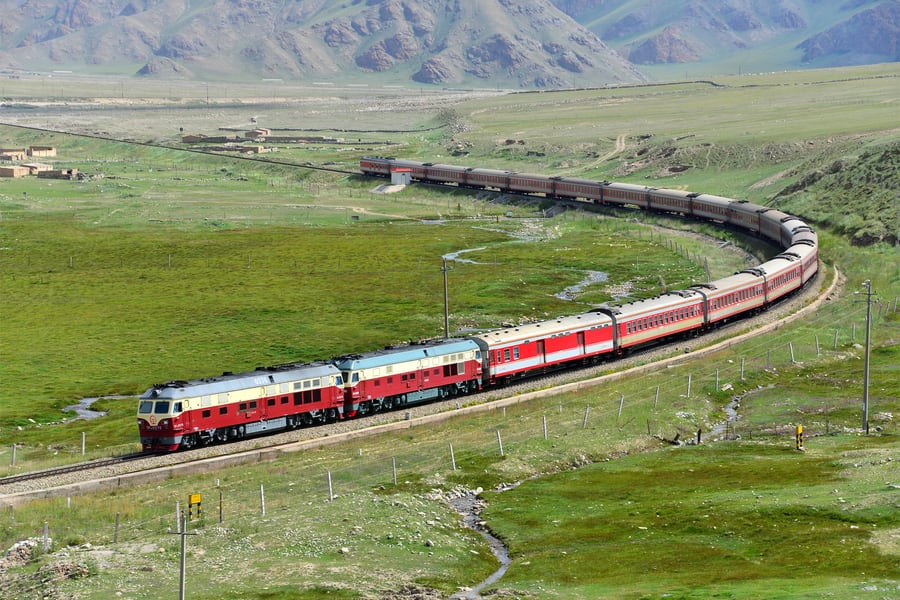
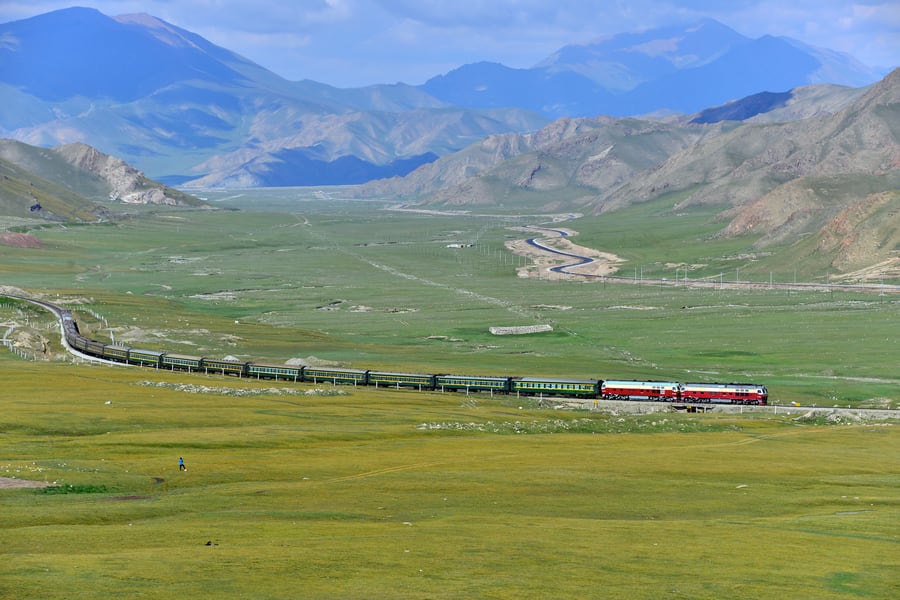
The line is single-track and not electrified, built for 120 km/h. Its trains are hauled by DF11 diesels, sometimes two at a time, and made up of China Railway's green long-distance coaches. The 5817 and 5818 carry hard seats, hard sleepers and soft sleepers; the K9787 and K9788, hard seats and hard sleepers.
Along the route
 Daggel / Wikimedia Commons · CC BY 3.0 · 2009 · cropped
The sand bridges
Where the dunes move — low ones by up to 20 metres a year — the line climbs onto bridges and lets the sand blow underneath. There are five, 49.7 kilometres in all. The longest bridge on the line, over the Niya River, is 18.6 kilometres on 560 piers. Hiroki Ogawa / Wikimedia Commons · CC BY 3.0 · cropped
The Keriya oasis
Yutian stands on the Keriya, a river fed mostly by glacier melt from the Kunlun that flows north for 519 kilometres and is lost in the sand. Its water keeps the oases along its course alive.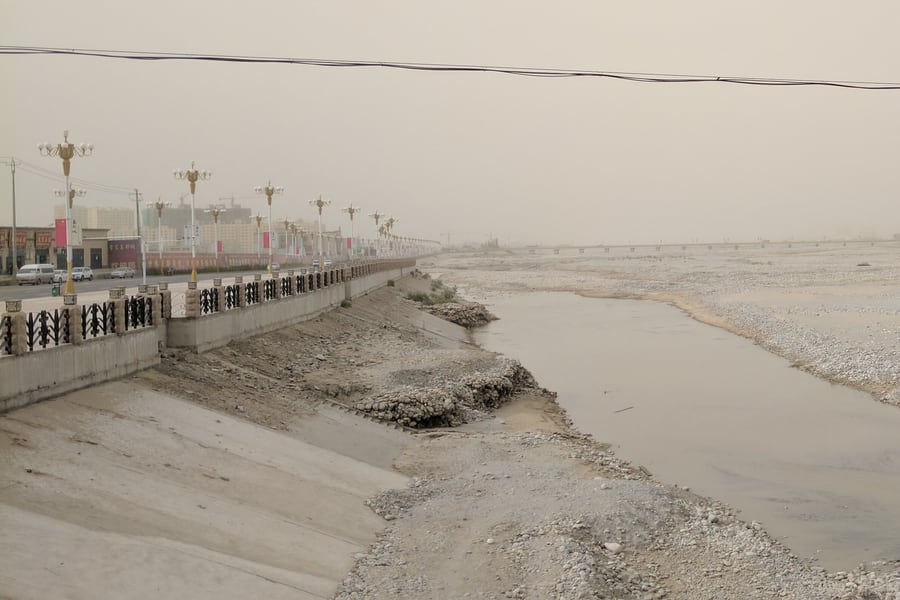 Voidvector / Wikimedia Commons · CC BY-SA 4.0 · 2017 · cropped
The Yurungkash at Hotan
Leaving Hotan, the line crosses the Yurungkash, the White Jade River, on a bridge 2.7 kilometres long, on 86 piers. The river comes down from the Kunlun and dries out in the desert to the north.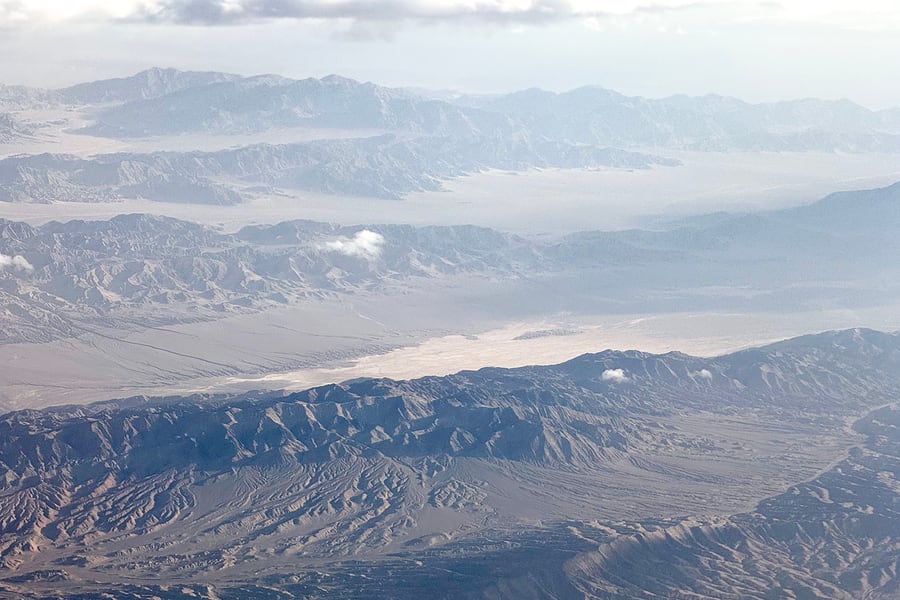 Windmemories / Wikimedia Commons · CC BY-SA 4.0 · 2024 · cropped
The Altyn-Tagh
At the eastern end, around Ruoqiang, the mountains to the south are the Altyn-Tagh. Ruoqiang County covers 198,318 square kilometres, the largest county in China; Qiemo, its neighbour, is the second.A bit of history
Culture & experiences along the way
 Hiroki Ogawa / Wikimedia Commons · CC BY 3.0 · cropped
Jade from the White Jade River
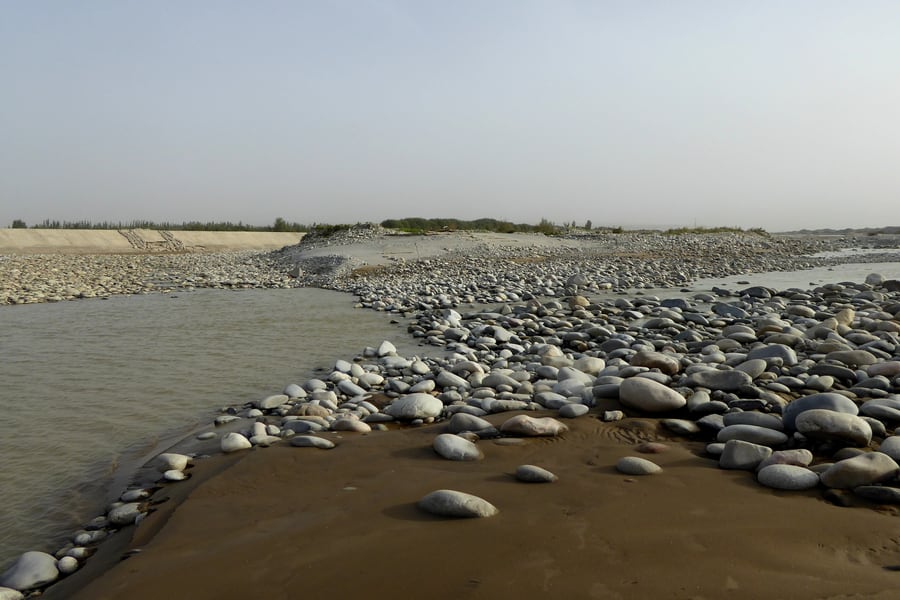
The Yurungkash is the White Jade River. Rising in the Kunlun, it carries down white river stones that are nephrite, one of the two minerals called jade. North of Hotan it meets its sister, the Karakash — the Black Jade River — and the two go on into the desert as the Hotan River. Mizu basyo / Wikimedia Commons · CC BY-SA 3.0 · 2011 · cropped
Nan from the tonur
The round Uyghur bread is baked stuck to the inside wall of a clay oven, the tonur. Bakers stamp the middle with a pattern of dots — the tool is a durtlik — which lets the steam out and marks each bakery's bread as its own. In Uyghur it is tonur nan.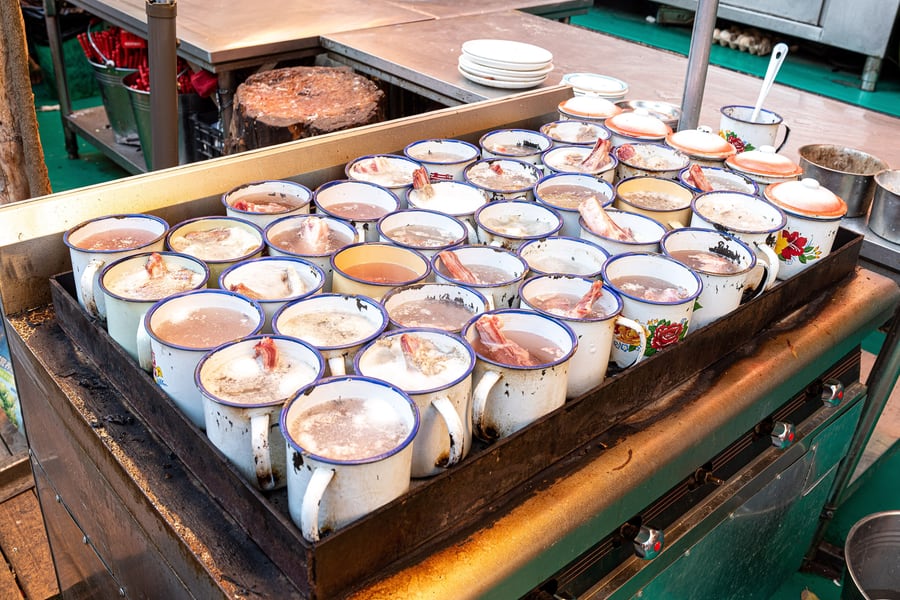 N509FZ / Wikimedia Commons · CC BY-SA 4.0 · 2023 · cropped
Gangzirou, lamb in a mug
Lamb on the bone, stewed with turnip, chickpeas and goji berries in an enamel mug, one mug a portion, on a stove. Kashgar's own dish began in the early 1960s, when lamb was sent out to a commune digging irrigation works and cooked in the workers' drinking mugs.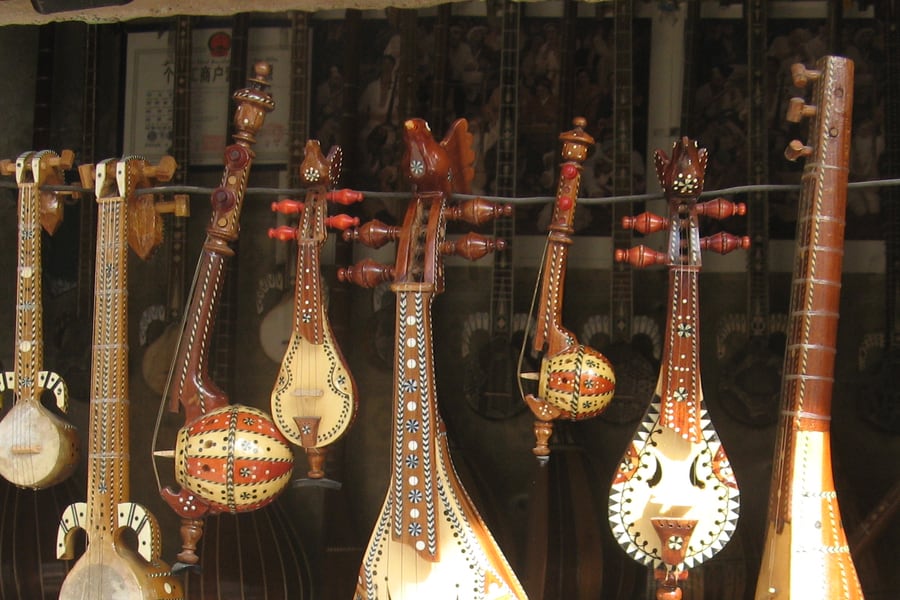 Lukas Bergstrom / Wikimedia Commons · CC BY 2.0 · 2008 · cropped
The Muqam
The Uyghur Muqam — songs, dances, folk and classical music, played on bowed, plucked and wind instruments made from local materials — was inscribed by UNESCO as intangible heritage of humanity in 2008. Amannisa Khan, a 16th-century queen of the Yarkent Khanate, is credited with collecting the Twelve Muqam.Timetables
Two trains a day run each way over the desert line, both daily, and both start or end far beyond it. The 5817 and 5818 run between Hotan and Ürümqi; the K9787 and K9788 between Kashgar and Ürümqi South, by way of Hotan, Ruoqiang and Korla. Like many Chinese trains they change number on the way: the 5817 leaves Ürümqi as the 5816, the K9787 leaves Ürümqi South as the K9786, and the K9788 leaves Kashgar as the K9785.
The 5817 is the train to take for the desert. It leaves Ruoqiang at 09:35 and reaches Hotan at 18:55, in daylight at every time of year.
Ruoqiang to Hotan
| Train | Starts at | Ruoqiang | Qiemo | Minfeng | Yutian | Hotan | Goes on to |
|---|---|---|---|---|---|---|---|
| K9787 | Ürümqi South 15:58 | 04:30 | 07:32 | 10:53 | 12:12 | 15:00 | Kashgar 21:19 |
| 5817 | Ürümqi 21:21 | 09:35 | 12:25 | 15:28 | 16:42 | 18:55 | — |
Hotan to Ruoqiang
| Train | Starts at | Hotan | Yutian | Minfeng | Qiemo | Ruoqiang | Goes on to |
|---|---|---|---|---|---|---|---|
| 5818 | Hotan | 12:30 | 15:26 | 16:56 | 20:12 | 23:06 | Ürümqi 11:18 |
| K9788 | Kashgar 09:50 | 16:00 | 18:48 | 20:01 | 23:24 | 02:15 | Ürümqi South 14:35 |
Every train also calls at the line's other six stations: Washixia, Jinshan, Nantun, Yuquanzhen, Cele and Luopu. Between Kashgar and Hotan there are six trains a day, the first leaving Kashgar at 04:45 and the last at 17:15.
Times are from 12306 for Thursday 15 and Sunday 18 October 2026, and were the same on both days — as of October 2026. Times are published by the operator: China Railway · 12306 (opens in a new tab).
Tickets
Every ticket is sold on 12306 against your passport, which is then your ticket at the gates. Between Ruoqiang and Hotan the 5817 and 5818 charge ¥98 for a hard seat, ¥180 for a hard sleeper and ¥287 for a soft sleeper; the K trains charge ¥112 and ¥194. The whole of the K9787, Ürümqi South to Kashgar, is ¥240 in a hard seat and ¥408 in a hard sleeper.
Keep your passport on you. The UK Foreign Office advises that Xinjiang has passport and security checks at shopping centres, markets and parks, that visitors may be asked for a phone number and photographed, and not to photograph security officials or installations.
Book your tickets
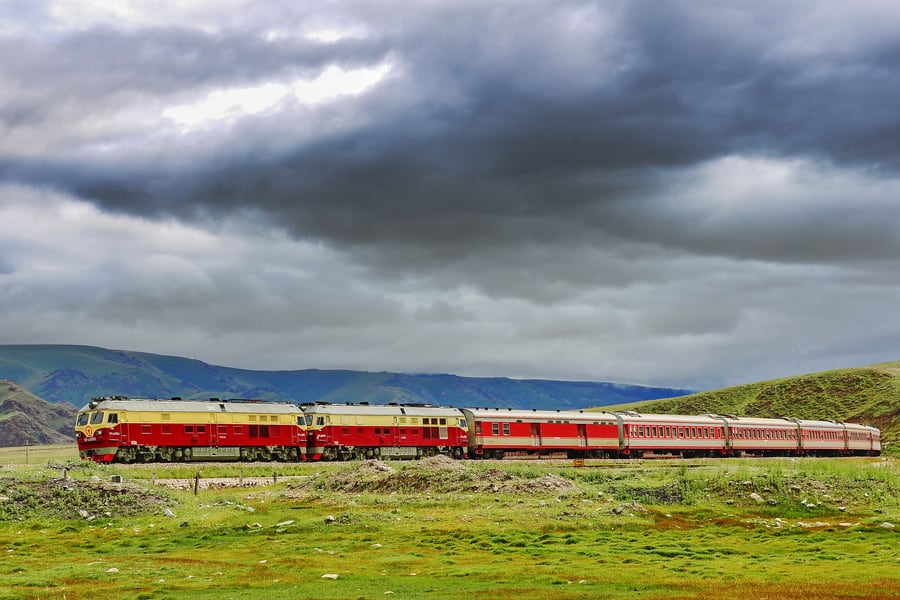 xue siyang (df45086) / Wikimedia Commons · CC BY-SA 3.0 · 2012 · cropped
Ruoqiang to Hotan
¥98 hard seat, ¥180 hard sleeper, ¥287 soft sleeper
The fares on the 5817 and 5818; the K trains charge ¥112 and ¥194.
Book Tickets (opens in a new tab, on 12306.cn)via 12306.cn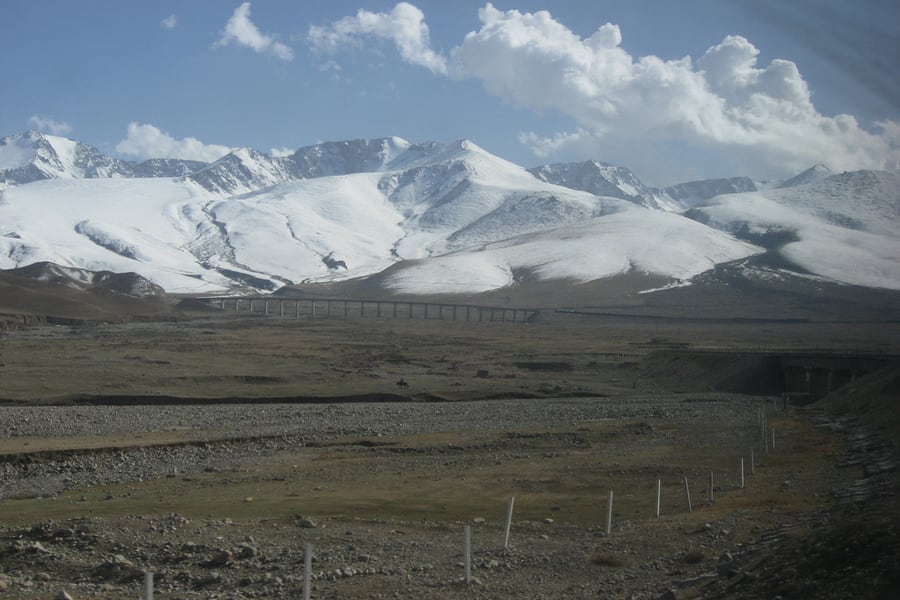 taylorandayumi / Wikimedia Commons · CC BY 2.0 · 2008 · cropped
Ürümqi to Kashgar round the desert
¥240 hard seat, ¥408 hard sleeper
The K9787 takes 29 hours 21 minutes, by Korla, Ruoqiang and Hotan.
Book Tickets (opens in a new tab, on 12306.cn)via 12306.cnRail Passes
No rail pass covers this line. Interrail and Eurail are European passes and do not reach China, and China Railway sells its seats one journey at a time on 12306, so the fare is simply the ticket.
Checked in October 2026.
Places to Visit
Hotan, at the western end of the desert line, was the Buddhist Kingdom of Khotan on the Southern Silk Road, and two of its ruins stand within reach of the city. The K9787 runs on from Hotan to Kashgar.
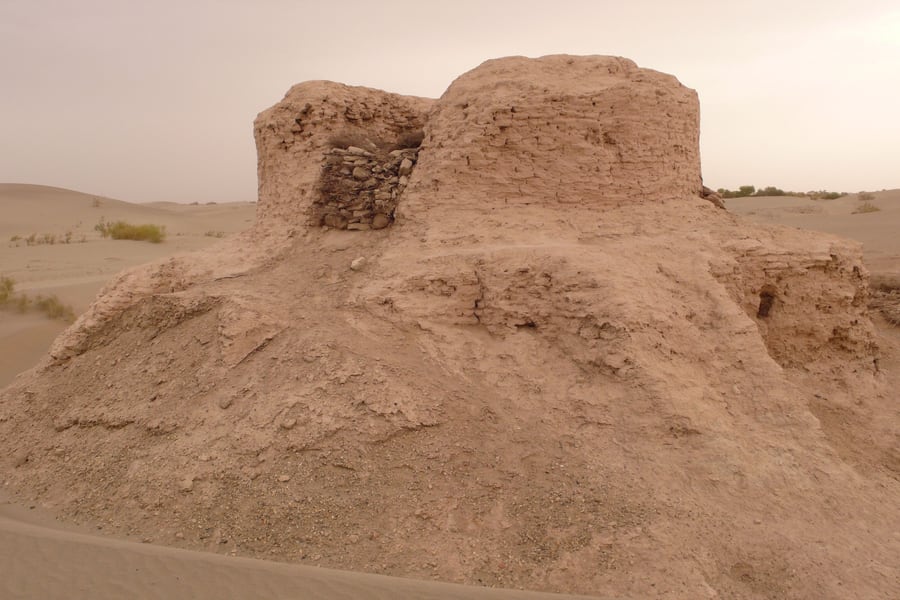 Daggel / Wikimedia Commons · CC BY 3.0 · 2009 · cropped
Rawak Stupa
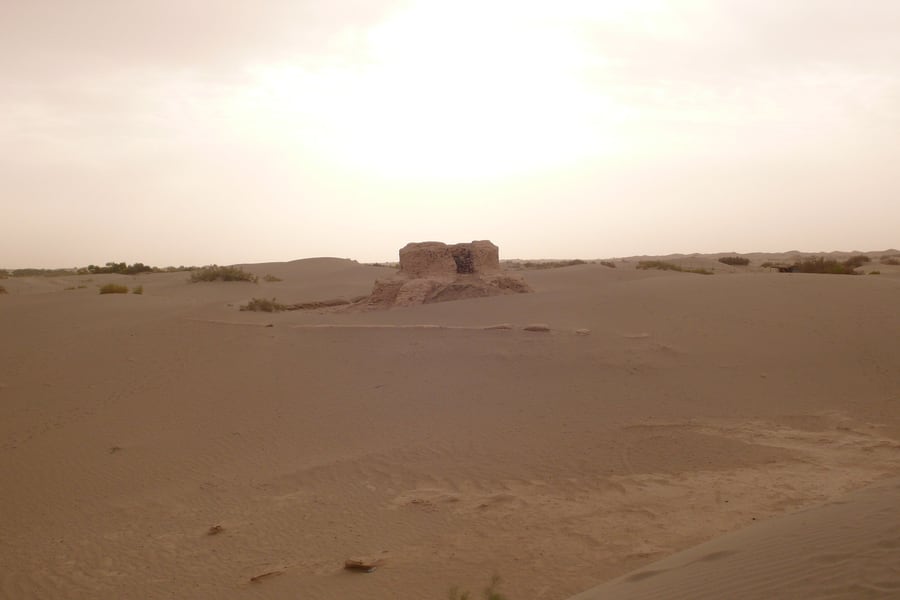
A Buddhist stupa of the old Kingdom of Khotan, standing in a walled court laid out as a three-dimensional mandala. Aurel Stein dug here in 1901 and found 91 large stucco statues of buddhas and bodhisattvas; he buried them again in the sand to protect them, and when he came back in 1906 most of them had gone.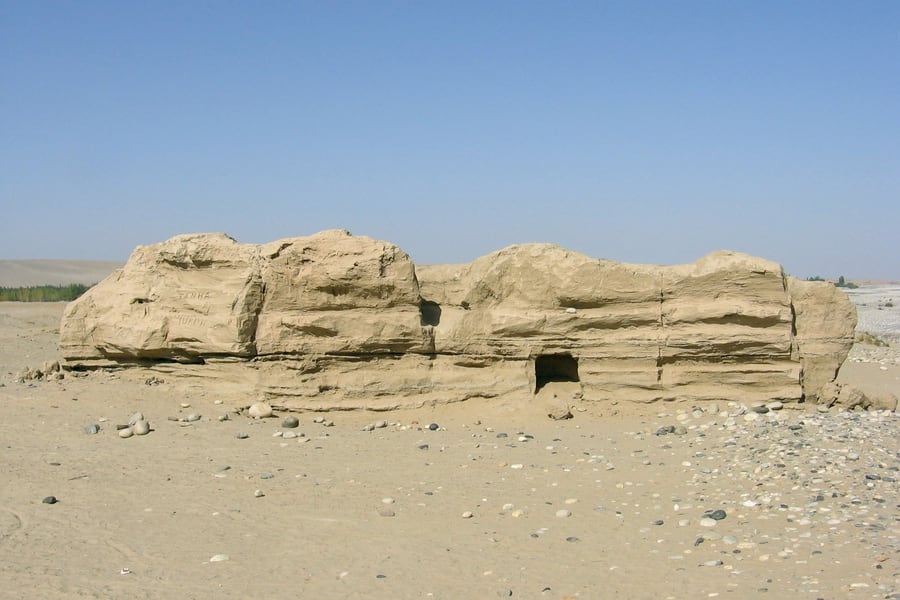 Colegota / Wikimedia Commons · CC BY-SA 2.5 ES · 2005 · cropped
Melikawat
The ruins of a city that was a great Buddhist centre of the Kingdom of Khotan, and may have been its capital. The first people to live here were probably Tocharians. What is left today is the remains of its walls, and glass and pottery in the sand.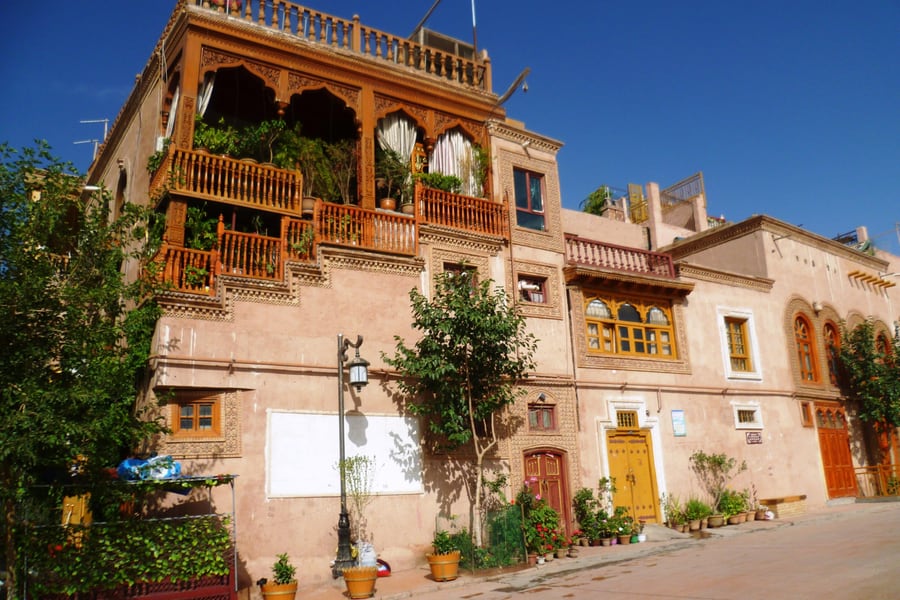 Radosław Botev / Wikimedia Commons · CC BY 3.0 PL · 2017 · cropped
The old city of Kashgar
The old Uyghur city of Kashgar grew up around the Id Kah Mosque, founded in 1442, now the largest mosque in China. Large parts of it were demolished and rebuilt from 2009, in a programme the government said was needed because the old houses were vulnerable to earthquakes and fire. Its streets of carved wooden balconies are the rebuilt city.Questions or corrections
Planning this trip and stuck on something, or spotted a time, fare or detail that has changed? Send us a message about The Taklimakan Desert Loop. We read every one, and we update this page when something has changed.