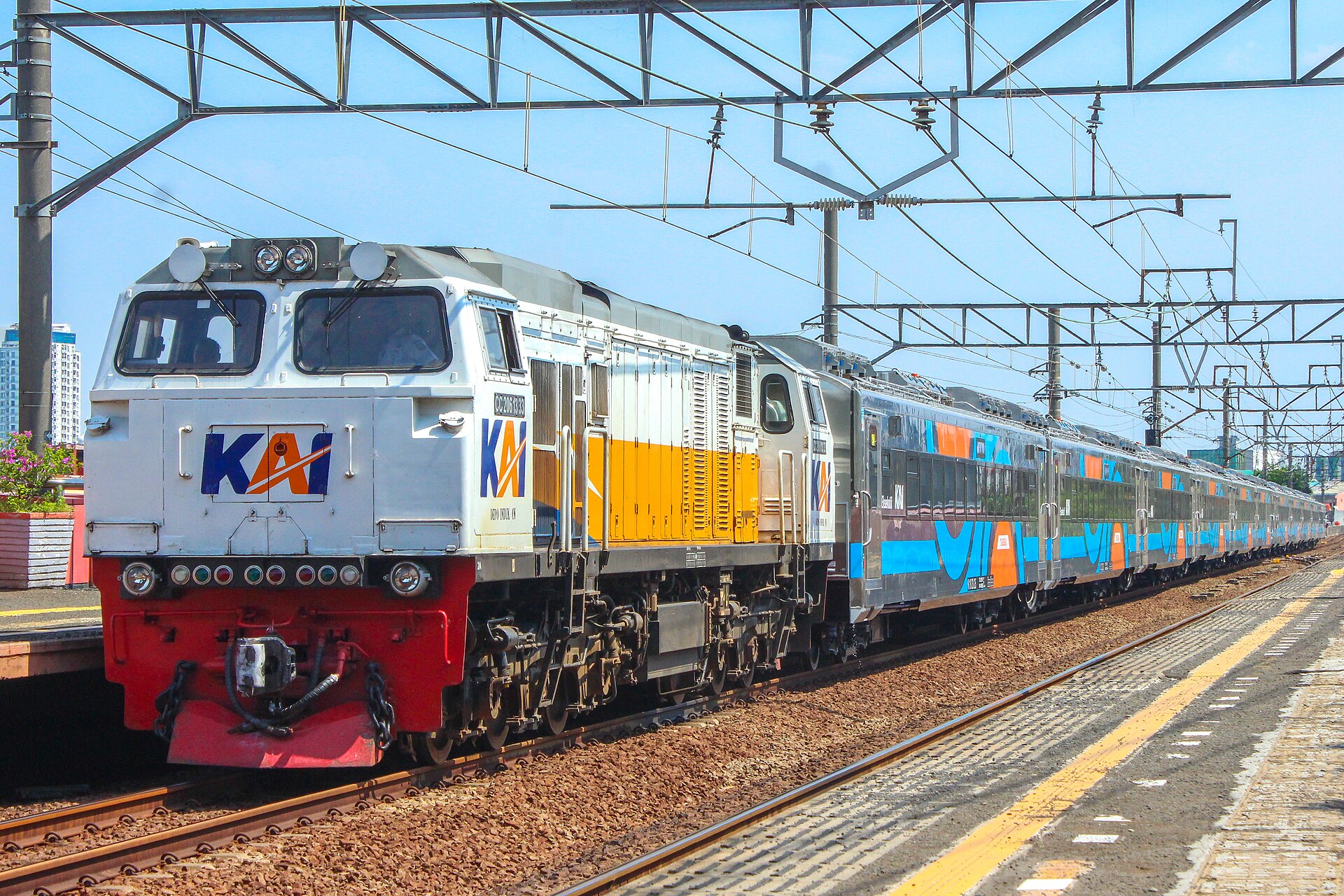
The Taksaka
TyewongX / Wikimedia Commons · CC BY-SA 4.0
- DistanceJakarta–Yogyakarta · 512 km
- DurationAbout 6 hours 10 minutes
- Best seasonYear-round; dry season (May–September) is easiest for temple visits
Introduction
If you ask a traveller in Indonesia which train to take, the answer is very often this one. The Taksaka is the country's classic tourist express — the comfortable, reliable, much-loved link from Jakarta straight to the heart of Yogyakarta, the cultural soul of Java and the base for its two greatest temples. For a quarter of a century it has been the train people ride to see Borobudur and Prambanan, and it remains the most popular rail journey in the country.
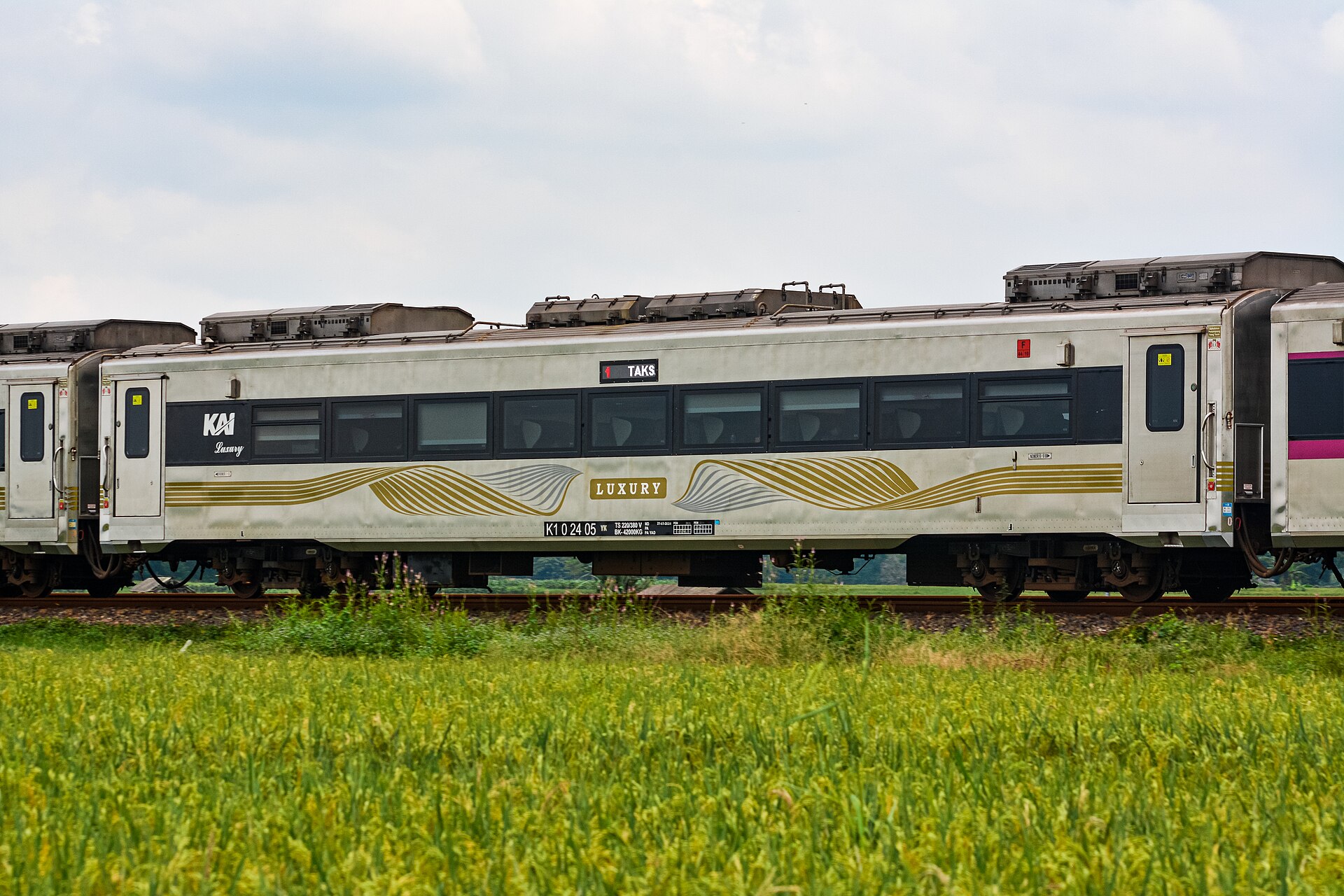
It is named for a dragon. Taksaka — Takshaka in the old myths — is the great naga, the serpent-king of Hindu and Javanese legend, and the national railway chose the name as a symbol of strength. The train lives up to it: a smart Executive-class express in gleaming stainless-steel coaches, running the 512 kilometres across the island in a little over six hours, at up to 120 km/h. Since 2019 it has also carried a Luxury carriage — just twenty-six seats that recline almost flat, with private screens and reading lights — an affordable brush with first class.
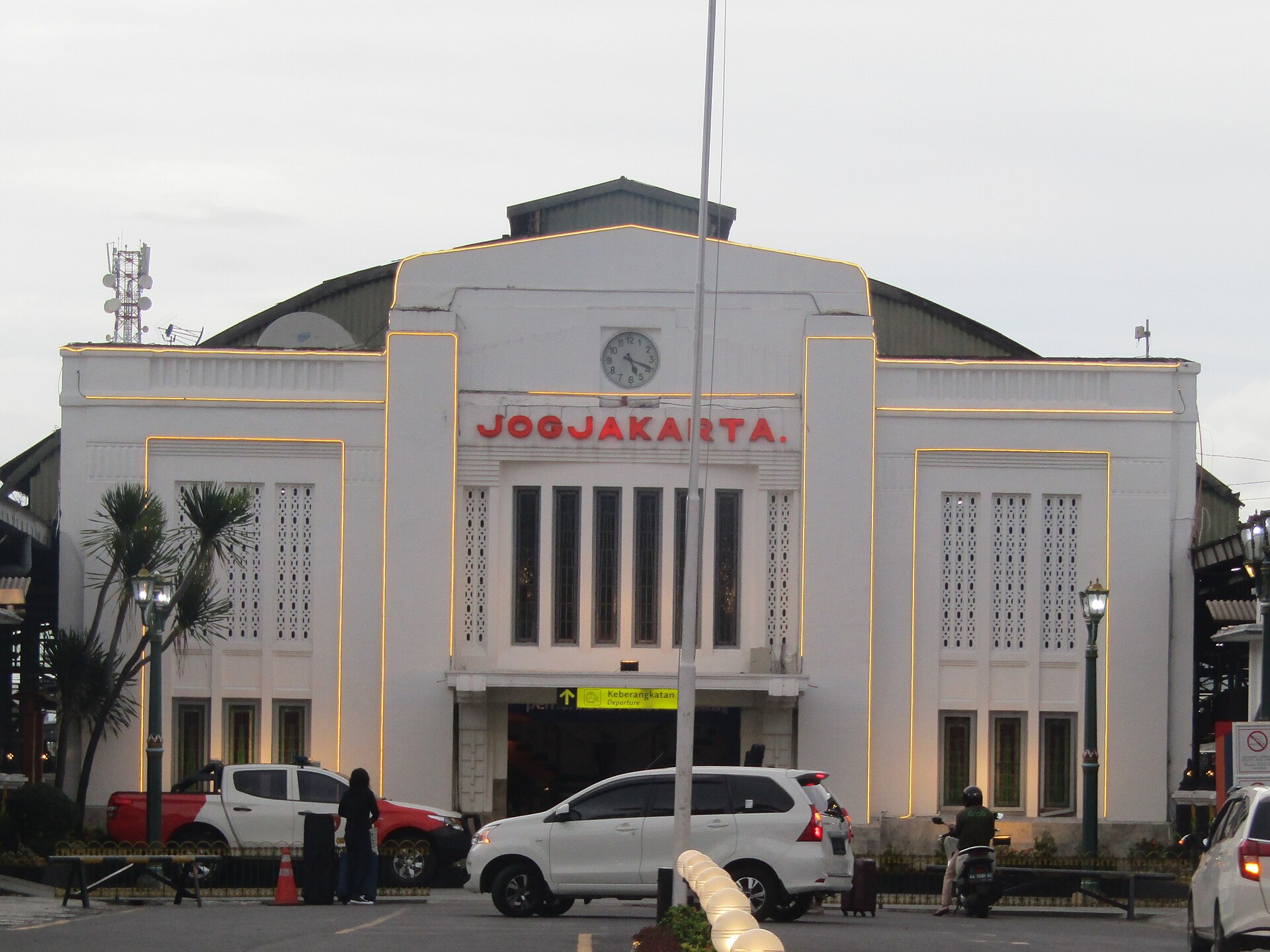
What makes the Taksaka special, though, is not just the comfort but the two stations it joins. It leaves from Gambir, in the middle of Jakarta beside Merdeka Square, and it sets you down at Tugu, an elegant 1887 station right in the centre of Yogyakarta — a few minutes' walk from the famous Malioboro street and the sultan's palace. No airport transfer, no edge-of-town terminus: you step off the train and you are already there, in the old royal city, with the temples of the plain waiting a short ride away. It is the easy, scenic, quintessentially Javanese way to make one of Asia's great cultural journeys.
The Journey
The Taksaka begins at Gambir, Jakarta's main intercity station, standing beside the great open space of Merdeka Square with the National Monument at its centre. It is a busy, modern station — the departure point for most of the premium trains to Central and East Java — and from here the Taksaka sets out east.
For the first stretch the line runs across the crowded northern plain of West Java, through the sprawl east of Jakarta and out toward Cirebon, the old sultanate and batik town on the Java Sea coast, reached in a couple of hours. Beyond Cirebon the railway turns inland and the character of the ride changes: the train climbs into the hills around Purwokerto, and the window fills with the classic green Java of the imagination — rice fields in every shade, stands of palm, small towns and, on a clear day, the blue cones of volcanoes standing over it all. This central stretch, over the hills and down through Kutoarjo into the valley of Central Java, is the prettiest of the journey.
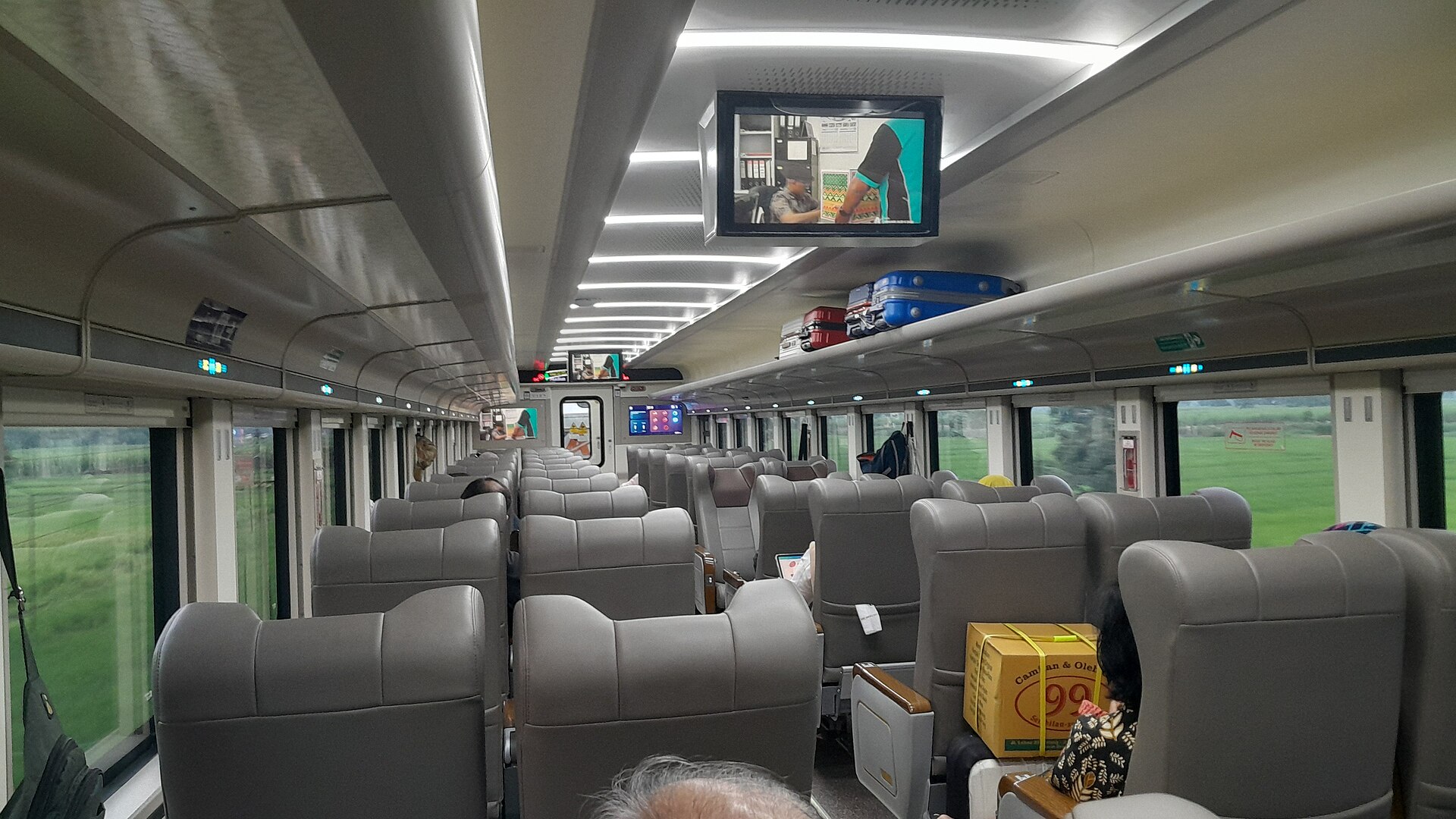
Onboard, the Taksaka is exactly what a long day train should be. The Executive coaches are wide and cool, with big reclining seats two-and-two either side of the aisle, picture windows, power sockets and an attendant bringing round hot meals and coffee — or you can walk to the buffet car. Those who want more can book the single Luxury carriage, added in 2019: just twenty-six seats, reclining almost flat, each with its own screen, reading light and footrest, for a fare that is still a fraction of business-class flying. It is one of the most civilised ways to cross the island.
A little over six hours after leaving Jakarta, the Taksaka rolls into Yogyakarta's Tugu station — and this is the masterstroke of the whole journey. Tugu is not on the edge of town; it is right in the middle of Yogyakarta, a graceful Art Deco building from 1887 set a short walk from Jalan Malioboro, the sultan's kraton and the old city's markets and warungs. You step down from the train into the heart of the cultural capital of Java, with Borobudur and Prambanan — the two greatest monuments in the country — an easy trip away across the plain. Whether you take a daytime run to watch the island pass, or an overnight departure that delivers you in time for a dawn visit to the great stupa, the Taksaka does what the best trains do: it makes the arrival feel like part of the destination.
Along the route
Alqhaderi Aliffianiko / Wikimedia Commons · CC BY-SA 4.0Straight to the heart of Yogyakarta
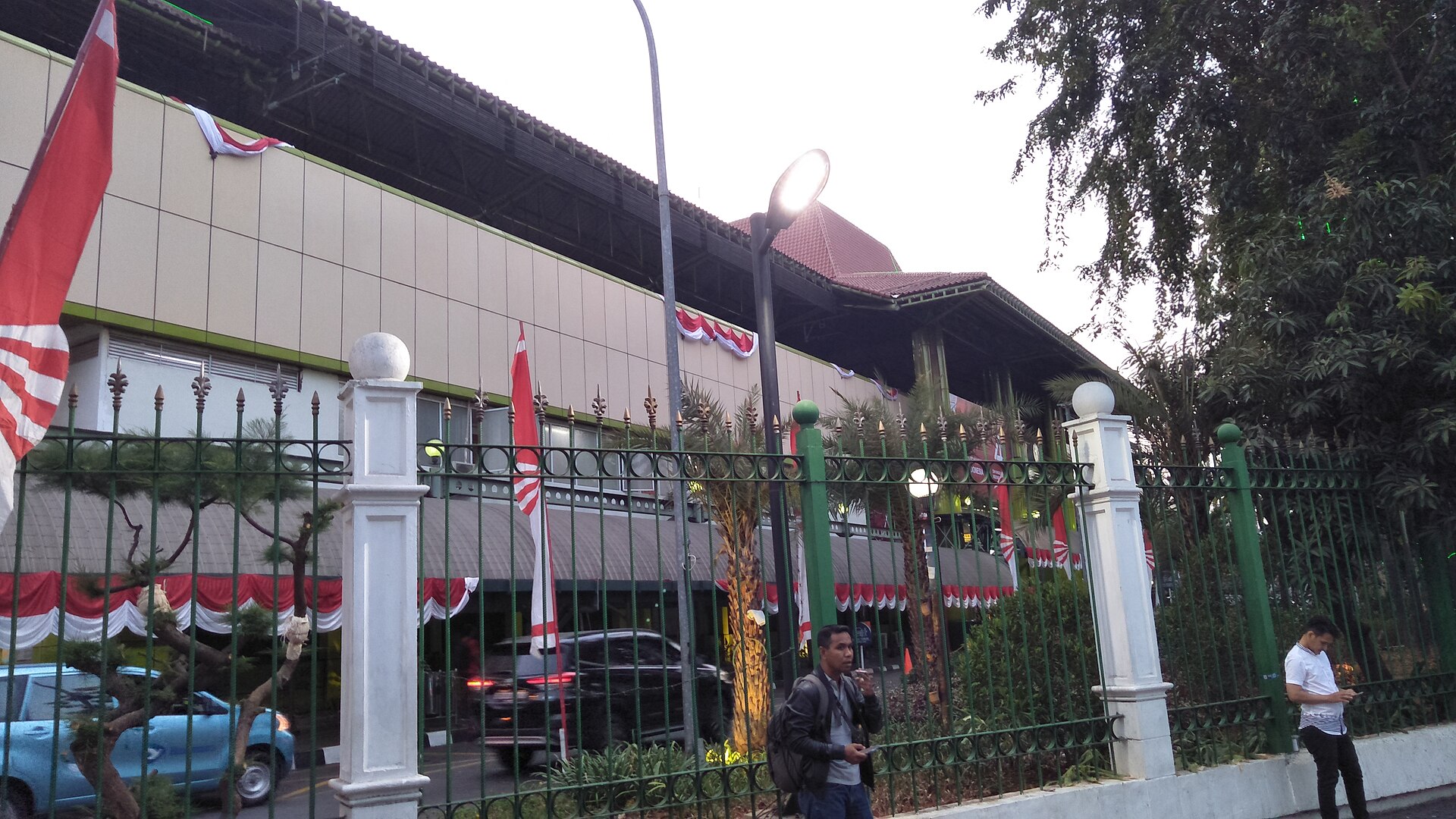
The Taksaka's great virtue is where it puts you down. Tugu station sits right in the centre of Yogyakarta, a graceful 1887 building minutes from Jalan Malioboro and the sultan's palace. You step off the train and you are already there.Jakub Hałun / Wikimedia Commons · CC BY-SA 4.0The temple train
For most travellers this is the temple train — the comfortable way from Jakarta to the two greatest monuments in Indonesia, both an easy trip from Yogyakarta: Borobudur, the ninth-century Buddhist stupa, and Prambanan, the soaring Hindu complex.Dwifa Bagaskoro S A / Wikimedia Commons · CC BY-SA 4.0Executive comfort, and a touch of luxury
The Taksaka is an Executive-class express in smart stainless-steel coaches. Since 2019 it has also carried a Luxury carriage: just 26 seats, reclining almost flat, with private reading lights — an affordable taste of first class.A bit of history
Culture & experiences along the way
Hamzz P / Wikimedia Commons · CC0A dragon named Taksaka
The train takes its name from Taksaka — Takshaka, the great naga, the serpent-dragon king of Hindu and Javanese myth. KAI chose it deliberately, as a symbol of strength and resilience, and it suits a train that has carried travellers to the old royal city for a quarter of a century. A fitting name for the road to the land of temples and sultans.Aleef Rahman HDW / Wikimedia Commons · CC BY 4.0Across the width of Java
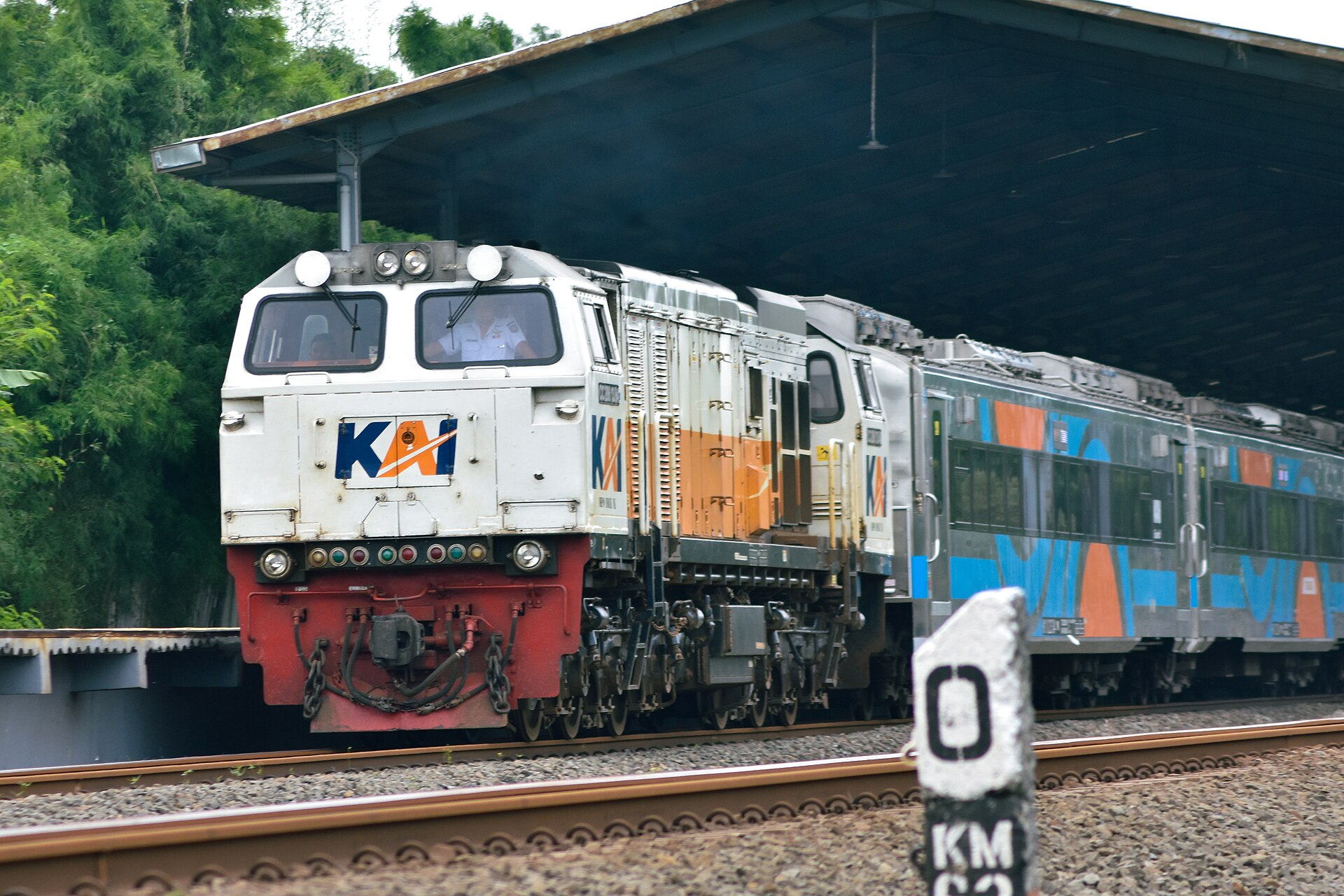
The ride itself is a fine one: 512 kilometres in a little over six hours, from Jakarta out past Cirebon on the north coast, inland over the hills around Purwokerto, and down through Central Java to Yogyakarta. The scenery softens into rice fields, palms and distant volcanoes — the classic green Java, best seen on the daytime runs.Gunawan Kartapranata / Wikimedia Commons · CC BY-SA 3.0Day train or night train
The Taksaka runs several times a day, and you can choose your style: a daytime run to watch the island slide past, or an overnight departure that has you stepping off into Yogyakarta in the small hours, ready for a dawn trip to Borobudur. Either way you arrive rested, in the middle of the city, for a fraction of the price of flying.Timetables
The Taksaka runs several times a day in each direction, with a mix of daytime and overnight departures, so you can pick the run that suits you — daylight for the scenery, or overnight to arrive in Yogyakarta ready for a dawn temple trip.
Departures (as of the 2026 timetable — confirm before travelling):
| Service | Departs | Arrives |
|---|---|---|
| Jakarta Gambir → Yogyakarta (morning) | 07:45 | 13:50 |
| Jakarta Gambir → Yogyakarta (afternoon) | 14:00 | 20:10 |
| Jakarta Gambir → Yogyakarta (night) | 21:20 | 03:30 |
| Yogyakarta → Jakarta Gambir (morning) | 07:30 | 13:35 |
| Yogyakarta → Jakarta Gambir (afternoon) | 14:45 | 20:54 |
| Yogyakarta → Jakarta Gambir (night) | 21:05 | 03:15 |
The full run of 512 kilometres takes about 6 hours 10 minutes, calling at Cirebon and Purwokerto (and, on some services, Kutoarjo, Kebumen or Kroya).
Good to know:
- It's a city-centre-to-city-centre train. Gambir is in central Jakarta beside Merdeka Square; Tugu is in the heart of Yogyakarta by Malioboro. No airport transfers at either end.
- Choose your class. All departures carry Executive coaches; most also carry the single premium Luxury carriage (26 near-flat seats). The Luxury car sells out first — book it early.
- Day or night. The daytime runs (roughly 07:45 and 14:00 from Jakarta) let you see the hills around Purwokerto; the overnight run (21:20 from Jakarta) arrives about 03:30, in good time for a sunrise visit to Borobudur.
- Book ahead around holidays. Around Indonesian public holidays and the long Idul Fitri season, the Taksaka fills weeks in advance.
Times as of the 2026 (Gapeka 1 February 2025) timetable and subject to change. Confirm current schedules and fares with the operator, KAI, before you travel (see the Tickets section below).
Tickets
The Taksaka is operated by Kereta Api Indonesia (KAI), and tickets are easy to buy through the official KAI website and the "Access by KAI" app, at station counters, or via travel platforms such as Traveloka and Tiket.com. Foreign cards can be temperamental on the Indonesian sites, so the app and the counters are the reliable fallbacks.
The train offers two classes. Executive is the standard — wide reclining 2-2 seats, air-conditioning and full onboard service — and is excellent value for a six-hour journey. The single Luxury carriage is the treat: twenty-six seats that recline almost flat, each with a private screen, reading light and footrest, at a fare that is still far below a business-class flight. There are only twenty-six of them per train, so they go first.
Booking opens weeks ahead, and demand climbs around weekends, Indonesian public holidays and the long Idul Fitri season, when Javanese trains fill to capacity. If your dates are fixed — and especially if you want the Luxury car — book early. Below, KAI's booking channel and its main site for live schedules, seat maps and fares.
Book your tickets
Taksaka · Jakarta to Yogyakarta
Executive and Luxury class
The classic run from Gambir in central Jakarta to Tugu in the heart of Yogyakarta, in KAI Executive class or the premium Luxury carriage. Several departures a day, day and night; reserved seats, easily booked through KAI. The comfortable, scenic alternative to flying.
Book Tickets (opens in a new tab, on Kereta Api Indonesia (KAI))via Kereta Api Indonesia (KAI)Timetable & booking · KAI
Departures, fares and the Luxury car
Live schedules, fares and seat maps from Kereta Api Indonesia, including the sought-after Luxury carriage. Booking opens weeks ahead and the train fills around holidays and the long Idul Fitri season, so reserve early — especially for the Luxury seats.
Book Tickets (opens in a new tab, on Kereta Api Indonesia (KAI))via Kereta Api Indonesia (KAI)Rail Passes
No rail pass covers the Taksaka. Interrail and Eurail are European schemes, and Indonesia is not among the 33 countries in Interrail's list of covered railway companies. KAI sells each journey as a reserved ticket, through its website and app, at the station or through travel platforms.
Checked October 2026 against Interrail's list of railway companies (opens in a new tab).
Places to Visit
The Taksaka's destination is one of the richest in Asia. Yogyakarta — "Yogya" to everyone — is the cultural capital of Java, still a sultanate, and the base for the two most extraordinary monuments in Indonesia. The city itself deserves days: it is the home of Javanese arts — gamelan, wayang shadow puppetry, classical dance — of the bird market and the batik and silver workshops of Kotagede, and of some of the best street food on the island.
But for most who ride the Taksaka, Jakarta is the start line and Yogyakarta is the whole point — and rightly so.
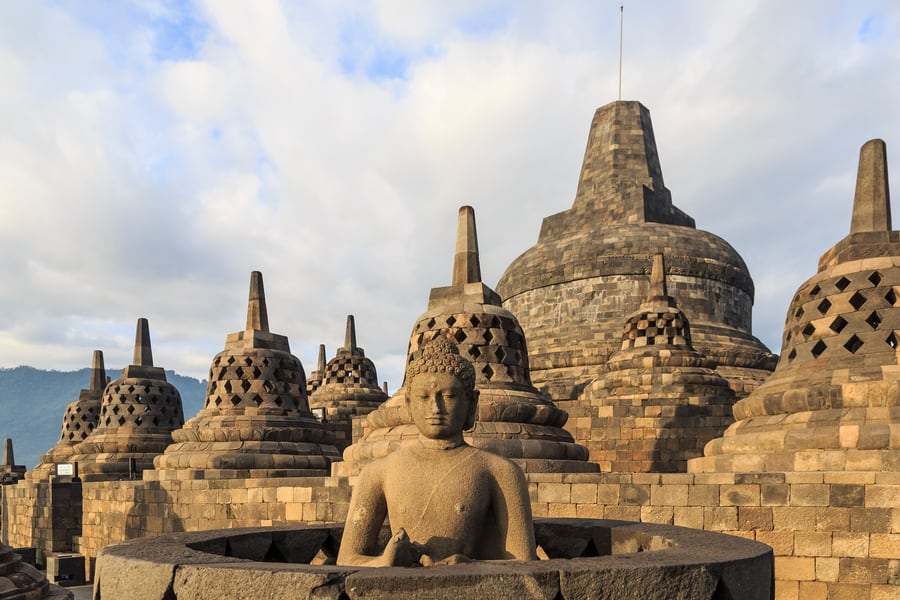 Photo by CEphoto, Uwe Aranas / Wikimedia Commons · CC BY-SA 3.0 · cropped
Borobudur
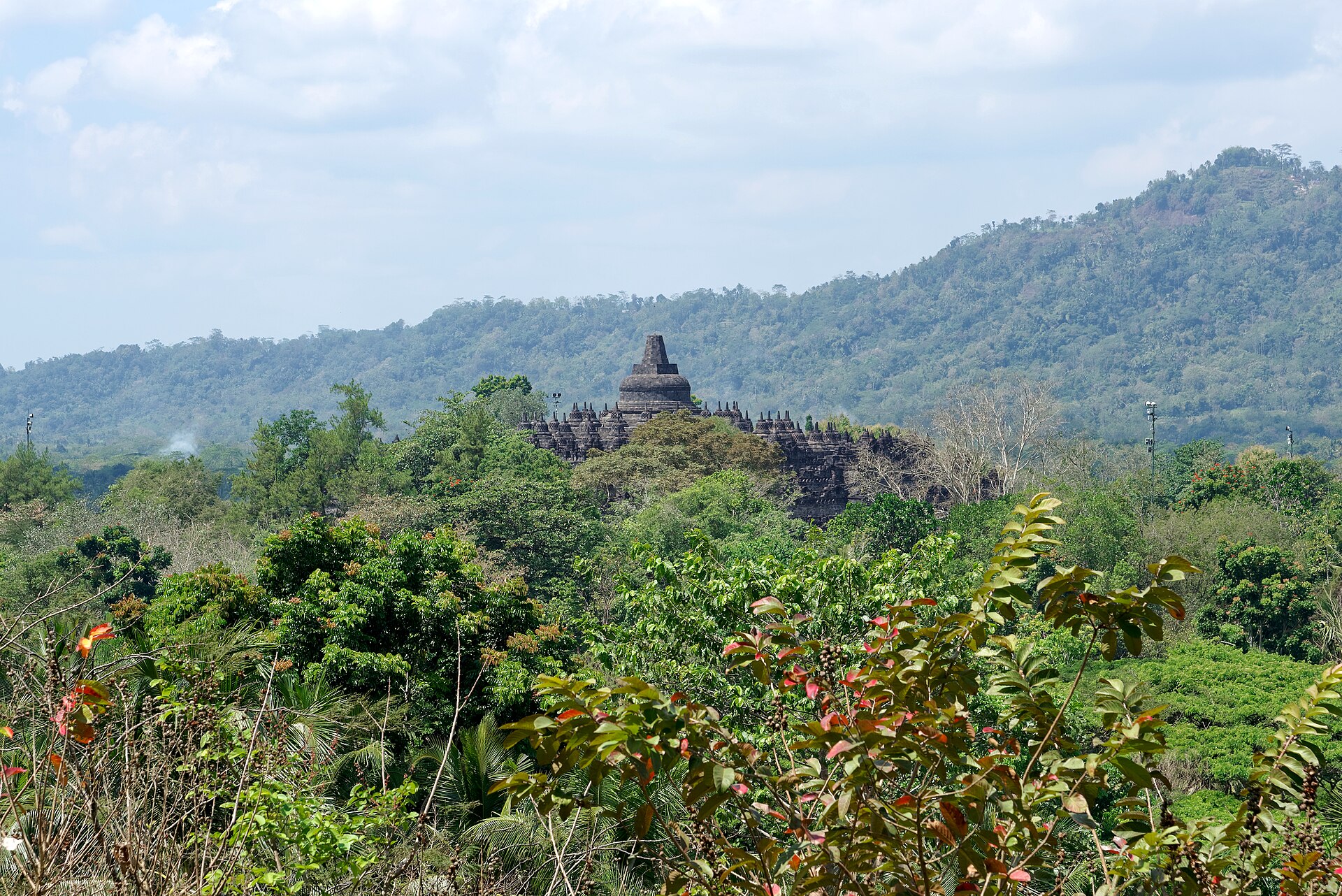
An hour or so northwest of the city, and the largest Buddhist monument in the world: a stupa raised by the Sailendra kings from about 780 and finished around 833, on a base 123 metres square, standing 35 metres above the fields. Its terraces carry 2,672 relief panels and 504 Buddha figures, 72 of them seated inside perforated stupas at the top. Dawn is the hour — but climbing it is capped now, and needs a booked slot.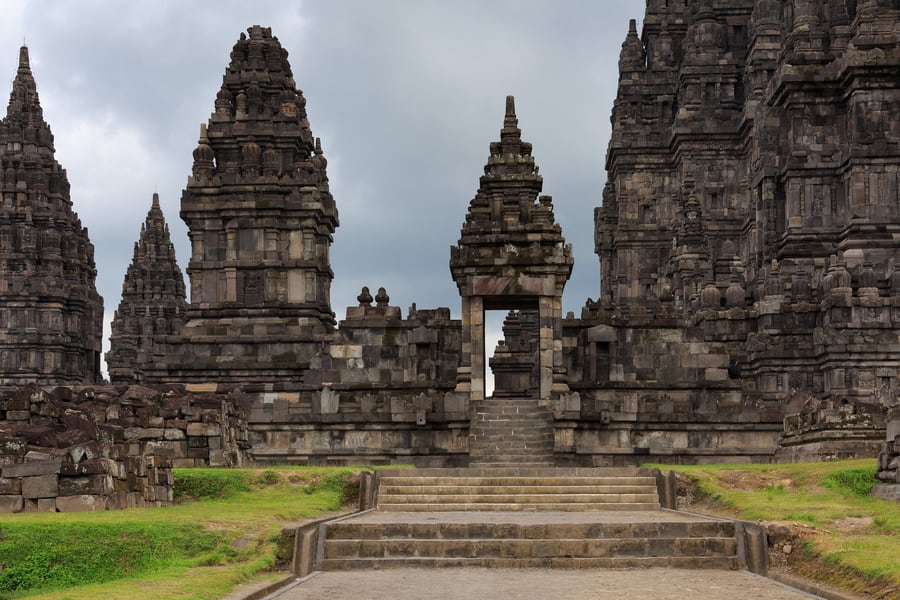 Photo by CEphoto, Uwe Aranas / Wikimedia Commons · CC BY-SA 3.0 · cropped
Prambanan
Nearer the city, out on the Solo road, and the Hindu answer to Borobudur: a cluster of tall, sharply carved towers begun about 850 under Rakai Pikatan and dedicated to Shiva, Vishnu and Brahma, the central Shiva shrine rising 47 metres. Of 240 original structures the eight main temples and eight inner shrines have been rebuilt, but only six of the 224 outer ones. The 2006 earthquake scattered carvings and left the towers standing.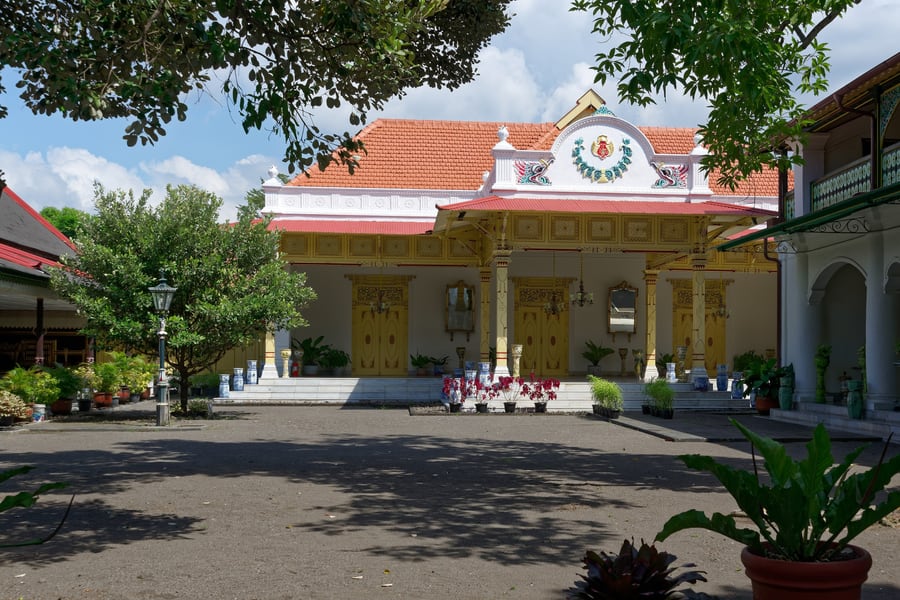 Jakub Hałun / Wikimedia Commons · CC BY-SA 4.0 · cropped
The Kraton
At the heart of the city, and still a living court rather than a monument. Built in 1755–56 for Hamengkubuwono I after the Treaty of Giyanti split Mataram in two, the walled palace remains the seat of the reigning sultan, with its own corps of guards and a large household of retainers. Gamelan, classical dance, macapat poetry and wayang are performed in the pavilions on a rotating programme through the week.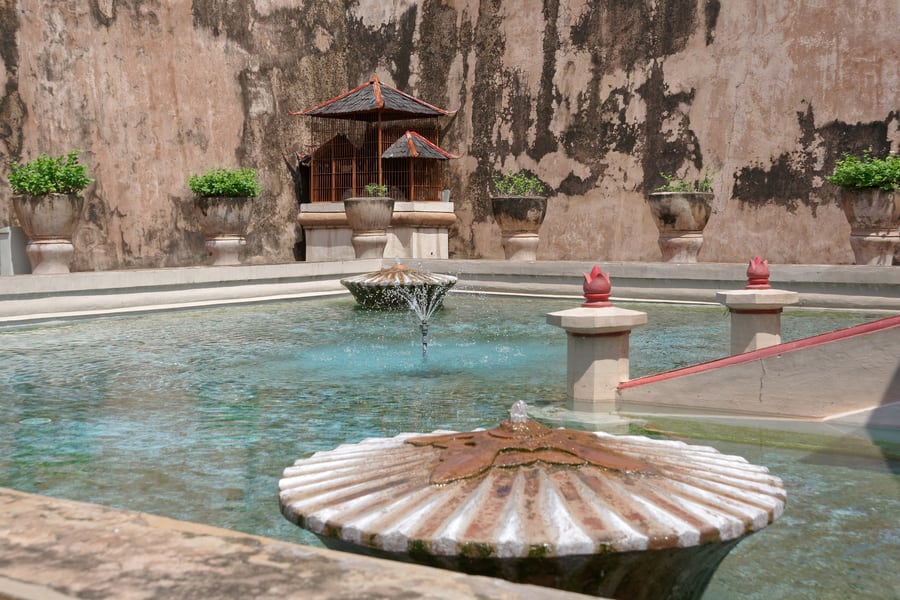 Jakub Hałun / Wikimedia Commons · CC BY-SA 4.0 · cropped
Taman Sari
A short walk southwest of the Kraton: the pleasure garden Hamengkubuwono I began in 1758, some 59 buildings that served at once as a retreat, a workshop, a meditation place and a bolt-hole, in use from about 1765 to 1812. The British invasion, the Java War and an earthquake in 1867 wrecked most of it. What survives beautifully is the bathing complex, and the Sumur Gumuling mosque, reached by an underground passage.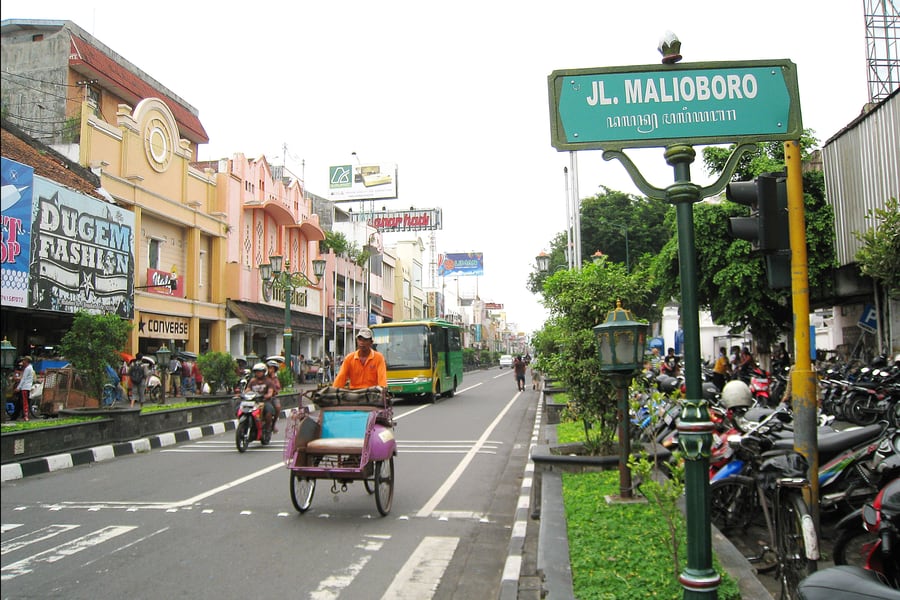 Gunawan Kartapranata / Wikimedia Commons · CC BY-SA 3.0 · cropped
Malioboro
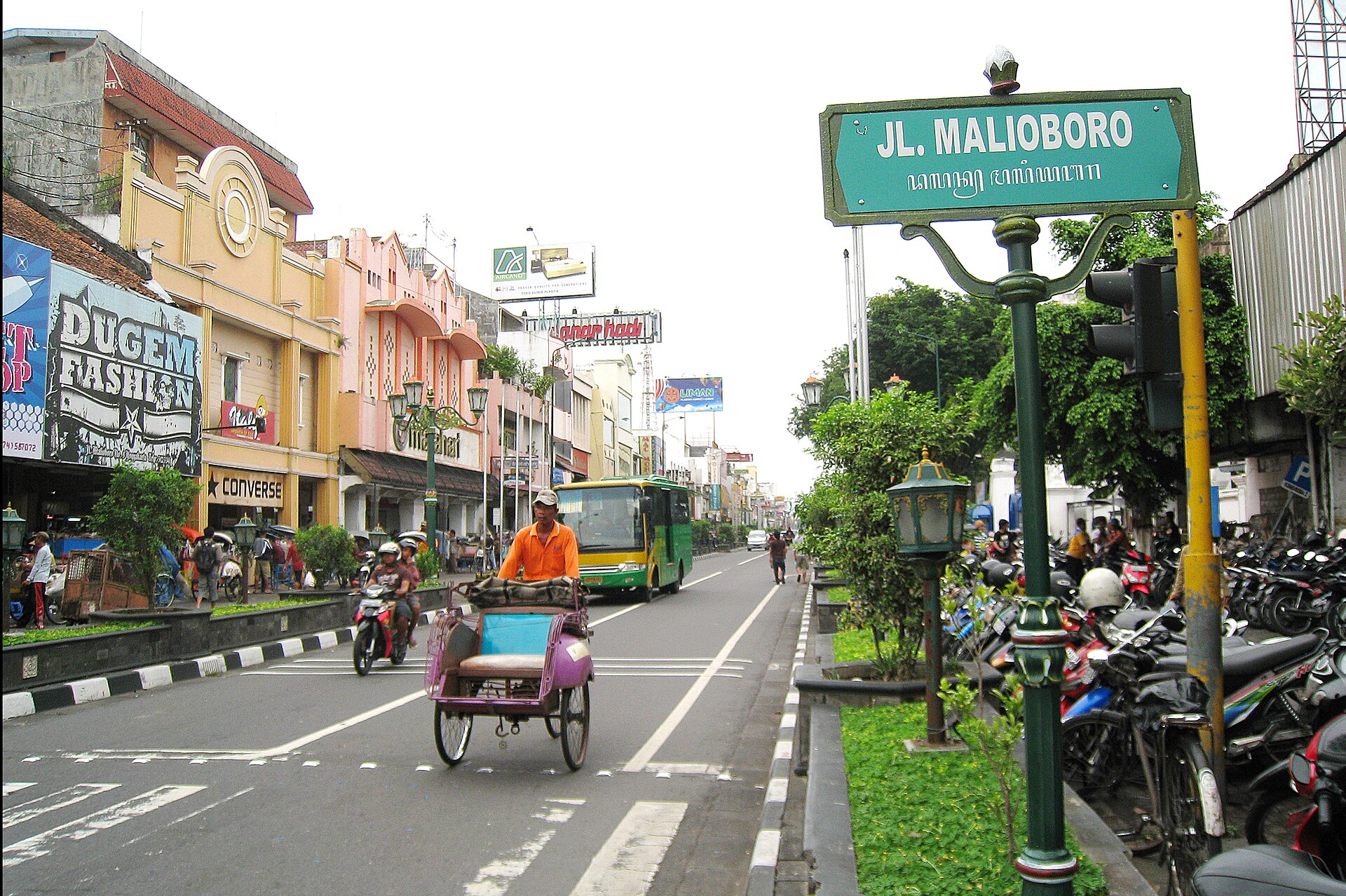
Minutes from Tugu station, and the spine of the city: stalls, becaks, batik shops and warungs running south from the railway towards the Kraton. It is where Yogya eats — gudeg, and lesehan mats spread on the pavement after dark — and where most visitors end up every evening whether they planned to or not. The station itself, opened on 20 July 1887, is a protected landmark at the top of it.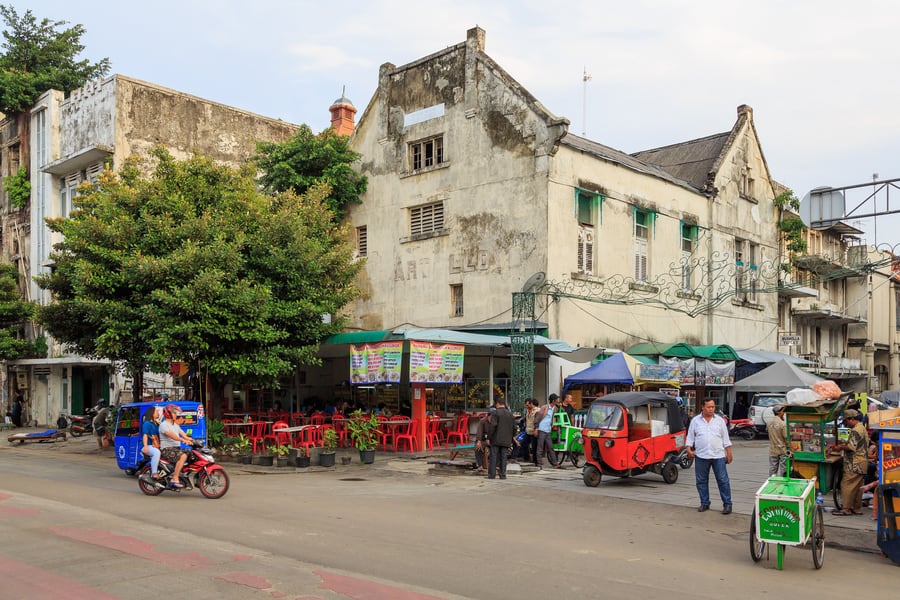 Photo by CEphoto, Uwe Aranas / Wikimedia Commons · CC BY-SA 3.0 · cropped
Kota Tua, Jakarta
If you have time at the Jakarta end, the old Dutch quarter is the thing to see. Gambir station sits by Merdeka Square, and Kota Tua is a short ride north: Fatahillah Square, faced by the Stadhuis — Batavia's city hall as rebuilt by 1710, and the Jakarta History Museum since 1974 — with warehouses, canals and streets of shuttered colonial houses around it. The National Museum is nearer still, just off the square by Gambir.Where to Sleep
The Taksaka delivers you into the middle of Yogyakarta, and that is where you will want to stay — the city has the widest and most characterful range of accommodation in Central Java, at every budget.
Around Malioboro and the station are the big international and business hotels, handy for arrivals and for the markets and palace. South of the centre, the streets of Prawirotaman and Tirtodipuran are the traveller's quarter, full of boutique hotels, guesthouses and cafés in a leafy, walkable setting. For something special, look to the heritage hotels in old colonial villas, or — the classic choice for temple-goers — the beautiful resorts and lodges out toward Borobudur, where you can wake close to the great stupa and be there for sunrise before the crowds.
In Jakarta, at the other end of the line, the hotels cluster in the central business and shopping districts near Gambir and along Jalan Thamrin — useful for a night on the way in or out, or if you take a late-evening Taksaka after a day in the capital.
Wherever you stay, book ahead around Indonesian public holidays and the long Idul Fitri season, when Yogyakarta and its trains alike fill to bursting — and reserve your Taksaka seat, especially in the Luxury carriage, at the same time.
Questions or corrections
Planning this trip and stuck on something, or spotted a time, fare or detail that has changed? Send us a message about The Taksaka. We read every one, and we update this page when something has changed.