Tbilisi to Batumi — over the Surami Pass to the Black Sea
Александр Сапожников / Wikimedia Commons · CC BY-SA 4.0 · 2023 · cropped
- Distance343 km, Tbilisi to Batumi
- Duration4 hr 1 min, with three stops
- Best seasonAll year, four times a day · the fourth pair is summer only, to 15 September 2026
Introduction
Georgia is a small country with a mountain range across its middle, and everything about its railway follows from that. The Likhi range runs north to south between the Greater and Lesser Caucasus, dividing the dry east from the wet, subtropical west, and the only sensible way through it is the Surami pass. The line from Tbilisi to the Black Sea has crossed there since 1872. It carried Caspian oil to the port of Batumi under the tsars, it was the first railway in the Soviet Union to be worked by electric locomotives, and it is still the spine of the country — 343 kilometres from the capital to the coast, all of it electrified at 3,000 volts.
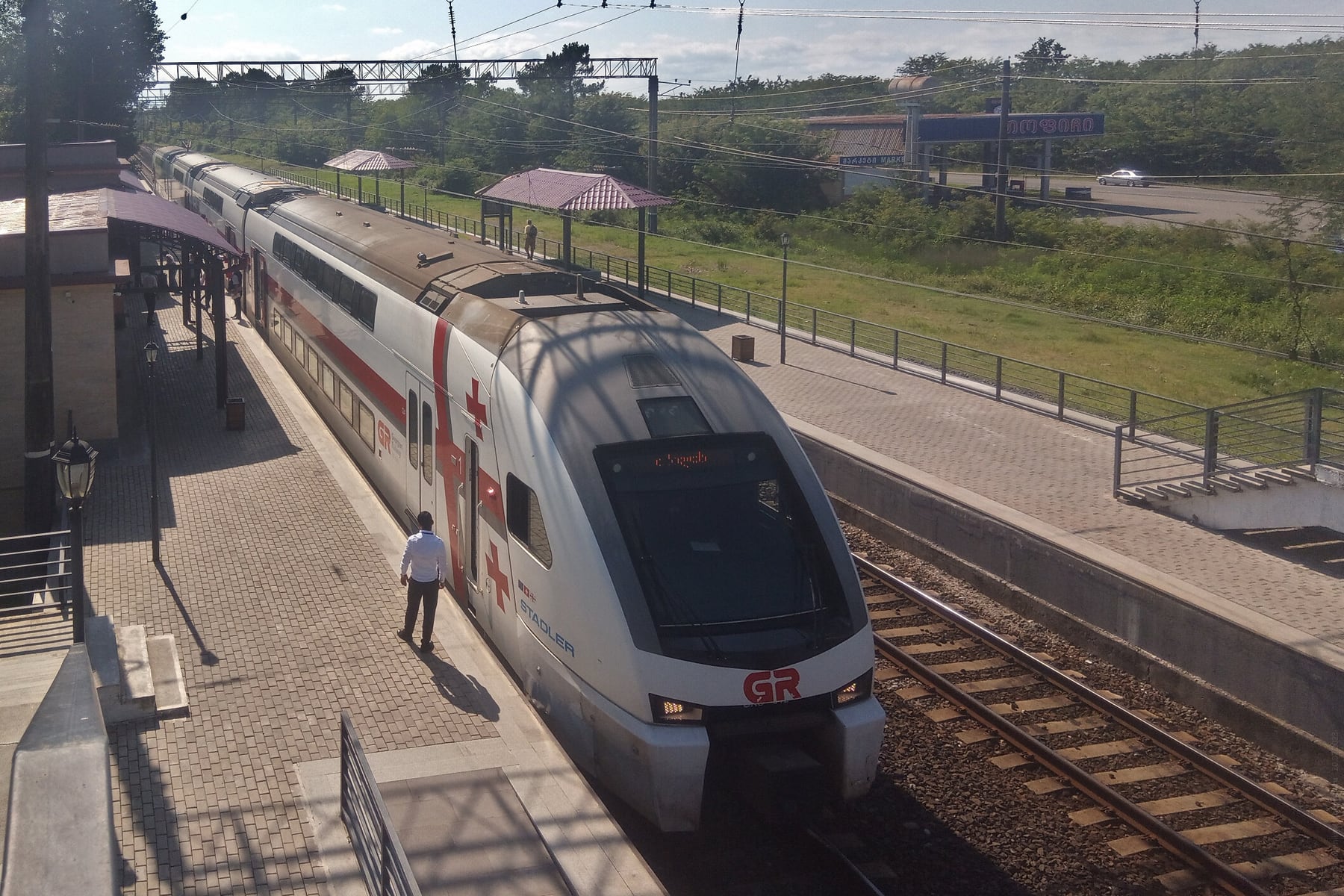
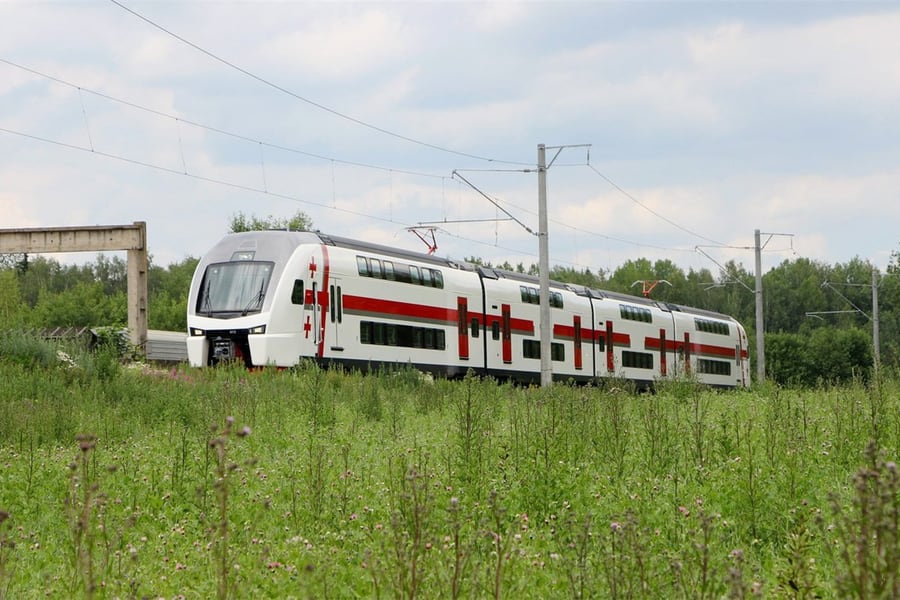
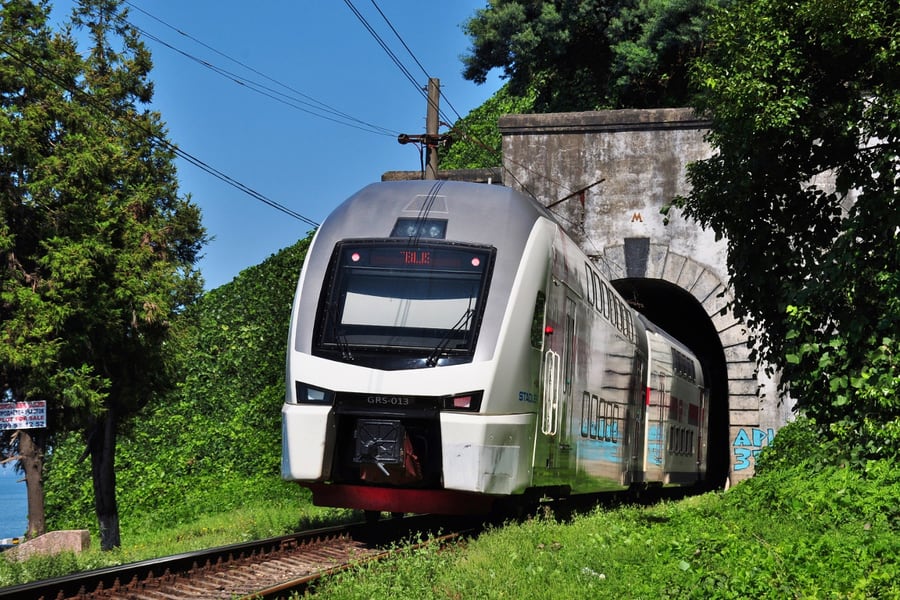
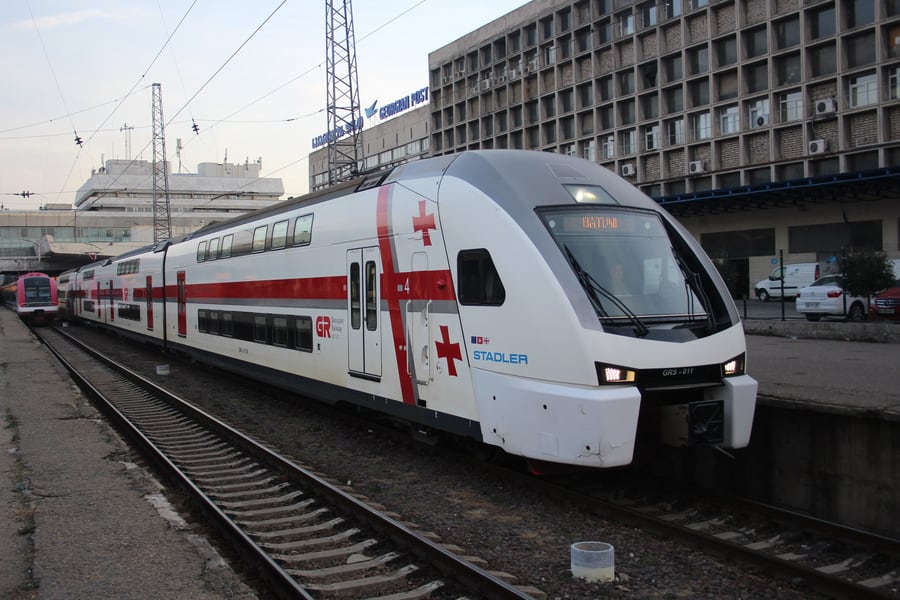
Four trains a day now run the whole length of it in four hours and one minute, calling three times on the way. They are double-deck Stadler units in Georgian Railway's white and red, with the country's five crosses on the flanks, and they were not built for Georgia at all. What the passenger gets is a morning of dry hills and vineyards east of the pass, twenty minutes of tunnels and river gorge through it, and then a long green descent into Imereti that ends beside the Black Sea. Second class costs 36 lari, and every seat is reserved.
The Journey
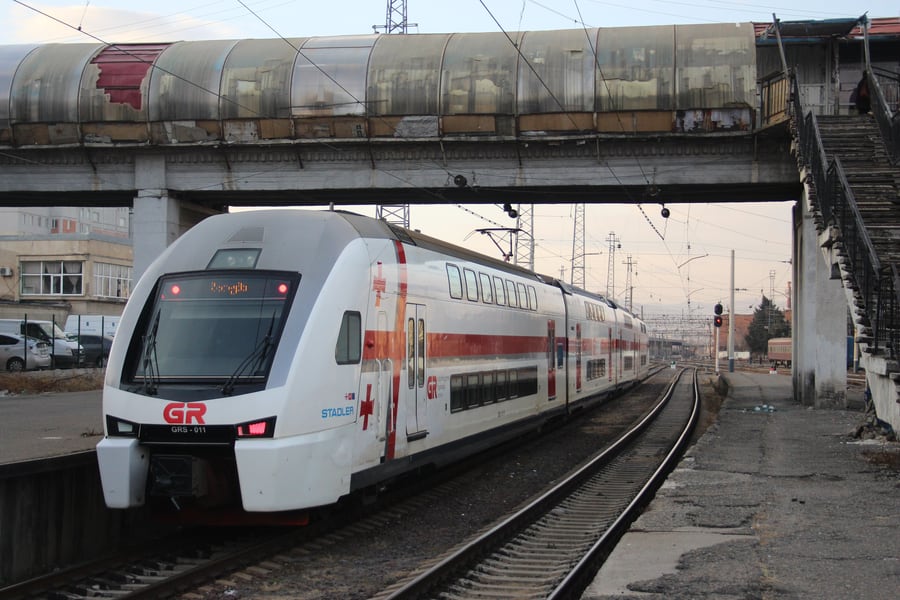
The train leaves from Tbilisi Central on Station Square — a Brutalist block of the early 1980s, rebuilt in 2010 as station and shopping centre together, with the only interchange between the city's two metro lines underneath it. Departures are at 06:30, 08:05, 10:15 and 17:10, and the first thing that happens is a long slow curl through the freight yards and out along the Mtkvari. Mtskheta passes on the right at kilometre 21, the old capital where the Aragvi meets the Mtkvari, and after that the valley opens into Shida Kartli: flat brown fields, poplar windbreaks, vineyards, and the Greater Caucasus standing along the northern horizon on a clear morning. Gori goes by at 76 km, Khashuri at 120. Neither is a stop on these trains.
Khashuri is where the character changes. The Borjomi branch turns south there towards the mineral springs, and the main line begins to climb west into the Likhi range — the wall that separates eastern Georgia from western, and the reason this railway exists in the form it does.
The pass
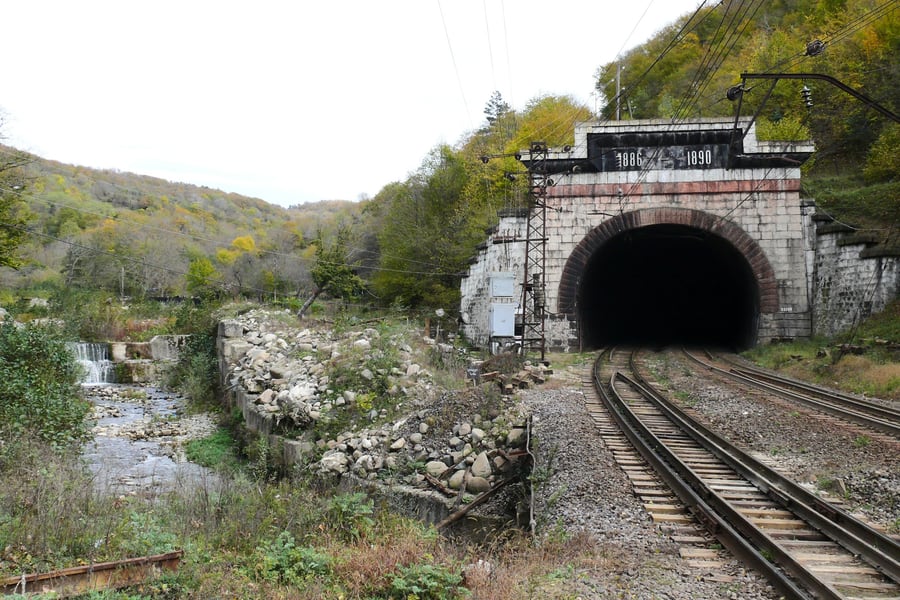
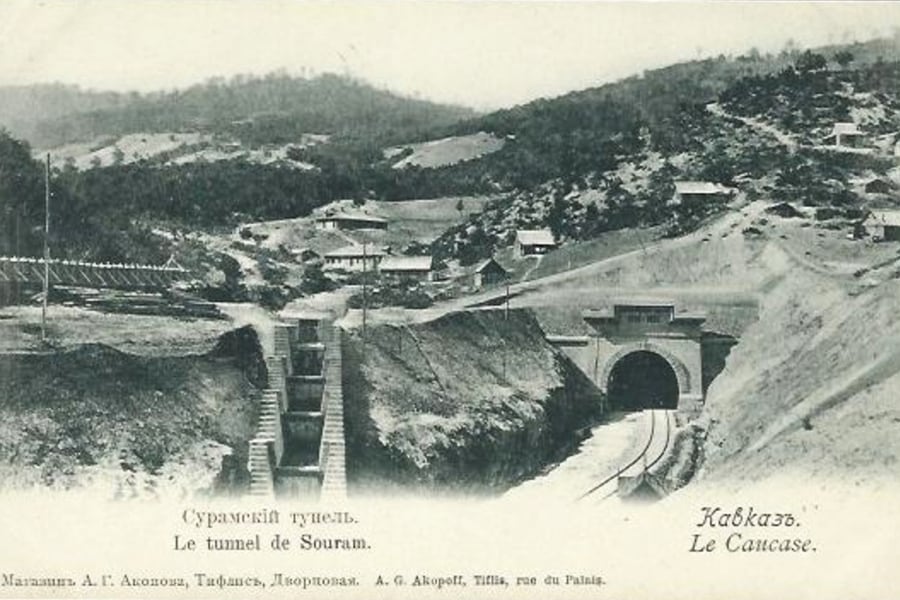
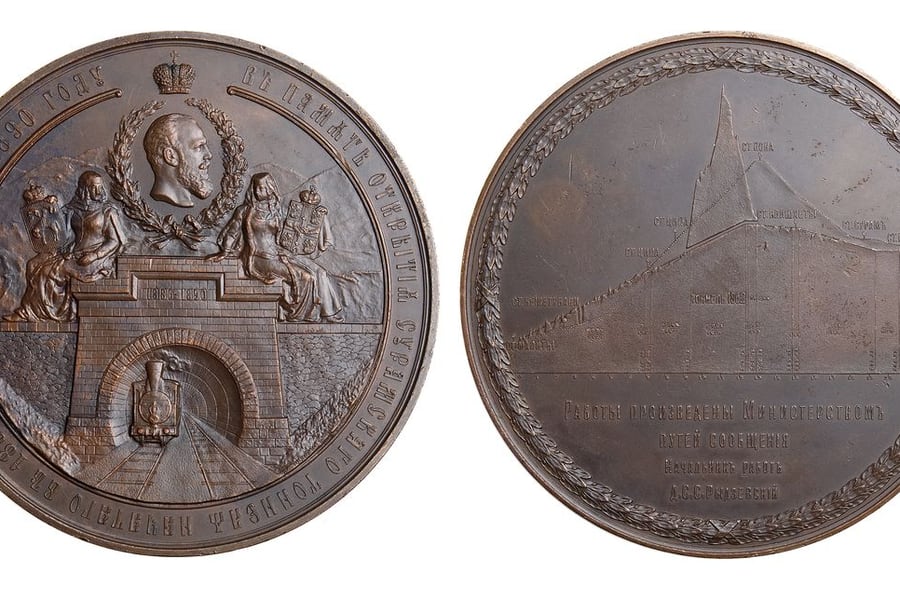
The Surami pass is only 949 metres, the lowest crossing of the range, and the line that opened through it in 1872 was built cheaply: gradients of 1 in 22 and curves of 100 metres radius, worked by Fairlie articulated tank engines because nothing else would go round them. By the late 1880s the section was full. The answer was a tunnel of about four kilometres between Likhi and Tsipa, finished in 1890, which eased the ruling gradient to 1 in 34 and let the curves out to 150 metres. The portal above the Chkherimela still carries the dates 1886–1890 cut into the stone over the arch.
Even so, the 63 kilometres from Khashuri down to Zestaponi stayed the bottleneck of the whole Georgian network for another century — steep, twisting, and slow enough that freight trains overheated their brakes on the descent. The rebuilding of that section took fourteen years, began in September 2011 and was declared complete on 24 December 2025, at a ceremony held at Kvishkheti in front of the mouth of a new dual-tube tunnel 8,300 metres long. The project laid 40 kilometres of new railway, six tunnels and ten bridges, and cut the time through the mountain section by between forty and fifty minutes. It is the reason a run that the 2022 public timetable allowed five hours and fifty-five minutes for now takes four hours and one.
Where the first Soviet electric train ran
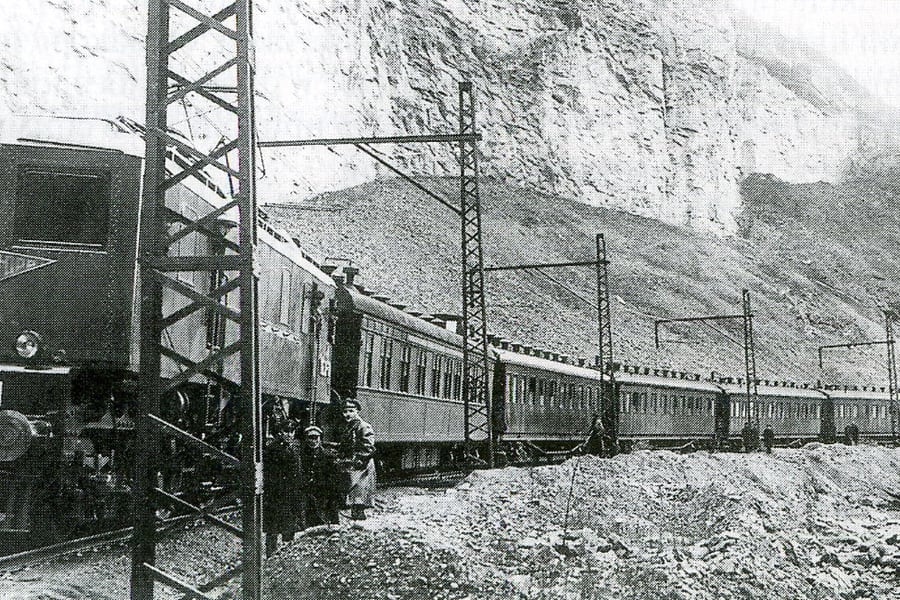
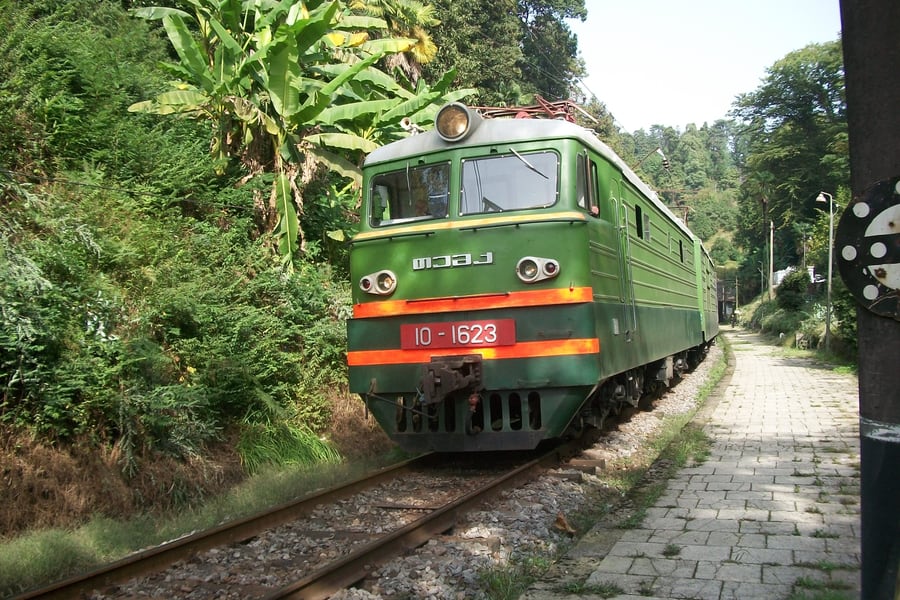
There is a second reason to look out of the window here. Work on electrifying Khashuri–Zestaponi at 3,000 volts direct current began in 1928, using power from new stations on the Mtkvari and the Rioni, and it finished in 1932. On 2 August that year an electric locomotive numbered S10-01 made its trial run over the pass; on 16 August electric working opened officially. Both were firsts for the Soviet Union, and the locomotive was American — one of eight ordered from General Electric, which had built comparable machines for the mountain railways of Brazil. Seven more came from Tecnomasio Italiano Brown Boveri, and only then did Kolomna and Dinamo start building the Soviet copy, the class Ss, whose name simply stands for Suramsky sovetsky — Surami, Soviet. The USSR's first passenger electric locomotive, the PB21, went on trial on the same railway between Khashuri and Gori in 1934.
Down to the sea
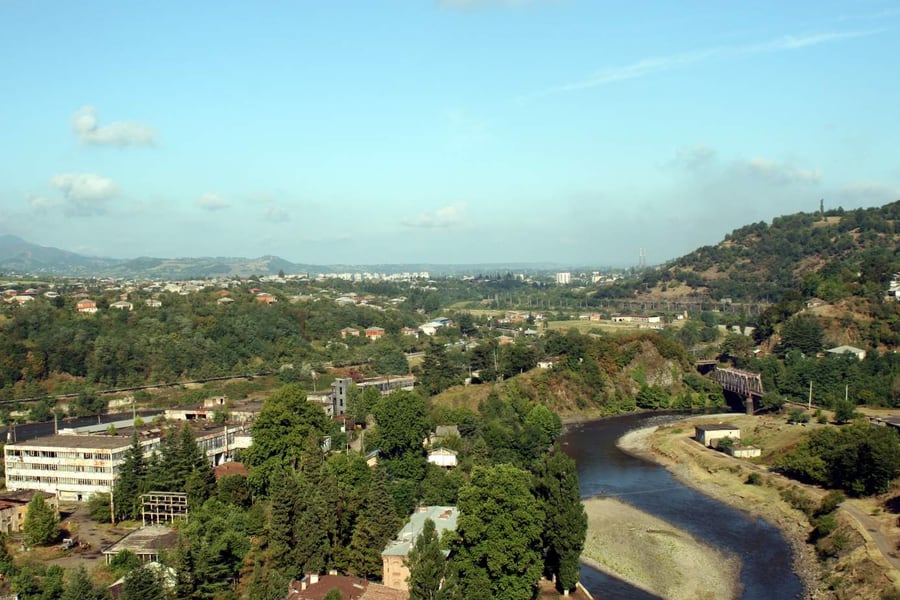
West of the tunnels the train drops through the gorge of the Chkherimela, past Marelisi and Kharagauli, and the landscape turns. Imereti is wet where Kartli was dry: box and hornbeam forest on the slopes, small red-roofed villages, and the Kvirila running alongside. Zestaponi arrives at 183 km, Rioni at 213, and then the only stop of the first half — Kutaisi International Airport, 231 km out and two hours thirty-five minutes from Tbilisi. The station was rebuilt in 2022 and put the country's second-busiest airport on the railway; it is a two-kilometre transfer to the terminal, and Kutaisi itself is fourteen kilometres further east.
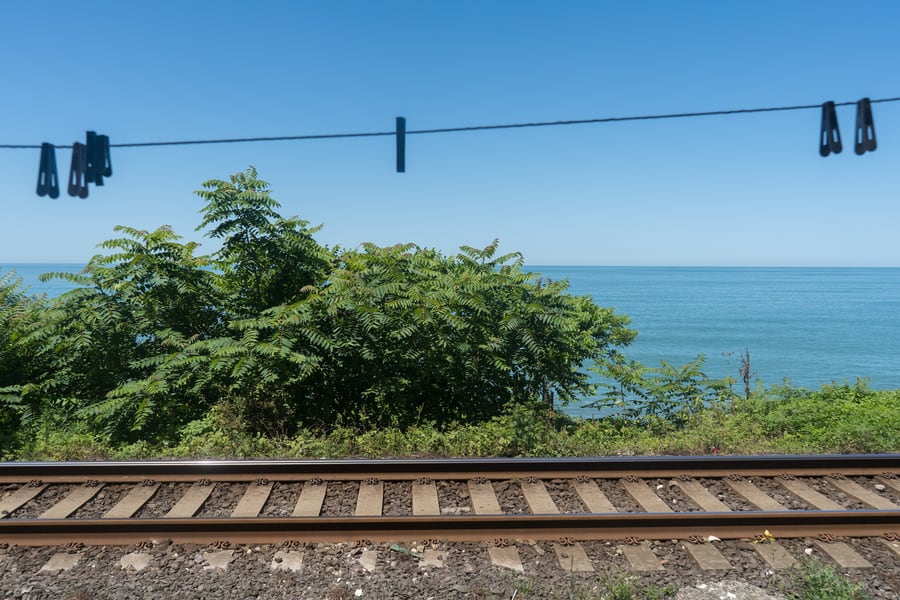
After Samtredia the line swings south and runs down the Colchis lowland to meet the coast. Ureki comes at 301 km, a resort whose beaches are sand rather than shingle, black and magnetic; Kobuleti at 326. From there to the end the railway is squeezed between the hills and the water, through short tunnels and tangles of bamboo, palm and banana at Green Cape, and it finishes at Makhinjauri — 342 km — and Batumi Central at 343. The station is not in the middle of Batumi despite the name: it stands about four kilometres from the old town, on the site the trains have used since services to the city centre stopped in the 1990s.
Along the route
 Wikimedia Commons · Public domain · 1890 · cropped
A tunnel bought with a medal
The 1872 line over the pass climbed at 1 in 22 on curves of 100 metres and was full by the late 1880s. Four kilometres of tunnel, finished in 1890, eased it to 1 in 34 — and the opening was marked with a struck medal.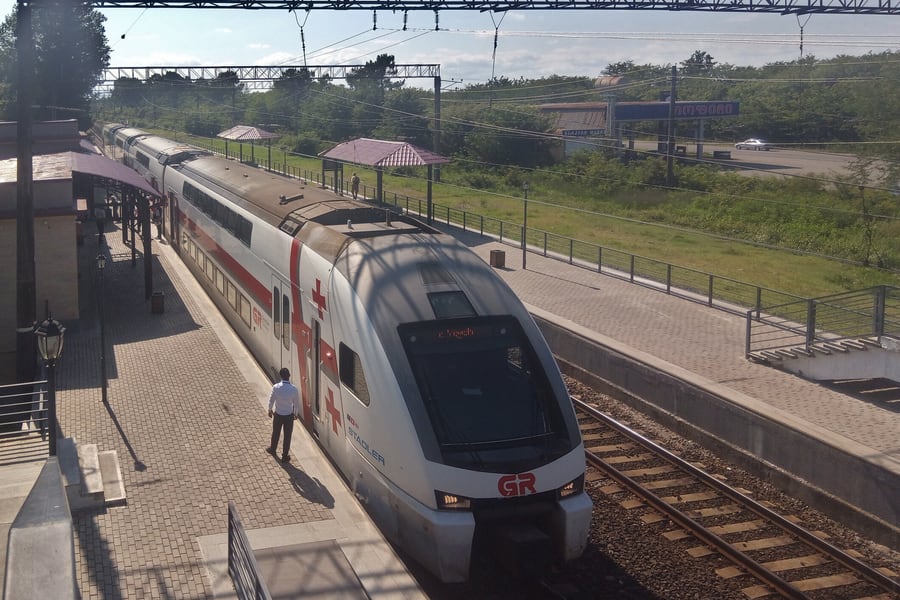 Александр Сапожников / Wikimedia Commons · CC BY-SA 4.0 · 2023 · cropped
One stop in the first 231 km
Nothing between Tbilisi and Kutaisi International Airport is served. Gori, Khashuri and Zestaponi all have platforms and all are passed at speed; the airport station was rebuilt in 2022 and is two kilometres from the terminal.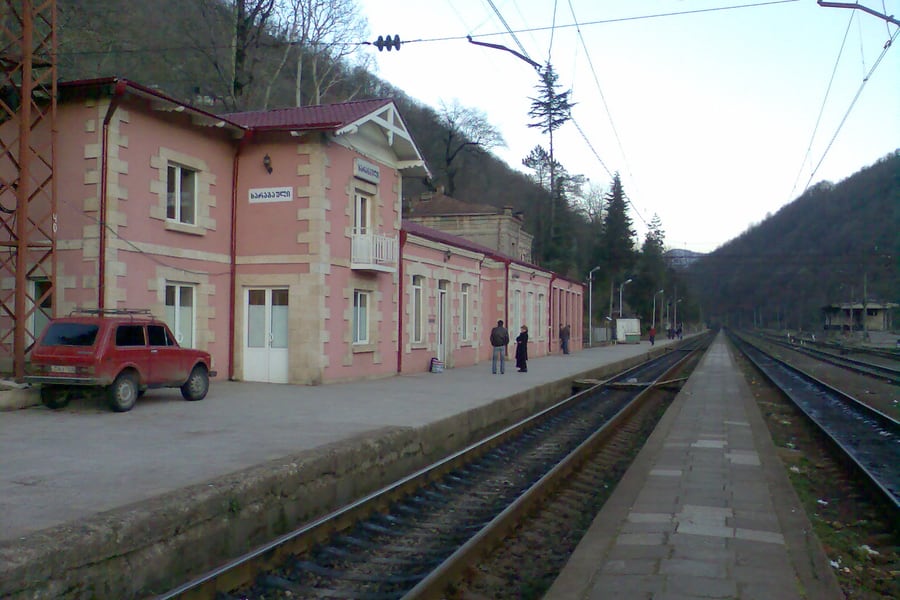 Givi Kurtanidze / Wikimedia Commons · CC BY-SA 3.0 · cropped
The stations the fast trains gave up
Kharagauli, at 160 km in the gorge below the pass, is one of a dozen country stations the expresses no longer call at. Two single-deck trains a day still do — the 08:15 to Zugdidi and the 17:30 to Poti.A bit of history
Culture & experiences along the way
 Superalbs / Wikimedia Commons · CC BY-SA 4.0 · cropped
A Moscow airport train that never went to Moscow
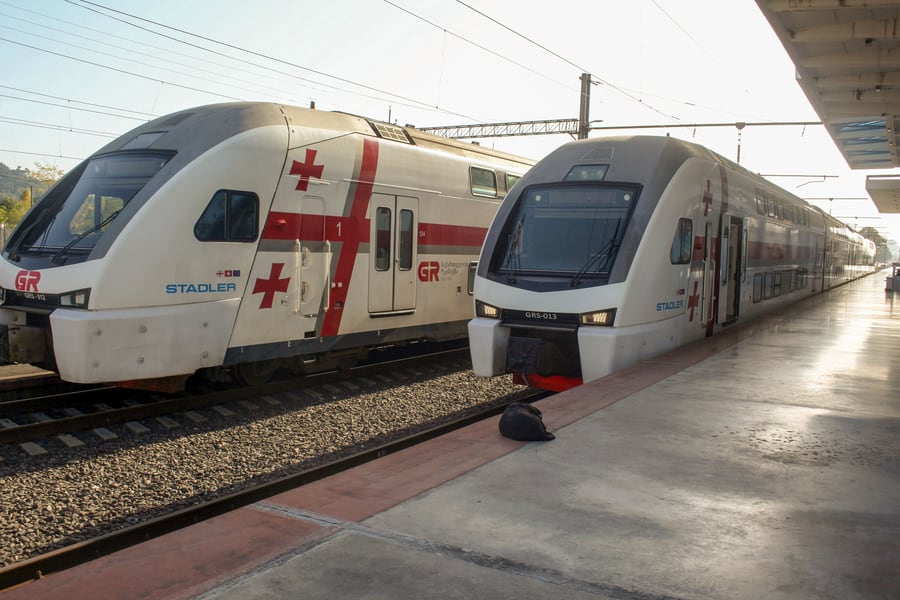
Aeroexpress ordered these double-deckers from Stadler in 2013 for the shuttles between Moscow and its three airports. When the rouble fell the order became unaffordable; a settlement in February 2016 cut it to eleven units, Azerbaijan took five, and Georgia signed for four that April at €39.6 million. They were in Georgia by that September.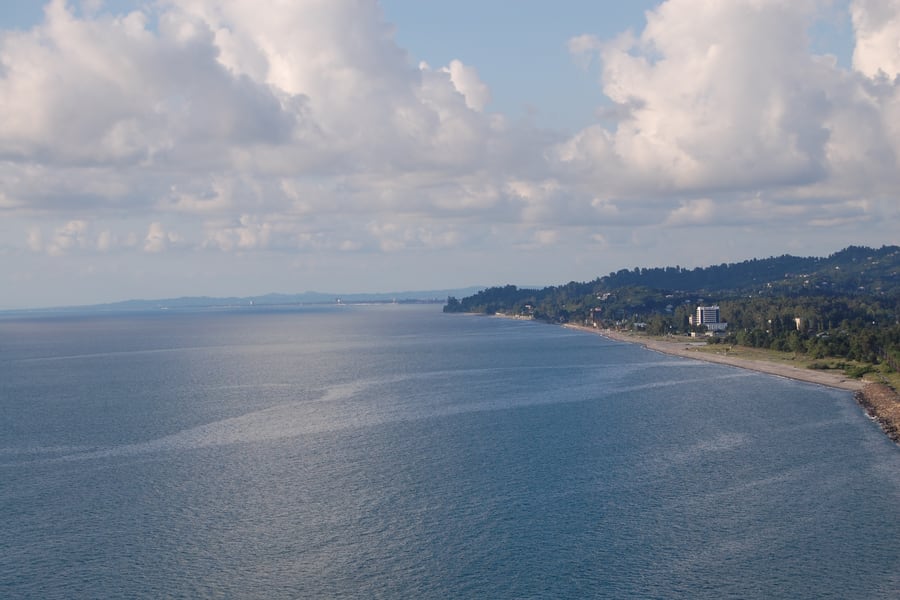 Andrzej Wójtowicz / Wikimedia Commons · CC BY-SA 2.0 · cropped
Where the country turns subtropical
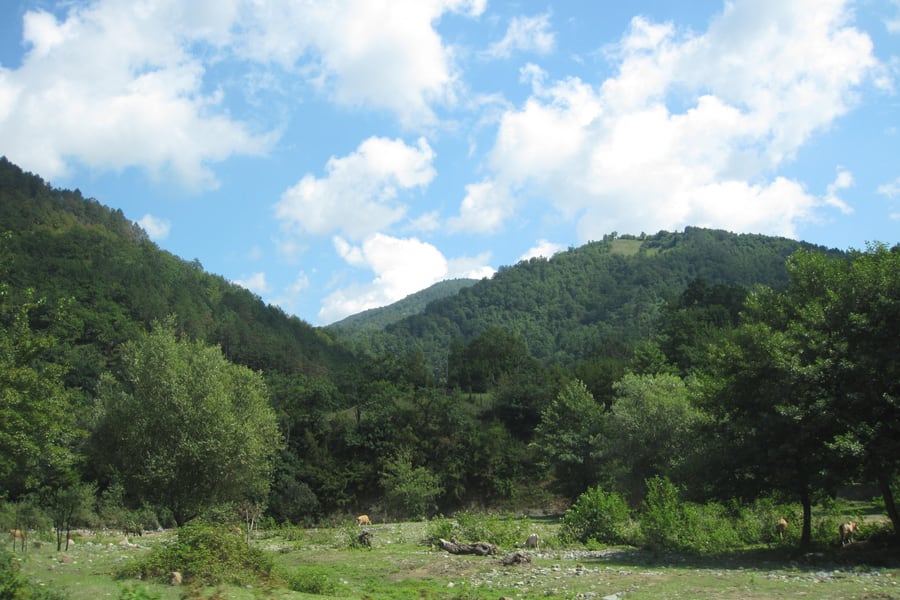
Somewhere in the tunnels the weather changes. East of the pass, Shida Kartli is dry and brown and the vines are staked in rows; west of it the rain comes off the Black Sea, the slopes go to box and hornbeam, and by the last half-hour there is bamboo, palm and banana growing at the lineside. It is the same journey and, in effect, two countries.Timetables
Georgian Railway runs four trains each way between Tbilisi and Batumi, every day, and they all take the same four hours. Times below are as of August 2026, taken from the operator's own selling system; tickets are sold through Georgian Railway (opens in a new tab) and its ticketing partner, and the booking window opens 20 days before departure.
Tbilisi to Batumi
| Station | 806 | 802 | 808 | 804 |
|---|---|---|---|---|
| Tbilisi | 06:30 | 08:05 | 10:15 | 17:10 |
| Kutaisi International Airport | 09:05 | 10:40 | 12:50 | 19:45 |
| Ureki | 09:53 | 11:28 | 13:38 | 20:33 |
| Kobuleti | 10:13 | 11:48 | 13:58 | 20:53 |
| Batumi | 10:31 | 12:06 | 14:16 | 21:11 |
Batumi to Tbilisi
| Station | 803 | 805 | 801 | 807 |
|---|---|---|---|---|
| Batumi | 08:00 | 14:10 | 16:50 | 18:30 |
| Kobuleti | 08:18 | 14:31 | 17:08 | 18:48 |
| Ureki | 08:38 | 14:51 | 17:28 | 19:08 |
| Kutaisi International Airport | 09:27 | 15:40 | 18:17 | 19:57 |
| Tbilisi | 12:00 | 18:13 | 20:50 | 22:30 |
What runs when
Trains 802, 808 and 804 out of Tbilisi, and 803, 801 and 807 back, are the year-round service. Train 806 at 06:30 from Tbilisi and train 805 at 14:10 from Batumi are a summer addition, and the last date on which either is being sold is 15 September 2026 — from the 16th the selling system shows three trains each way with several hundred seats free, and those two gone.
Only three intermediate stops are served: Kutaisi International Airport, Ureki and Kobuleti. Every other station on the 343 kilometres — Gori, Khashuri, Zestaponi, Samtredia — is left to the slower trains, of which two run daily from Tbilisi: the 08:15 to Zugdidi and the 17:30 to Poti. Both are single-deck, both take a good deal longer, and both cost about a third as much.
Tickets
Every seat is reserved, so a ticket is bought for a named train. Georgian Railway sells from 20 days before departure and closes sales ten minutes before it leaves; buying online adds a service fee of about a lari, and an agent adds theirs. Registering a ticket needs a personal identification number — a passport, for a foreign visitor — and that document is checked again at the train door.
Refunds slide with the clock: the full fare back more than 15 hours before departure, 85 per cent between 4 and 15 hours, 70 per cent inside 4. Children under five travel free without a seat of their own; five to ten pay a child fare. The fares below are as sold in August 2026.
Book your tickets
Second class
Tbilisi to Batumi, reserved seat
The standard fare for the full 343 km, on either deck.
Book Tickets (opens in a new tab, on railway.ge)via railway.geFirst class
Tbilisi to Batumi, reserved seat
Wider seating in its own saloon, sold on all four trains.
Book Tickets (opens in a new tab, on railway.ge)via railway.geShort of the whole run
Tbilisi to Kutaisi International Airport
Two hours thirty-five minutes, and a few lari less than the full journey.
Book Tickets (opens in a new tab, on railway.ge)via railway.geRail Passes
Georgia sits outside the Interrail and Eurail area. There is no Georgia One Country Pass among the twenty-nine that Interrail sells, and the Global Pass buys nothing here — checked against interrail.com in August 2026, where the only mention of Georgia is in the list of countries a traveller may live in.
That matters less than it would elsewhere, because the fares are low enough that a pass would struggle to pay for itself. The full 343 kilometres from Tbilisi to the Black Sea costs 36 lari in second class, and the slower trains to Poti and Zugdidi are cheaper still. Tickets are bought directly from Georgian Railway, online or at a station, and the only thing worth planning ahead is the 20-day selling window in July and August, when the coastal trains do sell out.
Places to Visit
The train stops three times in 343 kilometres, which makes each stop a decision rather than a convenience. Kutaisi International Airport is the way into Imereti and its eleventh- and twelfth-century monasteries; Ureki and Kobuleti are the two beach resorts on the Guria and Adjara coast, twenty minutes apart on the timetable and quite different in character; and Batumi is where the line ends, four kilometres from a station that carries its name.
 Matthias Bethke / Wikimedia Commons · CC BY-SA 4.0 · cropped
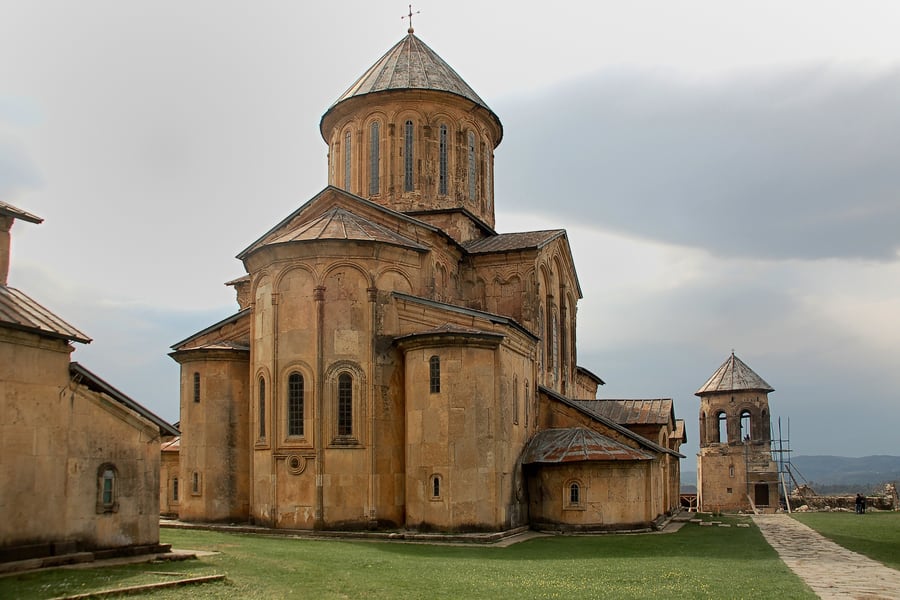
Gelati, from the airport stop
King David IV founded the monastery in 1106, when Kutaisi was the capital of Georgia, and he is buried at its gate beside the gates of Ganja his son carried off in 1138. The main church was finished in 1130 and holds murals from the twelfth century onward. The academy attached to it drew back scholars who had been working in Constantinople, and people of the time called it a second Athos. It is a UNESCO site, in the hills north-east of Kutaisi.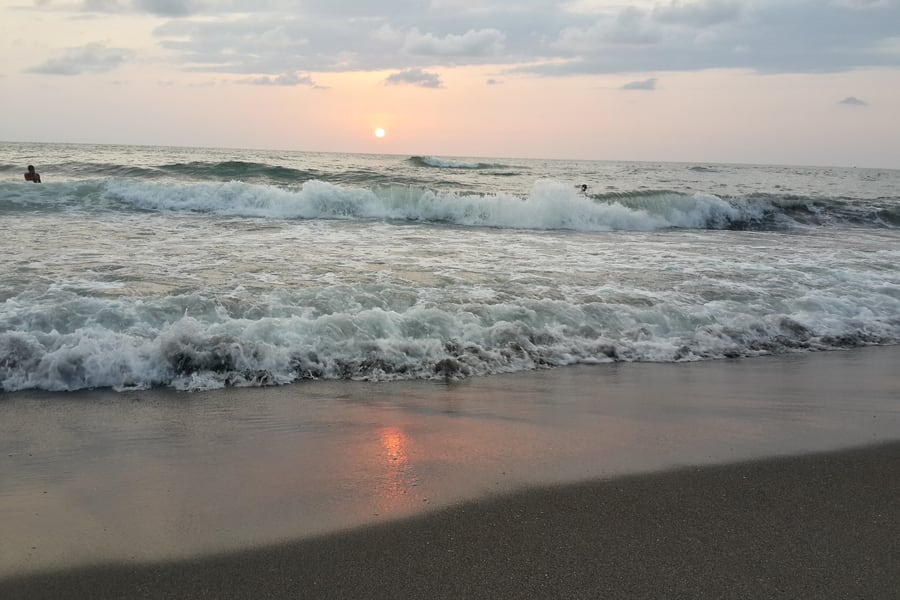 Kakha Kolkhi / Wikimedia Commons · CC BY-SA 2.0 · cropped
The black sands of Ureki
Almost the whole Georgian coast is shingle. Ureki is the exception: a strip of fine sand classed as black sand, with magnetic properties, sixty kilometres up the coast from Batumi. Georgians have come here since Soviet times on the belief that it helps the heart and the circulation, and the town keeps the quiet, slightly medicinal air of a place that fills in July and empties in September. It became a town in 1953 and has about a thousand residents.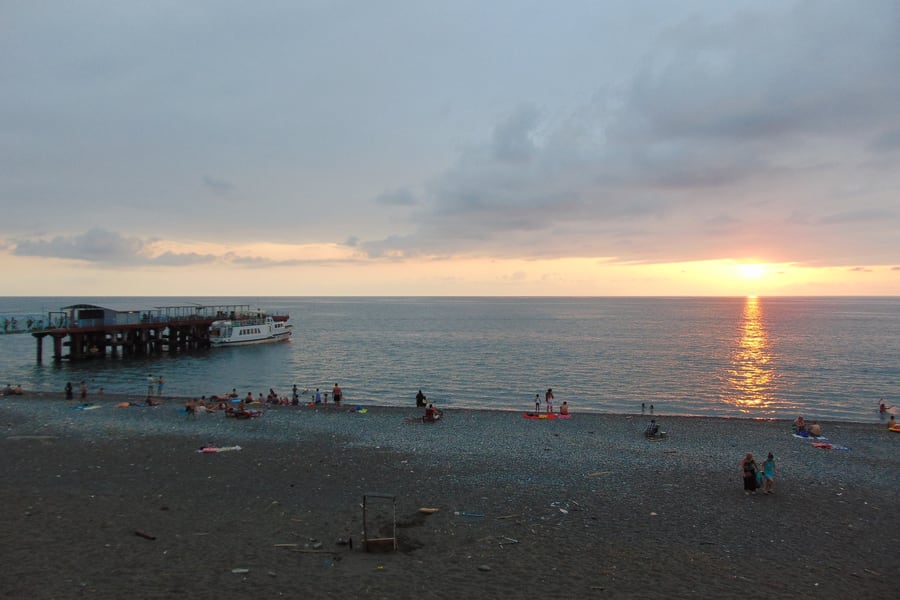 Kober / Wikimedia Commons · CC BY-SA 4.0 · 2016 · cropped
Kobuleti and the Ispani bogs
The last stop before Batumi is a resort strung along a single road behind the beach, twenty-eight kilometres up the coast and eighteen minutes up the line. Its sanatoriums were abandoned after the wars of 1990–93 and the town was rebuilt as a resort from 2004. Directly behind it lie the Ispani peat bogs of the Kobuleti Managed Reserve, a raised mire on a seashore lowland — an unusual thing to find at sea level in the subtropics.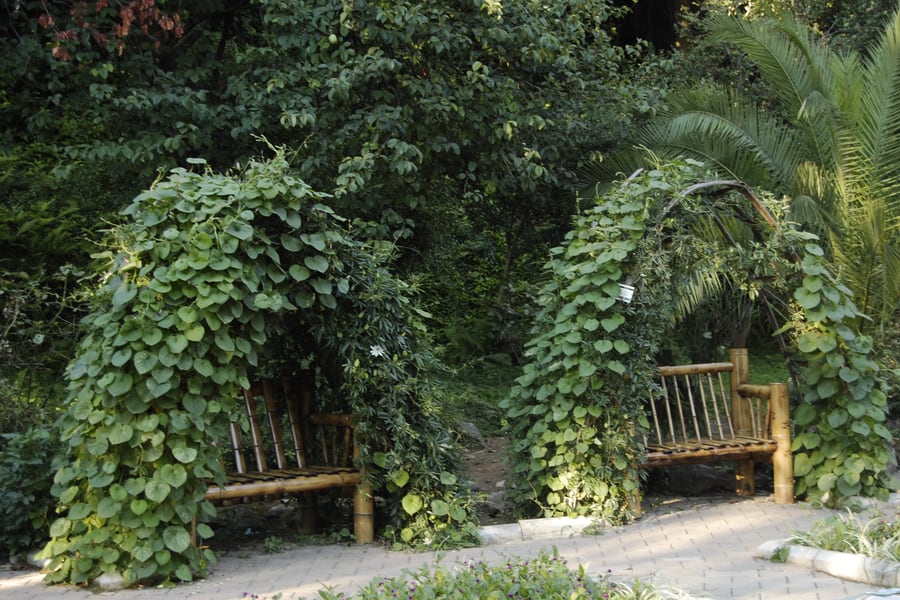 Andrzej Wójtowicz / Wikimedia Commons · CC BY-SA 2.0 · cropped
The botanical garden at Green Cape
The botanist and geographer Andrei Krasnov founded this garden in 1912 on the headland nine kilometres north of Batumi, and is buried in it. It covers about 108 hectares of hills and ravines above the sea, arranged by where the plants come from — Caucasian humid subtropics, East Asia, New Zealand, South America, the Himalayas, Mexico, Australia, the Mediterranean — with more than 2,000 species of woody plants. Its own railway halt, Green Cape, is on this line.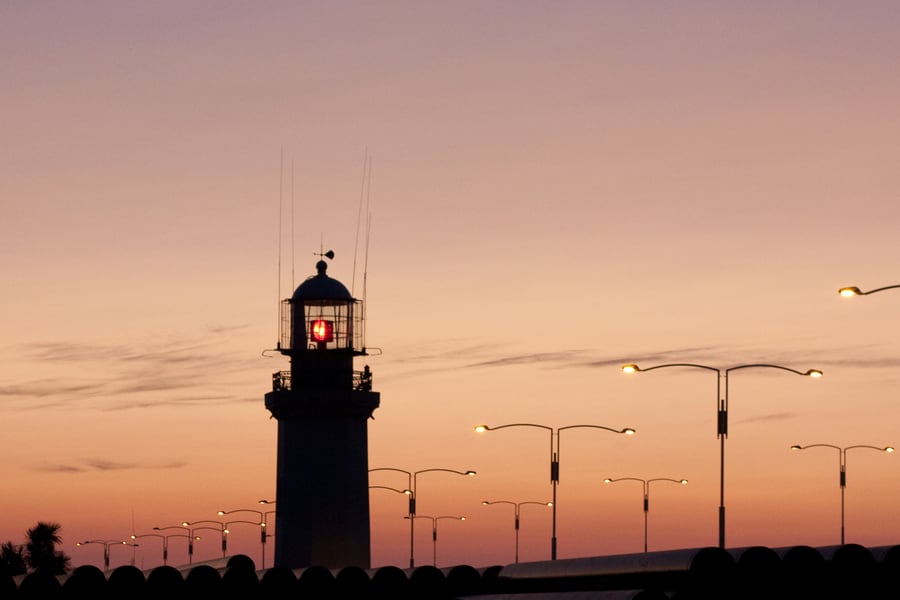 Dima / Wikimedia Commons · CC BY 2.0 · cropped
Batumi, and its lighthouse
The line ends four kilometres short of the old town, which is the better half of Batumi: low nineteenth-century streets from the years when this was the outlet for Baku's oil, laid out around squares that have kept their trees. The lighthouse on the boulevard is the oldest structure on it — built in 1863, while Batumi was still Ottoman, rebuilt by French engineers in 1882 once it was Russian, and working yet.Where to Sleep
The two ends of the line are the two places worth a night, and Kobuleti is the one intermediate stop with hotels on the beach it sits behind. Tbilisi Central and Batumi Central are both a short taxi ride from their city centres, so neither end obliges an early start. What follows for each hotel is what it says about itself on its own site.
Where to stay
Rooms Hotel Tbilisi
In the Vera district, near the start of the line
A hotel in the complex of a former publishing house, with 122 rooms and suites in nine categories over five floors, the top one given to rooms with their own terraces.
Check Availability (opens in a new tab, on roomshotels.com)via roomshotels.comGeorgia Palace Hotel & Spa
On the shore at Kobuleti, the last stop before Batumi
A resort hotel on the Black Sea shore at Kobuleti, with a spa and wellness centre, two restaurants and rooms ranging from garden-view doubles to family rooms and suites.
Check Availability (opens in a new tab, on gph.ge)via gph.gePiazza Boutique Hotel
On the piazza in old Batumi
A sixteen-room hotel on the Piazza in the old town, part of a complex that also holds a second hotel, five restaurants and a marble mosaic of 106 square metres.
Check Availability (opens in a new tab, on piazza.ge)via piazza.geQuestions or corrections
Planning this trip and stuck on something, or spotted a time, fare or detail that has changed? Send us a message about Tbilisi to Batumi — over the Surami Pass to the Black Sea. We read every one, and we update this page when something has changed.