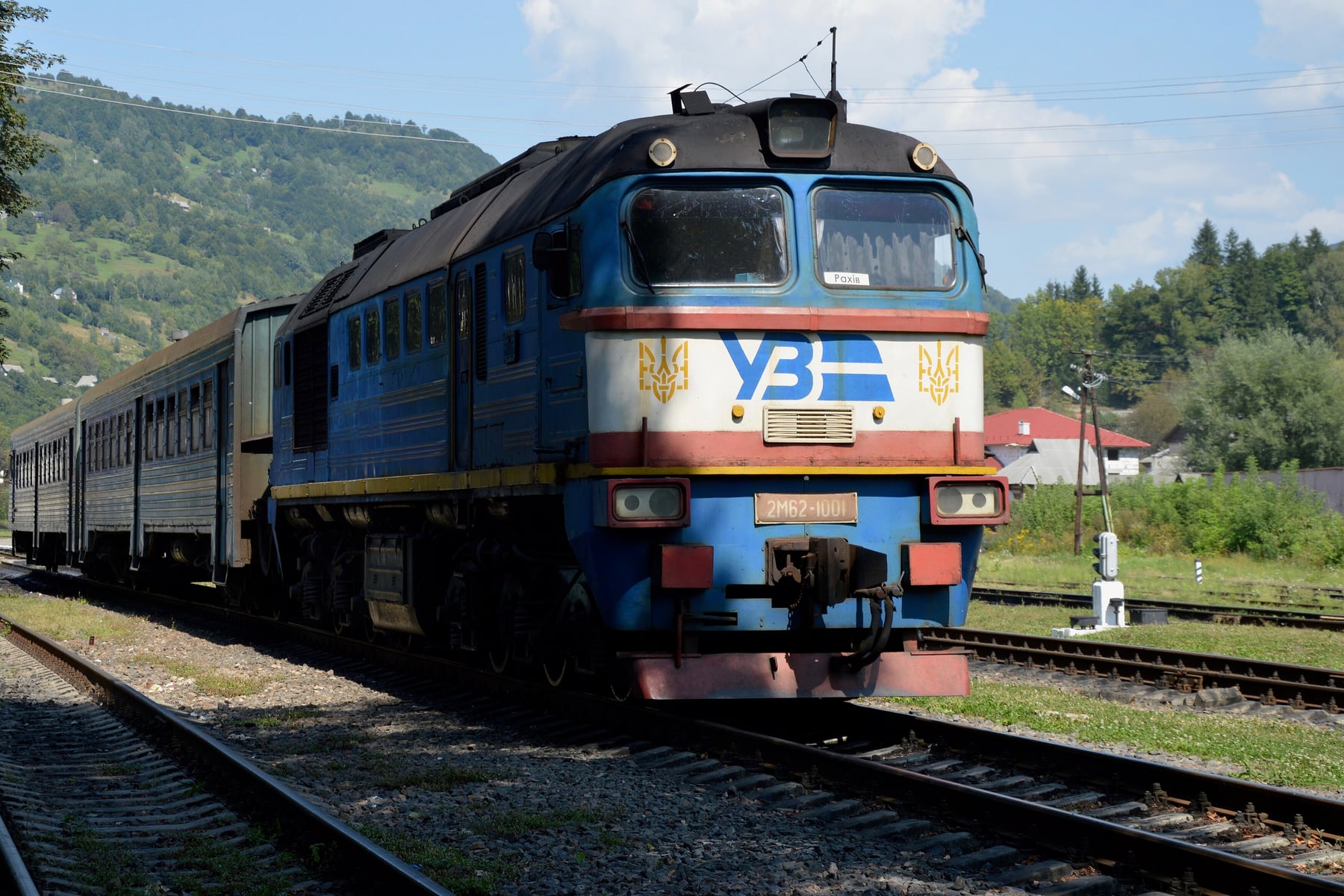
Ivano-Frankivsk to Rakhiv
VargaA / Wikimedia Commons · CC BY-SA 4.0 · 2019 · cropped
- DistanceAbout 146 km, Ivano-Frankivsk to Rakhiv
- Duration2 hr 59 min to 3 hr 29 min
- Best seasonDaily, mornings towards Rakhiv
Introduction
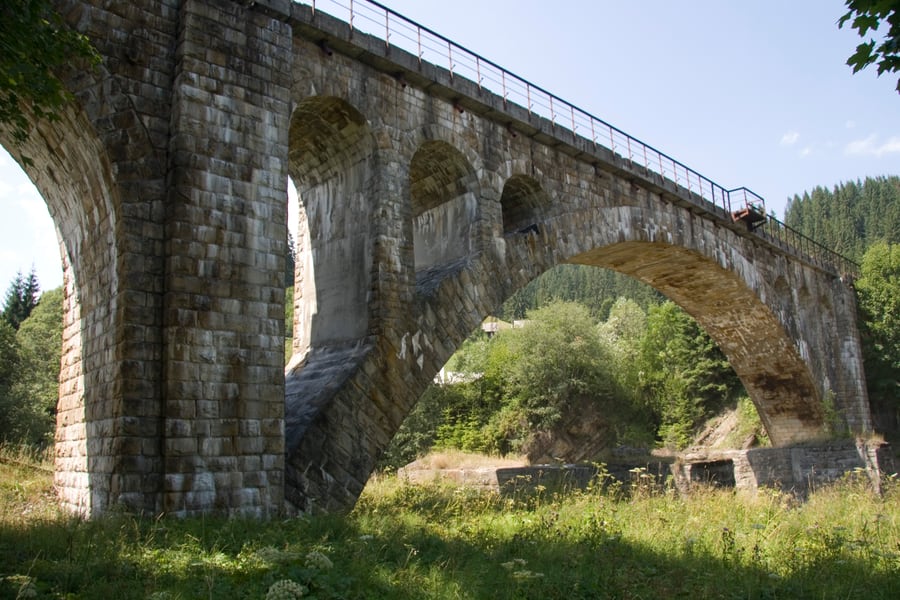
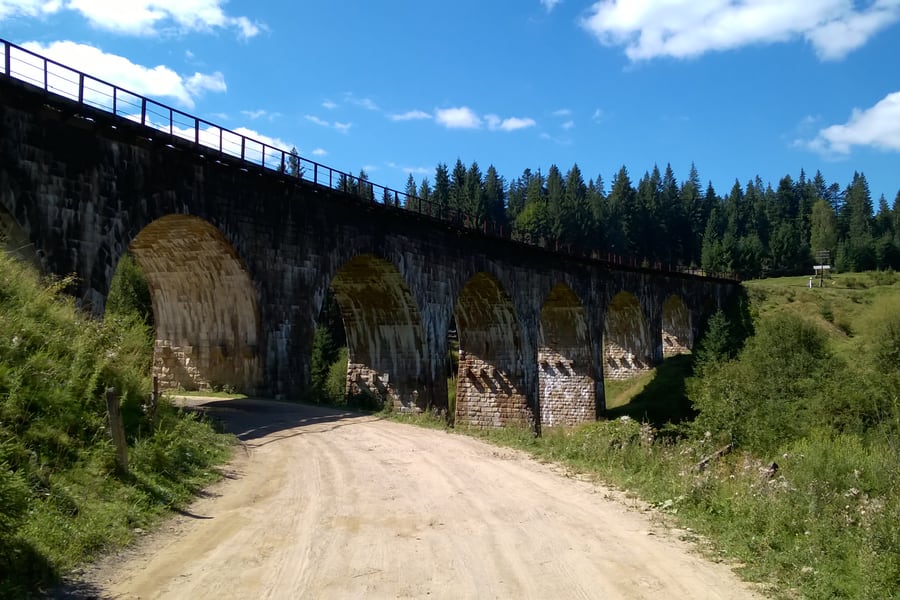
In 1894 Austria-Hungary drove a railway south from Stanislau, today's Ivano-Frankivsk, up the valley of the Prut and over the Carpathian watershed into the valley of the Tisza. It was built in stone. Around Vorokhta, where the line climbs out of the Prut valley, four viaducts of local sandstone carried it across the ravines — the longest of them 200 metres, on arches up to 30 metres wide.
A train still makes the whole climb. Train 95, the Hutsulshchyna from Kyiv, leaves Ivano-Frankivsk at 06:12 and reaches Rakhiv at 09:11: three hours and about 146 kilometres through Yaremche, Vorokhta and Yasinia, on a single diesel line with the river alongside for most of the way.
The two biggest viaducts were bypassed in 2000 and now stand beside their replacements, empty and open to walk under. The other two still carry the train. On the far side of the ridge the line drops through forest into Hutsul country — wooden churches, shingled roofs, and Hoverla, the highest mountain in Ukraine, in view from the carriage window.
The Journey
The line is single-track and unelectrified from end to end, so the trains are diesel. The engine you are most likely to meet is the 2M62, the twin-section version of the M62 that the Luhansk works designed in the 1960s for heavy freight — two bodies coupled back to back, a cab at each end. Ukrainian Railways uses the type on this line for passenger trains too.
Up the Prut
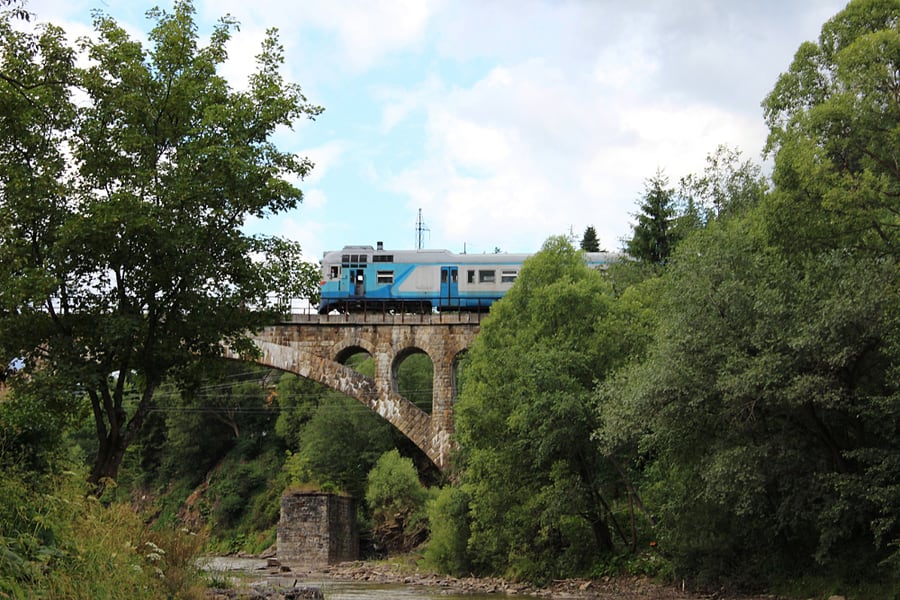
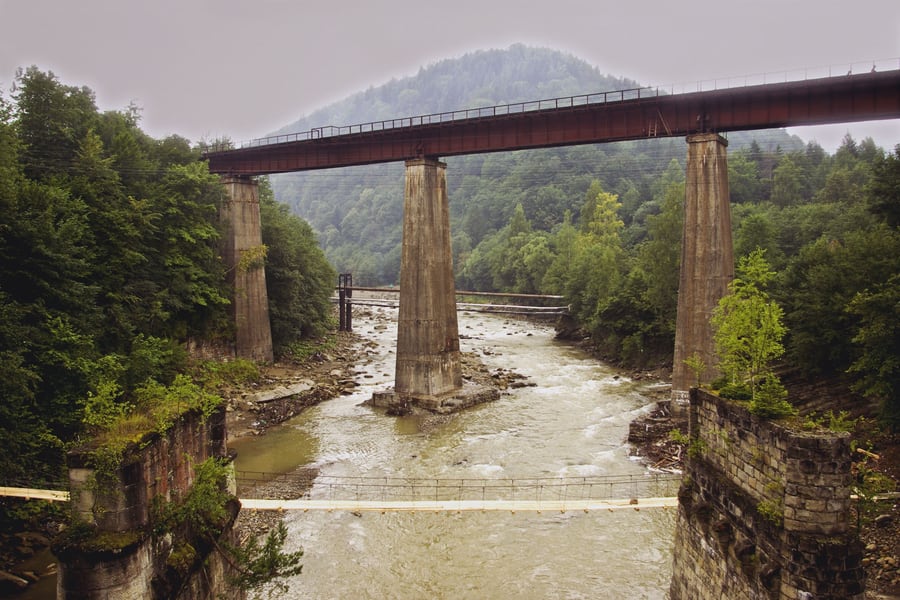
Out of Ivano-Frankivsk the train runs south across open farmland to Deliatyn, where the hills begin, and into the gorge of the Prut. At Yaremche, 20 kilometres on, the line crosses the river high above a rocky channel. An arch of 65 metres stood here from 1894, one of the widest stone railway arches in Europe; it was destroyed in the fighting after the First World War, rebuilt and reopened in July 1927, and blown up again in 1944. The iron girder bridge on piers that replaced it spans the gorge between the old stone abutments.
The viaducts
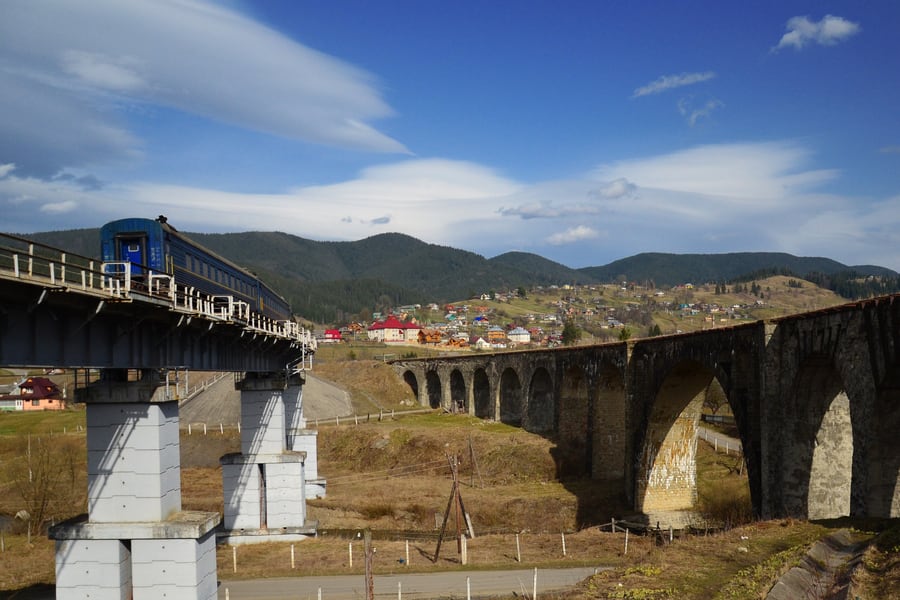
The line climbs on past Mykulychyn and Tatariv, and at Vorokhta, about 800 metres up, it curves across the valley on stone. The Carpathian National Nature Park counts four viaducts built around the village in 1894–1895, of sandstone quarried at Yamna, below Yaremche: 130, 170, 185 and 200 metres long. In 2000 new bridges were built beside the two largest, which have carried no trains since; the other two are still in use, so the train crosses stone arches on its way in and a modern deck with the old viaduct alongside. Under martial law the bridges count as strategic sites — a film crew shooting there in 2025 needed military permits — and the working ones are not places to linger with a camera.
Over the watershed
Beyond Voronenko the line goes into tunnels under the ridge, crossing from Ivano-Frankivsk oblast into Zakarpattia and from the Prut's basin into the Tisza's. It comes out at Lazeshchyna, where Hoverla stands above the valley, and runs down to Yasinia, a large Hutsul village and the start of most walks into the Chornohora range.
Down the Black Tisza
The last 27 kilometres follow the Black Tisza down a narrowing valley, crossing and recrossing the river past Kvasy, to Rakhiv, where the Black and White Tisza meet. The track goes on another 20 kilometres to Dilove and the Romanian border; the trains from Ivano-Frankivsk stop here.
Along the route
 Adam Nowak / Wikimedia Commons · Public domain · 2009 · cropped
Up the Prut
At Yaremche the train crosses the Prut gorge on an iron girder bridge, set between the stone abutments of a 65-metre arch that was reopened in 1927 and blown up in 1944.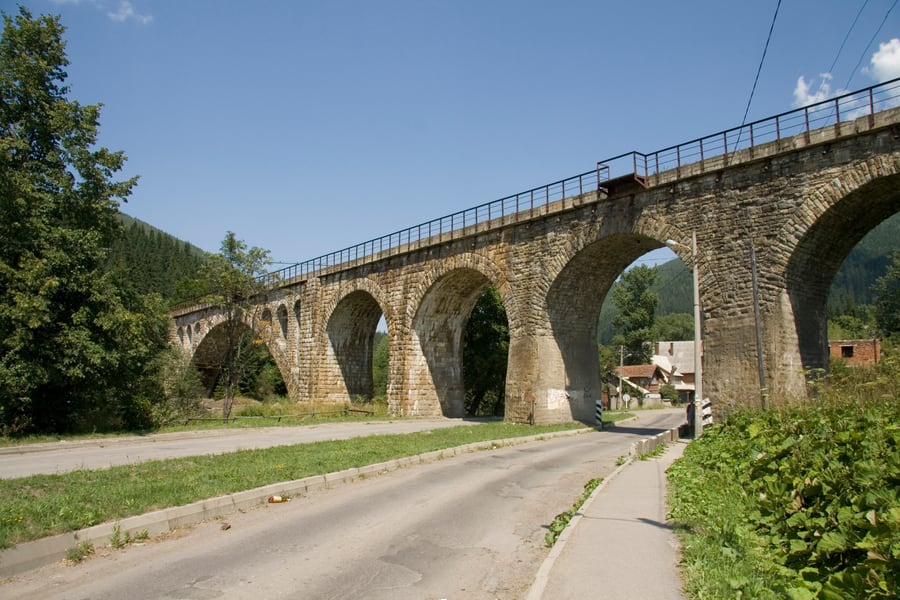 Dmytro Petishkin / Wikimedia Commons · CC BY 4.0 · 2012 · cropped
Across Vorokhta
Four sandstone viaducts from 1894–95 carry the line around the village. The train crosses the two still in use; the two largest stand beside the bridges that replaced them in 2000.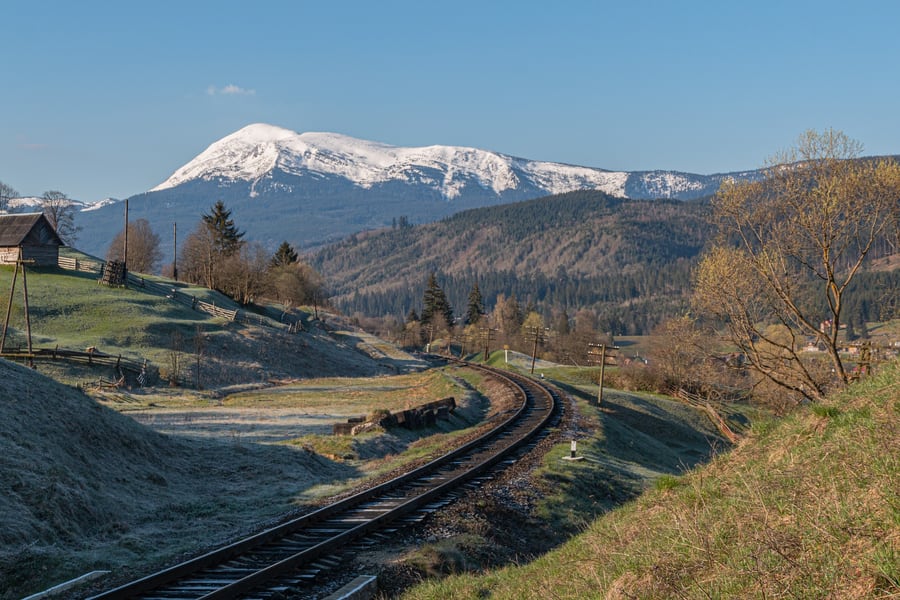 Robert-Erik / Wikimedia Commons · CC BY-SA 4.0 · 2021 · cropped
Under the ridge
Past Voronenko the line tunnels under the watershed into Zakarpattia. At Lazeshchyna, on the far side, Hoverla — the highest mountain in Ukraine — stands over the valley.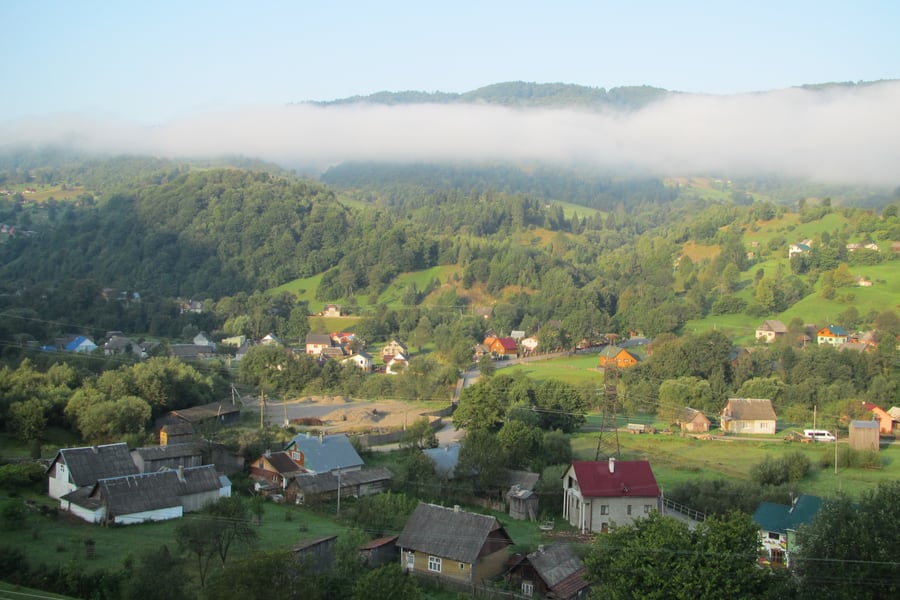 Gudyma s / Wikimedia Commons · CC BY-SA 3.0 · 2019 · cropped
Down the Black Tisza
The last 27 kilometres from Yasinia follow the Black Tisza down its valley past Kvasy, to Rakhiv, where it meets the White Tisza.A bit of history
Culture & experiences along the way
 Мандрівниця / Wikimedia Commons · CC BY-SA 4.0 · 2022 · cropped
Banosh
The Hutsul dish of the mountains: cornmeal cooked in smetana until it is smooth and rich, then topped with crumbled bryndza, crisp pork rind and often mushrooms. It is eaten across Ukraine, but nowhere more than here in the Carpathians — the thing to order after a day walking under the viaducts.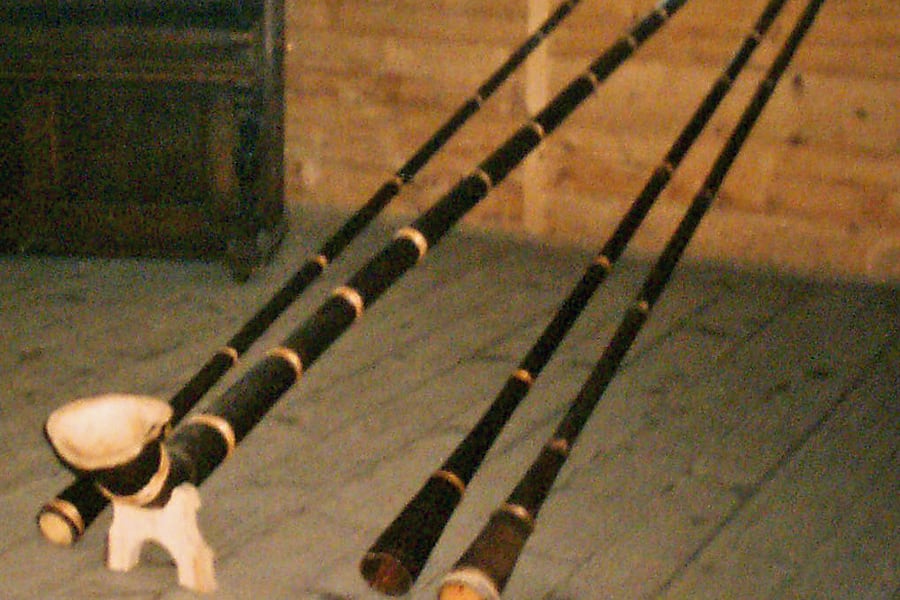 Bechstein / Wikimedia Commons · CC BY-SA 3.0 · cropped
The trembita
The Hutsul alpine horn: a straight wooden tube from two and a half to eight metres long, with no valves or keys, sometimes wrapped in birch bark. Its home is the eastern Ukrainian Carpathians and above all Hutsul country, and its long, carrying calls are played in the top of its range.Timetables
No train runs only between Ivano-Frankivsk and Rakhiv: the through trains are long-distance sleepers from Kyiv, Kharkiv, Sumy and Kryvyi Rih that make the mountain section their last three hours, in daylight in the morning. Every seat is reserved. Read from Ukrainian Railways' station boards in September 2026.
| Train | Ivano-Frankivsk | Yaremche | Vorokhta | Yasinia | Rakhiv |
|---|---|---|---|---|---|
| 95 Hutsulshchyna, from Kyiv — daily | 06:12 | 07:19 | 07:58 | 08:31 | 09:11 |
| 1 Yednist, from Kharkiv — odd dates, daily from 28 Sep | 06:50 | 08:01 | 08:40 | 09:14 | 09:55 |
| 293, from Kryvyi Rih — alternate days | 07:57 | 09:08 | 09:57 | 10:43 | 11:26 |
| Train | Rakhiv | Yasinia | Vorokhta | Yaremche | Ivano-Frankivsk |
|---|---|---|---|---|---|
| 144, to Sumy — odd dates, daily from 3 Oct | 13:28 | 14:12 | 14:45 | 15:20 | 16:36 |
| 2 Yednist, to Kharkiv — even dates, daily from 29 Sep | 16:45 | 17:28 | 18:01 | 18:37 | 20:08 |
| 56, to Kyiv — daily | 17:52 | 18:35 | 19:14 | 19:51 | 21:27 |
| 96 Hutsulshchyna, to Kyiv — daily | 21:22 | 22:06 | 22:40 | 23:19 | 00:37 |
The afternoon trains back are the ones to take for the views; 96 crosses the mountains in the dark.
To Vorokhta from Lviv
A regional express, train 808, is timetabled daily through October 2026 from Lviv (10:48) to Vorokhta and back, through Ivano-Frankivsk (12:58) and Yaremche (14:07) to Vorokhta at 14:40, returning at 16:18 to reach Ivano-Frankivsk at 18:17 and Lviv at 20:40. It is the easy way to see the viaducts as a day out; it does not go on over the ridge.
Individual dates are sometimes changed or cancelled. Live times are on Ukrainian Railways' timetable (opens in a new tab).
Tickets
Tickets are sold by Ukrainian Railways only: online at booking.uz.gov.ua (opens in a new tab), in the UZ app, or at a station window. The through trains to Rakhiv are long-distance workings, so a seat or berth from Ivano-Frankivsk is a short section of a much longer booking — in summer and at holidays they fill from the far end, and it is worth reserving ahead rather than turning up.
Every place is reserved and named on the ticket. Fares are set by UZ, quoted in hryvnia and shown at the point of sale; foreign cards are accepted online, and the ticket is a QR code the conductor scans at the carriage door.
Book your tickets
Train 95, Ivano-Frankivsk to Rakhiv
The morning crossing, 2 hr 59 min
Reserved seats and berths on the daily Hutsulshchyna from Kyiv, sold by Ukrainian Railways.
Book Tickets (opens in a new tab, on booking.uz.gov.ua)via booking.uz.gov.uaTrain 808, Lviv to Vorokhta
The viaducts as a day out
The regional express that runs up from Lviv through Ivano-Frankivsk to Vorokhta and back the same afternoon.
Book Tickets (opens in a new tab, on booking.uz.gov.ua)via booking.uz.gov.uaUkrainian Railways timetable
The operator's live schedule and changes
The station boards this page's times were read from, kept current by the operator.
Book Tickets (opens in a new tab, on uz.gov.ua)via uz.gov.uaRail Passes
No rail pass covers this journey. Ukraine is not one of the countries in the Interrail and Eurail pass network, and Interrail sells no One Country Pass for it, so neither a Global Pass nor any country pass buys a kilometre of Ukrainian track. Checked on the operators' own pass pages, September 2026.
That matters less than it would elsewhere, because Ukrainian fares are low by European standards and every place has to be reserved individually in any case. Buy the Ukrainian legs from Ukrainian Railways and keep any pass for the country you arrive through.
Places to Visit
The stops that reward getting off are Yaremche, for the waterfall a short walk from the station; Vorokhta, for the viaducts and the wooden church above them; and Yasinia, for the UNESCO-listed Struk church. Hoverla takes a day of its own.
 Gudyma s / Wikimedia Commons · CC BY-SA 3.0 · 2021 · cropped
Probiy waterfall, Yaremche
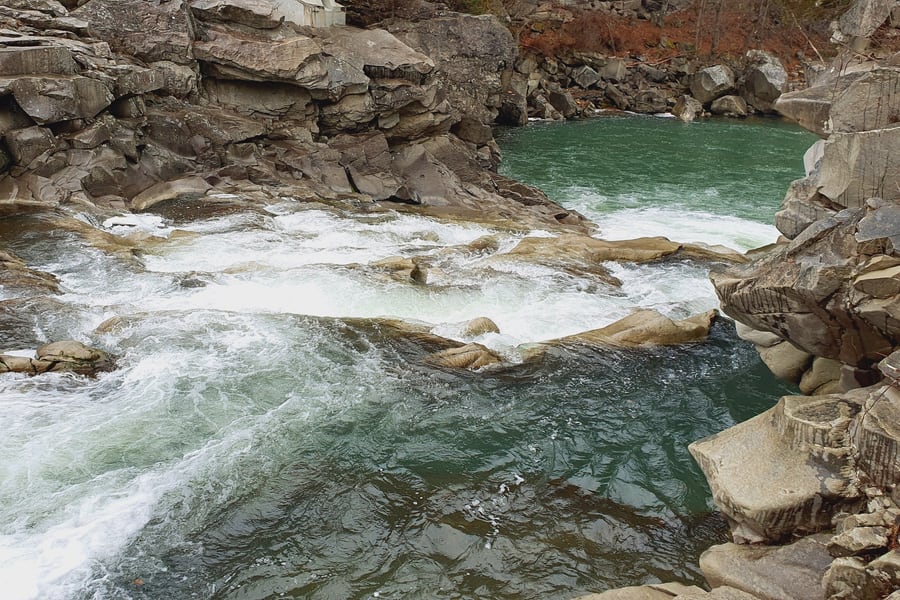
The Prut drops 8 metres through a slot in the rock a short walk from Yaremche station — one of the most powerful waterfalls in the Ukrainian Carpathians. It was higher in the 19th century, before the river deepened the channel above it. The rocks are slippery, and the viewing rails are there for a reason.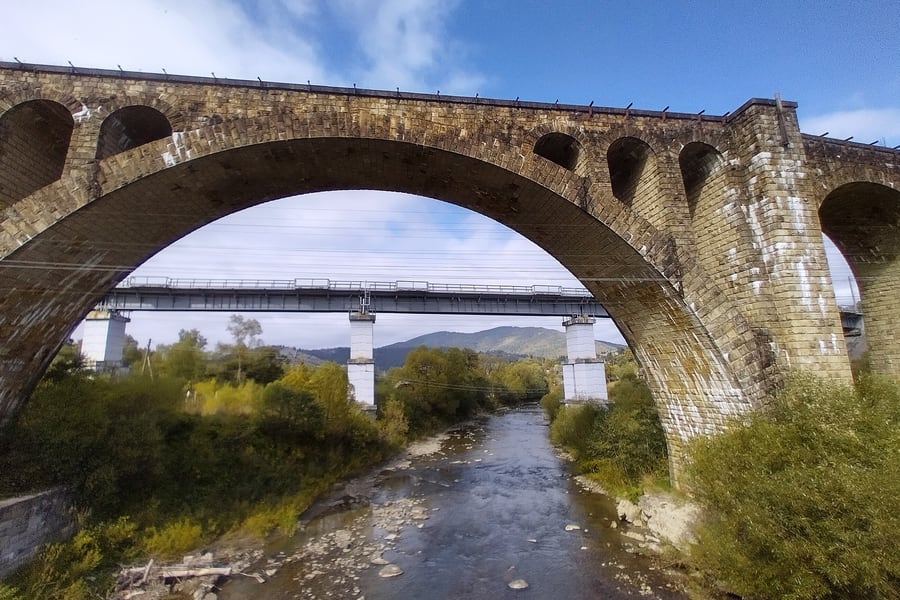 Половко Сергей Николаевич / Wikimedia Commons · CC BY-SA 4.0 · 2021 · cropped
The old viaducts, Vorokhta
The two largest of Vorokhta's four viaducts — 200 and 185 metres long — have carried no train since 2000, when new bridges were built beside them. The bigger one stands near the Church of the Nativity, its main arch 30 metres wide, and a lane runs underneath. Both were built in 1894–1895 of sandstone from the quarry at Yamna.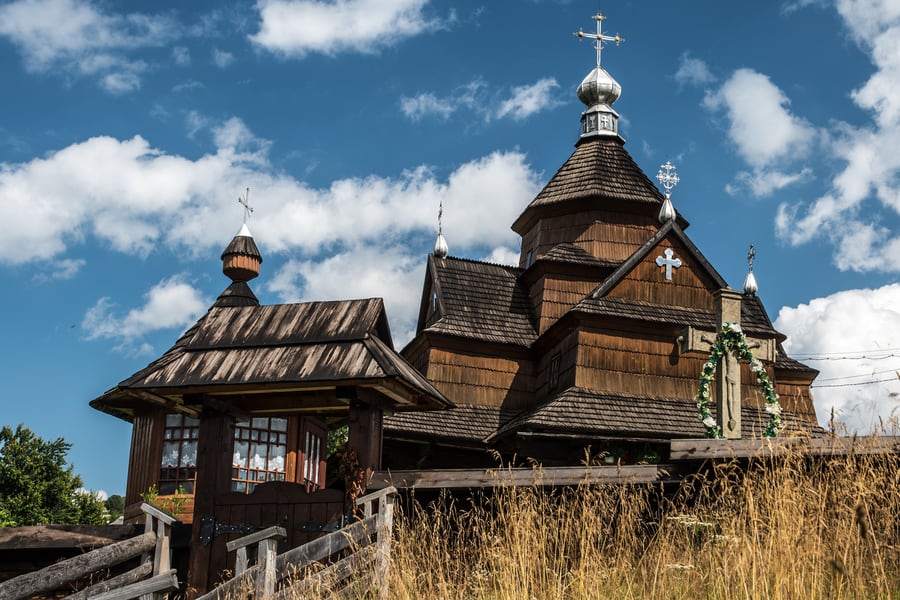 Sebastian Mierzwa / Wikimedia Commons · CC BY-SA 4.0 · 2019 · cropped
Church of the Nativity, Vorokhta
A wooden Hutsul church on a hill at the north end of the village, cross-shaped in plan with a single central dome, and often called the most perfectly proportioned of its kind. It was built elsewhere and moved here in the 18th century. Nineteenth-century wall paintings survive inside, and the bell tower holds a small museum.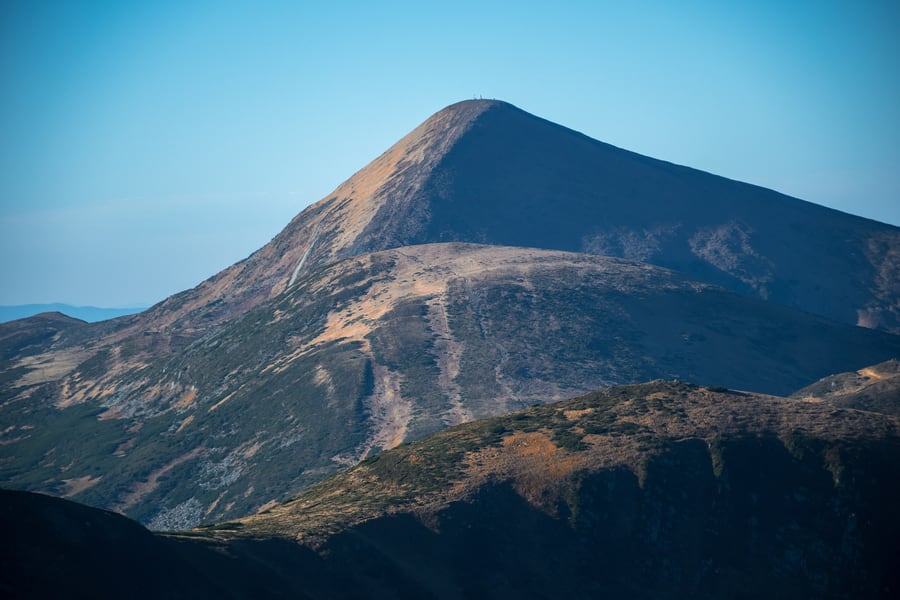 Nata Mostova / Wikimedia Commons · CC BY-SA 4.0 · 2019 · cropped
Hoverla
At 2,061 metres the highest mountain in Ukraine, in the Chornohora range, with the main spring of the Prut on its eastern slope. The usual way up starts at the Zarosliak base above Vorokhta and climbs more than 1,100 metres on a steep path — a long day, and in winter a mountaineering route.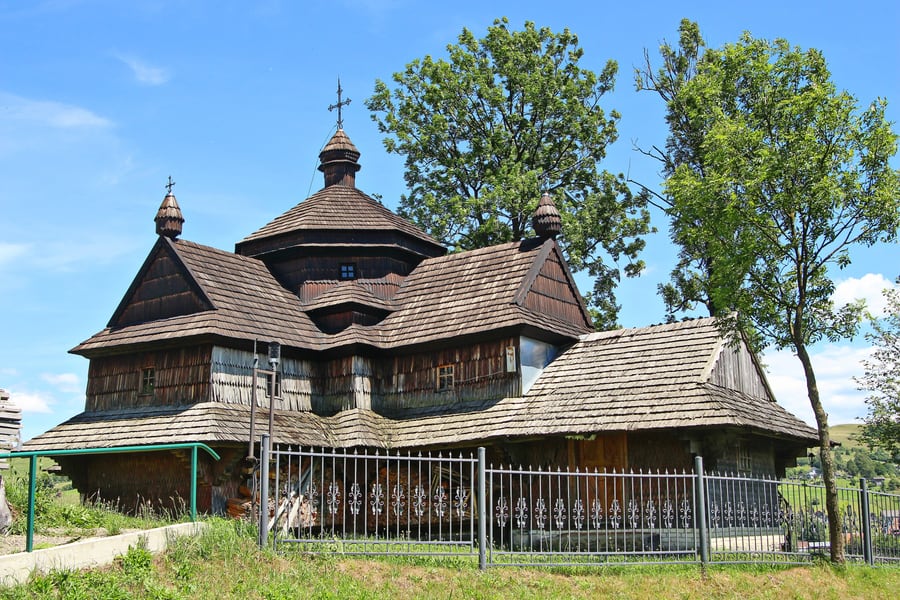 Oleksandr Malyon / Wikimedia Commons · CC BY-SA 4.0 · 2024 · cropped
The Struk church, Yasinia
The wooden Church of the Ascension, known as the Struk church, is one of eight Ukrainian churches inscribed on the UNESCO World Heritage List in 2013 as the Wooden Tserkvas of the Carpathian Region. It keeps the original iconostasis from the time it was built.Where to Sleep
The morning trains leave Ivano-Frankivsk between 06:12 and 07:57, so a night in the city before the climb makes the journey. At Rakhiv the first train back is not until 13:28, so arriving on 95 still leaves a morning in the town — or stay the night and take the valley at a slower pace.
Ukraine is under martial law, and a curfew applies — its hours are set by each regional military administration and change with the security situation. Train 96 reaches Ivano-Frankivsk at 00:37; check the current hours for the oblast before arriving that late, and tell the hotel when to expect you.
Where to stay
Optima Collection Park Hotel
Hetmana Mazepy 146, Ivano-Frankivsk
Seventy-nine rooms beside a lake by the city park, a five-minute walk from the historic centre.
Check Availability (opens in a new tab, on optimahotels.com.ua)via optimahotels.com.uaRakhiv Hotel & Apartments
Myru 44, Rakhiv
A hotel and apartments in the town, with a restaurant serving Transcarpathian dishes.
Check Availability (opens in a new tab, on hotelrakhiv.com)via hotelrakhiv.comQuestions or corrections
Planning this trip and stuck on something, or spotted a time, fare or detail that has changed? Send us a message about Ivano-Frankivsk to Rakhiv. We read every one, and we update this page when something has changed.