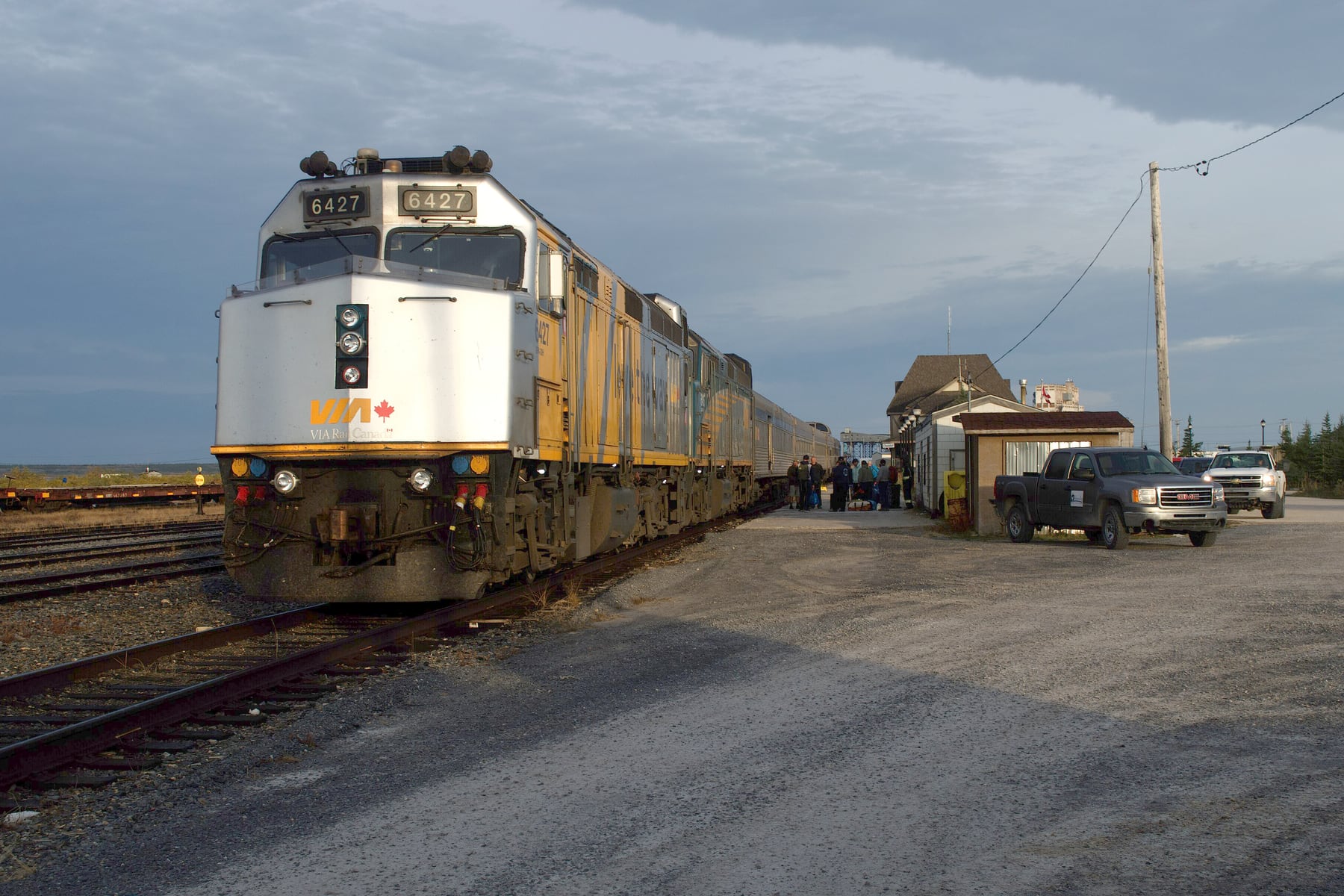
Winnipeg to Churchill
Phil Richards / Wikimedia Commons · CC BY-SA 2.0 · cropped
- Distance1,694 km
- Duration2 nights
- Best seasonAll year · 2 departures a week
Introduction
Churchill has no road. Nothing reaches it by land except this railway — 1,694 km north from Winnipeg, two departures a week, one day, twenty hours and fifty-five minutes if the track behaves. The alternative is a flight. That single fact is what makes VIA Rail's Winnipeg–Churchill train different from every other scenic run in Canada: it is not an excursion laid on for the view, it is the only surface link a town of 870 people has to the rest of the country, and it carries groceries, contractors, students and polar bear tourists in the same consist.
The line proved how much that matters in May 2017, when spring flooding tore out twenty-three sections of track between Gillam and Churchill and service north of Gillam simply stopped. For eighteen months the town was supplied by air while its owner and Ottawa argued about who should pay. The line was bought out of that stand-off on 31 August 2018 by the Arctic Gateway Group, repaired inside two months, and passenger trains ran again on 2 December 2018. It is now owned by forty-one Indigenous and Bayside communities, twenty-nine of them First Nations — the people it exists to serve.
What two nights in a 1950s stainless-steel car buy you is the whole width of the boreal forest, and then the end of it: the trees thin, shrink and stop, the train slows to walking pace over ground that never properly thaws, and it puts you down at nine in the morning on the shore of Hudson Bay.
The Journey
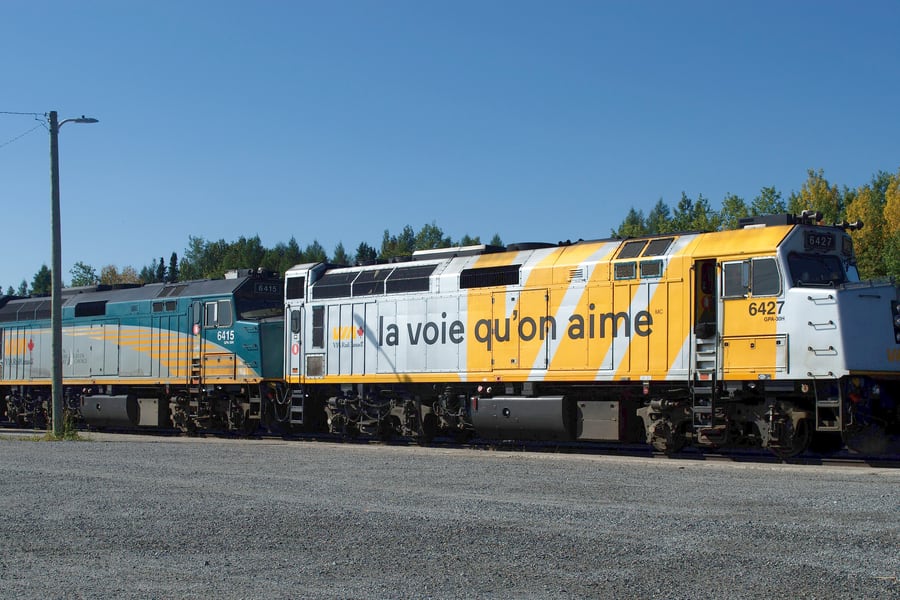
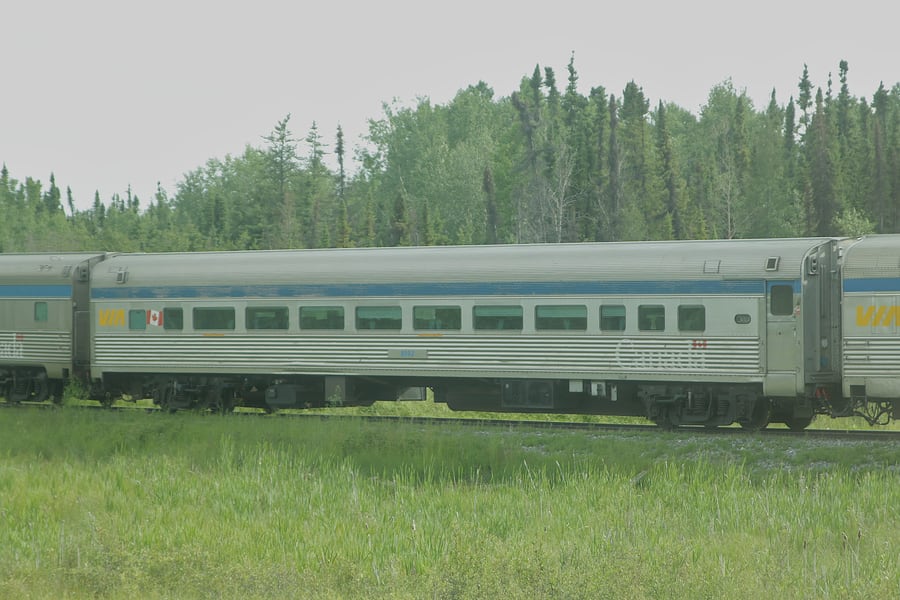
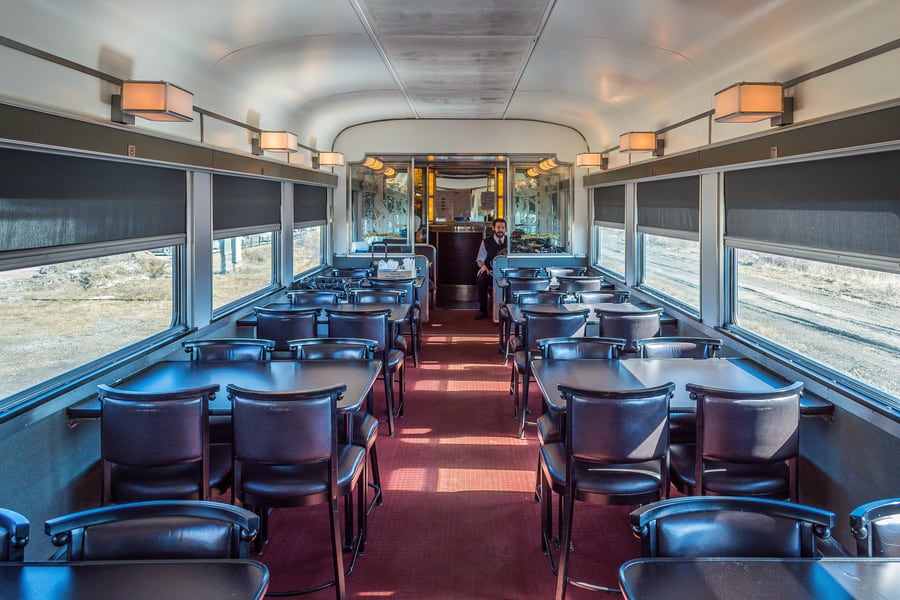
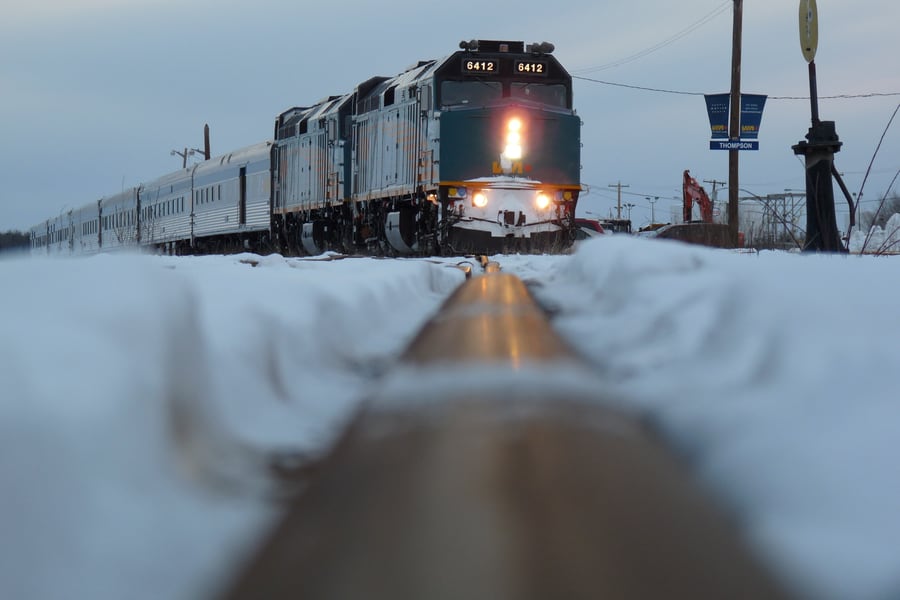
The train that leaves Winnipeg Union Station at five past twelve is short and unglamorous: a pair of F40PH-2 locomotives, a baggage car, stainless-steel Economy coaches, sleeping cars, and a car with a galley and a lounge. The F40s are General Motors machines built between November 1987 and April 1989 — VIA runs fifty-three of them and has rebuilt the class rather than replace it. Behind them, the passenger cars are older than the locomotives by three decades. The Economy coaches numbered 8100 to 8147 were built by Budd, AMF and Septa between 1946 and 1955, most of them in the fifties for Canadian Pacific's own transcontinental trains, and VIA bought them second-hand in 1978. Some have been stripped back to the chassis and rebuilt four times. They will outlive most things on the network.
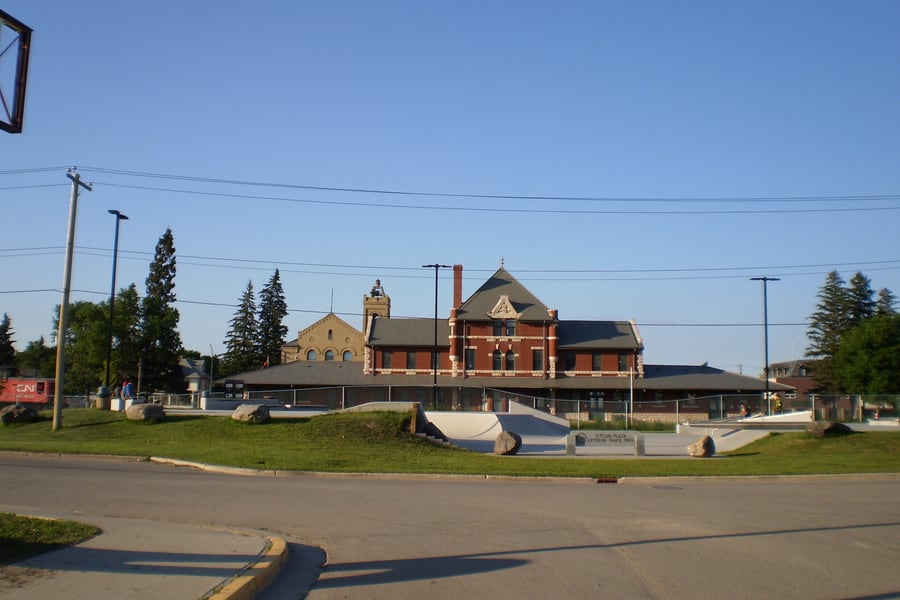
For the first six hours nothing about the journey feels northern. The line runs west and then north-west out of Winnipeg through Portage la Prairie and a string of prairie towns — Gladstone, Plumas, Glenella, McCreary, Laurier, Ochre River — most of which the train only stops at if somebody asks. At Dauphin it pauses properly beside a Canadian Northern station of 1912 that the province rates among its finest railway buildings. Then, between Roblin and The Pas, the route does something no map suggests: it leaves Manitoba entirely and runs for nine stops through Saskatchewan — Togo, Kamsack, Veregin, Mikado, Canora, Sturgis, Endeavour, Reserve and a town actually called Hudson Bay — before crossing back.
Where the Hudson Bay Railway begins
The Pas, reached at a quarter to two in the morning, is the join. Everything south of it is ordinary Canadian National main line. Everything north is the Hudson Bay Railway, the 800 km line to the coast, owned and operated by the Arctic Gateway Group, and the reason this journey is not like other journeys.
Building it took twenty years and beat two governments. Agitation for a rail outlet to the sea began in the 1870s; work started north from The Pas in 1911 and stopped when the First World War ran out of money, by which time the line had reached the Kettle Rapids on the Nelson River. The terminus was supposed to be Port Nelson, chosen in 1912 for the short approach rather than the harbour; in the 1920s, on the advice of the English engineer Frederick Palmer, it was switched to Churchill for its deep water. Some three thousand labourers — Canadians, Americans, and immigrants from Russia, Scandinavia and across Europe — laid the last stretch with picks, shovels and wheelbarrows across muskeg that could swallow a whole section of roadbed. The last spike went in at Churchill on 3 April 1929; the port opened for grain in 1931. Parks Canada unveiled a plaque marking the whole undertaking as a national historic event at the VIA station in The Pas in 2007.
The second day
North of The Pas the timetable becomes a list of names with nothing behind them: Orok, Halcrow, Cormorant, Dering, Dyce, Wekusko, Turnbull, Ponton, Pipun. Almost all are request stops, and VIA marks them as such in its own timetable. For the communities along here the train is the bus and the delivery service in one, and it stops where somebody has asked it to.
Thompson, reached at noon, is the longest booked stop on the line — five hours, in at 12:00 and out at 17:00. It exists because INCO announced a large, high-grade nickel deposit here in 1956 and opened an integrated mine, smelter and refinery in March 1961; it is now the largest city in northern Manitoba, and the last place going north from which a road leads anywhere at all.
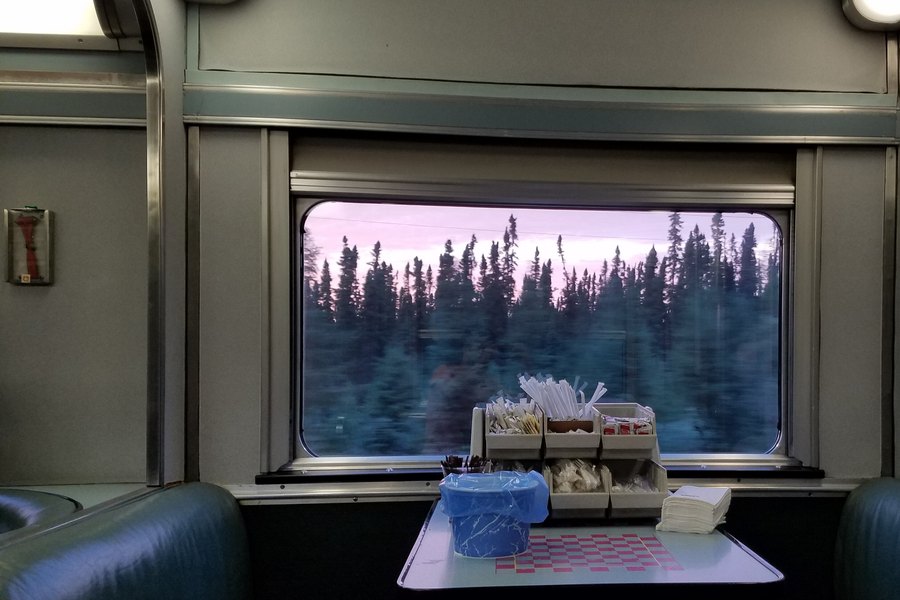
The afternoon and evening after Thompson are the best window hours of the trip: black spruce, muskeg, water, and a sky that gets bigger as the trees get smaller. Gillam comes up at eleven at night. Beyond it the line crosses the watershed between the Nelson and the Churchill rivers on ground that is frozen year-round underneath, and this is the section that failed in 2017. Arctic Gateway now watches it with drones, lidar and monitoring software, and says its investment has cut about three hours — roughly a tenth — off the running time.
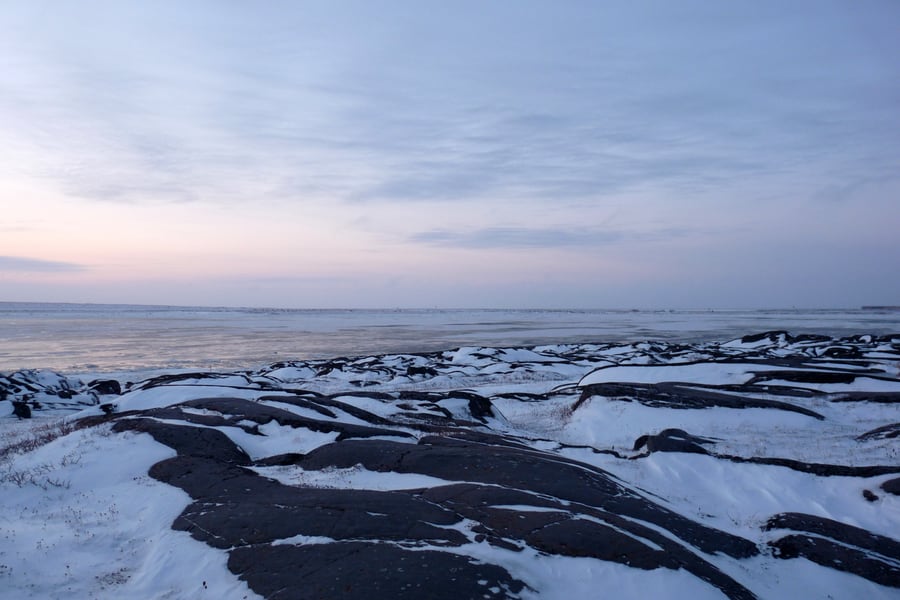
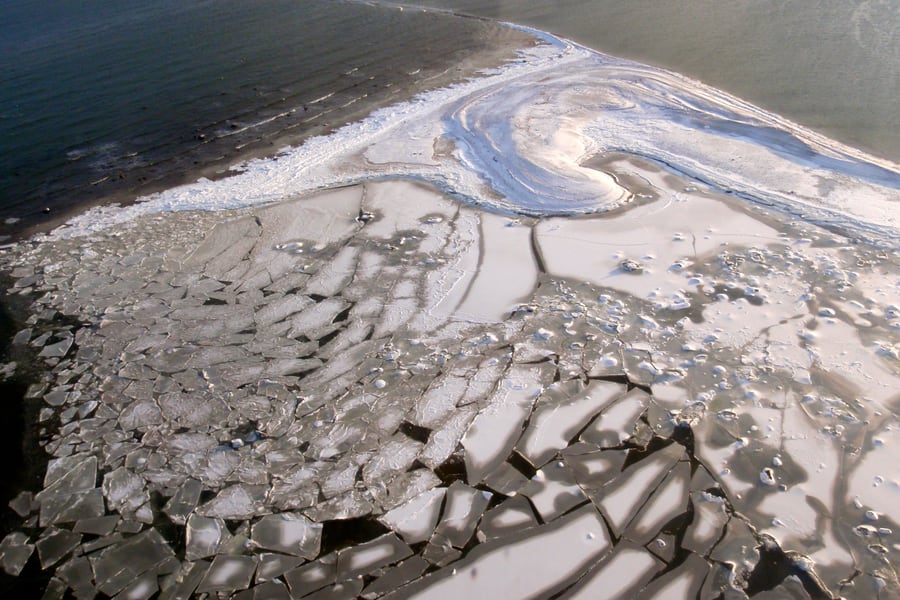
Somewhere in the small hours the tree line goes past in the dark. By breakfast the window shows tundra: no trees at all, bare Precambrian rock, and the flat white of Hudson Bay along the horizon. Churchill arrives at 09:00 on the third day.
Along the route
 Intermedichbo / Wikimedia Commons · CC BY-SA 4.0 · cropped
Out through the parkland
The first afternoon runs north-west through Portage la Prairie, Gladstone and McCreary to Dauphin, where the train pauses beside a Canadian Northern station of 1912 that Manitoba calls one of its finest pieces of railway architecture.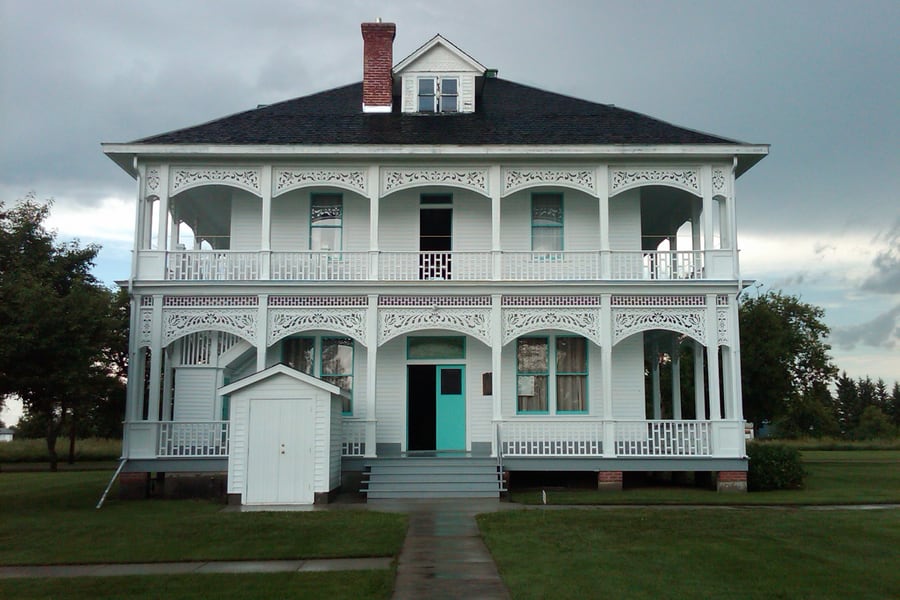 Billy Twin / Wikimedia Commons · public domain · cropped
The Saskatchewan loop
Between Roblin and The Pas the line leaves Manitoba altogether and runs through nine Saskatchewan stops — Togo, Kamsack, Veregin, Mikado, Canora, Sturgis, Endeavour, Reserve and the town of Hudson Bay.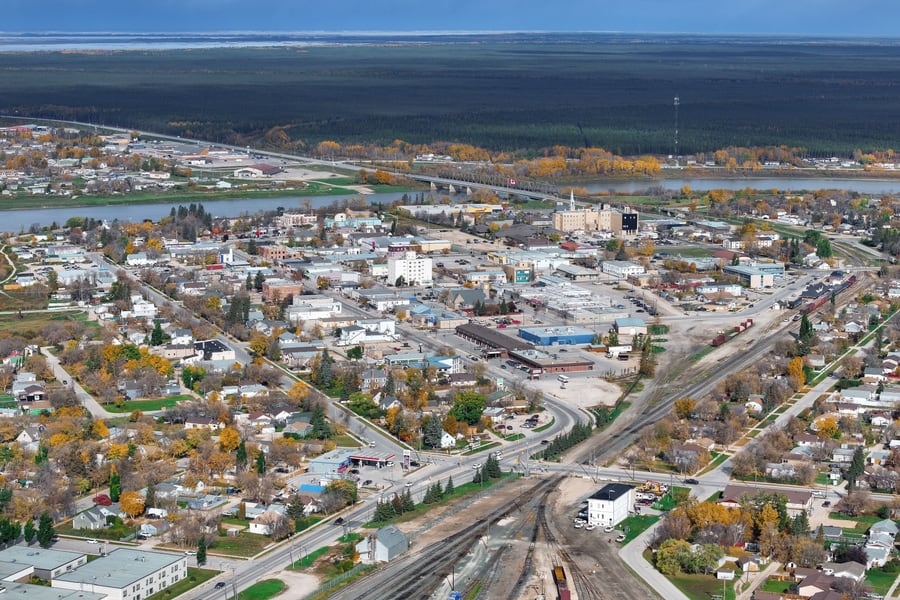 Quintin Soloviev / Wikimedia Commons · CC BY 4.0 · cropped
The Pas, in the dark
Northbound the train reaches The Pas at 01:45 and stands there three quarters of an hour. This is where the Hudson Bay Railway proper begins and where the Friday-only Churchill train starts its own run.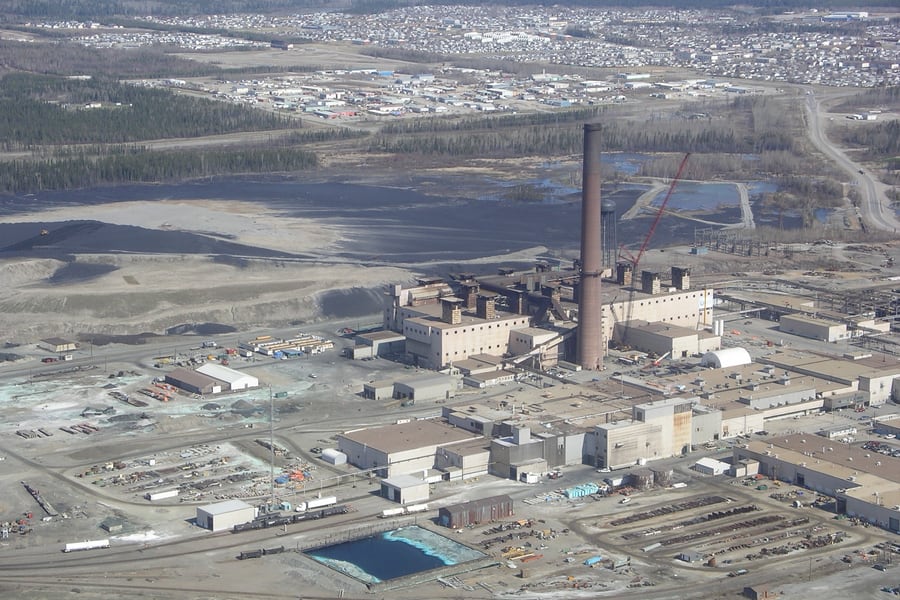 Timkal / Wikimedia Commons · CC BY-SA 3.0 · cropped
Five hours at Thompson
Thompson is a nickel town of the 1950s and the longest booked stop on the line: in at 12:00, out at 17:00. Long enough to leave the station, and long enough that nobody pretends this is an express.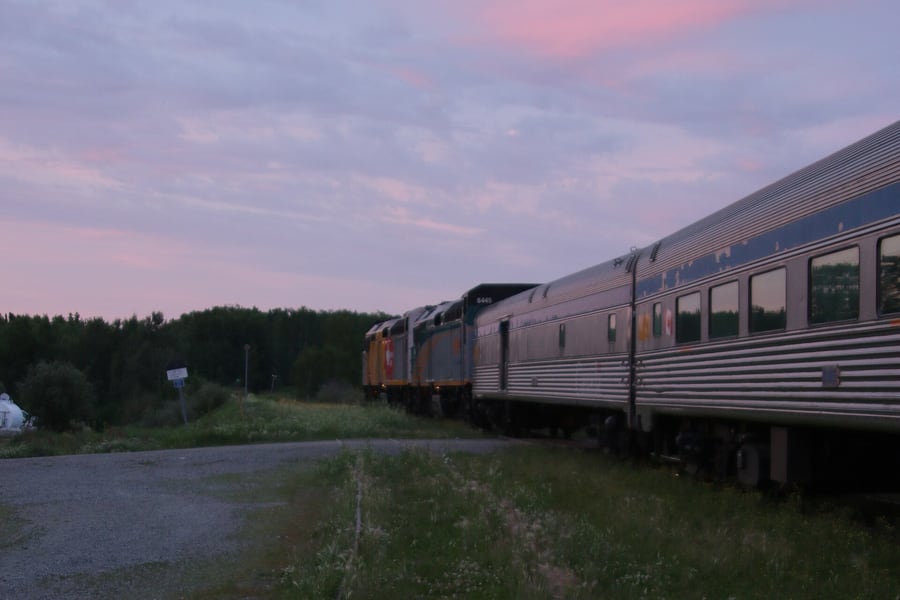 Colin Stepney / Wikimedia Commons · CC BY-SA 4.0 · cropped
Muskeg and flag stops
North of Thompson most calls are request stops — Sipiwesk, Pikwitonei, Bridgar, Pit Siding. The train is the bus, the freight service and the post for places with no road, and it stops when someone needs it to.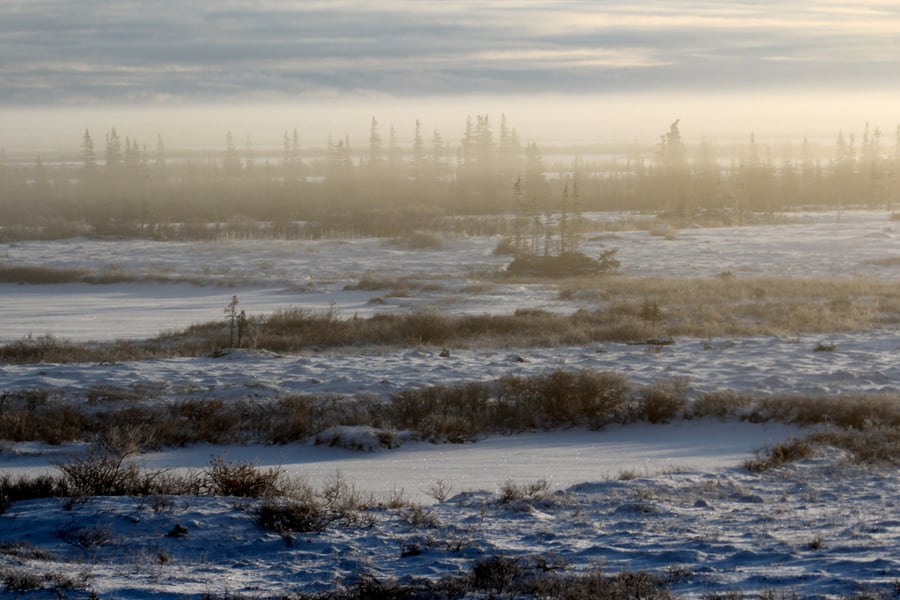 Emma / Wikimedia Commons · CC BY 2.0 · cropped
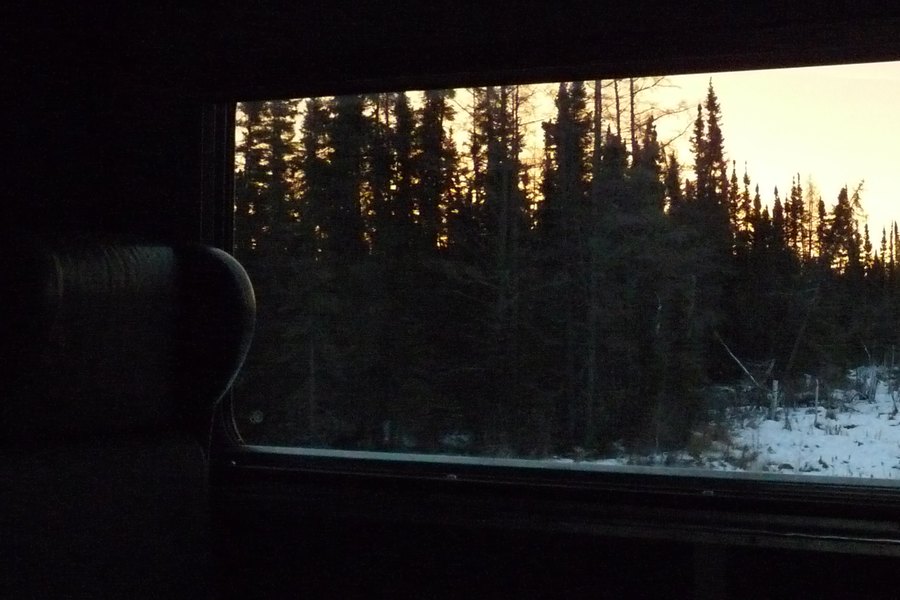
Past the tree line
Beyond Gillam the spruce thin, shrink and give out. The last 300 km run over frozen ground on a roadbed that has to be watched constantly, and the train slows to a walking pace over the worst of it.A bit of history
Culture & experiences along the way
 Cjstepney / Wikimedia Commons · CC BY-SA 4.0 · cropped
The Expedition Churchill car
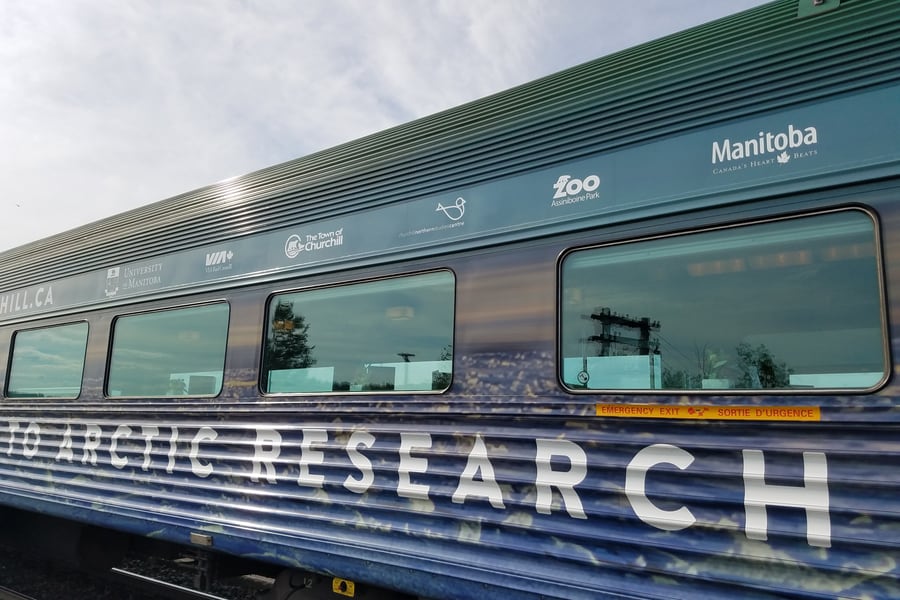
One vehicle on this train is wrapped rather than stainless: a car liveried for Expedition Churchill, the Assiniboine Park Zoo's polar bear programme, carrying the words ARCTIC RESEARCH the length of its flank. It is the only advertisement anywhere on the consist, and it advertises the reason most passengers are aboard.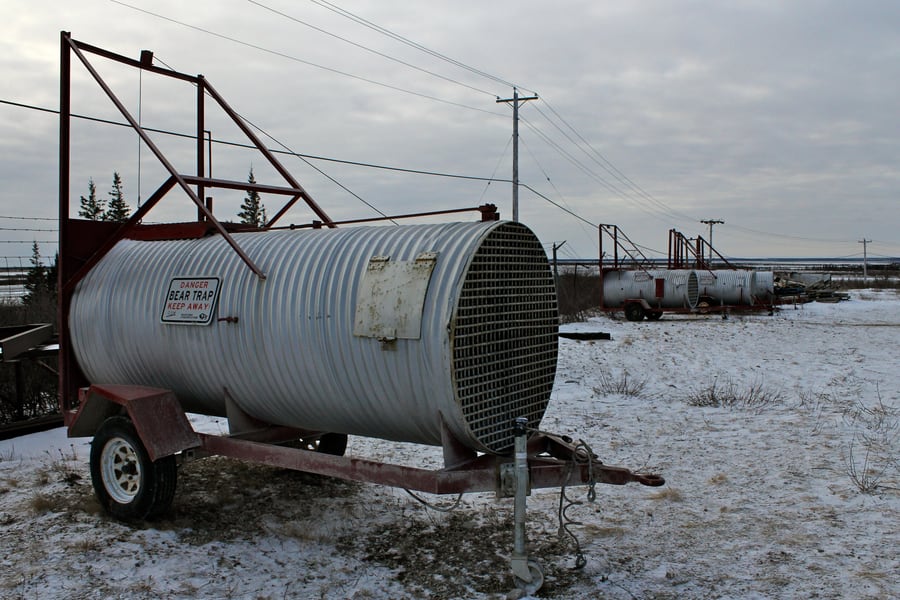 Emma / Wikimedia Commons · CC BY 2.0 · cropped
Bear traps on the edge of town
Culvert traps sit on trailers around Churchill, and they are equipment rather than display. A bear that will not be scared off is caught, held, and then — in Parks Canada's own words — relocated by helicopter or released straight onto Hudson Bay once the ice has formed. Seeing one parked tells you how the town works.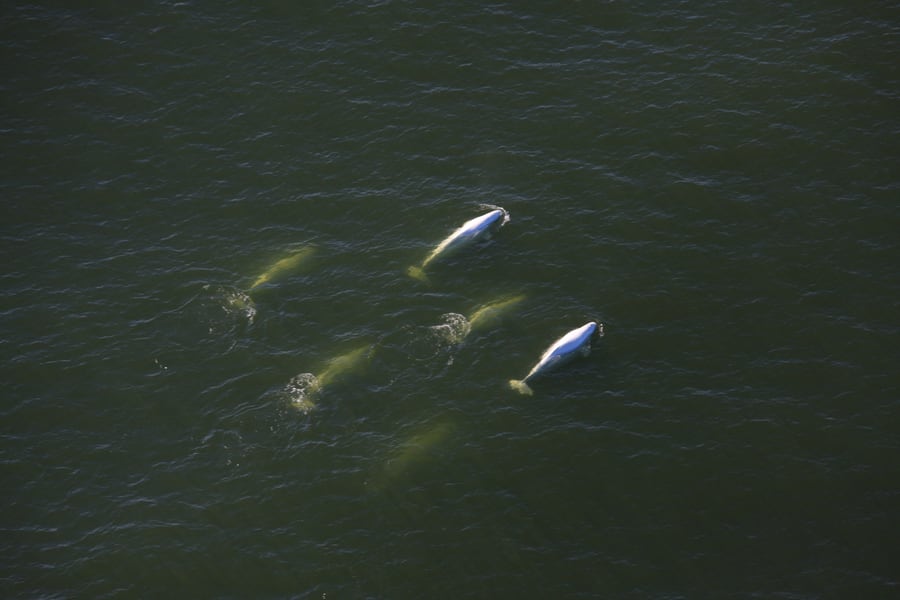 TravelingOtter / Wikimedia Commons · CC BY 2.0 · cropped
Belugas in the estuary
Once the ice breaks up, beluga whales move into the Churchill River, which the town describes as a safe place for them and their calves to feed and rest. Boats work the estuary through July and August, and the hydrophone gets you the whistles and clicks that earned belugas the name canaries of the sea.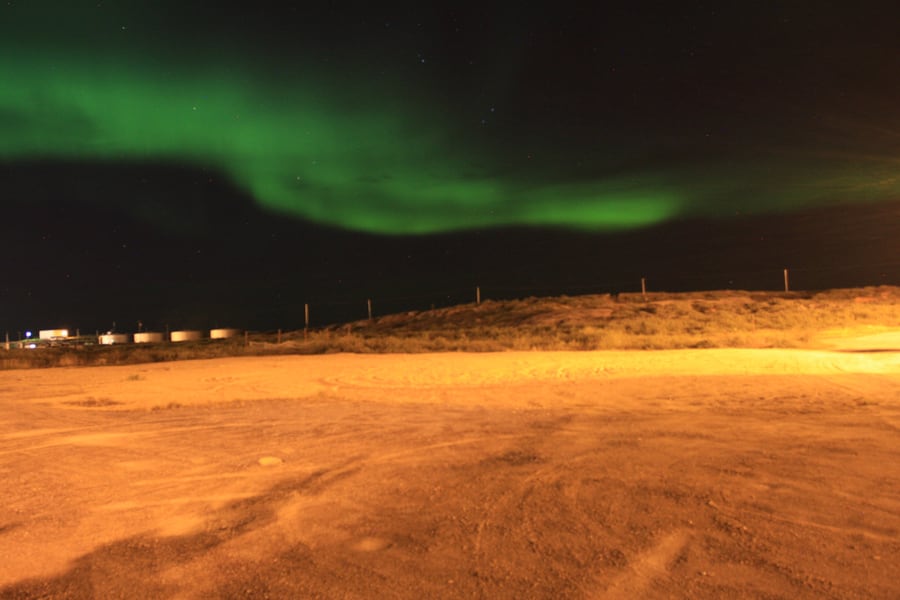 TravelingOtter / Wikimedia Commons · CC BY 2.0 · cropped
Aurora over the bay
Travel Manitoba reckons the northern lights are visible from Churchill on close to 300 nights a year. What varies is the darkness: the aurora weeks operators sell run through the winter, which is also when a berth on the train is easiest to get and cheapest to buy.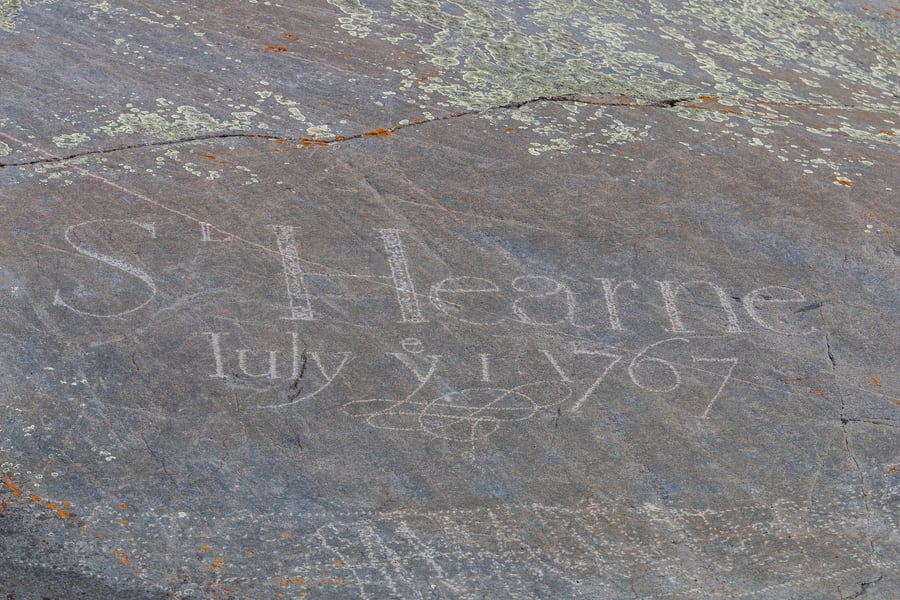 Maciej / Wikimedia Commons · CC BY-SA 2.0 · cropped
Samuel Hearne's signature
At Sloop Cove, 3.2 km from Prince of Wales Fort, Hudson's Bay Company men cut their names into the bedrock in the 1700s and moored their sloops to iron rings driven into the stone. The best-known name is Samuel Hearne's, carved when he was twenty-two. The rings are still there; the water is not.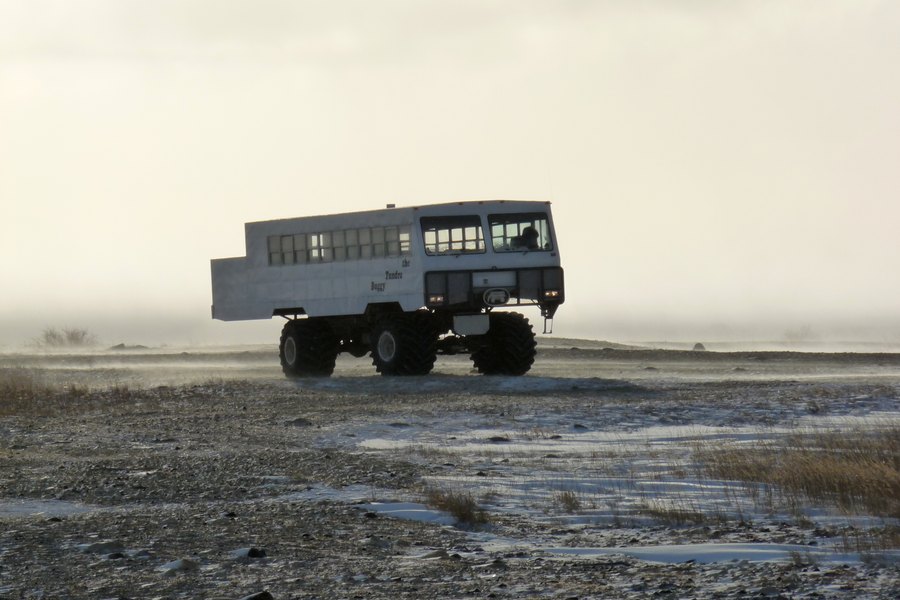 Ian Stewart / Wikimedia Commons · CC BY-SA 3.0 · cropped
Riding a tundra buggy
The high-clearance buses that work the Churchill Wildlife Management Area were built to cross ground no ordinary vehicle can, on tyres taller than a person. They are the only licensed way onto that land, and in bear season the waiting list is longer than the train's.Timetables
The through train runs twice a week in each direction, all year. Northbound it is train 693, leaving Winnipeg on Tuesdays and Sundays at 12:05; southbound it is train 692, leaving Churchill on Thursdays and Saturdays at 20:30. Both of VIA's published seasons — March to October 2026 and November 2026 to March 2027 — carry the same two days a week, so there is no extra summer departure and none is lost in winter.
Northbound takes 1 day 20 hours 55 minutes; southbound is about 1 day 20 hours 15 minutes. Times below are local, and the day is counted from departure.
| Station | Northbound · train 693 | Southbound · train 692 |
|---|---|---|
| Winnipeg Union | dep 12:05 · day 1 | arr 16:45 · day 3 |
| Dauphin | 16:56 / 17:06 · day 1 | 11:56 / 12:06 · day 3 |
| Canora (SK) | 19:36 / 19:46 · day 1 | 07:08 / 07:18 · day 3 |
| The Pas | 01:45 / 02:30 · day 2 | 23:30 · day 2 / dep 03:15 · day 3 |
| Wabowden | 07:48 · day 2 | 18:11 · day 2 |
| Thompson | 12:00 / 17:00 · day 2 | 11:30 / 14:00 · day 2 |
| Pikwitonei | 19:02 · day 2 | 09:27 · day 2 |
| Ilford | 21:36 · day 2 | 06:53 · day 2 |
| Gillam | 23:00 / 23:30 · day 2 | 05:00 / 05:30 · day 2 |
| Churchill | arr 09:00 · day 3 | dep 20:30 · day 1 |
Good to know:
- Thompson is a five-hour stop northbound (12:00–17:00) and two hours southbound. The Pas gets 45 minutes going north and nearly four hours coming back. Both are long enough to leave the station.
- Most of the 55 calls are request stops. VIA marks them with an asterisk in its own timetable; ask the crew, or arrange it when you book.
- Nine stops between Roblin and The Pas are in Saskatchewan, and VIA prints them on Mountain time. Saskatchewan does not put its clocks forward, so in the winter timetable those calls — Canora above, and Togo, Kamsack, Veregin, Mikado, Sturgis, Endeavour, Reserve and Hudson Bay with it — read an hour later than the times in the table. Nothing else on the line moves.
- A separate train serves the northern half only. Train 691 runs The Pas to Churchill on Fridays and train 690 comes back on Tuesdays, all year. It is not part of the Winnipeg run and cannot be joined at Winnipeg.
- The line crosses ground that shifts, so delays are normal. Arctic Gateway's track work has taken about three hours off the schedule, but do not book a same-day flight out of Winnipeg or Churchill against this train.
Times as of September 2026, from VIA Rail's published schedules for the seasons running to March 2027. Confirm before travelling on viarail.ca (opens in a new tab).
Tickets
Everything on this train is reserved and fares move with demand. Sampling VIA's booking engine in September 2026 for one adult one-way gave Economy at CA$241 on a Tuesday in November and CA$344 on the Sunday two days before it — the difference is polar bear season. Sleeper Plus was sold out on both the October and November dates checked, so for the autumn you are booking months ahead, not the fortnight VIA suggests.
Winter is the bargain: mid-February cost CA$247 in Economy, CA$423 for a berth and from CA$640 for a cabin. Note what Sleeper Plus does not include here — no meal service on this route, only a counter selling take-out to every class, and no Wi-Fi. VIA also asks that you pay cash on board. Fares checked September 2026 at reservia.viarail.ca (opens in a new tab); Canadian dollars, per person, before taxes and fuel surcharge.
Book your tickets
Economy class
A reclining seat, both nights
Checked baggage at selected stations, and a counter selling light meals, snacks and drinks.
Book Tickets (opens in a new tab, on viarail.ca)via viarail.caSleeper Plus · berth
Curtained upper or lower bunk
Seats by day, stacked beds behind heavy curtains by night, with a washroom and shower in the same car.
Book Tickets (opens in a new tab, on viarail.ca)via viarail.caSleeper Plus · cabin
For one, two or three
A private compartment with its own door, sold by occupancy rather than per person.
Book Tickets (opens in a new tab, on viarail.ca)via viarail.caRail Passes
No rail pass covers this train. Interrail and Eurail are European products with no application anywhere in Canada, and VIA Rail no longer sells a national pass: the Canrailpass is gone, and viarail.ca's old /canrailpass address now redirects through a dead "Canada Pass" URL to a rail-passes page whose own text reads "We do not have discount cards available for sale at the moment."
What VIA is in fact selling, on a separate page, are two Corridor discount cards valid from 8 September to 15 December 2026 — one for travel anywhere between Québec City and Windsor, one for Toronto to Windsor, Sarnia or Niagara. Neither goes within a thousand kilometres of this route. Both are Economy-only, both exclude Fridays and Sundays, and both state that the discount does not apply to Sleeper Plus fares. So the honest answer for Winnipeg–Churchill is to buy a ticket and buy it early.
What does exist is a set of conditional discounts rather than passes: reductions for seniors, youth and students, Canadian military, Indigenous travellers, and members of CAA and Hostelling International, each with its own eligibility and ID check. VIA's own page for this route also points travellers at its weekly Discount Tuesday sales, and discounted Economy fares were showing against the standard price on several of the winter dates we checked.
Checked September 2026 against viarail.ca/canrailpass (opens in a new tab) and viarail.ca/en/offers/frequent-railers (opens in a new tab).
Places to Visit
Two departures a week make this an unusually rigid route to break. Get off anywhere and the next train is three or four days away, so a stop is a stay, not an afternoon — and the two places worth planning one around, The Pas and Thompson, both sit on the road network and can be left by car or bus if the timing goes wrong.
Everything else worth seeing is at the far end. Churchill is small enough to walk across, but the fort, the estuary and the bear country all need a boat, a bus or a helicopter, and every one of them is seasonal.
 Milorad Dimić / Wikimedia Commons · CC BY-SA 4.0 · cropped
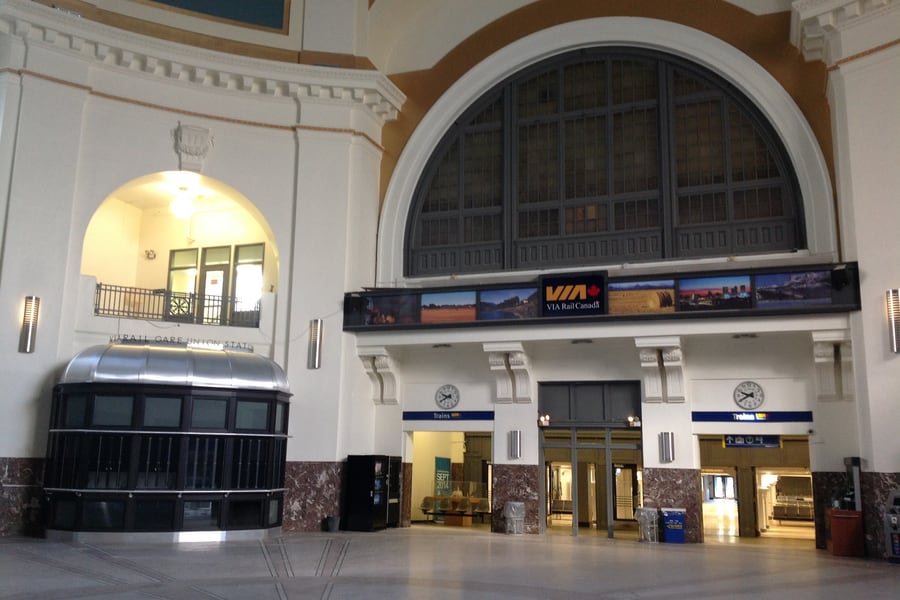
Winnipeg Union Station
The train leaves from a Beaux-Arts station built in 1908–11 for the Grand Trunk Pacific and the Canadian Northern, to a design by Warren and Wetmore — the New York firm behind Grand Central. Parks Canada singles out the domed central rotunda, and it is still the working station it was built to be, with a departure board under the dome.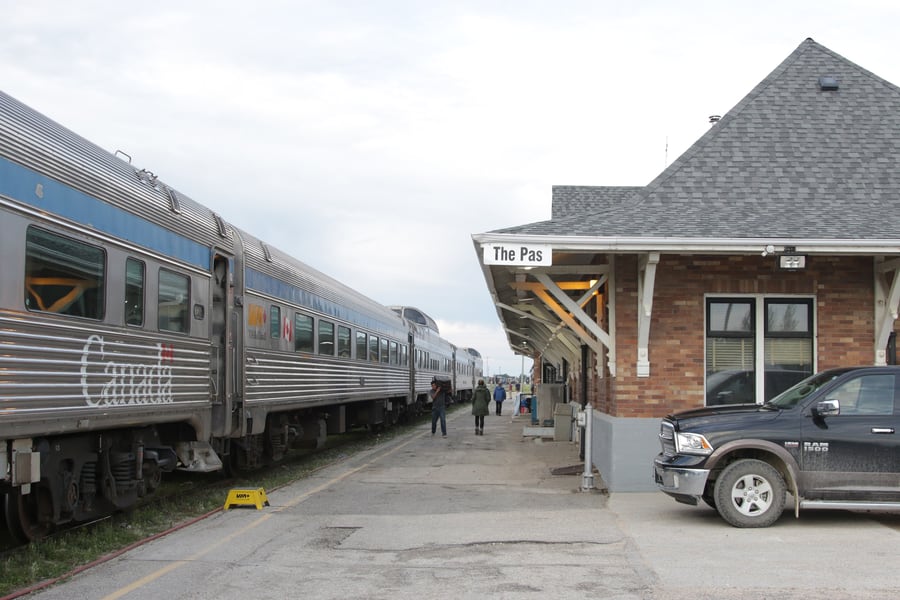 Colin Stepney / Wikimedia Commons · CC BY-SA 4.0 · cropped
The Pas
Where the Hudson Bay Railway proper begins, and where the federal plaque marking its construction as a national historic event was unveiled at the VIA station in 2007. The northbound train calls here at a quarter to two in the morning; the southbound stands nearly four hours, which makes The Pas a real place to break the trip.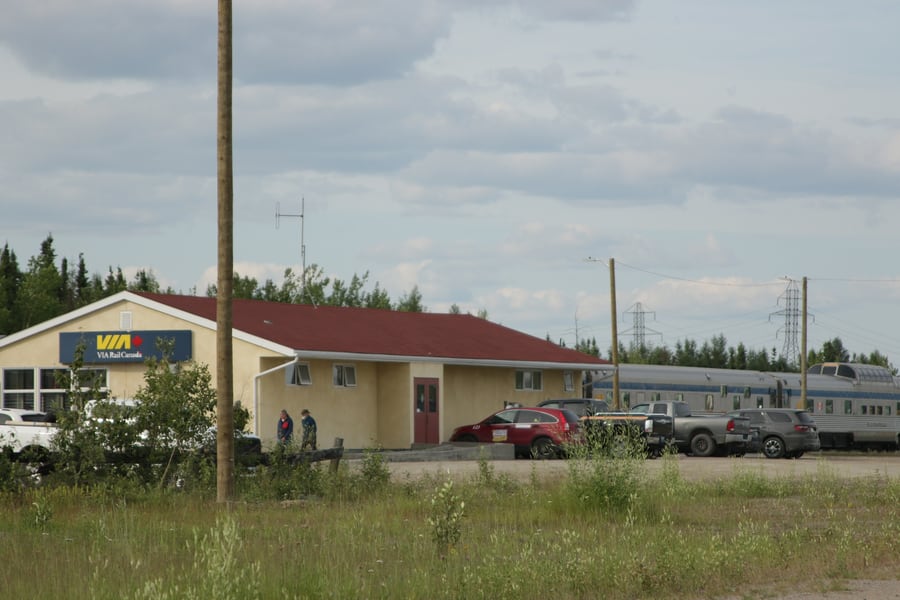 Colin Stepney / Wikimedia Commons · CC BY-SA 4.0 · cropped
Thompson
The largest city in northern Manitoba, and a planned one: INCO announced a large, high-grade nickel find here in 1956 and opened the mine, smelter and refinery in March 1961. The train's five-hour booked stop is the longest on the line — enough to walk into the centre and back.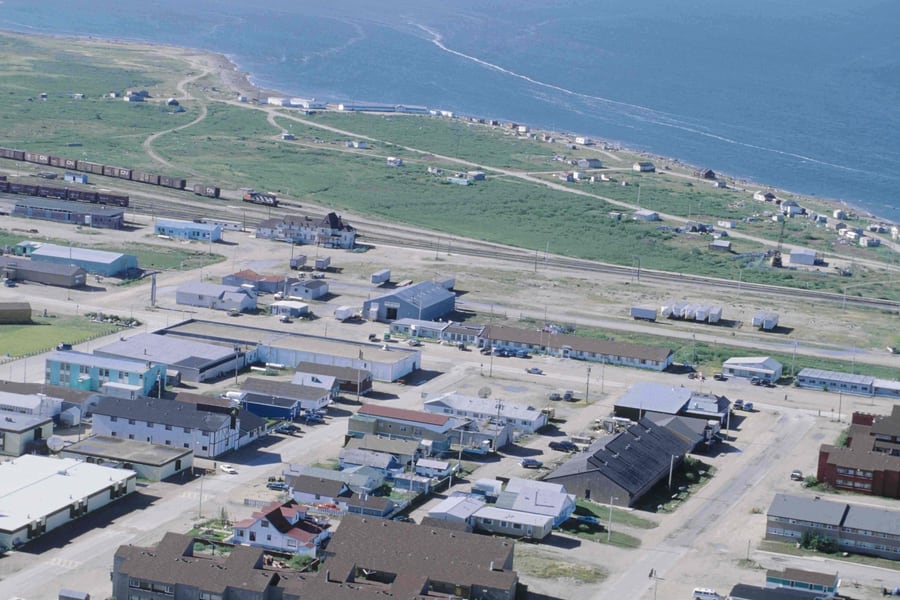 Ansgar Walk / Wikimedia Commons · CC BY-SA 2.5 · cropped
Churchill
Eight hundred and seventy people at the 2021 census, on the west shore of Hudson Bay about 140 km short of the Nunavut border. There is an airport, a port and this railway, and no road at all. The town is compact enough to cross on foot, which is how most visitors get around it.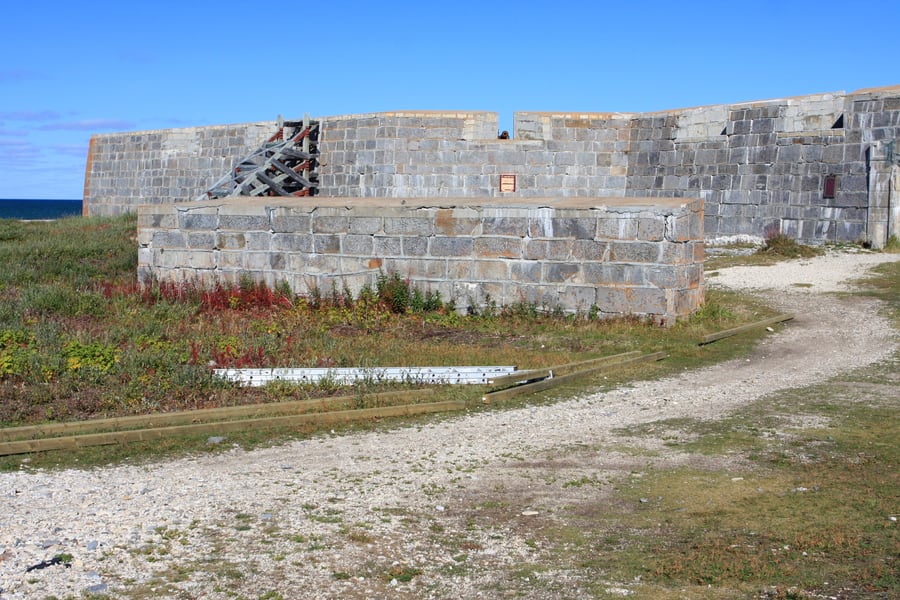 TravelingOtter / Wikimedia Commons · CC BY 2.0 · cropped
Prince of Wales Fort
A Hudson's Bay Company stone fortress at the mouth of the Churchill River, built between 1731 and 1771 to plans by English military engineers and surrendered to La Pérouse's French squadron in 1782 by Samuel Hearne. Parks Canada opens the ruins in July and August, and the Cape Merry Battery across the river from mid-July.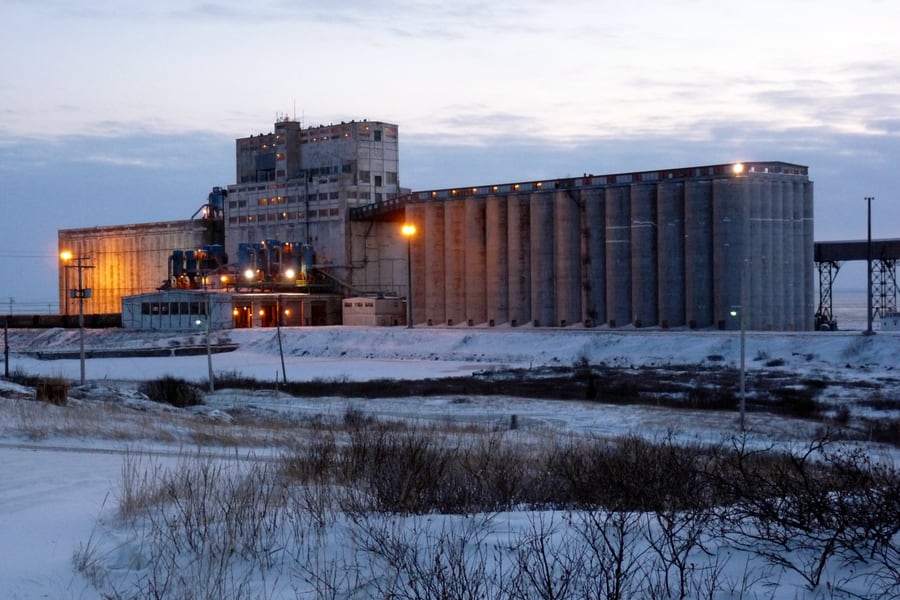 Ian Stewart / Wikimedia Commons · CC BY-SA 3.0 · cropped
The Port of Churchill
Canada's only Arctic deepwater seaport served by rail, and the reason the line was built. Grain went out from 1931; the terminal fell quiet after 2020 and loaded its first grain ship again in September 2026 — 30,000 tonnes of durum wheat for Europe. The elevator is visible from most of the town.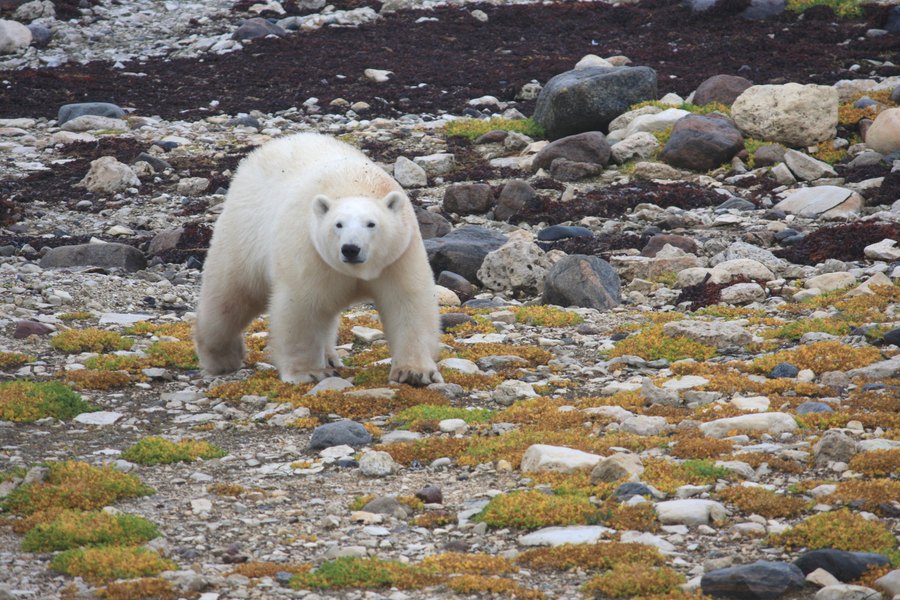 TravelingOtter / Wikimedia Commons · CC BY 2.0 · cropped
Churchill Wildlife Management Area
The protected ground east of the town where polar bears wait for Hudson Bay to freeze. Travel Manitoba puts the peak at mid-October to mid-November; bears are about from July, in smaller numbers. Access is by licensed operator only, and that fortnight is what the whole tourist season turns on.Where to Sleep
At the Winnipeg end the choice is wide and the railway hotel is still standing. At the Churchill end it is not wide at all: a town of 870 people has a handful of places to stay, they fill for polar bear season a long way ahead, and in October and November a bed can be harder to find than a berth on the train.
The train arrives at nine in the morning, often onto frozen ground, so ask about a pick-up from the station when you book. Churchill room rates are seasonal, so check them with the hotel for your dates.
Where to stay
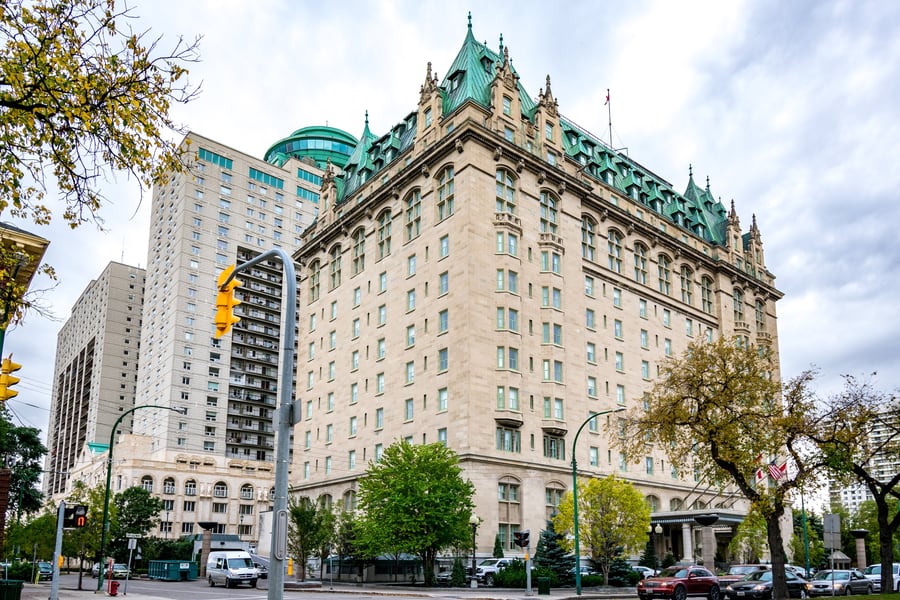 Jessica Losorata / Wikimedia Commons · CC BY-SA 4.0 · cropped
The Fort Garry Hotel
Winnipeg · a short walk from the station
The Grand Trunk Pacific's 1913 hotel and a National Historic Site, at 222 Broadway, a short walk from Union Station.
Check Availability (opens in a new tab, on fortgarryhotel.com)via fortgarryhotel.comPolar Inn & Suites
Churchill · family-run since 1990
Twenty-six rooms, one-bedroom apartments and kitchen suites at 153 Kelsey Boulevard, in the middle of town.
Check Availability (opens in a new tab, on polarinn.com)via polarinn.comLazy Bear Lodge
Churchill · hand-built from recycled logs
Built in 1999 largely from reclaimed material, including Douglas fir flooring from a 1920s Canadian National warehouse.
Check Availability (opens in a new tab, on lazybearlodge.com)via lazybearlodge.comQuestions or corrections
Planning this trip and stuck on something, or spotted a time, fare or detail that has changed? Send us a message about Winnipeg to Churchill. We read every one, and we update this page when something has changed.