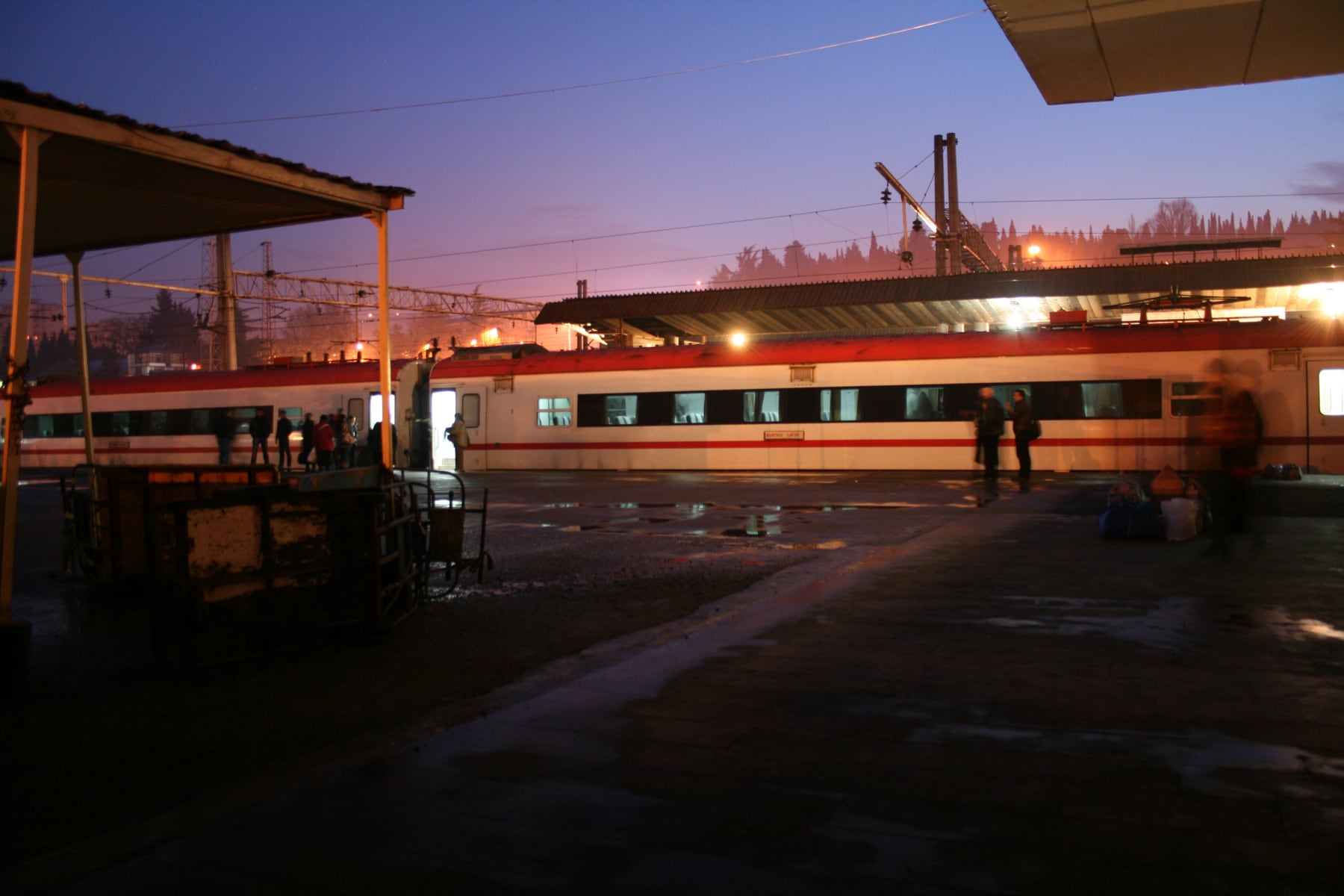
Yerevan to Batumi — Armenia's summer sleeper to the Black Sea
P.Kurmelis / Wikimedia Commons · CC BY 3.0 · 2013 · cropped
- DistanceAbout 720 km, Yerevan to Batumi
- Duration17 hr 34 min, overnight
- Best season14 June to 1 October 2026, alternate days
Introduction
Armenia has one railway line that leaves the country, and for fifteen weeks of the year it goes to the seaside. Train 202 pulls out of Yerevan at two in the afternoon, climbs north-west across the Ararat plain to Gyumri, turns east through Vanadzor and drops into the gorge of the Debed, and by late evening it is standing at Ayrum with the frontier two kilometres ahead. The rest is Georgia: Tbilisi in the middle of the night, the Surami pass before dawn, and at 07:34 the next morning the Black Sea at Batumi. Seventeen and a half hours, one border, four classes of sleeping car and about 720 kilometres of a network that is entirely electrified and almost entirely landlocked.
The train exists because the other frontiers do not open. Azerbaijan closed its railway to Armenia at the end of the Soviet period and Turkey joined the blockade in 1993; the line through Nakhchivan to Iran has been shut for as long. Georgia is the only way out by rail, and everything international runs through it — which is why a country of 780 kilometres of track has a named summer express to somebody else's coast, and why Armenians have gone to Batumi by sleeper for generations without the habit ever really breaking.
It is also, in the plainest sense, one train. From 14 June to 1 October it runs to Batumi as 202 and 201. On 2 October the Batumi leg stops, the numbers change to 372 and 371, and the same carriages spend the winter running only as far as Tbilisi.
The Journey
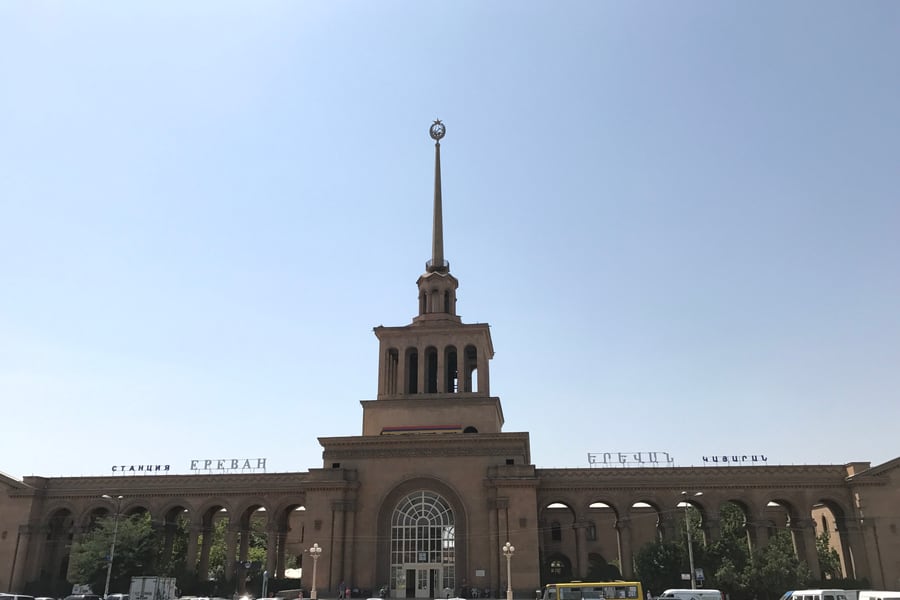
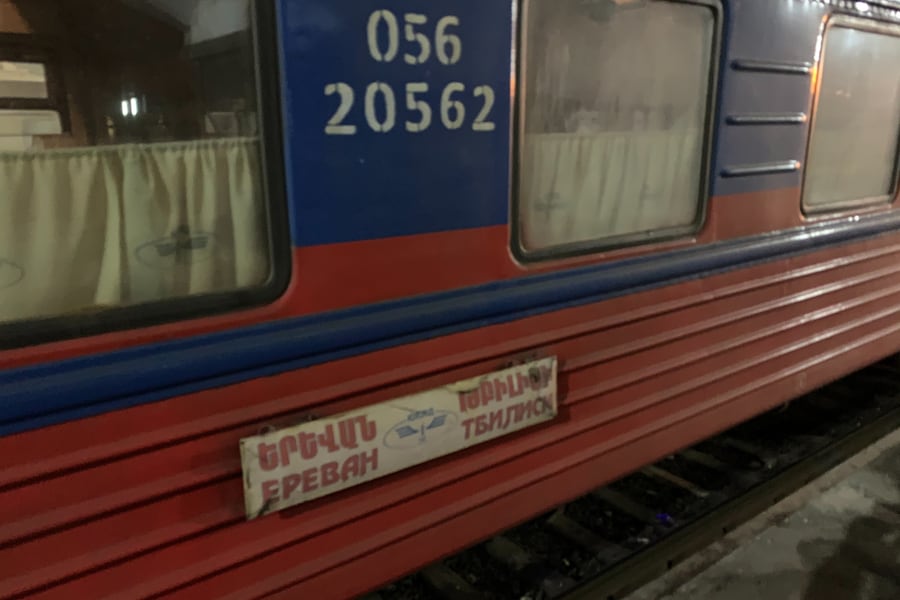
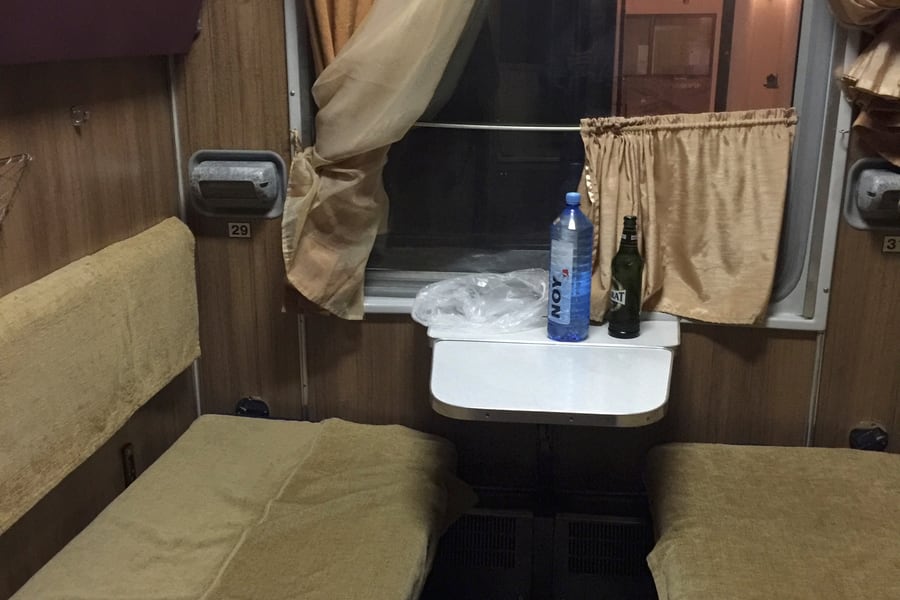
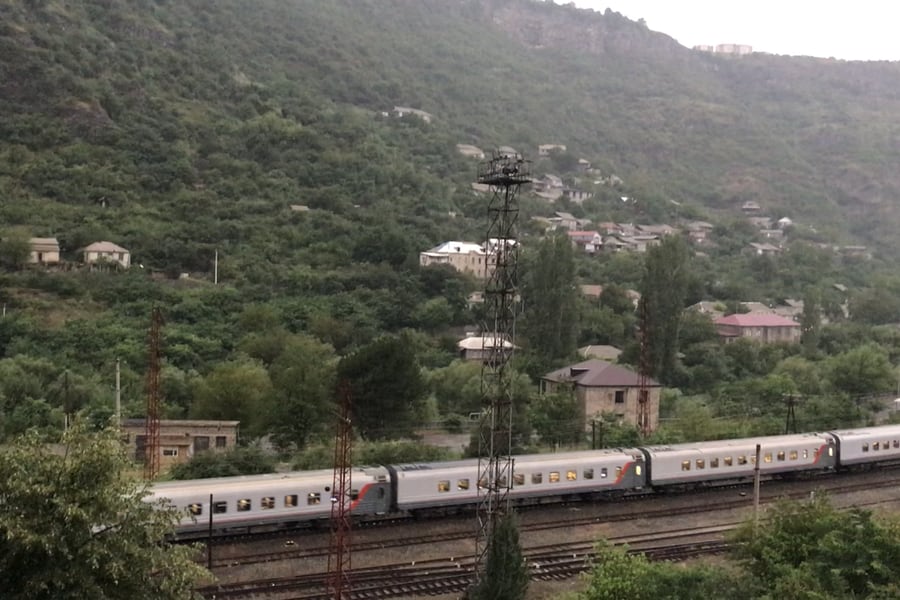
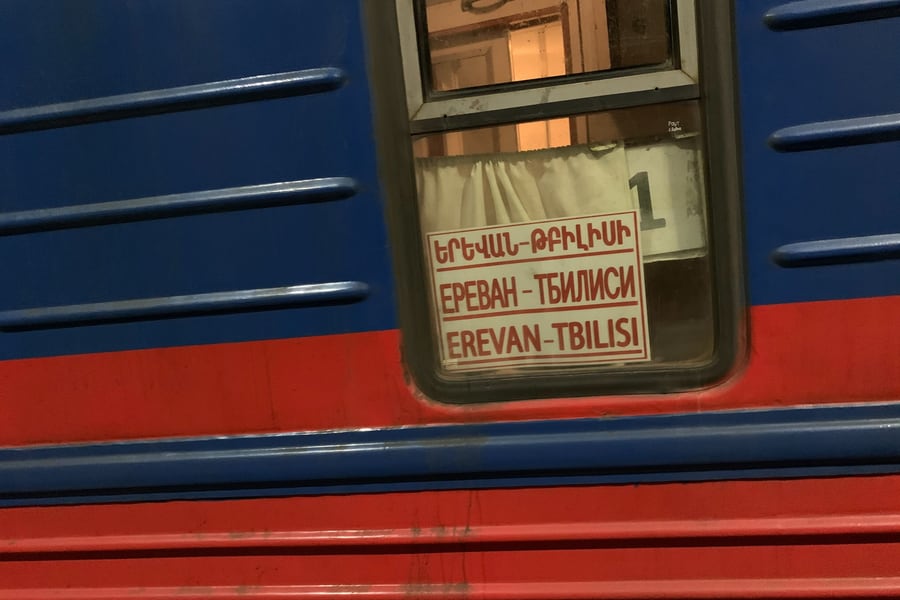
Yerevan's station is the sort of building a state puts up when a railway still means something. It was finished in 1956, with a spire, a clock and a long colonnade, and Yervand Kochar's copper David of Sassoun rearing out of a fountain in the square in front; a museum of Armenian railways opened inside in 2009, and a preserved steam locomotive stands on the platform. The train is made up an hour before departure at the far end: red and blue carriages of Soviet pattern, each with a hand-painted board on the flank reading Yerevan–Tbilisi in Armenian, Russian and Latin script.
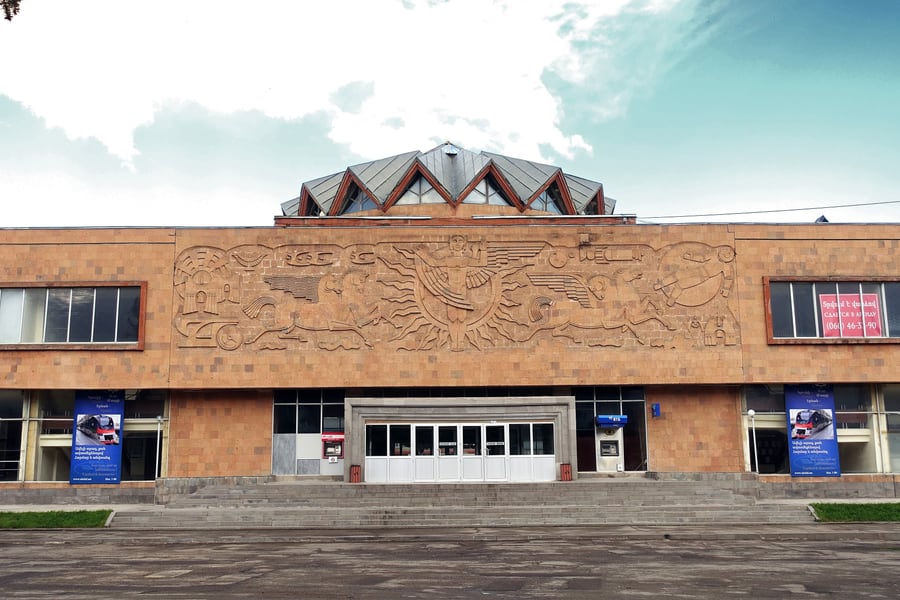
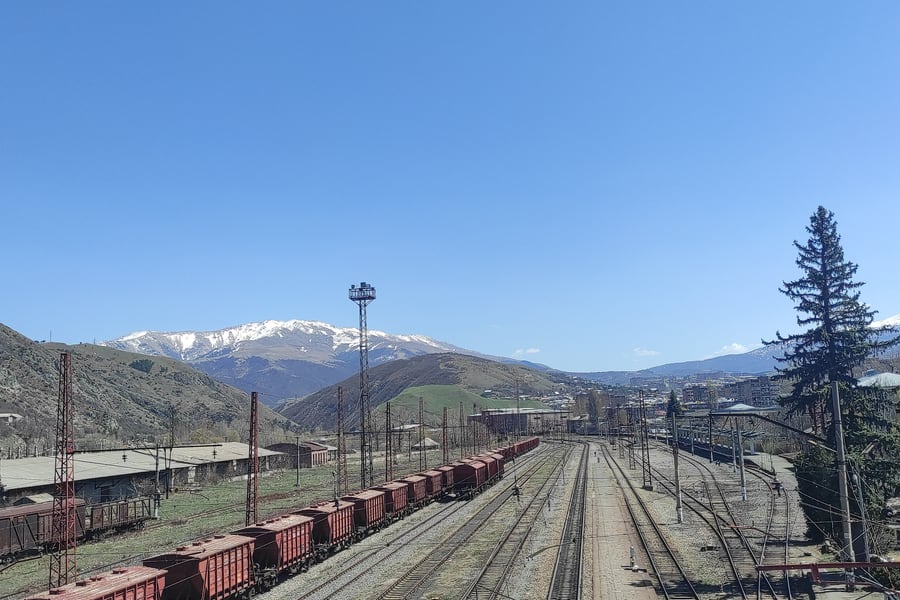
The first three hours are the open country of the Ararat plain and the Shirak plateau. Armavir at 14:48 is a two-minute stop; Gyumri at 16:29 is sixteen, long enough to walk the platform of a station whose 19th-century predecessor was the junction for Kars, and whose line to Turkey has not carried a train since 1993. Then the railway swings east into Lori, and at Vanadzor — the third city, the industrial capital of Lori at 1,350 metres, chemical plants and all, under wooded ridges — it begins to follow water downhill.
Into the Debed
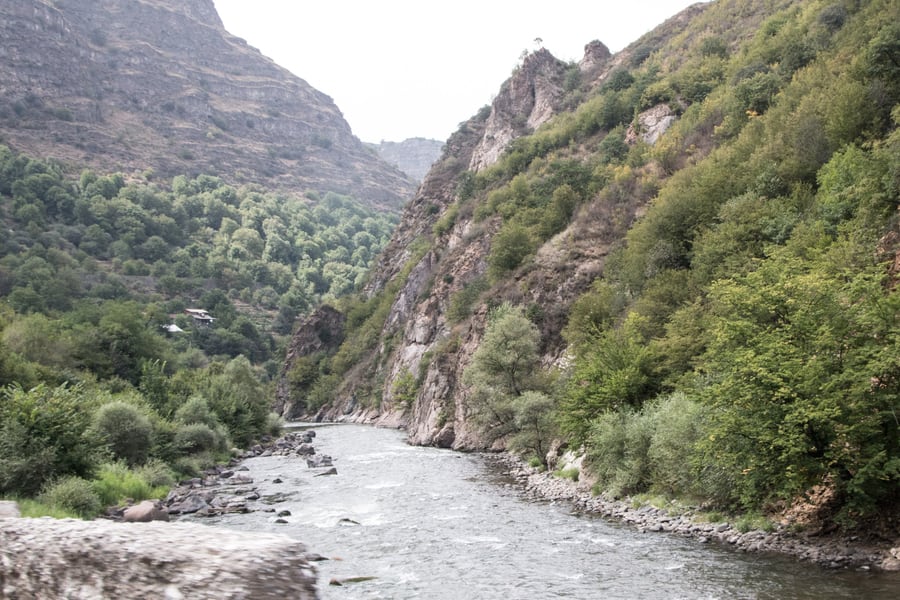
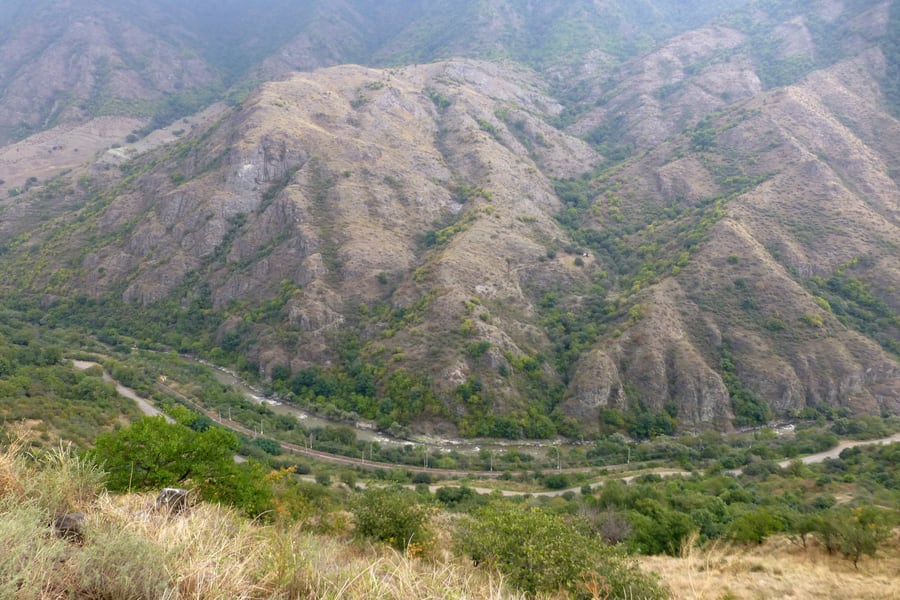
The best two hours of the Armenian half are the gorge. The Debed cuts a trench through the Lori uplands with barely room for the river, the road and the railway, and the train runs the bottom of it: rock on one side, water on the other, and villages stacked on ledges above. Alaverdi, at 715 metres, exists because a copper smelter opened here in 1899 and the settlement grew around it; the monasteries of Haghpat and Sanahin stand on the plateau either side of the town, ten centuries old and on the UNESCO list since 1996. At 19:57 the train reaches Ayrum, a village of about 1,700 people two kilometres short of the frontier, and stops for an hour while Armenian officers work through the train.
The border, and the night
Nothing about the crossing is quick. Ayrum takes the best part of an hour, then the train moves a few kilometres to Sadakhlo on the Georgian side and stands for another sixty minutes. Two railways have been trying to shorten this: in May 2026 South Caucasus Railway and Georgian Railways agreed to exchange passenger data in advance specifically to cut the time the train spends still at the border. Passports are collected and stamped on board — an Ayrum stamp is a small collector's item among people who have done this trip — and by the time the train is moving again it is properly dark.
Tbilisi comes at 00:11, and the thirty-four minutes there are the loudest part of the night: new passengers, luggage handed up in the dark under the trainshed. After that the train climbs the Surami pass in the small hours, the watershed of Georgia, electrified in 1932 and the first main line in the Soviet Union to be worked by electric locomotives. Most people sleep through it.
Down to the sea
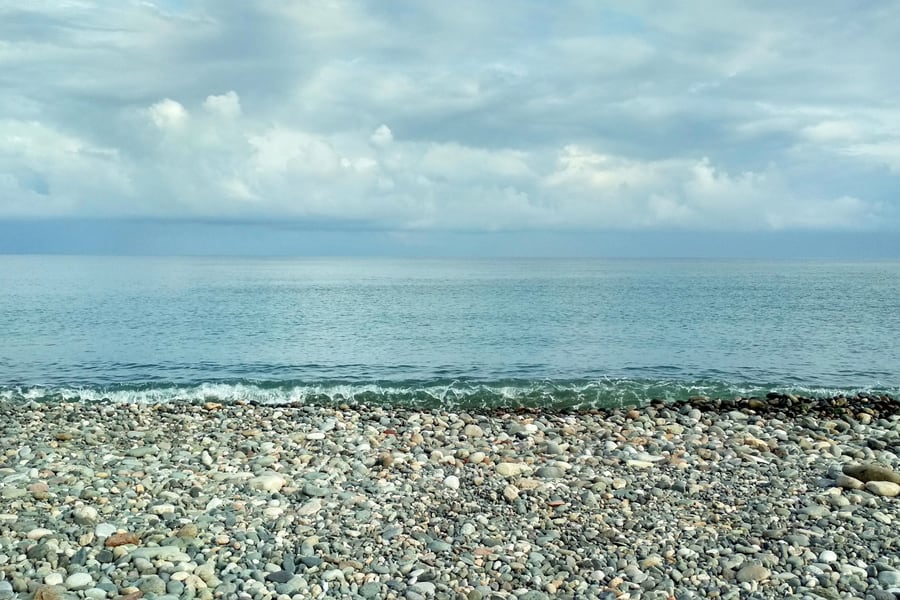
Morning is subtropical. Khashuri at 02:35 and Zestafoni at 04:13 are night stops; by Samtredia at 05:31 the light is coming up over flat, wet country, and from Ureki at 06:28 the railway is on a shelf between the hills and the water. Kobuleti, Makhinjauri, and at 07:34 Batumi — a city of palms, casinos and 19th-century oil money that Armenians have treated as their beach for generations. The train turns round the same afternoon: 201 leaves Batumi at 14:55 and is back in Yerevan at 08:59 the following morning.
Along the route
 Clay Gilliland / Wikimedia Commons · CC BY-SA 2.0 · 2016 · cropped
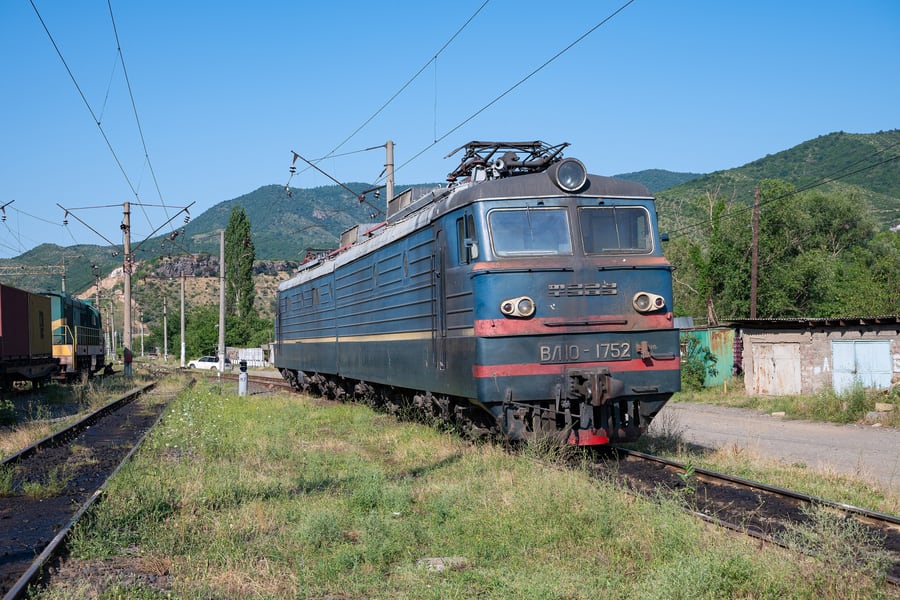
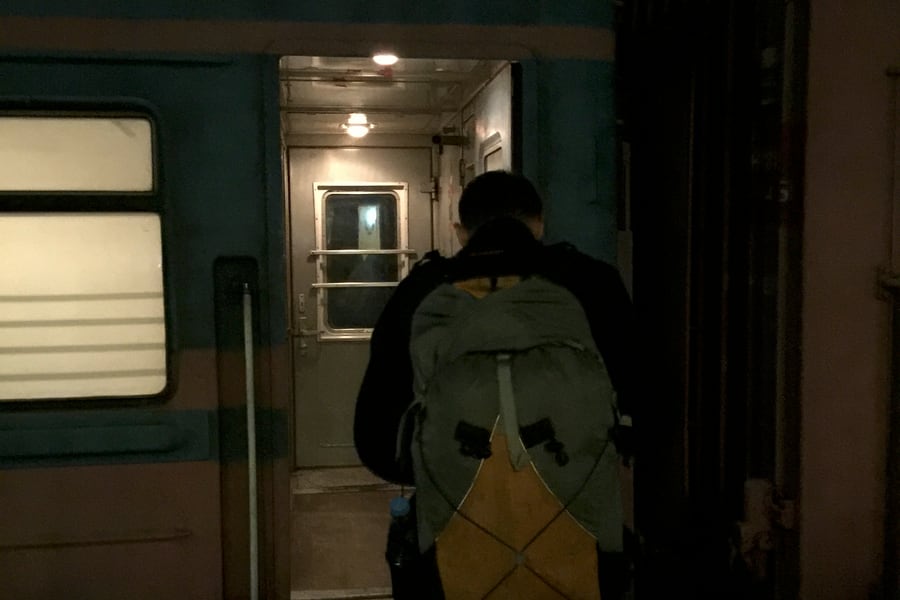
Boarding at two in the afternoon
The set is made up an hour before departure and the attendant checks each ticket at the door against a passport. Nobody is in a hurry: the first stop is forty-eight minutes away and the border is six hours off.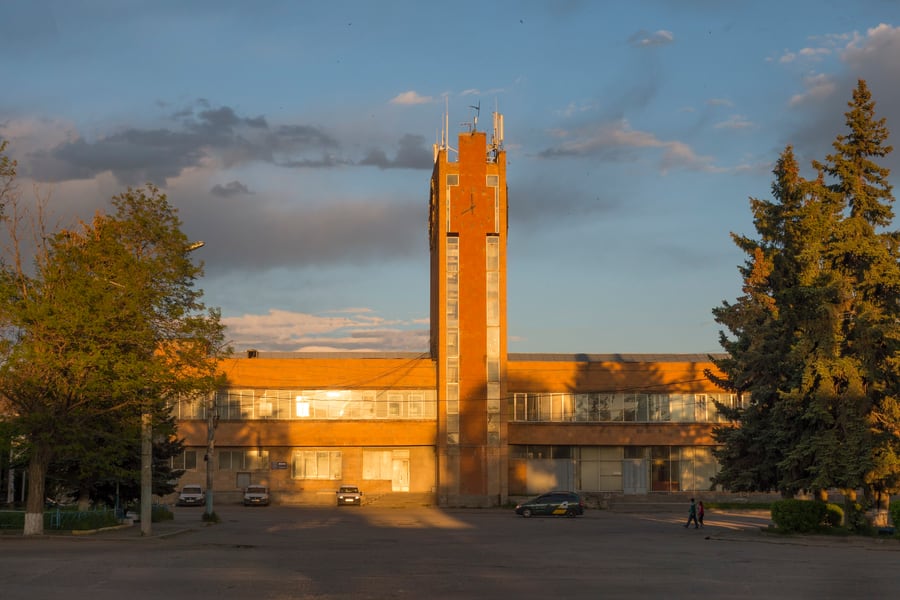 Armenak Margarian / Wikimedia Commons · CC BY-SA 4.0 · 2019 · cropped
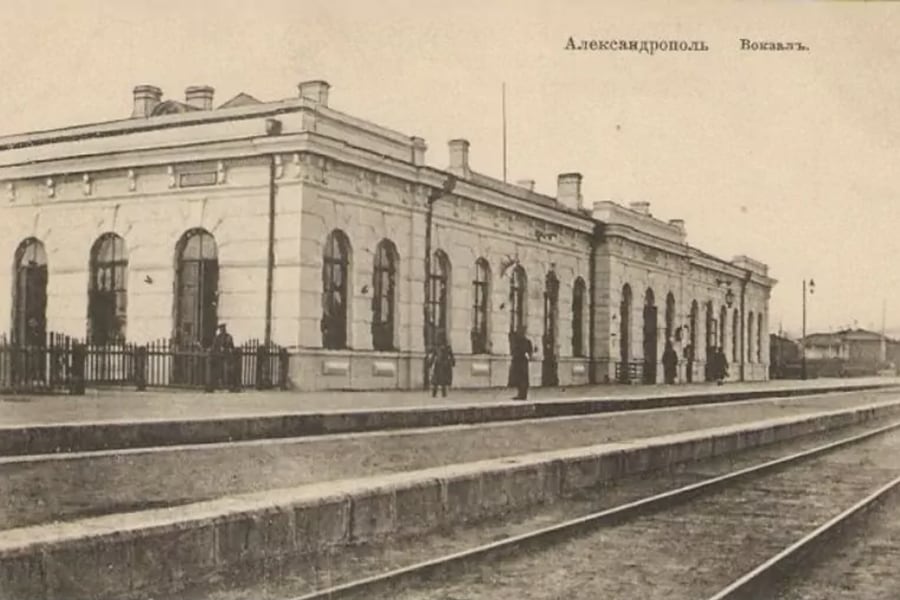
Gyumri, sixteen minutes
The longest stop before the border, and the one worth getting out for. Armenia's second city was Alexandropol under the Tsars and the junction for Kars; the station stands a little way out from the black-stone centre.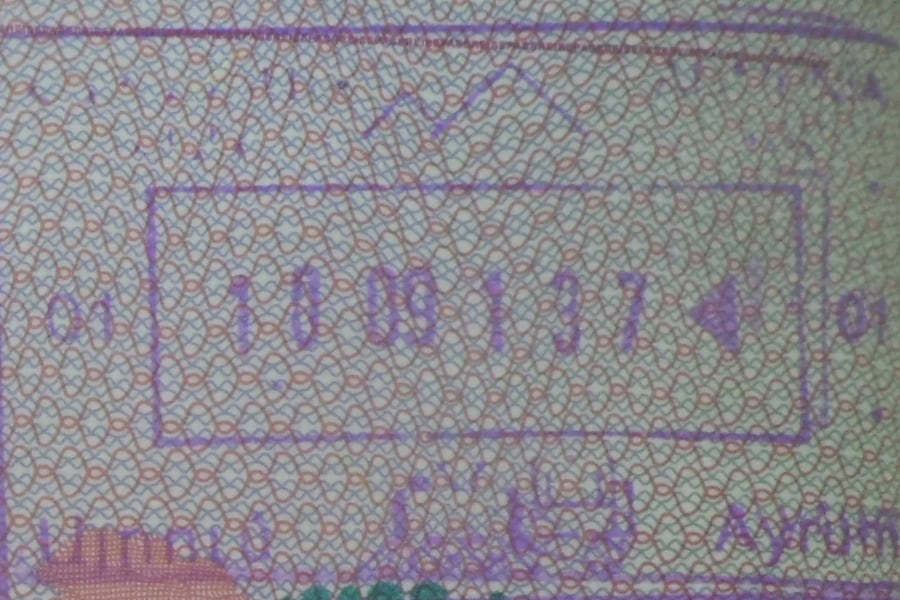 Hansi91 / Wikimedia Commons · Public domain · 2013 · cropped
Two hours standing at the frontier
Ayrum takes about an hour and Sadakhlo another. Passports are stamped on board, and in May 2026 the two railways agreed to swap passenger data in advance to cut the wait.A bit of history
Culture & experiences along the way
 Robot8A / Wikimedia Commons · CC BY-SA 4.0 · 2020 · cropped
A train that changes its name in October
From 14 June to 1 October the working is 202 and 201 and it runs to the sea. On 2 October the Batumi leg is dropped, the numbers become 372 and 371, and the same carriages spend the winter going only as far as Tbilisi. In summer there is no separate Tbilisi train at all: passengers for the Georgian capital ride this one and get off at midnight.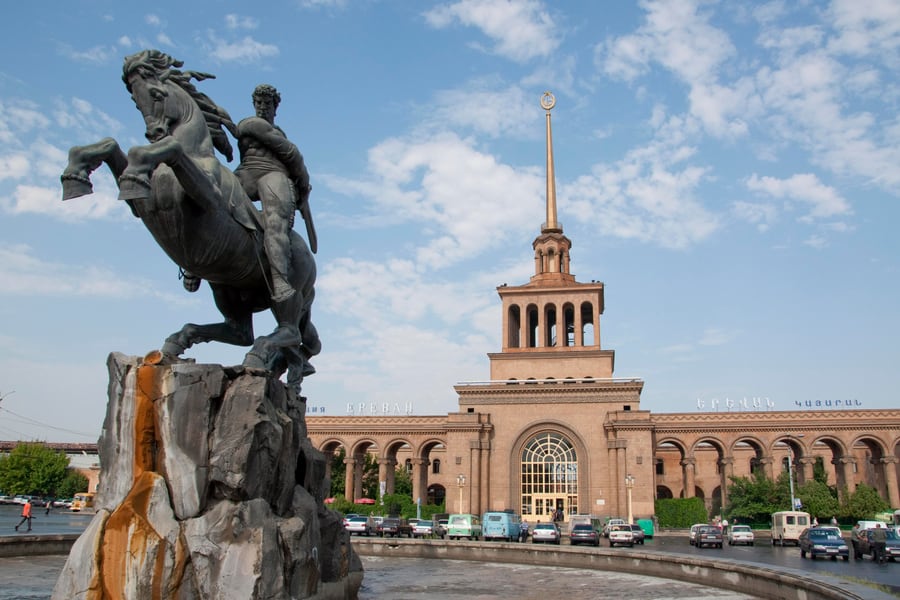 Nina Stössinger / Wikimedia Commons · CC BY-SA 2.0 · 2009 · cropped
The horseman outside the station
Yervand Kochar's David of Sassoun stands in the square in front of Yerevan station, 6.5 metres of copper on a basalt plinth, placed to greet a city's visitors when nearly all of them arrived by train. It is the second version. The first went up in September 1939 and was pulled down within days of Kochar's arrest in June 1941.Timetables
One train runs each way, on alternate days, from 14 June to 1 October 2026. A single set does the whole job — down to the sea overnight as train 202, turned round the same afternoon, back as train 201 the following morning — so the two directions leave on alternate dates: through September 2026 the Yerevan departures fall on even dates and the Batumi ones on odd. The last train out of Yerevan is on 30 September and the last out of Batumi on 1 October. Times below are as of August 2026, from South Caucasus Railway (opens in a new tab)'s own timetable and its selling system.
Yerevan to Batumi — train 202
| Station | Arrive | Depart |
|---|---|---|
| Yerevan | — | 14:00 |
| Armavir | 14:48 | 14:50 |
| Gyumri | 16:29 | 16:45 |
| Vanadzor | 18:04 | 18:09 |
| Ayrum (border) | 19:57 | 20:55 |
| Sadakhlo (border) | 21:20 | 22:20 |
| Tbilisi | 00:11 | 00:45 |
| Khashuri | 02:35 | 02:55 |
| Zestafoni | 04:13 | 04:28 |
| Samtredia | 05:31 | 05:33 |
| Ureki | 06:28 | 06:33 |
| Kobuleti | 07:02 | 07:09 |
| Batumi | 07:34 | — |
Batumi to Yerevan — train 201
| Station | Arrive | Depart |
|---|---|---|
| Batumi | — | 14:55 |
| Kobuleti | 15:25 | 15:36 |
| Ureki | 16:06 | 16:11 |
| Samtredia | 17:06 | 17:08 |
| Zestafoni | 18:08 | 18:20 |
| Khashuri | 19:28 | 19:38 |
| Tbilisi | 21:31 | 22:40 |
| Sadakhlo (border) | 00:38 | 01:38 |
| Ayrum (border) | 02:03 | 03:00 |
| Vanadzor | 04:42 | 04:47 |
| Gyumri | 06:05 | 06:25 |
| Armavir | 08:08 | 08:10 |
| Yerevan | 08:59 | — |
Southbound the train also calls at Moliti and Makhinjauri, northbound at Chakvi and Marabda. Nearly two hours of the schedule are spent standing at the two frontier stations, and the operator's published times build that in.
The rest of the year
From 2 October 2026 to 13 June 2027 the Batumi leg disappears and the same working runs to Tbilisi only, as trains 372 and 371 — out of Yerevan at 21:30 on even dates, arriving Tbilisi 07:35; back from Tbilisi at 20:20 on odd dates, into Yerevan at 06:55. In summer the reverse applies: there is no separate Tbilisi train, and passengers for Tbilisi ride the Batumi one.
Tickets
Tickets are sold online by South Caucasus Railway, and every berth is reserved, so a ticket belongs to a named train and a named passenger. Fares are in Armenian dram and are the same whichever direction is booked; the operator's own conditions for the international route are that a valid passport is required to cross the border, children under five travel free, and 36 kilograms of hand luggage travel free with a ticket. Since 1 January 2026 Georgia has also required every visiting tourist to hold medical and accident insurance of at least 30,000 lari, in Georgian or English.
The four classes are the operator's own: open-plan, compartment, comfort compartment and sleeper. Fares below are for one adult, Yerevan to Batumi, as sold on 31 August 2026 for a September departure, with the Tbilisi fare for comparison.
Book your tickets
Open-plan carriage
Yerevan to Batumi, one berth
The cheapest berth on the train, in the operator's open-plan sleeping car.
Book Tickets (opens in a new tab, on railway.am)via railway.amCompartment carriage
Yerevan to Batumi, one berth
A berth in a closed four-person compartment, the class most of the train is made up of.
Book Tickets (opens in a new tab, on railway.am)via railway.amComfort compartment
Yerevan to Batumi, one berth
The refurbished compartment stock, sold as a separate class at about a seventh more.
Book Tickets (opens in a new tab, on railway.am)via railway.amSleeper carriage
Yerevan to Batumi, one berth
The dearest class on the train, and the one the operator's carriage tour calls the sleeper.
Book Tickets (opens in a new tab, on railway.am)via railway.amRail Passes
Neither end of this journey is in the pass area. Armenia has no Interrail or Eurail One Country Pass, nor does Georgia, and neither country is among the 33 the Global Pass covers — checked against interrail.com and eurail.com in August 2026, where Armenia appears only in the list of countries a buyer may live in.
It costs nothing to lose. A pass would in any case buy no discount on an international sleeper, and the fare is low: the full run to the Black Sea starts at 17,630 dram in an open-plan carriage, and the dearest berth on the train, in the sleeper class, is 38,450. Tickets come straight from South Caucasus Railway, online or at a station counter, and since the train runs only every other day the date matters more than the class.
Places to Visit
The stops are few and most of them are long, which makes this a route that rewards breaking. Gyumri and Vanadzor are cities in their own right; the Debed gorge below Vanadzor holds two of the oldest monasteries in Armenia; and the far end is two capitals of summer, Tbilisi in the middle of the night and Batumi at breakfast. The operator sells to the intermediate stations as well as the terminus — Gyumri, Vanadzor and Tbilisi all have their own fares, and Gyumri to Batumi is sold as a journey in itself — so the run can be taken in two halves, with the alternate-day timetable setting how long the stop in between has to be.
 Armenak Margarian / Wikimedia Commons · CC BY-SA 4.0 · 2018 · cropped
The Black Fortress at Gyumri
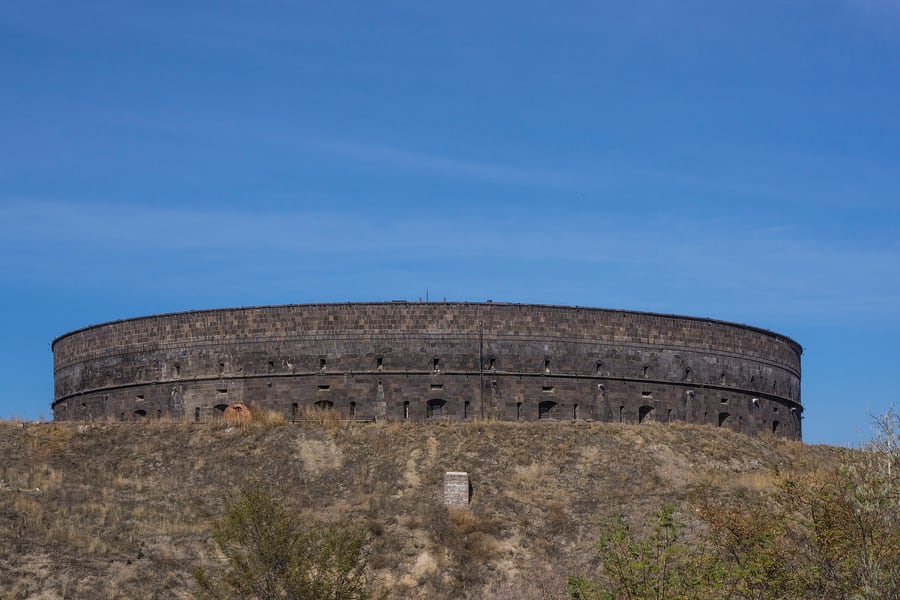
A round Russian fort of black stone on the hill above the second city, begun in 1834 after the war with Turkey of 1828–29 and a decade in the building. It was never besieged, was upgraded to first class after the Crimean War and downgraded again in 1887, and stands empty now on the edge of a city that was called Alexandropol from 1837 — renamed for the Empress after Tsar Nicholas I came to see it.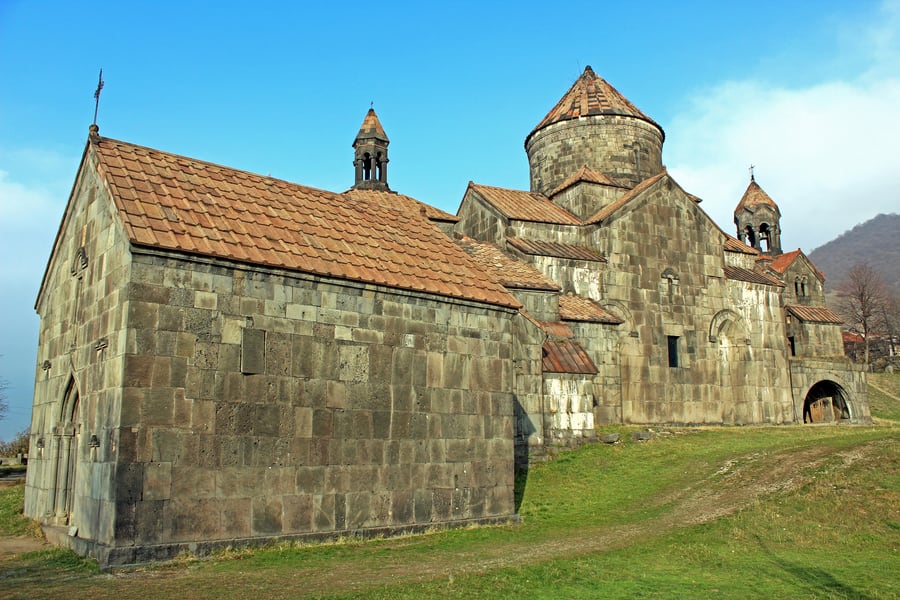 Soghomon Matevosyan / Wikimedia Commons · CC BY-SA 4.0 · 2017 · cropped
Haghpat, above the gorge
The monastery stands on the plateau over the Debed, an hour's climb or a short taxi ride from Alaverdi station. It was built between the 10th and 13th centuries, in the years when this valley was the centre of the Bagratid kingdom, and its churches, library and bell-tower are still the best-preserved group of their date in Armenia. UNESCO listed it with Sanahin in 1996.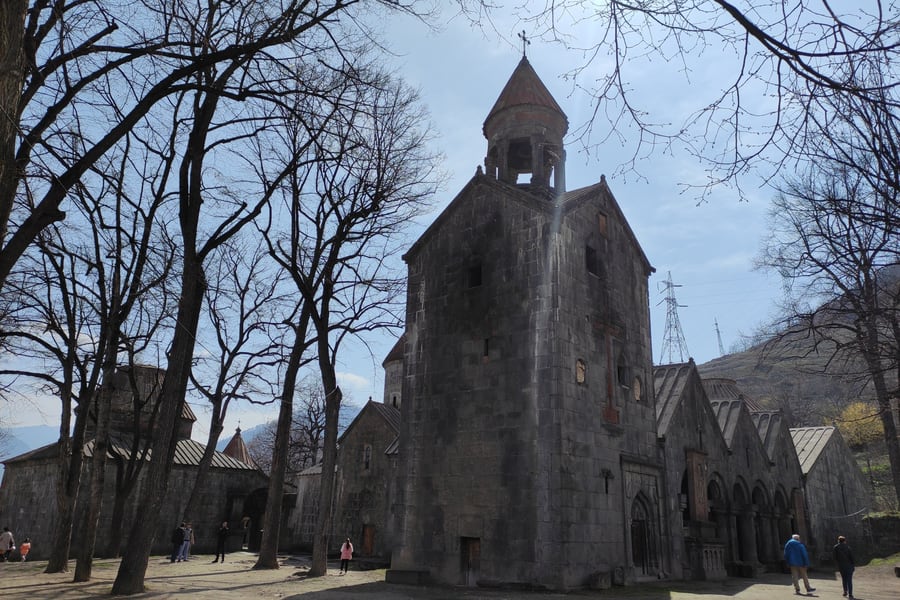 Soghomon Matevosyan / Wikimedia Commons · CC BY-SA 4.0 · 2023 · cropped
Sanahin, on the other side
Sanahin is the other half of the same World Heritage listing and the closer of the two to the railway — the district it gives its name to is part of Alaverdi. It was founded in the 10th century and grew into a school as much as a monastery. The dark tuff, the low arcades and the carved crosses set into the walls are what people come for.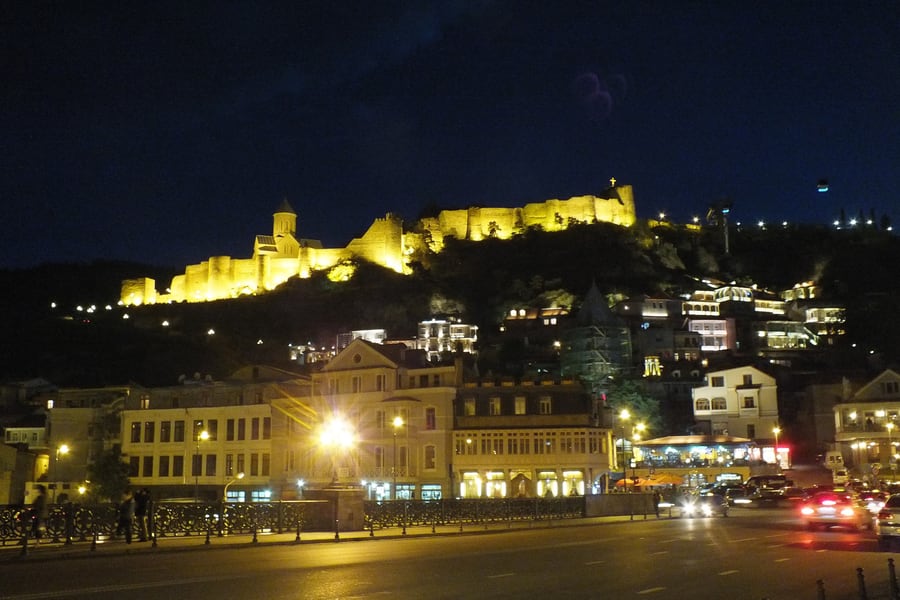 Saskia Heijltjes / Wikimedia Commons · CC BY-SA 2.0 · 2013 · cropped
Tbilisi, at midnight
The train stands thirty-four minutes in the Georgian capital, which is enough to see the platform and nothing else — but a ticket to Tbilisi costs a third less than one to Batumi and the old town under Narikala is worth the stop. The fortress on the ridge has been there in some form since the fourth century; the city below it is at its best in the hours this train passes through.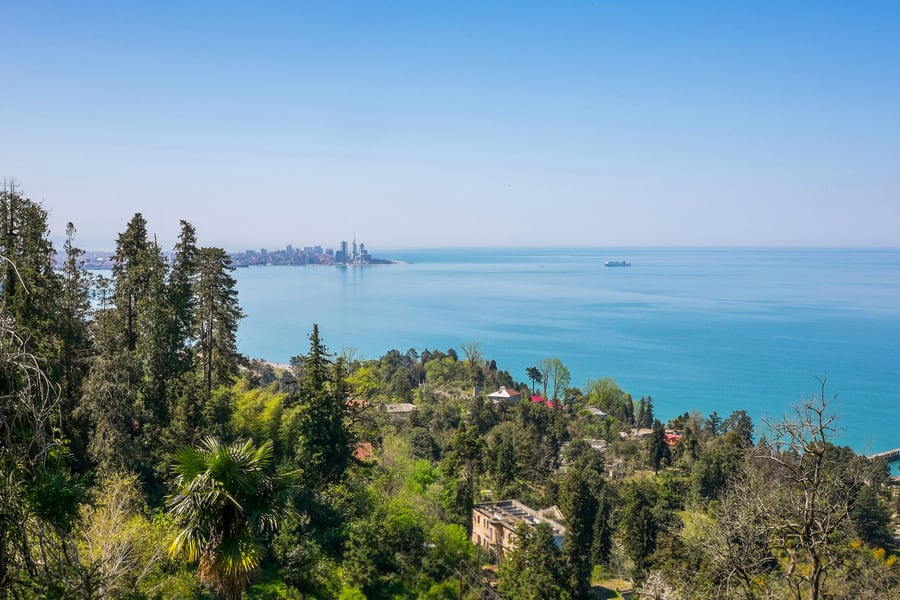 Jagermesh / Wikimedia Commons · CC BY-SA 2.0 · 2015 · cropped
Batumi, at breakfast
Georgia's second city, the capital of Adjara, sits in the subtropics twenty kilometres from the Turkish border, and is the reason the train runs at all in summer. Palms, casinos, a botanical garden on the headland north of town and a nineteenth-century old town built on Baku's oil money. The train arrives at 07:34 and leaves again at 14:55, so a day trip is possible and a week is easier.Where to Sleep
Two of the three nights this journey can involve are spent on the train, which leaves the ends. In Yerevan the departure is at two in the afternoon, so the night before is the one that matters; in Batumi the train arrives at 07:34, several hours before any hotel will have a room ready, and the return leaves at 14:55. The gorge in between is worth a night of its own if the trip is being broken at Vanadzor or Alaverdi.
Where to stay
Tufenkian Historic Yerevan
In central Yerevan, near Republic Square
A boutique hotel on Hanrapetutyan Street with an outdoor pool, the Kharpert restaurant and rooms furnished with the company's own carpets.
Check Availability (opens in a new tab, on tufenkianheritage.com)via tufenkianheritage.comTufenkian Avan Dzoraget
On the Debed, in the gorge the railway follows
A basalt-built hotel on the banks of the Debed in the Lori region, with an indoor pool and the Haghpat and Sanahin monasteries within reach.
Check Availability (opens in a new tab, on tufenkianheritage.com)via tufenkianheritage.comIntourist Palace Hotel & SPA
On Ninoshvili Street in Batumi
A large hotel near the seafront with seven room categories, a spa with sauna and Turkish bath, and its own Tbilisi restaurant.
Check Availability (opens in a new tab, on intouristpalace.com)via intouristpalace.comQuestions or corrections
Planning this trip and stuck on something, or spotted a time, fare or detail that has changed? Send us a message about Yerevan to Batumi — Armenia's summer sleeper to the Black Sea. We read every one, and we update this page when something has changed.