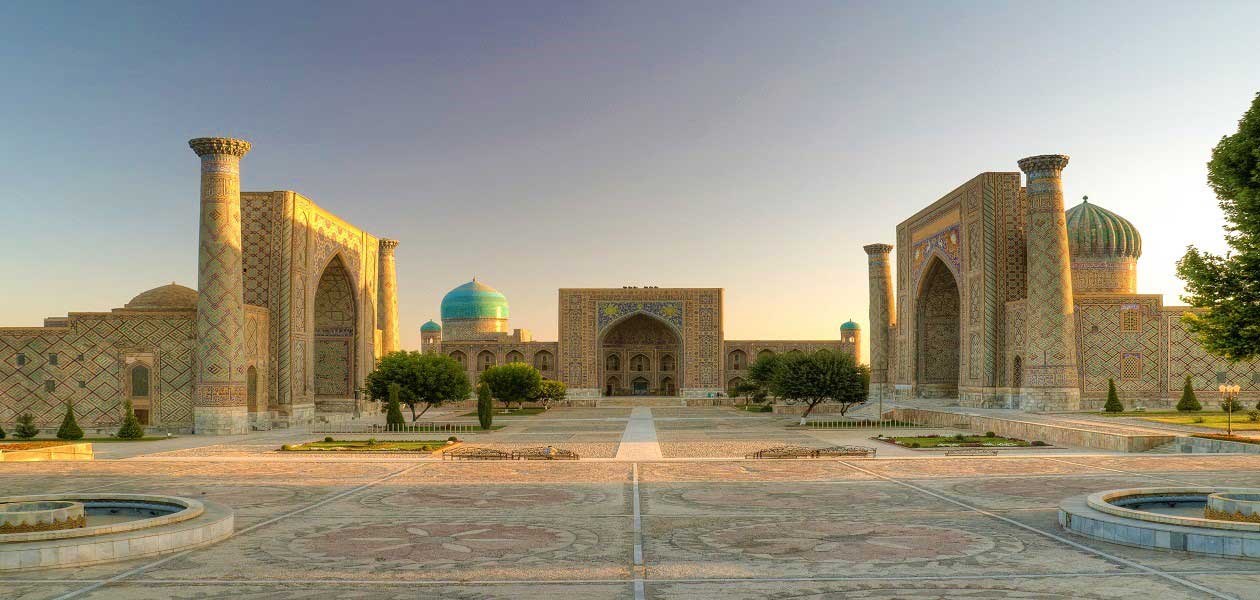
Uzbekistan

Uzbekistan lies in the middle of Central Asia and is one of only two doubly landlocked countries in the world — every one of its neighbours is landlocked as well. More than 39 million people live there, the most of any Central Asian republic, in a country of desert, irrigated valley and mountain. Tashkent is the capital, Uzbek is the official language and Russian is still widely spoken, and the three cities most travellers come for — Samarkand, Bukhara and Khiva — are the old Silk Road caravan towns strung out to the west of it.
Those distances are long and the country between the cities is largely empty, which is exactly what makes the railway the sensible way to cross it. Uzbekistan Railways works the desert corridor with Spanish-built high-speed trains — the first of their kind in Central Asia — and reaches further west toward Khiva and the Aral basin with older overnight sleepers. Fares are low by European standards, and the whole Silk Road can be strung together on a single set of rails.
Rail journeys in Uzbekistan
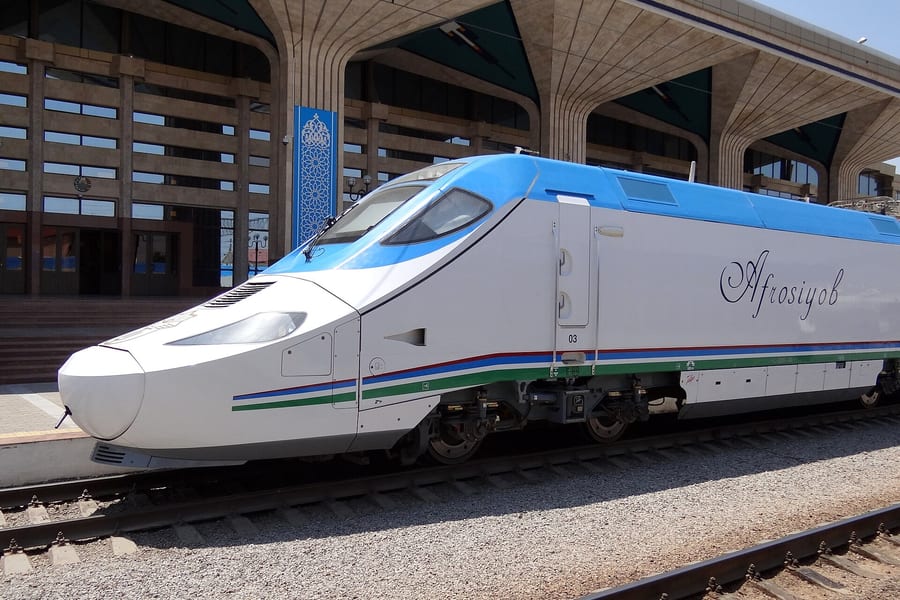
The Afrosiyob
Central Asia's first high-speed train crosses the desert at 250 km/h, linking Tashkent with the turquoise domes of Samarkand in a single morning.
View journey →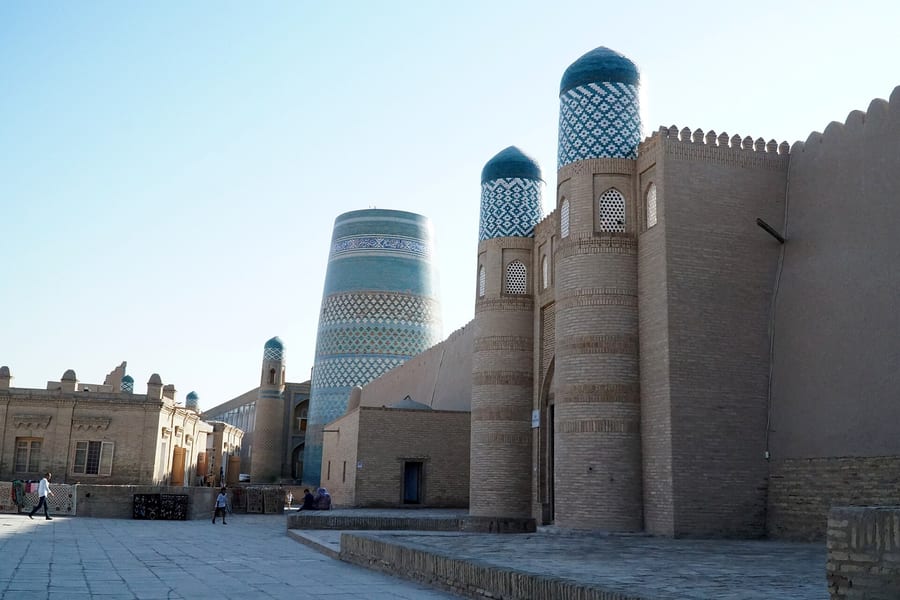
The Train to Khiva
Khiva was always the hardest Silk Road city to reach, marooned beyond the Kyzylkum desert. An overnight sleeper still rumbles out to it through the night.
View journey →Good to know
What is the best train journey in Uzbekistan?
The Afrosiyob high-speed train from Tashkent through Samarkand to Bukhara is the classic — a smooth, fast ride linking three of the Silk Road's greatest cities in a single day, at up to 250 km/h. For something more adventurous, the long haul out to Khiva crosses the Kyzylkum desert to the remotest and most perfectly preserved of the walled Silk Road towns.
How fast is the Afrosiyob train, and when did it start?
The Afrosiyob is a Spanish-built Talgo 250 capable of up to 250 km/h. It entered service on 8 October 2011 between Tashkent and Samarkand — the first high-speed train anywhere in Central Asia — and was extended to Bukhara in 2016. Tashkent to Samarkand takes a little over two hours; Tashkent to Bukhara around four.
Can you reach Khiva by train?
Yes. A direct railway and a modern station reached Khiva itself in 2018, and since May 2026 a new high-speed train, the Jaloliddin Manguberdi, runs straight from Tashkent to Khiva in about seven and a half hours, three times a week. The classic overnight sleeper — around fourteen hours, mostly to the neighbouring city of Urgench — still runs too, and remains a wonderful Silk Road experience.
Which Silk Road cities in Uzbekistan are UNESCO World Heritage Sites?
All three of the great ones. Itchan Kala, the walled inner town of Khiva, was inscribed in 1990 — the first World Heritage Site in what is now Uzbekistan — followed by the Historic Centre of Bukhara in 1993 and Samarkand – Crossroad of Cultures in 2001. The Afrosiyob and the Khiva trains connect all three.