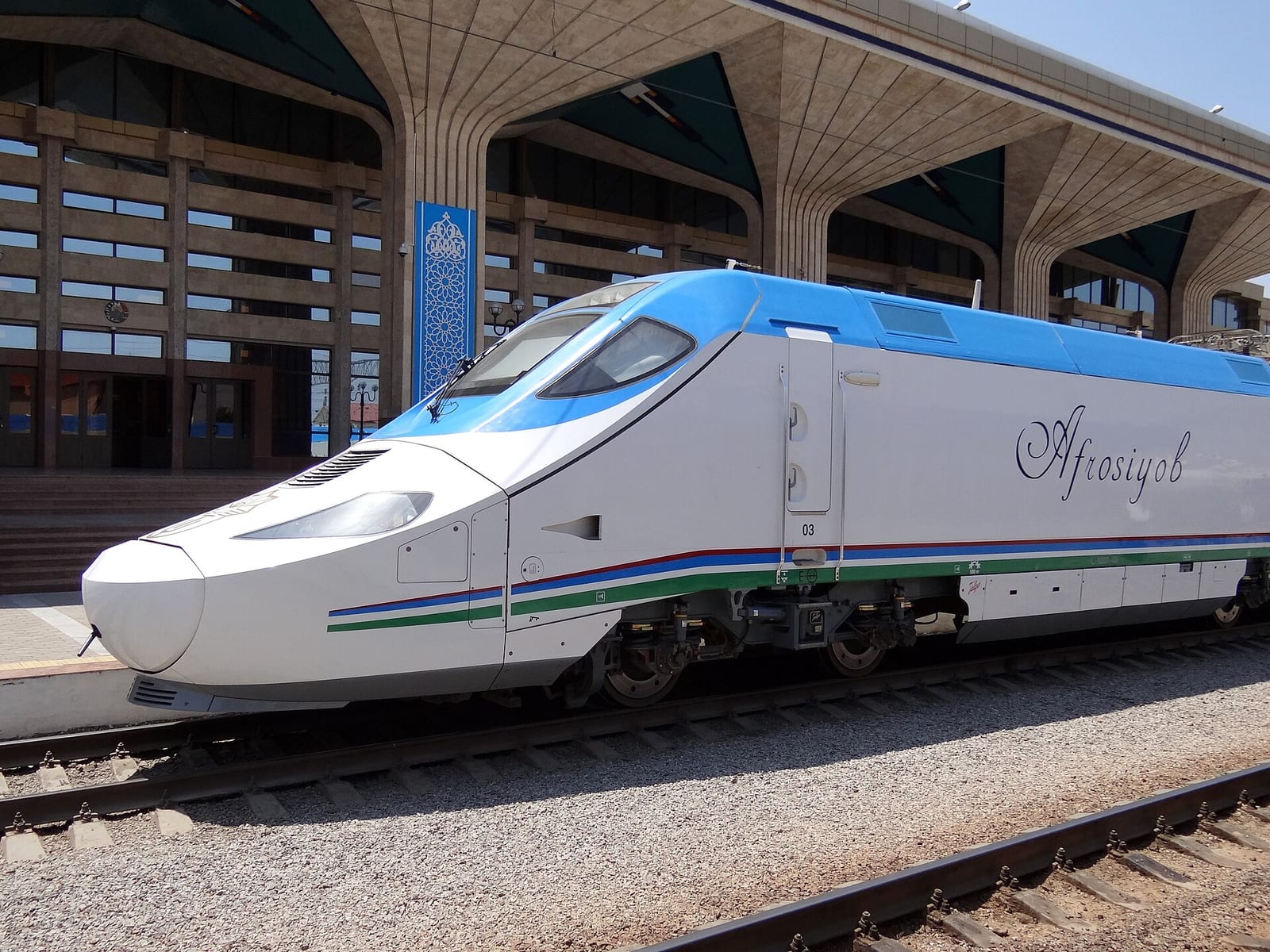
The Afrosiyob
Adam Jones / Wikimedia Commons · CC BY-SA 2.0
- DistanceTashkent–Samarkand–Bukhara · about 600 km
- DurationTashkent–Samarkand ~2 h 10 · Tashkent–Bukhara ~4 h 20
- Best seasonSpring (April–May) and autumn (September–October) for warm, clear days
Introduction
For most of history, the road between the great cities of Uzbekistan was measured in days. Caravans crossed from Tashkent to Samarkand and on to Bukhara through heat and dust, and the traveller counted the journey in nights on the ground. Today you can do the same run between breakfast and lunch, in an air-conditioned seat, at up to 250 kilometres an hour — aboard the Afrosiyob.
The Afrosiyob is a Spanish-built Talgo 250, and when it entered service in October 2011 it became the first high-speed train in all of Central Asia. There is something wonderful about the contradiction of it: a sleek European bullet train, all curved nose and tinted glass, flying across the same desert the Silk Road caravans once crawled over, past mud-brick villages, cotton fields and grazing sheep, to set you down at the foot of some of the most beautiful buildings ever raised by human hands.
It takes a little over two hours to reach Samarkand, city of Tamerlane, where the three great madrasahs of the Registan face one another across a single square. Push on and in about four hours from the capital you are in Bukhara — holiest and most haunting of the Silk Road cities, a warren of domes and minarets barely changed in centuries.
The train is named for Afrasiab, the ancient site of old Samarkand and the legendary Turanian king of Persian epic — a fitting name for a machine that has collapsed the distances of the Silk Road. This is not a heritage ride or a tourist special; it is Uzbekistan's everyday fast train, and it happens to be one of the most rewarding railway journeys on earth.
The Journey
The journey begins in Tashkent, Uzbekistan's sprawling, tree-lined capital and the largest city in Central Asia. Its main station is modern and orderly; you pass through an airport-style security check, find your reserved coach, and settle into seats that would not look out of place on a Spanish AVE — because, in effect, they are. The Talgo 250 trainsets were built by Talgo of Spain: two power cars bracketing eight low-slung passenger coaches and a bistro car, some 257 seats in all, in three classes.
Pulling out of the capital, the train quickly finds its stride. The suburbs give way to open country, and the Afrosiyob settles into a smooth, near-silent cruise across the Mirzachul steppe and the irrigated cotton lands of the Syr Darya basin. Attendants come round with tea and pastries; the desert slides past the window at a speed that makes the old caravan distances feel absurd. In two hours and ten minutes the train slows for Samarkand.
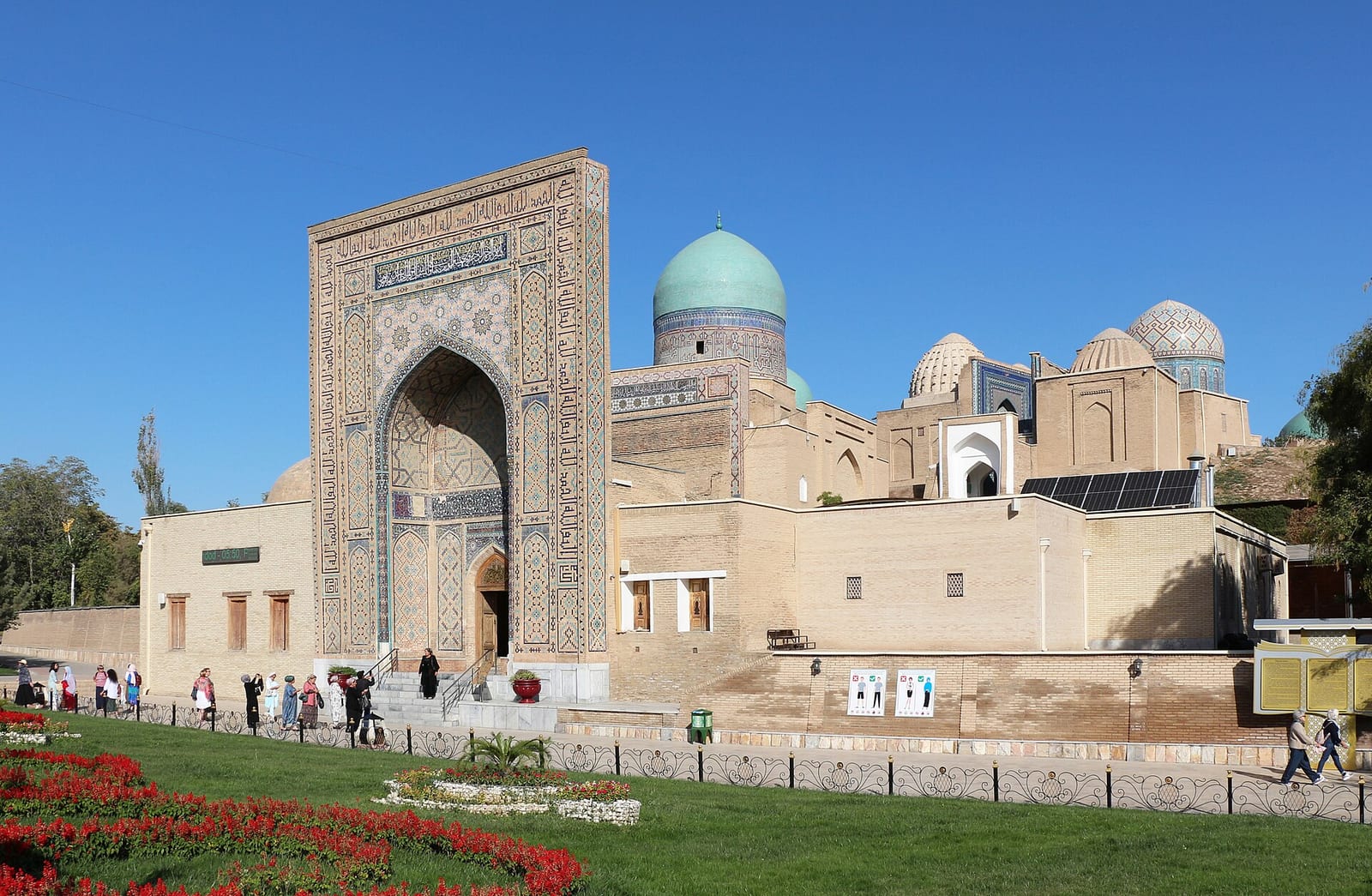
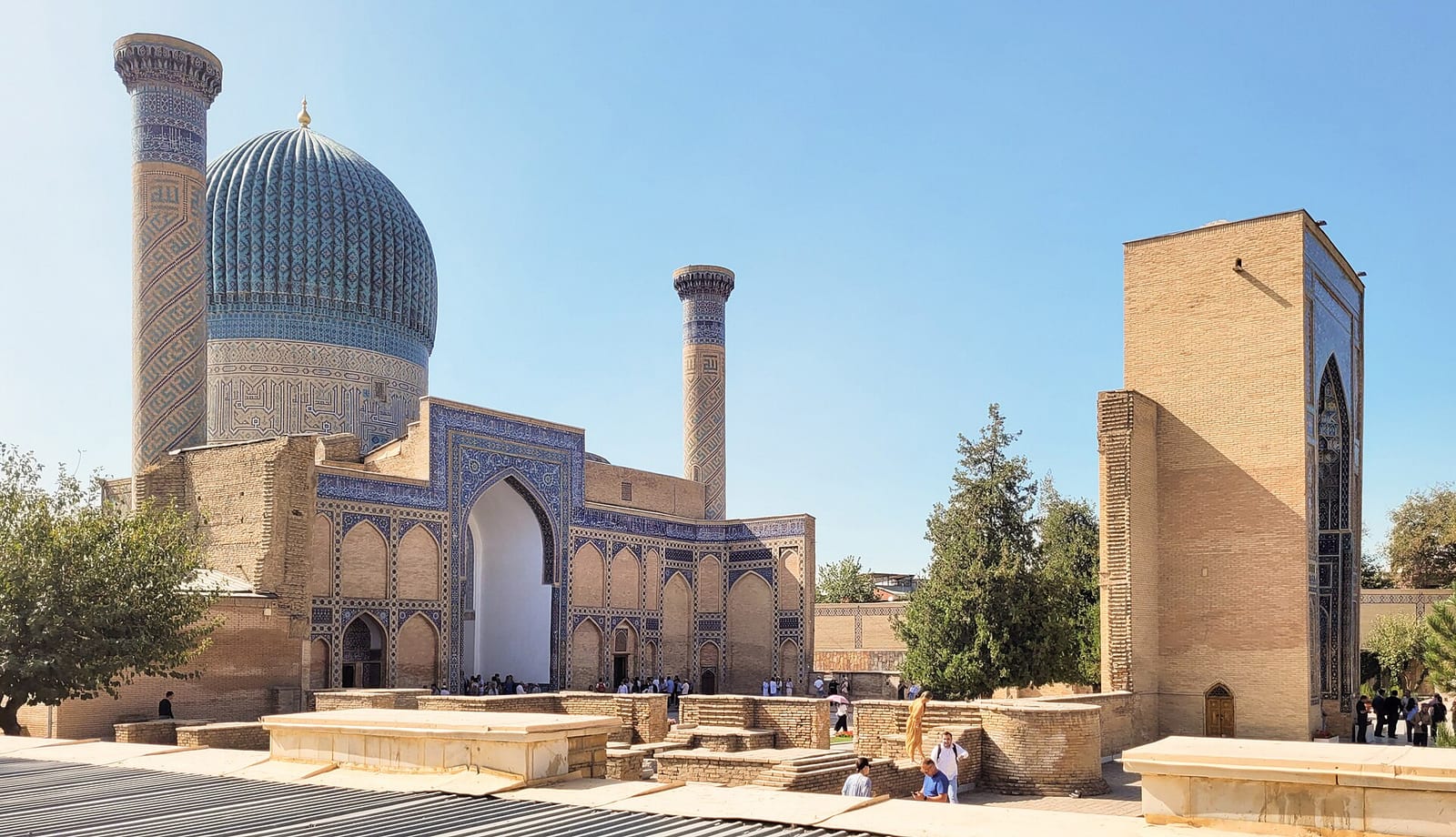
Samarkand's station sits a few kilometres from the monuments, but the payoff is close at hand: the Registan, Gur-e-Amir, Shah-i-Zinda and the great Bibi-Khanym mosque, a concentration of turquoise-tiled splendour with few equals anywhere. Many travellers break the trip here for a day or two before boarding another Afrosiyob west.
Beyond Samarkand the line runs on through Navoi and across increasingly arid country toward Bukhara — a total of about 600 kilometres from Tashkent, covered in roughly four hours. One thing to know: the Afrosiyob's Bukhara station is actually in the town of Kagan, about ten kilometres from the old city, so a short taxi ride waits at the end. Then the minarets rise from the plain, and you step down into a city that has been trading, praying and teaching on the same streets for more than a thousand years.
Along the route
Nikolai Bulykin / Wikimedia Commons · CC BY-SA 4.0Central Asia's first bullet train
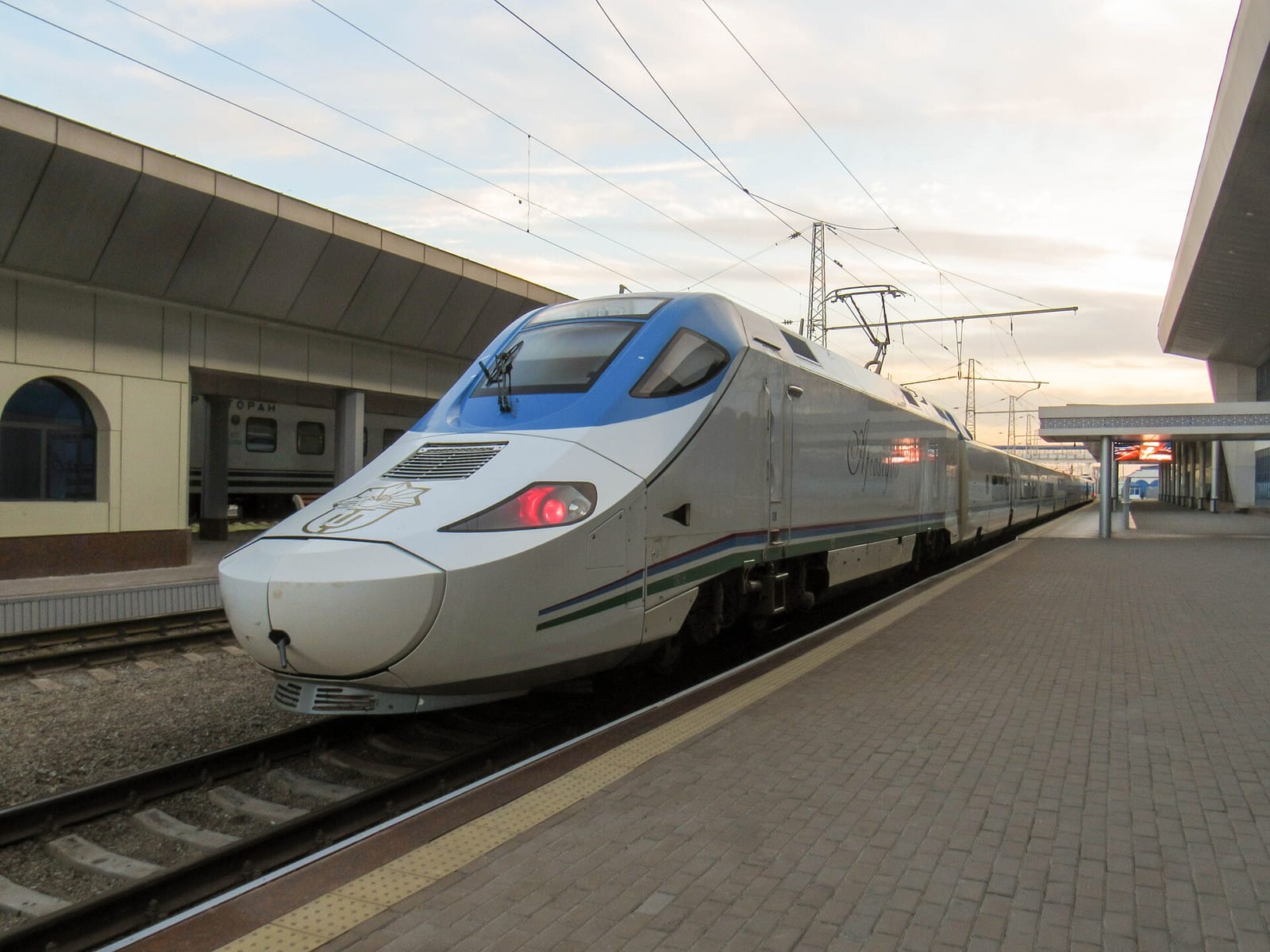
When the Afrosiyob slipped out of Tashkent on 8 October 2011 it became the first high-speed train in Central Asia. The Spanish Talgo 250 sets are built for 250 km/h, and they turned a day-long slog into a two-hour glide past mud-brick villages and cotton fields.Bobyrr / Wikimedia Commons · CC BY-SA 4.0Samarkand in time for lunch
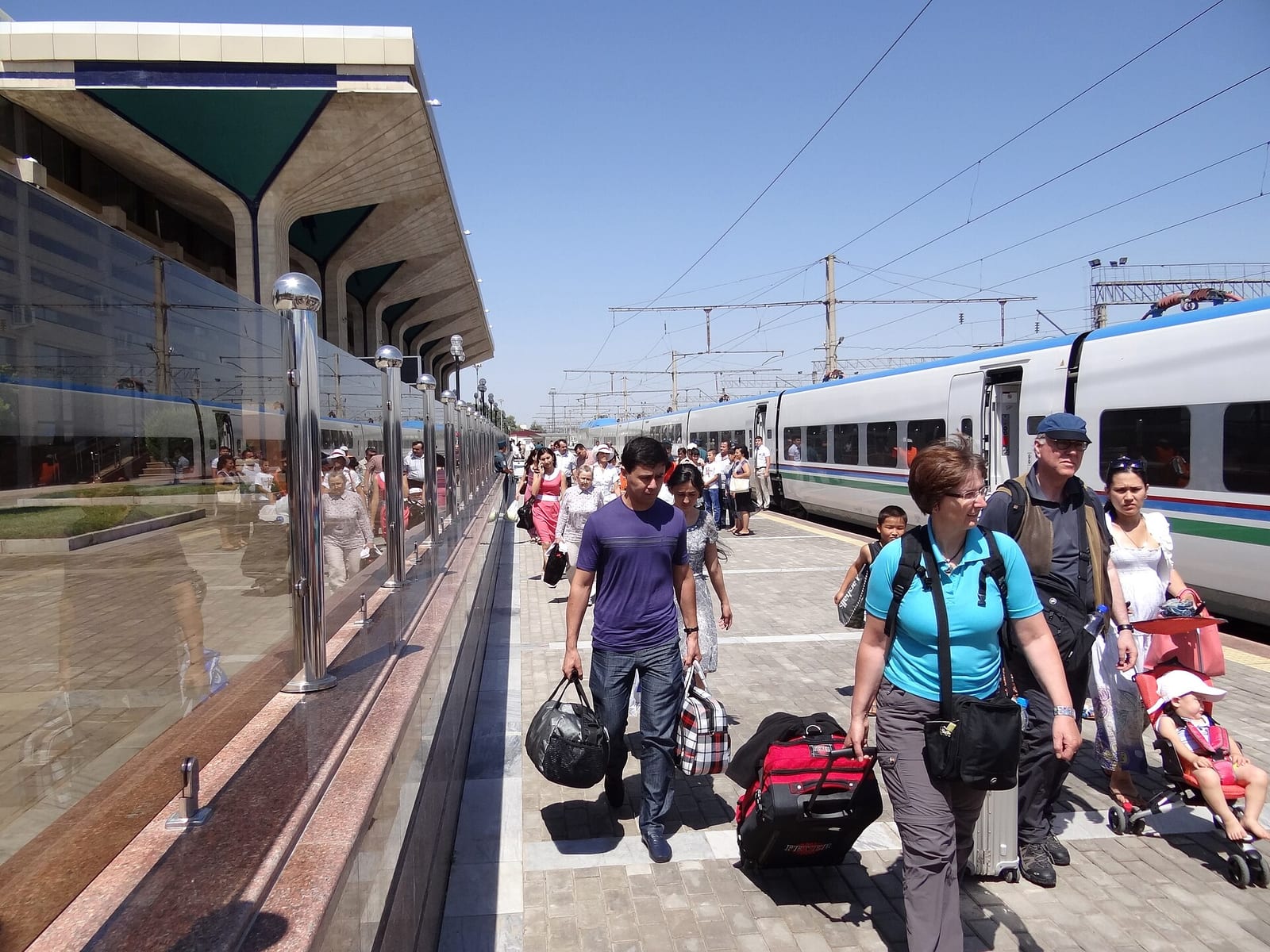
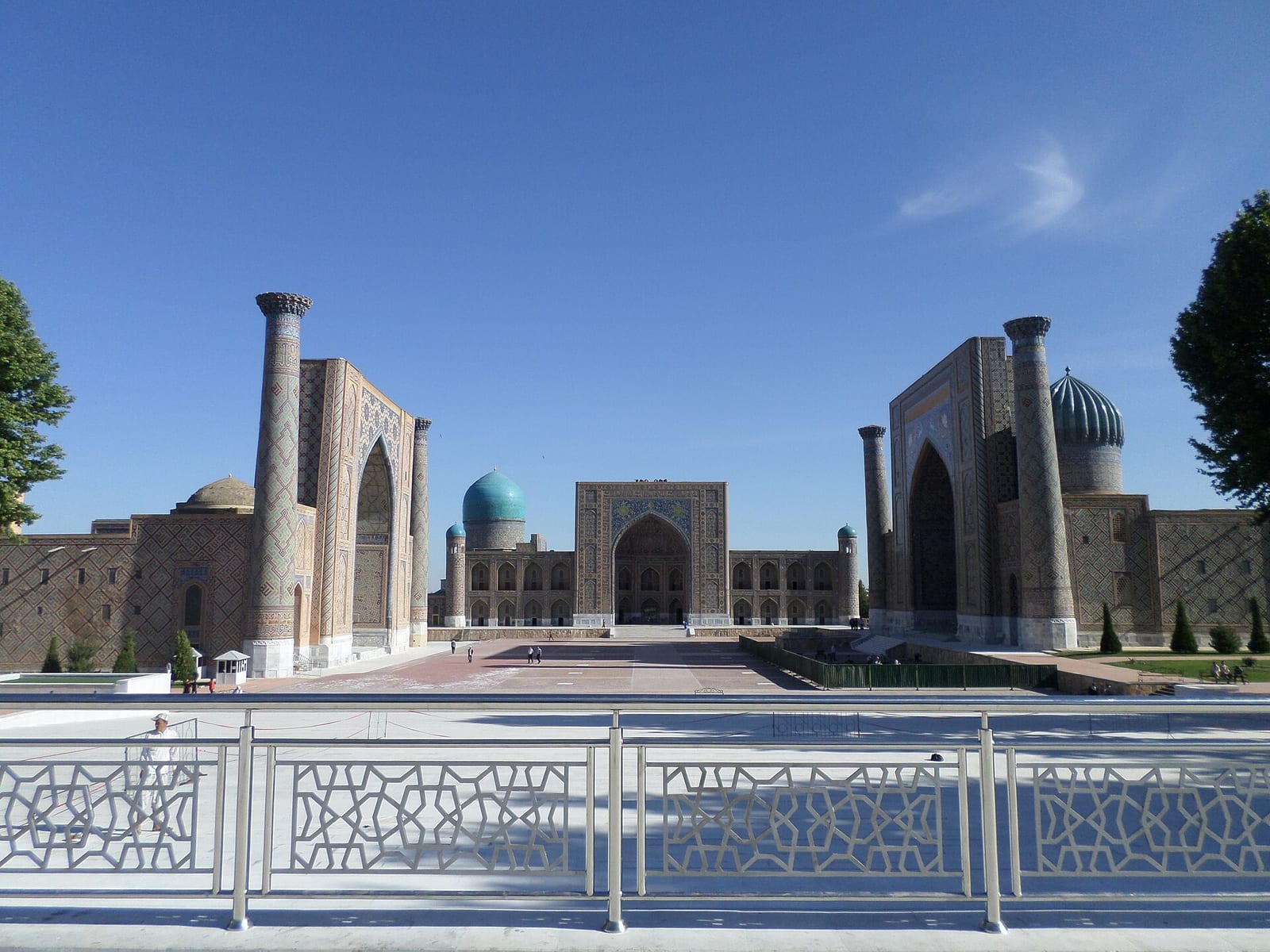
Two hours and ten minutes out of Tashkent you step off at Samarkand, a short ride from the Registan — three colossal madrasahs facing one square, perhaps the grandest ensemble in the Islamic world.Maksimsokolov / Wikimedia Commons · CC BY-SA 4.0On to Bukhara
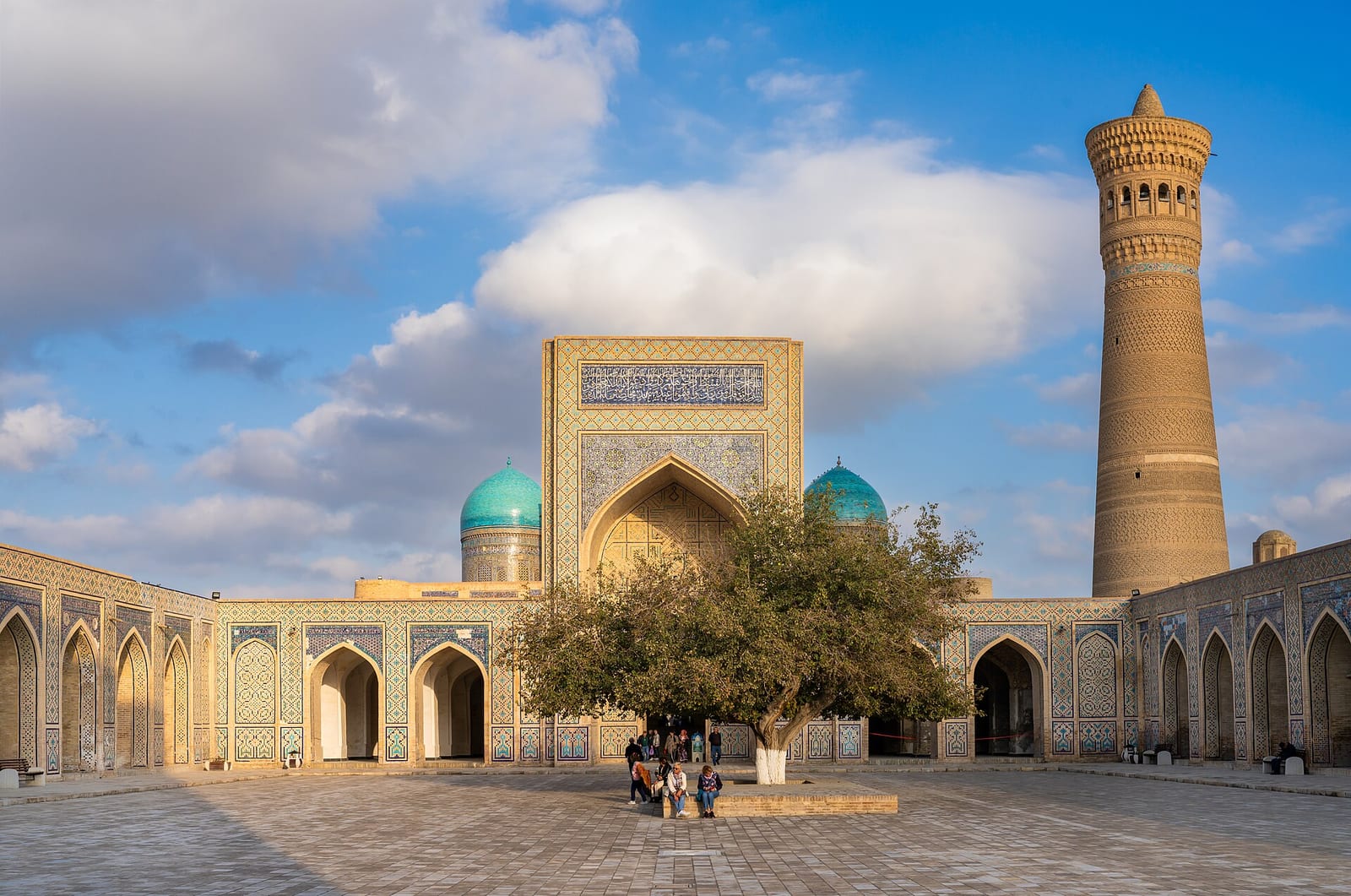
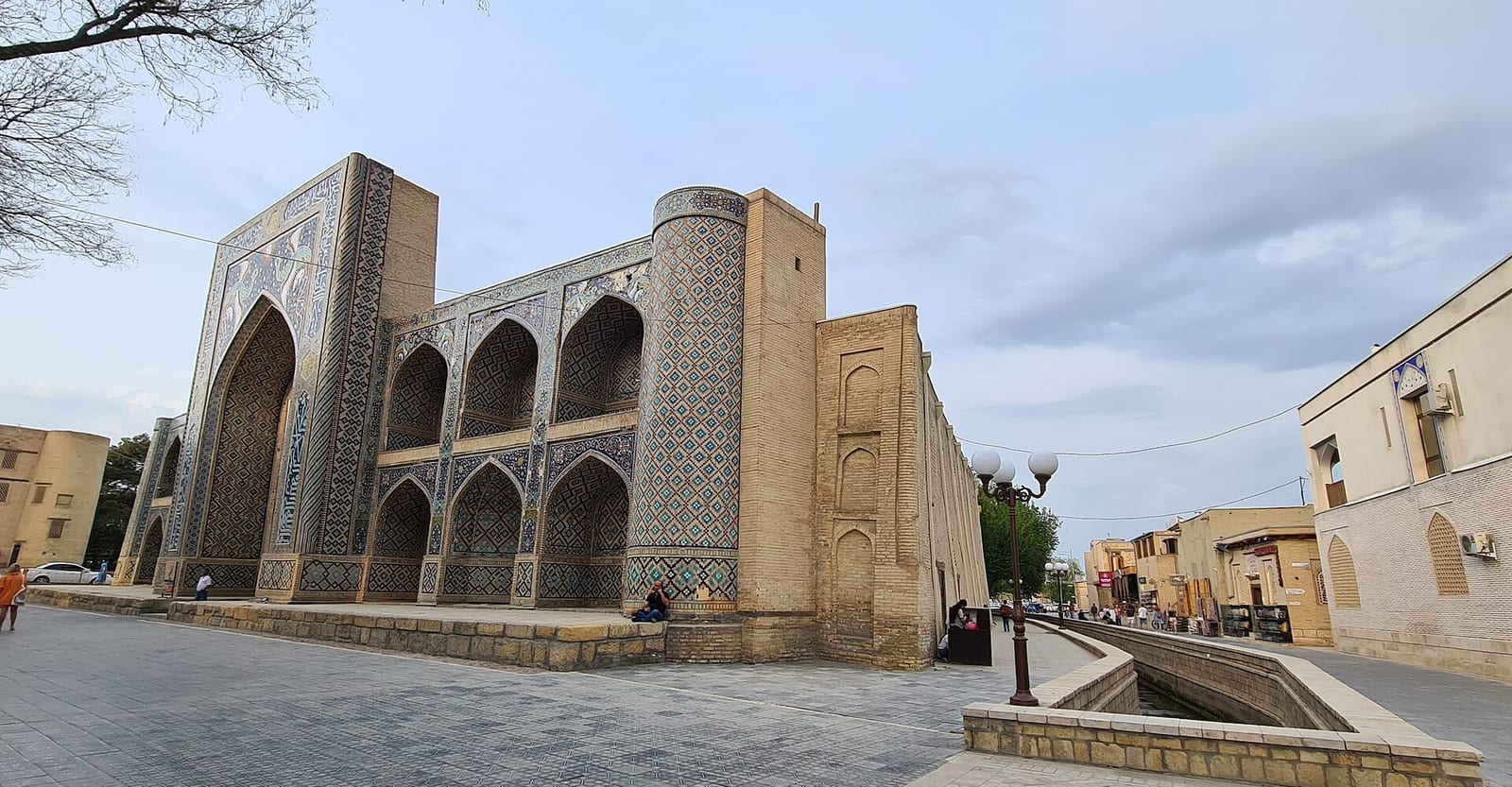
Since 2016 the Afrosiyob has run the whole 600 kilometres to Bukhara, holiest of the Silk Road cities — a labyrinth of madrasahs, covered bazaars and the twelfth-century Kalyan Minaret. Tashkent to Bukhara takes about four hours.A bit of history
Culture & experiences along the way
Adam Jones / Wikimedia Commons · CC BY-SA 2.0Ride in Business or VIP for the leather seats
The Afrosiyob carries three classes — Economy (2+2 seating), Business and VIP (both a roomier 2+1) — with power sockets, air-conditioning and tea and pastries brought round from the bistro car. Business and VIP cost only a little more and sell out fastest; on a hot Uzbek afternoon the extra space and the picture windows are well worth it.Bgag / Wikimedia Commons · CC0String the three cities together
The smart way to travel is to let the train do the work: Tashkent for a night, the morning Afrosiyob to Samarkand for a day or two, then onward to Bukhara, sleeping in the old cities and hopping between them in a couple of hours each time. It is one of the world's great rail itineraries, and almost all of it runs on this single high-speed line.BeshevI / Wikimedia Commons · CC BY-SA 4.0Mind the Bukhara station
One quirk to plan for: the Afrosiyob's Bukhara station is not in the old city at all but in the neighbouring town of Kagan, some ten kilometres to the south-east — a twenty-minute taxi from the minarets. It is a painless transfer once you expect it, but worth knowing before you arrive tired and looking for the domes.Timetables
The Afrosiyob runs several times a day in each direction, with the heaviest cluster of departures in the morning. Not every train runs the full distance to Bukhara — some turn back at Samarkand — so check the destination when you book.
A representative selection of Tashkent → Samarkand → Bukhara departures, as of the 2026 timetable (checked July 2026):
| Train | Depart Tashkent | Samarkand | Arrive Bukhara |
|---|---|---|---|
| 774 | 06:30 | 08:48 | — (Samarkand only) |
| 768 | 08:04 | 10:22 | 12:21 |
| 770 | 08:29 | 10:53 | 12:46 |
| 765 | 17:35 | 20:08 | — (Samarkand only) |
| 772 | 19:41 | 22:10 | 00:03 (+1) |
Westbound return, Bukhara → Tashkent, includes early-afternoon departures such as train 769 (Bukhara 14:58 → Tashkent 19:17) and 767 (Bukhara 16:11 → Tashkent 20:31), plus frequent Samarkand–Tashkent services through the day.
Good to know:
- Book early. Afrosiyob seats are reserved and the morning departures — especially in spring and autumn — sell out several days ahead. Reserve as soon as your dates are fixed.
- Three classes. Economy seats are arranged 2+2; Business and VIP are a roomier 2+1 with more legroom. All have air-conditioning and power sockets, and tea and pastries are served.
- Journey times. Tashkent–Samarkand is about 2 h 10–2 h 30; Tashkent–Bukhara about 4 h 20. The headline "250 km/h" is the line's design speed — day to day the train cruises a little below it, but it is still comfortably the fastest way across the country.
- The Bukhara station is in Kagan. Allow for a 20-minute taxi from the station into Bukhara's old town.
- A cheaper alternative. If the Afrosiyob is full, the older, slower Sharq trains cover the same route for roughly half the fare.
Times as of the 2026 timetable and subject to change. Always confirm current departures with the operator before you travel (see the Tickets section below).
Tickets
Tickets for the Afrosiyob are sold by Uzbekistan Railways (Oʻzbekiston Temir Yoʻllari) through its official online booking site and at every city railway station. Booking online in advance is much the easiest way — the morning trains fill up quickly, and turning up on the day often means no seats at all in peak season.
You will choose between three classes — Economy, Business and VIP — all of them comfortable, with the higher classes offering wider 2+1 seating and a little more space. Fares are modest by international standards, and even VIP is affordable; the price difference between classes is small enough that many travellers simply take the best seat available.
Buy a reserved seat for the specific train you want; there is no turn-up-and-go on the Afrosiyob. Have your passport to hand, as it is required both to book and to board. If the high-speed train is sold out, the same operator runs the slower Sharq trains on the same route at a lower fare — a good fallback for a flexible traveller.
Book your tickets
Tashkent – Samarkand – Bukhara
The Afrosiyob high-speed train
Book the Afrosiyob online through Uzbekistan Railways, or at any city station. Choose Economy, Business or VIP; seats are reserved and the popular morning departures sell out days ahead, so book early. Tashkent–Samarkand takes a little over two hours, Tashkent–Bukhara about four.
Book Tickets (opens in a new tab, on Uzbekistan Railways)via Uzbekistan RailwaysTimetable & seat classes
Plan your Silk Road day
Check current Afrosiyob departure times, seat availability and the Economy / Business / VIP fares on the Uzbekistan Railways booking site. The same site covers the slower, cheaper Sharq trains on the same route if the high-speed seats are sold out.
Book Tickets (opens in a new tab, on Uzbekistan Railways)via Uzbekistan RailwaysRail Passes
No rail pass covers the Afrosiyob. Interrail and Eurail are European schemes, and Uzbekistan is not among the 33 countries in Interrail's list of covered railway companies. Uzbekistan Railways sells each journey as a reserved ticket, online or at the station.
Checked October 2026 against Interrail's list of railway companies (opens in a new tab).
Places to Visit
The whole point of the Afrosiyob is the string of cities it connects, and each one deserves days rather than hours. What follows is what to do once you have seen the obvious things — and the obvious things really are worth the trip.
The unmissable ones
In Samarkand, the Registan — three madrasahs facing a single square, their façades a blaze of blue tilework — is one of the most photographed sights on the planet, and much better at dusk when the crowds thin. Nearby stand the ribbed dome of the Gur-e-Amir, Tamerlane's tomb, and the extraordinary Shah-i-Zinda, an avenue of tiled mausoleums climbing a hillside like a corridor of jewels. Above the modern city rises Afrasiab, the tell of Samarkand's earliest incarnation, whose museum holds the seventh-century Sogdian wall paintings found here in 1965 — the "Hall of the Ambassadors" cycle, showing envoys arriving at the Sogdian court.
In Bukhara, which is quieter and more intimate — a living old city rather than a set of monuments — wander the covered bazaars and the Lyab-i-Hauz, a shaded pool ringed by mulberry trees and teahouses, and climb the Kalyan Minaret in the Po-i-Kalyan. Give the city two nights and let yourself get lost.
Tashkent
Worth a night at either end. The capital has leafy boulevards and a famously ornate Soviet-era metro — built from 1977 to double as a nuclear shelter, which is why photography in it was forbidden until the ban was lifted in July 2018; you may now shoot the stations freely, and they are worth a fare each. Chorsu Bazaar sits under a blue dome 80 metres across, designed in 1980 by Vladimir Azimov and Sabir Adylov: vast, working, and not in the least a tourist attraction. The old Hazrati Imam quarter is below.
Beyond the Afrosiyob's reach, the walled desert city of Khiva completes the Silk Road quartet — reached on our companion journey, the train west across the Kyzylkum.
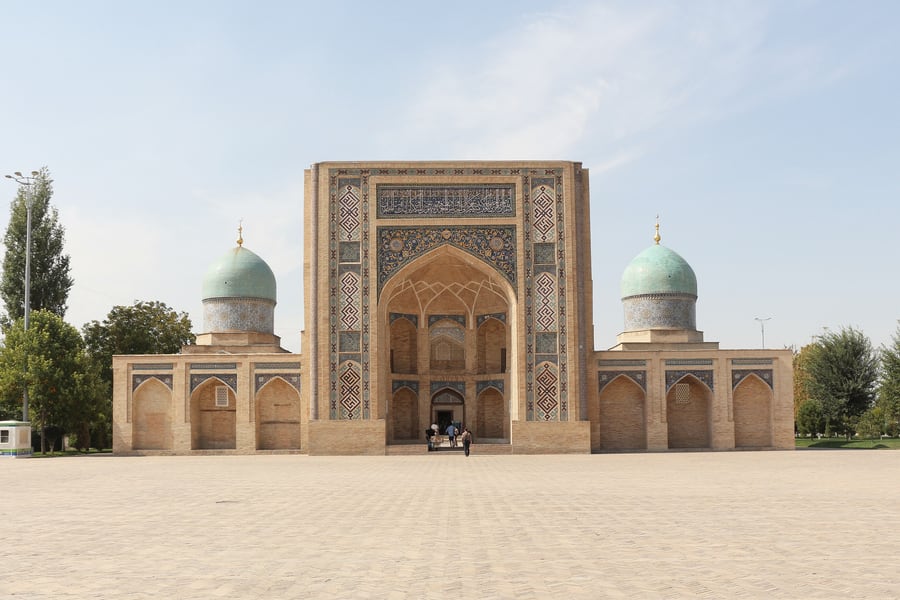 Bernard Gagnon / Wikimedia Commons · CC0 · cropped
Barak-Khan Madrasa, Tashkent
The oldest thing standing in the Hazrati Imam quarter: a madrasa of 1531–32, raised for Navroʻz Ahmadxon — nicknamed Baraqxon — by the architect Gʻulom Husayn, with thirty-four student cells and two mausoleums inside it. The great twin-minaret mosque across the square is no contemporary of it but a building of 2007. Note too that the quarter's most famous possession, the Uthman Qur'an, left in November 2025 for the new Center for Islamic Civilization next door.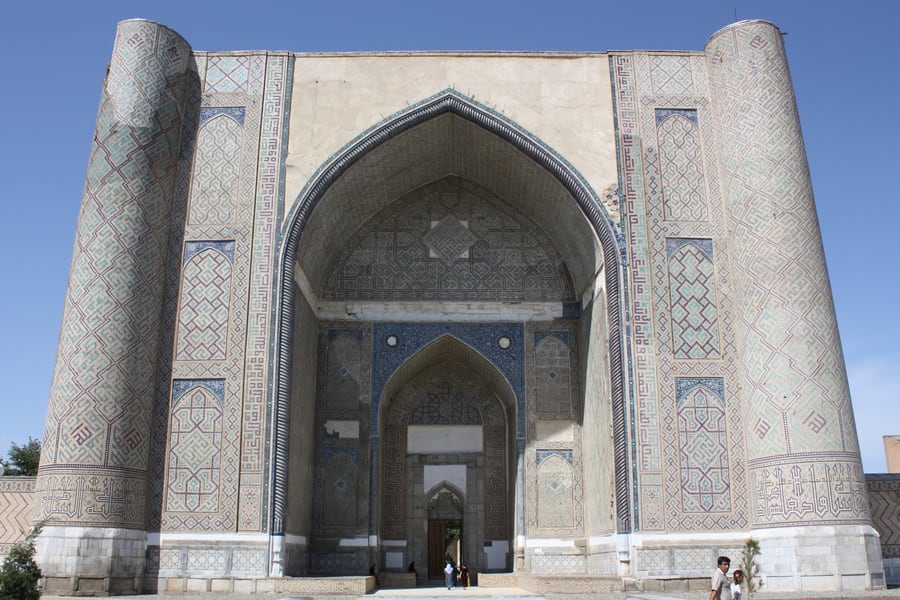 Arian Zwegers / Wikimedia Commons · CC BY 2.0 · cropped
The Bibi-Khanym Mosque, Samarkand
Timur came home from the 1399 Indian campaign and ordered the largest mosque in the Islamic world; his wife Saray Mulk Khanum commissioned it and it took her title. Finished by 1405: a portal 35 m high, an outer dome of 40 m, walls 167 by 109 m, four hundred marble columns. Bricks were dropping out of the dome within a few years — the technique of the day could not carry it — and the portal's inner arch fell in the 1897 earthquake. Rebuilding began in 1974.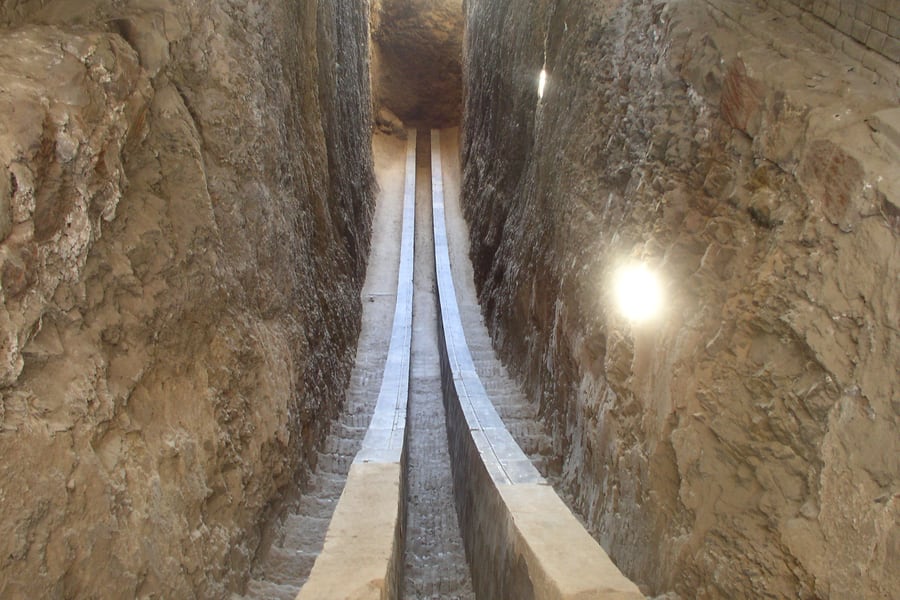 Alaexis / Wikimedia Commons · CC BY-SA 2.5 · cropped
Ulugh Beg's observatory, Samarkand
Almost nothing survives above ground, and that is the point — the instrument was so large that half of it had to be sunk into the hill. The Fakhri sextant, finished about 1428, had a radius of 40 m, and what you walk down into is its marble arc in a two-metre trench. From it Ulugh Beg catalogued a thousand stars and put the year at 365 days, 5 hours, 49 minutes, 15 seconds — 25 seconds out. His son had him killed in 1449; the observatory was lost until 1908.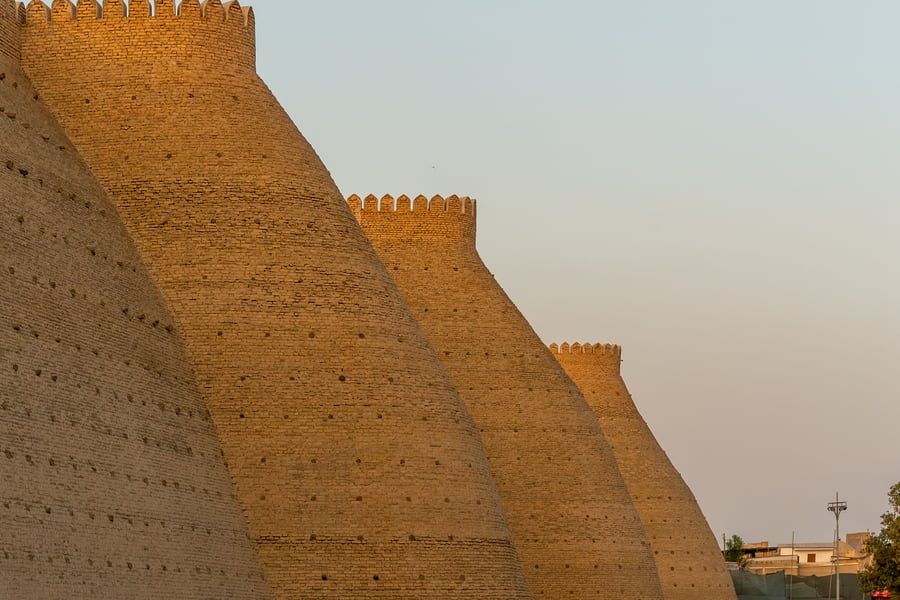 Nikolai Bulykin / Wikimedia Commons · CC BY-SA 4.0 · cropped
The Ark, Bukhara
Occupied since about the fifth century and rebuilt into what you see from the sixteenth: a mud-brick mound 16 to 20 m high, its wall running 790 m round nearly four hectares. Inside were the throne room, the coronation court, the mint and the gaol — an entire emirate in one enclosure. Much of it went in 1920, bombed by Red Army troops under Mikhail Frunze in the Battle of Bukhara, which is why so much of the interior is now open ground. What is left holds the museums.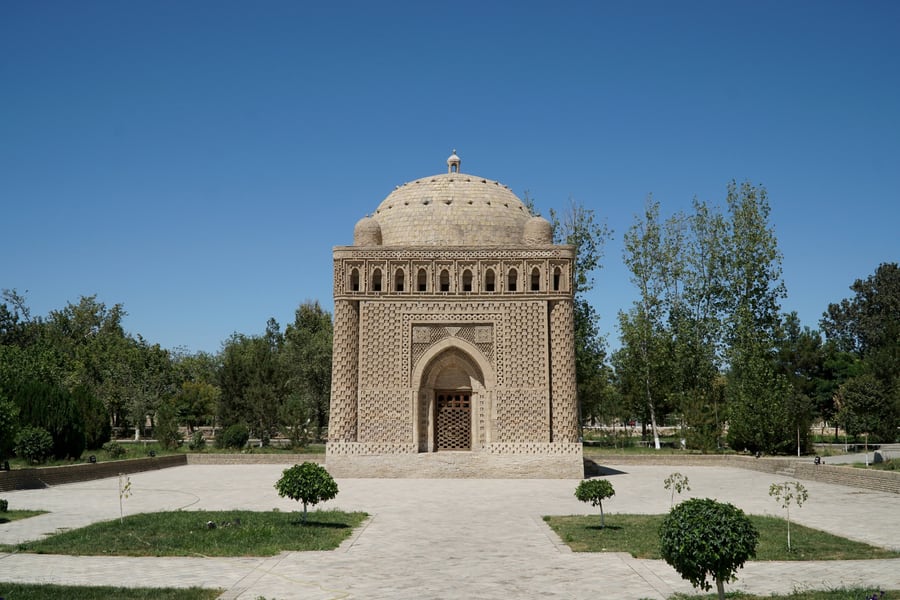 Adam Harangozó / Wikimedia Commons · CC BY-SA 4.0 · cropped
The Samanid Mausoleum, Bukhara
A brick cube 9.4 m a side, walls 1.8 m thick, dome 7 m across, built in the tenth century for the Samanid house — the sources argue between Ismail Samani (892–907) and his grandson Nasr II. The point of it is the brickwork: basketweave, checkerboard, dog-tooth and rosette, all cut from baked brick in a region that built in mud and plaster. It survived Genghis Khan in 1220 because it was already buried in silt, and was dug out again only in 1926–28.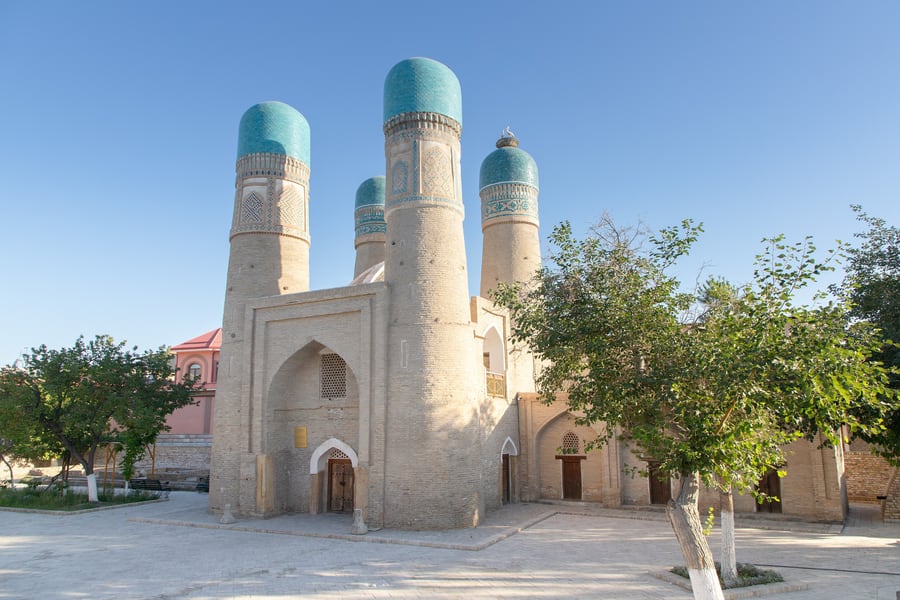 Pkkj / Wikimedia Commons · CC BY-SA 4.0 · cropped
Chor Minor, Bukhara
Down a lane east of the Lyab-i-Hauz and easy to walk past: four blue-domed towers over a small gatehouse, built in 1807 by Khalif Niyaz-kul, a wealthy Bukharan of Turkmen descent. The name is Persian for "four minarets" and it is wrong — not one of them is a minaret. Three were storerooms and the fourth holds the stair. Look closely at the decoration: the four do not match, and the motifs have been read as Christian, Buddhist and Zoroastrian as well as Islamic.Where to Sleep
Because the Afrosiyob makes hopping between the cities so easy, the natural plan is to sleep in the old cities themselves and let the train carry you between them.
In Samarkand, stay in the streets around the Registan and Gur-e-Amir, where a wave of small boutique hotels and family-run guesthouses has opened in restored courtyard houses — often with a rooftop or garden and views of a floodlit dome. It is the loveliest base in the country, and you are minutes on foot from the great monuments.
Bukhara is even more atmospheric for an overnight: many of its guesthouses occupy converted madrasahs and merchants' houses around the Lyab-i-Hauz, with tiled courtyards and breakfast served beside the pool. Waking inside the old city, with the call to prayer drifting over the rooftops, is one of the quiet pleasures of a Bukhara stay.
In Tashkent, handy for a night before or after your rail days, you will find the full range — international business hotels, mid-range chains and hostels — much of it within easy reach of the railway station and the metro.
Prices across Uzbekistan are gentle, service is warm, and rooms are generally easy to find outside the very peak of spring and autumn. Booking a night or two ahead in Samarkand and Bukhara is wise in high season, when the best courtyard guesthouses fill up.
Questions or corrections
Planning this trip and stuck on something, or spotted a time, fare or detail that has changed? Send us a message about The Afrosiyob. We read every one, and we update this page when something has changed.